



Abstract
In the field of engineering economy, engineering investment selection is a common problem, where the preference information is usually intuitionistic and fuzzy. To deal with the consistency and integrity of the information in the selection process, the aim of this article is to extend the superiority and inferiority ranking method and use the interval-valued intuitionistic fuzzy theory, where the individual evaluation values and the weights information of criteria and decision-makers are all described by interval-valued intuitionistic fuzzy numbers. First, some concepts of interval-valued intuitionistic fuzzy set are introduced. Then, the interval-valued intuitionistic fuzzy superiority and inferiority ranking (IVIF-SIR) method is developed. Moreover, an engineering investment selection model based on IVIF-SIR method is investigated. Finally, an illustration of choosing investment alternatives is used to prove the developed approach and a comparative study is also use to demonstrate the effectiveness.
Introduction
In practice, most engineering economy problems are decision making problems. For example, how to select an optimal alternative for an engineering investment among two or more alternatives on the two or more criteria [1, 2]. Multiple criteria group decision making (MCGDM) is a set of methods to help the decision makers (DMs) select suitable alternatives or get their ranking according to several criteria. Many researchers focus on the decision making applications to the engineering economy problems. For instance, Chung [3] investigated a social-economic-engineering combined framework for decision making in water resources planning. The systematic screening process would provide DMs with the flexibility to obtain the consensus of stakeholders in water resources planning. Ciuiu [4] solved the multiple criteria decision making problems in simultaneous equation models and considered an economic application of the GDP/capita and long-term unemployment rate in terms of computer skills. Pandit and Srivastava [5] extended the differential simplified operators to environmental economic dispatch. Nguyen, et al., [6] introduced an approach to handle the fuzzy problem in the engineering economics field.
From the above, we find that decision making theory is frequently utilized to solve the engineering investment selection problem in the field of engineering economy. To apply these decision-making approaches, there are two essential parts: (1) The evaluating information of alternatives given by different DMs with respect to various criteria. (2) The weight information of DMs and the criteria. Because of the fuzziness and uncertainty existing in practice, the preferences information are usually presented by the fuzzy set, which has been verified its usefulness for dealing with the engineering investment selection problems [7–14]. The fuzzy set theory has been applied to solve the engineering investment selection problem in engineering economy [15–18]. In those actual situations, engineering economists (or DMs) can express their preferences among the alternatives by fuzzy sets given in the form of intervals for criteria values [19]. As a generalization of fuzzy sets, intuitionistic fuzzy sets aim at dealing with additional uncertainty in the rule bases. Based on the intuitionistic fuzzy set, the interval-valued intuitionistic fuzzy theory has been a hot research topic, which has received many excellent results and has been verified its usefulness in dealing with uncertainty and hesitation [20–28].
Many researchers have investigated the interval-valued intuitionistic fuzzy (IVIF) theory [29–34], such as the correlation coefficient of IVIF numbers, the topology of IVIF sets, the entropy of IVIF numbers, etc. And some other related researchers presented some methods for multiple criteria decision making based on IVIF environment [35–41], such as the IVIF-TOPSIS method, the IVIF operators, the IVIF-VIKOR method, and the IVIF-LP method. But those methods are not suited to deal with decision making problems based on all the IVIF information. To overcome this drawback, an extended SIR method is proposed, which is useful to solve selection problems.
To ensure the consistency and integrity of the information in the selection process, an engineering investment selection problem is investigated in this paper, where all the information, including the criterion weights, DM weights and the evaluation values, are all characterized by IVIF numbers. In order to deal with the problem, an extended SIR method is introduced, which can be more appropriate to completely deal with the consistent evaluating information. The SIR method uses the superiority information and the inferiority information, and then derives the Superiority flows (S-flows) and the Inferiority flows (I-flows) from the Superiority matrix (S-matrix) and the Inferiority matrix (I-matrix). The method is a generalization for the notations of superiority and inferiority scores defined by Rebai [42, 43] and is wide used in application fields such as engineering management, spatial data processing, supplier selection, and others [44–49]. Xu [49] proposed a superiority and inferiority ranking (SIR) approach based on the simple additive weighting, which is famous and most widely used aggregation process because of its simplicity attraction. Then, Chai, et al. [50] proposed a new intuitionistic fuzzy SIR approach to solve multi-criterion decision making problem, in which intuitionistic fuzzy aggregation operators and SIR ranking methods are used to solve uncertain information, and integrate individual opinions into group opinions and make decisions on multi-criterion and constitute a specific decision map. And Chai, et al., [45] proposed a novel intuitionistic fuzzy SIR (IF-SIR for short) method to select supplier, in which the IF-SIR flows are calculated by using intuitionistic fuzzy aggregation operators. Qin [51] extended the classical superiority and inferiority ranking (SIR) group decision model to Pythagorean fuzzy environment.
In this paper, our motivation is to focus on managing the intuitionistic and fuzzy information of engineering investment selection, and the main contribution of this paper is to propose an extensional approach to engineering investment selection problem, in which interval-valued intuitionistic fuzzy (IVIF) is used to describe all evaluation information and extended SIR method is used to integrate individual opinions into group opinions and make decisions on multi-criterion and constitute a specific decision map. In a word, to the motivation and inspiration of the above discussion, an extended SIR method is proposed to solve the engineering investment selection problem under IVIF information.
The paper is structured as following: Some basic concepts of IVIF set are first introduced. Then, IVIF-SIR method for group aggregation and decision analysis is presented. Finally, an engineering economy investment problem is used to illustrate the method and comparisons are made with other methods.
Interval-valued intuitionistic fuzzy set
To describe the information in the engineering investment selection problems, some basic concepts of IVIF set are presented.
Where
The function
Where, the Superiority ranking: x i P>x k , if φ> (x i ) > φ> (x k ); and x i I>x k , if φ> (x i ) = φ> (x k ). The Inferiority ranking: x i P<x k , if φ< (x i ) < φ< (x k ); and x i I<x k , if φ< (x i ) = φ< (x k ). φ> (x i ) is the superiority flow and φ< (x i ) is the inferiority flow [49, 45].
Suppose an investment selection problem, in which the weight information of the criterions and DMs and the preference information all take the form of IVIFNs. Let
The IVIF-SIR method is shown in the Fig. 1 and consists of the following steps:
Procedure of the IVIF-SIR methodology.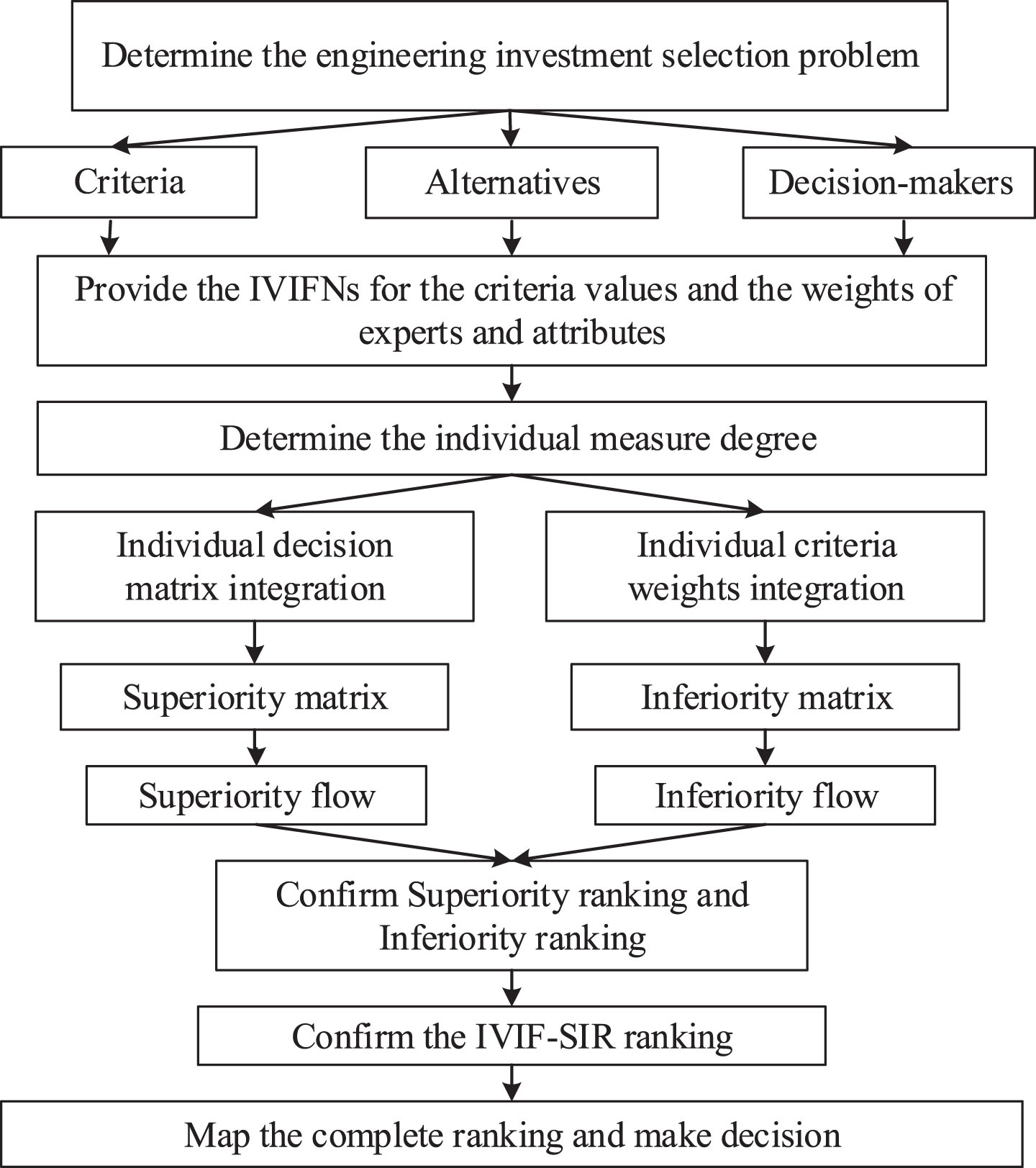
Where w k = ([a k , b k ] , [c k , d k ]) is an IVIFN, w+ = ([a+, b+] , [c+, d+]) = ([1, 1] , [0, 0]), w- = ([a-, b-] , [c-, d-]) = ([0, 0] , [1, 1]). And 0 ≤ ξ k ≤ 1, if ξ k → 1, then w k → w+ = ([1, 1] , [0, 0]).
a) Get the individual decision matrix integration:
b) Obtain the individual criteria weights integration:
Where 0 ≤ f (x
i
) ≤ 1, and if f (x
i
) → 1, then
a) Get the preference intensity:
The φ k (d) is a non-decreasing function from the real number to [0, 1]. Generally, φ k (d) can be chosen from six generalized threshold functions or defined by the DMs [53].
b) Obtain the S-matrix
S-flow:
I-flow:
It is clear that if the higher S-flow φ> (x i ) and the lower I-flow φ> (x i ), alternative x i is the better.
a) Obtain the Superiority ranking and the Inferiority ranking of the alternatives.
b) Confirm the complex ranking and Get a partial ranking structure R* ={ P, I, R } by applying the intersection principles in definition 4.
The evaluation information is given by DM 1
The evaluation information is given by DM 1
The evaluation information is given by DM 2
The evaluation information is given by DM 3
The weight information of DMs
Criteria weight information
For obtaining the optimal alternative, the approach is used to solve the problem.
Where the threshold criterion function set
S-flow and I-flow of candidates
S-flow and I-flow of candidates
and
Then, the superiority ranking and the inferiority ranking can be obtained:
and
The most desirable candidate is x2. In particular, there is a slight difference between x2 (0.433/0.351) and x5 (0.431/0.353), which have the same membership degree range and slightly different non-membership degree range. Hence, x5 is also a desirable alternative. From the results, this method can produce an optimal alternative, and also provide useful information for DMs to choose alternatives. In the process of decision, the IVIF-SIR method discusses the superiority and the inferiority information. And the method also considers the similarity intensity among the criteria and the preference intensity among the candidates.
In this section, a comparative study is conducted with other methods. The analyses are based on the same illustrative example and the comparative results are presented in the Table 7.
Comparison of different methods
Comparison of different methods
In the TOPSIS method and the aggregation operators, the IVIF numbers are transformed into equivalent interval numbers [60]. After that, the TOPSIS method is used to obtain the ranking: {x5} → { x2 } → { x1 } → { x4 } → { x3 }. And the ranking can be obtained by the aggregation operators: {x2} → { x5 } → { x4 } → { x1 } → { x3 }. In the above example, the rankings of the criteria obtained by three methods are slightly different. For example, the candidate x2 and x5 are ranked first and second by the Aggregation Operators, respectively, and the candidate x2 and x5 are ranked second and first by the TOPSIS method. The results of the TPOSIS method are similar to the results of the SIR method (only x2 and x5 switch positions). But x2 or x5 is still the desirable candidate with the three methods.
From the above analysis, the main advantages over the aggregation operators are because of the fact that our method accommodates the complete and consistent IVIF environment, and also because of the consideration of the loss of information among the candidates and the DMs. The IVIF-SIR method uses new types of information extracted from the original decision matrix rather than directly using the decision matrix like many classic methods. The S-matrix and I-matrix contain new information which reflect the DM’s attitude towards each criterion and describe the intensities of superiority and inferiority of each candidate.
The SIR is one of the classical decision-making methods with the consistency and integrity of the evaluation information, which has a simple computation process, systematic procedure, and a sound logic. This study extends the traditional SIR method to solve the economic investment selection problem, in which all evaluations information is expressed as IVIFNs and the consistent and uniform information are obtained. Considering the fuzzy degrees of membership and non-membership and the intensity of superiority and inferiority in the process of selection, the contribution is applying the existing SIR approach and IVIF theory in the field of engineering economy. In future work, we will consider how to solve more decision making problems in engineering areas by the proposed method under different fuzzy environment, such as, Neutrosophic Set or Pythagorean fuzzy set.
Footnotes
Acknowledgments
This work was supported in part by the Humanities and Social Sciences Research General Project of Chongqing Education Commission under Grant 18SKGH045, the Scientific and Technological Research Program of Chongqing Municipal Education Commission under Grant KJQN201800832, the Humanity and Social Science Youth foundation of Ministry of Education of China under Grant 19YJC630141, and the Doctoral Project of Chongqing Federation of Social Science Circles under Grant 2018BS71, 2018BS84.