



Abstract
Operations for linguistic neutrosophic numbers (LNNs) have been receiving considerable attention. Existing LNNs operations are generally based upon Archimedean triangular norm and triangular conorm. However, the existing operations fail to consider the correlation among variables. Archimedean copulas and co-copulas can not only reveal the correlation among variables but also prevent information loss when they are used as aggregation functions in the aggregation process. Here, LNN operations are redefined based on Archimedean copulas and co-copulas. Meanwhile, some specific cases are discussed. Then, a linguistic neutrosophic improved generalized weighted Choquet Heronian mean operator is developed. According to the proposed operator, a multi-criteria decision-making method is proposed to tackle the selection problem of low-carbon suppliers. The influences of different generated functions and parameters are discussed, and the feasibility of the proposed method are validated through comparative analyses.
Keywords
Introduction
Considering the complexity of an object, the limited cognitive ability of humans, and time pressure, crisp numbers fail to accurately express the evaluation information in multi-criteria decision-making (MCDM) problems. From this perspective, in 1965, Zadeh [1] initially introduced the fuzzy set (FS) that is described by a membership degree. Subsequently, on the basis of the concept of FS, researches introduced various extensions, such as intuitionistic fuzzy set (IFS) [2], Pythagorean fuzzy set [3], and neutrosophic set [4], to describe different type fuzzy information. To describe increasingly complex information, the FSs above have been extended to the following: trapezoidal intuitionistic fuzzy set [5], interval-valued Pythagorean fuzzy set [6], Pythagorean hesitant fuzzy set [7], interval neutrosophic set [8], single-valued trapezoidal neutrosophic information [9], etc. According to the basic concepts mentioned above, many studies investigated many theories to address MCDM problems, such as new operators [10], measurements [11, 12], preference relationships [13], etc. Various approaches have been studied under the fuzzy environments above, such as Technique for Order Preference by Similarity to an Ideal Solution (TOPSIS) method [14], QUALIFLEX [15], and so forth.
Considering the habits of a person’s expression and the complexities of an object, humans prefer using linguistic terms to express evaluation information when they evaluate an object. For example, when an expert is asked to evaluate the performance of a teacher, the expert prefers giving linguistic terms, such as “good,” “medium,” or “poor,” instead of giving the FSs or crisp numbers mentioned above. Hence, Zadeh [16] introduced a new concept named linguistic variables. Many linguistic fuzzy set extensions, such as linguistic intuitionistic fuzzy set (LIFS) [17], linguistic hesitant fuzzy set [18], and probabilistic linguistic term set [19], etc., have been proposed.
Although these linguistic fuzzy sets have considerably contributions in solving MCDM problems, they all cannot describe the inconsistent linguistic evaluation information. As decision-making environments become increasingly complex, the inconsistent linguistic evaluation information occurs commonly in real decision processes. For example, when a person evaluates a movie, he/she may write “The plot of the film is mediocre, the acting of the main actors is terrible, but the special effects of the film are excellent.” The evaluation simultaneously contains positive, neutral, and negative information. However, the FSs mentioned above cannot properly describe this type of evaluation information. To solve this problem, Fang and Ye [20] and Li et al. [21] proposed the novel notion of linguistic neutrosophic sets (LNSs), in which truth-membership degree, indeterminate-membership degree and falsity-membership degree are describes by linguistic variables. According to the concept of LNSs, the evaluation information above can be described as 〈s5, s3, s2〉, where the linguistic term set is S = {s0 (extremely low) , s1 (very low) , s2 (low) , s3 (slightlylow) , s4 (medium) , s5 (slightly high) , s6 (high) , s7 (very high) , s8 (extremely high)} . According to the fundamental concepts of LNSs, a family of operators [20, 22] and measurements [23, 24] are proposed. Considering that LNSs use linguistic variables to describe the degree of truth-membership, indeterminate-membership and falsity-membership, LNSs have clear advantages in describing inconsistent information. The inconsistent information will frequently appear with increasingly complex decision environments. Thus, further research applications of LNSs on real are worth while.
To address the linguistic information, researchers proposed several transform methods, such as fuzzy number [25], 2-tuple linguistic representation model [26], cloud model [27], and linguistic labels [28]. Although these methods provide an easy way to address linguistic information, some defects should be noticed in the transformation processes, such as information loss and ignoring semantic non-equidistant distribution. To solve these limitations, Wang et al. [29] defined linguistic scale functions (LSFs) that effectively handle the loss of information issues and obtain different results under different semantic environments. Thus, this paper applies the LSF to complete equivalent transformations between LNNs and crisp values.
Among the existing studies, a core issue is how to define reasonable operations of LNSs. Some LNS operations have been directly extended from LIFSs on the basis of the most common Archimedean triangular norm (t-norm) and triangular conorm (t-conorm). For example, Liang et al. [30] defined the operations of LNSs on the basis of Einstein triangular norm, which is a special type of Archimedean t-norm and t-conorm. Although the existing LNS operations have considerably contributions in dealing with computing problems under linguistic neutrosophic environments, they ignore the correlation among variables. However, the variables commonly have correlations among them in real decision problems. Hence, the existing operations are not proper ways that can be applied to address practical problems.
The Archimedean t-norm and t-conorm are the generalizations of various t-norm and t-conorm, such as Einstein t-norm, Frank t-norm, etc. The Archimedean t-norm and t-conorm are generally used to define the operations under fuzzy environments because the results obtained from these operations are closed [31]. Archimedean t-norm and t-conorm are also flexible because decision makers (DMs) can select different types of t-norms an t-conorms to define the operations. The copula functions proposed by Sklar [32] generally describe probability distributions. Besides having these advantages of Archimedean t-norm and t-conorm mentioned, the copula functions have an obvious characteristic, that is, flexible to capture the correlations among variables [33]. The most popular copula functions are Archimedean copulas family. The copula functions have been studied in aggregation fields and FSs fields to date. Nelsen [34] introduced the copula functions and applied it in aggregation in the round. Tao et al. [35] extended the Archimedean copulas and corresponding co-copulas to IFS.
Effective aggregation operators play a critical role in decision-making areas because aggregation operator-based approaches are considered as straightforward approaches to solve MCDM problems. Aggregation operators not only refer to average, maximum, and minimal but also involve more generalized concepts, such as prioritized aggregation operator [36], Bonferroni mean (BM) operator [37], etc. To the best of knowledge, the aggregation operators according to LNSs have some defects and need further study. Li et al. [27]. proposed linguistic neutrosophic geometric Heronian mean (LNGHM) operator. Fan et al. [38] proposed the linguistic neutrosophic number (LNN)-normalized weighted BM (LNNNWBM) operator and LNN-normalized weighted geometric BM (LNNNWGBM) operator. Fang and Ye [26] proposed a LNN-weighted arithmetic averaging (LNNWAA) operator and a LNN-weighted geometric averaging (LNNWGA) operator. These existing operators only considered one aspect of interrelationships or interactions among criteria. However, in an aggregation process, the interrelationships and interactions among the input arguments coexist. For instance, an investment corporation wants to select a desirable investment alternative according to three criteria, namely, low-carbon technology, cost and capacity. Low-carbon technology may influence capacity. Cost may depend upon the level of technology and capacity. By contrast, high low-carbon level technology may compensate for the bad performance of capacity.
The Heronian mean (HM) operator, which was initiated by Beliakov et al. [39], can capture the interrelationships among aggregation arguments. The HM operator has been extended to fuzzy environments. For example, Li et al. [40] proposed an improved weighted HM operator and a geometric weighted HM operator under single valued neutrosophic environments. The Choquet integral operator, presented by Grabisch et al. [41], can fully consider the importance and interactions of criteria. Many researchers extended the Choquet integral operator to various fuzzy environments [42, 43]. In another aspects, many researchers combined the Choquet integral operator with other theories to solve a variety of problems [44, 45].
On the basis of summarizing the previous research literatures, the motivations of this paper are as follows: Linguistic neutrosophic sets are dominant in describing inconsistent information. The existing LNN operations fail to consider the relevance between two linguistic neutrosophic values. Archimedean copulas are generally used to capture the relevance among variables in probability fields and as aggregation functions on a certain set, such as IFS. However, Archimedean copulas have not been applied to linguistic neutrosophic environments. LSFs can deal with different semantic situations. Hence, we propose new operations of LNSs on the basis of Archimedean copulas and LSFs. The new operations can not only reveal the relevance between two LNNs but also reflect differences among various semantics. Aggregation-operator-based methods are considered straightforward methods to solve complex MCDM problems because they are flexible and easy to use. The existing operators of LNSs only consider the interrelationships among criteria or priority of criteria and ignore the situation where the interrelationships and interactions among criteria coexist. Thus, the LNSs still need further exploration in aggregation operator aspects. From this perspective, we propose a comprehensive aggregation operator that can reflect the interrelationships and interactions among criteria according to novel LNNs operations.
According to the aforesaid analysis, this paper aims to define novel operations for LNSs and develop a comprehensive aggregation operator. The innovations of this proposal are summarized as follows. First, this proposal combines Archimedean copulas and LNSs such that the Archimedean copulas are extended to a new fuzzy environment, and the LNNs operations are extended. Second, the proposed comprehensive aggregation operator can simultaneously consider the interrelationships and interactions among criteria. Third, according to the novel operations and proposed aggregation operator, a MCDM method is established. The proposed method overcomes the defects of several existing methods because the method has both the advantages of the novel operations and the proposed operator.
This paper is arranged as follows. A set of concepts that are used in the following analysis are briefly reviewed in Section 2. Section 3 defines new operations for LNSs and discusses several properties of the new operations. In Section 4, an aggregation (linguistic neutrosophic improved generalized weighted Choquet HM, LNIGWCHM) operator is introduced, and a MCDM method is proposed. An illustrative example is conducted and the influences of different type of functions and parameters are discussed in Section 5. The comparative analysis is provided to discuss the effectiveness and practicability of the proposed method in Section 5. Finally, Section 6 concludes this paper.
Preliminaries
A set of fundamental concepts about linguistic term sets, LSFs, LNSs, Archimedean copulas, and Choquet integral and HM operators are briefly reviewed in this section. These concepts will be used in the subsequent analysis.
Linguistics term sets
Let linguistic sets LS ζ = {lsℓ| ℓ =0, 1, 2, ⋯ 2ζ} be an absolutely ordered discrete and finite set with odd cardinality. The linguistic variable value can be characterized by lsℓ. ζ is a positive integer, which decides the LS scale. For example, LSs can be given as follows: LS6 = {ls0 = extremely poor, ls1 = very poor, ls2 = poor, ls3 = mediums, ls4 = good, ls5 = very good, ls6 = extremely good} .
The LSs have the following properties. Be ordered: if ℓ > j, then, lsℓ > ls
j
; Negation operator: Neg (lsℓ) = ls2ζ-ℓ.
LSFs
LSFs widely are applied to cope with linguistic evaluation information. These functions can transform linguistic terms into different values under different semantic situations. The definition of LSFs is depicted in the following.
Specifically, in the next context, three LSFs are introduced.
This is an average function, which is similar to the subscript function.
To compare and rank two LNNs, Li et al. [21] proposed a comparison method, which is introduced in the following context.
According to Equations (4–6), the comparison method is depicted in Definition 4, as follows:
If If If If
The generated function Ge is a strictly decreasing and continuous function from [0, 1] to [0, + ∞] with Ge (1) = 0 The function ψ from [0, + ∞] to [0, 1] is defined as follows:
Considering the special situation where Cp is a strictly increasing function on [0, 1] 2, Ge (0) =+ ∞ and ψ = Ge-1 on [0, + ∞], Genest and Mackay [46] proposed a special Archimedean copula that is reformed as follows:
In this subsection, Choquet integral and HM operators are briefly reviewed.
The Choquet integral operator can measure the interactive characteristics among criteria used fuzzy measures proposed by Sugeno [48]. The definitions of fuzzy measures and Choquet integral operator are as follows:
If Γ (∅) = 0, then empty set has no importance. If Γ (Z) = 1, then, universal set has the highest importance. If S ⊂ Z, T ⊂ Z and S ⊂ T, then Γ (S) ≤ Γ (T), which is a newly added criterion cannot diminish the importance of a criterion set.
Sugeno [48] considered a special situation where the fuzzy measure on the basis of P (Z) satisfies the finite λ-fuzzy measure and the following added property:
If λ = 0, then Γ (S ∪ T) = Γ (S) + Γ (T). This situation is called an additive measure, which implies no interactions between M and N. If λ > 0, then Γ (S ∪ T) > Γ (S) + Γ (T). This situation indicates that the set {S, T} has positive synergetic interactions. If λ < 0, then Γ (S ∪ T) < Γ (S) + Γ (T). This situation indicates that the set {S, T} has negative synergetic interactions.
Hence, λ denotes the interactions among criteria, and used in the Choquet integral operator.
Let Z ={ z
j
|j = 1, 2, ⋯ , n } be a cluster of criteria. The λ-fuzzy measure Γ is defined as follows:
Particularly, if Γ (Z) = 1, the Equation (11) is reduced to Equation (13), as follows:
The HM operator captures the interrelationships among input arguments. Considering the importance of input arguments, Li et al. [40] proposed the improved generalized weighted HM (IGWHM) operator, which is defined as follows:
In this section, according the IFS operations proposed by Tao et al. [35], we propose the novel operations of LNSs on the basis of Archimedean copulas and co-copulas and discuss the desirable mathematical properties of the proposed new operations. Finally, some special cases are developed with respect to different generated functions.
(1) Addition operation
(2) Multiplicative operation
(3) Scalar-multiplication operation
(4) Power operation
The results obtained by the above operational rules are still LNNs.
The additional operations have the following desirable properties:
The multiplicative operations of LNNs have the following desirable properties:
Property 1 and Property 2 can be easily prove; thus, we omitted the proof.
Similar to Archimedean t-norm and t-conorm, different LNN operations can be derived with different types of copula function Cp (υ1, υ2). Then, Table 1 lists five common Archimedean copula types.
Common Archimedean copula types
Common Archimedean copula types
According to different copula types Cp (υ1, υ2) listed in Table 1, different LNN operations can be obtained. Then, the specific LNN operations are listed in Table 2, as follows:
Specific LNN operations with different types of copulas
In this section, the linguistic neutrosophic improved generalized weighted Choquet HM (LNIGWCHM) operator is proposed. Some properties of the proposed operator are discussed. Then, a MCDM method that combined the proposed operator is proposed.
Linguistic neutrosophic improved generalized weighted Choquet HM operator
Then, the proposed operator has the following theorem.
The detailed proof of
Theorem 2 is presented in the Appendix.
Afterward, the proposed operator has several properties, as follows:
Aggregation operators always have some ideal properties, such as boundedness, monotonicity, and idempotency. These properties can guarantee the efficiency of operators. The advantages of properties 3, 4 and 5 are that they simplify the aggregation operations, guarantee the aggregation result accuracy, and ensure the reasonably aggregation-operator-based methods that use comparison methods. These properties also provide a simple way to check the aggregation results.
The LNIGWCHM operator is influenced by the values of parameters σ and η. Afterward, some specific LNIGWCHM operators are discussed when the parameters σ and η take some special values.
(1) When σ = 0,
(2) When η = 0,
(3) When σ = η = 1,
According to the five certain types of copula functions and Theorem 2, the LNIGWCHM operator can be applied to different forms. Considering the space limitation, we only give one specific form, taking Gumbel-type copula function as an example.
When Ge (υ) = (- ln υ)
ς
, Equation (17) can be rewritten in detail as follows:
and
In this subsection, the presented LNIGWCHM operator is used to address an MCDM problem that is depicted by LNNs.
Suppose that A = {A1, A2, …, A n } is a set of alternatives and C = {C1, C2, …, C m } is a set of criteria. A ij = (e ij ) n×m is an initial evaluation matrix expressed by LNNs, where e ij represents the assessment information of each alternative A i under the criteria C j . To acquire the ranking of alternatives, we develop an approach utilized the proposed operators. Then, the main procedures of the proposed method are listed as follows:
Generally, the types of criteria are divided into two groups, namely, benefit and cost criteria. In maintaining the consistency of different criteria values, the evaluation values under cost criteria are commonly transformed into benefit criteria by using the Equation (23) as proposed by Li et al. [21], and the standardized evaluation matrix is denoted as R
ij
= (r
ij
) n×m.
Before reordering the evaluation information, the expected values E (r ij ), accuracy values H1 (r ij ) and certainty values H2 (r ij ) are calculated. Then, according to the comparison method introduced in
Definition 4, the evaluation information is reordered.
The fuzzy density of each criterion is subjectively obtained based on DMs opinions. Afterward, according to Equations (13 and 14), all fuzzy measures are calculated.
We aggregate the value r ij (j = 1, 2, ⋯ , m) of ith row and obtain a comprehensive value r i with respect to the alternative A i by utilizing the LNIGWCHM operator. Then,
According to the results obtained from step 5, alternatives can be ranked using the comparison method depicted in
Definition 4. The best one(s) can be selected.
This section adopts the number example from Li et al. [21]. The practicability and flexibility of the proposed method are validated by parametric analysis and comparative analysis on the basis of the example. In the next context, the background of the MCDM problem is introduced briefly.
A manufacturing corporation plans to choose a proper low-carbon supplier. Through preliminary screening, four alternatives {A1, A2, A3, A4} need further evaluation. The manufacturer establishes an expert panel to evaluate the four alternatives under three criteria. The evaluation information is expressed as LNNs, and the linguistic terms are used as follows: S = {s0 (extremelylow) , s1 (verylow) , s2 (low) , s3 (slightlylow) , s4 (medium) , s5 (slightlyhigh) , s6 (high) , s7 (veryhigh) , s8 (ext-remelyhigh)} . Three criteria, namely, the low-carbon technology C1, cost C2 and the capacity C3, are selected to appraise the alternatives. The initial evaluation matrix is shown in Table 3.
Initial evaluation matrix A
Initial evaluation matrix A
To select the optimal alternative(s), we suppose that Lf* (lsℓ) = ℓ / 2ζ; the steps are depicted as follows:
In this example, the criterion C2 is a cost-type criterion, while the others are benefit-type criteria. Therefore, the evaluation matrix must be standardized. According to Equation (21), initial evaluation matrix can be easily standardized. Hence, the standardized matrix is omitted.
Firstly, the E (r ij ), H1 (r ij ) and H2 (r ij ) are calculated. Then, according to the comparison method of LNNs, the reordered results are as follows (Table 4):
Reordered results of standardized evaluation matrix
Reordered results of standardized evaluation matrix
According to the experts’ opinions, the fuzzy density of each criterion can be obtained subjectively, which are h (C1) = 0.5, h (C2) = 0.42, and h (C3) = 0.3. Subsequently, the parameter λ = -0.48 is calculated using Equation (14). The following results can be calculated using Equation (13): h (C1, C2) = 0.82, h (C1, C3) = 0.73, h (C2, C3) = 0.66, and h (C1, C2, C3) = 1.
We use the LNIGWCHM operator on the basis of Gumbel-type copula and supported p = q = 1 and θ = 1; the comprehensive performance values of each alternative are obtained and shown in Table 5.
Comprehensive results of each alternative
Expected, accuracy and certainty values of r i
According to the comparison method and the results obtained from Step 5, the alternatives are ranked as: A2 ≻ A4 ≻ A3 ≻ A1. So, the best alternative is A2.
This subsection discusses the influences of the different types of generator Ge (υ), LSFs, and the parameters ς, σ, η.
First, the proposed generalized operator are applied to five specific forms on the basis of five common types of generator Ge (υ). According to the proposed method, the five specific operators are used to cope with the problem above under different semantics, supposing σ = η = 1. The ranking results are listed in Table 7 and Fig. 1.
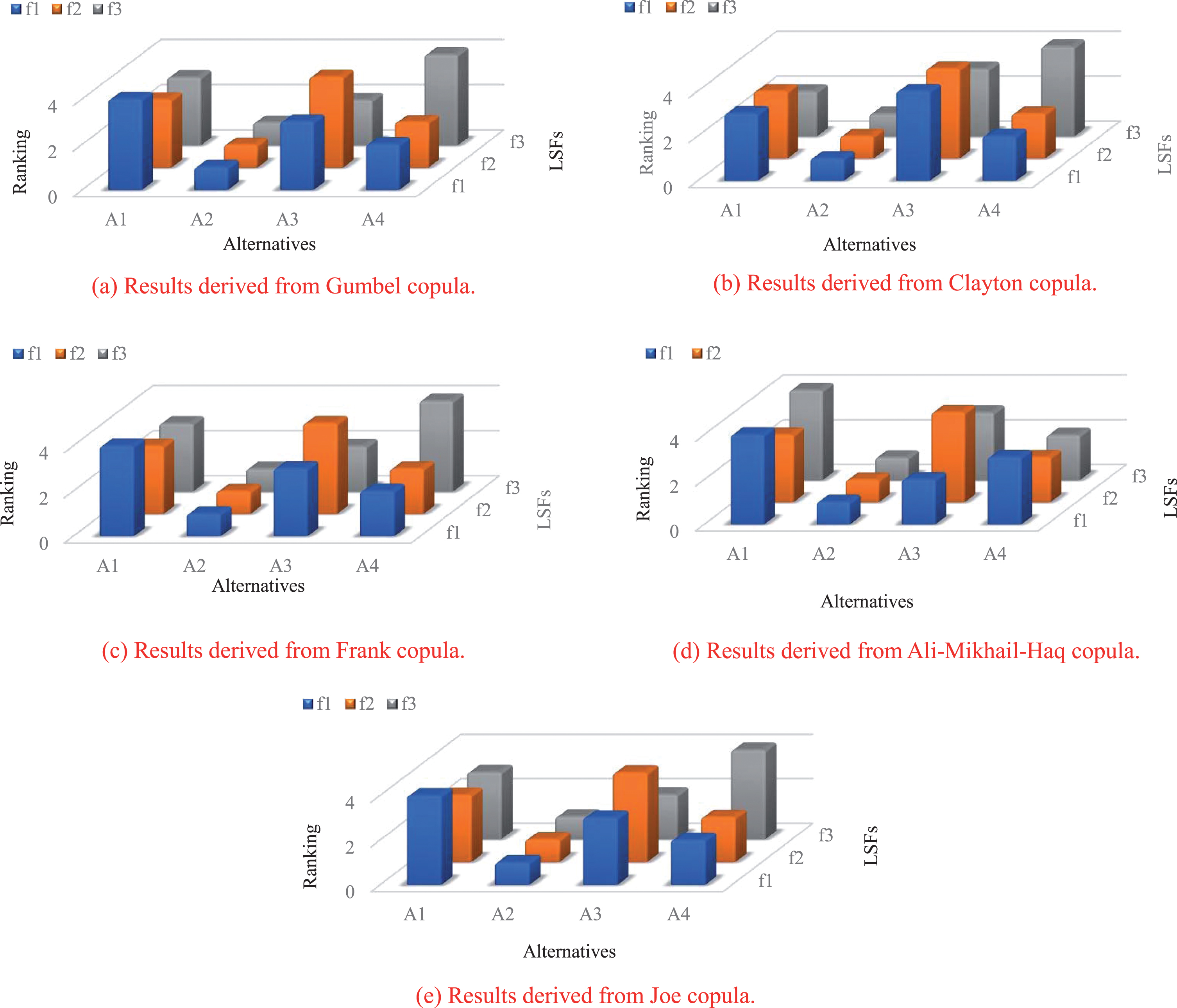
Ranking results derived from different types of Archimedean copulas.
Ranking results using different types of generator Ge (υ) on the basis of different LSFs
As shown in Table 7, the ranking results have slight differences on the basis of different types of Archimedean copulas and LSFs, whereas A2 is always the best option regardless of the changes on Archimedean copulas and semantics. Particularly, according to the same LSFs, the results have slight differences when different types of Archimedean copulas are used. This situation may be caused by distinct characteristics of these Archimedean copulas. In particular, the results obtained based on the second type of LSF are identical regardless of the changes in the Archimedean copula type. As shown in Fig. 1, according to the same types of Archimedean copulas, the ranking results have slight differences when using different LSFs. This situation reflects that the differences in semantic could influent the final results. Particularly, the final results are the same between Gumbel-type and Joe-type operators because when ς = 1, the LNIGWCHM Joe-type operator is reduced to Gumbel-type one. Therefore, the results verify the flexible and robust property of the method on the basis of the proposed LNIGWCHM operator.
Second, to illustrate the influence of the parameter ς that is added in the generated function Ge (υ) on the final results, we use the Ali-Mikhail-Haq copula-based LNIGWCHM operator as an example to conduct the proposed method, supposing σ = η = 1, and Lf* (lsℓ) = ℓ / 2ζ. The final results are shown in Fig. 2. The figure shows that the final results are slightly changed when parameter ς takes different value because of the different relevance among variables when parameter ς takes different values.
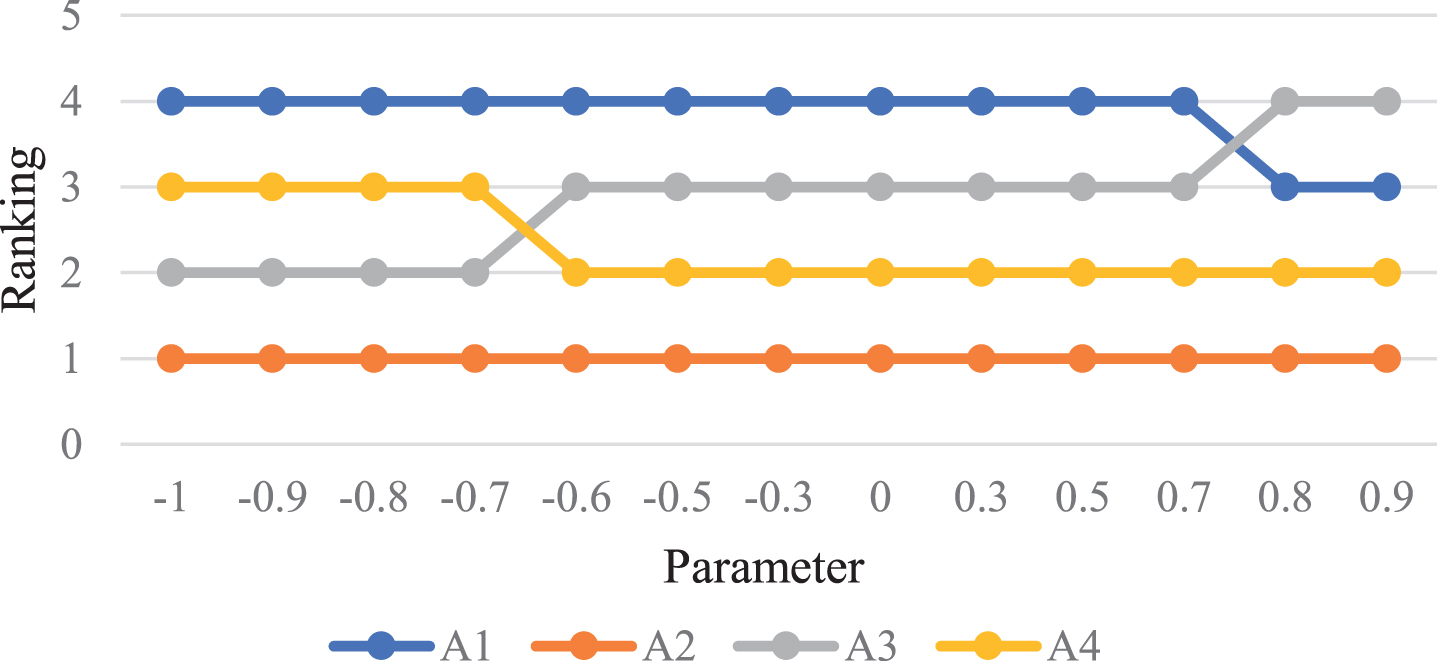
Results obtained on the basis of different values of parameter ς.
Third, the influence of the parameters σ and η on the final decision-making results are analyzed. The Gumbel type LNIGWCHM operator is taken as an example, supposing ς = 1 and Lf* (lsℓ) = ℓ / 2ζ. The ranking results are listed in Table 8.
Ranking results with different parameters σ, η
The final ranking results listed in Table 8 are slightly different when parameters σ, η have different values. Hence, the parameters σ, η of LNIGWCHM operator can affect the final decision choices. In particular, when parameters σ, η have different values, the dissimilar interrelationships of the input arguments are captured. The larger the values of σ, η are, the more captured the interrelationships among the criteria values are; otherwise, σ or η is 0, the interrelationships of the input arguments cannot be captured. The best alternative is invariably A2. Particularly, when σ > η, the final results are A2 ≻ A1 ≻ A3 ≻ A4; otherwise, when σ < η, the second-best choice is A4, and the worst choice is primarily A1.
According to analysis mentioned above, the differences in Archimedean copulas, LSFs, and parameters ς, σ, and η can affect the final results. Hence, the proposed method provides a flexible way to solve MCDM problems because DMs could flexibly select proper Archimedean copula, LSFs and the value of parameters ς, σ, and η according to the characteristics of real occasions.
In this subsection, a comparative analysis is conducted to confirm the effectiveness and practicability of the proposed method. We use the same information assuming that the weight of criteria is generated by the Choquet integral operator. We use recently proposed four methods under the linguistic neutrosophic environment.
Then, the four methods used for comparative analysis are briefly introduced. The first method was proposed by Li et al. [21], who proposed two operator; that is LNGHM and LNPGHM operators. The second method was proposed by Fan et al. [38], who proposed two aggregation operators on the basis of normalized BM operators, namely, LNNNWBM and LNNNWGBM operators. The third method was proposed by Fang and Ye [20], who proposed LNNWAA and LNNWGA operators. The fourth method was proposed by Liang et al. [49], who extended TOPSIS method combined with LNN. Then, the comparative analysis results are listed in Table 9.
Ranking results with different methods
Ranking results with different methods
The final ranking results derived from the five methods mentioned above are slightly differences, while the best choice is always A2. The main reasons for these differences may be as follows: The proposed operator has differences with the comparative operator. The comparative operators proposed in the literature [21, 38], only considered the interrelationships among input arguments. These researches ignored the interactions among criteria. The operators proposed by Fan et al. [38] and Fang and Ye [20] use linguistic variables’ labels that can cause information loss to some extent. Different operators may also have varying results due to the distinct inherent characteristics of the operators. Specifically, LNGHM and LNNWBM operators all consider the interrelations among input arguments, but they are respectively based on HM and BM operators. Meanwhile, the LNPGHM operator simultaneously considers the interrelationships among input arguments and the prioritization among criteria. The LNNWGA operator is defined based on geometric mean operators. In contrast to the existing operators, the proposed operator simultaneously considers the interrelationships and interactions among criteria. The proposed operator is a generalized form which could be bodied to different form based on different copulas functions.
According to the aforementioned analysis, the unique features and the main advantages of the proposed method are summarized as follows: In contrast to three methods mentioned above, the proposed-operator-based method simultaneously considers the interactions among criteria and interrelationships among the input arguments. Specifically, the proposed operator has the advantages of HM and Choquet integral operators. In real MCDM problems, the interrelationships and interactions among criteria coexist. Considering this situation, the presented operator is more flexible and more applicable than LNNWAA, LNNWGA, LNNWBM and LNNWBGM operators in practice. The proposed operator is a generalized form that can be applied to different forms on the basis of different types of copula functions. Hence, the proposed operator can provide more choices for DMs than several existing operators. We present a generalized operator of LNSs by adjoining the parameters λ, ς, σ, and η, which are decided by DMs. Hence, such operators can be flexible to depict the DM’s preference and address different situations.
Given the advantages of the proposed method, it can be applied to solve real MCDM problem or multi-criteria group decision making problems, in which criteria simultaneously have interactions and interrelationships. The method can also solve the situations wherein the DM’s preferences have changed. Thus, the proposed method has wide applications in real occasions. For example, the proposed method can be used to solve recommendation problems on the basis of online review. The recommendation problems always need to consider the changes in DM’s preferences and the interactions (e.g. complementary) among criteria. The method also can solve risk management problems wherein the DM’s risk preferences generally change, and the criteria have interrelationships and interactions (redundancy) among criteria. The proposed method can be applied to solve strategy selection problems, project evaluation problems, etc. The proposed operator can be combined with similarity measurements, distance measurements or other theories to address complex MCDM problems. The proposed operations and operator can be further extended to other fields, such as human resource management.
In this paper, we focused on the extension of Archimedean copulas and co-copulas under linguistic neutrosophic environments. First, a new LNN operations was defined according to Archimedean copulas and co-copulas. Simultaneously, a series of properties was studied, and some specific operations with some common types of Archimedean copulas were derived. Second, an improved generalized weighted Choquet HM operator for LNSs was presented based on the proposed operations. Next, a method combined the proposed operator was introduced under linguistic neutrosophic environment. This method was applied to solve a practical MCDM problem. The influences of different Ge (υ), LSFs, and parameters ς, σ, and η were discussed. Finally, the flexibility and feasibility of our method were proven by comparative analyzing.
The main advantages of the novel operations were that the proposed operations can capture the relevance among LNNs and provide additional choice for DMs by using generalized Archimedean copulas functions. Then, the LNN operations were defined based on LSFs, which can cope with different semantics. Hence, the novel operations of LNNs have both the advantages of Archimedean copulas and LSFs. According to the proposed operations, we proposed a generalization comprehensive aggregation operator by combining the Choquet integral and HM operators, which had the advantages of Choquet integral and HM operators. In particularly, the proposed operator can simultaneously capture the interrelationships and interactions among criteria. Thus, the proposed method based on the aggregation operator was flexible and superior when it was applied in practical problems.
The main contributions of this paper are listed as follows. First, Archimedean copulas were extended to LNSs. The new operations of LNSs were defined based on Archimedean copulas. Second, on the basis of the new operations, we proposed a family of generalization LNIGWCHM operator that can simultaneously capture the interrelationships and interactions among criteria. Third, the proposed operator-based method was conducted. The conclusion of comparative analysis showed that the proposed method was flexible and practical in solving MCDM problems and superior to the existing methods.
However, this paper has some limitations and restrictions. First, we failed to study the way that determines the weights of criteria. The weighted criteria can also influence the final results. Second, the proposed method only solved a numerical example. The proposed method should be used to solve real MCDM problems, such as recommendation problems, strategy-selection problems, etc. In the future, the proposed operator can combine with distance measurements or other theories to solve complex MCDM problems. Other LNN operators should be studied under the proposed operations. Considering the increasingly complexity decision conditions, the LNSs should be extended, such as hesitant linguistic neutrophic sets, to describe the complex information. Thus, the operations of these extensions of LNSs can be defined based on Archimedean copulas.
Footnotes
Appendix
Proof of Theorem 2
It is obviously that the aggregated value is an LNN. Next, we prove the Equation (17) by using mathematical induction on n:
(a) Since n = 2, the following equations can be obtained easily:
Therefore, when n = 2, Equation (17) is correct.
(b) Supposing Equation (17) is correct when n = k, that is
Then, when n = k + 1, the following equation can be obtained:
To prove Equation (24), the following Equation (25) must be proven in the first.
Equation (25) can be proven by using the mathematical induction of k ① when k = 2, the following equation can be obtained:
② Supposing Equation (25) holds for k = l, that is
Consequently, when k = l + 1, the following equation can be obtained:
So, Equation (25) holds for k = l + 1. Therefore, the Equation (24) holds for all k.
Subsequently, according to Equations (24) and (25), the following Equations can be converted into the following form: and
Consequently, Equation (24) can be converted into the following form:
Hence, when n = k + 1, the Equation (17) is correct. Then, Equation (17) holds for all n.
Therefore, Theorem 2 is completely proven.
Acknowledgments
The authors thank the editors and anonymous reviewers for their helpful comments and suggestions. This work was supported by the National Natural Science Foundation of China (grant. 71571193).