



Abstract
Dual hesitant fuzzy linguistic set consists of linguistic terms, membership hesitancy degrees and non-membership hesitancy degrees, which is widely applied to describe the quantitative and qualitative information in the decision-making problem. In this article, some new power aggregation operators of dual hesitant fuzzy linguistic set on the Archimedean t-conorms and t-norms functions are introduced. Then, the properties of those new operators are studied and the relationships between novel operators and existing ones are discussed. Furthermore, an approach to resolve group decision making problem is described. Finally, an example is used to illustrate the developed approach.
Keywords
Introduction
In the real life, linguistic terms are commonly applied for the qualitative evaluations of decision making [1, 2]. Nevertheless, linguistic variables just considered the membership degree belonged to the term, but without considered the non-membership degree or hesitation degree [3]. Zhu, et al., (2012) analyzed the non-membership degree and hesitation degree of quantitative decision making problem and introduced the dual hesitant fuzzy set (DHFS) [4]. Moreover, most of the information are qualitative in the real society [5]. In this article, our motivation is to research the dual hesitant fuzzy linguistic (DHFL) set, which consists of linguistic terms, membership hesitancy degrees and non-membership hesitancy degrees with the quantitative and qualitative evaluation information. Many researchers have focused on this field. Yang and Ju [6] proposed a method to solve the decision making problem under DHFL environment. Lu and Wei [7] introduced some geometric aggregation (GA) operators of DHFL set. Wei et al. [8] developed some interval-valued DHFLGA operators. In a word, the DHFL set would be better expressed the evaluation information than other sets in most practical problems.
Decision making is one of the most human activities in various fields [9, 10]. The fundamental prerequisite is how to aggregate individual information into overall information. A variety of extended aggregation operators are proposed by different researchers [11–13], for example, intuitionistic fuzzy aggregation operators [14, 15], linguistic aggregation operators [16–19], hesitant fuzzy aggregation operators [20, 21], generalized aggregation operators [22, 23], etc. Specifically, most of operators may not adequately account for the supportive dependencies among the different parameters in the decision-making process. Therefore, Yager [24] discussed the relations among different parameters in decision making problem and introduced the power average (PA) operator. By studying the PA operator, we find that the novel operator considers the input parameters within the weight information and describes the supportive dependency by the exact parameters. Based on PA operator, a power-geometric (PG) operator is presented in detail by Xu and Yager [25]. And then, Zhou et al. [26] extended the generalized mean operator and proposed weighted generalized PG (WGPG) operator. Following their studies, PG operators are extensively applied in different fuzzy environment, such as, linguistic PG operators [27], intuitionistic fuzzy and interval-valued intuitionistic fuzzy PG operators [28], trapezoidal intuitionistic fuzzy PG operators [29], generalized intuitionistic fuzzy argument-dependent PG operators [26], hesitant fuzzy PG operators [30], etc. To consider the existing correlations among DHFL parameters, this paper’s motivation is to study a variety of Power Successive operations of DHFL set, which is also used to solve the group decision making (GDM) problem.
In contrast to the above operators, those existing operators are all constructed with Archimedean t-norms and t-conorms (ATT) functions, which can allow the information fusion process more flexible and robust [31, 32] and would provide more opportunities in the making decision process. To generalize the ATT functions [33, 34], Gupta and Qi [35] extended the fuzzy linguistic theory and introduced some novel fuzzy linguistic aggregation operators. To emphasize the importance of membership degree, different intuitionistic fuzzy operators on ATT functions are discussed by Xia, et al. [36, 37]. Some properties of extended IVMINs are considered and some operators are studied under ATT functions by Yu [38]. When considering the hesitant fuzzy set and ATT functions, Zhang and Wu [39] developed several novel IVHF aggregation operators. Meeting the needs of qualitative evaluation preferences, Tao, et al. [40] extended ATT functions to aggregate novel operators under fuzzy linguistic 2-tuples environment. What’s more, some specific DHFPG operators on ATT functions are present by Wang, et al. [41]. While the above proposed aggregation operators are not used in the DHFL environment. Therefore, our motivation is to give some PG operators of DHFL set under ATT functions in this paper and present those novel operators in all its complexity.
In this paper, our motivation is to focus on discuss some novel PG operators of DHFL set under ATT functions, and the main contribution of this paper is to study the properties of those new operators and the relationships between operators and existing ones. Furthermore, an approach to solve group decision making problem is described, in which dual hesitant fuzzy linguistic set is used to describe all evaluation information and extended operators is used to integrate individual opinions into group opinions and make decisions on multi-criterion. In a word, to the motivation and inspiration of the above discussion, some dual hesitant fuzzy linguistic power-geometric operators based on Archimedean t-conorms and t-norms are proposed and applied to solve the group decision making problem.
As mentioned above, this article is organized as follows: Some correlative concepts of DHFL set and ATT functions are reviewed in Section 2. A series of novel PG operators under DHFL environments and ATT functions are proposed in Section 3. The approaches for GDM problem are introduced under DHFL environments based on those novel operators in Section 4. An example is illustrated to verify the effectiveness of the approach in Section 5. Section 6 gives the conclusion.
Preliminaries
Dual hesitant fuzzy linguistic set
Where sθ(x) is a linguistic variable, h (x) denotes the possible membership degree and g (x) denotes the non-membership degree. The expression ϑ =〈 s θ , h, g 〉 simplify 3-tuples ϑ (x) =〈 sθ(x), h(x), g(x) 〉, which is a DHFL element (DHFLE).
Where # h and # g are the numbers of elements in h and g, and ξ is the cardinality of S ={ s0, s1, ⋯ , sξ-1 } [42].
The traditional measures artificially adjust the equal lengths by adding elements into mismatching membership set or non-membership set [43]. To a certain extent, artificially adding elements would cause a lack of accurate information. For this, a novel distance for DHFLS without inserting any artificial elements is introduced. It is noteworthy that the method can calculate the distance between any two DHFLEs with different cardinalities.
Where # h k , # h l , # g k and # g l are respectively denoted the numbers of elements in h k , h l , g k and g l . The distance d (ϑ k , ϑ l ) satisfies the conditions: (i) 0 ≤ d (ϑ k , ϑ l ) ≤ 1; (ii) d (ϑ k , ϑ l ) = 0, if only if ϑ k = ϑ l =〈 s θ , { γ } , { η } 〉; (iii) d (ϑ k , ϑ l )= d (ϑ l , ϑ k ).
x
λ
= ϕ-1 (λϕ (x)), λ ≥ 0.
By learning majority of cases, some famous ATT functions are listed in Table 1.
Expression of ATT functions
Based on the classical theory of PG operator [25] and ATT functions [34], a series of novel PG operators of DHFL set are defined, in which the weighting information considers the relationships among different evaluation value and reinforces the support threshold of each other’s input parameters.
Power-geometric operator
To consider supportive correlations of evaluation value, a PG operator is introduced by Yager [25], which is a nonlinear aggregation tool.
Where
The support function Sup (ϑ j , ϑ l ) indicates the degree that ϑ j obtains support from ϑ l . In other words, the closer two elements ϑ j and ϑ l is, the more they support of each other.
Underlying the theory of DHFL set and ATT functions, some novel DHFLPG operators are proposed. To get the general closed operations, suppose
Where
Based on different ATT functions, some cases of ATT-WDHFLPG operator are studied.
Which are represented as the Einstein weighted DHFLPG (EWDHFLPG) operator.
Which are represented as the Frank weighted DHFLPG (FWDHFLPG) operator. Especially, if β → 1, then FWDHFLPG operator transforms into WDHFLPG operator.
To consider both group and individual opinions, the WGPG operator is extended to the DHFL environment, and the weighted generalized DHFLPG (WGDHFLPG) operator is proposed, which pay attention to the weights of those input parameters.
Similarly, the ATT-WGDHFLPG operator can also be proved to satisfy the properties.
Similarly, ATT-WGDHFLPG operator also has the properties of Strict-Idempotency and Strict-Boundary. Then some cases of the ATT-WGDHFLPG operator are introduced with different variable α and β.
Where
Which are represented as the Einstein weighted generalized DHFLPG (EWGDHFPG) operator.
Where
Which are represented as the Hammer weighted generalized DHFLPG (HWGDHFLPG) operator. In particular, if α = 1, then HWGDHFLPG operator transforms into WGDHFLPG operator; if α = 2, then ATT-WGDHFLPG operator transforms into EWGDHFLPG operator.
The above formulas have become more complicated. So, we would illustrate this procedure and simulate it with the MATLAB tool in the follow paper.
In this section, the group decision making problem can be resolved by the proposed DHFL operators. Expert
The approach for GDM problem under DHFL environments is constructed.
According to Qi, et al,’s research, the above approach is applied to evaluate the prepared emergency solutions (adapted from Ju et al. [48]), in which the decision matrices are constructed as showed in the following Tables 2–4, and
The approach based on the ATT-WDHFLPG or ATT-WGDHFLPG operator are showed as follows:
Decision making method based on ATT-WDHFLPG operator
In Table 5, the results are calculated by the ATT-WDHFLPG operator.
Decision matrix of expert D1
Decision matrix of expert D1
Decision matrix of expert D2
Decision matrix of expert D3
Aggregate the overall information by ATT-WDHFLPG operator
Ranking order of alternatives (α = 1.5, β = 3, λ = 1.5)
In Table 6, we find that the priority of alternatives are slightly change with different operators, but the most appropriate alternative is always the A3. Since the parameters will not affect the score values and accuracy values by the WDHFLPG operator, we research the trend of the score and the rankings of the alternatives with the changes in parameters α and β by the ATT-WDHFLPG operator.
Among Figs. 1 and 2, the figures show how the score value and accuracy value of alternatives change as the parameter increases. In Fig. 1, the score value and accuracy value of alternatives calculated by the ATT-WDHFLPG operator increase as the parameter α ∈ (0, 100). Furthermore, as the parameter α < 14.135, the ranking of alternatives has big changed by the accuracy values, which are calculated by the HWDHFLPG operator. Obviously, the score value and accuracy value increase as the parameter α increasing. We also find when the parameter α is greater than 14.135, the ranking order of alternatives have a slightly change in the above example as the parameter α increases. Figure 2 indicates that the score value and accuracy value of alternatives by the FWDHFLPG operator increase as the parameter β ∈ (0, 100). Moreover, as the parameter β > 13.106, the ranking of alternatives has smoothly changed by the accuracy values, which are calculated by the FWDHFLPG operator.
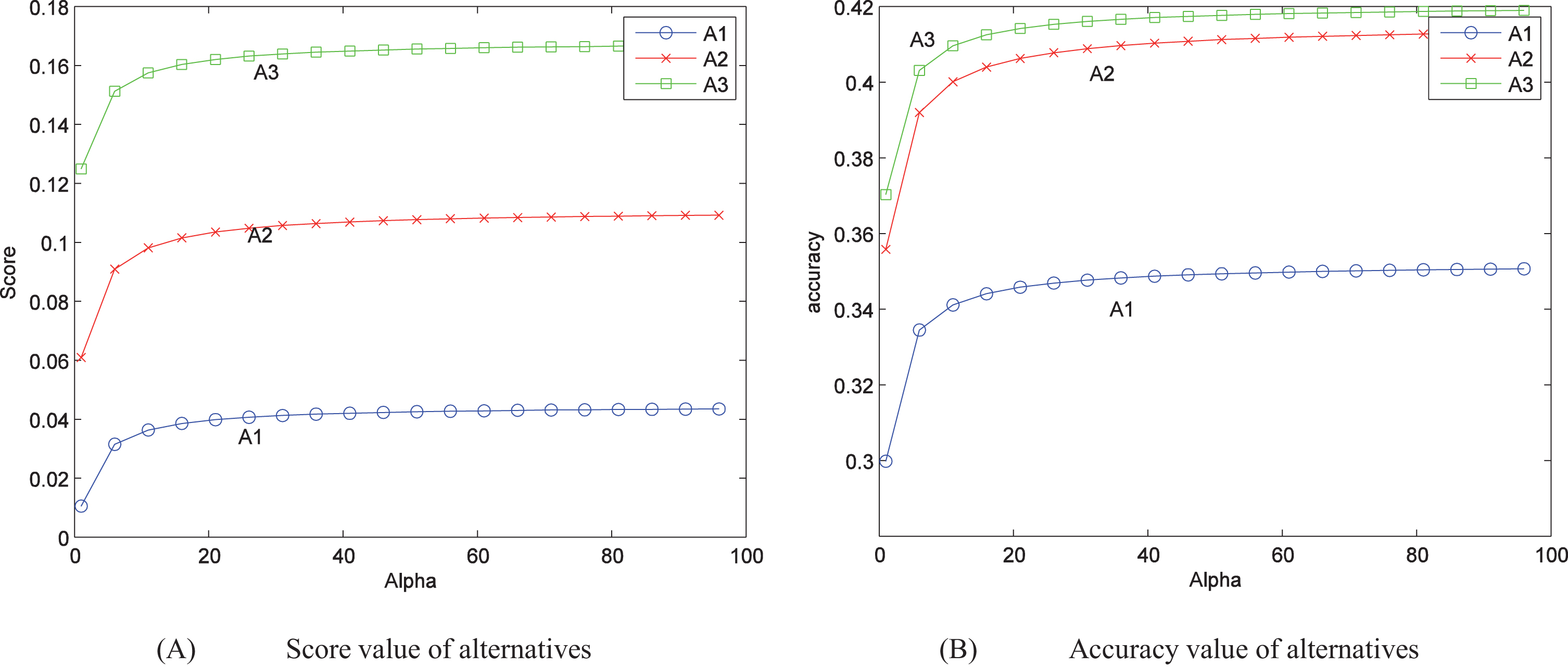
Score and accuracy for alternatives obtained by HWDHFLPG.
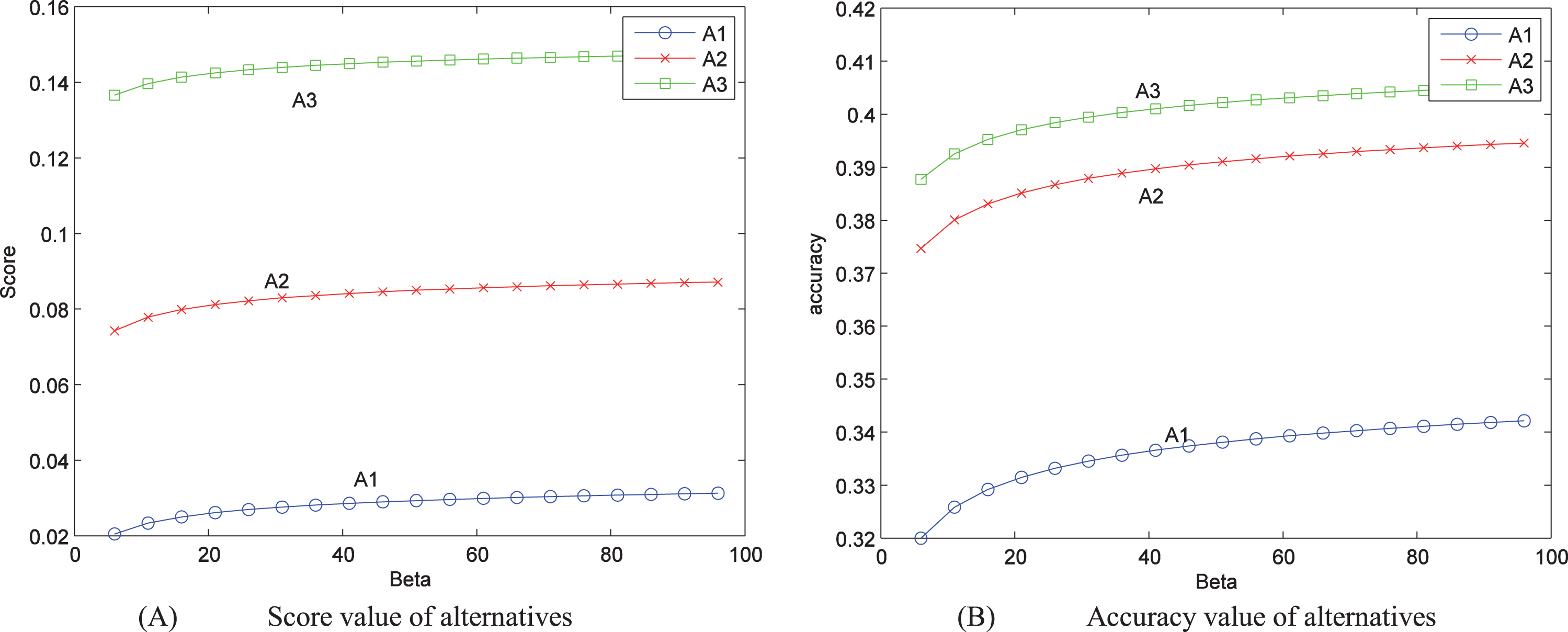
Score and accuracy for alternatives obtained by FWDHFLPG.
In summary, the results are showed in the Table 7.
Aggregate the overall performance of alternatives by ATT-WGDHFLPG
Aggregate the overall performance of alternatives by ATT-WGDHFLPG
Ranking order of alternatives (α = 1.5, β = 3, λ = 1.5)
From the above analysis, the ranking are slightly change with different operators, but the best one is always the alternative A3. Some generalized DHFL aggregation operators are introduced to solve the above problem, in which the parameter λ is considered to control the power of arguments.
To discuss the influence of the parameter λ on the ATT-WGDHFLPG operator, some plots of the score value and accuracy value of alternatives are shown in the following figures. The Figs. 3–6 show how the score value and accuracy value of alternatives change as the parameter λ increase. Furthermore, the score value and accuracy value of alternatives have significant change with the parameter λ by the ATT-WGDHFLPG operator. In the decision process, experts can confirm the value of the parameter λ in accordance with their preferences.
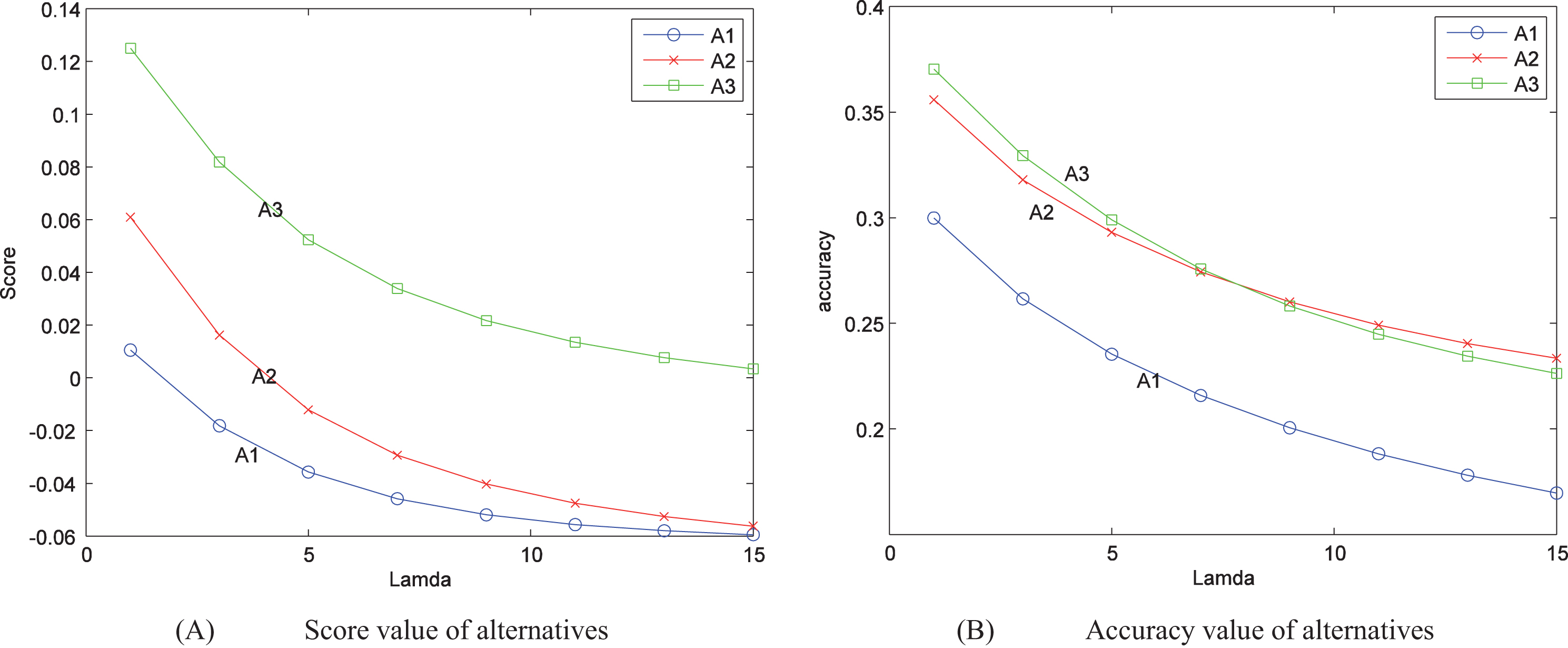
Score and accuracy obtain by WGDHFLPG (0 < λ ≤ 15).
In Fig. 3, the score value and accuracy value by WGDHFLPG operator increase as the parameter λ ∈ (0, 15). Moreover, the ranking order has a major change by the accuracy value as the parameter λ ∈ (6, 9). The score value and accuracy value increased as the parameter λ ∈ (0, 15) are indicated in Fig. 4 by the EWGDHFLPG operator. The ranking of alternatives has a major change on the score value with parameter λ ∈ (11, 14). Moreover, the ranking order also has a major change on the accuracy value with parameter λ ∈ (4, 7). In Fig. 5, the score value and accuracy value increases with the parameter λ ∈ (0, 15) by HWGDHFLPG operator. With the parameter λ ∈ (13, 15), the ranking order has a major change on the score value. And, as the parameter λ ∈ (5, 8), the priority of alternatives has a major change, which is ordered by the accuracy value. The score value and accuracy value increased with the parameter λ ∈ (0, 15) are indicated in the Fig. 6, which are calculated by FWGDHFLPG operator. With the parameter λ ∈ (14, 15), the ranking order has a major change on the score value. And, as the parameter λ ∈ (5, 7), the priority of alternatives also has a major change on the accuracy value. Especially, the accuracy value calculated by the FWGDHFLPG operator have a major change as parameter λ ∈ (0, 10).
To describe the variation trend of the parameter α and β on the ATT-WGDHFLPG operator, the score value and accuracy value increased as the parameter α ∈ (0, 100) are displayed in Fig. 7, which are calculated by HWGDHFLPG operator. Figure 8 shows that the score value and accuracy value, which obtained by the HWGDHFLPG operator, increase as the parameter β ∈ (0, 100). The accuracy value of alternatives has a smoothly change on the parameter β.
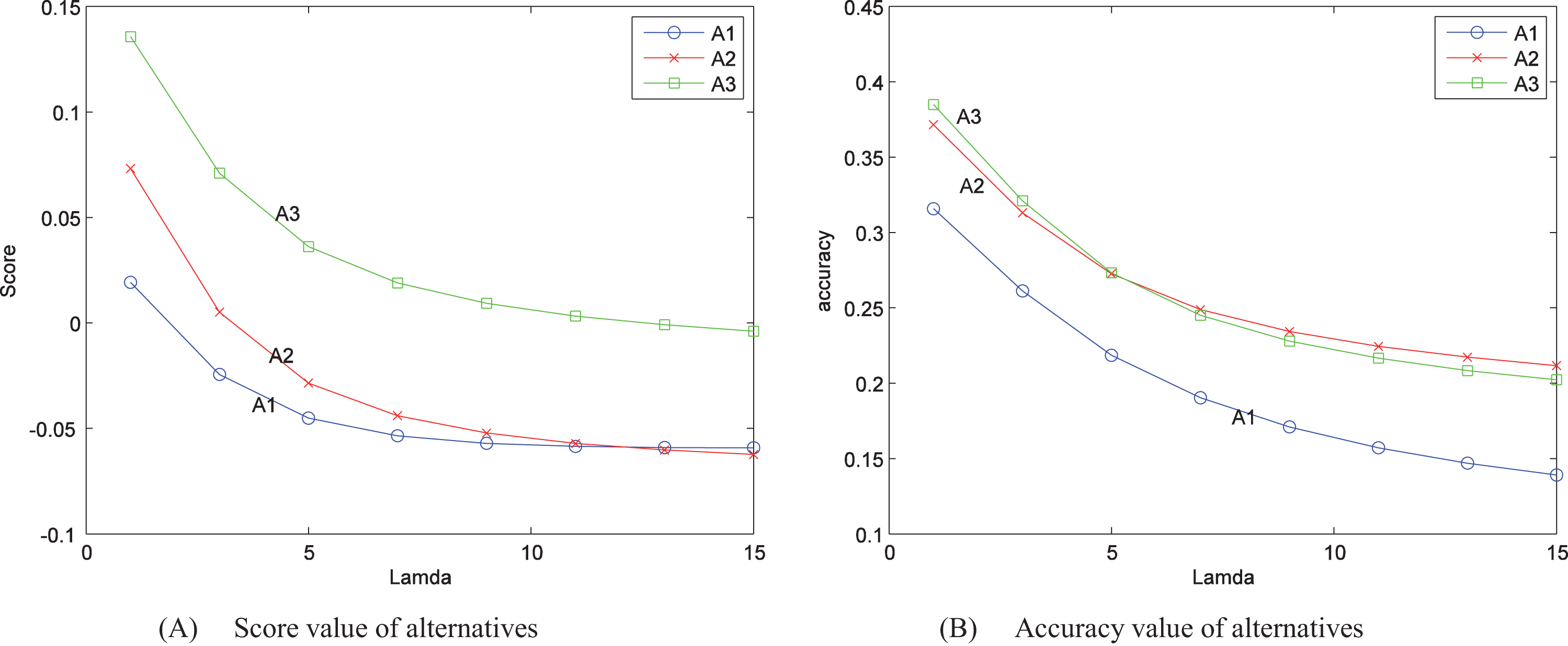
Score value and accuracy value obtain by EWGDHFLPG (0 < λ ≤ 15).

Score value and accuracy value obtain by HWGDHFLPG (0 < λ ≤ 15).
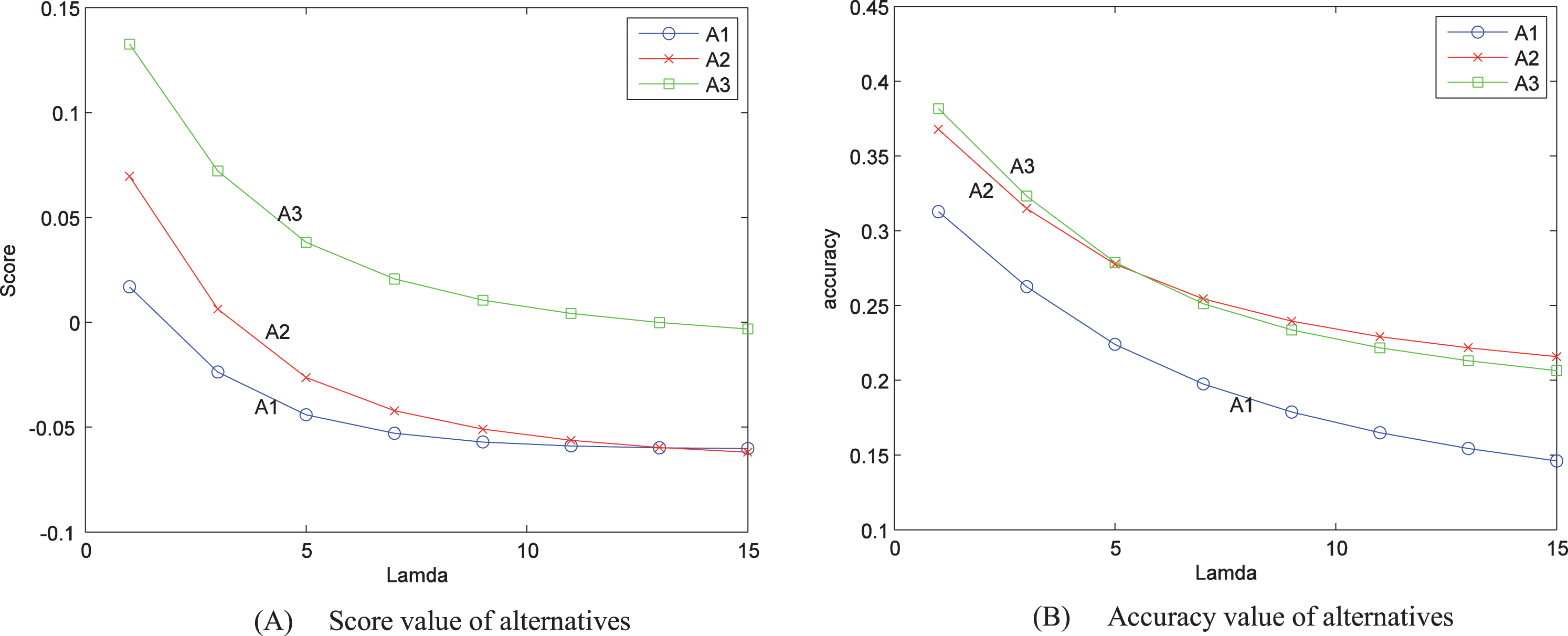
Score value and accuracy value obtain by FWGDHFLPG (0 < λ ≤ 15).

Score value and accuracy value obtain by HWGDHFLPG (0 < α ≤ 100).
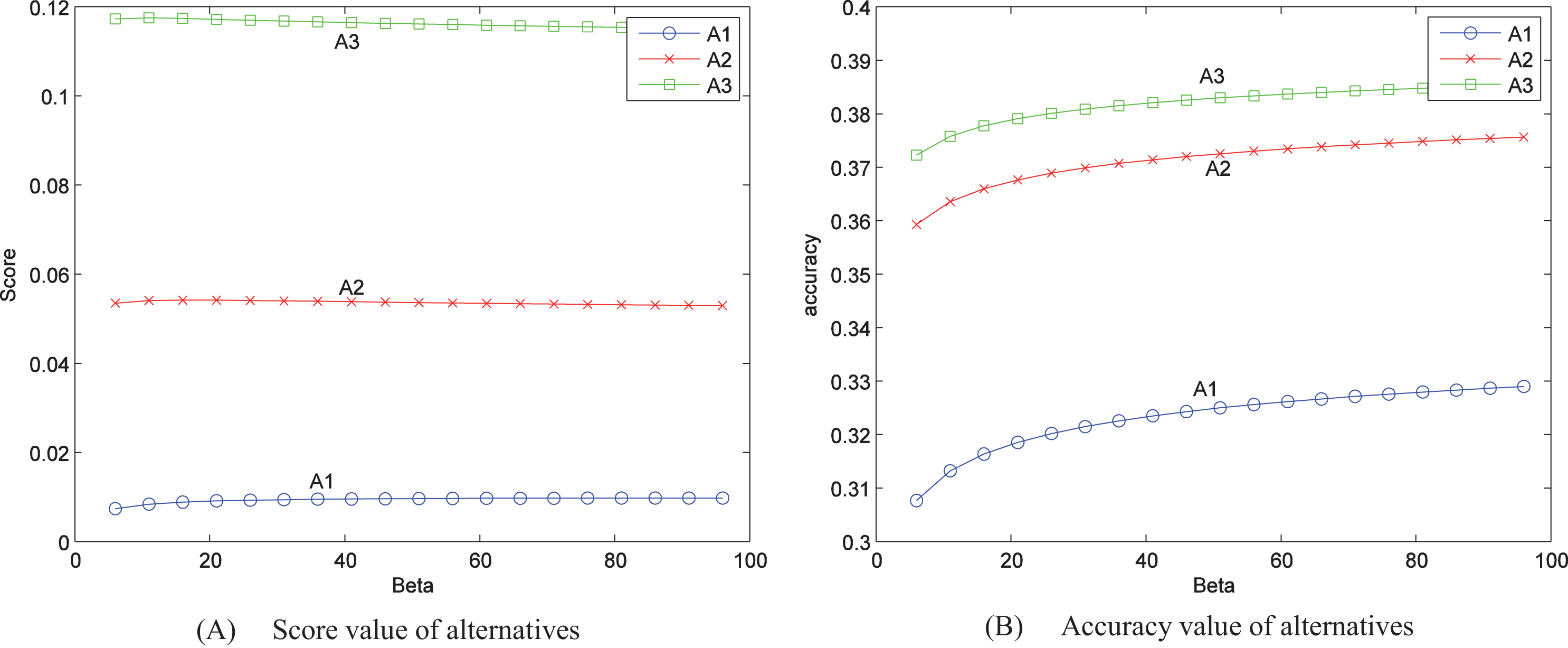
Score value and accuracy value got by FWGDHFLPG (0 < β ≤ 100).
From the above analysis, we can observe the score values and the ranking order with the changes of parameter, which indicate the experts’ preference reflection. Although, ATT functions are presented as different functions with different parameters, and there are many different DHFLPG aggregation operators. Consequently, experts may have more choices in the process of GDM and can select suitable operators under different practical situation.
The aim of this paper is to introduce some novel DHFL power-geometric aggregation operators based on ATT functions. Considering the flexibility of the power operators and supportive correlations among parameters, the PG operations and weighted generalized PG operations of DHFL set, which can better describe the quantitative and qualitative evaluation value, are introduced. Based on ATT functions, some DHFL aggregation operators are investigated, which are extended the powerful family of DHFL aggregation functions. Then some PG operators based on ATT functions under DHFL environment are proposed and some properties of those are investigated. After that, an approach is proposed to solve MAGDM problem under DHFL environment. In the end, an illustrative case is introduced to display the practical advantages of the approach, and the operators can offer different experts more choices than ever. In the future, the application of those operators will be applied to different methods under different fuzzy environment.
Footnotes
Acknowledgments
The authors would like to thank the anonymous reviewers and editors for their insightful and constructive comments on our paper. This work was supported in part by the Doctoral Project of Chongqing Federation of Social Science Circles under Grant 2018BS71, the Humanities and Social Sciences Research General Project of Chongqing Education Commission under Grant 18SKGH045 and 17SKG059, the Scientific and Technological Research Program of Chongqing Municipal Education Commission (KJQN201800832), the Ministry of education of Humanities and Social Science project (19YJC630084).