



Abstract
Cloud computing is used for processing resources that are conveyed as an administration over a network and a prototype to enable beneficial on-interest network access to a general loch of configurable reckoning resources which are rapidly provisioned and discharged. While adopting cloud computing, major challenges like resource provisioning, resource allocation and security are arising. Only prevailing resource provisioning algorithm are depending upon single tier application utilizing meta-heuristic methodology. Here, we presented a multi-tier application for provisioning dynamic resources utilizing meta-heuristic methodology like Ant Colony Optimization algorithm (ACO), Simulated Annealing (SA) algorithm and hybrid algorithm which fuses ACO and SA and also an improved cost based scheduling is used to schedule jobs within the cloud with reduced cost. Implementation outcomes displays the efficiency of provisioning resources using ACO-SA algorithm in multitier application of hybrid cloud is greater than other resource provisioning algorithms in cloud computing.
Keywords
Introduction
Cloud computing is referred as the process of abstracting details from the user where is no need of experience in controlling the technology. It is considered as an innovative complement, usage and dissemination prototype for information technology services based on Internet [1]. Cloud computing delivers three kinds of services: Software as a Service (SaaS), Platform as a Service (PaaS) and Infrastructure as a service (IaaS) [2]. Cloud computing is an expansion of grid computing, distributed computing and parallel computing and it offers safe, rapid, appropriate data storage as well as calculating power using internet, while dynamic extendibility, distribution and virtualization are the fundamental features of cloud [3]. Moreover, it is represented as a parallel and distributed system having many dynamically interrelated and virtualized machines (VM), which are evenly distributed over cloud to provide services to consumers according to their need, for which consumers are charged depending upon their consumption [4].
The cloud infrastructure can be classified into three types: the private cloud is owned by an enterprise and is operated solely to serve its own purposes; the public cloud offers services that are open for public usage; the hybrid cloud supports the usage of both private and public cloud services [5]. Cloud Computing has presented as financial and virtualization innovation, that puts the assignment scheduling multifaceted design of cloud computing to the VM layer through resource virtualization [6]. It is a developing idea which improves utilizing of various conveyed resources, the significant point in provisioning resource is most extreme execution in least time, to limit the absolute time taken, the scheduling rule intend to decrease the measure of information move with least expense [7]. A noteworthy test in resource provisioning system is to decide the perfect measure of resources required for the execution of work so as to limit the money related expense from the point of view of clients and to amplify the resource use from the viewpoint of service providers [8].
In view of the application needs Static/Dynamic Provisioning and Static/Dynamic Allocation of resources must be made so as to effectively utilize the resources without abusing SLA and meeting these QoS parameters [9]. There are numerous assignments require to be executed by the accessible resources to accomplish least completion time, less reaction time, effectual use of resources and so forth, so we have to propose a scheduling algorithm to beat proper distribution guide of errands on resources [10]. Aneka’s due date driven provisioning strategy is utilized for logical application as logical applications need huge calculating power [11]. A failure aware resource provisioning algorithm was developed with the aim of maximizing income for SaaS consumers and also ensuring QoS necessities of SaaS consumers [13]. The algorithm used that is suitable for web applications where response time is one of the important factors and uses an operating model system to automatically detect and solve bottlenecks in a multi-tier cloud hosted web applications [14].
Versatile Application Container [EAC] is used for provisioning the resources where EAC is a virtual resource unit for giving better resource effectiveness and increasingly adaptable applications [15]. The strategy called Adaptive Power-Aware Virtual Machine Provisioner (APA-VMP) where their sources are provisioned powerfully from that point source pool [16]. Attaining capability and giving reasonableness to errands execution is the essential thought of the assignment scheduling calculation [17]. The scheduling algorithm has got key importance in cloud environment while scheduling the tasks, where the objective is to achieve efficiency, hence to minimize turnaround time, increase throughput and reduce cost under changing scenarios [18]. New scheduling strategies may utilize a portion of the ordinary scheduling ideas to combine them with some system aware techniques to give answers for better and progressively effective occupation scheduling [19]. Dynamic Scheduling Model is a flexible approach than static scheduling but it has more execution overhead as compared with static [20].
To support dynamic resources provisioning in multi-level utilization of mixture cloud by utilizing meta-heuristic method we propose a half and half calculation that join ACO and SA in this paper. The rest of this paper is composed as follows: some of the recent works related to our resource provisioning methods is explained in Section 2. Our proposed resourced provision and scheduling method in a hybrid cloud environment is explained in Section 3. Section 4 contains the experimental results obtained by our proposed hybrid resource provisioning algorithms followed by the conclusion in Section 5.
Related work
The very recent works related to the resource provisioning and scheduling in hybrid cloud computing are detailed below:
Toosi et al. [21] presented another resource provisioning calculation to help the due date necessities of information concentrated applications in hybrid cloud conditions. To assess the proposed calculation, we execute it in Aneka, a stage for creating versatile applications on the Cloud. Test results utilizing a genuine contextual analysis executing an information serious application to quantify the walkability file on a hybrid cloud stage comprising of dynamic resources from the Microsoft Azure cloud demonstrate that the proposed provisioning calculation can proficiently allot resources contrasted with existing strategies.
Ramanathan and Latha [22] proposed versatility technique of Scale-Out strategies to acquire the exact expectation of occupation fulfillment times through the exploratory outcomes demonstrates the presentation dimension of Map Reduce benchmark in the open stack private cloud. The relapse based execution model foreseeing and assessing the execution time of 5 famous Map Reduce benchmark applications over the private cloud condition with better resource utilization which depicts 99% of accuracy results.
Nayak and Tripathy [23] aimed to utilize AHP (Analytic Hierarchy Process) as a leader in the refilling calculation to pick the conceivable best rent from the given best exertion line so as to plan the due date touchy rent. The proposed work improves the presentation of the inlaying calculation by scheduling increasingly number of leases and limiting the rent dismissal utilizing AHP.
Priya et al. [24] introduced an integrated resource scheduling and load balancing algorithm for efficient cloud service provisioning. The strategy develops a Fuzzy-based Multidimensional Resource Scheduling model to get resource scheduling productivity in cloud foundation. Expanding usage of VMs through fair load balancing is then accomplished by powerfully choosing a solicitation from a class utilizing Multidimensional Queuing Load Optimization calculation. A load balancing algorithm is then actualized to maintain a strategic distance from underutilization and overutilization of resources, improving inertness time for each class of solicitation. Reenactments were led to assess the adequacy utilizing Cloudsim test system in cloud server farms and results demonstrate that the proposed technique accomplishes better execution as far as normal achievement rate, resource scheduling proficiency and reaction time. Implementation examination demonstrates that the strategy improves the resource scheduling proficiency by 7% and furthermore lessens the reaction time by 35.5 % when contrasted with the best in class works.
Ahmad et al. [25] proposed Hybrid Genetic Algorithm (HGA) where an answer acquired from a heuristic is seeded in the underlying populace that gives a course to come to an ideal (make-length) arrangement. The changed two-fold genetic operators seek thoroughly and combine the calculation at the best arrangement in less measure of time. This was demonstrated to be the quality of the HGA in the enhancement of the principal objective (make-length) of schedule. The utilized calculation additionally improves the load balancing during the execution side to use resources at most extreme. The exhibition of the calculation was breaking down by utilizing integrated datasets, and certifiable application work processes. The HGA was assessed by contrasting the outcomes with famous algorithms. The exploratory outcomes approved that the HGA beats these methodologies and furnishes quality calendars with less make-ranges.
Resource provisioning
For productively utilizing the Cloud Resources, resource provisioning procedures are to be utilized. The provisioning procedures are utilized to improve QoS parameters, limit cost for cloud client and augment income for the Cloud Service Provider, improve reaction time, convey services to the cloud client even in nearness of disappointments, improve execution decreases SLA infringement, proficiently uses cloud resources, diminishes control utilization. In situations where request by applications may change or shift, “dynamic provisioning” systems have been proposed whereby VMs might be relocated on-the-fly to new process hubs inside the cloud. Based on their need, the resources are allocated to the providers. Consumer has to pay depending upon the consumption. While creating hybrid cloud utilizing dynamic provisioning is rarely referred as cloud bursting.
Dynamic resource provisioning by hybrid ABO-SA
Cloud computing is a prototype to convey data innovation services in which resources are recovered from the web through electronic instruments and applications. While adopting cloud computing, major challenges like resource provisioning, resource allocation and security are arising. Only prevailing resource provisioning algorithm are depending upon single tier application utilizing meta-heuristic methodology.To overcome this, we recommendmeta-heuristic method like ACO, SA algorithm and hybrid algorithm which fuses ACO and SA for dynamic resources provisioning in multi-tier application of hybrid cloud. The architecture of our proposed method was exposed as Fig. 1.

Architecture of our proposed method.
The hybrid cloud engineering uses both exclusive cloud servers and leased occurrences from open cloud suppliers, to offer adaptable services that are especially fit to big business computing. Since the expense of each assignment in cloud resources is not quite the same as each other, scheduling of client errands in the cloud isn’t equivalent to in customary scheduling strategies. In cloud computing stage, where resources have diverse resource expenses and calculation execution which is because of occupation gathering, communication of coarse-grained employments and resources upgrades calculation/communication proportion. For this purpose, we present an algorithm depend upon both costs with consumer job gathering in hybrid cloud. This scheduling calculation estimates both resource cost and calculation execution, it likewise enhances the computation/communication ratio by grouping the user tasks depending upon a specific cloud resource’s processing capability and dispatches the gathered tasks to the resource.
In our proposed algorithm, we use ACO as a local searching select local best position (Lbest) and global searching to select global best position (Gbest). To put on the ACO algorithm in multi-tier application the following steps should be taken and repeated in each level /* INITIALIZATION*/ Initialize parameters ρ, τ0, q0, NANT (Number of Ants) and N (Number of Iterations). Initialize the output set P as empty. Initialize all pheromone values to τ0 /*LOOP*/ For l = 1 to NANT do, /*CREATING SOLUTION SET*/ Visit available server list. Choose a new random server from the list of available servers. For each remaining VM that is waiting to get allocated do Verify the resource request for every VM. Choose an exact VM that can be packed in the server. Whenever the resource request of the VM is larger than the obtainable space in server, then Explore for other available servers. Else, do Exploit the server and assign the VM to the server. Update local pheromone table after each allocation Calculate the solutions for the two objectives for each solution set. If the present resolution in an ant populace is not subjugated by another resolution, it is moved to the output set P. Else, do Perform global pheromone update. End Loop. Return the output set P.
LOCAL UPDATE:
When a VM i is assigned to host j, an ant decreases the pheromone trail level between VM i and host j by applying the local update rule:
Where τ0 is the initial pheromone value and ρl (0< ρl<1) is the local pheromone evaporating parameter.
GLOBAL UPDATE:
The global update is applied after all the ants have built a route.
The flow chart of ACO algorithm is shown in Fig. 2.
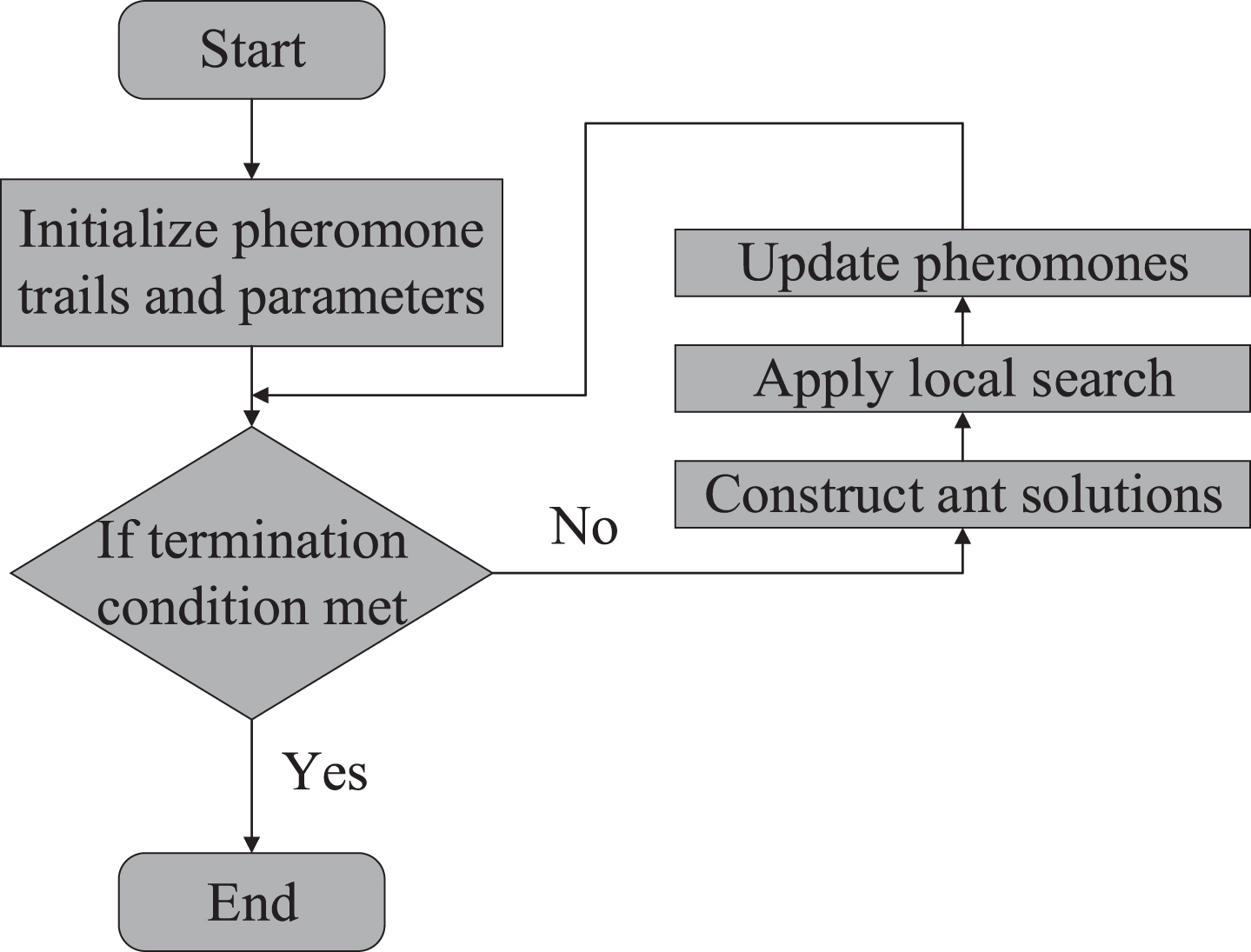
Flowchart of SA.
In our proposed method, we utilize SA as global searching to choose global best position (Gbest) and to look around Gbest to choose best among them. To apply the SA calculation in staggered application the accompanying advances ought to be taken and rehash in each dimension.
The thought behind SA originates from a physical procedure known as annealing. Annealing happens when you heat a strong past its softening point and afterward cool it. On the off chance that we cool the fluid gradually enough, huge precious stones will be shaped, then again, if the fluid is cooled rapidly the gems will contain flaws. The cooling procedure works by bit by bit dropping the temperature of the framework until it combines to an unfaltering, solidified state. SA misuses this relationship with physical frameworks so as to take care of combinatorial advancement issues. We characterize S to be the solution space, which is the limited arrangement of every single accessible arrangement of our concern, and f as the genuine esteemed cost function characterized on individuals from S. The issue is to discover an answer or state, I ∈ S, which limits f over S. SA is a sort of local search algorithm that begins with an underlying arrangement for the most part picked aimlessly and produces a neighbor of this arrangement, and afterward the adjustment in the cost f is determined. On the off chance that a decrease in expense is discovered, the present arrangement is supplanted by the created neighbor. Something else (in contrast to local search and descent algorithms, similar to the hill climbing calculation), in the event that we have a tough move that prompts an expansion in the estimation of f, which implies that, if a more terrible arrangement is discovered, the move is acknowledged or rejected relying upon a succession of irregular numbers, yet with a controlled likelihood. This is done as such that the framework does not get caught in what is known as a local minimum (instead of the global minimum where the near optimal solution is found). The likelihood of tolerating a move which causes an expansion in f is known as the acceptance function and is typically set to exp(- φ/T). Where T is a control parameter which relates to the temperature in the similarity with physical annealing. We can see from the acceptance function, as the temperature of the framework diminishes, the likelihood of tolerating a more terrible move is diminished, and when the temperature achieves zero then just better moves will be acknowledged which makes SA act like a hill climbing algorithm at this stage. Subsequently, to abstain from being rashly caught in a local minimum, SA is begun with a generally high estimation of T. The calculation continues by endeavoring a specific number of neighborhood moves at every temperature, while the temperature parameter is slowly dropped. The pseudo-code for the SA is shown below:
The flow chart of SA is shown in Fig. 3.
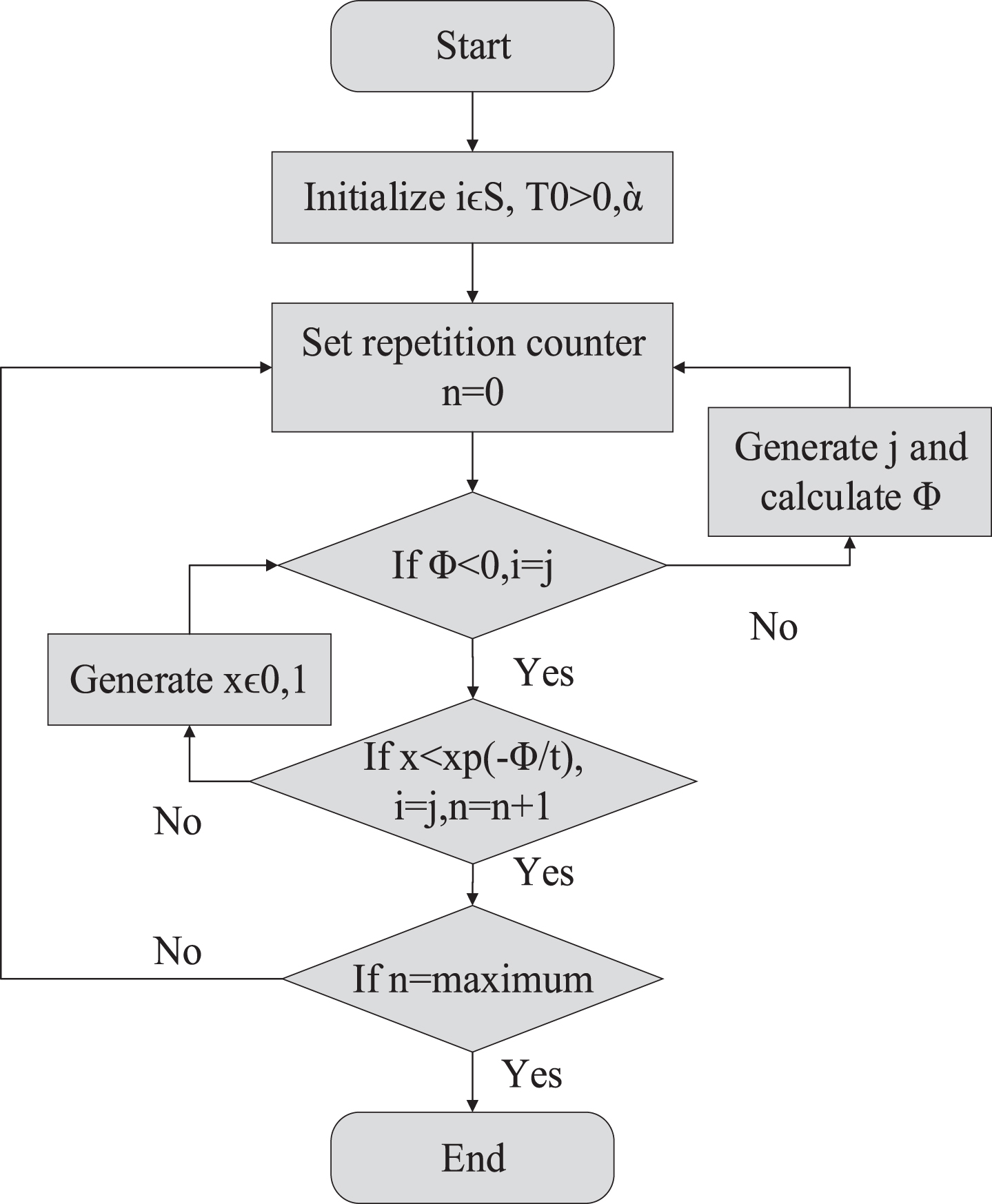
Flowchart of ACO.
In our proposed algorithm, in every level in multi-level application we utilize PSO as a local searching select local best position (Lbest) and global searching to choose global best position (Gbest), and utilize SA to seek nearby Gbest; in other words, Lbest and Gbest fluctuates in every iteration
In ACOSA algorithm, ACO and SA make tour, respectively. The visit made by SA is also assessed as a pheromone and influences the search likelihood of ACO. The assessment estimation of the visit made by SA is called honey. To execute the ACO-SA algorithm the accompanying steps ought to be taken and rehashed to every level of multi-level application.
Step 1: Initialization
Let iteration number t = 0. τij (t) is the amount of pheromone trail on the path (ij) among cities i and j at time t, and τij (t) is primarily set to τ0. mij (t) is the amount of honey trail on the path (ij) among cities i and j at time t, and mij (t) is initially set to m0.
Step 2: Find tour.
Find tour of ACO: For the k-th ant (k = 1, 2,…, M), the visiting city is chosen by probability pkij (t). ACO-SA uses two kinds of pkij (t) according to conditions. The k-th ant finds a tour according to the following equations;
Where LA is the best tour length of ants at t, LS is the best tour length of SA at t. Ω is a city set which ants are not visiting yet. α, β, and γ are the control parameters of τ, η, and m, respectively. ·
Find tour of SA: City is set at random and tour is created. This tour length is the present states. Two of the city turn of s is exchanged and tour is created. This is performed for the number of cities, and least span in its tours is the neighborhood state e. Estimation and modernization are performed as below. Identify a visit depending upon the below conditions;
Where sb is the best state.
Where T is a temperature parameter.
Step 3: Pheromone update
Compute the tour length Lk(t) and update the amount of the pheromone trail τij by
Where ρ ∈ [0, 1] is the pheromone trail decay coefficient.
Step 4: Honey update
Compute the tour length sb and update the amount of the honey by
Step 5:
Let t = t + 1 and T * c. c ∈ [0, 1] is cooling coefficient and makes T low gradually. Go to step 2 and repeat until the maximum time limit t = tmax.
The flowchart of the proposed ACO-SA is presented as Fig. 4.

Flowchart of proposed Hybrid ACO-SA.
Activity-based costing is a method of assessing both the cost of the resources and the computation performance. In hybrid cloud computing, every application will run on a virtual system, wherever the resources will be distributed virtually. Each application is totally dissimilar and is independent and has no connection between each other at all, for instance, some require more CPU time to calculate complex task, and some others may want more memory to store data, etc. Resources are sacrificed on activities executed on every distinct unit of service.
With a specific end goal to quantify direct costs of applications, every individual utilization of resources (such as CPU cost, memory cost, Input/output cost etc.) must be measured. At the point when the direct information of every distinct resources cost has been quantified, more accurate cost and profit analysis based on it than those of the traditional way can be got.
Problem formulation for improved ABC
For formulating the issue, describe Ti i = {1,2, 3 . . . n} as n liberated jobs permutation and Rj, j = {1,2, 3 . . . m} as m calculating resources with an objective of minimizing the completion time and minimizing the cost. The processing capability of every resource is expressed in MIPS (Machine Instructions per second) and the size of each task in MI (Number of Machine Instructions). Suppose that the processing time Pi, j for task i computing on j resource is known. The completion time T tot(x) represents the sum of the total computation time Texe(x) and total communication time Tcomm(x) Refer Total computation time is calculated by adding the processing time of all the resources.
In our problem, optimization criteria are minimization of make-span and minimization of cost.The price for every separate resource is different. Let there be three lists of tasks with high, medium and low priorities. To calculate the jobs, the system can take from high priority list first, then medium and then low.
Let ‘n’ be the total number of resources in use
Ri,k: The ith separate utilizationof resources by the kth task.
Ci,k: The price of the ith separate utilization of resources by the kth task.
Pk: The revenue earned from the kth task.
Lk: The priority level of the kth task.
If the entire separate resources utilization is supposed to be n, so the priority level of the kth task is
The priority level of task is calculated using Equation 7.
The scheduler acknowledges number of assignments, normal MI of errands, deviation level of MI granularity size and preparing overhead of the entire jobs. Resources are chosen. The need dimensions of the errands are determined using Equation 7. Tasks are sorted according to their priority, and they are placed in three different lists based on three levels of priority namely high priority, medium priority and low priority. Now job grouping algorithm is connected to the above records so as to assign the errand gatherings to various accessible resources.
The principle target of this algorithm is to schedule gatherings of jobs in cloud computing stage, where resources are having distinctive resource costs and diverse calculation execution. While grouping of tasks are done, communication between tasks and resources optimizes computation/communication ratio. This algorithm measured performance of computation and cost of resources. This likewise expanded the execution of assignments/move of information between errands proportion by consolidating different tasks during execution. The way toward consolidating errand is normally done by after analyzing the capacity of various accessible resource and its processing. The algorithm is listed below.
Terms used in the algorithm
n: Entire quantity of task
m: Entire quantity of Resources accessible.
Gi: List of tasks submitted by the user
Rj: List of Resources available
MI: Million guidelines or processing requests of a consumer job
MIPS: Million guidelines per second or processing abilities of a resource
Tot-Jleng: Overall processing requests (MI) of a job collection (in MI)
Tot-MIj: Overall processing ability (MI) of jth resource
Results and discussion
This section shows the proposed resource provisioning and scheduling of resources for multi-tier applications and the results obtained by them.
System configuration:
Operating System: Windows 8
Processor: Intel Core i3
RAM: 4 GB
Domain: Cloudsim
Platform: Java
Results
To confirm the efficiency of proposed calculations, we utilize the Cloudsim toolbox to give resource dependent on the proposed calculations. The test consequences of resource provisioning dependent on hybrid calculation that join ACO and SA algorithm in multi-level application are contrasted and the test outcomes of ACO, PSO algorithm and SA algorithm as alone in multi-level use of cloud computing. We have checked the execution of the algorithms by fixed the quantity of client claimed twice number of VM as host in every datacentre, the results are show in Table 1.
Simulation results
Simulation results
Comparison of proposed method with existing methods
Figure 5 shows the graph for the number of requests vs finishing time based on the simulation results obtained by our proposed ACO-SA.

Number of requests Vs finishing time.
This section provides the comparison between our proposed ACO-SA resource provisioning method with the existing resource provisioning algorithms such as PSO-SA, PSO and SA lonely.
The finishing time of the various resource provisioning methods are different. The comparison with our proposed method with the existing resource provisioning method is displayed as Fig. 6.

Comparison of proposed method with existing methods.
From the above simulation results and comparison graphs it is evident that our proposed resource provisioning method is more efficient than the existing method and completes the requested task earlier than the other existing methods
To confirm the efficiency of proposed calculations, we utilize the Cloudsim toolbox to give resource dependent on the proposed calculations. The test consequences of resource provisioning dependent on hybrid calculation that join ACO and SA algorithm in multi-level application are contrasted and the test outcomes of ACO, PSO algorithm and SA algorithm as alone in multi-level use of cloud computing. We have checked the execution of the algorithms by fixed the quantity of client claimed twice number of VM as host in every data centre. The results and comparison shows that the status of response time with respect to processing time of request. By performing various calculations, it has been found that the proposed model is very well promising in predicting the actual pattern.
Conclusion
In this paper, we presented a multi-tier application for provisioning dynamic resources utilizing meta-heuristic methodology like Ant Colony Optimization algorithm (ACO), Simulated Annealing (SA) algorithm and hybrid algorithm which fuses ACO and SA and also an improved cost based scheduling is used to schedule jobs within the cloud with reduced cost for resource provision and job scheduling problem in the cloud computing. By the experimental results and comparison, we conclude that our presented work provides a valuable result provisioning resources and scheduling for a cloud computing. In this paper an innovative algorithm is presented for resource provisioning in multi-tier cloud computing that combine ACO and SA algorithm. Simulation of our proposed algorithms shows that provisioning resource based on hybrid ACO-SA algorithm are good that take less average execution time as compared with resources provisioning based ACO and SA algorithms as alone in multi-tier cloud computing.