



Abstract
Let G be a finite simple graph. The line graph L (G) represents adjacencies between edges of G. We define first line simplicial complex Δ
L
(G) of G containing Gallai and anti-Gallai simplicial complexes Δ
Γ
(G) and ΔΓ′ (G) (respectively) as spanning subcomplexes. We establish the relation between Euler characteristics of line and Gallai simplicial complexes. We prove that the shellability of a line simplicial complex does not hold in general. We give formula for Euler characteristic of line simplicial complex associated to Jahangir graph
Introduction
Due to their immense applications in various fields, the study of simplicial complexes is a well established knowledge area of commutative algebra and algebraic topology. Simplicial complexes play the important role in encoding compact topological spaces. It has always been an important tool in topology to encode reasonably nice compact spaces via triangulation. In recent years, this importance has increased as triangulation is a necessary part of protocols for communicating with computers about topological spaces. The study of connectedness of simplicial complex has been of great importance due to various combinatorial and topological aspects, see for instance [5], [18] and [19].
Computing topological invariants is very useful in understanding the shape of an arbitrary object. The Euler characteristic is a number that describes topological space’s shape or structure regardless of the way it is bent. It is a well-known topological and homotopic invariant to classify surfaces. It arises from homological algebra [11, 23].
Let Δ be a simplicial complex of dimension d. The Euler characteristic of Δ is defined as
where f k is the number of k-dimensional faces of Δ. The chain complex C∗ (Δ) can be expressed as 0 → C d (Δ) →∂ d Cd-1 (Δ) →∂d-1 . . . →∂2C1 (Δ) →∂1C0 (Δ) →∂00,
where C
k
(Δ) is a free abelian group generated by all k-dimensional faces of Δ and ∂
k
the boundary homomorphism, given by
such that the symbol
where Ker ∂ k and Im ∂k+1 are the groups of simplicial k-cycles and k-boundaries, respectively.
The Euler characteristic of a simplicial complex Δ having dimension d is also given by
where the k-th Betti number β k is the rank of k-th homology group H k (Δ). The Betti numbers were coined by Poincaré after Betti. These numbers are topological objects which were proved to be invariants by Poincaré. He used them to extend the polyhedral formula to higher dimensional spaces. The modern formulation is due to Noether. The Betti numbers are used to distinguish topological spaces based on the connectivity of d-dimensional simplicial complexes. These numbers tell us the maximum amount of cuts that must be made before separating a surface into two pieces. The Betti numbers have applications in signal processing, data aggregation, sensing, bioinformatics and image analysis [6, 14].
The excision is one of the most useful property of Euler characteristic, given by χ (Δ) = χ (C) + χ (Δ ∖ C) ,
for every closed subset C ⊂ Δ. The excision property has a dual form χ (Δ) = χ (U) + χ (Δ ∖ U) ,
for every open subset U ⊂ Δ. This property is frequently used under the guise of the inclusion-exclusion formula.
The shellability of a simplical complex Δ is a well-studied combinatorial property that carries strong geometric and algebraic interpretations, see for instance [3, 22] and [24]. In many situations, proving shellability is the most efficient way of establishing Cohen-Macaulayness [3]. The algebraic criterion for shellability of a simplicial complex has been first introduced by A. Dress [7]. Eagon and Reiner [8] gave algebraic criterion of pure shellability of a dual simplicial complex
In this note, we define first line simplicial complex Δ L (G) associated to a finite simple graph G (see Definition 2.3), which is the generalization of line graph L (G). The notion of line graph was first introduced by Harary and Norman [10], which provides us main stream line of this work. The properties of line graph L(G) have been studied by many authors, see for instance [1, 20 and 21]. The line graph L (G) is a graph having edges of G as its vertices and two distinct edges of G are adjacent in L (G) if they are adjacent in G. It contains Gallai and anti-Gallai graphs Γ (G) and Γ′ (G) as spanning subgraphs, which have edges of G as their vertices. Two edges of G are adjacent in Gallai graph Γ (G) (respectively anti-Gallai graph Γ′ (G)) if they are incident but do not span (respectively span) a triangle in G. The anti-Gallai graph Γ′ (G) is the complement of Γ (G) in L (G) [9, 15]. The line simplicial complex contains Gallai simplicial complex Δ Γ (G) and anti-Gallai simplicial complex ΔΓ′ (G) as spanning subcomplexes. For Gallai simplicial complex, we refer [19]. The anti-Gallai simplicial complex ΔΓ′ (G) is the complement of Δ Γ (G) in Δ L (G).
In Theorem 3.2, we establish the relation between Euler characteristics of line and Gallai simplicial complexes.
In Proposition 4.1, we prove that the shellability of line simplicial complexes does not hold in general. In Proposition 4.2, we show that the line simplicial complex Δ L (Wn+1) of wheel graph Wn+1 is shellable.
In Theorem 5.3, we give formula for Euler characteristic of line simplicial complex associated to Jahangir graph
Basic setup
A simplicial complex Δ on the vertex set [n] = {1, …, n} is a subset of 2[n] with the property that if F ∈ Δ then every subset of F will belong to Δ. The members of Δ are called faces and the maximal faces under inclusion are called facets.
If
The dimension of a face F ∈ Δ is given by dim F = ∣ F ∣ -1, where ∣F∣ is the number of vertices of F. The dimension of the simplical complex Δ is defined by dim Δ = max {dim F| F ∈ Δ} . A simplicial complex Δ is said to be pure if it has all facets of the same dimension.
Let Δ be a simplicial complex of dimension d. The f-vector of Δ is defined as (f0, …, f
d
), where f
k
is the number of k-cells of Δ. The Euler characteristic of the simplicial complex Δ is given by
A simplicial complex Δ is said to be connected if for any two facets F and
A simplicial complex Δ over [n] is shellable if its facets can be ordered F1, F2, …, F
s
such that the subcomplex
In [10], Harary and Norman define the line graph L (G) of a finite simple graph G, which provides the main streamline of this work.
We define now line indices associated to a finite simple graph G, which plays a key role in the structural study of the line simplicial complex Δ L (G).
The line index is said to be a Gallai index if the incident edges ei,j and ej,k of G do not span a triangle in G, see [19]. The set of all Gallai indices is denoted by Ω Γ (G). The line index is said to be an anti-Gallai index if the incident edges ei,j and ej,k of G lie on a triangle in G. The set of all anti-Gallai indices is denoted by ΩΓ′ (G). The Gallai and anti-Gallai simplicial complexes Δ Γ (G) and ΔΓ′ (G) are generated by the sets of all Gallai and anti-Gallai indices, respectively.
Euler characteristic of line simplicial complexes
We prove first necessary and sufficient condition for a line simplicial complex Δ L (G) to be connected.
Now, we prove the converse implication. On contrary, we assume that the graph G is not connected. Therefore, there exist two non-empty subsets V1 and V2 of V (G) = [n] such that [n] = V1 ∪ V2 and V1∩ V2 = ∅ with the property that there are vertices, say r and s in G such that no path in G has r and s as end points for every r ∈ V1 and s ∈ V2. It implies that there is no face of Δ L (G) containing both vertices r and s for every r ∈ V1 and s ∈ V2 i.e. Δ L (G) is not connected, a contradiction. Hence the result.□
We establish now the relation between Euler characteristics of line and Gallai simplicial complexes.
By the excision property, the Euler characteristic of the line simplicial complex Δ
L
(G) is given by
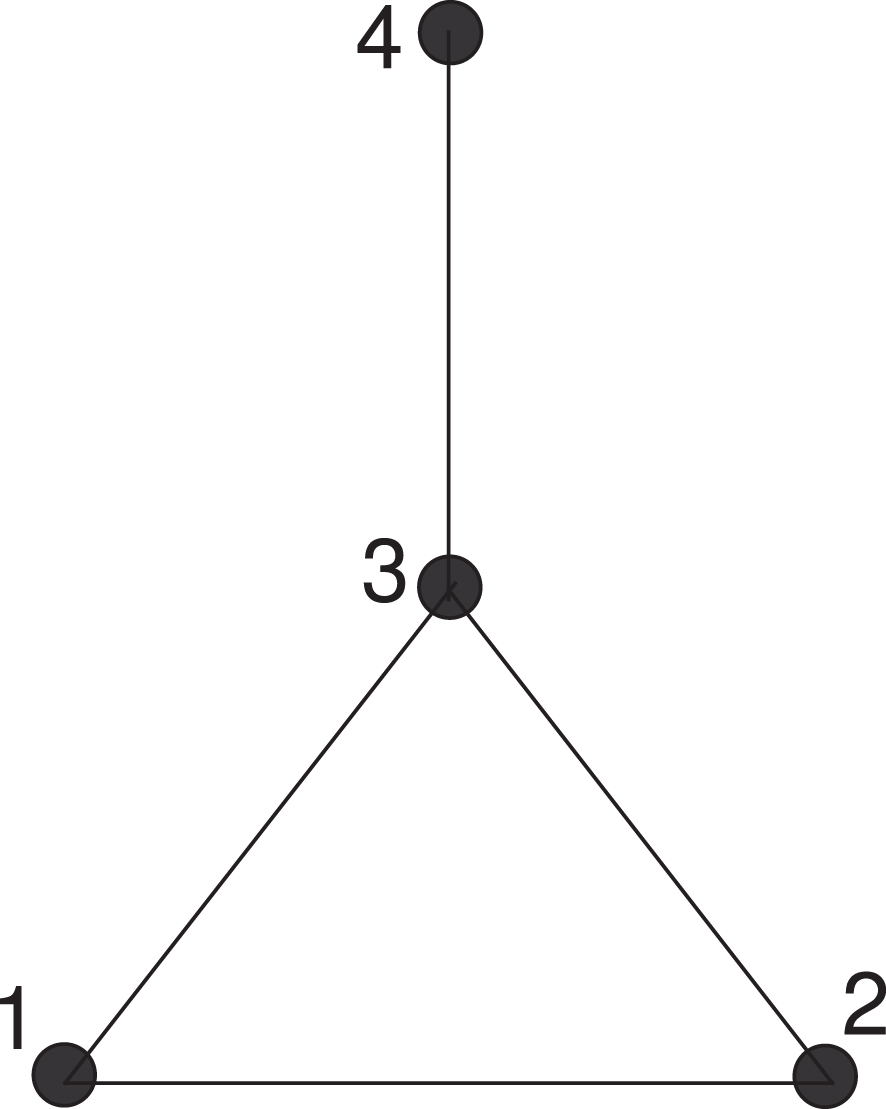
Graph G.
Then, the line simplicial complex of G is given by Δ L (G) = 〈{1, 2, 3} , {1, 3, 4} , {2, 3, 4} 〉 .
Therefore, χ (Δ L (G)) = f0-f1 + f2 = 1, where f i is the number of i-dimensional faces of Δ L (G).
The Gallai simplicial complex of G is given by Δ Γ (G) = 〈{1, 2} , {1, 3, 4} , {2, 3, 4} 〉 .
We compute χ (Δ Γ (G)) = g0-g1 + g2 = 0, where g i is the number of i-dimensional faces of Δ Γ (G).
Note that ∣ΩΓ′ (G) ∣ =1. Therefore, χ (Δ L (G)) = χ (Δ Γ (G)) + ∣ ΩΓ′ (G) ∣ .
In the following result, we prove that the line simplicial complexes are not shellable in general.
Also observe that F3 ≠ {5, 1, 2} since otherwise the subcomplexes 〈F1, F2, F3〉 ∩ {3, 4, 5} = 〈{3, 4} , {5} 〉 and 〈F1, F2, F3〉 ∩ {4, 5, 1} = 〈{4} , {1, 5} 〉 are nonpure. Thus we must have F3 = {3, 4, 5}. But then we have nonpure subcomplexes 〈F1, F2, F3〉 ∩ {4, 5, 1} = 〈{4, 5} , {1} 〉 and 〈F1, F2, F3〉 ∩ {5, 1, 2} = 〈{1, 2} , {5} 〉 . So, there is no choice for F4, which is a contradiction.□
In the following result, we prove that the line simplicial complex of wheel graph Wn+1 is shellable.

Wheel Graph Wn+1.
We fix shelling order of the facets of line simplicial complex Δ L (Wn+1), given by Δ L (Wn+1) = 〈F1,2,n+1, …, F1,n,n+1, F2,3,n+1, …, Fn-1,n,n+1, F1,2,3, …, Fn,1,2〉 .
We establish result into the following steps.
Hence the result.□
Let Δ be a simplicial complex of dimension d. The chain complex of Δ C∗ (Δ) : 0 → C d (Δ) →∂ d Cd-1 (Δ) →∂d-1 . . . →∂2C1 (Δ) →∂1C0 (Δ) →∂00
is a sequence of homomorphisms of free abelian groups C
k
(Δ) generated by all k-dimensional faces of Δ. The boundary homomorphism ∂
k
is given by
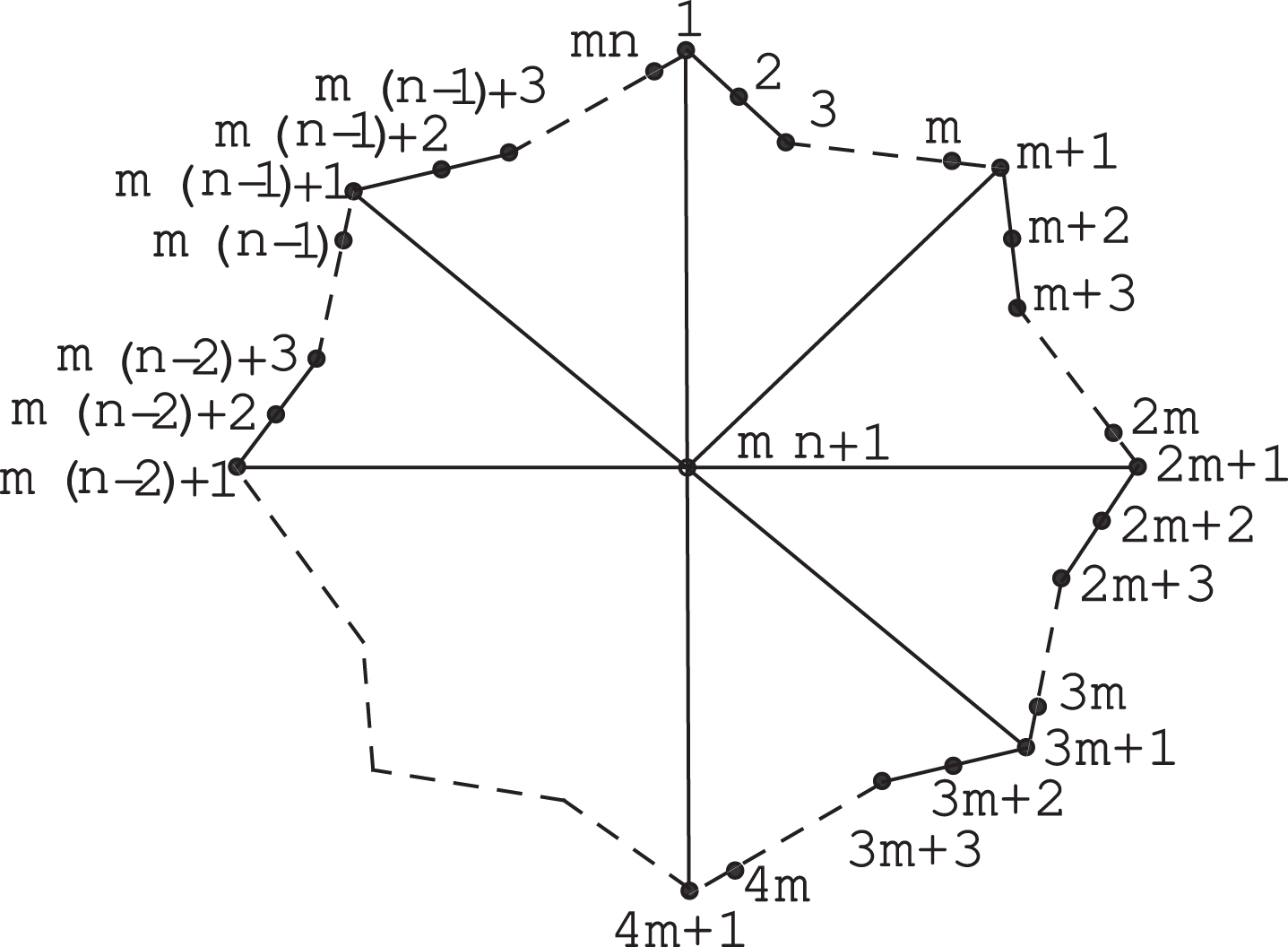
The Jahangir graph
Jahangir Graph
The following result gives us a combinatorial buildup of the line simplicial complex of Jahangir graph
(i)
(ii)
(iii)
(iv)
(v)
We find now the f-vector of line simplicial complex
(1) ∣ {Fi,i+1,i+2 : 1 ≤ i ≤ mn-2} ∣ = mn-2;
(2) ∣ {Fmn-1,mn,1, Fmn,1,2, Fmn,1,mn+1} ∣ =3;
(3)
(4) ∣ {Fm(i),m(i)+1,mn+1 : 1 ≤ i ≤ n-1} ∣ = n-1;
(5) ∣ {Fm(i)+1,m(i)+2,mn+1 : 0 ≤ i ≤ n-1} ∣ = n. Therefore,
Now, we count the number of edges of
(1) ∣ {Fi,i+1 : 1 ≤ i ≤ mn-1} ∣ = mn-1;
(2) ∣ {Fi,i+2 : 1 ≤ i ≤ mn-2} ∣ = mn-2;
(3)
(4) ∣ {Fm(i)+1,mn+1 : 0 ≤ i ≤ n-1} ∣ = n;
(5) ∣ {Fm(i)+2,mn+1 : 0 ≤ i ≤ n-1} ∣ = n;
(6) ∣ {Fm(i),mn+1 : 1 ≤ i ≤ n} ∣ = n;
(7) ∣ {Fmn,j : j = 1, 2} ∣ =2;
(8) ∣ {Fmn-1,1} ∣ =1 . Therefore,
In the following result, we give formula for Euler characteristic of line simplicial complex of Jahangir graph
By Lemma 5.1, the line simplicial complex
By Eq. (1), the boundary homomorphisms ∂ k are matrices of order fk-1 × f k with k = 1, 2.
Now, we present an algorithm to find ranks of ∂ k with k = 1, 2 using successive steps of Lemmas 5.1 and 5.2.
1. Begin
2. Input the value of n ≥ 2
3. Input the value of m ≥ 3
4. Store the boundaries of edges e ij in the form of
5. alternating sum of vertices v j -v i ,
6. //see Equation (1).
7. AlternatingSum1=[]
8. do i from 1 to m
9. equation= v [i + 1]-v [i]
10. AlternatingSum1[i] =equation
11. end do
12. AlternatingSum2=[]
13. do i from 1 to m * n-2
14. equation= v [i + 2]-v [i]
15. AlternatingSum2[i] =equation
16. end do
17. AlternatingSum3=[]
18. do i from m to m * n-m
19. if rem(i, m) =0, then
20. equation= v [m * n + 1]-v [i]
21. AlternatingSum3[i] =equation
22. end if
23. end do
24. AlternatingSum4=[]
25. do i from 2 to m * (n-1) +2
26. if rem(i, m) =2, then
27. equation= v [m * n + 1]-v [i]
28. AlternatingSum4[i] =equation
29. end if
30. end do
31. AlternatingSum5=[]
32. do i from 1 to m * (n-1) +1
33. do j from i + m to m * n + 1
34. if rem(i, m) =1 and rem(j, m) =1,
35. then equation= v [j]-v [i]
36. AlternatingSum5[i] =equation
37. end if
38. end do
39. end do
40. AlternatingSum6=[]
41. do i from 1 to 2
42. equation= v [m * n]-v [i]
43. AlternatingSum6[i] =equation
44. end do
45. AlternatingSum7= v [m * n-1]-v [1]
46. Create matrix of coefficients from
47. AlternatingSum1 to AlternatingSum7 and
48. store it in matrix ∂1
49. Compute rank (∂1)
50. //Store the boundaries of 2-dimensional faces
51. //F ijk in the form of alternating sum of edges
52. //e jk -e ik + e ij , see Equation (1).
53. AlternatingSum8=[]
54. do i from 1 to m * n-2
55. equation= e [i + 1, i + 2]-e [i, i + 2] + e [i, i + 1]
56. AlternatingSum8[i] =equation
57. end do
58. AlternatingSum9=[]
59. do i from 1 to m * (n-2) +1
60. do j from i + m to m * (n-1) +1
61. if rem(i, m) =1 and rem(j, m) =1,
62. then equation= e [j, m * n + 1]-
63. e [i, m * n + 1] + e [i, j]
64. AlternatingSum9[i] =equation
65. end if
66. end do
67. end do
68. AlternatingSum10=[]
69. do i from 1 to m * (n-1) +1
70. if rem(i, m) =1, then
71. equation=e [i + 1, m * n + 1]-
72. e [i, m * n + 1] + e [i, i + 1]
73. AlternatingSum10[i] =equation
74. end if
75. end do
76. AlternatingSum11=[]
77. do i from m to m * (n-1)
78. if rem(i, m) =0, then
79. equation= e [i + 1, m * n + 1]-
80. e [i, m * n + 1] + e [i, i + 1]
81. AlternatingSum11[i] =equation
82. end if
83. end do
84. AlternatingSum12=[]
85. do i from m * n-1 to m * n
86. equation= e [i, i + 1]-e [1, i + 1] + e [1, i]
87. AlternatingSum12[i] =equation
88. end do
89. AlternatingSum13= e [2, m* n]-e [1, m * n] +
90. e [1, 2]
91. Create matrix of coefficients from
92. AlternatingSum8 to AlternatingSum13 and
93. store it in matrix ∂2
94. Compute rank (∂2)
One can see that rank (∂1) = mn ; rank (∂2) = f2 . Note that rank (Ker ∂0) = f0 and rank (Im ∂3) =0. By dimension theorem of vector spaces, we have rank (Ker ∂1) = f1-mn and rank (Ker ∂2) =0 . By Eq. (2), the Betti numbers of Δ
L
(
Therefore, χ (Δ
L
(
Simplicial complexes have many applications in algebraic topology and commutative algebra. Computing topological invariants has been of great importance in understanding the shape of an arbitrary object. It has been a great development of recent years in applying topological tools to signal processing, data aggregation, sensing, bioinformatics and image processing.
We introduce line simplicial complex Δ
L
(G) of a finite simple graph G as a generalization of line graph L (G). The Euler characteristic is a well studied topological and homotopic invariant to classify surfaces. We establish the relation between Euler characteristics of line and Gallai simplicial complexes. Moreover, we present an algorithm to device formula for Euler characteristic of line simplicial complex associated to Jahangir graph
Footnotes
Acknowledgment
Authors are thankful to Higher Education Commission, Pakistan for its partial support.