



Abstract
The prevailing concepts of intuitionistic fuzzy sets (IFSs), Pythagorean fuzzy sets (PFSs) and q-rung orthopair fuzzy sets (q-ROFSs) have numerous applications in various fields from real life. Unfortunately, these theories have their own limitations related to the membership and non-membership grades. To eradicate these restrictions, we introduce the novel concept of linear Diophantine fuzzy set (LDFS) with the addition of reference parameters. This idea removes the restrictions of existing methodologies and the decision maker (DM) can freely choose the grades without any limitations. This structure also categorizes the problem by changing the physical sense of reference parameters. We present some fundamental operations on linear Diophantine fuzzy sets (LDFSs). We present geometrical interpretation for different operations of LDFSs. We also introduce the novel concepts of linear Diophantine fuzzy topological space (LDFTS) and linear Diophantine fuzzy weighted geometric aggregation (LDFWGA) operator. We discuss several properties of LDFTS with the help of examples. We introduce score functions and accuracy functions with different orders for the comparison of linear Diophantine fuzzy numbers (LDFNs). We propose two algorithms for solving multi-attribute decision-making (MADM) problem accompanied by an interesting application employing LDFTSs and LDFWGA operator.
Keywords
Introduction
To tackle real world problems the techniques usually employed in classical mathematics are not always beneficial due to uncertainties and vagueness present in these problems. Zadeh [1] initiated the idea of fuzzy sets as an extension of the traditional crisp set. A fuzzy set is a significant mathematical model to characterize an assembling of objects whose boundary is obscure. Since Zadeh’s contribution to fuzzy set [1], the classical logic has been extended to fuzzy logic, which is characterized by a membership function ranging in [0, 1] and provides a powerful alternative to probability theory to characterize imprecision, uncertainty, and obscureness in various fields. The concept of linguistic variable was introduced by Zadeh [2]. A linguistic variable, according to Zadeh, is a variable whose values are sentences or words in an artificial or natural language. If these words are expressed by fuzzy sets defined over a universal set, then the variable is called a fuzzy linguistic variable [2]. The fuzzy linguistic approach provides favorable outputs in several areas, whose description is relatively qualitative. The encouragement for the utilization of sentences or words instead of numbers is that linguistic characterizations or classifications are usually less absolute than algebraic or arithmetical ones. Problems that are related to uncertain conditions usually exist in decision-making, but are demanding because of the challenging situation of modeling and handling such uncertainties. Atanassov [3–5] proposed the idea of intuitionistic fuzzy sets as an extension of fuzzy set by introducing the concepts of membership grades (denoted by μ (x)) and non-membership grades (denoted by ν (x)) along with the restriction that sum of these two grades must not exceed unity. Atanassov [6] presented geometrical interpretation of the elements of the intuitionistic fuzzy objects. However, in the some practical problems, the sum of membership and non-membership degrees to which an alternative satisfying an attribute provided by decision maker (DM) may be larger than 1, but their sum of squares is less than or equal 1. Therefore, Yager [8, 9] developed Pythagorean fuzzy set (PFS) characterized by a membership degree and non-membership degree, which satisfies the condition that the sum of squares of its membership degree and non-membership degree is less than or equal to 1. PFS is also known as IFS of type 2 by Atanassov [6]. To extend the space of IFS and PFS many researchers have studied another model named as q-rung orthopair fuzzy set (q-ROFS) [10–12].
Molodtsov [13] originated the notion of a new kind of sets conventionally known as soft sets, as a mathematical model for sorting out uncertainties. Collections of soft sets and fuzzy soft sets are complete modular lattices with respect to certain binary operations. Therefore, logical connectors such as triangular norms, triangular conorms, and implications may be studied for them [14]. Agarwal et al. [15] presented various results on generalized intuitionistic fuzzy soft sets and their applications. Mahmood et al. [16] established a novel idea of spherical fuzzy set (SFS) with T-spherical fuzzy set (T-SFS) and presented applications in decision-making and medical diagnosis. Çağman et al. [17] introduced fuzzy soft set (FSS) theory and its applications in decision-making. Chang [18] established the idea of fuzzy topological spaces. Coker [19] presented the concept of intuitionistic fuzzy topological space. Garg [20–22] presented generalized Pythagorean fuzzy information aggregation using Einstein operations, Generalized intuitionistic fuzzy interactive geometric interaction operators using Einstein t-norm and t-conorm, accuracy function under interval-valued Pythagorean fuzzy environment and their applications in the decision making problems. Chen and Tan [23] developed multi-criteria fuzzy decision-making technique based on vague set theory. Tversky and Kahneman [24] presented some advances in the prospect theory for cumulative representation of uncertainty. Dombi [25] introduced the concept of Dombi’s operators with the contribution of t-norm and t-conorm. Feng et al. [26, 27] established an adjustable approach in decision-making problems based on fuzzy soft set. They presented a novel view on generalized intuitionistic fuzzy soft sets (GIFSSs) with the help of numerical examples. Jose and Kuriaskose [28] investigated aggregation operators, score function and accuracy function for multi-criteria decision-making (MCDM) based on intuitionistic fuzzy numbers (IFNs). Kaur and Garg [29] established aggregation operators on cubic intuitionistic fuzzy numbers (CIFNs) and presented an application in decision-making. Mahmood et al. [30] established generalized aggregation operators for cubic hesitant fuzzy numbers (CHFNs) and presented an application in MCDM problems. Riaz and Hashmi [33–35] investigated certain properties of fuzzy parameterized fuzzy soft topology (FPFS-topology), FPFS-metric and FPFS-compact spaces. They developed fixed point theorems of fuzzy neutrosophic soft (FNS)-mapping with its decision-making. Riaz et al. [36–41] established some results on soft rough topology, N-soft topology, bipolar fuzzy soft topology, bipolar neutrosophic topology and their applications in MCDM problems. Zhan et al. [42, 43] presented the concepts of rough soft hemirings, soft rough covering and its applications to multi-criteria group decision-making (MCGDM) problems. Zhang et al. [44–46] established fuzzy soft β-covering based fuzzy rough sets, fuzzy soft coverings based fuzzy rough sets and covering on generalized intuitionistic fuzzy rough sets with their applications to multi-attribute decision-making (MADM) problems. Xu [47] introduced the concept of intuitionistic fuzzy aggregation operators. Xu and Cai, in their book [48], presented the theory and applications of intuitionistic fuzzy information aggregation. Xu, in his book [49], presented hesitant fuzzy sets theory and various types of hesitant fuzzy aggregation operators. Ye [50] introduced interval-valued hesitant fuzzy prioritized weighted aggregation (IVHFPWA) operators and their application in MADM. Ye [51] introduced linguistic neutrosophic cubic numbers and their application in multiple attribute decision-making. Many researchers have studied fuzzy set theory, soft set theory, m-polar fuzzy set theory, Pythagorean fuzzy set theory and their applications in real life problems (see [52–62]).
In modern decision-making science, multi-attribute decision-making (MADM) phenomenon plays an important role in resolving the problems in our daily life. It is widely utilized in several areas, such as business, economics, social sciences and engineering technology including management evaluation, project evaluation, investment decision-making and many more. Liu et al. [63] introduced ranking range based approach to MADM under incomplete context and its application in venture investment evaluation. Zhang et al. [64, 65] presented a consensus based multi-attribute group decision-making approach. They introduced failure mode and effect analysis in a linguistic context. They established a comprehensive comparative study for consensus efficiency in group decision-making. Yu et al. [66] introduced unbalanced hesitant fuzzy linguistic term sets and presented an extended TODIM for multi-criteria group decision-making. Zhang et al. [67–69] established priority weights and consistency for incomplete hesitant fuzzy preference relations. They derived priority weights from intuitionistic multiplicative preference relations under group decision-making. They also established a novel approach for managing multi-granular linguistic distribution assessments in large-scale multi-attribute group decision-making. Zhang et al. [70] introduced an automatic mechanism to support consensus reaching. They used group decision-making method with heterogeneous preference structures.
The concepts of intuitionistic fuzzy sets (IFSs), Pythagorean fuzzy sets (PFSs) and q-rung orthopair fuzzy sets (q-ROFSs) have numerous applications in various fields of real life, but these theories have their own limitations related to the membership and non-membership grades. To eradicate these restrictions, we introduce the novel concept of linear Diophantine fuzzy set (LDFS) with the addition of reference parameters. The proposed model of LDFS is more efficient and flexible rather than other approaches due to the use of reference parameters. LDFS also categorize the data in MADM problems by changing the physical sense of reference parameters. This set covers the spaces of existing structures and enlarge the space for membership and non-membership grades with the help of reference parameters. The motivation of proposed model is given step by step in the whole manuscript. Now we discuss some important objectives of this paper. In some real life problems, the sum of membership grade and non-membership grade to which an alternative satisfying an attribute provided by decision maker (DM) may be larger than 1 (e.g 0.9 + 0.6 > 1) and their sum of squares is also larger than 1 (e.g 0 . 92 + 0 .62 > 1). IFS and PFS fail in such situations. To overcome these deficiencies, the restrictions on membership and non-membership grades are altered to Our first objective is to fill this research gap with the novel concept of linear Diophantine fuzzy set (LDFS). Through this model, we can deal with the intutionistic, Pythagorean and q-rung orthopair nature of attributes under the effect of reference parameters. (For example for (0.8 + 0.5 > 1), we can introduce reference parameters such that (0.8) (0.3) + (0.5) (0.2) <1, where 〈0.3, 0.2〉 can be taken as a pair of reference parameters for membership and non-membership grades, respectively). Since the proposed model looks similar to the well known linear Diophantine equation ax + by = c in the number theory, so linear Diophantine fuzzy set (LDFS) is the most suitable name for the proposed model. The second goal is to introduce the role of reference parameters in LDFS whereas IFSs, PFSs and q-ROFSs cannot deal with parameterizations. The proposed model enhance the existing methodologies and the decision maker (DM) can freely choose the grades without any limitation. This structure also categorizes the problem by changing the physical sense of reference parameters. Our third objective is to construct a strong relationship between proposed model and multi-attribute decision-making problems. We develop two novel algorithms to deal with the uncertainties in the data with multiple-attributes in a parametric manner. We use different score functions and accuracy functions for the ranking of alternatives in MADM. It is interesting to note that both algorithms yield the same result.
The layout of this paper is systematized as follows: Section 2 provides some basic concepts of fuzzy set (FS), intuitionistic fuzzy set (IFS), Pythagorean fuzzy sets (PFS) and q-rung orthopair fuzzy set (q-ROFS). In Section 3, we introduce the novel concept of linear Diophantine fuzzy set (LDFS). We establish some operations on LDFSs with the help of illustrations. In Section 4, we present the geometrical interpretation of linear Diophantine fuzzy objects by using its propositional calculus and logics. In Section 5, we establish linear Diophantine fuzzy topological space (LDFTS) and its fundamental properties including closure, interior, frontier and exterior for LDFSs. We present some results which hold in crisp set theory but do not hold for LDFS-theory. In Section 6, we present the idea of LDFSs for the concept of linear Diophantine fuzzy weighted geometric aggregation operator (LDFWG). We present various score and accuracy functions for the comparison of LDF-numbers (LDFNs) with different orders. In Section 7, we propose the idea of MADM with the help of LDFTS and LDFWGA operator. We present a numerical example concerning to the selection of appropriate journal for publication and analyze its result by using two different algorithms under LDF-rules and its associated score functions. In Section 8, we present a brief comparison between the proposed model and the existing approaches and see the influence of score functions on the final decision in the aggregated outcomes. Finally, the conclusion of this research is summarized in Section 9.
Background
In this section, we recall some basic concepts of FSs, IFSs, PFSs and q-ROFSs. We utilize these basic components for the construction of a hybrid structure called LDFS. In the whole paper, we use
Atanassov [3] suggested the idea of membership grades and non-membership grades with the condition that the sum of membership grade and non-membership grade to which an alternative satisfying an attribute cannot be larger than 1.
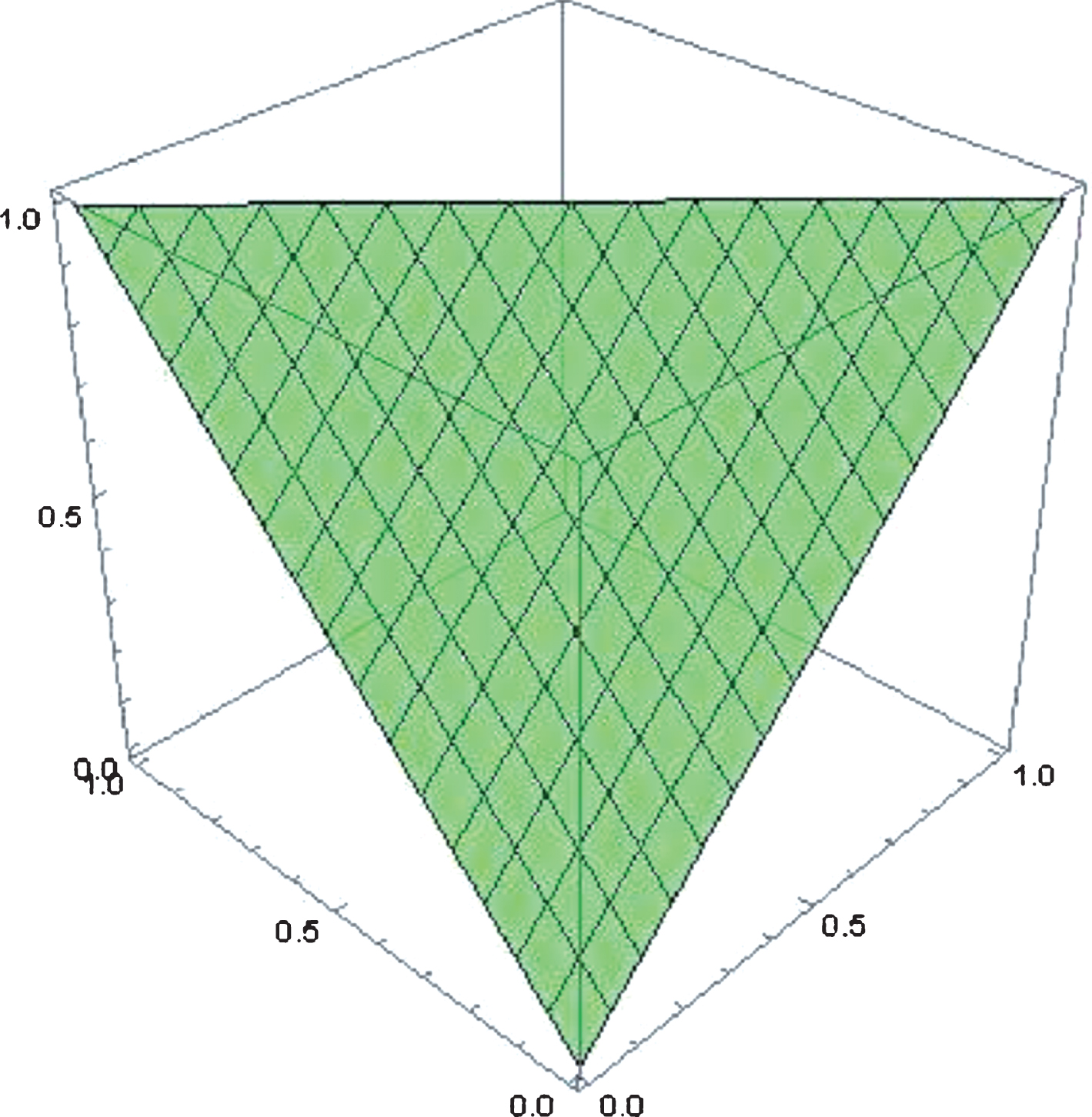
Graphical representation of membership, non-membership and indeterminacy grades for Intuitionistic fuzzy set.
In some real life problems, IFS cannot work when σ (ς) + ρ (ς) >1. To eradicate this drawback an extension of IFS was familiarized by Yager [8, 9] named as PFS, which is also known as IFS type 2 by Atanassov [4].

Graphical representation of membership, non-membership and indeterminacy grades for Pythagorean fuzzy set.
Furthermore,
In this section, we introduce the novel concept of linear Diophantine fuzzy set (LDFS). The proposed model has resemblance with well known linear Diophantine equation ax + by = c in the number theory. Since IFSs, PFSs and q-ROFSs have some limitations on membership/non-membership grades. In order to get rid of such limitations, we introduce the concept of LDFS with the addition of reference parameters. This idea remove the restrictions of membership/non-membership grades and the decision maker (DM) can freely choose the grades without any limitation. This structure also categorizes the problem by choosing different types of reference parameters. We discuss the structure of LDFS, its graphical representation and explain these concepts with the help of illustrations. In the whole manuscript, we shall use
Selection of industrial sewing machines
In the field of engineering, artificial intelligence, medical and MADM there are many physical applications of LDFS. One can be see a broad spectrum of these applications in this manuscript. Suppose that a company wants to buy some sewing machines for their line of work. They want to select the best machines with lots of features and having low cost. Let
Linear diophantine fuzzy set
Linear diophantine fuzzy set
If we change the physical meaning of these parameters then we can categorize the data in other sense in the form of LDFS. For second set we can consider α = easy to learn and β = not easy to learn. For these reference parameters the LDF data can be take the form as Table 2.
Linear diophantine fuzzy set
Here the reference parameters play an important role. They represent some specific property about machines like it is cheap, expensive, easy to learn or not, consume less electricity or not, etc. For every machine the values of parameter changes due to the change in variety of machines. The grades
Medication is the skill and practice of establishing the diagnosis, prognosis, treatment and prevention of disease. Medication plays an important function in the field of medicine for the recovery of patient in suitable time period. Every medication has some chemical and physical properties and some of them has multiple purposes and used to cure multi diseases. Let Q = {ς1, ς2, ς3, ς4, ς5} be the reference set where all the elements represent some medicines suitable for different infections such as sinusitis, pneumonia, ear infection, bronchitis and skin infections. We can easily categorize these medicines according to the selected disease or whatever physical property with safe or bad effects. If we consider the reference parameters as α = best effect against pneumonia and β = not highly effected to pneumonia. Then its LDFS is given in Table 3.
Linear diophantine fuzzy set
Linear diophantine fuzzy set
Every medicine has different salt and chemical combination in it. Then according to their quality and under the observation of its effects to the patient, we can assign them different amounts of parameters. These parameters show that how much we need factors from the corresponding medicine and their grade values represent that how much they contain the corresponding parameter. If we change parameter α = best effect against skin infection and β = not highly affected to skin infection or α = less side effects and β = more side effects, etc. then we can construct more LDFSs on the same reference set. This criteria help a physician to recommend best and suitable medicine to the patient for his disease. The final decision can be easily evaluated by using the appropriate algorithm on the constructed LDFSs. This approach increases the space of satisfactory and dissatisfactory grades with the addition of reference parameters.
In this part, we present graphical representation of LDFS with different combinations of reference parameters and observe that how its space in greater than the space of IFS and PFS. Figure 3, Figure 4 and Figure 5 show the comparison of IFS, PFS and LDFS, while Figure 6, Figure 7, Figure 8, Figure 9, Figure 10 and Figure 11 show the graphical view of LDFS with different pair of reference parameters.

Intuitionistic fuzzy set.
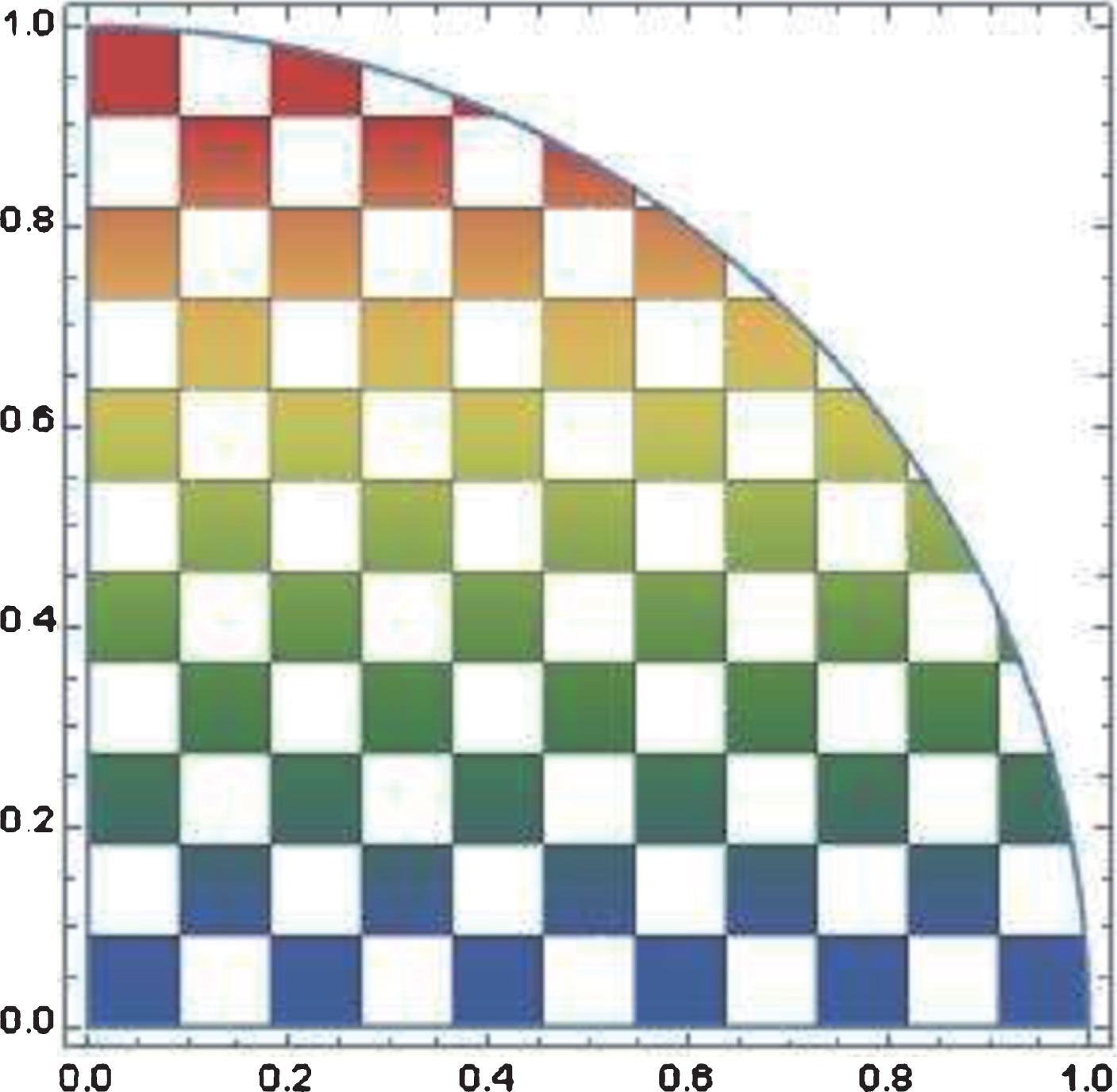
Pythagorean fuzzy set.
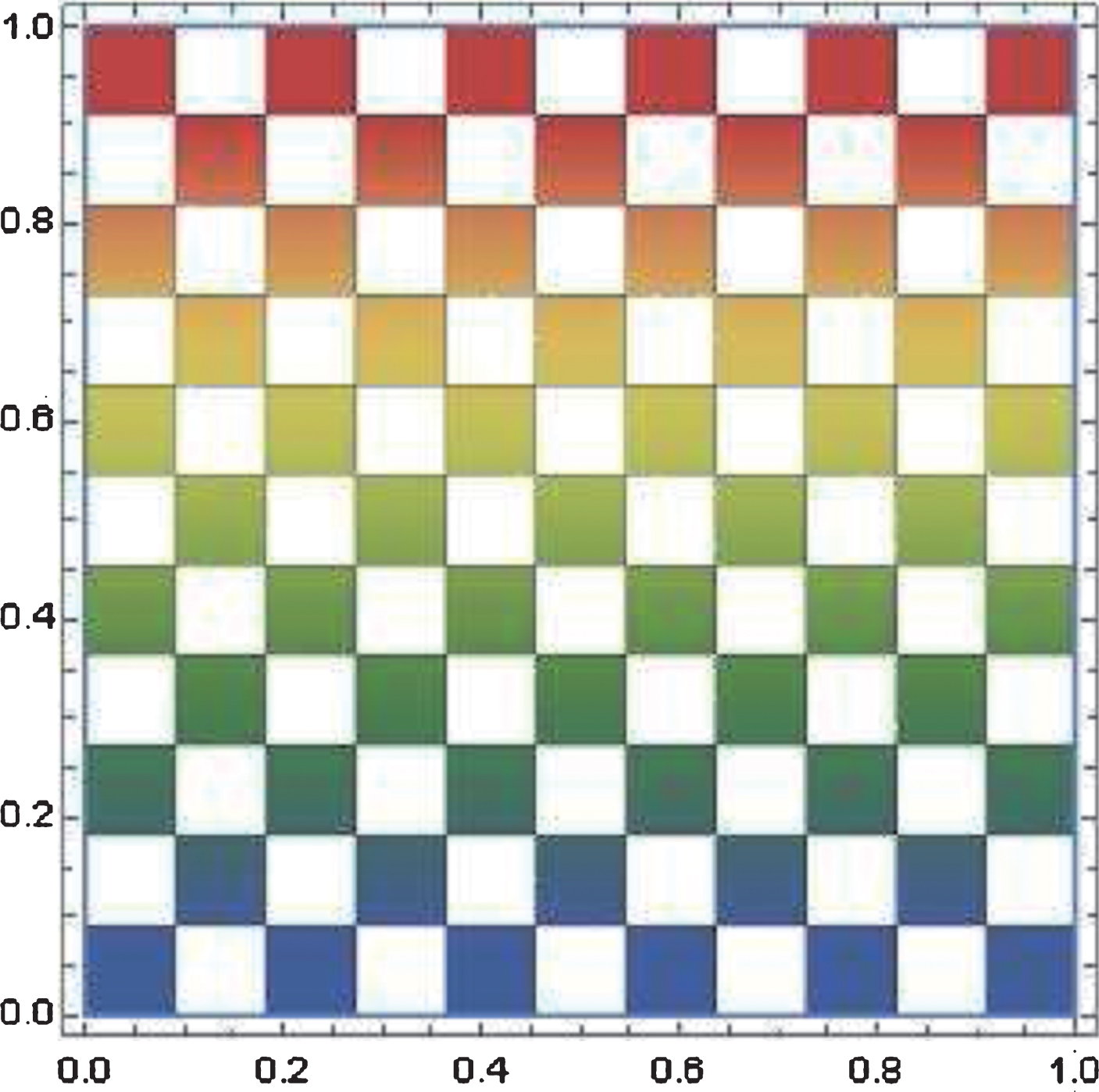
Linear Diophantine fuzzy set.
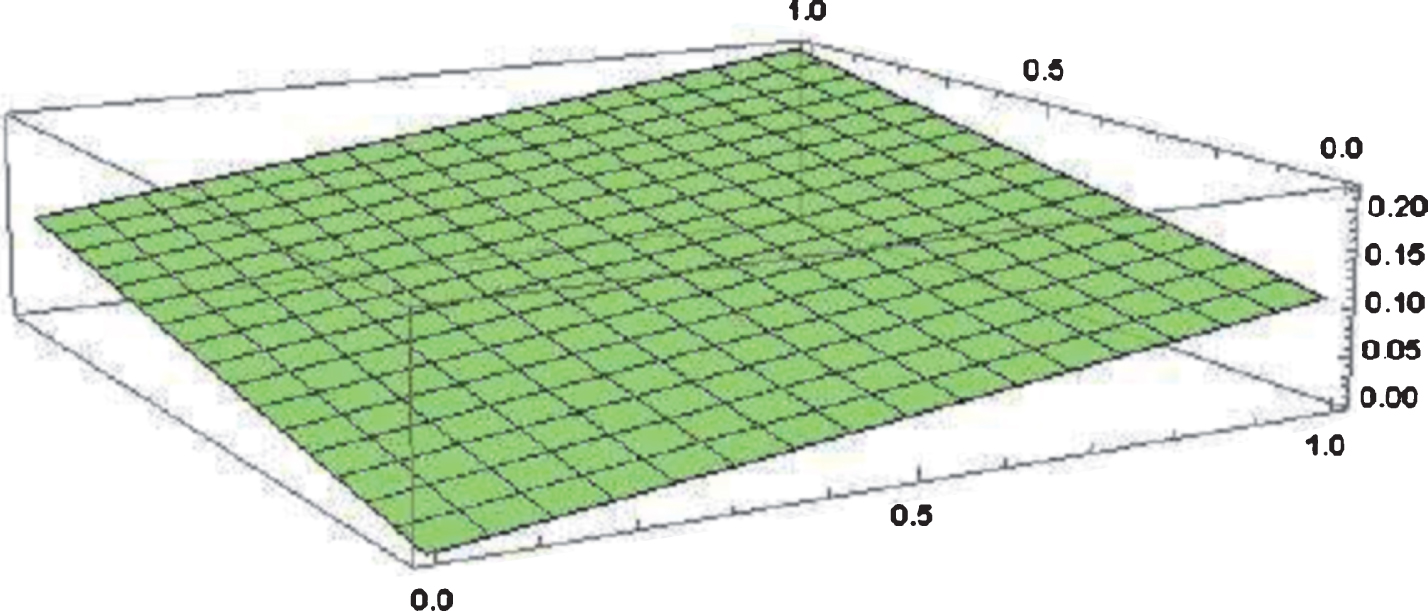
LDFS with 〈α, β〉 = 〈0.11, 0.11〉.
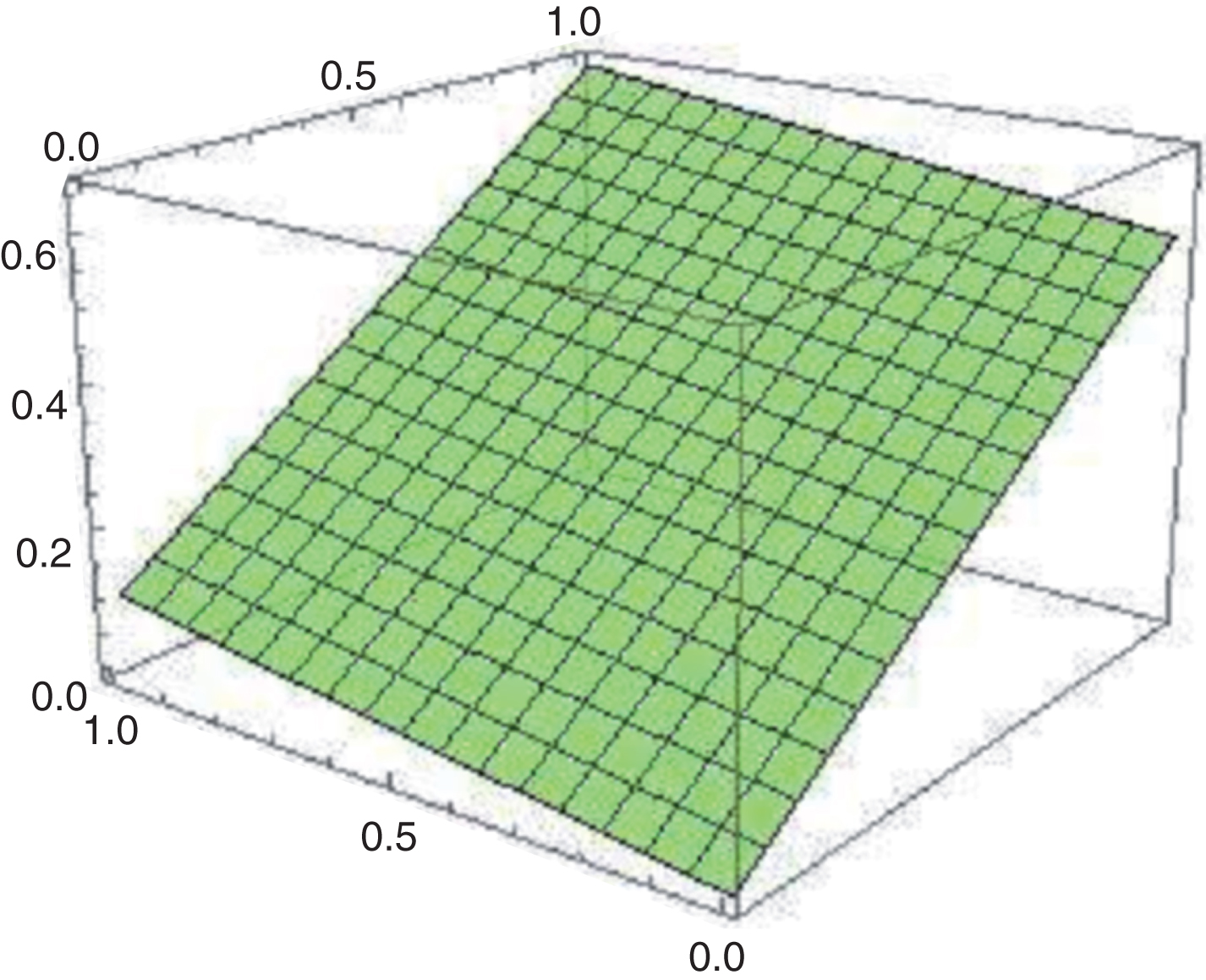
LDFS with 〈α, β〉 = 〈0.55, 0.11〉.
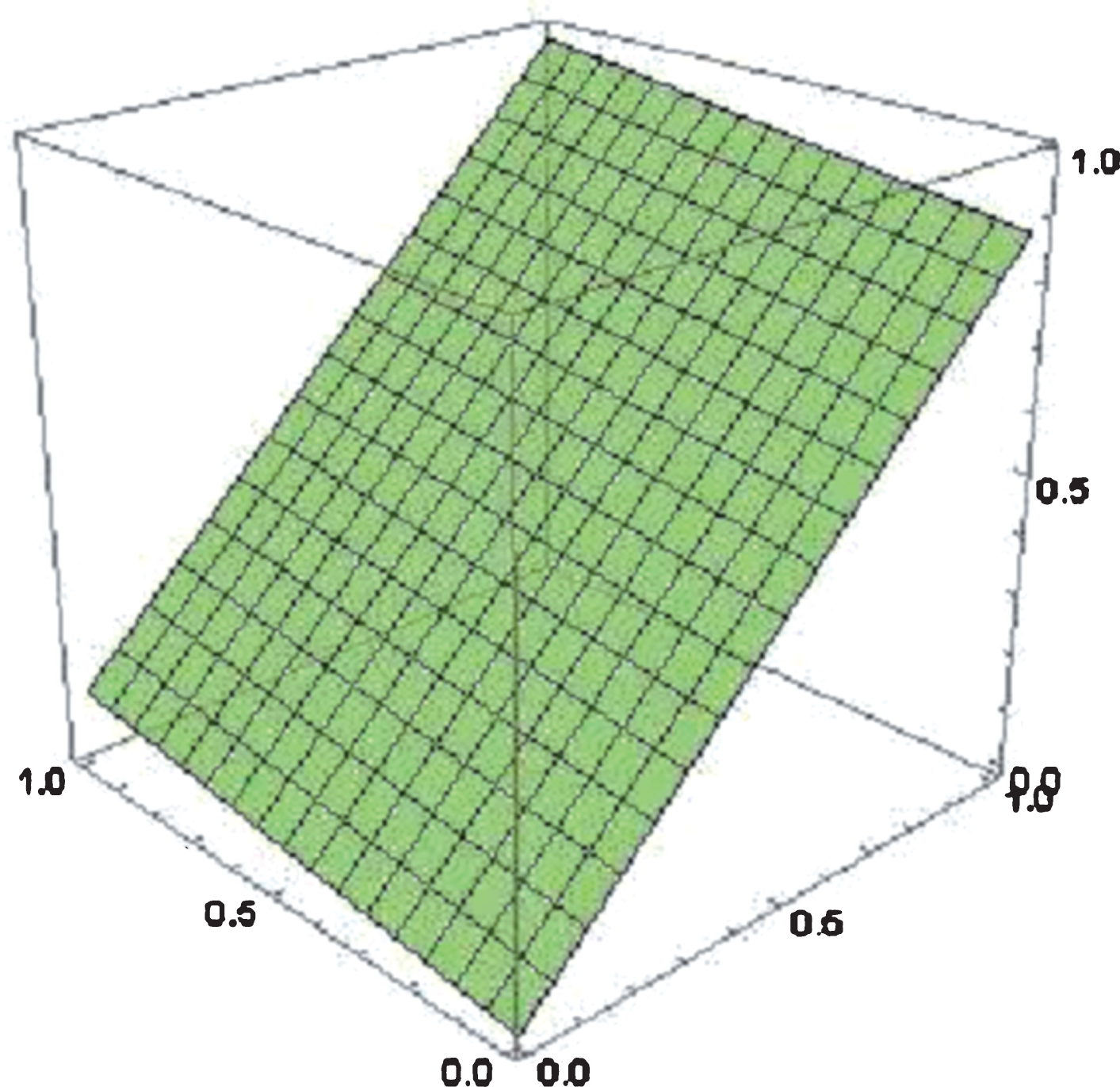
LDFS with 〈α, β〉 = 〈0.88, 0.11〉.
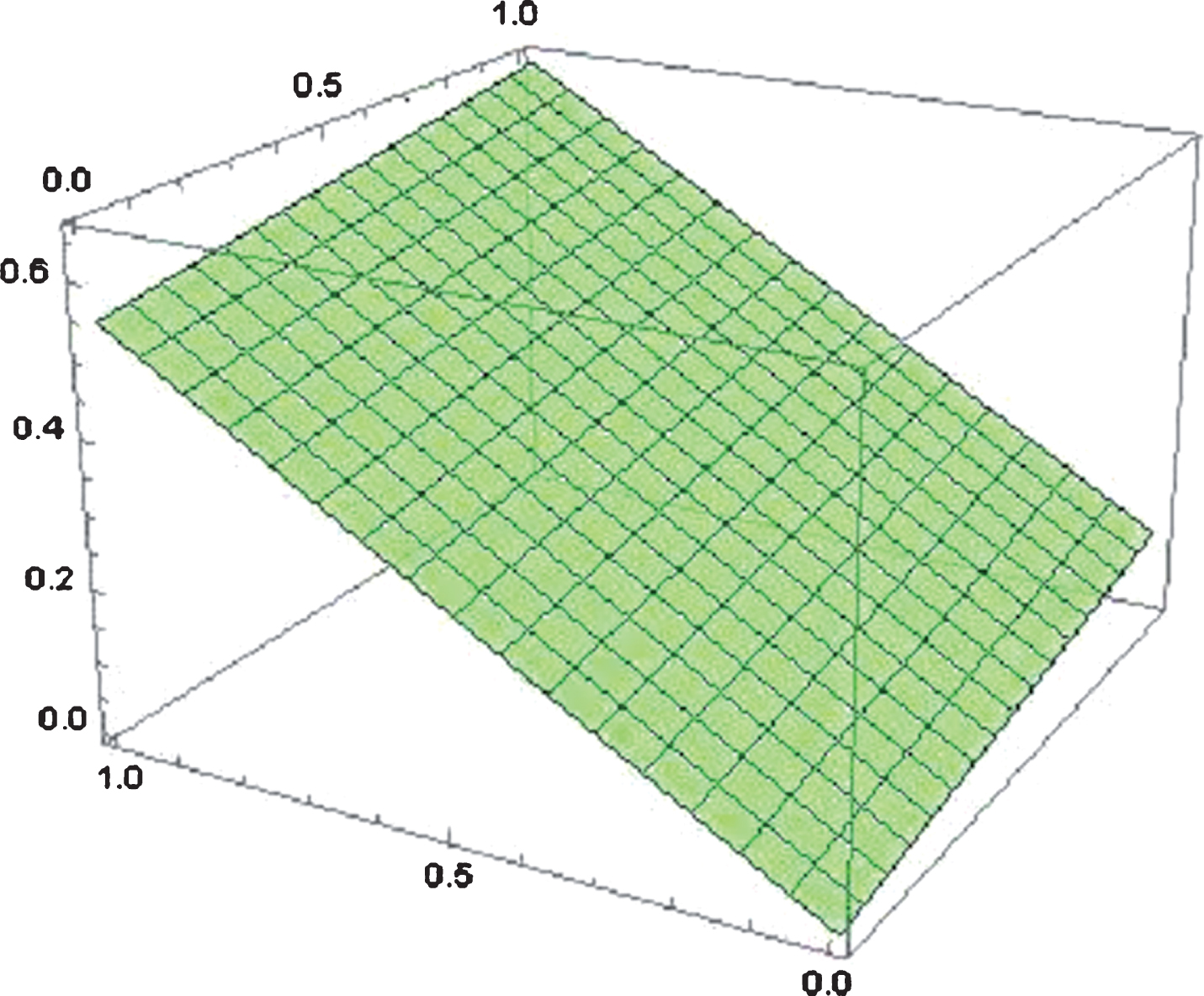
LDFS with 〈α, β〉 = 〈0.11, 0.55〉.
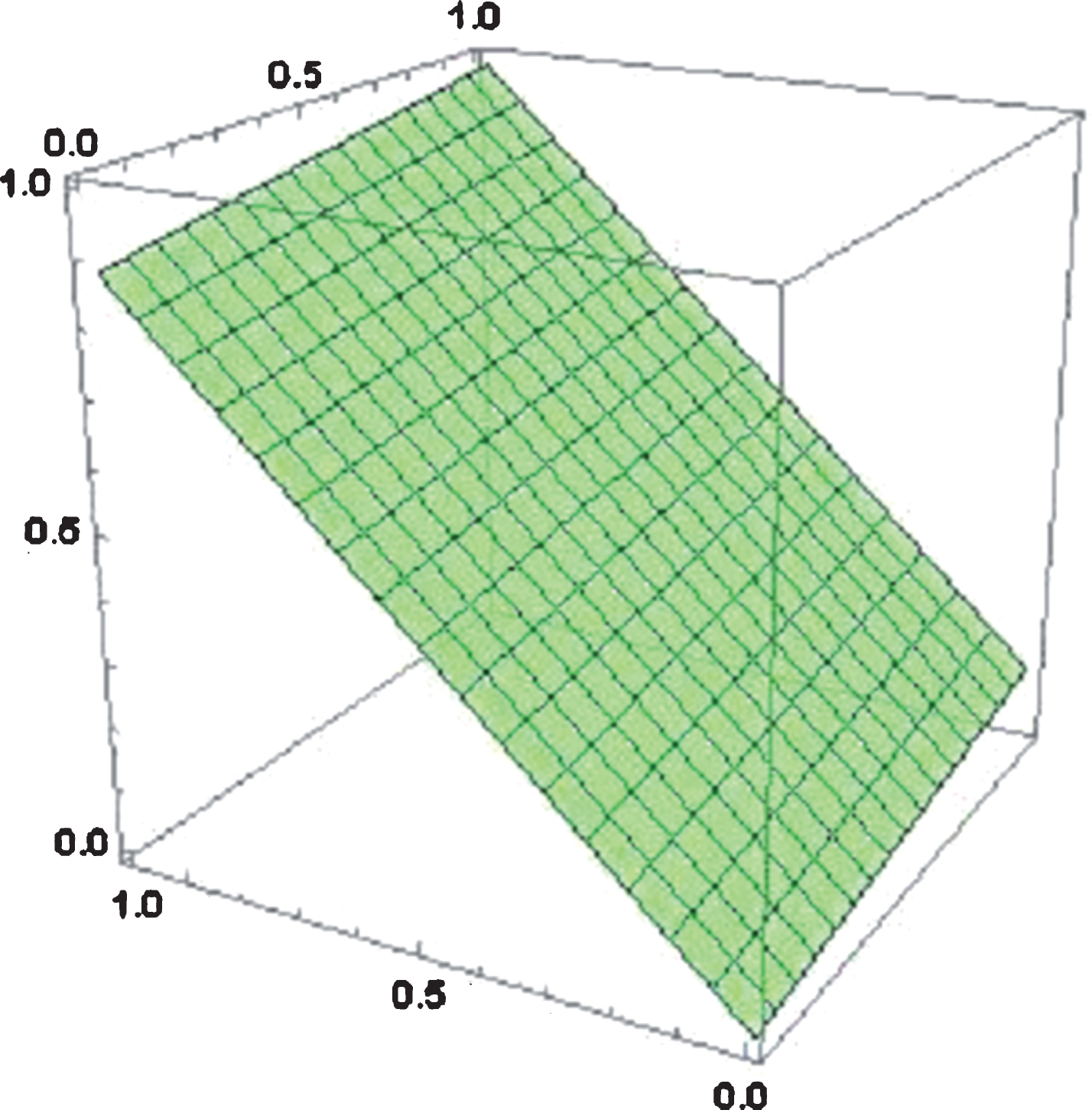
LDFS with 〈α, β〉 = 〈0.11, 0.88〉.
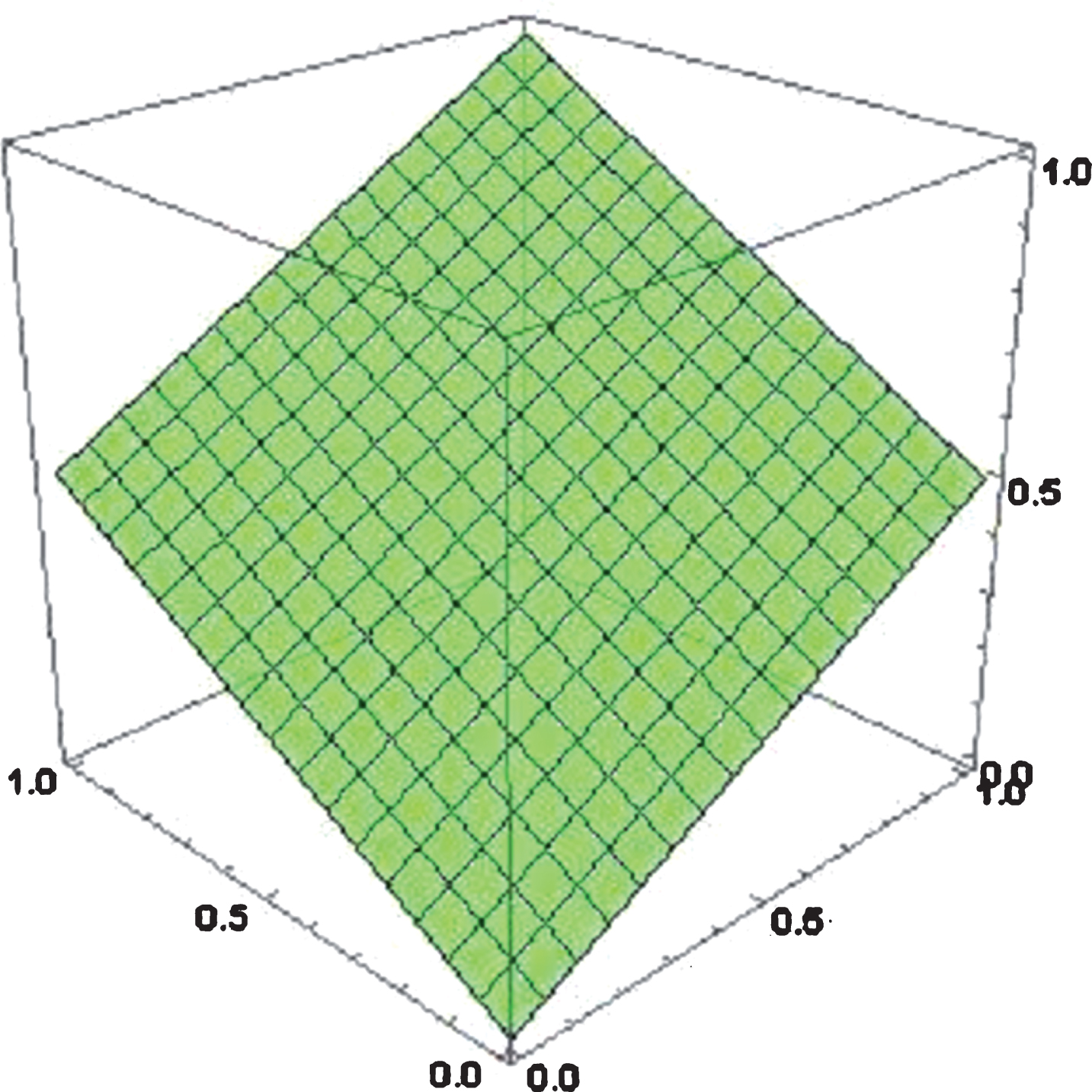
LDFS with 〈α, β〉 = 〈0.5, 0.5〉.
In this part, we define some operations on LDFNs which are also applicable for LDFSs.
•
•
•
•
•
•
•
•
•
•
•Clearly by using Definition 3.4 ℑ1 ⊆ ℑ 2
•ℑ1 ∪ ℑ 2 = (〈0.91, 0.36〉, 〈0.64, 0.27〉) = ℑ 2
•ℑ1 ∩ ℑ 2 = (〈0.81, 0.47〉, 〈0.52, 0.39〉) = ℑ 1
•ℑ1 ⊕ ℑ 2 = (〈0.9829, 0.1692〉, 〈0.8272, 0.1053〉)
•ℑ1 ⊗ ℑ 2 = (〈0.7371, 0.6608〉, 〈0.3328, 0.5547〉) If
•
•
Geometrical interpretation of the elements of LDF objects
The concept of IFS, intuitionistic fuzzy propotional calculus (IFPC) and intuitionistic fuzzy model logic (IFML) was established by Atanassov [4, 5]. He also investigated IF logics and its various properties in his papers. We extend this work for our new model named as LDFS and discuss its geometrical interpretation. The idea explain about the space of LDFSs and elaborate the operations geometrically, which will be helpful for new researchers to understand the idea of LDFS. Let
The pair 〈α, β〉 are reference parameters and there physical sense can be change in different situations. We consider their arbitrary values with the condition α + β ≤ 1 for this geometrical interpretation. They increase the space of membership and non-membership grades as detail is given in previous sections. The whole space is based on
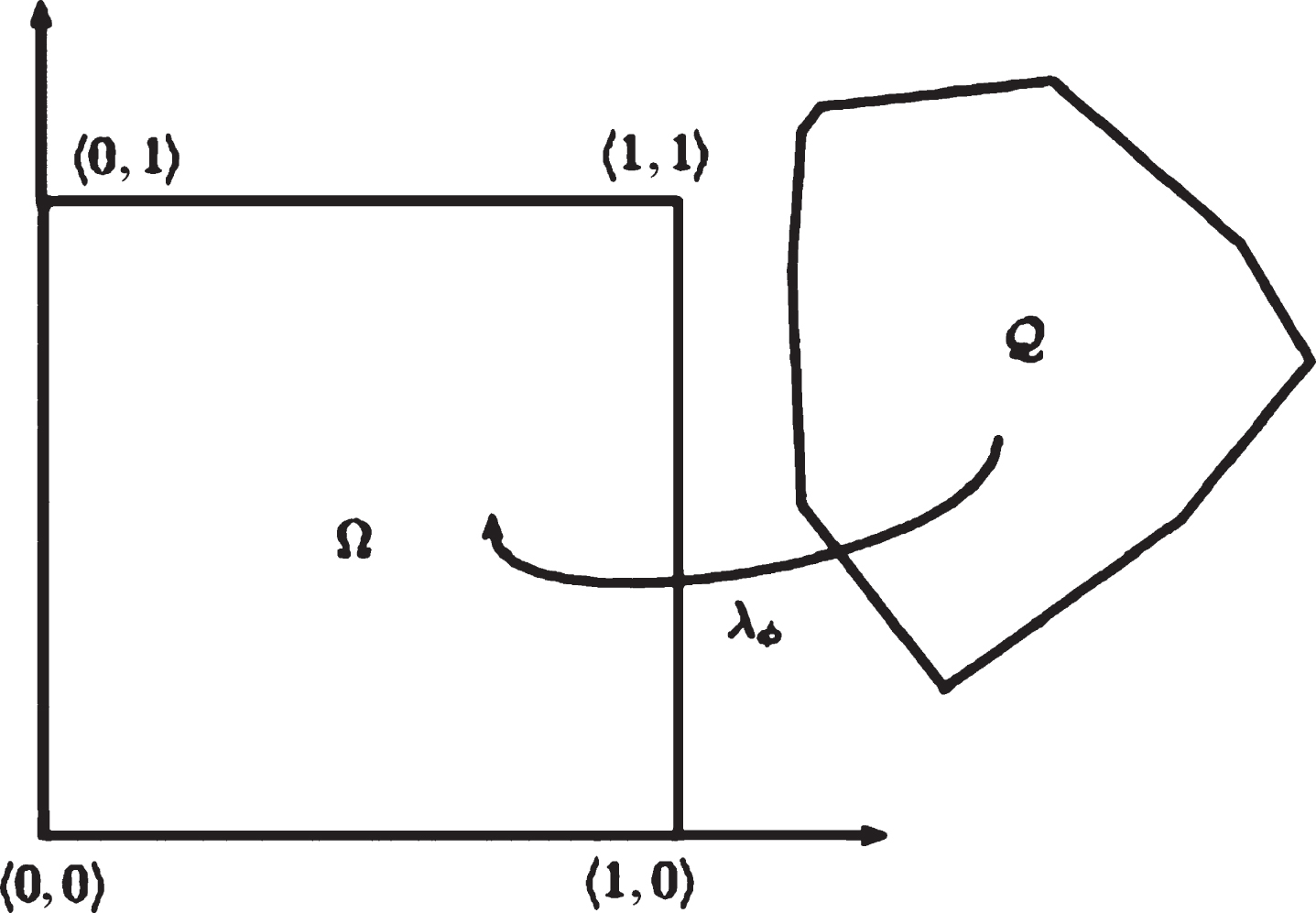
Geometrical interpretation of union and intersection of LDFSs.
If
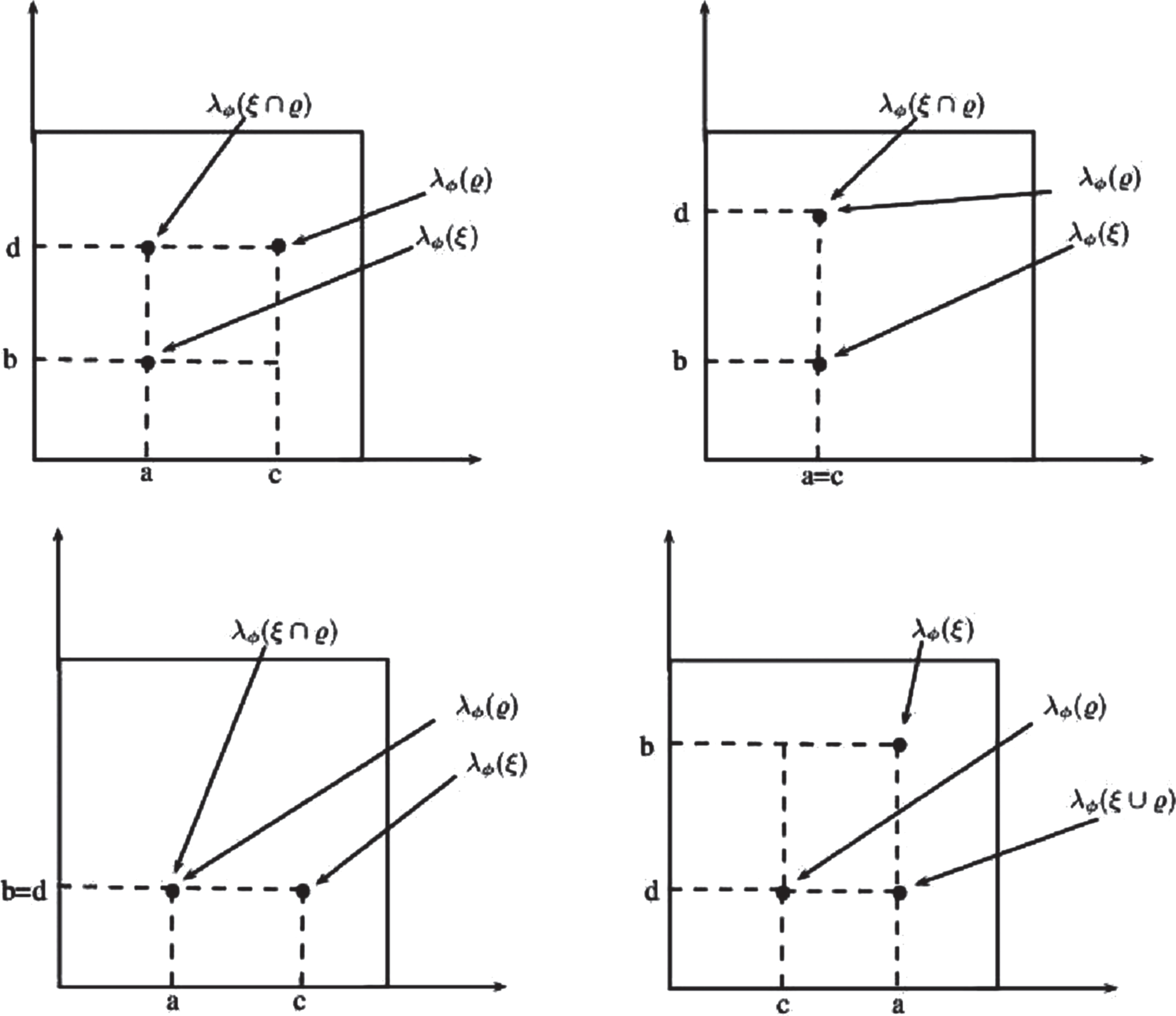
Geometrical interpretation of union and intersection of LDFSs.
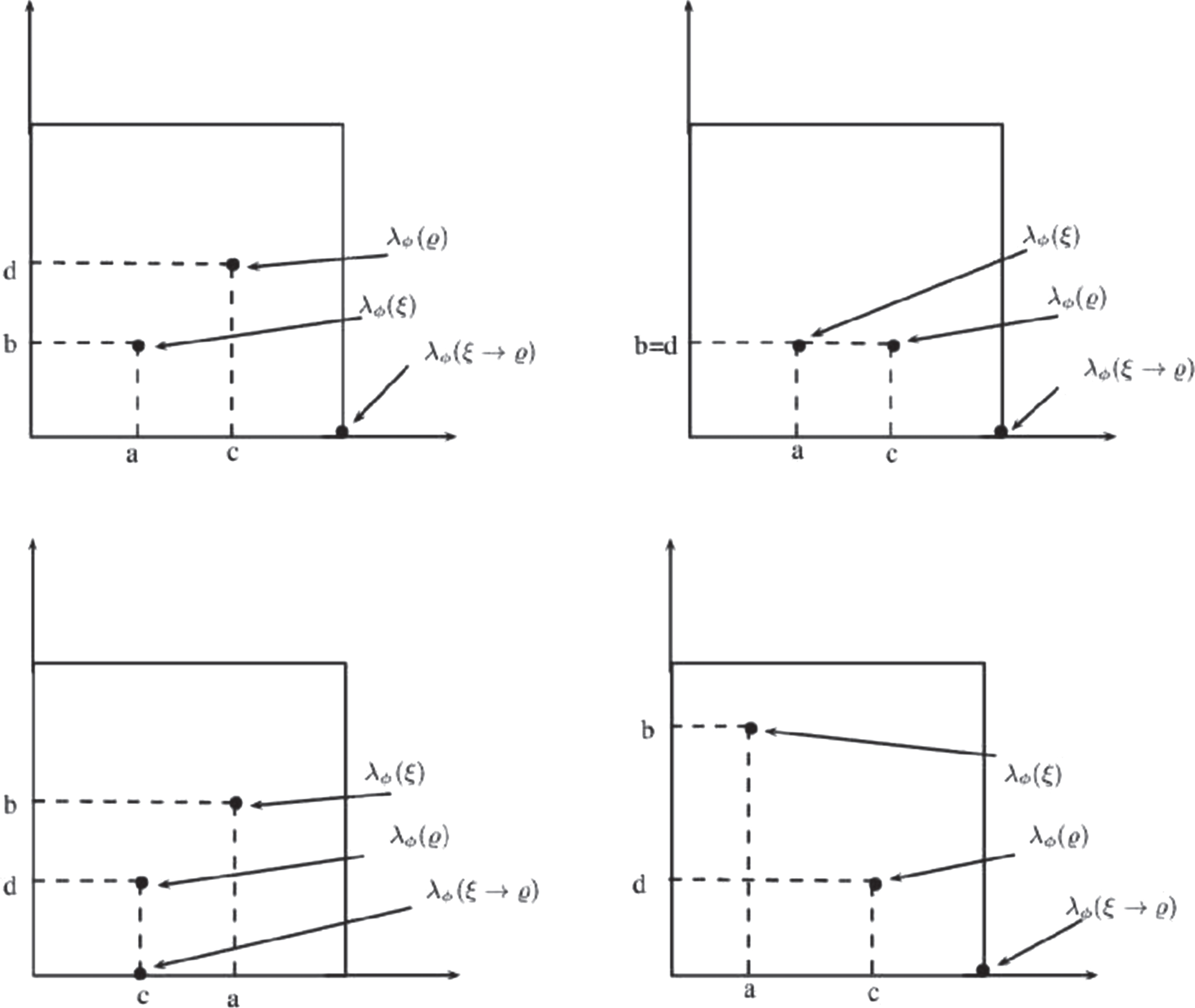
Geometrical interpretation of implication of LDFSs.
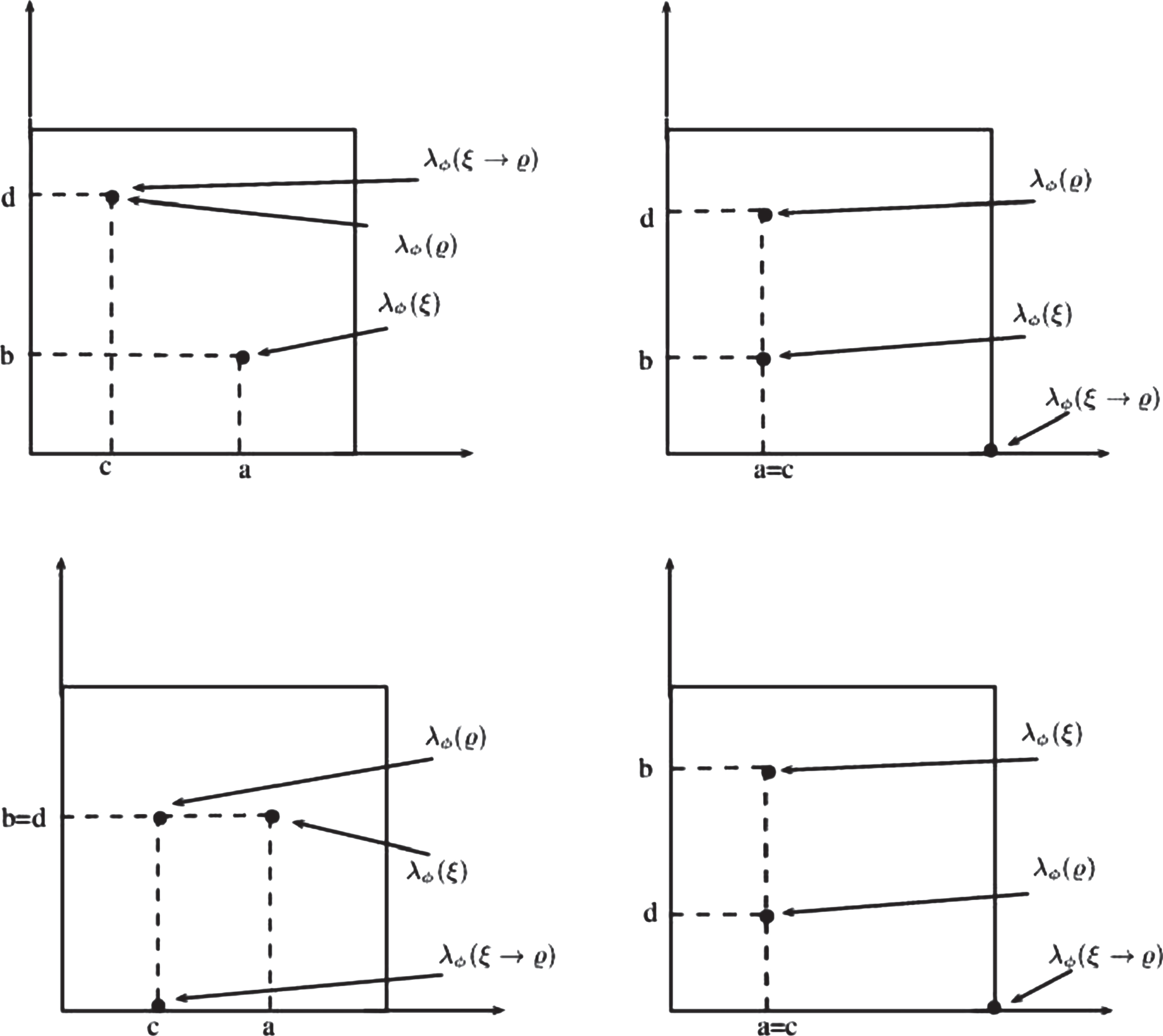
Geometrical interpretation of implication of LDFSs.
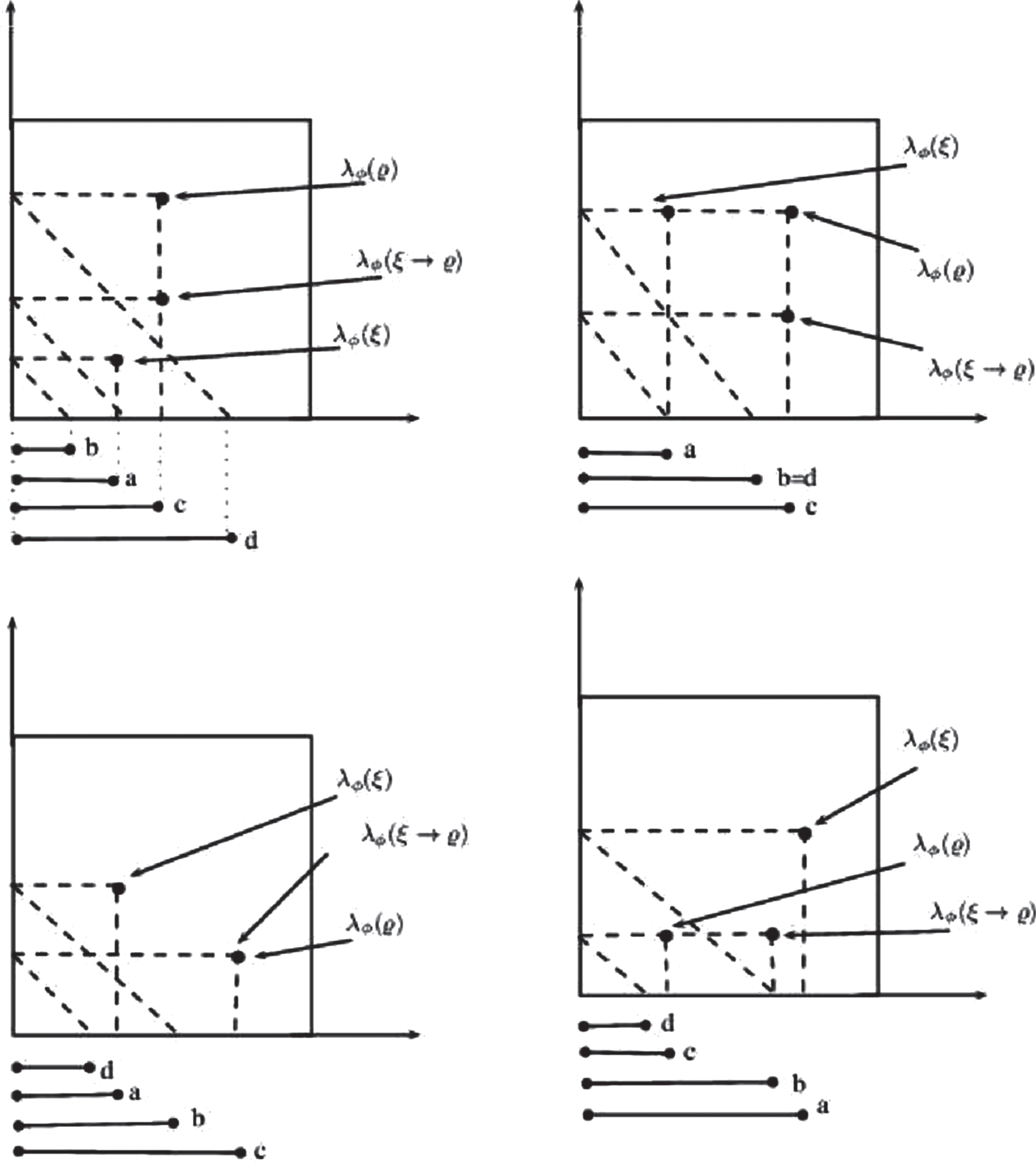
Geometrical interpretation of implication of LDFSs.
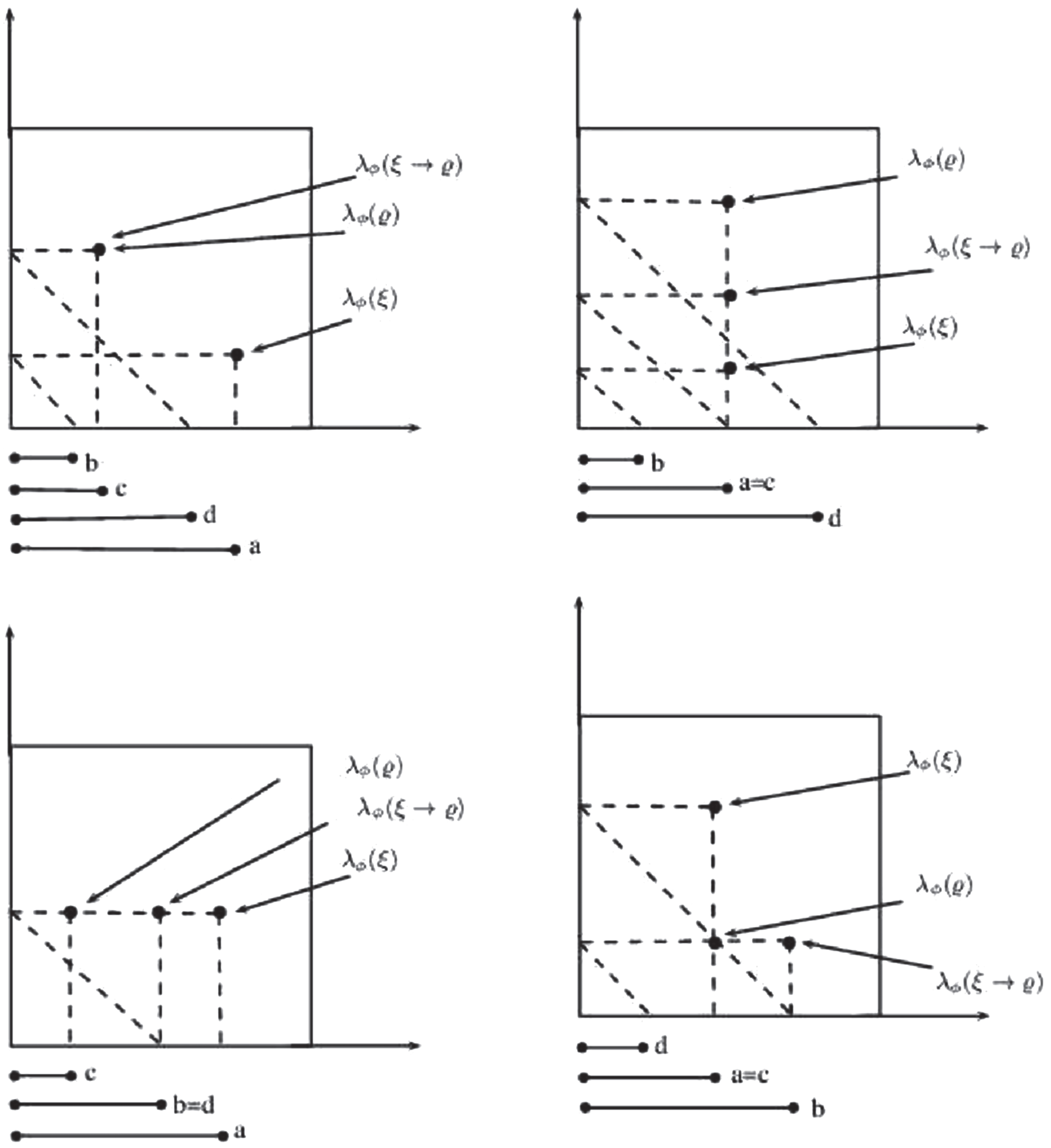
Geometrical interpretation of implication of LDFSs.
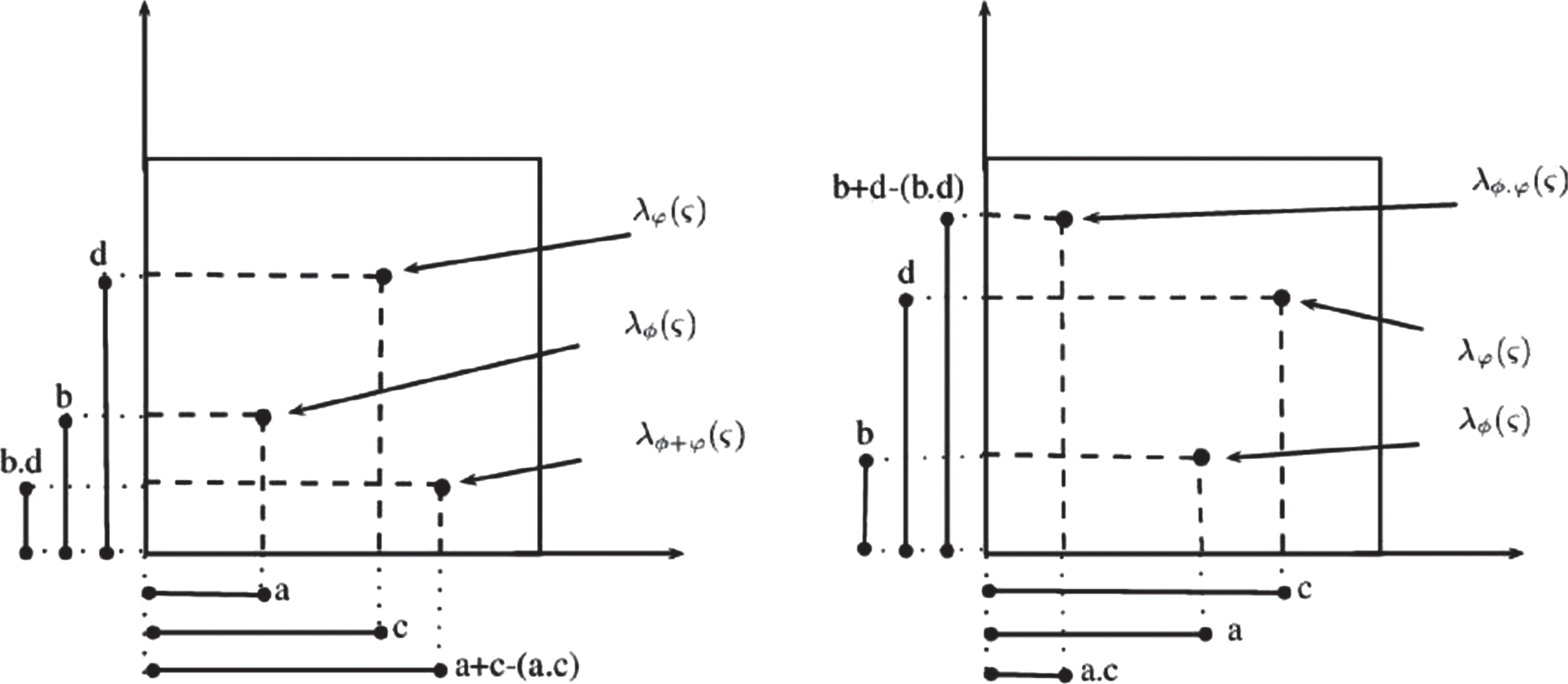
Geometrical interpretation of addition and multiplication of LDFSs.
We can do geometrical interpretations of various operations based on LDFSs and its logics, we explain some of its operations to understand the idea of LDFSs and reference parameters used in this model. It is important to note that all the graphical work will be same for geometrical interpretation of reference parameters but there we use the region Ω as a right triangle instead of unit square same as for IFSs due to the condition 0 ≤ α + β ≤ 1.
In this section, we establish LDFTS, interior, closure, exterior and frontier for LDFSs with the addition of LDF-subspace. We present various illustrations to understand the these ideas. We present an important theorem to see the fact that some topological results which hold for crisp set theory do not hold in LDFS-theory.
The members of
LDFS
LDFS
LDFS
Then clearly an assembling
LDFS
LDFS
LDFS
LDFS
Then
For the comparative analysis in MADM of LDFNs, we describe some score functions and accuracy functions. The notion of score function was initiated by Chen and Tan [23] for IFSs. Similar concept was proposed by Tversky and Kahneman [24]. That concept can be stretched out for hybrid models of fuzzy numbers and for LDFNs. There are more than one mappings for finding the score due to different strategies of different operators used in the algorithm. We define different score functions in this manuscript to determine the behavior of LDFNs under the influence of these score functions and then we compare their results.
In above definition we can simplify it as a binary relation
In above definition we can simplify it as a binary relation
The ESF is modified form of SF. The values in ESF is bounded in [0, 1] instead of [-1, 1]. ESF satisfy many properties some are listed below.
We can easily proof this by using the LDFS operations and by mathematical induction same as used in [47] by Xu. In LDFWGA operator, we use
A novel approach to MADM based on LDFS and LDFWGA
In this section, we present a novel approach to MADM based on LDFTS and LDFWGA operator. We present two different algorithms for the same numerical example and by using different types of score functions we get different ordering for final decision.
Numerical example
The significant movement within the academic community is to publishing a research article in a peer-reviewed journal. It supports you to linked with other researchers, get our research and name into rotation, and promote our research and ideas. To find an appropriate journal for our subject and writing style is also vigorous, so we can tailor your manuscript in to it and increase our probabilities of publication and broader gratitude. Here we present an application of MADM for publishing a research article in an appropriate journal.
Suppose that a PhD scholar Mr.X writes an interesting and novel research article in the field of Mathematics and presents its applications in daily life problems. He wants that his paper would be published in a well reputed and good impact factor journal. He and his two supervisors select a list of four journals for this publication. He is confused that which journal is most suitable for his manuscript. He can use a mathematical modeling for his decision, but we use our new concept of LDFS for the decision. This is superior than others due to free choice of grades of attributes and parameterized categorization. So this model gives best decision for the choice of suitable journal.
Let
According to a survey we can collect some data in the form of LDFSs about the selected journals from different faculty members and from research scholars of different well reputed universities. If we select three universities than we have three LDFSs for the input data given in Table 10, Table 11 and Table 12.
LDFS
LDFS
LDFS
LDFS
In this part, we construct two different algorithms based on LDFTS and LDFWGA operator. We calculate the scores using different score functions and at last we compare the results obtained from both algorithms. The reason of showing two different algorithms is that to elaborate the concept of LDFS and its variety to use in different situations. The flowchart diagrams of proposed algorithms can be seen in Figure 19 and 20.
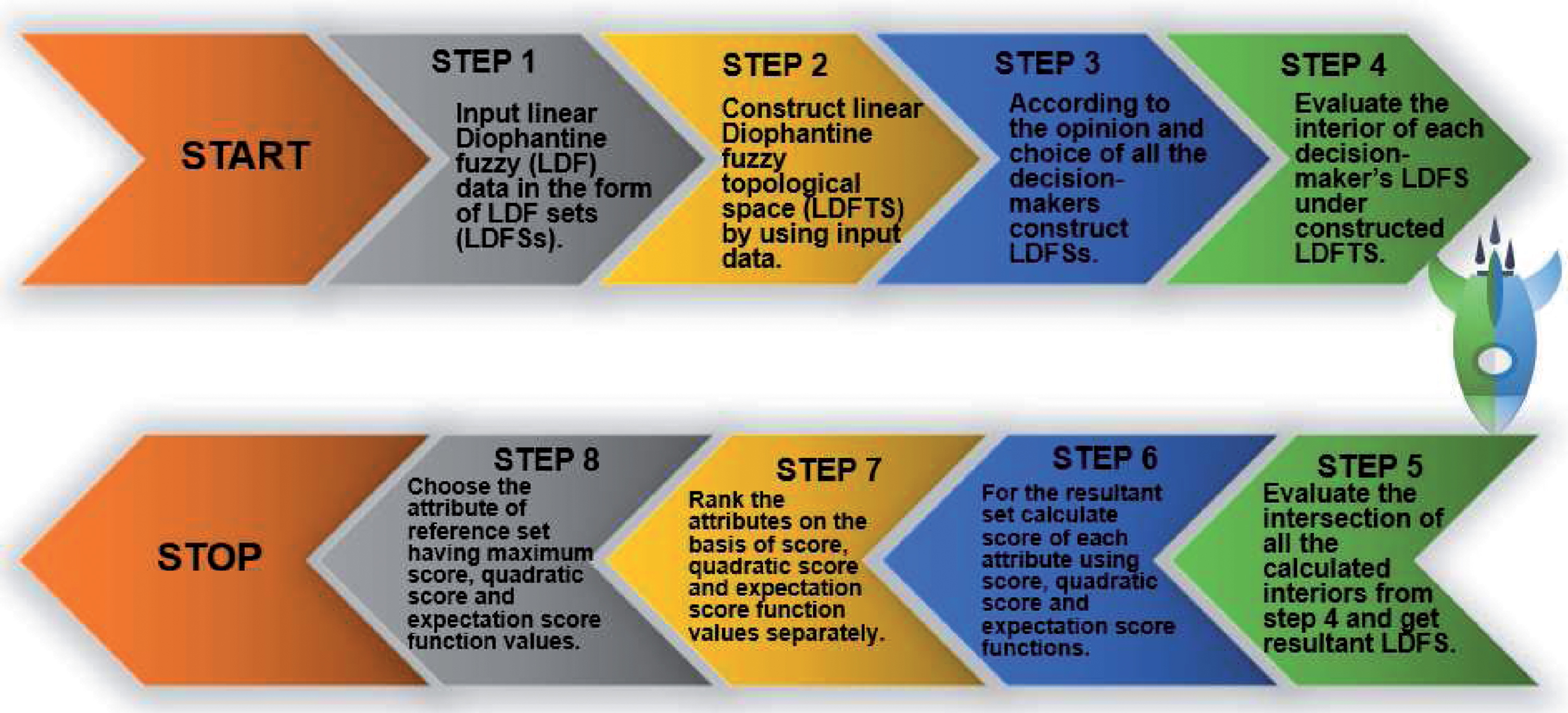
Flowchart diagram of proposed algorithm 1.
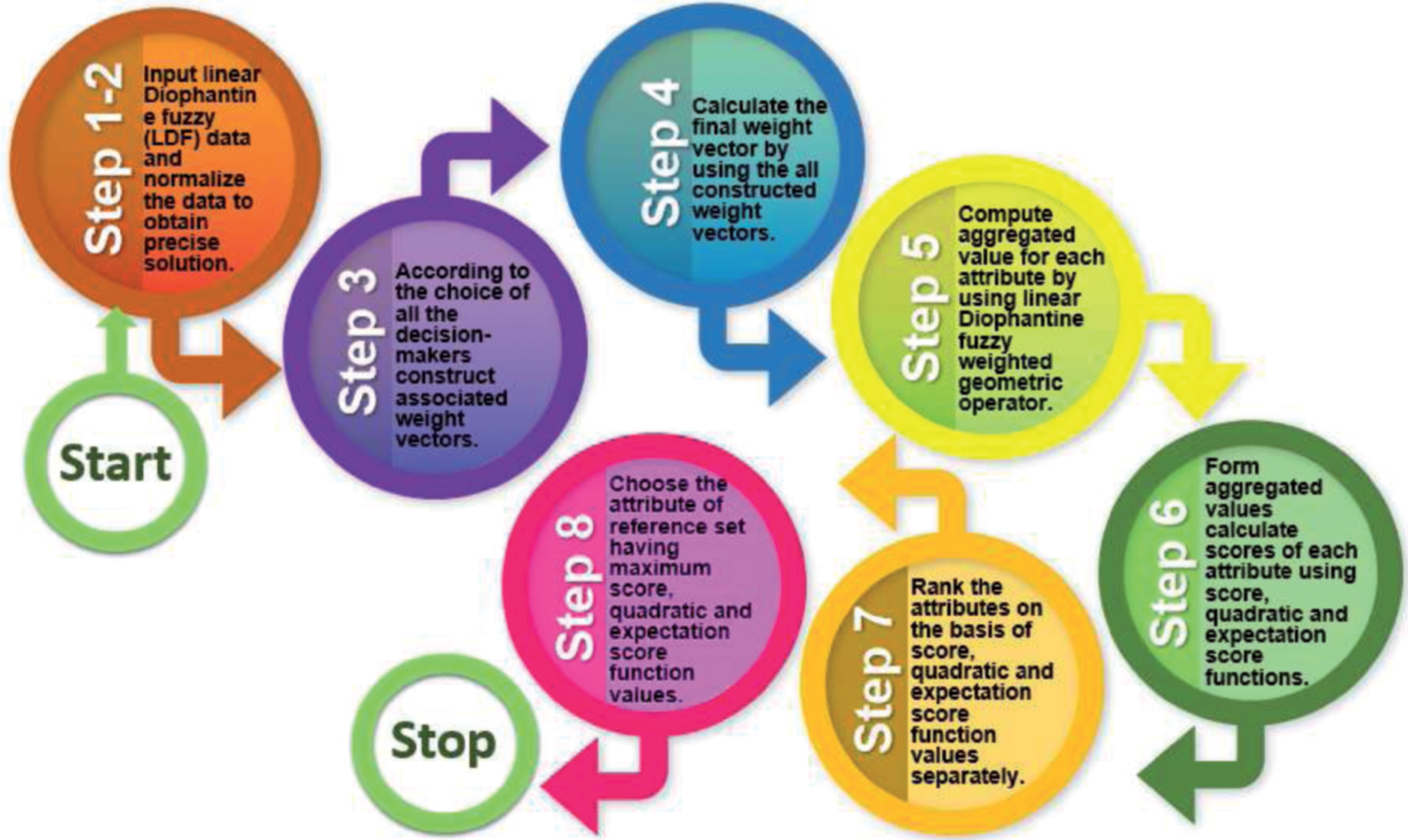
Flowchart diagram of proposed algorithm 2.
For the input LDFSs the assembling
Now we will find the interior of LDFSs
LDFS
LDFS
LDFS
Student’s opinion
Supervisor 1’s opinion
Supervisor 2’s opinion
We find final weight vector by using step.4 in algorithm 2 given as ζ = (0.6, 0.27, 0.13). Clearly,
In this section, we discuss the validity of proposed method, its flexibility of aggregation to deal with different inputs and outputs, the influence of score functions, sensitivity analysis, superiority and finally the comparison of proposed approach with the existing methodologies.
Ranking order for algorithm 1
Ranking order for algorithm 1
Ranking order for algorithm 2
Comparison analysis of LDFS with existing approaches
We have studied some extensions of fuzzy sets including IFSs, PFSs and q-ROFSs. We have established a new extension of fuzzy set named as linear Diophantine fuzzy set (LDFS) which is more efficient and flexible structure to deal with uncertainties. LDFS provides the additional characteristics of reference parameters α and β. We have presented the geometrical properties of LDFS to compare it with other existing extensions of fuzzy sets. The space for LDFSs is larger than IFSs, PFSs and q-ROFSs. For the comparison of linear Diophantine fuzzy numbers (LDFNs), we have introduced various score functions and accuracy functions. We have extended the idea of LDFS to linear Diophantine fuzzy topological space (LDFTS) and linear Diophantine fuzzy weighted geometric aggregation (LDFWGA) operator. We have established some significant results in the framework of LDFS and LDFTS with the help of illustrations. We proposed two different algorithms for multi-attribute decision making (MADM) based on LDFTS and LDFWGA. We have presented an application of the proposed MADM methods with the help of a numerical example for the selection of an appropriate journal for publication. We have presented a brief comparison between the suggested and existing approaches and observed the influence of score functions in the aggregated outcomes.
We hope that the findings in this manuscript will be helpful for the researchers and decision makers for solving various real world problems. Our future work will aim to explore the real life applications related to concepts based on linear Diophantine fuzzy rough set (LDFRS), linear Diophantine Hesitant fuzzy set (LDHFS), linear Diophantine fuzzy graphs (LDF-graphs) and interval valued linear Diophantine fuzzy set (IVLDFS). Our proposed model may be extended in new directions including TOPSIS, VIKOR, AHP, information aggregation, correlation, distance and similarity measures.