



Abstract
Most recently, uncertain and fuzzy factors appear frequently in group decision making (GDM) researches. A more realistic approach may be to use scientometric tools for carrying out the systematic review to disclose the fast-growing uncertain and fuzzy GDM methods. The aim of this paper is to show a comprehensive presentation of the state of these approaches. To achieve this goal, a systematic literature review of researching articles, which have been published in Science Citation Index (SCI) journals since 1965, is proposed. And this study mainly uses the software of CiteSpace which has been frequently used in data visualization field due to its universality in order to map the main trends in this subject. This work considers the leading categories, journals, authors and references, and the results indicate that the GDM research would continue to flourish. Additionally, some possible approaches that could improve the current fuzzy GDM methods are presented.
Introduction
Decision making is a common process with that people come face to face many times in ordinary practices. And among a few of options, it is aimed at choosing the one that is supposed to yield a higher payoff. A general phenomenon of the decision making process is that all the people concerned express their different preferences and not to make a decision by imposing one’s will on subordinates. In the 1940s, the concept of group decision making (GDM) was proposed [1].
In such a case, the GDM process would be complicated. The complexity that arises from the combination of these decision makers’ activities is reason enough to increase the intersection of discipline and the perspective of the scholars. Based on many disciplines such as mathematical economics, sociology, behavioral science, psychology, information science and so on [2–6], GDM has gradually formed its own theoretical system and research methods, and become an important part of modern decision-making theory.
GDM is a specific situation when individuals collectively make a choice from the alternatives before them. Therefore, the process of opinion fusion could be the most important thing. Dong et al. provided a clear and detailed perspective on the different types of fusion approaches [7–9]. Generally, the group of decision makers is required to give opinions about the many options which have been discussed. In the present GDM problems, decision makers probably cannot express their assessments with exact numerical values, and consequently to adopt linguistic assessments instead of numerical values. That has become more common in some areas. Some representative linguistic models and computational processes have been introduced to deal with linguistic information in GDM problems [10–12]. Furthermore, Li et al. considered the personalized individual semantics model creatively in linguistic group decision making [13–15].
Most GDM problems have multiple objectives which cannot be optimized simultaneously due to the inherent incommensurability and conflict between these groups. Alongside the idealized portrayal, the consensus-based decisions are realizable in GDM applications. Hence, the studies of consensus processes [16–18] are widely analyzed, and a variety of interesting simulation examples are provided as case studies for solving GDM problems [19, 20].
In such cases, the use of scientometric tools for carrying out the systematic review becomes essential to disclose other fast-growing uncertain and fuzzy GDM methods. The aim of this paper is to show a comprehensive presentation of the state of these approaches, and it reports the results of a systematic literature review of researching articles published in Science Citation Index (SCI) journals since 1965, especially taking into account their importance and impact in fuzzy GDM researches.
The rest of this paper has been organized as follows. Next in Section 2, the basic knowledge of research tools and data is introduced. Following this, visual relationship networks based on Web of Science (WOS) categories, article keywords, and influential authors are introduced and analyzed in Section 3, and therefore hot research topics can be concluded. Finally, conclusions and research challenges are presented in Section 4.
Research tools and data
As an interdisciplinary field, the visualization technology which has become a fast growth, successfully offers an important opportunity to advance the understanding of GDM problems. Particularly based on personalized data cleaning, the networks of co-cited references from GDM literature could be constructed and analyzed. The above solutions require the software of CiteSpace [21], which is developed by Prof. Chen at Drexel University. The co-cited information between different scientific theories or ideas could be valuable, because a meaningful connection is made when other articles cite the specific documents together. The software can visualize that connection in the form of co-citation networks, and has made very important discoveries in many scientific domains [22–26].
Based on the above reasons, CiteSpace has been chosen in this study and can give a solution to show the development and progress in the uncertain and fuzzy direction of GDM research.
The content of WOS could be measured by tens of millions of records and back files which were fully indexed dating back to 1898. Currently, a conjunct data-set of 3,207 articles has been collected from WOS as the raw objective data. It was started with a topic search for “group decision making” between 1965 and 2018 and centered on original research articles. When the literature of GDM appeared, their cited references were also included.
Progress of fuzzy GDM
Documents published in concentrated categories and journals
The data set available for this study was more than three thousands in size, generally in the form of published articles. One of the initial things which have been found is that a considerable amount of literature in GDM area falls into different WOS categories (Table 1).
Top 10 WOS categories in GDM area
Top 10 WOS categories in GDM area
At the top of the list is Computer Science. In Computer Science, Artificial Intelligence (AI) is intelligence demonstrated by machines, in complete contrast to the natural intelligence displayed by people and other living things. It is a very important GDM branch that has occurred along the way with computer-aided, or AI-based decision-making system. And in the category of Computer Science Artificial Intelligence, more than five hundred GDM related articles were published between 2014 and 2018.
Figure 1 is a visual diagram to Table 1, illustrating in more details and typical categories of the GDM research. The category of Engineering ranked second in this survey, and sometimes even overwhelmed Computer Science in importance. But over time, as a result of its continuing development, a part of cutting edge research has receded, in which Business & Economics, Management, Psychology and Social Sciences are included.
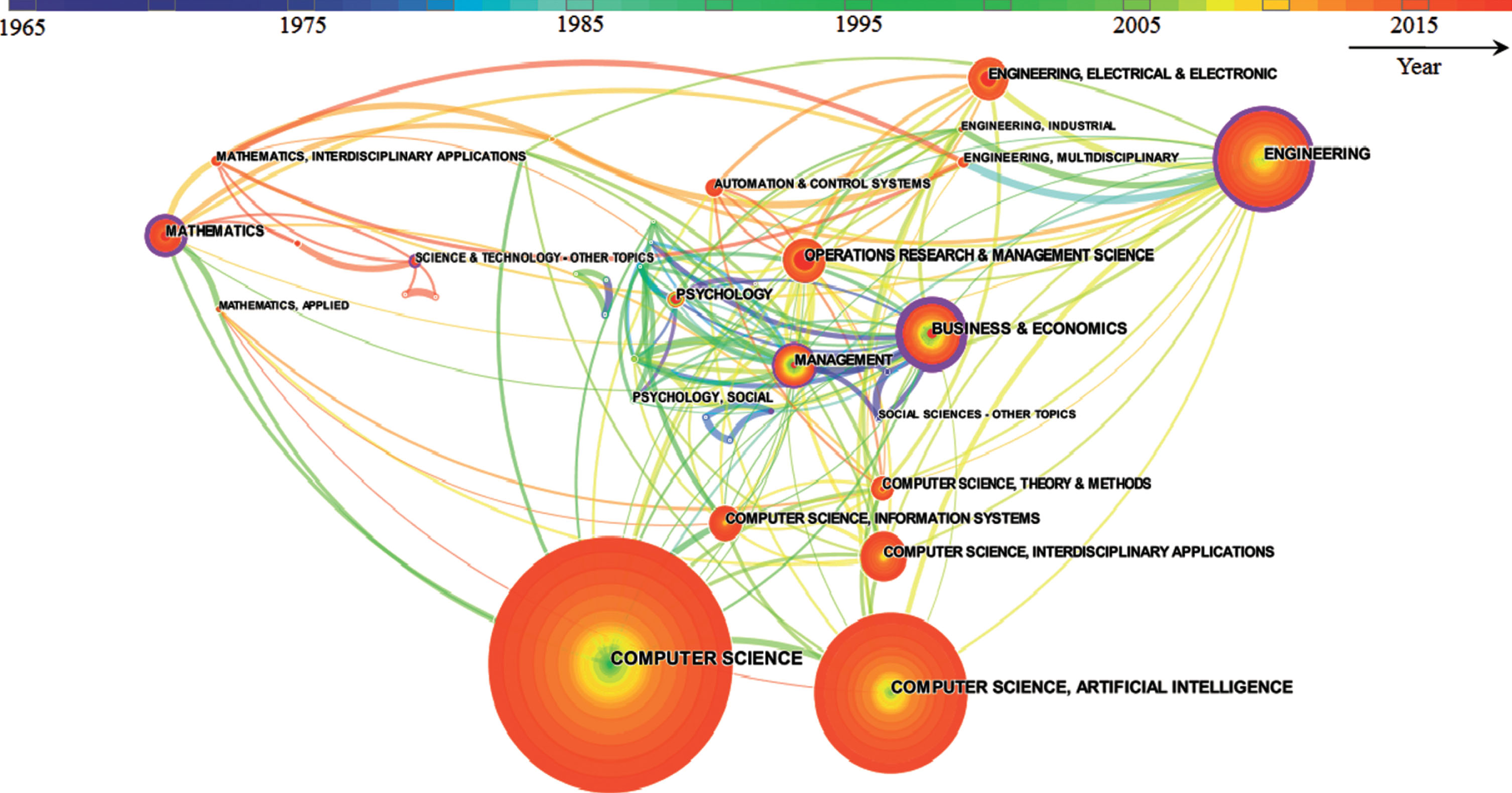
Influential WOS categories in the area of GDM.
As described in Table 2, the Journal of Intelligent & Fuzzy Systems is the most characteristic journal of GDM research in the category of Computer Science Artificial Intelligence. The Journal of Intelligent & Fuzzy Systems is one of the prominent international journals in the areas of fuzzy logic, intelligent systems, and web-based applications.
Representative journals which have published GDM papers
From the view of both Management and Social Science, Group Decision and Negotiation is the leading international journal, which emerges from evolving, unifying approaches to group decision and negotiation processes.
In this paper, an extraction process in the software of CiteSpace is employed to gather up some proper nouns or noun-phrases referring to titles or abstracts of GDM articles. These noun terms and their clusters are summarized in Figs. 2 and 3. There are many prominent positions, which defined the ones most worth taking seriously for studying purposes. The first obvious term is “Group decision making”, because on the subject of GDM, this will necessarily lead us to the term.
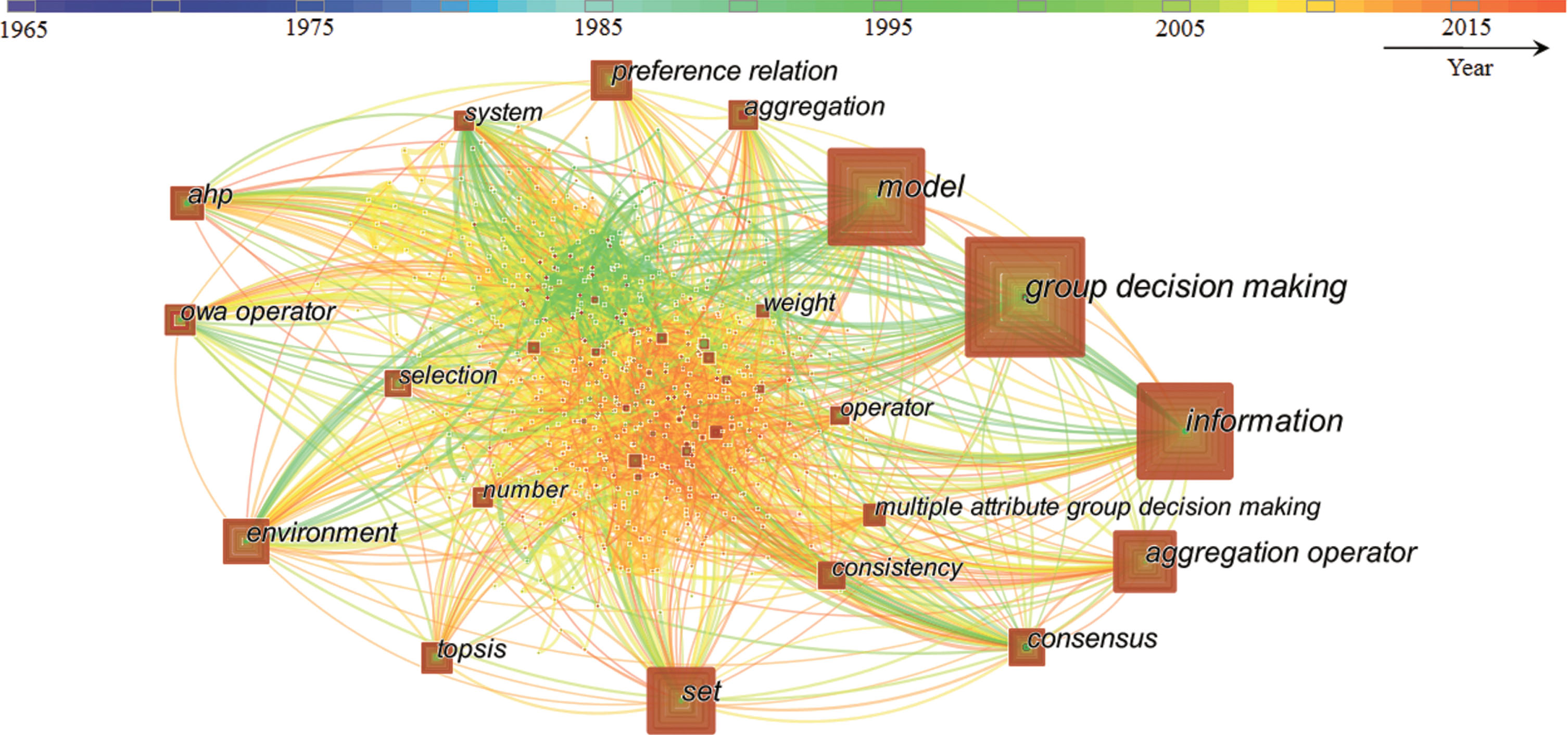
Distinguished keywords in the field of GDM.
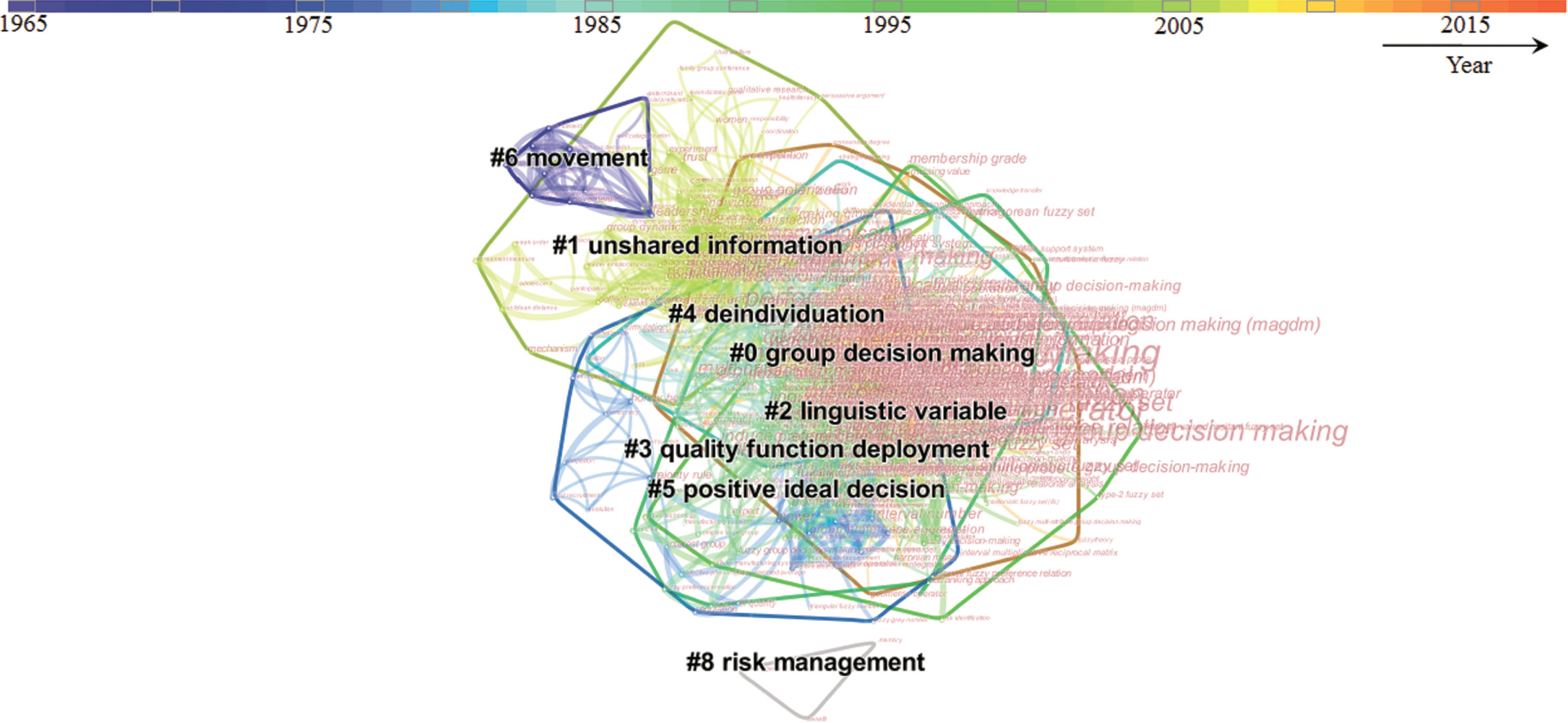
Main clusters which were made up of keywords in GDM area.
Table 3 also shows the details of some representative keywords across all these GDM studies, which was associated with Fig. 2 and turned out that there were correlations between topics, abstracts and keywords of papers. The keywords of “Model” and “Information” have been frequently recognized more in Table 3, but the majority of the co-citation is before 2005 (shown as the green links in Fig. 2) and these keywords are not really hot ones to pay attention to.
Top 20 keywords repeated most often in the GDM study
From the scientometric review, “Aggregation operator” may be one of the hottest topics in the field of GDM after 2010. Because in the process of decision making, the construction of preference relations are always generally needed, and furthermore, the decision makers need to aggregate the preference information contained. From the first appearance time of them to now, the aggregation operators which are many and various have been used in an astonishingly wide range of applications. Just like any other research fields, good scholars keep having new beliefs and new desires to find more suitable operators [27], so that it’s definitely a hot topic.
Then, “Multiple attribute GDM” [12, 29] has always been paid much attention to and widely applied in many areas. In these works, Zhang et al. developed a novel consensus framework based on social network analysis to deal with consensus-based multiple attribute group decision making (MAGDM) problems.
This paper has also defined many term clusters, which were summarized in Fig. 3. The largest of these, which has been tentatively named #0, is considered to be about “Group decision making”. The tag #0 contained more than one hundred elements that defined some kinds of specific area of GDM, such as “Consensus” [30–32] and “Experts’ preferences interaction” [33].
As mentioned previously, 3,207 articles with the topic of GDM were collected, and 5,216 authors associated with each had been discussed (See Table 4). And more than three quarters of the total number of papers is generated by those authors contributing only a single paper each.
The distribution of authors and GDM articles
The distribution of authors and GDM articles
Meanwhile, the authors who have produced more than 19 papers were considered as productive authors, the names of a total of 20 productive authors were showed in Fig. 4. Among them, Prof. Enrique Herrera-Viedma is the Vice-President for Research and Knowledge Transfer with University of Granada, Granada, Spain. And as a prolific scholar, Prof. Zeshui Xu is an authoritative GDM expert from China. He is the IEEE Fellow, IFSA Fellow, and IET Fellow.
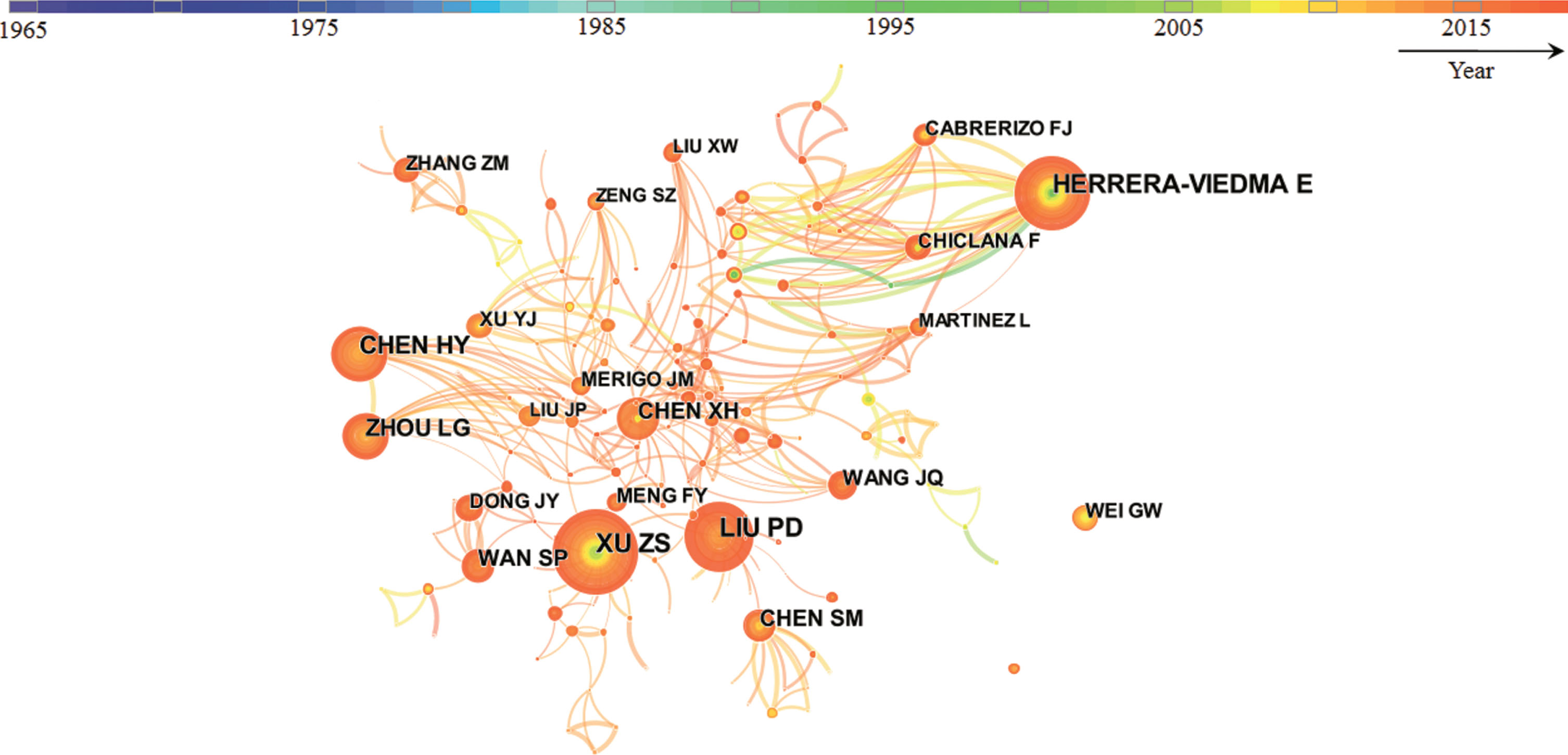
Productive and influential authors who published GDM papers.
Because GDM was highly specialized, a minority of researchers with high academic productivity usually dominated the development tendencies of the GDM research subjects. Lotka’s law [34] which was named after Alfred Lotka in 1926 described the frequency of publication by authors in any given field. It is an approximate inverse-square law, where the number of authors publishing a certain number of articles is a fixed ratio to the number of authors publishing a single article.
Where f(x) is the fraction of the authors, x is the number of papers, n is usually is hovering in a 1.8 to 2.5 range; Lotka’s law is expressed for n equaling to 2, C then being roughly equivalent to 0.61.
The first step in testing of Lotka’s law in GDM was to calculate the value of n (see Table 4). The method of linear least square [35] was used in this paper to define n = 1.865.
Where N = 35.
The computed value of the constant C in the current data was according to Prof. Pao [36].
Where n = 1.865.
For the data from Table 4, the value of the parameter was computed as C = 0.5579. Thus this set of GDM data complied with Lotka’s formulation:
The computed value of the constant C in the current data was 0.5579 (55.79%), which indicated that the proportion of contributors who published only one paper in the topic of GDM was less than sixty percent. So, n and C were measured as the parameters along the publication of the GDM articles. Because the longer time span had direct impact on the results of the above parameters, C = 0.5579 should be thinner than the classic model in which n is 2 and C is 0.61.
Prof. Price made major scientific contributions including Price’s square root law [37]. Price’s law pertained to the relationship between the literature on a subject and the number of authors in the subject area, stating that half of the publications come from the square root of all contributors. To further examine the empirical validity of Price’s hypothesis, data from Table 4 were collected and analyzed again. In this case, the square root of all contributors was about 72.2, Therefore, if the prolific group was selected in a narrow definition (x > 10), we would have 73 authors producing 1,548 papers. The number of 1,548 was supposed to be one sixth of the GDM publications, but not a half. So the Price law did not appear to apply in this case. And part of the reason for this could be that the sample size of the GDM publications was too big.
Another goal in this study was to extrapolate from classic research papers and generalize about the new emerging trends of GDM. Firstly, the total amount of references was statistically calculated out in virtue of the software named CiteSpace. And that is 47,445, generated by 3,207 articles on GDM. These references would be selected automatically by CiteSpace and formulated as a list of citation bursts, which was the second step in the process. The list contained 479 references as it was shown in Fig. 5. Ultimately, 19 candidates were featured from all the GDM references, and more details were in Table 5.
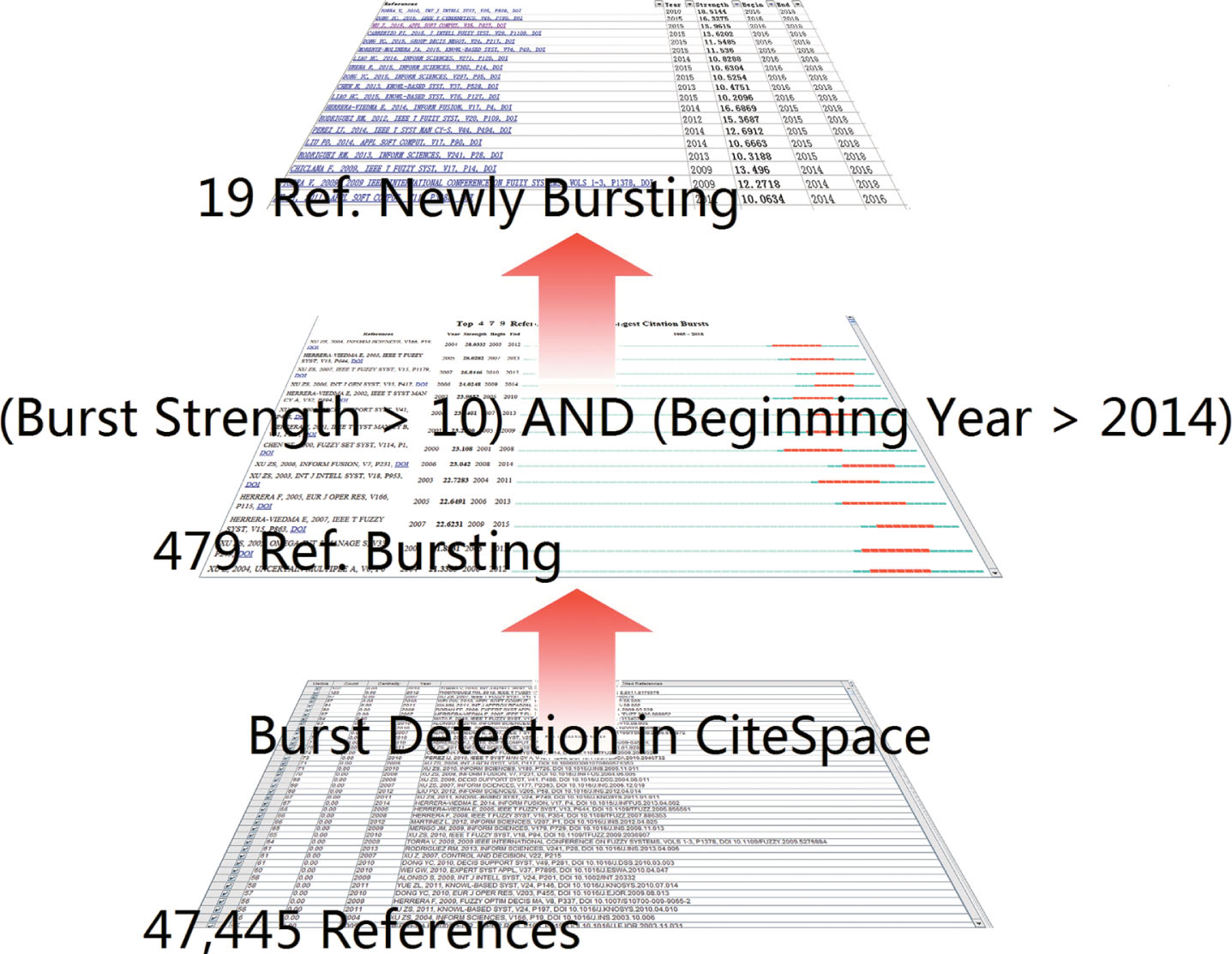
The process of searching for GDM references with strong citation bursts in recent 5 years.
GDM references with strong citation bursts in recent 5 years
Prof. Vicenç Torra is a noticeable researcher of the study of computer science and applied mathematics. And he is a prolific author of articles. Table 5 focused on some of his important works entitled “Hesitant fuzzy sets” [38] and “On hesitant fuzzy sets and decision” [39]. Thus this kind of thing like the hesitant fuzzy sets could be reckoned with as a new emerging research area. Furthermore, the works of Prof. Enrique Herrera-Viedma [40–44], Prof. Yucheng Dong [45, 46] and Prof. Huchang Liao [47, 48] became concentrated into linguistic research of fuzzy sets. Especially, the works of Prof. Dong are given to illustrate the feasibility and validity of the elegant linguistic representation models.
Figure 6 made clearer the exploration for other new emerging research keywords. This figure was composed of the keywords from all the articles that appeared on Table 5. So there were two overriding concerns regarding linguistic term sets in GDM, “Information” and “Consistency”.
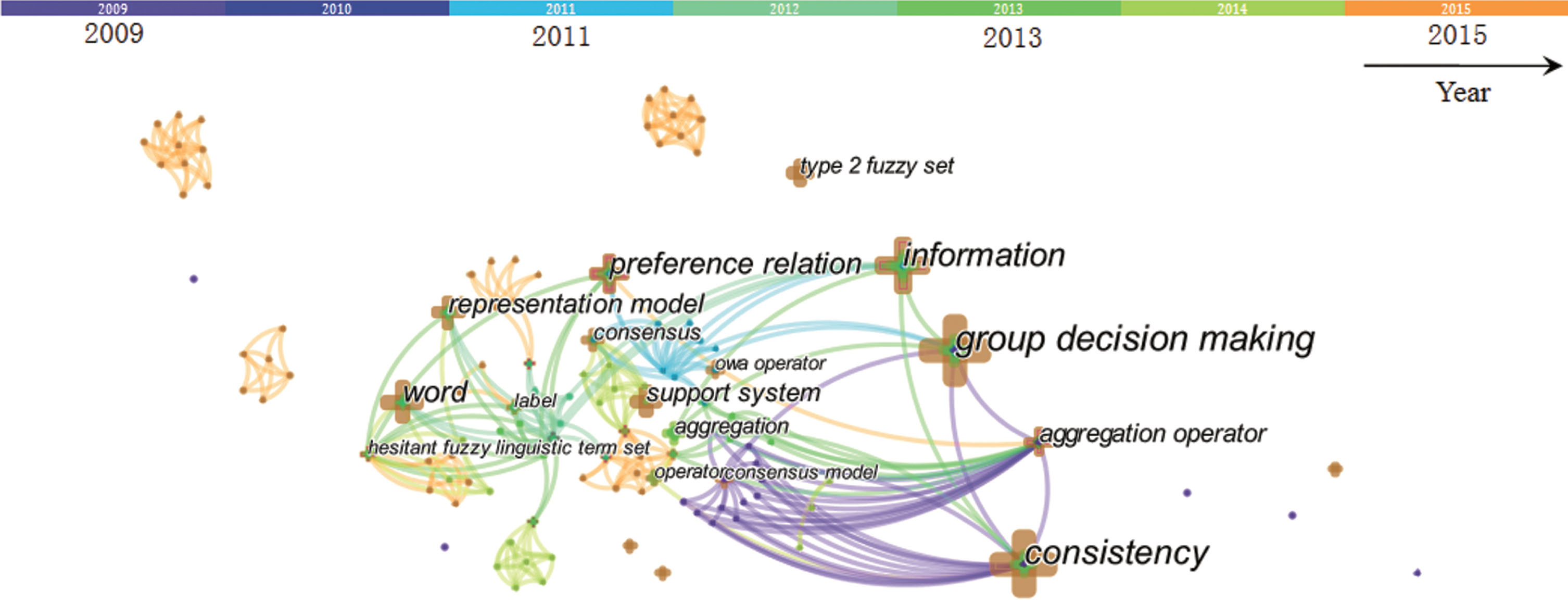
New emerging research keywords from 19 references with strong citation bursts.
Since Duncan Black proposed the concept of GDM, many productive topics based on it in the last five decades have been published. In this paper, an overview of the uncertain and fuzzy GDM research using bibliometric techniques was presented. From a general point of view, its importance within fuzzy research has been shown and described in a comprehensive approach. The primary contributions of this paper could be outlined as the following aspects.
Firstly, Artificial Intelligence (AI) belonging to Computer Science is one of the hottest research categories concerning GDM in WOS. And the Journal of Intelligent & Fuzzy Systems ranks among the most influential journals in this area. Secondly, “Aggregation operator” and “Multiple attribute GDM” have been paid much attention to and widely applied in many GDM researches. According to the analysis of term clusters, such as “Consensus” and “Experts’ preferences interaction” defined a specific area of GDM. Thirdly, a statistics-based method (Lotka’s law) has been introduced in this work for evaluating how well the group of authors has arranged their publications. And out of that, the leading prolific authors have been recognized, e.g., Prof. Enrique Herrera-Viedma and Prof. Zeshui Xu. Finally, some new emerging trends and potential research leaders of GDM researching were discerned by means of citation bursts of GDM references. And the results included hesitant fuzzy sets from Prof. Vicenç Torra and linguistic research of fuzzy sets from Prof. Enrique Herrera-Viedma etc.
For future research, the question of how to deal with some more segmented data sets would be further investigated. For example, the process of decision making given by experts could be made by fuzzy sets or include local ignorance. These challenges will continually contribute positively to this topic of GDM.