



Abstract
The safety of metro stations is threatened by various types of accidents caused by both man-made and natural causes. Knowing the accurate safety status of a metro station will help managers taking countermeasures timely, thus the safety of passengers and staff members in the station can be ensured. In order to evaluate the safety status of metro stations effectively, based on the Extension Theory, a metro station safety evaluation system was established. Fire, stampedes, violence and terrorist attacks, equipment failures, floods, and earthquake were taken into consideration in the established evaluation system. The evaluation index system includes 1 first-level index, 5 second-level indexes, 15 third-level indexes, and 55 fourth-level indexes. Then the method to determine the weights of indexes was introduced, also how to determine the score and safety grade of every index, and how to calculate the safety score for the third to first level indexes based on the Extension Theory were introduced in detail. After that, a real metro station was selected to verify the operability of the established safety evaluation system, the results show the established safety evaluation system can be used for the safety evaluation of metro stations, and can help the station safety management personnel knowing the safety status better.
Introduction
The urbanization and the rapid growth of the urban population have created huge demand for public transportation in cities all around the world, especially in fast-developing countries [1]. With the advantages of high speed, punctuality, environmental friendly, high capacity, and grade separation with other traffics [2, 3], many cities choose to construct metro systems to meet the growing demand for public transportation. Take China as an example, the development of urban rail transit is very rapid in China, especially in the recent 20 years [4]. By the end of 2018, the number of cities with urban rail transit operating in mainland China has reached 32, the total length of lines in operation is 5123.3 kilometers, and the total number of metro stations in mainland China has arrived 3255 [5]. Countries like India, Canada, and Japan also have metro systems with long rail mileages, and expansion to the existing metro systems to accommodate the growing populations is under consideration [6–8]. It can be expected that the metro systems will play an important role in future urban public transportation.
Metro system can bring great convenience to urban residents. However, some man-made and natural accidents may also pose a great threat to the safety of people in the metro stations, and as well as the facilities in the metro stations. Many accidents including fires, stampedes, and terrorist attacks have occurred in metro stations in some cities around the world [9]. Some serious accidents happened in metro stations around the world and their consequences are listed in Table 1.
Historical accidents in metro stations around the world
Historical accidents in metro stations around the world
As can be seen from Table 1, the safety of the metro stations is threatened by a variety of man-made or natural incidents. Whether it is man-made fires, violent incidents, terrorist attacks or natural disasters such as rainfall or earthquakes, they all have the possibility to affect the operation of metro stations. As an important part of the metro system, metro stations have characteristics including huge passenger flows, relatively closed space, limited accesses/exits, concentrated population and other safety risks. It’s necessary but difficult to ensure the safety of metro stations. Thus, research into the safety issues of metro stations is very necessary and can be helpful for the safety management.
In order to ensure the safety of metro stations, researchers have carried out a lot of researches in this field. Hu et al. (2006) presented an evaluation method for railway stations based on grey clustering theory combined with the Analytic Hierarchy Process, and operational safety, equipment safety, personal safety, and transportation safety were taken into consideration [10]. In 2009, Pan et al. proposed an evaluation model for the fire risk in urban subway operation, evacuation capacity and management were focused [11]. Meng (2010) proposed an analysis model of urban rail transit arrangement based on the application of the Delphi and Analytical Hierarchy Process, and the model was verified by carrying out experiment using real rail transit systems [12]. Zhang et al. (2011) established a dynamic evaluation indicator system for crowd management of metro stations, and the safety, cost-effectiveness, and comfort were taken into consideration [13]. In 2012, Sari et al. evaluated the urban rail systems in Istanbul under different risk factors using Fuzzy Analytic Hierarchy Process (FAHP), the risk factors considered include regional criticality, line characteristics, line safety and station structure [14]. Gao et al. (2014) established a safety assessment model for urban rail transit network operation, based on the multi-source information fusion and complex network theory, key equipment of urban rail transit is the main concerned object in their model [15]. Qin et al. (2012) established a dynamic risk assessment index system by taking people, equipment, environment, management, and accident factors into consideration, and then they proposed a new decision model combining interval type-2 fuzzy set and TOPSIS method [16]. In 2016, Zhang et al. established an adaptable metro operation incident database (MOID), which contains all details of incidents that have occurred in metro operation and the characteristics such as accident types, causes, time, and severity are identified [17]. Zhang Z et al. (2016) analyzed the factors which influence the safety status of a metro station, and established a safety status predicting model based on Genetic Algorithm-Support Vector Regression (GA-SVR) [18]. Wang (2016) established a comprehensive assessment system by using backpropagation neural network, which can quantitatively assess the crowded metro stampede accident risk [19]. In 2016, Lu et al. came up with a methodology for the congestion risk evaluation and precaution in order to ensure the safety of passengers in a metro station, the retention rate of the platform, the waiting rate of the ticket gate, and the transfer efficiency were taken into consideration [20]. The Technique for Order of Preference by Similarity to Ideal Solution (TOPSIS) methods were also applied to the safety research of metro stations. Huang et al. (2018) formulated an entropy-Technique for Order Preference by Similarity to Ideal Solution (TOPSIS) method to evaluate the urban rail transit system’s operation performance, the perspectives of the operator, passengers, and government were considered [21]. By Introduce fuzzy theory into the TOPSIS, fuzzy TOPSIS method was established by Cheng et al. (2016), this method can be used to carry out failure analysis for metro door system [22]. Mei. Y et al. (2019) presented a TOPSIS method to handle the evacuation strategy selection problem of a metro station based on interval type-2 fuzzy sets [23].
According to the literature listed above, most of the previous research about the safety research and evaluation of metro station mainly considered specific risk faced by metro stations, such as fires, the safety of equipment, crowded stampede events. The overall safety of metro systems was considered in some of the works. A safety evaluation system that comprehensively consider multiple risks is relatively rare at present. However, during the operation of metro stations, not only deal with specific accidents is important, but also it’s very important for managers to know the accurate safety status of a metro station, both safety status in differents areas and the overall safety status of the station. Therefore, it’s meaningful to establish an accurate, comprehensive and effective safety evaluation system for metro stations, which can help managers taking response measures to mitigate or eliminate the safety risks on time.
Based on the principles of evaluation indexes selection, various risks that may be faced by the metro stations from both humans and nature were analyzed at first. In order to create a comprehensive safety evaluation system, instead of just take one or two risks into consideration, 5 kinds of risks including fire, violence and terrorist attacks, equipment failures, stampedes, floods, and earthquake are taken into consideration when establishing the evaluation index system. The safety status of the 5 accidents listed above are taken as the second-level indexes, while the overall safety status of the metro station is regarded as the first-level index. According to the characteristics of the 5 kinds of accidents, the third-level and fourth-level safety evaluation indexes of each kind of accidents are then determined, thus a complete safety evaluation index system of metro stations was established. Then, based on the established index system and extension theory, a safety evaluation system for the metro station was established. How to determine the weights of indexes, how to determine the score and safety grade of each index, and how to calculate the safety score for the third-level to the first-level indexes are introduced in detail. At last, a metro station is selected for the application of the established safety evaluation system. The safety analysis is carried out for the selected metro station, thus the operability and practicability of the established evaluation system are verified. By using the evaluation system proposed, managers of metro stations can not only know the safety status of each kind of risks but also the overall safety status of the stations.
The structure of this article is organized as below: Extension Theory will be introduced in Chapter 2; the establishment of safety evaluation index system for metro stations will be introduced in Chapter 3; in Chapter 4, the safety evaluation calculation method based on Extension Theory will be discussed; Application of the established evaluation system in a real metro station will be presented in Chapter 5. Then, in Chapter 6, conclusions will be discussed. At last, future works will be presented in Chapter 7.
Extension Theory was created in the 1980 s by Cai Wen, a famous scholar from Guangdong University of Technology [24]. Extension theory combines matter-element theory with extension set theory to study matter-element and its transformation theory. It can be used to study the rules and methods of solving complex problems qualitatively and quantitatively [25].
Extension theory has three theoretical bases: the first one is the basic theory of the studied primitives (including matter-element, and relational element) and their transformations; the second is extension set theory as a quantitative tool. The third is extension logic. New theoretical knowledge can be developed when these three theories are combined with the theories in other fields, thus the application of extension theory can be achieved [26]. The extension evaluation method is an evaluation method based on the Extension Theory. In the extension evaluation, matter-element is first used to describe the object to be evaluated qualitatively, and the correlation functions of extension set theory are used for quantitative calculation. So it’s a method with the combination of qualitative and quantitative. Some basic concepts used in the extension evaluation method will be introduced in the flowing sections [27, 28].
Concept of matter-element
In extension theory, a matter-element is an ordered triad composed of things used to describe the features and the magnitude of the features of an object, it can be described as R=(N,C,V). In the equation, N means the object in order to describe, C means the features of N, and V means the values corresponding to features C. N, C, and V are called the three elements of the matter-element. With the basic concept of matter-element, the objective world can be regarded as a complex and interrelated matter-element network.
According to the extension theory, if an object N has n features c1,c2, ... ,c
n
, and the values v
i
(i = 1,2, ... ,n) corresponding to c
i
(i = 1,2, ... ,n), then Equation (1) can be used to describe the object N:
Extension set is an important part of the Extension Theory, an important method for dynamic classification of things, a quantitative tool to solve contradictory problems, and a set concept developed on the basis of classical set and fuzzy set. Extension set can not only describe the mutual transformation of “yes” and “no” of things, but also describe the degree of certain nature of things. The extension set provides a theoretical basis for the quantification, formalization and logicalization of the process of solving contradiction problems, and provides a new mathematical tool for people to solve contradiction problems.
If U is a universe of a fuzzy set, and K is a mapping from U to real domain, T is a given transformation for the element of U, then we call Equation (2) is an extension set about given transformation T on universe U, in which y = K(u) is the correlation formula of A(T).
In fuzzy mathematics, membership functions are used to represent the membership degree of a fuzzy thing. In extension mathematics, since the change of things is mostly from quantitative change to qualitative change, the extension mathematics uses the correlation function to describe the degree of certain nature of things.
In order to reduce the influence of human subjectivity as much as possible, the quantitative description should be adopted if possible. In order to realize the correlation function of certain properties of things in the domain, the concept of distance in the real variable function is extended to the concept of distance. The distance between point x and section X0 = < a, b > can be calculated by Equation (3):
In order to find the correlation between a certain point and a section, correlation function can be used to calculate their correlation. If X0 =〈 a, b 〉, X =〈 c, d 〉, in which, X0 ∈ X and X0, X don’t have common endpoints. Then the correlation of point x and section X0, X can be calculated by Equation (4):
In the equation:
x ∈ X0, and x≠a, b, then K(x)>0;
x = a or x = b, then K(x)=0;
x ∉ X0, x∈X, and x≠a, b, c, d, then -1 < K(x)<0;
x = c or x = d, then K(x) = –1;
x ∉ X and x≠c, d, then K(x)< -1;
D (x, X0, X) is the factor used to indicate the relative location in the nested intervals formed by X and X0, which can be calculated by Equation (5).
The establishment of evaluation index system
The establishment of evaluation index system plays an important role in the safety evaluation system. The quality of the evaluation indexes directly affect the accuracy of the evaluation results and the application effect of the evaluation system. Therefore, in the process of establishing the index system, it is necessary to pay attention to the comprehensiveness, representativeness, feasibility, and universality of the indexes. First, the index safety of metro station(S) is determined to be the first-level index of the evaluation system. Then, the safety of fire, safety of stampede, safety of violence and terrorist attack, safety of auxiliary equipment and safety of natural disasters are determined to be the second-level indexes. After that, based on the analysis of characters of fire, violence and terrorist attacks, equipment failures, floods, and earthquake, also take the suggestions from station managers, experts of safety and staff members of metro stations, the indexes which can represent the safety status were determined as the third and fourth-level indexes, thus the evaluation index system is formed, as shown in Table 2.
The evaluation index system of metro station
The evaluation index system of metro station
As can be seen from Table 2. The evaluation indexes are determined from fire safety, safety of stampede,, safety of violence and terrorist attack, safety of auxiliary equipment (escalator, platform screening door, and check-in Gate), and safety of natural disasters are taken into consideration. Then based on the charactersristics of the risks above, the indexes of lower levels are also determined. At last, the whole index system is formed.
As can be seen from Table 2, the evaluation indexes can be divided into two categories, qualitative indexes and quantitative indexes. So the value acquisition of each evaluation index can be divided into quantitative calculation and qualitative analysis. Taking the fire partition rationality (A11) and qualified rate of fireproof performance of decoration materials (A12) as examples, the value acquisition of qualitative indexes and quantitative indexes are introduced as below.
Fire partition rationality (A11)
The fire partition rationality (A11) refers to whether the fire partition of the evaluated metro station meets the requirements of related local codes and standards. Usually, people who carry out the evaluation work should refer to the local and national codes and standards. For example, the following provisions are made in the Metro design code of China (GB 20157-2013):
For underground stations, the passenger evacuation zones for station platforms and station hall can be divided into one fire partition zone. Interchange station where the public areas of station hall are shared by more than 2 lines, public area in the station hall should not be more than 5000 m2.
For stations on the ground, the equipment management area and the public area should be divided into different fire partition areas. The Maximum area of fire partition area in the public area should less than 5000 m2. When the equipment management area is located in the building with height less than or equal to 24 m, the maximum allowable area of its fire partition area should not be greater than 2500 m2. When the building with a height greater than 24 m, the maximum area of its fire partition area should not be greater than 1500 m2.
According to the regulations in the codes or standards, evaluation experts or station staff can make a judgment to the fire partition rationality (A11) of the station to be evaluated. The score of A11 ranges between 0 and 10, where 0 means the fire partition of the station totally does not meet the requirements of the codes, while 10 means the station partition fully meets the requirements of the codes. By taking the suggestion of experts or managers of metro stations, the safety status of A11 can divided into five safety levels according to the score range, as shown in Table 3.
The safety levels of Fire partition rationality (A11)
The safety levels of Fire partition rationality (A11)
The fireproof performance of decoration materials (A12) refers to the materials used in the metro station whether meet the requirements of codes and standards or not. If a metro station in China is to be evaluated, then the Metro design code of China (GB 20157-2013) can be referred to. In this code, regulations listed below about decoration materials in the metro station can be found:
a. Non-combustible materials with grade A should be used for the ceiling, wall, ground decoration materials and dustbins in public areas, equipment and management rooms of the underground station;
b. The materials of fixed service facilities such as advertising light boxes, guiding signs, lounge chairs, telephone booths and ticket vending machines in underground and ground station public areas should be made of non-combustible materials no less than class B1. Asbestos, glass fiber, plastic, and other products are not allowed to be used as decoration.
When calculating the value of index A12, a certain number or location of decoration materials are randomly selected to check the fire performance of the materials and confirm whether they meet the requirements of the related regulations. The Equation (6) is used to calculate the value of index A12:
In the equation:
γ f , the qualified rate of fireproof performance of decoration materials;
T1, the number of decoration materials with qualified fireproof performance;
T, the total number of checked decoration materials.
At last the safety level of qualified rate of fireproof performance of decoration materials (A12) can be divided into 5 grades as shown in Table 4.
The safety levels of Qualified rate of fireproof performance of decoration materials (A12)
In the same methods, all the evaluation indexes are qualitatively analyzed or quantitatively calculated, and the safety level is determined according to the standard requirements of the country or region where the station to be evaluated is located. Also, it should be noticed that when calculating the quantitative indexes, the time periods of these indexes should keep the same.
The weight of each index is very important for they play significant roles during the decision-making process, it’s important to find a good method to determine the weights of the evaluation indexes [29]. There are many methods to determine the weight of evaluation indexes, usually these methods can be divided into subjective methods and objective methods. Among them, the most widely used subjective determination method is the Analytic Hierarchy Process (AHP), while the most widely used objective determination method is the Entropy Weight Method.
Analytic hierarchy process
The principle of analytic hierarchy process (AHP) is to treat a decision-making problem affected by multiple factors as a system. By decomposing the system into several smaller components and dividing these factors into several sub-factors according to different attributes, a hierarchical structure is formed according to the dominant relationship among goals, factors, and sub-factors. In this hierarchy, the nature of the factors and their relationships can be clearly expressed. The hierarchical analysis model can be divided into the target layer, criterion layer and index layer from top to bottom. The target layer represents the final target to be completed, and the criterion layer represents the criteria to judge the target results [30].
The relative importance of these criteria is assessed. Alternatives for each criterion are compared according to the judgments of experts. An overall ranking scale of the alternatives is then determined [31]. The application of AHP to a decision problem involves the following steps [32]:
Step 1: Structuring of the decision problem into a hierarchical Model. It includes decomposition of the decision problem into elements according to their common characteristics and the formation of a hierarchical model having different levels. A simple AHP model has three levels that are goal, criteria, and index, as shown in Fig. 1.

The structure of AHP model.
Step 2: Making pair-wise comparisons and obtaining the judgmental matrix. In this step, the elements of a particular level are compared with respect to a specific element in the immediate upper level. The resulting weights of the elements may be called the local weights. The opinion of a decision-maker is introduced for comparing the elements. Elements are compared pair-wise and judgments on the comparative attractiveness of elements are captured using a rating scale. Usually, an element receiving a higher rating is viewed as a superior compared to another one that receives a lower rating. If the property does not hold for all the entries, the level of inconsistency can be captured by a measure called Consistency Ratio (CR) [33].
A value of CR less than 0.1 is considered acceptable because human judgments don’t need to be always consistent, and there may be inconsistencies introduced by the difference of scales used. The ability to identify inconsistent judgments through the calculation of consistency ration is considered one of the advantages of AHP.
Step 3: In this step, the local weights of the elements are calculated using the eigenvector method (EVM). The normalized eigenvector corresponding to the principal eigenvalue of the judgmental matrix provides the weights of the corresponding elements. Though EVM is followed widely in traditional AHP computations When EVM is used, Consistency Ratio (CR) can be computed. For a consistent matrix CR = 0, and if CR for a matrix is more than 0.1, the judgments should be elicited once again from the decision-maker till he gives consistent judgments.
Entropy is originally used in thermodynamics as a measure of the disorder of molecular states. In 1948, Claude E. Shannon, the father of information theory, first illustrated the relationship between probability and information redundancy in mathematical language [34]. In information theory, entropy is a measure of uncertainty. The more information there is, the less uncertainty there is and the less entropy there is. Conversely, the smaller the amount of information, the greater the uncertainty and the higher the entropy.
According to the characteristics of entropy, the randomness of an event can be judged by calculating the entropy value. The entropy value can also be used to judge the degree of dispersion of an index. The greater the degree of dispersion of the index, the greater the influence of the index on the comprehensive evaluation. It is necessary to collect all kinds of events within the evaluation objects within a certain period of time (it is recommended to take year as the unit) and conduct quantitative statistics to determine the weight of evaluation indexes. The following is an example shows how the entropy weight method is used to determine the index weight [35].
Step 1: Forming a data matrix. If there are n objects to be evaluated and there are m sets of data for this object, the following data matrix can be constructed:
Take the second-level indexes in Table 2 as an example, if the times of fire, stampede, terrorist attack, equipment failure and natural disasters of a metro station are gathered in 4 years, the matrix as Table 5 can be gained.
Times of accidents in a metro station from year 2015–2018
Step 2: Normalize the matrix X. by normalize matrix X, a new matrix P (x
ij
) can be obtained.
For Table 5, sum the data of each column at first, then divide each data by the sum of the data of the corresponding column to obtain the P matrix, as shown in Table 6.
Matrix P of accidents in a metro station from year 2015–2018
Step 3: Calculate the entropy value e
j
. The Equation (9) below can be used to calculate the entropy value.
In the equation, k = 1/lnm, in which m means the number of data sets. Besides, if p (x
ij
) = 0, then p (x
ij
) should be modified by using Equation (10):
By calculating the entropy value for fire, stampede, violence and terrorist attack, auxiliary equipment failures, and natural disasters listed in Table 6, values of e j shown in Table 7 can be gained.
The calculated values of ej for Table 6
Step 4: Calculate the diversity factor g
j
. Equation (11) can be used to calculate the diversity factor:
The greater the value of g j is, the more important the corresponding index is. After Equation (11) is adopted to calculate the diversity factor for Table 7, the values listed in Table 8 can be gained. Also ∑g j = 0.176957 can be calculated.
The values of gj for each index
Step 5: Calculate the weight factor for each index. Equation (12) can be used to calculate the weight factors.
By using Equation (12), the weight factor of each index in Table 8 can be obtained as shown in Table 9. In other words, the calculated index weights of fire, stampede, violence and terrorist attack, auxiliary equipment failure and natural disaster are 0.041, 0.3329, 0.0376, 0.5641 and 0.2430, respectively.
The weight factors of each evaluation index
When determining the weight factor of indexes, the AHP method is subjective while the entropy method is objective. Since the evaluation index system for a metro station is complex, method combining the AHP method with entropy method can reflect the actual situation of the object to be evaluated more accurately, the so-called comprehensive weighting method. Comprehensive weight methods include addition integration, multiplication integration, exponential integration or several methods combined. Among them, the additive integration weighting method is relatively simple and easy to operate, also the additive integration are adopted by some researchers, and the accuracy can be ensured [36, 37]. So the additive integration weight method is adopted in this paper. The method of using additive ensemble weighting to calculate the weight is as follows:
If the weight of index i is α
i
and β
i
by using the AHP method and Entropy Weight Method, then the comprehensive weight can be calculated by Equation (13):
In the equation, μɛ [0, 1] means the percentage values of α i . The value of μ can be determined according to the suggestion of Table 10.
The value selection of μ
Finally, it’s should be pointed out that the Entropy Weight Method needs to collect a large number of statistical data, and it is not easy to obtain complete statistical data for some metro stations. Therefore, for stations to be evaluated, if the obtained data are incomplete, only the parts with enough statistical data can be weighted by using the comprehensive method.
Section domain and classical domain of metro station safety evaluation
The value of each index has a certain range. For an index, it’s section domain can be gained when put the value ranges of its lower-level indexes into a matrix, that is R
p
=(N
p
,c,v
p
). The section domain R
p
can be presented by Equation (14):
In the equation:
N p , the whole safety level of the evaluation indexes;
c n , the lower-level indexes belong to N p ;
v pm , means the total value range of c m .
According to the indexes definition and the value acquisitions in Chapter 3.2, if the safety level of each index of a metro station can be divided into y levels, then the classical domains for each safety level of the indexes with lower-level indexes can be determined, in the element matter format, it can be marked as Equation (15):
In the equation:
N R 0j , the classical domains of the indexes with lower-level indexes at safety level of j;
cn, the lower-level indexes belong to N R 0j ;
v0jn, the range of value of c n when the safety level of N R 0j is j.
For an index, if there are m aspects of safety need to be evaluated, and each aspect has n indexes to describe it. Then each aspect of safety for the metro station can be described by the matter element below:
In the equation:
R m , the matter element of an aspect of safety for the metro station;
N m , the ith index which describes the aspect of safety for the metro station;
c k (k = 1,2, … ,n), the kth lower-level index which affects N i ;
v mk , the value of c k .
Take the index fire safety of architecture (A1) as an example, it has 4 lower-level indexes that are fire partition rationality (A11), qualified rate of fireproof performance of decoration materials (A12), fire resistance level of structures (A13), and time required to arrive from the nearest fire station (A14). If the value of A11, A12, A13, and A14 has been obtained, then the matter element of A1 can be presented as below:
In the matrix above, vA11, vA12, vA13, and vA14 are the values of A11, A12, A13, and A14, respectively.
At first, the subjective and objective weights of each evaluation index used in the safety evaluation model for metro stations should be calculated by using the analytic hierarchy process (AHP) and entropy weight method. And the comprehensive weight is calculated by using the additive integration weighting method. Finally, the weights of all evaluation indexes listed in Table 2 should be obtained.
Safety grade correlation degree calculation
After the metro station safety risk evaluation model is established by using Extension Theory, the safety level of each index can be calculated. The correlation analysis of the approximation between the matter element to be evaluated and the classical domains of each safety level can be calculated by using the correlation function in the extension theory. The correlation of the kth lower-level index of the ith index which describes the safety of metro stations and the safety level j can be calculated by using Equation (18):
In Equation (18): i = 1, 2, ... , m; j = 1, 2, ... , y; k = 1, 2, ... , n; ρ (v ik , v0jk), ρ (v ik , v pk ) mean the correlations between v ik and section v0jk, v pk respectively, they can be calculated by Equation (19)–(21).
The correlation between safety level t and N
m
, matter element of metro station safety evaluation indexes can be calculated by the equation listed below:
According to Equation (23), namely, determine the maximum value in the relational degree matrix calculated by Equation (22). The safety level corresponding to the maximum value is the safety level corresponding to the current safety level of the matter element N m .
Finally, it should be noted that the safety risk evaluation index system established in this paper has four levels. Therefore, it is necessary to use the score of the fourth-level indexes to calculate and judge the safety level of each thir-level index. Then, the evaluation matrix K1 of the second-level indexes can be obtained according to the calculation results of the third-level indexes, and the matrix W composed of the weights of the second-level indexes is multiplied by K1, as shown in Equation (24).
After the calculation result of the correlation degree of the second-level evaluation indexes are obtained by using Equation (24), the safety level of the second-level evaluation indexes can be determined by Equation (23).
The above calculation process is repeated for the second-level evaluation indexes, and the final evaluation result of the first-level index “safety of metro station (S)” can be obtained.
Researchers have carried out some studies about the safety evaluation of metro stations, as well as safety-related research. Comparison between this work and several other evaluation methods are compared and discussed, their information are listed in Table 11.
Comparison between methods proposed and similar reseach about metro safety
Comparison between methods proposed and similar reseach about metro safety
According to Table 11, different methods were adopted by these current research about the safety of metro stations. As can be seen from Table 11, most evaluation systems only considered one or two kinds of disasters faced by metro stations or metro systems, such as the floods safety evaluation by Lyu et al. (2019) and the fire risk assessment by D. Huang et al. (2019). As mentioned in Chapter 1, different kinds of accidents may threaten the safety of metro stations at the same time, so an evaluation system include multi-risks will be necessary. In the methods proposed in this article, accidents include fire, stampedes, violence and terrorist attacks, equipment failures, floods, and earthquake are considered, and these accidents are common safety threats to metro stations. So the proposed methods can be helpful to grasp the comprehensive safety status of a metro station as well as the safety status of each risk. Comprehensive is the most prominent advantage of the evaluation system proposed in this article.
T station in Guangzhou, China is selected to carry out the application. T station is the busiest metro station in Guangzhou. The station is extremely crowded during morning and evening rush hours, as shown in Fig. 2. With such a huge passenger flow, it’s very important to know the accurate safety status of this metro station.
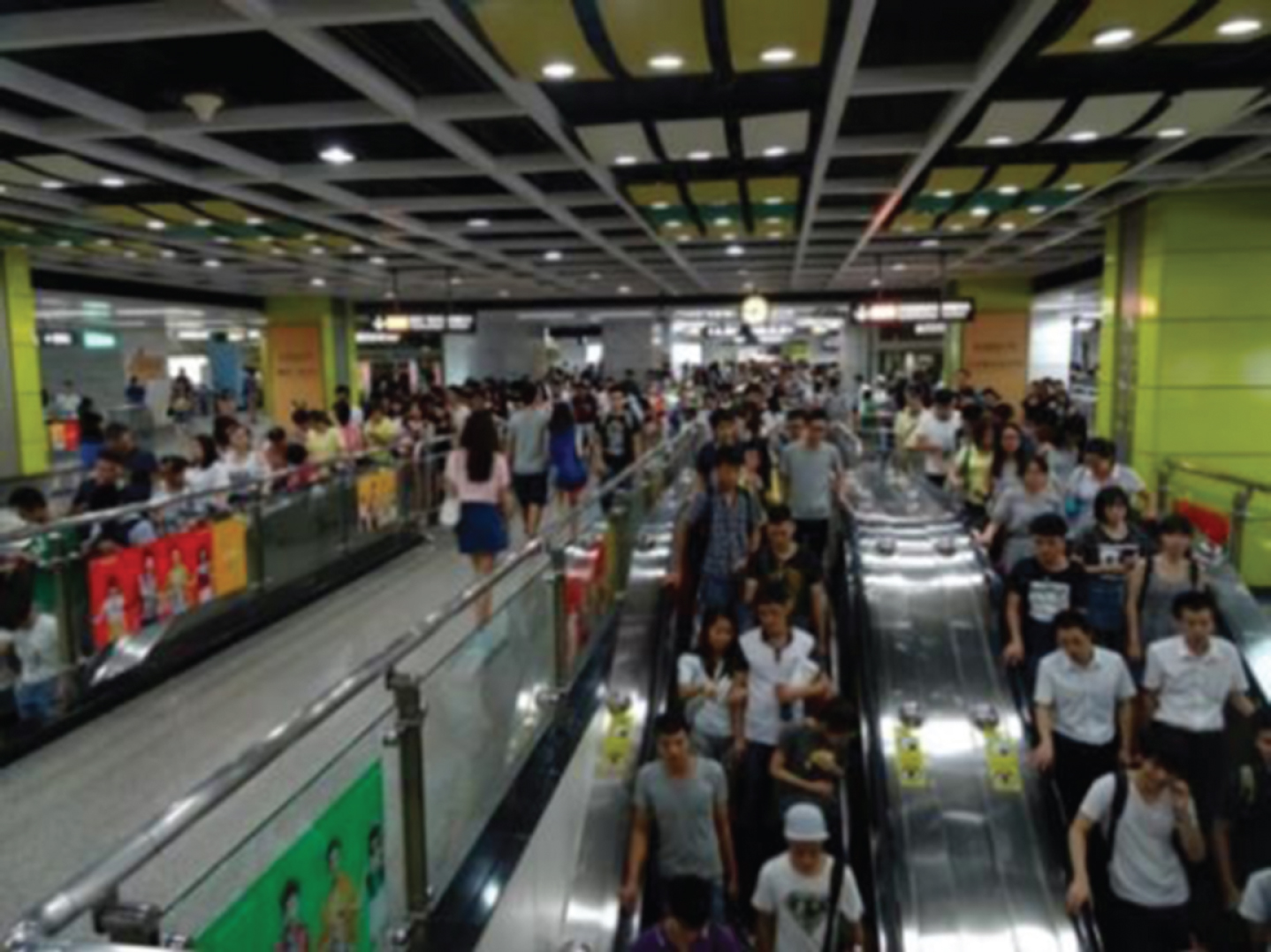
The crowd in T Station, Guangzhou, China.
Due to the article length limitation, only the calculation for the index building fire prevention (A1) in Table 2 is described in detail.
According to the steps mentioned in Chapter 3.2, the value range of different safety levels for the 4 lower-level indexes, including fire partition rationality (A11), qualified rate of fireproof performance of decoration materials (A12), fire resistance level of structures (A13), and time required to arrive from the nearest fire station (A14) are all determined, as shown in Table 12. The safety levels including safe, relatively safe, general, relatively dangerous and dangerous. Methods used to determine the safety levels are discussed in Chapter 3.2.
Values of lower-level indexes belong to Fire safety of architecture (A1)
In addition, the corresponding score ranges of each safety level of all the fourth-level indexes listed in Table 2 need to be determined one by one with the same method.
According to Table 11, the section domain Rp and classical domains for the safe, relatively safe, general, relatively dangerous and dangerous safety levels of index A1 can be gained by applying the methods presented in Section 4.1. The section domain and classical domains for index A1 are listed below:
The next step is to determine the matter element for index A1. According to the site inspection in T stain, the use of the provisions of the relevant codes and standards, the judgment by station staff and experts, the archives of T station, the scores of each index are obtained. Based on the obtained scores, the matter-element to be evaluated for index Building fire prevention (A1) can be obtained:
Then by using correlation function Equation (18), which is presented in Section 4.4, the correlation matrix between RA1 and R
safe
, R
Relativelysafe
, R
General
, R
Relativelydangerous
, R
Dangerous
can be obtained:
Meanwhile, the weight of each fourth-level indexes belong to fire safety of architecture (A1) is calculated according to the Analytic Hierarchy Process (AHP) method, as shown in Table 13.
The weights for fourth-level indexes belong to index A1
According to Table 13, the vector WA11-A14=(0.095, 0.519, 0.049, 0.337) can be gained. Then by adopting Equation (24): KA1 = WA11-A14·KA11-A14
Calculated results of second-level indexes of T station
According to the principle of maximum correlation in Equation (23), it shows the safety of building fire prevention (A1) belongs to the fourth-level, which means it’s in a relatively dangerous state.
Similarly, other indexes including electrical safety (A2), fire service reliability (A3), and fire protection management (A4), which belongs to the first-level index safety of Fire (A) can also be calculated,then the KA2, KA3 and KA4 can be obtained. When matrix composed of KA1, KA2, KA3 and KA4 are multiplied by the vector composed of the weights A1, A2, A3 and A4, the safety level of index safety of fire(A) can be determined.
Repeat the above calculation process, and do the same calculation for other second-level indexes, including safety of stampede (B), safety of violence and terrorist attack(C), safety of auxiliary equipment (D), safety of natural disasters (E), their safety status can be determined, the calculation results for second-level indexes are listed in Table 14.
After the weights of second-level indexes are determined by the method presented in Section 3.3, Equation (24) can be used to calculate the safety level of first-level index. That multiplies the calculated results of second-level indexes in Table 13 with the vector W composed of the weights of second-level indexes, the safety level of the first-level index safety of metro station(S) can be finally determined.
Number –0.066 is the greatest value in Kp, which is in correspond to the safety level “safe”, so according to criteria mentioned in Section 4.4, the overall safety status of T station is “Safe”.
Based on Extension Theory, a safety evaluation system for metro stations was established in this paper. When establishing the evaluation index system, accidents include fire, violence and terrorist attack, auxiliary equipment failure, floods, and earthquake were taken into consideration, a safety evaluation system that considers multiple risk factors were proposed. Then the method by combining the Analytic Hierarchy Process (AHP) and Entropy Weight Method was suggested to determine the weights for all the indexes. Finally, a safety evaluation model was proposed based on the concept of matter element, extension set, distance formula, and correlation function in extension theory. The calculation and safety level determination for third-level to first-level indexes were described in detail. At last, the operability of the proposed system was verified by applying the proposed evaluation system to calculate the safety condition of a real metro station, it proved that the proposed evaluation system can provide a feasible and comprehensive method for the safety evaluation of metro stations.
When comparing the safety evaluation system proposed with several recent research about the safety of metro stations, it shows that the comprehensive is the advantage of the proposed method, which means multiple risk factors are taken into consideration in the proposed evaluation system. Thus a comprehensive evaluation result can be obtained by using the proposed system. By using this evaluation system, managers of metro stations are able know the safety status of each kind of risk better, as well as the overall safety status of the stations. Besides, by applying the proposed evaluation system to a real metro station, its operability has been proved.
At last, it’s worth pointing out that due to the different characteristics of metro stations, such as the different structure, layout, and adjacent areas, the evaluation index system can be appropriately adjusted in the actual use, making the evaluation results more accurate and reliable.
Future work
This study provides a general safety evaluation method for all metro stations. However, many stations have unique characteristics such as building structure, connection with other kinds of transportations, passenger flow, and so on. The authors plan to classify metro stations according to their characteristics based on investigations, and then safety evaluation systems for each kind of metro stations will be established, which will take the characteristics of these stations into consideration.
Footnotes
Acknowledgment
The authors would like to thank the Ministry of Science and Technology (P. R. China) for its fund and support (National Key R&D Program of China. No. 2016YFC0802500). And Heng Yu also want to thank the financial aid provide by China Scholarship Council.