



Abstract
Nowadays, Industries have been receiving much attention in Failure modelling and reliability assessment of repairable systems due to the fact that it plays a crucial role in risk and safety management of process. The primary purpose of this article is to present a methodology for discussing uncertainty in the reliability assessment if the production system. In fact, we discuss the fuzzy E-Bayesian estimation of reliability for PVC window production system. This approach is used to create the fuzzy E-Bayesian estimations of system reliability by introducing and applying a theorem called “Resolution Identity” for fuzzy sets. To be more specific, the model parameters are assumed to be fuzzy random variables. For this purpose, the original problem is transformed into a nonlinear programming problem which is divided into four sub-problems to simplify the computations. Finally, the results obtained for the sub-problems can be used to determine the membership functions of the fuzzy E-Bayesian estimation of system reliability. To clarify the proposed model, a practical example for PVC window production system is conducted.
Introduction
In the progressive decades, the advancement in the Science and Technology are growing noticeably, which caused competition to gain the quality and reliability of products. Whereas these develops have influenced on the people’s lives that the enhancing the predictions people’s standard of living not simple be ignored. Statisticians for maintains competitiveness between products requires improving the reliability of industrial products [1], and [2].
Reliability modeling is the paramount discipline of reliable engineering. The Bayesian approach to system reliability is the assignment of a main distribution on strategic quantities which allow to identify the posterior distributions of the reliability system, [3–5], and [6]. Reliability analysts are conducted in estimating the reliability of component in a system through the analysis of system lifetime data [5, 7], and [8]. Furthermore, the system lifetime data include failure time and failure cause. Anyway, due to unavoidable reasons, such as short of funds and diagnostic constraints, the exact component causing the system failure is not identified [9].
The occurrence of fuzzy random variable makes the combination of randomness and fuzziness more persuasive, since the probability theory can be used to model uncertainty and the fuzzy sets theory can be used to model imprecision [10], and [11]. In a complex system, the number of failures and failure times may be recorded imprecisely due to equipment and human errors. For such cases this imprecision also should be quantified in the calculation. Here fuzzy set theory is used to quantify the uncertainty of imprecision. Researchers have stated that probability theory can be used in concert with fuzzy set theory for the modelling of complex systems [12–14], and [15]. First of all, [16] established the concept of hierarchical prior distribution.
The hierarchical Bayesian method requires two stages to fulfill the setting of the prior distribution. Recently, hierarchical Bayesian methods have been performed to data analysis, to be more specific, [17–22] and [23].
Recently, various revised E-Bayesian estimation methods, containing the fuzzy E-Bayesian estimation and quasi E-Bayesian estimation, have been put forward, for more details, likewise, [24–27] and [28] About relevant research of the E-Bayesian estimation method, for more details, see [19–21, 29–31] and [23]. It can be conclude that performing the E-Bayesian estimation method is easier than the hierarchical Bayesian method.
Recently, different scholars have implemented their work to investigate the statistical analysis of incomplete/masked data. Researchers in [32] considered the statistical analysis of incomplete data in the PMU system. Researchers in [33] presented the Bayesian analysis of SSALT model under the assumption that the masking probability related to the component. Researchers in [34] formulated Non-Homogenous Poisson Process (NHPP) and Homogenous Poisson Process (HPP) in order to anticipate the condition of a system. Next, they introduced distinction within failure evaluation of random processes. Besides, conducting Hierarchical Bayesian Model (HBM) and Maximum Likelihood Estimation (MLE) in order to examine the impact of utilizing observed data in inter-arrival failure time.in [35], it calculated the statistical analysis of parallel system with inverse Weibull distributed components. Researchers in [36] presented a full Bayesian method to analysis the masked data in step-stress accelerated life testing (SSALT). Researchers in [37] suggested model, an information criterion identifying the necessary data/rule set for the modeling of systems with the same hierarchical topologies is performed which referred to Trans-layer model learning (TLML). Then, a specific TLML algorithm is presented. To be more specific, first of all, TLML is applied on a simulation system and then on an aircraft engine to test its effectiveness in improving the Residual Useful Life (RUL). As a result, TLML can afford real-time estimations of component loading conditions and also expand the precision and reliability of the RUL estimation of the system. The classical approach is not suitable for estimate parameters because the low size samples. Statisticians in these cases looking for have achieved accurate estimation method called Bayes approach [38] in this article was examined the features of the E-Bayesian and Hierarchical Bayesian estimations of Pascal distribution’s parameter under two loss function of the system reliability, LINEX loss function and Entropy loss function which be happened. Researchers in [6] conducted the E-Bayesian estimation approach to obtain flexibility in the reliability system. It will be applied in Series systems, Parallel systems and k-out-of-m systems, based on Exponential distribution under squared error loss function. Moreover, to achieve a big spectrum of possibilities, we utilize three prior distributions to examine its effect on the E-Bayesian approach. Finally, to validate the proposed model, a real case study was performed by simulations. Researchers in [39] indicate the mathematical proof of that the limits of the E-Bayesian estimation and Hierarchical Bayesian are equal. Additionally, obtained the E-Bayesian estimation of Pascal distribution’s parameter is less than Hierarchical Bayesian estimation under squared error loss function.
All of above literatures are according to the assumption that the system is series; on the other hand parallel system is prevalent in practical engineering. For instance, the twin engines in a two-engine aircraft or the dual generators in a power plant are all parallel system. In fact, [40] formulated the maximum likelihood estimate of parallel system with stable failure rate and linear failure rate distributed components. Researchers in [41] presented a nonparametric Bayesian method to analyze masked data in SSALT. Researchers in [42], introduced a Hierarchical Bayesian Network (HBN) approach to estimate the uncertainty in performance prediction of manufacturing processes by aggregating the uncertainty which coming from multiple models at multiple levels. Researchers in [43] implemented a Hierarchical Weighted Voting System (HWVS) model in regard to explain the process of data transmission on the wireless sensor network (WSN) whose topology is cluster. Finally, the conclusions represent that proposed algorithm is applicable to HWVS.
As production systems are complicated, therefore, they will have many components according to the complexity of which can be problematic for such systems, because they identify the reliability of system components. Such problems are time-consuming, costly, and highly error-prone, and sometimes these estimates may be based. Thus, in this paper we present a new approach based on a combination of uncertainties with respect to the PVC window production system to achieve reliability.
The main contributions of the paper are listed below:
To summarize, factors of reliability are included in mathematical modeling. It is worth trying to formulate cases closer to real world environment. Therefore, one element that helps to model real world production systems problems is including uncertainty. Furthermore, less than different types of uncertainties were investigated in past researches for the different Bayesian estimation models. But, fuzzy uncertainty which is common in real cases was not considered. Fuzzy uncertainties occur when different elements of the production systems have various types of uncertainties. Thus, this paper tries to handle this drawback making the mathematical model more realistic.
On the other hand, by increasing the components in the productions and rising the amount of data exchange among different stages, data modeling and analysis is significant. Hence, including the concept of Bayesian estimation for reliability in a multi-components PVC window production system and complex system as an important segment of comprehensive production systems is required. Solving such a comprehensive mathematical model considering several activities in a PVC window production system in uncertain environment and huge amount of information as Bayesian estimations is time consuming. Therefore, an efficient solution approach should be developed to handle Fuzzy uncertainty having the following properties: Considering uncertainty and impreciseness in reliability evaluation in the form of fuzzy set; E-Bayesian proposal for validation and estimation. Conducting case study on a PVC window manufacturing system to assess the reliability of uncertainty.
In Section 2, we introduce the fuzzy E- Bayesian estimate system reliability for Series systems, Parallel and k-out-of-m with note to [44] with respect to reliability of the Bayesian fuzzy system that are given in [45, 46] and [47]. The computational procedures and the example (PVC window production system) are provided in order to clarify the applicability of the method in Section 3. The conclusion is explained in the last section.
Fuzzy E-Bayesian estimations of system reliability
According to [19], the prior parameters θi1 and θi2 should be selected to guarantee that f (r i ) is a decreasing function of r i . The derivative of f (r i ) with respect to r i is
Note that θi1 > 0, θi2 > 0, and 0 < r
i
< 1, it follows θi1 > 1, 0 < θi2 < t due to
Assuming that θi1 and θi2 are independent with bivariate density function, Then the E-Bayesian estimate of r
i
can be written as
In this section we are using Mellin transform [48], to finding E-Bayesian point estimate of system reliability that computed from reliability components. Mellin transform of the posterior distribution of sub-process reliability, r
i
, and reliability, r, with respect to complex parameter u is given in Equation (4). Under a squared error loss function, E-Bayes point estimate of the reliability is the mean of the posterior distribution. Since M { π (r ; u) } = E (ru-1) that E-Bayes point estimate of the reliability is given as Equation (4). E-Bayesian estimation of r
i
is obtained based on three different distributions of the hyperparameters θi1, θi2. These distributions are used to investigate the influence of the different prior distributions on the E-Bayesian estimation of r
i
.
Reliability of Series system with k independent components is
Since obtaining a closed form expression for
Then we can obtain
Similarly, the E-Bayesian estimates of r based on π2 (θi1, θi2) and π3 (θi1, θi2), are computed and given, respectively, by
Under the fuzzy assumptions as described section 2 we suppose that the lifetimes cannot be recorded precisely under some unexpected situations (e.g. the lifetimes cannot be measured due to machine errors or recorded due to human errors). Then, the lifetimes for component j should be regarded as fuzzy random variable
and
Similarly, the fuzzy E-Bayesian estimates of r based on π2 (θi1, θi2) and π3 (θi1, θi2) can be computed and obtained. According to the discussions given above, let
Then, this interval will contain all the E- Bayes point estimates for each
Let us consider a parallel system consisting of k independent components then
According to expand
Similarly, the E-Bayesian estimates of r based on π2 (θi1, θi2) and π3 (θi1, θi2) are computed and given, respectively, by
Under the fuzzy assumptions as described above, the E-Bayes point estimates of
Reliability of k-out-of-m system with m independent and identical components is
Again, we use of expand Taylor series then
and
Similarly, the E-Bayesian estimates of r based on π2 (θi1, θi2) and π3 (θi1, θi2) are computed and given, respectively, by
The fuzzy E-Bayes point estimate of the k-out-of-m system reliability
We consider the example of PVC window production system that has to completely explain about it. The PVC window production system consists of three main production processes. These are manufacturing, mixture formulation of materials and injection and forming. The manufacturing process has two parallel processes, Injection has six parallel processes and heat setting and Forming has four parallel processes. A graphical display of the problem is shown in Fig. 1 and The PVC window production system has a series–parallel system structure as shown in Fig. 2.
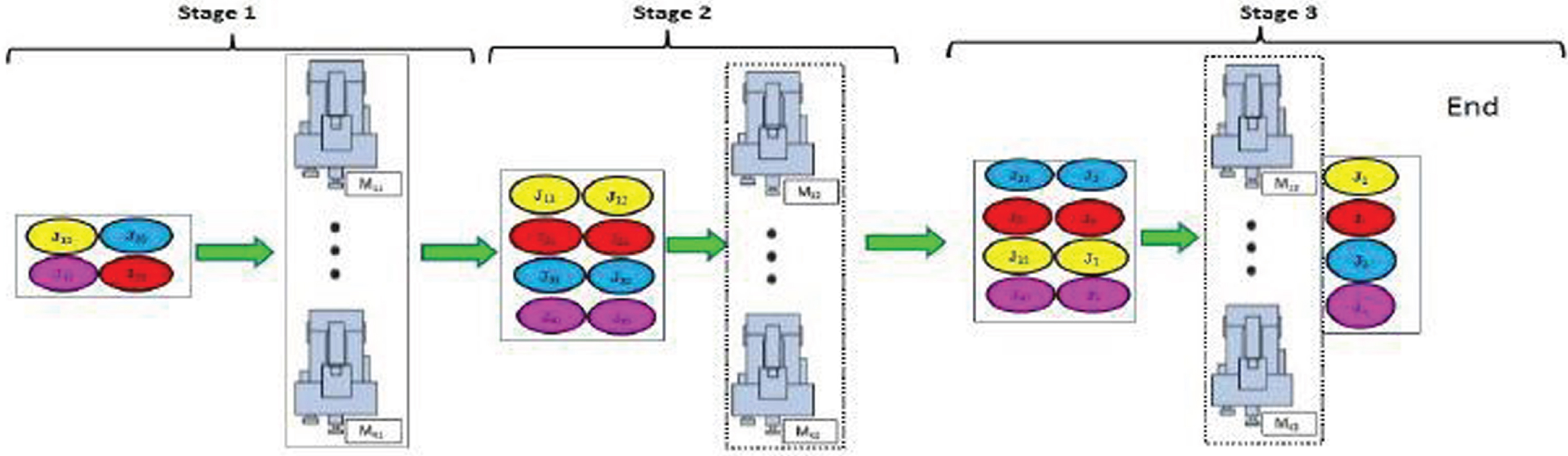
Graphical display of the problem.
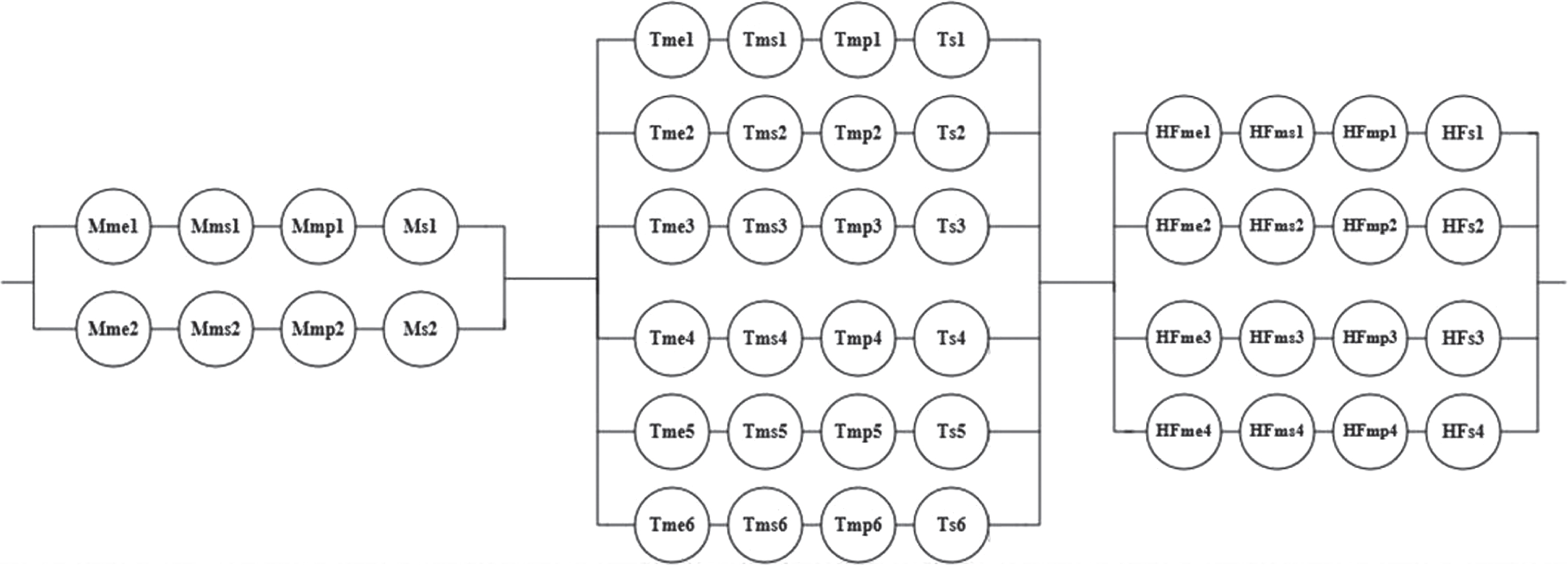
The series–parallel structure of PVC window production system.
We are going to obtain the fuzzy E- Bayesian estimations of system reliability at time t* = 8h and c = 2. Calculations are shown only for the first process of the manufacturing process. The simulated failure times and repair times are presented in Table 1.
Failure and repair times of the first process of the manufacturing process
In the table, the time unit is minute, and for illustration purposes only, a couple of simulated data are given and used in calculations. Explanation of the data is given in Table 1 on the machine and equipment sub-process (Mme1) of the first process of the manufacturing process and the similar explanations are valid for the other sub-processes. The above data show that the failure times are assumed as fuzzy real numbers, since the failure times and repair times cannot be recorded precisely due to human errors, machine errors, or some unexpected situations. For component 1(Mme1), The first failure time as mean of the exponential failure time distribution is around 1387, the second failure time is around 1305 and also repair time as mean of the exponential repair time distribution simulated as 120 and 80. Reflecting on the impreciseness of the data these numbers are taken as fuzzy triangular numbers. For example 1305 min is taken as,
These data were gathered from the company.
From Equations. (6), (7) and (8), fuzzy E- Bayesian estimations of system reliability
By applying the Supplemental Procedure [45], we have, for r ∈ A0,
If r < 0.5535, then we solve the following prob-lem using any software (we used software LINGO in this work:
If r > 0.5535, then we solve the following problem:
Finally, we can obtain the membership degrees for any given E- Bayesian estimations r of fuzzy system reliability
So, we just need to solve the sub-problems II. Using relations (6) and (7), for α = 1, yields
If r < 0.2046, then we solve the following problem using any software (we used software LINGO in this work:
If r > 0.5535, then we solve the following problem:
Using the above procedure and relations (8) and (9), for α = 1, yields
By applying the Supplemental Procedure [45], we have, for A ∈ G0,
If A < 0.7965, then we solve the following problem using any software (we used software LINGO in this work:
If A > 0.7965, then we solve the following problem:
Using the LINGO software, we obtained the membership degrees. Also, the intervals of the reliability for different α levels (such as α = 1.0, . . . α = 0.15) are tabulated in the application case study (see Table 2).
Sensitivity analysis at different α levels
As you can see in Table 2 and Fig. 3, due to increases in α levels, so the reliability decreases and accessibility increases, which is crucial in the case study showing that managers organization in plan activities that lead to future decisions and control the objectives of the organization’s subsystems and available subsystems.

Comparison of suggested methods for reliability in different alpha.
Also, since the reliability of the system is directly associated with the number of system components, it can be proved that the higher the level of uncertainty, the less reliable the system achieves the organization-approved effectiveness. Therefore, the actual performance guarantees the components that guarantee the performance of the program to guarantee the practical performance of the subsystems.
Therefore, operational managers should perform controls by measuring outputs, and comparing them with planned ones, in order to have an accurate estimate of the reliability of the system and its components in uncertainty. However, the system reliability behavior has an uniformity, so the error rate of the proposed method is negligible, indicating that the proposed method generally increases the reliability of the components of the systems produced. It will eventually reduce costs and reduce operating time.
In this paper, new approaches proposed as E-Bayesian to estimate systems reliability under fuzzy and impreciseness. The proposed modified estimation method was then implemented for a PVC window production system where data collection and failure time may be affected by the fluctuations in materials and production processes. The main objectives of this approach were: Increased reliability of components of production systems, Increased safety and cost optimization, Keep or repair equipment in operational condition.
The proposed model has two advantages. First, Prior information about the underlying system can be used first by the E-Bayesian methods. Second, using ambiguous set theory, we may come to a deeper conclusion than we would utilize the fuzzy set theory. For future research, fuzzy system reliability based on data censored by the E-Bayesian method and Bayesian hierarchy may be appropriate for further investigations.