Lattice implication algebra is a new logical algebraic system which is established by combining lattice and implication algebra. As a generalization of intuitionistic fuzzy set, neutrosophic set is introduced which deals with indeterminate membership in addition to degree of membership and degree of non-membership. In this article, the notion of neutrosophic set theory is applied to lattice implication algebras. The concept of implicative neutrosophic LI-ideals of a lattice implication algebra is introduced, and several properties are investigated. Relationship between a neutrosophic LI-ideal and an implicative neutrosophic LI-ideal is discussed, and conditions for a neutrosophic LI-ideal to be an implicative neutrosophic LI-ideal are provided. Characterizations of an implicative neutrosophic LI-ideal are considered, and the extension property of an implicative neutrosophic LI-ideal is studied.
As a new logical algebraic system, lattice implication algebras are established by combining lattice and implication algebra (see [21]). The fuzzy set theory was introduced by Zadeh [22] in 1965, in order to explain the situations where data are imprecise or vague. On the other hand in 1986, a generalized form of fuzzy set namely, intuitionistic fuzzy set was introduced by Atanassaov [1] which deals with both the degree of membership (belongingness) and non-membership (non-belongingness) of an elements within a set. Konwar et al. studied intuitionistic fuzzy n-normed linear spaces, intuitionistic fuzzy n-Banach spaces, and intuitionistic fuzzy hypergroupoids (see [11–14]). Smarandache [17] generalized the intuitionistic fuzzy set (IFS), paraconsistent set, and intuitionistic set to the neutrosophic set (NS), and presented many examples. In neutrosophic sets, indeterminate membership is treated in addition to degree of membership and degree of non-membership. Neutrosophic set theory is applied to various part which is refered to the site
http://fs.gallup.unm.edu/neutrosophy.htm.
Jun and his colleagues applied the notion of neutrosophic set theory to BCK/BCI-algebras (see [7–10, 19]). Borzooei et al. [3] studied commutative generalized neutrosophic ideals in BCK-algebras. Borzooei et al. [2] introduced the concept of neutrosophic LI-ideals and neutrosophic lattice ideals of a lattice implication algebra, and investigated several properties. They discussed relationship between a neutrosophic LI-ideal and a neutrosophic lattice ideal, and provided conditions for a neutrosophic lattice ideal to be a neutrosophic LI-ideal. Jun et al. studied LI-ideals in lattice implication algebras (see [4]), and Liu et al. studied implicative and prime LI-ideals in lattice implication algebras (see [6]).
In this paper, we apply the notion of neutrosophic set theory to lattice implication algebras. We introduce the concept of implicative neutrosophic LI-ideals of a lattice implication algebra, and investigate several properties. We discuss relationship between a neutrosophic LI-ideal and an implicative neutrosophic LI-ideal. We provide conditions for a neutrosophic LI-ideal to be an implicative neutrosophic LI-ideal. We consider characterizations of an implicative neutrosophic LI-ideal. We study the extension property of an implicative neutrosophic LI-ideal.
Preliminaries
By a lattice implication algebra we mean a bounded lattice (L, ∨ , ∧ , 0, 1) with order-reversing involution “ ′ ” and a binary operation “ → ” satisfying the following axioms:
y → (z → x) = z → (y → x) ,
y → y = 1,
y → z = z′ → y′,
y → z = z → y = 1 ⇒ x = z,
(y → z) → z = (z → y) → y,
(y ∨ z) → x = (y → x) ∧ (z → x) ,
(y ∧ z) → x = (y → x) ∨ (z → x) ,
for all y, z, x ∈ L . A lattice implication algebra L is called a lattice H-implication algebra if it satisfies:
We can define a partial ordering ≤ on a lattice implication algebra L by y ≤ z if and only if y → z = 1.
In a lattice implication algebra L, the following hold (see [20]):
0 → y = 1, 1 → y = y and y → 1 =1.
y → z ≤ (z → x) → (y → x) .
y ≤ z implies z → x ≤ y → x and z → y ≤ z → z.
y′ = y → 0.
y ∨ z = (y → z) → z.
((z → y) → z′) ′ = y ∧ z = ((y → z) → y′) ′ .
y ≤ (y → z) → z.
Let G be a subset of a lattice implication algebra L with 0 ∈ G. Then G is called
an implicative LI-ideal (briefly, ILI-ideal) of L (see [6]) if it satisfies
Lemma 2.1.([5]). Every LI-ideal G of L satisfies the following implication:
Let L be a non-empty set. A neutrosophic set (NS) in L (see [16]) is a structure of the form:
where is a truth membership function, is an indeterminate membership function, and is a false membership function. For the sake of simplicity, we shall use the symbol for the neutrosophic set
Given a neutrosophic set in a lattice implication algebra L, we consider the following sets.
which are called neutrosophic level subsets of L.
We refer the reader to the books [21] for further information regarding lattice implication algebras, and to the site “http://fs.gallup.unm.edu/neutrosophy.htm” for further information regarding neutrosophic set theory.
Implicative neutrosophic LI-ideals
In what follows, let L denote a lattice implication algebra unless otherwise specified, and we consider the following sets.
and
It is clear that
Proposition 3.1.For any a, y, z, x ∈ L, we have
Proof. Let a, y, z, x ∈ L be such that and . Then
and , , . It follows that
Hence . Now assume that and for all a, y, z, x ∈ L. Then
and
Combining (3.8) and (3.9) induces
This shows that .□
Definition 3.2.([2]). A neutrosophic set in L is called a neutrosophic LI-ideal (briefly, NLI-ideal) of L if the following assertions are valid.
Lemma 3.3.([2]). Every NLI-ideal of L satisfies the following assertion.
Theorem 3.4.Let be a neutrosophic set in L. Then the following are equivalent.
is an NLI-ideal of L.
satisfies:
Proof. Let be an NLI-ideal of L. Then by (3.11). Assume that (x → y) ′ ≤ z for all y, z, x ∈ L. Then by Lemma 3.3. It follows from (3.4) and (3.6) that .
Conversely, assume that satisfies the condition (3.13). Since (0 → y) ′ ≤ y for all y ∈ L, we have , that is, . Since (y → z) ′ ≤ (y → z) ′ for all y, z ∈ L, we get and so by (3.4). Therefore is an NLI-ideal of L.□
Definition 3.5. A neutrosophic set in L is called an implicative neutrosophic LI-ideal (briefly, INLI-ideal) of L if it satisfies (3.10) and
Example 3.6. Let L = {0, a, b, 1} be a set with Cayley tables as follows:
Define ∨- and ∧-operations on L as follows:
for all y, z ∈ L . Then L is a lattice implication algebra (see [21]). Let be a neutrosophic set in L defined by Table 1.
Tabular representation of
L
0
a
b
1
0.6
0.3
0.3
0.3
0.8
0.5
0.8
0.5
0.2
0.2
0.7
0.7
It is routine to verify that is an INLI-ideal of L.
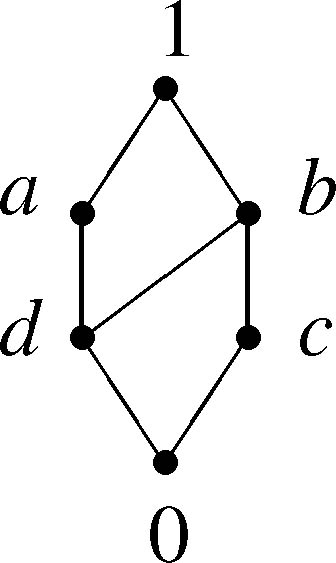
Example 3.7. Let L = {0, a, b, c, d, 1} be a set with Hasse diagram and Cayley tables as follows:
Define ∨- and ∧-operations on L as follows:
for all y, z ∈ L . Then L is a lattice implication algebra (see [5]). Let be a neutrosophic set in L defined by Table 2.
Tabular representation of
L
0
a
b
c
d
1
0.7
0.7
0.5
0.5
0.7
0.5
0.5
0.5
0.3
0.3
0.5
0.3
0.3
0.3
0.6
0.6
0.3
0.6
It is routine to verify that is an INLI-ideal of L.
We discuss relationship between NLI-ideals and INLI-ideals.
Theorem 3.8.Every INLI-ideal is an NLI-ideal.
Proof. Let be an INLI-ideal of L. For any y, z ∈ L, we have
Therefore is an NLI-ideal of L.□
The converse of Theorem 3.8 is not true in general as seen in the following example.
Example 3.9. Let L = {0, a, b, 1} be a set with Cayley tables as follows:
x
x′
⊳
0
a
b
1
0
1
0
1
1
1
1
a
b
a
b
1
1
1
b
a
b
a
b
1
1
1
0
1
0
a
b
1
Define ∨- and ∧-operations on L as follows:
for all y, z ∈ L . Then L is a lattice implication algebra (see [21]).
Let be a neutrosophic set in L defined by Table 3.
Tabular representation of
L
0
a
b
1
0.6
0.3
0.3
0.3
0.7
0.5
0.5
0.5
0.4
0.7
0.7
0.7
It is routine to check that is an NLI-ideal of L. But, it is not an INLI-ideal of L since .
We provide conditions for an NLI-ideal to be an INLI-ideal.
Theorem 3.10.In a lattice H-implication algebra, every NLI-ideal is an INLI-ideal.
Proof. Let be an NLI-ideal of a lattice H-implication algebra L. Since y → (y → z) = y → z for all y, z ∈ L, it follows from (3.11) that
for all y, z, x ∈ L. Therefore is an INLI-ideal of L.□
Lemma 3.11.If a neutrosophic set in L satisfies the condition (3.10), then
Proof. Straightforward.□
Theorem 3.12.A neutrosophic set in L is an INLI-ideal of L if and only if is an NLI-ideal of L which satisfies:
Proof. Let be an INLI-ideal of L. Then it is an NLI-ideal of L by Theorem 3.8, and
for all y, z ∈ L. Thus (3.16) is valid by Lemma 3.11.
Conversely, let be an NLI-ideal of L with the condition (3.16). Then
by (3.11), and so for all y, z, x ∈ L by (3.7). Therefore is an INLI-ideal of L.□
Theorem 3.13. If an NLI-ideal of L satisfies:
then is an INLI-ideal of L.
Proof. Let be an NLI-ideal of L which satisfies the condition (3.10). If we put x = z in (3.10) and use (I2), (a1) and (a4), then
for all y, z, x, u ∈ L. Hence is an INLI-ideal of L.□
Theorem 3.14.If an NLI-ideal of L satisfies:then is an INLI-ideal of L.
Proof. Let be an NLI-ideal of L which satisfies the condition (3.17). Then for all y, z, x, u ∈ L by (3.11). It follows from (3.17) and (3.7) that
for all y, z, x, u ∈ L. Therefore is an INLI-ideal of L by Theorem 3.13.□
Proposition 3.15.Every INLI-ideal of L satisfies:
Proof. Let be an INLI-ideal of L. Then it is an NLI-ideal of L by Theorem 3.8. Let y, z ∈ L. Then
and so ((z → (z → y) ′) ′ → (z → y) ′) ′ → (y → (z → y) ′) ′ = 1, that is,
Hence
by Lemma 3.3. Using Theorem 3.12, we have
It follows from (3.11) that
Note that
and so (y → z) ′ → (y → (z → y) ′) ′ = 1, that is, (y → z) ′ ≤ (y → (z → y) ′) ′. Thus ((y → z) ′, by Lemma 3.3. Since
we get
Since is an NLI-ideal of L, we have
Hence
by (3.23), (3.24) and (3.6). It follows from (3.22) and (3.6) that
that is, .□
Proposition 3.16.If an NLI-ideal of L satisfies (3.19), then it satisfies the following assertion.
Proof. Assume that is an NLI-ideal of L satisfying (3.19). Then
for all y, z, x ∈ L by (3.11). It follows from (3.19) and (3.7) that
for all y, z, x ∈ L.□
Theorem 3.17.Let be an NLI-ideal of L which satisfies the condition (3.26). Then is an INLI-ideal of L.
Proof. Assume that is an NLI-ideal of L satisfying the condition (3.26). Taking x = 0 in (3.26) induces , and so
for all y, z ∈ L. Since
we have ((y → z) ′, ((y → z) ′ → z) ′) = ((y → z) ′, . for all y, z ∈L. It follows from Theorem 3.12 that is an INLI-ideal of L.□
Corollary 3.18.Let be an NLI-ideal of L which satisfies the condition (3.19). Then is an INLI-ideal of L.
Theorem 3.19.Let be a neutrosophic set in L. Given ɛT, ɛI, ɛF ∈ [0, 1], consider the sets:
Then is an NLI-ideal (resp. INLI-ideal) of L if and only if , and are LI-ideals (resp. ILI-ideals) of L for all ɛT, ɛI, ɛF ∈ [0, 1].
Proof. The proof is routine and so it is omitted.□
Lemma 3.20.([6]). An LI-ideal I of L is an ILI-ideal of L if and only if the following assertion is valid.
Theorem 3.21.Let be an NLI-ideal of L. Then the following are equvalent.
is an INLI-ideal of L.
The set
is an LI-ideal of L for all b ∈ L and ɛT, ɛI, ɛF ∈ [0, 1].
Proof. Assume that Ib is an LI-ideal of L for any b ∈ L and ɛT, ɛI, ɛF ∈ [0, 1]. Let y, z ∈ L be such that . Then (y → z) ′ ∈ Iz. Since , we have z ∈ Iz. If follows from (2.2) that y ∈ Iz. Thus , and thus , and are ILI-ideals of L by Lemma 3.20. Therefore is an INLI-ideal of L by Theorem 3.19.
Conversely, suppose that is an INLI-ideal of L. Obviously 0 ∈ Ib for all b ∈ L. Let y, z ∈ L be such that (y → z) ′ ∈ Ib and z ∈ Ib. Then and . Since
we get (((y → b) ′ → b) ′ → ((y → z) ′ → b) ′) ′ ≤ (z → b) ′. Hence
and thus by Theorem 3.19 and Lemma 3.20. Hence y ∈ Ib, and Ib is an LI-ideal of L.□
Theorem 3.22. (Extension property) Let and be NLI-ideals in L such that and , that is, , and . If is an INLI-ideal of L, then so is .
Proof. Assume that is an INLI-ideal of L. Since and , we have
Let y, z ∈ L. If we take w = ((y → z) ′ → z) ′, then
Hence
by Theorem 3.12, and so by (3.29). Using (3.11) implies that . It follows from (3.6) that
that is, . Therefore is an INLI-ideal of L by Theorem 3.12.□
Conclusions
To establish an alternative logic for knowledge representation and reasoning, Xu has proposed a logical algebra—lattice implication algebra in 1993 by combining algebraic lattice and implication algebra in [Y. Xu, Lattice implication algebra. J. Southwest Jiaotong Univ, 28 (1993), no. 1, 20–27]. Using real standard or nonstandard subsets T, I and F of ] -0, 1+], Smarandache has introduced the notion of neutrosophic sets, which is a generalization of intuitionistic fuzzy set, in which indeterminate membership is dealt with in addition to degree of membership and degree of non-membership in intuitionistic fuzzy set. In this manuscript, we have applied the notion of neutrosophic set theory to lattice implication algebras. We have introduced the concept of implicative neutrosophic LI-ideals of a lattice implication algebra, and have investigated several properties. We have discussed relationship between a neutrosophic LI-ideal and an implicative neutrosophic LI-ideal, and have provided conditions for a neutrosophic LI-ideal to be an implicative neutrosophic LI-ideal. We have considered characterizations of an implicative neutrosophic LI-ideal, and have studied the extension property of an implicative neutrosophic LI-ideal.
Footnotes
Acknowledgments
The authors wish to thank the anonymous reviewers for their valuable suggestions. The second author is supported by a grant of National Natural Science Foundation of China (11971384).
References
1.
AtanassovK.T., Intuitionistic fuzzy sets, Fuzzy Sets and Systems20 (1986), 87–96.
2.
BorzooeiR.A., SabetkishM., Neutrosophic LI-ideals in lattice implication algebras, Neutrosophic Sets and Systems (submitted).
3.
BorzooeiR.A., ZhangX.H., SmarandacheF. and JunY.B., Commutative generalized neutrosophic ideals in BCK-algebras, Symmetry10 (2018), 350. doi: 10.3390/sym10080350
4.
JunY.B., On LI-ideals and prime LI-ideals of lattice implication algebras, J. Korean Math. Soc.36(2) (1999), 369–380.
5.
JunY.B., RohE.H. and XuY., LI-ideals in lattice implication algebras, Bull. Korean Math. Soc.35(1) (1998), 13–24.
6.
LiuY.L., LiuS.Y., XuY. and QinK.Y., ILI-ideals and prime LI-ideals in lattice implication algebras, Inform. Sci.155 (2003), 157–175.
7.
JunY.B., Neutrosophic subalgebras of several types in BCK/BCI-algebras, Ann. Fuzzy Math. Inform.14(1) (2017), 75–86.
8.
JunY.B., KimS.J. and SmarandacheF., Interval neutrosophic sets with applications in BCK/BCI-algebra, Axioms7 (2018), 23. doi: 10.3390/axioms7020023
9.
JunY.B., SmarandacheF. and BordbarH., Neutrosophic -structures applied to BCK/BCI-algebras, Information8 (2017), 128. doi: 10.3390/info8040128
10.
JunY.B., SmarandacheF., SongS.Z. and KhanM., Neutrosophic positive implicative -ideals in BCK/BCI-algebras, Axioms7 (2018), 3. doi: 10.3390/axioms7010003
11.
KonwarN. and DebnathP., Continuity and banach contraction principle in intuitionistic fuzzy n-normed linear spaces, J. Intell. Fuzzy Systems33(4) (2017), 2363–2373. DOI: 10.3233/JIFS-17500
12.
KonwarN. and DebnathP., Some new contractive conditions and related fixed point theorems in intuitionistic fuzzy n-Banach spaces, J. Intell. Fuzzy Systems34(1) (2018), 361–372. DOI: 10.3233/JIFS-171372
13.
KonwarN., DavvazB. and DebnathP., Approximation of new bounded operators in intuitionistic fuzzy n-Banach spaces, J. Intell. Fuzzy Systems35(6) (2018), 6301–6312. DOI: 10.3233/JIFS-181094
14.
KonwarN., DavvazB. and DebnathP., Results on generalized intuitionistic fuzzy hypergroupoids, J. Intell. Fuzzy Systems36(3) (2019), 2571–2580. DOI: 10.3233/JIFS-181522
15.
ÖztürkM.A. and JunY.B., Neutrosophic ideals in BCK/BCI-algebras based on neutrosophic points, J. Inter. Math. Virtual Inst.8 (2018), 1–17.
16.
SmarandacheF., A unifying field in logics. Neutrosophy: Neutrosophic probability, set and logic, Rehoboth: American Research Press (1999).
17.
SmarandacheF., Neutrosophic set, a generalization of intuitionistic fuzzy sets, International Journal of Pure and Applied Mathematics24(5) (2005), 287–297.
18.
SongS.Z., KhanM., SmarandacheF. and JunY.B., A novel extension of neutrosophic sets and its application in BCK/BI-algebras, New Trends in Neutrosophic Theory and Applications (Volume II), Pons Editions, Brussels, Belium, EU 2018, 308–326, by Florentin Smarandache and Surapati Pramanik (Editors).
19.
SongS.Z., SmarandacheF. and JunY.B., Neutrosophic commutative -ideals in BCK-algebras, Information8 (2017), 130. doi: 10.3390/info8040130
20.
XuY., Lattice implication algebras, J. Southwest Jiaotong Univ.1 (1993), 20–27.
21.
XuY., RuanD., QinK.Y. and LiuJ., Lattice-valued logic, Studies in Fuzzyness and Soft Computing, Vol. 132, Springer-Verlag, Berlin, Heidelberg, New York, 2003.