



Abstract
An extraction of granular structures using graphs is a powerful mathematical framework in human reasoning and problem solving. The visual representation of a graph and the merits of multilevel or multiview of granular structures suggest the more effective and advantageous techniques of problem solving. In this research study, we apply the combinative theories of rough fuzzy sets and rough fuzzy digraphs to extract granular structures. We discuss the accuracy measures of rough fuzzy approximations and measure the distance between lower and upper approximations. Moreover, we consider the adjacency matrix of a rough fuzzy digraph as an information table and determine certain indiscernible relations. We also discuss some general geometric properties of these indiscernible relations. Further, we discuss the granulation of certain social network models using rough fuzzy digraphs. Finally, we develop and implement some algorithms of our proposed models to granulate these social networks.
Introduction
A fundamental mathematical framework to deal with uncertain and vague information is rough set theory (RST), which was originally proposed by Pawlak [22]. In RST, the lower approximation (LA) and the upper approximation (UA) are used to approximate the subset of a universe. The main advantage of RSs to deal uncertainty and vague information is that it does not require any additional information about data. There are many interesting applications of this theory in the fields of cognitive sciences, machine learning, knowledge discovery, expert systems, inductive reasoning and pattern recognition. Rough approximations are widely used in the field of granular computing (GrC) [18]. Granulation of a problem leads to the collection of granules, a granule being a group of elements or objects combined together by similarity or indistinguishability. In RST, the objects are interconnected into equivalence classes, which leads o the formation of elementary blocks or granules. In this way, GrC is inherently similar to the foundation of RST. Pawlak [23] studied the various problems of granularity of knowledge using RSs. The formation of granulation structures by RST and the corresponding approximations were studied by Yao [34]. Wang et al. [30] introduced multi-granularity soft rough sets and multi-granularity soft relative attribute reduction. They studied basic properties of multi-granularity soft rough approximations and illustrated by examples. Furthermore, an algorithm for multi-attribute decision-making problems is proposed. The crisp information granulation fails to reflect the human reasoning and problem solving, when the granules are fuzzy in nature. The granules are fuzzy in the sense that the boundaries of real life phenomena such as small, large, intelligent, etc may not be defined sharply. To overcome the problem of uncertainty in GrC, information granularity of universe based on fuzzy sets (FSs) was proposed by Zadeh [36]. In this granulation, the relationships between clusters, groups or granules are presented using fuzzy sets and fuzzy graphs. Fuzzy information granulation provides a better way of studying the uncertain or indeterminate behaviors of granules. It is worth to note that the RST and FST do not play the same role in the problems of knowledge representation systems. Thus, they are not two rival theories to compare with each other but two different aspects to capture the imperfection of knowledge. Therefore, RSs and FSs can be combined to get an hybrid model of rough fuzzy theory (RFT) to get the better approximations.
To incorporate the advantages of RSs and FSs, Dubious and Prade [14] defined the fuzzy rough sets (FRSs) and rough fuzzy sets (RFSs). FRSs have various applications in many fields, including clustering, attribute reduction and classification [16]. Alsager and Alshehri [7] presented a novel hybrid model called multi Q-dual hesitant fuzzy soft (MkQDHFS) rough set model, by the combination of rough sets and MkQDHFS sets. Shah et al. [27] introduced different kinds of uncertainty measures related to Z-soft rough covering sets and discuss their limitations. Moreover, Zhang et al.[40] investigated a novel technique for multi-attribute decision making applying soft rough sets. They introduced various novel concepts, including soft relative positive regions, dependent degree of decision partition soft sets, soft decision systems, and conditional significance relative to decision partition soft sets. Zhan and Zhu [42] proposed some revised algorithms in decision making and provided certain examples. Finally, they constructed a new decision making method for rough soft sets. Novel decision making methods based on hybrid m-polar fuzzy models were proposed by Akram et al. [2]. They combined the notions of rough m-polar fuzzy sets and m-polar fuzzy soft sets to introduce new hybrid models for soft computing.
Theory of RFSs was applied to digraphs by Zafar and Akram [37]. They proposed a novel decision-making method based on rough fuzzy information. The same authors also defined rough fuzzy digraphs with applications [5]. Wang et al. [31] investigated the multiple attribute decision making (MADM) problem based on the aggregation operators with dual hesitant fuzzy information. Zhang [38] proposed attributes reduction based on intuitionistic fuzzy rough sets. Akram and Zafar [6] generalized the concept of connectivity of fuzzy graphs to rough fuzzy digraphs, introduced the strength of connectedness between vertices, and investigated certain properties. A new approach based on fuzzy rough digraphs for decision-making was proposed by Akram et al. [3]. Zhan et al. [39] introduced the concept of a rough soft hemiring as an extended notion of a rough hemiring and a soft hemiring. Recently, Pythagorean fuzzy soft graphs have been introduced by Shahzadi et al. [28]. They studied the certain properties of the proposed graphs, including perfectly regular and perfectly edge-regular Pythagorean fuzzy soft graphs.
Granulation for simple graphs was firstly introduced by Stell [25]. He demonstrated the different kinds of granulation for simple graphs and discussed the connection of vague graphs with granulation. Chen and Zhong [12] extracted the granular structures using simple graphs. They developed the granular structure models based on three types of elements in a simple graph, i.e., vertices, edges and their combination. In 2016, Chiaselotti et al. [13] studied some interesting concepts of simple graphs, which correspond to the GrC. Micro and macro models of granular computing based on the indiscernibility relation were studied by Bisi et al. [9]. They investigated the indiscernibility structures of knowledge representation system and developed three hypergraphic structures, including the discernibility hypergraph, the reduct and the essential hypergraph. Chen et al. [11] proposed a hypergraph model of GrC and gave an effective way of granular structures and a useful method for problem solving. Furthermore, Bianchi et al. [10] discussed the matching of labeled graphs using the GrC concepts and levels of abstraction. The relational granularity of hypergraphs and the applications of these relations to a theory of granularity were discussed by Stell [26]. Wang and Gong [29] discussed an application of fuzzy hypergraphs in GrC. Information granulation for rough fuzzy hypergraphs was studied by William-West and Singh in [32]. Recently, Luqman et al. [19] have proposed an m-polar fuzzy hypergraph model of GrC.
The construction of granules and grouping the clusters for crisp graphs have been explored many researchers in various domains. But they did not provide a detailed discussion on the construction of granular structures for graphs, use of these structures in problem solving, representation of relationships among granules and transforming the different levels of granularities. Moreover, the crisp approximations of simple graphs lack some information in case of uncertain network models and do not provide an adequate and exact visualization of certain problems. For example, in case of road networking vehicle travel time or vehicle capacity on a road network can not be determined exactly and in such cases, it is necessary to use fuzzy approximations to deal with the uncertainty. These deficiencies of previously proposed models motivate us to combine the hybrid model of RFSs with graph theory to extract the granular structures. We examine the information granulation by applying RFSs and review the corresponding approximations of granules. We discuss the accuracy measures of rough fuzzy sets and measure the distance between lower and upper approximations. The visual representation of RFDGs and merits of multilevel of granularity enable us to adopt the most fruitful techniques for problem solving. In addition. the main focus of our work is to present a brief discussion on the construction of granular structures using RFDGs, grouping these granules and representation of relationships between different levels of granularities. We consider the adjacency matrix of a RFDG as information table and determine some indiscernible relations. Thus, we study how to granulate the certain network models using RFDGs.
The contents of this paper are as follows: In section 2, we review some fundamental concepts of FSs, RSs, RFSs and RFDGs. In section 3, we define accuracy measures and distance between lower and upper approximations. We define RF information tables and set-valued information tables. In section 4, we study the role of RFDGs in information granulation. We discuss some general geometric properties of RFDGs and define certain mappings based on indiscernibility relations. In section 5, we discuss the granulation of certain social networks through RF approximations. We develop and implement some algorithms to granulate our social structures. In section 6, we give a brief comparison of our proposed models to granulate social networks with other existing models of crisp granulation. The last section deals with conclusions and future directions.
Preliminaries
(i) ξ is an ER on Z.
(ii) E is an ER on J∗ ⊆ Z × Z.
(iii)
(iv)
(v) (ξF, EJ) is rough fuzzy digraph, where
fuzzy knowledge representation system or fuzzy information table (FIT), in case of finite set, is defined as a structure
(i) ηF1∪F2 (z) = max {η F 1 (z) , η F 2 (z)} ,
(ii) ηF1∩F2 (z) = min {η F 1 (z) , η F 2 (z)} ,
(iii) |F1| = Ση F 1 (z) ,
(iv)
Accuracy measures of rough fuzzy approximations
The accuracy of ξF is also defined as:
Information table I
Information table I
Let us consider the subset of attributes given as
The ER
The ER
The distance between LA and UA is given as:
We now discuss the rough fuzzy approximations using SVITs and find out their accuracy measures.
The corresponding SVIT I
We now determine the tolerance classes according to the relation λ
A
*
for different subsets of
Note that, the relation matrix of
The relation matrix
Let F = {(s1, 0.8) , (s2, 0.6) , (s3, 0.7) , (s4, 0.4) , (s5, 0.9) , (s6, 0.3)} be a fuzzy set on Z. The LA and UA of F are determined as:
A multi-level partition of the universe is obtained through the nested sequence of equivalence relations and implies to a simple multi-level granulation of Z.
In this section, we study a RFDG
=
Let z ∈ ξF. Then, the neighborhood of z in
We denote by
(i)
(ii) z1thicksimw ⇔ z2thicksimw, for
(iii)
The equivalence between (i) and (iii) implies the following result.
The triplet
Equivalence relation ξ
Equivalence relation ξ
Let F = {(a1, 0.8) , (a2, 0.6) , (a3, 0.7) , (a4, 0.4) , (a5, 0.9)} be a fuzzy set on Z. Let ξF be a RFS, where the LA and UA are given as:
Equivalence relation on J*
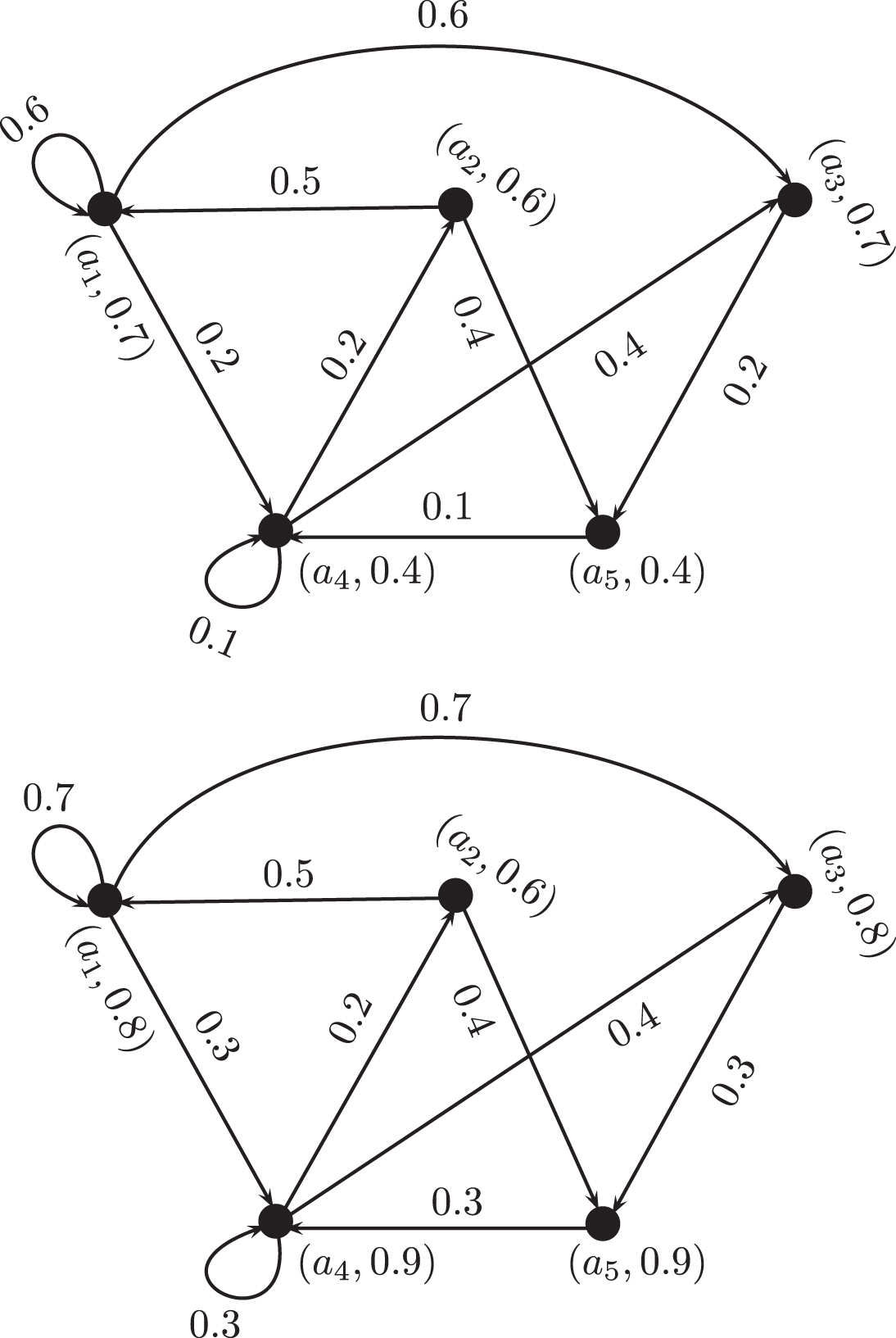
LA and UA of RFDG
The FIT
LA and UA of FIT, respectively
Let
In this subsection, we discuss some general geometric properties of RFDGs and define certain mappings based on indiscernibility relations.
(i) H ⊆ Z,
(ii) ξ H is an ER on H such that z i z j ∈ ξ H ⇔ z i z j ∈ ξ,
(iii) ξ H M is a RFS on H, where M is fuzzy set on H such that M (z i ) ≤ F (z i ), for all z i ∈ H,
(iv) E H is an ER on K* ⊆ H × H such that (z i z j , z k z l ) ∈ E H ⇔ (z i z j , z k z l ) ∈ E,
(v) E H K is a RFR on K*, where K is a fuzzy set on K* such that K (z i z j ) ≤ J (z i z j ).
Then, the ordered pair
ER ξ
H
on H
ER ξ H on H
Let M = {(a1, 0.6) , (a2, 0.5) , (a3, 0.6)} be a fuzzy set on H. Then, the LA and UA of ξ
H
M are given as:
Let K* = {a1a1, a1a3, a2a1} ⊆ H × H and K = {(a1a1, 0.4) , (a1a3, 0.5) , (a2a1, 0.3)} be a fuzzy set on K*. The ER E H on K* is given in Table 9.
ER E H on H
Then, the LA and UA of RFR E
H
K is given as follows:
The LA and UA of corresponding RFSDG generated by H are given in Figure 4(a) and 4(b).
LA and UA of 
We now prove that if unotsimw or
(i). First we prove that
From Definition 4.1, we observe that
z1 ∈ {x1, x2}, z2 ∉ {x1, x2}, z2 ∈ {x1, x2}, z1 ∉ {x1, x2}.
We first suppose that z1 ∈ {x1, x2}, z2 ∉ {x1, x2}, (as the second case z2 ∈ {x1, x2}, z1 ∉ {x1, x2} is similar to prove). WLOG, we suppose that x1 = z1. Since, z2 ∈ H and z2 ∉ {x1, x2}, this implies that
The other condition, which we have to examine, is {z1, z2} = {x1, x2}. WLOG, we assume that z1 = x1 and z2 = x2, the Definition 4.1 implies that
(ii). We now suppose that
Now, if
LA and UA of 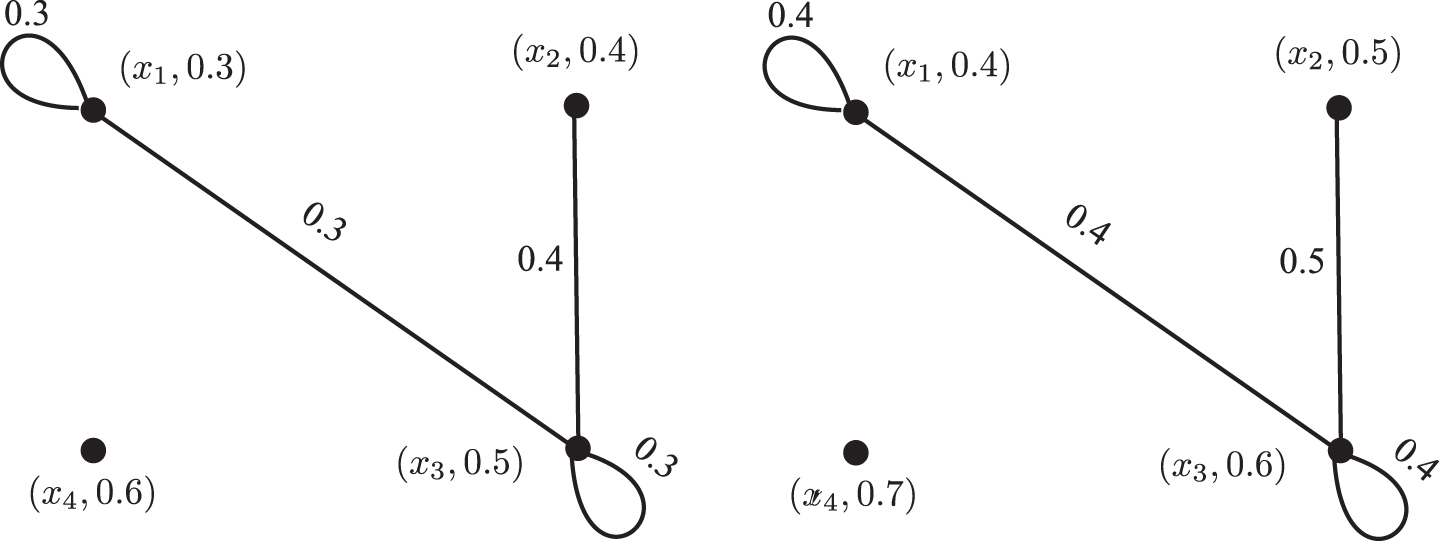
Thus, we have x1 is equivalent to x2 with respect to
We now determine the mapping
Thus, we have
The condition (ii) of Theorem 4.1 implies that, for all
Let
To prove the other side, let d* ∈ ω (S
l
). Then, there is an element g* ∈ S
l
such that ω (g*) = d*. Since, g, g* ∈ S
l
, we have
LA and UA of 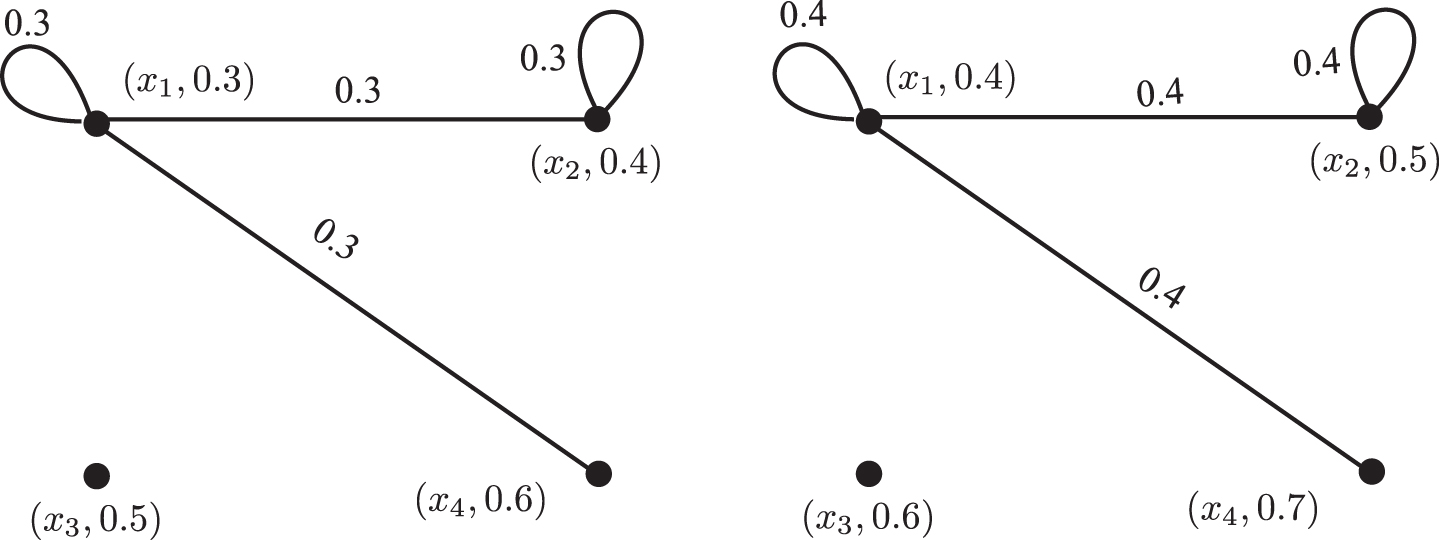
Let
We now determine the
That is
From above calculations, we deduce that
Suppose that
Then, we have
where ω (S1) = {x1, x2, x4}, ω (S2) = {x1, x2, x4}, ω (S3) = {x3}, and ω (S4) = {x1, x2, x4}. Thus, we have
In the granulation of social networks, social structures are discussed through graphs (or digraphs). The vertices of a graph represent the elements or members of some network and these vertices are connected through an edge if they have some relationship between them. In this section, we study the granulation and discuss some indiscernible relations of certain social networks using RFDGs.
Granulation of social network of elite families
In the field of social network analysis, we study the social structures through graphs or digraphs. In this subsection, we study the social network concerning the marriage ties of certain noble families using RFDG
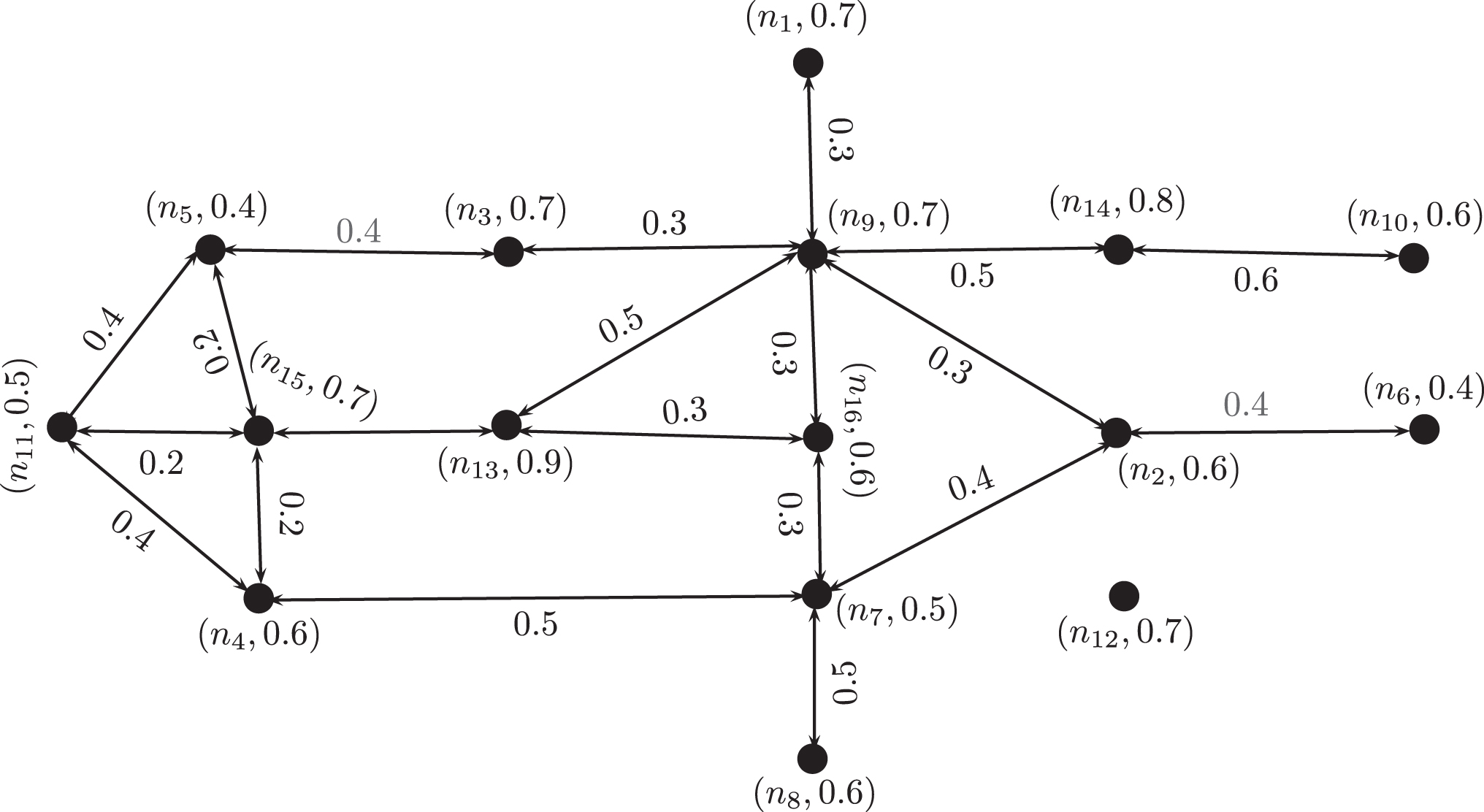
LA of social network
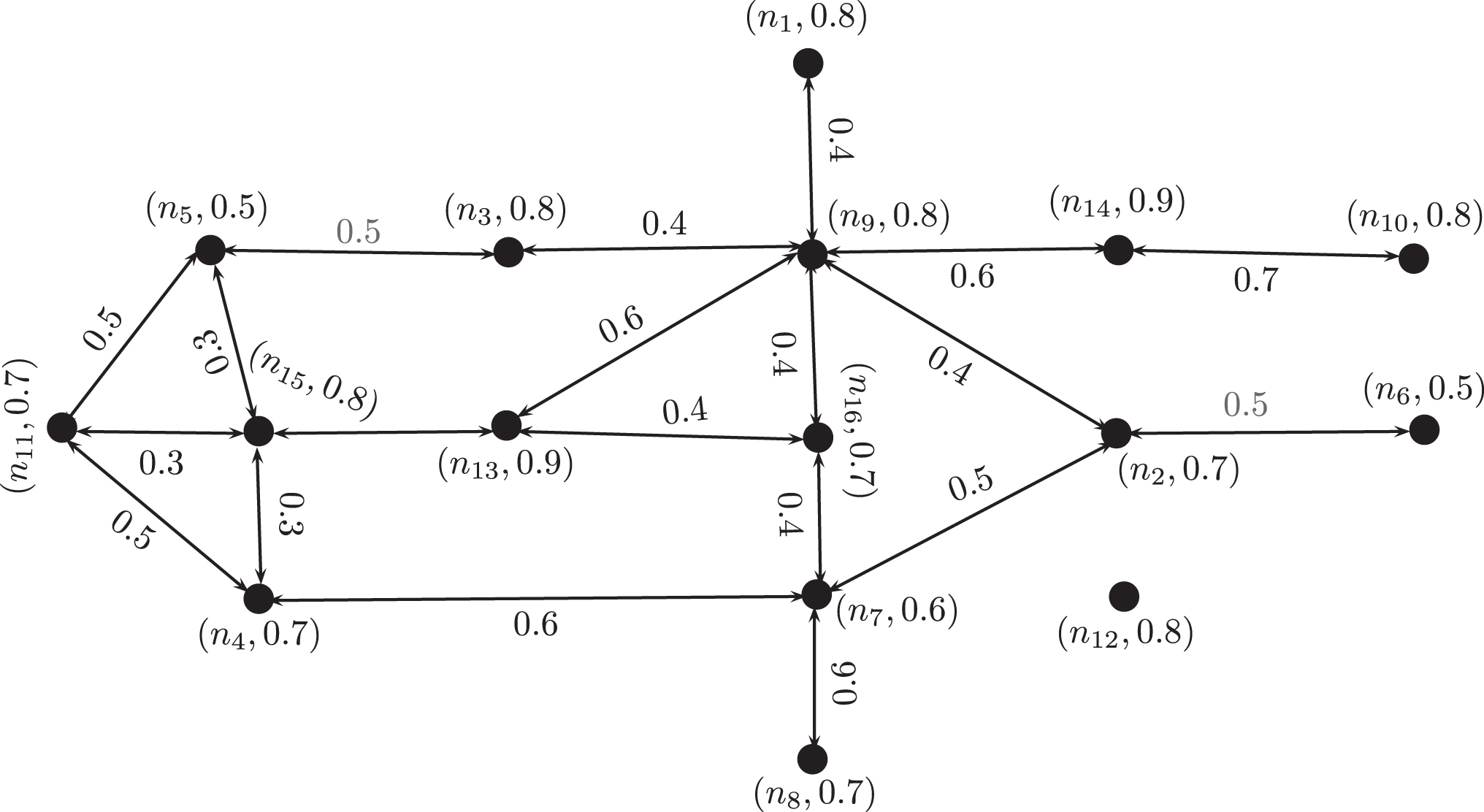
UA of social network
Granulation of social network and indiscernibility relations
In an organization structure, there are different stakeholder, including directors, managers, officers and other employees, who lead a company to fulfill its business objectives. Here, we consider the management structure of a business organization and represent this structure through the LA and UA of a RFDG

Minimum influence of employees on their staff.

Maximum influence of employees on their staff.
Here, the set of universe Z = {m1, m2, m3, ⋯ , m22} represent the members of a business organization and these members are connected through directed edges according to the relations between them. Different designations are shown by distinct shapes of vertices, i.e., the oval vertices represent the CEOs, circular vertices show officers under CEOs, rectangles represent the managers of the company and square vertices represent the teams working under managers. We skip to show the FIT

LA of
Note that, m22 and m14 possess no relationships with any member of the fixed set. Similarly, the UA is given in the following figure.
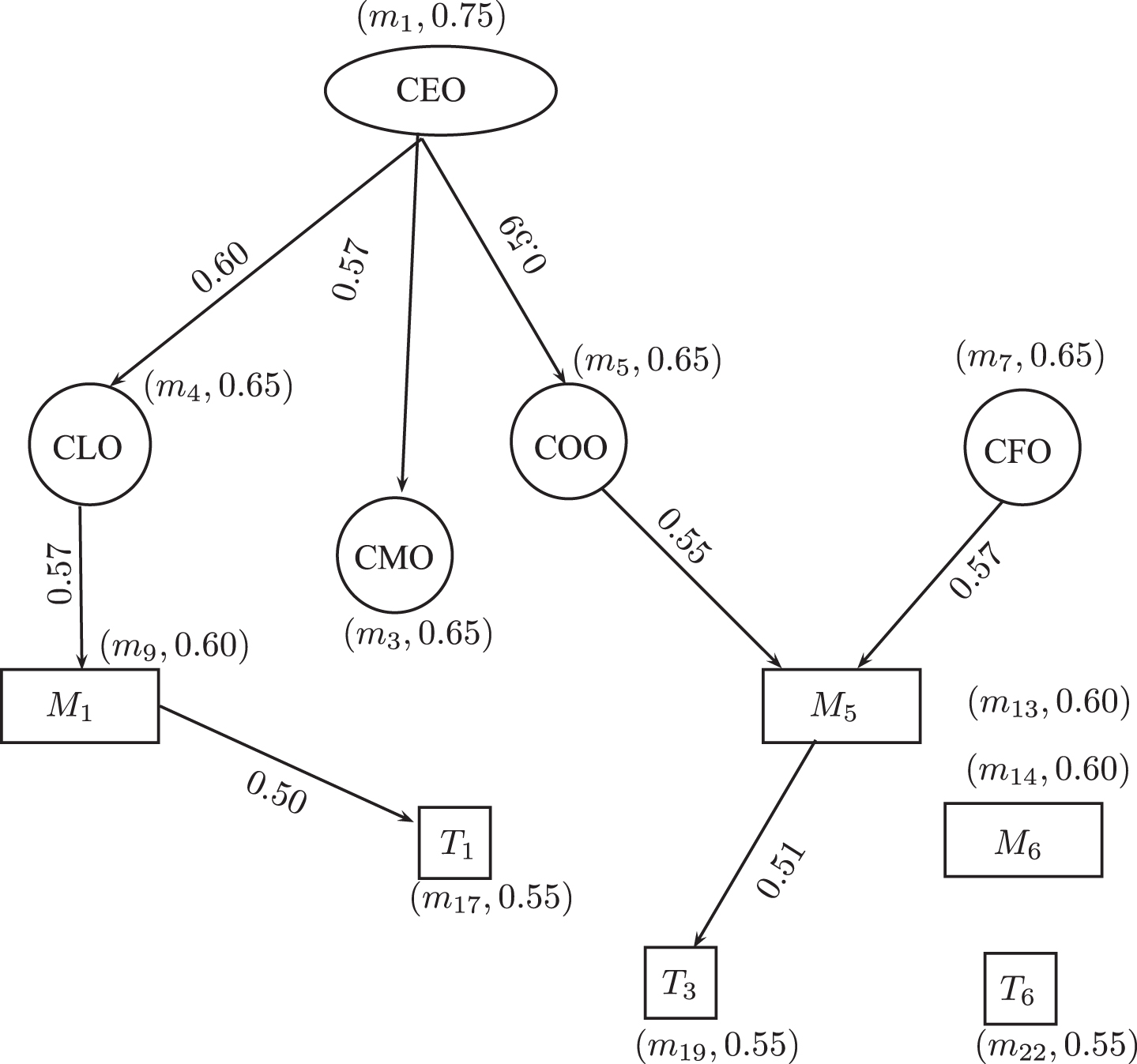
UA of
Similarly, by fixing any other set of vertices, we can determine the relationships between the corresponding members of an organization. The procedure adopted in the granulation of our network is described in Algorithm 2.
Generation of subgraphs
Theory of FSs and RSs are two different approaches to handle uncertainty but not opposite to each other. To combine both theories to obtain more generalized outcomes, Dubois and Prade [14] investigated the roughness of FSs and proposed a more general mathematical tool to deal with vagueness named as RFSs. In GrC, many researchers have constructed the granular structures and multilevels of granularities using simple crisp graphs and rough approximations. The crisp information granulation fails to reflect the human reasoning and problem solving, when the parameters or attributes are fuzzy in nature. To overcome the problem of uncertainty in construction of granules, we apply the hybrid model of RFDG to construct granular structures. A RFS and RFDG model of GrC handles the uncertain relationships between elements of universe and describes the lower and upper approximations of these relationships at different levels of granularity. Thus, our proposed model helps to granulate the complex uncertain networks more effectively and practically by considering the LA and UA. A very used example of constructing the granules in social networks using simple graphs is discussed by Chiaselotti et al. [13]. They considered the marriage ties of noble families in Florence in 15th century. The vertices of a simple undirected graph were considered as the 16 elite families and these vertices were connected by an edge if the corresponding families were linked by a marriage tie. The corresponding crisp graph is shown in Figure 11.
By considering this graph, they studied the symmetry blocks and corresponding partition of set of universe. We generalized the above example using RFDGs as given in 5.1 and the LA and UA of these families are given in Figures 2 and 3, respectively. We studied the indiscernible relations between these families using fuzzy information tables. Our proposed approach is more effective and practical in the way that it does not only provide the information about marriage ties between elite families (as described by crisp approach) but also illustrate the minimum and maximum strengths of these ties. For example, the LA of RFDG describes the minimum strength and UA shows the maximum strength of the ties of corresponding families.
Similarly, we consider another example of social network, i.e., face-to-face interaction networks. The data set information are derived from real situations and is given in Table 12.
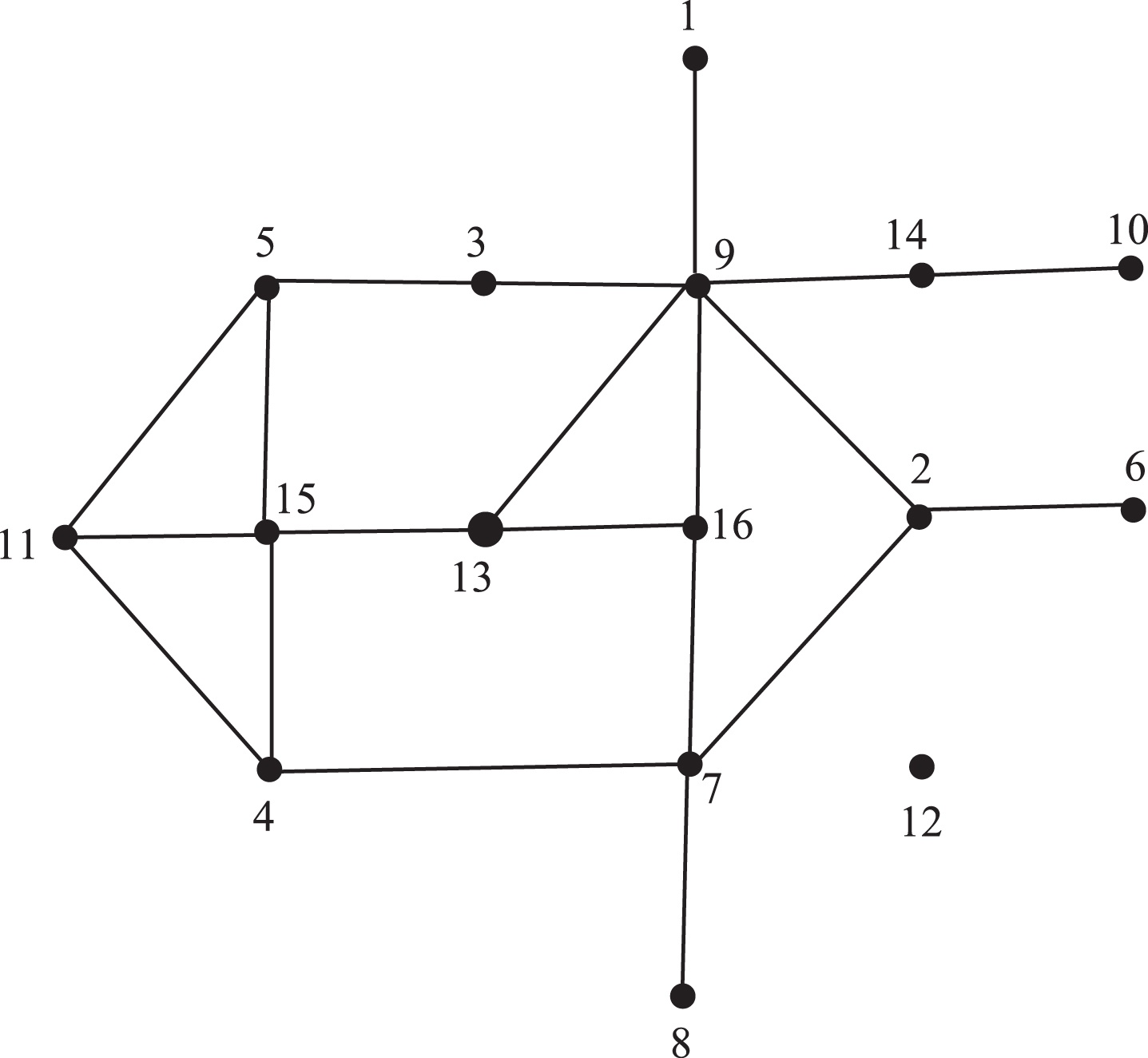
The elite families in Florence.
Dataset information
The dynamic face-to-face interaction networks represent the interactions that happen during discussions between a group of participants playing the Resistance game. In these networks, each vertex represents a participant. A directed edge from node u to v is is drawn if u looks at participant v or the laptop. We consider a small part of these complex networks to compare our model with crisp models. A crisp directed network of face-to-face interaction is given in Figure 12.
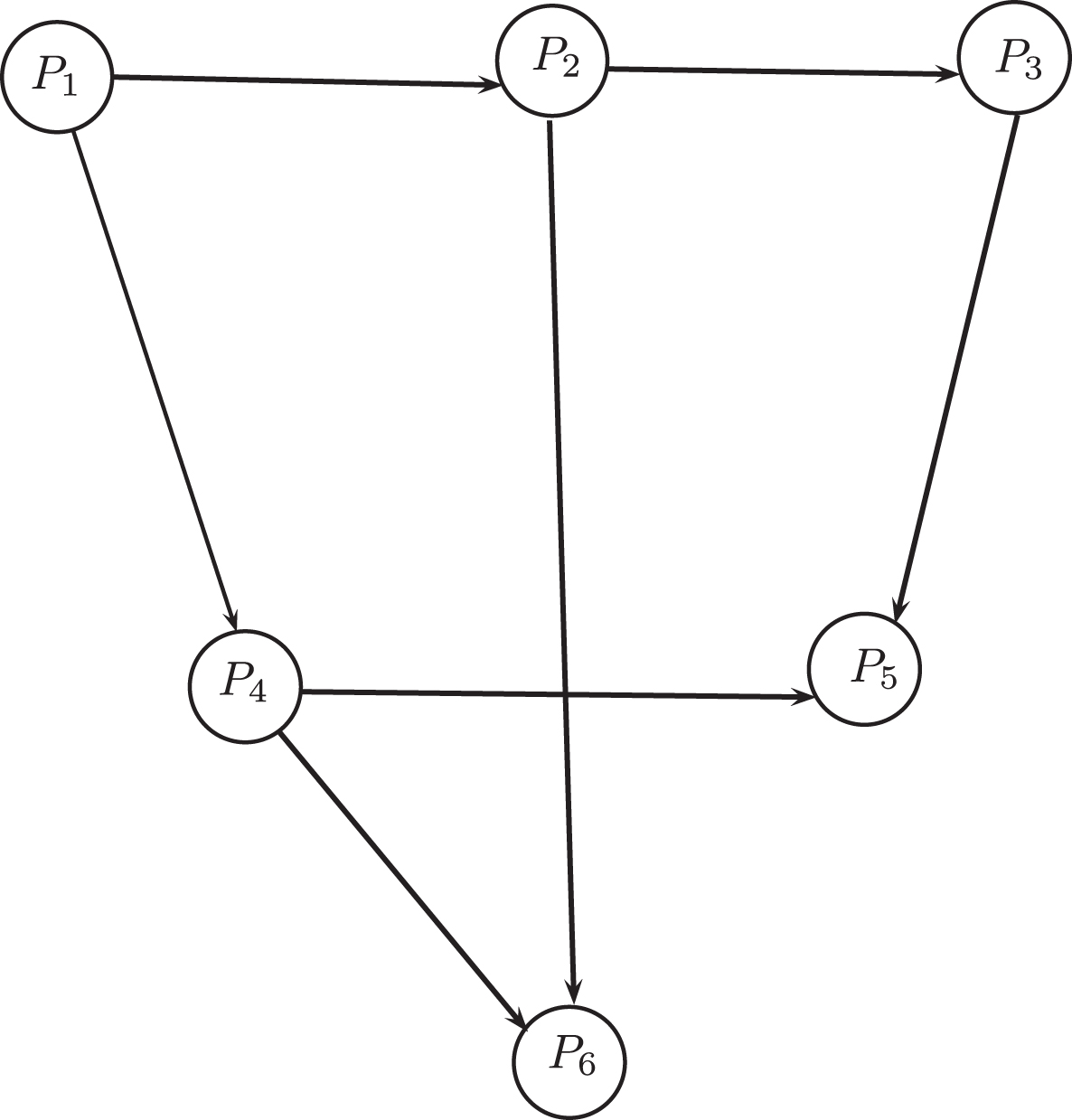
Face to face interaction network.
Now, if we want to obtain the symmetry blocks and indiscernibility partition of these participants according to the relation that how many maximum and minimum times a participant looks at other in some certain interval of time. Then, this crisp network model can not effectively deal with our problem. Consider the LA and UA of the above network as shown in Figure 13. Here, the degrees of vertices (participants) in LA represent the average minimum number of times of interaction and the degrees in UA represent the average maximum number of times of interaction to each other in a specific interval of time. The membership values of edges in LA represent the minimum number of looks between corresponding participants and membership values of edges in UA represent the maximum number of looks between corresponding participants. By considering the fuzzy information tables of these approximations, we can determine the symmetry blocks and partition (as we have described in 5.1) corresponding to the relation how many times a participant looks the other one.
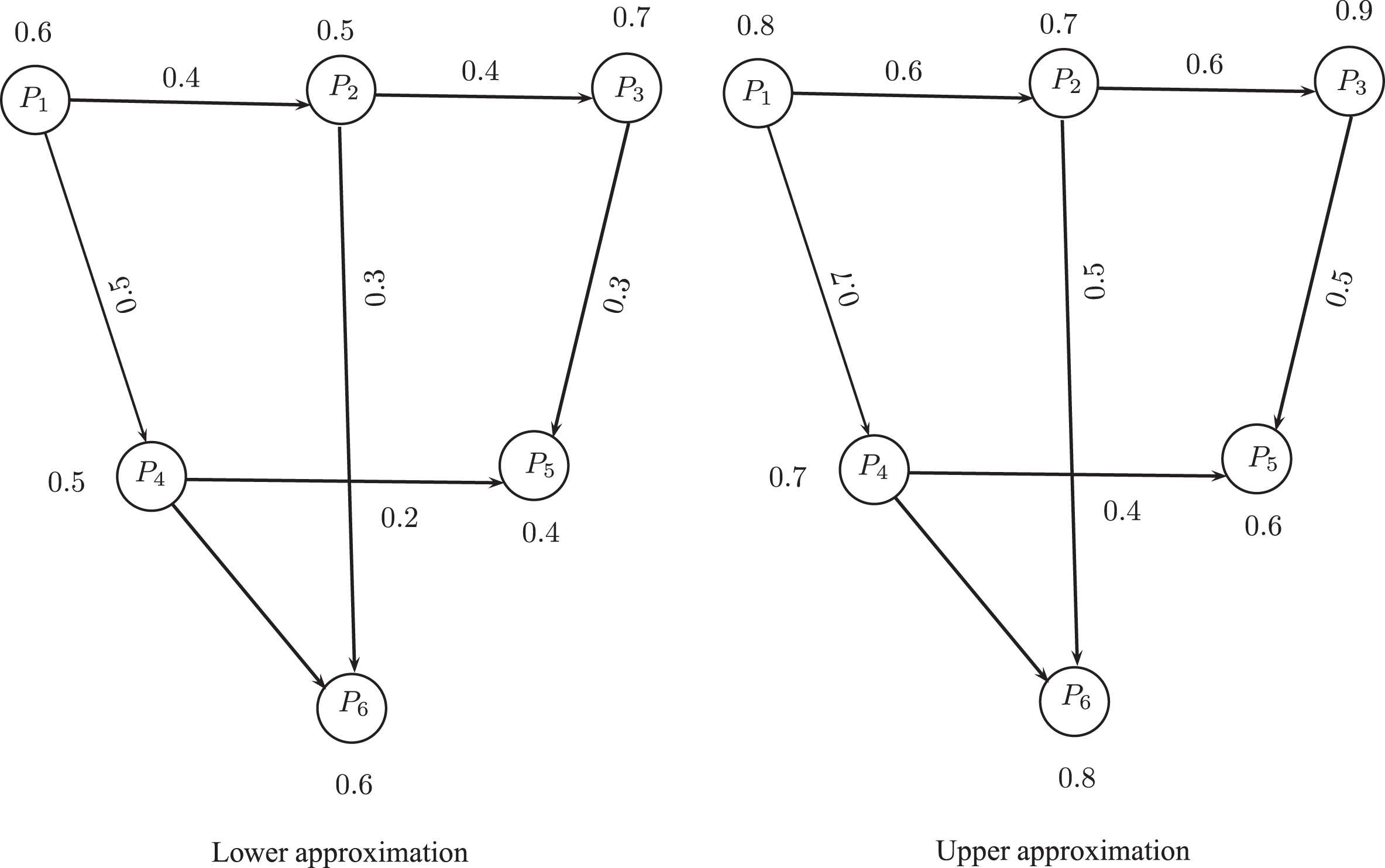
Lower and upper approximations of face-to-face interaction networks.
Hence, by considering the RFDG representation of social network models, we not only see the interactions between different elements of universe but also the maximum and minimum strengths of their relationships. Thus, the proposed models of GrC are more practical and applicable to approximate the social network models in which uncertainty and vagueness occur.
Rough sets and fuzzy sets are two different approaches to deal with uncertainty and inexact information but both theories are capable to handle vagueness occurring in real life. In this paper, we have applied the combined theory of RFSs to deal with uncertainty in information granulation of social networks. Rough fuzzy information granulation provides a multi-level visualization of problems containing uncertain information. We have presented a formal approach of GrC based on RFSs and RFDGS. This approach turns out to design a fruitful connection between modeling of granular structures and rough fuzzy approximations. We have defined the accuracy measures between the LA and UA of RFSs and calculated the distance using these measures. We have defined the FIT and SVIT to determine the indiscernibility relations between elements. Moreover, we have discussed some general geometric properties of indiscernibility relations and RFDGs. Further, we have presented certain social networks through RFDGs and granulated these networks using indiscernibility relations based on FITs. We have developed and implemented some algorithms to granulate the social networks. Finally, we have given a detailed comparative analysis of certain social networks occurring in real situation by considering the public data sets. We have proved the applicability of our proposed models by giving a brief comparison with other existing models of crisp graphs.
We aim to broaden our studies to (1) Fuzzy rough hypergraph models of granular computing, (2) Models of granular structures based on hesitant m-polar fuzzy graphs, (3) Fuzzy rough soft models of granular computing, (4) Hesitant fuzzy hypergraphs in granular computing and (5) Relational granularity of fuzzy hypergraphs.
Conflicts of interest
The authors declare no conflict of interest.
Acknowledgment
This project was funded by the Deanship of Scientific Research (DSR), King Abdulaziz University, Jeddah, under grant No. (DF-168- 135-1441). The authors, therefore, gratefully acknowledge DSR technical and financial support.