Let D be a finite distributive lattice with n join-irreducible elements. It is well-known that D can be represented as the congruence lattice of a rectangular lattice L which is a special planer semimodular lattice. In this paper, we shall give a better upper bound for the size of L by a function of n, improving a 2009 result of G. Grätzer and E. Knapp.
A classical result of R. P. Dilworth states that a finite distributive lattice D can be represented as the congruence lattice of a finite lattice L. There are many papers strengthening this result by requiring that the lattice L representing D have special properties. The lattice L constructed by Dilworth is atomistic. A sectionally complemented lattice L is constructed in G. Grätzer and E. T. Schmidt [12], while a planar lattice is constructed in G. Grätzer and H. Lakser [8].
For every result representing a finite distributive lattice D with n join-irreducible elements as the congruence lattice of a finite lattice L in some class K of lattices, the natural question arises: How small can we make L as a function of n and K ?
For the first result, K is the class of all lattices, that is, there is no restriction on L. The first proof of this representation theorem constructs a lattice of size O (22n), see G. Grätzer and E. T. Schmidt [12]. The size O (22n) was improved to O (n3) by G. Grätzer and H. Lakser [7] and to O (n2) by G. Grätzer, H. Lakser and E. T. Schmidt [9]. Finally, it was proved in G. Grätzer, I. Rival, and N. Zaguia [11] that O (n2) is best possible.
G. Grätzer, H. Lakser and E. T. Schmidt [10] stated that for a class of semimodular lattices, they can construct a lattice of size O (n3) =3n3 + 2n2 - 7n + 4. In fact, they proved that this size can be achieved with a finite planar semimodular lattice L. This result was improved by G. Grätzer and E. Knapp in [4, 5]. They constructed L as a rectangular lattice and improved the size to . G. Grätzer and E. Knapp [6] proved the converse for rectangular lattices: O (n3) is the best possible.
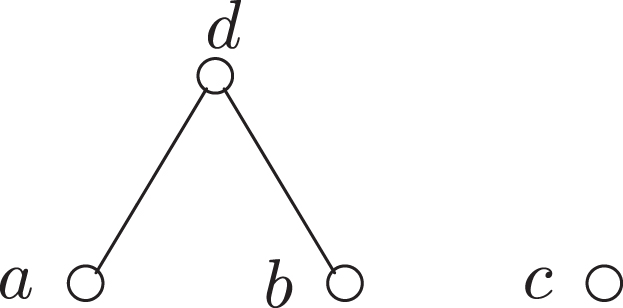
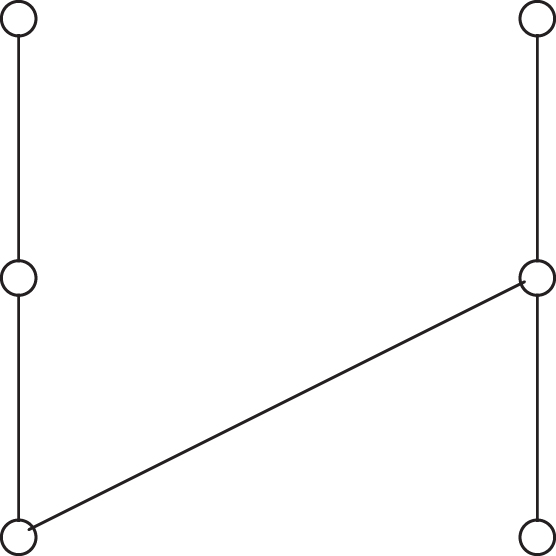
Let P be a partially ordered set with n elements. We say that O = {p1, ⋯ , pn} is an ascending order of P, if pi < Ppj implies that i < j (In [5], G. Grätzer and E. Knapp used the terminology of a finite order instead of an ascending order). Let △ (P) be the sets of all ascending orders of P. Clearly, | △ (P) |≥1. Particularly, | △ (P) |=1 if and only if P is a chain. Thus, a partially ordered set has more than one ascending order generally. For example, both O1 = {a, b, d, c} and O2 = {c, a, b, d} are the ascending orders of Fig. 1.
A partially ordered set P.
In [5], G. Grätzer and E. Knapp showed that there exists a rectangular lattice L such that ConJL ≅ P for any finite partially ordered set P with
when O = {p1, p2, ⋯ , pn} is an ascending order of P, where mi is the number of elements covered by pi in P. Using formula (5), G. Grätzer and E. Knapp proved the following three results (see also [2, 13]):
Theorem 1.1.Let D be a finite distributive lattice with n join-irreducible elements. Then D can be represented as the congruence lattice of a rectangular lattice L satisfying .
Theorem 1.2.Let D be a finite distributive lattice with n join-irreducible elements. Then D can be represented as the congruence lattice of a planar semimodular lattice L of .
Theorem 1.3.Let P be a finite partially ordered set of n elements. Then P can be represented as the partially ordered set of join-irreducible congruences of a rectangular lattice L of .
G. Grätzer [5, 13] raised an interesting open problem: how much smaller one can make the coefficients of n3 in both Theorems 1.1 and 1.2 ? In this paper, we shall give a response to the problem. For convenience, we denote NP (O) = |L| in formula (5).
Unless otherwise stated, we use the standard terminology and the notation of [13].
Finite partially ordered sets
In this section, we shall introduce some definitions and primary results of a finite partially ordered set.
Definition 2.1.Let P be a finite partially ordered set. Then we denote thatWe define max{|l| : l ∈ SP} is the rank of P, in symbols r (P). Again, we set that
It is easy to see that
for l1, l2 ∈ TP with q ∈ l1 ∩ l2.
Definition 2.2.Let P be a finite partially ordered set and q ∈ P. We denote thatWe say that r (q) is the rank of q.
Further, we define for any 0 ≤ i ≤ r (P).
Obviously, the following properties are established by Definitions 2.1 and 2.2.
TP≠ ∅ and r (P) ≥1,
for any i ≠ j,
.
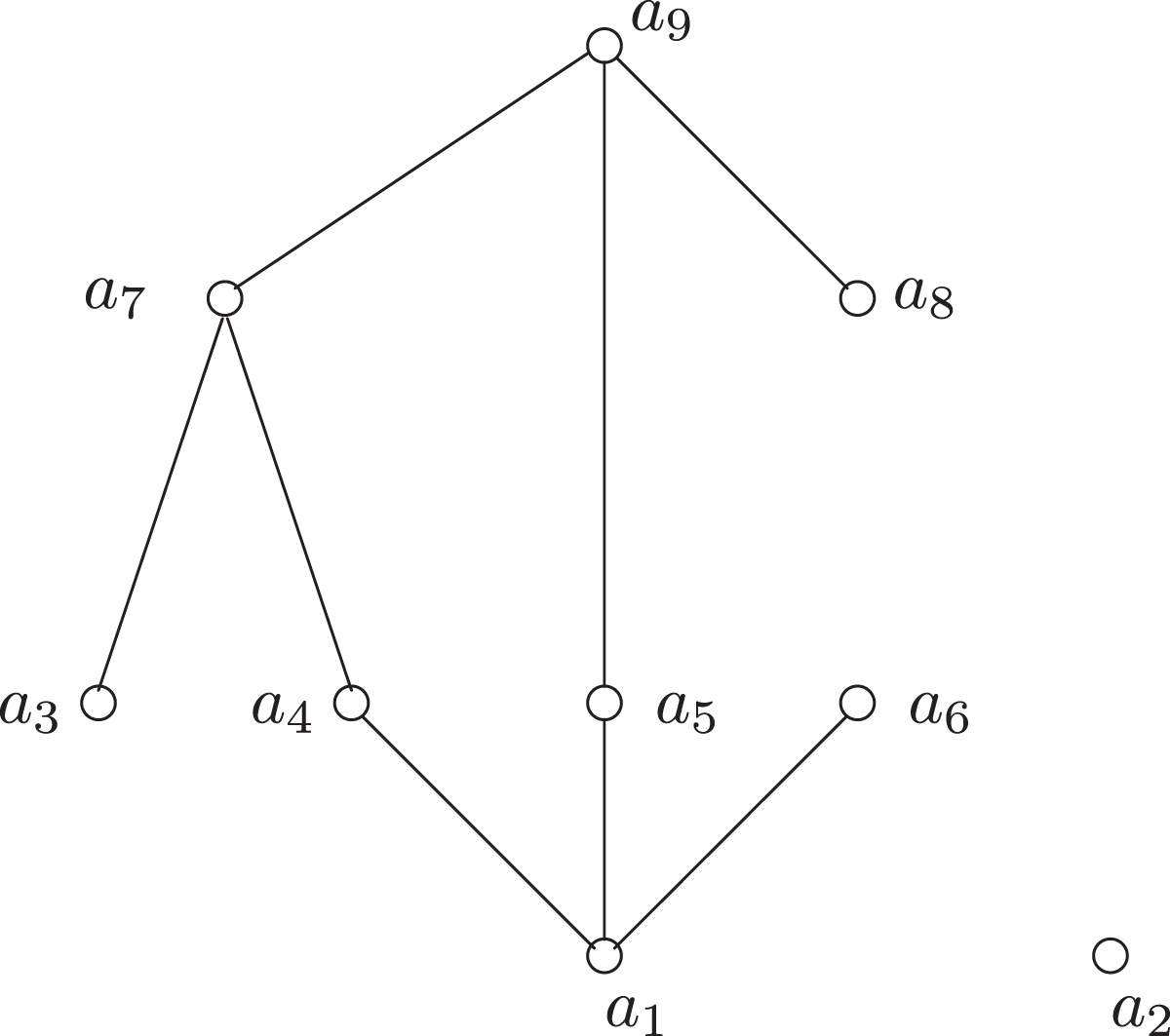
For example, Fig. 2 is a partially ordered set. First, it is easy to see that r (P) =4 and l : a1 ≺ Pa4 ≺Pa7 ≺ Pa9 is an element of TP. Secondly, we know that and . Finally, we can verify that (1), (2) and (3) are satisfied.
A finite partially ordered set P.
Definition 2.3.We say that a finite partially ordered set P is closed, if for any , the following two conditions are satisfied.
If p is a maximal element of P, then for any , there exists an element u < Pp such that u ≺ Pq.
If p is a minimal element of P, then for any , there exists an element v > Pp such that v ≻ Pq.
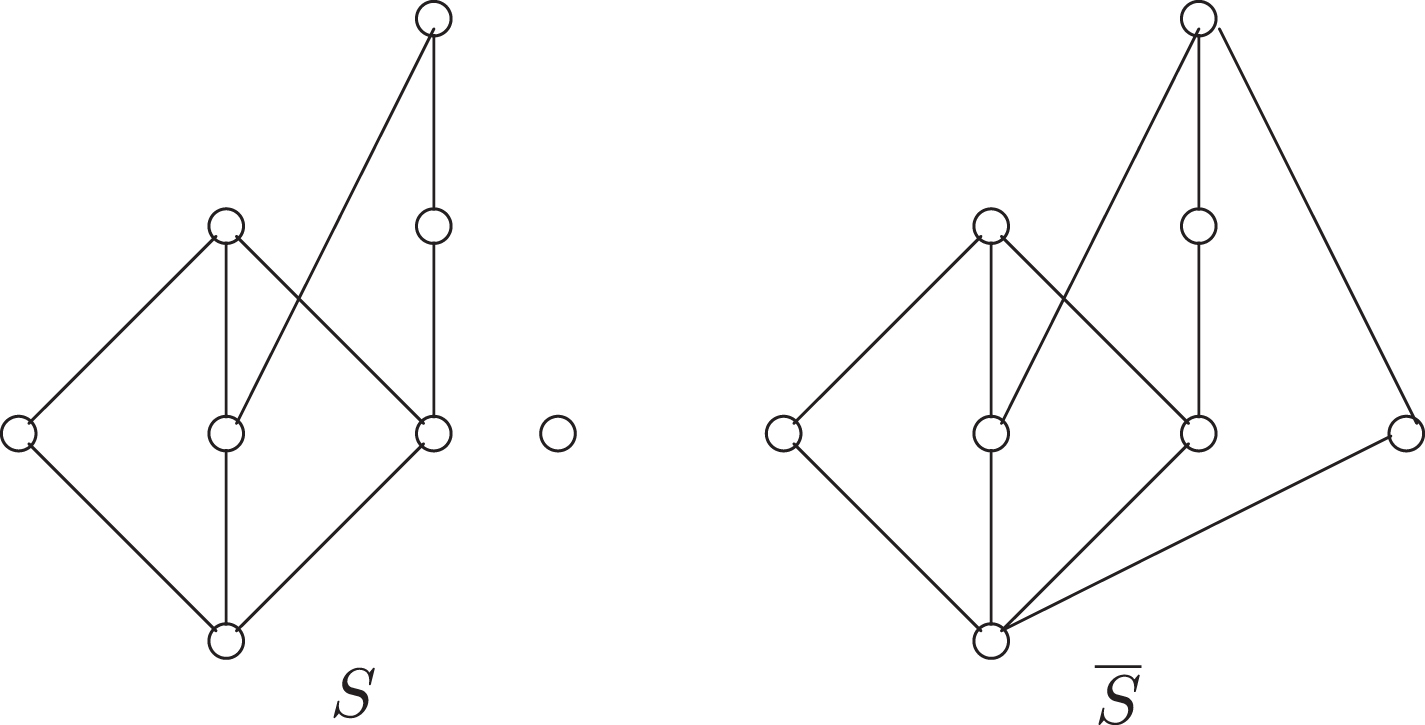
Obviously, every finite lattice and the partially ordered set in Fig. 3 are closed partially ordered sets. However the partially ordered sets in both Figs. 1 and 2 are not closed.
Two partially ordered sets S and .
Lemma 2.1.Let P be a finite partially ordered set. Then:
(a) In the case of r (P) =1, is a closed partially ordered set.
(b) In the case of r (P) =2, we connect p to q for any such that p ≺ q. This way, we obtain a new diagram which is a closed partially ordered set.
(c) In the case of r (P) ≥3, if , p is a maximal element of P and satisfying q ⊁ Ph for any h < Pp, then we connect p to q such that p ≺ q. This way, we obtain a new diagram which is a partially ordered set. Further, if , u is a minimal element of and satisfying for any , then we connect v to u such that v ≺ u. This way, we obtain a new diagram which is a closed partially ordered set.
Proof. (a) follows from Definition 2.3. From the construction of of (b), it follows that is a partially ordered set and . Thus is a closed partially ordered set by Definition 2.3. It remains, therefore, to show (c).
First, we claim that is a partially ordered set. Assume that is not a partially ordered set. Then there exist three elements x1, x2 and x3 in such that and . From the construction of , we conclude that , x1 ≻ Px3, x2 > Px3 and x1 ⊁ Px2 since P is a partially ordered set. From this it follows that by the construction of , a contradiction. Hence, is a partially ordered set. Similarly, we can prove that is a partially ordered set. By Definition 2.3 and the construction of , it is clear that is a closed partially ordered set.□
In Fig. 3, it is clear that the closed partially ordered set is obtained from the partially ordered set S by Lemma 2.1.
Lemma 2.2.Let P be a finite partially ordered set, and let be obtained by Lemma 2.1. If then O ∈ △ (P) and .
Proof. Assume that but O ∉ △ (P). Let O = {p1, ⋯ , pn}. Then we observe that there exist two integers i, j with i < j such that pi > Ppj. It follows that by Lemma 2.1, and which implies that , an impossibility. Therefore, O ∈ △ (P).
Set and mi be the numbers of elements covered by pi in and P, respectively. It is clear that from Lemma 2.1. Thus by formula (5).□
Layered partially ordered sets
In this section, we shall discuss a class of closed finite partially ordered sets which are called layered partially ordered sets.
Definition 3.1.Let P be a finite closed partially ordered set. We say that P is layered if P satisfies the following four conditions:
(A) If , then p ≻ Pq implies and for an exact integer 1 ≤ j ≤ r (P) -1.
(B) For , p is a maximal element of if and only if p has upper covers in . Further, there exists an exact integer 1 ≤ i ≤ r (P) such that for any q ≻ Pp.
(C) For , p is a minimal element of if and only if p has lower covers in . Further, there exists an exact integer 1 ≤ i ≤ r (P) such that for any p ≻ Pq.
(D) Each element is a doubly-irreducible (i.e., p is both join-irreducible and meet-irreducible) element in .
A finite graded partially ordered set is layered and all finite semimodular lattices are also layered. It is easy to see that the partially ordered set in Fig. 3 is not layered.
Definition 3.2.Let P be a finite layered partially ordered set. For any r (P) ≥ i ≥ 2, if and imply p ≻ Pq, then we say that P is a complete layered partially ordered set.
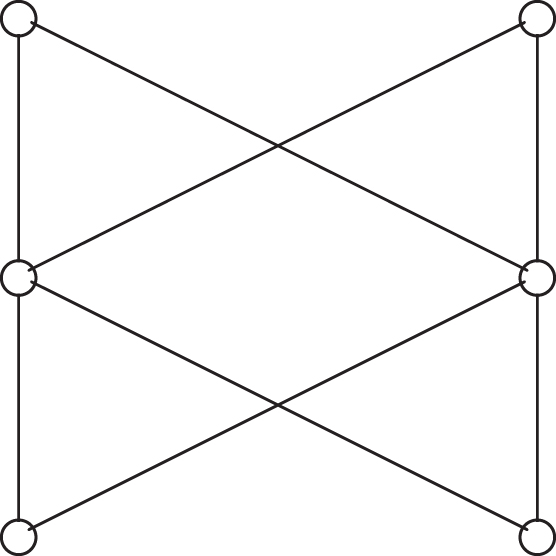
It is clear that the partially ordered set Kn1,n2,⋯,nm is an example of complete layered partially ordered set (the concept of Kn1,n2,⋯,nm is from [1]). Figure 4 is K2,2,2.
K2,2,2.
Lemma 3.1.Let P be a finite layered partially ordered set. For any r (P) ≥ i ≥ 2, if and satisfy p ⊁ Pq, then we connect p to q such that p ≻ q. This way, we obtain a new diagram Pc which is a complete layered partially ordered set.
Proof. For the purpose of this proof, we first need to show that Pc is a partially ordered set. Suppose that Pc is not a partially ordered set. Then there exist three elements p1, p2 and p3 in Pc such that
If , then inasmuch as the construction of Pc, the formula (11) implies that p1 > Pp2, p1 ≻ Pp3 and p2 > Pp3 which mean that P is not a partially ordered set, a contradiction.
If , then we assume that and j ∈ {1, 2, 3}. Then from formula (11) and the construction of Pc, we have t1 > t2 > t3. However, by the construction of Pc, the condition p1 ≻ Pcp3 yields that t1 = t3 + 1 clearly, which is contrary to the fact that t1 > t2 > t3.
If and , then the formula (11) implies that p1 > Pp2 and p1 ≻ Pp3. Thus, by (C) of Definition 3.1, we know that p1 is a minimal element of , contrary to the fact that p1 > Pp2 and .
If and , then the formula (11) implies that p2 > Pp3 and p1 ≻ Pp3. Then by (B) of Definition 3.1, we have that p3 is a maximal element of , contrary to the fact that p2 > Pp3 and .
If and , then the formula (11) implies that p1 ≻ Pp3. Further, from formula (11), there exists an element such that and which implies that . Thus, by (D) of Definition 3.1, we have , which means that p1 is a minimal element of , contrary to p1 > Pp3 and .
Therefore, in what follows, we suppose that there exists exactly one element of {p1, p2, p3} which belongs to . There are three cases to consider.
Case 1. If , then by formula (11) and the construction of Pc we have p1 ≻ Pp3, which implies that p1 is a minimal elements of . From formula (11), there exists an element u ∈ P such that p1 ≻ Pcu ≥ Pcp2 and which implies that p1 ≻ Pu. Clearly, since p1 is a minimal elements of . Then by (C) of Definition 3.1, there exists an integer j such that and . However, u ≥ Pcp2 > Pcp3, a contradiction.
Case 2. If , then by the construction of Pc, p1 ≻ Pcp3 implies that there exists an integer k ∈ {1, ⋯ , r (P) -1} such that and , i.e., r (p1) = r (p3) +1. Further, formula (11) yields that there exist two elements q ∈ P and r ∈ P such that p1 ≻ Pcq ≥ Pcp2 ≥ Pcr ≻ Pcp3. We claim that . Indeed, if then , contrary to q > Pcp3. Similarly, we can prove that . Thus p1 ≻ Pcq and r ≻ Pcp3 will deduce that p1 ≻ Pq and r ≻ Pp3. On the other hand, by the construction of Pc, , and will imply that q ≥ Pp2 ≥ Pr since q ≥ Pcp2 ≥ Pcr. Thus p1 ≻ Pq ≥ Pp2 ≥ Pr ≻ Pp3, contrary to r (p1) = r (p3) +1.
Case 3. If , then p1 ≻ Pp3 by formula (11). Thus p3 is a maximal element of by (B) of Definition 3.1. It is clear that there exists an element v ∈ P such that p2 ≥ Pcv ≻ Pcp3 by formula (11). Then v ≻ Pp3, and which means that . Thus by (B) of Definition 3.1., there exists an integer i such that and . However, p1 > Pcp2 ≥ Pcv, a contradiction.
Therefore, by Cases 1, 2 and 3, Pc is a partially ordered set, which together with the construction of Pc and Definition 3.1. deduce that Pc is a completed layered partially ordered set.□
Obviously, the completed layered partially ordered set in Fig. 4 is obtained from the following layered partially ordered set in Fig. 5 by Lemma 3.1.
A finite layered partially ordered set.
Let P be a finite layered partially ordered set, and let Pc be obtained by Lemma 3.1. Then we observe that
by the construction of Pc, and similar to the proof of Lemma 2.2 we have the following lemma by formula (5).
Lemma 3.2.Let P be a finite partially ordered set, and let Pc be obtained by Lemma 3.1. If O ∈ △ (Pc), then O ∈ △ (P) and NPc (O) ≥ NP (O).
Let P and Q be two disjoint partially ordered sets. For the elements x, y ∈ T = P ∪ Q, define x ≤ Ty if one of the following conditions holds:
x, y ∈ P and x ≤ Py;
x, y ∈ Q and x ≤ Qy;
x ∈ P and y ∈ Q.
Then (T, ≤ T) is a partially ordered set (see [3]). We write (T, ≤ T) = P + Q. It is easy to see that if P = Km1,⋯,mk, Q = Kn1,⋯,nr and P∩ Q = ∅, then P + Q = Km1,⋯,mk,n1,⋯,nr.
Now, let P = (P, ≤ P) be a finite partially ordered set. Suppose that S = (S, ≤ S) and R = (R, ≤ R) are two disjoint partially ordered sets, and both S and R are subsets of P. For the elements p, q ∈ T = S ∪ R, define p ≺ Tq if one of the following conditions holds:
p, q ∈ S and p ≺ Sq;
p, q ∈ R and p ≺ Rq;
p ∈ S and q ∈ R, p ≺ Pq;
p ∈ R and q ∈ S, p ≺ Pq.
We write (T, ≺ T) = S ⊎ PR, and say that S ⊎ PR is the join-sum of S and R restricted to P. Then we have the following lemma.
Lemma 3.3.Let P be a complete layered partially ordered set with r (P) ≥3, and let , and S = Km,n satisfying and . Then T = Q ⊎ P (S + R) is a layered partially ordered set and r (T) = r (P) -1.
Proof. By the hypotheses of Lemma 3.3 and the definition of S + R, we have that P = S ∪ R ∪ Q and U = S + R is a complete layered partially ordered set. Moreover, r (U) = r (P) -1, and . On the other hand, by the construction of U, we know that
for any r (P) -1 ≥ i ≥ 3.
Now, let a, b ∈ P. Then by the definition of T = Q ⊎ PU, there are three cases as below:
Case (i). If a, b ∈ U and a > Tb then a > Ub, especially, the condition a ≻ Tb yields that
Further, a > Ub implies that
by the definition of U = S + R and the constructions of S and R.
Case (ii). If a, b ∈ Q and a > Tb then we observe that a > Pb, moreover, a ≻ Tb will yield that
Case (iii). If a ∈ Q, b ∈ U or a ∈ U, b ∈ Q, then we know that a > Tb means a > Pb, especially, the condition a ≻ Tb means
from the definition of T = Q ⊎ PU.
The rest of the proof is made in three steps as follows.
Step 1.T is a partially ordered set.
Assume that T is not a partially ordered set, then there exist three elements p, q, r ∈ T such that
Clearly, formulas (9) and (10) imply that
Thus we observe that p ⊁ Pr since P is a partially ordered set.
We next claim that {p, q, r} ⊊U and {p, q, r} ⊊Q. If {p, q, r} ⊆ U then p > uq, p ≻ ur and q > ur by formulas (5) and (10), which are contrary to that U is a partially ordered set. Similarly, from formulas (7) and (10) we have that {p, q, r} ⊊Q. Therefore, there are six types, as follows. Using formulas (5) to (10), we have that
Type 1. If p, q ∈ Q and r ∈ U then p ≻ Pr.
Type 2. If q, r ∈ Q and p ∈ U then p ≻ Pr.
Type 3. If p, r ∈ Q and q ∈ U then p ≻ Pr.
Type 4. If p, q ∈ U and r ∈ Q then p ≻ Pr.
Type 5. If q, r ∈ U and p ∈ Q then p ≻ Pr.
Clearly, every type as above is in opposition to formula (11).
Type 6. If p, r ∈ U and q ∈ Q, then p ≻ Ur and p > Pr by formulas (5), (6) and (10). Since p ⊁ Pr, by the construction of U, it is easy to see that there exists an element such that p ≻ Py ≻ Pr which together with formula (11) follows that , contrary to the fact that .
Therefore, T is a partially ordered set.
Step 2.T is closed.
By the definition of T = Q ⊎ PU and the construction of U, we observe that T is a closed partially ordered set since T is a partially ordered set and P is closed.
Step 3.T is layered.
From Steps 1 and 2, T is a closed partially ordered set. Thus, in order to prove that T is layered, it suffices to show that (A), (B), (C) and (D) of Definition 3.1. are satisfied. The proof is made in three cases, as follows.
Case 1. We shall prove that the condition (D) holds.
By the definition of T = Q ⊎ PU, the condition r (U) = r (P) -1 means that r (T) = r (U) since . Then we have that . Thus, from formulas (7) and (8), we know that the condition (D) is true. Further, by the construction of T and formula (4), we have that
for any r (T) ≥ i ≥ 3.
Case 2. We shall show that the condition (B) holds. Dually, we can prove that the condition (C) is true.
Suppose that p is a maximal element of . Then because of .
If p is a maximal element of then there exists an element such that r ≻ Pp since P is a layered partially ordered set. Then from the definition of T = Q ⊎ PU, we must have that r ≻ Tp since r ∈ U and p ∈ Q. Let q ≻ Tp. Then by formulas (7) and (8), we have that q ≻ Pp because of p ∈ Q. It follows that q ≻ Pp for any q ≻ Tp, which will deduce that there exists an integer j such that for any q ≻ Tp since P is a layered partially ordered set and p is a maximal element of . We conclude that there exists an integer k such that for any q ≻ Tp by formula (12).
If p is not a maximal element of , then p has only one cover q in P since P is a layered partially ordered set and . Clearly, for a certain integer i since p is maximal element of . Now, we claim that p has only one cover q in T. Otherwise, suppose that there are at least two different elements q1, q2 ∈ T such that q1 ≻ Tp and q2 ≻ Tp. By formulas (7) and (8), it follows that q1 ≻ Pp and q2 ≻ Pp because of p ∈ Q, an impossibility. We conclude that p has only one cover q in T, and then for any q ≻ Tp.
Therefore, if p is a maximal element of then there exists an element such that q ≻ Tp, and for any r ≻ Tp.
Conversely, we shall show that if p has covers in then p is a maximal element of .
Let . Using formulas (7) and (8), if there exists an element such that q ≻ Tp then q ≻ Pp. In what follows, we shall prove that p is not a maximal element of will lead to a contradiction. In fact, if p is not a maximal element of , then there exists an element such that r ≻ Tp. Note that both p and r belong to Q since . Thus r ≻ Pp by formula (7). If , then p is a maximal element of since q ≻ Pp and P is a layered partially ordered set, contrary to the fact that r ≻ Pp and . Hence, , which together with r ≻ Pp, q ≻ Pp and deduces that P is not a layered partially ordered set, a contradiction. Therefore, p is a maximal element of .
Consequently, the condition (B) holds.
Case 3. We shall prove that the condition (A) is true.
Suppose that , and p ≻ Tq. Then , and j > i where i ≠ 0. If then p, q ∈ U since , P = S ∪ R ∪ Q and U = S + R. Using formula (5), we know that p ≻ Uq, and which together with formulas (4) and (12) yields that j - i = 1 since U = S + R is a complete layered partially ordered set.
In what follows, we shall prove that either or still implies j - i = 1. Assume that j - i ≠ 1, then j - i ≥ 2. Distinguishing three situations, we have:
(i1) If , then p, q ∈ Q. From this it follows that p ≻ Tq will yield p ≻ Pq by formula (7). On the other hand, the condition j - i ≥ 2 implies that there exists an element such that p1 ≻ Tq by formula (7), this implies that p1 ≻ Pq since q ∈ Q. Clearly p1 ≠ p which together with p ≻ Pq, p1 ≻ Pq and deduces that since P is a layered partially ordered set. Hence q is a maximal element of , contrary to and p ≻ Pq.
(i2) If and . Then p ≻ Tq yields that p ≻ Pq by formula (8). Thus, q is a maximal element of . By the proof of (i1), we know that there exists an element such that p1 ≻ Tq and p1 ≻ Pq. It follows that , and this implies that there exists an integer k such that since P is a layered partially ordered set. By formula (12), there exists an integer k1 such that , contrary to , and j - i ≥ 2.
(i3) If and , then p ≻ Tq and p ∈ Q yield that p ≻ Pq by formula (8). Thus p is a minimal element of since P is a layered partially ordered set. On the other hand, from j - i ≥ 2, there exists an element such that p ≻ Tp1, this implies that p ≻ Pp1 by formula (8). Thus, from P is a layered partially ordered set, there exists an integer t such that , which together with formula (12) deduces that for a certain t1 ∈ {1, ⋯ , r (T)}, a contradiction.
Therefore, the condition (A) is satisfied.
From Cases 1,2 and 3, we conclude that T is a layered partially ordered set.□
In Fig. 6, we know that the layered partially ordered set M3 is obtained from the complete layered partially ordered set P by Lemma 3.3, and it is easy to see that r (M3) = r (P) -1 = 3.
Two partially ordered sets P and M3.
For convenience, we denote by . Then, from formulas (5)–(8) in the proof of Lemma 3.3, one can check that
and if then
Lemma 3.4.Let P be a complete layered partially ordered set with r (P) ≥3, and let , and S = Km,n satisfying and . Then T = Q ⊎ P (S + R) is a layered partially ordered set and r (T) = r (P).
Proof. Let U = S + R. Then , and by the construction of U, one can observe that U is a complete layered partially ordered set with r (U) = r (P) and . Further, by the hypotheses of Lemma 3.4, we have that
for any r (P) ≥ i ≥ 3.
Now, suppose a, b ∈ P. Then similar to the proof of Lemma 3.3, we can distinguish three cases:
Case I. If a, b ∈ U and a ≻ Tb then
further, if a, b ∈ S and a > Ub then
and if a ∈ R, b ∈ S and a > Ub then
Case II. If a, b ∈ Q and a ≻ Tb then
Case III. If a ∈ Q, b ∈ U or a ∈ U, b ∈ Q, then a ≻ Tb means
The rest of the proof is made in two steps as follows.
Step (a).T is a partially ordered set.
Assume that T is not a partially ordered set, then there exist three elements p, q, r ∈ T such that
If {p, q, r} ⊆ U then p > Uq, p ≻ Ur and q > Ur by formulas (16) and (21), contrary to the fact that U is a partially ordered set. Thus, {p, q, r} ⊊U. From formulas (19) and (21), it follows that {p, q, r} ⊊Q similarly. Therefore, there are six types, as follows.
Type (a). If p, q ∈ Q and r ∈ U then p > Pq > Pr and p ≻ Pr by formulas (19), (20) and (21), a contradiction.
Type (b). If q, r ∈ Q and p ∈ U, then similar to the proof of Type (a), one can deduce a contradiction.
Type (c). If p, r ∈ Q and q ∈ U, then similar to the proof of Type (a), one can deduce a contradiction.
Type (d). If p, q ∈ U and r ∈ Q then p ≻ Pr and q > Pr from formulas (20) and (21). Moreover, from formula (20) and p > Tq in formula (21) we have that p > Uq, and which yields that p and q are comparable in P by the construction of U. Clearly, if p > Pq then p > Pq > Pr, contrary to the fact that p ≻ Pr. Thus we must have that q > Pp ≻ Pr which together with p > Uq deduces that by formula (15). Thus p ⊁ Pr, an impossibility.
Type (e). If q, r ∈ U and p ∈ Q, then similar to the proof of Type(d), one will obtain a contradiction.
Type (f). If p, r ∈ U and q ∈ Q, then p ≻ Ur and p > Pq > Pr from formulas (16), (20) and (21). Since p ≻ Pr will deduce a contradiction, we have p ⊁ Pr. Thus, by the construction of U, it is easy to see that there exists an element such that p ≻ Py ≻ Pr. Then , and this contradicts the fact that .
Therefore, T is a partially ordered set.
Step (b).T is layered.
Arguing as Step 2 in the proof of Lemma 3.3, one can prove that T is a closed partially ordered set. Thus it suffices to show that (A), (B), (C) and (D) of Definition 3.1 hold.
By the definition of T = Q ⊎ PU, the condition r (U) = r (P) means that r (T) = r (U) since . Then we have that . Further, by formula (15), we have that
for any r (T) ≥ i ≥ 3.
Similar to Cases 1, 2 and 3 in the proof of Lemma 3.3, we can prove that (A), (B), (C) and (D) of Definition 3.1 are satisfied.
Consequently, T is a layered partially ordered set.□
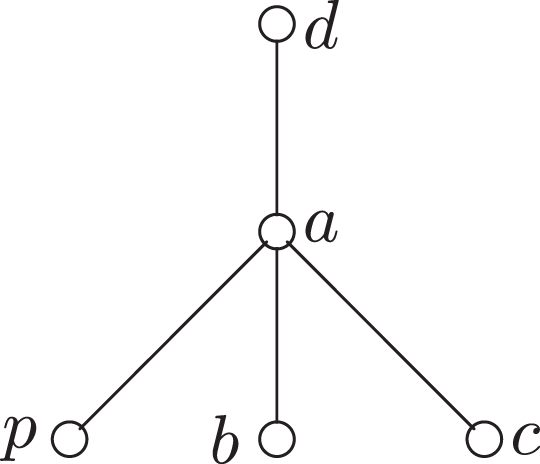
Obviously, the layered partially ordered set M3 in Fig. 6 is obtained from the following complete layered partially ordered set P in Fig. 7 by Lemma 3.4 and r (M3) = r (P).
A finite complete layered partially ordered set P.
Notice that, from formulas (16)-(20) in the proof of Lemma 3.4, one can check that
The upper bound theorem
Let T = Kn1,⋯,nm. By formula (5), we know that for any two ascending orders O1, O2 ∈ △ (T), NT (O1) = NT (O2). Thus, for convenience, let N (T) = NT (O) for any O ∈ △ (T) below.
Theorem 4.1.Let P be a layered partially ordered set with n elements. If n ≥ 2, then there exist an ascending order O ∈ △ (P) and a partially ordered set T = Ku,v with u + v = n such that N (T) ≥ NP (O).
Proof. (I) In the case of r (P) =1. Suppose that O ∈ △ (P) with O = {p1, p2, ⋯ , pn}. Then, by formula (5),
Let T = Kn-1,1. Using formula (5), we have
Thus N (T) - NP (O) =2 (n2 - 1) ≥0 for any n ≥ 2, i.e., N (T) ≥ NP (O).
(II) In the case of r (P) =2. Let T = Pc. We have that since P is a layered partially ordered set. Thus T = Pc = Ku,v and u + v = n by formula (3). Set O ∈ △ (Pc). Then O ∈ △ (P) and N (T) = NPc (O) ≥ NP (O) by Lemma 3.2.
(III) In the case of r (P) =3. We know that since P is a layered partially ordered set. Observe that for any i ∈ {0, 1, 2, 3} by formula (3). Thus Pc = Kt1,t2,t3 with for any i ∈ {1, 2, 3}, and this deduces that t1 + t2 + t3 = n.
Let O ∈ △ (Pc). Then from Lemma 3.2, we know that O ∈ △ (P) and NP (O) ≤ NPc (O) = N (Pc). Further, using formula (5), we have that
We distinguish two cases as below.
Case 1. If t1 ≥ t2, then let T = Kt1,t2+t3. Using formula (5), we know that
Then
since t1 ≥ t2. At the same time, N (T) - NP (O) ≥ N (T) - N (Pc) since N (Pc) ≥ NP (O). Thus N (T) - NP (O) ≥0, i.e., N (T) ≥ NP (O).
Case 2. If t2 ≥ t1, then let T = Kt2,t1+t3. Using formula (5), we know that
Then
since t2 ≥ t1. Therefore, N (T) - NP (O) ≥0 since N (Pc) ≥ NP (O), i.e., N (T) ≥ NP (O).
(IV) In the case of r (P) = k > 3. By Lemma 3.1, it is clear that Pc is a complete layered partially ordered set. By formula (3), we have that r (Pc) = r (P) = k. Let , and . There are two cases as follows.
Case (i). If t1 ≥ t2, then set , and S1 = Km,n with and . Moreover, let T1 = Q1 ⊎ Pc (S1 + R1). Then T1 is a layered partially ordered set by Lemma 3.3, and consequently is a complete layered partially ordered set by Lemma 3.1. Using formulas (3) and (12), we have that and . Then, without loss of generality, we assume that
and
where m1 ≥ 0 and m2 ≥ 1. Clearly,
Next, let
be an ascending order of . Then we claim that . Otherwise, there exists an element q ∈ Γ such that for some i with 1 ≤ i ≤ t1 + t2 + t3 + m1 + m2 by formula (24). Then obviously. As and , we have that , an impossibility. Thus . Hence, there must exist an element such that since is a layered partially ordered set. We conclude that , a contradiction. Therefore, .
Clearly, O1 ∈ △ (T1) by Lemma 3.2. Further, from formulas (5) to (8), we conclude that O1 ∈ △ (Pc). Thus, by formulas (1) and (13), we have that
since t1 ≥ t2. At the same time, by Lemma 3.2. Therefore, we have that
i.e.,
Moreover, by Lemma 3.3, we know that .
Case (ii). If t1 ≤ t2, then set , and Z = Kr,s with and . Let W = X ⊎ Pc (Z + Y). Then by Lemma 3.4, W is a layered partially ordered set, and which together with Lemma 3.1 implies that Wc is a complete partially ordered set. Using formulas (3) and (22), we obtain that , and . Then, without loss of generality, we assume that
Set and S1 = Km,n with and . Let T1 = Q1 ⊎ Wc (S1 + R1). Then by the proof of Case (i), we know that and . Now, without loss of generality, we assume that
and
where m1 ≥ 0 and m2 ≥ 1. It is easy to see that
is an ascending order of . Now, let
be an ascending order of . Then similar to the proof of Case (i), we can prove that
belongs to , △ (T1), △ (Wc) and △ (W), respectively. Let O0 = {p1, ⋯ , pn}. Then, from formulas (16) to (20), we conclude that O0 ∈ △ (Pc). Therefore, by Lemma 3.2, we have
Again, by formulas (14) and (23), we have that for any . Thus, from formula (5) we have that
since t2 ≥ t1, which together with formula (26) means that
i.e.,
Moreover, by Lemmas 3.3 and 3.4, we know that .
Cases (i) and (ii) tell us that in the case of r (P) = k > 3, we always can construct a set of complete layered partially ordered sets
and a set of ascending orders
satisfying and (Note that the case that Oi = Oi-1 may occur, i ≥ 1, for instance, in formula (25)). Therefore . By Lemma 3.2, the condition O0 ∈ △ (Pc) implies that O0 ∈ △ (P) and NPc (O0) ≥ NP (O0). Thus, . Further, by the proof of (III), there exists a partially ordered set T = Ku,v with u + v = n such that since and is a layered partially ordered set. Hence, N (T) ≥ NP (O0).
Finally, from (I), (II), (III) and (IV), we conclude that there exists an ascending order O ∈ △ (P) and a partially ordered set T = Ku,v with u + v = n such that N (T) ≥ NP (O).□
The following example illustrates Theorem 4.1.
Let us consider the layered partially ordered set P in Fig. 7 again. We know that O = {p, b, c, a, d} ∈ ▵ (P), and then NP (O) =83 by formula (5). On the other hand, we know that N (T) =101 ≥ 83 = NP (O) by formula (5) when T = K2,3.
The O (n3) bound
In this section, we shall give a positive response to the open problem raised by G. Grätzer in [2, 5].
Theorem 5.1.Let D be a finite distributive lattice with n join-irreducible elements and let P = (ConJD, ≤ D). If the obtained by Lemma 2.1 is a layered partially ordered set, then D can be represented as the congruence lattice of a rectangular lattice L satisfying
Proof. Suppose n ≥ 2. Then by Theorem 4.1, there exists a partially ordered set T = Kk,t with k + t = n and an ascending order such that . Thus by Lemma 2.2 we have that O ∈ △ (P), and which implies that N (T) ≥ NP (O).
Using formula (5), we have
Then . Clearly, is a solution of . Further, we know that S (t) ≤ S (t0) for any t ∈ {1, ⋯ , n}. Let . Then . Suppose that and . Then
in which .
Therefore, when n ≥ 2.
On the other hand, if n = 1 then NP (O) =5. In this case we can verify that .
Finally, we have , i.e., .□
Now, we shall give an example to illustrate Theorem 5.1.
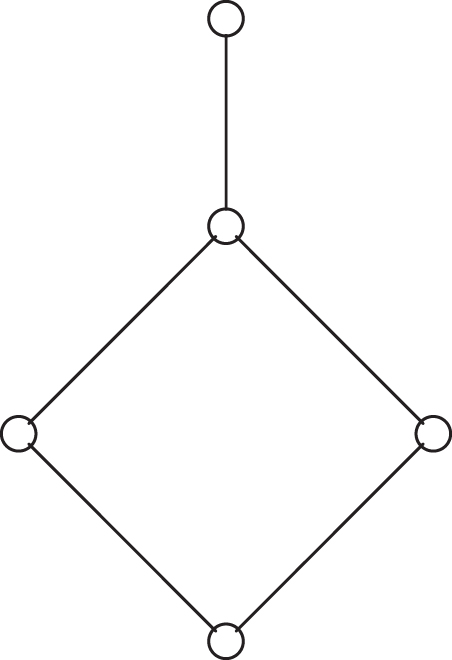
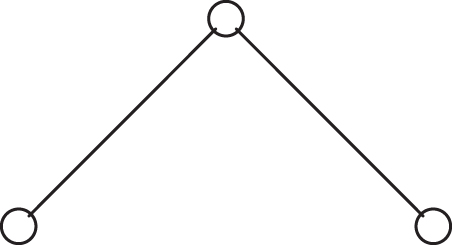
Example 5.1. Let D be a finite distributive lattice in Fig. 8. Then P = (ConJD, ≤ D) is the partially order set in Fig. 9.
A distributive lattice D.
The partially order set P = (ConJD, ≤ D).
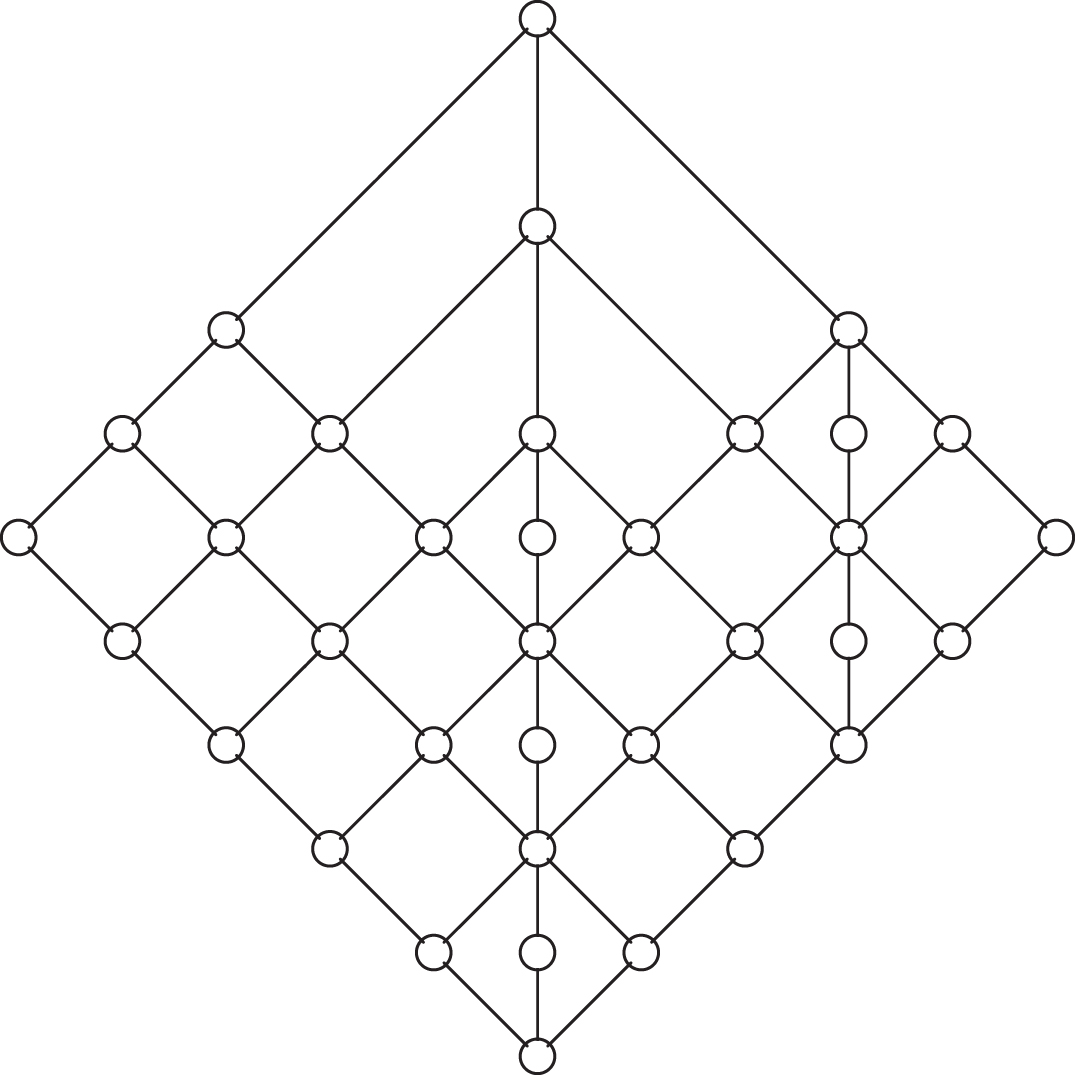
Obviously, both the finite lattice D in Fig. 8 and the partially order set P in Fig. 9 satisfy the conditions of Theorem 5.1. Then we obtain a rectangular lattice L in Fig. 10 which satisfies ConL ≅ D and with n = 3.
A rectangular lattice L.
Lemma 5.1.Let P be a finite partially ordered set and H (P) be the diagram of P. If |P|=2n, then there are at most n2 segments which connect the circles in H (P).
Proof. In order to prove Lemma 5.1, we first need to check the following result A.
A. If a space T have 2n points, and there are n2 + 1 segments which connect these points in T, then there exists at lest one triangle in T.
This is trivial when n = 1, so we proceed by induction on n for n ≥ 2.
It is easy to see that A holds for n = 2. Assuming that A holds for n = k.
Consider n = k + 1. From the hypotheses of A, there are 2k + 2 points and (k + 1) 2 + 1 segments in T. Let l be one of the segments and a, b be the endpoints of l. If there exists one point c of the other 2k points which connects both a and b, then a, b, c form a triangle. Otherwise, there are at most 2k + 1 segments which connect a or b. Thus, there are at least (k + 1) 2 + 1 - (2k + 1) = k2 + 1 segments among the other 2k points. By induction assumption, there exists at least one triangle in T, completing the proof of A.
Since H (P) is the diagram of P, there is no triangle in H (P). Therefore, by A, if |p|=2n, then there are at most n2 segments which connect the circles in H (P).□
Similar to Lemma 5.1, we can verify the following lemma.
Lemma 5.2.Let P be a finite partially ordered set and H (P) be the diagram of P. If |P|=2n + 1, then there are at most n2 + n segments which connect the circles in H (P).
Then we get the following improved version of Theorem 1.1:
Theorem 5.2.Let D be a finite distributive lattice with n join-irreducible elements. Then D can be represented as the congruence lattice of a rectangular lattice L satisfying |L| ≤ f (n) where
Proof. Let P = (ConJD, ≤ D). Then |P| = n. Suppose that O = {p1, p2, ⋯ , pn} ∈ △ (P). Then by formula (5), there exists a rectangular lattice L such that P ≅ ConJL, in which L satisfies
where mi is the number of lower covers of pi in P. Clearly,
If n = 2k, then by Lemma 5.1 . We note that for any positive integer k. Therefore, using formulas (28) and (29), we have that
i.e.,
If n = 2k + 1, then by Lemma 5.2 . Again, for any positive integer k. Therefore, using formulas (28) and (29), we have that
i.e.,
Consequently, |L| ≤ f (n).□
Next, we shall present an example to illustrate Theorem 5.2 as follows.
Example 5.2. Let us discuss the distributive lattice D in Fig. 8 again. We can check that ConL ≅ D and |L|=35 ≤ f (3) when L is the lattice in Fig. 10.
In [5], G. Grätzer and E. knapp presented that there is a planar semimodular lattice L such that ConJL ≅ P for any finite partially ordered set P with
when O = {p1, p2, ⋯ , pn} ∈ △ (P), where mi is the number of lower covers of pi in P. So, similar to the proof of Theorem 5.2, we get the following improved version of Theorem 1.2:
Theorem 5.3.Let D be a finite distributive lattice with n join-irreducible elements. Then D can be represented as the congruence lattice of a planar semimodular lattice L satisfying |L| ≤ g (n) with
Conclusions
It is worth to be pointed out that both f (n) in Theorem 5.2 and g (n) in Theorem 5.3 are very rough. Thus, we have a question: how close can one brings the coefficient of n3 in f (n) to and the coefficient of n3 in g (n) to ? On the other hand, let D be a finite distributive lattice whose order of join-irreducible elements is a balanced bipartite order on n elements. In 2010, G. Grätzer [6] proved that D can be represented as the congruence lattice of a rectangular lattice L with . Therefore, we have another question: how close can one brings the constant to ?
In the future, we shall study the characterizations of the congruence lattices of rectangular lattices, and then answer the two open problems as mentioned above.
GrätzerG. and KnappE., Notes on planar semimodular lattices. II. Congruences, Acta Sci Math (Szeged)74 (2008), 37–47.
5.
GrätzerG. and KnappE., Notes on planar semimodular lattices. III. Rectangular lattices, Acta Sci Math (Szeged)75 (2009), 29–48.
6.
GrätzerG. and KnappE., Notes on planar semimodular lattices. IV. The size of a minimal congruence lattices representation with rectangular lattices, Acta Sci Math (Szeged)76 (2010), 3–26.
7.
GrätzerG. and LakserH., Homomorphisms of distributive lattices as restrictions of congrunces, Canad J Math38 (1986), 1122–1134.
8.
GrätzerG. and LakserH., Congruence lattices of planar lattices, Acta Math Sci Hungar60 (1992), 251–268.
9.
GrätzerG., LakserH. and SchmidtE.T., Congruence lattices of small planar lattices, Proc Amer Math Soc123 (1995), 2619–2623.
10.
GrätzerG., LakserH. and SchmidtE.T., Congruence lattices of finite semimodular lattices, Canad Math Bull41 (1998), 290–297.
11.
GrätzerG., RivalI. and ZaguiaN., Small representations of finite distributive lattices as congruence lattices, Proc Amer Math Soc123 (1998), 1959–1961. Correction: 126 (1998) 2509-2510.
12.
GrätzerG. and SchmidtE.T., On congruence lattices of lattices, Acta Math Sci Hungar13 (1962), 179–185.
13.
GrätzerG. and WehrungF., Lattice theory: special topics and applications, Birkhäuser, Basel, 2014.