



Abstract
In this paper, we study the generating formula of filters in pseudo equality algebras, also we introduce prelinear pseudo equality algebras and divisible pseudo equality algebras, and then we investigate some characterizations of them. We focus on algebraic structures of the set F (X) of all filters in pseudo equality algebras and obtain that F (X) can form a Heyting algebra. Moreover, we give the notions of some types of filters ((positive) implicative filters, fantastic filters) in pseudo equality algebras and investigate their properties. Finally, we discuss the relations among these filters.
Keywords
Introduction
As we all known, various fuzzy logic algebras have been widely introduced and studied as non-classical logic semantic systems. The well-known algebraic structure is residuated lattice. BL-algebras, MTL-algebras, MV-algebras, etc., are the best known classes of residuated lattice [11, 12]. With the further development of fuzzy logic, EQ-algebras [17] were proposed by V. Novák with the intent to develop an algebraic structure of truth values for fuzzy type theory. An EQ-algebra has three binary operations, meet, multiplication, fuzzy equality, and a unit element. And it generalized the residuated lattice. As S. Jenei mentioned in [14], if the product operation in EQ-algebras is replaced by another binary operation smaller or equal than the original product we still obtain an EQ-algebra, and this fact might make it difficult to obtain certain algebraic results. For this reason, S. Jenei introduced a new structure in [14] called equality algebras which is similar to EQ-algebras, but without a product. These algebras were assumed for a possible algebraic semantics of fuzzy type theory. So since the equality algebra was proposed, it has attracted extensive attention of many scholars [3, 19] and it is meaningful to study equality algebras. As a generalization of equality algebras, S. Jenei and L. Kóródi introduced the notion of pseudo equality algebras and proved that the pseudo equality algebras were term equivalent to pseudo BCK-meet-semilattices in [16]. Then L.C. Ciungu found a gap in the proof of this result and presented a counterexample and a correct version of the theorem. Also, the correct version of the corresponding result for equality algebras was given in [7]. Moreover, Dvurečenskij and Zahiri showed in [10] that every pseudo equality algebra in the sense of [16] was an equality algebra and they defined and investigated a new concept of pseudo equality algebras (called JK-algebras) and established a connection between pseudo equality algebras and a special class of pseudo BCK-meet-semilattices. Apart from their logical interest, equality algebras as well as pseudo equality algebras seem to have important algebraic properties and it is worth studying them from an algebraic point of view.
Filter is an important concept in the field of non-classical logical algebra. They play an important role in the study of the completeness of various logical systems. From a logical point of view, various filters correspond to various sets of provable formulas. In recent years, filters on equality algebras have been widely studied and many important conclusions have been obtained. In 2012, S. Jenei introduced the concept of filters in equality algebras and obtained some important properties in [14, 15]. Subsequently, in [18], M. Zarean and R.A. Borzooei introduced the notions of prime filters, maximal filters and principal filters in equality algebras, and discussed their properties and relations among them. For the first time, R.A. Borzooei systematically studied the concepts and properties of several special types of filters (implicative filters, positive implicative filters, fantastic filters and Boolean filters) in equality algebras, and discussed the relations among these filters in [4].
Now, in this paper, we give the generating formula of filters in pseudo equality algebras, then we introduce the notions of prelinear pseudo equality algebras and divisible pseudo equality algebras, and we investigate some characterizations of them. Moreover, we give the notions of (positive) implicative, fantastic filters in pseudo equality algebras inspired by [1, 9]. Then we investigate some properties of these filters and study their equivalent definitions. Also, the relations among them are discussed. This paper is organized as follows: In Section 2, we review some necessary notions and properties in pseudo equality algebras, which will be used in the next sections. In Section 3, we prove some properties that will be used in subsequent sections, and we give the generating formula of filters in pseudo equality algebras. Then we introduce prelinear pseudo equality algebras and divisible pseudo equality algebras and give some characterizations of them. Moreover, we investigate algebraic structures of the set F (X) of all filters in pseudo equality algebras X and obtain that F (X) can form a Heyting algebra. In Section 4, we define (positive) implicative filters, and investigate some properties and relations of them. Moreover, we give the notion of strong normal filters and discuss some properties. By using the notion of strong normal filters, we get the new relations between implicative filters and positive implicative filters. In Section 5, we introduce the notion of fantastic filters, then investigate some properties and the relations between fantastic filters and (positive) implicative filters.
Preliminaries
In this section, we recollect some definitions and results which will be used in the following sections.
(X, ∧ , 1) is a meet-semilattice with top element 1, x∼x = x ∽ x = 1, x∼1 = 1 ∽ x = x, x ≤ y ≤ z implies x∼z ≤ y∼z, x∼z ≤ x∼y, z ∽ x ≤ z ∽ y and z ∽ x ≤ y ∽ x, x∼y ≤ (x ∧ z) ∼ (y ∧ z) and x ∽ y ≤ (x ∧ z) ∽ (y ∧ z), x∼y≤ (z∼x) ∽ (z∼y) and x ∽ y ≤(x ∽ z) ∼ (y ∽ z), x∼y≤ (x∼z) ∼ (y∼z) and x ∽ y ≤(z ∽ x) ∽ (z ∽ y).
The operation ∧ is called meet (infimum) and ∼, ∽ are called pseudo equality operations. Define the relation x ≤ y if and only if x ∧ y = x, for all x, y ∈ X. Also, two other operations are defined, called implications:
A pseudo equality algebra X is bounded if there exists an element 0 ∈ X, such that 0 ≤ x, for all x ∈ X. And we define two unary operations, x- = x → 0, x∼ = x ⇝ 0, for all x ∈ X.
x ∽ y ≤ x ⇝ y and y∼x ≤ x → y, x ≤ ((z∼x) ∽ z) ∧ (z∼ (x ∽ z)), x ≤ ((x∼z) ∼ (1∼z)) ∧ ((z ∽ 1) ∽ (z ∽ x)), x ∽ 1 ≤ ((x ∽ z) ∼z) ∧ ((z ∽ x) ∼ (z ∽ 1)), 1∼x ≤ (z ∽ (z∼x)) ∧ ((1∼z) ∼ (x∼z)), x ∽ y = 1 or y∼x = 1 imply x ≤ y, x∼y = 1 implies z∼x ≤ z∼y and x ∽ y = 1 implies y ∽ z ≤ x ∽ z, x ≤ y if and only if x → y = 1 if and only if x ⇝ y = 1, x ⇝ 1 = x ⇝ x = x → x = x → 1 =1, 1 ⇝ x = x and 1 → x = x, x ≤ (y → x) ∧ (y ⇝ x), x ≤ ((x → y) ⇝ y) ∧ ((x ⇝ y) → y), x → y ≤ (y → z) ⇝ (x → z) and x⇝ y ≤ (y ⇝ z) → (x ⇝ z), x ≤ y → z if and only if y ≤ x ⇝ z, x → (y ⇝ z) = y ⇝ (x → z), y → x ≤ (y ∧ z) → (x ∧ z) and y⇝ x ≤ (y ∧ z) ⇝ (x ∧ z), x → y = x → (x ∧ y) and x⇝ y = x ⇝ (x ∧ y), 1∼x = x ∽ 1, If x ≤ y, then x ≤ (y ∽ x) ∧ (x∼y), x ∽ y ≤ 1∼ (y ∽ x) and x∼y ≤ 1∼ (y∼x).
y ≤ z implies that x → y ≤ x → z and x ⇝ y ≤ x ⇝ z, y ≤ z implies that z → x ≤ y → x and z ⇝ x ≤ y ⇝ x.
1 ∈ F, If x ∈ F, x ≤ y, then y ∈ F(that is F is an upset), If x, x ∽ y ∈ F, then y ∈ F.
Condition (XF3) is equivalent to the condition:
F is a filter of X if and only if for all x, y ∈ X, it satisfies condition (XF1) and the condition: (XF4) If x, x → y ∈ F, then y ∈ F. F is a filter of X if and only if for all x, y ∈ X, it satisfies condition (XF1) and the condition:
A filter F of a pseudo equality algebra X is proper if F ≠ X. A proper filter is called maximal if it is not strictly contained in any other proper filter of X. We will denote by F (X) the set of filters of X.
New types of pseudo equality algebras
In this section, we firstly prove some properties that can be used in the following sections, and we give the generating formulas of filters in pseudo equality algebras. Then we introduce prelinear pseudo equality algebras and divisible pseudo equality algebras, also we give some characterizations of them. Moreover, we investigate algebraic structures of the set F (X) of all filters in pseudo equality algebras.
x → y ≤ (z → x) → (z → y), x ⇝ y ≤ (z ⇝ x) ⇝ (z ⇝ y).
≤ ((x ∧ z) ∼z) ∼ ((y ∧ z) ∼z)
= (z → x) ∼ (z → y)
≤ (z → y) → (z → x) Hence, x → y = (x ∧ y) ∼x
≤ (z → x) → (z → (x ∧ y))
≤ (z → x) → (z → y))
For all indexed families {x
i
} i∈I in X, we have (∨ i∈Ix
i
) → y = ∧ i∈I (x
i
→ y) and (∨ i∈Ix
i
) ⇝ y = ∧ i∈I (x
i
⇝ y), provided that the infimum and suprimum of {x
i
} i∈I exist in X, (x ∨ y) → z = (x → z) ∧ (y → z) and (x ∨ y) ⇝ z = (x ⇝ z) ∧ (y ⇝ z), x → y = (x ∨ y) → y and x ⇝ y = (x ∨ y) ⇝ y.
{ The proof is straightforward consequence of (1). By (2), (x ∨ y) → y = (x → y) ∧ (y → y) = x → y. Similarly, we get x ⇝ y = (x ∨ y) ⇝ y.
≤ ((x → y) ⇝ y) → β
≤ (((x → y) ⇝ y) ∧ ((y → x) ⇝ x)) → β
= α → β y → x ≤ ((y → x) ⇝ x) → x
≤ ((y → x) ⇝ x) → β
≤ (((x → y) ⇝ y) ∧ ((y → x) ⇝ x)) → β
= α → β Since X is prelinear, we have (x → y) ∨ (y → x) =1, then α → β = 1. So α ≤ β. Thus, α is the least upper bound of {x, y}. Hence, L (X) = (X, ∧ , ∨ , 1) is a lattice.
Now, it is enough to prove that x ∧ (y ∨ z) ≤ (x ∧ y) ∨ (x ∧ z). By Proposition 5.8(3) and Proposition 2.3(12), y → z = (y ∨ z) → z ≤ (x ∧ (y ∨ z)) → (x ∧ z). By the similar way, z → y = (y ∨ z) → y ≤ (x ∧ (y ∨ z)) → (x ∧ y). Since X is prelinear, 1 = (y → z) ∨ (z → y) ≤ ((x ∧ (y ∨ z)) → (x ∧ z)) ∨ ((x ∧ (y ∨ z)) → (x ∧ y)) ≤ ((x ∧ (y ∨ z)) → ((x ∧ z) ∨ (x ∧ y)). Hence x ∧ (y ∨ z) ≤ (x ∧ z) ∨ (x ∧ y). The proof of other side is clear. Thus x ∧ (y ∨ z) = (x ∧ z) ∨ (x ∧ y).
(x ∧ y) → z = (x → z) ∨ (y → z) and (x ∧ y) ⇝ z = (x ⇝ z) ∨ (y ⇝ z), x → (y ∧ z) = (x → y) ∧ (x → z) and x ⇝ (y ∧ z) = (x ⇝ y) ∧ (x ⇝ z).
(2) We first proof x → (y ∧ z) = (x → y) ∧ (x → z). By Proposition 2.3(13), Proposition 3.1(1) and Proposition 2.4(2), we have y → z = y → (y ∧ z) ≤ (x → y) → (x → (y ∧ z)) ≤ ((x → y) ∧ (x → z))→ (x → (y ∧ z)). By the similar way, z → y ≤ ((x → y) ∧ (x → z)) → (x → (y ∧ z)). Since X is prelinear, (z → y) ∨ (y → z) =1, and so ((x → y) ∧ (x → z)) → (x → (y ∧ z)) =1. Then (x → y) ∧ (x → z) ≤ x → (y ∧ z). Conversely, by Proposition 2.4(1), we have x → (y ∧ z) ≤ (x → y) ∧ (x → z). The proof of second equation is similar.
Routine calculations show that (X, ∧ , ∼, ∽ , 1) is a divisible pseudo equality algebra.
Routine calculations show that X is a pseudo equality algebra which is not divisible, since (b → 0) ∧ b = a ≠ 0 = b ∧ (b ⇝ 0).
y1 → (⋯ (y n → b) ⋯) = 1 → (y1 → (⋯ (y n → b) ⋯)) = (y1 → (⋯ (y n → (a ⇝ b)) ⋯)) → (y1 → (⋯ (y n → b) ⋯)) ≥ (a ⇝ b) → b ≥a Hence x1 → (⋯ (x m → a) ⋯) ≤ x1 → (⋯ (x m → (y1 → (⋯ (y n → b) ⋯)) ⋯)) and so x1 → (⋯ (x m → (y1 → (⋯ (y n → b) ⋯)) ⋯)) =1. By the definition of S, b ∈ S. Then by Definition 2.5, S is a filter of X. Finally, we show that S is the smallest filter of X containing D. Suppose that F is a filter of X containing D and a ∈ S, then there exist x1, x2, ⋯ , x n ∈ D ⊆ F, such that x1 → (⋯ (x n → a) ⋯) =1 ∈ F. Since x1, x2, ⋯ , x n ∈ F, then by repeated application of (XF4), we have a ∈ F. Hence S ⊆ F. The proof of the second equation is similar.
For each d belonging to a pseudo equality algebra X, the filter generated by {d} is called principal filters. Clearly, 〈d〉 = {a ∈ X|d → n a = 1, for some n ∈ N} = {a ∈ X|d ⇝ n a = 1, for some n ∈ N},
where d → 0a = a, d → n a = d → (d → n-1a), d ⇝ 0a = a, d ⇝ n a = d ⇝ (d ⇝ n-1a).
Moreover, we show that F1 → F2 is a filter of X. Clearly, 1 ∈ F1 → F2. Let x ∈ F1 → F2 and x ≤ y, then for any f ∈ F1, f ∨ x ∈ F2. Since f ∨ x ≤ f ∨ y, by (XF2), f ∨ y ∈ F2. So y ∈ F1 → F2. Now, assume x, x ∽ y ∈ F1 → F2, then for any f ∈ F1, f ∨ x ∈ F2, f ∨ (x ∽ y) ∈ F2. By Proposition 2.3(1) and (XF2), we can get f ∨ (x ⇝ y) ∈ F2. Since X is a distributive lattice, then by Proposition 2.7, f1 ∨ (x ∧ (x ⇝ y)) = (f1 ∨ x) ∧ (f1 ∨ (x ⇝ y)) ∈ F2. Since X is divisible, then x ∧ y = x ∧ (x ⇝ y). So f ∨ (x ∧ (x ⇝ y)) = f ∨ (x ∧ y) ≤ f ∨ y. Then by (XF2), f ∨ y ∈ F2, hence y ∈ F1 → F2. And so F1 → F2 is a filter of X.
Finally, in order to prove that (F (X) , ∧ , ∨ , → , {1} , X) is a heyting algebra, we only to prove that F1 ∧ F2 ≤ F3 if and only if F1 ≤ F2 → F3. Assume that F1 ∧ F2 ≤ F3. Let x ∈ F1, then for any f ∈ F2, x ∨ f ∈ F1 ∧ F2, and so x ∨ f ∈ F3. By the definition of F2 → F3, x ∈ F2 → F3, then F1 ≤ F2 → F3. Conversely, assume that F1 ≤ F2 → F3. Let x ∈ F1 ∧ F2, then x ∈ F1 ⊆ F2 → F3, so for any f2 ∈ F2, f2 ∨ x ∈ F3. Taking f2 = x ∈ F2, we have f2 ∨ x = x ∈ F3. Thus F1 ∧ F2 ≤ F3.
By Definition 2.8, (F (X) , ∧ , ∨ , → , {1} , X) is a heyting algebra.
From now on, X denotes a pseudo equality algebra, unless otherwise stated.
(Positive) Implicative filters
In this section, we define (positive) implicative filters, and investigate some properties and relations of them. Moreover, we give the notion of strong normal filters and discuss some properties. And by using the notion of strong normal filters, we get the new relations between implicative filters and positive implicative filters.
1 ∈ F, x → ((y → z) ⇝ y) ∈ F and x ∈ F imply y ∈ F, x ⇝ ((y ⇝ z) → y) ∈ F and x ∈ F imply y ∈ F, for any x, y, z ∈ X.
Now we proof a new proposition in pseudo equality algebras, which will be used by the following sections.
x∼y ∈ F and y∼z ∈ F imply x∼z ∈ F, x ∽ y ∈ F and z ∽ x ∈ F imply z ∽ y ∈ F, x → y ∈ F and y → z ∈ F imply x → z ∈ F, x ⇝ y ∈ F and y ⇝ z ∈ F imply x ⇝ z ∈ F.
If x∼y ∈ F and y∼z ∈ F, then by (X7), x∼y ≤ (x∼z) ∼ (y∼z). since F is a filter, by (XF2), (x∼z) ∼ (y∼z) ∈ F, by (XF3), x∼z ∈ F. If x → y ∈ F and y → z ∈ F, since F is a filter, then by Proposition 2.3(9), x → y ≤ (y → z) ⇝ (x → z), by (XF2), (y → z) ⇝ (x → z) ∈ F. Since y → z ∈ F, we get x → z ∈ F.
F is an implicative filter of X;
If (x → y) ⇝ x ∈ F, then x ∈ F and if (x⇝ y) → x ∈ F, then x ∈ F, for all x, y ∈ X;
If x- ⇝ x ∈ F, then x ∈ F and if x∼ → x ∈ F, then x ∈ F, for all x ∈ X;
If x- ⇝ (y ⇝ z) ∈ F and z ⇝ x ∈ F, then y ⇝ x ∈ F and if x∼ → (y → z) ∈ F and z→x ∈ F, then y → x ∈ F, for all x, y, z ∈ X;
If x- ⇝ (y ⇝ x) ∈ F, then y ⇝ x ∈ F and if x∼ → (y → x) ∈ F, then y → x ∈ F, for all x, y ∈ X;
(x∼ → x) ⇝ x ∈ F and (x- ⇝ x) → x ∈ F, for all x ∈ X.
(2) ⇒ (1) Suppose that (2) holds. Let x → ((y → z) ⇝ y) ∈ F and x ∈ F. Since F is a filter, by (XF4), (y → z) ⇝ y ∈ F. Now, by (2), y ∈ F. By a similar argument, we can show that x ⇝ ((y ⇝ z) → y) ∈ F and x ∈ F imply y ∈ F. Therefore, F is an implicative filter.
(2) ⇒ (3) If x- ⇝ x ∈ F, then x- ⇝ x = (x → 0) ⇝ x ∈ F and by (2), x ∈ F. The proof of other case is similar.
(3) ⇒ (2) Let (x → y) ⇝ x ∈ F, since 0 ≤ y, by Proposition 2.4(1)(2), (x → y) ⇝ x ≤ (x → 0) ⇝ x = x- ⇝ x. Since F is a filter of X, by (XF2), x- ⇝ x ∈ F. So by (3), x ∈ F. The proof of other case is similar.
(3) ⇒ (4) Let x- ⇝ (y ⇝ z) ∈ F and z ⇝ x ∈ F. By Proposition 2.3(9), x- ⇝ (y ⇝ z) ≤ ((y ⇝ z) ⇝ (y ⇝ x)) → (x- ⇝ (y ⇝ x)). Since F is a filter, by (XF2), ((y ⇝ z) ⇝ (y ⇝ x)) → (x- ⇝ (y ⇝ x)) ∈ F, by Proposition 3.1(2), z ⇝ x ≤ (y ⇝ z) ⇝ (y ⇝ x) and since z ⇝ x ∈ F, by (XF2) and (XF4), x- ⇝ (y ⇝ x) ∈ F. Thus, by Proposition 2.3(7), x ≤ y ⇝ x. So by Proposition 2.4(2), x- ⇝ (y ⇝ x) ≤ (y ⇝ x) - ⇝ (y ⇝ x). Then (y ⇝ x) - ⇝ (y ⇝ x) ∈ F. By (3), y ⇝ x ∈ F. The proof of other case is similar.
(4) ⇒ (5) If x- ⇝ (y ⇝ x) ∈ F, let z = x in (4), then since x ⇝ x = 1 ∈ F, so y ⇝ x ∈ F. The proof of other case is similar.
(5) ⇒ (3) If x- ⇝ x ∈ F, then by Proposition 2.3(6), x- ⇝ x = x- ⇝ (1 ⇝ x) ∈ F, then by (5), x = 1 ⇝ x ∈ F.
(3) ⇒ (6) Let α = (x∼ → x) ⇝ x, then by Proposition 2.3(11) and 2.3(9), we have α∼ → α = (α ⇝ 0) → α = (((x∼ → x) ⇝ x) ⇝ 0) → ((x∼ → x) ⇝ x) = (x∼ → x) ⇝ ((((x∼ → x) ⇝ x) ⇝ 0) → x) ≥ (((x∼ → x) ⇝ x) ⇝ 0) → (x ⇝ 0) ≥x ⇝ ((x∼ → x) ⇝ x). By Proposition 2.3(7), x ≤ (x∼ → x) ⇝ x, hence x ⇝ ((x∼ → x) ⇝ x) =1 ∈ F. Hence by (XF2), α∼ → α ∈ F. Then by(3), α ∈ F. Hence, (x∼ → x) ⇝ x ∈ F. By the similar way, we can get (x- ⇝ x) → x ∈ F.
(6) ⇒ (3) Suppose x- ⇝ x ∈ F. By assumption, (x- ⇝ x) → x ∈ F, then by (XF4), x ∈ F. By a similar argument, we show that x∼ → x ∈ F imply x ∈ F.
1 ∈ F, x → (y → z) ∈ F and x ⇝ y ∈ F imply x → z ∈ F, x ⇝ (y ⇝ z) ∈ F and x → y ∈ F imply x ⇝ z ∈ F, for any x, y, z ∈ X.
(2) We can see the prove of (2) is similar.
If x ⇝ (x ⇝ y) ∈ F, then x ⇝ y ∈ F, If x → (x → y) ∈ F, then x → y ∈ F.
(2) We can see the prove of (2) is similar.
In the following, we investigate the relations between positive implicative filters and implicative filters.
By routine calculations, we can see that (X, ∧ , ∼, ∽, 1) is a pseudo equality algebra. Moreover, F = {b, 1} is a positive implicative filter which is not an implicative filter of X, because, 1 → ((a → 0) ⇝ a) =1 ∈ F and 1 ∈ F, but a ∉ F.
From Example 4.16, we can see that not all positive implicative filters are implicative filters. In the following, we give the conditions under which the positive implicative filters become the implicative filters.
F
is an implicative filter of X;
x-∼ ∈ F implies x ∈ F and x∼- ∈ F implies x ∈ F, for all x ∈ X;
(x → y) ⇝ y ∈ F implies (y → x) ⇝ x ∈ F and (x ⇝ y) → y ∈ F implies (y ⇝ x) → x ∈ F, for all x, y ∈ X.
(2) ⇒ (1) Suppose that (2) holds and F be a positive implicative filter. By Proposition 4.12, F is a filter. Suppose that x- ⇝ x ∈ F, By Proposition 2.3(8), x ≤ x-∼. Then by Proposition 2.4(1), we have x- ⇝ x ≤ x- ⇝ x-∼ = x- ⇝ (x- ⇝ 0). Since F is a filter and by (XF2), x- ⇝ (x- ⇝ 0) ∈ F. Since F is a positive implicative filter, then by Proposition 4.15, x- ⇝ 0 = x-∼ ∈ F, then by (2), x ∈ F. By a similar argument, we can show that x∼ → x ∈ F implies x ∈ F. Then by Theorem 4.7, F is an implicative filter.
(1) ⇒ (3) Let F be an implicative filter of X and (x → y) ⇝ y ∈ F. By Proposition 2.3(7), x ≤ (y → x) ⇝ x, by Proposition 2.4, ((y → x) ⇝ x) - ≤ x- = x → 0 ≤ x → y, hence by by Proposition 2.4, (x → y) ⇝ y ≤ ((y → x) ⇝ x) - ⇝ y. Then by Proposition 2.3(8), y ≤ (y → x) ⇝ x, then by Proposition 2.4(1), ((y → x) ⇝ x) - ⇝ y ≤ ((y → x) ⇝ x) - ⇝ ((y → x) ⇝ x). Thus, (x → y) ⇝ y ≤ ((y → x) ⇝ x) - ⇝ ((y → x) ⇝ x). By Proposition 4.4, F is a filter. Then by (XF2), ((y → x) ⇝ x) - ⇝ ((y → x) ⇝ x) ∈ F. Hence, by Theorem 4.7, (y → x) ⇝ x ∈ F. The proof of other case is similar.
(3) ⇒ (1) Let F be a positive implicative filter and x- ⇝ x ∈ F. By Proposition 2.3(8) and Proposition 2.4(1), x- ⇝ x ≤ x- ⇝ (x- ⇝ 0). Then by Proposition 4.12, F is a filter. By (XF2), x- ⇝ (x- ⇝ 0) ∈ F. Then by Proposition 4.15, x- ⇝ 0 ∈ F. By assumption, we have (0 → x) ⇝ x = x ∈ F. By a similar argument, we can show that x∼ → x ∈ F implies x ∈ F. Then by Theorem 4.7, F is an implicative filter.
Next, we give the notion of strong normal filters and discuss some properties. By using the notion of strong normal filters, we give the equivalent definition of (positive) implicative filters and get the new relations between implicative filters and positive implicative filters.
(2) ⇒ (3) Suppose that x → (z∼ → y) ∈ F and y → z ∈ F. By Proposition 3.1(1), y → z ≤ (z∼ → y) → (z∼ → z). Since F is a filter, by (XF2), (z∼ → y) → (z∼ → z) ∈ F. By Proposition 4.6(2), x → (z∼ → z) ∈ F. By (6), x → z ∈ F. The proof of other case is similar.
(3) ⇒ (1) Suppose that (3) holds. If x∼ → x ∈ F, then 1 → (x∼ → x) ∈ F, x → x = 1 ∈ F, by (3), 1 → x ∈ F. By Proposition 2.3(6), x ∈ F. By a similar argument, we can show that x- ⇝ x ∈ F implies x ∈ F. Then by the equivalence of (1) and (3) in Theorem 4.7, F is an implicative filter of X.
The inverse of Proposition 4.15 is not hold unless F be a strong normal filter of X, and the next proposition will proof it.
F is a positive implicative filter of X, if x ⇝ (x ⇝ y) ∈ F, then x ⇝ y ∈ F and if x → (x → y) ∈ F, then x → y ∈ F.
(2) ⇒ (1) Suppose that (2) holds. Let x ⇝ (y ⇝ z) ∈ F and x → y ∈ F, for any x, y ∈ X. Since F is a strong normal filter and x ⇝ (y ⇝ z) ∈ F, by Proposition 4.20, we have x → (y ⇝ z) ∈ F. By Proposition 2.3(11), y ⇝ (x → z) ∈ F. Since F is a strong normal filter, by Proposition 4.20, we have y → (x → z) ∈ F and x → y ∈ F. By Proposition 4.6(2), x → (x → z) ∈ F. Then, by (2), x → z ∈ F. Since F is a strong normal filter, by Proposition 4.20, x ⇝ z ∈ F. Then we have (PIF3). The proof of (PIF2) is similar. Therefore, F is a positive implicative filter.
(⇐) Let x → (y → z) ∈ F and x ⇝ y ∈ F. By Proposition 2.3(12), x → (y → z) ≤ (x ∧ y) → (y ∧ (y → z)). Since F is a filter, (x ∧ y) → (y ∧ (y → z)) ∈ F. By Proposition 2.3(13), x ⇝ (x ∧ y) = x ⇝ y ∈ F. Since F is a strong normal filter, by Proposition 4.20, x → (x ∧ y) ∈ F. So by Proposition 4.6(2), x → (y ∧ (y → z)) ∈ F. By assumption, (y ∧ (y → z)) → z ∈ F, thus, x → z ∈ F. By the similar way, we can see that x ⇝ (y ⇝ z) ∈ F and x → y ∈ F imply x ⇝ z ∈ F. So we can see that F is a positive implicative filter.
Next, we give the conditions in which the positive implicative filters become the implicative filters under the notion of strong normal filters.
F
is an implicative filter of X,
(x → y) ⇝ y ∈ F implies (y → x) ⇝ x ∈ F and (x ⇝ y) → y ∈ F implies (y ⇝ x) → x ∈ F, for any x, y ∈ X.
(2) ⇒ (1) Let (x → y) ⇝ x ∈ F, for any x, y ∈ X. By Proposition 2.3(8), x ≤ (x → y) ⇝ y. Then by Proposition 2.4(1), (x → y) ⇝ x ≤ (x → y) ⇝ ((x → y) ⇝ y). Since (x → y) ⇝ x ∈ F, then by (XF2), (x → y) ⇝ ((x → y) ⇝ y) ∈ F. Since F is a positive implicative filter, by Proposition 4.15, (x → y) ⇝ y ∈ F, and so by assumption, (y → x) ⇝ x ∈ F. Also, by Proposition 2.3(7), y ≤ x → y. Then, by Proposition 2.4(2), (x → y) ⇝ x ≤ y ⇝ x, thus by (XF2), y ⇝ x ∈ F. Since F ia a strong normal filter, by Proposition 4.20, y → x ∈ F. Then, by
Fantastic filters
In this section, we first introduce the notion of fantastic filters, and then investigate some properties and the relations with (positive) implicative filters.
1 ∈ F, z → (x → y) ∈ F and z ∈ F imply ((y → x) ⇝ x) → y ∈ F, z ⇝ (x ⇝ y) ∈ F and z ∈ F imply ((y ⇝ x) → x) ⇝ y ∈ F, for any x, y, z ∈ X.
F is a fantastic filter of X; y → x ∈ F implies ((x → y) ⇝ y) → x ∈ F and y ⇝ x ∈ F implies ((x ⇝ y) → y) ⇝ x ∈ F, for any x, y ∈ X.
(2) ⇒ (1) Since F is a filter, (FF1) holds. Now, let z → (x → y) ∈ F and z ∈ F, for any x, y ∈ X. Since F is a filter, by (XF4), x → y ∈ F. Then by assumption, ((y → x) ⇝ x) → y ∈ F. By a similar argument, we can show that z ⇝ (x ⇝ y) ∈ F and z ∈ F imply ((y ⇝ x) → x) ⇝ y ∈ F. Thus F is a fantastic filter.
(2) ⇒ (1) Assume that (x → y) ⇝ y = (y → x) ⇝ x for all x, y ∈ X, then by Proposition 2.3(11) we have (y→ x) → (((x → y) ⇝ y) → x) = ((x → y) ⇝ y) → ((y → x) → x) = 1, therefore (y → x) ≤ ((x → y) ⇝ y) → x. Now by Proposition 2.3(8) and Proposition 2.4(1), (((x→ y) ⇝ y) → x) ⇝ (y → x) ≥ y → ((x → y) ⇝ y) = (x → y) ⇝ (y → y) = (x → y) ⇝ 1 =1, hence (((x → y) ⇝ y) → x) ⇝ (y → x) =1, i.e., (((x → y) ⇝ y) → x) ≤ y → x. Then (x → y) ⇝ y = (y → x) ⇝ x. The proof of the second equation is similar.
(1) ⇒ (3): Assume that {1} is a fantastic filter and a = (y → x) ⇝ x for every x, y ∈ X. Then by Proposition 2.3(11), y → a = y → ((y → x) ⇝ x) = (y → x) ⇝ (y → x) =1 ∈ {1}, by Proposition 5.5, ((a → y) ⇝ y) → a = 1, i.e., (a → y) ⇝ y ≤ a. Since x ≤ a, by Proposition 2.4(2), a → y ≤ x → y and so (x → y) ⇝ y ≤ (a → y) ⇝ y. Then we have 1 = ((a → y) ⇝ y) → a ≤ ((x → y) ⇝ y) → a then ((x→ y) ⇝ y) → ((y → x) ⇝ x) = ((x → y) ⇝ y) → a = 1, i.e., ((x → y) ⇝ y) ≤ ((y → x) ⇝ x) and similarly ((y → x) ⇝ x) ≤ ((x → y) ⇝ y), therefore ((x → y) ⇝ y) = ((y → x) ⇝ x). By Lemma 5.7, ((x → y) ⇝ y) → x = y → x. And the second equation is similar.
(3) ⇒ (1) By Proposition 5.5 is trivial.
(⇐) Let x, y ∈ X and y → x ∈ F. By Proposition 2.3(11), (y → x) ⇝ (((x → y) ⇝ y) → x) = ((x → y) ⇝ y) → ((y → x) ⇝ x) ∈ F and F is a filter, by (XF5), we have ((x → y) ⇝ y) → x ∈ F. By a similar argument, we can show that y ⇝ x ∈ F implies ((x ⇝ y) → y) ⇝ x ∈ F. Hence by Proposition 5.5, F is a fantastic filter.
In the following, we investigate the relations between fantastic filters and (positive) implicative filters.
The following example shows that not every fantastic filter of X is an implicative filter.
By routine calculations, we can see that (X, ∧ , ∼, ∽ , 1) is a pseudo equality algebra. Moreover, F = {b, 1} is a fantastic filter, which is not an implicative filter of X, because, 1 → ((a → 0) ⇝ a) =1 ∈ F and 1 ∈ F, but a ∉ F.
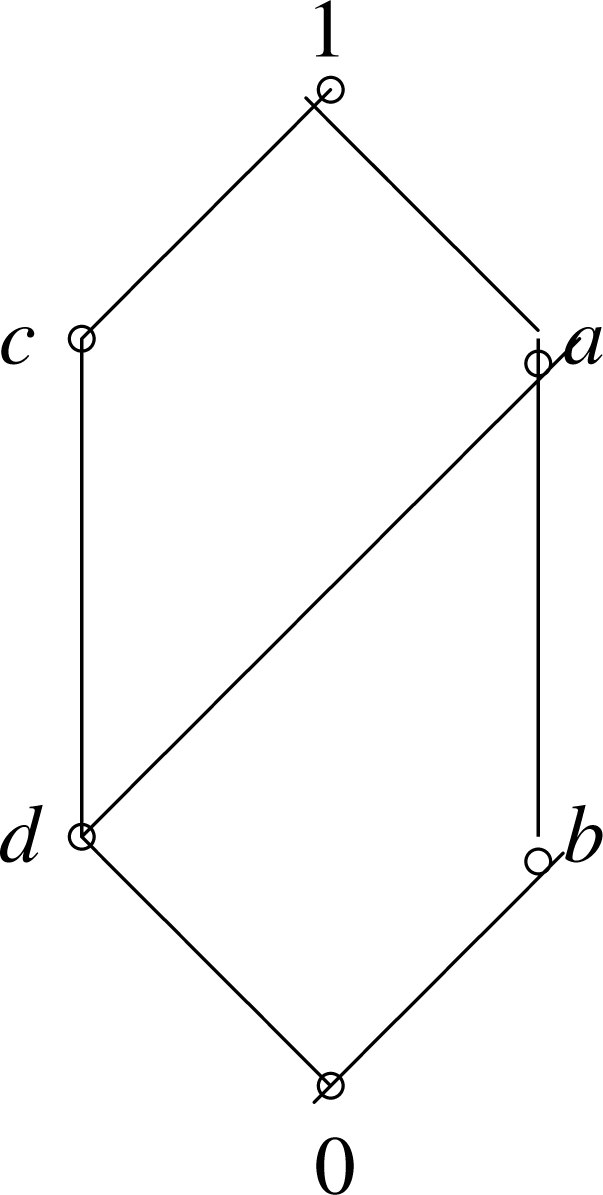
By routine calculations, we can see that (X, ∧ , ∼, ∽ , 1) is a pseudo equality algebra, and we can prove that G = {c, 1} is a fantastic filter, but it is not a positive implicative filter. Because a → (a → b) =1 ∈ G and a ⇝ a = 1 ∈ G, but a → b = a ∉ G. Moreover, in Example 4.16, F = {b, 1} is a positive implicative filter, but it is not a fantastic filter. Because 0 → a = 1 ∈ F, but ((a → 0) ⇝ 0) → a = a ∉ F. This shows that positive implicative and fantastic filters do not coincide, in general.
(⇐) Let x, y ∈ X and (x → y) ⇝ x ∈ F. By Proposition 2.3(9), (x → y) ⇝ x ≤ (x → y) ⇝ ((x → y) → y). Since F is a strong normal filter, then by (XF2), (x → y) ⇝ ((x → y) → y) ∈ F. By Proposition 4.20, (x → y) → ((x → y) → y) ∈ F. Since F is a positive implicative filter, by Proposition 4.15(2), (x → y) → y ∈ F, and so (x → y) ⇝ y ∈ F. Moreover, by Proposition 2.3(7) and Proposition 2.4(2), (x → y) ⇝ x ≤ y ⇝ x. By (XF2), y ⇝ x ∈ F. Thus, y → x ∈ F. Since F is a fantastic filter, ((x → y) ⇝ y) → x ∈ F. Since (x → y) ⇝ y ∈ F and F is a filter, then x ∈ F. By the similar way, we can show that (x ⇝ y) → x ∈ F implies x ∈ F. By Theorem 4.7(2), F is an implicative filter.
Conclusion
It is well-known that using filters with special properties plays an important role in investigating the structure of a logical system. From a logical point of view, the sets of provable formulas can be described by filters of those algebraic semantics. Moreover, the properties of filters have a strong influence on the structure properties of algebras. The aim of this paper is to introduce the notions of (positive) implicative and fantastic filters in pseudo equality algebras and to investigate their properties. Several characterizations of these filters are derived and in this paper we try to investigate the relations among them. We want to set up quotient algebra in pseudo equality algebras associated with these filters in the future.
Footnotes
Acknowledgments
This research is supported by a grant of National Natural Science Foundation of China (11971384).