



Abstract
The aim of this paper is to develop a multi-attribute group decision making (MAGDM) with picture fuzzy sets based on ELECTRE TRI method, i.e., an ELECTRE TRI based group decision making with picture fuzzy information is given. The MAGDM with picture fuzzy information based on picture fuzzy ELECTRE TRI outranking method is divided into three stages, i.e., the group decision information aggregation stage, determination of parameters and ELECTRE TRI outranking based outranking stage. A novel comparison law for picture fuzzy sets is introduced. In the group decision information aggregation stage, the concept of picture fuzzy normalized weighted Bonferroni mean (PFNWBM) is developed. The developed decision procedure is further applied to the assessment of energy security. The numerical example shows that the developed group decision procedure is feasible and valid.
Keywords
Introduction
Group decision making (or collaborative decision making) is a decision-making situation that individuals make a selection from the candidates before them. Since the decision is made by groups but not by individuals, the decision can reflect the wisdom of crowds. As a typical group decision situation, the multi-attribute group decision making (MAGDM) is a common decision environment with several decision makers (DMs), candidates and attributes, whose aim is to make a selection (or selections) from all candidates by comprehensively considering the evaluations given by the DMs with respect to different attributes. MAGDM has been widely studied in theory and applied to economic and management problems [1–6, 67].
Among current studies on MAGDM, group decision making under different types of decision information environments and their applications is a hot topic. Especially, the case of uncertainty that the edge of decision information is unclear, or fuzzy in other words. The concept of fuzzy sets is introduced by Zadeh [7] in 1965 to express such uncertainty, which has been generalized as diverse kinds of fuzzy information [8–13, 65]. Among those different types of fuzzy information, the concept of intuitionistic fuzzy sets (IFSs) extends the classical notion of fuzzy sets by detailing the degree of an element in a given set according to three dimensions, i.e., the membership degree (μ), the non-membership degree (ν) and the hesitancy degree (π). The mentioned three degrees satisfy the condition that μ + ν + π = 1. Recently, taking the American presidential election, electors in American are allowed to have 4 choices, i.e, vote for, abstain, refusal of voting and vote against, while not all Americans have the right to vote, in other words, when all Americans are seen as 1, then the sum of electors could be less than 1, i.e., μ + ν + π ⩽ 1 (The electors with deterministic attitudes: support, no support and abstention). To associate with such situations, Cuong and Kreinovich [13] introduce the concept of picture of fuzzy sets (PFSs). Since the definition of PFSs is developed, theoretical studies on PFSs and their applications have been reported. Singh [14] introduces the correlation coefficient of PFSs. Wei [15–17] consider the similarity measures and the cross-entropy measure of PFSs. While Son [18] develops the notion of generalized picture distance measure of PFSs. Thong [19], Phuong and Thong [27] and Van and Van [20] propose the clustering analysis and inference models under the picture fuzzy environment, respectively. Son [21] puts forward some picture association measures to measure the analogousness in PFSs by using picture distance measures. Wei [22], Garg [23] and Thong [24–26] consider the applications of PFSs to multicriteria decision making (MADM), optimization and forecasting.
It can be seen that decision making is the main application fields of PFSs. By using these fundamental and theoretical studies on PFSs, some typical decision technologies include TODIM (an acronym in Portuguese of interactive and multiple attribute decision making, a method for solving the multiple attribute decision making (MADM) problem considering DM’s behavior) [22], VIKOR method [20] and picture fuzzy information fusion based decision methods [23, 29] have been introduced. The developments of these decision technologies provide objective and selective stylized decision approaches for practical applications with PFSs.
As an another typical decision procedure, ELECTRE TRI outranking method is now a powerful tool to produce the ranking of candidates by considering multiple criteria, which has been generalized to diverse information environments [31–33]. The advantages of ELECTRE TRI outranking method include the unnecessary of decision information’s algebra structure and the fusion of DM’s subjective attitude and objective ranking procedure. Actually, ELECTRE TRI assigns a candidate to one of the predefined categories according to compare the candidate with referenced profiles separating the categories. Herein, the determination of profiles and thresholds corresponding to those profiles could be subjective, while the outranking process is objective when all parameters are determined. However, by reviewing the literatures on ELECTRE TRI and PFSs, it can be found that the combination of ELECTRE TRI outranking method and PFSs has merely been reported. Besides, the application of ELECTRE TRI outranking method to group decision making with PFSs has also merely been reported.
By considering the issues highlighted before, the aim of this paper is to propose the combination of ELECTRE TRI and PFSs so that a novel decision technology named as picture fuzzy ELECTRE TRI outranking method can be put forward. Furthermore, the application of the developed picture fuzzy ELECTRE TRI outranking method to MAGDM problems with PFSs would also be discussed. In order to simplify the outranking procedure of alternatives in MAGDM with PFSs, we introduce the concept of picture fuzzy weighted Bonferroni mean to aggregate picture fuzzy group decision information. Herein, the weighted Bonferroni mean is selected to aggregate PFSs for the reason that such form of mean value contains possible links among aggregated information [35–38, 46]. Then the picture fuzzy ELECTRE TRI is introduced and applied to MAGDM with PFSs.
To realize the aims mentioned above, the rest of this paper is structured as follows: Section 2 briefly presents the fundamental concepts of PFSs and ELECTRE TRI outranking method. Section 3 puts forward the picture fuzzy ELECTRE TRI outranking method and its application to MAGDM with PFSs, in which the concept of picture fuzzy normalized weighted Bonferroni mean and its properties are discussed. While a numerical example about supplier selection assessment is shown in Section 4 to illustrate the feasibility and validity of the developed model. Comparisons of the developed group decision method with other existed group decision approaches for MAGDM with PFSs are also presented. Section 5 gives some conclusions and remarks on the developed model.
Preliminaries
Picture fuzzy sets
In traditional fuzzy set given by Zadeh [7], the degree of an element in a given fuzzy set is represented by a real number between [0, 1], which is different from the characteristic function whose value is either 0 or 1. In order to enrich the expression of fuzzy sets, the following notion of intuitionistic fuzzy sets is given by Atanassov [8]:
It can be seen that an AIFS can provide more detailed information rather than classical fuzzy set, but there are still some situations in real life which cannot be represented by Atanassov’s IFSs. For instance, the example of voting situation in the section of Introduction. To illustrate such situations, the following concept of picture fuzzy sets is introduced:
For convenience, the notation α = (μ α , η α , v α ) is called as a picture fuzzy number (PFN) [39], where μ α ∈ [0, 1], η α ∈ [0, 1], v α ∈ [0, 1], 0 ⩽ μ α + η α + v α ⩽ 1.
By the concepts and notations mentioned above, the following algebra structure is defined:
α ⊕ β = (μ
α
+ μ
β
- μ
α
μ
β
, η
α
η
β
, v
α
v
β
); α ⊗ β = (μ
α
μ
β
, η
α
+ η
β
- η
α
η
β
, v
α
+ v
β
- v
α
v
β
);
Let X = { x1, x2, ⋯ , x
n
} be a finite universal set, A = {(μ
A
(x
i
) , η
A
(x
i
) , v
A
(x
i
))} and B = {(μ
B
(x
i
) , η
B
(x
i
) , v
B
(x
i
))} are two sets of PFNs. To measure the difference between A and B, the following normalized Hamming distance d(A, B) can be utilized,
In order to compare picture fuzzy numbers, the score function S and the accuracy function H are introduced.
By the score function S and the accuracy function H, the comparison between α and β can be given according to:
if S (α) < S (β), then α is smaller than β, denoted by α < β; if S (α) = S (β), then if H (α) = H (β), then α is equal to β, denoted by α = β; if H (α) < H (β), α is smaller than β, denoted by α < β.
Since there is a neutral membership in a PFN π A (x), two extreme cases would be the ratio η A (x) is assigned to μ A (x) and ν A (x), i.e., when assigning the part of refusal membership to the other three membership degrees, one can derive a AIFS located between 〈μ+ η, ν, π 〉 and 〈μ, ν+ η, π 〉. It can be easily seen that given a PFN, one can uniquely obtain the two AIFNs, while given two AIFNs with the forms, one can also determine the corresponding PFN.
According to Theorem 1, the following dominance degree of a PFN can be derived:
By Equation (1), the dominance degree of a PFN is an average of the dominance degrees corresponding to two AIFNs defined by the TOPSIS [54, 67]. it can be seen that the larger the dominance degree is, the larger the picture fuzzy number would be.
ELECTRE is a family of multi-criteria decision analysis approaches developed by Roy [40] in the mid-1960 s, which aims to choose the best action(s) by considering concrete and multiple criteria. There are two main stages to an ELECTRE application, i.e., the construction of one or several outranking relations and an exploitation procedure elaborating the recommendations.
ELECTRE TRI is a method pertaining to the ELECTRE family which are based on outranking methods. It assigns alternatives to predefined and ordered categories. The ordered categories are defined with lower and upper limits adjusted for each criteria being considered [27, 41–43]. For each criteria C
j
(j = 1, 2, ⋯ , n), the category CTh+1 will be limited by a lower limit b
h
and an upper limit bh+1. The assignment of a candidate a into a category CTh+1 results from the comparison of the alternative with the limits b
h
(h = 1, 2, ⋯ , p) and comparisons are based on an outranking relation S [44, 45]. The credibility index σ (a, b
h
) and σ (b
h
, a) are proposed to verify the relationship between alternative a and b
h
, which could be calculated as:
The discordance indices d j (a, b h ) , j = 1, 2, ⋯ , n, is calculated by:
When the credibility indices σ (a, b
h
) and σ (b
h
, a) are calculated, the following rules are used to determine the preference relation between alternative a and the limit b
h
: If σ (a, b
h
) ⩾ λ and σ (b
h
, A) ⩾ λ, aSb
h
and b
h
Sa, then a is indifferent in relation to b
h
(aIb
h
); If σ (a, b
h
) ⩾ λ and σ (b
h
, a) < λ, aSb
h
and not b
h
Sa, then a is preferred in relation to b
h
(a ≻ b
h
); If σ (a, b
h
) < λ and σ (b
h
, a) ⩾ λ, b
h
Sa and not aSb
h
, then b
h
is preferred in relation to a (b
h
≻ a); If σ (a, b
h
) < λ and σ (b
h
, a) < λ, neither aSb
h
or b
h
Sa exists, then a is incomparable in relation to b
h
(aRb
h
);
Then, the following two assignment procedures can be used to derive the outranking of candidates [41–43]: The pessimistic procedure Compare successively each alternative a with the limits b
h
(h = 1, 2, ⋯ , p). Assign the alternative a to the highest category CTh+1 such that a ≻ bh-1. The optimistic procedure Compare successively each alternative a with the limits b
h
(h = 1, 2, ⋯ , p). Assign the alternative a to the lowest category CTh+1 such that bh-1 ≻ a
Let X = {X1, X2, ⋯ , X
m
} be a set of candidates (or alternatives). Given that each alternative is evaluated by a set of decision makers Exp = {D1, D2, ⋯ , D
l
} according to a set of criteria (or attributes) C = {C1, C2, ⋯ , C
n
}. The decision matrices are denoted as
In this section, the picture fuzzy ELECTRE TRI method will be developed and further be applied to derive the preferences of all alternatives.
Picture fuzzy normalized weighted Bonferroni mean
The Bonferroni mean (BM) was originally introduced by Bonferroni [47, 48] and then be generalized by Yager [49]. By comparing with other aggregation operators, the desirable characteristic of the BM is the capability to capture the interrelationship between input information [47–49]. Therefore, the normalized BM [56] is extended to aggregate picture fuzzy information of decision makers in this paper.
According to Definition 8, the following conclusions can be derived:
Besides, since the values of μ α i , η α i and v α i are located in [0, 1], according to the operational rules defined in Definition 3, it’s easy to derive that the result obtained in Theorem 2 is also a PFN.
According to the conclusion mentioned above, Theorem 2 is proved. □
By using the PFNWBM, a set of PFNs can be aggregated to be a single PFN, which will be further used to simplify the group decision procedure.
Determination of experts’ weighting vector
In order to measure the importance of experts, let ϖ = (ϖ1, ϖ2, ⋯ , ϖ
l
)
T
be the weighting vector of experts. Given that
By using the normalized Hamming distance measure between two PFSs, the difference of one expert’s decision matrix with the other experts’ decision matrices can be given according to
According to Equation (8), it can be seen that 0 ⩽ dist(k) ⩽ 1. Then, by the differences given above, the weight of the k-th expert can be obtained according to
By Equation (9), as mentioned before, suggestions provided by different individuals would be aggregated in group decision making, so consensus among the group is encouraged.
On the contrary, to measure the importance of attributes, the maximizing deviation method [50] is extended to assign the weights of attributes. It assigns a larger weight to the attribute which create larger difference among all alternatives. In other words, if all alternatives have similar performance value in term of a given attribute, then such attribute has less effect on ranking the alternatives. Given that ω = (ω1, ω2, ⋯ , ω
n
)
T
is the weighting vector of attributes. Then the following optimization model can be used to obtain the weighting vector:
By solving Equation (10), the solution can be represented according to
According to Equation (11), let x ij be the picture fuzzy decision information, then the weighting vector of attributes can be derived.
With the notions and notations mentioned above, the picture fuzzy ELECTRE TRI method is put forward in this subsection, which will be further applied to MAGDM with PFNs. The decision procedure can be shown in the following:
In order to simplify the group decision procedure, we first aggregate the group decision information of alternatives given by different experts.
By using the weighting method of experts ϖ = (ϖ1, ϖ2, ⋯ , ϖ l ) T provided by Equation (8), decision information of alternatives given by experts can be aggregated according to the developed PFNWBM, which can be shown as below:
According to Equation (12), it can be seen that
Let
For the purpose of constructing the comprehensive concordance index, the thresholds include the preference threshold (p), the indifference threshold (q) and the veto threshold (v) are firstly determined. Ramezanian [51] utilizes an optimization model to derive the profiles and thresholds of posteriori ELECTRE TRI. While Mousseau and Slowinski [52] build an optimization model to optimize the profiles and thresholds with given partitions of candidates and subjective assessments on the thresholds. Galo et al. [31] provide these parameters according to DMs’ subjective evaluations. Mousseau et al. [55] integrate specific functionalities supporting the decision maker (DM) in the preference elicitation process. However, there would be no deterministic partitions of candidates in most of practical cases. Besides, the profiles and thresholds given by subjective assessments would be changeable with respect to the attitude of DM. Thus, an objective way to determine the profiles and thresholds is needed.
Clustering analysis is a natural solution for the partition of candidates. Thus, the following procedure can be considered to produce the profiles and thresholds:
Given that
Let
Herein, PFNs
Next, the picture fuzzy thresholds associate to the profile
Actually, the thresholds corresponding a profile reflect certain preferences of DM. The determination of these parameters is just a selective way, the parameters would be changeable with respect to different attributes.
According to Theorem 1 and Definition 7, picture fuzzy profiles and thresholds determined by Equations (13, 14) would be transformed to crisp values. Since the larger the picture fuzzy number is, the larger the dominance degree would be, so the crisp values corresponding to these parameters would keep the order relations. Then,
As a result, the calculation of the credibility index can be computed according to Eqs. (2–5). Noting that the thresholds could be provided with the same value by the descending order if referenced values are not sufficient.
With the credibility index, by giving the “cut level” λ, the preference relation, the indifference relation and the incomparability relation can be further derived.
The flow chart of the developed decision procedure is shown in Fig. 1. As shown in Fig. 1, both of the aggregation of picture fuzzy information by using the normalized weighted Bonferroni mean and the combination of picture fuzzy group decision making and ELECTRE TRI are provided.
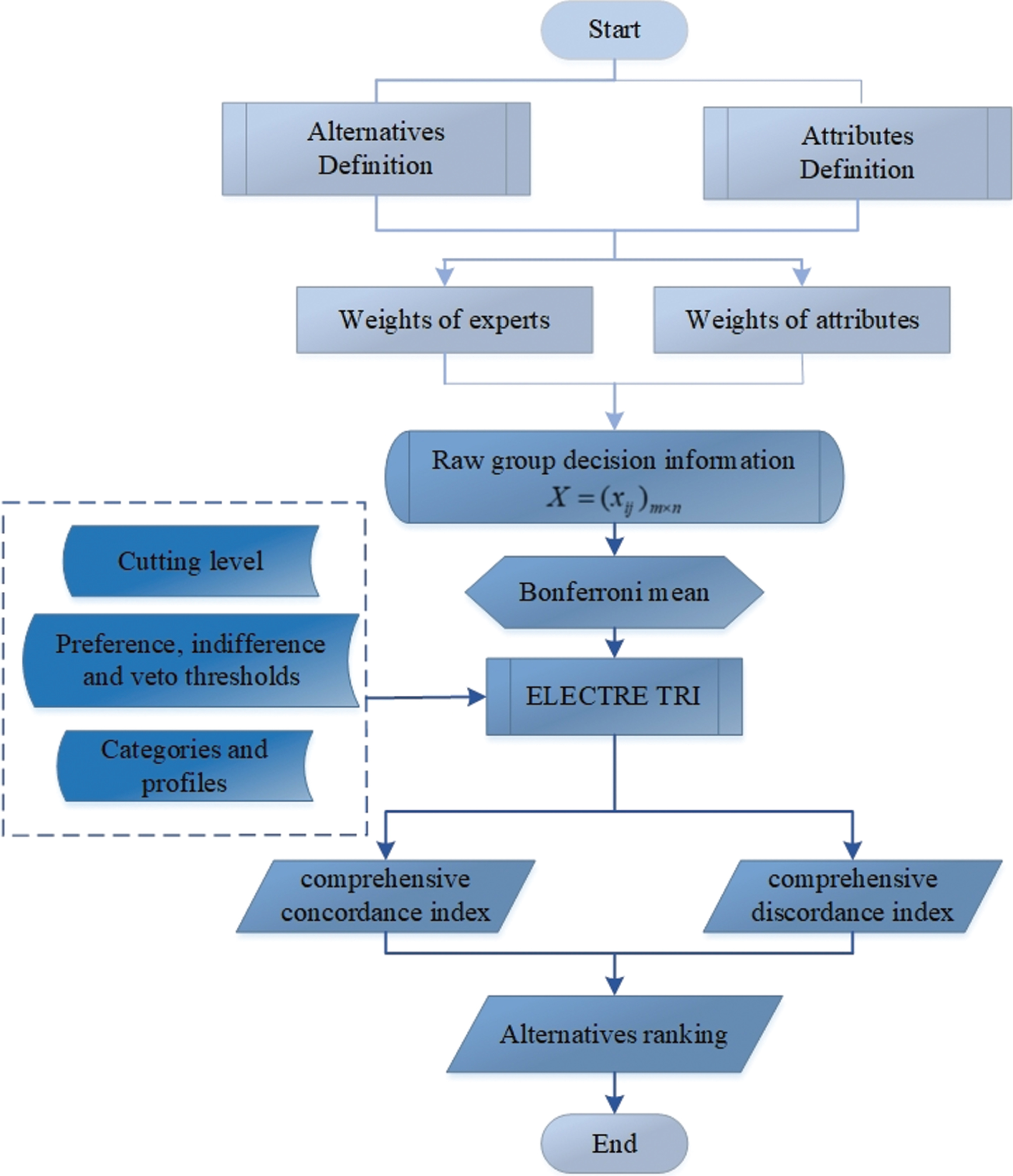
Flow chat of the developed decision procedure.
Case study
In a narrow sense, supplier selection refers to the process of selecting one or more suppliers after the proposal and quotation of the enterprise, which plays an important role for the production of enterprises [57]. The illustrative case is adapted from a practical supplier selection of a pump enterprise. The enterprise requires three departments include accounting department, quality inspection department and production department to make evaluations on candidate suppliers after first round filtering. To avoid the multi-modal information provided by different apartments, the concept of picture fuzzy sets is utilized. Five candidates (A1, A2, A3, A4 and A5) in China are evaluated and divided into 4 categories. The attributes used to evaluate these candidates are: C1 - economic cost, C2 - product quality, C3 - deliver ability and C4 - after-sales service. Three decision makers are involved in this decision process.
According to Equation (8), the distances of decision matrix given by each expert with other decision matrices can be obtained, we have dist(1) = 0.0216, dist(2) = 0.0279 and dist(3) = 0.0298. Then, by Equation (9), the weighting vector of experts is derived and listed in the following:
By using the weighting method of experts, the judgements given by the decision makers in Table 1 are aggregated using the picture fuzzy normalized weighted Bonferroni mean (PFNWBM, p = q = 1). Aggregated results are shown in Table 2.
Judgement of individual alternative
Judgement of individual alternative
Aggregation of judgements of individual alternative
According to Equation (11), the weights associate to attributes with aggregated PFNs can be obtained, and we have
Let ℘ j , j = 1, 2, 3, 4 be the picture fuzzy decision information given by all expert, assume that all alternatives would be partitioned into 4 categories (A, B, C, D and A ≻ B ≻ C ≻ D). Then, by using the evolutionary clustering analysis and Eqs. (13–15), the parameters can be collected and summarized in Table 3 † .
Parameters for the outranking of alternatives in ELECTRE TRI
As shown in Table 3, a1 to a5 (i.e., A1 to A5) are dominance degrees of aggregated PFNs listed in Table 2. All profiles and thresholds are computed according to the evolutionary clustering analysis and determination rules. Let λ = 0.8, by using the software J-Electre-v2.0, solutions are listed in Table 4 to Table 6.
The concordance index c j (a, b h )
The discordance index c (A i , b h )
The credibility
Based on the preference relations in Table 6 and the procedure in Subsection 3.2.3, the five areas are categorized as presented in Table 7.
Result of ELECTRE TRI categorization
The results listed in Table 7 show that both A2 and A3 are better than the other three candidates according to the optimist rule, A3 locates in the middle, while the rankings of A4 and A5 are lower.
In order to show the efficiency and validity of our developed model, the picture fuzzy weighted averaging operator (PFWA), the picture fuzzy geometric averaging operator (PFWGA) and TOPSIS method (positive ideal point 〈1 0 0〉 and negative ideal point 〈0 0 1〉) are also considered. With the weighting vector of attributes, the calculated results are listed in the following Table 8.
Comparative results given by different methods
Comparative results given by different methods
By Table 8, noting that the larger the dominance degree or closeness degree is, the better the candidate would be. The rankings of all candidates can be derived, we have:
PFWA: A2 ≻ A3 ≻ A1 ≻ A5 ≻ A4;
PWGA: A2 ≻ A3 ≻ A5 ≻ A1 ≻ A4;
TOPSIS: A2 ≻ A3 ≻ A5 ≻ A1 ≻ A4.
As a result, it can be seen that the categories given by our method is the same as three selective approaches. Although efficient, there would be advantages and disadvantages among these decision technologies. Both of PFWA and PFWGA can provide detailed aggregation results of given decision matrices, in which the algebra structure and comparison laws of PFNs are needed. Besides, possible information loss would be existed when making aggregation. The TOPSIS method compares all candidates with respect to ideal points, but PFNs locate on the perpendicular line cannot be distinguished. While the developed group decision procedure utilizes algebra structure and operational rules of PFNs, and considers multiple attributes simultaneously with certain subjective preferences of DMs. In practical decision problems, the developed group decision model is suitable to the situation that both of objective algebra structure and subjective attitude need to be integrated.
It can be seen that the developed combination of ELECTRE TRI and picture fuzzy group decision making provides a novel method for the ranking of alternatives when considering multiple attributes (or criteria). The advantage of the developed method is that it could compare alternatives in an objective way with more feasibility in real decision problems.
Group decision making is a common decision situation in practical economic and management problems. Decision information is the base to derive scientific decision, while the attitude of decision makers is also important in group decision process. In the developed ELECTRE TRI based outranking method for MAGDM with picture fuzzy information, the strengths of such outranking approach can be summarized according to: To avoid multi-modal decision information provided by different apartments and to describe the uncertainties in real-world decision problems, picture fuzzy information is utilized. A novel comparison law and a novel aggregation method is given. In group decision process, objective information aggregation is considered. With the information aggregation process, individual assessments can be integrated so that the MAGDM decision problem can be simplified. In group decision process, the attitude of decision maker(s) can also be included by using the ELECTRE TRI method. Besides, an objective parameter determination method is discussed.
Conclusions and remarks
The multi-attribute group decision model with regard to categorization that combines picture fuzzy sets and ELECTRE TRI as an approach to deal with the evaluation of alternatives is proposed and tested in the previous part. The weight of specialist is calculated based on ranking vectors, the weight of attributes is computed based on the maximum deviation principle. The scores of the alternatives and the weights of the criteria have been aggregated. And then they were use as input to the ELECTRE TRI computation, as well as the parameters of ELECTRE TRI. ELECTRE TRI is used to categorize alternatives and output the results of the decision making problems.
In the future, the developed outranking can be extended in two ways. The first would be the application of other types of ELECTRE method include ELECTRE II, III, and ELECTRE TRI–B/C et al. Next, the outranking method can be further applied to other kinds of picture fuzzy information. For example, other types of picture fuzzy information [58, 63], complex intuitionistic fuzzy sets [59], Pythagorean fuzzy [60, 62] and interval-valued q-rung orthopair 2-tuple linguistic [61, 64].
Footnotes
Acknowledgments
The work was supported by National Natural Science Foundation of China (Nos. 71701001, 71771001, 71871001, 71901001, and 71901088), the Social Science Innovation and Development Research Project in Anhui Province (2019CX094), the Key Research Project of Humanities and Social Sciences in Colleges and Universities of Anhui Province (SK2018A0025, SK2019A0013). The authors would like to thank the editors and the anonymous reviewers for their valuable comments and suggestions which would have helped immensely in improving the quality of this paper.
The calculation is realized by using the software J-Electre-v2.0, three thresholds are the averages of corresponding thresholds associate to profiles.