In this paper, an unprecedented kind of fuzzy graph designated as m-polar interval valued fuzzy graph (m-PIVFG) is defined. Complement of the m-PIVFG open and closed neighborhood degrees of m-PIVFG are discussed. The other algebraic properties such as density, regularity, irregularity of the m-PIVFG are investigated. Moreover, some basic results on regularity and irregularity of m-PIVFG are proved. Free nodes and busy nodes of m-PIVFG is explored with some basic theorems and examples. Lastly, an application of m-PIVFG is described.
Abbreviations
FS
Fuzzy set
FG
Fuzzy graph
IVFS
Interval-valued fuzzy sets
IVFG
Interval-valued fuzzy graph
m-PFS
m-polar fuzzy sets
m-PFG
m-polar fuzzy graph
m-PIVFS
m-polar interval-valued fuzzy sets
m-PIVFG
m-polar interval-valued fuzzy graph
Introduction
Observing the vast application of graph theory which is a mathematical structure defined as an ordered pair G = (V, E) together with a set of vertices V and a set of edges E. A fuzzy model is needed to describe a fuzzy graph when there is a vagueness either in vertices or in edges or in both. Recently, applications of graph theory are mostly used in the fields of computer networks, electrical network, coding theory, operational research, architecture, data mining etc. In 1736 graph theoretical concept was first modeled by Swiss mathematician Euler from the concept of Konigsberg bridge problem.
For solving various decision making problems in real life fuzzy set, a non-empty set V together with a fuzzy set and a fuzzy relation have been applied. Ten years after Zadeh’s concept on fuzzy set in 1965, Kauffman [1] proposed the basic idea of fuzzy graph. Later Rosenfeld [2] developed this concept which have been successfully applied in information theory, modern science, engineering science, manufacturing, medical diagnosis, etc. In fact, he also detailed definition of several fuzzy concepts such as fuzzy vertex, edges, cycles, paths, connectedness, and so on. In 1994, Zhang [3, 4] gave the extension of the concept of fuzzy set and the idea of bipolar fuzzy sets. Mordeson and Peng [5–7] incorporated the idea of complement fuzzy graph and demonstrated a few properties and operations on it. Later this concept was described by Sunitha and Kumar [8, 9].
In 2006, Nagoorgani and Chandrasekaran [10] studied on the degree of a node in fuzzy graph. Later on Shannon and Atanassov [11] elaborated the conceptualization of intuitionistic fuzzy relation and intuitionistic fuzzy graphs and described various properties. In 2008, Nagoorgani and Radha [12] introduced regular fuzzy graph which was later used to find density. In 2009, Hongmei and Lianhua [13] made a deeper study on IVFG, in 2011, Akram and Dudek [14] and in 2018 Rashmanlou et al. [15] studied some operations on it. Hawary [16] defined complete fuzzy graph and studied some new operations on it. Nagoorgani and Malarvizhu [17, 18] detailed isomorphic properties on fuzzy graphs and also gave the definition of the self-complementary fuzzy graphs. Then, Akram [19] presented the notations of bipolar fuzzy graphs and further researched on it [20, 52]. Later, the extension of bipolar fuzzy set and the idea of m-polar fuzzy sets (m-PFS) were introduced by Chen et al. [21] in 2014. Later on Rashmanlou briefly described categorical properties on it [22]. Samanta and Pal investigated on fuzzy tolerance graph [23], fuzzy threshold graph [24], fuzzy k-competition graphs [25], p-competition fuzzy graphs and also fuzzy planar graphs [26]. Some properties related to isomorphism and complement on IVFG were studied by Talebi and Rashmanlou [27]. Later, Ghorai and Pal [28, 29] described various properties on m-PFGs. They examined isomorphic properties on m-PFG. Ghorai and Pal [30] described the density of m-polar fuzzy graphs and some operations on it. Raut and Pal [31] studied on fuzzy permutation graph and its complements in 2018. Various extensions of fuzzy graphs [32] have been incorporated to handle the vagueness of the real world problem [33]. In this uncertain environment to solve various decision making problems [34], fuzzy graphs have used several models. Different types of research on generalized fuzzy graphs were discussed in [36–42]. A through study on shortest path problem has made by Nayeem and Pal [51]. Some remarkable research studies regarding fuzzy graph are given in Table 1.
Some remarkable research studies regarding fuzzy graphs.
References
Contributions
Kauffman (1973)
Introduction of fuzzy graphs
Rosenfeld (1975)
Modification the concept of fuzzy graphs given by Kauffman (1973)
Sunitha (2001)
New definition of complement of fuzzy graphs
Akram (2011)
Interval-valued fuzzy graph
Akram &Dudek (2011)
Bipolar fuzzy graphs
Samanta &Pal (2011)
Fuzzy tolerance graph
Samanta &Pal (2011)
Fuzzy threshold graph
Nagorgoni &Radha (2012)
Regular fuzzy graph
Samanta &Pal (2013)
Fuzzy k-competition graph and p-competition graph
Samanta &Pal (2014)
Fuzzy planar graph
Ghorai &Pal (2015)
m-polar fuzzy graph
Ghorai &Pal (2016)
m-polar fuzzy planar graphs
Raut, Pal &Ghorai (2018)
Fuzzy permutation graph and its complements
This study
Balanced m-PIVFG with busy and free nodes, and their examples
The main contribution of this study are as follows:
Concept of m-PIVFGs and complement of m-PIVFGs are introduced with examples.
Open and closed neighbourhood degree of a vertex of m-PIVFG are defined.
Definitions of regularity and irregularity in m-PIVFG and their examples.
Investigation of busy and free nodes and their examples.
Results on busy and free nodes.
The rest of the article is arranged as follows: Section 1 describes historical backgrounds of FSs, FGs, m-PFGs and IVFGs. Our aim and motivation are also written in this section. In section 2, some preliminary concepts regarding FGs, m-PFGs, IVFGs are described. Section 3 discussed about m-PIVFG and complement of m-PIVFG. In section 4, open and closed neighbourhood degree of a vertex of m-PIVFG are defined. Balanced m-PIVFG, regular m-PIVFG and also density of an m-PIVFG are also investigated and supported with examples. Some theorems related to these definitions are discussed with their proofs. In section 5, we define the irregularity of an m-PIVFGs with examples and some theorems with their proofs. Section 6 demonstrated the definition of busy nodes, free nodes with the help of examples and some basic theorems related to these. Section 7 is based on a summary of this article along with future works.
Preliminaries
In this part of this paper we briefly study some basic terminologies of FS, FGs, m-PFS and m-PFGs which are used in this paper. The basic definition of IFGs are also demonstrated.
Fuzzy sets, extension of the classical notion of the set were proposed by Zadeh [43] in 1965. A fuzzy set is a set of elements having degrees of membership. A fuzzy set A = (S, m) is a pair of set S and a membership function m : S → [0, 1]. Throughout this article, we use the notation G* as a classical graph and G as a graph defined in a fuzzy environment.
Definition 2.1. ([21]) An m-PFS (or a [0, 1] m-set) on a set X is a function A : X → [0, 1] m. The collection of all m-PFS on X is addressed as m (X).
Definition 2.2. [44] Let A be an m-PFS on X. An m-polar fuzzy relation on A is an m-PFS B of X × X such that B (x, y) ≤ min {A (x) , A (y)} ∀x, y ∈ X i.e. for each i = 1, 2, . . . , m and ∀x, y ∈ Xpi ∘ B (x, y) ≤ min {pi ∘ A (x) , pi ∘ A (y)}, where pi means membership value of ith pole.
Definition 2.3. [44] An m-PFG of a crisp graph G* = (V, E) is a pair G = (A, B) where A : V → [0, 1] m is an m-PFS in V and B : V × V → [0, 1] m is an m-PFS in V × V such that for each i = 1, 2, . . . , m; pi ∘ B (xy) ≤ min {pi ∘ A (x) , pi ∘ A (y)} ∀xy ∈ V × V and B (xy) =0 ∀xy ∈ (V × V) - E, where 0 = (0, 0, . . . , 0) is the smallest element in [0, 1] m. A and B are known as the m-polar fuzzy vertex set and edge set of G, respectively.
Definition 2.4. [45] An IVFS A on V is defined as , where and are fuzzy subsets on V such that , ∀x ∈ V.
Based on this set a graph called IVFG is defined.
Definition 2.5. [13] By an IVFG of a crisp graph G* = (V, E) we mean G = (A, B), where is an IVFS on V and is an IVFS on edge set E, such that , ∀xy ∈ E.
Definition 2.6. [46] An m-PIVFG of a graph G* = (V, E) is a pair G = (V, A, B) consists of a non-empty set V together with pair of interval-valued function A : V → [0, 1] m is an m-PFS in V and B : V × V → [0, 1] m and μ : V × V → [0, 1] m for each i = 1, 2, . . . , m; , and , and for every i, the interval number of a vertex x and of an edge xy in G satisfying , , ∀x, y ∈ V.
Definition 2.7. [46] Let G = (V, A, B) of G* = (V, E) be an m-PIVFG. The complement of G is an m-PIVFG , where , , and for every i and x, y ∈ V.
Lots of works have been done on this graph [47–50]. In the following section balanced m-PIVFG, regularity m-IVFG are defined with suitable examples. Some theorems related to regularity of m-IVFG are also discussed.
Balanced m-PIVFG
Herein, the concept of neighbourhood of m-PIVFG are introduced and demonstrated with examples. Also, in this part we described balanced and regularity of m-PIVFG with appropriate examples and some theorems related to these are also explained with their proofs.
Definition 3.1. Let G = (V, A, B) be an m-PIVFG of a crisp graph G* = (V, E). The open-neighbourhood degree of a vertex x in G is defined by , for i = 1, 2, . . . , m where and is defined by and , for every i. Moreover, , , for xy ∈ E and , , for xy ∉ E, x, y ∈ A.
Definition 3.2. Let G = (V, A, B) be an m-PIVFG of a crisp graph G* = (V, E). If all the vertices have a similar open-neighborhood degree, then G is is known as a regular m-PIVFG.
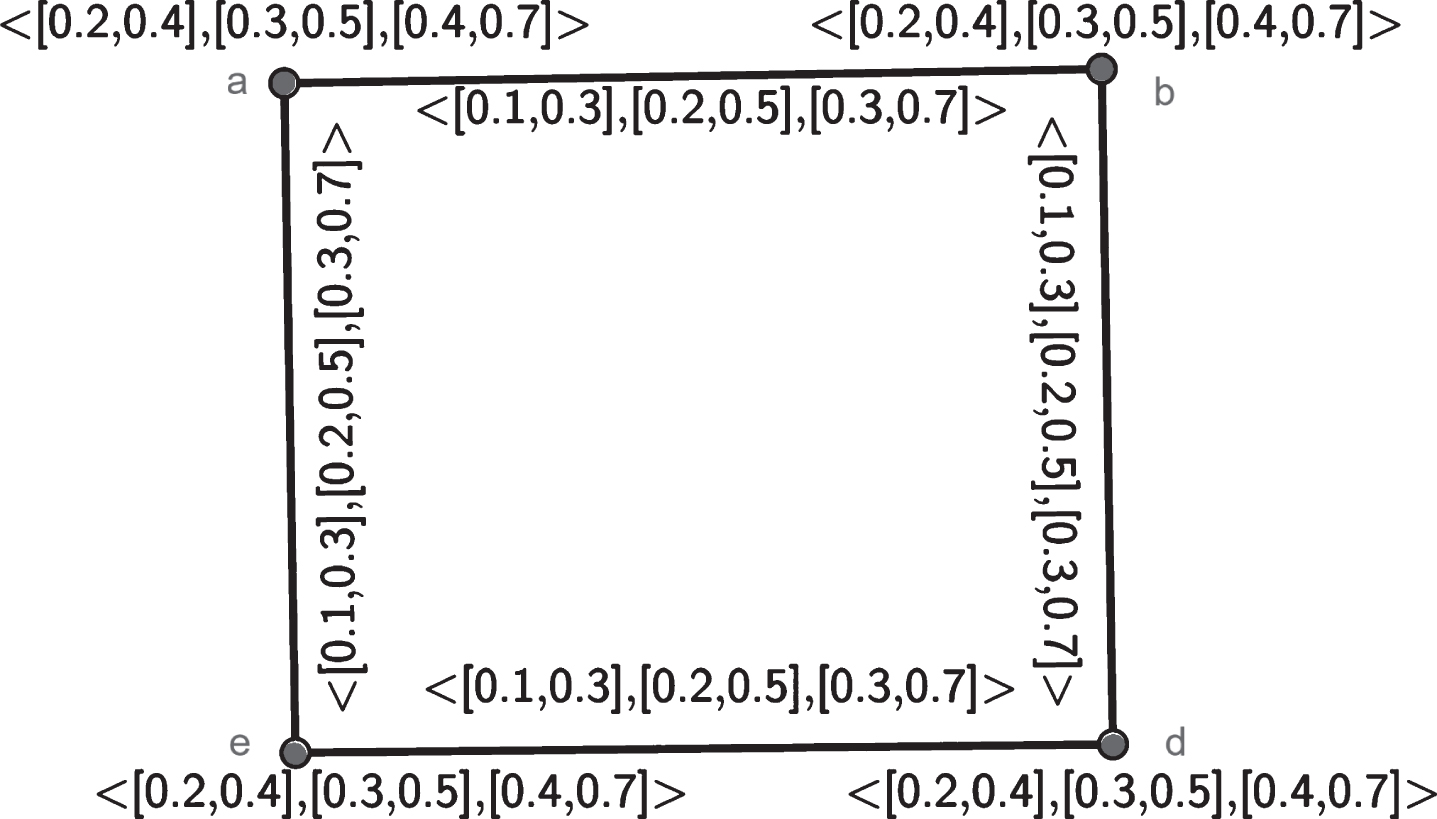
Example 3.1. Let G = (V, A, B) be an m-PIVFG (Fig. 1) where,
Definition 3.3. Let us consider an m-PIVFG G = (V, A, B) of a crisp graph G* = (V, E). Then the closed-neighbourhood degree of a vertex x in the m-PIVFG G is defined by , where, , , for every i.
Definition 3.4. Let G = (V, A, B) be an m-PIVFG of a crisp graph G* = (V, E). If all the vertices of G have a similar closed neighborhood degree for every pole, then G is known as a totally regular m-PIVFG.
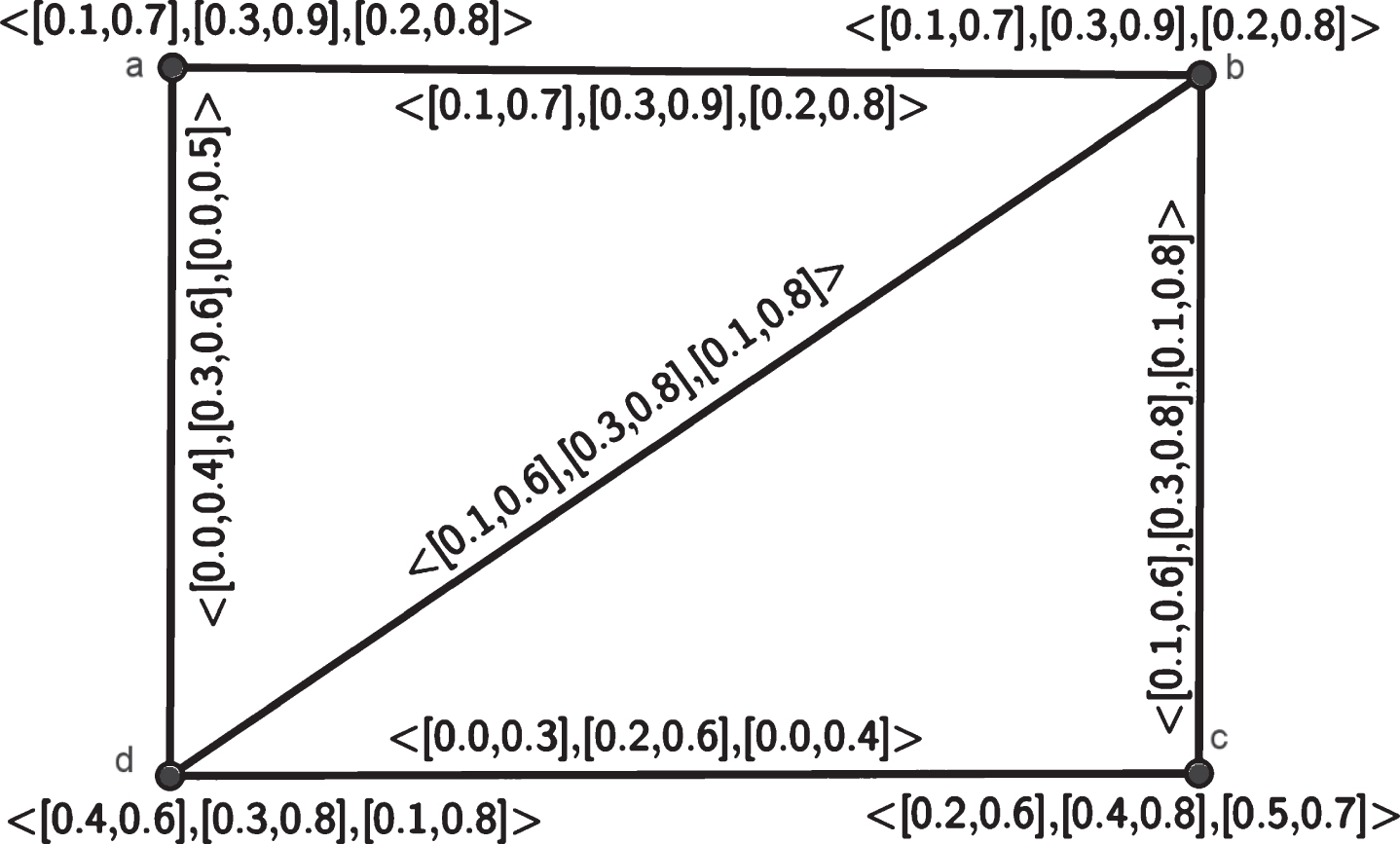
Example 3.2. Let us consider a graph G such that vertex set V = {a, b, c, d} and edge set E = {ab, bc, cd, ad}(Fig. 2). Let A be an m-PIVFS on V and B be an m-PIVFS on E defined by
Closed neighborhood degree of a 3-PIVFG G.
Thus, G is a regular m-PIVFG as well as totally regular m-PIVFG.
Definition 3.5. An m-PIVFG G = (V, A, B) of G* = (V, E) is said to be complete if and , for every pair of vertices x, y ∈ V.
By definition it is obvious that every complete m-PIVFG is totally regular, but the converse is not true.
Example 3.3. From Example 3.2, as seen in Fig. 2, it is observed that G is totally regular but not complete.
Theorem 3.1.Let G = (V, A, B) be an m-PIVFG of G* = (V, E). Then , for i = 1, 2, . . . , m is a constant mapping if and only if the subsequent properties are equivalent:
G is a regular m-PIVFG.
G is a totally regular m-PIVFG.
Proof. Suppose that . Let and ; for i = 1, 2, . . . , m and ∀x ∈ V.
Now, (i) ⇒ (ii)
Let us assume that G is an m-PIVFG. Let and ; for i = 1, 2, . . . , m and ∀x ∈ V. So, and ; ∀x ∈ V. Similarly for others. In general, , for i = 1, 2, . . . , m and ∀x ∈ V. Thus, G is a totally regular m-PIVFG.
Again, (ii) ⇒ (i)
Let us consider that G is totally regular m-PIVFG. Afterwards, ; ∀x ∈ V. Now, for i=1, or, or, or, . Also, or, or, or, . In general, Therefore, G is a regular m-PIVFG. Consequently, (i) and (ii) are equivalent.
Theorem 3.2.Let G = (V, A, B) be an m-PIVFG where G* is a crisp graph with an odd cycle. Then, G is a regular m-PIVFG if and only if B is a constant map.
Proof. Let is a constant map, for i = 1, 2, . . . , m. Let, , , ∀xy ∈ E. Then, , , ∀x ∈ V. Thus, G is a regular m-PIVFG. Conversely, let G be a regular m-PIVFG. Thereafter, , , ∀x ∈ V. Also, let e1, e2, . . . , e2n+1 be the edges of G in that order. Let , . Then, , , , and so on. Therefore,
for i = 1, 2, . . . , m and j = 1, 2, . . . , (2n + 1). Thus and . So, e1 and e2n+1 incident at a vertex v1. Then, or, or, ci + ci = ri or, ci = ri/2. This proves that is a regular function.
Similarly, , , , and so on. Therefore,
for i = 1, 2, . . . , m and j = 1, 2, . . . , (2n + 1). Thus and . So, e1 and e2n+1 incident at a vertex v1. Now, or, or, ki + ki = si Thus, ci = ri/2. This proves that is a regular function ∀xy ∈ E. Therefore, B is a constant map.
Corollary 1.Let G be an m-PIVFG, where G* is a usual graph having even cycle. Thereafter, G is a regular m-PIVFG if and only if for i = 1, 2, . . . , m is a constant map or alternate edges have the same membership degrees.
Definition 3.6. The density of an m-PIVFG G = (V, A, B) is D (G) = ([p1 ∘ Dl (G) , p1 ∘ Du (G)] , [p2 ∘ Dl (G) , p2 ∘ Du (G)] , . . . , [pi ∘ Dl (G) , pi ∘ Du (G)] , . . . , [pm ∘ Dl (G) , pm ∘ Du (G)]); where
for x, y ∈ V, provided Dl (G) < Du (G). If the condition is not true then we have to define the density by other way.
Definition 3.7. An m-PIVFG G is balanced if D (H) ≤ D (G) i.e, pi ∘ Dl (H) ≤ pi ∘ Dl (G) and pi ∘ Du (H) ≤ pi ∘ Du (G) for all subgraphs H of G.
Definition 3.8. An m-PIVFG G is strictly balanced if for every x, y ∈ V, D (H) = D (G) for all non-empty subgraphs.
Theorem 3.3.Every complete m-PIVFG is balanced.
Proof. Let G = (V, A, B) be a complete m-PIVFG. Thereafter, and for every pair of vertices x, y ∈ V and ∀ i. Consequently, and .
Similarly we get, pi ∘ Du (G) =2, ∀ i. Also, every subgraph of a complete m-PIVFG is complete. Hence, it can be easily checked that D (H) = ([2, 2] , [2, 2] , . . . , [2, 2]) for m pole and for every H ⊆ G. Thus G is balanced m-PIVFG.
Note 1. Converse of above theorem is not true, that is every balanced m-PIVFG is not necessary complete.
Note 2. Let G be a self-complementary m-PIVFG. Then, D [G] = ([1, 1] , [1, 1] , . . . , [1, 1]).
Theorem 3.4.Let G be strictly balanced m-PIVFG and be its complement; thereafter, .
Proof. Let G be a strictly balanced m-PIVFG and be the complement. Let H be any non-empty sub graph of G. Since, G is a strictly balanced m-PIVFG then D (G) = D (H) for any H ⊆ G and x, y ∈ V. In ,
, for every x, y ∈ V and ∀ i.
Dividing both sides of (i) by we get,
Taking summation both sides,
for every x, y ∈ V. Multiplying by 2 both sides,
i.e, . Similarly, . Again, . This completes the proof.
Note 3. The complement of a strictly balanced m-PIVFG is also strictly balanced.
Note 4. Let G1 and G2 be isomorphic m-PIVFG. If G2 is balanced then G1 is also balanced.
Irregularity in m-PIVFG
In this present section, first, the irregularity in m-PIVFG with suitable examples are defined and some theorems related to that are described.
Definition 4.1. Let G = (V, A, B) be an m-PIVFG on G* = (V, E). If there exists a vertex in G which is adjacent to vertices with distinct neighborhood degree, then G is called an irregular m-PIVFG.
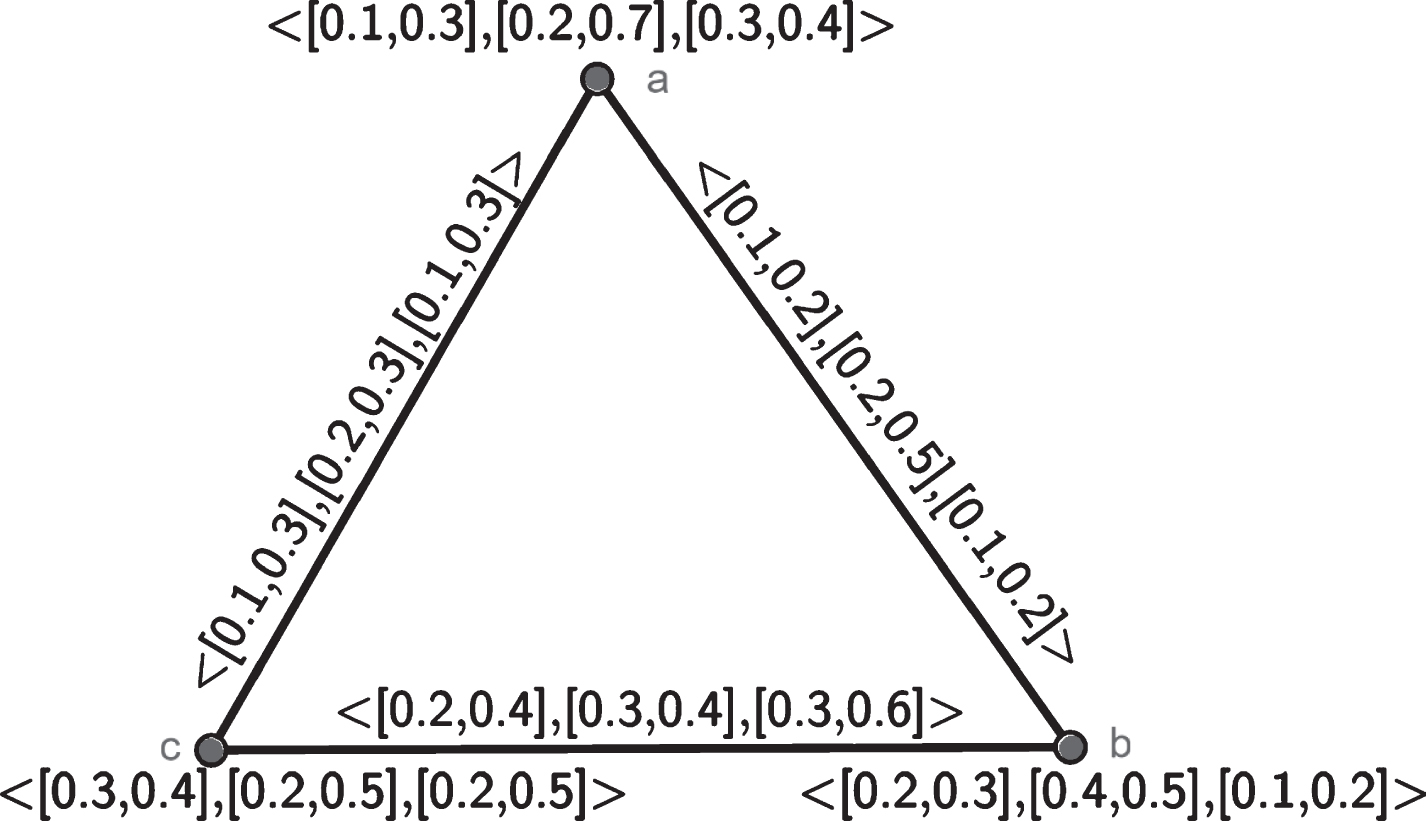
Example 4.1. Let us assume an m-PIVFG G = (V, A, B) (Fig. 3), where
Thus, deg (a) ≠ deg (b) and deg (a) ≠ deg (c). Therefore, G is an irregular graph.
Definition 4.2. Let G be an m-PIVFG of a crisp graph G*. If there exits a vertex in G which is adjacent to vertices with distinct closed neighborhood degree, then, it is said to be a totally irregular m-PIVFG.
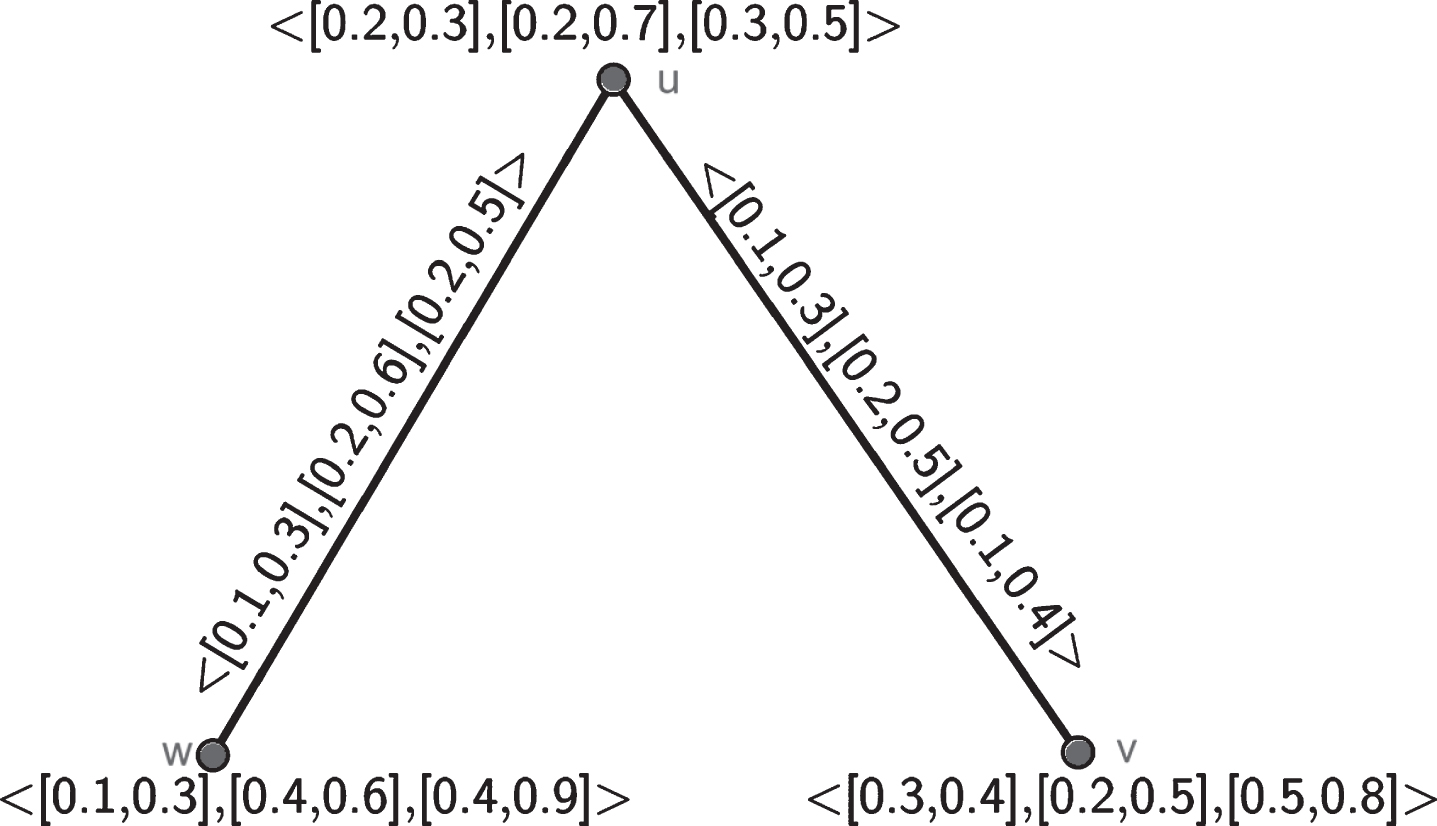
Example 4.2. Let us think about an m-PIVFG G = (V, A, B) (Fig. 4), where
Here, deg [u] = ([0.4, 0.9] , [0.6, 1.8] , [0.6, 1.4]),
deg [v] = ([0.4, 0.7] , [0.4, 1.0] , [0.6, 1.2]),
deg [w] = ([0.2, 0.6] , [0.6, 1.2] , [0.6, 1.4]).
A 3-PIVFG G which is totally irregular.
Hence, there exists a vertex u which has distinct closed neighbourhood degrees with the vertices v and w. Therefore, the graph shown in Fig. 4 is a totally irregular m-PIVFG.
Definition 4.3. A connected m-PIVFG G = (V, A, B) is called a neighborly irregular m-PIVFG if every two adjacent vertices of G have distinct open neighborhood values in G.
Example 4.3. Let us think about an m-PIVFG G = (V, A, B), where
Definition 4.4. A connected m-PIVFG G = (V, A, B) is said to be a neighborly totally irregular m-PIVFG if every two adjacent vertices of G have distinct closed neighborhood degree.
Since, every two adjacent vertices of G having different closed neighborhood grades G is neighborly totally irregular m-PIVFG.
Definition 4.5. Let G be connected m-PIVFG. G is said to be a highly irregular m-PIVFG if every vertex of G is adjacent to vertices in G with distinct neighborhood values.
Example 4.5. It is clearly observed that G of example 4.3 is highly irregular.
Theorem 4.1.An m-PIVFG G is highly neighborly irregular m-PIVFG iff neighborhood degrees of all vertices of G are different.
Proof. Let an m-PIVFG G is highly irregular as well as neighborly irregular m-PIVFG. Also let and adjacent vertices of v1 be v2, v3, ⋯ vn with neighborhood degrees , ,⋯, respectively. Then, since G is highly irregular, and . Again since G is neighborly irregular, then and , for each i = 1, 2, ⋯ , m. Therefore, the neighborhood grades of all the vertices of G are different.
Conversely, let the neighborhood grades of all the vertices of G are different, then and . So, G is highly irregular as well as neighborly irregular.
Theorem 4.2.An m-PIVFG G = (V, A, B) of some crisp graph G* = (V, E) with a cycle of 3 vertices is highly irregular as well as neighborly irregular m-PIVFG iff for each pole of the vertices both the membership values upper and lower between every pair of vertices are all distinct.
Proof. Let us consider that for each pole of the vertices both the membership values lower and upper are all different.
Case I:
Let x, y, z ∈ V.
Given that, and , for each i = 1, 2, ⋯ , m. Then, , i.e., . Similarly . Hence, G is neighborly irregular and highly irregular.
Case II:
Let G be highly irregular and neighborly irregular. Let deg (x) = (p1 ∘ deg(x) , pi ∘ deg(x) , ⋯ , pi ∘ deg(x)) = ([s1, t1] , [s2, t2] , ⋯ , [sm, tm]). Now let us assume both the membership values lower and upper of any two distinct vertices are same for each pole. Let x, y ∈ V. Let and , for i = 1, 2, ⋯ , m. Then, deg (x) = deg (y). Since G* is cyclic, it contradicts the idea that G is a neighborly irregular as well as highly irregular m-PIVFG. Hence our assumption is wrong. Hence for each pole, the lower and upper membership values of all the vertices of G are all different.
Note 5. A neighborly irregular m-PIVFG may not be neighborly total irregular.
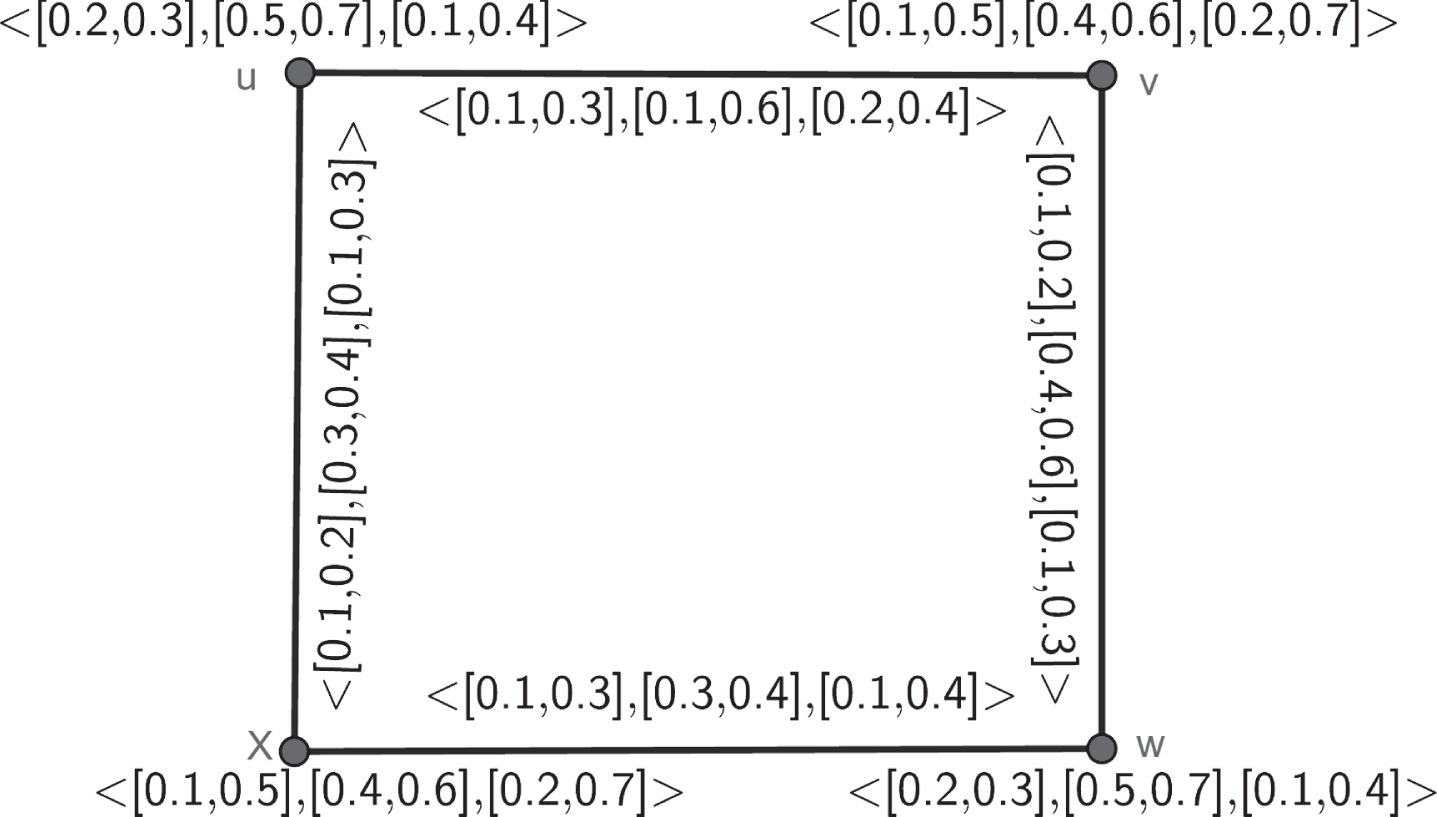
Example 4.6. Let us consider an m-PIVFG G = (V, A, B) (Fig. 6), where
Neighborly irregular but not neighborly total irregular 3-PIVFG G.
Here, deg (b)= deg (c) but deg [b]=deg [c]. That means two adjacent vertices b and c have same closed neighborhood degree. Thus, G is neighborly irregular but not neighborly total irregular.
Theorem 4.3.If an m-PIVFG G is neighborly irregular m-PIVFG and is a constant map, then it is neighborly totally irregular m-PIVFG.
Proof. Let G be a neighborly irregular m-PIVFG. Then, the open neighborhood degrees of every two adjacent vertices are distinct. Let x, y ∈ V be adjacent vertices with distinct open neighborhood degrees, i.e., deg (x) = ([s1, t1] , [s2, t2] , ⋯ , [sm, tm]) and deg (y) = ([k1, l1] , [k2, l2] , ⋯ , [km, lm]), where s + i ≠ ti and ki ≠ li. Let pi ∘ μl (x) = c1 and pi ∘ μu (x) = c2. Since is constant function, and . Similarly, and . Now let us claim that and . Consider or, si + c1 = ki + c1 or, si = ki, for all i = 1, 2, ⋯ , m. This contradicts the fact that si ≠ ki or . Similarly for or, ti + c2 = li + c2 or, ti = li, for all i = 1, 2, ⋯ , m. Which contradicts the fact that ti ≠ li or, . Thus, G is a highly totally irregular m-PIVFG.
Free node and busy node
In this section, some definitions of free nodes and busy nodes of m-PIVFG are defined and demonstrated with the help of suitable examples. Some theorems related to these are proposed.
Definition 5.1. A node x of an m-PIVFG is called l-busy node if , ∀i otherwise the node x is said to be l-free node.
Similarly, a node x of an m-PIVFG is said to be u-busy node if , ∀i otherwise the node x is called u-free node.
Definition 5.2. A node x of an m-PIVFG G = (V, A, B) is said to be
l-partial free node if it is l-free node in both G and .
l-fully free node if it l-free node in G but it is a l-busy node in .
l-partial busy node if it is a l-busy node in both G and .
l-fully busy node if it l-busy node in G but it is a l-free node in .
Definition 5.3. A node x of an m-PIVFG G = (V, A, B) is said to be
u-partial free node if it is u-free node in both G and .
u-fully free node if it u-free node in G but it is a u-busy node in .
u-partial busy node if it is a u-busy node in both G and .
u-fully busy node if it u-busy node in G but it is a u-free node in .
Example 5.1. Let us consider an m-PIVFG (Fig. 7) where,
.
Therefore,
Where, represents vertices of . Hence, node a is l-busy node in both G and . Thus, a is l-partial busy node. And, also node a is u-busy node in both G and . Thus a is u-partial busy node. Similarly,
Therefore,
Hence, node b is l-busy node in both G and . Thus, b is l-partial busy node. And, also node b is u-busy node in G and u-free node in . Thus, b is u-fully busy node.
Similarly,
Therefore,
Hence, node c is l-free node in G and l-busy node in . Thus, c is l-fully free node. And, also node c is u-busy node in both G and . Thus, c is u-partial busy node.
Similarly,
Therefore,
Hence, the node d is l-busy in the graph G and its complement, i.e., d is l-partial busy node. Also the node d is u-busy node in the graph G and its complement. Thus, d is u-partial busy node.
Definition 5.4. An edge (x, y) of an m-PIVFG is known as an effective edge if pi ∘ μl (xy) = min {pi ∘ μl (x) , pi ∘ μl (y)} and pi ∘ μu (xy) = min {pi ∘ μu (x) , pi ∘ μu (y)}, ∀i = 1, 2, ⋯ m.
Theorem 5.1.If an m-PIVFG has some effective edges, then it has atleast one l-busy node and one u-busy node.
Proof. Assume that G = (V, A, B) be an m-PIVFG, has a few effective edges. Let (x, y) be an effective edge of G. Without loss of generality, we consider that pi ∘ μl (x) ≤ pi ∘ μl (y), ∀i. Then, clearly , ∀i. Therefore, l is busy node. Similarly, for pi ∘ μu (x) ≤ pi ∘ μu (y), ∀i i.e , ∀i. Hence, u is also a busy node.
Theorem 5.2.If a complete m-PIVFG has n-nodes with n > 1 then it has atleast (n - 1) l-fully busy node and nu-fully busy nodes.
Proof. Let G be an m-PIVFG with n-nodes. Also let G be complete m-PIVFG. Let us consider the nodes as x1, x2, x3, ⋯ xn such that, pi ∘ μl (x1) ≥ pi ∘ μl (x2) ≥ pi ∘ μl (x3) ≥ ⋯ ≥ pi ∘ μl (xn).
Thereafter, let for i = 1, . In general, , From the above equations it conclude that . Also for i = 1, 2, ⋯ , m we can similarly conclude that . Therefore, there exists atleast (n - 1) l-busy nodes in G. Since, G is complete m-PIVFG therefore contains only isolated nodes, therefore it has (n - 1) l-free nodes. Hence, there exists at least (n - 1) l-fully busy nodes in a complete m-PIVFG. Again let us consider the nodes as x1, x2, x3, ⋯ xn such that, pi ∘ μu (x1) ≥ pi ∘ μu (x2) ≥ pi ∘ μu (x3) ≥ ⋯ ≥ pi ∘ μu (xn). Henceforth, let for i = 1, . In general, , . From the above equations it conclude that for k = 1, 2, ⋯ , n . Also for i = 1, 2, ⋯ , m, we can similarly conclude that for k = 1, 2, ⋯ , n. Therefore, there exists nu-busy nodes in G. Since, G is complete G-PIVFG therefore contains only isolated nodes, therefore it has nu-free nodes. Hence, there exists nu-fully busy nodes in a complete m-PIVFG.
Application
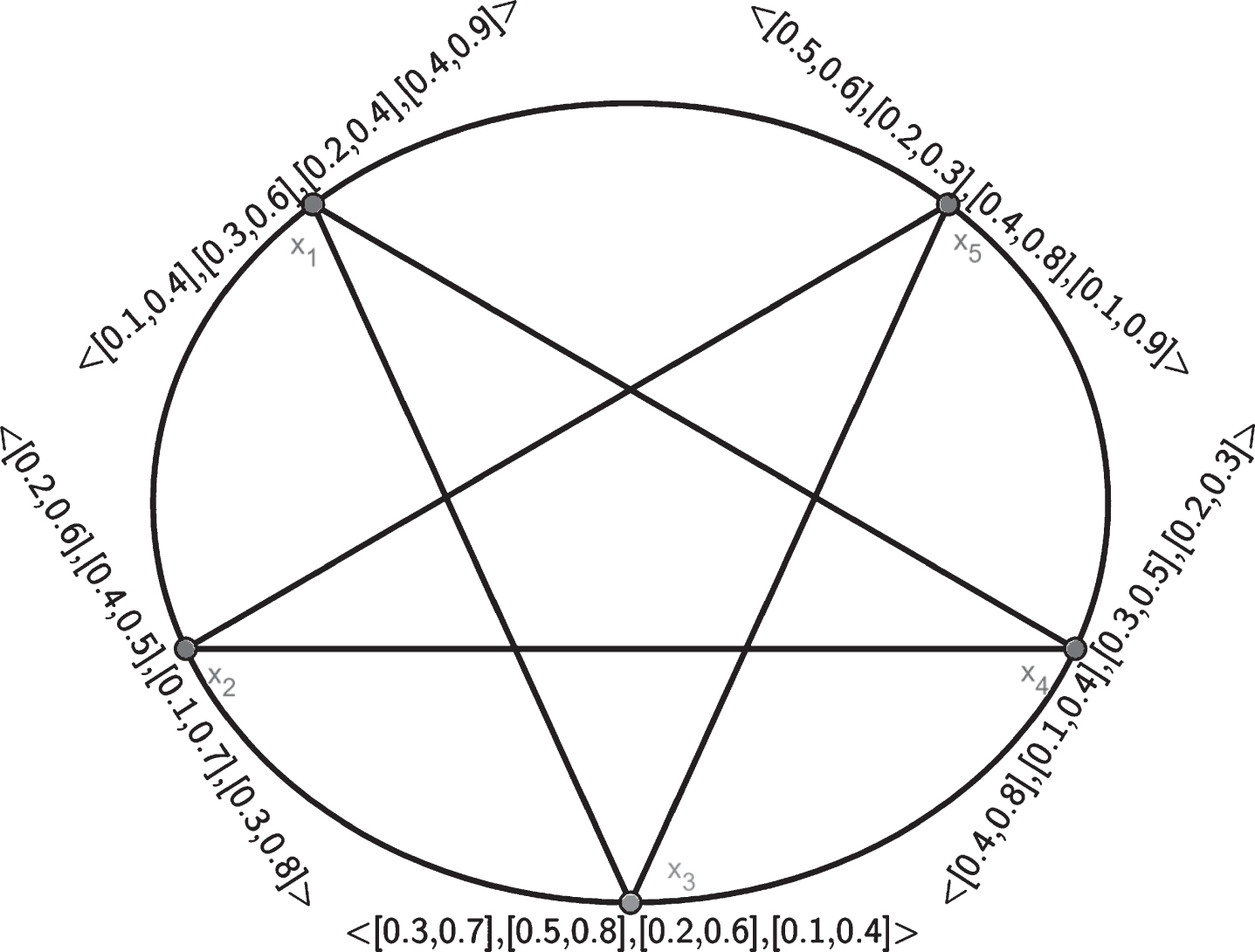
In recent days fuzzy graphs have wide range of applications in computer networks, social networks, robotics, medical diagnosis, engineering field and so on. That is, where there is a case of uncertainties that means in a decision making problem IVFG and m-PIVFG are used to simplify that type of problems. Our proposed idea m-PIVFG has more advantages than that of these two type of networks IVFGs and m-PIVFGs. This type of network allows to assign membership values in the form of an interval [0, 1]. Henceforth this types of network is used to various real life problems in multipolar decision making problems. Here we consider a case when a customer want to buy a mobile from a well-known company within a certain amount. Herein, different companies Samsung (x1), Apple (x2), Huawei (x3), Oppo (x4) and Xiaomi (x5) are taken as different nodes. An edge is drawn between any two nodes if there is a m-polar fuzzy relation between them. The customer prefers some different features such as operating system, internal memory/RAM, camera quality, high demand/rating which are taken as pole (pi) of every companies (Fig. 9). These features are taken as poles of every companies. Here the membership value of each pole indicates the interval of preference depending on these qualities. That means among these companies one may have top operating system, average memory, good camera quality and may be in high demand and so on within his range. Thus this is a multivalued information between any two companies which is judged in some interval in [0, 1]. This type of decision making problem is an real life example of our proposed structure of m-PIVFG.
A 4-PIVFG G.
Membership value for each edge is given by Table 2.
Membership value assigned to each pole(pi) of each edge.
Edges
p1
p2
p3
p4
x1x2
[0.1,0.4]
[0.3,0.5]
[0.1,0.4]
[0.3,0.8]
x1x3
[0.1,0.4]
[0.3,0.5]
[0.1,0.4]
[0.3,0.8]
x1x4
[0.1,0.4]
[0.3,0.5]
[0.1,0.4]
[0.3,0.8]
x1x5
[0.1,0.4]
[0.3,0.5]
[0.1,0.4]
[0.3,0.8]
x2x3
[0.1,0.4]
[0.3,0.5]
[0.1,0.4]
[0.3,0.8]
x2x4
[0.1,0.4]
[0.3,0.5]
[0.1,0.4]
[0.3,0.8]
x2x5
[0.1,0.4]
[0.3,0.5]
[0.1,0.4]
[0.3,0.8]
x3x4
[0.1,0.4]
[0.3,0.5]
[0.1,0.4]
[0.3,0.8]
x3x5
[0.1,0.4]
[0.3,0.5]
[0.1,0.4]
[0.3,0.8]
x4x5
[0.1,0.4]
[0.3,0.5]
[0.1,0.4]
[0.3,0.8]
Comparing these features among all these companies we have taken a weight operator for each pole pi and for each j = 1, 2, 3, 4, 5. Thus for each pole we are calculating weight for each companies accordingly. Hence, for first pole (that means for operating system), , similarly w (x2)=0.7, w (x3)=0.7, w (x4)=0.7, w (x5)=0.55. Thus for second pole (that means for internal memory), w (x1)=0.65, w (x2)=0.55, w (x3)=0.65, w (x4)=0.65, w (x5)=0.55. Thus for third pole (that means for camera quality), w (x1)=0.6, w (x2)=0.8, w (x3)=0.7, w (x4)=0.6, w (x5)=0.7. Thus for fourth pole (that means for demand/rating), w (x1)=0.75, w (x2)=0.75, w (x3)=0.65, w (x4)=0.55, w (x5)=0.9. Depending on these weight we calculate a ranking table (shown in Table 3).
Rank (Ri) allotted to each company
Features
R1
R2
R3
R4
R5
p1
x2x3 & x4
x1
x5
p2
x1x3 & x4
x2 & x5
p3
x2
x3 & x5
x1 & x4
p4
x5
x1 & x2
x3
x4
Depending on these features, suppose ri be the preference of feature i for rank Ri. Obviously ri > rj for i < j and r1 = 5, r2 = 4, r3 = 3, r4 = 2 and r5 = 1. Thus the combined preference score is given by the formula (such as for x1, S1 = r2 + r1 + r3 + r2 = 4 +5 + 3 +4 = 16). Therefore, the preferences of all mobile companies are calculated in Table 4.
Preference of all mobile
Candidate
Score
Samsung
16
Apple
18
Huawei
17
Oppo
15
Xiaomi
16
Hence, he can buy a mobile from Apple company with all these better features. It is very necessary for a person to take an appropriate decision to select a company’s mobile so that he can buy a better mobile with all these features. This type of multipolar determination is an example of decision making problem which is also suitable example of m-PIVFG.
Conclusion and future research direction
IVFGs and m-PFGs being viewed as generalizations of fuzzy and bi-polar fuzzy graphs respectively. In this article, we introduce m-PIVFG and its complements are illustrated through examples. We also explain the definition of neighbourhood degrees, closed neighbourhood degrees of m-PIVFG with proper examples. Also, we have stated balanced m-PIVFG, regularity in m-PIVFG and density and some properties related to regularity of m-PIVFG and balanced m-PIVFG. We also explain irregularity in m-PIVFG and some properties regarding itself. Free nodes and busy nodes in m-PIVFG are also discussed with supporting examples and theorems. In future, we shall investigate other results of m-PIVFG and extend them to solve various decision making problems under fuzzy environment.
Footnotes
Acknowledgment
The authors are cordially thankful to the Editor-in-Chief, Professor Reza Langari, the area Editor and all the anonymous reviewers for their constructive comments which led to strongly improve the quality of the paper.
References
1.
KaufmannA., Introduction to the theory of fuzzy subsets, 1975.
2.
RosenfeldA., Fuzzy graphs, in Fuzzy sets and their applications to cognitive and decision processes, (1975), pp. 77–95, Elsevier.
3.
ZhangW.-R., Bipolar fuzzy sets and relations: a computational framework for cognitive modeling and multiagent decision analysis, in NAFIPS/IFIS/NASA’94. Proceedings of the First International Joint Conference of The North American Fuzzy Information Processing Society Biannual Conference. The Industrial Fuzzy Control and Intellige, (1994), pp. 305–309, IEEE.
4.
ZhangW.-R., Bipolar fuzzy sets, in 1998 IEEE International Conference on Fuzzy Systems Proceedings. IEEE World Congress on Computational Intelligence (Cat. No. 98CH36228)1 (1998), pp. 835–840, IEEE.
5.
MordesonJ.N. and Chang-ShyhP., Operations on fuzzy graphs, Information Sciences79(3-4) (1994), 159–170.
6.
MordesonJ.N. and NairP.S., Cycles and cocycles of fuzzy graphs, Information Sciences90(1-4) (1996), 39–49.
7.
MordesonJ.N. and NairP.S., Applications of fuzzy graphs, in Fuzzy Graphs and Fuzzy Hypergraphs, (2000), pp. 83–133, Springer.
8.
SunithaM., Studies on fuzzy graphs, Depart of mathematics Cochin university of Science and Technology Cochin, India, 2001.
9.
SunithaM. and VijayakumarA., Complement of a fuzzy graph, Indian Journal of Pure and Applied Mathematics33(9) (2002), 1451–1464.
10.
NagoorganiA. and ChandrasekaranV., Free nodes and busy nodes of a fuzzy graph, East Asian Mathematical Journal22(2) (2006), 163–170.
11.
ShannonA. and AtanassovK., On a generalization of intuitionistic fuzzy graphs, Notes on Intuitionistic Fuzzy Sets12(1) (2006), 24–29.
12.
NagoorganiA. and RadhaK., On regular fuzzy graphs, Journal of Physical Sciences12 (2008), 33–40.
13.
HongmeiJ. and LianhuaW., Interval-valued fuzzy subsemi-groups and subgroups associated by interval-valued fuzzy graphs, in 2009 WRI global congress on intelligent systems1 (2009), 484–487, IEEE.
14.
AkramM. and DudekW.A., Interval-valued fuzzy graphs, Computers & Mathematics with Applications61(2) (2011), 289–299.
15.
RashmanlouH., PalM., BorzooeiR.A., MofidnakhaeiF. and SarkarB., Product of interval-valued fuzzy graphs and degree, Journal of Intelligent & Fuzzy Systems, no. Preprint, (2018), pp. 1–9.
16.
Al-HawaryT., Complete fuzzy graphs, International J Math Combin4 (2011), 26–34.
17.
NagoorganiA. and MalarvizhiJ., Isomorphism on fuzzy graphs, International Journal of Computational and Mathematical Sciences2(4) (2008), 190–196.
18.
NagoorganiA. and MalarvizhiJ., Isomorphism properties on strong fuzzy graphs, International Journal of Algorithms, Computing and Mathematics2(1) (2009), 39–47.
19.
AkramM., Bipolar fuzzy graphs, Information Sciences181(24) (2011), 5548–5564.
20.
AkramM., Bipolar fuzzy graphs with applications, Knowledge-Based Systems39 (2013), 1–8.
21.
ChenJ., LiS., MaS. and WangX., m-polar fuzzy sets: an extension of bipolar fuzzy sets, The Scientific World Journal2014, 2014.
22.
RashmanlouH., SamantaS., PalM. and BorzooeiR., Bipolar fuzzy graphs with categorical properties, International Journal of Computational Intelligence Systems8 (2015), 808–818.
23.
SamantaS. and PalM., Fuzzy tolerance graphs, International Journal of Latest Trends in Mathematics1(2) (2011), 57–67.
24.
SamantaS. and PalM., Fuzzy threshold graphs, CIIT International Journal of Fuzzy Systems3(12) (2011), 360–364.
25.
SamantaS. and PalM., Fuzzy k-competition graphs and p-competition fuzzy graphs, Fuzzy Information and Engineering5(2) (2013), 191–204.
26.
SamantaS. and PalM., Fuzzy planar graphs, IEEE Transactions on Fuzzy Systems23(6) (2015), 1936–1942.
27.
TalebiA. and RashmanlouH., Isomorphism on interval-valued fuzzy graphs, Annals of Fuzzy Mathematics and Informatics6(1) (2013), 47–58.
28.
GhoraiG. and PalM., Some properties of m-polar fuzzy graphs, Pacific Science Review A: Natural Science and Engineering18(1) (2016), 38–46.
29.
GhoraiG. and PalM., Some isomorphic properties of m-polar fuzzy graphs with applications, SpringerPlus5(1) (2016), 2104.
30.
GhoraiG. and PalM., On some operations and density of m-polar fuzzy graphs, Pacific Science Review A: Natural Science and Engineering17(1) (2015), 14–22.
31.
RautS., PalM. and GhoraiG., Fuzzy permutation graph and its complements, Journal of Intelligent & Fuzzy Systems, no. Preprint, (2018), pp. 1–15.
32.
PramanikT., PalM., MondalS. and SamantaS., A study on bipolar fuzzy planar graph and its application in image shrinking, Journal of Intelligent & Fuzzy Systems34(3) (2018), 1863–1874.
33.
BinuM., MathewS. and MordesonJ.N., Connectivity index of a fuzzy graph and its application to human trafficking, Fuzzy Sets and Systems360 (2019), 117–136.
34.
JanaC., PalM. and WangJ.-Q., Bipolar fuzzy dombi aggregation operators and its application in multiple-attribute decision-making process, Journal of Ambient Intelligence and Humanized Computing10(9) (2019), 3533–3549.
35.
AkramM. and SarwarM., Novel applications of m-polar fuzzy competition graphs in decision support system, Neural Computing and Applications30(10) (2018), 3145–3165.
36.
GhoraiG. and PalM., Regular product vague graphs and product vague line graphs, Cogent Mathematics3(1) (2016), 1213214.
37.
GhoraiG. and PalM., A note on regular bipolar fuzzy graphs neural computing and applications21(1) (2012), 197–205, Neural Computing and Applications30(5) (2018), 1569–1572.
38.
GhoraiG. and PalM., On degrees of m-polar fuzzy graphs with application, Journal of Uncertain Systems11(4) (2017), 294–305.
39.
GhoraiG. and PalM., Applications of bipolar fuzzy sets in interval graphs, TWMS Journal of Applied and Engineering Mathematics8(2) (2018), 411.
40.
Abdul-JabbarN., NaoomJ. and OudaE., Fuzzy dual graph, Journal of Al-Nahrain University12(4) (2009), 168–171.
41.
SahooS. and PalM., Intuitionistic fuzzy competition graphs, Journal of Applied Mathematics and Computing52(1-2) (2016), 37–57.
42.
AmanathullaS., SahooS. and PalM., L (3, 1, 1)-labeling numbers of square of paths, complete graphs and complete bipartite graphs, Journal of Intelligent & Fuzzy Systems, no. Preprint, (2019), pp. 1–9.
43.
ZadehL.A., Fuzzy sets, Information and Control8(3) (1965), 338–353.
44.
GhoraiG. and PalM., A study on m-polar fuzzy planar graphs, International Journal of Computing Science and Mathematics7(3) (2016), 283–292.
45.
GorzalczanyM.B., A method of inference in approximate reasoning based on interval-valued fuzzy sets, Fuzzy Sets and Systems21(1) (1987), 1–17.