



Abstract
The polygonal fuzzy set is an effective tool to express a class of fuzzy information with the help of finite ordered real numbers. It can not only guarantee the closeness of arithmetic operation of the polygonal fuzzy sets, but also has good linearity and intuitiveness. Firstly, the concept of the n-intuitionistic polygonal fuzzy set (n-IPFS) is proposed based on the intuitionistic fuzzy set and the polygonal fuzzy set. The ordered representation and arithmetic operation of n-IPFS are given by an example. Secondly, a new aggregation method for multi attribute fuzzy information is given based on the n-IPFS operations and the weighted arithmetic average operator, and the ranking criteria of n-IPFS are obtained by using the score function and the accuracy function. Finally, a new group decision making method is proposed for urban residents to choose the livable city problem based on the decision matrix of the n-IPFS, and the effectiveness of the proposed method is explained by an actual example.
Keywords
Introduction
At present, most cities in China begin to attach importance to the construction of livable cities, and the evaluation of livable cities can provide a reference for the development of a city. However, so far there is no unified standard for the comprehensive evaluation of livable cities. This has to attract the attention of many scholars all over the world. See [1–3]. With the continuous improvement of the modern living standard, people are becoming more and more demanding for the living environment. The choice of livable cities has also become a hot issue in the field of urban scientific research, which naturally has turned into a focus problem of concern of national government and urban residents. Generally, the comprehensive evaluation of a livable city mainly focuses on the characteristics of many attributes, such as, environmental beauty, social security, comfortable life, economic development and climate suitability. In recent years, the evaluation for a multi-attribute livable city is gradually moving towards specialization and model, such as Tang and Zhang [4] establishes an evaluation system of ecological city health indicators with ideal solution and grey correlation degree. See Ref. [5].
In 1986, Prof. Atanassov [6] first proposed the concept of the intuitionistic fuzzy set (IFS), and added the concept of non membership while describing the membership degree of things. Later, he also put forward the concept of interval IFS [7]. These basic concepts have attracted the attention of many scholars, especially in the field of decision science. Many new methods and technologies were brought out. The main achievements in this field are attributed to the problems of multi-attribute decision making (MADM) and multi-attribute group decision making (MAGDM). In 2000, Szmidt et al. [8] emphasized that the third index “hesitation” of intuitionistic fuzzy information should not be ignored when introducing intuitionistic fuzzy distance, and proposed the concept of similarity measure to describe intuitionistic fuzzy decision information. Xu et al. [9] established a linear programming model by defining intuitionistic judgment matrix and score matrix, studied the decision-making approach of
MADM based on intuitionistic fuzzy preference information, and proposed MAGDM method according to multiple aggregation operators. See [10]. In 2010, Wei [11] defined the expected value and score function of the intuitionistic trapezoid fuzzy number (ITFN) based on weighted arithmetic average operator. Wan et al. [12] put forward a MAGDM method through ITFN and interval ITFS, respectively. See [13]. In 2012, Wang et al. [14] gave a new calculation formula of score function and accuracy function the concepts of ITFN, and the method of aggregation operators are applied into the group decision making problems and a solution method is developed. See [15, 16]. In addition, other scholars have proposed some generalized intuitionistic fuzzy sets. See [17–20].
In 2017, Yu et al. [21] gave the gain and loss formula of balanced high-frequency LTS under the condition that the decision-makers were in a state of hesitation, and the proposed method dealt with the multi-objective group decision-making problem of unbalanced HFLTSs, and then extended the traditional TODIM method to MCGDM method. See [22, 23]. In addition, Zhang et al. [24] discussed the relationship between IMPR and standardized intuitionistic multiplication weight vector through linear programming theory, and proposed group decision-making methods of complete and incomplete IMPR. In 1991, Hwang and Yoon first proposed the TOPSIS (Technique for order preference by similarity to an ideal solution) decision-making model for multi-attribute information in [25]. Their main idea is to deal with MADM problems by ranking the relative closeness of positive (negative) ideal solutions. This method has been widely concerned and adopted by many scholars, and many research results have been achieved. See [26–28]. These excellent results provide theoretical basis and application potential for decision makers from different perspectives.
Unfortunately, some arithmetic operations of fuzzy sets based on the Zadeh’s extension principle does not satisfy the closeness, which brings many troubles to the application of fuzzy numbers (or sets), so people often discuss the problem with the special case of triangle or trapezoid fuzzy number. But this usually causes a lot of useful information to be lost. In order to overcome the complexity and non closure of general fuzzy set operation, Liu [29] first introduced the concept of symmetric polygonal fuzzy number and its arithmetic operation in 2002, and applied them to the construction and modeling of a neural network. In 2016, Duan [30] gave a FCM clustering algorithm for multi index information based on the concept of the polygonal fuzzy set. Later, an isolation layering algorithm was also put forward. See [31]. In 2018, Wang [32] proposed n-intuitionistic polygonal fuzzy sets (n-IPFS) by combining intuitionistic fuzzy sets and polygonal fuzzy sets, and gave a new TOPSIS method of multi-attribute decision-making through its ordered representation of n-IPFS. The application of these polygonal fuzzy numbers (or sets) makes us think about how to extend their practical scope.
At present, the scientific evaluation standards of livable cities in China are mainly based on GDP growth, social civilization, economic prosperity, beautiful environment, resource allocation and public security. However, people’s satisfaction with some indicators of urban construction payment does not change completely according to linear function, but changes slowly according to a smooth curve state with the increase or decrease of residents’ income. For example, taking the “beautiful environment” as an example, once the investment in environmental construction is reduced, although the cost of living will be reduced, but the livability will become poor, the residents can not be satisfied. If the environmental construction is improved, the livability will become stronger, but the cost of living will increase, the satisfaction will still reduce. This requires a smooth curve (such as parabola membership function or Gauss membership function) to describe residents’ satisfaction with livable environment. In this case, if we blindly use the trapezoid (or triangle) fuzzy numbers or interval trapezoid fuzzy numbers (or set) to deal with this problem, it will be very inappropriate.
Up to now, no one else has used the ordered representation of the n-IPFS to describe or aggregate multi-attribute information of a modern livable city. In this paper, we choose the orderly representation of n-IPFS to give a group decision-making method of modern livable cities, which main motivation is based on the following two reasons: On the one hand, it is more reasonable and practical to choose a smooth Gauss membership function to describe multi-attribute information of livable city, and it is more easier to express the index information of livable city by the order representation of n-IPFS. On the other hand, the n-IPFS of the Gauss membership function can be used to directly weight and aggregate multiple index information, and its operation is simple and practical, so as to establish a more perfect evaluation system of urban diversified development.
This paper is organized as follows: In Section 2, the concept of the n-IPFS and its arithmetic operations are introduced, and the ordered representation of an n-IPFS is given by an example. In Section 3, multiple n-IPFS are aggregated through the weighted arithmetic average (WAA) operator, and a comprehensive ranking rule of the n-IPFS is given by the score function or accuracy function. In Section 4, a decision making model is established through the practical problems of residents choosing livable cities, and a group decision making method for residents to choose livable cities is given by a decision matrix. In Section 5, an example is given to illustrate the effectiveness of the proposed group decision method.
n-Intuitionistic polygonal fuzzy set
As we all know, an intuitionistic fuzzy sets are not only a generalization of ordinary fuzzy sets, but also can describe fuzzy phenomena more comprehensively from three aspects. In general, a traditional intuitionistic fuzzy set A are represented as A = { 〈x, μ A (x) , υ A (x) 〉|0 ⩽ μ A (x) + υ A (x) ⩽1, x ∈ X},
Let
Its geometric meaning is shown as in Fig. 1 below.
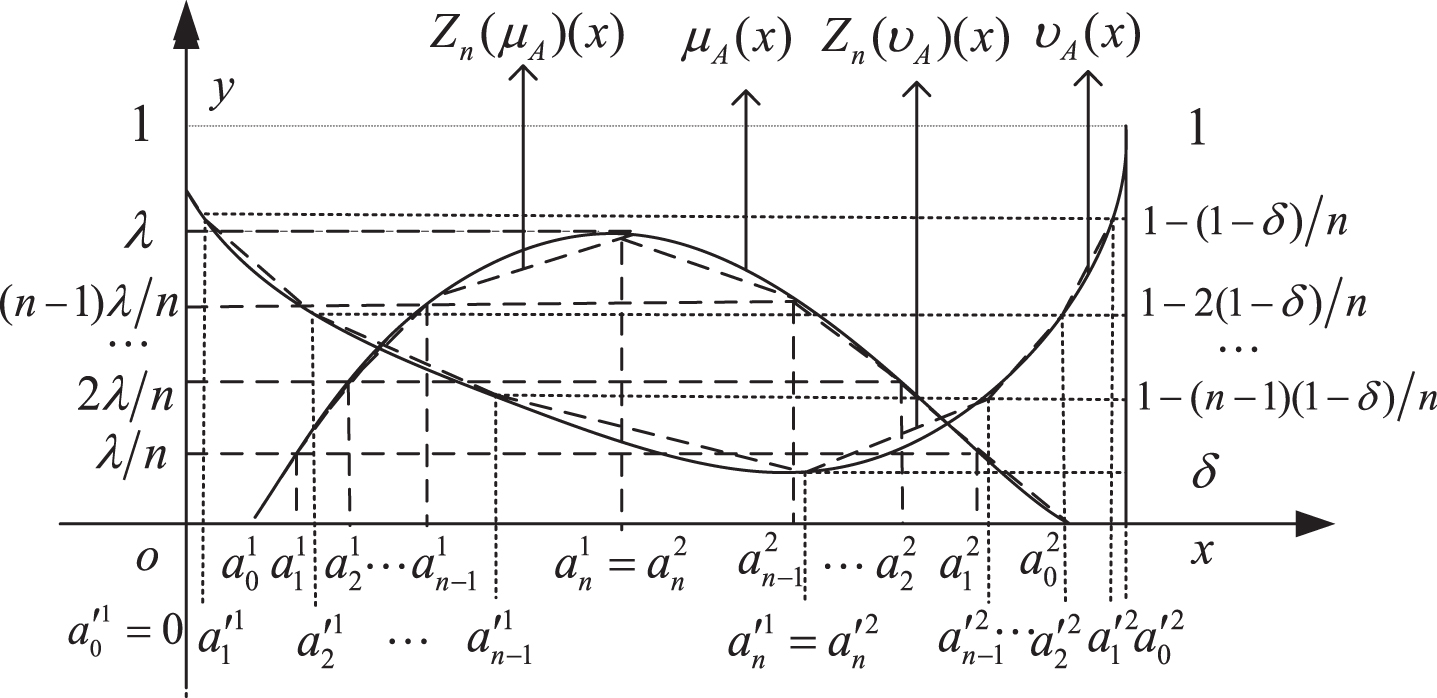
Sketch map of n-equidistance division of μ A (x)(or υ A (x)).
Similarly, for the non-membership function υ
A
(x), the closed interval [δ, 1] on the y-axis can be divided into n- subintervals equally, the points of division are x
i
= δ + i (1 - δ)/n, i = 0, 1, 2, ·· · , n. If there are 2n + 2 orderly real numbers
Let Z
n
(μ
A
)
In addition, let
Then ||Z n (μ A ) || is called an n-norm on the membership fuzzy set μ A , ||Z n (υ A ) || is called an n-norm on the non-membership fuzzy set υ A .
In fact, an n-IPFS can express the diversity and complexity of things more comprehensively. So it can play an important role in practical problems. Ref. [25] only considers an equidistance division of [0, λ] and [δ, 1] in special cases (). However, it is difficult to satisfy such special cases in practical problems. Therefore, the concept of the n-IPFS and its ordered representation proposed in this paper are more general.
Next, we take an example to illustrate how to transform an intuitionistic fuzzy set into concrete n-IPFS and its ordered representation.
In the case of n = 3, what is the ordered representation of the membership fuzzy set μ A , the non-membership fuzzy set υ A and the intuitionistic fuzzy set A?
Clearly, Supp(μ A ) = [1, 5], Ker(μ A ) = {3}; Supp(υ A ) = [0, 6], Ker(υ A ) = {2}. See Fig. 2.
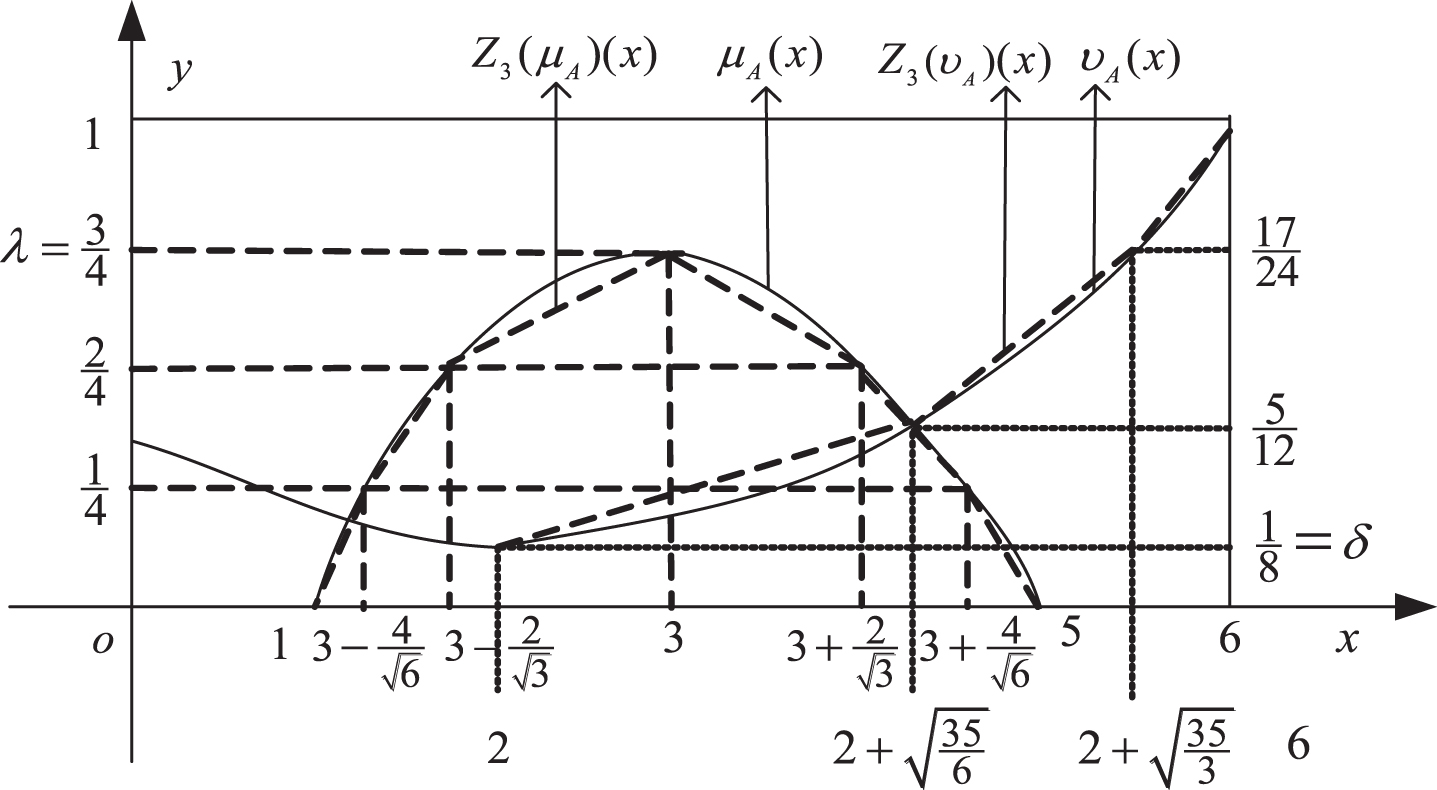
Sketch map of the equidistance division of μ A (x)(or υ A (x)) when n = 3.
Let n = 3, then the maximum membership degree λ = 3/ - 4, the closed interval [0, 3/ - 4] can divided into three equal parts, and the width of each small closed interval is 1/ - 3 × 3/ - 4 = 1/ - 4, i.e., the two points λ1 = 1/ - 4 and λ2 = 2/ - 4 are inserted into the closed interval [0, 3/ - 4].
When x ∈ [1, 5], let
So the ordered representation Z3 (μ A ) of 3-PFS of the membership fuzzy set μ A is shown as
Their geometric interpretation and the equidistance division of the fuzzy set μ A are shown in Fig. 4.
On the other hand, Obviously, the minimum membership degree of the non-membership fuzzy set υ A is δ = 1/8, then the closed interval [1/8, 1] is divided into three equal parts, and the width of each small closed interval is 1/3 × (1 - 1/8) = 7/24, then the two points δ1 and δ2 on [1/8, 1] are
That is to say, the δ1 = 5/12 and δ2 = 7/24 are inserted into the closed interval [1/8, 1].
When x ∈ [0, 6], let
Next, in order to better apply the n-IPFS to the decision making problem of choosing a livable city by urban residents, some basic arithmetic operations for the n-IPFS will be given. For this reason, according to the ordered representation of general fuzzy sets, we first give the arithmetic operations of the n-polygonal fuzzy sets as follows:
ω· Z n (A) = 〈 (ωZ n (μ A ) , λ A ) ; (ωZ n (υ A ) , δ A ) 〉, where ω > 0.
In fact, the operations of n-IPFS not only overcome the complexity of the operations of fuzzy sets based on the Zadeh extension principle, but also maintain the linearity and closeness of the operations, which makes the calculation simple and intuitive. This is one of the important reasons for the introduction of the concept of n-IPFS in this paper.
With the increasing application of intuitionistic fuzzy sets, the effective aggregation and processing of fuzzy information are becoming more and more important, and the aggregation operator is a way to integrate fuzzy information. In practical problems, the given fuzzy information needs to be aggregated, and then the ordering rules of the intuitionistic fuzzy sets are given according to the score function and the exact function. Next, we first give the concepts of the weighted arithmetic mean operator and weighted geometric mean operator of the n-IPFS.
Now, we will further give the aggregation method of multiple n-IPFS on the intuitionistic fuzzy set space
Then the aggregation operator is
Therefore, when m = 2 the formula (1) is established.
Now, when m = k is assumed, the above formula (1) is established, then when m = k + 1 is used, according to Definitions 3.1 and 2.3 we can get that
If let
In accordance with the above results we can continue to obtain the following conclusions as follows
Thus, by mathematical induction the formula (1) is established, for all natural numbers
According to Theorem 3.1 and Definition 2.3, it is not difficult to see that the aggregation of multiple n-IPFSs is still an n-IPFS, and the aggregated n-IPFS can still be regarded as the response of the object to the comprehensive information. Actually, a new addition operation is introduced by the n-norm || · || in this aggregation process, and the aggregation formula of the IPF weighted average operator IPF - WAA is obtained by this addition operation. For simplicity, the decision method given in this paper is only applicable to the aggregation of multiple attribute indexes information by addition operator, so as to make an ordering of the n-IPFSs below.
Let,
If E (A) > E (B), then it is called A stronger than B, and is simply called A > B; If E (A) = E (B), and satisfies S (A) > S (B), it is called A stronger than B, i.e., A > B; If E (A) = E (B), and satisfies S (A) = S (B), it is said that A and B are equal, i.e., A = B.
In fact, the score function E (·) and the accuracy function S (·) in Definition 3.2 are mainly defined by n-norm, the maximum membership degree λ A and the minimum non-membership degree δ A have a common factor (||Z n (μ A ) || + ||Z n (υ A ) ||)/ - 2. In addition, it is not difficult to see from Definition 3.2 that the larger the score function E (A) is, the larger the difference value λ A - δ A is, then the larger λ A or the smaller δ A , and the greater the degree of membership of A. Especially when the two score functions are equal, the greater the accuracy function S (A), the greater the degree of membership of A. Therefore, the E (·) and S (·) can be calculated by Defining 3.2, and then the intuitionistic fuzzy set A and B can be sorted according to Definition 3.3.
By substituting this into the result of Theorem 3.1, we immediately obtain
Then Z n (A-) ⩽ IPF - WAA (Z n (A1) , Z n (A2) , ·· · , Z n (A m )) ⩽ Z n (A+).
Similarly, we can also prove that the aggregation operator IPF–WAA satisfies the monotonicity!
This paper is omitted! We will elaborate in another article.
Next, let’s go back to the core of this article: how do residents choose livable cities? How can we use n-IPFS to describe the multi attribute index information of livable cities in order to establish a decision-making model ? On these two questions we will focus on the next section.
In addition, with the development of artificial intelligence technology, shopping websites and logistics companies are two important parts of a supply chain system. For example, logistics companies carry out comprehensive evaluation and decision-making through five indicators of transport cost, transport efficiency, transport reliability, service attitude and commodity throughput. Because the logistics company is limited by its own scale and operating capacity, if the daily transportation volume is too small, the transportation cost is low, and the profit is low; if the daily transportation volume is too large, the transportation cost increases, and the profit is also large, but the company may exceed its own bearing capacity, even lead to the decline of transportation efficiency. As a whole, the evaluation or decision-making of logistics companies is a process aimed at obtaining the maximum profit. Its main characteristic is that these index information can be set and expressed artificially according to a linear membership function, such as, a trapezoid (or triangle) fuzzy number or interval fuzzy number. In fact, if from the perspective of consumption and profit, it is a reverse process to evaluate logistics companies and residents’ choice of livable cities. The main characteristics of these two decision-making problems are: one is consumption, the other is profit.
As we all know, the higher demand for livable cities is an important manifestation of the improvement of living standards. The economic level, educational level, environmental conditions and convenience of life of a city have an important impact on the comfort of the residents. In recent years, in a questionnaire entitled “what affects the well-being of the people of China”, the level of income, health and social security are in the forefront, the specific data is shown in Fig. 3. In 2017, the top three cities in China’s top 10 livable cities were Qingdao, Kunming and Sanya, respectively, while Dalian, Weihai, Suzhou, Zhuhai, Xiamen and Chongqing ranked fourth to tenth, respectively. This is mainly because Qingdao has the highest index of comprehensive livability evaluation, Kunming has the most comfortable and pleasant natural environment, Sanya has the strongest advantage in air environment and health, Dalian is the most prominent in urban safety and natural environment. The distribution and weight of their main attribute indicators are shown in Figs. 3, 4.
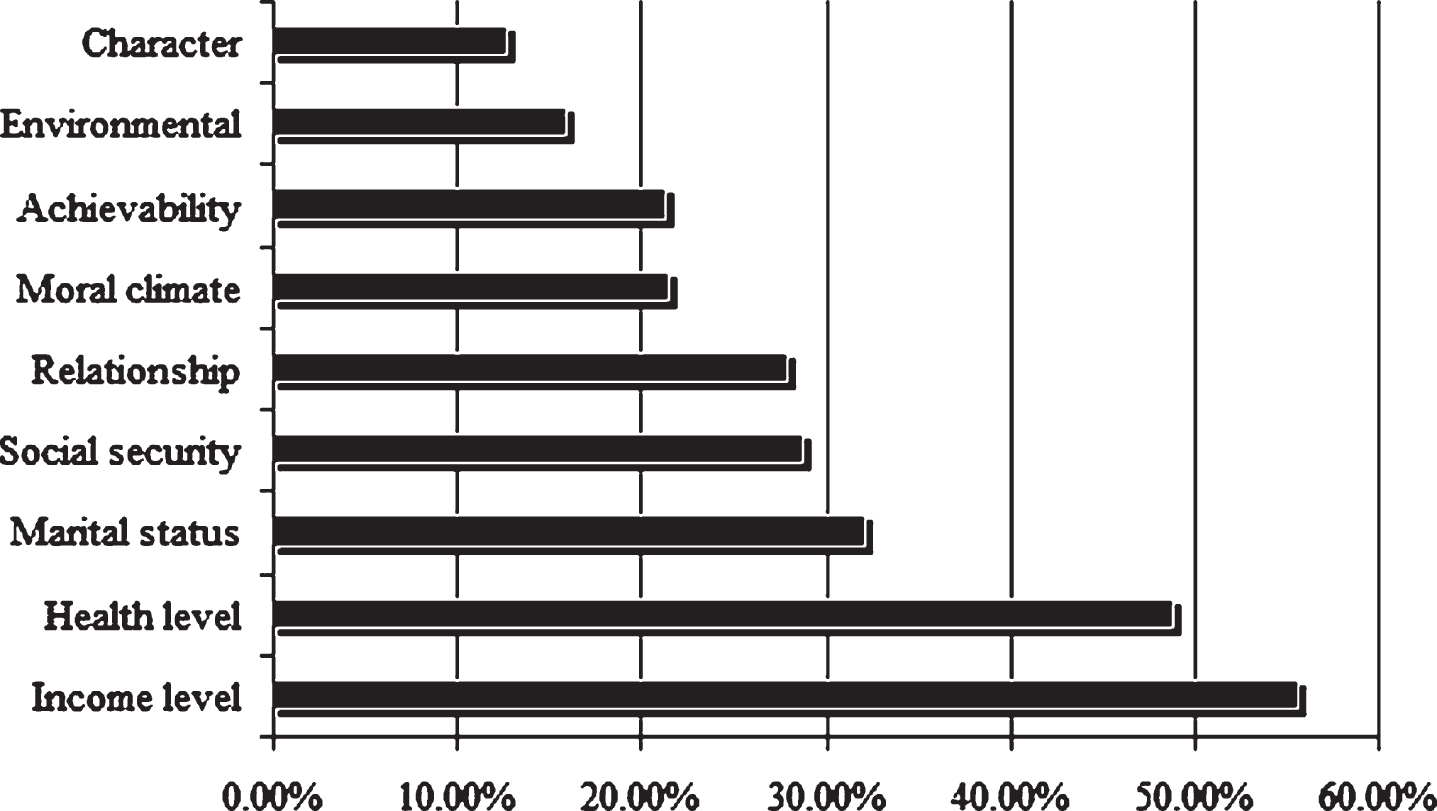
The main attribute indicators that affect happiness of Chinese urban residents.
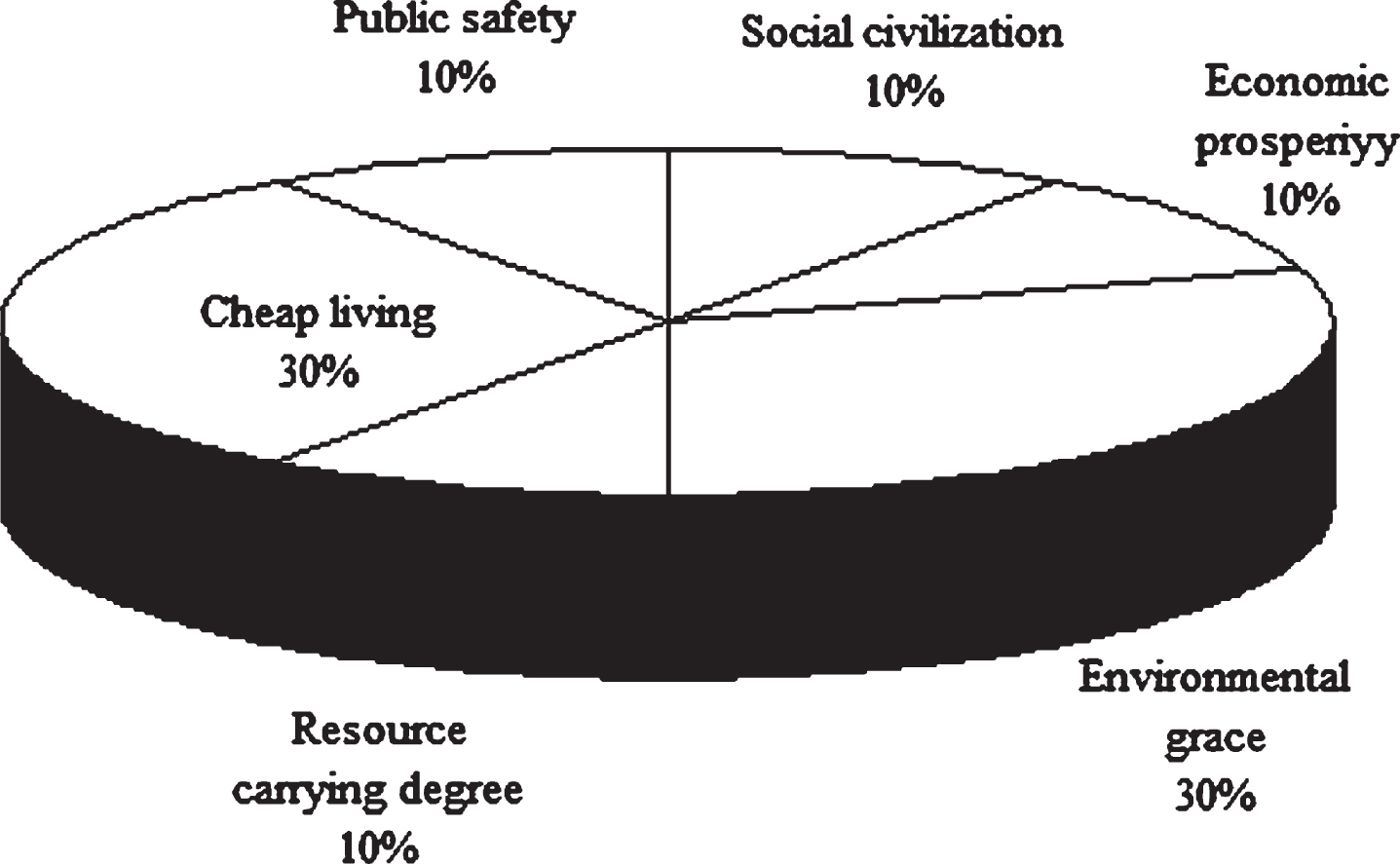
The weight distribution of multi attribute indicators in livable cities.
At present, China’s livable city scientific evaluation standard is mainly from the six indicators of social civilization, economic prosperity, environmental grace, resource carrying degree, cheap living and public safety. The weight of each index is shown in Fig. 4. To describe the beauty of the environment as an example, once the environmental beauty is low, the cost of living will be reduced, the livability will become worse and the residents will not be satisfied. If the environment is high, the livability will become stronger, but the cost of living will increase, even more than the income of the residents, and the residents may not be satisfied. we may use the smooth Gauss function to describe residents’ satisfaction with the beauty of urban environment.
For example, we can utilize Gauss type function μ A (x) = e-6×10⁻⁶(x-500)2 and υ A (x) =1 - e-4×10⁻⁶(x-500)2 to describe the residents’ satisfaction degree and dissatisfaction degree with the urban environmental beauty, respectively. Clearly, μ A (x) and υ A (x) satisfy 0 < μ A (x) + υ A (x) =1 - (e-4×10⁻⁶(x-500)2 - e-6×10⁻⁶(x-500)2) <1, and the intuitionistic fuzzy set A represents “the beautiful environment”. In addition, assuming that the average cost per household is less than 500 RMB/year on the maintenance environment, residents’ satisfaction is reduced with the increase in expenditure, while the dissatisfaction is risen as the cost increases. When the cost reaches 500 RMB/year, its satisfaction is highest and the dissatisfaction is the lowest. When the cost exceeds 500 RMB/year, the satisfaction decreases with the increase of cost, the degree of dissatisfaction will increase with the increase of expenditure. When the expenditure exceeds 1000 RMB /year, satisfaction will be regarded as 0, and dissatisfaction will be regarded as 1. We can intercept a membership function of n-IPFS on Gauss function to approximately express residents’ satisfaction and dissatisfaction. See Figs. 5, 6.
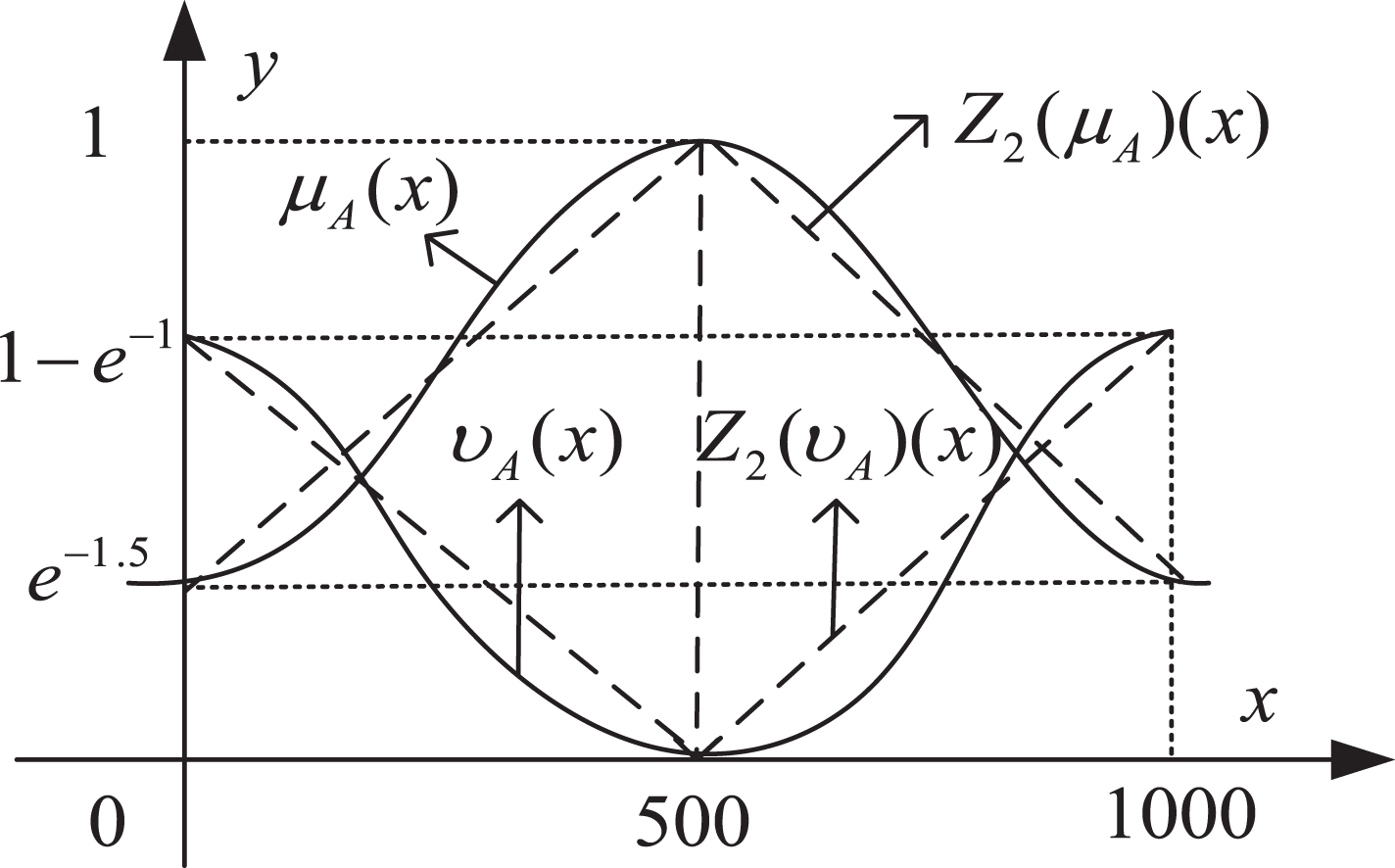
Intercepting IPFS on Gauss functions when n = 1.
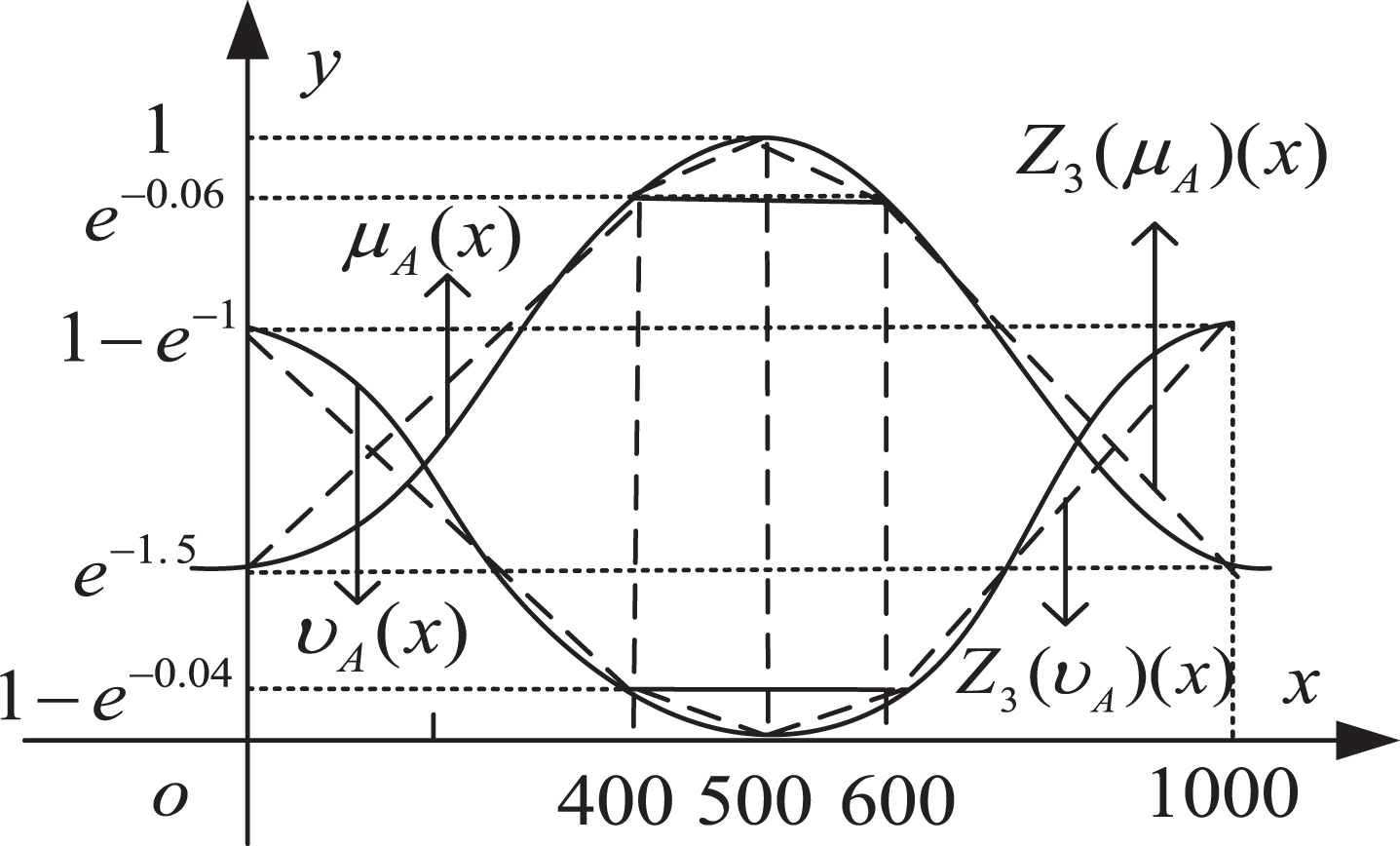
Intercepting IPFS on Gauss functions when n = 2.
In fact, a number of index parameters in a livable city can be described by the intuitionistic fuzzy sets. This is because an intuitionistic fuzzy set can not only describe the fuzzy phenomena from three aspects of affirmation, negation and hesitation, but also it can also solve the problems of digitalization of fuzzy decision, which is more convenient for comparison and calculation. In addition, an n-IPFS is more accurate than an intuitionistic triangular fuzzy set or intuitionistic trapezoid fuzzy set when characterizing multiple index information in livable cities. This is because the n-IPFS superimposed by several trapezoids can describe fuzzy phenomena with 2n + 2 ordered real numbers in more detail. Such as, when n = 3 we can use an array Z3 (μ A ) = (0, 200, 400, 500, 500, 600, 800, 1000) of 8 ordered real numbers to show the satisfaction and dissatisfaction of the residents to the environmental grace. Obviously, the ordered representation of 3-IPFS describes residents’ satisfaction and dissatisfaction with environmental elegance, which is closer to the Gauss type function. As shown in Figs. 7, 8.
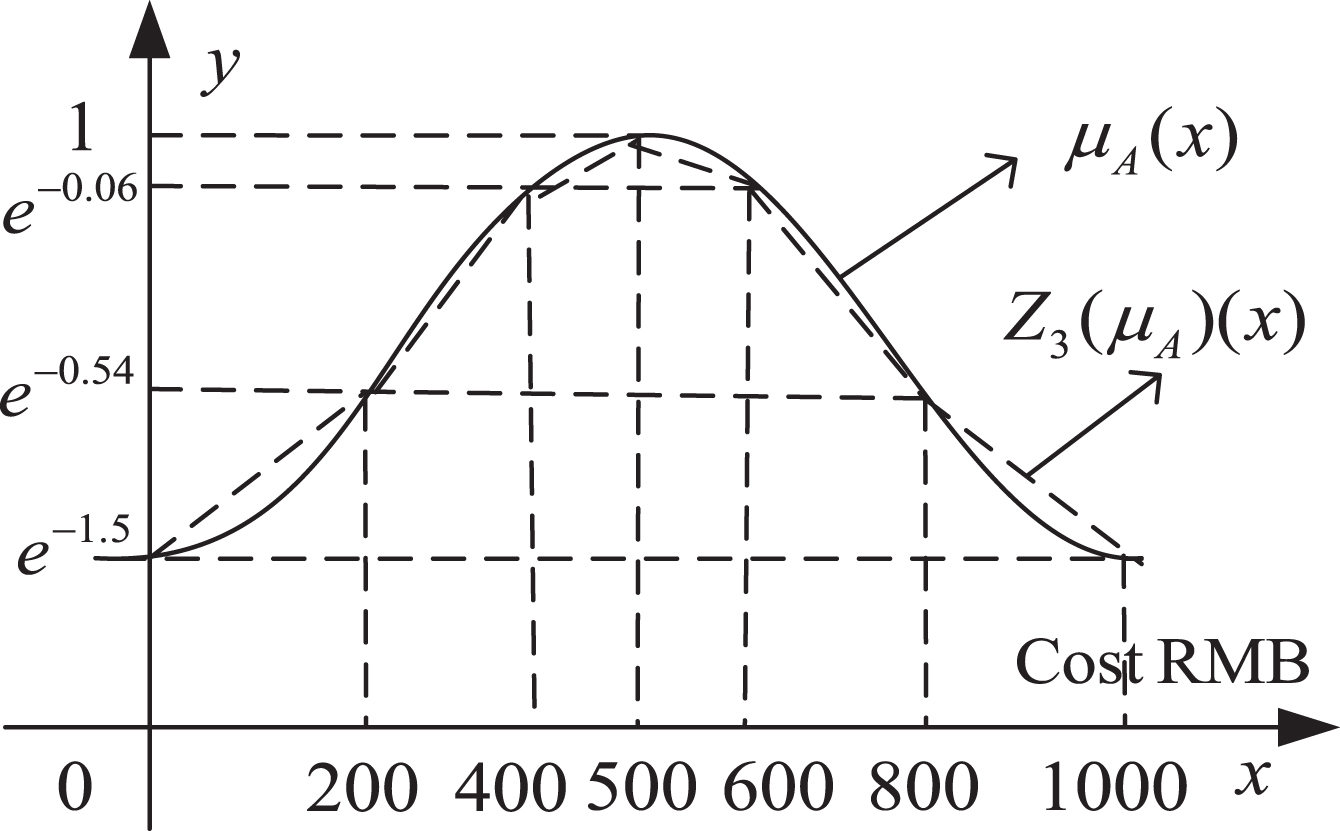
Describing the degree of residents’ satisfaction with Z3 (μ A ) when n = 3.
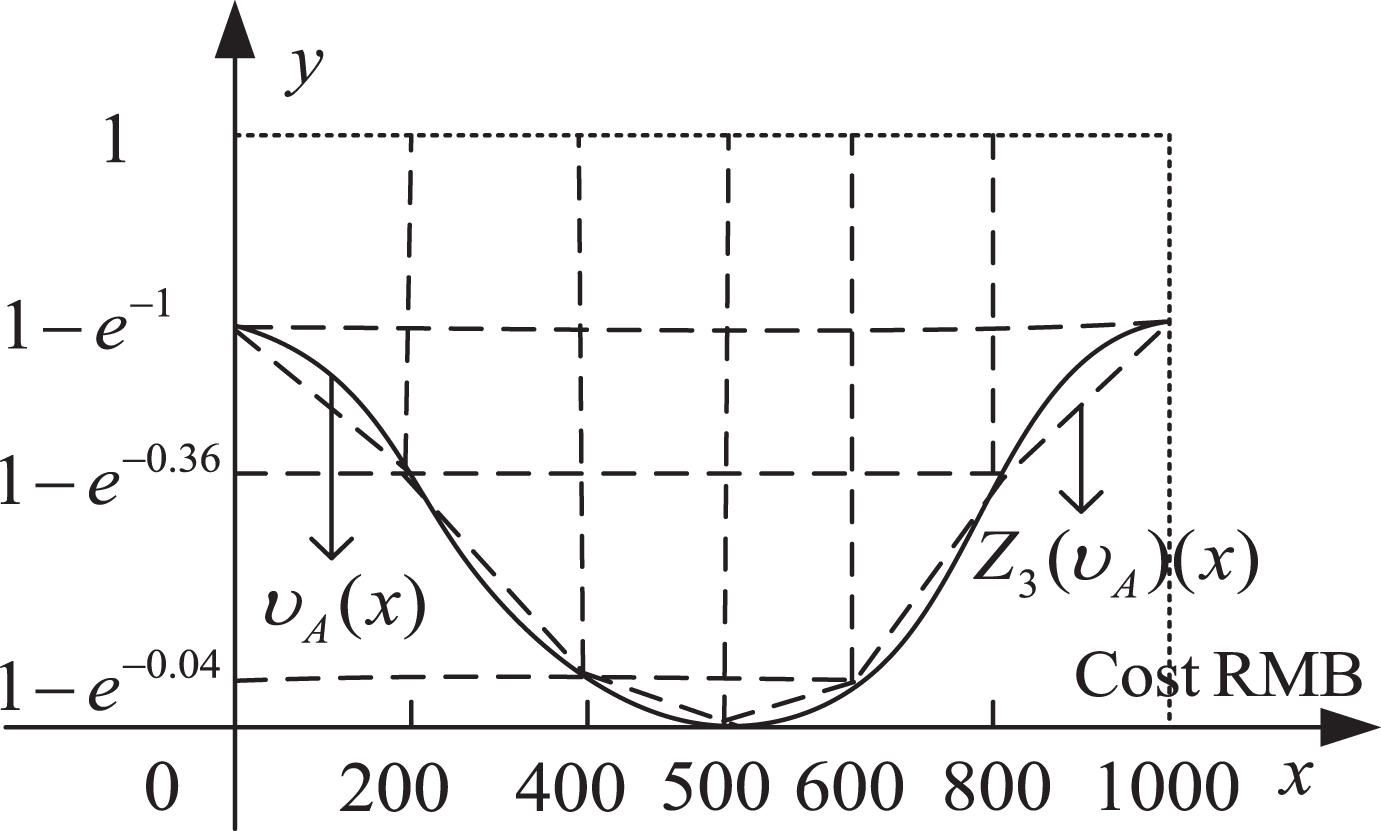
Describing the degree of residents’ dissatisfaction with Z3 (υ A ) when n = 3.
For example, the annual fees paid by urban residents for urban environmental construction services are 200RMB/year, 400RMB/year, 500RMB/year, 600RMB/year, 800RMB/year, 1000RMB/year, that is, with the increase of payment fees, the service quality can be improved. We can regard these six data as an ordered representation of the annual fee standards of residents, and record them as Z3 (μ
A
) = (0, 200, 400, 500, 500, 600, 800, 1000) = Z3 (υ
A
). Let 2n + 2 =8, then n = 3, and calculate the corresponding subdivision points on the y-axis by the Gauss membership function μ
A
(x) and the non-membership function υ
A
(x) in turn as e-1.5, e-0.54, e-0.06 and 1 - e-0.04, 1 - e-0.36, 1 - e-1. See Figs. 7, 8. By connecting the coordinates of adjacent points in turn, we can obtain the analytical expressions of the linear membership functions Z3 (μ
A
) (x) and Z3 (υ
A
) (x) of the polygonal fuzzy sets, i.e.,
Next, we will set up a group decision making model of livable city based on n-IPFSs expansion operation and its aggregation operators.
It is assumed that there are m alternative livable cities {Q1, Q2, ·· · , Q m } for residents, where each city has l evaluation indexes {r1, r2, ·· · , rl}, the weight vector of each index is w = (w1, w2, ·· · , w l ), and k residents {p1, p2, ·· · , p k } participate in the selection, the weight vector is ω = (ω1, ω2, ·· · , ω k ).
Without loss of generality, let the evaluation value of the resident p
t
on the r
j
index of the city Q
i
be
where i = 1, 2, ·· · , m ; j = 1, 2, ·· · , l, and
Suppose the decision matrix given by residents p t to l evaluation indicators can be expressed as
and the matrix is simply recorded as
Obviously, the line i of the matrix
In accordance with the decision matrix of the n-IPFS we have given a new group decision method for residents to choose livable cities. Although the surface of the proposed method seems to be more complex, it is easier to determine an ordered representation of an n-IPFS in practice, see example 1. Therefore, the proposed method is more accurate and universal than the decision method based on intuitionistic triangular fuzzy sets or intuitionistic trapezoid fuzzy sets. This is because the ordered representation of n-IPFS can more accurately describe the fuzziness of multiple attributes in objective things, so the method is more superior.
If the residents group {p1, p2, p3} constituted by three people intends to make a livable choice for six cities Q i (i = 1, 2, ·· · , 6): Tianjin, Qingdao, Jinan, Kunming, Taiyuan and Shenyang, respectively, i.e., the six alternative livable cities are expressed as {Q1, Q2, ·· · , Q6}. We use {p1, p2, p3} to evaluate the six alternative cities through five indicators, such as income level, educational health resources, employment opportunities, environmental conditions and transportation convenience, and the indexes are recorded as {r1, r2, r3, r4, r5}. The given index’s weight vector is w = (0.25, 0.15, 0.2, 0.25, 0.15), the resident’s weight vector is ω = (0.5, 0.3, 0.2), and let the parameters m = 6, l = 5, k = 3,n = 3.
Next, we will rank the livability of the six alternative livable cities {Q1, Q2, ·· · , Q6} according to the above group decision making method.
① The transformation criteria between fuzzy linguistic variables and the intuitionistic polygonal fuzzy sets are given through 3-ordered representations. See Table 1.
Transformation criteria between fuzzy linguistic variables and 3-IPFSs
Transformation criteria between fuzzy linguistic variables and 3-IPFSs
Obviously, the three residents can made a digital evaluation for the five attribute index {r1, r2, r3, r4, r5} in six alternative cities {Q1, Q2, Q3, Q4, Q5, Q6}, respectively. By the transformation criterion between linguistic variables and 3-IPFS in Table 1, the evaluation results are expressed in the form of formula (3) decision matrix
② In accordance with the proposed method of Ref. [29], the decision matrix
where each element
Similarly, we can also obtain second and third residents’ evaluation information on six alternative cities, and it can be changed into the form of decision matrix as Formula (4) by normalization.
③ By Theorem 3.1, each evaluation index r
j
(j = 1, 2, 3, 4, 5) in six alternative cities {Q1, Q2, Q3, Q4, Q5, Q6} is aggregated by the weighted arithmetic mean operator one by one, and the weight vector of the index is calculated according to a given w = (0.25, 0.15, 0.2, 0.25, 0.15). Hence, we can get
Therefore, we can immediately get the comprehensive evaluation matrix (G
i
) 6×3 of each resident’s for the six alternative cities, where each element
Hence, we can obtain the comprehensive evaluation values of three residents for the six alternative livable cities {Q1, Q2, Q3, Q4, Q5, Q6}, and thenaccording to the formula given in Definition 3.2, the corresponding score function and accuracy function value can be got, as shown in Table 2.
Comprehensive evaluation values of residents to six alternative livable cities
Comprehensive evaluation values obtained by the method of Ref. [14]
According to the data in Table 2, it is not difficult to see that the score functions of the comprehensive evaluation of the six cities rank from large to small as follows:
By the ranking criteria of Definition 3.3, the comprehensive ranking of the six cities {Q1, Q2, Q3, Q4, Q5, Q6} in terms of livability is Q3 > Q4 > Q1 > Q2 > Q6 > Q5. That is to say, the order of their livability is Qingdao, Xiamen, Beijing, Tianjin, Lanzhou and Taiyuan in turn.
However, if we utilize the group decision making method given in [14], it must be given a new transformation criterion between linguistic variables and ITFNs, that is, delete the elements 2-3 and 6-7 of each ordered representation in Table 1, such as,

is changed to Δ1 =< ((1, 18, 21, 38) , 0 . 95) ; ((1, 5, 17, 30) , 0.01) >. Similarly, other Δ2 to Δ7 are also modified.
The comprehensive evaluation values, score function and accuracy function of six cities are obtained by using the method given in [14], as shown in Table 3 below:
According to the data in Table 3 and the proposed method in Ref. [14], the score function of the six cities’ comprehensive evaluation is ranked as E (Q3) > E (Q4) > E (Q1) > E (Q2) > E (Q5) > E (Q6).
Compared with the results of this paper, we find that there are two reasons for the deviation of Q5 and Q6 in the last two cities: (1) A ITFN is only represented by four data, and there is the possibility of missing information; (2) The dissatisfaction values δ G i of Q5 and Q6 are large, such as, δ G 5 = 0.21 and δ G 6 = 0.17, that is, the satisfaction of these two cities is too low. In addition, From the comparison of the two methods, the dissatisfaction values δ G i of Q5 and Q6 are the same, while the n-IPFS is the extension or refinement of a ITFN, which can describe or express the fuzzy information more comprehensively. Hence, the ranking E (Q6) > E (Q5) in Table 2 is more reasonable. That is to say, the proposed method in this paper is better than that in Ref. [14].
In this paper, the concept of n-IPFS is proposed according to the advantages of an intuitionistic fuzzy set and polygonal fuzzy set. It is not only a generalization of trigonometric fuzzy sets or trapezoid fuzzy sets, but also the generalization of intuitionistic fuzzy sets, and the closeness of some arithmetic operations is retained. In fact, an n-IPFS is used to describe and express the multi attribute index information of the alternative livable cities, and the fuzzy information expressed by multiple n-IPFS is aggregated into a comprehensive information, and then the decision method of livable city is given according to rank criteria of the score function. Of course, the weights used in this method are all given, but the weights are not known in many practical problems. Hence, how to determine an incomplete weights is also one of the important issues to be studied. This is a problem that we need to continue to discuss.