In this paper, the problem of approximating general fuzzy number by using multi-knots piecewise linear fuzzy number is studied. First, r - s-knots piecewise linear fuzzy numbers are defined, and the conceptions of the I-nearest r - s-knots piecewise linear approximation and the II-nearest r - s-knots piecewise linear approximation are introduced for a general fuzzy number. Then, most importantly, we set up the methods to get the I-nearest r - s-knots piecewise linear approximation and the II-nearest r - s-knots piecewise linear approximation for a general fuzzy number. And then, we investigate some properties of the new approximation operators. Finally, we also present specific examples to show the effectiveness, usability and advantages of the methods proposed in this paper, and compare the methods with some other approximation algorithms.
It is known that approximation theory is an important research field in mathematics, and it has strong application backgrounds. In this research field, many important results have been obtained. Recently, there is still a lot of work about function approximations. For example, in [11], Drugowitsch and Barry introduced parts of a formal framework that aims at studying classifier systems, concerning how a set of classifiers approximate a function separately and in combination; In [20], Nikolaev established a relation between bijective functions and renormalization group transformations and founded their renormalization group invariants, and proposed several improved approximations (compared with the power series expansion) based on this relation; In [21], Pekarskii dealt with the order of best rational approximations to function zα in a domain with zero external angle and vertex at the point z = 0; In [18], Jafarov investigated the approximation properties of trigonometric polynomials in rearrangement invariant quasi Banach function spaces; In [9], Darabi and Itskov presented an analytical method based on the Padé technique and the multiple point interpolation for the inverse Langevin function.
About fuzzy numbers, the concept was proposed by Chang and Zadeh to study the properties of probability functions in [5]. With the development of theories and applications of fuzzy number, this concept becomes more and more important. The problem of approximations of membership functions of fuzzy numbers is also an important research area [15], and this topic has been extensively studied in the last decade. For example, in [25–28], Yeh studied the problems of trapezoidal, triangular, weighted trapezoidal, weighted triangular and weighted semi-trapezoidal approximations of fuzzy numbers, and get some important results; In [4], Chanas proposed an approximation interval of a fuzzy number which keeps the same width of the interval and the fuzzy number, which satisfied that the Hamming distance between this interval and the approximated number is minimal; In [14], Grzegorzewski proposed a new interval approximation operator, which is the best one with respect to a certain measure of distance between fuzzy numbers; In [16], Grzegorzewski and Mrówka gave a new nearest trapezoidal approximation operator preserving expected interval; In [1], Coroianu and Grzegorzewski addressed an important problem whether it is better to simplify initial data before using an aggregation operator or conversely, to aggregate original fuzzy values and then to simplify the output; In [6], Coroianu, Gagolewski and Grzegorzewski obtained approximations which are simple enough and flexible to reconstruct the input fuzzy concepts by using 1-knot fuzzy numbers. Recently, in [8], Coroianu and Stefanini proved that in most of the cases the extended inverse fuzzy transform preserves the quasi-concavity of a fuzzy number and hence it can be used to generate fuzzy numbers by approximating the restriction of the membership function to its support; Ban and Coroianu in [2], and Yeh in [29] studied the problem of symmetric triangular approximations of fuzzy numbers under a general condition and properties, and obtained some interesting results; In [24], we proposed methods of approximating general fuzzy number by using step type fuzzy number (i.e., simple fuzzy number). Just recently (it is when we revise this paper of us), we also learned that in [7], Coroianu, Gagolewski and Grzegorzewski studied the problem of multi-knots piecewise linear approximation of fuzzy numbers, obtained some important results.
In fact, whether interval approximations of fuzzy numbers or triangular approximations of fuzzy numbers or trapezoidal approximations of fuzzy numbers are all using piecewise linear functions to approximate fuzzy numbers. For some practical application problems, such approximations are indeed simple and practical enough as the used piecewise linear functions have no knot or have only one knot. However, for some practical applications, some problems which need more accurate approximation (using piecewise linear functions to approximate general fuzzy number) may be encountered, so it is meaningful work to study using multi-knots piecewise linear fuzzy number to approximate general fuzzy number. In this paper, we are going to study the approximation problem of multi-knots piecewise linear fuzzy number, and the approximation methods introduced by us greatly extend the approximation method of using piecewise linear fuzzy number with no knot or only one knot.
This paper is arranged as follows: In Section 2, we briefly review some basic notions, definitions and results about fuzzy numbers. In Section 3, we define r - s-knots piecewise linear fuzzy number, and give the conceptions of I-nearest r - s-knots piecewise linear approximation and II-nearest r - s-knots piecewise linear approximation for a general fuzzy number. Then, for a general fuzzy number, we obtain the methods to get the I-nearest r - s-knots piecewise linear approximation and the II-nearest r - s-knots piecewise linear approximation. In Section 4, we investigate some properties of the proposed approximation operators. In Section 5, we give specific examples to show the effectiveness, usability and advantages of the methods in this paper, and compare some approximation methods of fuzzy numbers of piecewise linear type. In Section 6, we make a brief summary to this paper.
Basic definitions and notations
A fuzzy subset (in short, a fuzzy set) of the real line is a function . For each such fuzzy set u, we denote by for any r ∈ (0, 1], its r-level set. By [u] 0, we denote the closure of the set (it is also denoted as supp(u)), i.e., .
If u is a normal and fuzzy convex fuzzy set of , u (x) is upper semi-continuous, and [u] 0 is compact, then we call u a fuzzy number, and denote the collection of all fuzzy numbers by E.
It is known that if u ∈ E, then for each r ∈ [0, 1], [u] r is a nonempty compact convex set in , i.e., a closed interval. For u ∈ E, we denote the closed interval by for any r ∈ [0, 1].
In [6], the authors defined r0-piecewise linear 1-knot fuzzy number u (see Figure 1, where r0 ∈ (0, 1)), its membership function can be written in the following form£º
where with s1 ≤ ⋯ ≤ s6.
piecewise linear 1-knot fuzzy number u.
Let be the collection of all n × n real matrixes (i.e., the matrixes with all real number elements).
If matrix satisfies
then A is a strictly diagonally dominant matrix (see Theorem I in [22]).
If is a strictly diagonally dominant matrix with positive diagonal entries (i.e., aii > 0, i = 1, 2, ⋯ , n), then
for any i = 1, 2, ⋯ , n, where, λi (i = 1, 2, ⋯ , n) is the eigenvalues of A (see Theorem VII in [22]).
Approximation by using multi-nodes piecewise linear fuzzy number
In [6], Coroianu, Gagolewski and Grzegorzewski studied the problem of approximating general fuzzy numbers by using piecewise linear 1-knot fuzzy number, gave a method of approximating general fuzzy numbers by using piecewise linear 1-knot fuzzy numbers, i.e., proposed a method to obtain the piecewise linear 1-knot (1-node) fuzzy number which is closest to a known fuzzy number in all piecewise linear 1-knot fuzzy numbers with same known level value (at the knot). In this section, we are going to study the problem of approximating general fuzzy numbers by using multi-knots piecewise linear fuzzy numbers, and try to establish methods for calculating such approximation in the form of concrete calculation formulas. It should be pointed out that just in the revision process of this manuscript, we learned that Coroianu, Gagolewski and Grzegorzewski has also studied this problem in [7]. However, the methods for calculating such approximation established by authors in [7] in the way which is different from the way which we are going to give in this paper.
In the following, in order to introduce r - s-knots piecewise linear fuzzy number, we first give the following result:
Theorem 1.Let r = (r1, r2, ⋯ , rm) and s = (s1, s2, ⋯ , sn) with 0 < r1 < r2 < ⋯ < rm < 1 > sn > sn-1 > ⋯ > s1 > 0. For any A = (a0, a1, ⋯ am+1) , B = (b0, b1, ⋯ am+1) with a0 ≤ a1 ≤ a2 ≤ ⋯ ≤ am ≤ am+1 ≤ bn+1 ≤ bn ≤ ⋯ b2 ≤ b1 ≤ b0, if the fuzzy set u of is defined asthen u ∈ E.
Proof. From u (x) =1 as x ∈ [am+1, bn+1], we see that u is normal; From the definition of u, we see that u (x) is continuous, and suppu = (a0, b0), so u (x) is upper semi-continuous, and is compact. In the following, we show that u (x) is fuzzy convex, i.e., u (tx + (1 - t) y) ≥ min {u (x) , u (y)} for any (with loss of generality, let x ≤ y) and t ∈ [0, 1]:
From the definition of u, we know that u (x) is non-decreasing on (- ∞ , bn+1], and non increasing on (bn+1, + ∞). Therefore, from x ≤ tx + (1 - t) y ≤ y, we have that u (tx + (1 - t) y) ≥ u (x) ≥ min {u (x) , u (y)} as tx + (1 - t) y ∈ (- ∞ , bn+1], and u (tx + (1 - t) y) ≥ u (y) ≥ min {u (x) , u (y)} as tx + (1 - t) y ∈ (bn+1, + ∞).□
Definition 1. Let r = (r1, r2, ⋯ , rm) and s = (s1, s2, ⋯ , sn) with 0 < r1 < r2 < ⋯ < rm < 1 > sn > sn-1 > ⋯ > s1 > 0. For any A = (a0, a1, ⋯ am+1) , B = (b0, b1, ⋯ bn+1) with a0 ≤ a1 ≤ a2 ≤ ⋯ ≤ am ≤ am+1 ≤ bn+1 ≤ bn ≤ ⋯ b2 ≤ b1 ≤ b0, the fuzzy number u defined in Theorem 1 is called a r - s-knots piecewise linear fuzzy number, and denoted by
r and s are called the left threshold (level) value set and the right threshold (level) value set of upl, respectively. Specially, as r = s, the fuzzy number upl = PL (r, A ; s, B) (in short, upl = PL (r, A ; B)) are called a r-knots (i.e., s-knots) piecewise linear fuzzy number (known as r-piecewise linear m-knot fuzzy number according to [7], also known as polygonal fuzzy number according to [3]), and r (i.e., s) is called the threshold value set of upl.
For fixed r = (r1, r2, ⋯ , rm) and s = (s1, s2, ⋯ , sn) with 0 < r1 < r2 < ⋯ < rm < 1 > sn > sn-1 > ⋯ > s1 > 0, we denote the collection of all r - s-knots piecewise linear fuzzy numbers by rPLs (E), and denote the collection of all r-knots (s-knots) piecewise linear fuzzy numbers by PLr (E) (i.e. PLs (E)).
In the following, we are going to establish a recursion formula to obtain the r - s-knots piecewise linear fuzzy number which is the the nearest (with respect to metric d) approximation with the left threshold value set r and the right threshold value set s. To do this, we first give the following definition.
Definition 2. Let u ∈ E and r = (r1, r2, ⋯ , rm) , s = (s1, s2, ⋯ , sn) with 0 < r1 < r2 < ⋯ < rm < 1 > sn > sn-1 > ⋯ > s1 > 0. If there exists upl ∈ rPLs (E) with , , and (i.e., [upl] 0 = [u] 0 and [upl] 1 = [u] 1) such that
then upl is defined to be the I-nearest (with respect to metric d) r - s-knots piecewise linear approximation (in short, I - r - s-KPLA) of fuzzy number u. Specially, as r = s, upl is called the I-nearest (with respect to metric d) r-knots (i.e., s-knots) piecewise linear approximation (in short, I - r-KPLA) of fuzzy number u.
Definition 3. Let u ∈ E and r = (r1, r2, ⋯ , rm) , s = (s1, s2, ⋯ , sn) with 0 < r1 < r2 < ⋯ < rm < 1 > sn > sn-1 > ⋯ > s1 > 0. If there exists upl ∈ rPLs (E) such that
then we say that upl is the II-nearest (with respect to metric d) r - s-knots piecewise linear approximation (in short, II - r - s-KPLA) of fuzzy number u. Specially, as r = s, we say that upl is the II-nearest (with respect to metric d) r-knots (i.e., s-knots) piecewise linear approximation (in short, II - r-KPLA) of fuzzy number u.
By the definitions of the I-nearest r - s-knots piecewise linear approximation and the II-nearest r - s-knots piecewise linear approximation of a fuzzy number, we can directly get the following result:
Proposition 1.Let u ∈ E and r = (r1, r2, ⋯ , rm) , s = (s1, s2, ⋯ , sn) with 0 < r1 < r2 < ⋯ < rm < 1 > sn > sn-1 > ⋯ > s1 > 0, upl be the I-nearest r - s-knots piecewise linear approximation of fuzzy number u, and vpl be the II-nearest r - s-knots piecewise linear approximation of fuzzy number u. Theni.e., vpl is a better approximation of u than upl.
Proof. From
we see that
□
Lemma 1.Let 0 < r1 < r2 < ⋯ < rm < 1 > sn > sn-1 > ⋯ > s1 > 0, a0 ≤ a1 ≤ a2 ≤ ⋯ ≤ am ≤ am+1 ≤ bn+1 ≤ bn ≤ ⋯ b2 ≤ b1 ≤ b0, r = (r1, r2, ⋯ , rm), s = (s1, s2, ⋯ , sn), A = (a0, a1, ⋯ am+1) , B = (b0, b1, ⋯ bn+1) and u = PL (r, A ; s, B). Thenandfor r ∈ [0, 1].
Proof. From the definition of , we can directly obtain the conclusion by the definitions of and .□
For convenience, we give the following notation:
Let u ∈ E and r = (r1, r2, ⋯ , rm) , s = (s1, s2, ⋯ , sn) with 0 < r1 < r2 < ⋯ < rm < 1 > sn > sn-1 > ⋯ > s1 > 0. We give the following notations:
and
Theorem 2.Let u ∈ E and r = (r1, r2, ⋯ , rm) , s = (s1, s2, ⋯ , sn) with 0 < r1 < r2 < ⋯ < rm < 1 > sn > sn-1 > ⋯ > s1 > 0. If , i = 1, 2, ⋯ , m, j = 1, 2, ⋯ , n are respectively determined by following recursion formulas:andand satisfy , thenis the I-nearest (with respect to metric d) r - s-knots piecewise linear approximation of fuzzy number u, where , and , , and (i = 1, 2, ⋯ , m, j = 1, 2, ⋯ , n) are respectively determined by formulas (7), (8), (9) and (10).
Proof. We denote the n-dimensional Euclidean space as for positive integer n. For any , with x1 ≤ x2 ≤ ⋯ ≤ xm ≤ yn ≤ ⋯ y2 ≤ y1, we denote and ux,y = PL (r, X ; s, Y).
We define as
for any . By the Definition of metric d, we see that
By Lemma 1, we have that
and
Let r0 = 0, rm+1 = 1, , , s0 = 0, sn+1 = 1, and . Then for any fixed i = 1, 2, ⋯ , m, we have that
Likewise, for any fixed j = 1, 2, ⋯ , n, we have that
Let
and
Then we can obtain that
and
where, xT is the transposition of x = (x1, x2, ⋯ , xm), yT is the transposition of y = (y1, y2, ⋯ , yn), and
From 0 < r1 < r2 < ⋯ < rm < 1 > sn > sn-1 > ⋯ > s1 > 0, we see that ri+1 - ri > 0, i = 1, 2, ⋯ , m and sj+1 - sj > 0, j = 1, 2, ⋯ , n (r0 = s0 = 0, rm+1 = sn+1 = 1), so
and
Therefore, C1 and C2 are both strictly diagonally dominant matrix. Thus, by Thomas algorithm in [23], we know that there is a unique set of solutions for the two equations for Linear Equations (13) of unknown quantities x1, x2, ⋯ , xm and Linear Equations (14) of unknown quantities y1, y2, ⋯ , ym (denote the solutions set of (13) as (a1, a2, ⋯ , am) and the solutions set of (14) as (b1, b2, ⋯ , bn)), and the solutions sets (a1, a2, ⋯ , am) and (b1, b2, ⋯ , bn) are determined by Recursion formulas (11) and (12).
Denoting , by , we can define r - s-knots piecewise linear fuzzy number as upl = PL (r, A ; s, B).
In the following, in order to show that the r - s-knots piecewise linear fuzzy number upl is the I-nearest (with respect to metric d) r - s-knots piecewise linear approximation of fuzzy number u, we only show that the Hessian matrix of the function D (x1, x2, ⋯ , xm, y1, y2, ⋯ , yn) of m + n variables is a positive definite matrix as (x1, x2, ⋯ , xm, y1, y2, ⋯ , yn) = (a1, a2, ⋯ , am, b1, b2, ⋯ , bn).
From the expressions of and (i = 1, 2, ⋯ , m, j = 1, 2, ⋯ , n) which we obtained before, we have that
for i = 2, 3, ⋯ , m - 1, and
for j = 2, 3, ⋯ , n - 1, and
Therefore, we can obtain the Hessian matrix of the function D (x1, x2, ⋯ , xm, y1, y2, ⋯ , yn) at (a1, a2, ⋯ , am, b1, b2, ⋯ , bn) as follow:
Since C1 and C2 are all strictly diagonally dominant and real symmetric, C is strictly diagonally dominant and real symmetric. It implies that the eigenvalues of C are all positive values, so C is a positive matrix. Therefore (a1, a2, ⋯ , am, b1, b2, ⋯ , bn) is the minimum point of D (x1, x2, ⋯ , xm, y1, y2, ⋯ , yn). Thus, we see that upl = PL (r, A ; s, B) is the I-nearest (with respect to metric d) r - s-knots piecewise linear approximation of fuzzy number u.□
For convenience of application, we give the following corollary by Theorem 2:
Corollary 1.Let u ∈ E, with 0 < r1 < 1 > s1 > 0. Then the I-nearest (with respect to metric d) (r1) - (s1)-knots (in short, r1 - s1-knots) piecewise linear approximation of u iswhere, and
Proof. In Theorem 2, taking m = n = 1, we can obtain Formula (15). From 0 < r1 < 1 > s1 > 0, and Formula (15), we can show . Then, by Theorem 2, we can directly see that Corollary 1 holds.□
Corollary 2.Let u ∈ E, r = (r1, r2), s = (s1, s2) with 0 < r1 < r2 < 1 > s2 > s1 > 0. Ifand satisfy , then upl = PL (r, A, s, B) is the I-nearest (with respect to metric d) (r1, r2) - (s1, s2)-knots piecewise linear approximation of fuzzy number u, where .
Proof. The proof of the corollary can be directly obtained from Theorem 2.□
Likewise, we can also obtain the following corollary in which m ≠ n, i.e., the number of left knots and the number of right knots of the piecewise linear fuzzy number are not equal (not symmetrical case):
Corollary 3.Let u ∈ E, r = (r1), s = (s1, s2) with 0 < r1 < 1 > s2 > s1 > 0. Ifand satisfy , then upl = PL (r, A, s, B) is the I-nearest (with respect to metric d) (r1) - (s1, s2)-knots piecewise linear approximation of fuzzy number u, where .
By Proposition 1, we see that for u ∈ E and r = (r1, r2, ⋯ , rm) , s = (s1, s2, ⋯ , sn) with 0 < r1 < r2 < ⋯ < rm < 1 > sn > sn-1 > ⋯ > s1 > 0, the II-nearest r - s-knots piecewise linear approximation vpl of fuzzy number u is better than the I-nearest r - s-knots piecewise linear approximation upl of fuzzy number u (i.e., d (u, vpl) ≤ d (u, upl)). In the following, we are going to give the recursion formulas to calculate II-nearest r - s-knots piecewise linear approximation. For this purpose, we first give the following notation:
Let u ∈ E and 0 = r0 < r1 < r2 < ⋯ < rm < rm+1 = 1 = sn+1 > sn > sn-1 > ⋯ > s1 > s0 = 0. We denote
and
Theorem 3.Let u ∈ E and r = (r1, r2, ⋯ , rm) , s = (s1, s2, ⋯ , sn) with 0< r1 < r2 < ⋯ < rm < 1 > sn > sn-1 > ⋯ > s1 > 0. If , i = 0, 1, ⋯ , m + 1, j = 0, 1, ⋯ , n + 1 are determined by following recursion formulas:andand satisfy a0 ≤ a1 ≤ a2 ≤ ⋯ ≤ am ≤ am+1 ≤ bn+1 ≤ bn ≤ ⋯ b2 ≤ b1 ≤ b0, thenis the II-nearest (with respect to metric d) r - s-knots piecewise linear approximation of fuzzy number u, where, A = (a0, a1, ⋯ , am+1) , B = (b0, b1, ⋯ , bn+1), r0 = s0 = 0, rm+1 = sn+1 = 1, and , , and (i = 1, 2, ⋯ , m, j = 1, 2, ⋯ , n) are respectively determined by formulas (18), (19), (20) and (21).
Proof. The theorem can be proved by the similar method as in Theorem 2. We omit the proof process.
□
Likewise, from Theorem 3, we can also get the following corollaries:
Corollary 4.Let u ∈ E, with 0 < r1 < 1 > s1 > 0. Then the the II-nearest (with respect to metric d) r1 - s1-knots piecewise linear approximation of u (where r1 = (r1) , s1 = (s1)) iswhere, A = (a0, a1, a2) , B = (b0, b1, b2) and
Corollary 5.Let u ∈ E, r = (r1, r2), s = (s1, s2) with 0 < r1 < r2 < 1 > s2 > s1 > 0, , , and (i = 0, 1, 2). Ifand satisfy a0 ≤ a1 ≤ a2 ≤ a3 ≤ b3 ≤ b2 ≤ b1 ≤ b0, thenis the II-nearest (with respect to metric d) (r1, r2) - (s1, s2)-knots piecewise linear approximation of fuzzy number u, where, A = (a0, a1, a2, a3) , B = (b0, b1, b2, b3).
Remark 1. Above, for the I-nearest and II-nearest r - s-knots piecewise linear approximations, we only gave four corollaries (Corollaries 1-4) about the case where m = n and they are concretely given. In fact, when m ≠ n, we can also give the similar results as long as m and n are concretely given. For example, see the following Corollary 6:
Corollary 6.Let u ∈ E, r = (r1, r2), s = (s1) (in short, (s1) = s1) with 0 < r1 < r2 < 1 > s1 > 0, , . Ifand satisfy a0 ≤ a1 ≤ a2 ≤ a3 ≤ b3 ≤ b2 ≤ b1 ≤ b0, thenis the II-nearest (with respect to metric d) (r1, r2) - s1-knots piecewise linear approximation of fuzzy number u, where, A = (a0, a1, a2, a3) , B = (b0, b1, b2, b3).
Properties of approximation operators
Definition 4. Let r = (r1, r2, ⋯ , rm) , s = (s1, s2, ⋯ , sn) with 0 = r1 < r2 < ⋯ < rm < 1 > sn > sn-1 > ⋯ > s1. We define mapping rΞs : E → rPLs, u → rΞs (u) , ∀ u ∈ E by rΞs (u) being the I-nearest r - s-knots piecewise linear approximation of fuzzy number u, and mapping rΠs : E → rPLs, u → rΠs (u) , ∀ u ∈ E by rΠs (u) being the II-nearest r - s-knots piecewise linear approximation of fuzzy number u. Specially, as r = s, we denote rΞs by Ξr (i.e., Ξs), and rΠs by Πr (i.e., Πs).
In the section, we are going to give some simple properties of approximation operators rΞs and rΠs. For this reason, let us first review some important numerical characteristics of fuzzy numbers.
For u ∈ E, denoting and , we call the closed interval [E* (u) , E* (u)] the expected interval (see [12, 17]) of u, and denoted by EI (u), so we have .
Let s : [0, 1] → [0, + ∞) with be a non-reducing function. For u ∈ E, and are called the value of u and the ambiguity of u (see [10, 16]), respectively. Specially, as s (r) =1, ∀ r ∈ [0, 1], we denote Vals (u) and Ambs (u) as Val (u) and Amb (u), respectively.
Theorem 4.Let r = (r1, r2, ⋯ , rm) , s = (s1, s2, ⋯ , sn) with 0 = r1 < r2 < ⋯ < rm < 1 > sn > sn-1 > ⋯ > s1. Then approximation operators rΠs and rΞs fulfill the following properties:
(1) Approximation operator rΠs is better than rΞs with respect to metric d, i.e., d (u, rΠs (u)) ≤ d (u, rΞs (u)) for any u ∈ E;
(2) rΠs keeps the original expected interval “EI (u)” unchanged, i.e., EI (rΠs (u)) = EI (u) for any u ∈ E;
(3) rΠs keeps the original expected value “Val (u)” unchanged, i.e., Val (rΠs (u)) = Val (u) for any u ∈ E;
(4) rΠs keeps the original ambiguity ”Amb (u)” unchanged, i.e., Amb (rΠs (u)) = Amb (u) for any u ∈ E.
Proof. The conclusion (1) can be directly obtain by Proposition 1.
In the following we show the conclusion (2):
Let u ∈ E. From rPLs (E), we know that there exist A = (a0, a1, ⋯ , am+1) and B = (b0, b1, ⋯ , bn+1) with a0 ≤ a1 ≤ ⋯ ≤ am+1 ≤ bn+1 ≤ ⋯ ≤ b1 ≤ b0 such that rΠs (u) = PL (r, A ; s, B). Denoting uX,Y = PL (r, X ; s, Y) for any X = (x0, x1, ⋯ , xm+1) and Y = (y0, y1, ⋯ , yn+1) with x0 ≤ x1 ≤ ⋯ ≤ xm+1 ≤ yn+1 ≤ ⋯ y1 ≤ y0, we define as
for any . Then, from d (u, rΠs (u)) = min{ d (u, v) : v ∈ rPLs (E) }, i.e.,
we have that
and
For any i = 0, 1, ⋯ , m + 1 and j = 0, 1, ⋯ , n + 1, using the similar method in the proof of Theorem 2, we can get the expressions of
and
so we have that
and
where, r0 = 0 = s0 and rm+1 = 1 = sn+1, AT is the transposition of A = (a0, a1, ⋯ , am+1), BT is the transposition of B = (b0, b1, ⋯ , bn+1), and
It implies that
and
Then we have that
i.e.,
Thus we can obtain EI (rΠs (u)) = EI (u), so the conclusion (2) holds.
From conclusion (2), we know that E* (rΠs (u)) = E* (u) and E* (rΠs (u)) = E* (u). Thus we have that
and
so the conclusion (3) and (4) holds.□
Examples and comparisons of some approximation methods
Let u ∈ E and r = (r1, r2, ⋯ , rm) , s = (s1, s2, ⋯ , sn) with 0 < r1 < r2 < ⋯ < rm < 1 > sn > sn-1 > ⋯ > s1 > 0.
In this Section, we are first going to give the algorithms of solving the I-nearest (resp. II-nearest) r - s-knots piecewise linear approximation of fuzzy number u. Then we give some specific examples to show the effectiveness, usability and advantages of the methods proposed by us. And then, we compare the new methods with some other approximation algorithms.
Algorithms of the I-nearest approximation
Firstly: For any r ∈ [0, 1], from the known u ∈ E, we work out and .
Second: By Recursion Formulas (11) and (12) (if the number of components m and n of r and s conforms to Corollary 1 or 2 or 3, then Corollary 1 or 2 or 3 can be used directly), we work out a1, a2, ⋯ , am and b1, b2, ⋯ , bn.
Third: Denoting , then upl = PL (r, A ; s, B) is the I-nearest r - s-knots piecewise linear approximation of fuzzy number u.
Algorithms of the II-nearest approximation
Firstly: For any r ∈ [0, 1], from the known u ∈ E, we work out and .
Second: By Recursion Formulas (22) and (23) (if the number of components m and n of r and s conforms to Corollary 4 or 5, then Corollary 4 or 5 can be used directly), we work out a0, a1, ⋯ , am+1 and b0, b1, ⋯ , bn+1.
Third: Denoting A = (a0, a1, ⋯ , am+1) and B = (b0, b1, ⋯ , bn+1), then upl = PL (r, A ; s, B) is the II-nearest r - s-knots piecewise linear approximation of fuzzy number u.
Example 1. Let fuzzy number u be defined as:
By Lemma 1, we have that and , and , , and .
(1) If we take r (= (r1)) = s (= (s1)) = (0, 5) (For short, r = s = 0.5), then by Formula (15), we have that a = -0.61 and b = 0.61. Therefore, by Corollary 1, we know that the piecewise linear fuzzy number (see Figure 2)
is the I-nearest 0.5-knots piecewise linear approximation (i.e., 0.5-piecewise linear 1-knot fuzzy approximation in [6]) of fuzzy number u, where A = (-1, - 0.59, 0) and B = (1, 0.59, 0).
u and I - 0.5-KPLA upl.
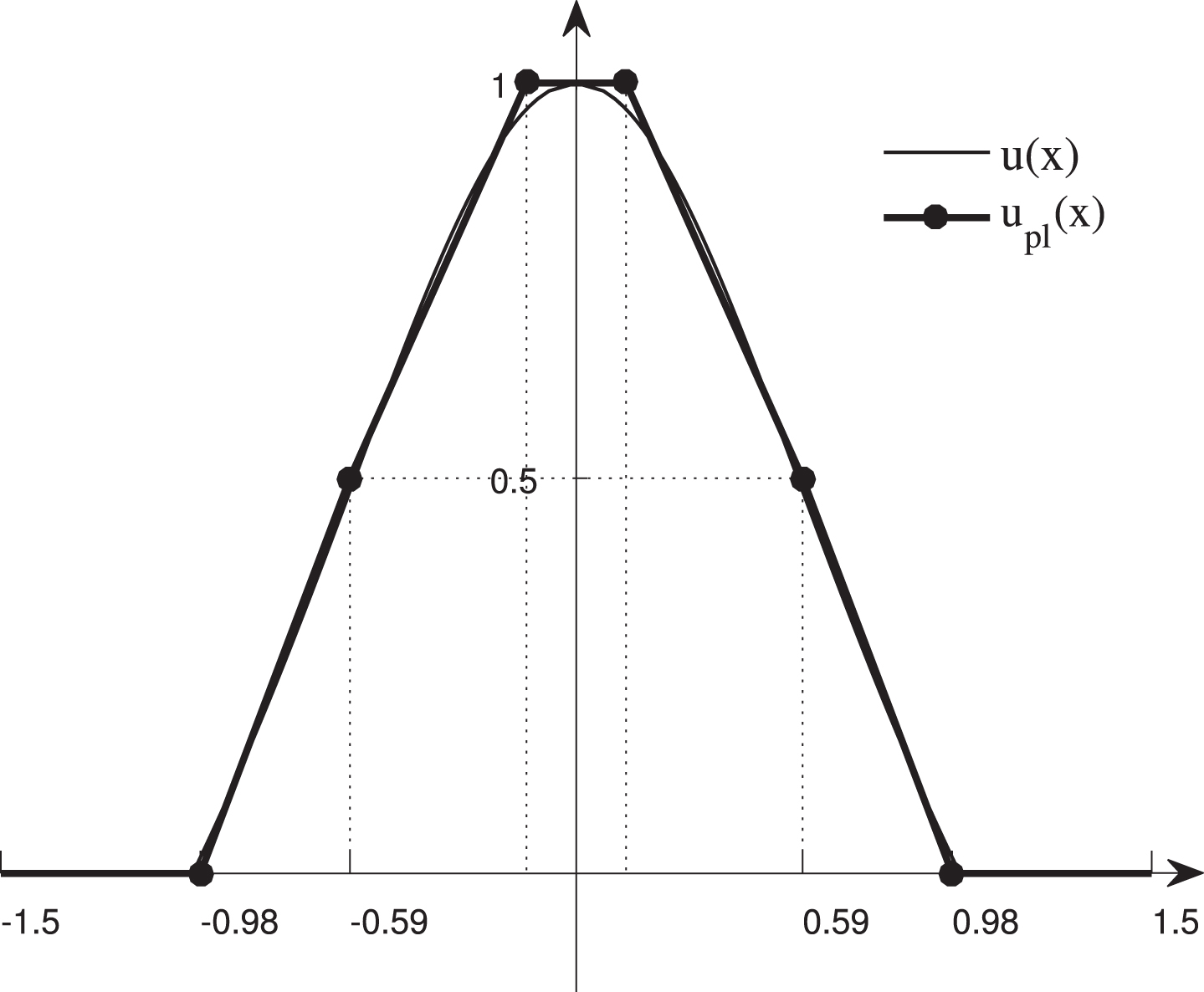
(2) Likewise, by Formula (24), we have that a0 = -0.98, a1 = -0.95, a2 = -0.12, b0 = 0.98, b1 = -0.59 and b2 = -0.12. Therefore, by Corollary 4, we know that the piecewise linear fuzzy number (see Figure 3)
is the II-nearest 0.5-knots piecewise linear approximation of fuzzy number u, where A = (-0.98, - 0.59, - 0.12) and B = (0.98, 0.59, 0.12).
u and II - 0.5-KPLA upl.
Remark 2. For u ∈ E, in the extreme case of r = s = φ (the number of left knots m and the number of right knots n of II-nearest piecewise linear approximation are all zero), the II-nearest φ-knots piecewise linear approximation upl = PL (φ, A ; B) of fuzzy number u can be regarded as the nearest (with respect to metric d) trapezoidal approximations of fuzzy number u, where φ is an empty set, A = (a0, a1), B = (b1, b2), , , and . Generally speaking, the more are the left knots and the right knots of the II-nearest piecewise linear approximation, the better is the approximation effect.
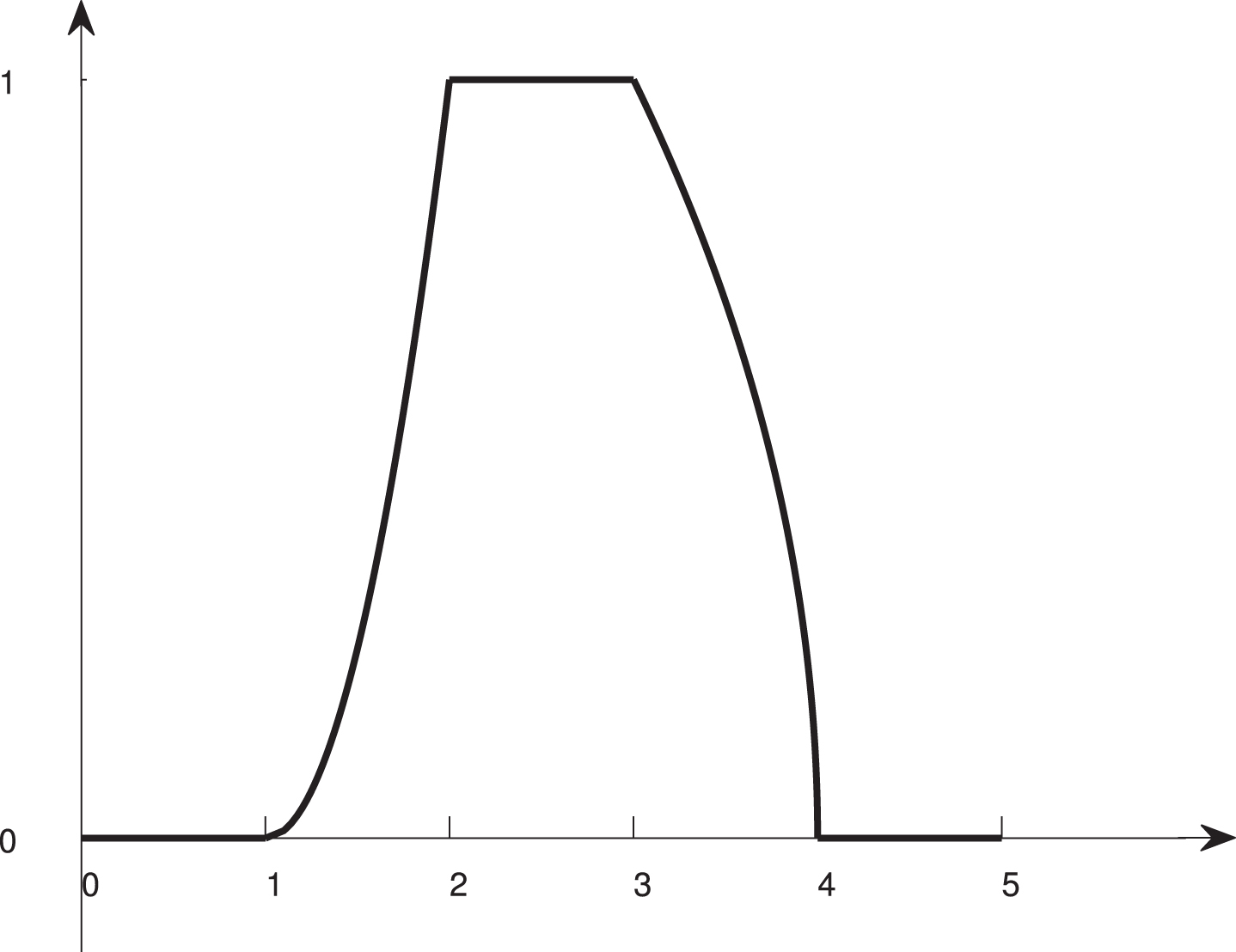
Example 2. Let fuzzy number u be defined as (see Figure 4):
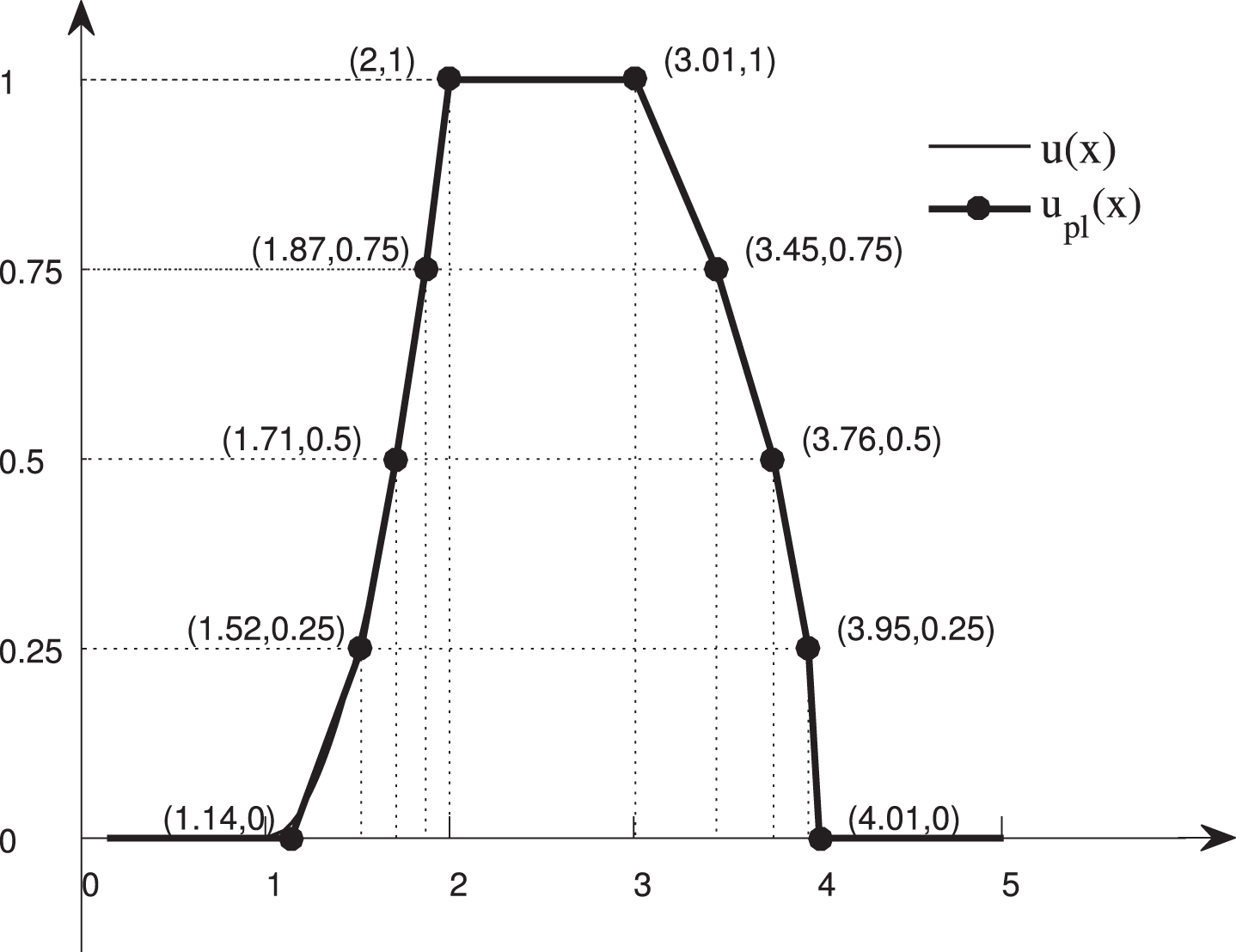
In [7], the authors demonstrates how to approximate the given fuzzy number u with a (0.25, 0.5, 0.75)-knots piecewise linear fuzzy number (known as (0.25, 0.5, 0.75)-piecewise linear 3-knots fuzzy number according to [7]) by their algorithms. From the calculating process they provide, we can see that the nearest piecewise linear fuzzy number approximation is upl = PL ((0.25, 0.5, 0.75) , A ; B) (see Figure 5), where A = (1.14, 1.52, 1.71, 1.87, 2.00), B = (4.01, 3.95, 3.76, 3.45, 3.01) (known as S ((0.25, 0.5, 0.75) , s) according to [7], where s = (1.14, 1.52, 1.71, 1.87, 2.00, 3.01, 3.45, 3.76, 3.95, 4.01)).
On the other hand, from , , r = s = (0.25, 0.5, 0.75), using the methods (Formulas (22) and (23)) proposed in this paper, we can obtain the same nearest piecewise linear fuzzy number approximation upl = PL ((0.25, 0.5, 0.75) , A ; B), which is the II-nearest (0.25, 0.5, 0.75)-knots piecewise linear approximation of u (see Figure 5).
u.
u and II - (0.25, 0.5, 0.75)-KPLA upl.
For the given u and s = r = (0.25, 0.5, 0.75), the nearest piecewise linear fuzzy number approximation obtained by using the algorithm in [7] and the II-nearest piecewise linear approximation obtained by using the method in this paper are same.
Remark 3. In Examples 1 and 2, the given left threshold value set r and the given right threshold value set s are equal, which is the way to use when the membership function of the fuzzy number u to be approximated is left-right symmetrical (or close to left-right symmetrical). However, when the membership function of the fuzzy number u is not left-right symmetrical, we should respectively take the left threshold value set r and the right threshold value set s according to its left-right different cases. In addition, The thresholds value in set r and set s should be selected as the level values corresponding to the points at which the curvatures of the membership function of u are relatively large. For set r and set s, the number of level values should be respectively determined according to the left-right different cases of the membership function of u.
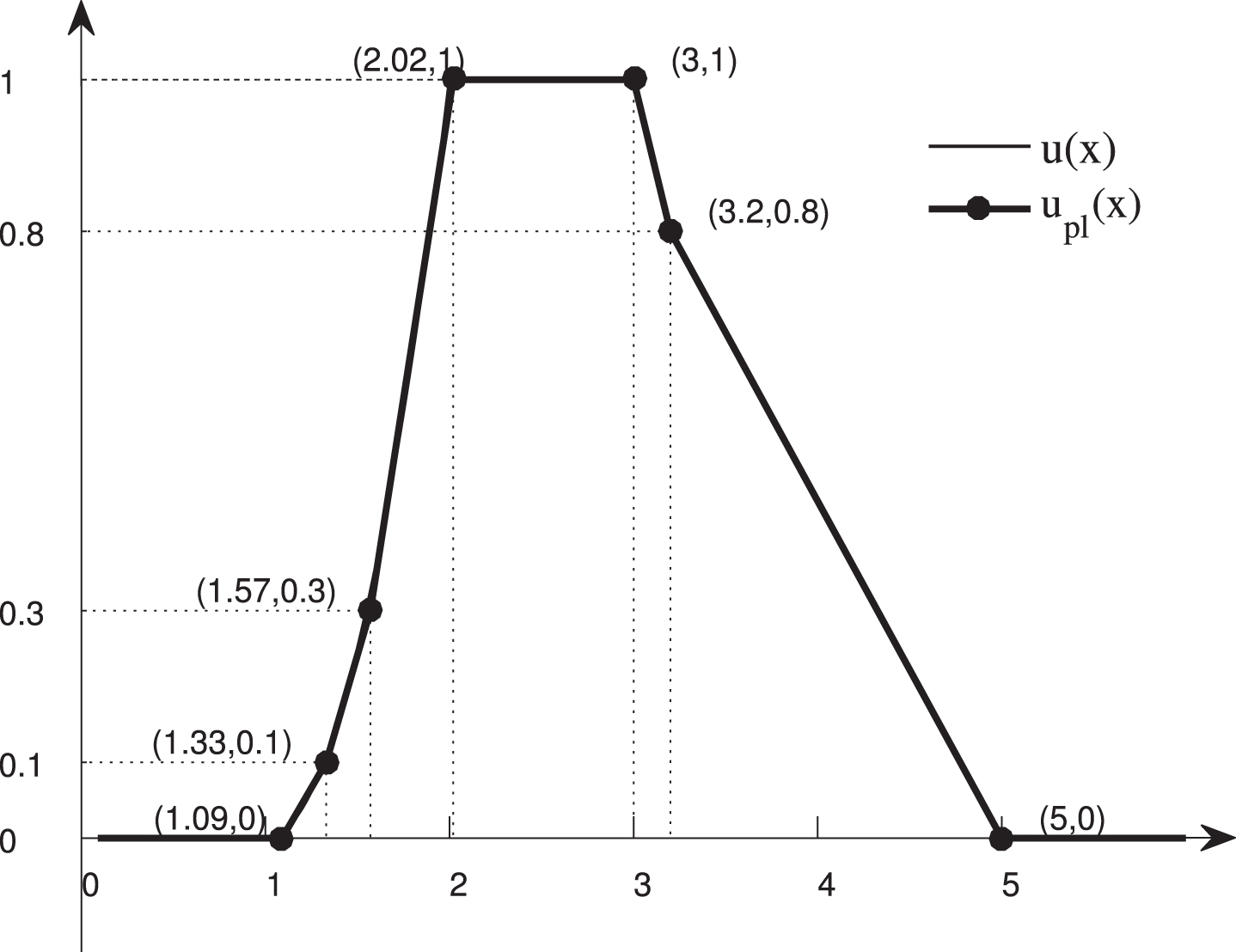
Example 3. Let fuzzy number u be defined as (see Figure 6):
i.e.,
In order to obtain better approximation results, considering the different situations (see Remark 3) of left and right of u (x), we can choose r = (0.1, 0.3) and s = (0.8) (in short, s = 0.8. Then by Formula (26) in Corollary 6, we can work out that a1 = 1.09, a2 = 1.33, a3 = 1.57, a4 = 2.02, b1 = 5.00, b2 = 3.20 and b3 = 3.00. Thus, we obtain the II-nearest (0.1, 0.3) -0.8-knotes piecewise linear approximation upl = PL ((0.1, 0.3) , A ; 0.8 . B) (see Figure 7) of fuzzy number u, where A = (1.09, 1.33, 1.57, 2.02) and B = (5.00, 3.20, 3.00).
u.
u and II - (0.1, 0.3) - 0.8 - KPLA upl.
In the following, we compare several approximation methods or algorithms, including those we proposed in this paper and Coroianu et al. established in [6] and [7]:
In [6], by embedding the fuzzy number space into a Hilbert space, and based on some theoretical results on convergence in the Hilbert space, Coroianu, Gagolewski and Grzegorzewski delivered algorithms producing the approximations of general fuzzy numbers by 1-knot piecewise linear fuzzy numbers. The new approximation method proposed by us is to use n-nodes piecewise fuzzy numbers to approximate general fuzzy numbers, so the new methods are the generalization of Coroianu’s algorithms. In addition, the new methods are given directly by the expression of the fuzzy number u to be approximated and the given sets r and s of left and right level values (see the Corollaries 1 and 3). However but the method of Coroianu’s algorithms in [6] does not give specific expressions (which is directly by u, r and s) of the desired abscissas of the nodes.
For given fuzzy number u and given sets r and s of left and right level values, the I-nearest r - s-knots piecewise linear approximation preserves the support and the core, but the II-nearest r - s-knots piecewise linear approximation does not necessarily preserve the support and the core. However, when the metric d is used as a measure standard, we can think that II-nearest r - s-knots piecewise linear approximation is better than the I-nearest r - s-knots piecewise linear approximation since rΞs (u) is closer to fuzzy number u than rΠs (u) (see Conclusion (1) of Theorem 4, of course, sometimes rΞs (u) = rΠs (u) may also occurs).
In the revision process of this manuscript, we learnt that Coroianu, Gagolewski and Grzegorzewski also studied the problem of multi-knots piecewise linear approximation in [7], and delivered algorithms producing the approximations of general fuzzy numbers by multi-knots piecewise linear fuzzy numbers in the similar way with in [6]. However, the algorithms delivered by Coroianu et al. in [7] and the methods proposed in this paper are established in different ways. In [7], by embedding the space of fuzzy numbers into a Hilbert space, they established the approximation algorithms based on some theoretical results on convergence in the Hilbert space. However, in this paper, we use Hessian’s theorem to obtain the approximation method by finding the minimum point of multivariate function. For given fuzzy number u to be approximated and given sets r and s of left and right level values, with the methods proposed by us, we can directly calculate the abscissa of each knots by formulas (or recursive formulas) expressed by u, s and r to achieve the corresponding nearest approximations. This may be an advantage of our approach (the method of Coroianu’s algorithms in [6] or [7] does not give specific expressions which is directly by u, r and s). Although the algorithms in [7] and the methods in this paper of us is different, theoretically, the approximations obtained are all the nearest approximations with respect to the same metric d, and they should be the same for the same type of nearest approximation. For example, the nearest approximations in Example 2 is the case.
Conclusion
In this paper, we gave the definition (Definition 1) of r - s-knots piecewise linear fuzzy number and the expressions (Theorem 1) of their membership functions, defined the I-nearest r - s-knots piecewise linear approximation (Definition 2) and II-nearest r - s-knots piecewise linear approximation (Definition 3) for a general fuzzy number, and obtained the theorem (Proposition 1) of the relation between the two kinds of multi-knots piecewise linear approximations. Then we obtained the methods to get the I-nearest r - s-knots piecewise linear approximation (Theorem 2) and the II-nearest r - s-knots piecewise linear approximation (Theorem 3) for a general fuzzy number, and gave some corollaries (Corollaries 1-5) and one remark (Remark 1). And then, we obtained some properties (Theorem 4) of the approximation operators proposed in this paper. Finally, we gave specific examples (Examples 1-3) to show the effectiveness, usability and advantages of the methods proposed by us, and compared the new methods with some other approximation algorithms.
References
1.
BanA., CoroianuL. and GrzegorzewskiP., Trapezoidal approximation and aggregation, Fuzzy Sets and Systems177 (2011), 45–59.
2.
BanA.I. and CoroianuL., Symmetric triangular approximations of fuzzy numbers under a general condition and properties, Soft Comput20 (2016), 1249–1261.
3.
Báez-SánchezA.D., MorettiA.C. and Rojas-MedarM.A., Onpolyghonal fuzzy sets and numbers, Fuzzy Sets and Systems209 (2012), 54–65.
4.
ChanasS., On the interval approximation of a fuzzy number, Fuzzy Sets and Systems122 (2001), 353–356.
5.
ChangS.S.L. and ZadehL.A., On fuzzy mappings and control, IEEE Trans Syst Man Cybernet2 (1972), 30–34.
6.
CoroianuL., GagolewskiM. and GrzegorzewskiP., Nearest piecewise linearapproximation of fuzzy numbers, Fuzzy Sets and Systems233 (2013), 26–51.
7.
CoroianuL., GagolewskiM. and GrzegorzewskiP., Piecewise linear approximation of fuzzy numbers: algorithms,arithmetic operations and stability of characteristics, Soft Computing. https://doi.org/10.1007/s00500-019-03800-2.
8.
CoroianuL. and StefaniniL., General approximation of fuzzy numbers by F-transform, Fuzzy Sets and Systems288 (2016), 46–74.
9.
DarabiE. and ItskovM., A simple and accurate approximation of the inverse Langevin function, Rheol Acta54 (2015), 455–459.
10.
DelgadoM., VilaM.A. and VoxmanW., On a canonical representation of fuzzy numbers, Fuzzy Sets and Systems93 (1998), 125–135.
11.
DrugowitschJ. and BarryA.M., A formal framework and extensions for function approximation in learning classifier systems, 70 (2008), 45–88.
12.
DuboisD. and PradeH., The mean value of a fuzzy number, Fuzzy Sets and Systems24 (1987), 279–300.
13.
GrzegorzewskiP., Metrics and orders in space of fuzzy numbers, Fuzzy Sets and Systems97(1) (1998), 83–94.
14.
GrzegorzewskiP., Nearest interval approximation of a fuzzy number, Fuzzy Sets and Systems130 (2002), 321–330.
15.
GrzegorzewskiP., Fuzzy numbers and their applications, Fuzzy Sets and Systems257 (2014), 1–2.
16.
GrzegorzewskiP. and MrówkaE., Trapezoidal approximations of fuzzy numbers, Fuzzy Sets and Systems153 (2005), 115–135.
17.
HeilpernS., The expected value of a fuzzy number, Fuzzy Sets and Systems47 (1992), 81–86.
18.
JafarovS.Z., Approximation by trigonometric polynomials in rearrangement invariant quasi Banach function spaces, Mediterranean Journal of Mathematics12 (2015), 37–50.
19.
JimenezM., Ranking fuzzy numbers through the comparison of its expected intervals, Internat, J Uncertainty, Fuzziness and Knowledge-based Systems4 (1996), 379–388.
20.
NikolaevG.N., Renormalization group approach to function approximation and to improving subsequent approximations, Theoretical and Mathematical Physics164(2) (2010), 1035–1050.
21.
PekarskiiA.A., Approximation to the function zα by rational fractions in a domain with zero external angle, Mathematical Notes91(5) (2012), 714–724.
22.
TausskyO., A recurring theorem on determinants, American Mathematical Monthly56 (1949), 672–676.
23.
ThomasL.H., Elliptic problems in linear difference equations over a network, Watson Sci. Comput. Lab. Rept., Columbia University, New York, 1949.
24.
WangG. and LiJ., Approximations of fuzzy numbers by step type fuzzy numbers, Fuzzy Sets and Systems310 (2017), 47–59.
25.
YehC.T., A note on trapezoidal approximation of fuzzy numbers, Fuzzy Sets and Systems158 (2007), 747–754.
26.
YehC.T., Trapezoidal and triangualr approximations preserving the expected interval, Fuzzy Sets and Systems159 (2008), 1345–1353.
27.
YehC.T., Weighted trapezoidal and triangular approximations of fuzzy numbers, Fuzzy Sets and Systems160 (2009), 3059–3079.
28.
YehC.T., Weighted semi-trapezoidal approximations of fuzzy numbers, Fuzzy Sets and Systems165 (2011), 61–80.
29.
YehC.T., Note on symmetric triangular approximations of fuzzy numbers under a general condition and properties, Soft Comput22 (2018), 2133–2137.