



Abstract
In many real production scenarios, departmental organizations often exhibit a hierarchical structure, where departments cooperate with subordinate departments to optimize resource allocation and maximize their respective benefits. However, due to a lack of information or data, many model parameters in the allocation process cannot be precisely defined. In response to this challenge, an interval n-person hierarchical resource allocation model is proposed to achieve maximum economic benefit in uncertain environments. Based on the concepts of satisfactory degrees of comparing intervals and interval-valued cores of interval-valued n-person cooperative games, an auxiliary nonlinear programming model and method are developed to solve the interval-valued cores of such cooperative games. The approach explicitly considers the inclusion and/or overlap relations between intervals, whereas the traditional interval ranking method may not guarantee the existence of interval-valued cores. The proposed method offers cooperative opportunities under uncertain conditions. Finally, the feasibility and applicability of the models and methods are demonstrated through a numerical example and comparison with other methods.
Introduction
In economic theory, the rational allocation of resources plays a pivotal role in informed decision-making, particularly when faced with limited resources. Consequently, resource allocation has been a prominent focus of research in microeconomics throughout various periods of early Western economic thought, modern economic doctrine, and the socialist economic framework. The issue of resource allocation holds equal significance when considering both microeconomic and macroeconomic factors. The efficient allocation and utilization of resources is essential for the efficient functioning of a society or system. Shimizu et al. [1] initially investigated the hierarchical planning problem for multi-objective systems and formulated it as a two-level planning problem. Wang et al. [2] proposed a two-level optimization model for institutional resource allocation, incorporating an incentive strategy to ensure truthful estimation of benefits by department heads. Yan et al. [3] addressed the general framework of multi-objective resource allocation problems with multiple decision-makers in the risk management of large-scale hierarchical systems. Liu et al. [4] considered platform benefits and consumer rights, proposing a bilevel programming model for optimal resource allocation in shared manufacturing, which was solved using a genetic algorithm. Talvar et al. [5] introduced a combined Nash equilibrium and auction algorithm to optimize resource allocation in fog computing, demonstrating its efficacy through simulations. Khan et al. [6] proposed a fuzzy dynamic linear programming model to optimize resource allocation in uncertain environments, demonstrating enhanced efficiency in enrollment within Pakistan’s education system and emphasizing the model’s robustness, flexibility, and practicality in addressing uncertainties. Most previous studies on hierarchical resource allocation have not adequately considered the cooperation between subordinate departments nor accounted for the incompleteness and uncertainty of information or behavioural complexities. This study aims to address these limitations by utilizing interval-valued n-person cooperative games to investigate decentralized multi-decision makers’ involvement in hierarchical resource allocation under uncertain environments while allowing for cooperation among subordinate departments.
The cooperative game approach has found numerous successful applications, particularly in the domains of enterprise management and economics [7–9]. However, practical scenarios often involve imprecision and vagueness in the values of player coalitions due to information uncertainty and the complexity of players’ behaviour. Consequently, researchers have explored interval-valued cooperative games [10]. The core concept [11], which represents a set-valued solution, plays a pivotal role in classical cooperative games [12, 13]. In an extension of this concept, the core of cooperative games can be expanded to include the interval-valued core for interval-valued cooperative games. Therefore, Branzei et al. [14] investigated cooperative games under interval uncertainty and examined the convexity of the undominated cores with intervals as values. Alparslan-Gok et al. [15, 16] introduced selection methods for interval-valued cooperative games and analyzed several solution concepts such as the interval-valued core, the interval-valued dominance core, and stable sets. To analyze the existence of interval-valued cores more effectively, they also introduced Γ-balancedness and extended Bondareva–Shapley theorem [17] from traditional cooperative games to an interval setting. Han et al. [18] discussed a type of interval-valued cores by defining a specialized order relation between intervals. Fei et al. [19] proposed a novel approach for computing the discounted Shapley value of interval-valued cooperative games, effectively addressing certain inconsistencies by incorporating the discounted Shapley value and the monotonicity condition of weak coalitions. Lai et al. [20] introduced the “AT solution” for interval-valued graph cooperative games, offering a simplified method that derives monotonic solutions directly from coalitions’ value bounds. Li and Ye [21] extended generalized solidarity values to interval-valued cooperative games and developed a simplified approach for solving them. Li et al. [22] discussed the importance of allocating resources in a coalition to ensure fairness and stability, proposing linear programming models with compromise limit constraints to address this issue. As mentioned above, these traditional interval ranking methods are relatively strict and only consider strict relationships between intervals, including intersecting and greater than, and do not consider inclusion and overlap relationships between intervals. In addition, players may accept the inclusion and/or overlap relationship between interval coalition values to a certain degree of satisfaction in actual cooperation. Therefore, the main purpose of this study is to introduce the concept of comparing satisfaction (or ranking index) between intervals, which is characterized by the inclusion or overlapping relationship of interval coalition values, and to propose a method for calculating the effective interval core for interval cooperative games.
The study is structured as follows. Section 2 introduces the concepts of operations on intervals and satisfactory degrees of comparing intervals. Section 3 develops a theoretical framework for modelling and analyzing hierarchical resource allocation in uncertain environments, employing interval-valued n-person cooperative games and introducing an interval ranking index and an auxiliary nonlinear mathematical programming model to manage and plan complex economic activities and production effectively. Section 4 proposes a solution for distributing the benefits of interval-valued coalitions by introducing the concept of interval-valued core allocation vector sets. We also derive an auxiliary nonlinear programming model to obtain the interval-valued cores and corresponding maximum satisfactory degree that all players can accept, given interval-type inclusion and/or overlap relations. Section 5 provides a numerical example and compares it with the traditional LR method to illustrate the feasibility and superiority of the proposed model and method. Section 6 presents the main findings.
Preliminaries and notations
Initially, we introduce two fundamental concepts: operations on intervals and satisfactory degrees of comparing intervals. These concepts facilitate a comprehensive understanding of how intervals and uncertainty are addressed in this study.
Operations on intervals
Operations on intervals refer to mathematical techniques utilized for performing operations between intervals. These operations encompass addition, subtraction, multiplication, division, and other mathematical procedures executed on intervals to generate interval outcomes that inherently possess uncertainty. In this study, the utilization of operations on intervals plays a pivotal role in effectively addressing uncertainty in resource allocation problems arising from insufficient information or data.
Let
If
⩾ 0, then
Alternatively, an interval
Based on the definition of operations on intervals in Ref. [23], the definition is improved by introducing equality and scalar multiplication. This improvement makes the definition more rigorous and reflects the essence of interval operations more accurately, thus laying a solid foundation for subsequent research and application. The operations on intervals of equality, addition, and scalar multiplication are defined as follows:
Equality of two intervals: Addition (or sum) of two intervals: Scalar multiplication of a real number and an interval:
Where
Using the mean-width or center-radius form mentioned above, we can rewrite the operations of Equality of two intervals: Addition (or sum) of two intervals:
Scalar multiplication of a real number and an interval:
Obviously, the arithmetic operations above are the generalization of real numbers.
Satisfactory degrees of comparing intervals
Satisfactory degrees of comparing intervals are used to measure the degree of comparison between two intervals. This concept provides a systematic method for measuring the relative position and degree of overlap between intervals. In this study, the satisfactory degree is utilized to analyze the correlation and relative advantages of intervals to aid in identifying opportunities for cooperation and develop strategies to maximize the benefits of resource allocation.
Most traditional ranking methods [24, 25] are stricter, as shown in Fig. 1, which only considers strict intersection, greater than, and other relations without considering inclusion and/or overlapping relations between intervals. In fact, for fuzzy sets, the statement “the interval
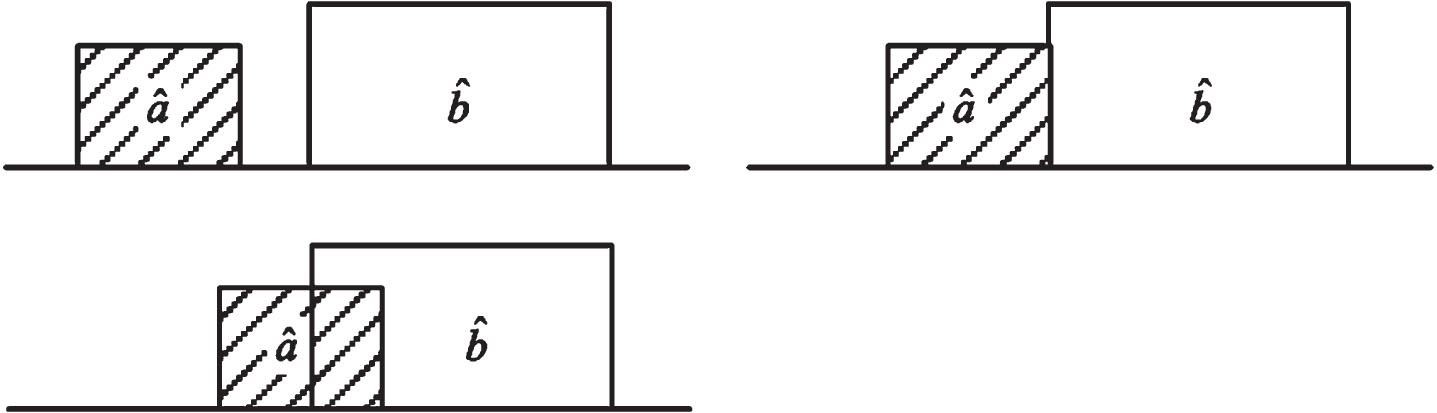
Relations of
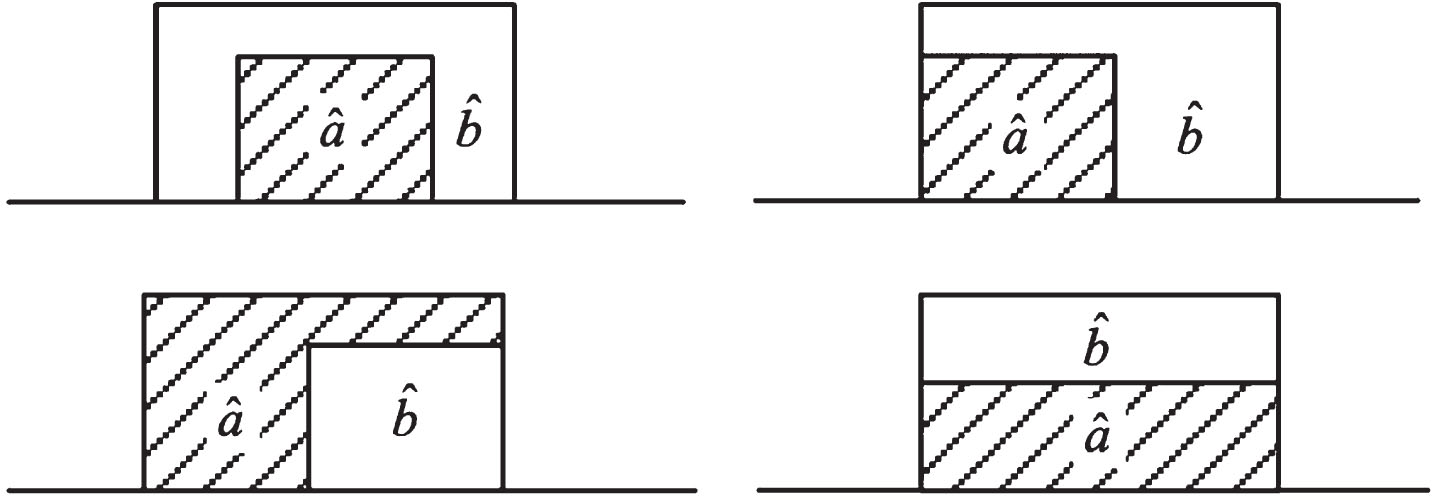
Relations of
In the sequent, it is easy to prove that the satisfactory degree λ is continuous except a single special case, i.e.,
=
and
For any interval
Thus, “ ⩽ I ” and “⩾ I ” are well established as fuzzy partial orders of intervals. Definitions 2 and 3 may provide quantitative ways to determine the exact degree of satisfaction in ranking two intervals. Then, the satisfaction equivalent form of the interval-valued inequality relation is defined using the satisfactory degree λ.
Modeling optimal resource allocation in hierarchical organizations under uncertainty
In practical resource allocation scenarios, problems such as incomplete data, unclear data, and complex behavioural patterns are often encountered. As a result, many model parameters are defined as interval values rather than exact values in such situations. Imagine a scenario where a superior department is responsible for allocating a limited number of resources among its n (n ⩾ 2) subordinate departments.
The total amount of these finite resources is represented by an interval
Where
In which
This study focuses on a specific situation: when the superior department allocates resources according to the model, it does not consider the cooperation between subordinate departments. However, after the resource allocation scheme is determined, some subordinate departments will redistribute the resources they receive according to their actual production conditions, capacity and efficiency in order to achieve greater benefit among departments. We refer to this collaborative approach as “sharing of results”. By applying the methodology outlined in Ref. [26], we can find out the optimal amount of resources
Any nonempty subset S in N is called the cooperative coalition of subordinate departments. Then, there are n cooperative coalitions. The purpose of forming cooperative coalition S is to maximize the objective function of S. Since we assume that there is no adversarial competition between subordinate departments, so the mathematical model of cooperative coalition S can be built as follows:
The objective function here is equal to the sum of the objective functions of each department in the cooperative alliance S. Obviously, other forms of the target function are also available. At this point, model (1) can be considered as the resource allocation problem of n - s + 1 subordinate departments without any cooperation, where s is the number of departments in cooperative coalition S. The optimal solution
The property of the value
Proof. Because
Obviously, the above two programs are equivalent to the following programs:
So,
Theorem 1 states that two coalitions that do not contain any of the same departments are likely to produce more benefits, or at least not getting worse due to the cooperation.
In the case of only two subordinate departments, the only kind of cooperative coalition is N = {1, 2}. At this point, the corollary becomes
Because for any two allocation vectors
Interval-valued cores for interval-valued n-person cooperative coalitions’ benefit distribution
In this section, we assume the number of subordinate departments n ⩾ 3. First, we introduce the concept of dominance.
In which
Condition 1) indicates that each department in cooperative coalition S thinks that the allocation plan
Condition 2) indicates that a cooperative coalition S has sufficient capacity to ensure that each department gets benefit
Obviously, for a given cooperative coalition, S is a partial order relationship, and is not a partial order relationship.
Here,
By using the concept of the satisfactory degree λ given above, we can establish the following satisfactory crisp equivalent forms of interval-valued inequality constraints, which will be used to construct auxiliary nonlinear programming models of interval-valued n-person cooperative games. For any coalition S ⊂ N, let
For the situation
Let
Analogously, for the situation
Where
i
and
For the situation
which is a system of linear inequalities about the variables
i
and
Application and computation
Suppose a superior department with three subordinate factoriesT1, T2, and T3, which share the same resource. Each factory produces two products using that resource. Due to lack of information or imprecision of the available information, we assume the following mathematical model:
Where
Similarly, if the factory T2 and factory T3 cooperate, the model after cooperation is as follows:
we can obtain the interval value of coalition S = {2, 3} is
According to Equation (8), the nonlinear programming model can be constructed as follows:
Where δ ∈ [0, 1] and
i
and
According to Equation (9), the system of linear inequalities can be constructed as follows:
Where
i
and
Solving Equation (12) by using the LINGO tool, we find there is no solution that simultaneously satisfies all the constraints. In other words, there is no feasible solution of Equation (12) and hereby these three factories may have not any cooperative desire for this situation.
Analogously, according to Equation (10) for other situation, the systems of linear inequalities can be constructed as follows:
Where
i
and
In order to show the applicability and superiority of the proposed method, we compare it with the LR method. The linear programming model is constructed according to Equation (10) as follows:
where
By using the LR method of comparing intervals (i.e., if
⩽
and
Solving Equation (15) by using the LINGO tool, we find there is not a solution that simultaneously satisfies all the above constraints. In other words, there is no feasible solution of Equation (15) and hereby these three factories may have not any cooperative desire. Obviously, it is shown that there is not any feasible solution with the traditional LR interval ranking method. On the contrary, we can obtain the feasible solution by introducing the satisfactory degrees of comparing intervals, which can give more scientific suggestions for players (or managers).
Furthermore, we find that when δ* = 0.875, then
Therefore, it is shown that the traditional LR interval ranking method, which strictly considers relationships of intersection and superiority, may limit cooperative intent and decision-making in scenarios involving interval-valued payoffs. In contrast, our nonlinear mathematical programming model, accounting for inclusion and/or overlap relations between intervals, identifies maximum satisfaction levels and feasible solutions, thereby uncovering potential cooperative opportunities previously overlooked. These findings align with real-world expectations. Moreover, this approach complements, rather than replaces, traditional methods by offering alternative solutions when traditional interval ranking fails to yield feasible outcomes. This flexibility enhances decision-making, especially in complex situations characterized by interval relations of inclusion and/or overlap.
In this study, we conducted an in-depth investigation of the n-person hierarchical resource allocation problem under uncertainty, focusing on cooperation among subordinate departments. We utilized interval-valued n-person cooperative games as a foundational framework for formulating and analyzing these allocation problems, particularly in contexts where model parameters are subject to imprecision and uncertainty due to external factors. An essential contribution of this research is the introduction of an interval ranking index, which is developed based on the inclusion and/or overlap relations between interval-valued payoffs. This index lays the foundation for constructing an auxiliary nonlinear mathematical programming model for interval-valued cores, which is suitable for any interval-valued n-player cooperative game. Our theoretical analysis and practical computations demonstrate that exploring the profit distribution solutions in cooperative coalitions within such contexts has significant practical relevance. It provides insights for decision-makers to organize, manage and plan effectively in complex economic activities and production processes. Furthermore, this study provides theoretical references for the rational use of social resources and the improvement of economic production efficiency, thus providing a valuable support tool for production management decision-making.
Footnotes
Acknowledgments
This work has been supported by the Project of Philosophy and Social Science Research in Colleges and Universities in Jiangsu Province (Grant No. 2022SJYB2251).