



Abstract
Quality function deployment (QFD) is an useful tool to solve Multi-criteria decision making, which can translate customer requirements (CRs) into the technical attributes (TAs) of a product and helps maintain a correct focus on true requirements and minimizes misinterpreting customer needs. In applying quality function deployment, rating technical attributes from input variables is a crucial step in fuzzy environments. In this paper, a new approach is developed, which rates technical attributes by objective penalty function and fuzzy technique for order preference by similarity to an ideal solution (TOPSIS) based on weighted Hamming distance under the case of uncertain preference characteristics of decision makers in fuzzy quality function deployment. A pair of nonlinear programming models with constraints and a relevant pair of nonlinear programming models with unconstraints called objective penalty function models are proposed to gain the fuzzy important numbers of technical attributes. Then, this paper compares the fuzzy numbers by fuzzy technique for order preference by similarity to an ideal solution (TOPSIS) method based on weighted Hamming distance in consideration of the uncertain preference characteristics of decision makers. To end with, the developed method is examined with the numerical examples.
Introduction
Multi-criteria decision making (MCDM) [1–3] refers to the decision to choose between a set of solutions that are mutually conflicting and cannot be shared, which is an important management issue to rate these solutions and find the optimal alternative. A MCDM problem is formatted as following. (C1C2 . . . Cn)
and W = (W1, W2, . . . , Wm). Where (A1, A2, . . . , An) are alternatives, (C1, C2, . . . , Cn) are criteria, Bij is the score of Ai on Cj and Wi is the weight of Ai.
Recently, in order to fully comply with the people-oriented principle, more and more MCDM problems are considered based on decision-making requirement. Therefore, quality function deployment (QFD) [4, 5] is developed. QFD, which is a method based on reasoning and deduction, an effective tool to couple customer requirements (CRs) with technical attributes (TAs). Over the past 20 years, the application and field of QFD have been continuously expanded, not only in manufacturing [6], but also in supply chain [7, 8], healthcare service [9], transportation [10, 11] and other fields. In the above MCDM problem, A and C represents customer requirements and technical attributes respectively in QFD; W represents the customer requirement priorities in QFD, which is an important level matrix; and B represents the relationships between customer requirements and technical attributes in QFD, which is a relation matrix. The rating of technical attributes is a key result of QFD since it guides the design team in decision-making, resource allocation, and the subsequent QFD analyses [12]. What’s more, it makes a company achieve higher customer satisfaction and thus more competitive advantages. Therefore, how to derive the importance of TAs from the important level matrix and the relation matrix is a key step for the success of QFD. However, the important level matrix and the relation matrix need the opinions of experts and customers, which is generally vague and uncertain. The traditional QFD method processes the input information by a definite numerical method, which often cannot accurately express the input information, resulting in a lot of information being lost or distorted. Fuzzy theory [13] is a powerful tool to deal with fuzzy information, which can quantify subjective and uncertain information. Each input of the traditional QFD can be taken as a language variable or fuzzy number, and then fuzzy reasoning, fuzzy evaluation, fuzzy decision-making and other methods can be applied to carry out QFD. So, the fuzzy QFD has been developed. The fuzzy QFD is shown by the various input information, which reflects people’s subjective judgments, understandings and evaluations in many cases [16–20].
In a word, in order to follow the people-oriented principle and gain higher innovation efficiency in new product development, based on fuzzy QFD, this paper aims to develop a new method to rate the importance of technical attributes by the important level matrix and the relation matrix in fuzzy environment, which becomes an inevitable trend of sustainable development in different fields.
A vital process in fuzzy QFD is the merge TAs with a product by design experts. To meet specific evaluation requirements, the combination, integration, mixing of MCDM approaches have become increasingly important for decision makers. Researchers have developed a series of hybrid methods in fuzzy QFD. The combination of fuzzy analytical hierarchy process (AHP) and fuzzy QFD [21–23] focuses on the importance weights of customer requirements to prioritize and infer the qualitative, vague and imprecise Voice of Customer; The mixture of fuzzy analytic network process (ANP) and fuzzy QFD [24, 25] laies emphasis on addressing the inner-relationship and inter-relationship among QFD components; The integrations of grey relational analysis (GRA) and fuzzy QFD [26, 27], possibility theory and fuzzy arithmetic in fuzzy QFD [28, 29], which pay attention to the effectiveness of QFD in handling the vague, subjective and limited information. Furthermore, the linkage of fuzzy technique for order preference by similarity to an ideal solution (TOPSIS) and fuzzy QFD [30, 31] attaches importance to determine the priority of technical attributes in QFD. Therefore, this paper applies to the method of fuzzy TOPSIS in fuzzy QFD to rate TAs.
However, most of these methods are calculated by the weighted sum of the relationship measure in the important level matrix and the relation matrix. In practice, calculating the importance of each TA falls under the category of fuzzy weighted average in fuzzy situation. Therefore, Vangeas and Labib [32] first used fuzzy weighted average in QFD, and they developed a model to obtain the optimal solution of TAs by the fuzzy weighted average. Afterwards, the fuzzy weighted average is widely combined with many different methods, such as Chen et al. [34] integrate fuzzy weighted average method and fuzzy expected value operator in QFD; Wang and Chin [37] integrate fuzzy normalization and fuzzy weighted average in QFD. In these papers, a pair of nonlinear programming (NLP) models are obtained by fuzzy weighting method, and then, NLP model with constraints is converted to LP model with constraints by introducing parameters. What’s more, the fuzzy importance of TAs are obtained by solving the pair of LP models with constraints. Since it is hard to get the membership function of TAs accurately, the defuzzification method of fuzzy expected value operator is developed and is used widely [33, 34]. But in these traditional methods, there are exists some problems (for example: [34]): (1) The traditional defuzzification method of fuzzy expected value operator need the h-level set to derive the membership functions of TAs, which need to take a large amount of h; What’s more, the defuzzification method loses some information; (2) The preference of decision makers is not taken into account in these methods.
Therefore, in order to rate TAs in fuzzy QFD and solve above questions, a new approach is developed in this paper, which is combining objective penalty function method and the fuzzy TOPSIS method based on the weighted Hamming distance. Firstly, the objective penalty function method, which can convert NLP model with constraints into NLP model with unconstraints. It is the most common approach to NLP models with constraints, which can decrease the complexity of calculations. Secondly, the fuzzy TOPSIS method is developed to make a comparison between fuzzy numbers rather than crisp numbers obtained by the frequently-used defuzzification method in fuzzy QFD, which can make the utmost of the original data to rate TAs, accurately reflect the gap between TAs, and make the data calculation simple and easy. Finally, the parameter β is defined to represent the degree of decision makers’ preference in the weighted Hamming distance, which can fully takes into account the characteristics of decision makers preferences for uncertainty.
As above discussed, the paper is structured in Fig. 1 and as follows: In Section 2, we show definitions of fuzzy set theory, objective penalty function and weighted Hamming distance. In Section 3, we proposed the method of objective penalty function and fuzzy TOPSIS based on weighted Hamming distance to rate TAs. In Section 4, two examples are given to illustrate the feasibility of the proposed method. Finally, conclusions are made in Section 5.
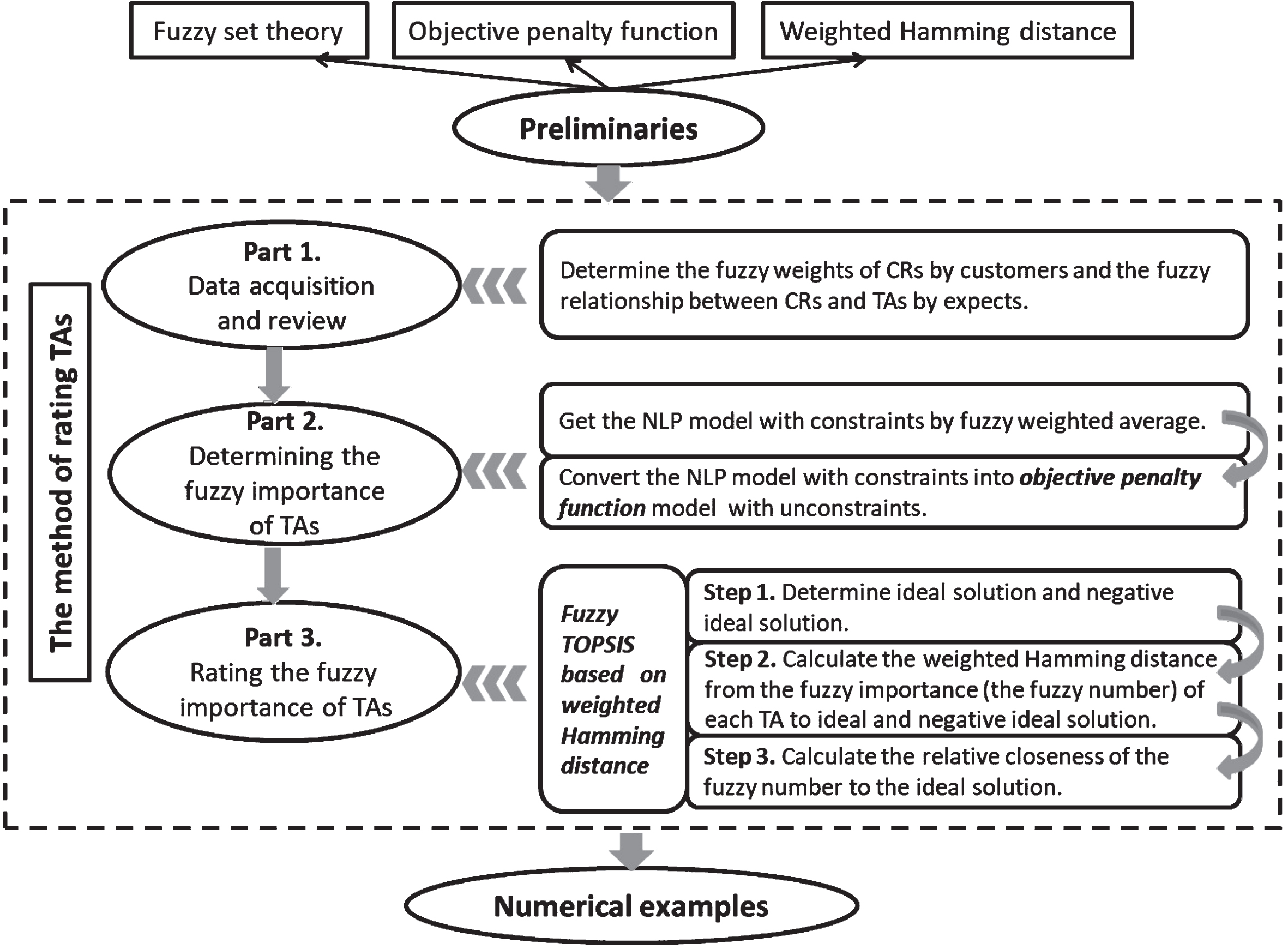
Flowchat of the proposed method.
In this section, some basic knowledge and necessary concepts are introduced which related to fuzzy set theory (Kong [39]), objective penalty function (Meng [38]) and weighted Hamming distance (Kong [39]).
Fuzzy set theory
Example: The membership function of
Objective penalty function
The objective penalty function method is to convert a constraint optimization problem into an unconstrained optimization problem in order to easy to solve the problem. We consider the following nonlinear constrained optimization problem:
Meng et al. [38], studied the following objective penalty function
(i) M* ≤ M ≤ M*, if
(ii) M ≤ M*, if
Therefore, the objective penalty function is exactness. That is to say, in some conditions, the optimal solution of the original problem is the optimal solution of the objective penalty function problem, and the optimal solution of the objective penalty function problem is the optimal solution of the original problem.
Weighted Hamming distance
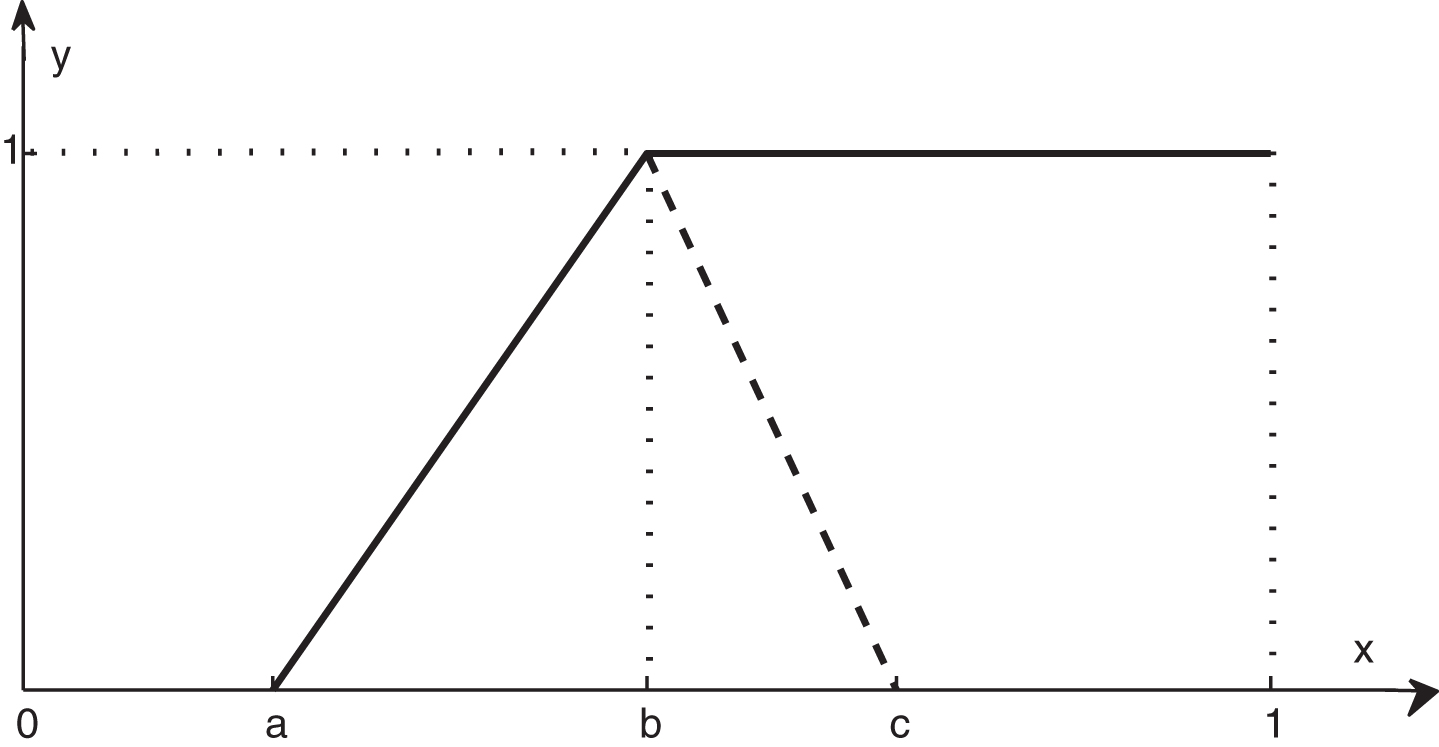
The left set.
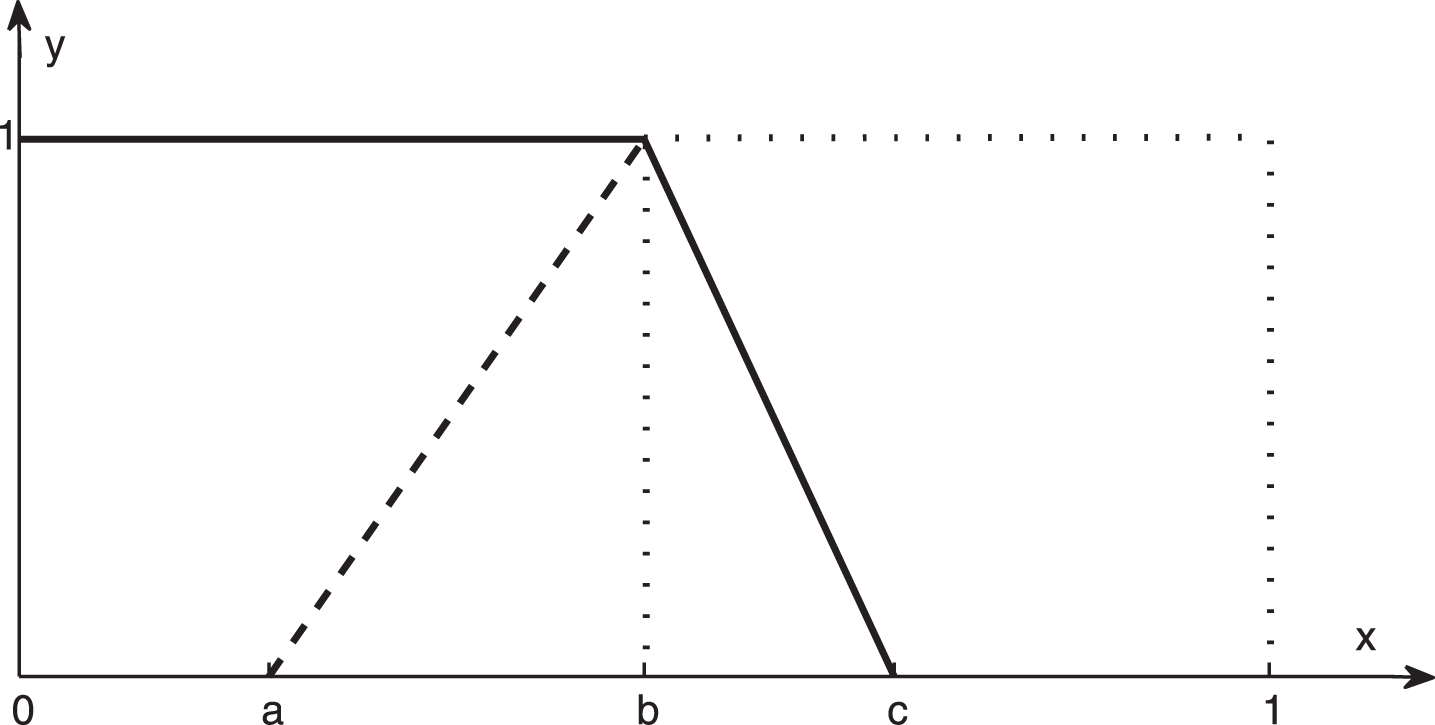
The right set.
Therefore,
where β represents the uncertain preference factor of decision makers. Such as, β = 0.5 denotes that the decision maker is neutral in respect of uncertain; β > 0.5 indicates that the decision maker is nauseous about uncertain; and β < 0.5 indicates that the decision maker is preferential concerning uncertain.
Date acquisition and review
QFD is a method to translate CRs into product TAs. In this process, the weights of CRs is as important as the importance of TAs.
In fuzzy QFD, the relative weights of customer requirements, the relationships expressed between the CRs and TAs, and even the correlations among TAs could be represented in fuzzy numbers (Chen and Fung [34]).
Assuming that during a product design, there are m CRs denoted by CR
i
, i = 1, 2, . . . , m, and n TAs denoted by TA
j
, j = 1, 2, . . . , n . Let p be the number of customers investigated in the target market, what’s more, the pth individual preference on the ith CR is denoted by
By integrating the weights of p customers, the relative weights of each W
i
, the final fuzzy weight of the ith CR, i = 1, 2, . . . , m, can be given as:
Analogous to the fuzzy weights of CRs, let q be the number of expertise, and their individual assessment on the degree between the ith CR and jth TA is denoted by
Therefore, let Y
j
denote the fuzzy weight of TA
j
, can be obtained as:
Obviously, the fuzzy weighted average Y j is a fuzzy number.
Then, the fuzzy weighted average Y
j
is defined as the following membership function
Generally, the functions
Let (W i ) h and (U ij ) h indicate the h-cuts sets of W i and U ij respectively, (W i ) h and (U ij ) h can be shown as:
Let W
i
and U
ij
are triangular fuzzy numbers, When h = 1,
W
i
= (a
i
, b
i
, c
i
)
Next, according to the model of (P),
For the model of (P1), which is converted into:
For the model of (P2), which is converted into:
But it is hard to construct the membership function
Now, the problem is how to rate the fuzzy importance of TAs by the obtained fuzzy number Y j of Section 3.2.
There are many methods which can be used to rate fuzzy numbers mentioned in literature (Li and Lee [42]), Kim and Park [43], Li [45]. But the first method is only applicable to the situation where the decision maker is an uncertain hater (Lee and Li [42]); The second method will be affected by the maximum and minimum values (Kim and Park [43]); and the third method does not take into account the uncertain preferences of decision makers.
In this paper, the fuzzy TOPSIS method (Chen [44]) is used. In order to better consider the preferences of decision makers, the fuzzy TOPSIS method based on weighted Hamming distance is developed as follows:
Determine the ideal solution Y+ and negative ideal solution Y- by the triangular fuzzy numbers
TOPSIS method makes the best use of the information of the original data, not only can it rank the technical attributes, but also the results can accurately reflect the gap between the technical attributes. Most importantly, TOPSIS method makes the data calculation simple and easy. What’s more, TOPSIS method based on weighted Hamming distance fully takes into account the characteristics of decision makers’ preferences for uncertainty. It is not only suitable for the comparison between fuzzy numbers and fuzzy numbers, but also suitable for the comparison between fuzzy numbers and crisp numbers. Therefore, the ideal solution can be determined as the crisp number 1 and the negative ideal solution can be set as the crisp number 0.
In this section, two fuzzy QFD examples are examined to illustrate the performance of the method developed in this paper.
In that example, eight major customer requirements are identified to represent the biggest concerns of the customers, which are defined by CR i (i = 1, 2, . . . , 8). And based on the design team’s experience and expert knowledge, 10 technical attributes which are defined by TA j (j = 1, 2, . . . , 10) are identified responding to the eight major CRs. The CRs and the TAs are shown in Table 1.
CRs and TAs considered for the example study
CRs and TAs considered for the example study
Part 1. Date acquisition and review. The important level matrix and the relation matrix will be shown. The an important level matrix, which represents the importance of CRs, is expressed as the linguistic data at seven levels, which are shown in Table 2. And the membership functions of these triangular fuzzy numbers are shown in Fig. 4. What’s more, assume that 10 customers are surveyed in the target market, use those seven fuzzy numbers to express their individual assessments on each CR. After integrating weights of 10 customers on the CRs, the important level matrix can be shown in Table 3. Furthermore, the relation matrix, which represents the relationships between the CRs and the TAs, can be expressed by triangular fuzzy numbers. They are shown in Table 4, and their membership functions are shown in Fig. 5. Assume that 7 experts are involved in evaluating the relationships between the CRs and the TAs, after synthesizing the evaluations of 7 experts, the final relation matrix can be obtained as shown in Table 5.
The pre-defined triangular fuzzy weights
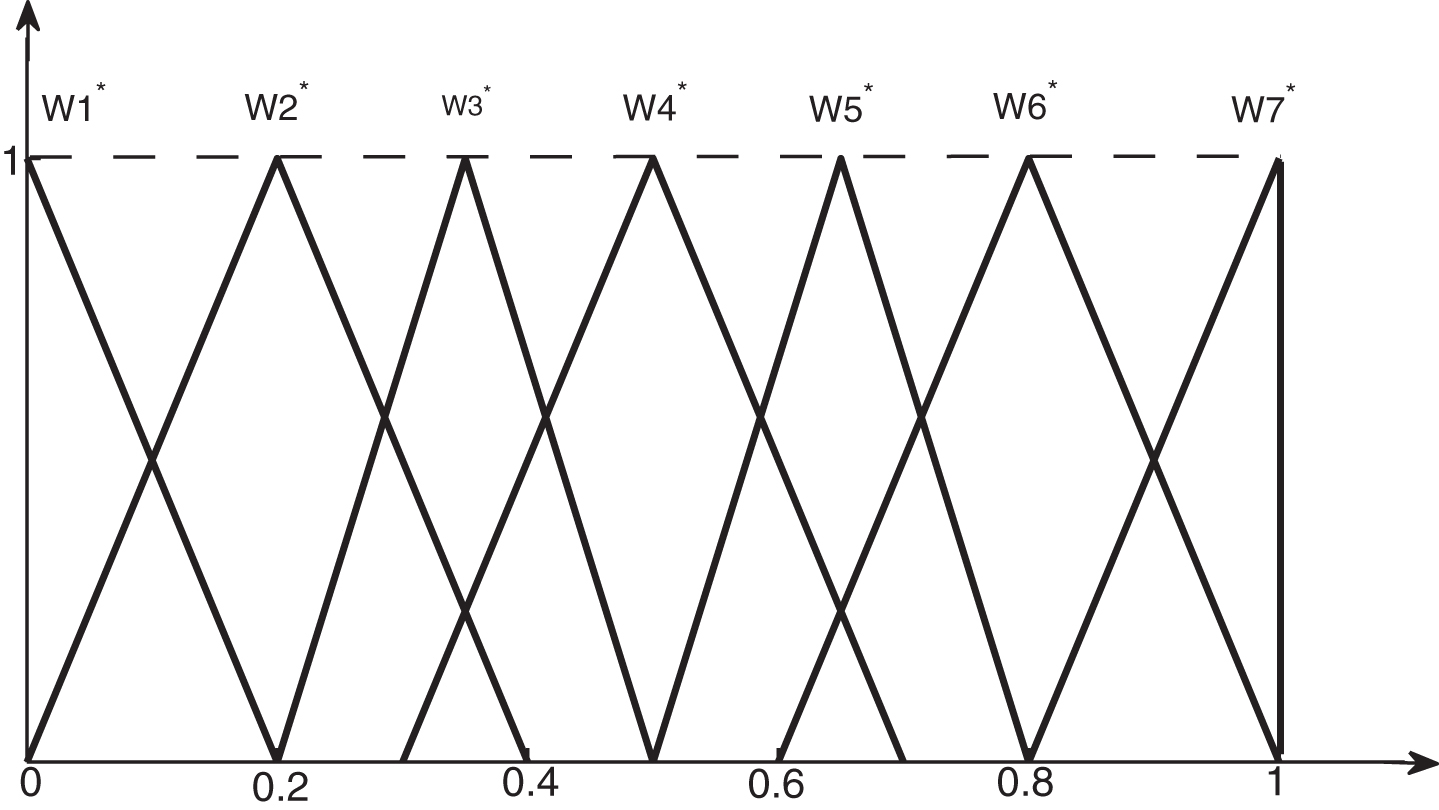
Membership functions for the weight to CAs.
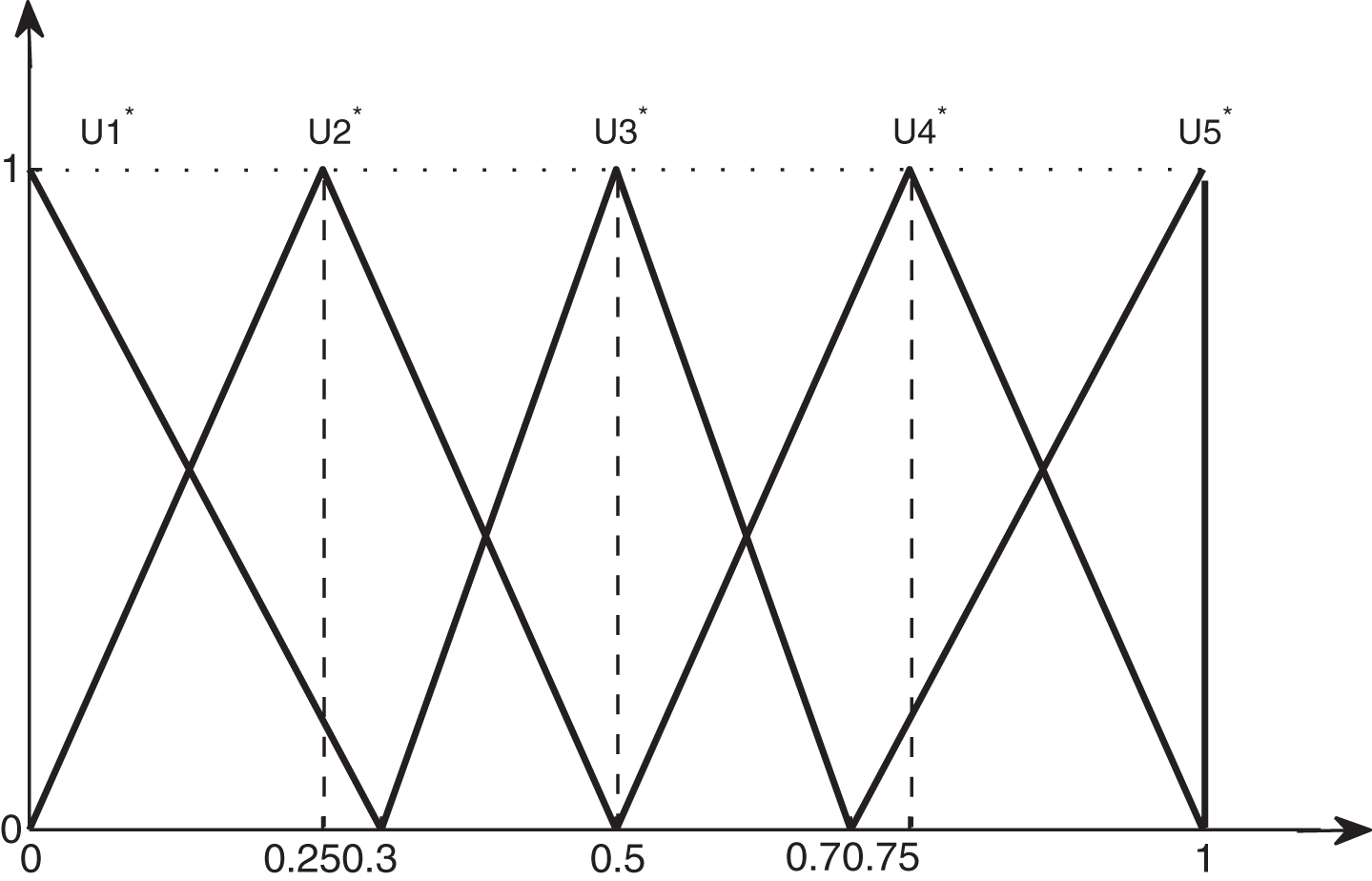
Membership functions for the relationship strength.
Weight W i of the 10 experts on CR i
Part 2. Determining the fuzzy importance of TAs. The NLP models of P1 and P2, which obtained by fuzzy weighted average, are converted into the objective penalty function models given in P1 (M) and P2 (M) to solve, and the results of
The exactness of objective penalty function method and traditional method
The exactness of objective penalty function method and traditional method
Part 3. Rating the fuzzy importance of TAs. The ranking of TAs with the fuzzy number will be obtained by TOPSIS method based on the weighted Hamming distance. In the new method, taking into account the preferences of decision makers, the value of β will be defined as 0, 0.25, 0.5, 0.75, 1. The relative closeness of each TA and the ranking in different β as shown respectively in Table 7. To comparison, the results obtained in traditional method are also shown in Table 7.
In the traditional method, the rating of TAs is TA3≻ TA7≻TA1≻TA2≻TA4≻TA8≻TA6≻TA9≻TA10≻TA5 (where ≻ means “at least as preferred as”). In fact, this rating should be the same as that obtained by the new method when the preference factor β = 0.5, which denotes a neutral attitude towards uncertain, that is to say, decision makers do not consider the uncertain preference. However, as can be seen from Table 7, the ranking of TAs is TA3≻ TA7≻TA1≻TA4≻TA2≻TA8≻TA6≻TA9≻TA10≻TA5 when β = 0.5. The reason they are different as follows: By using the linear programming model, when h = 0 and h = 1, the fuzzy number of TA2 and TA4 can be calculated respectively as (0.2456, 0.4868, 0.7390) and (0.2316,0.4880,0.7382). By using the objective penalty function method, the fuzzy number of TA2 and TA4 can be obtained respectively as (0.2342, 0.4828, 0.7335) and (0.2312, 0.4915, 0.7401). Comparing them in pairs, it is easy to see that the error is over 0.01 only between the value of
In addition, from Table 7, the different values of β are considered, the rating of TAs is different. When β = 0, 0.25, 0.5, TA10 ≻ TA5 (where ≻ means "at least as preferred as"); and when β = 0.75, 1, TA5 ≻ TA10. Assume that C5 = C10, we can calculate that β ≈ 0.6040. Therefore, when β > 0.6040, the rating of TAs is TA3≻ TA7≻TA1≻TA4≻TA2≻TA8≻TA6≻TA9≻TA10≻TA5; and when β > 0.6040, the rating of TAs is TA3≻ TA7≻TA1≻TA4≻TA2≻TA8≻TA6≻TA9≻TA5≻TA10.
Finally, taking computing time of this task into account in Matlab, we get that the computing time is about 0.9959s in the new method and about 1.2777s in the traditional method.
By investigating the customer’s thoughts, we summarized eight customer requirements, which are defined by CR i (i = 1, 2, . . . , 8) as follows: fast refrigeration (CR1), low power consumption (CR2), low noise (CR3), environmental protection (CR4), beautiful appearance (CR5), multi-function (CR6), low price (CR7) and simple operation (CR8). Simultaneously, 10 product qualities which are known as technical attributes are defined by TR j (j = 1, 2, . . . , 10) as follows: refrigeration capacity (TA1), power consumption (TA2), noise level (TA3), insulation layer thickness (TA4), box size (TA5), temperature control mode (TA6), cooling mode (TA7), additional function (TA8) and input power (TA9).
Part 1. Date acquisition and review. Similar Example 1, the importance of CRs are expressed as the linguistic data at seven levels, a pre-defined triangular fuzzy weight set
Weight W i of 10 customers on CR i
Similarly, the relationships between CRs and TAs are linguistically judged as five levels, which can be expressed by a pre-defined triangular fuzzy set
4 in Example 1). Ten experts participated in the assessment of the relationships between CRs and TAs, and by integrating the individual assessments of experts using the fuzzy numbers, the final relationships between the CRs and the TAs can be obtained as shown in Table 9.
Weight W i of the 10 experts on CR i
Part 2. Determining the fuzzy importance of TAs. By the objective penalty function, the results of
The exactness of objective penalty function method and traditional method
The exactness of objective penalty function method and traditional method
Part 3. Rating the fuzzy importance of TAs.By these fuzzy numbers of TAs in Table 11, the TOPSIS method based on the weighted Hamming distance is used to rank these nine TAs. When the preference value of decision makers is equal to 0, 0.25, 0.5, 0.75 and 1, respectively, based on the relative closeness C j , the rankings as shown in Table 11. To make a comparison with the traditional method, the rating by which is also given.
The results show that the ranking of TA1 and TA8 is different when the uncertain preference β of decision makers are different. By calculation, β ≈ 0.7608 when C1 = C8. Therefore, when β < 0.7608, the rating of TAs is TA7≻ TA2≻TA9≻TA4≻TA6≻TA3≻TA8≻TA1≻TA5; and when β > 0.7608, the rating of TAs is TA7≻ TA2≻TA9≻TA4≻TA6≻TA3≻TA1≻TA8≻TA5. What’s more, compared with the traditional method, the new method take the preference of decision makers in consideration and get the different rating by different preference factor. And when decision makers do not consider the uncertain preference, that is β = 0.5, the rating of TAs in the new method is same as in the traditional method. Therefore, the top four are relatively stable, namely: Cooling mode (TA7), power consumption (TA2), input power (TA9) and insulation layer thickness (TA4).
Finally, taking computing time of this task into account in Matlab, we get that the computing time is about 0.7789s in the new method and about 1.1991s in the traditional method.
In general, in order to determine the importance of TAs in fuzzy QFD, the paper proposed a new method, which mainly includes three parts: (1) Date acquisition and review. The important level matrix of CRs and the relation matrix between CRs and TAs are determined in this part; (2) Determining the fuzzy importance of TAs. Here are two innovative points: (a) For solving constrained nonlinear programming problems, the exact penalty function is used. What’s more, in the traditional exact penalty function methods, the constraint penalty parameter need to be continuously increased, which makes it not efficient in practical computing of Matlab. So the objective penalty function method with objective penalty parameter is proposed; (b) The new method adopts the fuzzy method approximate fuzzy number method, which only takes h = 0 and h = 1 by solving the proposed two constrained non-linear programming problems to obtain the fuzzy importance of each TA; (3) Rating the fuzzy importance of TAs. In this part, the TOPSIS method based on weighted Hamming distance is proposed to get the raking of TAs. This method takes fully into account the uncertain preferences of decision makers.
Finally, we can draw the following conclusions from the Examples 1 and 2: (1) In the part of calculating the fuzzy importance of TAs, the value of
In short, a new method to rating TAs in fuzzy QFD is proposed, which can provide more suitable options for decision makers. Furthermore, the new method also may be proved to apply in some cases that the level important matrix and the relation matrix of fuzzy QFD are defined by trapezoidal fuzzy numbers or intuitionistic fuzzy numbers in future studies.
Footnotes
Acknowledgment
The authors acknowledge the support from the General Program of National Natural Science Foundation of China under Grants 11671250.