



Abstract
This paper studies the flight path optimization problem of air cargo companies in aviation line alliance. There are two limitations in this paper. One is to limit of the number and location of airbases and capacity in the air network. The other is to limit of flight time and airspace capacity of full cargo aircraft in actual operation. Considering the influence of alliance on operation, the selection probability of air alliance is introduced. It is assuming that all cargo aircraft is one type, the unit transportation cost of every aviation line is the same as each other, the queuing problem of aircraft landing is not considered, and the network transportation demand of itself must be completed by an airline. It proposes a directed aircraft fleet routing problem optimization model (SMDDDAAAFRPTW) with multi-airbase stochastic and time constraints to minimize total operating cost and flight distance. Using the multi-objective optimization algorithm NSGA-II by most scholars, and improving the initial solution generation step, introducing Genetic engineering into cross-mutation to solve the optimal number and location of air bases and fleet routing of multiple aircraft. Comparing with the weighted method and ant colony algorithm, it shows that the improved NSGA-II algorithm is effective and has better computational efficiency. The results show that the more segments are selected for outsourcing, the lowest cost of network and the lowest carbon emission. This kind of decision-making behavior is only suitable for the initial operation phase of the enterprise.
Keywords
Introduction
At present, with the increase of global air cargo demand, the environment also puts forward bigger requirements. China’s low carbon plan proposes to reduce the carbon dioxide emissions of civil aviation units by 11% in 2020. Therefore, under the premise of increasing business demand and air pollution caused by air transport, how to reasonably plan air transport options and fleet routes is an important issue. In this paper, the problem of aircraft fleet route optimization under the airline alliance is studied. Through the airline alliance, the mileage is saved and the number of aircraft usage is reduced, so as to reduce the environmental pollution of air transportation and the business cost of enterprises. At present, there are few researches on the coalition choice of air transportation. Most scholars focus on the impact of the Coalition on customers, the optimization mode of network and the distribution of interests under the coalition. This study is based on the revenue that a cargo airline and other air passenger or cargo companies can obtain according to the transportation choice behavior of different segments under the route alliance to determine the probability of choice behavior.
So the problem of aircraft fleet route optimization with multi-airbases stochastic and time constraints under route alliance can is presented in this manuscript. In this paper, the route alliance is considered to determine the aircraft fleet route optimization problem under self operation selection. Compared with the previous route optimization problem, this paper proposes a new route problem, that is air transportation problem with multiple starting and ending points. It refers to the transportation of each segment as a group of starting and ending points. All requirements are directed. And a new alliance cooperation is introduced to determine the optimal problem. So this paper will perform the following steps. Firstly, the probability function of route alliance selection is introduced. It is assumed that there is only one type of cargo aircraft, the unit transportation cost of each segment is the same, the problem of aircraft landing and queuing is not considered, and the demand of its own network transportation must be completed by one airline. All aircraft can only stay overnight at the base airport, and a double-layer objective optimization model of cost minimization and carbon emission minimization is established. The description of the probability function of route alliance selection is to use the improved prospect theory to analyze the game and determine the transport choice behavior of air freight companies in different segments. Design the adaptive NSGA-II algorithm solution model, and compare with the weighted algorithm, and analyze the case of a domestic air freight company to illustrate the optimal route scheme and route operation selection of the airline.
Literature review
(1) Aircraft Fleet Route Literature and Its Limitation
For the research of aircraft fleet route optimization, most scholars have established aircraft fleet route deployment or scheduling model. The main purpose of the study is to minimize the cost, balance the use of aircraft and alleviate congestion. Evaluation model of route choice. Dipasis B. et al. [1] used a binary logit regression model to determine the choice of routes by the users employing instrument flight rules, was found that operational characteristics, such as distance, commercial flights, and altitudes of the flights are critical. Mathematical programming model of Cost minimization. Yu Zhuo [2] established aircraft fleet route deployment model with the goal of aircraft use balance and cost minimization, and applied the actual data of airlines to solve the problem, obtained a feasible deployment scheme, which provides decision support for airlines. Feng Xiang et al. [3] solved the problem of inbound flight scheduling under the condition of multiple runways, which required the sum of squares of total flight delay time and total delay cost to be the least. Xu J. et al. [4] quantify the fuel and cost benefits of applying extended formation flight to commercial airline operations. Mathematical programming model of time minimum. Zhang Wei [5] takes the minimum relative deviation between the actual total flight time and the expected flight time as the objective function to determine the assignment between the aircraft and the flight section on the premise of meeting the aircraft scheduling instructions and the aircraft maintenance plan. Wu Donghua [6] aims to solve the problem of aircraft scheduling with the priority of aircraft flight time balance, aircraft take-off and landing times balance and aircraft waiting time minimum. Wang T.C. et al. [7] established times constraint model to meet both optimal sequence and minimal changes of scheduled time of arrival from estimated time of arrival requirements. Mathematical programming model of safety factor. Liu Jiapeng et al. [8] considered the safety factor and task completion degree, and applied the weight penalty function to comprehensively consider the influence of various factors to establish the model. Mathematical programming model of reducing flight delay. Cai K. et al. [9] discusses the problem of alleviating airspace congestion and reducing flight delay simultaneously in air traffic flow management to establish a multi-objective air traffic network flow optimization. Mathematical programming model of other factors. Wei Xing [10] established a phased aircraft scheduling optimization model. Firstly, the nonlinear model of aircraft integrated scheduling problem is established, and further considering the constraints of aircraft type assignment, route generation and flight restriction, the 0-1 integer optimization model of aircraft integrated scheduling with weekly scheduling period and maintenance opportunity is constructed. Zhong H. et al. [11] established a dual objective integer programming model to solve the problem of flight departure scheduling with partial constraints between adjacent airports. Zhang, Y. et al. [12] based on the route air traffic system model composed of route, waypoint and airport, a route scheduling model is proposed. Under the safety related constraints, such as the capacity of the route and the airport, and the speed of the aircraft, the unit transport flow mechanics model is used to describe the system dynamics. Younghoon C. et al. [13] established a maximum-flight-time-constrained multitrip vehicle routing problem with time windows optimization model by small unmanned aircraft systems. Ho-Huu V et al. [14] present the development of a two-step optimization framework to deal with the design of aircraft departure routes and the allocation of flights to minimize cumulative noise annoyance and fuel burn.
There is less research on the flight route of aircraft in the aviation network such as Vehicle Routing Problems, and there is less research on the service level as the objective function. So the paper will establish flight route of aircraft model to solve the flight route optimization.
(2) Methodology
The solutions to aircraft fleet route optimization problems mainly include accurate algorithms, heuristic algorithms. Accurate algorithm. Wei Xing [10] adopt branch and bound method to solve Integrated optimization model of aircraft scheduling. Wang Lu et al. [15] study on the accurate algorithm of multi-objective optimization of inbound aircraft scheduling. Zhang y et al. [12] propose Lagrange relaxation method Distributed flight routing and scheduling for air traffic flow management. Zheng Q.M. et al. [16] used a graph model of the airport structure to solve the route segment. Fuzzy optimization algorithm. Wu Donghua et al. [6] developed fuzzy decision theory based on multi-objective. Heuristic algorithm. Yu Zhuo and Fan Wei [2] developed flight string generation algorithm airport flight route scheduling optimization management. The papers that are interested in detailed reviews of adaptive genetic algorithm are referred to Liu Jiapeng and Zhang Xuesong [8], Feng Xiang and Yang Hongyu [3], Feng Xinling et al. [17], Li Yaohua and Wang Lei [18], Seongim C. et al. [19]. Most papers putted to use hungarian algorithm [5], particle swarm optimization algorithm [20], tabu search algorithm [11], variable neighborhood search algorithm [21], simulated annealing algorithm [22], separation algorithm [23] to solve aircraft scheduling problem.
Based on previous research, this article will take aviation alliances as a breakthrough, consider alliance selection, cost optimization, and carbon emissions optimization as the basis for decision-making, and improve heuristic solving algorithms to solve problems.
Model establishment
In this section, we present the aircraft fleet route optimization model, but needs to be assumed that the demand for all OD demands do not exceed the capacity of one aircraft, the traffic volume response in the flight process, as show in Fig. 1. It is assumed that the aircraft landing takes the same time and staggers the landing time, so there is no queuing problem. Segment capacity and flight time are restricted. Related to the actual flight restrictions, the cargo plane is allowed to fly at most once a day on the same segment. The unit transportation cost of each segment in the transportation process is the same. The unit transportation cost of the aircraft is related to the type of aircraft, assuming that the type of aircraft used is the same. If the segment operation is outsourced, the self operated freight volume of the segment airline is affected by the probability of other airlines flying in the segment.
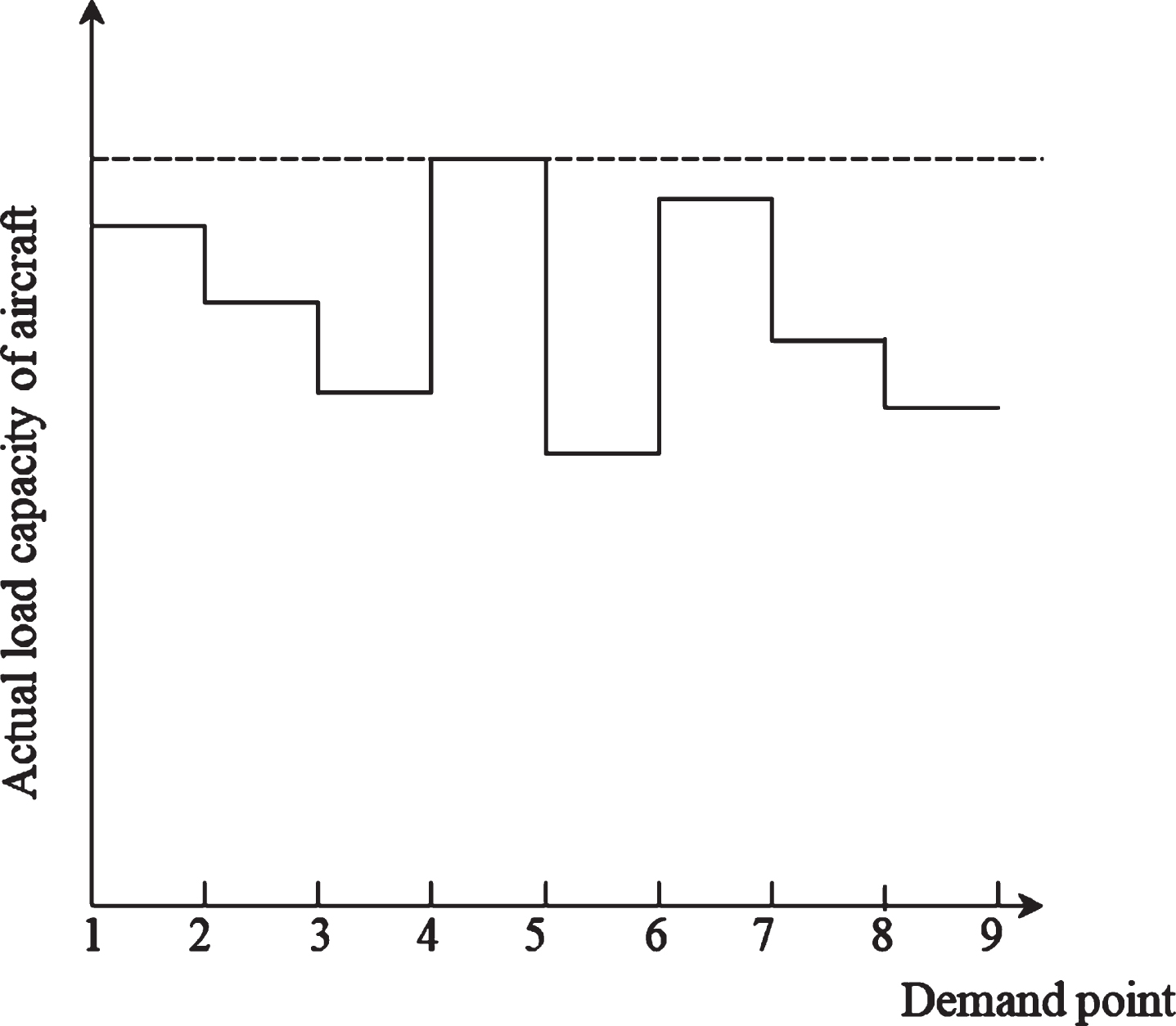
Traffic volume response during aircraft flight.
The problem of aircraft fleet route optimization with multi-airbases stochastic and time constraints under route alliance in the actual problems. The aviation network of airline company has m demand points and multiple alternative aviation bases N. Which the freight demand is D ij between of each demand points. In the actual flight, the capacity and time constraints on the segment and the capacity constraints of the aviation base are restricted. In addition, airline company adopts alliance each other. When the cost of the segment transportation self operation more than the outsourcing, the segment would take flight outsourcing which demand will be zero. This paper can be regarded as the research on that the optimization problem of aircraft fleet route with time windows and stochastic multiple depots in directed demand and aviation alliance, acroname SMDDDAAAFRPTW, as shown in Fig. 2.

SMDDDAAAFRPTW problem diagram.
There are N demand point, the demand and distance of point i to point j are D ij and d ij among of them, there are N′ air base. The cost of the airline’s operating process is C P including the fixed flight cost of the whole cargo aircraft in any segment. The fixed cost is C FO and unit transportation cost is C T ij . C W ij represents loading and unloading cost per unit weight. In addition, the takeoff and landing cost of the whole cargo aircraft in any segment is CPTL[i,j] and each takeoff and landing combined into one and the same. Unit time cost of downtime and waiting is c w . Unit time penalty cost for early start of service is c e . Unit time penalty cost of delayed service is c d .
In addition, the waiting time W
jt
of the full cargo t plane for the next segment service at the airport j is related to the total volume of unloading and loading of the aircraft at the airport, among of W
jt
equals (D
ijt
+ D
jit
) * ς1 + ς2, among of them, ς1 is loading and unloading time of unit goods, and ς2 is the fixed value of waiting time, which refers to the maintenance time before the flight of the aircraft. But the cost of waiting at the base airport is not included. Time window of flight allowed in the segment [i, j] is T[a,b][i,j], the actual starting time
In the actual operation of one route, airlines can choose alliance self operation or outsourcing according to the freight volume of the segment [i, j]. When airlines choose to join the alliance, the operation choice of different segments is related to their freight volume, freight volume of other cooperative airlines and operation choice of other cooperative airlines. When the airline chooses self operation, the business income is R1
ij
= P
x
* [t * C
T
ij
* d
ij
* D
ij
- (C
P
+ C
T
ij
* d
ij
* D
ij
)] + (1 - P
x
) * [t * C
T
ij
* d
ij
* D
ij
-
According to the risk aversion problem studied by Rieger, an improved prospect theory of loss value is proposed.
The weight function is used to reflect the degree of risk loss.
The improved risk-value function is used to describe the risk loss.
Therefore, the prospect theory function based on the improved risk-value loss is as follows.
If the decision-maker is more sensitive to the loss, then ϑ > 1. When the loss is not very sensitive, then, ϑ ≤ 1. λ1 and λ2 represent the concave and convex degree of the value function in the gain and loss, then 0 < λ1, λ2 < 1;p is the probability, ξ and τ represent the change degree of the weight, which also reflects the different attitudes of decision makers towards the gain and risk.
Therefore, A4 = (- ϑ+ ϑλ2 * C
W
* d
ij
* D
ij
) *
Among of them, C W is unit loss cost without carrier. ξ is the change degree of weight when positive income τ is the change degree of weight in case of negative return. ϑ is sensitivity of decision makers. λ1 is the concave and convex degree of value function in income. λ2 is the concave convex degree of value function at the time of loss.
In this paper, multi-objective aircraft fleet route optimization model is established with cost minimization and carbon dioxide emission minimization as objective functions. This problem can be abstracted as a new route optimization problem with time window for multi base random directed demand.
First objective: total cost minimization
The first part is fixed cost, which is the sum of fixed cost of aircraft and fixed cost of base. The second part is the transportation cost, which is obtained by multiplying the driving distance and the unit driving distance rate. The third part is loading and unloading, take-off and landing fees. The fourth part is the cost of waiting, which is obtained by multiplying the waiting time and the unit time rate, and the aircraft waiting at the base does not need to pay the waiting cost. The fifth part is the penalty cost of early service, which is proportional to the time difference. In the sixth part, the penalty cost for delaying service is directly proportional to the time difference. The seventh part is the penalty cost of transportation time, which is caused by the flight start time exceeding 24 hours. The eighth part is the penalty cost of unmanned transportation, that is both sides of the alliance have not allocated transportation capacity to complete the segment transportation.
Second objective: carbon emission minimization
According to the International Civil Aviation Organization, the calculation of carbon emissions can be divided into landing and takeoff stage (LTO) and cruise stage [24].
Formula (14) indicates that the demand of each segment is met; formula (15) indicates that the number of air bases is limited; formula (16) indicates that all aircraft must start from the air base point; formula (17) indicates that all aircraft must return to the air base point; formula (18) indicates that the aircraft capacity of each base airport is limited; formula (19) indicates that all requirements are met Point service aircraft must leave from this demand point with flow balance constraint; formula (20) indicates that each demand segment can not be serviced; formula (21) indicates that the aircraft’s T carrying capacity in the segment [i, j] does not exceed the aircraft capacity; formula (22) indicates that if the starting flight time exceeds 24 hours, it is counted once, and if it does not exceed 24 hours, it is recorded as 0 times; formula (23) indicates that the segment is or must be completed at that time P1 ≥ υ. Only the flight can carry out the transportation of the next segment. Select alliance self operation, or alliance outsourcing. Formula (24) (25) (26) is the decision variable, where formula (24) represents the sub path reduction constraint; formula (25) is the decision variable, which indicates whether the segment [i, j] is selected by the aircraft T; formula (26) is whether the point o is the aviation base.
In this paper, the problem of aircraft fleet route optimization is studied, which needs to be solved as follows. Determine the self operating segment of the alliance. Determine the number and location of the optimal base of the company. Flight route of each aircraft.
Because genetic algorithm to solve route assignment problem is used by most scholars, and genetic algorithm is suitable for solving discrete problems. Then the paper select NSGA-II algorithm to solve the aircraft fleet route optimization problem, and the hybrid quantum evolution algorithm is used to solve the directed graph problem of aviation network by matrix coding. The improved NSGA-II algorithm has a relatively strong global search ability, especially when the crossover probability is relatively large, it can generate a large number of new individuals, which improves the global search range. The improved NSGA-II algorithm can improve the rationality of the algorithm The optimization process is shown in Fig. 3.

Algorithm flow chart.
Step 1: Improve coding form and parameter initialization
Two segment coding form is adopted. The first segment uses chromosome coding, with a total of individuals o, representing alternative aviation bases. The genes on each chromosome represent whether to choose as aviation bases, 1 represents aviation bases, and 0 is not. The second segment uses matrix coding to randomly generate individuals m * m within the feasible region, forming the initial population, in which the previous O individual represents alternative aviation bases. If there are two air bases and 10 demand points, a group of 10*10 will be generated. The numbered of [(1,3), (3,4), (3,4), (4,5), (5,1), (5,1), (2,6), (6,7), (7,8), (8,8, (8,2), (2,1), (1,2), (1,9), (9,10), (9,10),(10,1)] is representing the corresponding solution path, that is three aircraft are needed for transportation, and the service order is route 1 : 1-3-4-5-1, route 2:2-6-7-8-2-1-2, route 3:1-9-10-1.
Step 2: Evaluation of fitness value
According to the aircraft route optimization model, determine the appropriate fitness evaluation function, in this case Fit1 = Z1 and Fit2 = - Z2. So that the key to the solution lies in the calculation of the probability P1 of the alliance to select the self-supporting segment, the formation of the path Hamilton circle and the final self-supporting segment under the self-supporting segment. the probability P1 that the alliance chooses self operation and determines the self operation segment According to the formula (1) (2) (3), the self selection probability of the alliance among OD demand is calculated. When P1 ≥ υ, that is recorded as 1, otherwise it is 0, forming a new is matrix A = yij[m*m]. Forming the path Hamilton circle under the self-supporting segment
According to the matrix A, several Hamilton cycles are formed and the path is determined. At that time
In order to preserve the information of qubit, a new technique of Hamilton circle formation is proposed in this paper. The process is as follows: The location of the base airport will be determined, and the corresponding rows and columns will be deleted to form a matrix. If a row with all 0 is found, and the corresponding columns of the row are all 0, then this demand point will be deleted. The value of diagonal position can only be 0. If there are more than one 1 in a row of the matrix, take any one as 1, change the other position of the row to 0, and change the other position of the column corresponding to the 1 position to 0. If there is only one 1 in a row of the matrix, keep it. After traversing all rows, ensure that there is only one 1 in each row. If there is only one 1 in a column, keep this 1. If there are more than one 1 in a column, randomly select one 1, and move the other 1 to other columns without one. After traversing all columns, ensure that each column has only one 1. Ensuring that each row and each column have only one 1, forming a sub matrix. Subtract the submatrix from the matrix to get a new matrix, change all minus one in the matrix to 0, return to step 1, continue to complete the formation of Hamilton circle, until all 1 in the matrix are 0. Then form a group of paths from the first row of the first matrix, and form a chromosome. Insert the number of the base airport. The first principle is that the time meets the needs. The second principle is that the probability of all bases reaching and transmitting is 1 priority. The third principle is that one base is inserted for every six segments. At insertion, the original segment is repeated and directly the second segment of the next aircraft.
(3) All positions and corresponding segments of 1 are determined as self operation.
(4) calculation of fitness function
According to formula (4) and (5), calculate Fit1 and Fit2.
Step 3: Principle of domination
If at least one target of a chromosome p is better than that of the chromosome q, and all targets of the chromosome p are not worse than that of the chromosome q, then the chromosome p dominates the chromosome q, that is p ≥ q, and p1 > q1 or p2 > q2.
Step 4: Calculate order value By comparing the objective function values of the chromosome p and q, the population ordered was rank i . If p is dominated q, the order value ratio of p is lower than q. If it is not dominated, it has the same order value. According to the objective function value, select the chromosomes that have not been sequenced, and repeat the process until all the chromosomes in the population are graded.
Step 5: Calculate congestion distance
According to the ascending order of the order values, the target function values are mapped to different edge [-1, 1], and the congestion distance corresponding to the maximum and minimum values of each level is set to inf. For the chromosome not on the edge, the crowding distance is the difference between the two chromosomes, and the crowding distance of chromosome i is calculated according to formula (27) to formula (29).
Step 6: Select
According to the calculation results of Step3, Step4 and step5, the tournament method was used to select chromosomes N/2. When rank i > rank j , the chromosome j is better than the chromosome i, or when rank i = rank j and crowd d istance i < crowd d istance j , the chromosome j is better than the chromosome i.
Step 7: Improve crossover, improve variation
According to the crossing probability p c , using the technology of chromosome recombination and the idea of shear enzyme. First select any segment to cut, and express the cutting site as the cutting gene position, then select any length of the same cutting gene position in other positions of the chromosome to cut, and exchange the positions of the two segments.
Before crossing: 1-4-2-3-1-3-2-4-1-4-3
After crossing: 1-3-2-4-2-3-1-4-1-4-3
According to the mutation probability p m , it is the same as the improved crossover method. Based on a segment of gene in chromosome, a small segment of gene is selected to mutate. At the same time, after the mutation position, the same gene is selected to connect with the previous segment of gene, and a small segment of gene is mutated with the previous segment of gene.
Before mutation: 1-3-2-3-1-4-2-4-1-4-3
After mutation: 1-4-2-3-1-3-2-4-1-4-3
Step 8: Number of elites
The new population P (t) was formed by combining the chromosomes of parents and children. The next population P (t + 1) was obtained by sequence value, crowding degree and crossing. The chromosomes were selected according to the ascending sequence of fitness value, and finally the chromosomes N were selected.
Step 9: Terminate judgment
When the iterative algebra reaches the expected specification, the program is terminated, and the result is verified. The selected chromosome cannot output the result repeatedly, otherwise, Step2 is returned.
Parameter setting and basic information
According to the investigation and research of S airline company, The OD matrix of air freight volume of air freight company on a certain day in 2018 is shown in appendix Table A1.
During the actual operation of S airlines, the number of alternative bases is N = 7, The unit transportation cost is 330yuan/ton per 100 km, the maximum carrying capacity of the aircraft is Q = 30 tons, the fixed expenses required for each flight is C P = 25000 yuan/flight, the handling operation cost is CW = 500 yuan/ton, and the take-off and landing expenses of the aircraft are CP TL = 20000 yuan/flight. Shenzhen is determined the base of the airline. Other alternative base of the airline sets of the base are Guangzhou, Shanghai, Chengdu, Shenyang, Zhengzhou, Xi’an. In addintion, assuming the construction cost allocated to each day by the aviation base follows the uniform distribution U (3000004000000), the aircraft capacity Q N of each base follows the linear distribution y = 20 - 2 * x, and suppose the time window of each segment is [U(0,18), U(0,18)+U(2,6)]. Other parameters are shown in Tables 2 and 3.
All base of the airline company
All base of the airline company
Airline alliance operation parameter settings
Other parameter settings
The improved NSGA-II algorithm uses MATLAB R2016b software to run the calculation on the inter core i7-8550u CPU @ 1.80 GHz 1.99 GHz, 8.00GB memory computer.
Determine the initial solution of base of airline is (1,2,3,4,5,6,7), compare the influence of the different parameters for the improved algorithm, such as population size, crossover probability, mutation probability, maximum iteration, as show in Fig. 4. According to the results of Fig. 4, The best parameters of the algorithm are set as follows: population size N = 100, crossover probability pc = 0.8, mutation probability pm = 0.8, maximum iteration MAXGEN = 100. So the optimal results of the number of airports in different bases are shown in Table 4.

The value of different algorithm parameters.
Optimal results of the number of airports in different bases
According to Table 4, when the number of base airports is 7, the carbon emission is the smallest, the cost is also the smallest at this time. Because the more bases there are, the distance required for the aircraft to start from the base and return to the base will be reduced, and the number of aircraft required for route optimization will also be reduced. Optimal route scheme in this case is show in Table 5.
Optimal results of the number of airports in different bases
In this paper, two methods are used to compare and analyze the results.
(1) The weighted method is one of the commonly used methods to solve the multi-objective optimization problem. Because the dimensions of the two objectives are inconsistent, the dimensionless standard processing is needed. If
By adjusting the weighting coefficient ω1 and ω2, setting the step to 0.05. ω1 is form 0,0.05,0.1,... to 0.95,1.0, ω2 is from 1.0,0.95,0.9,... to 0.05, 0, in this time. we can get a set of Pareto optimal solutions, as show in Table 6.
Algorithm running time and result comparison
(2) Ant colony algorithm is suitable for searching path problem on graph, but the calculation cost will be large.
The results of the weighted method and ant colony algorithm are consistent with the improved NSGA-II algorithm. The improved NSGA-II algorithm is better than other two methods, whether it’s calculating speed or calculating results, so the improved algorithm is effective and efficient.
This section is an analysis of different influencing factors. By analyzing load capacity, fixed cost, cost sharing coefficient, OD demand, the degree of weight in case of negative return, sensitivity of decision makers and coefficient of return, we get the influence of different factors on the optimization result, which has a certain impact on the airline’s decision. And calculate ANOVA through 6 groups of calculation values by improved algorithm.
(1) Restriction of different load capacity Q
When the load capacity constraint Q becomes larger, the unit transportation cost of the aircraft selected on behalf of the airline will become larger. However, the self-supporting segment will be reduced. At this time, the cost and carbon emission under different Q = (30, 35, 40, 45, 50) influences are shown in Fig. 5, and the ANOVA paradigm of load capacity in Table 7. As a whole, with the increase of load capacity Q, the cost is getting lower and lower, and carbon emission is getting lower and lower. It shows that airlines can select the aircraft with more capacity limit in the transportation process. By analyzing the Table 7, it results show that the p-value is small, and the calculation results of the improved algorithm are stable of different load capacity.

Optimal results under different aircraft capacity constraints.
ANOVA paradigm of load capacity
(2) Fixed cost on aircraft C P
When the fixed cost C P of aircraft increases, the number of self operating segments will decrease. The cost and carbon emission under different C P = (25000, 30000, 35000, 40000, 45000) influences are shown in Fig. 6, and the ANOVA paradigm of fixed cost in Table 8. As a whole, with the increase load capacity Q, cost is getting lower and lower, and carbon emission is getting lower and lower. It shows that the fixed cost of airline aircraft greatly affects the optimal result. By analyzing the Table 8, it results show that the p-value is small, and the calculation results of the improved algorithm are stable of different fixed cost.
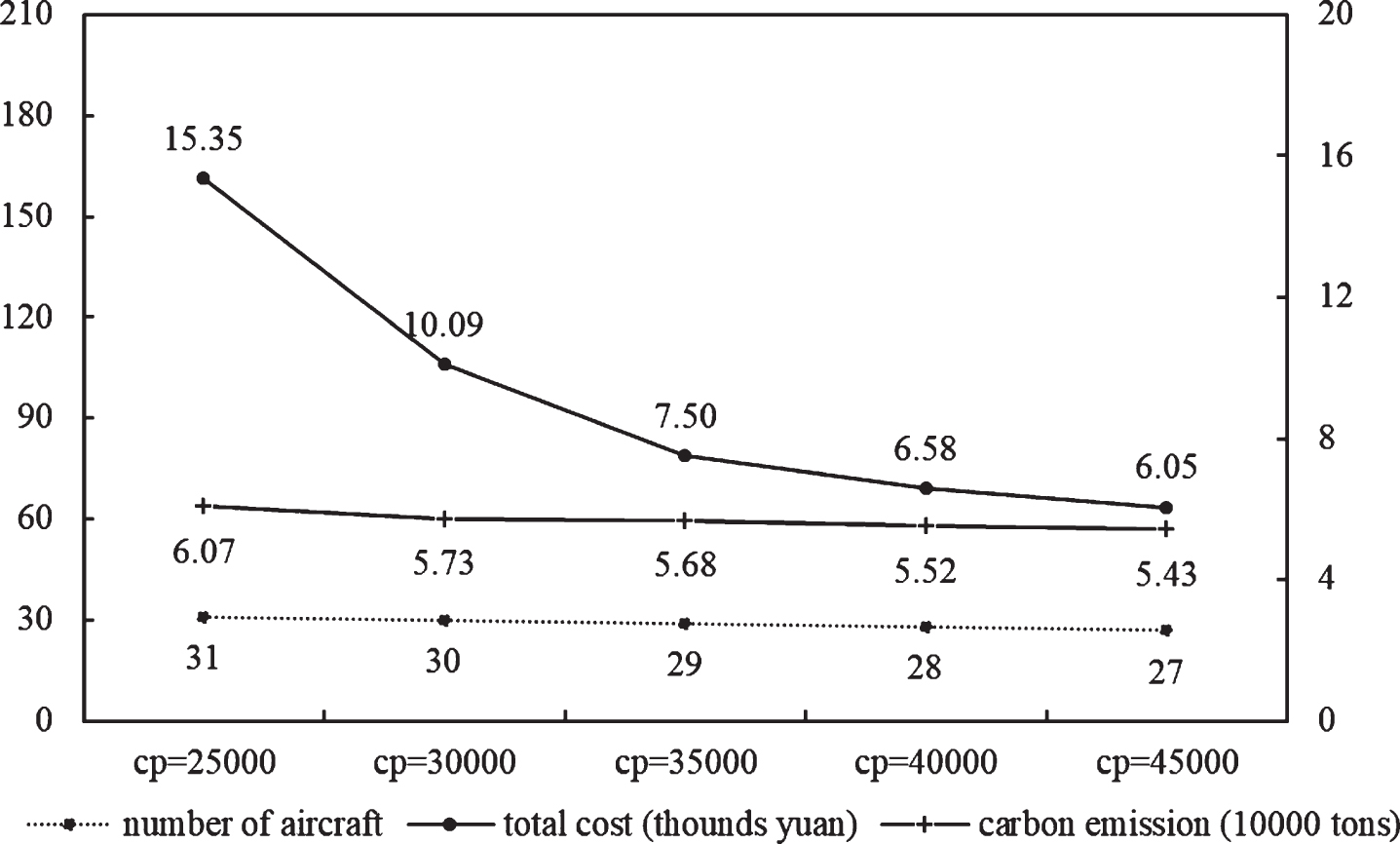
Optimal results of different fixed cost.
ANOVA paradigm of fixed cost
(3) Cost sharing coefficient α, β
When the coefficient of alliance self operation and alliance outsourcing changes, the decision-making of airlines will also change. When comparing and analyzing different values α = 0.4, β = 1.6, α = 0.6, β = 1.2, α = 0.6, β = 1.4, α = 0.6, β = 1.6 and α = 0.8, β = 1.6, the results are shown in Fig. 7, and the ANOVA paradigm of cost sharing coefficient in Table 9. It shows that the larger the cost of self operation α is, the smaller the probability of airlines choosing self operation is, the smaller the total cost is, and the lower the carbon emission is; the smaller the outsourcing cost β is, the smaller the probability of airlines choosing self operation is, the smaller the total cost is, and the lower the carbon emission is. Therefore, airlines should consider both cost and carbon emission in the choice of route transportation behavior. By analyzing the Table 9, it results show that the p-value is small, and the calculation results of the improved algorithm are stable of different cost sharing coefficient.
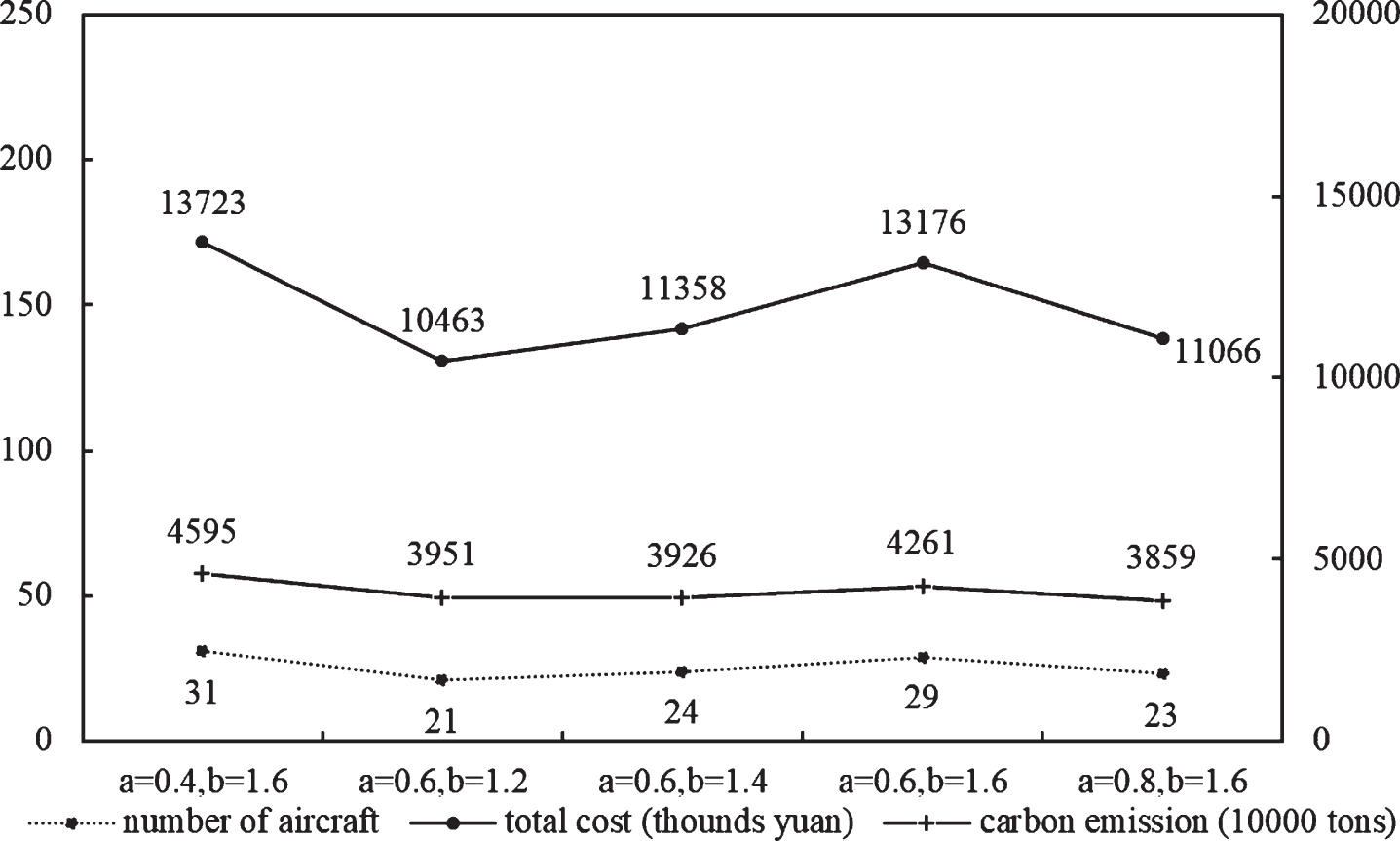
Optimal results of different Cost sharing coefficient.
ANOVA paradigm of Cost sharing coefficient
(4) the OD demand
The OD demand is the basis of transportation business. When the D = [D, 2D, 3D, 4D, 5D], the compare result is show in Fig. 8, and the ANOVA paradigm of OD demand in Table 10. The result shows that the more OD demand, the more the number of aircraft, the total cost and carbon emission. And when the OD demand multiplied, aircraft is needed more, the total cost and carbon emission is with linear increases. So more and more aircraft is needed to complete transportation business. So the more demand there is, the higher the cost and the smaller the scale effect. By analyzing the Table 9, it results show that the p-value is small, and the calculation results of the improved algorithm are stable of different OD demand.

Compare results under different OD demand.
ANOVA paradigm of OD demand
(5) the degree of weight in case of negative return
The weight in case of negative return represents the tolerance of decision makers to risk loss. When the τ = [0.6, 0.7, 0.8, 0.9, 1.0], the compare result is show in Fig. 9, and the ANOVA paradigm of the degree of weight in case of negative return in Table 11. The results show that when the degree of weight in case of negative return increase, number of aircraft, the total cost and carbon emission is increase too. But the growth rate is getting smaller and smaller. The smaller the impact of the degree of weight in case of negative return on the results. By analyzing the Table 11, it results show that the p-value is small, and the calculation results of the improved algorithm are stable of different the degree of weight in case of negative return.
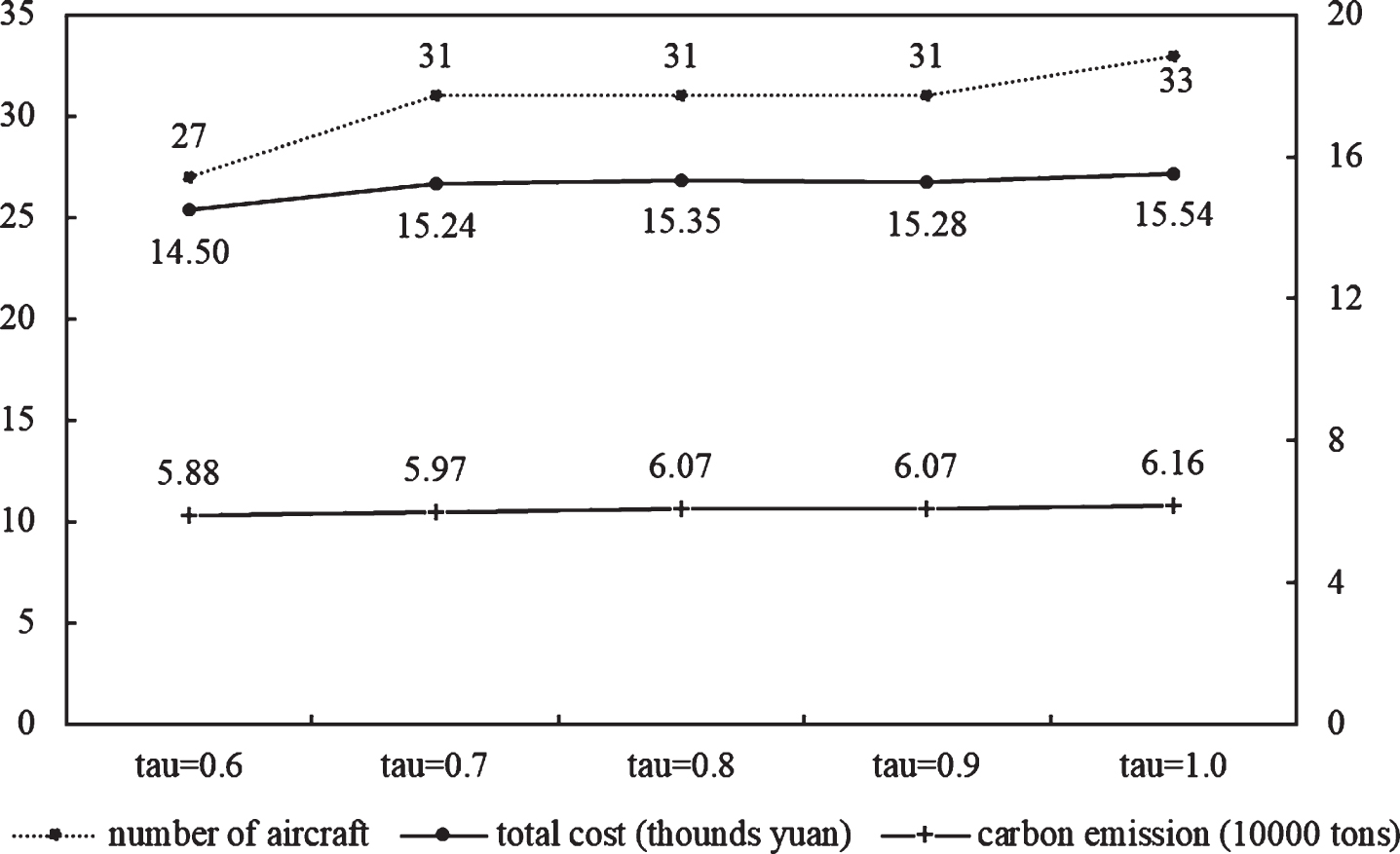
Compare results under different degree of weight in case of negative return.
ANOVA paradigm of different degree of weight in case of negative return
(6) sensitivity of decision makers
The sensitivity of decision makers represents the decision makers types. The more sensitive to the loss of decision makers, the more ϑ. When the ϑ = [0.5, 1.0, 1.5, 2.0, 2.5], the compare result is show in Fig. 10, and the ANOVA paradigm of sensitivity of decision makers in Table 12. The results show that when the sensitivity of decision makers increase, the number of aircraft, the total cost and carbon emission is increase too. But the growth rate is getting smaller and smaller. The smaller the impact of sensitivity of decision makers on the results. By analyzing the Table 12, it results show that the p-value is small, and the calculation results of the improved algorithm are stable of different sensitivity of decision makers.
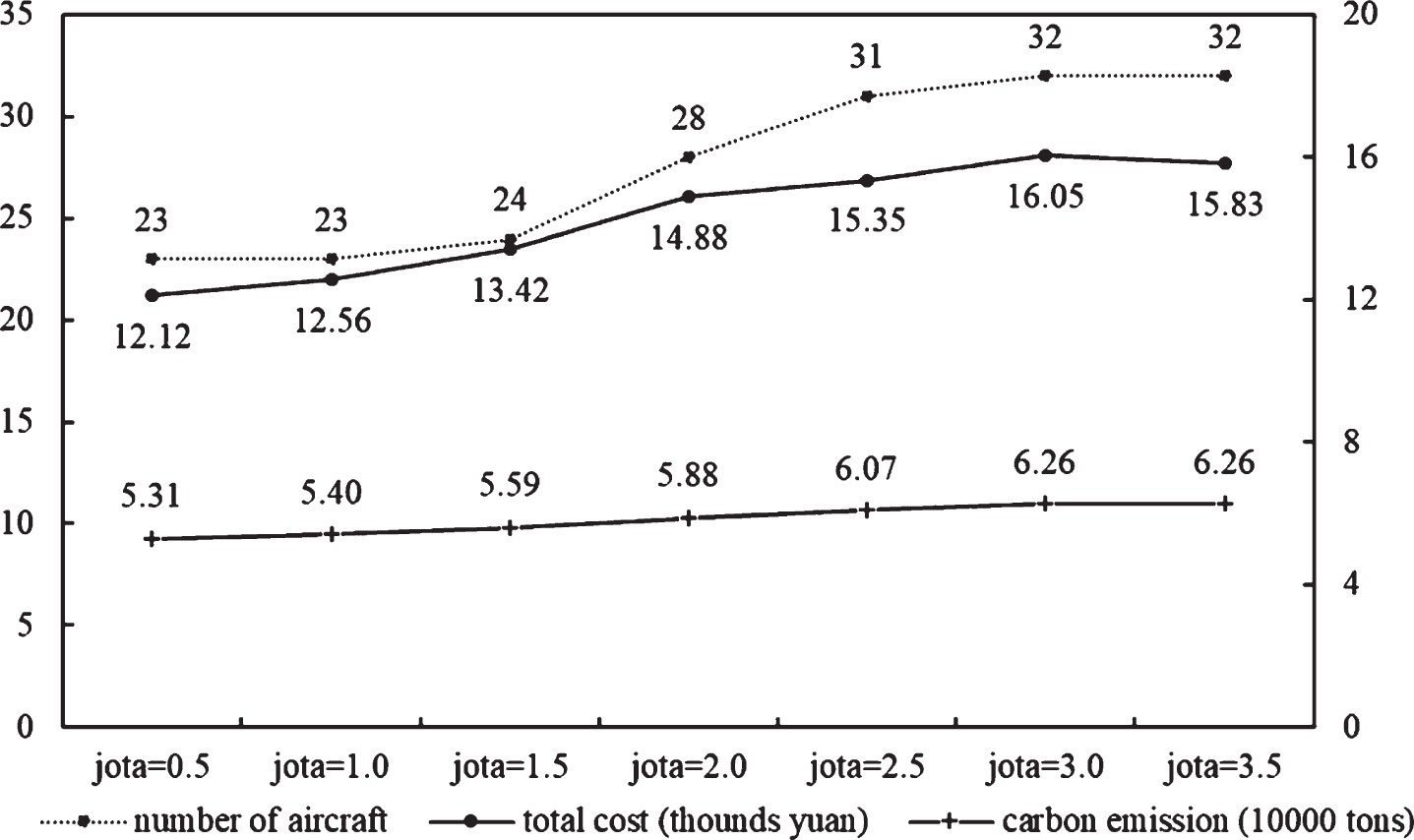
Compare results under different sensitivity of decision makers.
ANOVA paradigm of sensitivity of decision makers
(7) coefficient of return
Coefficient of return is the is the ratio of input to output in the process of airline operation. The more coefficient of return means the more profit. When the t = [1.5, 2.0, 2.5, 3.0, 3.5], the compare result is show in Fig. 11, and the ANOVA paradigm of coefficient of return in Table 13. The results show that when the coefficient of return is doubled, the cost is more than twice, and most of them adopt the self operating mode. By analyzing the Table 12, it results show that the p-value is small, and the calculation results of the improved algorithm are stable of different coefficient of return.
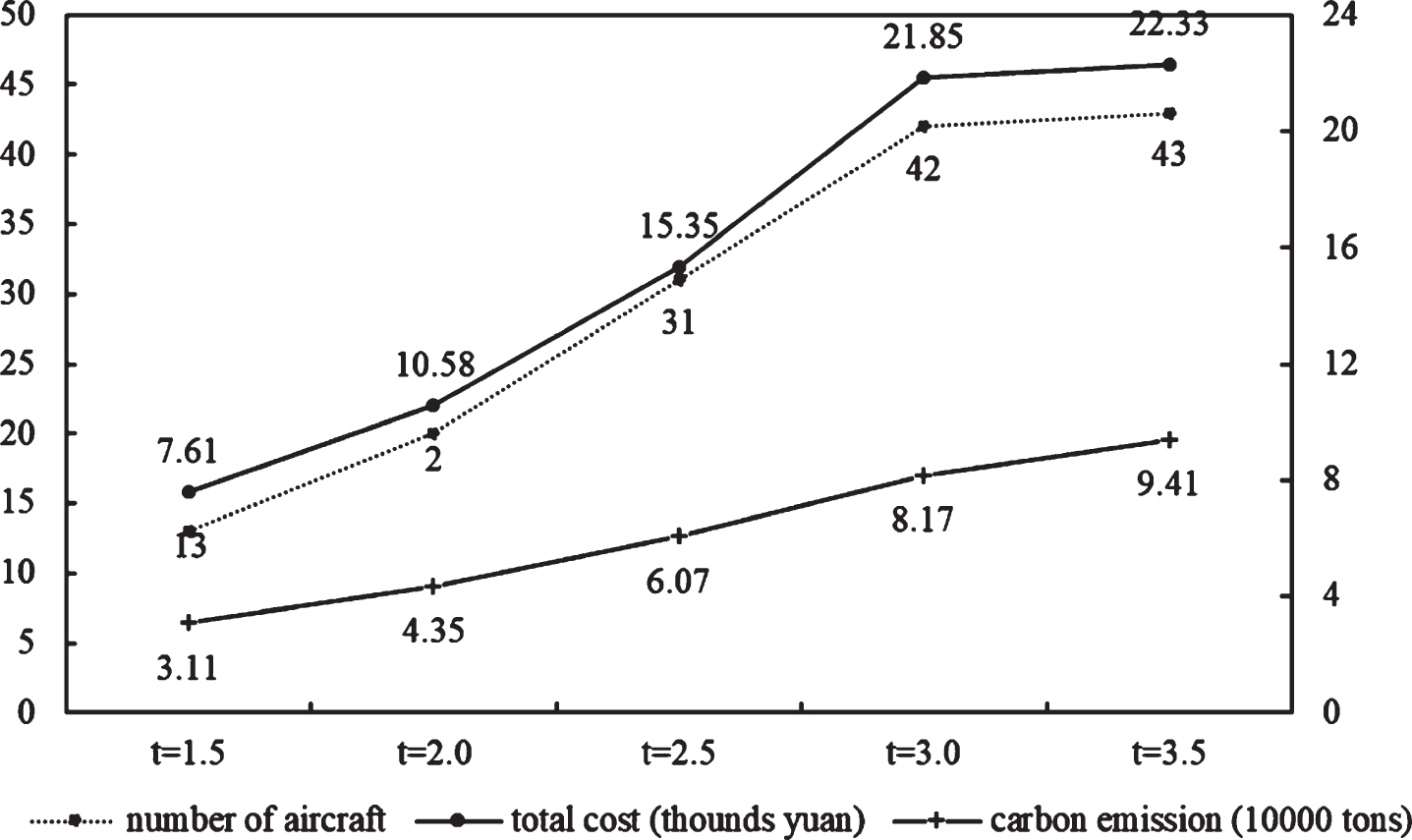
Compare results under different coefficient of return.
ANOVA paradigm of coefficient of return
This paper studies the problem of aircraft route optimization under the air alliance network, introducing alliance transportation selection behavior probability function. The aircraft route is a directed graph optimization problem, which establishes a 0-1 integer programming model to minimize the total cost and carbon emission. Firstly, the probability of self-supporting transportation is calculated by using the improved prospect theory, and the segment of self-supporting transportation is preliminarily determined. By using the improved NSGA-II algorithm, the final self-supporting transport segment and route are calculated.
Therefore, through the research of this paper, the following conclusions are drawn. Aviation alliance effectively solves the problem of high cost and high carbon emission of airlines. Through aviation alliances outsource small-demand operations, it can reduce waste of transportation resources and costs. By outsourcing business, this part of the business will be merged with other airline business, and carbon emissions will also be reduced. By comparing the improved algorithm NSGA-II with the weighted method and ant colony algorithm, it shows that the improved algorithm is better than the weighted method and ant colony algorithm in calculation efficiency and results. Airlines in different aircraft capacity limits, aircraft fixed cost, cost sharing coefficient, penalty cost, will have a certain impact on the choice of aircraft route and cost. With the increase of load capacity and fixed cost on aircraft, the more outsourcing business, cost is getting lower and lower, carbon emission level is getting lower and lower. The larger the cost of self operation, the lower the total cost and carbon emission; the smaller the outsourcing cost, the smaller the total cost, and the lower the service level. With the increase of OD demand, the degree of weight in case of negative return, sensitivity of decision makers and coefficient of return, the larger the total cost, and the higher the service level.
Footnotes
Appendix
OD matrix of air freight volume (unit: kg)
O\D
Shenzhen
Guangzhou
Shanghai
Chengdu
Shenyang
Zhengzhou
Xi’an
Beijing
Tianjin
Chongqing
Shenzhen
0
4978
1980
2020
1840
0
3654
5200
5953
550
Guangzhou
4700
0
3773
2915
2507
728
2903
8707
0
2574
Shanghai
3518
3173
0
12697
6815
0
5960
14175
6620
0
Chengdu
1878
2066
2165
0
1160
687
971
4453
4750
905
Shenyang
612
1713
2193
1344
0
457
774
2823
1962
1120
Zhengzhou
0
491
0
2555
1771
0
1415
2768
2365
0
Xi’an
2303
2156
3979
1157
1171
1174
0
7207
3854
1298
Beijing
6219
2896
5857
14490
0
1206
7121
0
4363
2295
Tianjin
5532
0
3542
5556
2817
2870
5727
23077
0
8252
Chongqing
2264
576
0
5020
1517
0
1845
1908
2540
0
Nanjing
1040
2183
433
2832
1061
0
0
332
1472
194
Wuhan
0
2134
1957
3007
1048
0
1043
5314
3845
301
ShiJia zhuang
1775
5
620
1882
0
0
1615
0
2651
61
Taiyuan
846
921
1243
0
393
73
783
2733
1673
858
Dalian
0
847
1661
747
0
431
618
0
939
769
Changchun
303
30
971
109
215
162
0
423
843
793
Harbin
1620
1129
2342
568
0
351
775
5074
1175
708
Hohhot
104
783
2041
499
0
369
313
1899
1574
1226
Ji’nan
270
657
1083
753
0
279
439
4698
887
475
Qingdao
285
558
618
259
0
0
0
616
323
330
Hefei
1080
3476
404
2984
1048
0
1160
0
4485
0
Hangzhou
1900
3325
4793
2330
2159
434
2454
733
5934
3863
Ningbo
214
381
0
1620
867
0
861
1301
2131
0
Wenzhou
546
2546
0
368
244
0
152
559
9
0
Fuzhou
1060
3860
0
2162
447
0
1383
3980
2053
0
Xiamen
630
515
1978
356
386
388
546
1938
59
0
Changsha
5031
16
1535
4676
2714
849
2779
5495
0
6162
Nanning
291
260
421
293
112
0
49
855
325
452
Guilin
495
0
405
122
0
0
90
642
0
631
Nanchang
0
72
408
888
189
0
431
2681
406
0
Guiyang
404
750
862
419
82
198
305
1360
1830
0
Kunming
784
1968
1770
1234
395
63
302
1363
0
924
Lhasa
98
0
0
4306
0
0
0
0
0
0
Haikou
200
0
0
491
347
0
2105
460
711
161
Lanzhou
505
457
1951
782
268
101
1254
1459
1000
422
Yinchuan
218
193
596
356
105
72
634
1326
603
284
Xining
218
320
330
296
0
115
469
993
881
1161
Urumchi
1590
984
3496
1396
0
133
2885
3538
1657
1727
O\D
Nanjing
Wuhan
Shijiazhuang
Taiyuan
Dalian
Changchun
Harbin
Hohhot
Ji’nan
Qingdao
Shenzhen
224
0
475
1681
0
540
0
485
564
396
Guangzhou
1578
5245
1612
954
1010
3498
704
1527
1909
2574
Shanghai
1754
3241
1500
5631
1264
4951
2183
4804
4257
847
Chengdu
2267
2623
1297
0
834
1091
397
809
965
133
Shenyang
1011
512
0
629
411
1534
0
0
0
713
Zhengzhou
0
0
0
1552
1648
897
605
791
730
374
Xi’an
0
1113
681
1096
482
0
220
646
660
1104
Beijing
0
5863
0
5942
0
259
3885
6134
5062
3878
Tianjin
5321
4735
9006
2802
2303
2587
1799
3920
2423
1638
Chongqing
2489
1831
418
1018
657
2258
277
4369
2552
1867
Nanjing
0
0
0
1014
0
0
439
843
703
938
Wuhan
0
0
279
1947
0
402
384
562
511
468
ShiJia zhuang
0
771
0
1067
0
0
946
610
303
0
Taiyuan
315
569
225
0
88
149
0
277
206
209
Dalian
0
0
0
148
0
0
0
0
0
0
Changchun
0
206
145
189
0
0
74
119
99
36
Harbin
935
1282
494
273
382
838
0
0
0
177
Hohhot
330
174
431
300
299
203
0
0
0
421
Ji’nan
534
238
545
225
237
345
0
0
0
434
O\D
Nanjing
Wuhan
Shijiazhuang
Taiyuan
Dalian
Changchun
Harbin
Hohhot
Ji’nan
Qingdao
Qingdao
179
375
0
54
0
0
0
77
133
0
Hefei
0
1264
0
1068
0
0
182
652
903
361
Hangzhou
10
1875
0
1313
0
762
1162
1808
1052
1342
Ningbo
0
0
234
1340
758
139
132
0
394
239
Wenzhou
652
612
86
60
87
200
69
206
0
66
Fuzhou
2233
1257
532
948
149
611
318
124
361
0
Xiamen
908
584
502
632
47
483
27
142
326
18
Changsha
1717
3237
1352
716
1057
1351
1133
1924
1083
271
Nanning
338
230
98
342
0
98
57
79
84
0
Guilin
0
0
0
0
0
0
0
0
0
0
Nanchang
571
0
254
1964
0
202
78
149
194
122
Guiyang
469
376
0
0
87
107
48
78
61
0
Kunming
404
826
584
1004
427
596
68
167
347
0
Lhasa
0
0
0
84
0
0
0
0
0
0
Haikou
0
127
0
474
11
483
0
0
0
0
Lanzhou
359
464
152
180
99
273
55
66
52
183
Yinchuan
73
108
0
120
0
55
0
0
61
0
Xining
277
185
0
193
0
0
0
0
0
0
Urumchi
661
1750
426
222
137
132
79
0
0
0
O\D
Hefei
Hangzhou
Ningbo
Wenzhou
Fuzhou
Xiamen
Changsha
Nanning
Guilin
Nanchang
Shenzhen
1932
1040
751
210
194
2708
2523
1080
107
0
Guangzhou
1405
6484
2018
5114
2519
511
428
335
0
119
Shanghai
764
1521
0
0
0
750
1546
2939
1075
1447
Chengdu
2203
1359
583
377
359
618
707
985
148
1187
Shenyang
914
1103
414
424
237
462
269
647
0
521
Zhengzhou
0
94
0
0
0
285
106
1238
699
0
Xi’an
1166
901
1256
442
279
814
683
558
353
1687
Beijing
0
2600
1698
625
346
2777
5602
2163
473
3822
Tianjin
9332
6347
3415
1362
828
1130
0
132
0
1481
Chongqing
0
3488
0
0
0
0
536
20
745
0
Nanjing
0
60
0
0
0
200
411
805
353
0
Wuhan
1373
1153
0
322
284
1634
2136
900
0
0
ShiJia zhuang
0
0
0
0
0
0
536
284
0
0
Taiyuan
600
495
178
201
39
234
231
616
0
357
Dalian
0
0
0
0
0
196
243
287
0
163
Changchun
0
104
101
43
0
194
248
40
0
168
Harbin
865
979
49
24
0
63
534
270
0
183
Hohhot
669
1521
493
0
0
0
261
182
0
147
Ji’nan
578
1306
105
116
72
134
161
211
0
165
Qingdao
89
645
90
0
0
0
190
0
0
0
Hefei
0
0
0
0
0
790
808
881
208
363
Hangzhou
0
0
1426
1154
1067
1105
1561
834
215
1253
Ningbo
0
43
0
0
0
0
124
348
104
0
Wenzhou
0
216
0
0
0
0
200
2
0
9
Fuzhou
285
1834
0
0
0
0
0
409
0
0
Xiamen
311
547
0
0
0
0
0
363
6
0
Changsha
2049
1667
3013
438
0
0
0
1114
467
0
Nanning
290
193
185
95
0
197
117
0
0
1687
Guilin
0
117
66
0
0
0
123
0
0
0
Nanchang
282
486
0
0
0
0
130
229
28
0
Guiyang
291
257
171
0
79
261
218
0
0
291
Kunming
298
480
246
430
774
658
0
529
0
0
Lhasa
0
0
0
0
0
0
0
0
0
0
Haikou
147
0
0
0
0
52
299
0
0
378
Lanzhou
124
367
401
73
160
206
435
0
0
216
Yinchuan
165
77
49
0
0
0
146
0
0
65
Xining
326
0
0
0
0
0
0
0
0
0
Urumchi
1249
124
535
0
0
138
86
0
0
120
O\D
Guiyang
Kunming
Lhasa
Haikou
Lanzhou
Yinchuan
Xining
Urumchi
Shenzhen
816
2747
218
392
321
279
306
612
Guangzhou
3334
4916
765
740
554
1505
618
3361
Shanghai
4166
3074
598
472
1352
1684
456
1803
Chengdu
641
2494
5450
194
797
506
311
1619
Shenyang
547
501
115
175
257
445
99
450
Zhengzhou
1543
717
245
355
365
564
570
635
Xi’an
1108
1028
363
944
3978
1730
1612
1104
Beijing
2897
2284
78
707
1776
2623
1393
2720
Tianjin
4771
5136
988
891
1174
1063
815
993
Chongqing
206
1916
832
202
251
913
157
839
Nanjing
1147
621
0
227
1038
707
0
1043
Wuhan
797
2002
225
305
228
274
287
503
ShiJia zhuang
138
257
0
60
165
46
47
338
Taiyuan
0
894
112
101
212
343
65
212
Dalian
0
287
0
0
84
0
0
0
Changchun
87
0
0
45
152
76
51
187
Harbin
175
265
0
84
23
88
5
34
Hohhot
150
116
0
132
12
0
0
373
Ji’nan
145
410
0
48
103
93
0
181
Qingdao
0
48
0
90
0
0
0
80
Hefei
726
1132
0
530
550
486
117
455
Hangzhou
1260
1160
0
778
488
557
288
1114
Ningbo
236
1400
0
64
524
49
0
373
Wenzhou
0
94
0
4
0
0
36
0
Fuzhou
675
1217
0
233
256
0
108
903
Xiamen
91
229
185
23
312
106
63
277
Changsha
1885
976
0
589
612
492
138
1093
Nanning
0
0
0
201
65
0
0
0
Guilin
0
0
0
82
0
0
0
0
Nanchang
69
1104
0
93
245
58
0
152
Guiyang
0
0
0
103
515
0
0
265
Kunming
1737
509
139
372
139
129
0
100
Lhasa
0
0
0
0
0
0
0
0
Haikou
811
0
0
0
0
0
0
0
Lanzhou
197
193
6
81
0
0
0
488
Yinchuan
0
111
0
0
0
0
0
0
Xining
0
134
177
90
0
0
0
135
Urumchi
71
145
0
45
1572
56
84
0