



Abstract
Due to increasing difficulty and challenging issues of newsboy problem under uncertainty, managers seek newer and appropriate approaches to apprehend more accurately the demand for perishable products and or the products having a short shelf life. This paper investigates a newsboy problem with fuzzy random demand in a single product business scenario. The classical newsboy model is extended to a fuzzy random newsboy problem to determine the optimal order quantity and expected profit under hybrid uncertainty. To solve the proposed model, a new solution approach based on chance constraint programming is proposed to formulate the crisp equivalent form of the fuzzy random newsboy model. Numerical examples and a real-life case study are presented to show the utility of the projected model. From the outcomes, decision makers can make comprehensive recommendations for the optimal order quantity and expected profit obtained by our proposed model under two-folded uncertainty. Also, a sensitivity analysis suggests that the profit and order quantity will increase (or decrease) with the increase (or decrease) of the mean demand.
Introduction
In production and inventory management it is very difficult and challenging to apprehend the demand parameter under uncertain environment and when decision makers (DM) deal with new product development, perishable/short life cycle products such as fashion goods, Christmas trees, greeting cards, etc. The distinguishing characteristic of these products is the single replenishment opportunity and the DMs have to decide the optimal number of quantity to be purchased before the beginning of the selling season to maximize his/her expected profit. Such inventory problems are called single-period inventory problem (SPIP) also termed as the newsvendor/newsboy problem [17].
Over the years, researchers mainly have had investigated newsboy problem using probability theory, where a random variable is extensively used to describe the uncertainty in demand parameter. With the ground-breaking work by Hadley and Whitin [7], much attention paid on production/inventory models considering single-item as well as multi-item cases with constraints. Nahmias and Schmidt [28] studied a multi-item newsboy problem (MINP) with random demand imposing linear budget constraints. An extensive investigation on the newsboy problem and its probable development was published by Gallego and Moon [6] and Khouja [17]. Moon and Silver [12] sustained the MINP with budget constraint issue considering the total worth of the replenishment quantities as well as the fixed price of non-zero replenishment. Furthermore, the MINP with uncertain budget constraint carried out by Vairaktarakis [8] using interval data and discrete demand settings. Ölzer et al. [1] imposed value-at-risk constraint for investigating risks in MINP with random demand. Thus, researchers pay special attention to SPIP and consider it an essential tool for inventory management due to its inherent attractive characteristics. A few extensions of the basic newsboy model are developed in the recent years. For instance, Qiu and Shang [26], Turgay et al. [34], and Wang et al. [4] solve the newsboy models in the probabilistic set-ups applying robust optimizing tools. Ma et al. [15] analyzed some vital issues of SPIP model, for example, loss aversion, and effect of supply and demand uncertainties since DMs only pay for an exact amount of quantity received by him/her. Chen et al. [30] studied a newsboy problem considering price-demand relationships and volume discounts for customers in cases of bulk-purchase. Recently, Mitra and Chatterjee [27] considered random demand in end-of-season to obtain the optimal order quantity in a SPIP and also compared it to the standard SPIP for determining the expected profit.
However, randomness is not the only form of uncertainty and probability theory is not sufficient to deal with the all real-world inventory problems. In many cases, it becomes difficult to get the demand distribution function of products because of insufficient information and historical data. In these cases, the demand parameters are imprecisely/vaguely quantified depending on the DMs/market experts’ knowledge-based opinion and subjective information provided by them from experience. Hence, the market experts have to supply their belief degree (confidence levels) while describing the uncertain product demand. In response, the fuzzy set theory (FST; Zadeh, 1965) have been used as practical and intelligent solution approach for dealing degree of imprecision and subjectivity in real life problems. With the advancement of fuzzy optimization techniques and fuzzy mathematical programming researchers like Ishii and Konno [10], Kao and Hsu [3], Li et al. [14], Ji and Shao [33], Panda et al. [5] and Dutta et al. [23] have also cultivated the newsboy model in the fuzzy environment. However, newsboy model with merely fuzzy demand could not be extended further. Since fuzzy newsboy models only can deal with the uncertainty due to fuzziness while they avoid inherent randomness which always exist in the demand. On the other hand, it is more important to note that classical newsboy models [7] deal with randomness and assume adequate amount of data is always available to obtain feasible solution of the different inventory problems. But, this idea is also inappropriate since it cannot be applied to many practical problems involve fuzziness as well as randomness in data. Thus, in many real cases, both of the randomness and fuzziness fall short to procure more practical and rational decision making in an SPIP under uncertainties ([19–21]). Hence, real-world circumstances indicate the necessity of more reliable and appropriate framework/approach which is able handle to hybrid uncertainty due to the coexistence of fuzziness and randomness in present competitive business market. Ever since Kwakernaak [11] introduced fuzzy random variables, related theories have been extensively developed and applied to solve problems with fuzzy random data having two-folded uncertainty. Dutta et al. [24] solved inventory control problem considering demand as a fuzzy random variable (FRV). Chang et al. [9] used fuzzy random theory to deal with uncertain lead-time in an inventory model with backorders and lost sales. Assuming annual demand as FRV a continuous review inventory model (CRIM) under hybrid uncertainty has been solved by Dutta and Chakraborty [22]. Dey and Chakraborty ([20, 21]) developed a periodic review inventory model (PRIM) with demand as FRV. Recently, some authors have studied distribution-free newsboy model under fuzzy random environment (Kumar and Goswami [25]; Adhikary et al. [13]). However, the classical newsboy model with fuzzy random simulation is still less addressed in the literature for providing broad guidelines to determine the optimal order quantity under uncertainty. In many practical inventory problems, the demand parameter has always some fuzziness and insufficient data (lack of information) due to several reasons. Hence the newsvendor (decision maker) seeks some market experts’ opinions and their belief degree about the uncertain demand of an item. For example, an expert confidently says if the product demand is “about ξ”. Now, this uncertain demand can be represented as a triangular fuzzy variable
The main objectives of this study are as follows: Extending the classical newsboy problem under hybrid uncertainty in the single-item business system. In order to solve the extended model, a new solution approach based on chance constraint programming is proposed to formulate the crisp equivalent form of the fuzzy random newsboy model. A fuzzy random simulation technique is used to find the optimal order quantity and total expected profit. Discuss a solution approach that can capture both the fuzziness and randomness of the product demand and covers not only the classical newsboy model but also the fuzzy newsboy model. A real case study from milk industry where the proposed model can be implemented.
The paper is prearranged into nine sections. After the introductory section, section 2 offers the basic concept of fuzzy random variables (FRVs), their properties, and the chance distribution of FRVs. Section 3 describes the relevant theorem on chance distributions for triangular fuzzy random variables. In the fourth section, the formulation of the newsboy problem with fuzzy random demand and its related theorem have been discussed. The fifth section discusses the solution methodology which involves chance constraint programming for FRVs and algorithms of fuzzy random simulation. Section 6 includes a numerical example to validate the proposed model while the seventh section presents an application of it to a real-world case study. In section 8, the outcomes of the proposed method are compared with the results obtained by previous methods. Finally, section nine concludes the paper along with the limitation and future scope of this study.
Preliminaries
In this section, we present some preliminary concepts of fuzzy random variable required for this study.
The credibility of the fuzzy event {η ≥ t} is characterized by
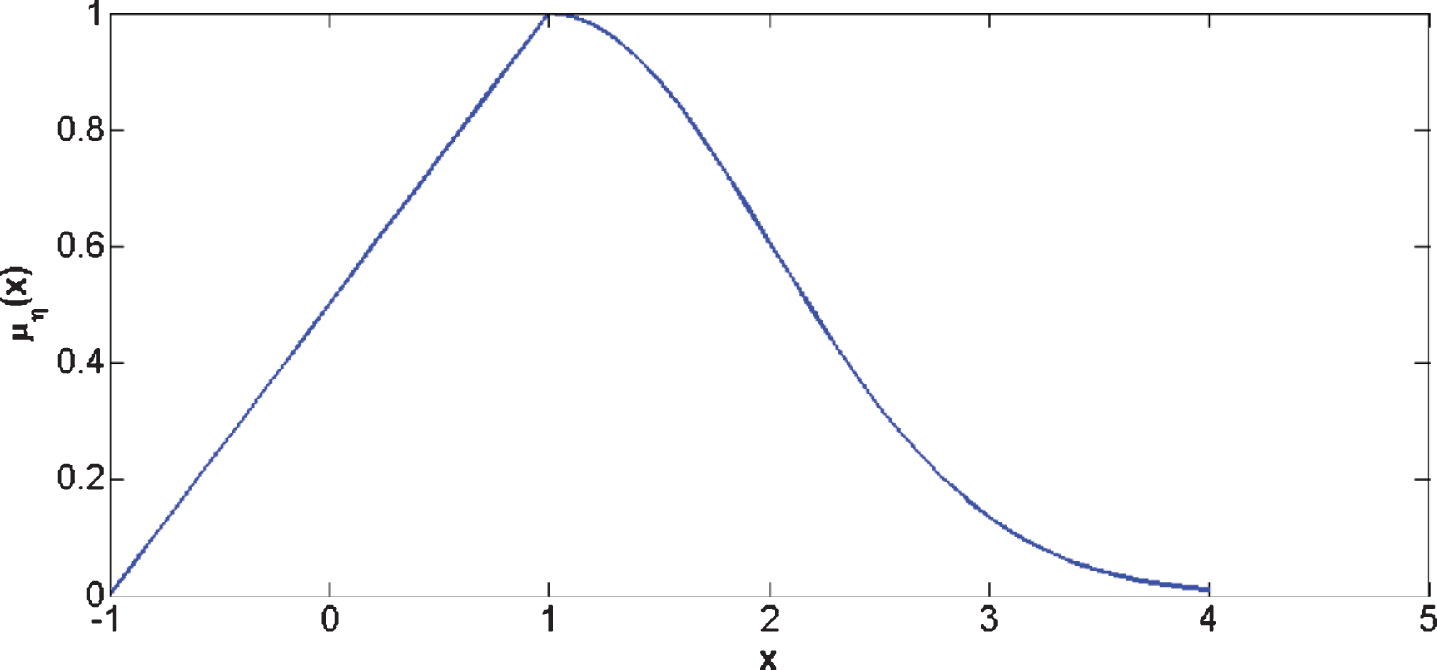
The possibility distribution of η.
Thus, the credibility of {η ≥ t} is
Since η is a continuous fuzzy variable, we have Cr {η ≥ t} =1 - Cr {η < t}. By the result of Example 1, we have
From definition 3 it is shown that if η is a fuzzy random variable, then
Let η be a fuzzy random n-dimensional vector, and
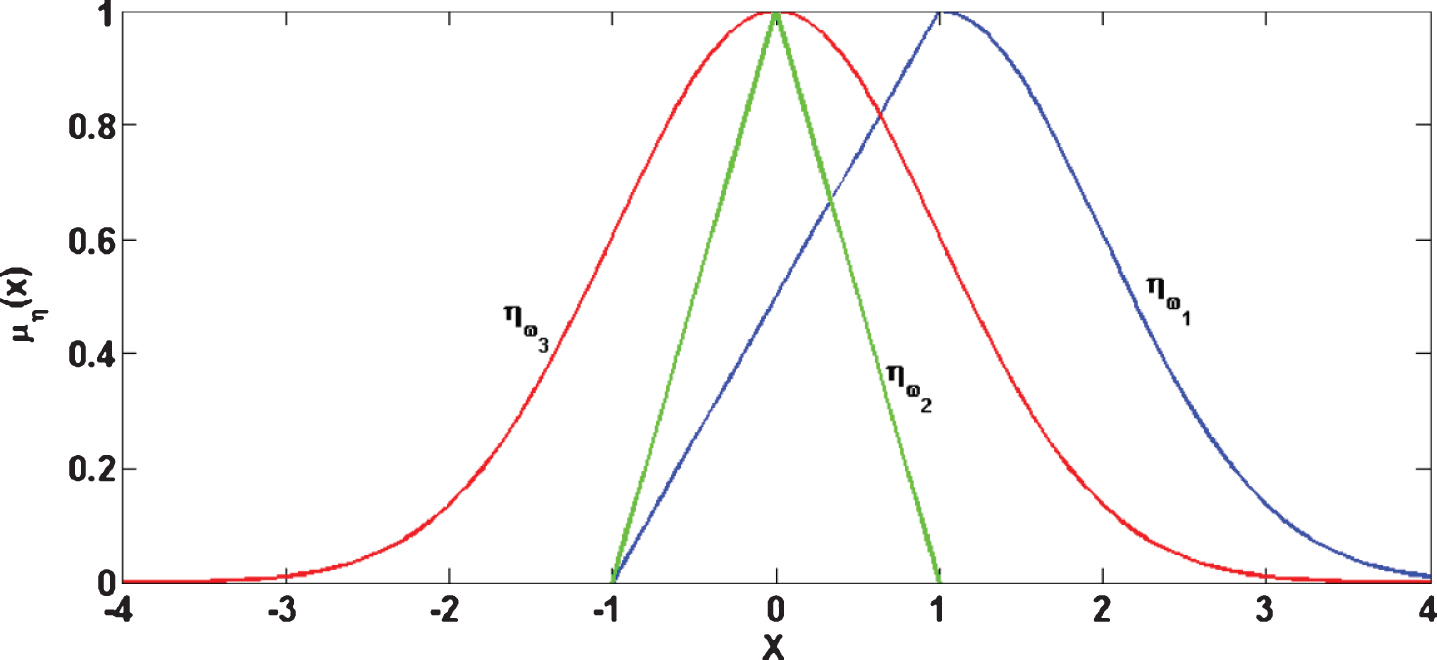
The possibility distribution of the fuzzy random variables η ω 1 , η ω 2 , and η ω 3 .
To calculate the mean chance of {η ≥ t} and {η < t}
provided at least one of the two integrals is finite.
If X (ω) > t + a, then
Model parameters and the decision variables of the proposed model are prescribed in the Table 1.
Model Notations
Model Notations
We developed a model with the demand considering as a fuzzy random variable to tackle the two fold uncertainty. Here, we assumed the demand be ξ = (X (ω) - a, X (ω) , X (ω) + b) a triangular fuzzy random demand.
According to the assumptions of the newsvendor model, the inventory decision and the pricing decision should be made before observing the actual demand. When the actual demand is smaller than the ordering quantity, the remained inventory would be disposed of at a discount h. When the actual demand is greater than the ordering quantity, some profit would be foregone. So the total profit could be described as:
In a similar way, if r < 0, then we obtain that
If chance distribution Ch (x) is continuous, then we have Ch {ξ ≤ x} = Ch {ξ < x}. Since the chance measure Ch is self dual, Ch {ξ ≥ x} =1 - Ch {ξ < x} Then Eq (12) is translated into the following form
Select the range of solution space, say, S. Generate x = (x1, x2, . . , x
n
)
T
from the solution space S. Compute all the functional values of Ch {ξ ≤ x
i
} for i = 1, 2, …, n using Theorem 1. Find a particular Optimal order quantity End.
Define the function H (q). Declare the variables in the function. Input the value of the variables. Use Trapezoidal method for numerical integration to find the integral value. Print the value.
We test our proposed method by using the following two examples.
Case study
The rationality and practical application of the projected SPIP under a fuzzy random environment is tested to a real-life industrial application. Initially, our research proposal has been sent to seven top dairy enterprises in West Bengal, India. They harvest or process (or both) of animal milk – mostly from cows or goats, but also from buffaloes, sheep – for human consumption. The dairy companies are located all over West Bengal (a populated state in eastern India) and of a multi-purpose farm concerned with the harvesting of milk. Four out of seven companies agreed to provide basic details of milk product sales and nodded to carry out our research proposal tested in their business framework. We selected the nearest dairy company (‘Mother Dairy’) to our institute and which has several distribution centers countrywide. This particular company has gathered much experience in the dairy industry and steadily thrived and established their business. Besides the sale throughout the year the company manager set a new goal to capture the temporary huge milk demand during the festive season. Due to several uncertain factors (some of them are explained in the next paragraph), this exceptional milk demand and the net profit from it are typically very uncertain rather than deterministic. Generally, the net profit is vaguely approximated from past data by experts who can reckon that the demand also is contingent on the financial ailment which varies randomly. Thus, the fuzzy random theory is a suitable tool for treating the hybrid uncertainty in this SPIP.
Being a product of short shelf life, the managing director (MD) (here, the decision-maker) of Mother Dairy must follow the daily demands at different distribution centers. The MD has to decide how many packs of milk get ready for the next morning so that the company gets maximum profit and suffer a minimum loss in the milk business. Because the packaged processed milk has 5-7 days of shelf life and any such remaining milk packets/bags after those days should have no food value since they will have passed their expiry date. So, this is where one can apply SPIP model for decision making. The processed milk bags are sold in the market, the demand is uncertain, and the MD must decide the order quantity for the next lot. Note that, ordering too many milk bags brings the risk of surplus if they are unsold whereas too few milk bags can give a miss of higher profit. Hence, the MD finds it difficult to describe the accurate probability distribution of milk demand. In this study, we have been interested to incorporate the perception of all group of actors in the dairy industry to get wide-ranging comprehensions since the data is greatly dependent on decision makers’ opinions as well as previous demand information. This is why we welcomed the data inputs from the customers, sales managers, operating officers of the dairy company, and material suppliers. Thus, according to his/her long-term experience and above mentioned data inputs, it is easy and more flexible for the MD to go for a rough estimation of the mean demand and its standard deviation.
With inputs from the experts, the MD finds suitable to consider milk demand as a triangular fuzzy random variable,
Now, a sensitivity analysis is conducted to observe the change in profit and optimal order quantity with the change of mean (μ) of milk demand and its salvage value (h). We change the value of the mean demand and repeat the computations using algorithms 1 and 2. The computational results are summarized in Table 2(a) and graphically shown in Figure 3 (a) and (b). The following insights are obtained from the results: The results show that the order quantity and profit will increase if the mean demand rises. On the other hand, they will be reduced if the mean demand declines. From Table 2(a) it is observed that a change of 18.18% in mean demand (when μ changes from 450 units to 550 units) yields a difference of 22.62% in order quantity (q) and 24.6%in profit (H). We notice that the profit function (H) and order quantity (q) decrease as the salvage value of milk bags increases (refer to Table 2(b) and Fig. 4 (a), (b)). An increase of 25% in salvage price (when h changes from Rs. 200 to Rs, 250) will slash the profit (H) by 43% as well as the order quantity (q) by 32.14 % .
Sensitivity Analysis
Sensitivity Analysis
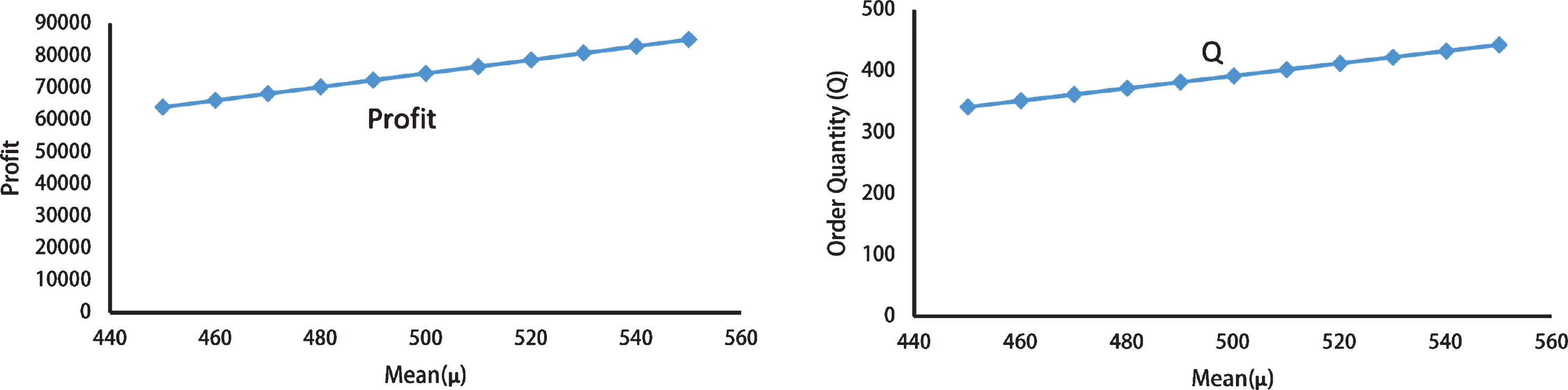
a) Profit changes under mean change. b) Order quantity under mean change.
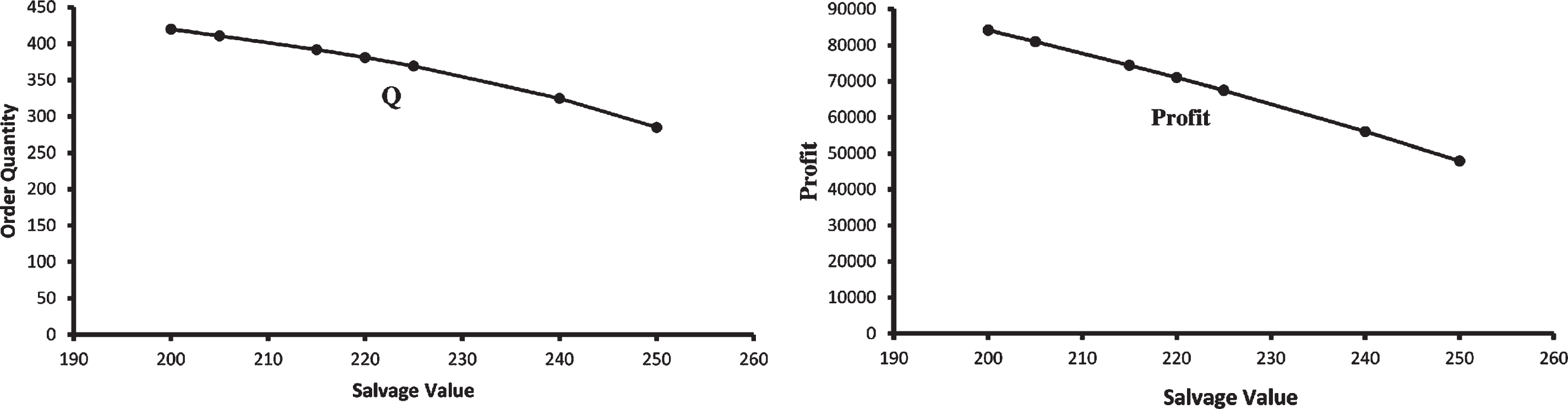
a) Order quantity changes under salvage value change. b) Profit changes under salvage value change.
Based on the obtained results, the following recommendations were suggested to managers If the company wants make a higher profit, they need more milk bags ready for the next lot when the market demand is high. Hence, the MD should be flexible enough to take the risk of loss due to surplus purchasing while aiming to capture the scope of making a higher profit in today’s competitive market situation. If the company has to sell each milk bag at a higher salvage price, it will make less contribution to the total profit and consequently, profit (H) decreases with the increase of salvage price (h). Hence, mean demand and salvage value are closely related to the profitability in a single-period inventory business setup.
In this subsection, we compare the results obtained by our proposed model with two other exiting methods- randomness [17] and fuzziness [3]. All three methods are applied to the problems discussed for example 5 & 6, with a real case study. Table 3 shows the optimal order quantity (q) computed by different methods.
In case of example 5, the fuzzy random demand is given by
On the other hand, the fuzzy random demand in example 6 is
Finally, in a bigger business set-up (i.e., the case study), the fuzzy random demand is given by
Order quantity using different approaches
Order quantity using different approaches
In this paper, an extension of the traditional newsboy problem has been proposed based on fuzzy random theory. To address the challenges of recent inventory problems, the proposed model provides a mechanism to characterize the fuzzy random parameter. To solve the proposed model, a new solution approach based on chance constraint programming is proposed to formulate the equivalent deterministic form of the fuzzy random newsboy model. Two numerical examples and a real-life case study are presented to demonstrate the efficiency of the proposed model.
Major contributions of this study can be highlighted as follows: (1) The first contribution of this paper is an extension of the classical newsboy problem under hybrid uncertainty is proposed in the single-item business system. (2) The proposed model can be used as a powerful managerial tool for calculating the optimal inventory level and the total expected profit under two-fold uncertainty. (3) The proposed model advances the classical newsboy problem and makes it more realistic decision-making approach by incorporating some amount of previous market data and experts’ subjective judgments. (4) This paper can assist managers and decision analysts on how to achieve the optimum order quantity and the corresponding expected profit. (5) Finally, this paper serves as a useful reference for researchers in the field of inventory management.
Although this study is helpful in decision making under two-folded uncertain demand, it has some limitations. The model is developed for single item inventory problem and demand is assumed as the only uncertain parameter. In real-world situations, a single product business may not repay much return to the retailers ([16, 29]). For this reason, most retailers in inventory management are adopting multiple product business strategies. Furthermore, selling price, purchase costs can be fuzzy, rough, random, or hybrid variables. Thus, some of the potential future research directions are as follows: (1) a newsboy problem with demand as a rough random or rough fuzzy variable; (2) multi-item or multi-period hybrid newsboy problem; (3) Mean-variance bi-objective newsboy problem.