



Abstract
There are numerous large-scale global optimization problems encountered in real-world applications including engineering, manufacturing, economics, networking fields. Over the last two decades different varieties of swarm intelligence and nature inspired based evolutionary algorithms (EAs) were developed and still. Among them, particles swarm optimization, Firefly algorithm, Ant colony optimization, Bat algorithm are the most popular and recently developed leading swarm intelligence based approaches. They are mainly inspired by the social and cooperative behaviors of swarm likewise herds of animals, flocking of birds, schooling of fish, ant colonies, herds of bisons and packs of wolves working together for their common benefit. Due to easy implementation and high capability in achieving of absolute optimum, swarm intelligence based algorithms have attained a great deal attention in both academic and industrial applications. This paper proposes a hybrid swarm intelligence (HSI) algorithm that employs the Bat Algorithm (BA) and the Practical Swarm Optimization (PSO) as constituents to perform their search process for dealing with recently designed benchmark functions in the special session of the 2017 IEEE congress of evolutionary computation (CEC’17) [3]. The approximate solutions for most of the CEC’17 benchmark functions obtained by the suggested algorithm in its twenty five independent runs of trails are much promising as compared to its competitors.
Keywords
Introduction
Global Optimization is a mathematical process of seeking values of the variables that lead to an optimal value of the function that is to be optimized globally. Optimization process1 were first embarked by the American mathematical scientist George Bernard Dantzig in 1940s, since then their industrial applications have expanded very rapidly in advanced engineering design, biotechnology, data analysis, environmental management, financial planning, process control, risk management, scientific modeling, and many others. Nowadays, it is almost impossible to name a single industry that can not use optimization procedures. In general, an optimization problem is either constrained or unconstrained. Mathematically, an optimization problem can be described as follow:
During the last two decades, various optimization methods have been developed [26]. In general, they are categorized into Linear and non-linear optimization techniques as shown in Fig. 1. Linear optimization was first introduced by a Soviet economist Leonid Kantorovich during the World War II to plan the expenditures cost of army and the imposed increase in losses over their enemy. George B. Dantzig has then lead a proper foundation applying (LP) to solve other real-world problems facing USA in engineering, operation research, computer science, economics, and statistics2. He was the first American mathematical scientist who generalized the linear programming to plan the training schedules of US Air Force and to provide logistical supply of men for the deployment in the services [19]. Linear optimization methods have many advantages besides some disadvantages, as not managing the non-linear optimization problems. However, it is quite unrealistic because most of the real-world problems are naturally non-linear [21, 79].
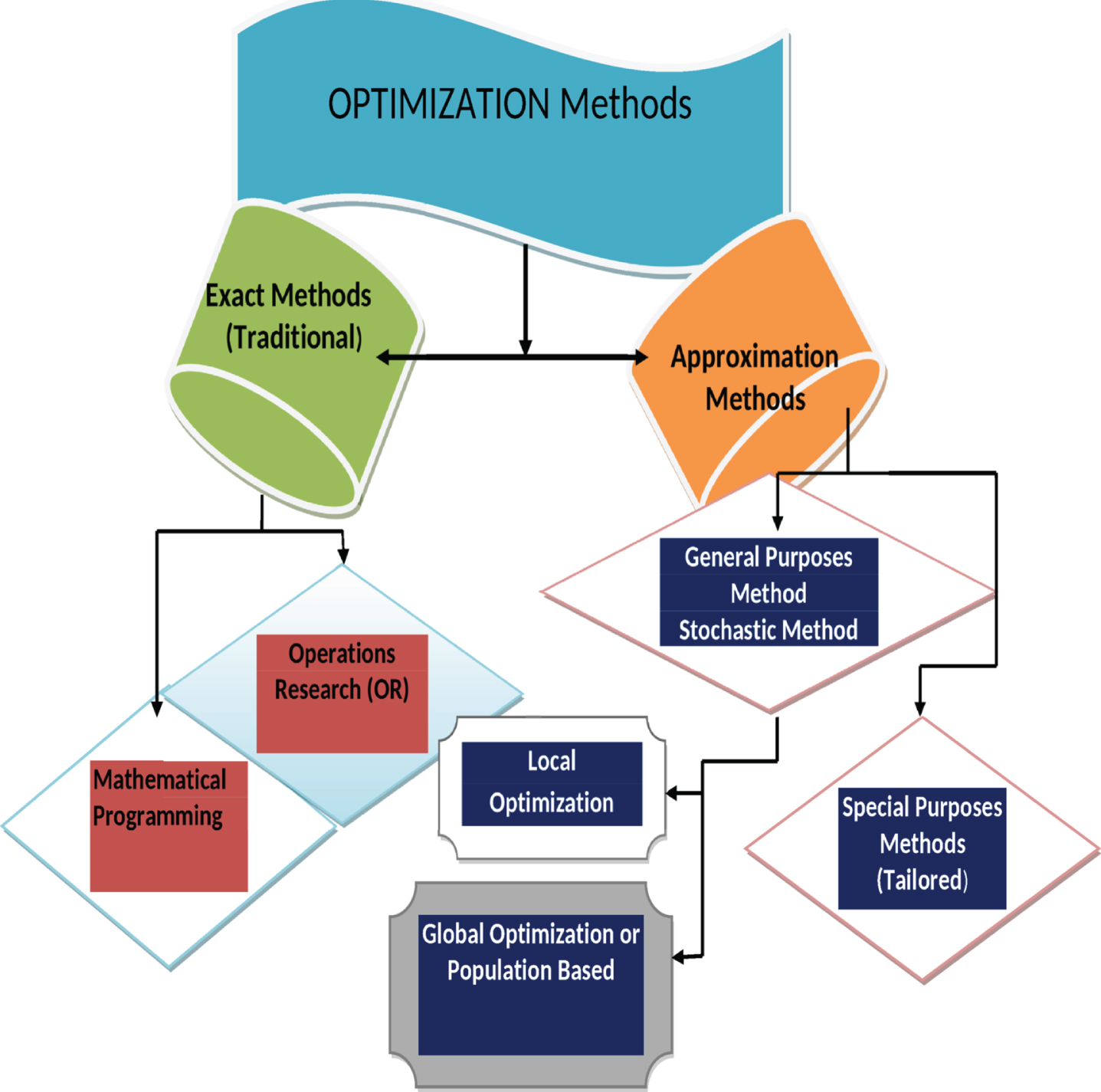
Classification of Optimization Techniques.
Non-linear optimization approaches are further subdivided into local and global optimization methods [26, 69]. Local search methods move from solution to solution in the search space of the problem at hand and applying local changes while finding an optimal solution until time bound is elapsed. Local search methods provide local optimal solution with low computational cost as compared to global search methods. Newton steepest decent method and sequential quadratic programming [7], 2-opt local search, Monte Carlo method and WalkSAT are the prime examples of local search optimization methods. Global optimization methods are heuristic-based methods [41]. Among these, the gradient-based methods are quite expensive in terms of computational cost while solving the real-world problems comprising non-differentiability, discontinuity, non-linearity, noise, flat, multi-dimensionality or the existence of many local optima. Evolutionary computing methods are much effective in finding quality solutions for problems with non-linearity, multi-modality and high dimensionality.
Evolutionary algorithms(EAs) offer alternatives to LP and NLP [21, 63]. Over the last few decades, various advanced EAs have been developed and still continue to be developed for dealing with diverse test suites of optimization and search problems [9–11, 81]. EAs are population based optimization methods that provide a good set of approximated solutions in a single simulation in contrast to the way traditional mathematical programming techniques do. In general, they can be divided into nine different categories including the biology-based algorithms mainly inspired by the principles of biological evolution [1, 65], social-based inspired by human interactions and information exchanges that evolve more rapidly than any other species on the earth [39], music-based algorithms inspired by human interactions and their bias [29, 58], chemical-based [66], sport-based [70], mathematics-based [56], swarm-based [6, 82]. Swarm intelligence based algorithms [75] follow decentralized rules, self-organized mechanisms to efficiently handle complex problems with dynamic properties, incomplete information, and limited computation capabilities. Swarm of insects, birds, bee, fishes, ants, herds are searching for food either scattered in groups or moving together while targeting their position for good source of foods by moving from one position to another based on the smell of food; that is, the bird is aware of the position where food can be found, having the correct food resource message. In general, they are transmitting their message to other fellow, particularly the useful message at any period while searching for food from one position to another, then they finally flock to the position where food can be found [67]. In the last several years, a number of hybrid algorithms [36], memetic algorithms [33, 45–52] and ensemble strategies [43, 44] were conducted to improve the efficiency of various existing meta-heuristic algorithms. In [28], a novel chaotic based bat algorithm is suggested and have found higher accuracy for forecasting model with complex motion of floating platforms. A complete ensemble empirical mode decomposition adaptive noise and support vector regression with quantum-based dragonfly algorithm proposed in order to identify fluctuations and the nonlinear tendencies of electric loads, but also to generate satisfactory forecasts [83]. Two numerical examples based on Tokyo Electric Power Company (Japan) and the National Grid (UK) demonstrate that the proposed hybrid algorithm has outperformed their competitors. In [30], the proposed hybrid optimization algorithm employs the particle swarm optimization (PSO) and Cuckoo Search (CS) [76] algorithm to solve the preventive maintenance period optimization model problem. A novel approach of hybridization of CS and PSO for remote sensing image classification to get higher efficiency and greater optimization value is introduced in [36]. The suggested hybrid algorithm have successfully classified and diversified land cover areas in a remote sensing satellite image. A novel hybrid Cuckoo Search algorithm with global harmony search is designed for solving Knapsack problems [20]. The proposed algorithm utilizes global harmony search (GHS) for exploration purposes and (CS) for exploitation in their search process. In [22], a novel hybrid GSA-GA algorithm is introduced for dealing with nonlinear constraint optimization problems with mixed variables. Firstly, this algorithm tuned up the problems at hand solutions with gravitational search algorithm and then each solution promote by employing the genetic operators likewise selection, crossover, mutation operators. In [57],a novel integrated heuristic approach called time varying acceleration coefficient particle swarm optimization with mutation strategies (TVAC-PSO-MS) is proposed for managing a standard test system of hydrothermal generation scheduling. The framework of the suggested algorithm updates their initial solution with TVAC-PSO approach and then local best solutions are updated by employing the successive mutation operators including the Cauchy, Gaussian, and opposition based mutations operators. The Cauchy mutation strategy is applied to enhance the search capability and the Gaussian, as well as the opposition based mutation strategies are used to improve the exploitation capability of the algorithm. In [64, 84], an improved ABC algorithm called Gbest-guided ABC (GABC) algorithm is proposed that incorporating the information of global best (Gbest) solution into the solution search equation to improve the exploitation of the artificial bee colony (ABC) algorithm. Fuzzy multi-objective optimization problem are modeled by taking into account the preference of decision maker regarding cost and reliability goals and then particle swarm optimization is applied to solve them under a number of constraint functions [23].
Despite the aforementioned hybrid algorithms, many other advanced types computational techniques are devised to manage both large-scale global optimization problems and multi-objective optimization problems with complicated Pareto shapes [2, 62]. Along the same line, the main purposes of this paper is to develop an efficient and robust hybrid (SI) algorithm aiming to alleviate the existing shortcomings of the chosen SI based algorithms. The suggested HSI algorithm make advantages of the most popular PSO [16, 32] and Bat algorithms [71, 73] in order to perform the evolution of population. The performance of the suggested HSI algorithm is analyzed by employing thirty benchmark functions with real-parameters. These benchmark functions were designed for the special session of evolutionary algorithms competition of the 2017-IEEE-Congress on evolutionary computing (IEEE-CEC’17) [3]. The approximated solutions obtained by suggested algorithm are much promising for most of the used test problems. The gathered numerical results indicate clearly the effectiveness and usefulness of the suggested HSI algorithm while dealing with large-scale non-linear optimization problems.
The rest of the paper is organized as follows: Section 2, introduces the framework of the proposed hybrid swarm intelligence based algorithm. Section 3, demonstrates the experimental results and characteristics of the used benchmark functions. In Section 4, we conclude our work.
The classical evolutionary computing techniques fall into four paradigms including the genetic algorithm [17, 80], genetic programming [35], evolutionary strategy [4, 5] and evolutionary programming [60]. Recently Swarm intelligence based algorithms have attracted much interest of many researchers in various fields. SI based algorithms are primarily inspired by the collective, decentralized, self-organized behaviours of agents. Particle swarm optimisation (PSO) was first developed by Kennedy and Eberhart [32] inspired from the social behaviour of swarms likewise ant colonies [34], bird flocking [82], hawks hunting, animal herding [8], bacterial growth, fish schooling and microbial intelligence operate on a set of N solution vectors with n-decision variables. In the search space, each particle is moving based on its own velocity vector by utilizing information exchange among its neighbors [16, 32]. PSO looks for the optimal solution by employing the objective function values in order to evaluate the quality of the solution. The main advantages of PSO has less number of parameters to be tuned and constraints acceptance as compared to other paradigms of evolutionary computing methods. PSO generate its initial solutions uniformly and randomly within the given search space of the problems and optimized them by using velocity vector v and position vector x till the end of each iteration. Xin-She Yang [73, 74] was the first to develop the Bat algorithm (BA) by employing a frequency-tuning technique for diversity maintenance of the solutions in the population. (BA) utilizes the automatic zooming to try to balance exploration and exploitation during the search process by mimicking the variations of pulse emission rates and loudness of bats when searching for prey [73]. All bats use echolocation to sense distance, and they also know the difference between food/prey and background barriers in some magical way. Microbats typically use a type of sonar, called echolocation, to detect prey, avoid obstacles, and locate their roosting crevices in the dark [74, 78].
As per no free lunch (NFL) theorem statement [15], most of the existing aforementioned evolutionary algorithms cannot always perform better while solving various test suites of optimization and real-world problems. Recently, the use of ensemble strategies [43, 48] and hybrid EAs [20, 62] have attracted much attention to benefit from the handiness of diverse key features of evolutionary approaches and their tuning at different stages of population evolution by intending to keep up counterbalance between exploitation and exploration during the whole course of optimization. In this paper, we have advised a hybrid swarm intelligence algorithm that employs various multi-search operators by admitting the most popular particle swarm optimization (PSO)[16, 32] and the most recently developed Bat algorithm (BA) [71, 77] to evolve initial set of uniformly and randomly generated solutions called population of size N. The flowchart of proposed (HSI) algorithm is hereby given in the Fig. 2 and its framework is described in the Algorithm 1. The main reason of employing PSO [16] in the framework of the suggested algorithm is its simple algorithmic structure, easy to implement with very few number of control parameters. However, as like other evolutionary algorithms, major problem with PSO is premature convergence that can be overcame by using it combination with Bat algorithm. The suggested algorithm have shown good converging behaviour by moving toward the optimal or near optimal solution of the most used problem in reasonable time. In order to analyse the effectiveness of the proposed algorithm, we have chosen thirty different benchmark functions to carried out experiments. These benchmark functions were recently designed for the special session of evolutionary algorithm computation in IEEE congress on evolutionary computation(IEEE-CEC2017) [3].
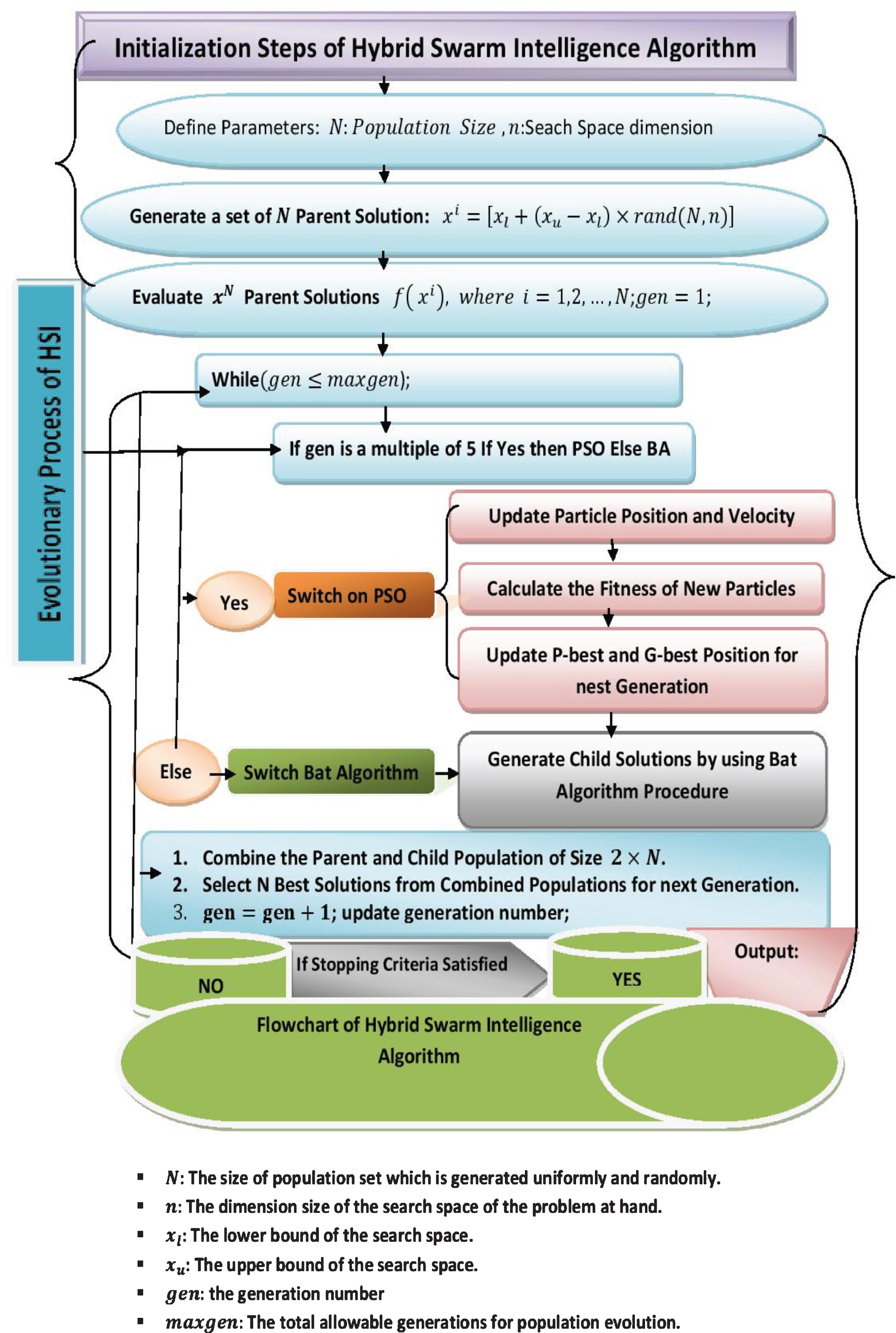
Flow Diagram of Hybrid Swarm Intelligence Algorithm.
1: Define N: size of population.
2: n: number of decision variables/real-parameters.
3: x l : lower bound of the decision/parametric space.
4: x u : upper bound of the decision/parametric space.
5: M t = 100 × n: Maximum iterations for population evolution.
6: Generate initial set of solutions uniformly and randomly, [x1, x2, …, x N ] = x l + (x u -x l ) × rand (N, n)
7: Compute the objective function values of the initial set of solutions, [f (x1) , f (x2) , …, f (x N )]
8: Initialize first iteration, t = 1
9:
10:
11:
12:
13:
14: Calculate the frequency of i th Bat f i to seek its prey.
15: β ∈ [0, 1] is a uniform random vector.
16: f i = f min + (f max -f min ) × β.
17: Update the velocity of the i
th
Bat,
18: x g is the global best solution found so far over the whole population.
19: Update the position of the i
th
Bat,
20:
21: Update average loudness A t of all Bats.
22: Update pulse emission rate
23:
24:
25: Compute the objective function values, f (y1) , f (y2) , …, f (y N ), of the new solutions, [y1, y2, …, y N ].
26: Apply selection based on survival of the fittest principle for next iteration.
27: Compare parent solution x i and offspring solutions y i .
28:
29: x i = y i
30:
31: y i = y i
32:
33: t = t + 1 % update the iteration t;
34:
In this research work, we examined the performance of the proposed hybrid swarm intelligence algorithm by using the most recently designed benchmark functions with real-valued decision variables. They are 30 functions with different characteristics. These kinds of benchmark functions play an important role in the development and assessing of novel developed optimization methods. The detailed characteristics of the used benchmark functions are hereby explained in Table 1, where UF denotes the class of Uni-modal Functions, MF stands for Multi-modal Functions, CF refers to Composition Functions, SRF epitomize the shifted and Rotated Functions and finally HF represents the Hybrid Functions.
Properties of the IEEE-CEC’17 Benchmark Functions [3]
Properties of the IEEE-CEC’17 Benchmark Functions [3]
All experiments were performed by using the computer system with Intel Core i5-6200 CPU, 2.40GHz and 4G RAM, under Windows 10 pro, 64 bit OS. The proposed algorithm and all other used algorithms in the comparative analysis were implemented in MATLAB R2017b programming environment. To validate the performance of stochastic nature based algorithms, it is intimated in the existing literature of evolutionary computation to execute the proposed algorithm at least 10 to 25-times for fair judgment and comparison against their competitors. Therefore, we have executed our hybrid swarm intelligence (HSI) algorithm versus particle swarm optimization (PSO) and Bat algorithm (BA) with 25 random seeds by using rand (squostate’, sum (100 * clock)) in the Matlab environment.
Parameters settings
In our carried out experiments, we have taken the different parameters as: the lower bound x
l
= -100, upper bound x
u
= 100 for the used benchmark functions, N = 100 is the size of initially generated set of solutions, n = 10, 30, 50 are the different dimensions of the search space, M
t
= n × 1000 are maximum number function evaluations, r1 and r2 are the two uniformly distributed random numbers, v
t
is the current velocity of the particle, x
t
is the current position of the particle, ω = 0.729 is the inertia factor, where ω ∈ [0.8, 1.2], a1 and a2 are the two acceleration constants or acceleration coefficients that usually lie between 1 and 4, however, we have used a1 = a2 = 1.7 and α = γ = 0.9. The loudness of the Bats decreases due to an increase in their pulse rate as they get closer to their prey, like
Discussion on experimental results
Most of the existing benchmark functions are solved as per defined criteria. The suggested algorithm and other used competitors are allocated same N × n function evaluations to make clear validity comparison against each other. Bat algorithm (BA) and Particle swarm optimization (PSO) are used as competitors against the hybrid swarm intelligence (HSI) algorithm in order to carry out experiments over recently designed benchmark functions for the special issue of IEEE congress on evolutionary computation IEEE-CEC’2017 [3]. Among the used benchmark functions, F1-F3 are uni-modal functions, F4-F10 are simple multi-modal functions, F11-F20 are hybrid and F21-F30 are composition functions as described in Table 1.
Each algorithm namely, PSO, Bat algorithm and our proposed HSI based algorithm are executed 25-times independently with different random seeds and the numerical results in terms of Minimum, Average, standard deviation and Maximum values are summarized in the Tables 2 and 3. Tables 2 and 3 clearly exhibit that the proposed HSI algorithm has performed much better than PSO and BA has tackled each benchmark functions more effectively, especially, F6, F7, F8, F10, F13, F14, F17, F19, F20, F22, F25, F26, F27 and F29 keeping their minimum objective function values. (PSO) has shown better performance as compared to (BA) and have got minimum function values for the problems like F1, F4, F5, F12 and F18. On the other hand, (BA) has performed better than (PSO) and found objective minimum values while solving problems denoted by F11, F15, F16, F23 and F30. (PSO) and (HSI) has somehow found same results in terms of minimum objective function values to cope with problems F9, F21 and F24. Likewise for the benchmark function, namely, F28 (PSO) and (BA) have shown better convergence behaviour. The average objective function values gathered by (HSI) are quite better than (PSO) and (BA) as listed in the second column of the aforementioned tables. The standard deviation of the proposed HSI algorithm are much better than (PSO) and Bat algorithm. The maximum values of (HSI) over each benchmark function, especially on F1, F3, F5, F6, F8, F9, F11, F13, F14, F18, F19, F20, F22, F23, F24, F26, and F29 is quite reasonable as compared to their competitor. All these experimental results are clearly indicated that the proposed algorithm is quite encouraging and much competitive for dealing almost all benchmark functions. The test problems used in this paper were first developed for the special issue in IEEE-Congress of evolutionary computation of the EAs competition [3]. Tables 4 and 5 furnish the numerical results approximated by our proposed HSI algorithm by solving each benchmark function of the IEEE-CEC’17 test suite {[3] being thirty dimensions. The first column of Table 4 and Table 5 present the minimum objective function values estimated by (HSI) algorithm versus (PSO) and Bat Algorithm. Benchmark functions, namely, F1, F5, F6, F8, F9, F10, F13, F14, F19, F20, F21, F23, F24, F25, and F29 are solved by HSI in their 25-runs of simulation in an efficient manner as compared other two algorithms used to establish a fair comparison with same parameter settings and resource allocations. As compared to Bat algorithm, (PSO) have found better numerical results by solving benchmark functions, namely, F3, F7, F11, F12, F15, F16, F17, F18, F22 and F30. On the other hand, Bat algorithm has tackled F4 in 30-real-parameters comparatively better than (PSO). Similarly, (PSO) has worked out better by solving the benchmark functions, F26 and F28 as compared to Bat algorithm. The second column of the tables 4 and 5 summarize the average function values with respect to (PSO), (BA) and proposed (HSI) algorithm, respectively. The third column of the same tables provide the evolution in standard deviation of the (PSO), (BA) and (HSI) algorithm for each IEEE-CEC’17 benchmark function [3] in their 25-independent runs of simulations. The maximum function values found by (HSI) for each problem are much better than (PSO) and Bat Algorithm, especially on F4, F7, F9, F18, F19, F20, F23, F24, F28 and F29 which are hereby outlined in the 3 rd column of the table 4 and table 5, respectively. (PSO) has found better results in terms of maximum function values for the problem F1, F3, F5, F8, F10, F12, F14, F21, F25, F26 and F30 as compared to Bat algorithm. The maximum function values of Bat algorithm for the test problems F6, F11, F13, F15, F16, F17, F22 and F27 are relatively better than (PSO). Tables 6 and 7 give the numerical results accumulated by proposed HSI algorithm in terms of the minimum function values, average function values, standard deviation values and maximum function values by solving each benchmark functions [3]. HSI has tackled more efficiently the test problems including F1, F6, F8, F9, F13, F14, F17, F19, F20, F21, F23, F24, F25, F26, F27, F28, F29 and F30 with n = 50 decision variables as compared to their counterparts. As compared to Bat algorithm, PSO has found better experimental results for dealing with IEEE-CEC’17 benchmark functions including F3, F4, F5, F7, F10, F11, F12, F15, F16, F18 and F22 in its 25 independent runs of simulations with different random seeds. The average function values of the HSI are much better than PSO and BA especially over the test problems including F5, F6, F8, F9, F10, F12, F16, F17, F19, F21, F22, F23, F24, F25, F26, F29 and F30 along with standard deviation values. The maximum values of the PSO over the problems F5, F8, F10, F11, F12, F15, F16, F19, F20, F21, F26, F27 are better than Bat algorithm. The performance of Bat algorithm versus PSO to cope with benchmark functions including F1, F3, F4, F9, F13, F14, F18, F24, F25, F29 and F30 are better in terms of proximity and diversity.
The numerical results obtained by a) PSO,b)Bat algorithm (BA) and c) HSI in solving IEEE-CEC’17 Benchmark Functions including F1-F15 being n = 10 decision variables [3]
The numerical results obtained by a) PSO,b)Bat algorithm (BA) and c) HSI in solving IEEE-CEC’17 Benchmark Functions including F1-F15 being n = 10 decision variables [3]
The numerical results obtained by a) PSO, b) Bat algorithm(BA) and c) HSI in solving the IEEE-CEC’17 Benchmark Functions including F16-F30 being n = 10 decision variables [3]
The numerical results obtained by a) PSO, b)Bat algorithm (BA) and c) HSI by solving the IEEE-CEC’17 Benchmark Functions including the F1-F15 being n = 30 decision variables [3]
The numerical results obtained by a) PSO, b) Bat algorithm (BA) and c) HSI by solving IEEE-CEC’17 Benchmark Functions including the F16-F30 being n = 30 decision variables [3]
The numerical results obtained by a) PSO, b) Bat algorithm (BA) and c) HSI by solving IEEE-CEC’17 Benchmark Functions including F1-F15 being n = 50 decision variables [3]
The numerical results obtained by a) PSO, b) Bat algorithm (BA) and c) HSI by solving IEEE-CEC’17 Benchmark Functions including F16-F30 being n = 50 decision variables [3]
The numerical results summarized in aforementioned tables confirm that (HSI) algorithm is more consistent and flexible comparing their constituent algorithms in solving large-scale and high-dimensional optimization problems with continuous search space. Along this line, the statistical analysis were conducted by utilizing the Wilcoxon’s rank sum test with λ = 0.05 significance level in order to establish a fair comparison among the proposed hybrid swarm intelligence (HSI) and other constituent algorithms including the particle swarm optimization (PSO) and Bat algorithm (BA) used in comparative analysis of this paper. After careful comparative analysis and investigation, we reach at the point that the suggested algorithm was ranked first in dealing with most of the employed benchmark functions efficiently, (PSO) remained second and Bat algorithm as third. All these statistical evidences can be seen in summarized Tables and depicted figures.
Figure 3 displays the evolution occured in the average objective function values by applying (HSI), (PSO) and Bat algorithm (BA) while solving the benchmark function, F1-F10, F17 and F21-F26 in n = 10 dimension. Figure 4 depicts the average objective function values in order to solve the benchmark function, F27-F29 comprising n = 10 decision variables [3] regaring (HSI) versus (BA) and (PSO). These figures clearly exhibit that the convergence ability of the proposed hybrid swarm intelligence (HSI) algorithm is much promising as compared to the convergence behaviour of the particle swarm optimization (PSO) and Bat algorithm (BA) in their respective 25-independent runs of simulations with different random seeds.
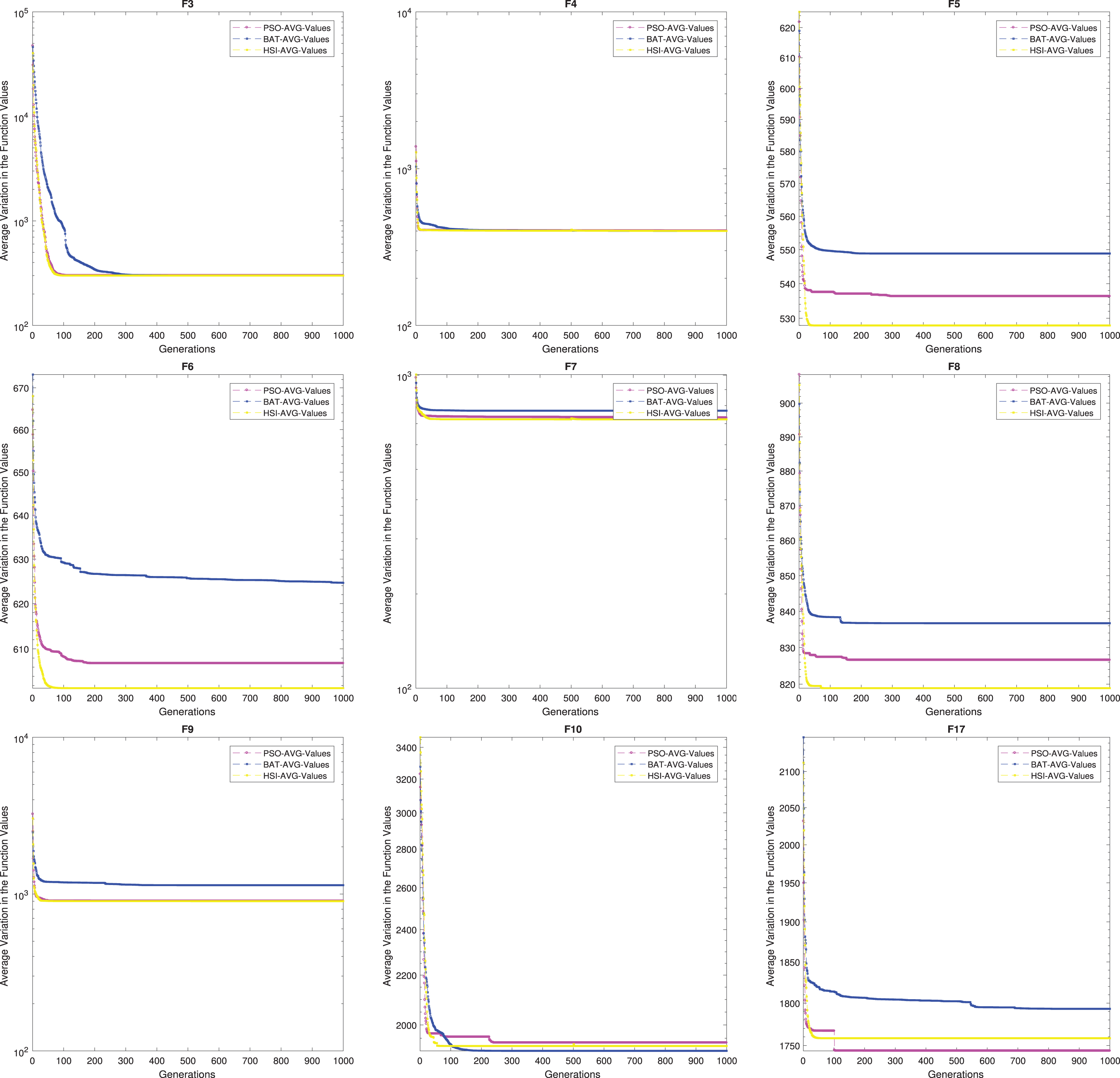
The evolution in average objective function values displayed by our proposed HSI versus PSO and BA for benchmark functions, F3-F10 and F17 in ten dimension [3].
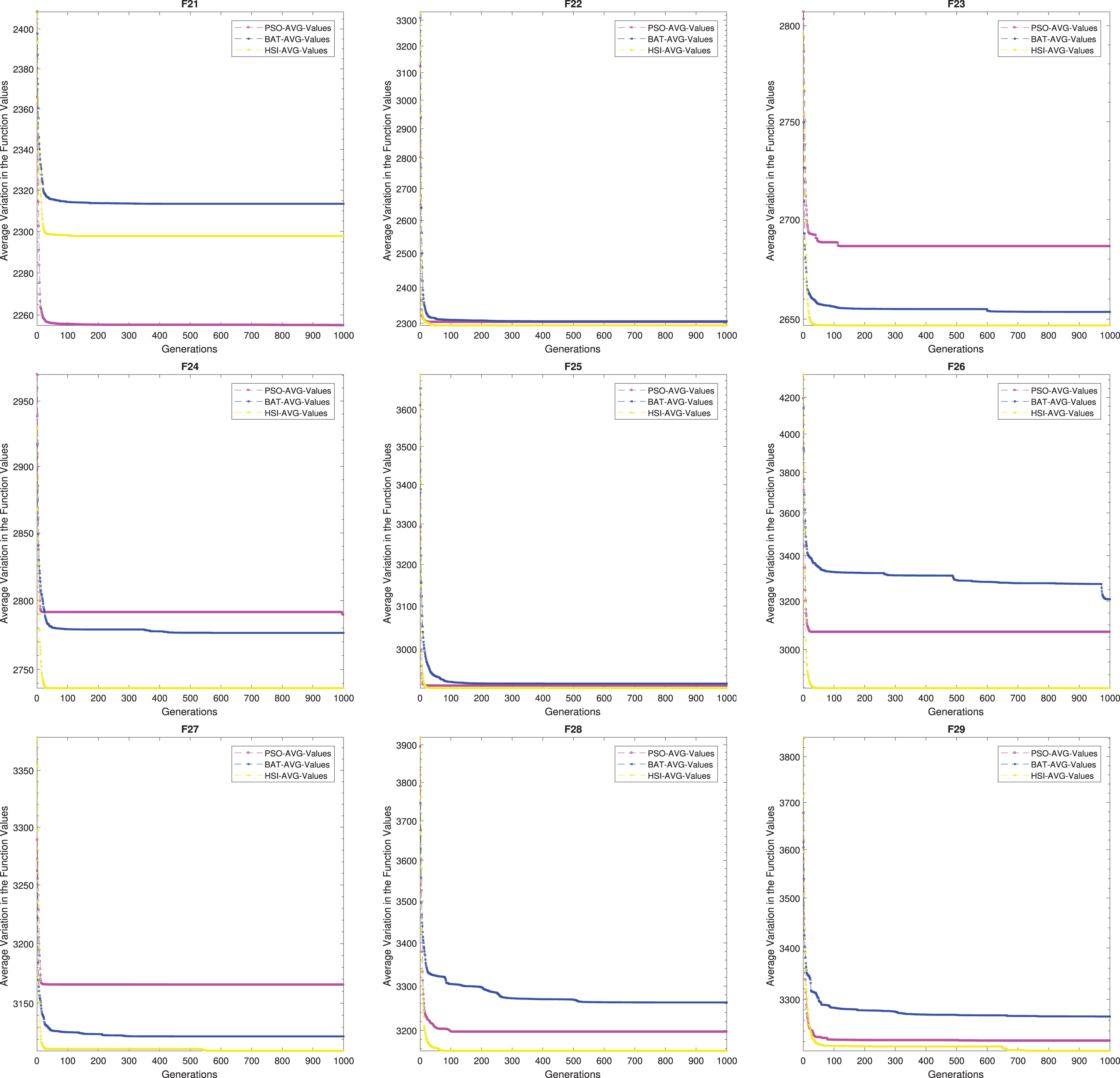
The evolution in the average objective function values displayed by our proposed HSI versus PSO and BA for benchmark functions F21-F26 and F27-F29 in ten dimension [3].
Figure 5 clarifies that (HSI) has solved most efficiently the used benchmark functions keeping in view the average values of F1 to F6 after solving them in different dimensions including n = 10, 30, 50 decision variables, respectively, as compared to Particle Swarm Optimization and Bat Algorithm. Similarly, Figure 6 shows the comparison among the minimum values presented by (HSI), (PSO) and BA, respectively keeping the optimal values of the benchmark functions as listed in the last column of the Table 1.
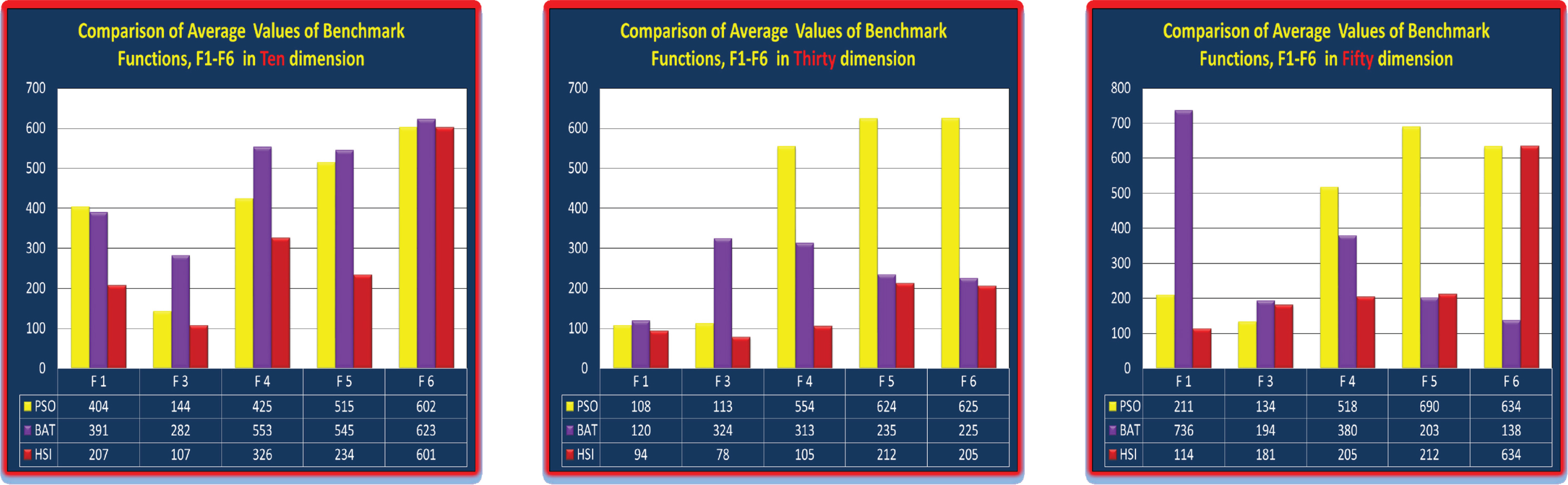
Comparison among the average function values for F1 to F6 displayed by BA, PSO and HSI. The 1 st panel for the mentioned function with ten dimension,2 nd panel is thirty dimension and 3 rd panel for the function solved in fifty dimension.
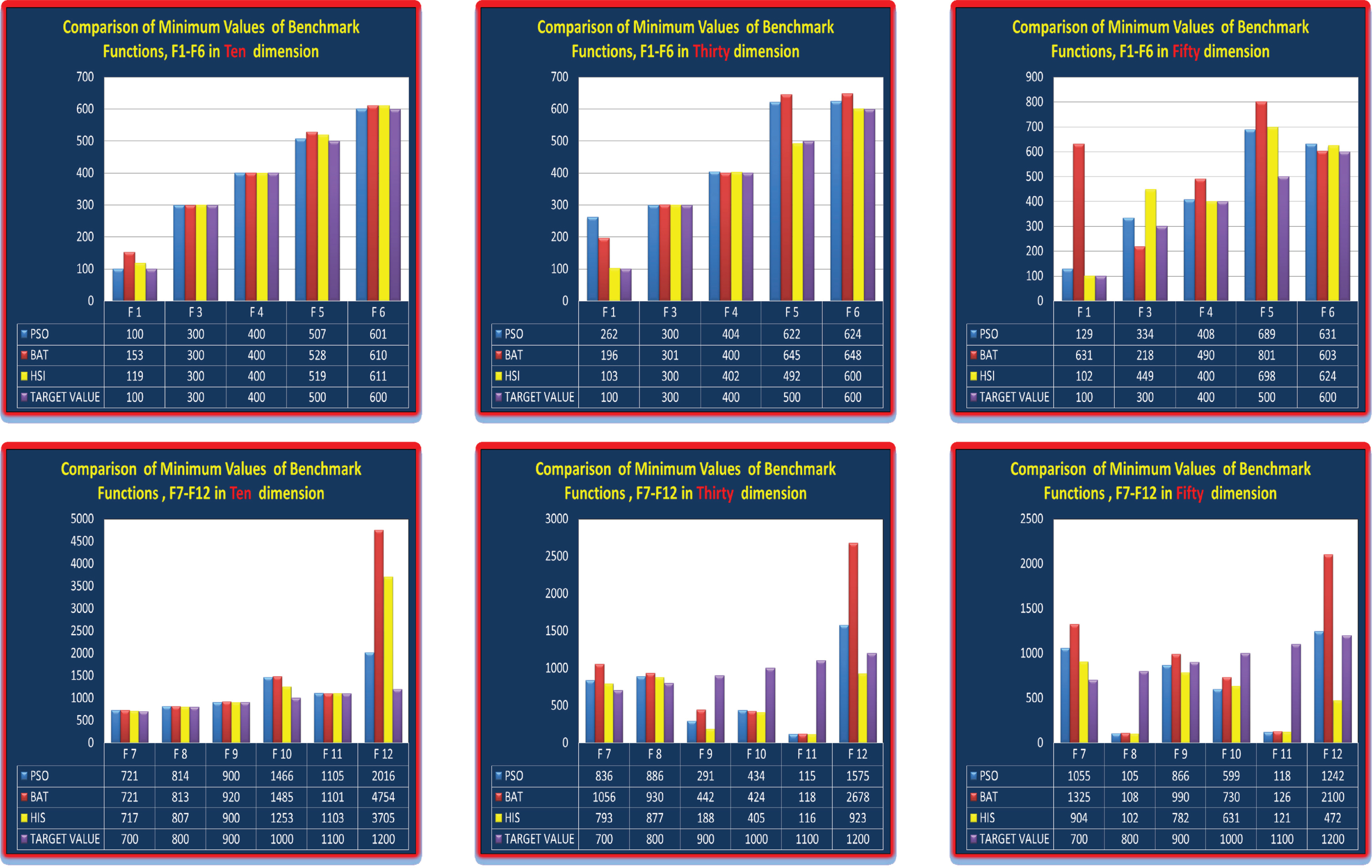
Comparison among Minimum function values for F1 to F12 displayed by BA, PSO and HSI.The 1 st panel for the mentioned function with ten dimension,2 nd panel is thirty dimension and 3 rd panel for the function solved in fifty dimension.
Since the last two decades, evolutionary computation has become an emerging and important paradigm of computational intelligence for solving complex optimization and search problems. Due to population-based collective learning process, self-adaptation, robustness and some other key features, evolutionary algorithms have successfully tackled several important practical problems in physical and numerical, social, biological, chemical and pharmaceutical sciences as well as in engineering and computer architectures. Variation operators are the most important drivers of evolution in the framework of the existing different paradigms of evolutionary algorithms. These operators are mainly looked for valuable information about the landscapes and samples across the search space of the problem at hand. The ensemble use of self-learning and adaptive procedures in the form of hybridization are quite useful and helpful in alleviating the shortcomings of the baseline evolutionary algorithms. In this paper, a hybrid swarm intelligence (HSI) algorithm is developed for dealing with large-scale global optimization problems. The proposed algorithm has employed the most popular particle swarm optimization (PSO) and newly developed Bat algorithms for population evolution.The suggested methodology is elitism based by utilizing the current and previous gathered useful information regarding their whole search process. The proposed algorithm have tackled most of the IEEE-CEC017 benchmark functions promisingly with fast convergence and good diversity maintenance order as compared to its constituent algorithm within same resources allocation.
In future, we intend to investigate the algorithmic behaviour of the suggested algorithm by using more complicated benchmark functions and real-world optimization problems. The following mutation strategies can be utilized as a part of the proposed algorithm with dynamic resources allocations in the future research plan.
