



Abstract
As an important expanded of the classical formal concept, the three-way formal concept analysis integrates more information with the three-way decision theory. However, to the best of our knowledge, few scholars have studied the intuitionistic fuzzy three-way formal concept analysis. This paper proposes an intuitionistic fuzzy three-way formal concept analysis model based on the attribute correlation degree. To achieve this, we comprehensively analyze the composition of attribute correlation degree in the intuitionistic fuzzy environment, and introduce the corresponding calculation methods for different situations, as well as prove the related properties. Furthermore, we investigate the intuitionistic fuzzy three-way concept lattice ((IF3WCL) of object-induced and attribute-induced. Then, the relationship between the IF3WCL and the positive, negative and boundary domains in the three-way decision are discussed. In addition, considering the final decision problem of boundary objects, the secondary decision strategy of boundary objects is obtained for IF3WCL. Finally, a numerical example of multinational company investment illustrates the effectiveness of the proposed model. In this paper, we systematically study the IF3WCL, and give a quantitative analysis method of formal concept decision along with its connection with three-way decision, which provides new ideas for the related research.
Introduction
Three-way decision (3WD), proposed by Yao [1], is an effective tool for uncertain information processing and decision-making. The main idea of 3WD is to combine the Bayesian minimum risk decision theory to divide the discourse domain into three disjoint regions, i.e., positive domain, negative domain and boundary domain, which represent acceptance decision, rejection decision and delayed decision, respectively. In fact, we always use 3WD unconsciously in our daily lives. For example, the editor marks the manuscript as accepted, rejected, or in need of further modification based on the review comments; the doctor determines whether the patient has recovered or needs to continue treatment according to the patient’s symptoms. 3WD is an effective heuristic strategy, more in line with people’s cognitive and decision-making habits, which can be explained, depicted and motivated [2]. Due to the universality of 3WD, the theory has been widely concerned by scholars since it was proposed, and has been widely applied in the neural network [3, 4], clustering analysis [5, 6], information system [7, 8], granular computing [9, 10], etc. Nowadays, 3WD has become a part of the basic theory of artificial intelligence. The in-depth research on 3WD will help people form a more general information processing model to deal with complex decision-making problems in the uncertain environments.
Formal concept analysis (FCA), proposed by Wille [11] in 1982, is an effective mathematical tool for data mining and knowledge discovery. FCA mainly uses formal concept (concept for short) to describe the relationship between objects and attributes, and expresses the generalization and specialization of concept through Hasse diagram. In addition, the concept lattice is an important part of FCA, which consists of a pair of order pairs, namely, extension and intension. Specifically, extension is the set of attributes common to the objects and intension is the set of objects which have all attributes [12, 13]. Over the past few years, FCA has been widely combined with different disciplines and applied in many fields, such as construction of concept lattice [14, 15], extension of concept lattice [16, 17], reduction of concept lattice [18, 19], rules extraction of concept lattice [20, 21], etc. Furthermore, the generation algorithm and operator structure of concept lattice are also important research orientations.
Nevertheless, it must be pointed out that the classical FCA can only reflect the information shared by extension and intension, but ignores the information that extension and intension do not capture. From this perspective, Qi et al. [12, 22] integrates the ideas of the 3WD into FCA and proposes a three-way formal concept analysis (3WFCA) model. In 3WFCA, the three-way concept lattices are constructed by establishing a Galois connection between the power sets of the object and attribute. In addition, there are two types of concept lattices, namely, object-induced and attribute-induced. The extension and intension of the three-way concept lattices are also represented by a pair of ordered pairs, but the difference is that the intension of the attribute-induced three-way concept lattices consists of two parts: the positive domain and the negative domain, which respectively represent the attributes of the object “jointly possessed” and “jointly not possessed”. Dually, we can also get the object-induced three-way concept lattices. From this point of view, the three-way concept lattices are associated with to 3WD. It is possible to obtain the positive, negative and boundary domains of the 3WD by constructing three-way concept lattices. This is one of its attractive research points. As an important expanded form of FCA, 3WFCA has gained considerable attention since it was proposed [10, 23–29]. For example, Ren et al. [27] investigated four kinds of attribute reduction methods for three-way concept lattices.
Note that the things we encounter and deal with in our daily life are usually vague and uncertain, such as natural language. To better describe and process complex fuzzy problems more delicately, Atanassov [30] proposed the theory of intuitionistic fuzzy sets in 1986. Intuitionistic fuzzy sets describe the fuzzy nature of the objective world by using two parameters of membership degree and non-membership degree. It is much more exquisite than the single membership of the fuzzy set. As a new mathematical method, intuitionistic fuzzy set theory has been applied to various fields [31–35]. The research on intuitionistic fuzzy sets can be categorized into the following two aspects, namely, theory and application. In terms of theoretical research, it mainly studies the flexible properties of intuitionistic fuzzy set, such as operator [31], correlation coefficient [34], distance measure [35], etc., while the applied research mainly focuses on the decision-making problem of uncertain environment [7, 31–33]. For example, Garg et al. [31] proposed novel aggregation operators and ranking method for complex intuitionistic fuzzy sets. Subsequently, they studied decision-making in intuitionistic fuzzy environment from different perspectives [32, 33]. Moreover, intuitionistic fuzzy set combined with 3WD theory can be extended to address the uncertainty of information systems. Yang et al. [36] studied the 3WD model in the multi-granularity space through intuitionistic fuzzy numbers. Liang et al. [37] proposed an intuitionistic fuzzy decision rough set model based on point operator and used to construct the 3WD model. In practice, the theory of intuitionistic fuzzy set has greatly promoted the development of analyzing and solving uncertain problems. Therefore, scholars began to study the concept lattice in uncertain environments, such as fuzzy and intuitionistic fuzzy concept lattices [16, 38–40] and rough concept lattices [41, 42]. Intuitionistic fuzzy sets provide a better theoretical basis for the study of three-way concept lattices of uncertain problems, but so far, there is rarely research on the fusion between them.
Three-way concept lattice analyzes the relationship between the generalization and specialization of concepts from the perspective of attributes and objects, which is more in line with human thinking process. On the one hand, the membership degree, non-membership degree and hesitation degree of intuitionistic fuzzy set are nicely complementary to 3WD’s positive domain, negative domain and boundary domains. Thus, if one can use the intuitionistic fuzzy set theory to construct three-way concept lattices and use them to analyze 3WD, there will be unexpected gains. On the other hand, the degree of attribute correlation is also a problem worthy of attention, because it is closely related to the changes of the constructed concept lattice. Their combination can not only expand the research scope of 3WFCA to intuitionistic fuzzy environment, but also quantitatively analyze the correlation degree of each concept.
In practice, by introducing positive domain, negative domain and boundary domain, the relationship between 3WFCA and 3WD can be more clearly analyzed, and it also provides a new method and direction for studying intuitionistic fuzzy decision-making problems. Hence, it is a subject worthy of further intensive research. The main contributions of this paper are as follows. The concepts of membership correlation degree, non-membership correlation degree and hesitation degree perturbation correlation coefficient (abbreviated as disturbance coefficient) are defined, and their related properties are discussed. Then, the correlation degree between any two intuitionistic fuzzy attributes is extended to multiple attributes. We extend * operator and Combining the positive domain, negative domain and boundary domain of 3WD, we analyze the relationship between IF3WCL and 3WD. For the boundary domain objects in OI-IF3WCL and AI-IF3WCL, we propose secondary decision strategies and corresponding algorithms, respectively.
This paper mainly combines intuitionistic fuzzy set, 3WFCA and 3WD ideas to construct IF3WCL. This paper is organized as follows. In Section 2, we simply review some basic knowledge of classical concept lattice, three-way concept lattice and intuitionistic fuzzy set. In Section 3, we propose a method for calculating the intuitionistic fuzzy attribute correlation degree and analyze its related properties. On the basis of it, the IF3WCL of object-induced and attribute-induced are given. In Section 4, we deeply analyze the relationship between IF3WCL and 3WD, and give a secondary decision strategy for the boundary domain of IF3WCL. In Section 5, the paper ends with conclusions.
Preliminaries
In this section, we review some necessary notions in classical FCA, three-way concept lattice and intuitionistic fuzzy set. Throughout this paper, we assume that the domain of discourse U and the attribute set A are both non-empty finite sets, P (U) and P (A) are power sets of U and A, respectively. X C is the complementary set of X.
Three-way decision
The discourse domain can be divided into three disjointed parts by upper and lower approximations, namely, the positive domain POS(X), the negative domain NEG(X), and the boundary domain BND(X) are as follows:
Cost function matrix
Cost function matrix
In Table 1, λ
PP
, λ
BP
, and λ
NP
represent the cost losses of adopting a
P
, a
B
, and a
N
decisions when in state X. Similarly, λ
PN
, λ
BN
, and λ
NN
denote the decision loss under state ¬X. Therefore, the expected loss of object x under different actions is (a
i
| [x]) (i = P, B, N), which can be expressed as follows:
Pr(X| [x] ) and Pr(¬ X| [x]
R
) represent the probabilities that the equivalence class belongs to X and ¬X. By a reasonable hypothesis,λ
PP
≤ λ
BP
< λ
NP
and λ
NN
≤ λ
BN
< λ
PN
; if the BND domain exists, then (λ
BP
- λ
PP
) (λ
BP
- λ
NN
) < (λ
PN
- λ
BN
) (λ
NP
- λ
BP
), and condition Pr(X| [x]
R
) + Pr(¬ X| [x]
R
) =1 holds. We can get the following rules:
Here, α and βrepresent:
p1 ≤ p2 ⇒ φ (p2) ≤ φ (p1). q1 ≤ q2 ⇒ ψ (q2) ≤ ψ (q1). p ≤ ψ (φ (p) , q ≤ φ (ψ (q).
Then, the pair of mappings is called Galois connections.
Concretely, for a formal context, any pair elements (x, a) ∈ I or xIa means that the object x has the attribute a. Dually, the meaning of the relationship (x, a) ∉ I or xI C a is that the object x does not possess the attribute a.
For a formal context K = (U, A, I), a pair of dual operators* : (U) → (A) and * : (A) → (U) for any X ⊆ U and B ⊆ A are defined as follows:
As understood by Definition 4, X* is the set of attributes common to the objects in A, and B* is the set of objects which have all attributes in B.
X ⊆ X**, B ⊆ B** . X* = X***, B = B*** . X ⊆ B* ⇔ B ⊆ X* .
Moreover, the infimum and supremum of C1 and C2 are defined by:
Thus, the
A formal context K
A formal context K
For the convenience of description, we use the symbol “×” to represent xIa and the blank to indicate the relationship xI C a.
The concept lattice corresponding to the formal context K is shown in Fig. 1.
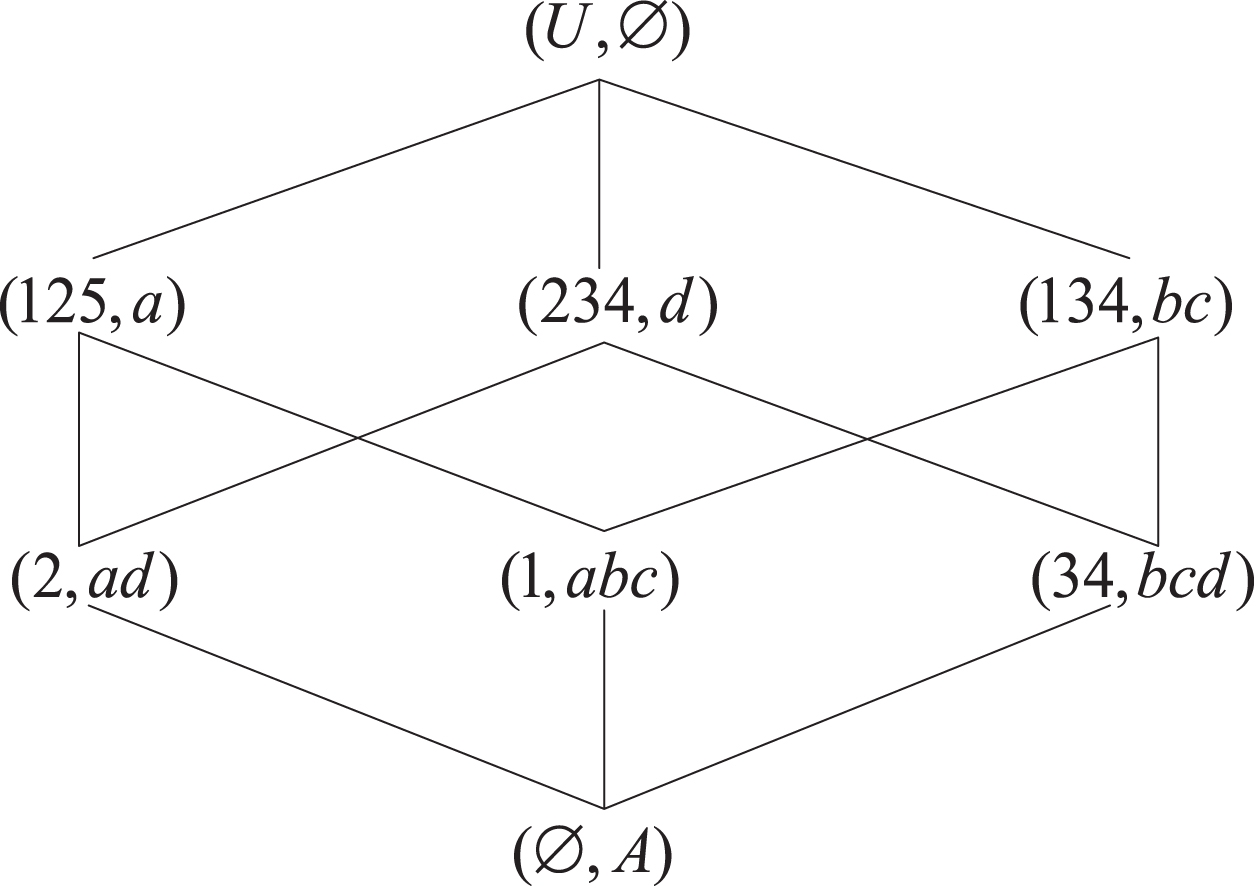
Concept lattice for the formal context K.
To reflect the information that the FCA actually contains but not represented, that is, objects (or attributes) does not have any elements in the intension (or the extension) of a formal concept, Qi et al. [12, 22] regards the * operator in the classical FCA as a positive operator and gives the definition of negative operator as follows.
∀X ⊆ U and ∀B ⊆ A, the three-way operators are composed of operator * and operator
In relation to the three-way operators, a pair of inverse operators is defined on X, Y ⊆ U and B, C ⊆ A respectively [12]:
If OE1 = (X, (B, C)) and OE2 = (Y, (D, E)) are both OE-concepts, the partial order relationship between them can be expressed as:
OE1 is called a sub-concept of OE2, and OE2is called a super-concept of OE1. Obviously, OEL (U, A, I) is a complete lattice, and the infimum and supremum are defined as:
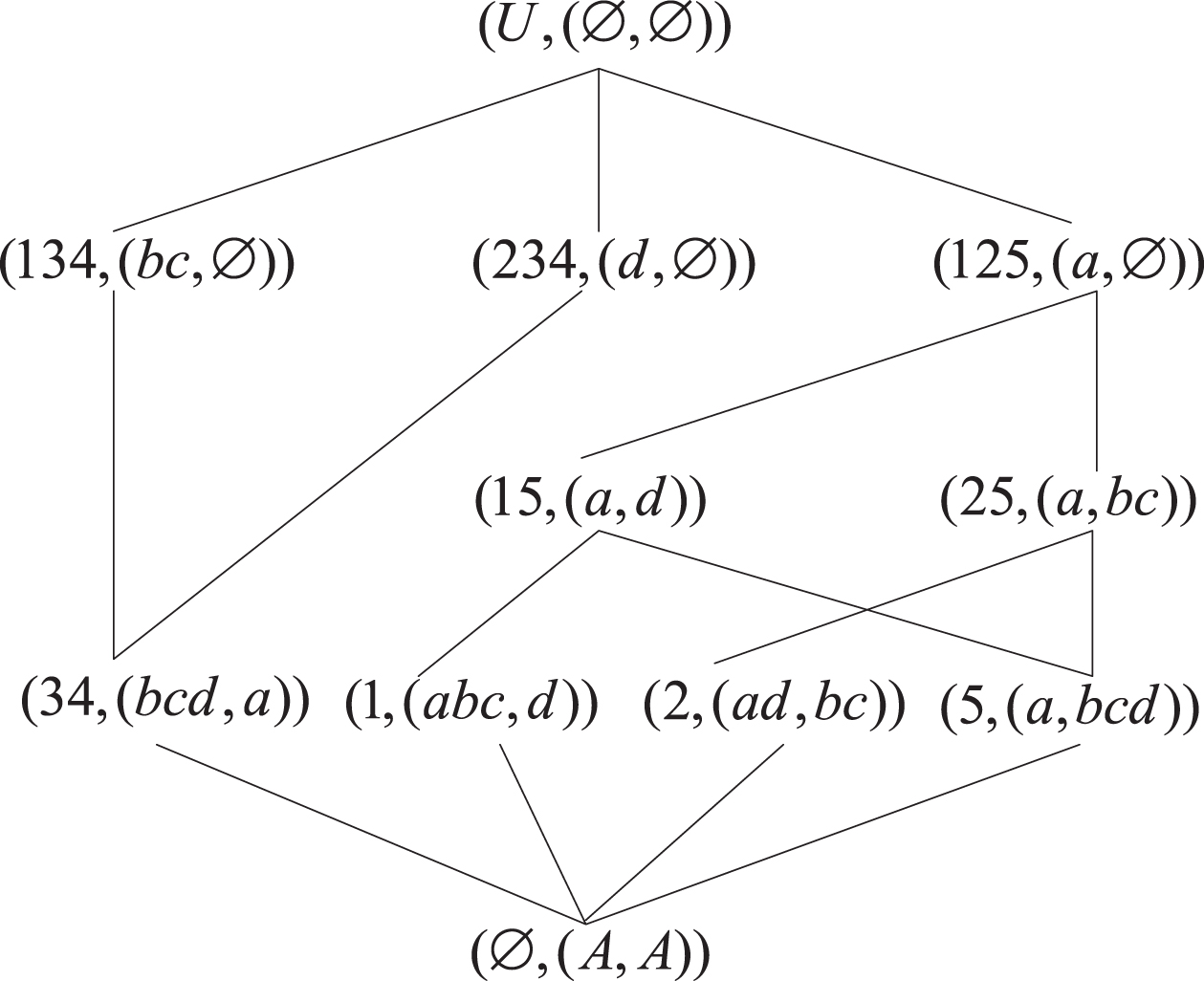
The OE-concept lattice of Table 2.
Similarly, ((X, Y) , B) is called attribute-induced three-way concept (AE-concept for short). If and only if X⋖ = (B, C) and (B, C) ⋗ = X, then (X, Y) is called extension and B is the intension of ((X, Y) , B). The set of all AE-concepts in the formal context K is denoted as AEL (U, A, I).
If AE1 = ((X, Y) , B) and AE2 = ((Z, W) , C) are both AE-concepts, the partial order relationship between them can be expressed as:
AE1 is called a sub-concept of AF2, and AF2is called a super-concept of AE1. Obviously, AEL (U, A, I) is a complete lattice, and the infimum and supremum are defined as:

The AE-concept lattice of Table 2.
In addition,
Intuitionistic fuzzy 3WFCA
In order to enable the traditional 3WFCA to deal with the uncertainty problem in the intuitionistic fuzzy environment, and to quantitatively analyze the correlation degree between the concepts in OI-IF3WCL and AI-IF3WCL, this section will study them through attribute correlation degree. In addition, the fusion of 3WD and intuitionistic fuzzy 3WFCA can also provide new ideas and methods for intuitionistic fuzzy uncertain decision-making.
For the convenience of expression, if there is no special description, it is assumed that all data have been dimensionless processed, and x i (1 ≤ i ≤ m) is an element in the universe U and a j (1 ≤ j ≤ n) is an element in the attribute set A.
Correlation degree of intuitionistic fuzzy attributes
The correlation degree of intuitionistic fuzzy attributes is mainly composed of membership correlation degree, non-membership correlation degree and hesitation degree perturbation correlation coefficient, which will be analyzed below separately.
∀x
i
∈ U,
It can be found that the larger value of c μ (a p , a q ), the greater the membership correlation degree between attributes a p and a q .
Some properties of membership correlation degree are given as follows: Boundedness: 0 ≤ c
μ
(a
p
, a
q
) ≤1; Local monotonicity: When Symmetry: c
μ
(a
p
, a
q
) = c
μ
(a
q
, a
p
).
Properties (1) and (3) are easily obtained from Equation (1). The following is only a proof of property (2).
The analysis of non-membership correlation is the same as the membership correlation, which can be calculated as follows:
Similarly, when
The properties of non-membership correlation degree are as follows: Boundedness: 0 ≤ c
ν
(a
p
, a
q
) ≤1; Local monotonicity: When Symmetry: c
ν
(a
p
, a
q
) = c
ν
(a
q
, a
p
).
Compared with membership description and non-membership description, hesitation degree is caused by some unknown information. From this perspective, we can think that it is precisely because of a variety of random and uncertain independent factors (or related factors, here we assume that they are independent) collectively cause the existence of hesitation degree. According to the central limit theorem, the influence caused by these factors obeys the Gaussian distribution. For the convenience of analysis, it is assumed to follow the standard Gaussian distribution. Hence, the perturbation coefficients of the attributes a
p
and a
q
with respect to the object x
i
can be expressed as:
In summary, the correlation between the attributes a
p
and a
q
with respect to the object x
i
is calculated as follows:
Therefore, the correlation degree between any two attributes on domain U can be expressed as:
Because Equations (1)–(3) are all symmetrical, the attribute correlation matrix in Definition 11 can be simplified into the form of a lower triangular matrix:
Intuitionistic fuzzy concept lattice based on the degree of attribute correlation
∀x
i
∈ U, ∀ a
j
∈ A,
In Equation (9),
An IFFC
According to Equations (5) and (6), we can calculate the degree of attribute correlation in
The corresponding concepts of Table 3 are shown in Fig. 4.
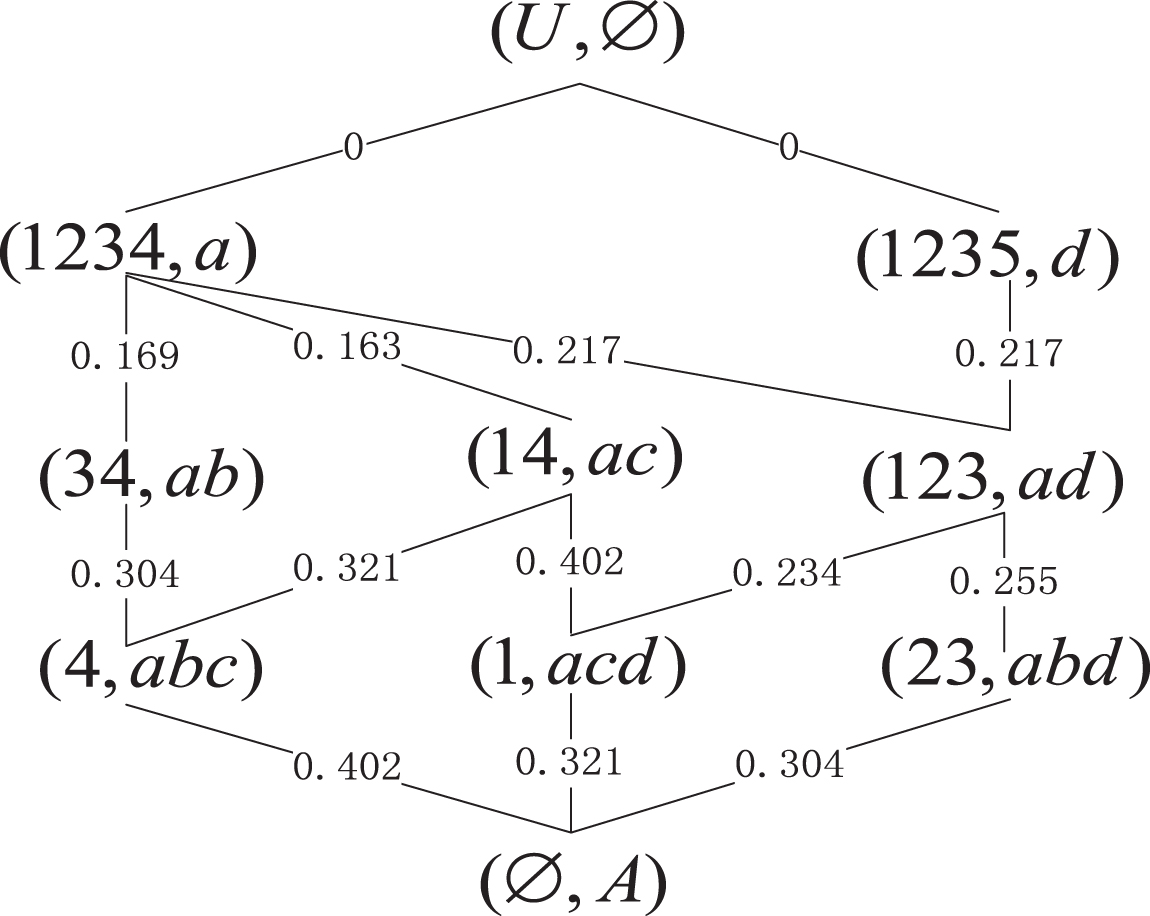
Intuitionistic fuzzy concept lattice based on Association Space for the formal context
It can be found that compared with the classical concept lattice, the intuitionistic fuzzy concept lattice based on Association Space shows the intensions correlation degree between each parent concept and its direct child concept. Therefore, by setting different values of κ, we can show the intension that we are only interested in or the degree of correlation reaches a certain range, so as to achieve the purpose of concept reduction.
It can be concluded that under the degree of correlation κ, any object in X “jointly not possessed” the attributes in
The following is the definition of intuitionistic fuzzy three-way operators
The corresponding inverse operator
Due to the similarity of the proof method, only the property (1) is proved below.
∀X, Y ∈ (U),
Thus,
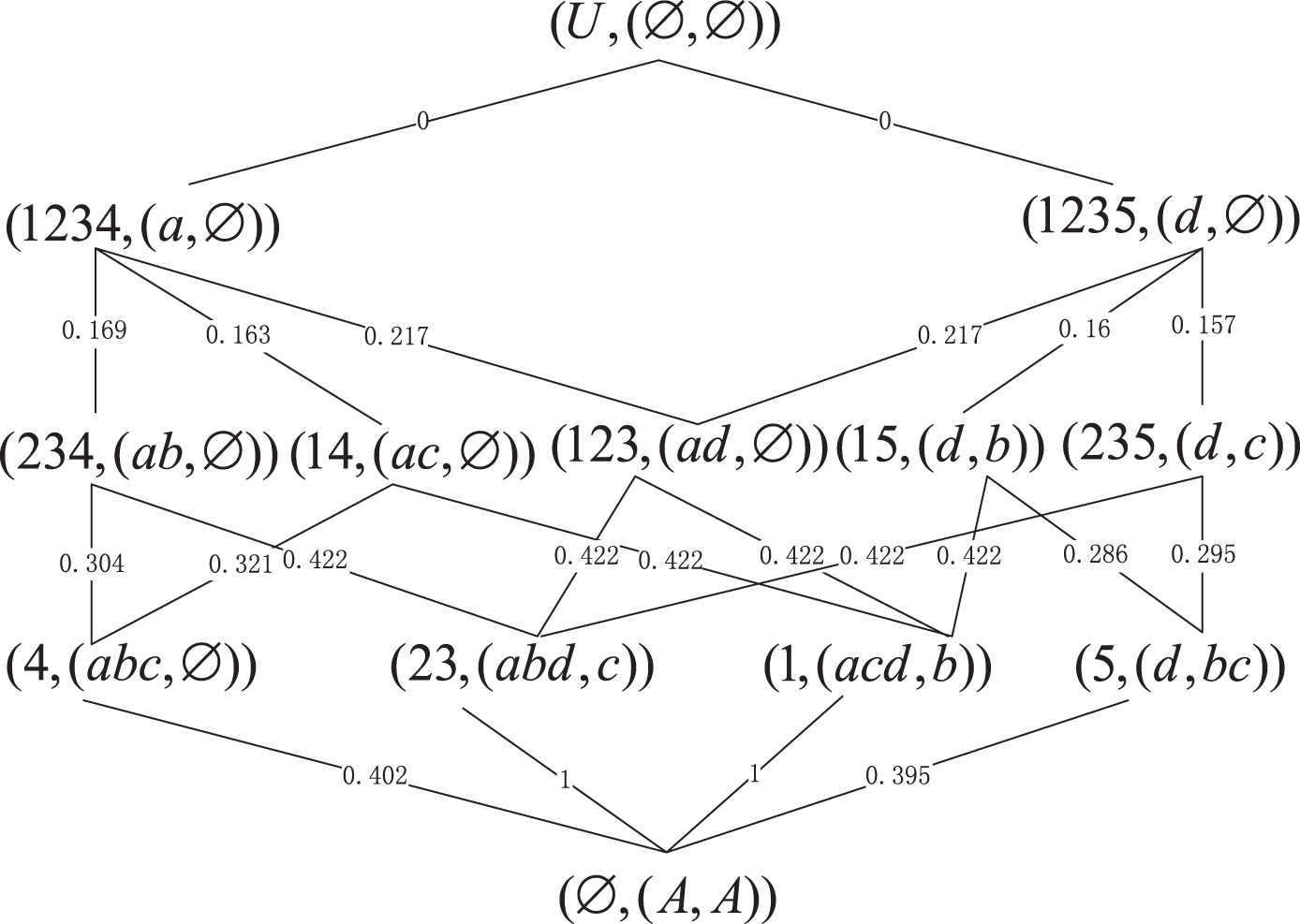
OE0 concept lattice for the formal context
Similarly, the following is the definition of the IF3WCL of attribute-induced.
∀X, Y, Z, W ∈ P (U),
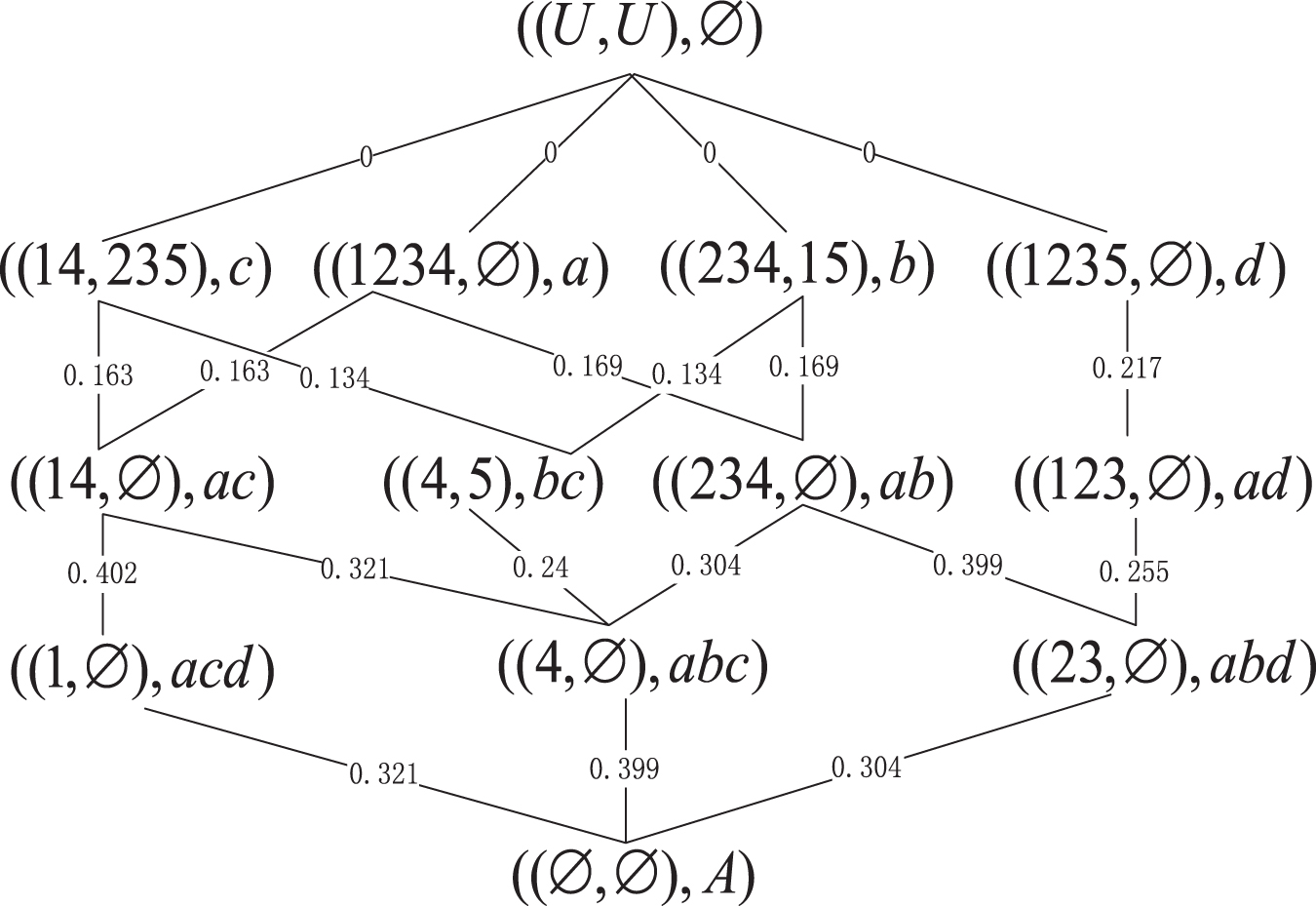
AE0 concept lattice for the formal context
The main idea of 3WD is to divide the domain into three disjoint parts, namely the positive domain POS, the negative domain NEG and the boundary domain BND. Furthermore, we adopt corresponding strategies for different domains, and finally achieve the purpose of optimal decision-making. In IF3WCL, the intension of each concept OE
κ
is essentially a set of intuitionistic fuzzy sets that satisfy the (δ, ρ) condition, expressed as follows:
To make this more precise, the intension of each OE
κ
concept is composed of a membership degree and a non-membership degree that simultaneously satisfies the above-mentioned conditional attributes. For any OE
κ
concept, its three-way division rules about intension can be expressed as:
Therefore, the positive domain is POS (A) = {d}, the negative domain is NEG (A) = {b}, and the boundary domain is BND (A) = {a, c} of concept ({x1, x5} , ({d} , {b}) 0.16).
Similarly, the three-way division rules for the extension of the AE
κ
concept are as follows:
Therefore, the positive domain is POS (X) = {x4}, the negative domain isNEG (X) = {x5}, and the boundary domain is BND (X) = {x1, x2, x3} of concept ({x4} , {x5}) , (bc) 0.134).
The secondary decision of boundary intension object in the OE κ concept
In the case of insufficient information, the boundary domain provides a good buffer space for the optimal decision, but the boundary object cannot always be in a delayed state, and it will eventually be transformed into two-way decisions, i.e., the positive or negative domains. To scientifically and objectively solve the problem of reclassification of boundary domain objects in the OE κ concept, a secondary decision strategy is given below.
(2)
Since
So f (i) is an increasing function on [0,1]. Since
For the secondary decision problem of boundary objects in the OE
κ
concept, we mainly need to consider two factors. In the first place, the 3WD division of IF3WCL is based on the degree of attribute correlation. In the second place, the objects in the boundary domain are closely related to the (ρ, δ) condition. So, considering the combination of these two factors and adding the influence of attribute weights, the calculation method of attribute central degree is given as follows:
For the situation of intension separation, we can use the Definition 9 to calculate and compare the Euclidean distance of χ and (ℏ μ (a j ) , ℏ ν (a j )) for final division.
Based on the above ideas and strategies, we give the secondary decision algorithm of object-induced IF3WCL.
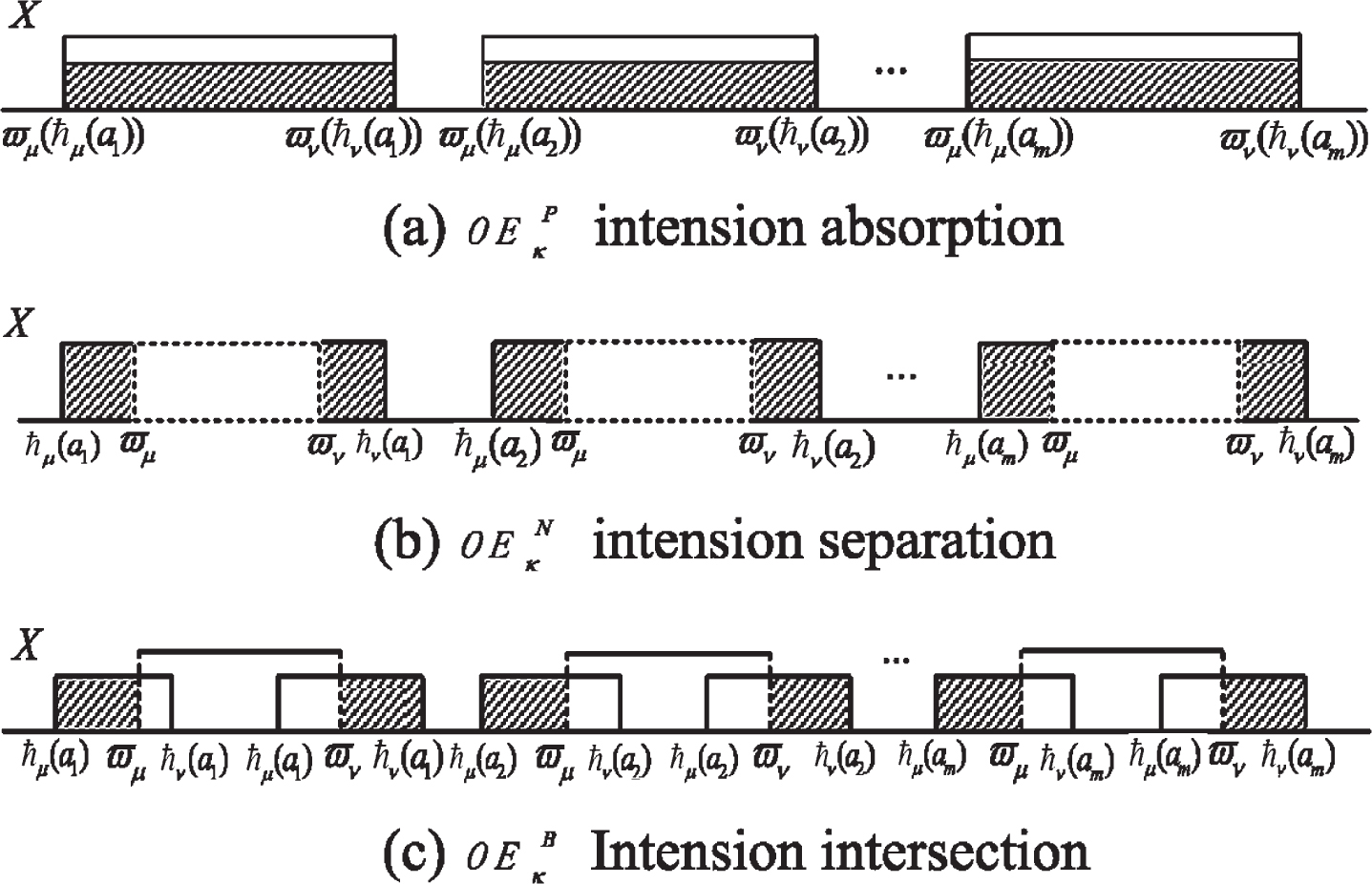
Therefore, the secondary decision result is that both attributes a and c belong to the positive domain.
Similarly, each AE κ concept has a definite intension, and its extension is an intuitive fuzzy representation of intension. Therefore, the problem of re-decision on the boundary objects of the AE κ concept is finally transformed into an analysis and processing problem for the intuitionistic fuzzy set in intension.
In the Equations (17) and (18), | · | represents the cardinality of the set. In order to avoid full coverage (or full separation) of the boundary objects due to too low (or too high) coverage, the values 0(or 1) should be eliminated during the calculation.
If the boundary object x
i
is completely covered by (Cov
P
, Cov
N
), it will appear as POS-extension coverage, otherwise, it will show NEG-extension separation, which can be expressed as:
According to the Definition 21 and Theorem 7, we give the secondary decision algorithm of attribute-induced IF3WCL as follows.
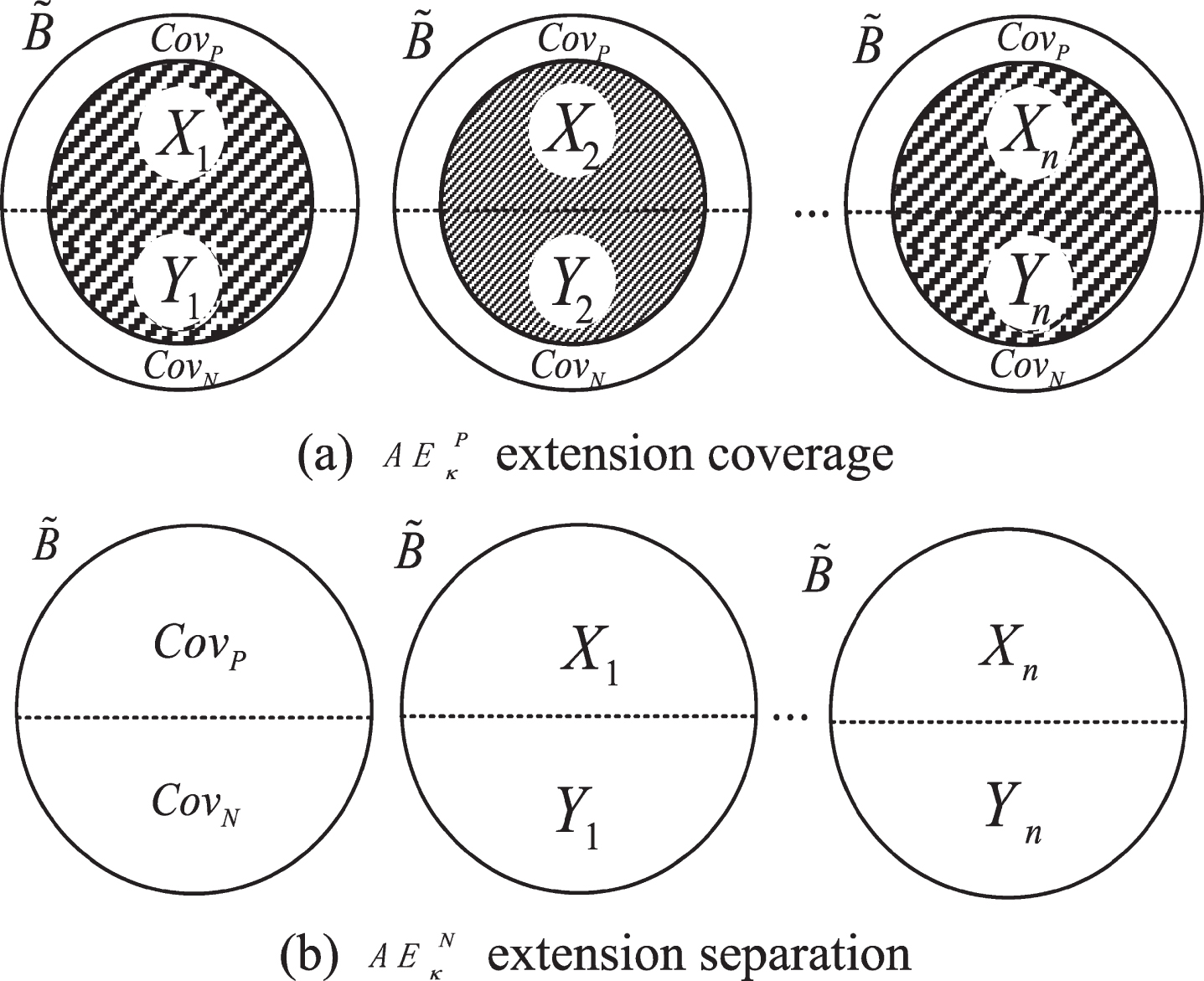
Therefore, the final results of the secondary decision are x1 ∈ POS and x2, x3 ∈ NEG.
To illustrate the application of the proposed model, this section will consider an example of a multinational company, which wants to achieve the group’s strategic development goals through the best capital investment (adapted from [45]). After preliminary screening, there are three (U = {x1, x2, x3}) investment plans: (1) x1, car company; (2) x2, food company; and (3) x3, computer company. In addition, the evaluation indicators can be divided into five (G = {G1, G2G3, G4, G5}) categories: (1) G1, the impact; (4) G4, the environmental impact; and (5) G5, the development of the society, as shown in the following matrix:
In the following, we will make a decision on the above problems through the method proposed in this paper. The method involves the following steps:
The extension and intension of AE0 concept induced by attributes
The extension and intension of AE0 concept induced by attributes
From Table 4, we can observe that a total of five AE0 concepts are obtained. Since the intension of concept 1AE0 is empty set, we will not consider it in our analysis. In the other four cases, as the concept intension changes, the corresponding decision-making is also different. Taking 4AE0 as an example, when the intension is {G1, G2, G3, G4}, the corresponding positive domain is {ϕ}, the negative domain is {x3}, and the boundary domain is {x1, x2}. In other words, scheme x3 cannot be adopted, and schemes x1 and x2 need be determined after further investigation. The interpretation of 2AE0, 3AE0, and 5AE0 is similarly to 4AE0.
Table 4 shows that 4AE0 and 5AE0 need to make a secondary decision. For 4AE0, using Equations (17) and (18), we get Cov
P
= 0.2, Cov
N
= 0.4.
Therefore, the secondary decision result is as follows:
Further analysis shows that different κ values will lead to changes in the number of AE concepts, as shown in Table 5.
AE concept generated under different κ values
To sum up, when considering the influence of all factors on the investment plan, x1 is the most desirable alternative, while x2 and x3 are not suitable for investment.
At present, uncertainty analysis and decision-making has become more and more worthy of attention. FCA can objectively describe the uncertainty problem from two dimensions of attribute and object.
This paper mainly combines the intuitionistic fuzzy set with the 3WFCA model, and uses the attribute correlation degree to analyze the relationship between each concept. Meanwhile, we give the secondary decision strategy and algorithm of boundary object in AE-concept and OE-concept. The proposed models, OI-IF3WCL and AI-IF3WCL, can not only satisfy the quantitative analysis of uncertainty in intuitionistic fuzzy environment, but also enhance the information expression ability and application scope of the traditional 3WFCA model. In future work, we consider extending the existing model to the Pythagorean fuzzy environment [46, 47]. In addition, the combination of 3WFCA and the support intuitionistic fuzzy set [48] is also a subject worth of research.
Footnotes
Acknowledgments
This work is supported by the National Natural Science Foundation of China under Grant No. 61877004, and the Beijing Normal University Interdisciplinary Research Foundation for the First-Year Doctoral Candidates No. BNUXKJX1925.