



Abstract
The plan of this research is to establish an innovative multi-attribute group decision-making (MAGDM) based on a interval-valued bipolar fuzzy set (IVBFS) by unifying“ VIseKriterijumska Optimizacija I Kompromisno Rasenje (VIKOR)” method. The VIKOR method is regarded to be a helpful MAGDM technique, particularly in circumstances where an expert is unable to properly determine his decision at the outset of the design of the scheme. The theory of set pair analysis (SPA) is a state-of-the-art uncertainty theory consisting of three variables, including “identity degree”, “discrepancy degree” and “opposite degree” of connection numbers (CNs) and a combination of many current theories dealing with vagueness in the data. Inspired by this, we are therefore making an attempt in the current research to enhance the theory of information measurement by incorporating certain metrics using CNs. In this research paper, we present the linguistic VIKOR method in the context of the CNs based metrics obtained from the interval-valued bipolar fuzzy numbers (IVBFNs). First of all, we create CNs of IVBFNs and then CN-based metrics. Secondly, we develop linguistic VIKOR method using CNs based metrics to handle an MAGDM problem under IVBF type information. The predominance and advantages of proposed approach are also highlighted. Furthermore, we demonstrate the efficiency of the extended VIKOR method by solving a numerical example, sensitivity analysis and a detailed comparison with some existing approaches.
Introduction
Multi-attribute group decision-making (MAGDM) is a scenario in which group of people simultaneously make a selection from the options before them. The decision is therefore not further ascribable to a single person who is a group member. Because all the persons and processes of social groups, including cultural influence, make a contribution to the final result. Human beings inescapably are encountered with many choice-making obstacles, which tangle different terrain including, artificial intelligence [47], granular computing [53], modelization of uncertainty [54]. In addition, these concepts enhance the terrain of rational computing as well as furnish many functional techniques to resolve applied problems. In short, researchers has explored many decision making methods on different extended fuzzy set [40–43].
In reality, decision makers (DMs) periodically are convinced with numerical data to indicate decision making material, because of expanding complication of the environment in decision analysis and situation itself [17, 51]. In this regards, as an extension of the fuzzy set (FS) [52] whose member has only membership grade, Atanassov [6] exhibited intuitionistic fuzzy set (IFS) that possessed a grade of membership and non-membership degrees. In recent years, investigators have more deliberation towards IFS [6] and IVIFS [7] because of these beliefs which have been constructively attached to multiple realistic applications, including identification of diseases, decision or choice making, recognition of suitable and evaluation of clustering objects. There is no doubt, IFS and IVIFS effectively resolve the practical world issues which accommodate vagueness but still there is a need of the investigation of an alternative which possess property and a counter property at the same time. To deal with this issue, Zhang [55, 56] introduced an abstraction of a novel extended fuzzy set named as, bipolar fuzzy set (BFS), depicted by two constituents, including grades of positive membership function ranges over [0, 1] and other is associated with the grade of negative membership function which ranges over [-1, 0]. In the meanwhile, Zhao [60] introduced the theory of set pair analysis (SPA), to furnish a volumetric analysis of the quality of the set pair. The strategy is called incorporation of the certainty and uncertainty via an assembled connection number (CN). The metric method is one of the capable approach to distinguish between alternatives from their best values. It has been examined also from the research that different information measures including, entropy, divergence and similarity can be persuaded by the normalized metric depend on their aphoristic definitions. Other than that technique for order preference with respect to the similarity to the ideal solution (TOPSIS), constructed by Hwang and Yoon [25] and VIKOR developed by Opricovic [36] are well known MADM approached. Currently, distance measure approaches are significantly important approaches which will help in comparison of data as well as represent the interrelation between them. Moreover, to make a decision with more curiosity, it is beneficial to ask the DMs to represent their decision by keeping in view the property as well as counter property of individual alternative. In this regard, IVBFSs have great potential to assemble the vague and uncertain data in practical applications than the existing theories including FSs and IFSs. Consequently, by keeping in view the importance of these theories, it is essential to expand the metrics to measure the IVBFNs by utilizing CNs of the SPA theory and also to construct linguistic VIKOR method for resolving MAGDM methods. This analysis has forced us to think about main goals for this article: (1) to establish some new metrics for CNs by the mean of IVBFNs (2) to explore the advantage of the developed metric as compare to current distance measures, (3) to resolve a practical problem of MAGDM with complex IVBF information (4) to explore validity and stability of the approach.
To attain the goals (1) and (2), firstly, we establish the CNs of IVBFNs. Secondly, we construct metrics based on proposed CNs. The dominance of the developed metrics is expressed by the means of the examples in contrast with existing distance measures. Goal (3) is tackled by developing VIKOR method depend on proposed metrics in which desires related to individual alternative are exhibited in terms of IVBFNs and its approximated CNs. Goal (4) is attained by a testing a general criteria. The usefulness, sensitivity and primacy of the method, have been examined through a practical example.
The remaining parts of the article are ordered as follows: Section 2 includes relevant work to resolve an MAGDM problem by utilizing different metrics and methods. In Section 3, we shortly make an overview relevant to the notions of FS, BFS and IVBFS, and CNs of SPA. We present novel metrics with their performance’s comparison in Section 4. In Section 5, we develop linguistic VIKOR method based on novel metrics under CNs of IVBFNs. Section 6 present a functional example to examine efficiency of the considered approach. The advantages, sensitivity and stability of solution are also discussed in the same section. Lastly, we summarized and concluded this study in Section 7.
Relevant work
To develop and coordinate the vague and undetermine data in the course of decision making method, multiple efforts have been formed by different authors in handling the data by utilizing aggregation operators [15, 50], geometry and entropy measures [10, 39], possibility theory [8, 13], score and improved score function [1, 35], bipolar fuzzy and bipolar fuzzy soft extended TOPSIS approaches [2–4, 44], Above all these concepts, metric method is outstanding method to tackle such kind of problems. Bera and Mahapatra [9] discussed some metric properties of neutrosophic soft set. Although, aside from that VIKOR is most suitable MAGDM method, whose goal is to select the best compromised solution by calculating worst and best distances of each alternative. After its successful applicability, the researchers have been developed VIKOR method under fuzzy and extended fuzzy environments. Chang and Hsu [12] established an analysis of choice making of land-use restraint strategies in the Tseng-Wen reservoir watershed via VIKOR method. In (2009), Sayadi et al. [45] developed an extended VIKOR method for choice making problem by using interval numbers. In 2011, Shemshadi et al. [46] presented a method for the selection of supplier based on entropy measure for objective weighting using fuzzy VIKOR. Luo and Wang [34] established an MADM based on a novel distance measure under intuitionistic fuzzy VIKOR. Pramanik et al. [37] developed an MAGDM strategy using bipolar neutrosophic set VIKOR. The concept of BFS resolve bipolar logical reasoning problems [57] as well as utilized in many circumstances, including psychiatry of computation [58], sciences of medicine [33], quantum of bipolar logic-based computing [59]. Further, Gul [23] introduced the idea of aggregation operators by utilizing bipolar fuzzy data and different operations to solve an MADM problem. Recently, such concepts have been commonly used by researchers to manipulate vague data.
Apart from these theories, Zhao [60] introduced a novel theory of SPA to handle fuzzy data by developing the interconnected model of certain and uncertain information together. To handle certainty and uncertainty as combined framework formed on triplet namely “sameness", “discrepancy", and “contrast" of connection numbers (CN), which is the key ingredient of this theory. Jiang et al. [29] introduced some fundamental ideas relevant to the CNs. Wang and Gong [48] introduced an approach to resolve the MADM problems by utilizing SPA theory. Cao et al. [11] established the stochastic choice making by considering the SPA theory under the IVIFS data. Kumar and Garg [18, 19] developed a TOPSIS method for resolving the choice making problems by utilizing CN of the SPA theory under IFS and IVIFS environments. Garg and Kumar [20] introduced similarity measure based method to resolve MADM problems using CNs. Garg and Kumar [22] presented an exponential distance based TOPSIS for CNs of IVIFSs.
As a result, keeping the capability and utility of CNs of the SPA theory as well as vision from Garg and Kumar [22], the objective of this study is to construct a robust linguistic VIKOR method for IVBFSs using CNs and its based metrics. Furthermore, a problem of MAGDM has been discussed to check the validity of the approach.
Preliminaries
In the present section, we shortly study the notions on the FSs, BFSs, IVBFSs, and theory of set pair analysis over the universal set
In (1989) Zhao introduced a concept called SPA to balance imprecision by adding a level of relation between the characteristics of the set pair. SPA is a well-defined ambiguity theory to address both confirmation and doubt as a single combined model.
In the present section, we define some novel distance measures, namely IVBFNs based connection number metrics. The validity of CNs and proposed metrics is also investigated.
Connection numbers of interval-valued bipolar fuzzy numbers
In the present subsection, we introduce CNs corresponding to IVBFSs by unified the concept of score and accuracy function of IVBFNs as well as to unite the intervals of degrees of property and implicit counter property into one structure.
The example given below is an explanation of above CNs.
In this subsection, we introduce some distance measures
In many circumstances, the weights of different criteria play an important part in a decision-making method. In this regard, a weight vector can be defined as W = (w1, w2, . . . , w℘) with the condition that w℘ > 0 and
Based on the principle of the CNs metric, this segment contains a step-by-step mechanism for the proposed VIKOR method.
Consider a set V
k
, (k = 1, 2, 3, . . . n) of alternatives and Develop evaluation information: Suppose that decision makers Assign the weights to the decision makers (DMs): This step assigns suitable weights to individual DM. Obtain the overall (aggregated) IVBF decision matrix: By using IVBF weighted averaging operator, all individual decision matrices can be converted into a final aggregated matrix as follows:
Possess the weights of attributes: This step assigns suitable weights to each attributes according to priority level of the attribute. Computation of the best and worst values of alternatives: The best value Computation of CNs decision matrices: Compute the CN decision matrices Calculate the key values of proposed IVBFS linguistic VIKOR method: Calculate the values where Rank the alternatives, choosing by the values 1. If the only 2. If
Linguistic variables for rating the alternatives with IVBFNs
The proposed method has been tested in this section on the real-life problem of decision-making by means of IVBF information and a sensitivity analysis is also addressed. The potential benefits of the proposed method have also been addressed in the same segment. The flow chart of the method can be seen in Fig. 1.
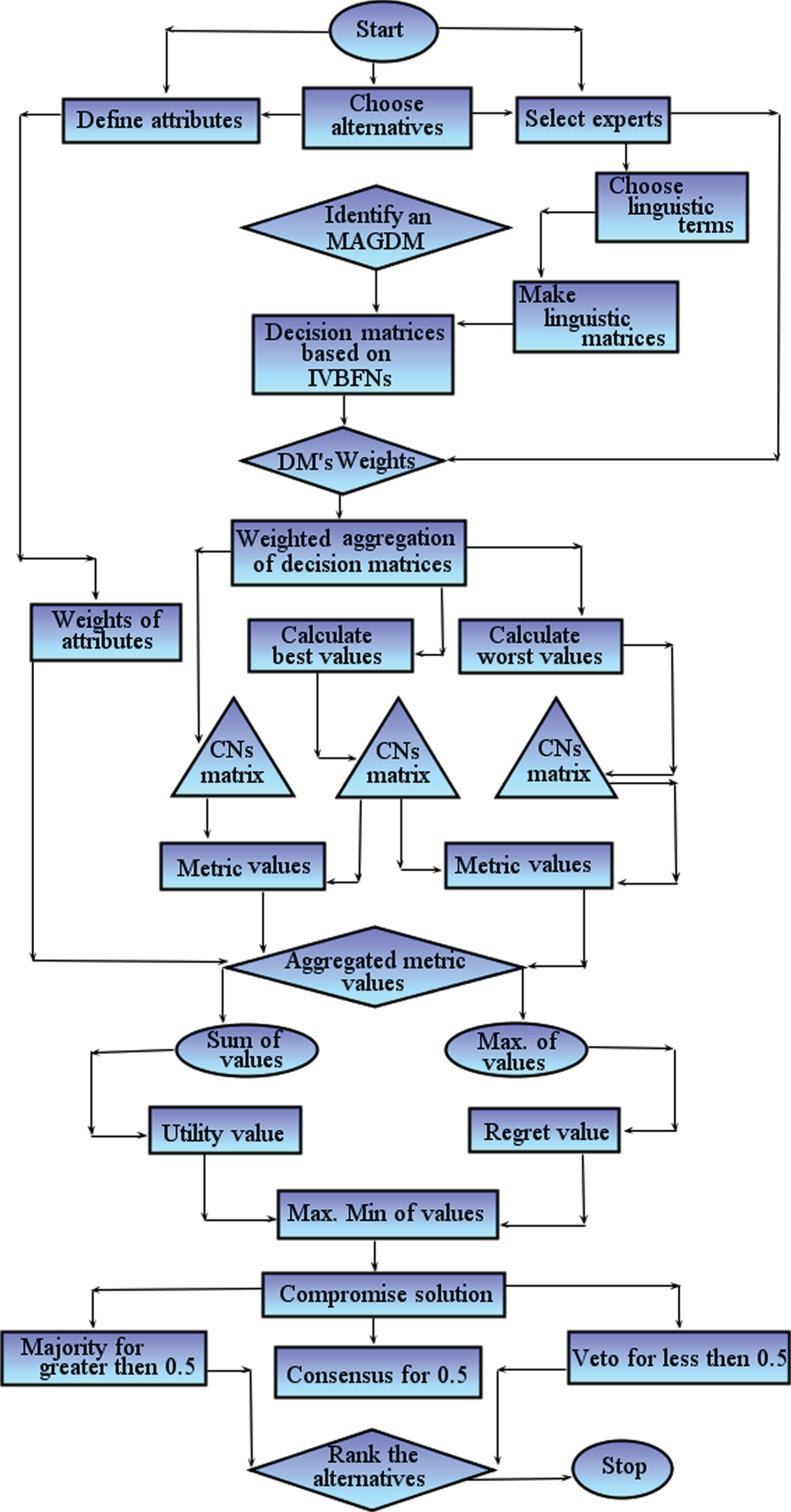
Road map of the whole problem is given in the figure below.
Homelessness is the state of persons without a house, and individuals without a home are considered homeless. This is the elementary definition of homelessness, but as per the United Nations, people living in overcrowded slums are also regarded as homeless. Pakistan is estimated to have 20 million homeless people in a country of 220 million. Most of them probably wind up in shanty towns and other urban slums. Others opt at shrines, under bridges, walkways, sidewalks and road separators. The difficulty is compounded by a lack of solid information on people who are homeless, especially homeless women and children. There are several factors of homelessness in Pakistan, such as interest rates, joblessness, natural catastrophes, higher population progression, etc. There are no affordable homes available in Pakistan. Pakistan has few examples of cheap housing, though on a limited scale. It could not be benefited by the general public. The shortage of housing is also one of the primary reasons for the homelessness in Pakistan, as people who are poor can not acquire open-market homes. Dismayed by the increasing homeless population, the government of Pakistan has decided to develop shelters to provide people with rooftops and basic necessities. The plan is the pet project of the Pakistani government, which has vowed to transform Pakistan into a welfare system. The government paved the way for the “Shelter Home” project in major city Lahore, which is considered home to a large number of poor and homeless people, mostly elderly people, women and children. "Shelter Home is a move towards the establishment of a humanitarian state in the country. In the first step, the government plans to develop shelters in major cities, such as Lahore, Rawalpindi, Karachi, and Peshawar. In Lahore only, five sites have been dedicated to the development of shelters for homeless people. Each will be capable of handling greater than 1000 men and women. The goal behind the establishment of shelter houses is to regain self-respect to homeless people spending the night under the open sky. It has also been aimed at expanding the moral responsibility by the state and citizens. The government invites the contractor to build shelters.
They required six attributes for construction company selection, namely,
Linguistic variables for alternatives with respect to attributes provided by each decision maker
Linguistic variables for alternatives with respect to attributes provided by each decision maker
Decision matrices based on IVBFNs using linguistic variables in Table 2, provided by decision makers
All decision makers evaluate each alternative The weights of DMs are given by ℑ1 = 0.335, ℑ2 = 0.333, and ℑ3 = 0.332. By using Equation 10, the overall matrix of decision information is calculated and results are given in Table 4. The weights for attributes are given as follows: w1 = 0.1548, w2 = 0.1687, w3 = 0.1695, w4 = 0.1680, w5 = 0.1671 and w6 = 0.1719. The best and worst values of overall decision matrix can be achieved by using Equations 11 and 12 respectively. The calculated values are given as
The aggregated decision matrix by using weighted averaging formula for IVBFNs.
The calculation of CNs matrices, To calculate the values In Table 10, it can be seen that
Connection numbers matrix
Connection numbers matrix
Connection numbers matrix
Metric values of connection numbers matrices,
Aggregated weighted metric values
The values of
Stability of the optimal solution for different values of γ
In the propounded linguistic VIKOR technique, the coefficient of decision-making procedure is important to ranking outcomes. Thus, a sensitivity test is conducted in this respect, to evaluate the sustainability of our technique in such scenarios. For each γ ranges over [0, 1] interval, we compute the associated compromise solution to explore the impact of distinct γ’s on the qualifying outcome. Table 11 demonstrates the sensitivity analysis in areal life case. Three distinct ranking outcomes are produced for all the γ’s values examined, including
Advantages of proposed technique
According to the above assessment of stability in order to tackle decision-making issues, the suggested technique is consists of the following features: The IVBFS is represented by the degrees of the property and counter-property of a particular element such that the interval of degrees extend to [-1, 1]. Nevertheless, circumstances may arise in which the IVBF theory is unable to provide full data on the scenario. On the other side, the theory of SPA provides an alternative way of dealing with certainty and uncertainty by means of statistical study of the “identity,” “discrepancy” and “contrary” degree of the connection numbers, so that the sum of the triplet is equal to one. The theory of SPA is therefore more appropriate for actual science and IT applications. It combines degrees of property and counter property in a unified structure by the means of CNs obtained from IVBFNs. The presented method depicts the interval-valued bipolar fuzzy data using connecting degrees, which can be concurrently defined as property degree, and the implicit counter-property degree with a straightforward mathematical representation. Depending on this, we can calculate the degree of association without any conversion and thus efficiently prevent the loss of data. The sensitivity analysis illustrates how the decision-making strategy would affect the result, and also it indicates that the conclusion arrived from our method is stable and effective. The findings acquired by the proposed technique may be more precise, since they contain stability of best alternative for all parametric values. The suggested technique is more nebulous and appropriate to address the real-life issue more precisely than the current ones.
Comparative Study
In this section, we make a comparative study of proposed approach with some existing approaches. We make a theoretical comparison of the study with existing studies by comparing the features of methods. Unlike the VIKOR method based on conventional fuzzy sets, including interval fuzzy numbers [45], triangular fuzzy numbers [5, 32], and trapezoidal fuzzy numbers [30], The strategy presented in this article is based on IVBFS, which adds a degree of property and implicit counter-property on the grounds of traditional human thinking and is capable of describing assistance, resistance and neutrality in human consciousness. Such an expanded definition enables to better portray situations where the decision-maker refrains from expressing their assessments. comparing with the approaches [4, 39] applying different bipolar information based techniques to calculate best worst values, our method generates crisp values result in a more intuitive way with less computation. Although Pramanik et al. (2018) extended the VIKOR method to bipolar neutrosophic information based on normalized hamming distance, the method sometimes generates counterintuitive cases and takes no consideration of waver in bipolar neutrosophic sets. Instead, our method contain a new CN based distance measure could reflect bipolarity in a unified form effectively. Also, the new metrics does not generate counterintuitive cases. Compared with the other methods [26–28, 49] based on those extensions of BFSs, BFSs possess sound theoretical foundation such as basic definition and operations, comparison rules, information fusion method, and measures of BFS.The proposed CN based linguistic VIKOR method can take advantage of these theories in construction and verification, which is favorable to practical application. One more thing, the presented method consider IVBF information which contain more information as compare to BFS. Although BFSs have the benefit of being able to consider waver, most of existing methods are applied to environment with less nonspecificity information [1, 35]. Through an example of real life decision making, presented SPA theory and IVBF theory based method illustrates the effectiveness of proposed method in such situation. Moreover, example under consideration indicates that our method can obtain desired ranking result, superior in environment with low specificity. In the MAGDM problem with different set theories, subjective randomness exists, due to this randomness these theories sometimes fail to determine ranking. To overcome this issue connection numbers of SPA theory play a vital role. Compared with similar methods used for MADM [12, 37], the current process, depending on the decision-making philosophy of the typical VIKOR method, can enhance group benefit and reduce individual hesitations at the same time, making the outcome of the decision more rational. Also, the coefficient of decision mechanism can be changed according to actual requirements to balance group utility and individual regret, which can increase the flexibility of decision-making.
Conclusion
In this paper, we brought out some novel metrics for decision making method in the context of BFS domain by utilizing the CNs of SPA theory. In this regard, we first develop CNs based on IVBFNs and the proposed some metrics using CNs. Furthermore, by utilizing these metrics, a novel linguistic VIKOR method based on CNs of IVBFNs has been constructed with a practical example of MAGDM. The current process, depending on the decision-making philosophy of the typical VIKOR method, can enhance group benefit and reduce individual hesitations at the same time, making the outcome of the decision more rational. Also, the coefficient of decision mechanism can be changed according to actual requirements to balance group benefit and individual hesitation, which can increase the flexibility of decision-making. The merits of the presented method are to discuss the most of the data more properly and objectively relevant to the object to decrease the data loss. One more thing, this study contain the CNs which combine the property and counter property of an object rather than discrete as in BFS and IVBFS theory. The proficiency of the propounded technique has been highlighted by the mean of a numerical example and obtained results are balanced with the stability analysis. The dominance of method has been examined through real example to represent that method is deliberately working in all such cases where the data involves bipolarity. It has been examined from sensitivity analysis that the propounded method is more suitable for ranking among alternatives. In future work, we shall study the presented technique on different classical methods and extended fuzzy sets.