



Abstract
Based on an unqualified product recalling process in a supply chain, this paper establishes an evolutionary game model between consumer federation and manufacturer, as well as analyzes the effects of manufacturer’s pricing strategy and consumer federation’s supervision on the decision-making and dynamic tendency. Under this structure, the manufacturers’ pricing strategies on recalls mechanism have two scenarios: the high penalty and low penalty from consumer federation. Results shows that, when the consumer federation adopts high penalty measures, there will be an ESS for consumer federation that can both minimize the cost and protect consumers’ rights. Further, the probability of manufacturer adopting “recall” strategy is positively correlated with the change in the product price, and both the probability of consumer federation adopting “regulate” strategy and manufacturer adopting “recall” strategy are positively correlated with the penalty coefficient.
Introduction
With the rapid development of social economy and the gradual advancement of global trade integration, consumers have more and more channels to purchase with more and more different sorts of product. However, the crisis caused by product quality also frequently breaks out in the global. For example, in 2010, Toyota has suffered thousands of safety accidents caused by accelerator pedal problems and 52 deaths [9]. Product recalls occur frequently in many industries, which are closely related to public health and social security, as well as have attracted high attention from the government, media and public. In 2009, China promulgated the tort liability law, which stipulates the strict liability principle for product producers. On the one hand, the implement provides economic compensation for the injuries and losses faced by consumers; On the other hand, the high compensation also guides enterprise to strengthen product quality management and after-sales management.
For consumers, unqualified product will bring a great harm to them, which may include time cost, communication cost, extra expenses and so on. On this basis, if the enterprise fails to deal with the unqualified product sold to consumers, consumers’ brand trust and brand loyalty of the enterprise will be seriously affected, even the brand image of enterprise will be severely damaged. For enterprises, when they sell unqualified product to a consumer, the enterprise has the responsibility to recall the unqualified product at the reason of that this product will infringe consumers’ interests. In addition, recalling of unqualified product is the symbol of responsibility for enterprises, which can help them improve their brand image from the consumers’ point of view. Maybe short-term costs could be negatively affected, long-term benefits could be better. This approach can also promote market dominance, especially if your opponents are not responsible to government and consumers. Benefits are always inseparable from good brand images.
So, the enterprises have an incentive to recall unqualified product. The occurrence of product injury will cause harm to consumers, whereas the high compensation can be avoided and the harmful accidents can be prevented if the enterprises take measure to purchase unqualified product for maintenance or exchange. Further, consumer federation advocated by the government also supervise enterprise via publicities, affecting the quality defect, among which the implicit threat of strict law enforcements is considered as the main reasons to accept the recall of unqualified product. This paper will discuss whether the consumer association should choose to supervise the recall of manufacturers to balance consumer surplus and own costs, and whether the enterprises should choose to recall unqualified product to improve the corporate image and profit.
There is an evolutionary game model of the dynamic behaviors between consumer federation and manufacturer explored in this paper. The structure of this paper will be organized as the follows. Section 2 presents the literature review. The analysis of the model and the equilibrium of evolution game are proposed in Section 3. In Section 4, we employ a numerical example to demonstrate the practical application of the established model. In Section 5, we summarize the managerial insights and future research directions.
Literature review
There are three categories of literature related to our study: consumer’s attitude on unqualified product recalling, the analysis of product recall policy and application of evolutionary game theory.
Consumer’s attitude on unqualified product recalling
For the past few years, the variety and quantity of product that consumers can obtain through transactions were greatly enriched. But unqualified product problem came along, among the more serious ones are: in 2008, Sanlu milk powder incident caused nearly 40000 infants diagnosed kidney damages, which brought the crisis to the public. [19]. At the year of 2011, E. coli contamination of bean sprouts in Germany, according to statistics, has killed 37 people and put over 3,000 in treatment [21]. More commonly, product recall often occurs in the automobile industry. The essential meaning of recall is an activity that the enterprises take measures to eliminate the harm caused by the unqualified product, which is a process that requires the participation of both enterprises and consumers.
For consumers, there are two choices. One is to respond to the enterprise’s recall activities, and consumers may need to pay a certain transportation cost and prescription cost. The second one is not to respond to the recall activities of enterprises, in which case consumers should suffer the potential losses caused by unqualified product. According to the severity of harm caused by the unqualified product, consumers can decide whether to respond to the recall of unqualified product or not. Zhao, Y et al. analyzed consumers’ behavior responses to the product-harm crisis in [31]. Meanwhile, their research has provided preliminary insights about consumers’ attitude towards unqualified products. Siomkos, G.J et al. analyzed the impact of consumers’ concerns about the severity of product quality problems on recalling strategies in [26]. From the perspective of consumers, enterprises that implement active recalling could be more responsible. Aikaterini et al. focused on the hazard of unqualified product and examined consumers’ responding on unqualified product in three different time periods in [2]. They found that time can impact consumers’ attitude towards the harm of unqualified product.
Consumer’s attitude on unqualified product recalling can actually affect their judgements of an enterprise, including brand trust and brand loyalty and so on. Lassoued R et al believed that brand loyalty can be impacted by brand trust via consumer confidence. Consumer confidence in credence qualities has a positive influence on brand loyalty in [17]. Siau and Shen believe that enterprises’ reputation is the main factor affecting consumer brand trust in [24]. The brand trust of consumers will bring potential benefits to the enterprise brand. Research results of Jang. A [13] shows that voluntary recall can reduce the negative influences on consumers’ brand trust caused by recalling. Brand loyalty enables consumers to show their enthusiasm for a brand and form long-term brand purchasing power, which can also increase potential profits of enterprises [10].
The macro analysis of product recall policy
From a macro perspective, plenty of researches have been carried out on the issue of recall decision. Kong, D et al. explored the connection between product recall and corporate social responsibility by analyzing the cases of China’s food industry in [16]. They found that the value destroying of product recalls can be mitigated by corporate social responsibility. Xu et al. explores the decision-making and coordination mechanism of pricing and collection rate based on the corporate social responsibility respectively in a manufacturer-retailer supply chain and a dual-channel forward supply chain in [27, 34]. But their research did not take the context of how unqualified product hurt consumers into account. Thomsen et al. studied the issue of recall decision based on social welfare in the context of a single manufacturer in [29]. Different from this, our paper focuses on the protection of consumer rights, the consumer federation always aims at consumer surplus. While instead of individuals, the subjects of our study are supply chain members.
Not only will product recall affect consumers’ consumption experience, it is also regarded as a nightmare for almost all enterprises in supply chain. When product recall happens, many aspects including revenues, reputation, and profitability of enterprises will suffer significant declines. Further, there will be not just punishment from regulators, the public pressure given by the media will follow [8, 15]. There have been studies illustrate that from the perspective of indirect penalties, the product recalling cost is far more than the direct cost of replacing or repairing the unqualified product. Some scholars investigated some key features about product recalling and their influences on the retailers’ financial profits. They also found the similar conclusion: compared to repair or exchange, refund remediation has a greater negative impact on retailer [23].
Generally, the product recall is usually caused by low quality, in this regard, manufacturers can choose to recall actively or take a negative strategy, and the consumer federation has the power to regulate enterprises who offer unqualified product. Chen et al. found that when an enterprise recalls their unqualified product proactively, which is prior to the consumer federation’s required recall, this recall may impact manufacturer’s financial value more negatively instead of passive recalling strategies in [4].
The adoption of active or passive recall strategies also has an impact on corporate social responsibility. Jolly and Mowen indicated that when an enterprise can take measure before the government agency supervises and orders it to move, people will perceive it to be more responsible in [14]. According to [25], by voluntarily recalling, the manufacturer is sending a message that it genuinely concerns about the experience of its clients. Consumers may regard proactive recalls as a message that manufacturers are trying to solve quality problems and that manufacturers with high socially responsibilities are more capable of producing high-quality product. This can enhance consumers’ trust in manufacturer’s product and can result in a significant promote in the enterprise’s future business and revenue [26].
Applications of evolutionary game theory
Evolutionary game theory, which combines dynamic evolutionary process analysis with game theory analysis, has great potential in simulating substantial problems in many areas, such as economies [7], finance [18] and so on. Basing on trial-and-error method, evolutionary game theory assumes that both the game-agents are bound and rational in seeking game balance, which is consistent with the principle of the evolution in biology. The strategies adopted by both sides will finally converge to the evolutionary stable strategy (ESS) in the evolutionary game [6]. When the game-agents choose a strategy in the continued repeated game, they should consider not only the current strategies but their effect in the future.
Evolutionary game theory extends the description of population evolution of traditional game theory [1], it is widely used to predict the evolutionary trend of populations’ behavior in different fields including social, finance, economics, etc. [3]. It is considered by the evolutionary game theory that groups of multiple players under the assumption of bounded rationality, and eventually explores which strategy will be chosen by the majority of players [28]. Nevertheless, the traditional game theory only analyzes the specific strategies of enterprises, rather than exploring whether the strategies have the process of evolution and whether they can eventually reach the evolutionary stability. Chai and Xiao constructed a model of evolutionary game including single manufacturer and multiple retailers to analyze evolutionary behaviors of retailers in a duopoly supply chain in [5]. In their research, the stable strategies of retailers could be social responsibility or non-social responsibility.
Xiao and Yu explored the retailers’ evolutionary stability in a duopoly condition. In their research, there are two kinds of strategies for retailers to adopt: profit maximization and revenue maximization in [28]. Hafezalkotob et al. established a model based on a manufacturer-retailer supply chain under risk-neutral and risk-averse behaviors respectively in [12]. Their research examined the evolutionary strategies of retailers with different attitudes toward risk-averse. Mahmoudi et al. took different government scenarios into account in [20], and established a model of evolutionary game between a group of retailers and a group of producers, where the producer’s strategy includes whether to implement green production, and the retailer’s strategy includes investing in marketing with large or small cost. Zhang et al developed the evolutionary game model consisting of governments and manufacturers, and explored how manufacturers’ decisions would be influenced by the government policy [32]. They also analyzed the dynamic tendency of the cap-and-trade market. Chen and Hu explored the dynamic relation between government and manufacturers considering carbon taxes and subsidies in [30]. Their research investigated the evolutionary process of governments and manufacturers’ strategies under both dynamic and static carbon taxes.
Although the above literature applied evolutionary game theory to analyze the supply chain from different perspectives, none of the studies focused on the evolution of enterprises’ strategies (especially manufacturers’ strategies) related to product responsibility. Our paper innovatively establishes an evolutionary game model considering the loss of unqualified product to consumers and the subsequent partial liability faced by enterprises.
Evolutionary game model
Model descriptions
In this paper, we consider the participants are bounded rational with complete information conditions to maximize their own goals by adjusting strategies, where the manufacturer produces qualify product or unqualified product with a certain probability. Further, consumer federation considers the decision on whether supervises the manufacturer to recall unqualified product or not. In addition, the manufacturer can choose whether to recall unqualified product to improve quality or not. For the shareholders in dynamic evolution game, the manufacturer expects to maximize his own profit, whereas consumer federation considers the maximization of consumer surplus.
For consumer federation and manufacturer in this model, there are two strategies affecting their own decision. When manufacturer recalls and consumer federation supervises, it can provide the publicity and increase the income for the manufacturer. On the other hand, consumer federation regulates make a punishment cost when the manufacturer doesn’t recall. In order to investigate on the behaviors of regulation and recall for shareholder, we can compare the equilibrium with different strategies, in which both sides behavior strategy constitutes a dynamic evolution process. The associated variable and parameter notations and the meanings of them can be found in Table 1.
Major notations explanation
Major notations explanation
The manufacturer can produce qualified product and unqualified product, where ϑ indicates the probability of manufacturer producing high-quality product. And consumers purchase product from manufacturer at the selling price of p. After purchasing, consumers can observe the quality information of product. Unqualified product will cause harm to consumers, and the harm degree is B. Meanwhile, consumer federation can know the product quality from consumer and take the maximization of consumer surplus in account to impose regulatory penalties on manufacturer. For the manufacturer recalling unqualified product, the probability is β (0 ⩽ β < 1) and the recalling cost is c. However, if the manufacturer refuses to recall, the manufacturer has the responsibility to compensate the consumer loss, and the liability cost is L (L > B > c). Moreover, the manufacturer can improve the product quality via technology improvement beforehand, where the improvement efficiency is k. Refer to the quality improvement cost function of Hu et al. We can get that manufacturer’s quality improvement cost is
Refer to the literature of Fan et al. [33], the anticipated liability cost of unqualified product is cβ + L (1 - β) and anticipated loss by consumer is (1 - β) (B - L). Consumers are willing to buy a product from manufacturer if and only if the reserve price v is not less than the sum of the product price and anticipated loss p + (1 - ϑ) (1 - β) (B - L) Since the reserved price v obeys the uniform distribution on [0, 1], the market demand can be written as follows
When the unqualified product is recalled successfully, it can be deduced that the recall probability β ∈ (0, 1). On the contrary, when the recall is failed, the recall probability β = 0. For each product, the manufacturer’s expected profit is P = p - (1 - ϑ) [cβ + L (1 - β)]. Then the total profit are respectively as the following.
While consumer federation choose to regulate the behavior of manufacturers, they can penalize manufacturers depending on the number of products not recalled. Total penalty cost by consumer federation can be represented as Equation (4), where t stands for consumer federation’s penalty amount for each failed recall of unqualified product.
When the manufacturer chooses to recall unqualified products and its behavior is known by consumer federation, consumer federation can maintain the reputation of the manufacturer and bring some additional income S to the manufacturers by propagating.
The consumer federation can adopt regulating or not regulating the behavior of manufacturers, the strategic space can be (regulate, not regulate). Suppose the consumer federation would implement the strategy “regulate” with the probability x and the probability of consumer federation implementing the strategy “not regulate” could be expressed as 1 - x.
Manufacturers can choose to recall or not recall unqualified product. The strategic space of manufacturers is (recall, not recall). Suppose the probability of recalling unqualified product by manufacturers is y ; and they would not recall unqualified product with the probability 1 - y .
Let U x and U1-x represent the expected utility of the consumer federation while its strategy is “regulate” or “not regulate” respectively. According to Table 2, the mean utilities of the consumer federation with different behavior strategies can be obtained as follows.
Payoff matrix between the consumer federation and manufacturer
Payoff matrix between the consumer federation and manufacturer
U
y
and U1-y indicate the expected utility of “recall” and “not recall” for manufacturer respectively. The mean utilities of the manufacturer can be obtained similarly as the equations shown.
According to Xiao and Yu (2006), the replicator dynamic system is dynamic differential equations depicting the frequency of adopting a specific strategy by a population in the evolutionary game theory. The replicator dynamic equations when manufacturer choosing “recall” and when “regulate” chosen by consumer federation can be represented by F (x) and F (y), which are respectively shown as follows.
We can treat the replicator dynamic system as the combination of Equations (9) and (10).
By substituting (5), (6), (7) and (8) into (9) and (10), the replicator dynamic equations can be deduced as follows
The equilibrium points of this evolutionary game can be obtained by the dynamic system above.
(0, 0) , (0, 1) , (1, 0) , (1, 1) are the fixed equilibrium points of the model.
If
The equilibrium points are shown in Proposition 1, whether they are the ESS or not would be explored in the next.
It is not necessary that the equilibrium point is the ESS in the replicator dynamic system. The stability of the equilibrium points can be deduced by analysis of the Jacobian matrix (Friedman, 1991). According to Lyapunov stability analysis, the Jacobian matrix J of the above replicator dynamic system is as follow.
Only if the equilibrium point satisfies the scenario that Det [J] = ad - bc > 0 and Tr [J] = a + d < 0, it can be an ESS. Det [J] and Tr [J] can be calculated as the Equations (13) and (14) shown.
By changing the initial condition, the evolutionary game would have different ESS. The result of analysis of the evolutionary game between the consumer federation and manufacturer is divided into different conditions shown in Table 3.1–Table 3.6.
Local stability analysis of the evolutionary game between the consumer federation and manufacturer when T - Δ > 0, C1 - C2 > 0
Local stability analysis of the evolutionary game between the consumer federation and manufacturer when T - Δ > 0, 0 < C2 - C1 < S + T
Local stability analysis of the evolutionary game between the consumer federation and manufacturer when T - Δ > 0, S + T < C2 - C1
Local stability analysis of the evolutionary game between the consumer federation and manufacturer when T - Δ 〈 0, C1 - C2 〉 0
Local stability analysis of the evolutionary game between the consumer federation and manufacturer when T - Δ < 0, 0 < C2 - C1 < S + T
Local stability analysis of the evolutionary game between the consumer federation and manufacturer when T - Δ < 0, S + T < C2 - C1
*“+” denotes positive; “–” denotes negative, N denotes uncertainty.
When T - Δ > 0 and C1 - C2 > 0, then (0,1) is an ESS of the replicator dynamic system. The behavior strategy is (not regulate, recall). The evolutionary path is displayed in Fig. 1(a). When T - Δ > 0 and 0 < C2 - C1 < S + T, the replicator dynamic system has no ESS, and shows a closed loop line with an infinite loop. The evolutionary path is displayed in Fig. 1(b). When T - Δ > 0 and S + T < C2 - C1, then (1,0) is an ESS of the replicator dynamic system. The behavior strategy is (regulate, not recall). The evolutionary path is shown in Fig. 1(c). When T - Δ < 0 and C1 - C2 > 0, then (0,1) is an ESS of the replicator dynamic system. The behavior strategy is (not regulate, recall). The evolutionary path is shown in Fig. 1(d). When T - Δ < 0 and 0 < C2 - C1 < S + T, then (0,0) is an ESS of the replicator dynamic system. The behavior strategy is (not regulate, not recall). The evolutionary path is displayed in Fig. 1(e). When T - Δ < 0 and S + T < C2 - C1, then (0,0) is an ESS of the replicator dynamic system. The behavior strategy is (not regulate, not recall). The evolutionary path is shown in Fig. 1(f).
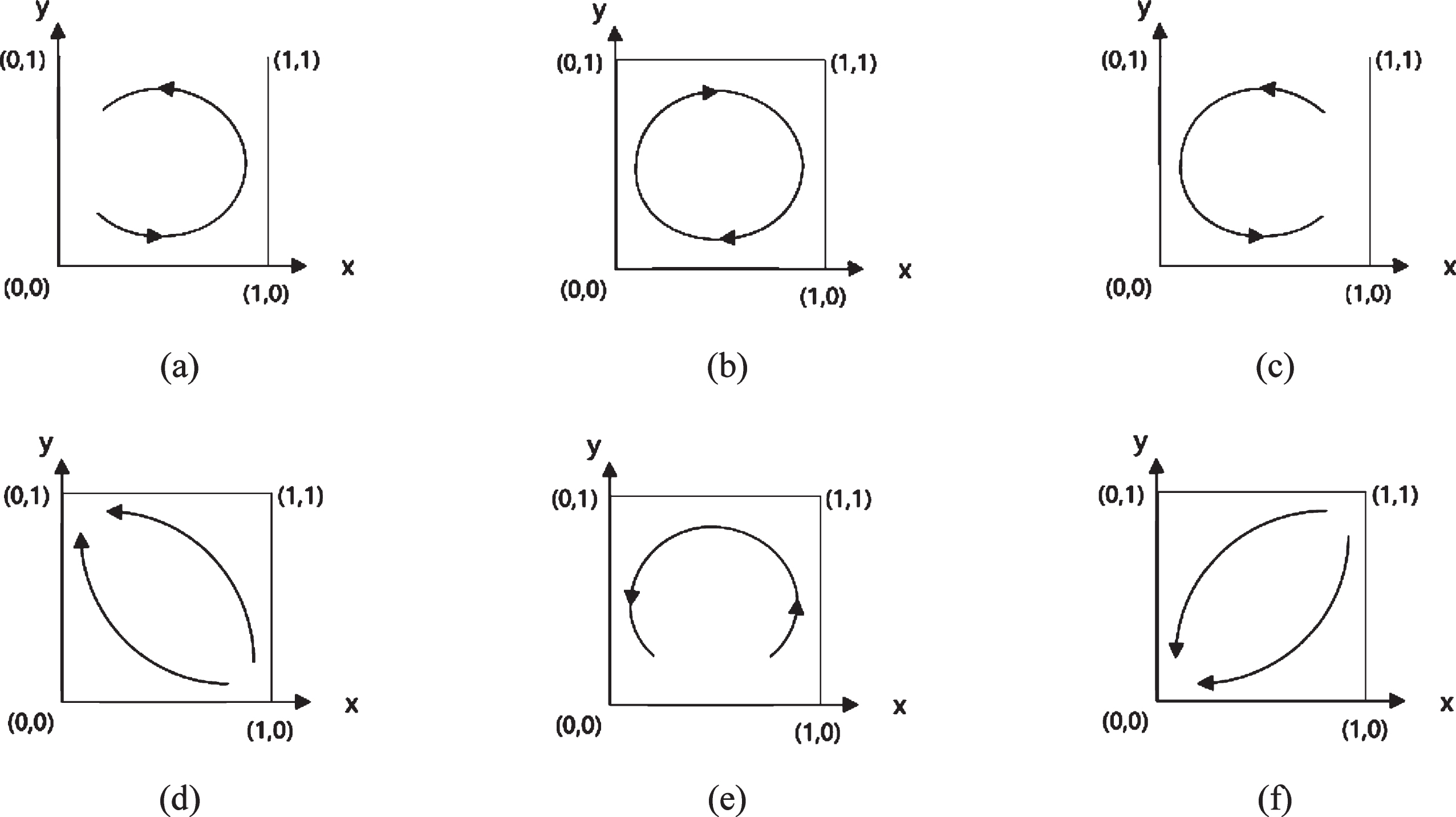
The local stability of the evolutionary game between the governments and manufacturers.
The Local stability analysis of equilibrium points is as follow.
•(0,0). The behavior strategy is (not regulate, not recall).
When T - Δ < 0C1 - C2 < 0, Det [J] |(x=0,y=0) > 0, Tr [J] |(x=0,y=0) < 0, then (0,0) (not regulate, not recall) is an ESS of the replicator dynamic system.
•(0,1). The behavior strategy is (not regulate, recall).
When the parameters of replicator dynamic system satisfies that C1 - C2 > 0, Det [J] |(x=0,y=1) > 0, Tr [J] |(x=0,y=1) < 0, then (0,1) (not regulate, recall) is an ESS of the replicator dynamic system.
•(1,0). The behavior strategy is (regulate, not recall).
When T - Δ > 0, S + T < C2 - C1, Det [J] |(x=1,y=0) > 0, Tr [J] |(x=1,y=0) < 0, then (1,0) is an ESS of the replicator dynamic system.
•(1,1). The behavior strategy is (regulate, recall).
The point (1, 1) cannot satisfied Det [J] |(x=1,y=1) > 0, Tr [J] |(x=1,y=1) < 0 in any cases, so that (regulate, recall) is not an ESS of the replicator dynamic system either.
•For the equilibrium point (x0, y0).
(x0, y0) cannot be an ESS in any conditions.
The evolutionary stable strategy of manufacturer and consumer federation evolves to (0,1) when the parameters of replicator dynamic system meet the condition of Tables 3.1 and 3.4, evolves to (1,0) for Table 3.3, evolves to (0,0) for Tables 3.5 and 3.6, while there is no equilibrium for Table 3.2.
In this paper, we assume the values of the necessary parameters. The evolutionary game model with the different initial parameter values are solved and analyzed by MATLAB software. In this part, the evolutionary game model is analyzed to describe the long-term evolutionary behavior between consumer federation and manufacturer. We also assessed the mixed strategies adopted by manufacturer and consumer federation under different values of parameters.
Both of the manufacturer and consumer federation are adjusting their individual optimum strategies to maximize their own goals. The mutual effect between manufacturer and consumer federation are investigated in the dynamic system. Through numerical simulation, the evolution trends of the strategy of manufacturer and consumer federation are deduced. In consideration of the automobile industry involves many product recall responsibilities and the recall majorities are all manufacturers, this paper carries out numerical simulation in combination with the automobile industry market. In order to observe the strategy evolution path of both sides of the game more significantly, it is assumed that p = 0.8, B = 0.6, L = 0.7, k = 1/6, θ = 0.8β = 0.9, t = 2.5, Δ = 0.01, S = 0.01. For the consumer federation, the initial probability of the strategy “regulate” is x = 0.5. y = 0.2, y = 0.7 are the two different initial probabilities of manufacturer choosing “recall” strategy. Sensitivity analysis of three exogenous variables c, B and L is carried out in this paper.
Mixed strategies adopted by manufacturer and consumer federation with high penalty
It is assumed t= 2.5 to depict that the penalty from consumer federation is high. That is, consumer federation impose more severe penalties than their own regulatory costs. According to the analysis in Section 3, it can be deduced that the evolution result of dynamic system is determined by the relationship of C2 - C1 and S + T. The effect of variables c, B and L on C2 - C1 is shown in Fig. 2.
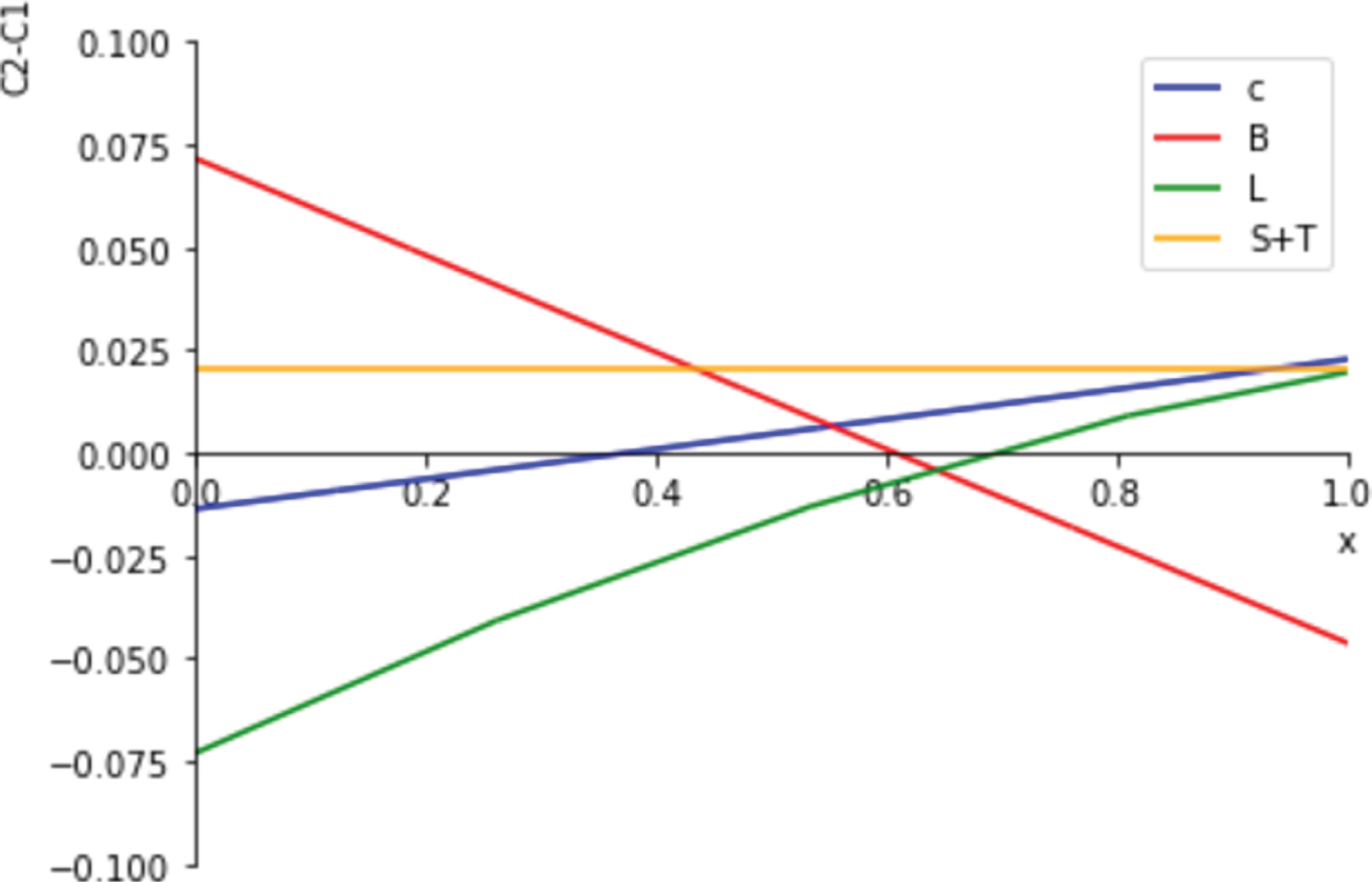
The effect of variables c, B and L on C2 - C1 with high penalty from consumer federation.
Figures 3–5 shows four different evolutionary paths of consumer federation and manufacturers’ behavioral strategy in different cases when T - Δ > 0. It can be seen that different relationship of C2 - C1 and S + T have a significant impact on the strategy evolution results of both consumer federation and manufacturers.
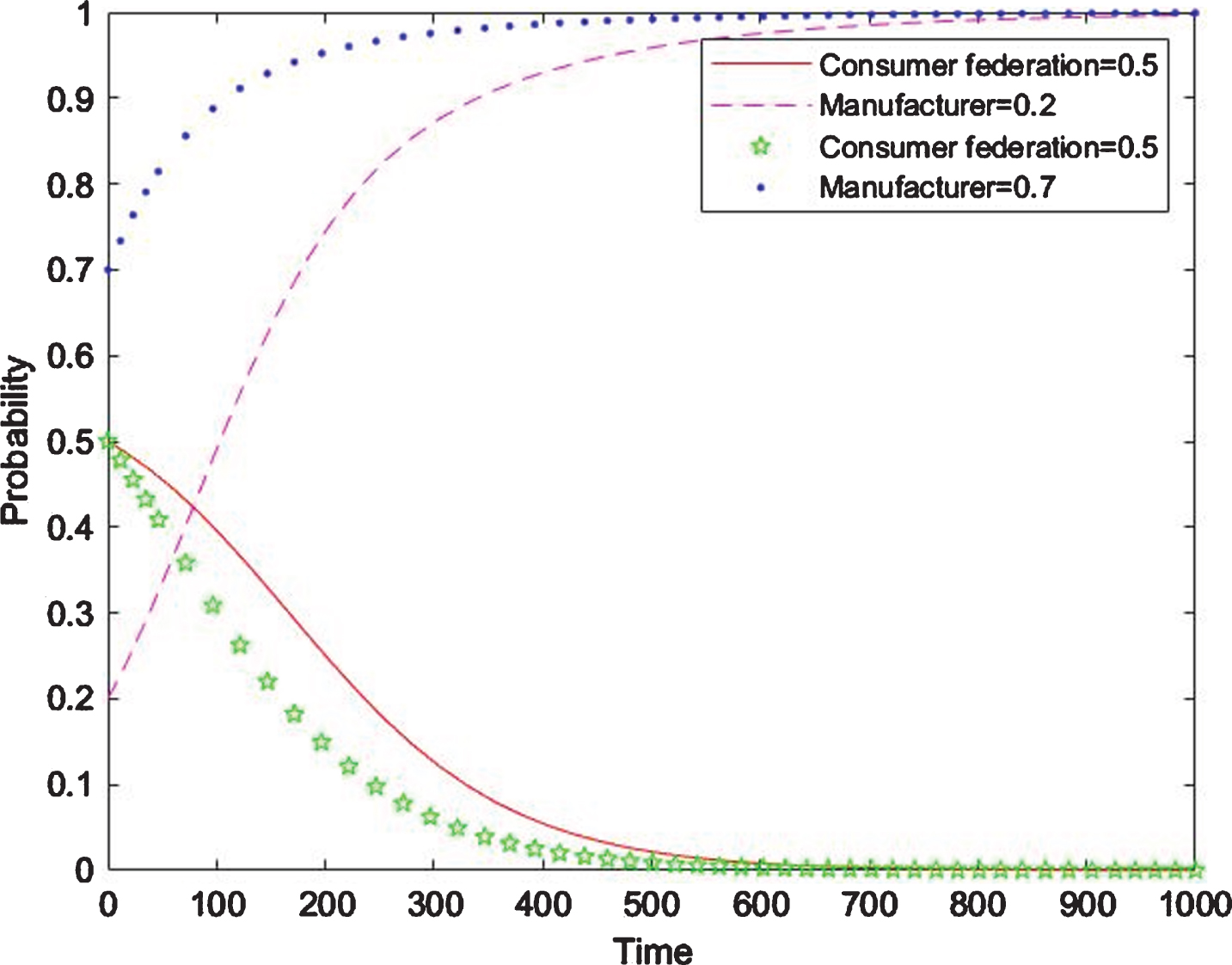
Evolutionary path of consumer federation and manufacturers’ behavioral strategy while T - Δ > 0, C1 - C2 > 0.

Evolutionary path of consumer federation and manufacturers’ behavioral strategy while T - Δ > 0, 0 < C2 - C1 < S + T.

Evolutionary path of consumer federation and manufacturers’ behavioral strategy while T - Δ > 0, S + T < C2 - C1.
For sensitivity analysis of c, we assume that B = 0.6, L = 0.7. To satisfy the condition T - Δ > 0 and C1 - C2 > 0, c<0.37 can be solved by the inequality set. The evolution of the replication dynamic system can be influenced by the change of c. We assume that the value of c is 0.3, which means the manufacturer’s recall costs are low, and the penalties for unrecalled products are high. Because of there are more profit while the recalling is successful, manufacturers would recall unqualified product voluntarily, at the same time, consumer federation is not necessary to take the “regulate” strategy. After reaching the critical point, the strategies of both sides will evolve towards (0,1).
For sensitivity analysis of B, we assume that c = 0.4, L = 0.7. Similarly, it can be solved that B > 0.61. The evolution of the replication dynamic system can also be influenced by the change of B. We assume that the value of B is 0.65, which means the loss of unqualified product to consumers is higher. Consumers’ higher loss caused by unrecalled products will strengthen government punishment. The strategies will evolve towards (0,1).
For sensitivity analysis of L, we assume that c = 0.4, B = 0.6. Similarly, it can be solved that L < 0.68. The evolution of the replication dynamic system can also be influenced by the change of L. We assume that the value of L is 0.65, which means the compensation for unrecalled product is higher. Then the unrecalled products will reduce the manufacturer’s profits more significant. manufacturers would recall unqualified product voluntarily, at the same time, consumer federation is not necessary to take the “regulate” strategy. The strategies will also evolve towards (0,1).
The evolutionary path of this condition is shown in Fig. 3. In view of the certain labor and material costs caused by the consumer federation’s regulation process, this condition would be the best result of evolution. The ESS in this case can be a desired outcome for both the consumer federation and consumers.
For sensitivity analysis of c, B and L, it is assumed respectively that B = 0.6, L = 0.7, c = 0.4, L = 0.7 and c = 0.4, B = 0.6. By solving the inequality set, the result is 0.37 < c<0.93, 0.44 < B < 0.61, and 0.68 < L < 0.99. The evolution of the replication dynamic system can also be influenced by the change of all the three parameters. In this condition, the evolutionary path is shown in Fig. 4. Both the probability of consumer federation choosing “regulate” strategy and that manufacturer adopting “recall” strategy will be fluctuant, the dynamic system will not evolve to stability in any equilibrium points. It is obvious that there is not a fixed trend in the evolutionary path for the two sides. Manufacturers and consumer federation continuously vary their optimal strategies but there is not stable status eventually, which means that the ESS of this condition is not exist. In addition, as the initial values changes, the ranges of fluctuation are also different.
In the case of S + T < C2 - C1, for sensitivity analysis of c, B and L, it is assumed respectively that B = 0.6, L = 0.7, c = 0.4, L = 0.7 and c = 0.4, B = 0.6. By solving the inequality set, the result is c> 0.93, B < 0.44 and L > 0.99. In this case the limitation of L > B > c, B> c > 0.93 cannot be met simultaneously. So, the evolution of the replication dynamic system cannot be influenced by the change of c in this case. But it can be influenced by the change of B and L.
The evolutionary path is shown in Fig. 5, when S + T < C2 - C1. There exists Nash equilibrium. The evolutionary curve tends to fixed values, which reveals that the dynamic strategies of manufacturers and consumer federation can reach a stable state as time goes on. In this case, because of the profit from “not recall” strategy is much higher than the profit from recalling. Manufacturers are willing to choose the “not recall” strategy, which could lead to consumer federation’s regulating. But for both consumers and consumer federation, the result is not an ideal stable strategy because that even if the consumer federation efforts to regulate, the rights of consumers are still not effectively protected.
In order to study the effects of different penalty mechanisms. We assume t= 1.0 to depict that the penalty from consumer federation is low. Figs. 6–10 shows three different evolutionary paths in different cases when condition T - Δ < 0 is satisfied. According to the analysis in Section 3, it can be deduced that the evolution result of dynamic system is determined by the relationship of C2 - C1 and S + T. The effect of variables c, B and L on C2 - C1 is shown in Fig. 6.
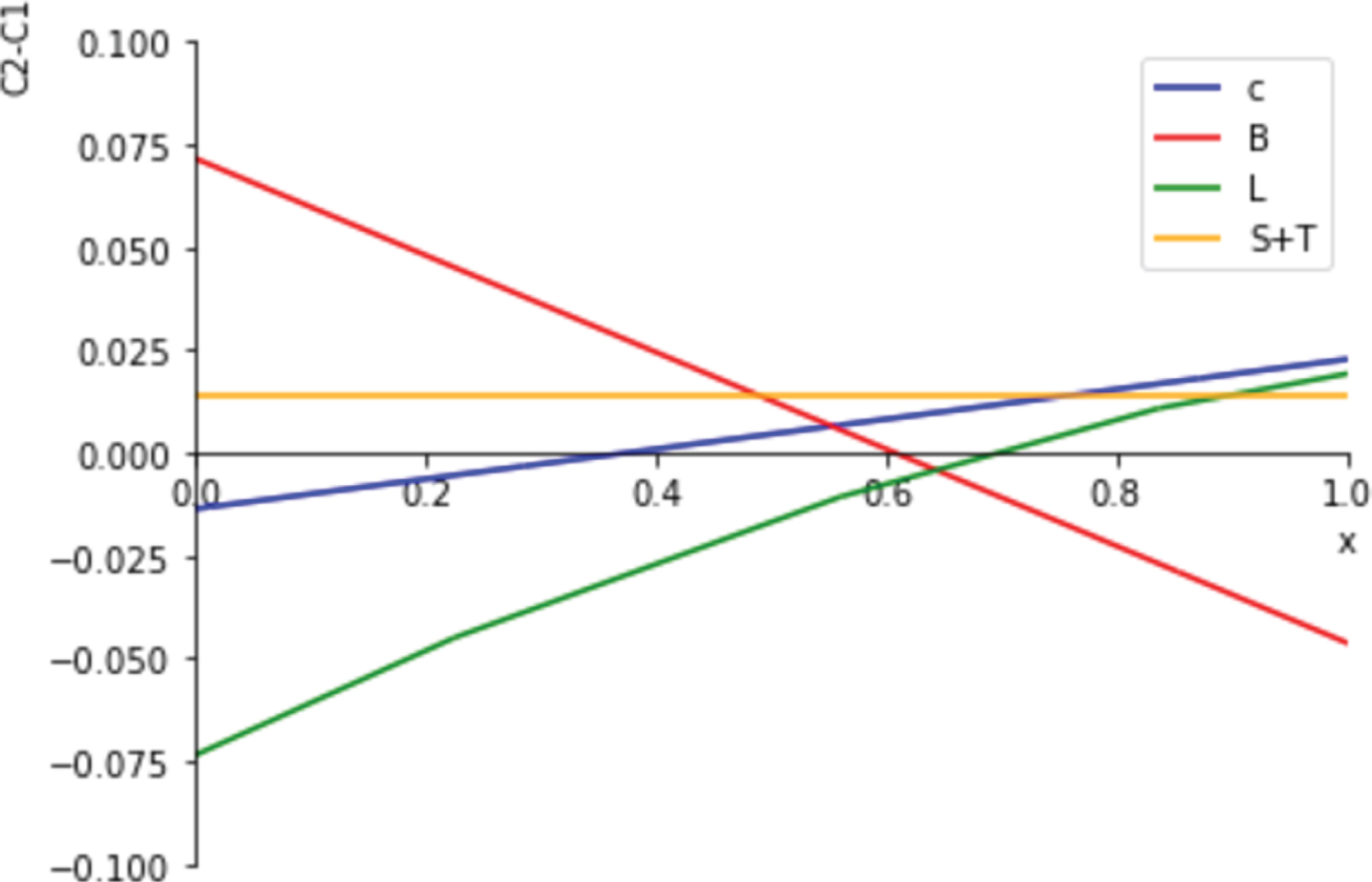
The effect of variables c, B and L on C2 - C1 with low penalty from consumer federation.
Figure 7 is the evolutionary path we obtained when we assumed that c= 0.3, B = 0.6, L = 0.7, c = 0.4, B = 0.65, L = 0.7 and c = 0.4, B = 0.6, L = 0.65 the same as the case in Fig. 3. It is easily to find from the evolutionary results of Fig. 7 that with the game frequency increasing and time going on, the evolutionary curves gradually converge to the point (0,1). The Nash equilibrium exists. While the cost of regulation is higher than penalty, consumer federation tends to choose the “not regulate” strategy. Satisfyingly, we can see that the probability of manufacturers choosing “recall” strategy is growing as time goes on. The ESS in this case can also be a desired result for both the consumer federation and consumers.

Evolutionary path of consumer federation and manufacturers’ behavioral strategy while T - Δ 〈 0, C1 - C2 〉 0.
Compared with Fig. 3, the evolutionary path shown in Fig. 7 is not much different, which means that the change of penalty t has no significant influence on the evolutionary stable strategy in the case of C1 - C2 > 0.
In Figs. 8 and 9, the assumed value of c, B and L the same as the cases in Figs. 4 and 5 respectively. While the recall of manufacturers has a positive impact on consumer surplus. As time goes on, the evolutionary stability result is that both the probability of consumer federation choosing “regulate” strategy and the probability manufacturers choosing “recall” strategy trend to zero. The ESS point is (0,0). The more significant the difference between C2 and C1, the more significant the evolutionary tendency is.
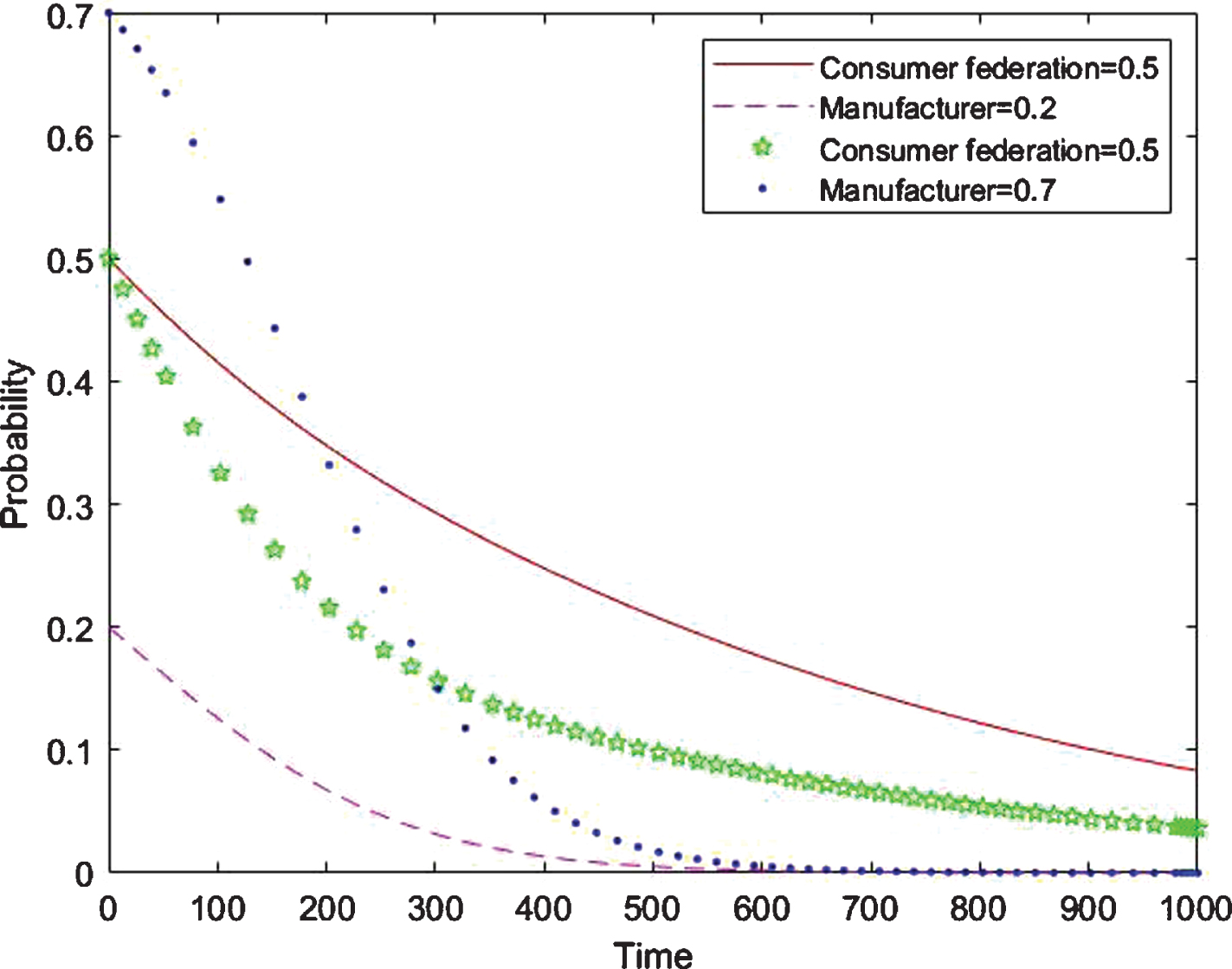
Evolutionary path of consumer federation and manufacturers’ behavioral strategy while T - Δ < 0, 0 < C2 - C1 < S + T.

Evolutionary path of consumer federation and manufacturers’ behavioral strategy while T - Δ < 0, S + T < C2 - C1.
Compare Fig. 8 with Fig. 4, we can see that while 0 < C2 - C1 < S + T, there can be an ESS only if the penalty from consumer federation is low. However, in this case, although the measures to reduce the penalty taken by consumer federation will lead to the stable strategy of both sides, the rights of consumers will be not guaranteed.
If we compare Fig. 9 with Fig. 5, while S + T < C2 - C1, we can see that both sides of the game will come to an ESS in two scenarios. But the evolutionary stable strategies are different. When the penalty coefficient is lower, manufacturers are not inclined to recall the unqualified product, which makes it harder to protect the rights of consumers. But in front of the higher penalty coefficient, the ESS exist and trend to the point (1,0), which means that even if the consumer federation does not intervene, manufacturers will gradually tend to recall the unqualified product. The consumer federation can achieve the purpose of protecting consumers’ right with minimized cost. So, it can be concluded from the comparison that while the evolutionary game cannot be stable, consumer federation can appropriately reduce the penalty coefficient t. But this is not a perfect measure, because the rights of consumers will not be protected. The better measure is to modulate penalty coefficient to facilitate the situation as Fig. 5 shown.
The results generated by the simulation could be applied in many other manufacturers that have the choice to recall their unqualified product.
In this paper, by building a model of evolutionary game theory and using MATLAB for simulation analysis, the evolution rules of strategies between consumer federation and manufacturers for the recall of unqualified product in the supply chain are described, and the conclusions are simulated by using simulation tools. Our research shows that the factors influencing the strategies of consumer federation and manufacturers include change in product price C2 - C1, and penalty coefficient for failed recall of unqualified product t.
With the change of different parameter values, the evolutionary game system presents different evolutionary stability results. The correlation between product recall and consumer surplus and the penalty measures while the unqualified product is not recalled will affect the probability of both sides’ strategies. From the analysis above, we can draw the following conclusions. First, when the consumer association adopts high penalty measures, when the penalty is higher than a certain critical value, the two sides of the game may not reach a stable strategy. Then consumer federation can appropriately reduce the penalty measure. If consumer federation adopts low-penalty regulation strategy, the model is more likely to achieve stability than if it adopts high-penalty strategy. But this is only an expedient, because the rights of consumers are not be protected. Next, consumer federation should adjust their measures to facilitate the situation that manufacturers recalling voluntary. It would be a better stabilization strategy that can both minimize the cost and protect consumers’ rights. Third, the probability of manufacturers adopting recall strategy is correlated with the change in C2 - C1 negatively, and also positively related to the penalty coefficient t. The probability of consumer federation adopting “regulate” strategy is related to the penalty coefficient t positively.
Although the conclusions of this paper offer some theoretical suggestions for improving the consumer shopping experience and recall decisions of unqualified product in supply chain, the conclusion has yet to be further inspected by the theory and practice. This article examines how the consumer federation to develop the related policy from the perspective of the consumer surplus, which is a new perspective. But our research does not involve other indicators than consumer surplus. So, an analysis from other indicators that affect consumer satisfaction will be a new research. In addition, we assumed that the information between game-agents is symmetric. In fact, information between them is always asymmetric. It will be a great research to explore an evolutionary game between consumer federation and manufacturers under the information asymmetry.