



Abstract
Consistency is related with reasonableness of the priority vector derived from a preference relation. In this paper, it is pointed out by an example that the existing consistency for the intuitionistic multiplicative preference relations (IMPR) is weak that the ranking or the optimal alternative could not always be derived from the given consistent IMPR. We provide a novel consistency for the IMPRs by the score function and accuracy function and characterize it with the S-normalized and A-normalized intuitionistic multiplicative priority vectors (IMPV). Then, we propose methods to check and reach the S-normalization, the acceptable consistency of the IMPR by its local IMPVs. We also give some examples to show how the proposed methods work and make comparisons with the existing methods to demonstrate the advantages and disadvantages of the proposed methods.
Keywords
Preference relation is a powerful tool to express the decision maker’s preferences over a set of feasible alternatives. Generally, preference relations are divided into multiplicative preference relations (MPR) [11] and fuzzy preference relations (FPR) [8, 12]. MPRs and FPRs were contacted by the transformation functions [1] which help to integrate different types of preference relations into a unified case. MPR is a kind of popular preference relations, and has been extensively investigated in Ref. [11]. However, due to the limitation of decision maker’s global perception, the decision maker may provide an inconsistent preference relation [2, 11]. Thus, an acceptable consistency is adopted to measure the consistency. Usually, if the consistency degree of a preference relation is smaller than a certain threshold parameter, it is of acceptable consistency.
From the concept of MPRs, one can find that they could only express the decision maker’s preferred information. However, in some situations, this is insufficient, and the decision maker might hope to give the positive and negative comparisons of an alternative over another simultaneously. Furthermore, considering the phenomenon that preferred information is usually asymmetrical distribution, Xia [14] introduced the concept of IMPRs by using intuitionistic multiplicative numbers (IMNs). The analyses of the existing literature indicate that works on the IMPRs focus on the following aspects: Aggregation operators for intuitionistic multiplicative information. Xia [15] investigated group decision making based on intuitionistic multiplicative aggregation (IMA) operators. Yu [17] focused on the IMA operators for intuitionistic multiplicative preference information based on algebraic operational laws. Jiang [4] aggregated information and ranking alternatives in decision making with IMPRs by the ordered IMA operators. Qian [9] pointed out that the existing operations to define the IMA operators in Refs. [14, 15] are not closed, and then proposed some novel IMA operators. Xu [16] found that some existing IMA operators in Refs. [4, 15] are not suitable to aggregate IMPRs in group decision making, and hence developed some symmetric IMA operators. Garg [3] developed several novel correlation coefficients under the intuitionistic multiplicative environment. Ren [10] developed the intuitionistic multiplicative analytic hierarchy process in group decision making. Consistency for the IMPRs. Xu [13] defined the consistency for the IMPRs and derived the priority weight intervals. Jiang [4] discussed a more general consistency property of the IMPRs than that of Xu [13] by splitting an IMPR into two MPRs and then presented a novel consistency definition of the IMPRs. Jin [6] and Meng [7] made an approach to derive intuitionistic multiplicative weights based on intuitionistic multiplicative preference relations. Zhang [18] revealed that Jiang’s consistency extension is not robust to permutations of the decision maker’s pairwise judgments and not able to reflect the hesitancy in the decision maker’s preference. They proposed a novel consistency for the IMPRs based on which the intuitionistic multiplicative group analytic hierarchy process in group decision-making and group decision making with incomplete IMPRs were investigated in Refs. [19, 20].
However, the aforementioned studies in Refs. [18–20] have several flaws, which are described as follows: Although Zhang’s consistency in Ref. [18] is robust to permutations of the decision maker’s pairwise judgments, the ranking could fail to be derived from some IMPRs (See Example 1.3 for detail); Zhang proposed two sufficient conditions to construct IMPRs by the IMPVs in Refs. [18, 19] where the derived IMPVs could not completely reflect the preference of the decision maker; Method to check and reach the acceptable consistency in Ref. [19] is dependent on the preseted threshold and adjustment parameters, respectively, it could be time consuming or difficult for a decision maker to provide such suitable values to meet the needs.
Inspired by the work in Refs. [14, 18], we investigate the consistency for the IMPRs to overcome the shortcomings in Refs. [18–20]. To do this, the rest of this paper is structured as follows: In Section 2, a brief introduction to MPRs, IMPRs and their consistencies is made. In particular, some novel alternative definitions of consistencies for the MPRs and IMPRs are given by the corresponding priority vectors; example shows that Zhang’s consistency could fail to derive a ranking. Section 3 provides a novel definition of the consistency by the score function and the accuracy function, and equivalent conditions to derive the IMPVs are given. Furthermore, the S-normalization and A-normalization are given to guarantee the reasonability of the IMPRs. In Section 4, methods to check and repair these S-normalization and the acceptable consistency of an IMPR are investigated by their local IMPVs, respectively. Numerical examples are given to illustrate the effectiveness of our method. In Section 5, comparison with Zhang’s method are provided. Section 6 gives the conclusions.
Preliminary
To make the presentation self-contained, in what follows, we review some basic concepts on the MPRs and the IMPRs and their consistencies.
Multiplicative preference relations
In Ref. [11], a sufficient condition was provided to give the relationships between the MPRs and their corresponding priority vector. Here, an equivalent condition is given as follows:
The constraint
Here, let us review the concept of intuitionistic multiplicative sets (IMSs).
For convenience, α = (ρ
α
, σ
α
) is called an intuitionistic multiplicative number, IMN for brevity in Ref. [14]. In order to compare the IMNs, a score function s and an accuracy function h are defined as follows:
If s (α1) > s (α2), then α1 ≻ α2; If s (α1) = s (α2), if h (α1) > h (α2), then α1 ≻ α2; if h (α1) = h (α2), then α1 = α2.
Note that for a group of IMNs, the ranking derived by Definition 1.6 is totally ordered, that is, any two IMNs are comparable.
When ρ ij σ ij = 1 for all i, j = 1, 2, ⋯ , n, the IMPR R reduces to an MPR. To derive a reasonable ranking, Xu introduced the following consistency concept for IMPRs.
Jiang et al. [5] defined their consistency by deleting the constraint i ≤ k ≤ j in Xu’s consistency.
Zhang [18] presented the following consistency concept for IMPRs:
A vector whose entries are IMNs is called an intuitionistic multiplicative priority vector (IMPV). For an entry ω i in an IMPV ω (resp. r ij in an IMPR R), we write s (ω i ) = s i (resp. s (r ij ) = s ij ) and h (ω i ) = h i (resp. h (r ij ) = h ij ) for brevity in the following parts.
Note that Eq. (9) was also used to define the consistency for IMPRs in Ref. [6] and some sufficient conditions to the consistency were provided. Next, we characterize this consistency for the IMPRs as follows:
Conversely,
Based on Theorem 1.12 and Definition 1.6, we find that the condition of Zhang’s consistency is weak that we could not always derive a ranking from the consistent IMPR.
Associated with Theorem 1.3 and Definition 1.2, we propose the following novel consistency for the IMPRs to overcome the shortcoming of Zhang’s consistency:
Theorem 2.2 indicates that some necessary constraints should be given to well guarantee the correspondence between the IMPRs and the IMPVs, we state them as follows:
If If If ω is both S-normalized and A-normalized, then it is said to be normalized.
Based on the above, Theorem 2.2 could be rewritten as follows:
In real decision making, it is impossible that the decision maker’s judgment accords with concrete mathematical formulae. Thus, the IMPVs either could not be normalized or provide various rankings. From Theorem 2.2, we find that for a given IMPR, it could be not consistent, if either the consistency formulae Eqs. (12) and (13) are not satisfied or the IMPV is not normalized. In this section, we investigate the consistency from these two aspects:
Apply the Logarithm log 3 (·) to Theorem 2, we have
The above theorem indicates that there exist n-1 independent membership degrees and n-1 independent non-membership degrees in R which always determine the same ranking, if the consistency is satisfied.
In order to reach the normality for the IMPR, we develop the following concepts:
an IMPV determined by both n-1 independent membership degrees and n-1 independent non-membership degrees is called a local IMPV of R; if each local IMPV is normalized, then R is said to be normalized.
Based on the above concepts, we develop the following method to S-normalize an arbitrary IMPR R as follows:
Solve Check the S-normalization of Transform the IMPR Output the IMPR
Although the IMPR is modified by Algorithm I, the modification is based on a linear function in Step 3, and hence the local IMPVs of the original IMPR and that of the modified one always determine the same ranking. Thus, the proposed method can preserve the original preference information as much as possible in this sense.
Check and reach the consistency formulae for an IMPR
For an IMPR R, we construct an IMPR
Next, a procedure to modify the preference values of a given IMPR R to reach the acceptable consistency can be established by the following steps:
Assume Check and reach the S-normalization of Check the acceptable consistency of Reach the acceptable consistency of Output the ranking.
The proposed algorithm possesses the following advantages: The modification is locally executed, not for all the entries of an IMPR, and hence can preserve the initial preference information as much as possible; The acceptable consistency is checked by the local IMPVs, and is independent on the preseted threshold and adjustment parameters, respectively; The procedure of reaching the acceptable consistency can be visualized by the local IMPVs.
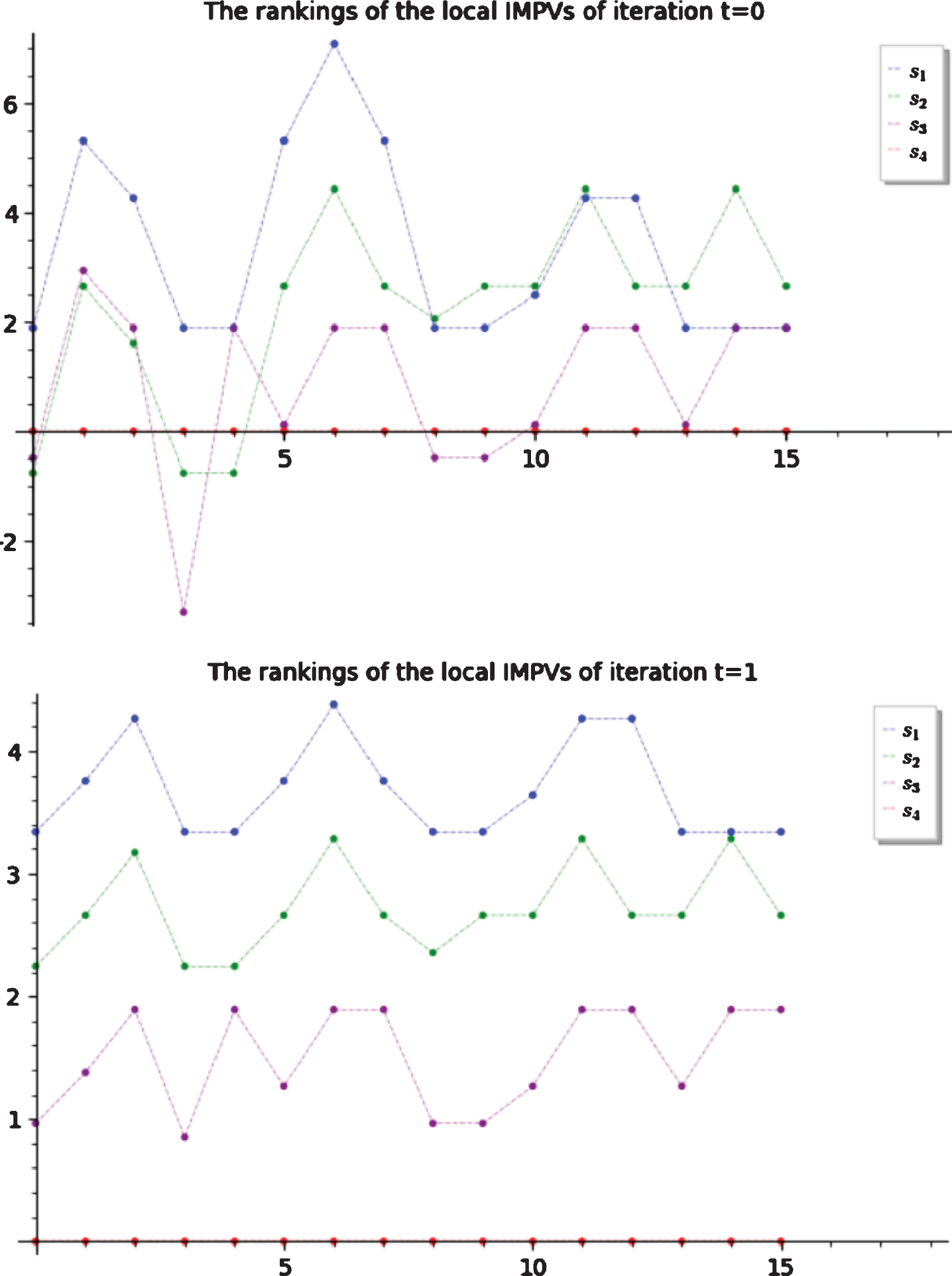
The rankings of the local IMPVs in Example 3.7
When t = 1, the iteration stops, the modified IMPR R(1) is given as follows:
which is of acceptable consistency. Thus, the ranking is x1 ≻ x2 ≻ x3 ≻ x4.
In this section, we make a detailed comparison with the method based on Zhang’s consistency for the IMPR as follows: Although Zhang’s consistency in Ref. [18] is independent of alternative labels of the IMPR, it could not derive a ranking from a given IMPR in some cases; although the proposed consistency overcomes the above issue, it is equivalent to that in Ref. [5], and hence dependent of alternative labels of the IMPR. Furthermore, Zhang also proposed several consistency formulae to relate the IMPRs with the IMPVs in Refs. [18, 19] which is only a sufficient condition for their consistency. Thus, the derived IMPV could not completely reflect the preference of the decision maker. The present paper provided an equivalent condition between the IMPRs and IMPVs, and hence the preference of the decision maker can be well-described. For the acceptable consistency in Ref. [19], it was defined by the distance measures between the original IMPR and the constructed consistent IMPR, and then checked by a preseted threshold parameter. Thus, whether the acceptable consistency for an IMPR reaches is dependent on the threshold parameter. It could be time consuming or difficult for a decision maker to provide such suitable values to meet the needs. In this paper, a novel acceptable consistency was proposed with the local IMPVs of the original IMPR without the help of the preseted threshold parameter which can avoid some opposed results by using different threshold parameters. for reaching the acceptable consistency, the original IMPR was replaced with the weighted geometric averaging of the original IMPR and the constructed consistent IMPR with the weight as an adjustment parameter which is dependent on the threshold parameter. Moreover, the modified IMPR could still be unreasonable, because they could inherit some ill properties such as non-S-normalization from the original IMPR which can not happen in the proposed method.
Using the consistency index CI as follows:
Establish the matrix Convert Calculate the adjustment parameter Obtain the rectified IMPR
Then, the adjustment parameters λ0 = 0.029, 0.27, 0.51, 0.76, 0.83, respectively. All the rectified IMPRs
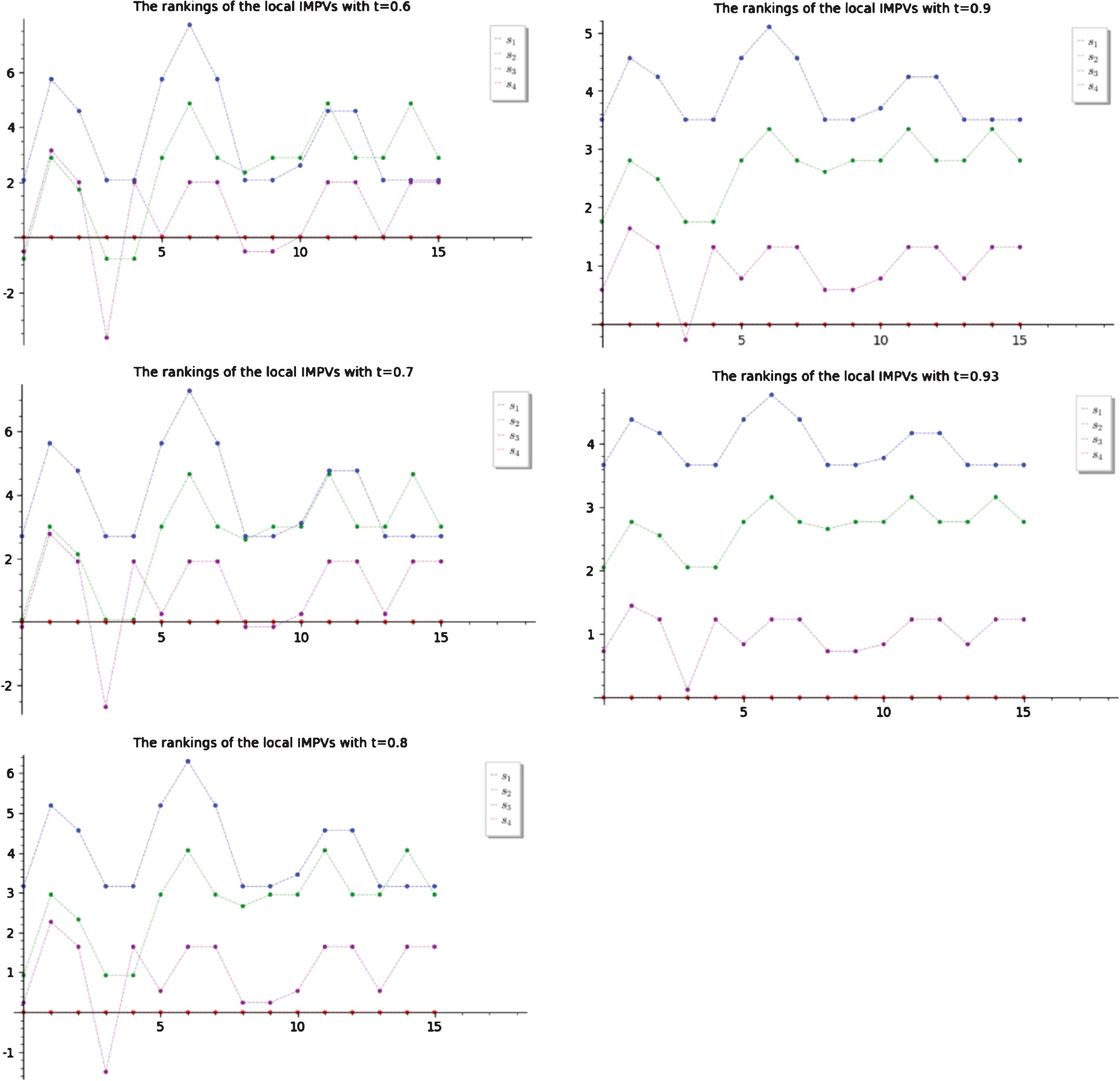
The rankings of the local IMPVs in Example 4.1
The present paper proposed a novel consistency for the IMPRs by the score function and accuracy function which can overcome the shortcomings of the existing consistency. For the consistent IMPRs, they were characterized by the S-normalized IMPVs; for the inconsistent IMPRs, methods to check and reach the proposed S-normalization, acceptable consistency of the IMPRs were investigated, respectively. Compared with the existing methods, the proposed methods processes the following advantages: The proposed consistency is completely characterized by the S-normalized and A-normalized IMPV which can guarantee the reasonability of the given IMPR; Method to check and reach the acceptable consistency is independent on the preseted threshold and adjustment parameters, respectively; The procedure of reaching the acceptable consistency can be visualized by the local IMPVs.
However, group decision making with the IMPRs have been developed in Refs. [7, 18–20] and A-normalization of the IMPRs was not considered in the present paper without which the accuracy values of some entries in the modified IMPRs could be still unreasonable, that is, it could be bigger than 1. Thus, how to develop a method to simultaneously reach both S-normalization and A-normalization in group decision making with the IMPRs is the future work.
Footnotes
Acknowledgments
The authors would like to thank the editors and the anonymous reviewers for their insightful and constructive comments and suggestions that have led to this improved version of the paper. This research was supported by the NSF of Shandong Province (No. ZR2017MG027).