



Abstract
Companies are attaching more and more importance to sustainable supply chain management (SSCM) as which makes the right strategy measures for companies. Due to the complexity of external environmental factors and internal structure, sustainable supply chain management is vulnerable to various risks. The purpose of this paper is to present a new two-stage approach for determining the best practitioner in Iran Pars Special Economic Energy Zone based on the sustainable supply chain risk management (SSCRM). The best and worst method (BWM) is used to determine the weight of risk factors. Then the method of linguistic value soft set is used to assess the impact of risk factors on each company’s sustainable supply chain which is a multiple attribute decision making problem with language preference in the second stage. Consequently, the ranking results of sustainable supply chain of each enterprise are obtained. This study contributes to finding the key risk factors of SSCRM. Evaluating these companies SSCRM with preference information, the best practitioner can obtain. The combination of BWM and linguistic value soft set approach provides a new nonparametric theoretical method and tool for this kind of decision-making problems with this background. At the same time, the conclusions of this study have guiding significance for the implementation of industrial supply chain. Limitations of the study along with future research directions are also presented.
Introduction
The emergence of global manufacturing has made supply chain management (SCM) gained more attention [16]. SCM provides organizations with operational and strategic competitive advantages that are critical to the business in nowadays globalized competitive surroundings [27]. Therefore, most decision makers need to integrate the information of organizations at all levels in the supply chain to maintain the operation of the supply chain [25]. From the perspective of supply chain economic benefits in the long run, sustainable supply chain management (SSCM) integrates and realizes the organization’s economic, environmental and social performance based on supply chain management. Consequently, it maximizes the profitability of supply chain and social well-being, while minimizes the negative environmental impact [17, 37]. Its emergence made organizations be aware of the importance of business sustainability, and more and more companies realize that sustainable development plays a critical role in operations management.
For SSCM, sustainable supply chain risk management (SSCRM) is one of the important contents [31, 44]. Accordingly, the risk in SSCM mainly considers not only the basic operational risk, but also the economic, natural and social risk. For example, due to the low production and poor quality of domestic iron ore, domestic steel mills, such as Baosteel, often import foreign ore, such as Australias high-speed iron ore, which produces high-quality steel, reduces costs and environmental pollution. However, while implementing sustainable supply chain management, enterprises may encounter new risks. It is well known that ore raw materials are imported, so some external conditions, such as natural disasters, wars, terrorism, and uncertainty in the policy market may bring risks to the supply chain. Therefore, the risk assessment of SSCRM is of vital importance to todays enterprises managers.
Based on the above analyses, risk in sustainable supply chain means a potential condition or event related to sustainability that can cause risk problems in other parts of the supply chain, which makes the risk factors in SSCM are complex, potential and uncertain. This paper focus on evaluating SSCRM of several representative enterprises in key industries (taking oil industry as an example), and obtains the best practitioners. Specifically, this paper evaluate different complexes in Iran Pars Special Economic Energy Zone and decide four complexes which has highest production capacity. That is Arya Sasol (A1), Nouri (A2), Mobin (A3) and Zagros (A4). Iran is the world’s leading oil and gas producer and the third largest oil producer in OPEC after Saudi Arabia and Iraq. The petrochemical industry as an important part of petroleum products, such as fertilizers, urea, ammonia and sulfur, need to take into account environmental factors during production. What’s more, the current international situation has changed at any time. Changes in the import and export policies of crude oil in various countries will also greatly affect the market share of oil. All major international companies, no exception, give the risk issue high degree of concern and sustainability to assess its supply chain due to the expansion of oil/gas, high risk operations, environmental and technological changes.
In this research, we construct a two-stage decision-making model. The purpose of this paper is to present a new two-stage approach for evaluating SSCRM as a multi-criterion decision making problem with uncertain information. The combination of BWM and linguistic value soft set approach provides a new nonparametric theoretical method and tool for this kind of decision-making problems with this background. Considering the interaction of risk factors(criterion), we first adopt BWM to determine criteria weights for evaluation of SSCRM. According to Rezaei [35], BWM is a robust MCDM method due to several salient features. Comparing to other subjective methods for determining criteria weights, it can reduce the complexity and the time required for decision makers or experts to evaluate the required criteria. It can also be more convenient for research that requires participation from less accessible respondents. Second, BWM produces highly consistent comparisons that lead to results with a high level of reliability. More and more, this method can be used independently to derive weights, or in combination with other MCDM methods.
Then we take into account the fact that the decision maker may not be familiar with the performance of all evaluation criteria in the evaluation process, which makes the decision information uncertain and vague. For example, when a company’s manufacturer’s machinery and equipment fails, the impact on its supply chain may be described by some linguistic variables such as low, high, no fair, and so on. At the same time, different decision makers have different familiarity with the evaluation objects, and the evaluation attributes they choose will be different. To handle with the decision-making problems with uncertainties and imprecise information, several new uncertainty theories included the theory of probability [23], theory of fuzzy sets [24] and so on have been utilized as efficient tools. Though the above new mathematical theories provide an efficient tool, as pointed out in [30]. The reason for these difficulties is, possibly, the inadequacy of the parameterization tool of the theories. Consequently, Molodtsov initiated the concept of soft theory as a mathematical tool for dealing with uncertainties which is free from the above difficulties. What’s more, decision-makers always prefer to use linguistic values to describe uncertain information. We finally use linguistic value soft set to evaluate SSCRM which are tally with reality decision-making.
The following is the arrangement of the paper: Section 2 mainly introduces the relevant literature on sustainable supply chain risk management (SSCRM). The research framework model and the risk standard in the assessment of SSCRM are determined; besides, the BWM and linguistic value soft set methods are introduced in Section 3. Then in a real case, the company’s supply chain risk assessment is conducted through a research framework in Section 4. Finally, the evaluation results are discussed, the shortcomings of this research are summarized and the future work is prospected in Section 5.
Literature review
Sustainable supply chain management
While sustainability has now grown into a mainstream, SSCM is now quite mature. Reza [36] argue that sustainable supply chains have a triple bottom line: organizational long-term development, environmental sustainability and social responsibility, and David [43] in his paper argued that knowledge of SSCM is always based on knowledge of supply chain management, logistics based on the technology and operations management, marketing strategies, social and environmental management. Therefore, Ahi [2] define SSCM as “by voluntarily integrating social, environmental and economic factors with the organization’s internal affairs systems to produce a harmonized supply chain for effective and efficient management the distribution of capital, information and material flows about production, procurement, and services and products. Finally the goal is to improve the organization’s resilience, profitability and competitiveness, and meet the needs of stakeholders.” The sustainability of a company is largely decided by the management of the sustainable supply chain implemented. Sustainable supply chain is not only an effective source of cost reduction, but it also helps companies achieve long-term profitability [42]. Based on the research of these scholars [34], it seems to us that SSCM is based on the long-term economic benefits of the supply chain, realizing the economic, environmental and social performance of the organization, maximizing the profitability and social welfare of the supply chain, while minimizing the negative impact on the environment. Because the sustainability principles of the supply chain are often not just within the supply chain, they also emphasize the coordination of internal sustainability with stakeholders in the external supply chain. SSCM therefore requires a global outlook on development to emphasize the relationship between environmental and social equity through sustainable economic growth. Efficient SSCM is highly dependent on supply chain programme, coordination and cooperation.
Sustainable supply chain risk management
In the supply chain and logistics management, risk management is a common problem. Companies that can respond to risk problems in a timely manner and solve problems have strong competitiveness in the industry and maintain the long-term development of the company [1, 47]. Oliveira [32] mentioned that various approaches have been adopted to improve organizational supply chain risk management. This process mostly identifies risks, assesses their potential impacts, identifies key risks in the supply chain, defines and implements risk response strategies, and monitors and controls risks. Reza [27] in the context of SCRM, using Shannon entropy method to determine the standard weight and fuzzy TOPSIS (approaching the ideal solution ordering method) to sort the suppliers and select the appropriate suppliers. Qazi [33] researched and developed the supply chain risk network management process, based on the case study in the global manufacturing supply chain. They used the Bayesian belief network (BBN) and fault tree analysis (FTA) method for risk identification, and then the BBN and Expected Utility Theory (EUT) conduct risk analysis. These studies reduce risk issues in the supply chain by identifying risk analysis, determining the choice of key suppliers in the supply chain with mathematical model, relevant methods of systematic analysis, systematic evaluation. What’s more, as far as we know, there are only three scholars use MCDM to research the SSCRM. Based on the Iranian manufacturing industry, Song [38] used rough numbers and DEMATEL to identify key risks in sustainable supply chains. Reza [27] use an intergrated fuzzy multi-criteria decision-making approach to develop a framework for the SSCRM evaluation. The risk assessment model of SSCM established in this paper uses language value variables to describe the degree of risk influence of supply chain after determining the risk factors and considers the limited knowledge of decision-makers, making the decision-making model more close to the real situation.
Best and worst method
In 2015, Jafar Rezaei proposed the BWM approach to MCDM [35]. He suggests that BWM can be used to solve multi-criteria problems more efficiently and reliably. BWM requires fewer comparison data; therefore, it does not require complete pairwise comparison matrices, and thus is less complicated, saves time, and is easy to implement compared to other MCDM methods. Several MCDM methods include AHP, ANP, TOPSIS, ELECTRE and VIKOR have been used and developed in many fields, over the past few years. For some recent developments, we refer to step-wise weight assessment ratio analysis(SWARA) [19], Full Consistency Method (FUCOM) [12], Level Based Weight Assessment (LBWA) among others [49]. These methods use the pairwise comparison technique to determine the most influential factor by calculating the relative weight of each criterion. The AHP and ANP methods have many aggregation procedures to obtain a preference vector from pairwise comparisons matrix. The SWARA method is applied because of its simplicity and a small number of steps. However, the SWARA method does not have the ability to determine the consistency degree of the comparisons obtained. FUCOM and LBWA have smaller number of pairwise comparisons. At the same time, optimal values of weight coefficients can be obtained that eliminates inconsistencies in expert preferences. FUCOM need to perform the ranking of the criteria and determine the comparative priorities of the evaluation criteria. LBWA means to calculate of the influence function of the criteria based on grouping criteria by levels of significance. The ranking and grouping need more time for decision-makers if the number of criteria is large. BWM be used will simplify our decision-making process. In the future, we will try these methods to apply this kind of problem.
BWM can be used to solve multi-criteria problems more efficiently and reliably. Many scholars also adopt BWM to solve the decision-making problem about the supply chain management. Hadi [4] identified the social standards of the supply chain, proposed a social sustainability assessment framework, and adopted the BWM method to determine the relatively important social standards in the manufacturing supply chain. BWM can be used to solve multi-criteria problems more efficiently and reliably. Many scholars also adopt BWM to solve the decision-making problem about the supply chain management. Badi [6] presented the rough BWM-MAIRCA (Multi-Attribute Ideal-Real Comparative Analysis) model to select supplier for pharmaceutical supplying. Wan [3] uses BWM to identify the collective importance of the forces which influence SSCM practices in the O&G industry. Masha [18] select green suppliers of KSC based on the suppliers green innovation abilities by using BWM and fuzzy TOPSIS. Saima assess the environmental criteria for sustainability in select industries in Bangladesh under BWM framework [40]. BWM is an efficient MCDM method for performance in supply chains. Despite this, it has not been implemented widely in SSCRM. The present study contributes to the literature using BWM to outline indicators to measure risk factors in SSCRM.
Research framework and methodology
Research framework
The existing literature mainly focus on establishing a SSCRM framework with qualitative approach, this article realize SSCRM from the perspective of constructing a two-stage multi-attribute decision-making model. Firstly, this paper uses the BWM method to determine the risk weight because the According to literature review, BWM is more effective and consistent with decreasing the number of pairwise comparisons. What’s more, the method has been applied widely supply chain management. In this paper, the risk factors related to the SSCRM are summarized in the next subsection through a large number of literature reviews, which are shown in Table 1. After determining the weighting of risk factors, the second stage uses the linguistic value soft set method to evaluate the sustainable supply chain risk management of the companies in the Iranian petroleum industry. Since the evaluation indicators are differential, the weights obtained by the BWM method are combined here to obtain comprehensive evaluation results. A framework is proposed in Fig. 1.
Evaluation attributes of SSCRM risk factor
Evaluation attributes of SSCRM risk factor

The proposed evaluation method of BWM and linguistic value soft set.
Reza [36] argue that sustainable supply chains have a triple bottom line: organizational long-term development, environmental sustainability and social responsibility. Complex environmental issues include non-renewable resources, landfill deposition and carbon emissions. Social responsibility includes gender equality, ethical behaviour, circumstance and relations of the labour, living payments and the use of legitimate labour. Any violation of factors can bring high risks to the company. Organizational sustainability requires measures to be taken at the bottom line with social responsibility and minimal environmental impact while maintaining economic viability. Due to the globalization of the supply chain, the increase of the market uncertainty and social pressure, sustainable supply chain risk management is becoming more and more complex. In general, SSCRM is an important tool for developing, implementing, and evaluating supply chain management strategies to help managers identify and mitigate risks. [38] mentioned that SSCRM has become a strategic requirement for companies. Compared to traditional SCM, which focuses on economic enterprise performance, SSCM is a combination of environmental and social goals and economic development [39]. Supply chain managers reduce sustainable supply chain risks and costs through measures such as resource recovery, organizational relationship management, and sustainable sources of raw materials. Therefore, the improvement of risk factor management and the assessment of sustainability-related measures in the supply chain are important for sustainable supply chain risk identification and management [15].
Because SSCM is a three-dimensional sustainable development of the economy, society and the environment. Through a large number of literature reviews, the following four types of risk factors are identified: organizational operational risk, economic risk, environmental risk, and social risk. The risk factors in the sustainable supply chain management in Table 1 can be obtained, and five first-level indicators are identified, and there are second-level indicators after each level one. This paper evaluates these risk factor criteria and obtains the weight of each risk element.
We can see that there are many risk factors here. If we adopt the traditional method to determine the weight, the number of pairs of comparisons is more, which makes the consistency of decision results is not high. This paper evaluates these risk factor criteria and obtains the weight of each risk element using the BWM. In this way, decision-makers only need to compare other risk factors with the most important and the least important risk factors, which improves the efficiency of decision-making and ensures the consistency of decision-making results in the meantime. When decision maker describes the risk-affected degree of sustainable supply chain, they often prefer to use such linguistic variables likely high and low to describe opinions that cannot be expressed accurately. More importantly, not every decision-maker is familiar with all the attributes of the evaluated object, the method of language value soft set is adopted in the second stage of decision-making.
Best worst method
The best-worst method (BWM) is a typical method for solving multi-attribute decision problems, based on pairwise comparison of evaluation criteria [35]. However, it is not a two-two comparison of any standard. It is a structured comparison. Compared with all previous standards, BWM greatly saves the calculation process. Compared with other multi-attribute evaluation methods, the BWM method obtains more consistent results. The following is the specific calculation process: Let we define E = {e1, e2, e3, . . . e
n
} is an evaluation criteria set that should be used to arrive at a decision. According to different decision problem, every decision-maker determine the best(the significant) and the worst(the unimportant) criteria. Then we define E
B
= (eB1, eB2, eB3, . . . , e
Bn
) is the best criterion for all other’s strength, e
Bi
indicates the strength of the best criterion B over criterion i and e
BB
= 1. The strength of the best criterion over all the other criteria are determined by every decision-maker using a number 1-9. Similarly, E
W
= (e1W, e2W, e3W, . . . , e
nW
)
T
is all the criteria over the worst criterion, where e
iW
indicates the preference of the criterion i over the worst criterion W, and e
WW
= 1. The strength of all the criteria over the worst criterion are determined by every decision-maker using a number 1-9. Construct mathematical programming and solve, the optimal weights
Consistency index (CI) Table (Rezaei, 2015)
In real life decision-making problems, many attributes can not be quantified by numbers for decision-makers. So they are more inclined to use language value to handle uncertain information. Several new uncertainty theories included the theory of probability [23], theory of fuzzy sets [24] and so on have been utilized as efficient tools. More and more, there are many extension for linguistic value with uncertainty [20–22]. However, the theory of fuzzy set and their generalization such as Intuitionistic fuzzy set, Interval fuzzy set are obstructive to the determination of membership functions. And the inadequacy of the parameterization tool of the theories is limit to use. Molodtsov initiated the concept of soft theory as a mathematical tool for dealing with uncertainties.
Since all decision makers may not be familiar with all the evaluation object’s standards, it is generally unsatisfactory for the decision maker to evaluate the results according to all the evaluation matrices. Linguistic value can better reflect the view of decision makers. Therefore, linguistic value soft set theory is used based on the decision makers to choose the familiar evaluation criteria to produce the most reasonable evaluation, and obtain a more reasonable evaluation result. The construction of the selection value matrix makes it possible to try to aggregate decision maker results in the presence of multiple standards. The evaluation results are obtained under the identified information. Then, we will introduce to the knowledge about the linguistic value soft set used in the expert evaluation of this article.
We give an example V={μ-3=very low, μ-2=low, μ-1=slightly low, μ0=fair, μ1=slightly high, μ2=high, μ3=very high} is a set of seven terms μ.
In the general decision-making process, the model results obtained according to the expert’s preference information may be continuous, which does not match the positive integer we set earlier. In order to facilitate calculation and retain all information, the discrete set V is expanded into a continuous set
For any μ
η
⊕ μ
β
= μ
β
⊕ μ
η
μ
η
⊕ μ
β
= μη+β
λμ
η
= μ
λη
λ (μ
η
⊕ μ
β
) = λμ
η
⊕ λμ
β
(λ1 + λ2) μ
η
= λ1μ
η
⊕ λ2μ
η
Then we have, 0 ≤ ω
k
≤ 1; ω1 + ω2 + ω3 + … + ω
l
= 1
Case background
The assessment model established in this paper takes sustainable supply chain risk management as the research object. The purpose is to get better practitioners in key industries and provide guidance management suggestions for the development of other enterprises in the industry. In the first stage of the model, we assume that three experts, d1, d2 and d3, are invited to assess the importance of risk factors in Table 1 about SSCRM, and then obtain the weight of risk factors according to the BWM method. Next, according to the actual situation of supply chain management of each enterprise, the three experts evaluate the degree of impact of the company when it encounters risks in the second stage. The best practitioners in an enterprise can be evaluated by using the method of soft set of linguistic values. Here we use a case that evaluate the sustainable supply chain about four complexes in Iran Pars Special Economic Energy Zone to implement the decision-making model. The case background is evaluating different complexes in Iran Pars Special Economic Energy Zone and decide four complexes which has highest production capacity. That is Arya Sasol (A1), Nouri (A2), Mobin (A3) and Zagros (A4). In our paper, we use the evaluation data in article [36] and make arrangement according to the corresponding risk factors.
Implementation process and results
The evaluation process of this research is mainly divided into three parts: the first part is the weight of risk factors obtained by the BWM method; the second part is the evaluation result of the supply chain of each company by the method of linguistic value soft set; the third part is the comprehensive evaluation, according to the Part 1 of the risk factor assessment results are combined with the company’s supply chain assessment to obtain the company’s assessment results.
Step 1.1-1.4 Here we calculate the weights of the criteria and the sub-criteria under each level. According to Table 1, there are four levels of risk factors: {RF1, RF2, RF3, RF4}. Experts evaluate these four risk factors and determines most important and least important assessment criteria. Table 3 shows the preference of the best criterion for the other criteria. We use the evaluation data in article [36] and make modifications according to the corresponding risk factors. Table 4 shows the preference of the other criterion for the worst criterion.
The comparison about the best over all the other criteria given by Expert 1
The comparison about the best over all the other criteria given by Expert 1
The comparison about all criteria over the Worst given by Expert 1
Step 1.5 Construct a mathematical plan and solve it, and calculate the ideal weight of the weight of the first-level risk factor
Step 1.6 The expert evaluates the secondary risk factors under each primary risk factor and obtains the relevant weights of the secondary risk factors according to Step 1 – Step 3. The final results are shown in Table 5. The result has a good consistency. Ranking of risk factors:
RF33 > RF35 > RF22 > RF14 > RF24 > RF12 > RF13 > RF34 > RF21 > RF16 > RF17 > RF18 > RF32 > RF44 > RF31 > RF23 > RF43 > RF41 > RF15 > RF11 > RF42
Select three experienced senior managers to assess the supply chain risk of four representative companies in the petroleum industry. The decision makers D = {d1, d2, d3} evaluate four representative companies sustainable supply chain risk based on their expertise. According to the Definition 2, the evaluation objects of the four representative companies are expressed as S = {A1, A2, A3, A4}, the evaluation parameters E = {e1, e2, e3, . . . , e21}. The evaluation parameters e i (1 ≤ i ≤ 21) here are the secondary risk elements in Table 1; the decision makers use the following set of language values to indicate the supply chain risk assessment level of each company:R={R-3=very low, R-2=low, R-1=slightly low, R0=fair, R1=slightly high, R2=high, R3=very high}. The decision maker d1 evaluate risk factors include: RF11, RF12, RF13, RF14, RF15, RF16, RF17, RF21, RF22, RF23, RF24, RF32, RF33, RF34, RF35, RF41, RF43, RF44. The decision maker d2 evaluate risk factors include: RF11, RF12, RF13, RF14, RF15, RF16, RF18, RF21, RF22, RF23, RF31, RF32, RF33, RF34, RF42, RF43, RF44. The decision maker d3 evaluate risk factors include: RF12, RF13, RF14, RF15, RF16, RF17, RF18, RF21, RF22, RF23, RF24, RF31, RF33, RF34, RF35, RF41, RF42,RF43, RF44. Then,
Result of BWM:criteria weights for the SSCRM
1The CR of 1-st Level Criteria. 2The CR of 2-nd Level Criteria.
These are the elements that three decision makers choose to evaluate.
Step 2.1 Each decision maker evaluates each supply chain risk element.We use a set of seven terms as V={μ-3=very low, μ-2=low, μ-1=slightly low, μ0=fair, μ1=slightly high, μ2=high, μ3=very high} to denote the level of supply chain affected by risk factors. Detailed data are shown in the
Step 2.2 Construct a selection value matrix to get the weight of the decision maker, where
According to Definition 5, we can calculate the weight of the decision maker as:
Step 2.3 Integrate the decision maker’s linguistic value soft set matrix and the selection value matrix, and obtain the decision result matrix according to Definition 4, where
Step 3.1-Step 3.2 Combining the weights obtained by the BWM method, the comprehensive result is obtained by simple weighting according to Definition 6.
Step 3.3 Based on the weighted aggregation linguistic value soft matrix T M over universe U and parameter set E, we can obtain the comprehensive result T M (x j ) (j = 1, 2, 3, 4) of every object in universe U as follows: T M (x1) =μ0.6362, T M (x2) = μ0.592, T M (x3) = μ0.8893, T M (x4)= μ1.1423. According to the linguistic value, we can obtain that x2 is the best practitioner which has the least impact on its supply chain. Sorting the results gives the rankings of the representative companies as shown in Table 6. Figure 2 is a pictorial representation and comparison of the ranking of different methods. The following is the ranking representation.
The rank of comprehensive result

The comparison result of ranking by the different methods.
Under each first-level of risk factors, the ranking of each of the secondary risk factors can be seen directly from the Figs. 3 and 4: in the organization’s operational risk, the risk of machinery and equipment ranks first, followed by the quality of supply sources and lack of flexibility, key suppliers choose risk as well as IT systems and information security risks, supply and demand uncertainty are ranked last. In economic risk, price and exchange rate fluctuations rank first, and market share reduction risk ranks last. Among environmental risks, environmental pollution factors rank first, and hazardous waste generation ranks last. Among the social risk factors, business ethics ranked first, and labor disputes ranked last. On the whole, we can understand that organizational risk (RF1) has the largest weight in the sustainable supply chain risk factors, followed by environmental risk (RF3), economic organization risk (RF2), and social risk (RF4); Among the secondary risk factors, environmental pollution risk factors (RF33), government policy risk factors (RF35), price fluctuations and exchange rate factors (RF22), machine equipment risk factors (RF14), demand fluctuations (RF24), selection of key suppliers the risk factor (RF12) is the top 6 risk factor [36]. Believes that sustainable manufacturing and sustainable supply risks are weighted. This is similar to the higher weight of the organization’s operational risk factors obtained in this paper. Among the secondary risk factors, key supplier selection, machine equipment risk, government policy risk, economic problems, quality risk of supply sources, and IT security risk elements have higher weights. The weight of environmental issues is relatively higher than the risk factors mentioned above, and the overall results are relatively similar [38]. Believes that the correct supplier is not selected in the risk assessment, the price and cost fluctuations, the uncertainty of the supply source, the damage of reputation, and the low quality risk factor of the source of supply are ranked high. The choice of supplier and the risk factors of the source of supply are similar to those obtained in this paper. Since this paper is based on the petroleum industry, the results analysis has a higher weight for the risk factors of environmental pollution in the petroleum industry. It can be understood that in the process of crude oil exploitation, oil and gas leakage may occur, and the waste water generated in the reprocessing process may cause environmental pollution. The experts believe that the current risk of environmental pollution is more important and become an important criterion for sustainable supply chain risk assessment; relevant government policies have a great impact on it. For example, agreements such as import and export trade between countries may have a certain impact on the sales of recycled products such as petroleum; the fluctuation of prices and the risk of exchange rate are manifested by the risks brought by the external economic market. To a certain extent, it is affected by the agreement policies between the national governments, which makes the risk elements have higher weights.
According to the results obtained, through horizontal comparison, we can know the higher risk factors in the supply chain of each company. The higher risk among A1, A2, A3 and A4 is environmental pollution, price fluctuation and exchange rate, machinery and equipment risk. The risk selection of key suppliers is mainly due to the high weight of these risk factors, and the sustainable supply chain of these four companies can not deal with these four risks in time, which has a certain impact on the results. Government policies and fluctuations in demand are less risky. Although the weight factors of these two risk factors are relatively high, they are found in the sustainable supply chain assessment of each company and found to be less risky, indicating that the four companies performed better. Overall, the four companies A1, A2, A3 and A4 are vulnerable to environmental pollution risks in the results of sustainable supply chain risk assessment. These four companies need to take corresponding measures in the area of environmental pollution. From a vertical comparison, it is possible to find which company performs best for each risk factor. For example, A1 has the best performance for the risk of selection of key suppliers. For the risk factor of demand fluctuation, A2 company performs best. After the final evaluation result, we can think that the better performing company, that is, the less risky company can provide guidance for other companies.
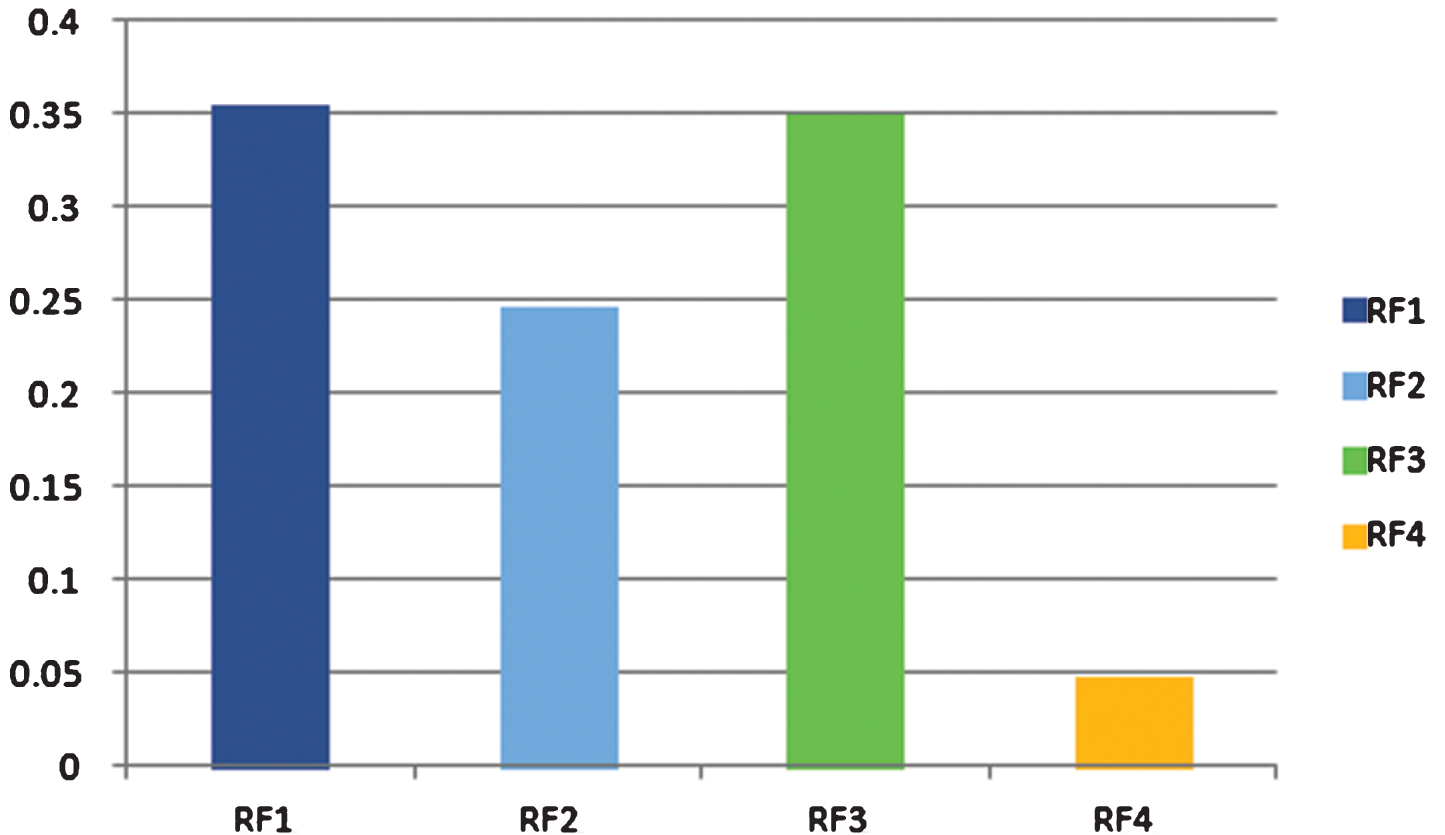
The weights of first-level of risk factors.
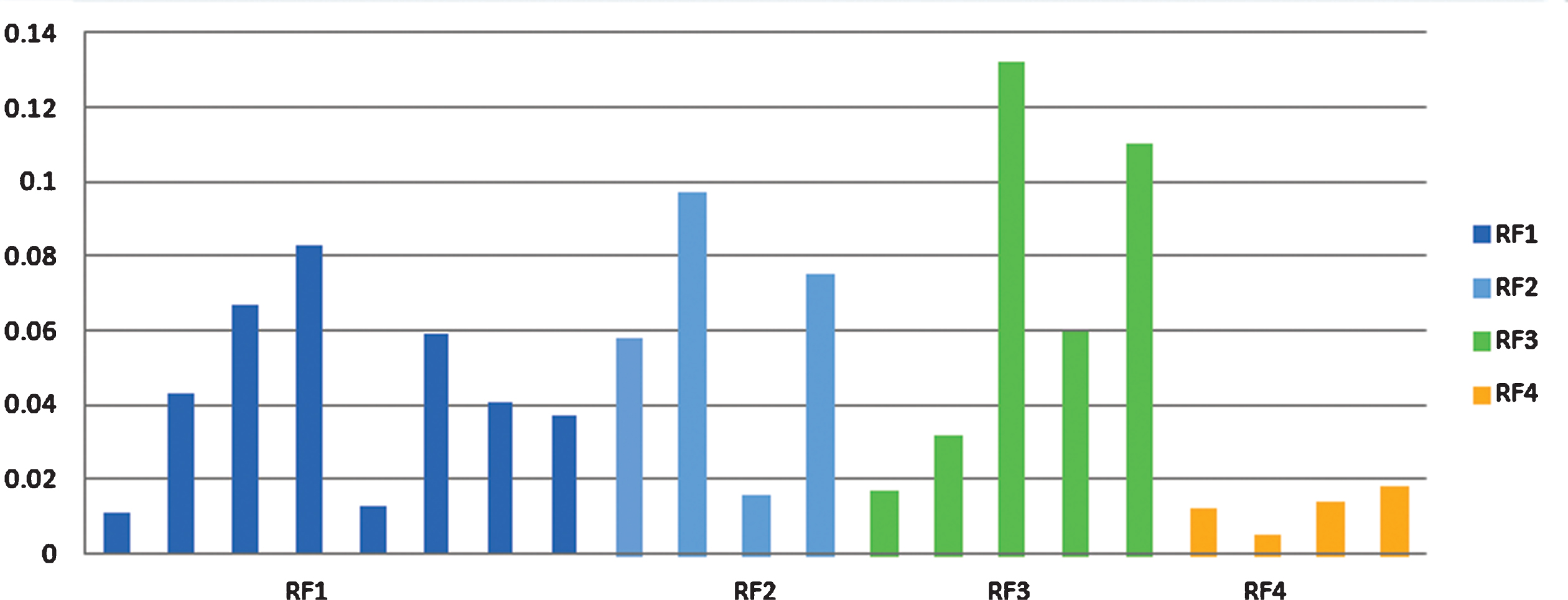
The Weights of second-level of risk factors.
This study aims to summarize the risk factors of sustainable supply chain. We construct an evaluation model that takes the supply chain of leading enterprises in a particular industry as the research object to obtain the best practitioners. To solve this problem, we introduce BWM and linguistic value soft set method, then construct a new two-stage evaluation model. Total risk factors in four categories, including operational risks, economical risks, environmental risks and social risks were identified. Furthermore, the consistency evaluation results of the cases in the literature [36] are applied to verify the validity of the model. Moreover, the analysis of the evaluation results can provide a basis for enterprise decision makers to formulate effective measures and promote the harmonious development of supply chain. There are two main contributions in this research: for one thing, the risk assessment model constructed in this paper identifies the key risk factors in sustainable supply chain management. We take into account the incomplete information conditions in the decision-making process and reflect the real preference of the decision maker as much as possible so as to make the model closer to the actual decision scenario. For another, this method provides new research methods and ideas for risk assessment of sustainable supply chain risk management. The best and worst method (BWM) is used to determine the weight of risk factors. Then the method of linguistic value soft set is used to assess the impact of risk factors on each company’s sustainable supply chain which is a multiple attribute decision making problem with language preference in the second stage. Consequently, the ranking results of sustainable supply chain of each enterprise are obtained. However, the limitation of this study when using the BWM method is that it still needs decision makers to evaluate each evaluation criteria. At the same time, in future research, when assessing the risk factors of sustainable supply chain, policy makers should also consider the linkages between the various risk factors and the possibility of occurrence of risks, making the decision-making results more scientific and reasonable. And we suggest that future research on this topic focus on others specific regions to allow for precise analysis. Moreover, other scopes of supply chains rather than the O&G industry may be evaluated by this study.
Acknowledgment
The work was supported by the National Natural Science Foundation of China (71571090, 61772019), the Youth Innovation Team of Shaanxi Universities, the Interdisciplinary Foundation of Humanities and Information (RW180167), the Project of Fundamental Research Funds for the Central Universities (JB190602), the Innovation Fund of Xidian University.