



Abstract
For the sake of better handle the imprecise and uncertain information in decision making problems(DMPs), linguistic interval-valued intuitionistic fuzzy numbers(LIVIFNs) based aggregation operators (AOS) are proposed by combining extended Copulas (ECs), extended Co-copulas (ECCs), power average operator and linguistic interval-valued intuitionistic fuzzy information (LIVIFI). First of all, ECs and ECCs, some specifics of ECs and ECCs, score and accuracy functions of LIVIFNs are gained. Then, based on ECs and ECCs, several aggregation operators are proposed to aggregate LIVIFI, which can offer decision makers (DMs) desirable generality and flexibility. In addition, the desired properties of proposed AOS are discussed. Last but not least, a MAGDM approach is constructed based on proposed AOs; Consequently, the effectiveness of the proposed approach is verified by a numerical example, and then the advantages are showed by comparing with other approaches.
Keywords
Introduction
In actual life, multi-attribute decision making (MADM) has been applied in many fields such as real estate evaluation, mine site selection, investment scheme selection, etc. However, in the face of complex, unknown and uncertain DMPs, it is not realistic to be only evaluated by a single decision maker(DM), because personal decision-making ability and knowledge reserve are limited in front of such problems. Therefore, on the basis of MADM, scholars put forward MAGDM in which multiple experts negotiate to sort and choose the best alternative.
When dealing with evaluation problems, people prefer to describe evaluation information with accurate value. However, because of the fuzziness of human thinking, and the complex and changeable factors of decision making environment, it is difficult to meet the needs by using accurate number to describe decision making information. Generally, decision makers tend to use fuzzy language such as “excellent”, “good”, “bad” and fuzzy degree words such as “extraordinary”, “general”, “special” to express the evaluation value. Therefore, fuzzy set(FS) [1] has been widely used in the MAGDM problem after Zadeh first introduced it [2]. Up to now, on the basis of FS, scholars put forward more than twenty types of FSs [3], such as hesitant fuzzy set, intuitionistic fuzzy set(IFS) [4], etc. Among them, IFS and interval-valued IFS (IVIFS) [5] are more studied. By adding a nonmembership degree (NMD) into consideration, IFS and IVIFS are the powerful extension of FS. Since the introduction of IFS, the theories and applications of IFS have been studied comprehensively, including operational rules [6–8], aggregation operators (AOs) [9–11], score and accuracy functions [12, 13], fuzzy calculus [14, 15], similarity and distance measures [16, 17] and so on.
Although IFS and IVIFS have gained importance and popularity in MAGDM, its studies are restricted to tackle some uncertain information in quantitative environments. There exists such a kind of DMPs in which the decision makers (DMs) give their opinions on alternatives not easily in a quantitative form, but it can be easily described by linguistic variables (LVs) [18, 19]. For example, selecting a proper car from a certain number of alternatives is a typical decision problem in daily life. In this problem, factors affecting the car selection such as space size, engine performance, appearance, price, may be described by LVs like "poor", "medium", and "good". Under this condition, IFS and IVIFS are no longer suitable. In view of this, Xu [20, 21] introduced linguistic term set (LTS) and continuous linguistic term set (CLTS) respectively. Since the introduction of LTS (CLTs), some extended linguistic fuzzy sets have been developed, Such as, linguistic hesitant fuzzy set (LHFS) [22, 23], linguistic neutrosophic sets [24, 25], linguistic intuitionistic fuzzy sets (LIFS) [26], linguistic Pythagorean fuzzy set [29] and so on. As an important extended linguistic fuzzy set, LIFS is drawing much more attention. Chen [26] first introduced the concept of LIFS by combing LTS and IFS in which the MD and NMD are expressed by the LTS. Since then, the theories and applications on LIFS are also all comprehensively studied. For example, Liu [27, 28] proposed power Bonferroni operators and partitioned Heronian means operators based on LIFNs. Li et al. [30] developed a set of new operational rules and entropy for LIFSs. Peng [31] defined linguistic intuitionistic Frank improved weight Heronian mean operators (LIFFIWHM). Arora et al. [32] defined a prioritized linguistic intuitionistic fuzzy AO (LIFPWA) and applied it to MADM approach, which is more general and flexible to tackle DMPs. Besides, some MADM (MAGDM) approaches have been built based on LIFS or LIFN [33–42].
In the above car selection decision problem, if the decision maker is not sure whether the description of a certain performance is "good" or "very good", but it is certain that it is between "good" and "very good". In this case, it is obviously more reasonable to describe it with linguistic interval-valued. In order to solve the above problem, Garg and Kumar [43] introduced linguistic interval-valued IFS (LIVIFS). LIVIFS is a more general form of LIFS. In LIVIFS, MD and NMD are expressed by the interval LVs (ILVs). When the upper and lower bounds of ILVs are equal, LIVIFS degenerates to LIFS. Based on LIVIFS, Garg and Kumar [43] presented a weighted average operator(LIVAIFWA ω ), an ordered weighted average operator (LIVAIFOWA ω ), and a hybrid average (LIVAIFHA ω ) operator. Kumar and Garg [44] proposed a prioritised weighted averaging operator. Liu and Qin [45] presented a weighted Maclaurin symmetric mean operator (LIVIFWMSM). Combined with power Muirhead mean operator, Qin et al. [46] developed a weighted aggregation operator(LIVIFAWPMM). Besides, some MADM (MAGDM) approaches have been built based on LIVIFS [47–52].
But there are some limitations among these AOs: firstly, in practical decision-making problems, the aggregation of attribute values is a complicated process, in which a set of general and versatile AOs is needed. However, in the matter of most AOs, the operational rules are established in the light of t-norms (TNs) and t-conorms (TCs), the above mentioned AOs are only gotten by a special TNs and TCs, i. e. algebraic TN and algebraic TC. Secondly, these AOs are assembled based on the DM’s preference and attributes are independent of each other. In addition, for different attributes, the values need to be evaluated by domain experts combined with professional knowledge and personal preferences. So the data itself is subjective, and at the same time, it is inevitable that some experts have a strong preference for a candidate, which means extreme attribute values can be provided by some biased experts [53].
Among various of TNs and TCs, copulas and co-copulas are classical examples of TNs and TCs. Copulas [54] can not only reflect the dependence among variables, but also prevent information losing in the aggregation process. Copulas are functions that connect the joint distribution function with their respective edge distribution functions, which can describe the correlation between variables, so some people call it a connection function [54, 55]. As a tool for describing the dependence mechanism between variables, the copula function contains almost all the dependence information of random variables, especially when it is impossible to determine whether the traditional linear correlation coefficient can correctly measure the correlation between variables. There are basically two types of copula, Archimedean copula and Gaussian copula. In this paper, we only discuss Archimedean copula.
There are two distinguishing features of copulas: (1) Just as TNs and TCs, copulas and co-copulas are flexible because DMs can select different types of copulas to define the operations under fuzzy environment, and the results obtained from these operations are closed; (2) Copula function is flexible to capture the correlations among attributes in DMPs. Based on two obvious characteristic, copula have been applied to some DMPs. For example, Nelsen [54] applied copulas in aggregation function. Tao et al. [55] extended copulas to IFS and applied it to DMPs. In the light of Archimedean copula, Tao [56] studied a new computational model for unbalanced linguistic variables. Chen [57] defined new AOs in linguistic neutrosophic set based on Copulas and applied them to solve DMPs.
The existed AOs provide the most commonly used way to aggregate LIVIFS, but it lacks a unique way in practical applications. What is it the form of AO on the basis of copula function and LIVIFS? Considering Power average(PA) operator has the ability to reduce the irrational data provided by biased DMs, what is the form of generalized weighted PA operator? What are the differences between copula-based AOs and existed AOs? SO the goal and motivation of the present work are to synthesize ECs (ECCs), power operator, and LIVIFS and to develop some MAGDM approach with LIVIFI. The following three aspects should be addressed included in this work: (1) to define novel operational rules of LIVIFNs based on ECs and ECCs which can reflect the relevance, (2) to construct corresponding AOs regarding the proposed operational rules, (3) to develop a novel decision approach for MAGDM with LIVIFI. In these three main aspects, constructing novel operational rules is the core issue. Based on the above-analyzed, this work focuses on developing linguistic interval-valued intuitionisitic fuzzy Copula(LIVIFCA) aggregation operators with LIVIFI. The goals of this work are:
(1) to propose a new version of Copulas and Co-copulas by extending the domain and the range of Copulas and Co-copulas from [0, 1] to [0, t] (t > 0).
(2) to define a new operation rules of LIVIFNs based on ECs and ECCs.
(3) to propose a family of new AOs for managing LIVIFI by combing proposed new operational rules and PA operator.
(4) to propose a novel decision approach for MAGDM with LIVIFI and investigate some special cases.
In order to achieve the above goals, the organization is as follows. We firstly focused on new version of Copulas and Co-copulas which can tackle the linguistic information in Section 2. In Section 3, we introduce the LIVIFCA based on ECs and ECCs together with their properties. In Section 4, weighted averaging PA operator, and generalized weighted PA averaging operator are proposed based on LIVIFNs. The algorithm of MAGDM with LIVIFI based on LIVIFCA is contructed in Section 5. Case analysis will be carried out and some advantages of the proposed MAGDM approach based on LIVIFCA operators are analysed in Section 6 and the conclusion will be obtained in Section 7.
Preliminaries
In this section, firstly some basic concepts related to IFS and DIFS are reviewed, along with an overview of the evidential reasoning algorithm, which are the basis of the present work.
For convenience, we set α = ([s a , s b ] , [s c , s d ]), where s a , s b , s c , s d ∈ S[0,t], and also [s a , s b ] ∈ [s0, s t ] , [s c , s d ] ∈ [s0, s t ] , b + d ≤ t.
(1) If S (α1) < S (α2), then α1 < α2;
(2) If S (α1) = S (α2) and H (α1) = H (α2), then α1 < α2.
Most existed AOs are built based on TN and TC. It is a pity that the range and the domain of TN and TC must be in [0, 1], under the circumstance, this type of AOs may be invalid in some real DMPs in which the decision information are expressed by LVs. In linguistic intuitionisitic decision making, if the MD and NMD of a LIVIFN can be transformed into [0, t], where t > 0, then all operation rules can be extended to [0, t]. Furthermore, some decision making approaches can be extended to deal with LIVIFI. For this purpose, the extended TN and extended TC are introduced by Liu [58]:
(T1)
(T2)
(T3)
If T just satisfies (T1), then T is called a semi-copula. With the help of extended TNs and extended TCs, we first introduce the concept of extended Copulas (ECs) and extended Co-copulas (ECCs) in order to handle some DMPs with LIVIFI.
(C1)
(C2)
(C3)
From the definition of ECCs, we have
In what follows, all ECs are all EACs if not specified. In order to introduce some new operations for LIFNs based on ECs and ECCs mentioned above, following conclusion is given firstly.
It follows from the definitions of EC and ECC that
As ϱ is strictly decreasing and c
i
+ d
i
≤ t (i = 1, 2), it follows that
When generator ϱ (c) is different, several common formulas are shown in Table 1.
The influence of parameters θ on the rank of alternatives
In this following, we will give a new version of operational rules based on ECs and ECCs.
It is easy to verify that
So Eq. (8) holds for all n ∈
Similarly, the following theorems can be obtained easily.
Based on Theorem 2.2 and Theorem 2.3, for all λ > 0, we can define the following operations:
In this part, we will give a family of linguistic interval-valued intuitionistic fuzzy copula weighted averaging (LIVIFCWA) operator by combining the LIVIFNs, ECs and ECCs introduced in Section 2.
Some discussions on LIVIFCWA
(1)When n = 1, Theorem 3.1 is obvious.
(2)Presume Theorem 3.1 holds when n = l,i.e,
So, when n = l + 1, we have
Thus, theorem 3.1 holds for all n ∈
In what follows, we will give some properties of LIVIFCWA operators.
LIVIFCWA (λα1, λα1, …, λα n ) = ([s a , s b ] , [s c , s d ]) where
and
Therefore, we can see that Theorem 3.3 is held.□
□
On the other hand, as c i ≥ η i , d i ≥ ν i , we have
similarly, we have
According to Theorem 3.4, we have, LIVIFCWA (α-, ⋯ , α-) = α- and LIVIFCWA (α+, ⋯ , α+) = α + Accordingly, α- ≤ LIVIFCWA (α1, ⋯ , α n ) ≤ α+
Besides,
Thus, Theorem 3.7 is kept.□
In this subsection, we will discussions on LIVIFCWA, and some special cases of LIVIFCWA will be given when the the generators of ECs take different form.
Let α i = ([s a i , s b i ] , [s c i , s d i ]).
(
(
(
where
(
where
(
The linguistic interval-valued intuitionistic fuzzy copula weighted power averaging operators
The PA operator
(
where
(
(
where
(
(
(
In this part, we will give a approach for MAGDM. In general, a MAGDM problem consists of the following parts: (1) Alternative set: Ξ = {Ψ1, ⋯ , Ψ
m
}; (2)Attribute (Criteria) set: A = {a1, ⋯ , a
n
}; (3)WV of attribute: W = (w1, ⋯ , w
n
)
T
satisfies w
i
∈ [0, 1] and
DMs evaluate the attribute value of alternative Ψ
i
under the attribute a
j
can be expressed by a LIVIFNs:
The flow chart of the Novel MAGDM method is shown in Figure 1.
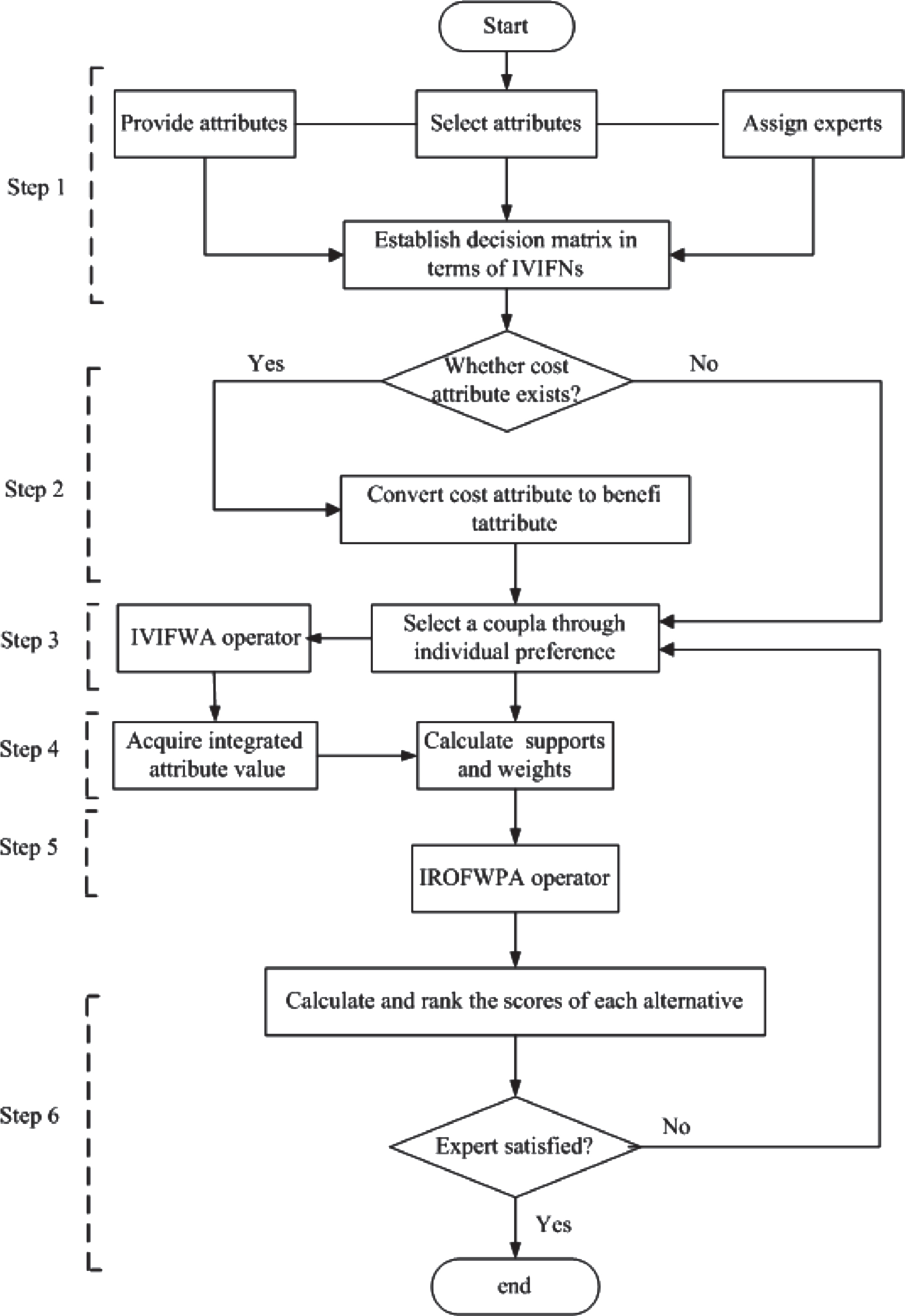
Flow chart of MAGDM.
This example is from [15]. In the selection of companies for investment in the rural areas. There are four companies Ψ1, Ψ2, Ψ3, Ψ4 taken as in the form of the alternatives. The following four attributes (a1, ⋯ , a4) should be considered: a1: Project cost; a2: Technical capability; a3: Financial status; a4: Company background.
The expert use LVs
D ecision matrix R
k
(k = 1, 2, 3)
D ecision matrix R k (k = 1, 2, 3)
let λ = (0.243, 0.514, 0.243) be WV of the three experts, and w = (0.4, 0.25, 0.2, 0.15) be WV of the attributes.
Integrated decision matrix
Integrated decision matrix
Similarly, we have
Z1 = ([s3.5131, s5.1567] , [s1.0687, s2.2485]),
Z2 = ([s2.6424, s4.3525] , [s1.4184, s3.1305]),
Z3 = ([s3.2033, s4.9469] , [s1.2020, s2.5225]),
Z4 = ([s3.4572, s4.5699] , [s1.6161, s2.5368])
The rank of alternatives is a1 ≻ a3 ≻ a4 ≻ a2, and so a1 is the best alternative.
The ordering results of alternatives use other ECs proposed in present work are list in Table 4. From Table 4, we can see that there are slight differences among the scores of alternatives by different types of copulas, but the ranking results are exactly the same. This suggests that the use of different types of copulas has no obvious effect on the aggregation results.
The ordering results of alternatives using other different Copulas
In this subsection, the influence of parameter q, θ on the results will be analyzed. Without loss of generality, we select the Gumbel type copula to conduct an analysis with respect to different values of q and θ. The score value and the order relation are listed in Table 5, Table 6, Figure 2 and Figure 3.
The influence of parameters θ on the rank of alternatives
The influence of parameters θ on the rank of alternatives
The influence of parameters q on the rank of alternatives
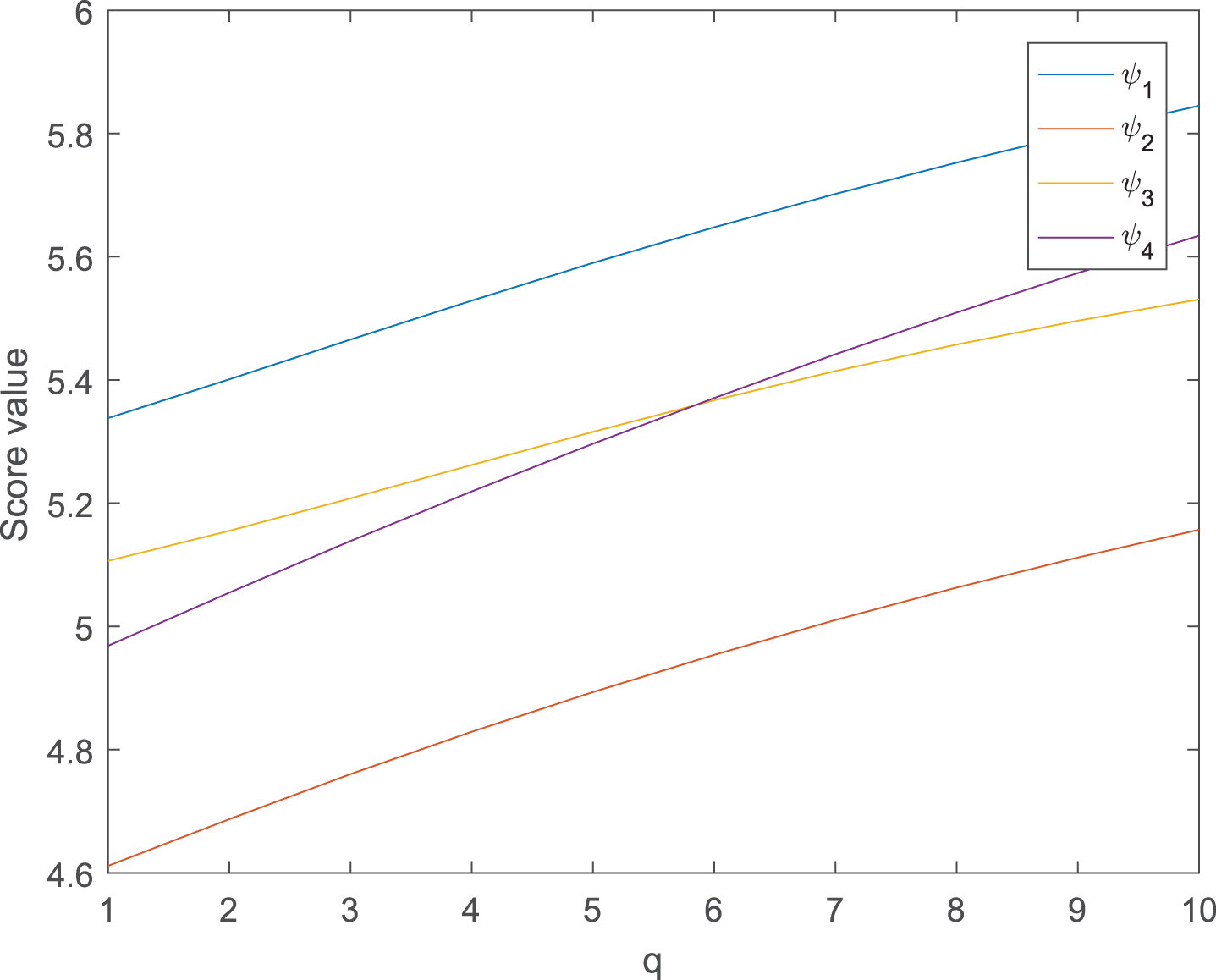
Scores of A i (i = 1, 2, 3, 4) when θ = 1, q ∈ [0, 10].
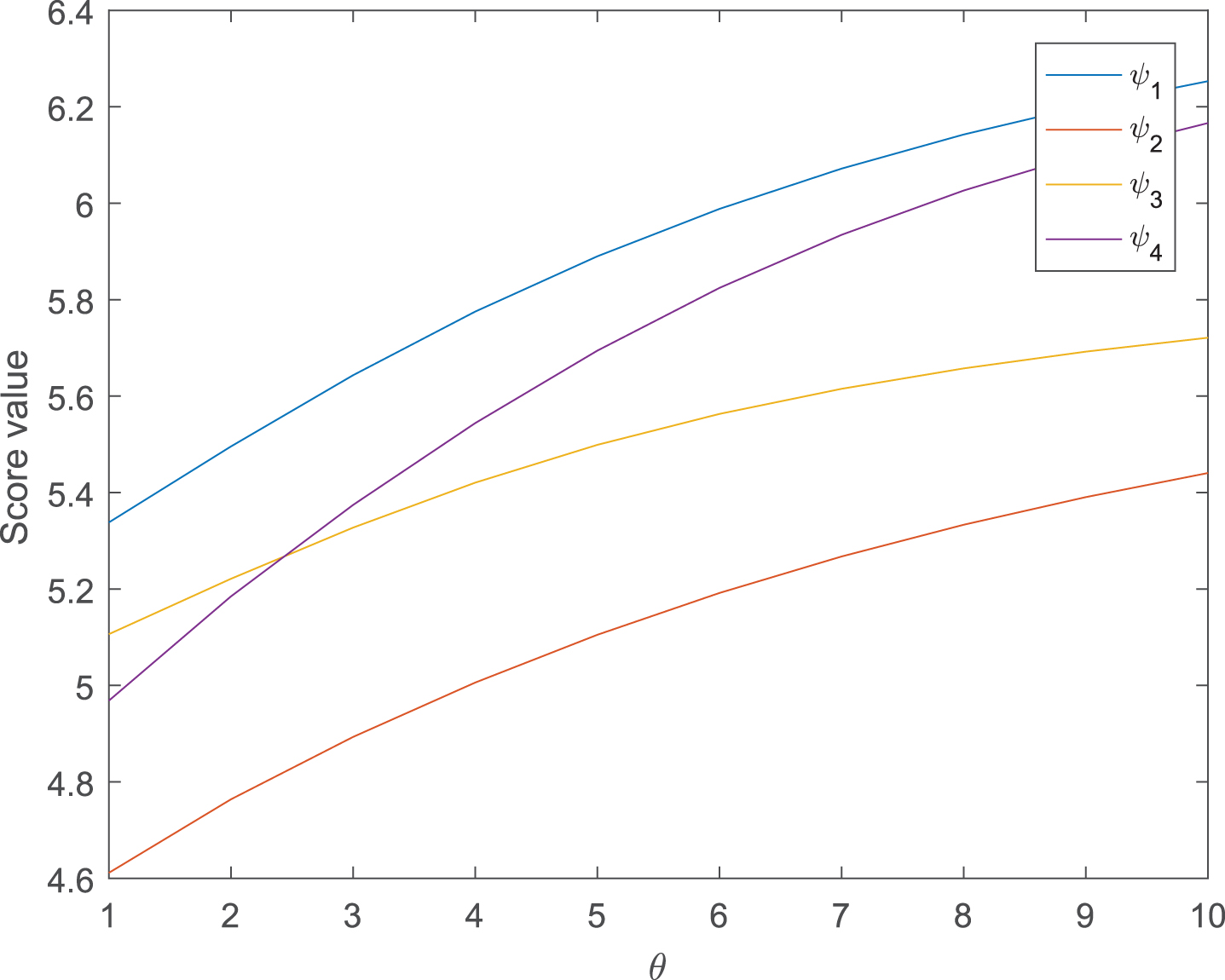
Scores of A i (i = 1, 2, 3, 4) when q = 1, θ ∈ [0, 10].
From them, it is easy to derive the following conclusions: (1)the score value of alternatives are different by applying different parameters, but the ranking order of alternatives are almost the same; (2)although the final decision resultants of alternatives are slightly diverse, the optimal alternative is the same; (3)the parameter q can be regarded as a risk preference attitude of managers, i.e., the parameter q has a better control capability for the comprehensive evaluation value of alternatives;(4)the score value of all candidates increase monotonically with the increase of the parameter value q or θ.
Furthermore, we can see from Figure 2 and Figure3 that the order of Ψ3 and Ψ4 will be changed slightly under different parameter q or θ, but the best and worst candidates will not change.
In summary, we can derive that the sorting orders of alternatives are relatively stable with respect to different parameter q, θ. Accordingly, the proposed method can validly avoid interferences and acquire the best alternative.
In what follows, the proposed approach will be analyzed and compared with other existing methods.
Comparison with existing approaches for example 2
Comparison with existing approaches for example 2
Comparison with existing approaches for example 3
In this example, we changed the attribute value
In what follows, the proposed approach will be analyzed and compared with other existing method approaches.
(1) Chen et al.’s LIFWA operator [26], Zhang’s LIFWA operator [38] and Liu and Wang’s ILIFWA operator [39] are all based on LIFS. The operational rules are special form of ECs and ECCs. The proposed method will be degenerate to the above methods when t = 1, θ = 1, p = 1,and q = 0, and only consider s(a+b)/2 and s(c+d)/2. Therefore, the proposed method is more general.
(2) Compared with Tao’s method [55]. If t = 1, q = 1, and only consider s(a+b)/2 and s(c+d)/2, LIVIFCWPA operator in this paper reduce to IFCAA ω . Therefore, compared with IFCAA ω [55], LIVIFCWPA is the generalization of Tao’s method.
(3) Compared to the method of [45] and [43], the proposed method is more universal and flexible. It can be regarded five aggregation functions through assigning diverse copulas to it and flexible parameters θ, q can also be selected according to decision maker¡¯s attitude.
(4) In [46], Qin et al. combine the MM operator and the PA operator under the Archimedean T-norm and T-conorm operations(ATT). Compared with our method, Qin et al consider the interconnection of diverse attributes, but the designed method is based on ATT which is the special form of ECs and ECCs.
A detailed comparative analysis for aforementioned approaches are displayed in Table 9.
The characteristic comparison of different AOs
The merit of LIVIFCA operators are summarized as follows:
•(1) As far as the operational rules are concerned. On the one hand, the operational rules of Garg and Kumar [43] were built based on algebraic t-norm (TN A ) and t-conorm (TC A ). Copulas and co-copulas are classical examples of TNs and TCs. It is seen from Section 3 that TN A and TC A are the special cases of ECs and ECCs, which not only reflect the coherence between variables, but also prevent information losing in the process of integration. As Copulas and Co-copulas can only handle some situation on [0, 1], but it is invalid for some situations on [0, t] (t > 0). Therefore, we extend classical copulas and Co-copulas from [0, 1] to [0, t] to handle some DMPs with linguistic information. Hence, these AOs based on the ECs and ECCs are more diversified and also avoid information loss in decision making process. On the other hand, some different LIVIFS’ operational rules are obtained based on different cases of ECs and ECCs in our work, and different types of AOs have been proposed correspondingly. The main advantage of these AOs is that it can provide more choices for DMs.
•(2) In the matter of AOs. Garg and Kumar [43] introduced the LIVAIFWA ω operator, LIVAIFOWA ω , LIVAIFHA ω operator to manage LIVIFI. The proposed LIVIFCWA operators are different families with different ECs and ECCs. The details have been studied with particulars in Section 4. What’s more, combined PA operator, we proposed generalized weighted power (GLIVIFCWPA)operator. Therefore, the proposed AOs are more flexible for DMs to make more choices in real DMPs.
•(3) Moreover, taking into account the irrational data given by biased decision makers in real DMPs, it is very interesting to integrate the Copula operations and PA operator for MAGDM under LIVIFS environment. The proposed operators not only make the decision making approach more flexible and robust in practical DMPs, but also reduce the impact of irrational data given by biased DMs.
Linguistic interval-valued intuitionistic fuzzy theory is a powerful tool to handle imprecise and uncertain information. In order to build the new approach for MAGDM under Linguistic interval-valued intuitionistic fuzzy environment, we propose a new version of copulas and co-copulas named ECs and ECCs, and present a LIVIFCWA operator, LIVIFCWPA operator and a GLIVIFCWPA operator respectively. Also some properties of the proposed AOs have been proved and five specific forms of AOs are obtained when EC and ECC take different types of ECs and ECCs. On this basis, a new MAGDM method is proposed and a detailed numerical example is given. Finally, the effectiveness, feasibility and superiorities of proposed method is proved by some comparative study. In future, we shall focus especially on the correlation between attributes, incomplete attribute information, as well as the large scale decision making algorithm based upon linguistic assessment theory and methodology.
Conflict of interest
The authors declare that they have no conflict of interest.
Footnotes
Acknowledgments
This work was supported in part by Sichuan Province Youth Science and Technology Innovation Team under Grant 2019JDTD0015, Application Basic Research Plan Project of Sichuan Province under Grant 2017JY0199; Scientific Research Project of Department of Education of Sichuan Province (No.17ZB0220, No.18ZA0273); The Application Basic Research Plan Project of Sichuan Province (No.2017JY0199); The Scientific Research Innovation Team of Neijiang Normal University (No.18TD008);Open fund of Data Recovery Key Lab of Sichuan Province(No.DRN19018)