



Abstract
Development of a robust triple multimodal biometric approach for human authentication using fingerprint, iris and voice biometric is the main objective of this manuscript. Accordingly, three essential algorithms for biometric authentication are presented. The extracted features from these multimodals are combined via feature fusion center (FFC) and feature scores. These features are trained through artificial neural network (ANN) and support vector machine (SVM) classifiers. The first algorithm depends on boundary energy method (BEM) extracted features from fingerprint, normalized combinational features from iris and dimensionality reduction methods (DRM) from voice using sum/average FFC. The second proposed algorithm uses extracted features from zoning method of fingerprint, SIFT of iris and higher order statistics (HOS) of voice signals. The third proposed algorithm consists of extracted features from zoning method for fingerprint, SIFT from iris and DRM from voice signals. Classification accuracy of implemented algorithms is estimated. Comparison between proposed algorithms is introduced in terms of equal error rate (EER) and ROC curves. The experimental results confirm superiority of second proposed algorithm which achieves a classification rate of 100% using SVM classifier and sum FFC. From computational point of view, the first algorithm consumes the lowest time using SVM classifier. On other hand, the lowest EER is achieved by first proposed algorithm for extracted features from Karhunen-Loeve transform (KLT) method of DRM. Additionally, the lowest ROC curves are accomplished respectively for extracted features from multidimensional scaling (MDS), generated ARMA synthesis and Isomap features. Their accuracy is improved with SVM. Also, the sum FFC introduces efficient results compared to average FFC. These algorithms have the advantages of robustness and the strength of selecting unimodal, double and triple biometric authentication. The obtained results accomplish a remarkable accuracy for authentication and security within multi practical applications.
Introduction
Currently, information and communication technology -(ICT) awarded eligible services in wide range applications that necessitate strong protection procedures. This is essential for protection of data from unauthorized persons [1]. Conventional authentication systems such as password, lock and access card have a lot of issues [2–5]. These issues include forgotten the password, different password attacks stolen the card and misuse of card [2–4].
Recent authentication systems through human physiological [6] and behavioral detail are not easy to forge. This kind of personal security [7] information is known as biometric recognition system [2–4, 8–10]. Individual personal unimodals such as DNA, Iris, Voice, fingerprint and iris can be utilized as single recognition source [2]. However, the quality of definite features of authentic user and sensors issues is low [11]. Multimodal biometric authentication (MBA) offers the advantages of higher speed, security and efficiency [12]. It improves the identity verification accuracy [13]. This type of security has a lot of superior advantages compared to conventional security methods [8]. Multimodal biometric authentication can be used within worldwide applications [14] such as nuclear reactors, industrial, banking and medical environments.
In [15], they achieved respectively maximum accuracies for speaker verification under clean and noisy environments of 100% and 73.75% [15]. The sound features are captured from MFCC with vector quantization for pattern matching [15]. Hodjat Hamidi [16] studied the significant utilization of biometric data in IoT functions. Hamidi [16] developed a continuous security solution depending on internet of things (IOT) using multimodal biometrics for smart healthcare technologies. M. Hammad and K. Wang [4] applied convolution neural network for secure ECG and fingerprint features. For additional protection, they use a unique cancelable biometric technique. A QG-MSVM classifier is utilized for enhancement of authentication process. A considerable approach by Anter Abozaid et al. [17] using multimodal recognition approach for authentication tool is conducted.
The basis of MBA represents the fusion of considered biometric unimodal data [18, 19]. Unimodal data stands for fusion of extracted features, matching score and decision levels [18]. These methods have the benefits of exploiting much higher information from each unimodal. The integration of data from individual unimodal is the main challenge of MBA [17]. So, feature fusion and matching score levels are considered in this article. This paper is concerned with combination of several unimodals such as fingerprint, iris and voice in order to bypass the limitations of unimodals biometric authentication. Triple multimodal biometric has little attention in the literature due to structure complexity and feature matching process. The extracted features from these unimodals are fused in a single decision vector. This work paper is sorted in the coming way: experimental framework is illustrated in Section 2. Section 3 establishes multimodal biometric authentication algorithms. Discussion of deduced experimental results is clarified within Section 4. Section 5 is concerned for final conclusion.
Experimental setups
Three different experiments are executed in this manuscript. Databases of 228 image and signal are experimentally captured using different data acquisition system (DAS). For fingerprint, 8 images for each person are acquired. These images are used for training and testing purposes. A digital camera with X pixels is functionalized for acquisition of these images. The iris images are captured by Lenovo tablet camera with android. This camera is with 2 MPixels. Each image is characterized with 1024×600 resolutions. Also, the implemented algorithms are evaluated by iris database in [20]. For iris database, three images for each eye per person are captured. It is 3×64 for both eyes of left and right. These databases images are 24 bit-RGB with 576×768pixels. TOPCON TRC50IA optical instrument coupled with Sony camera DXC-950P 3CCD is used for acquisition of iris images. Ten audio signals for each person are acquired. All persons repeated the same sentence many times. The real audio signals are taken by aid of 2.6 GHz Pentium (R) Dual-Core CPU and RAM of 1GB. A stereo dynamic headphone ST-2688 is employed for voice acquisition. The proposed triple multimodal biometric authentication approach of fingerprint, iris and audio voice is implemented in Fig. 1. Classification using the considered triple multimodals biometric increases the degree of authentication. This approach consists of multiple algorithms like image denoising, enhancement and image segmentation algorithms. Furthermore, diverse algorithms are implemented with extracted features and classifiers. The accuracy of classification results are of concern. Moreover, the biometric features are combined in different ways for increasing the authentication degree.

The proposed triple multimodal biometric authentication approach using fingerprint, iris and voice for human classification.
De-noising algorithms
Figure 2 declares the implemented denoising algorithm of fingerprint images. This algorithm utilizes the impulse method with split Bregman technique. The captured images are noised with salt pepper, speckle and Gaussian noises. Then, the impulse method is applied. The Bregman variables are initialized for creation of total variation matrices. It depends on low rank and total variation. Hence, it is used to solve the next optimization problem.
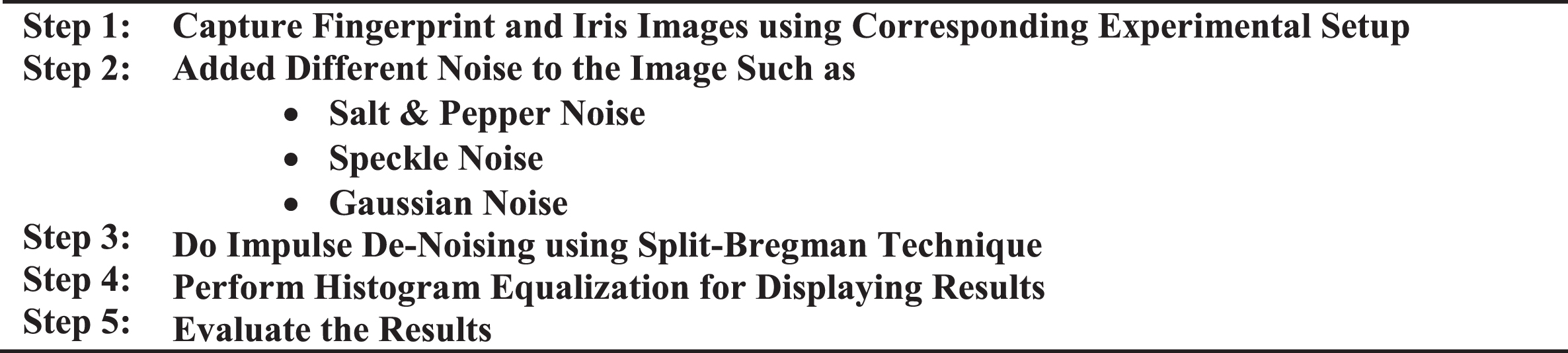
Image de-noising algorithm using impulse method with split Bregman technique.
Two known kinds of minutiae details are considered due to their robustness and stability. The ridge and bifurcations are two main types of minutiae of fingerprint images. Ridges endings can be described as the points at terminated ridge curve. However, the bifurcations are the junction of two splits ridges for two paths. Extraction of minutiae is essential for better recognition and identification of fingerprint. Here, an algorithm is implemented in order to show the ridges and bifurcation within fingerprint images as depicted in Fig. 3. The morphological operations depend on the shape of minutiae and its positions. The ridges can be assumed as pixels with one neighbor in 3×3 neighbourhood [21]. The acquired image can be treated by morphological operation. Skelton operation is selected. It ignores pixels on the borders of image without permitting objects to break apart. Binarization process is performed for isolation of background from the object in fingerprint image. An adaptive threshold process is used for binarization. It is described by [21].
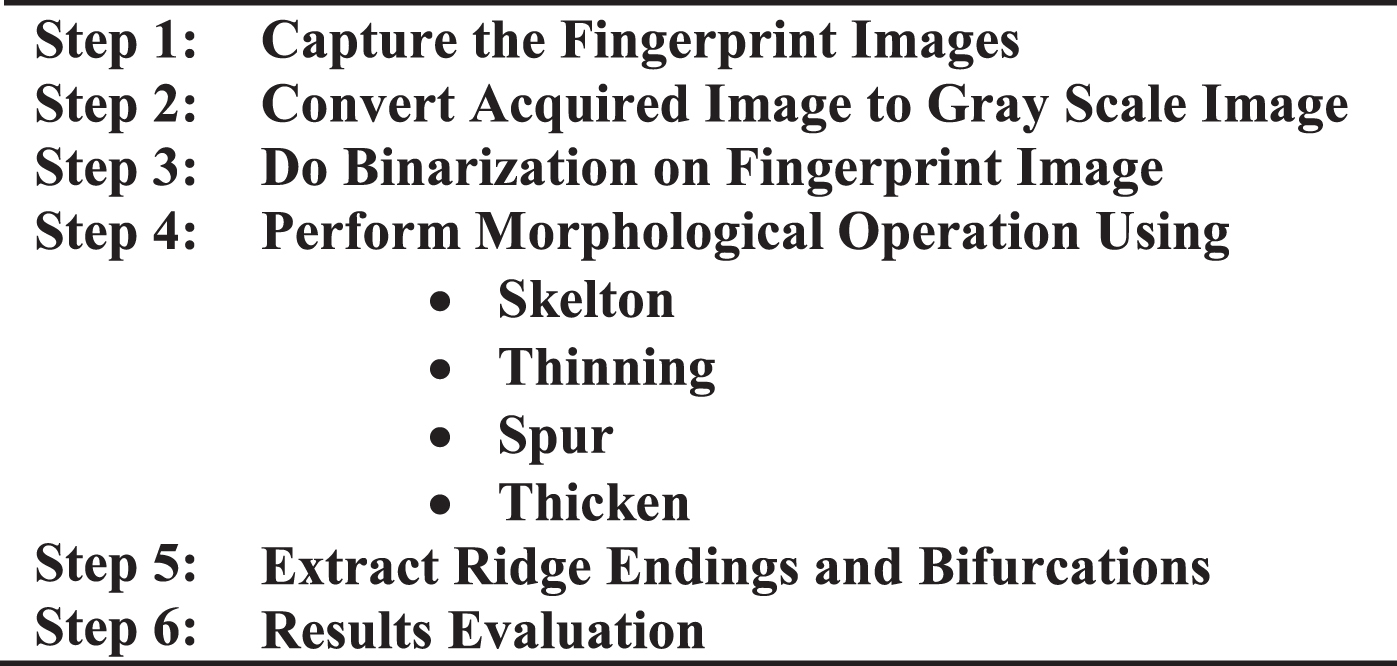
An algorithm for extraction of different types of minutiae from fingerprint images.
The fingerprint and iris images segmentations are presented by algorithm based active contour as shown in Fig. 4. It is counted on local information in image.
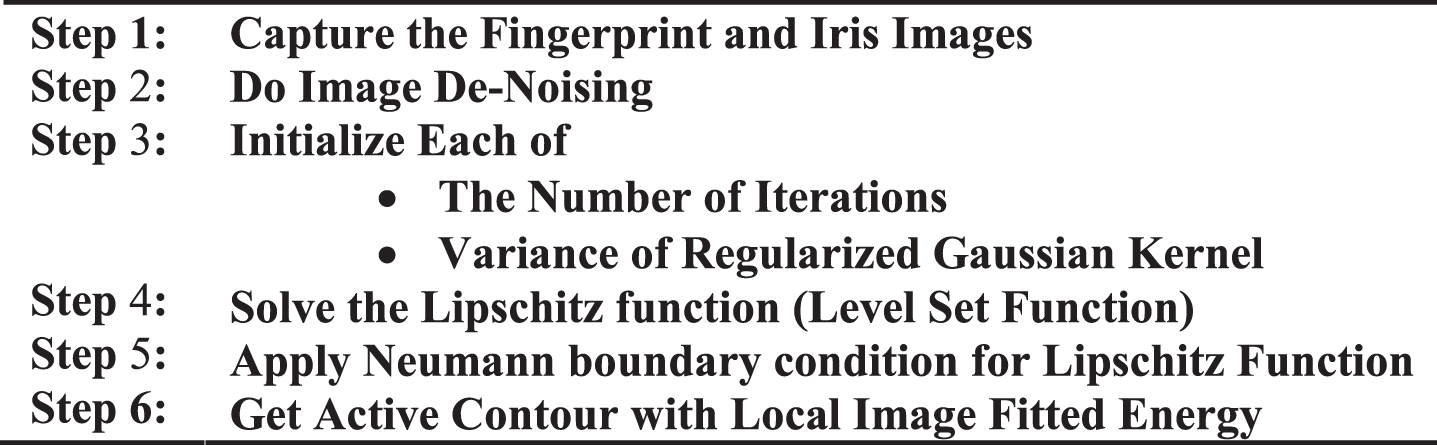
Fingerprint and iris images segmentation algorithm by active contour using LIFE method.
This method has the benefit of using local image fitting energy in order to acquire image information. This method has the ability of image segmentation with intensity in-homogeneities. It is robust to noise degradations. Besides, the execution time is too much efficient. This algorithm depends on solution of gradient descent flow as [22–26].
Here, an approach for MBA is presented. Figure 5 shows the extracted features of trained and tested images. A database for the specified persons is captured. Then, 8 images for each person are selected as database. The acquired grey images are transformed into color images. The image contrast is applied for overcoming misclassification problems. The features of captured images are extracted using one of the considered algorithms. The features are saved as database for testing purposes. In testing phase, the tested image has features compared with that saved in trained database. Feature matching process is done using a classifier. These features are assigned to the corresponding person. Additionally, the evaluation of this approach is considered for each extracted feature. This approach depends on several implemented algorithms. These algorithms are conducted in the next subsections.

Personal classification approach for various extracted features from unimodals images.
Features extraction algorithm using boundary energy method (BEM)
Two different algorithms are presented. These algorithms depend on the extracted feature from the captured fingerprint images. The first algorithm uses the boundary energy features. This algorithm depends on energy metrics of feature extraction method. This algorithm is necessary for modification of contour shape in order to reduce energy. This principle is called boundary energy. Additionally, such method can be applied for analysis of images in diverse domains. It is assumed to be global shape in which described by [27].

Extracted features algorithm of fingerprint images using boundary energy method.
An algorithm based on extracted features from zoning method is conducted in Fig. 7. This algorithm depends on dividing each image into multiple zones. Then, the features of each zone are extracted. These features are regional and geometric features. Also, the image is grayscale. This image is converted into binary image. A morphological operation is done on each image. The image universe discourses are determined. Each image is divided into 9 rows and 9 columns. The width and height of each zone are initialized. The features of each zone are acquired. Finally, the regional properties of the image are estimated. These features include shape measurements and pixel value measurements. The extracted features are combined in one vector. These features are employed for training and testing purposes of fingerprint images.

Extracted features algorithm of unimodal fingerprint images using image zoning method.
Universe of discourse refers to the shortest matrix fitting image skeleton. It contains locations of diverse line segments within fingerprint image. Subsequently, the features may be acquired by divided windowing of every image. Thus, more information about each zone will be obtained. The location of fingerprint within each image is assumed as a feature in all zones [28].
Features extraction algorithm using normalized combinational method
Algorithms based on normalized combinational features and SIFT methods are utilized for extraction of iris features. The accuracy and comparison of these unimodals are introduced. An algorithm utilizes several feature extraction methods is introduced. These methods are color moments, edge directional histogram and texture features that established in Fig. 8. For color moments, three color moments are considered. These are mean, color variance and color skewness. This algorithm accept RGB color image. Then, color space transformation for each image is performed from RGB to UVL. Mean, standard deviation and skewness of whole colors represent the color features. For edge directional histogram, the edge histogram for horizontal, vertical, two diagonals and one non-directional are estimated. It is stored in 1×5 vectors. Then, every RGB image is converted into ycbcr color space. Preprocessing of whole types of edge orientations is essential. Canny method is applied in order to get the edges of the intensity image. Such edge image is multiplied by the type of detected orientation. Subsequently, histogram is estimated. Lastly, acquisition of texture features from images is executed. It depends on creating a gray level co-occurrence matrix [29]. These features are concatenated for classification of iris images. The accuracy of this algorithm is estimated.

Unimodal algorithm based on combinational feature for iris images.
An algorithm for features extraction of iris images using scale invariant feature transform (SIFT) is introduced in Fig. 9. It is prepared for mutating image data to scale-invariant coordinates linked to local features. The extracted features by SIFT keypoints are distinctiveness. It is accomplished by combining the higher dimensional data within a local region of the image [30]. The keypoints have the advantages of robustness. Most of these keypoints are captured from conventional images that guide to robustness in extracting small objects among clutter. Keypoints are given for all scales. Little local features are accessible for matching small and highly occluded objects. Conversely, the subjected images to noises and blurring are handled by larger keypoints. The calculated time of these keypoints is efficient. Thousand keypoints are supposed to be taken from usual images. The presented approach in [30] utilizes Taylor expansion of scale space function Ω(a, b, σ) shift. Thus, the origin at the sample point is given by [30].

Extracted features algorithm of unimodal iris images using SIFT features method.
Each image is converted into double precision. A scale-space extreme detection is performed. The images are smoothed. The image in first octave is interpolated. DoG pyramid is constructed. Therefore, keypoints can be localized. Thus, extreme points may be estimated by searching on each pixel in the DoG map. Precise localization of keypoints is fundamental. However, points associated with short contrast are abolished using remainder of Taylor expansion. Subsequently, the multiple orientations are assigned. The keypoints descriptor is initialized. Therefore, the features of SIFT are estimated after performing the PCA calculations.
HOS features from unimodal voice recognition
Here, two different algorithms are used for voice recognition in which HOS and DRM are the bases of such algorithms. The influence of the AWGN noise and other channel degradations are considered. These degradations have negative influence on recognition of audio signal. HOS can be functionalized for wide range of engineering problems [31]. It is utilized for recognition of audio signal. The bispectrum features are one branch within HOS. It is able to detect and quantify phase combination. Bispectrum has been estimated using two main approaches. These approaches are conventional and parametric. It based on AR, ARMA, and MA, models. Moreover, it is classified to both direct and indirect categories. On other hand, these approaches have restrictions on statistical variance of the estimates as well as computer time. Additionally, the memory is the essential restriction with their implementation. Bispectrum is directly related to two peak frequencies. It is real valued and nonnegative in contrast with the power spectrum. They contain complex values [32]. The symmetry properties of cumulants carried over to symmetry properties of poly-spectra for real values. Power spectrum is symmetric since Γ2x(Ω) =Γ2x(-Ω). This symmetrical property of bispectrum is indicated by [31].
It is know that parametric estimators are often valuable. It is supposed that underlined issue behaves as a parametric model. It is considered that x(n) is related to finite set of parameters (μ). So, the statistics is function of μ. This parametric estimation of power spectrum is introduced by guessing μ and evaluating E
xx
(Ω| μ). ARMA model is a popular model in time series analysis. The ARMA process has power spectrum that stated by [33].
The spectrum power is not related to phase information of the transfer function. It is stated as
The cross-bispectrum is initiated by [31]
Therefore, an algorithm for extracted features from order statistics is investigated within Fig. 10.

Unimodal audio signal identification algorithm based on HOS method.
An algorithm for voice recognition is investigated. This algorithm uses the dimensionality reduction method (DRM) as introduced in Fig. 11. The DRM represents the conversion of high dimension data to lower one. It is necessary in a wide domain of applications of digital signal and image processing. Three different approaches for DRM are utilized. These approaches are traditional linear, global nonlinear, and extensions with variants of local nonlinear techniques. Traditional linear technique includes KLT. The global nonlinear techniques include Kernel principle component analysis (KPCA), multidimensional scaling (MDS), Isomap, maximum variance unfolding (FastMVU) and diffusion-maps (DM). Finally, the extensions and variants of local nonlinear techniques are conformal eigenmaps (CCA), maximum variance unfolding (MVU) and linearity preserving projection (LPP). Therefore, eight methods are employed for estimating the features by DRM. The KLT is suggested for linear conversion of χ to maximize χ
χ
ρYχ. It is found by [34].

Unimodal audio signal identification algorithm based on dimensionality reduction method.
The MDS is a group of nonlinear techniques that maps the data to lower dimensional representation as well as keeping pairwise distances between data points. The raw stress function is described by [34].
Maximize ∑
ζl
∥ σ
ζ
- σ
l
∥ 2 subject to
Diffusion maps (DM) is originated from dynamic system. The DM is based on Markov random walk of graphed data. Hence, the value of proximity data points is attained. The lower dimensional data is described by
Two different fusion centers are taken into account. The first one is the feature fusion center (FFC). The second one depends on scores fusion center (SFC). The extracted features of biometric are combined using feature fusion center (FFC) as indicated in Fig. 12. This center has three different scenarios based on sum, average and maximum feature fusion. On the other side, the extracted features of fingerprint, iris and voice are combined as sum, average and maximum rules. This center increases the recognition accuracy and classification rate. Moreover, the scores fusions (SFC) are concerned. It utilizes the estimated scores of underlined unimodals (fingerprint, iris and voice). A schematic diagram of proposed multimodal biometric authentication algorithms for FFC between fingerprint, iris and voice is presented in Fig. 13.

The fusion center for multimodal biometric classification.
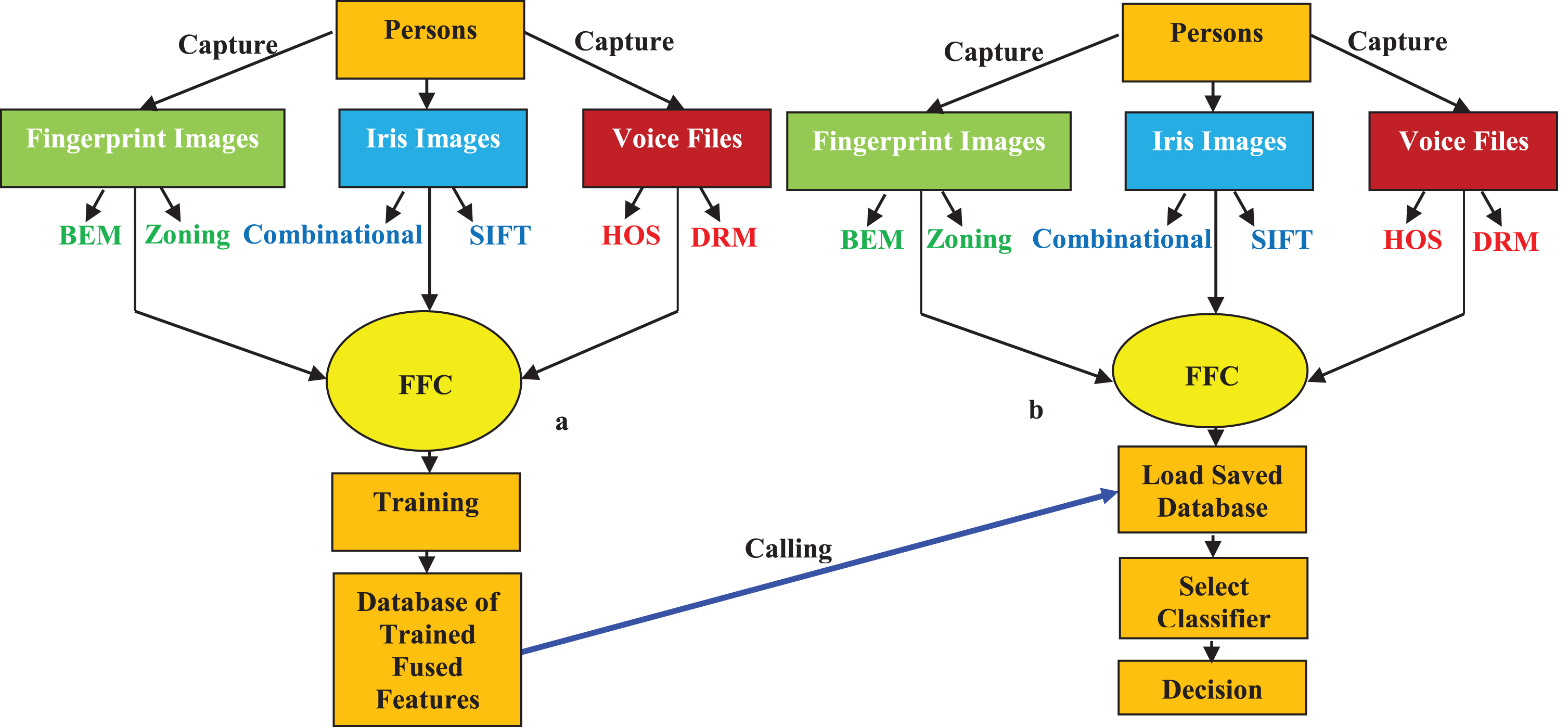
Schematic diagram of proposed multimodal biometric authentication algorithms for fingerprint, iris and voice a) Training phase b) Testing phase.
The scores fusion (SFC) center depends on likelihood ratio (LLR) formula that estimates the total fused score as follows.
where p(.|G) and p(.|I), SFingerprint SIris and SVoice refer to matching scores PDF of the genuine person, the matching scores probability density function of impostor person, matching score of fingerprint identification method, the matching score of the iris differentiation technique and the matching score of the voice recognition technique, respectively.
SVM represents a class of machine learning algorithms in which performs regression and pattern recognition. This classifier is relied on statistical learning technique as well as structural risk minimization idea [29]. The SVM as a classifier is used for differentiation between multiple classes. An algorithm for feature matching process used for classification purposes by SVM is introduced. This algorithm based on selection of several conditions. These conditions avoiding repeating process of classes values. Besides, it avoids selection of particular value of iteration based on classes.
Also, the ANN is utilized for feature matching. The ANN algorithm has two different phases. These phases are training and testing phases [23–26]. The biometric database is captured. The biometric database images are changed into grayscale form. Then, image enhancement is performed. Features of all persons are extracted individually. These features are extracted using different algorithms. The image is degraded by Poisson noise in testing phase. In such phase, the extracted features are compared with trained features using ANN to recognize each person. Also, classification rate of recognized persons is estimated.
Finally, a pseudo-metric motivates the neural similarity on a given non-empty set X with respect to the Łukasiewicz synchronism in Łukasiewicz structure [35]. The main expression describing the similarity is affected by a generalized mean and Łukasiewicz construction as [35].

Mean classification accuracy using Lukasiewics structure for the extracted features.
This algorithm depends on the extracted features saved in database. The number of column should be specified as features of the data. Similarity mensuration of generalized Lukasiewics framework is supposed. This measure is indicated by a parameter in generalized Lukasiewics similarity (α) and generalized mean parameter (θ). The mean classification accuracy with best parameter values is obtained. Additionally, the best parameter values with respect to mean classification accuracy are presented. Variances with best parameter values are attained.
Triple algorithms intended for multimodal biometric authentication are proposed. Every algorithm contains three chief phases. The phases stand for features extraction, training phase and testing phase. The first algorithm is conducted in Fig. 15. The extracted features by this algorithm are declared in Fig. 15(a). The training phase of first proposed multimodal biometric authentication algorithm is presented in Fig. 15(b). Conversely, testing step is notified in Fig. 15(c). This algorithm includes fingerprint, iris and voice as multimodal biometric authentication. Higher authentication degree is the basic merit of this algorithm. The features of captured fingerprint images by experimental setups are extracted using BEM method. However, the features of iris images are acquired by combinational feature method. The audio files are captured and converted into data signals. The features of voice signals are extracted using Karhunen-Loeve Transform, MDS, fastMVU and Isomap methods. The extracted features are submitted for feature fusion center (FFC) or score fusion. The FFC perform addition, average of features and maximum feature. Additionally, the FFC calculates average of such features. So, many decisions can be taken into account by FFC. Then, the features at the output of FFC are trained using either ANN or MSVM. Consequently, these features are saved in database for classification purposes. In testing phase, the trained features which saved in database are called. An appropriate classifier is selected for comparison between features in database with the testing ones. Subsequently, a decision is taking about the person. Also, the classification accuracy is computed. The second algorithm for multimodal biometric authentication is implemented as revealed in Fig. 16. This proposed algorithm depends on various extracted features methods that described in Fig. 16(a). One of basic fingerprint features is the zoning method. SIFT technique is utilized for describing features of iris images. The features of voice signals are extracted using HOS methods. These features are submitted to either FFC or SFC. The FFC performs one of three main arithmetic processes. These processes are sum, average and maximum of these three features. Additionally, the features are trained as investigated in Fig. 16(b). Finally, an appropriate classifier is applied for feature matching process such as ANN and MSVM as shown in Fig. 16(c). Then, the classification accuracy is accomplished.

The first proposed algorithm of multimodal biometric authentication between fingerprint, iris and voice a) Extracted features (BEM + combinational + DRM) b) Training phase c) Testing phase.
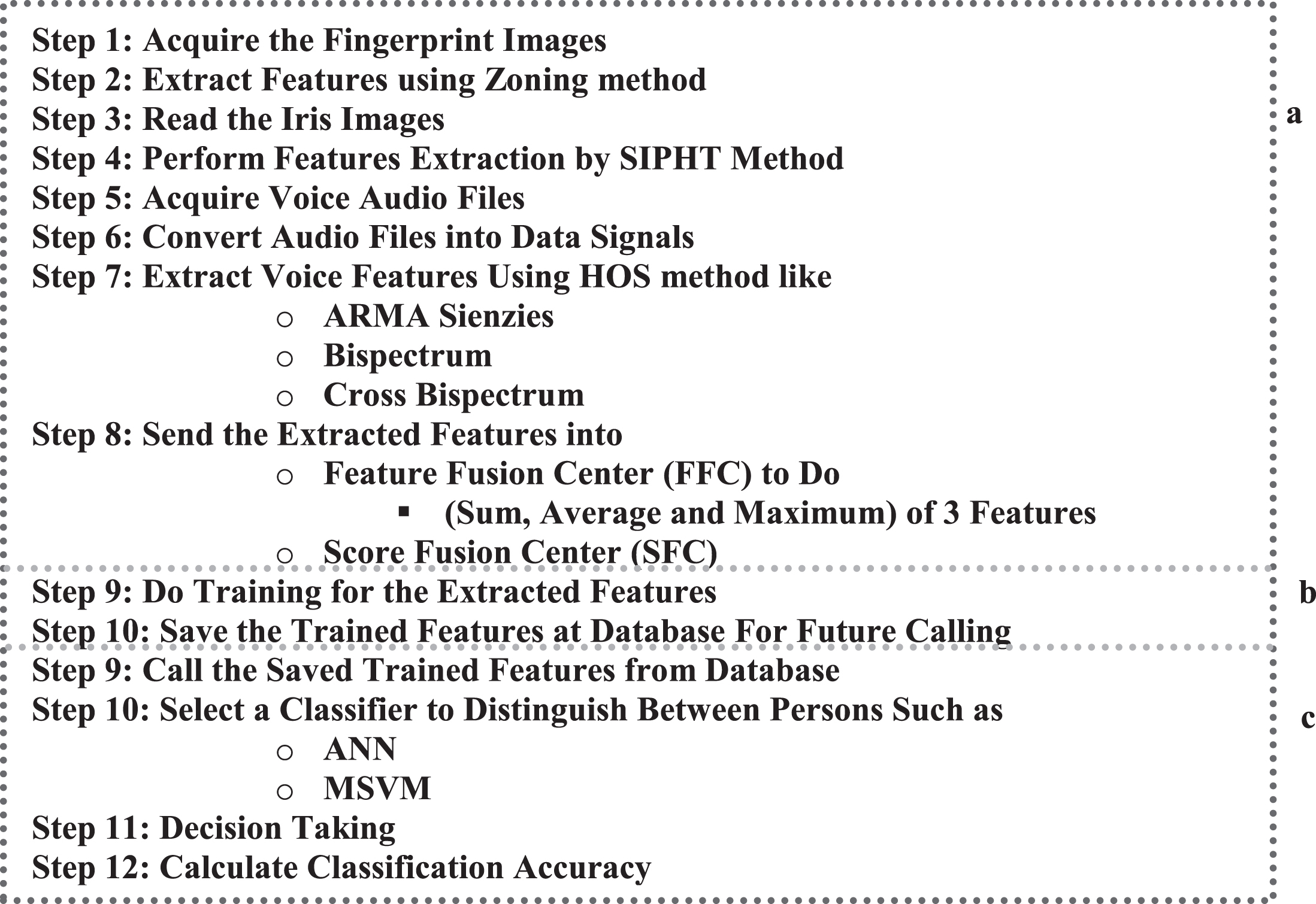
The second proposed algorithm of multimodal biometric authentication between fingerprint, iris and voice a) Extracted features (zoning + SIFT + HOS) b) Training step and c) Testing step.
A third algorithm is conducted as given in Fig. 17. This algorithm depends on extracted features from zoning method, SIFT method for respectively fingerprint images and iris images as illustrated in Fig. 17(a). The features of voice are extracted from KLT, KPCA, MDS and diffusion map methods. The extracted features are submitted for FFC or SFC. The FFC computes the sum or average or maximum of the three features. Then, the ANN and MSVM are applied for features matching process between stored features in Fig. 17(b) and tested ones in Fig. 17(c). Therefore, classification accuracy can be predicted.
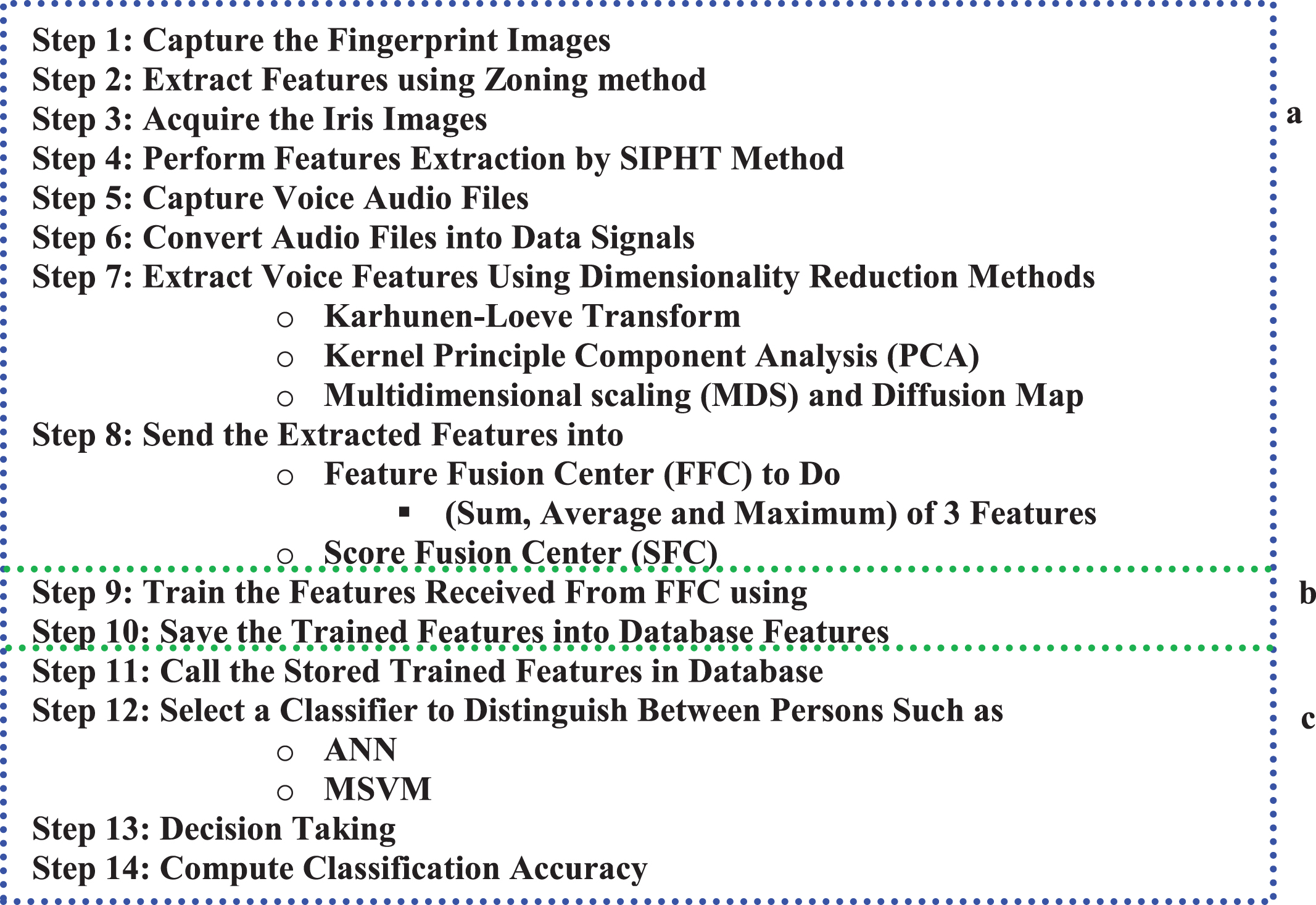
The third proposed algorithm of multimodal biometric authentication between fingerprint, iris and voice for a) Extracted features by (zoning + SIFT + DRM) b) Training stage and c) Testing step.
Fingerprint and iris image preprocessing results
The fingerprint/iris images are de-noised using impulse method with split Bregman technique as illustrated in Fig. 18. Fingerprint images are detected as appeared in Fig. 18(a). The noisy image with speckle noise is evident in Fig. 18(b). The de-noised image via impulse method is declared within Fig. 18(c). The influence of different noises on fingerprint images is illustrated through statistical measurement as in Table 1. These measurements are judged and identified via PSNR, MSE, RMSE, entropy, mean absolute error (MAE) and PCC. Results are improved with image preprocessing step. The PSNR2 after processing is enhanced and better than PSNR1 before processing under all noise degradations. The best results are achieved under salt pepper noise degradation of the image. The obtained results confirm the robustness of the applied algorithm for image de-noising. However, the captured iris image is illustrated in Fig. 18(d). The noisy image is shown in Fig. 18(e). The de-noised iris image by impulse method with split Bregman technique is implemented in Fig. 18(f). Statistical evaluation of de-noised iris image is introduced in Table 1. The obtained results confirm the improvement of statistical evaluation under Speckle degradations.
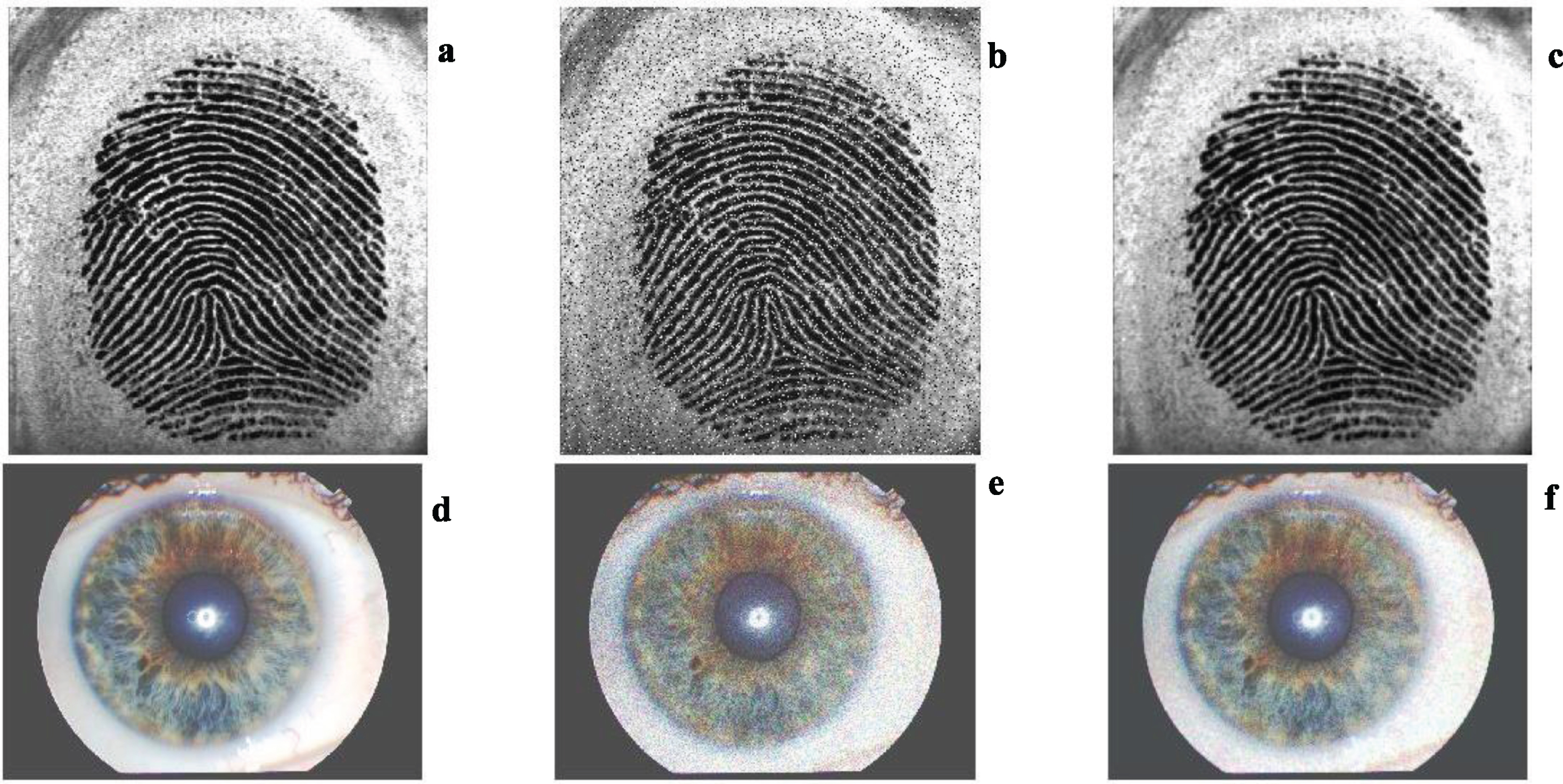
Filtered images using impulse method with split Bregman technique a),d) Original fingerprint and iris images b),e) Noisy fingerprint and iris images with speckle noise and c),f) De-noised fingerprint and iris images.
Evaluation of fingerprint and iris images de-noising algorithm using impulse method with split Bregman technique
The minutiae within fingerprint images are extracted. The input fingerprint image is specified in Fig. 19(a). Thinning image is articulated within Fig. 19(b). However, extracted minutia of fingerprint image by Skelton operator is illustrated in Fig. 19(c). What is more, assessments of desirable fingerprint images are suggested in Table 2. Statistical measure of attained results verified the highest PSNR of thicken operation. However, thicken operator gives the lowest SNR and image entropy. On other hand, the thin operator introduces the best SNR. Finally, the image segmentation results using active contours with local image fitted energy for fingerprint and iris are respectively depicted in Fig. 20(a)-(b).
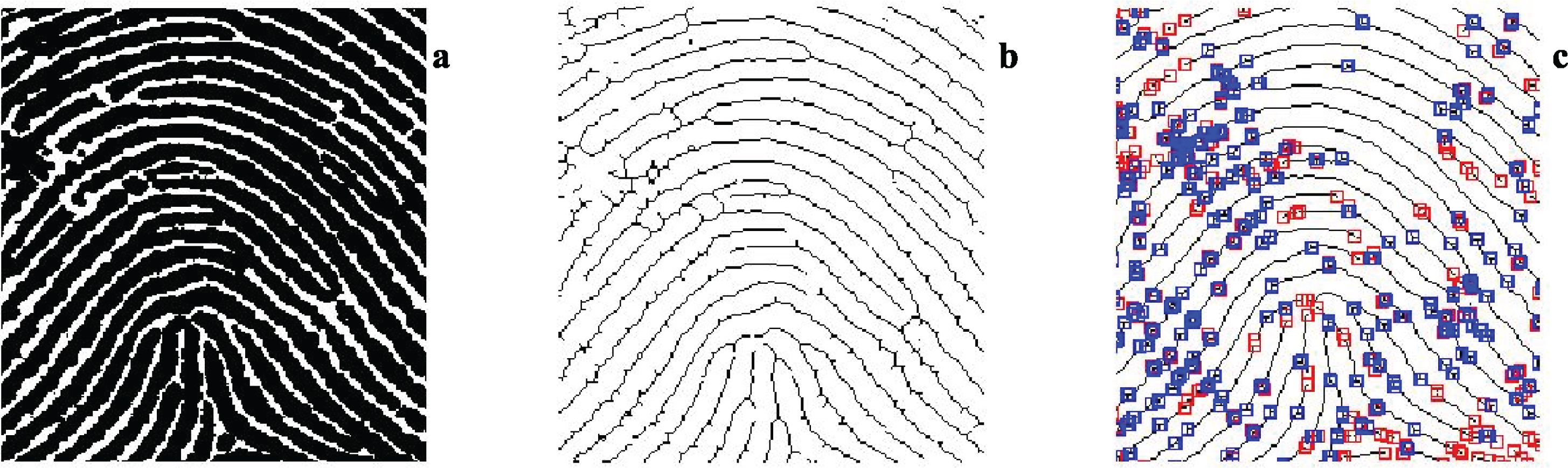
The extracted minutiae of fingerprint images using Skelton operator a) Input fingerprint image b) Thinning fingerprint image c) Extracted minutiae from fingerprint image.
Statistical analysis of extracted minutiae using different morphological operations
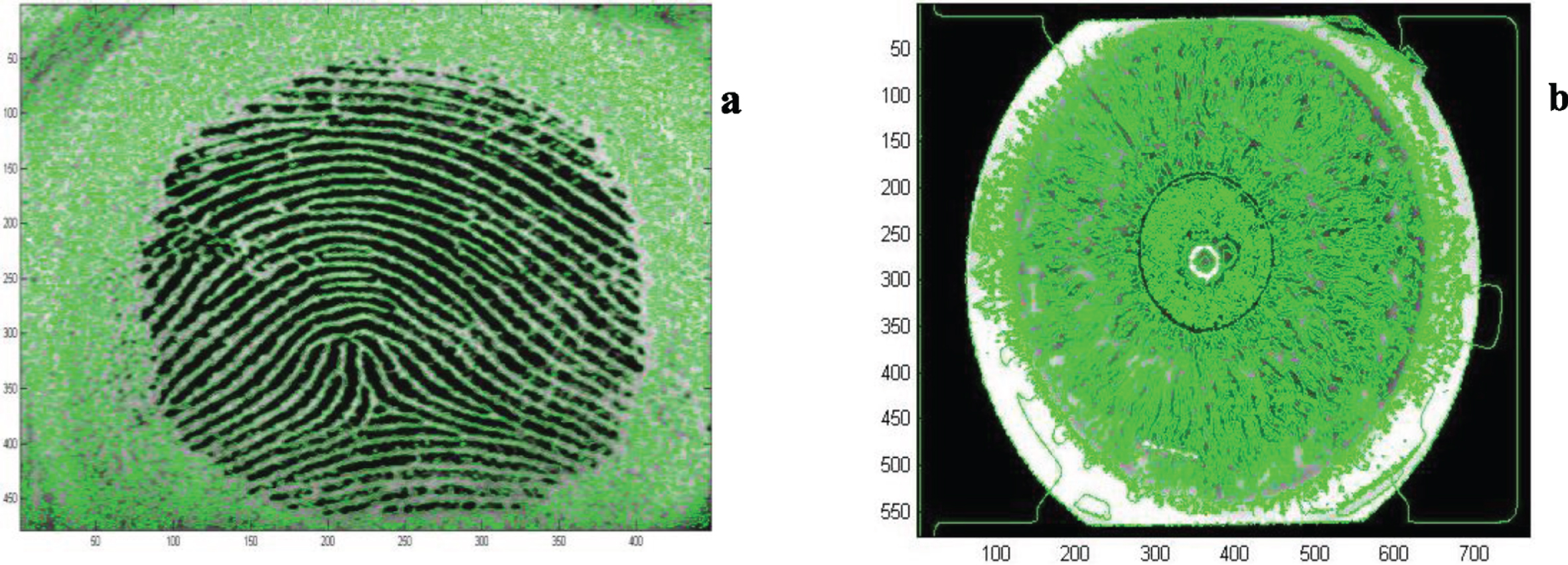
Segmented images depending on active contour by LIFE a) Fingerprint image b) Iris image.
The average value of extracted features from fingerprint images for different persons using bounded energy method (BEM) is presented in Table 3. The obtained results confirm that HSV histogram feature cannot differentiate between fingerprint images. The other energy metrics show variation in their values with different persons. These energy metrics can be used for differentiation between different persons. Besides, the average values of extracted features using image zoning features like eccentricity, extent and orientation are illustrated in Table 4. These features are engaged for classification between 5 persons. The accuracy for proposed algorithms is determined by the measure of the eccentricity, extent and orientation parameters. These parameters represent a challenging due to diverse nature of image data. These parameters are clarified for different persons in Table 4.
Average value of extracted bounded energy (BEM) features
Average value of extracted bounded energy (BEM) features
Average value of extracted image zoning features method
Table 5 indicates a comparison between maximum classification accuracy using different fingerprint identification algorithms. These algorithms depend on BEM with ANN, BEM with MSVM, zoning with ANN and zoning with MSVM. The comparison shows the superiority of zoning method with ANN that achieves classification rate of 96.5% over BEM method with ANN that attains lower classification rate of 59%. However, the BEM method with MSVM achieves higher classification rate of 98.3871% compared to 98.2% by zoning method with MSVM. Besides, the classification accuracy obtained by Lukasiewics similarity using BEM is found to be of 54.87% instead of 7.50% achieved using zoning.
Comparison between maximum classification accuracy using different fingerprint identification algorithms
The ROC and equal error rate (EER) are applied for evaluation of the underlined algorithms. Besides, four measure parameters are used for evaluation purposes. Such parameters have false positive rate (FPR), FNR, TPR and true negative rate (TNR) [36]. Imposter has a probability that treated as genuine individual. It refers to FPR [36]. It classifies the quantity of misclassified genuine attempts as zero trial impostor trials. However, FNR signified to probability of a genuine individual that rejected as an imposter. The percentage of desirable genuine users by this system refers to TPR. False acceptance rate (FAR) is the proportion of misclassified impostors trials as genuine trials. However, the EER refers to intersection point for the FPR-FNR curve. It is mathematically given by
Table 6 compares the estimated results of EER for fingerprint recognition under different algorithms. These algorithms are BEM with ANN, zoning with ANN, BEM with MSVM and zoning with MSVM. The algorithm with zoning method and ANN accomplishes the lowest possible error of zero value compared with other algorithms. Additionally, the MSVM achieves lower EER of 0.04033 with zoning method.
EER for the fingerprint identification using various identification algorithms
Classification error of proposed fingerprint identification algorithms is specified in Table 7. The obtained results show that BEM with SVM achieves too much lower error of 0.0053. However, zoning with SVM introduces classification error of 0.96471. On other hand, the error of liner kernel with zoning method is found to be of 1.6129%. It is lower than kernel error of 6.45161% using BEM. Additionally, the obtained samples misclassification by zoning method is too much lower than of BEM. It attains respectively the values of 0.95294 and 0.8 with ANN and SVM. The variation of classification threshold using different fingerprint identification algorithms is described in Table 8. Classification thresholds are problem-dependent. The optimum value of classification threshold is found to be of 0.5. Lower threshold value of 0.37 is attained by BEM with ANN. Yet, the uppermost threshold can be obtained by zoning with ANN. Also, bias of the considered classifiers is computed as indicated in Table 9. The lowest bias of 0.91106 is computed for zoning with SVM. The ROC curves of fingerprint identification algorithms under BEM and zoning extracted feature methods are presented in Table 10. The ROC curve values using zoning method is too much higher than of BEM. However, the sensitivity, specificity, area under curve and identification accuracy values using BEM is higher than of zoning method.
Classification error of the proposed fingerprint identification algorithms
Classification threshold using different fingerprint identification algorithms
The bias of various classification methods
ROC values of fingerprint recognition algorithm for various extracted feature methods
The evaluation of attained best classification accuracy for MSVM using BEM and zoning feature extraction methods are designated in Fig. 21. The comparison between different classifiers indicated that extracted features from bounded energy with MSVM achieve the highest accuracy of 98.381% compared to zoning method as referred in Fig. 21(a). A maximum classification accuracy of 98.2% is realized using image zoning method. Also, the lowest error is obtained using energy bounded method as declared in Fig. 21(b). However, a percent classification error of 1.8% is attained for extracted features from zoning method with MSVM. These proposed methods realize high accuracy compared to that in literature.

Classification accuracy of extracted features by BEM and Zoning methods for a) Fingerprint classification rate (%) against number of iterations with MSVM and b) Classification error percent (%) versus number of iterations with MSVM.
The classification results of iris unimodal are presented for different extracted features and classifiers. These features extractors are combinational and SIFT. The classification accuracy of combinational method is estimated to be respectively of 99% and 98.2% for ANN and MSVM classifiers as indicated in Table 11. The Lukasiewics similarity classification rate is computed to be of 5.2632% with a classification error of 0.0128. The classification rate for SIFT method under ANN is found to be of 99% as appeared in Table 12.
Evaluation in terms of maximum classification rate (%) for MSVM and ANN using image combinational feature extraction method
Evaluation in terms of maximum classification rate (%) for MSVM and ANN using image combinational feature extraction method
Comparison between achieved maximum classification rate for ANN and MSVM using image SIFT feature extraction method
The iris classification rate against number of iterations using MSVM for combinational and SIFT feature extraction method is depicted in Fig. 22(a). However, the classification error of unimodal iris using MSVM is illustrated in Fig. 22(b). Table 13 declares the estimated EER values for iris recognition under different feature extraction methods and classifiers. It is noted that combinational feature extraction method with ANN achieves the lowest possible EER compared to all other methods. The ROC curve values of iris recognition under combinational and SIFT extracted features methods is indicated in Table 14. This table shows higher values of FNR, specificity and recognition accuracy using SIFT method. From other corner, the dedicated combinational method realizes superior measures with respect to sensitivity and area under curve.
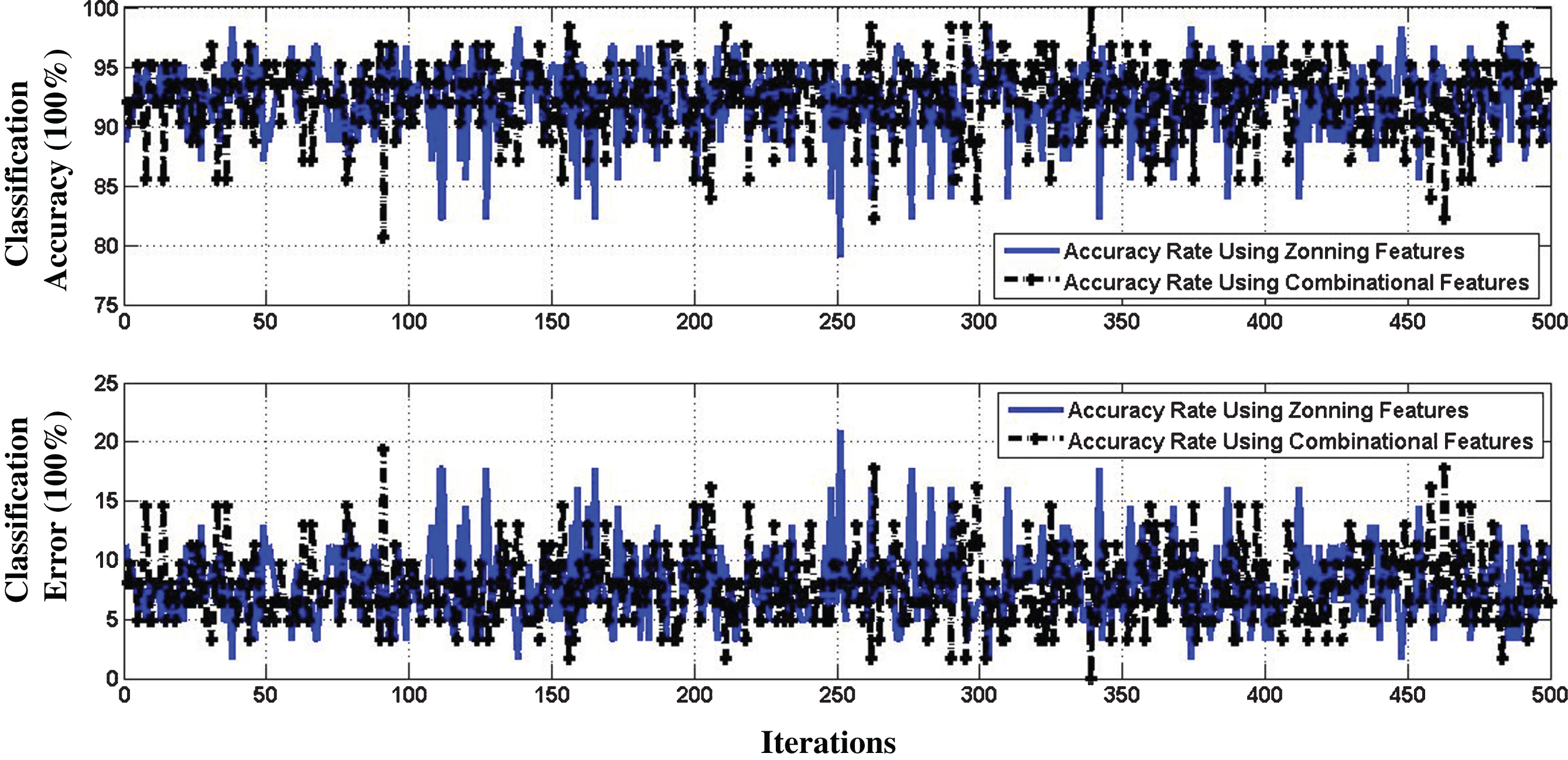
Classification accuracy of extracted features by Zoning and combinational methods for a) Iris classification rate (%) against number of iterations with MSVM and b) Classification error (%) against number of iterations with MSVM.
The estimated EER values for iris recognition under different feature extraction methods and classifiers
ROC values of iris recognition algorithm for various extracted feature methods
This subsection is concerned with unimodal voice recognition for human authentication. Experimental voice features are captured using HOS and DRM. Experimentally, HOS features are taken from bi-spectrum assessment based on the indirect method, ARMA synthetics, bispectrum estimation using the direct approach, cross-bispectrum estimation using direct approach and frequency estimation using eigenvector method. However, the features of DRM contain KLT, KPCA and MDS. The average classification rate for voice recognition using extracted features from higher order statistics under various attacks is depicted in Table 15. These attacks are Gaussian, Rician and complex attack (Gaussian + Rician). It is noted that generated ARMA synthesis gives the highest recognition rate under various noise attacks. It achieves 100% recognition under all attacks with too much lower computational time as indicated in Table 16. Besides, the extracted features from cepstral coefficients of the signal and bispectrum with indirect method introduce 100% recognition under Gaussian attack. On other hand, the extracted features from bispectrum estimation using the direct approach present the lower recognition of 52.8182% under all noise attacks. Furthermore, the estimated time of such algorithm is assessed as notified in Table 16. The classification accuracy against percentage of impulsive error for extracted features from HOS under complex attacks with Gaussian and Rician noises is illustrated in Fig. 23. The generated ARMA synthesis gives average classification rate of 100%. The recognition rate is improved with DRM. Table 17 declares the average classification rate (%) for voice recognition using dimensionality reduction algorithm under various attacks. Higher classification rate of 100% is accomplished under Gaussian noise attack. Also, the extracted features from KLT achieve too much better accuracy compared to other DRM features. The ROC curves for voice recognition under Karhunen-Loeve transform and multidimensional scaling extracted features are estimated in Table 18. It is observed that attained curves are recognized for both methods. The voice classification accuracy against percentage of impulsive error for extracted features from dimensionality reduction under complex attacks of Gaussian with Rician is clarified in Fig. 24.
Average classification rate (%) for voice recognition using extracted features from higher order statistics under various attacks
Average classification rate (%) for voice recognition using extracted features from higher order statistics under various attacks
Computational time (s) for voice recognition using extracted features from HOS

Voice classification accuracy against percentage of impulsive error for extracted features from HOS under complex attacks of Gaussian with Rician.
Average classification rate (%) for voice recognition using dimensionality reduction algorithm under various attacks
ROC values of voice recognition algorithm

Voice classification accuracy against percentage of impulsive error for extracted features from dimensionality reduction under complex attacks of Gaussian with Rician.
The classification accuracy of first proposed algorithm for extracted features from BEM of fingerprint, normalized combinational features from iris and DRM from voice signal using ANN with sum FFC under Gaussian and Rayleigh attacks at different SNR and noise variance is presented in Table 19. Under these degradations, the features extracted from the Isomap gives higher classification rate of 95% compared to other methods. Also, the Karhunen-Loeve transform (KLT) achieves high classification accuracy of 94%. However, the multidimensional scaling introduces too much lower classification rate of 50% under Rayleigh attack.
Classification rate (%) of first proposed algorithm for extracted features from BEM, combinational and DRM using ANN with sum FFC under Gaussian and Rayleigh attacks
Classification rate (%) of first proposed algorithm for extracted features from BEM, combinational and DRM using ANN with sum FFC under Gaussian and Rayleigh attacks
The classification accuracy of first proposed algorithm under Rician attack and complex attack (Gaussian + Rician) is implemented in Table 20. The results confirm that extracted features from Karhunen-Loeve transform accomplishes higher classification rate of 99% compared to other feature extracted methods. Also, the extracted features from Isomap give a classification rate of 95% at 0 noise variance. It is observed to be decreased to 64% at higher noise variance.
Classification rate (%) of first proposed algorithm for extracted features from BEM, combinational and DRM using ANN with sum FFC under Rician and complex attacks
The classification accuracy of first proposed algorithm against percentage of impulsive error under Rician attacks is represented in Fig. 25. The extracted features using KLT and fast MVU achieve accuracy rate of 94%. However, the extracted features from Isomap and multidimensional methods introduces lower classification rate.
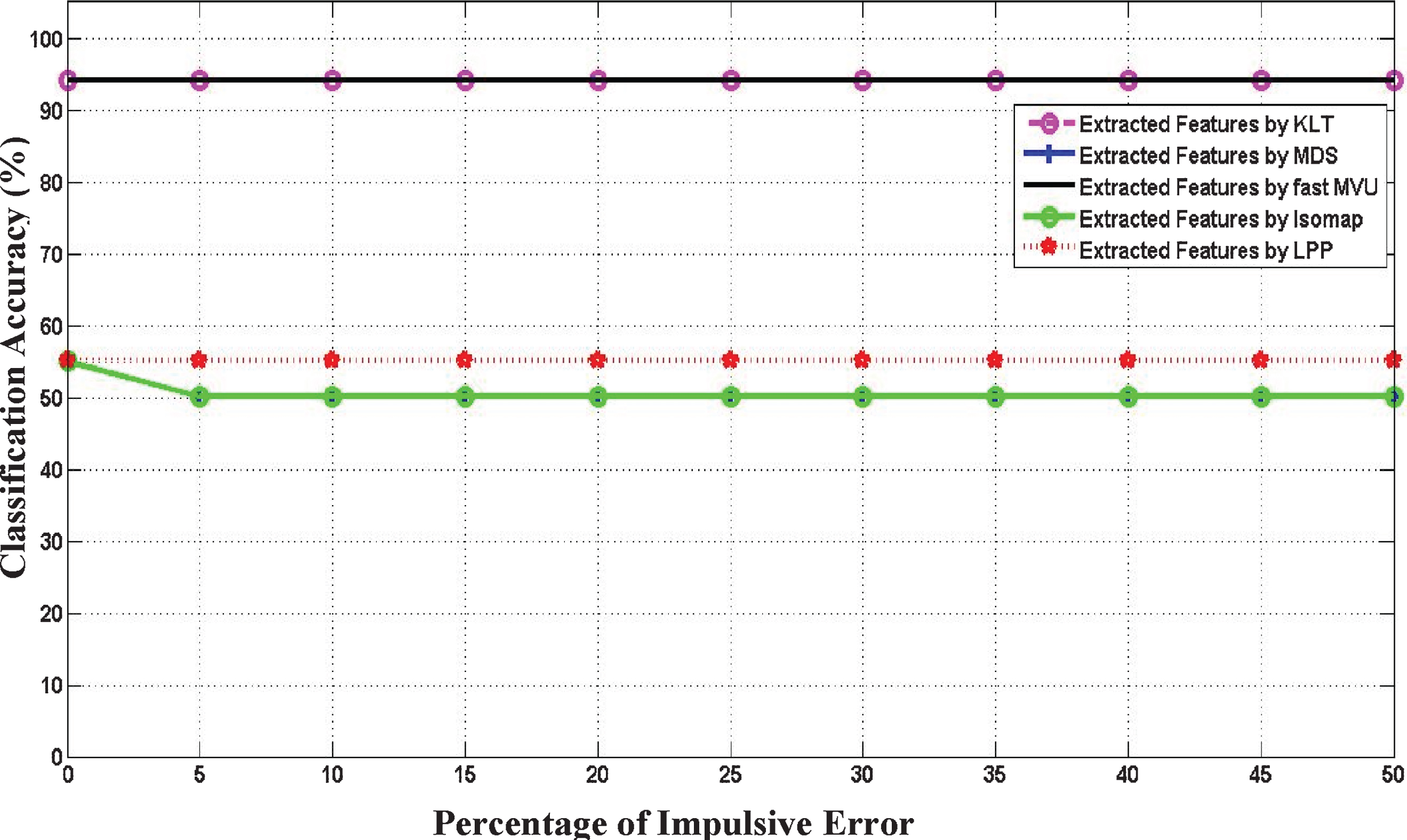
Classification rate of first proposed algorithm for extracted features from BEM, normalized combinational and DRM using SVM with sum FFC under Rician attacks.
Comparison of computed average classification rate for the first proposed algorithm under various noise attacks is of primary concern as discussed in Table 21. The average classification rate for multimodal biometric authentication under various attacks is illustrated in Table 21. It is computed under Gaussian, Rayleigh and complex (Gaussian + Rician) attacks. The highest classification accuracy is attained by extracted features from Karhunen-Loeve transform under complex noise attack of 98.1%. Also, an average accuracy of 94% is attained under Gaussian attack for extracted features from DRM methods. The lowest classification rate of 50% is accomplished for extracted features from MDS under Rayleigh attack. The consuming time of this algorithm with dual core 2.6 GHz is obtained in Table 22. It is noticed that extracted features from fast maximum variance unfolding and Isomap methods give the longest consuming time. Additionally, the extracted features from Karhunen-Loeve transform achieves the best computational time under all attacks. The classification rate of the second proposed algorithm for extracted features from zoning method of fingerprint, SIFT from iris and HOS from voice signal using SVM with sum FFC under complex (Gaussian + Rician) attacks is described in Table 23. The best classification accuracy of 100% is achieved using second algorithm under various noise degradations. This algorithm is robust against complex noise attacks.
Average classification rate for multimodal biometric authentication under various attacks using extracted features BEM, normalized combinational and DRM using ANN with sum fusion center
Computational time (s) for first proposed multimodal biometric authentication algorithm under various attacks using ANN with sum fusion center
Classification rate (%) of second proposed algorithm for extracted features from zoning, SIFT and HOS using SVM with sum FFC under complex attacks
The classification accuracy of the third proposed algorithm for extracted features from zoning features from fingerprint, SIFT from iris and DRM from voice using ANN with sum FFC under Gaussian and complex (Gaussian + Rician) attacks against SNR are declared in Table 24. It is noted that extracted features from Karhunen-Loeve transform, KPCA and LPP achieve higher accuracy of 99% compared to extracted features from multidimensional method under Gaussian attack. Additionally, the extracted features from multidimensional and KLT methods give higher accuracy rate of 94% compared to kernel PCA under complex attack. These results assure the robustness and significant importance of KLT feature extraction method under noisy environments.
Classification rate (%) of third proposed algorithm for extracted features from zoning, SIPHT and DRM using ANN with sum FFC under Gaussian and complex attacks
Table 25 shows the classification rate of the third proposed multimodal biometric algorithm for extracted features using SVM with sum FFC under complex attacks. The results illustrated that third algorithm introduces significant results of 99% for extracted features from KLT, Kernel PCA MDS and LPP. However, the extracted features from Isomap give the lowest possible classification accuracy.
Classification rate of third proposed algorithm for extracted features using SVM with sum FFC under complex attacks
The classification errors by re-substitution error obtained using SVM for first and third algorithms are presented in Table 26. The lowest re-substitution error is estimated with Isomap extracted features from first algorithm. However, the diffusion map achieves the lowest error and highest bias by the third proposed multimodal biometric algorithm. On other hand, the re-substitution error due to classification by the second proposed multimodal biometric algorithm is indicated in Table 27. It is noticed that extracted features from ARMA models and Bispectrum estimations give the lowest error and highest bias. However, the highest re-substitution error with smallest bias is achieved with extracted features from bispectrum estimation using the indirect method. The computational times in seconds for first, second and third proposed algorithms using SVM with sum FFC under different attacks are described in Table 28. The 2nd multimodal biometric algorithm achieves shortest possible executed run time under all attacks using the same processing hardware. Finally, a comparison between all algorithms under different extracted feature methods, classifiers and FFC is summarized in Table 29. This comparison shows the best classification rate by the proposed three multimodal biometric algorithms under various attacks. It is observed that classification rate of 100% is obtained by the second proposed algorithm using SVM and sum FFC. Also, the best features are ARMA, Bispectrum and Eigenvector with Zoning + SIFT + HOS. Also, the first algorithm and third one introduce classification rate of 99%. Also, the sum FFC achieves higher rate for all algorithm under various attacks. The extracted features from KLT introduce much better results. The minimum rate is acquired using second proposed algorithm for features extraction by bispectrum estimation with ANN classifier and sum FFC. The max FFC achieve a classification rate of 99% for first and third algorithm with lowest possible error of 0.0078. This rate is achieved by extracted features from KLT. However, the rate of 50% is obtained by other feature extraction methods. Thus, the influence of FFC on classification rate is essential. The classification limits rate using FFC rule with sum, maximum and average features are presented in Table 30. It is noticed that second algorithm with sum fusion rule presents the best classification rate of 100%. However, the third proposed algorithm gives the lowest rate of 50.4545%. On other hand, the influence of score fusion on classification rate under different attacks is illustrated in Table 31. The highest rate of 99.0667% is attained with extracted features of zoning from fingerprint image, combinational from iris image and DRM from voice signal using MSVM classifier. This comparison shows the superiority of sum FFC over all other fusion rules. It achieves the best classification rate under all attacks. A useful comparison among proposed algorithms from EER view is accomplished. Table 32 declares the EER comparison for proposed algorithm with sum FFC of extracted features by using SVM classifiers. The lowest EER value of 0.0046 is introduced by the first algorithm for extracted features from KLT. The second algorithm achieves a comparable value of EER of 0.01. The highest computed EER value of 1.6250 is obtained wit extracted features from MDS by the third proposed algorithm. Additionally, the lowest threshold value is computed by extracted features from KLT by first algorithm. However, the highest threshold value is attained using extracted features from MDS by third algorithm. Moreover, the lowest misclassified samples are achieved by the proposed third algorithm. Finally, the false negative rate, FPR, true positive rate and TNR are estimated for evaluation of ROC characteristics. Table 33 indicates the ROC values of the first proposed algorithm for different feature extraction methods (BEM from fingerprint image + normalized combinational from iris image + DRM from voice signal). The obtained results confirm that multidimensional scaling method introduces the lowest curve values compared to other methods. However, it presents the highest sensitivity and specificity. Besides, the multidimensional scaling method achieves the largest values of area under curve and identification accuracy. The ROC curve values using the second algorithm are realized in Table 33. It is noted that generated ARMA synthetics achieves the lowest ROC curve values compared to other feature methods. Bispectrum with indirect method realizes the optimum sensitivity and specificity. The largest area under curve and identification accuracy is attained using generated ARMA synthetics. The ROC curve values for the third algorithm of multimodal biometric are introduced in Table 33. Isomap extractor accomplishes lowest FNR and FPR. Nevertheless, Isomap extractor offers greater sensitivity, specificity and area under curve. On other hand, the extracted feature from fast MVU has higher identification accuracy. The ROC curve values for the third algorithm of multimodal biometric are presented in Table 33. On other direction, the Isomap features insert the lowest FNR and FPR. However, the extracted features from Isomap give higher values of sensitivity, specificity and area under curve. However, extracted feature from fast MVU introduces higher identification accuracy. As a final conclusion for proposed algorithms in this manuscript that stated as follows.
The re-substitution classification error of first and third proposed algorithms using SVM with sum FFC
The re-substitution classification error of second proposed algorithm for extracted features from zoning, SIFT and HOS using SVM with sum FFC
Computational times (s) of first, second and third proposed algorithms using SVM with sum FFC under different attacks
The best classification rate by the proposed three multimodal biometric algorithms using ANN and SVM with different FFC under various attacks
Maximum and minimum classification rate under sum, average and max FFC for the proposed three algorithms
Classification rate using scores fusion rule under various attacks for all algorithms
EER comparison for proposed algorithm with sum FFC of extracted features by using SVM classifiers
ROC values of the proposed three algorithms for different feature extraction methods
A remarkable accuracy using three proposed algorithms for multimodal biometric authentication is achieved. The second proposed algorithm for extracted features from zoning + SIFT + HOS introduces too much higher classification rate of 100%. The second algorithm demonstrated the lowest computational time for the same comparable hardware machine. The EER is estimated that confirms superiority of first proposed algorithm. ROC curves are computed that prove the applicability of first proposed algorithm.
This manuscript focused on development of three various robust algorithms for human authentication using triple multimodal biometrics. These multimodals are fingerprint, iris and voice. The features of fingerprint images are extracted using BEM and zoning feature method. The features are acquired from iris image by SIFT and normalized combinational features extracted methods. However, the voice classification uses extracted features from DRM. These dimensionality reduction methods include KLT, kernel PCA, MDS, Fast MVU, Isomap and diffusion map. Besides, the voice signals are classified using comparable higher order statistics features. The first algorithm depends on extracted features from BEM of fingerprint, normalized combinational method from iris, and DRM for voice features. The second proposed algorithm utilizes the zoning method from fingerprint, SIFT from iris and higher statistics from voice signal. The third proposed algorithm uses the zoning method from fingerprint, SIFT from iris, and DRM from voice. For all algorithms, the features are fused FFC (sum, maximum and average) and fusion score is considered. Additionally, the feature matching process is presented using ANN and SVM classifiers. Comparison between these algorithms is investigated. Besides, the accuracy of multimodal biometrics is compared to the analogues unimodal results. The classification accuracy is computed. The experimental results demonstrated that second implemented algorithm achieves the best classification accuracy of 100% using SVM. Also, the first and third proposed multimodal biometric algorithms introduce a classification accuracy of 99% with extracted features from Karhunen-Loeve transform under various noise attacks. These proposed triple multimodal biometric algorithms improve the human authentication level. Deep learning is supposed to be applied in the future research for efficient authentication purposes. These proposed authentication algorithms will be implemented using fast processing hardware such as field programmable gate array and graphical processing unit.