




Abstract
Soft set is the power tool to deal with uncertainty in a parametric manner. In applications of soft set, one of the most important steps is to define mappings on soft sets. In this study, we model theory of game under theory of soft set which is an effective tool for handling uncertainties events and problems that may exist in a game. To this end, we first define some expected impact functions of players in soft games. Then, we propose three new decision making algorithms to solve the 2.2 × p, 2 . n × p and m . 2 × p soft matrix games, which cannot be settled by the relevant soft methods such as saddle points, lover and upper values, dominated strategies and Nash equilibrium. The proposed soft game algorithms are illustrated by examples.
Introduction
To model problems which contains uncertainties, Molodtsov [32] proposed the theory of soft set as a generalization of fuzzy set [52]. This theory handles the problem of fuzzy set in setting the membership function [32]. Soft set theory has been developed rapidly, for instance operations on soft set [7, 45] and their applications [33, 51]. Majumdar and Samanta [31] and Kharal [26] studied relation of similarity between soft sets and their application in different fields. Kamacı [23] defined the symmetric difference operation for each of the soft sets and for the soft matrices. Then, the similarity measure between soft matrices was defined and and calculated with an efficient Scilab code. The inverse soft matrices was describe via the inverse soft sets over both the universal set and the parameter set. As an endeavor in the authentic-life applications, two decision making methods was introduced in [37]. Many decision making and modelling methods on soft set have been expanded since then including game theory and bijective soft matrix theory, see [3– 5, 25]. Riaz et al. [41] defined some new concepts related to topological structure of soft rough sets. New algorithm to illustrate uncertainties in the multi-criteria group decision making by utilizing N-soft can be seen in [40]. Naeem et al. [35] strengthened to hand uncertainty by using Pythagorean fuzzy soft sets.
Webb [50] proposed the concept of modern game theory consisting of two main branches which are cooperative and non-cooperative game. Rational individuals in non-cooperative game interact with each other for their own goals. Game theory have also been applied to the problem of economics, political, decision makings, and so on. There have been numerous researches on game theory such as in [9– 11, 53]. Besides, there have been growing demands on developing intelligent systems and strategies for games.
Decision making methods on theory of game combined the idea of fuzzy set in [27, 48], where two or more autonomous decision makers have conflicting interests. For a typical game that has been studied much in the past years- the Fuzzy Matrix Game, Zhang et al. [54] considered a multiple objective bi-matrix approach based on fuzzy goals. Roy and Mondal [44] developed a simple a method for solving matrix game with fuzzy intervals. Programming approaches for Bi-matrix Games have been examined in [17, 18]. In the classical game theory, the payoff functions are real numbers and some simple arithmetic operations are used to find the solutions of such classical game problem. In real life scenarios, the payoff functions could be uncertain due to the fluctuation of several parameters of payoff function. Therefore finding the exact payoff function in such games could be challenging and difficult for the decision maker. Many researchers used fuzziness to handle this type of uncertain situations. In fuzzy games, the type 1 fuzzy member function is used to represent its payoff function. The membership grade of a type 1 fuzzy set is crisp (real number), which is found by human perception. There exists different kind of uncertainties in the fuzzy payoff function and it is very hard to choose the proper membership function of the fuzzy payoff function. If the payoff function of a game varies under some certain conditions such as time or data is collected from multiple different sources which generally fluctuate, then the payoff function cannot be represented properly by fuzzy membership function. The solution for this game problem can be soft set, which increases the capability to manage the uncertainty in the game problem and it handles inexact information in a logically proper manner. Deli and Çağman [14, 15] introduced a game model for better dealing with uncertainties so-called a soft game with some solution methods with pure and probabilistic strategy. A soft set is constructed with the help of sentences, words, real numbers, mappings and so on. They considered the payoff function of their proposed soft game as a set valued function and they determined the solution of the problem applying the some operations of soft sets. They have worked on two person soft games and n-person soft games. They provided four different algorithms for the soft games which are soft saddle points, soft dominated strategies, soft lower and soft upper value, and soft Nash equilibrium. However, some the soft games in real life cannot not be solved properly by those four algorithms. Giri and Dey [21] considered two different game models for recycling by the manufacturer and recycling by the recycler. It seems that ex-ante pricing commitment via optimal results of the two game models.
The main motivation behind the work is to introduce an algorithmic approach for soft game which will be simple enough and efficient in the real life applications of soft game. In the previous researches, the authors used soft set to construct a soft game. Besides, some solutions for soft games were given by using the set operations. Even though the problems of boundary values and membership functions being settled by this research; yet more works on modelling game under soft set should be expanded by new notions such as impact functions and equivalent algorithms to achieve more adaptation to the game contexts.
In this paper, we will study some modeling game by using the notion of soft set, which cannot be settled by relevant methods such as the soft saddle points, soft lower and soft upper values, soft dominated strategies and soft Nash equilibrium. The contributions of paper are highlighted as follows Inspirited from utility theory for game modeling [19], we define the expected impact functions of players in soft games. That plays a key role to measure the players preference ordering over a choice set. We propose three algorithms to solve the 2.2 × p, 2 . n × p and m . 2 × p soft matrix games, which cannot be settled by the relevant methods in [13]. The usefulness of the proposed soft game algorithms are illustrated by some examples.
The paper is structured as follows: in Section 2, most of fundamental definitions of the operations of soft sets, soft games and probabilistic soft games are presented. In Section 3, we firstly give the concept of the expected impact functions of players in soft games. Then, three algorithms to solve the 2.2 × p, 2 . n × p and m . 2 × p soft matrix games are proposed. All algorithms are presented with illustrative examples. In Section 4, we concludes and suggests directions for future researches.
Preliminary
In this section, we have introduced theory of soft set in [2, 7] and theory of soft game in [12–15].
If
Deli and Çağman [14] the soft game with mixed strategy is defined as
Note that
Let
Proposed methods for soft games
In this section, we firstly define, by inspirited from [19], some expected impact functions in sub-section 3.1. Then, three new decision making algorithms for solving the 2.2 × p, 2 . n × p and m . 2 × p soft matrix games are presented in subsequent sub-sections.
Expected impact functions
Expected impact function of Player 1 in the tps-game is defined by
Expected impact function of Player 2 in the tps-game is defined by
Note that
Methods for 2.2 × p Soft Games
In this section, we propose some algorithms for 2.2 × p soft matrix games, which cannot be solved with methods that are soft saddle points, soft lover and soft upper values, soft dominated strategies and soft Nash equilibrium.
If Player 1 chooses the first x1 with probability ρ
X
(x1), we equate his expected impact values when Player 2 uses probabilistic strategy If Player 2 chooses the first y1 with probability ρ
Y
(y1), we equate his a expected impact values when Player 1 uses probabilistic strategy Player 2’s average expected impact value by using this strategy is
Method for 2 . n × p Soft Games
Now, we define a decision making method for 2 . n × p.
Graph linear functions of ρ
X
(x1).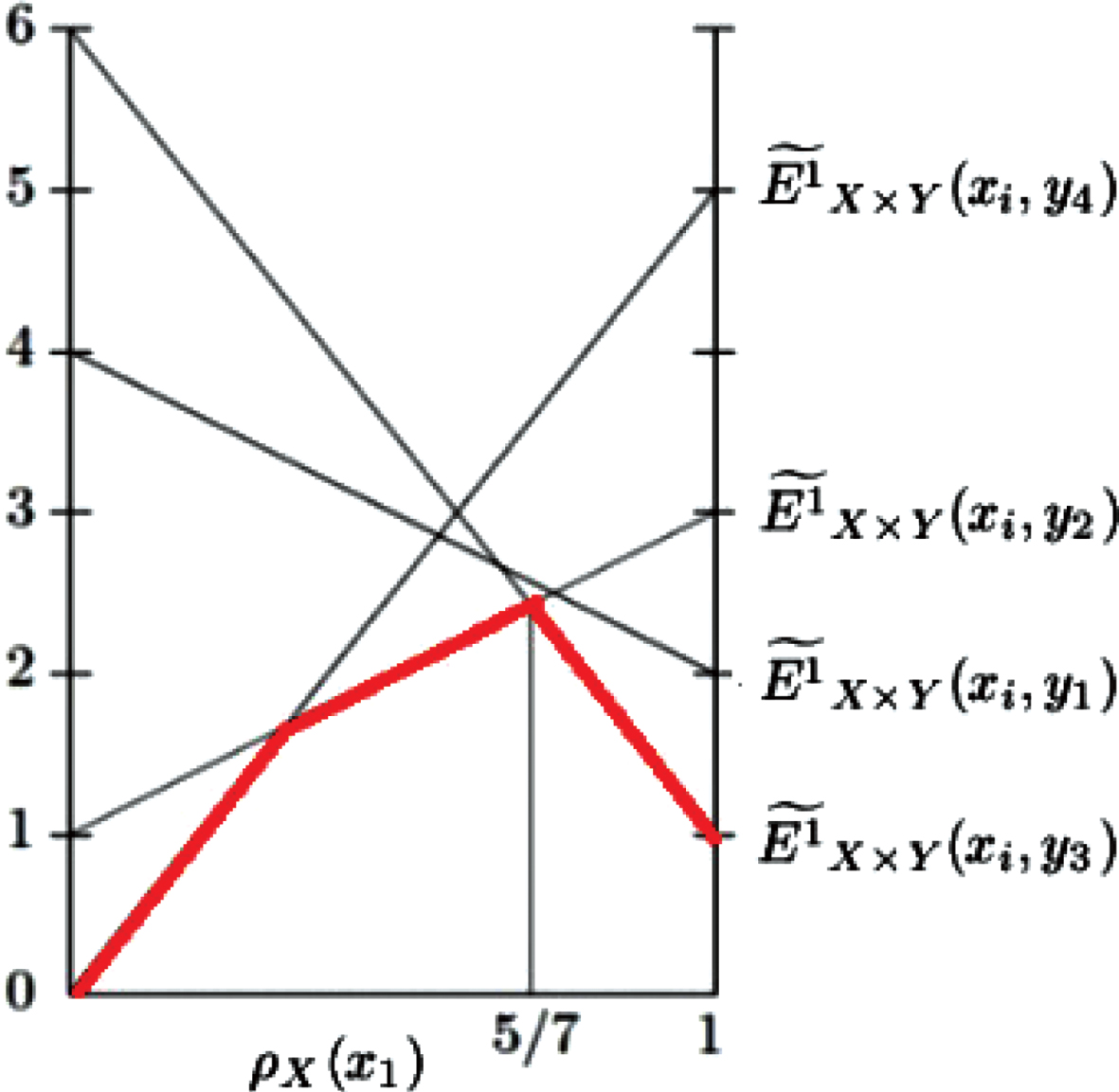
For a fixed value of ρ
X
(x1), average winnings Player 1 is at least the minimum of these four functions evaluated at ρ
X
(x1). Since he wants to maximize average winnings, ρ
X
(x1) that achieves the maximum of this lower envelope needs to be found. According to the drawing, this should occur at the intersection of the lines for y2 and y3. Player 1’s optimal strategy is
In this section, we define a method for all m . 2 × p soft matrix games with the aid of a graphical interpretation.
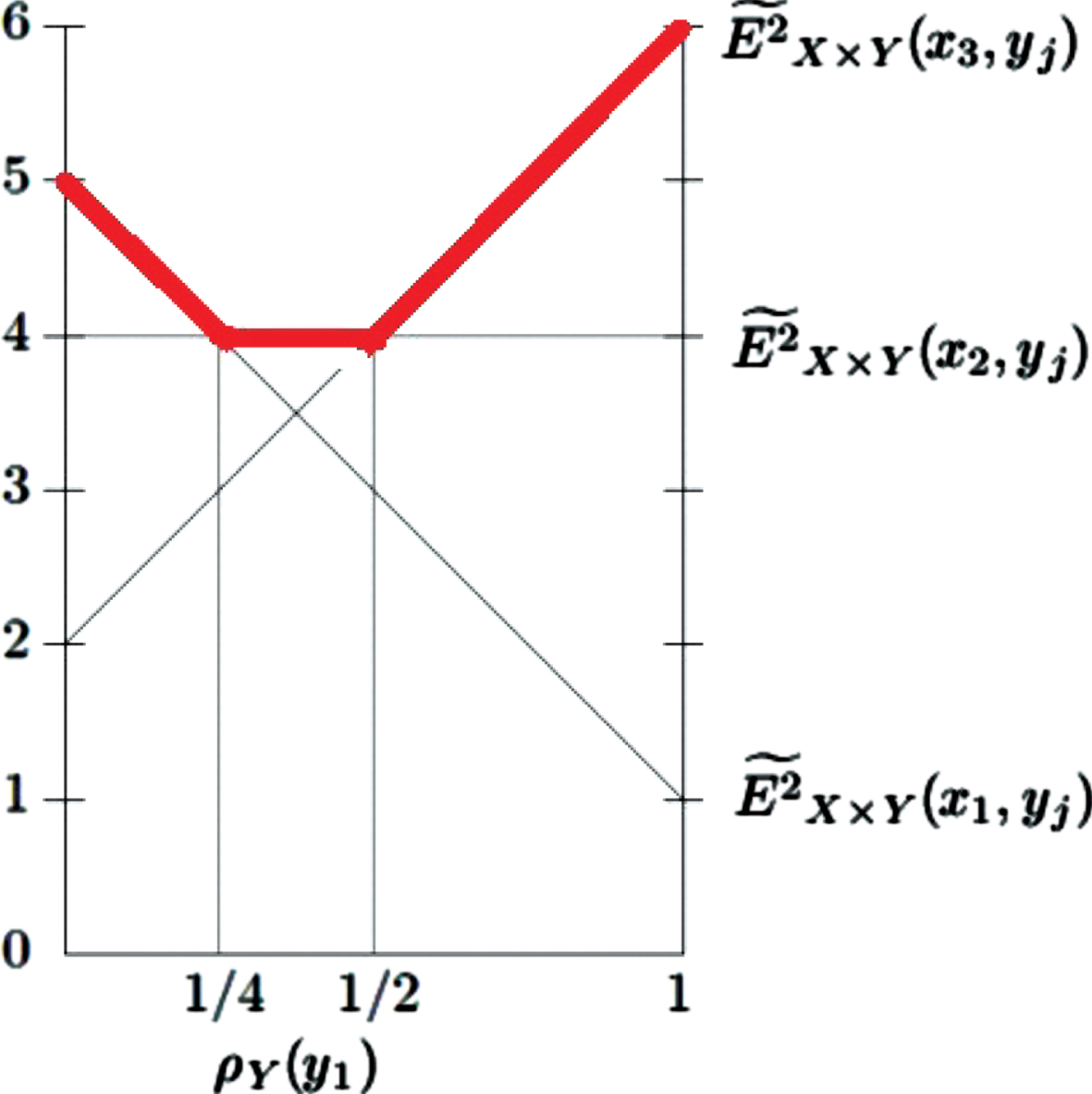
Graph of linear functions ρ Y (y1).
In Fig. 2, if Player 2 chooses ρ
Y
(y1)/y1, then Player 2’s average loss for Player 1’s three possible choices of rows is given in the accompanying graph. Here, Player 2 looks at the largest of her average losses for a given ρ
Y
(y1). This is the upper envelope of the function. Player 2 wants to find ρ
Y
(y1) that minimizes this upper envelope. From the graph, we can see that any value of ρ
Y
(y1) between
The minimum spanning tree (MST) [16], which focuses on determining a spanning tree with minimum cost, is one of the most important and fundamental network optimization problem in graph theory. The MST has been used to model and solve many real life problems in several domains including telecommunications, transportation, scheduling, supply chain management and routing. However, in real world scenarios, many kinds of uncertainty are frequently found, because of imperfect data, failure, or other reasons. It seems to be more reliable and realistic for the decision maker to consider the MST problem with soft set as edge weight. We call this MST problem as soft MST (SMST) problem. A soft tree is a circuit less connected undirected soft graph. Let
Conclusion
In this paper, by developing the theory of utility and random variable in game we defined some expected impact functions and proposed three algorithms to solve the 2.2 × p, 2 . n × p and m . 2 × p soft matrix games, which cannot be settled by the relevant methods such as the soft saddle points, soft lover and soft upper values, soft dominated strategies and soft Nash equilibrium. The proposed soft game algorithms were illustrated by examples. They can be applied to the problem that contain uncertainty such as political, decision makings, social, economic systems, pattern recognition, decision making, medical diagnosis, verification systems and so on. In the future, we will consider expansion of the theory in connection with some other advanced sets [1, 49] to model the dynamic games which require much challenge in real time systems. In this paper, we have presented one simple numerical example using our proposed algorithm. It is possible to consider the several soft game conditions in the numerical example, and our proposed algorithm solves this problem because of a small sized of numerical example. Therefore, as an another future study, we require to consider a large scale soft game problem using our proposed algorithm, and to compare our proposed algorithm with other algorithms in terms of optimality, efficiency, computational time, correctness and other several aspects of intelligent computation [22, 48]. Furthermore, we try to minimize the computational time and improve the efficiency of our proposed algorithm. Despite the demand for future study, our proposed algorithm presented in this paper is a significant initial contribution to game theory in soft set environment.