



Abstract
Decision making (DM) is an important process encountered in every moment of life. Since it is difficult to interpret life depending on a single criterion, Multi-Criteria Decision Making (MCDM) enables to make decisions easier by creating appropriate choice in situations of uncertainty, complexity, and conflicting objectives. Therefore, we have studied the Analytic Hierarchy Process (AHP) which is one of the MCDM methods based on binary comparison logic. When uncertainties concerning the nature of life are considered, the solution procedure of AHP has been addressed by using Interval Type-2 Fuzzy Numbers (IT2FN)s to obtain more realistic results. The usability of AHP with IT2FN is increased by amplifying hierarchy with sub-levels. Since sub-criterion may also need to be evaluated on sub-criteria in some cases of real multi-criteria problems, it is explicitly essential that each of sub-sub-criterion is included in the hierarchy at the own level in the real sense. In this paper, a new multilevel type-2 fuzzy AHP method is expanded by adding sub-criteria to the Interval Type-2 Fuzzy AHP (IT2FAHP) method developed by Kahraman et al. [C. Kahraman, B. Öztayşi, İ. Sarı and B. Turanoğlu, Fuzzy analytic hierarchy process with interval type-2 fuzzy sets, Knowledge-Based Systems
Keywords
Introduction
The portfolio selection problem is an old and important type of MCDM problem. Nowadays, not only big companies require expert opinions but also, smaller companies, even individuals want to get expert opinions to get bigger or richer. This kind of needs gets more possible by the use of data or information involving vagueness but predictable at the same time.
A portfolio is the general name of investment instruments such as money, currency, gold, bonds, stocks, and deposits that natural or legal persons hold and save as they wish in order to invest and earn. The investment portfolio is created based on investors’ earnings and risk estimates. Risk is the possibility of losing investment. Optimal investment is about maximum gain with minimum spending. Therefore, while choosing which portfolio to invest in, risk must be reduced as much as possible. In addition, the criteria that should be taken into account in portfolio selection can be diversified among themselves, and a lot of items should be evaluated under them at their level. For that purpose, we proposed a detailed structure of the portfolio selection hierarchy.
The development of modern portfolio theory began with the article published by Harry Markowitz [24] in 1952. According to Markowitz, it is not possible for the investor to know the money he can get at the end of the period. Therefore, he suggested that the investor could make some predictions by taking advantage of the past performance of the stock. According to this theory, the process of portfolio selection can be divided into two stages. The first stage starts with observation and experience and ends with estimated expectations about the future performance of investment instruments. The second stage starts with expectations about the future return of the portfolio and ends with the portfolio selection [42]. In this second stage, there are two targets that can ensure that the investor reaches the optimum investment. The first is the expected return of the investment and the other is the risk of the investment. While investors want to increase their expected returns, they also want to reduce the uncertainties about the return they can get. In other words, while they want to maximize their returns, they want to minimize their risks. Achieving these two goals means achieving optimum investment [13].
In 1980, Saaty [35] applied a crisp AHP method to a portfolio selection problem with multilevel hierarchy and in 2004, Enea and Piazza [14] applied constrained fuzzy AHP method to project selection problem. By using the hierarchy structure of Saaty and revising the method of Enea and Piazza, Tiryaki and Ahlatcioglu [38] combined these two studies and applied it to the portfolio selection problem. In this paper, we consider these significant works and attempt to replace the fuzzy AHP method with IT2FAHP. In addition, it is tried to obtain type-2 fuzzy weights based on the original weights of the criteria instead of crisp weights. In the hierarchy established in the modeling of the problems, it is known that the efficiency of the AHP method decreases as the number of criteria increases if all criteria are at the main criterion level. In this case, efficiency can be increased again by classifying the criteria and adding new levels to the hierarchy. However, there is no such study in the literature for the AHP method based on type-2 fuzzy sets. The aim is to make the existing IT2FAHP procedure in the literature suitable for DM problems involving sub-criteria levels in the hierarchy. Also, the AHP method for type-2 fuzzy sets is applied to the portfolio selection problem for the first time with this study.
The rest of this paper is organized as follows. In Section 2, a literature review of the existing MCDM methods and their fuzzy developments are given. In Section 3, Interval Type-2 Fuzzy Sets (IT2FS) and some basic operations are explained. Then, a defuzzification method and IT2FAHP methodology in the literature which our proposed extension is based on. In Section 4, the steps of the proposed method are given. In Section 5, an application for the portfolio selection problem under IT2FS is made. In Section 6, our research has concluded and recommendations for further research are given.
Literature review
The applicability of classical logic to life may not be realistic and sufficient. In real life, many uncertainties arise from the nature of humans and nature itself. Fuzzy set theory was first proposed by Lotfi Zadeh [44] in 1965. Zadeh introduced the fuzzy sets, which are nowadays known as type-1 fuzzy sets and by making this great contribution to science, he showed a way to define obscurity mathematically. Even though these type-1 fuzzy sets build up a gray area that includes every mid-value between binary values 0 and 1, this structure was not enough to explain the unknown likelihoods. Later, Zadeh [45] further extended the concept of fuzzy sets and introduced type-2 fuzzy sets as an extension to fuzzy sets. Although type-2 fuzzy sets may contain more possible cases and allow to examine these a lot more widely, it is highly complicated to make calculations. Hence, type-2 fuzzy sets have been simplified and an extension is presented. Mendel et al. [25] have introduced the interval type-2 fuzzy sets in order to overcome calculation difficulty. Recently, the importance of DM studies with interval type-2 fuzzy sets has become increasingly important.
DM is a requirement of life. But the decision does not have to be related to only one condition or criterion. For this reason, MCDM methods came up with decision theory [7, 20]. There are many MCDM methods in the literature. Some known methods are; TOPSIS (Technique for Order Preference by Similarity to Ideal Solution) [20], VIKOR (VIseKriterijumska Optimizacija I Kompromisno Resenje) [11], ELECTRE (Elimination Et Choix Traduisant la Realité) [31], PROMETHEE (Preference Ranking Organization Method for Enrichment Evaluation) [1], ANP (Analytic Network Process) [33, 34], DEMATEL (DEcision MAking Trial and Evaluation Laboratory) [15], LINMAP (The Linear Programming Technique for Multidimensional Analysis of Preference) [37], TODIM (Tomada de Decisión Inerativa Multicritero), [16, 17]. To solve problems that have more than one and probably conflicting criteria and have at least two alternatives, MCDM techniques are needed to be used. At this point, AHP which is one of the most popular techniques among DM methods is recommended. The classical AHP method which contains only crisp numbers were introduced by Saaty [32]. Since the AHP method gives both weight and ranking values together, it is often preferred by decision-makers. AHP method’s superiority over other methods is provided by these features. By using the linguistic variables instead of only numerical data, verbal input can also be processed in comparison matrices of AHP. In many application areas, this advantage gives an opportunity to benefit from expert opinions and different kinds of data [4, 41].
In some problems, the classification of main criteria may need another level of criterion class. For this purpose, sub-criteria were included in the hierarchy and multilevel methods were introduced to the literature. There are many applications for multilevel problems with crisp and type-1 fuzzy sets. Kahraman et al. [21] made an application to compare catering firms with fuzzy AHP. In 2009, Tiryaki and Ahlatcioglu [38] studied the portfolio selection problem using fuzzy AHP and crisp weights. Mohajeri and Amin [26] used a hybrid AHP-DEA (Data Envelopment Analysis) method for site selection. Paksoy et al. [28] applied fuzzy AHP and hierarchical fuzzy TOPSIS for distribution channel management. Rahman et al. [30] used AHP with WLC (Weighted Linear Combination) and OWA (Ordered Weighted Averaging). Corrente et al. [10] applied ELECTRE-Tri methods to sorting problems and proposed an extension of PROMETHEE and ELECTRE. Uygun et al. [40] studied fuzzy ANP and DEMATEL as another hybrid method for outsourcing evaluation. Tyagi et al. [39] proposed an extended fuzzy AHP approach for product development. Zhang et al. [46] combined the PROMETHEE method with fuzzy rough sets and applied it to a medical problem.
With the development of fuzzy logic theory, decision making methods have been diversified. Thanks to these innovations, decision makers can make more effective and realistic choices. The first algorithm for fuzzy AHP was given by Laarhoven and Pedrycz [23]. Then, Buckley [2] extends this fuzzy AHP and gives rise to the use of fuzzy ratios rather than crisp ratios. The operations of interval type-2 fuzzy sets on MCDM were used by Chen and Lee [8] for the first time. There are many IT2FN MCDM applications in the literature with various methods. Kahraman et al. [22] applied IT2FN, which does not cause too much mathematical difficulty, to the AHP method for the first time. Oztaysi [27] focused on enterprise information systems selection problems and adapted a group decision making approach to Kahraman et al. [22] method. Chen [9] proposed LINMAP and applied it to supplier selection problem, Celik et al. [5] extended ELECTRE method, Qin et al. [29] developed extended TODIM to green supplier selection problem, Yu et al. [43] studied on fuzzy likelihood-based MABAC approach for a tourism website. Soner et al. [36] applied a hybrid method of AHP and VIKOR for maritime transportation, Celik et al. [3] used hybrid AHP and TOPSIS method. Zhou et al. [47] combined DEMATEL and QUALIFLEX (QUALItative FLEXible) methods based on IT2FN environment. Ecer [12] used the IT2FAHP approach by defuzzifying the weights.
In this study, the sub-criteria are included in the IT2FAHP proposed by Kahraman et al. [22] hierarchical structure to increase the usability of IT2FN. By using the IT2FAHP method containing a multilevel hierarchical structure, MCDM problems involving many criteria will able to be solved with better and more realistic weighting. Thus, no matter how much the number of criteria included in the problem increases, it will be possible to calculate the type-2 fuzzy weights of these criteria. Moreover, the IT2FAHP procedure is carried out to the portfolio selection problem for the first time.
Preliminaries
Interval Type-2 fuzzy sets
In this section, basic definitions and operations will be given for interval type-2 fuzzy sets.
The representation of the
An interval type-2 fuzzy set
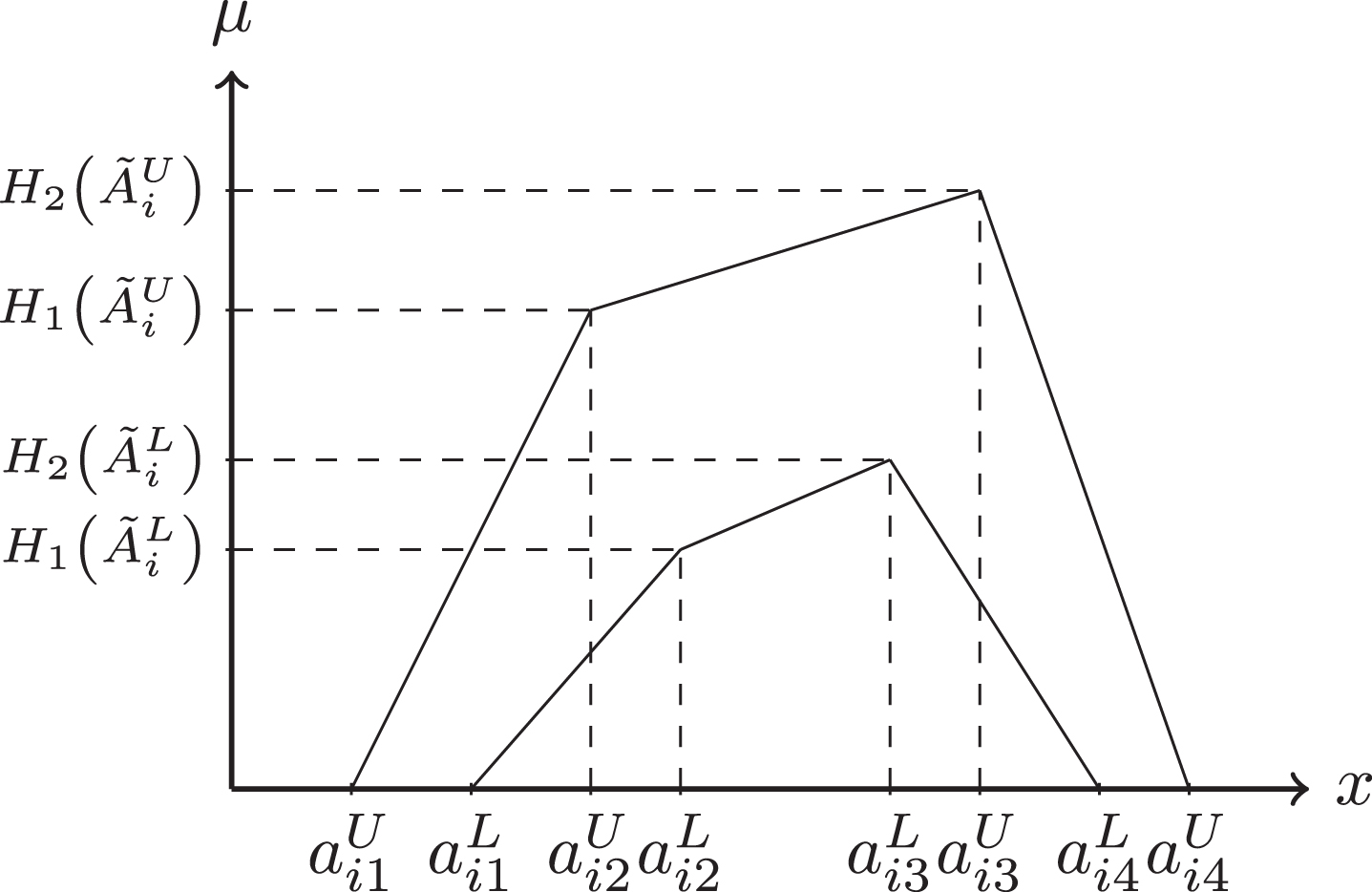
Interval type-2 trapezoidal fuzzy number.
In this section, the defuzzification method used within the IT2FAHP procedure given in the next subsection will be described.
In order to better understand the extended method, the steps of the current method in the literature added by Kahraman et al. [22] are described as follows:
Fuzzy scales of linguistic variables
In this section, the given interval type-2 fuzzy AHP method will be extended for sub-criteria. Steps of the proposed multilevel decision method are explained as follows:
The fuzzy scales to be used in the method are given in Table 1.
The normalized fuzzy weight
In this section, the given AHP method based on IT2FNs will be applied to a portfolio selection problem. Detailed, and explicit hierarchical structure is given with Figure 2. The problem has “Extrinsic”, “Intrinsic” and “Investor Objectives” as the main criteria. The extrinsic criterion is about the factors that cannot be under the control of the company but affect their stocks. On the other hand, the intrinsic criterion is all about the internal condition of the companies. A situation that will have an impact on the company will also affect its stocks. Different from these two main criteria, the investor objectives are not related to the company directly. The criterion is for investor’s demands or expectations.
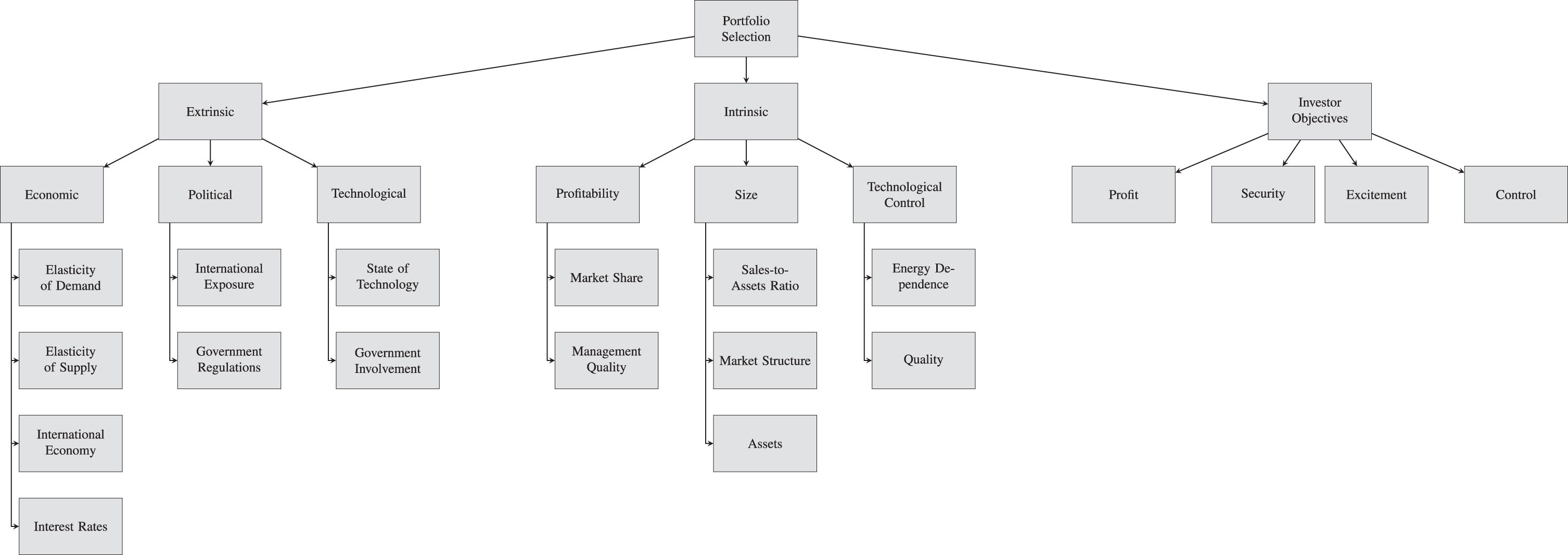
Hierarchy of application model
The first main criterion divides into 3 sub-criteria which are “Economic”, “Political” and “Technological”. All these sub-criteria also have another level under each. This arm of the hierarchy is for impact on companies regulated by the state of the government and changes in the world. The second main criterion also has 3 sub-criteria which are “Profitability”, “Size” and “Technological Control”. These provide direction for investment estimates depending on the current situation of the company. The investor objectives have 4 sub-criteria and no other level under them. These are, “Profit”, “Security”, “Excitement” and “Control”. They may vary according to the investor’s approach to stock selection.
For the fuzzy weights, our expert has made pairwise comparisons of the sub-criteria relative to each other, the data in the [38] are based on. The criteria and multilevel hierarchy structure are shown in Table 2. The pairwise comparisons of the main criteria corresponding to each other were taken equally.
The all criteria of application
The proposed model was dealt with using the software MATLAB R2020a in 0.558 secs. All the computational experiments were carried out on a computer with a 2.80 GHz processor and 8GB RAM running Windows 10 Pro.
Pairwise comparison matrix for alternatives w.r.t. C111
Pairwise comparison matrix for sub-criteria under Economic sub-criterion
Geometric means of each row for alternatives w.r.t. C111
Geometric means of each row for Economic sub-criterion
Priority weights of alternatives w.r.t. C111
Priority weights of Economic sub-criterion
Normalized weights of Economic sub-criterion
Fuzzy utility values, defuzzified values and normalized crisp values
In order to compare the results obtained with our method, the same problem was solved with the type-1 fuzzy AHP method. The type-1 fuzzy number equivalents of the linguistic variables used are given in Table 1. For comparison, the normalized criteria weights obtained are shown in Table 11. Looking at the ranking of the weights of the criteria, it can be seen that the top-ranking criteria achieved in the IT2FAHP method are at the higher level of the hierarchy compared to others. Also, the rankings and final weights of the alternatives are given in Table 12. There is a change in the ranking of the first three alternatives. However, there is no change in the rankings of other alternatives. This can be explained by the more successful processing of the IT2FNs in uncertainty, as they are more extensive.
Weights obtained with type-1 fuzzy AHP and IT2FAHP
Alternative rankings obtained with type-1 fuzzy AHP and IT2FAHP
It is known that AHP is an efficient and widely used method for weighting and ordering processes. The technique can be used alone both in analyzing the superiority relationship between the criteria and in ordering alternatives by pairwise comparisons. Also, hybrid usage with other methodologies to provide weight information is quite common. As the number of criteria increases, the classification and leveling of criteria contribute to the effectiveness of the procedure. Uncertain situations can be examined with the help of IT2FS and linguistic variables. In this paper, we extended the AHP method based on IT2FN in the literature [22] with the use of multilevel hierarchy and applied the given method to a portfolio selection problem. To the best of our knowledge, there are no such multilevel studies for IT2FAHP in the literature. With this augmentation for AHP, the expansion of the hierarchy became possible in the IT2FN environment. It has been observed that the method presented for the solution of problems that include criteria with multiple-sub levels in most cases, such as portfolio selection, gives realistic and effective results. Moreover, in this study, the AHP method, which is easy to calculate, and the IT2FN, where the uncertainty can be handled better than the crisp numbers or type-1 fuzzy sets, were used together. Although it seems like a disadvantage that each additional level increases processing intensity for multilevel problems, it will be advantageous to use the proposed method as the increasing process density in the methodology is minimal. As another advantage, as many levels as possible can be added to the hierarchy thanks to its flexibility. For further research, the effectiveness can be increased by applying the extended method to various types of problems that include a high number of criteria. As a suggestion for future studies, the proposed method can be adapted to AHP-TOPSIS composition for problems that require multi-level hierarchical structure since the solution procedure of AHP generates weight information in hybrid approaches. In addition, the method can be integrated with the ELECTRE or VIKOR method, where the solution (or solution set) can be obtained instead of sorting or a single solution since it would keep the group benefit at the highest level and individual regret at the lowest level.
Footnotes
Acknowledgment
This work has been supported by Yildiz Technical University Scientific Research Projects Coordination Department. Project Number: FBA-2017-3073.
The authors would like to thank reviewers for their valuable suggestions and comments to improve the manuscript.