



Abstract
The shipyard facility location selection (FLS) decision is a critical process that involves conflicting, qualitative, and quantitative criteria. Multi-Attribute Decision Making (MADM) methods are used as a powerful tool to overcome this complex problem. Today, using these methods in an integrated way, more accurate, efficient, and systematic results are obtained in solving complex issues such as FLS, which contains an uncertain structure. This paper proposes a framework for the weighting of criteria and ranking potential feasible locations (alternatives) using the combination of fuzzy analytical hierarchy process (AHP) and fuzzy technique for order performance by similarity to ideal solution (TOPSIS) methods. While fuzzy AHP determines the importance values of the criteria by pairwise comparisons, fuzzy TOPSIS prioritizes the alternatives using the relative weights obtained with Fuzzy AHP. The integration of these two techniques provides a robust approach considering the results obtained for the shipyard FLS decision. The applicability of the proposed method is expressed in Turkey by a case study of the shipyard FLS decision.
Introduction
The concept of globalization has emerged with the advances in technique. The new world order brought by this concept has caused the competition of firms to increase with their rivals in their own country and other countries. This increased competition made it imperative that firms behave more rigorously in all decisions they had to make to survive. Therefore, all decisions should be supported by scientific data and based on a systematic structure. Decision making is a process that has different and non-commensurable standards [1] and should be conducted meticulously in such an era where competition is very high.
FLS is considered a significant problem that requires a decision-making process and is defined as the geographic location where a firm continues its activities [2]. This location should enable the firm to achieve low cost and high-profit rates and reach its goals in the long run. Therefore, a correct FLS decision is a critical process for firms, and an incorrect FLS decision causes inefficient use of raw materials, inadequate transportation, and increased operating costs [3].
FLS can occur due to many factors. The idea of establishing a new facility is the most important of these factors. The following factors are also considered in the occurrence of FLS: technological innovations, management changes, design changes in the manufactured product or new product designs, shift in demand, economic fluctuations, new machine purchases, adverse effects of environmental problems on the facility, and finally broader capacity needs [4].
Before FLS, a firm determines in which area it will serve and what kind of products it will produce. It then determines the criteria of a geographic location, defined as all conditions and features required for a particular production unit, for a correct FLS decision. These criteria can be conflicting, tangible, and intangible, such as the utility of resources, cost of investment, and proximity to other facilities [5]. The criteria affecting the FLS decision vary depending on the era’s economic, social, and technological developments. For a correct FLS decision, it is more important to identify appropriate criteria that meet the needs of the present age rather than the number of criteria.
Today, the correct FLS decision is vital for shipyards where ship production is carried out. The main reason for this is that more than 90% of the world trade is carried out by sea and the critical task of ships in maritime transportation. For this reason, many ships are built worldwide and navigate in different seas every year. In addition to ship production, shipyards carry out the maintenance/repair and modification processes. Every year, hundreds of ships undergo many different procedures in the dry dock for maintenance, repair, and modification in shipyards. When the shipowners want to add a new ship to their fleet or need maintenance and repair for their existing ships, the first point they pay attention to is the location of the shipyard. The shipowners prefer the shipyard by considering shipyard location to achieve their purpose.
Ships are usually large structures, so the shipyards are located in a large area. Therefore, the initial investment costs of the shipyards are quite high. This situation leads to irreversible consequences for an incorrect FLS decision for shipyards. In the shipyard, there are fixed structures with high investment costs such as hangars, cranes, launch systems, and departments. It is almost impossible to move these structures, which have high investment costs, to another location after the shipyard is established, as this will cause immense damages. Therefore, the FLS decision for the shipyard is a critical decision that can affect all processes after the shipyard establishment.
The number of shipyards tends to decrease worldwide. In contrast, especially since 2002, the number of shipyards in Turkey has seen a significant increase, and many shipyards are the investment stage. In this study, we examined criteria and alternatives for an appropriate FLS decision considering an increase in the number of shipyards in Turkey and the country’s economic, social, and geographical factors. Since the examination of the criteria and alternatives involves uncertainty, we used integration of Fuzzy AHP and TOPSIS, two of the Multiple Attribute Decision Making (MADM) methods. While Fuzzy AHP determined the criteria weights, TOPSIS ranked the alternatives. Besides, it is aimed to make the results more reliable by conducting a consistency analysis for pairwise comparison matrices obtained from decision-makers.
Changing the criteria influencing the shipyard FLS decision according to socio-economic conditions of the day, the deficiency of studies on this topic, and a substantial increase in the number of shipyards in Turkey are the key factors in the execution of this study. Therefore, the criteria were defined as a synthesis of the criteria examined in the relevant studies in the literature. In this paper, the shipyard FLS problem consists of five main criteria, 22 sub-criteria, and five alternatives.
The rest of the study is organized as follows: Section 2 informs an overview of shipyards in the world and Turkey. Section 3 reviews the literature on the shipyard FLS decision and the proposed method. The details of the proposed approach to solving the problem are presented in Section 4. An illustrative of a case study and its results are given in Section 5. Finally, Section 6 explains the conclusions and future researches.
An overview of shipyards in the world
There are many shipyards in the world, especially in coastal countries. The global economic crisis in 2008 affected shipowners wishing to increase the number of ships in their fleet, and this harms the shipyards. After the crisis continued for a while, the sector recovered but could not reach its previous level. As a result, especially after 2014, the number of shipyards in the world tended to decrease. Figure 1 shows the change in the number of shipyards worldwide in 2014-2019 [6].

Number of active shipyards worldwide from 2014 to 2019 [6].
On the other hand, the number of shipyards in Turkey has been increasing since 2002. The reason for this is another topic, but the increasing number of shipyards in Turkey is an indication of the importance of the shipyard FLP decision. Figure 2 shows this change. According to the Turkish Shipbuilders’ Association industry report [7], the total number of shipyards in 2018 is 78. Also, according to statistics published by the Chamber of Shipping [8], 23 shipyards are at the investment stage in Turkey, and 15 new shipyard areas were determined. In a country where shipyard activities are so intense, establishing a correct shipyard location is a critical process.
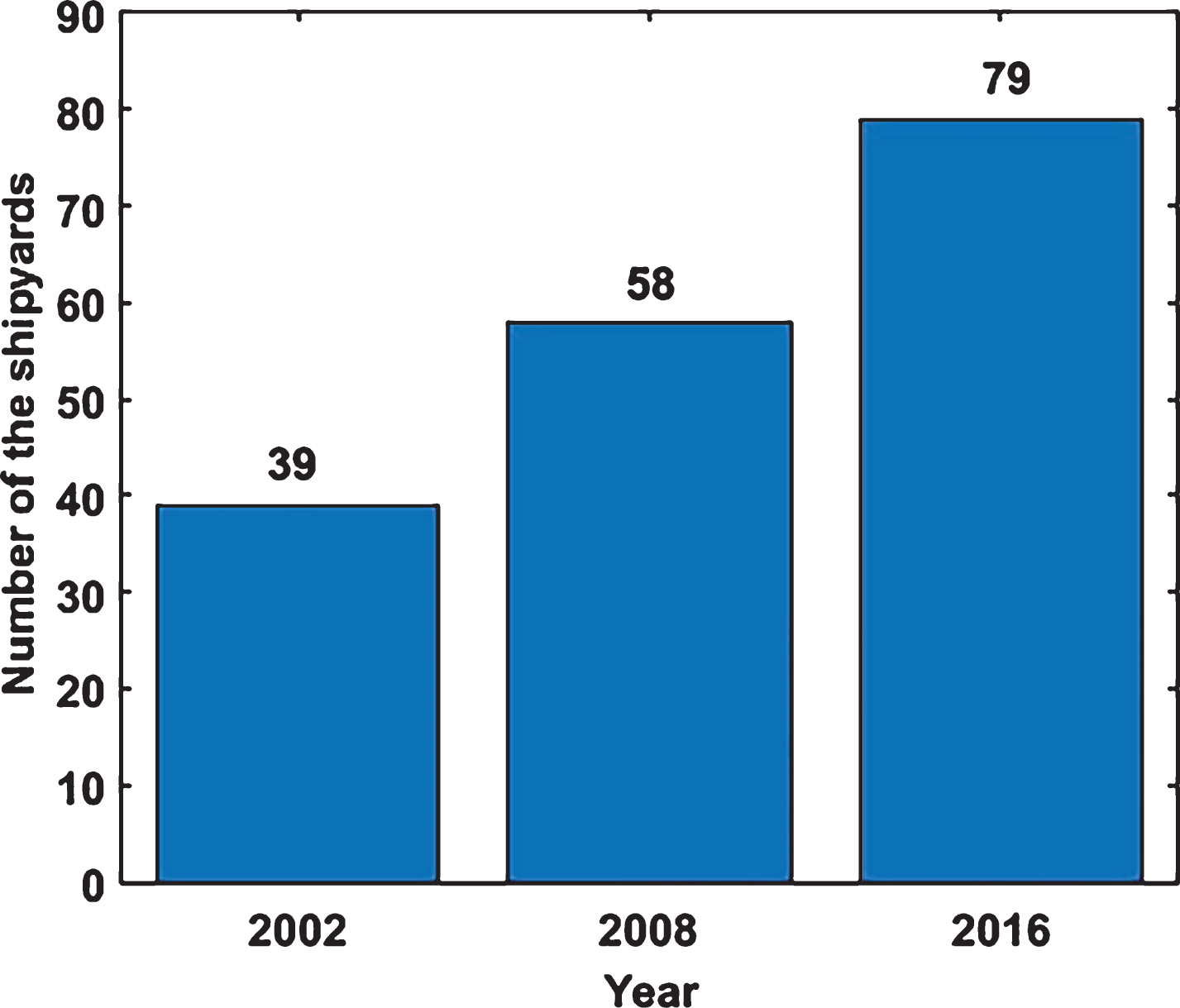
Number of active shipyards in Turkey from 2002 to 2016 [8].
Shipyard facility location
In the literature, there are few studies related to shipyard FLS decision. Güneri and Şahin [9] compared the results obtained by the two methods using the Analytical Hierarchy Process (AHP) and Fuzzy AHP methods separately. Guneri et al. [10] determined the most appropriate shipyard location using the Analytical Network Process (ANP) method for the model consisting of criteria and alternatives. Saracoglu et al. [11] examined in detail the main and sub-criteria that affect only the shipyard position without using any method for weighting the criteria. Aliefendioğlu and Sağır [12] determined the criteria that affect the shipyard location by considering the characteristics of a region without any weighting calculation.
Multi-criteria decision-making (MCDM) methods
The ever-changing world conditions compel not only people but also institutions and organizations to achieve correct and successful results in their decisions [13]. People, institutions, and organizations select from alternatives throughout their lives. When these selections come together verbally, the decision becomes uncertain. Therefore, numerical methods, such as decision analysis and algorithms, give promising results in the decision-making process [14]. The problem of group decision making (GDM) arises when more than one person wants to make a final decision considering various criteria and alternatives. A group of decision-makers expresses their opinions, and they aim to obtain a concentrated solution with GDM [15].
GDM problems include a multi-criteria structure, and MCDM methods are used to solve these problems. These methods use various optimization models to rank alternatives. MCDM has become a widely used research area for the solution of complex GDM problems, considering many quantitative and qualitative criteria [16]. MCDM approaches are examined under two main groups [17]: Multi-attribute decision making (MADM) and multi-objective decision making (MODM). The main distinction between MADM and MODM results from defining alternatives. In MODM, alternatives are not predetermined, and MODM criteria are defined indirectly by a scientific program that results in continuous alternatives. In MADM, alternatives are determined in advance and clearly defined [18].
MODM and MADM methods are used in many different problems. Each of these methods may not be specific to the problem. In solving a problem, more than one way can be used separately, or a hybrid approach consisting of several methods can be preferred. Therefore, these methods can be applied to different problems in many areas. While MODM methods are generally used in design problems such as strategic planning or collection routing optimization [19], MADM methods are applied successfully in areas such as resource allocation, facility location, and supplier selection [20]. In this study, we integrate two of the MADM methods and apply them to our problem.
MADM methods are classified under three groups as value-based methods, outranking methods, and distance-based methods [21]. Techniques such as multi-attribute value theory (MAVT), multi-attribute utility theory (MAUT), and AHP are commonly used in value-based methods. Outranking methods include approaches such as Preference Ranking Organization and Method for Enrichment Evaluation (PROMETHEE) and Elimination and Choice Expressing Reality (ELECTRE). TOPSIS is one of the most preferred distance-based methods.
Integration of Fuzzy AHP-TOPSIS
Shipyard FLS decision is a critical process in which many different qualitative and qualitative criteria are evaluated. MADM methods are the most appropriate tool to overcome this problem considering the studies in the literature. Various ways have been applied in the researches for FLS problems that can be solved with MADM methods [22–26]. Although there is no general formula or rule regarding which of the MADM techniques should be used, the literature review states that AHP is the dominant method in various application areas, with 65% [27]. However, the use of Fuzzy AHP alone is not practical, as many pairwise comparisons are required when the criteria and alternatives are evaluated together [28]. Therefore, many integrated MADM methods are applied to the solution of FLS problems in researches [29–32]. Despite the extensive use of mixed MADM methods, it is difficult to decide which integrated approach works best in solving FLS problems. In this paper, we have used the integrated Fuzzy AHP-TOPSIS method, which has been successfully applied in the solution of many complex issues in the literature to overcome the shipyard FLS problem.
There are studies where the Fuzzy AHP-TOPSIS method integrated into the literature has been successfully applied. Sun [33] used the integrated Fuzzy AHP-TOPSIS method to evaluate different laptop ODM companies. He stated that the applied approach allows decision-makers to understand the entire evaluation process better and provides a more effective system support tool. Choudhary and Shankar [34] used the integrated fuzzy AHP-TOPSIS method for thermal power facility location selection. Samvedi et al. [35] applied the mixed Fuzzy AHP-TOPSIS method to measure risks in the supply chain and combine values into a comprehensive risk index. Hanine et al. [36] first determined the criteria weights for the Landfill of Industrial Wastes location selection with Fuzzy AHP. Then, He ranked the alternatives with TOPSIS. While Sirisawat and Kiatcharoenpol [37] used the mixed fuzzy AHP-TOPSIS method to classify and rank reverse logistics barriers, Ocampo [38] applied it to determine the sustainable manufacturing strategy for food production. Beskese et al. [39] proposed a mixed hesitant Fuzzy AHP-TOPSIS approach for wind turbine selection. When the literature is carefully examined, it is seen that the integrated Fuzzy AHP-TOPSIS method is a contemporary approach applied in many areas. In this study, by integrating the uncertainty values into the decision-making process, we calculated the weights of the criteria with Fuzzy AHP. Then, we used TOPSIS to rank alternatives. Thus, as a result of the combination of these two techniques, it will be possible to provide a robust approach to determine the criteria weights for the shipyard FLS decision and to rank the alternatives.
Materials and methods
In this paper, we apply a three-stage solution process to the problem for an appropriate shipyard FLS decision. The first stage includes the determination of decision-makers and criteria and a review of the literature. In the second stage, the weights of the main and sub-criteria were calculated by using the Fuzzy AHP technique. Besides, the results were made more reliable with a mechanism that controlled the consistency of the aggregated decision matrices. In the third stage, we have ranked the alternatives with Fuzzy TOPSIS, taking into account the criteria weights calculated with Fuzzy AHP. The research mechanism of this study is illustrated in Fig. 3.
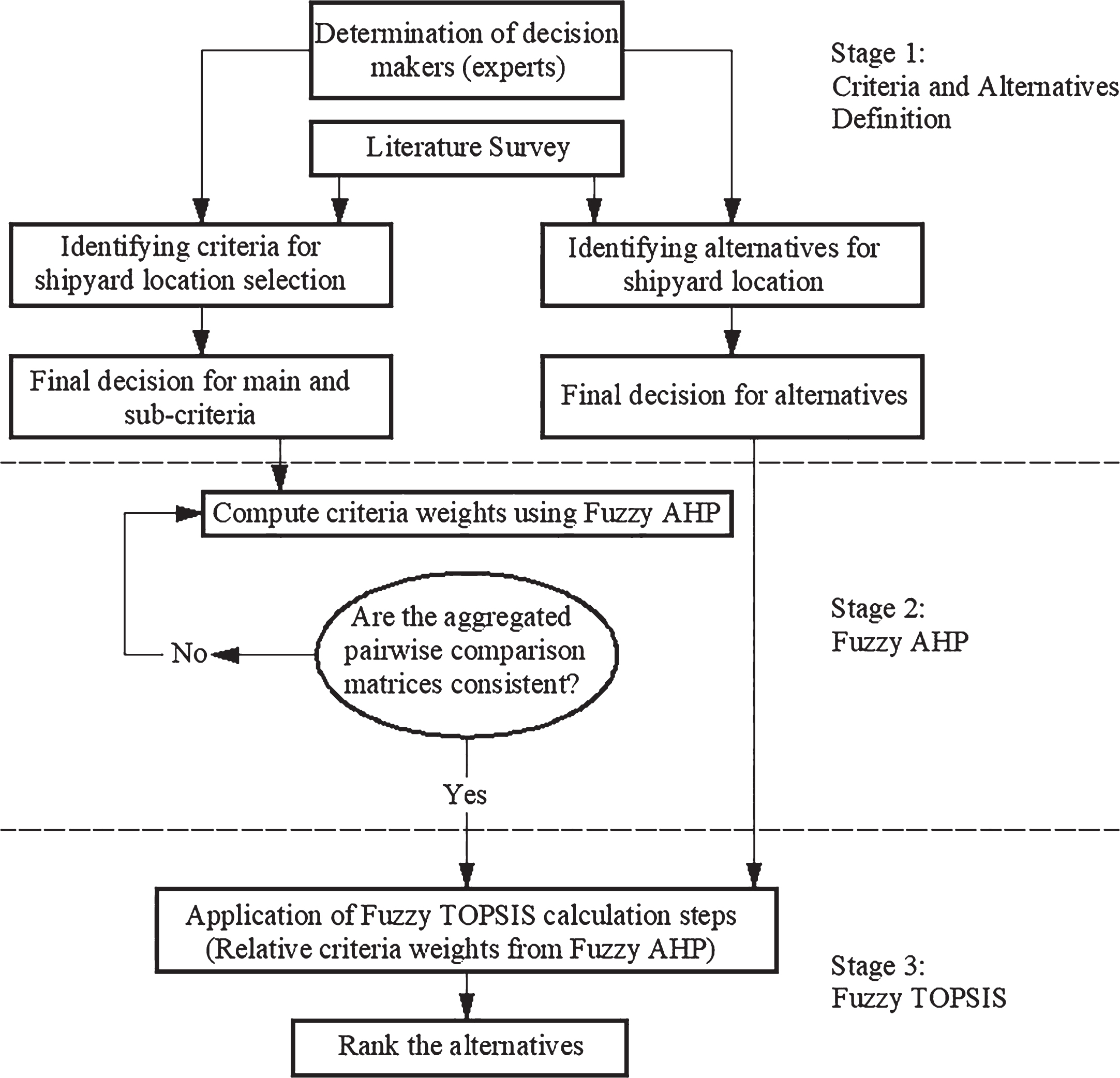
The hierarchical structure for the solution of shipyard FLS problem.
In this stage, decision-makers, criteria, and alternatives necessary for the solution of the problem were carefully examined. Six decision-makers evaluated criteria and alternatives, and the weighting factor of each decision-maker was assumed to be equal. Table 1 displays the profile of the anonymous decision-makers. Besides, the hierarchical structure of the criteria and related sub-criteria for shipyard FLS by different levels are presented in Fig. 4.
Profile of the anonymous decision-makers
Profile of the anonymous decision-makers
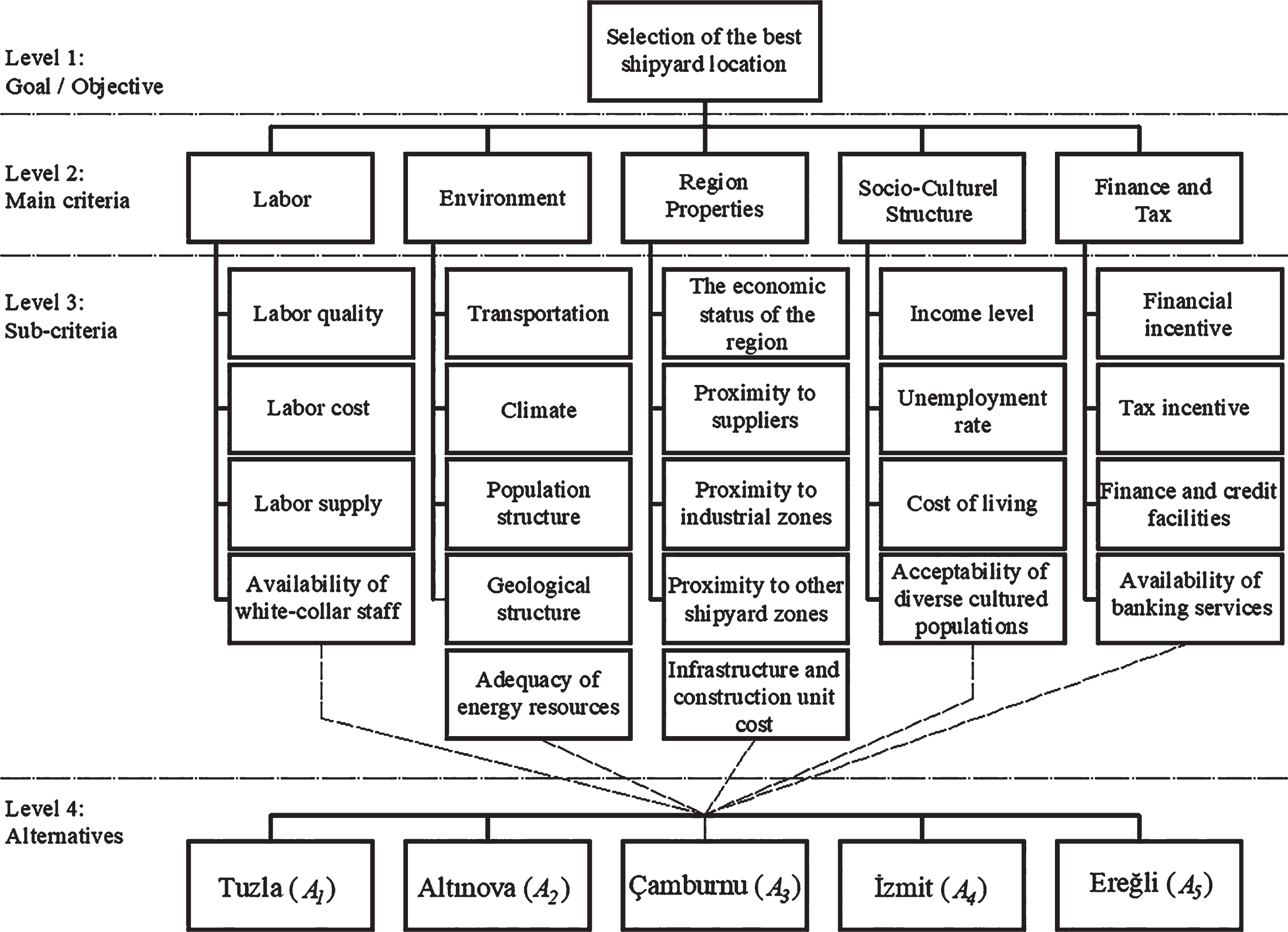
Diagram of the hierarchical structure of the criteria and related sub-criteria for shipyard FLS by different processes.
AHP is a decision-making model that helps us to make decisions in our complex world, and it is also a mathematical method that takes into consideration the decisions of individuals or groups and evaluates quantitative and qualitative variables collectively, and firstly developed by Saaty [40]. Laarhoven and Pedrycz [41] used fuzzy numbers for the first time by defining the triangular membership function. Buckley [42], Chang [43], and Jing and Chang [44] contributed to this field by making studies. In this paper, we will use fuzzy AHP developed by Buckley [42], and this method has several steps as follow:
Step 1: In this step, the most suitable criteria for solving the problem are determined.
Step 2: The criteria are determined, and then linguistic variables and their fuzzy equivalents are defined to indicate the importance of these criteria.
Step 3: The following fuzzy decision matrices are created with the help of a survey (for each expert or decision-maker), which includes pairwise comparisons of the criteria:
Step 4: Since the data collected from decision-makers are in the form of linguistic variables, these data are converted into fuzzy numbers.
Step 5: At this step, the fuzzy comparison value obtained from each of the decision-makers is calculated separately for each criterion to form aggregated main and sub-criteria matrices. There are many ways to do this. In this study, we used the geometric mean method proposed by Buckley [42] for aggregating fuzzy numbers obtained from decision-makers. The geometric mean equations are as follows:
Step 6: First, Equation (4) calculates the geometric mean of each row in the aggregated decision matrix, and then, Equation (5) calculates the fuzzy weights of the criteria as follows:
Step 7: In this step, defuzzification converts the fuzzy triangular number (FTN) to a real number using Equation (6).
l, m, and u are the lower bound, mean value, and the upper bound of the fuzzy number of criterion i, respectively.
After defuzzification, normalization is applied for the main and sub-criteria. The following equations calculate the normalized absolute value of each criterion:
Step 8: Equation (9) calculates the relative weights to compare sub-criteria among themselves:
Each main criterion may not have an equal number of sub-criteria. For example, one of the main criteria may have three sub-criteria, while another main criterion may consist of ten sub-criteria. This may produce unrealistic conclusions. Therefore, Equation (10) calculates the equalized absolute value of each criterion:
Finally, Equation (11) calculates the normalized value of the sub-criteria equalized:
Pairwise comparisons from decision-makers must be reliable for the accuracy of the results. Consistency analysis is an indication of how consistent the decision-makers are in their decisions, and there are many proposed approaches in the literature. Crawford and Williams [45] proposed a row geometric mean method (RGMM) for the consistency of decision matrices. Aguaron and Moreno-Jiménez [46] used geometric consistency index (
w = [(wL1, wM1, wU1) , (wL2, wM2, wU2) , …, (w Ln , w Mn , w Un )] T and A = (a Lij , a Mij , a Uij ) nxn
A and w are a fuzzy decision matrix and a priority vector derived from A using the RGMM, respectively. The maximum values of
TOPSIS is one of the MADM methods and initially proposed by Yoon and Hwang [49]. The underlying logic of TOPSIS is the concepts of the positive ideal solution (PIS) and the negative ideal solution (NIS). The most appropriate solution has the shortest distance from the PIS and the farthest from the NIS. Besides, TOPSIS presents an easily cognizable and programmable process [50]. Many researchers [51–53] developed Fuzzy TOPSIS techniques in recent years. Fuzzy TOPSIS approach needs the relative criterion weight value of each criterion [54]. Fuzzy AHP steps calculate the importance of each criterion, as mentioned. In this paper, we used Chen’s fuzzy TOPSIS method [53]. Chen calculated the crisp Euclidean distance between two fuzzy numbers. Linguistic variables can quickly transform into fuzzy numbers required for calculations in this technique. Chen’s Fuzzy TOPSIS method has several calculating steps, such as:
Step 1: In this step, alternatives are determined for the problem.
Step 2: Linguistic variables and their fuzzy number equivalents are identified to evaluate alternatives against criteria (see Table 3). For example, m is the total alternatives called A ={ A1, A2, …, A
m
} and n is the total sub-criteria called C ={ C1, C2, …, C
n
}. In this step, each alternative A
j
(j = 1, 2, …, m) evaluated against each criterion C
i
(i = 1, 2, …, n) and the fuzzy pairwise comparison matrix (
Note that
Step 3: In this step, the fuzzy pairwise comparison matrices are aggregated and the fuzzy decision matrix (
Note that
Step 4: In this step, the normalized fuzzy decision matrix (
Step 5: Equation (18) computes the weighted normalized decision matrix (
Step 6: Firstly, Equation (21) and (22) calculate the fuzzy positive ideal solution (FPIS, A*) and the fuzzy negative ideal solution (FNIS, A-), respectively.
Then, the distance of each alternative from (FPIS, A*) and (FNIS, A-) is calculated by Equation (23) and (24):
where d (. , .) is the distance between two FTN, and it is calculated according to Equation (25):
Note that
Step 7: In this step, the closeness coefficient (CC
i
) is calculated by Equation (26):
Step 8: Equation (26) assigned a CC j value to all alternatives. Finally, alternatives are ranked in descending order.
Problem description
Especially in the last 20 years, shipyard activities have considerably increased in Turkey. During these years, the number of shipyards has doubled, and new shipyard areas have been identified. Also, many shipyards are in the investment stage nowadays. Since Turkey is a peninsula, there are many areas for the shipyard location. This causes a location selection problem for shipyards. Therefore, to overcome this problem, it is necessary to analyze the criteria and alternatives that affect the shipyard FLS decision. Therefore, in this study, we use a three-stage methodology to prioritize and sort the criteria and alternatives that affect the shipyard location, and this methodology is detailed below:
Stage 1: Identification of shipyard FLS criteria
In this study, we determined five main criteria and 22 sub-criteria for the problem and five alternatives for the best location. Definitions of sub-criteria and which category they belong to (benefit or cost) are presented in Table 2.
Selected criteria for shipyard location selection
Selected criteria for shipyard location selection
Decision-makers evaluate main and sub-criteria by using linguistic variables and equivalents, as given in Table 3. For an easier understanding of the calculations, we explain the equations used in Fuzzy AHP and Fuzzy TOPSIS techniques through a numerical example.
Linguistic variables and FTN used for criteria and alternatives
Linguistic variables and FTN used for criteria and alternatives
The weights of the main criteria were calculated to understand the steps in the fuzzy AHP better. For example, Table 4 shows the fuzzy decision matrix obtained by pairwise comparison of the main criteria using Equation (1) for decision-maker DM1. M1, M2, M3, M4, and M5 in Table 4 are the main criteria and represent labor, environment, region properties, socio-cultural structure, and Finance and tax, respectively. Fuzzy number equivalents of the linguistic variables in Table 4 presented in Table 5. Then, the aggregated fuzzy decision matrix is calculated using Equation (3). For example, the value of M2 in the aggregated decision matrix for the main criteria is calculated as follow:
The fuzzy decision matrix for DM1
The fuzzy number equivalents of the linguistic variables in Table 4 for DM1
Likewise, calculations are made for other main criteria, and the aggregated fuzzy decision matrix is obtained (see Table 6).
The aggregated decision matrix for the main criteria
Then, the criterion weight of M1 is calculated as follows using Equations (4), (5), (5), and (7), respectively. Likewise, the same equations are applied for M2, M3, M4 and M5, and Table 7 is obtained.
The criteria weights for the main criteria
Likewise, we applied the defuzzification and normalization procedure to the other main criteria. Table 7 shows all the main criteria weights.
After the main criteria weights were obtained, we calculated the weights of each sub-criterion. For this, Equations (6), (8), (9), (10) and (11) are used, respectively, and all weights of sub-criteria can be seen in Table 8. For example, these calculations for sub-criteria C1 are as follows:
The criteria weights for sub-criteria
Finally, we applied the Fuzzy TOPSIS technique to rank the alternatives. Decision-makers evaluated the alternatives according to criteria using Table 3, and Table 9 shows the fuzzy linguistic variables for DM1. Next, we calculated the aggregated decision matrix (
Linguistic expressions for D1
Linguistic expressions for D1
Similar calculations are carried out for other criteria, and the
Aggregated fuzzy decision matrix (
Normalized fuzzy decision matrix (
Similar calculations are carried out for other criteria, and the
The distances
Weighted fuzzy decision matrix (
FNIS and FPIS values for criteria
The distances
Similarly, final solutions for shipyard FLS decisions are given in Table 15.
CC j values of the five alternatives
It is difficult to determine which factors are more dominant for the shipyard FLS decision, but the integrated AHP-TOSIS approach has made it more scientific and systematic. In this study, five main criteria, 22 sub-criteria, and five alternatives for the FLS decision were identified by considering the studies in the literature. For this, a four-step hierarchical structure (Fig. 4) was created, which included the objective of the problem, the main criteria, sub-criteria, and alternatives. To overcome the problem identified in Fig. 4, a solution method consisting of a fuzzy AHP-TOPSIS combination was proposed, and a three-stage hierarchical structure (Fig. 3) was created to solve the problem. While determining the criteria, alternatives, and decision-makers for the shipyard FLS decision in Stage 1, the weights of the main and sub-criteria were calculated in Stage 2 using Fuzzy AHP and presented in Table 7 and Table 8, respectively. Besides, the percentages of the significance values of these criteria are shown in Fig. 5. The percentage importance of the main criteria is in descending order M5> M1> M3> M2> M4 (Fig. 5a). It can be seen that finance and tax have the highest importance among the main criteria. Ranking values are C1> C2> C3> C4 for the sub-criteria of Labor, and the labor quality has the highest value (Fig. 5b). Adequacy of energy resources has the highest importance among the sub-criteria of Environmental, and the ranking values are C5> C6> C9> C7> C8 (Fig. 5c). Proximity to suppliers has the highest percentage importance among the sub-criteria of Region properties, and the ranking values are determined as C11> C12> C13> C14> C10 (Fig. 5d). Ranking values are C17> C15> C16> C18 for the sub-criteria of Socio-cultural structure, and the cost of living has the highest value (Fig. 5e). The financial incentive has the highest importance value among the sub-criteria of Finance and tax, and the ranking values are C19> C20> C21> C22 (Fig. 5f). When the importance values of the sub-criteria are examined, the financial incentive has the highest importance value, and the normalized and equalized values of all sub-criteria are presented in Fig. 6.

The importance of the main and sub-criteria.

The equalized and normalized values of all sub-criteria.
Consistency analysis was conducted in this study to make the results more reliable. Thus, the consistency values of the aggregated decision matrices obtained by evaluating the criteria and alternatives of the decision-makers were calculated by using Equation (12) and presented in Table 16. When the consistency analysis values were examined, it was observed that the decision-makers gave very consistent answers in evaluating the criteria and alternatives.
The consistency rates for the aggregated fuzzy decision matrix
Finally, the fuzzy AHP technique was applied in Step 3 to select the best alternative. The ranking of other alternatives is presented in Table 15. According to the final results, the most appropriate solution for the shipyard FLS problem has been determined as Izmit. Tuzla has almost the same importance as Izmit. The ranking values of the alternatives are A4> A1> A2> A5> A3 and are illustrated in Fig. 7.
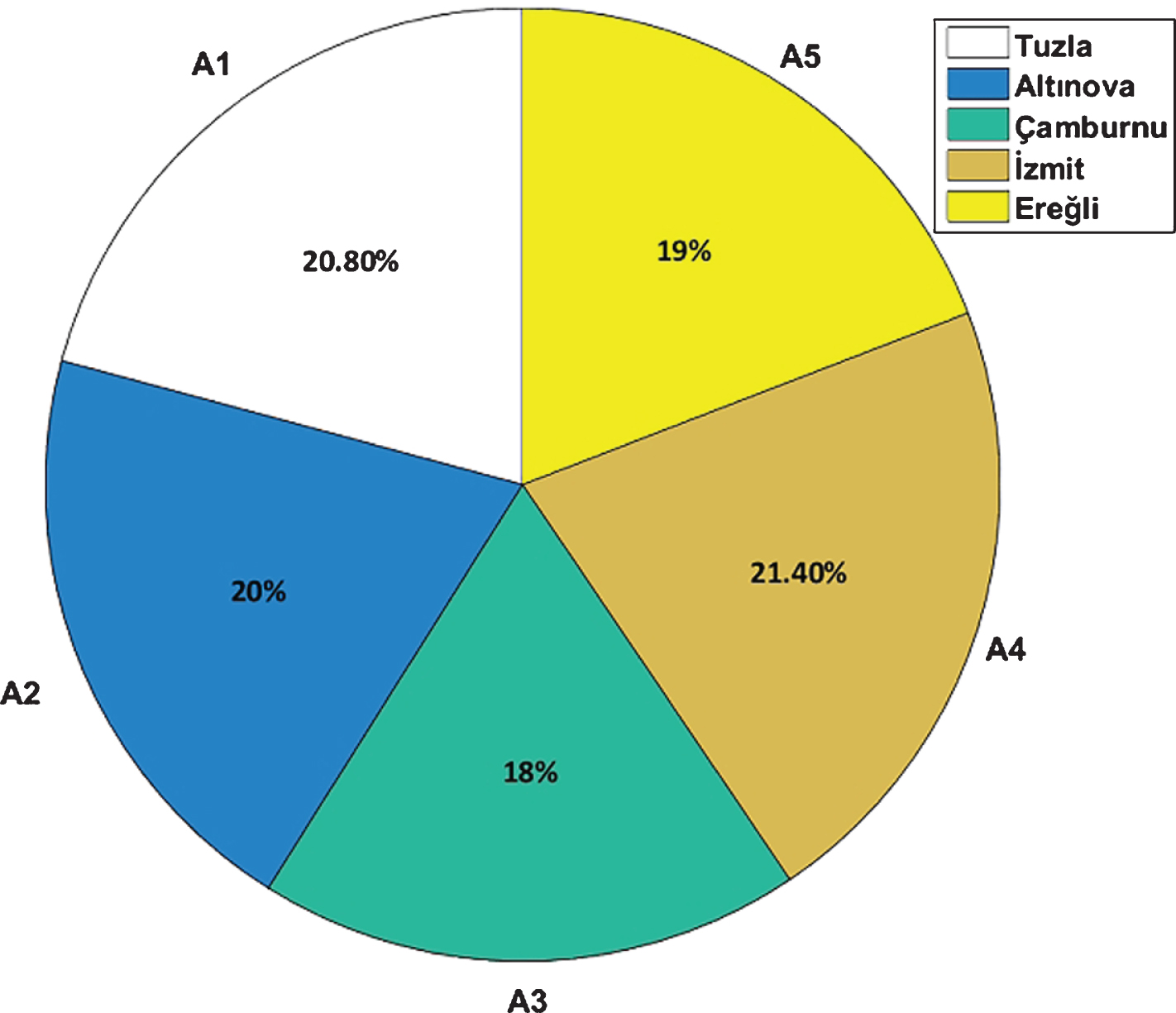
Ranking values of the alternatives.
Shipbuilding is one of the essential industries in the world, and it also has critical importance in Turkey, which is a peninsula. Although global economic developments have affected this situation a bit, shipbuilding still maintains its significance. In recent years, the number of shipyards in Turkey has increased in contrast to the world. Therefore, determining the most appropriate shipyard location is an extremely critical process. Since the shipyard FLS decision contains qualitative and quantitative criteria that conflict with each other, it is necessary to use MADM methods to obtain a correct decision. When the literature is carefully examined, many different solution approaches are suggested among the MADM methods for FLS problems. Only one method or integration of more than one method can be used to solve the problem. But in recent years, integrated methods have been used to overcome complex issues such as FLS. By integrating the two methods, a more robust approach and practicality are provided for the solution of the problem.
In this study, an integrated AHP-TOPSIS approach is used for shipyard FLS decision. Firstly, the relative weights of the main and sub-criteria are calculated with Fuzzy AHP, and then, Fuzzy TOPSIS is applied to prioritize alternatives. Since consistency analysis is performed before the criterion weights are determined, pairwise comparisons of decision-makers are provided to be more reliable. When the obtained results are analyzed, Finance and tax (main criterion) and Finance incentive (sub-criterion) are determined as the criteria with the highest importance. Besides, proximity to suppliers and transportation are the most critical sub-criteria after the financial incentive. Since the shipyard FLS decision directly affects the initial investment costs, it makes sense that the criteria related to costs have high importance value. Therefore, it can be said that the proposed approach is applicable to this study and used as a powerful tool in the MADM process. Consequently, the contribution of this study is to propose a feasible, efficient, and practical decision framework and to rank solutions for a correct shipyard FLS decision. The ranking of solutions will help individuals or companies to achieve successful results for the shipyard investment.
In this study, much useful knowledge has been achieved for investors who attempt to establish a shipyard in Turkey. The results of this work have been given as detailed above. It is strongly recommended that the shipyard investors consider these conclusions to make a correct decision. Also, these results will be useful for countries with similar geographical, economic, and social characteristics as Turkey.
In future research work, technological innovations, economic and social changes in the world can be reexamined, and more comprehensive analysis can be made for criteria and alternatives. With this detailed analysis, other integrated solutions can be offered to solve the problem. Besides, the number of decision-makers can be increased. However, this situation causes hesitant linguistic knowledge due to the difference in expertise and culture of different decision-makers. Therefore, successful analysis can be obtained by using models [55, 56] that suggest hesitant linguistic variable sets in decision-makers’ decisions. Finally, the impact of decision weights and aggregated matrices on judgment rules [15] can be examined by calculating the minimum consensus cost (MCC) affecting the consensus reaching process (CRP), which is an essential issue for GDM.