



Abstract
The evolution of the product family is the essential driving force for the development of a complex product. Only customer satisfaction is emphasized in the traditional module configuration methods, which is not beneficial for product family evolution that is due to non-customer factors such as the emergence of new technology. In this study, the intuitionistic fuzzy number is employed to quantify the degree of correlation between each module and configuration targets, namely customer satisfaction and the degree of evolution of the product family, respectively. The bi-objective integer programming model is constructed by maximizing the degree of customer satisfaction and product family evolution. An improved Pareto ant colony optimization (P-ACO) is designed to solve this model and subsequently the Pareto frontier is obtained. The radar chart is adopted to represent the performance of each configuration scheme in the Pareto frontier. The feasibility and effectiveness of the proposed method are expounded by a case study and result comparison, showing that this method can provide a more competitive product configuration scheme to customers in the future market.
Introduction
The research and development of complex products are significant for the development of countries. A complex product usually has some typical features such as long development lead-time, high development cost and technical content, and multi-disciplinarity, which may lead to many difficult issues in its development [21, 41]. By implementing modular design, a complex product can be decomposed into some relatively simpler modules to reduce the design complexity and cost and shorten the lead-time of design and manufacturing [20, 48]. Driven by the requirements of various tasks and working conditions, the modules of a complex product will be continuously extended, updated, and iterated, and thus a complex product family will be created. On the basis of the evolved complex product family, module instances are chosen to construct a module combination, which is essentially a customized complex product. The selection process is referred to as the module configuration, which is a specific variant of product configuration for modular products (we do not make a strict distinction between module configuration and product configuration, and they are used according to the research content) [30]. As a large number of common modules and variant modules are included in a complex product and several module instances are derived for each of the common modules and variant modules in the evolution process of a complex product, the number of module configuration schemes is growing exponentially. In recent years, how to obtain the optimal module configuration scheme for a complex product in accordance to customer requirements (CRs) and other constraints has attracted the attention of researchers and practitioners.
The configuration objective is of paramount importance. From the respective viewpoints of customers and enterprises, there are two primary objectives for module configuration, namely customer satisfaction and total cost [22, 46]. Besides, for different backgrounds and constraints, there are also some other configuration objectives such as environmental performances [34], assembly and disassembly [8, 37], and component replenishment [44]. Obviously, the final optimized configuration solution is ultimately decided by the configuration objective.
As claimed by America, van de Laar, and Muller [2], a complex product can be regarded as a man-made system, and it must evolve to maintain or even increase its value by satisfying changing CRs, using emerging new materials and technologies, etc. In other words, actuated by some external factors (e.g., changing CRs) and internal factors (e.g., the development of new technologies), a complex product continuously evolves during its life cycle. The necessary stage for the evolution of a complex product is the appearance of a product family [18]. In a product family, the modules or module instances with the tendency to evolve are more likely to be selected for the next generation, which means that the evolvability of the product family can meet the future market demand and provide better configuration schemes. Although many objectives have been considered in previous research to satisfy different configuration requirements, little attention has been paid to the evolvability in the module configuration process of a complex product. Therefore, it is significant to consider the CRs and product family evolution issues (PEs) simultaneously in the module configuration process.
In this study, motivated by the above discussion, a bi-objective optimization approach for the module configuration of a complex product is proposed. First, the two objectives are defined as CRs and PEs. Second, a bi-objective integer programming model is constructed which is solved by the improved Pareto ant colony optimization (P-ACO). Finally, the module configuration problem of a crawler crane is implemented to expound the feasibility and effectiveness of the proposed approach. The rest of this article is organized as follows: related literature is reviewed in Section 2; the module configuration problem of a complex product is described in Section 3; the proposed approach is detailed in Section 4; a case study is established with a discussion and comparison analysis in Section 5; and conclusions and future work are presented in Section 6.
Literature review
Product evolution
The term evolution, proposed by Wallace and Darwin, is well-known in the field of biology and is essential for the study of all natural and artificial systems. Seminally, in a study of reverse-engineering and redesign methodology, Otto and Wood [28] depicted an S-curve for product evolution in time. To cope with changing circumstances, new functionality requirements, and new technologies, Gu, Hashemian, and Nee [7] proposed an adaptive design methodology and introduced the concept of adaptability, which is related to the product evolution. Bryan et al. [4] made the first attempt to clarify the impact of PEs on other product lifecycle stages and designed a co-evolution framework by associating the product family and reconfigurable assembly system over several product generations. In 2012, Advanced Engineering Informatics published a special issue on the evolvability of complex systems, which facilitated more intensive research on product evolution and its applications.
Van Beek and Tomiyama [36] developed a structured workflow approach by explicitly modeling key concepts of the product evolution process to support the product development process for complex multi-disciplinary systems. By designing the evolvable systems, Urken, Nimz, and Schuck [35] analyzed how systemic robustness, resilience, and sustainability are related to product evolvability. Additionally, Luo [25] proposed a simulation-based method to assess the isolated effect of product architecture on product evolvability by analyzing a design structure matrix, and showed that modularity and inter-component influence cycles promote product evolvability. Moreover, Allen et al. [1] presented and demonstrated a technique aimed at improving the success of engineering projects in the developing world. Flexibility and adaptability minimize the impact of uncertainties and are enabled by numerically optimized amounts of designed-in excess, and a sensitivity analysis performed on the system model helped the designer prioritize and refine the set of uncertain requirements and parameters. From the viewpoint of network topology, Park and Okudan Kremer [29] investigated the evolutional properties of a product family. Additionally, Hou and Jiao [10] reviewed the literature and focused on the inverse design based on usage information. The inverse design is an effective means to establish product evolution.
Product configuration
As discussed in Section 1, product configuration is an essential means for selecting various components to constitute a customized product with the aim of meeting the individual requirements of a customer. Thus, a great number of studies have been conducted on the subject of configuration objective [46]. The determination of optimization objective(s) is the most important issue for product configuration, and many different optimization objectives have been considered in previous studies. The optimization objectives of product configuration are classified into the following three categories: (1) customer-oriented objectives; (2) enterprise-oriented objectives; and (3) other objectives.
Most of the research on product configuration considers customer-oriented objectives since CRs are the essential driving force for a manufacturing enterprise. To support product configuration, Jiao and Zhang [16] proposed an association rule mining-based methodology to identify a product portfolio by satisfying CRs. Additionally, under a one-of-a-kind production situation, Hong et al. [9] identified the optimal product configuration and its parameters to satisfy individual CRs related to product performance and cost. Song and Kusiak [33] used a data mining approach to determine the prime product configuration scheme considering the customer cover criterion. Wang [38] and Zhao et al. [49] incorporated customer satisfaction into the decision-making process of product configuration by using a fuzzy Kano model. For emotional design, Huang et al. [11] proposed a product configuration analysis method based on the personal construct theory and developed a customer mind map for each Kansei tag in order to capture CRs. Moreover, in a study of the configuration of product-extension services, Song and Chan [32] used the comprehensive performance of the service, total service cost, and service response time (all of which are customer-oriented) as the optimization objectives. Jiao, Yang, and Zhang [15] applied a probabilistic classifier to map the CRs to a product configuration scheme with the highest probability. In recent years, more and more research has combined customer-oriented objectives with other objectives to establish the product configuration, and related works will be reviewed in the following. In summary, customer-oriented objectives are considered to be consistent with CRs and increase customer satisfaction, which is essential for product configuration.
The consideration of enterprise-oriented objectives can enhance the profitability and survivability of an enterprise. In a work dealing with the uncertainties in product configuration, Liu and Liu [24] incorporated the total lifecycle cost as an objective. The total lifecycle cost was also integrally addressed in a multi-objective optimization for product configuration by Badurdeen, Aydin, and Brown [3]. Other than the total cost, which is the most important enterprise-oriented objective, some other factors have also been addressed. For example, Viswanathan and Allada [37] created a theoretical basis for addressing product configuration issues, which is indispensable during product redesign, by modeling the combinatorial configuration design optimization problem from a disassembly perspective. Furthermore, Hvam, Pape, and Nielsen [12] developed a product configuration system with the aim of shortening the lead-time of making budget quotations. Moreover, Jiang et al. [14] proposed a new approach for inventory-shortage-driven product configuration by considering cost, lead-time, and inventory variation. As well as the product cost, the total market share and reliability requirements were also considered by Wu et al. [39] to develop a methodology for the joint decision of product configuration and remanufacturing. In summary, enterprise-oriented objectives are mainly related to the cost. As for the third category, namely “other objectives”, these are mainly related to the environmental objectives [3, 34] and shared surplus, which measures the interaction between customer satisfaction and enterprise profitability [5, 43].
Multi-objective algorithms
There are many algorithms for solving multi-objective models. Xu [40] constructed design models for the optimization of low-carbon products with performance, cost, and carbon tax as optimization objectives and used the Non-dominated Sorting Genetic Algorithm II (NSGA-II) to find the Pareto optimal design schemes. Additionally, Hsin et al. [31] proposed a multi-objective green cyclic inventory routing problem model and employed a discrete multi-swarm particle swarm optimization (PSO) and a heuristic optimization to acquire the optimal set of the model. Therein, the discrete multi-swarm PSO combined the discrete PSO concept and multiple PSO concept, which can improve the PSO’s solution exploration capability and reduce the possibility of premature convergence. To find the optimal solutions of the flow shop problem with multiple objectives, Li et al. [13] proposed the ant colony optimization (ACO) algorithm to search for optimal schedules of the two machines flow shop problem; according to the actual situation of the flow shop, the pheromone updating rule was defined specifically. To improve the convergence speed and enhance the global search capability of the ACO algorithm, Ning et al. [26] designed a novel strengthened pheromone update mechanism which strengthened the pheromone on the edges and designed a novel pheromone-smoothing mechanism to reinitialize the pheromone matrix. Finally, the improved algorithm was analyzed and tested on a set of benchmark test cases, which demonstrated the effectiveness of the improved algorithm. With reference to the above algorithms, in the present study, an improved P-ACO algorithm was proposed to solve the configuration model.
From the above literature, one can conclude that research on product family evolution (PFE) is still in the preliminary stage and there are still many issues that need to be tackled. From the viewpoint of configuration objectives, most research has focused on customer-oriented and enterprise-oriented objectives, whereas the PEs, which are very common and inevitable, are rarely considered. The research contributions of this article are highlighted from the following aspects: The CRs and PEs are simultaneously incorporated into the module configuration of a complex product, based on which the module configuration problem is characterized as a bi-objective integer optimization problem. The closeness relation degrees between each CR and PE and each module are quantified by using an intuitionistic fuzzy set (IFS) which can concurrently represent the degree of membership and non-membership. The improved P-ACO is employed to solve the established optimization model, and the proposed module configuration methodology is expounded by the module configuration of a large-tonnage crawler crane.
Problem description
Currently, in most studies, the objective of module configuration is to meet the customer requirements. However, as non-professionals, customers cannot cognize products specifically, which will lead to an inaccurate configuration scheme [27]. With technological evolution and market changes, modules will be added to products (e.g., the fingerprint identification function of smartphones) or existing modules will be modified to improve customer satisfaction. The upgrade and development process for modules or module instances is the embodiment of the PFE process. Thus, the module configuration of complex products needs to consider the PFE.
Motivated by the above discussion, in this article, CRs are defined as the explicit requirements as they can be easily captured by an enterprise. Meanwhile, PEs are defined as the implicit requirements since they cannot be directly perceived by customers or enterprises. As shown in Fig. 1, two optimization dimensions of module configuration are considered. As the product family is time-evolving and CRs are time-varying, the vertical axis is defined as the time dimension as well as the PFE dimension while the horizontal axis is defined as the CR dimension. If the enterprise attempts to achieve a high satisfaction level on implicit requirements (PEs), the advanced technology and environmental factors should be developed and considered, which will result in high cost and long lead-time, which are in conflict with CRs. Consequently, in this article, the explicit requirements (CRs) and implicit requirements (PEs) will be considered as the optimization objectives of the module configuration problems.

Illustration of the optimization objectives for the module configuration. PEs: product family evolution issues. CRs: customer requirements.
To clearly illustrate the module configuration problem, the module configuration of Product A is taken as an example. The product family structure of Product A is depicted in Fig. 2. The physical module interfaces connect modules. The module set is
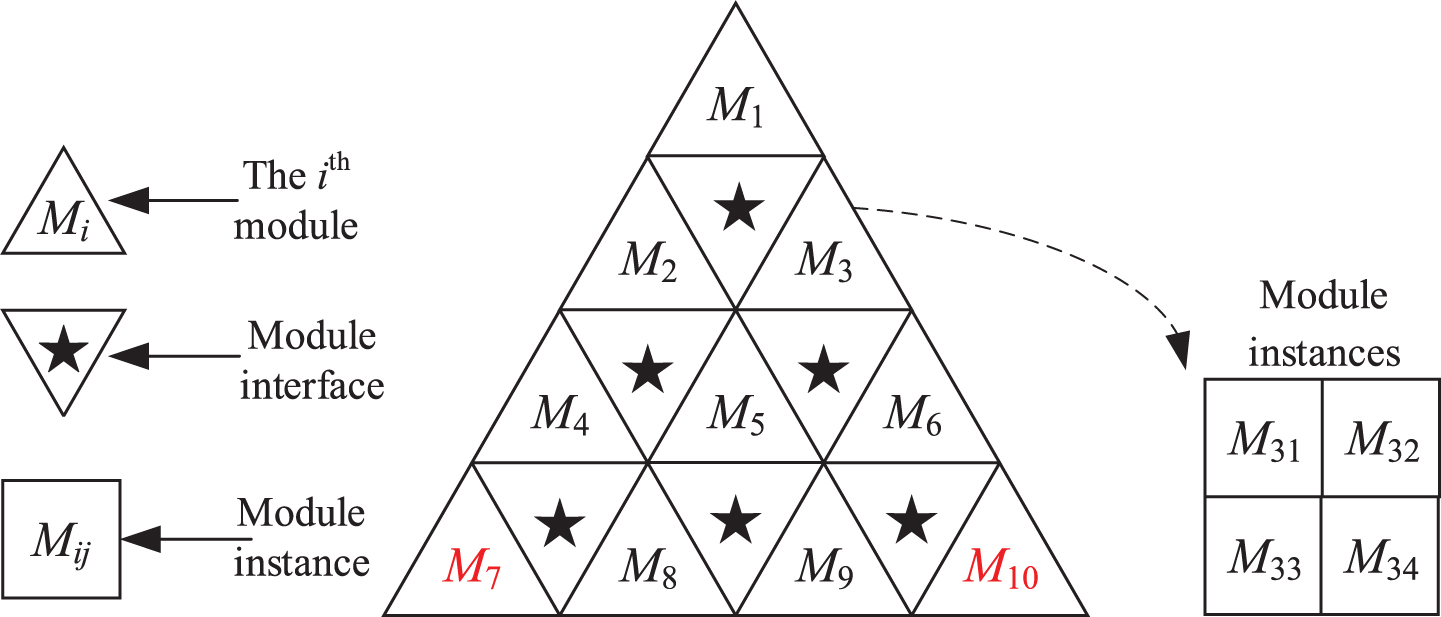
Descriptive illustration of a product family.
The module configuration process is depicted in Fig. 3. The product family is the foundation of product module configuration. The objectives are described as CRs and PEs in the module configuration, which are used to select the optimal module instances. Herein, the selected module instances have the tendency to be redesigned and upgraded to satisfy the PEs and the configuration schemes can meet future market demand. Although CRs have a dominant impact on module configuration, PFE issues (PEs) can offset the deficiency of customers in product cognition and should be incorporated in the module configuration.

Brief illustration of the module configuration model.
Model construction
In a modular product family, suppose that there are m required modules and n optional modules. The ith required module has T
i
module instances (i = 1, 2, ... , m) and the jth optional module has T
j
module instances (j = 1, 2, ... , n). The g
i
th module instance of the ith required module is represented as
CRs are described as
where m and N (N≤n) are the number of required modules and optional modules, respectively.
For module configuration optimization, it is critical to determine the relationship among CRs and modules. The Quality Function Deployment (QFD) method is employed to transform the subjective and uncertain CRs into engineering characteristics (ECs) that designers can understand. The IFS is employed to characterize the relationship between a module and an EC, and then the IFS is transformed into the connection degree whose trends of set pair is calculated to quantify the comprehensive closeness density (CCD) between an EC and a CR [42]. The deterministic CRs (cost, delivery deadline, etc.) are determined according to the historical record of the enterprise. Then, the correlation intensity matrix between CRs and modules is:
where the membership degree
The connection degree in set pair analysis theory is introduced to describe the uncertainties in the module configuration process [42]. Taking
Then, the closeness degree is defined as
A larger
Introduce the weights of CRs into
where
In the module configuration problem, suppose that
To maximize customer satisfaction and the promotion degree of PFE, the object function is established as:
The first objective function indicates that the satisfaction degree for CRs of the configuration scheme should be maximum while the second one denotes that the promotion degree for PFE of the configuration scheme should also be maximum.
For the above optimization model, the following constraints should be satisfied:
In Equation (13), C
X
is the production cost of scheme X, δ is the profit margin of an enterprise, C is the maximal cost that customers can accept, T
X
is the delivery time, and T
m
is the longest delivery time that customers can accept. Equations (14) and (15) can ensure that one module instance should be selected for each required module and no more than one module instance can be selected for each optional module. The polarity and non-negativity of the weights of CRs and PEs are constrained in Equation (16). Equation (17) indicates the dependency relation or mutual exclusion between two modules. In Equation (17),
The proposed model is a typical combinational optimization problem with multiple objectives and has been proven as an NP-hard problem [32, 47]. For solving this kind of problem, Yi et al. [45] proposed an improved ant colony algorithm which applies different heuristic functions and pheromone change methods and introduces an adaptive mechanism and mutation strategy to shorten the calculation time of the ant colony algorithm, speed up algorithm convergence, and improve prediction accuracy. Additionally, Doerner et al. [6] proposed a meta-heuristic algorithm for P-ACO which can obtain a set of optimal solutions for multi-objective problems (Pareto optimal solutions) and provide an effective compromise between the required computing time and the quality of the approximate solution space.
Based on previous studies of the ant colony algorithm, in the present study, an improved ant colony algorithm is proposed to solve the multi-objective optimization problem. In order to enhance the searching ability of P-ACO, the iterative searching process was divided into two stages—random searching and probabilistic searching—which can optimize the method, the pheromone updating rule, and the state transfer rule. There is always conflict among the objectives in a multi-objective optimization problem, and there cannot be an optimal solution for all the objectives; therefore, the final solution will be a set of non-dominated solutions, e.g., the Pareto optimal solution.
Principles of P-ACO
P-ACO is an extension of the traditional ant system (AS). It is different from the AS in terms of state transfer rules and pheromone updating rules for different dimensions of optimization objectives. The P-ACO updates the Pareto optimal solution set by comparing the present generation’s feasible solution with the potential solution in the non-dominant solution set. The pheromones between states are updated according to the solution set. Then, a new round of iteration is started until the condition of the maximum number of iterations is satisfied. The remainder of this section describes in detail (1) the optimization method and pheromone updating rules and (2) the state transition rule.
(1) The optimization method and pheromone updating rules
In order to better guide the ants to search the feasible space, an external set A(t) is used to save all Pareto solution sets found by the entire colony after t iterations. Any solution x
i
in set A (t) is not dominated by any other solutions, and the pheromone concentration in the path of ant i should be increased to guide other ants to search the field where ant i is located. The pheromone increment is composed of several parts, the number of which is the objective number m of the multi-objective optimization problem. If objective j is the gain indicator, the pheromone increment of ant i in the colony of generation t under objective j is expressed as:
The total pheromone increment of ant i in the colony of generation t is calculated under the objective j as follows:
The pheromone on path r is updated as follows:
(2) State transfer rules for ant colonies
Different from the application of the basic ant colony algorithm, in the path planning problem of the Traveling Salesman Problem, the ant goes from selecting an instance of a module to selecting an instance of the next module without considering the distance of module instances in the product module configuration. In this process, pheromones serve as iteration indicators. The instances with high concentrations of pheromones will be selected with a higher probability as the next direction of movement. If the current instance of the kth ant is p, the probability of transferring from instance p to instance q can be expressed as:
The P-ACO algorithm simulates a group of ants moving between adjacent states of the problem, selects the next path according to the pheromone concentration on the path with a certain probability, and searches for a feasible solution to the problem step-by-step considering the state transition rule. The Pareto optimal solution set is updated by comparing the feasible solution of the present generation with the potential solution in the non-dominant solution set. The pheromones between states are updated according to the solution set. Then, a new iteration is started until the condition of the maximum number of iterations is satisfied. Thus, the iteration is stopped and the Pareto optimal solution set is obtained. The implementation process of the improved P-ACO algorithm in module configuration is shown in Fig. 4, and the steps of module configuration are as follows: Initialize the ant colony system and generate the ant colony in the phase of random search and probability, the population qualities of which are N
rand
and N
prob
, respectively. Initialize the ant colony system and generate the ant colony in the phase of random search and probability. Then, define the τ
rand
and τ
prob
and determine the volatilization coefficients ρ of the pheromone; Set the Pareto solution set A (t), where t = 0 and A (0) is an empty set; According to the path index of each ant (module instance index), calculate the objective function value and constraint conditions, filter the non-dominant solution that satisfies the constraint conditions, and update the set A (t); The Pareto solution set A (t) is used as the input to calculate and update the pheromone concentration on the path between search module instance using Equations (18)–(22); In the probabilistic search stage, calculate the transfer probability of all the instances for the next module selected by the ant with the pheromone concentration between the instances as input (calculated using Equation (23) and determine the next module instance by the roulette method; After all the N
prob
ants have traversed each module, the objective function value and constraint condition are calculated according to the path index of each ant; The feasible solutions that satisfy the constraint condition are screened and compared with the elements in the Pareto solution set, and the non-dominant solution set A (t) is updated; Judge whether the algorithm flow reaches the maximum number of iterations; If the maximum number of iterations is not reached, then t = t+1 and steps (5)–(8) are repeated; If the maximum number of iterations is reached, the algorithm is terminated.

Improved P-ACO algorithm flow.
Taking the non-dominated sorting of two objective (benefit objective) optimization problems as an example, the process is illustrated in Fig. 5. When the algorithm reaches the termination condition, the first-level non-dominated individuals in the population are taken as the Pareto optimal solution.
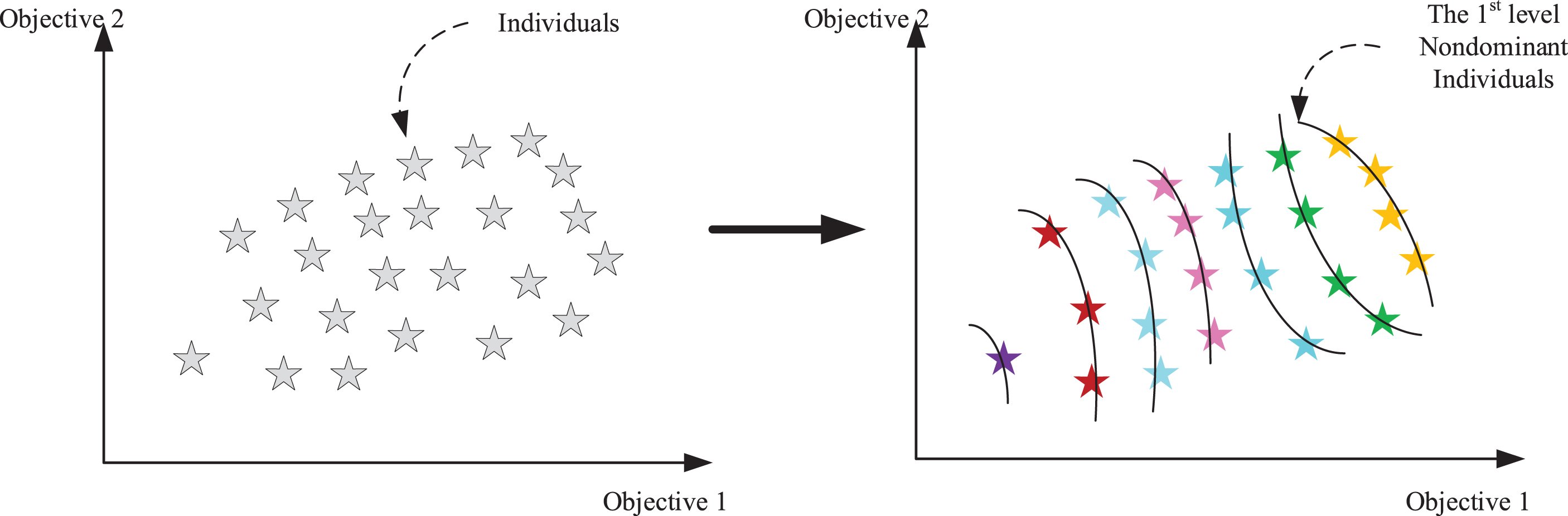
Non-dominant sorting process of individuals.
A large-tonnage crawler crane (LTCC) is a typical complex product. Compared to wheel cranes, LTCCs have some advantages such as larger lifting capacity, smaller ground pressure, and walking on load. LTCCs are widely used in many areas, such as the construction of nuclear power stations and the lifting of wind-driven generators. Figure 6 depicts the layout of an LTCC. As a complex product, the modular design is implemented in the R&D of the LTCC, which can effectively shorten the development lead-time and ensure the development quality. A module configuration problem considering the PEs of an LTCC is established to expound the effectiveness of the proposed methodology.

Layout illustration of a large-tonnage crawler crane (LTCC).
The 19 modules that are used in this study are illustrated in Fig. 6 and the related functions and module instances are listed in Table 1. As shown in Table 1,
Configurable modules and the related module instances
Configurable modules and the related module instances
The sales department receives an order for an LTCC for subway construction. Part of the product specification requirements are: the rated load lifting capacity is 180 t, the operation radius is 30 m, good appearance and maintainability, high security, operational comfort, technological reliability, long lifetime, the price is not more than RMB 5 million, and the delivery time should not be longer than three months. These requirements are represented as CR1 (lifting capacity), CR2 (appearance), CR3 (security), CR4 (maintainability), CR5 (operational comfort), CR6 (technological reliability), CR7 (lifetime), CR8 (price), and CR9 (date of delivery). The weights of these CRs are obtained by using a fuzzy analytic hierarchy process (FAHP), and the results are listed in Table 2.
Weights of the customer requirements (CRs)
Considering the PEs in product configuration, the evolution directions of the LTCC are discussed and formed. These directions are increasing intelligence level, the application of new materials, a more humanized design scheme, a much higher rate of resource utilization, and better environmental adaptation, which are represented as PE1, PE2, PE3, PE4, and PE5, respectively. Similarly, the related weights of PE i (i = 1, 2, ... , 5) are determined by FAHP, and the results are listed in Table 3.
Weights of the product family evolution issues (PEs)
As shown in Table 4, product managers are invited and investigated to determine the intuitionistic incidence matrix between module instances and CRs. Then, the CCD matrix between the modules and CRs is obtained according to Equations (2)–(7). The matrix is listed in Table 5.
Intuitionistic fuzzy incidence matrix between modules and CRs
Note: only part of the evaluation data is displayed to save space, the same is true for the following tables and figures. CR8: 10,000 ¥, CR9: month.
Comprehensive closeness density (CCD) matrix between modules and CRs
Similarly, the CCD matrix between module instances and PEs is determined, as shown in Table 6.
The CCD matrix between modules and PEs
The improved P-ACO algorithm is implemented to solve the model to simultaneously consider CRs and PEs. The algorithm is programmed using Python 3.6.4 on a computer with an Intel(R) Core(TM) i5-3210M CPU @ 2.50 GHz and 4.0 GB of RAM. First, the values of algorithm parameters were determined roughly through pre-experiment and the exact parameters were determined through comprehensive experiment to be the following: pheromone volatilization factor: 0.3; CR pheromone weights and PFE pheromone weights: 0.5; and population size: 200. In the random search phase, the parameters are determined to be as follows: total pheromone released by an ant in a trip: 2; and number of iterations: 5. In the probabilistic search phase, the parameters are determined to be as follows: total pheromone released by an ant in a trip: 2; and number of iterations: 200. As shown in Fig. 7, the values of the two optimization objectives stabilize at the 19th iteration.

Convergence process of two objectives.
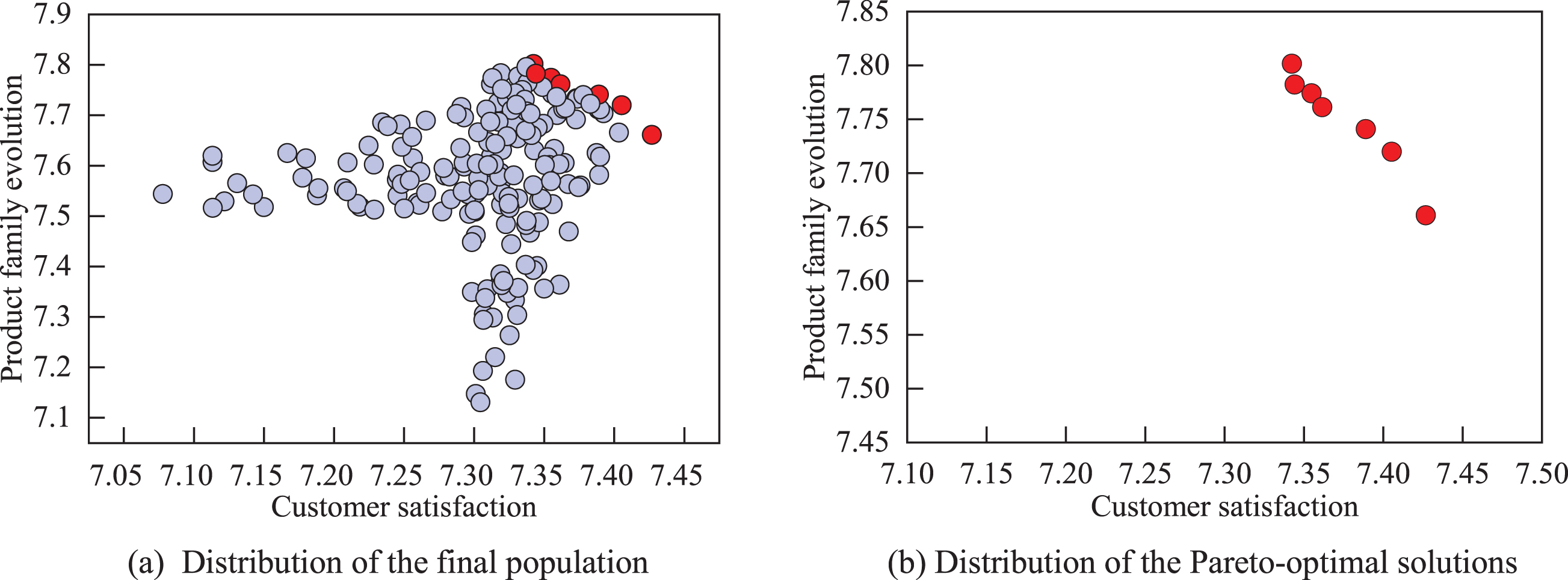
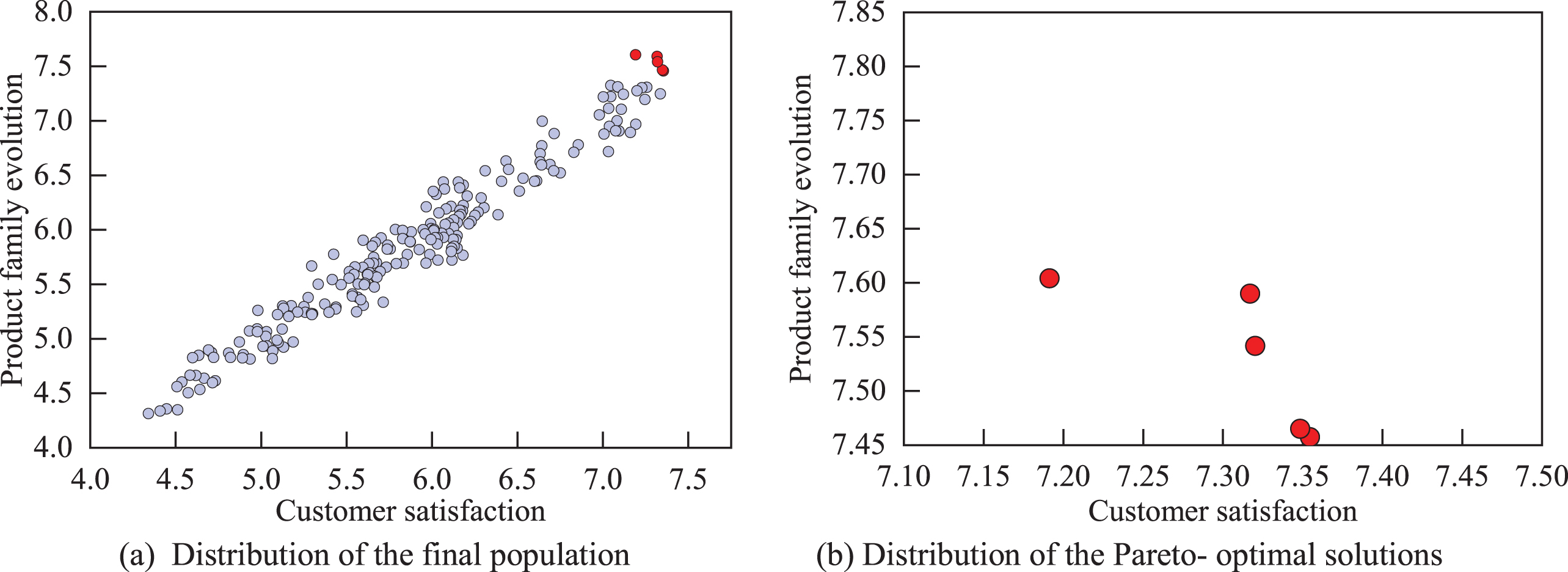
The population distribution after 200 iterations is depicted in Fig. 8. As shown in the figure, there are 19 solutions in the Pareto optimal solution set, which is elaborated in Fig. 9 and Table 7.
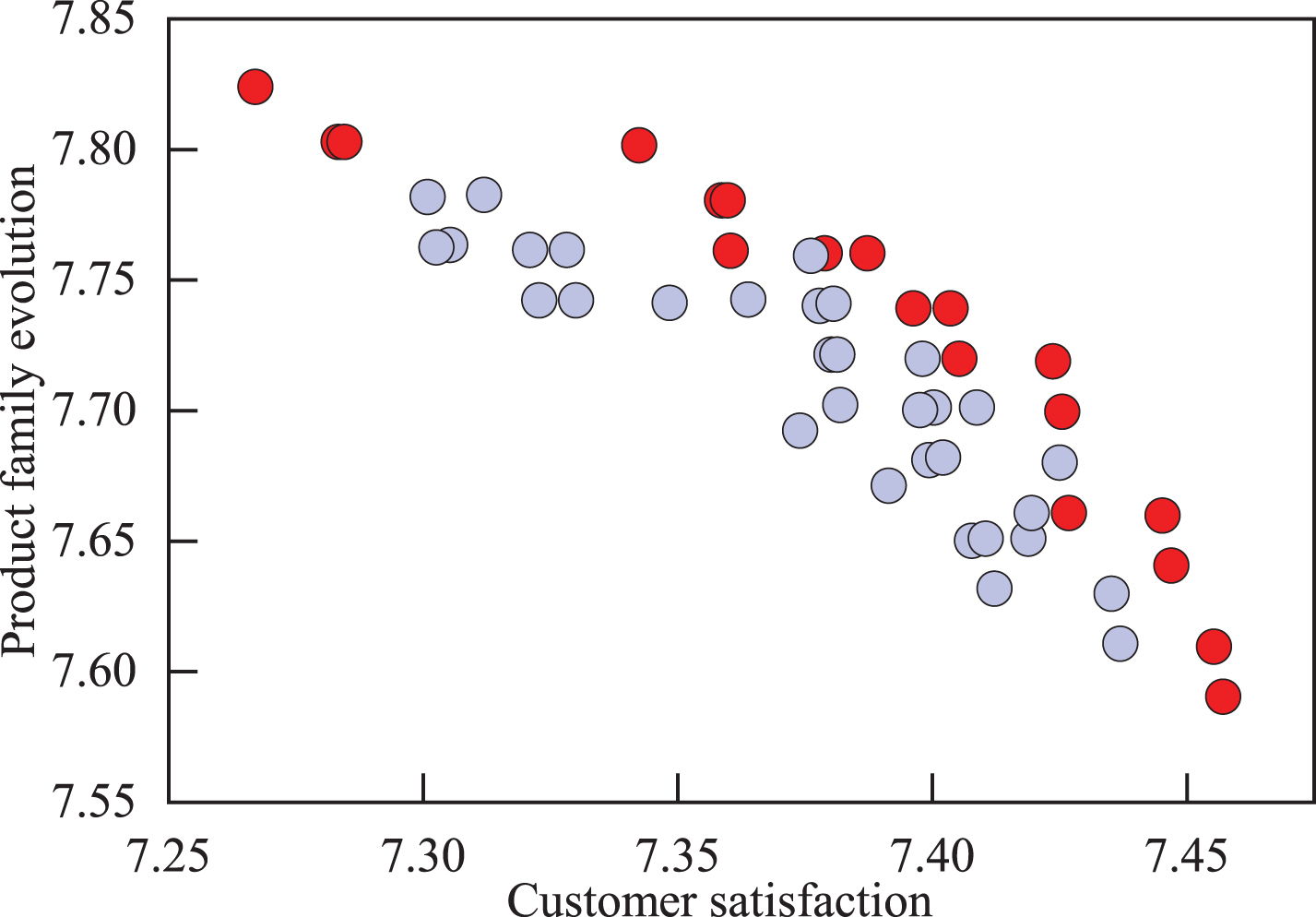
Distribution of the final population.
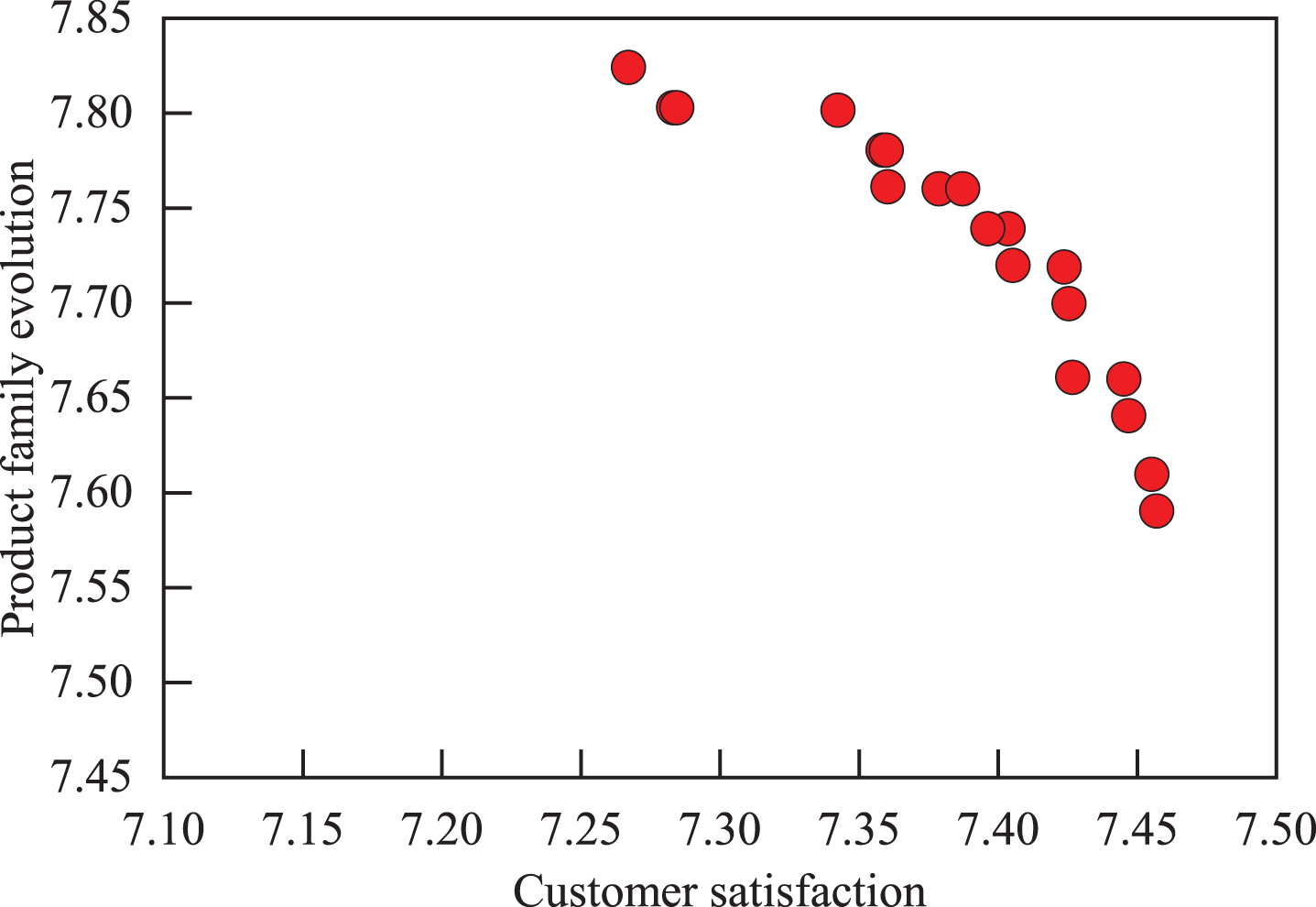
Distribution of the Pareto-optimal solutions.
Pareto-optimal solution set
Note: only part of the Pareto-optimal solution set is shown to save space.
As shown in Fig. 9, compared with the other solutions, the first solution has the best performance for the PFE objective, however also has the worst customer satisfaction. The second and third solutions have a similar PFE degree while the third solution has a larger customer satisfaction than the second. Meanwhile, the 17th and 19th solutions have a similar and relatively large customer satisfaction, yet the PFE degree of the 19th solution is not acceptable. To expound the performance of these solutions, the first and 19th solutions are compared. The performances of the first and 19th solutions are depicted in Fig. 10. As shown in the figure, the first solution has smaller values of price and date of delivery and larger values for each PFE dimension, which indicates that, for this solution, more time and cost are required to develop a product that is in accordance with the evolution trend. If the extra time and/or cost is not acceptable to the customers, the customer satisfaction will decline.
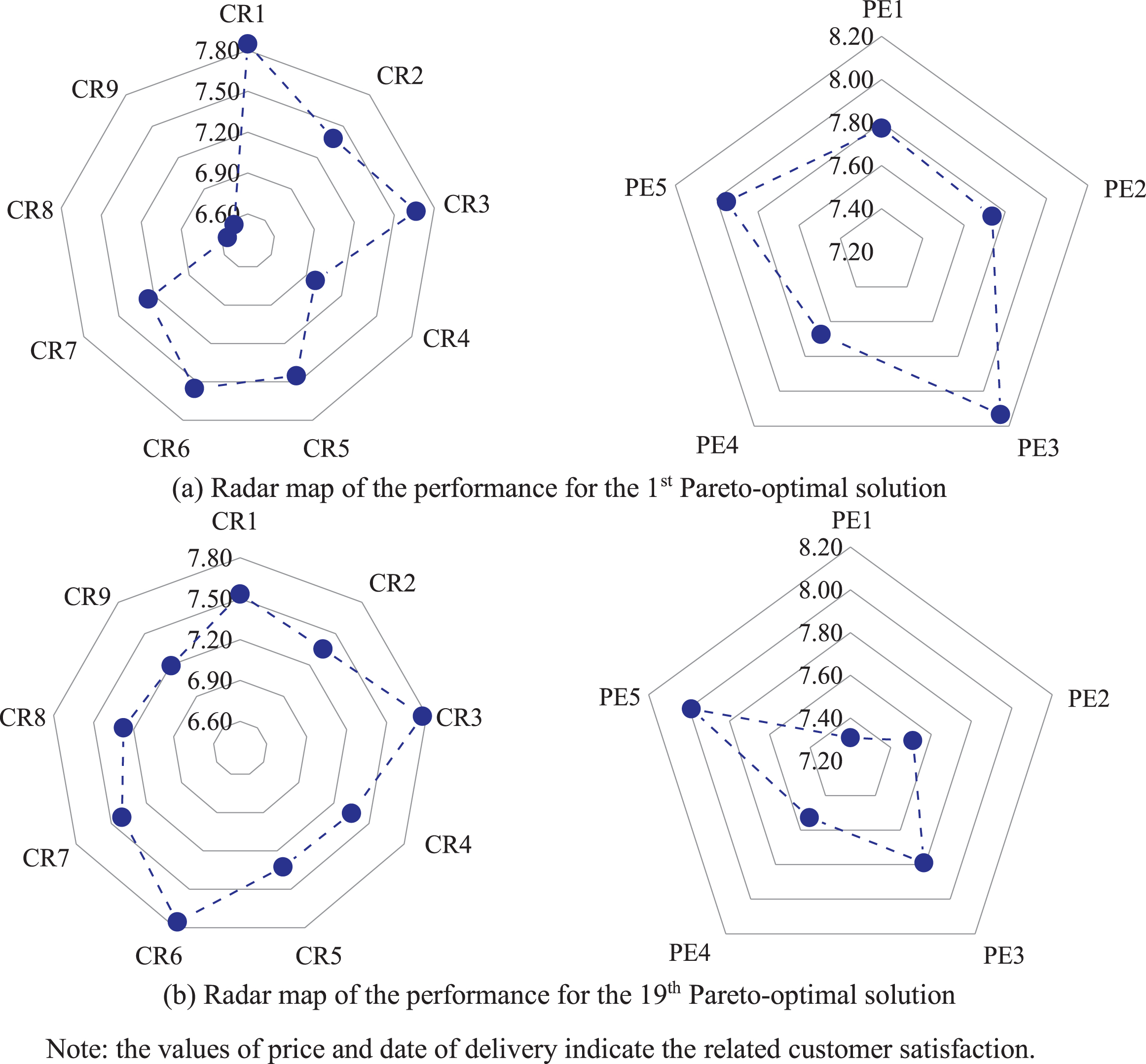
Radar map of the performance for the 1st and 19th solutions.
Comparison with single objective model
To demonstrate the effectiveness of the proposed method, only the CRs are considered in the optimization model, which is solved using the improved P-ACO algorithm. The optimal solution is solution a, which is shown in Fig. 11 (represented as a blue triangle) and detailed in Table 8. A radar map of the performance for solution a is illustrated in Fig. 12. From the figure, it can be seen that the performance on CRs is relatively high and the performances on intelligence level (PE1), applications of new materials (PE2), and resource utilization (PE4) are relatively low. Therefore, the configuration of solution a may be a disadvantage in future competition, which will lead to dissatisfaction from customers.
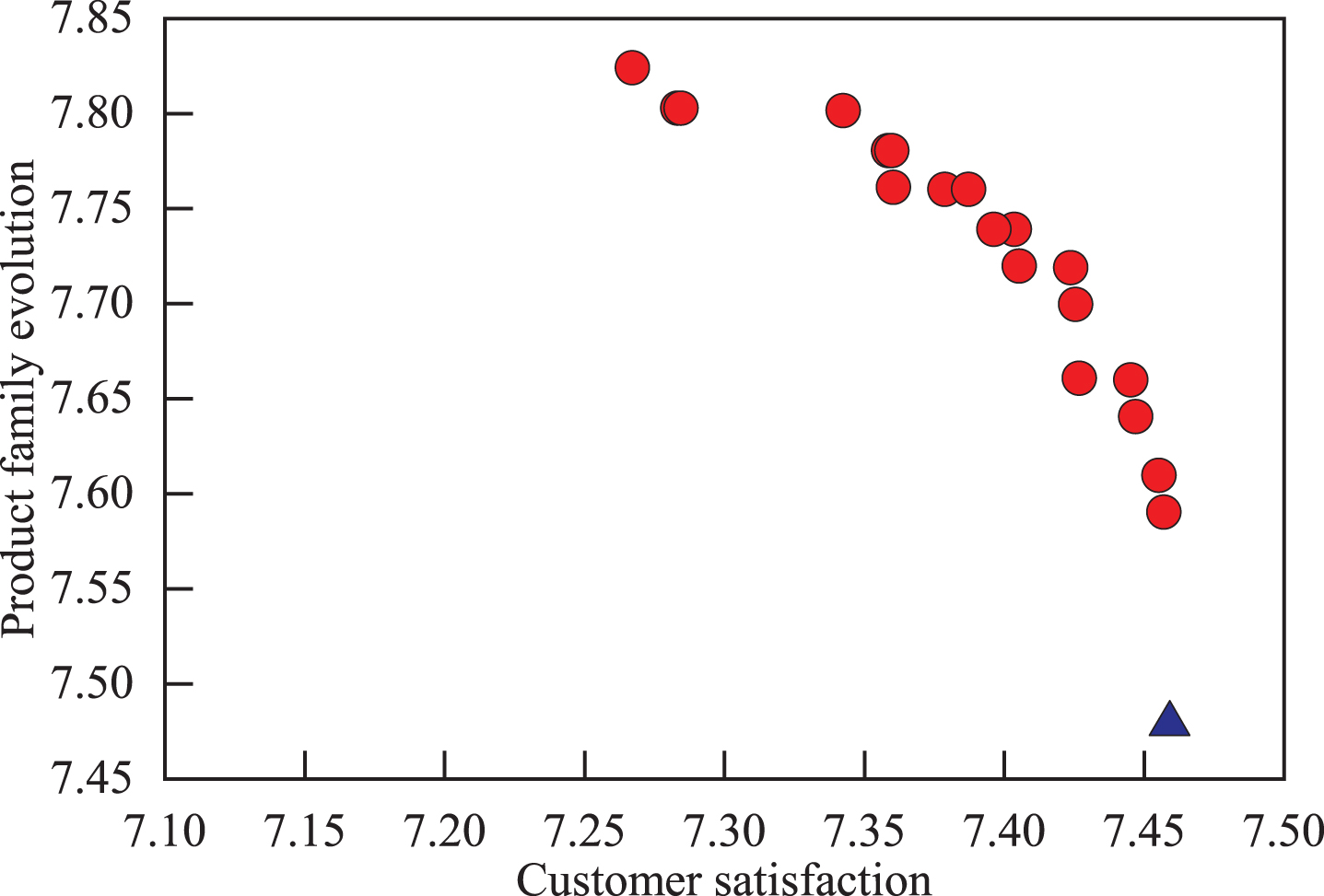
Optimization results considering CRs.
Configuration details of the optimal solution a considering CRs
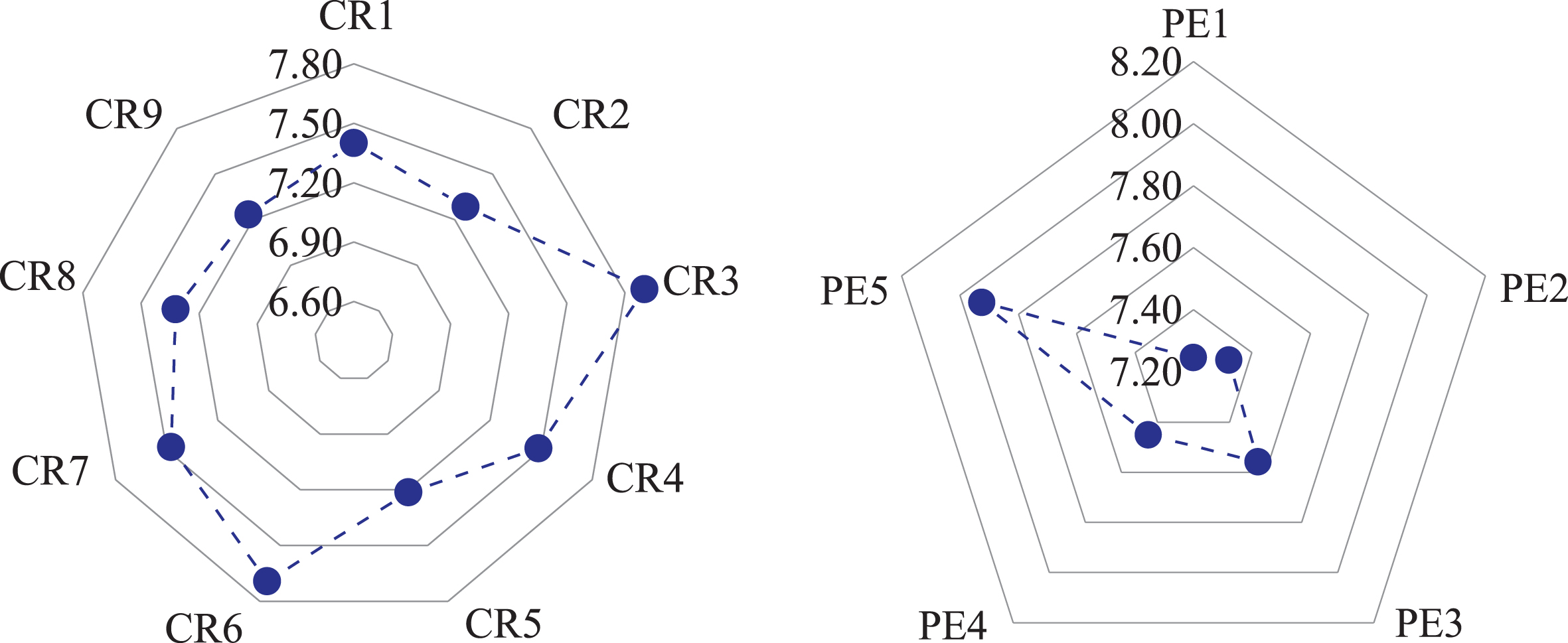
Radar map of the performance for solution a.
To overcome the above problems, CRs and PEs, which are defined as explicit requirements and implicit requirements, respectively, are considered in this study. The optimized results are a set of Pareto optimal solutions that outperforms on some CRs and/or PEs compared to a single configuration scheme. Customers can choose a configuration scheme from the optimized Pareto optimal solution set according to the performance and their individual preferences.
As discussed above, many algorithms are available for solving multi-objective models. To demonstrate the effectiveness of the proposed approach for solving the configuration model, in this work, the NSGA-II and PSO algorithms are implemented for comparative study. Based on the case study described above, the parameters of the PSO and NSGA-II algorithms are in accordance with the parameters of the improved P-ACO algorithm, such as population size and number of iterations. The related results are shown in Figs. 13–16.
Results obtained using the particle swarm optimization (PSO) algorithm.

Results obtained using the PSO algorithm.
Results obtained using NSGA-II.

Results obtained using NSGA-II.
As can be seen from Figs. 9, 13(b), and 15(b), the Pareto optimal solutions of the improved P-ACO algorithm are superior to those of the NSGA-II and PSO algorithms. The result shows that the improved method can search solution space sufficiently and find better global solutions. The observation that the improved method can enhance the global search capability can be explained by the fact that, in the process of solving the model using the improved P-ACO algorithm, the non-dominant solutions obtained from each iteration are stored in a set and are updated continuously. A comparison of the convergence processes of the three algorithms (Figs. 7, 14, and 16) shows that the convergence values of the proposed method are larger than those of the other two algorithms, and that the values acquired by the proposed method, the PSO algorithm, and the NSGA-II algorithm stabilize at the 19th, 164th, and 131st iterations, respectively; that is, the convergence rate of the improved P-ACO is faster than those of the other two algorithms. Therefore, the improved method can solve the model effectively. Although the solution speed of the proposed method is high, the number of optimal solutions is larger than in the other two algorithms; therefore, the proposed model may provide too much information to decision makers, potentially confusing them. Besides, the PSO and NSGA algorithms have five Pareto optimal solutions and the values of their maximum CR and PFE are very similar to the values of the improved P-ACO algorithm.
In this article, CRs and PEs are simultaneously considered to establish the module configuration of a complex product. The introduction of PEs can effectively decrease the risk of the product being outmoded and can thus assist the enterprise to provide a more competitive product. The conclusions of this article are as follows. Motivated by the product family evolution trend, the PEs are introduced into the module configuration problem, which can effectively enhance the flexibility and adaptability of the configuration scheme with respect to the dynamic environment; The module configuration of a complex product is modeled as a bi-objective (CRs and PEs) integer programming model. The CCD between CRs and PEs and modules is quantified by using the IFS, which is then defuzzied based on the set pair analysis; An improved P-ACO is designed to solve the proposed optimization model, and the obtained Pareto optimal solution in a case study is analyzed and compared with the results of traditional models.
This study is the first time that PEs have been introduced into the module configuration, and there are still many issues to address. For example, the product evolution should be separately analyzed in the temporal and spatial dimensions, and the interaction among customers should be considered when studying the CR evolution process.
Footnotes
Acknowledgments
This project was supported by the National Natural Science Foundation of China (Grant No. 51505480, 51875345).