



Abstract
Firefly algorithm (FA) is one of most important nature-inspired algorithm based on swarm intelligence. Meanwhile, FA uses the full attraction model, which results too many unnecessary movements and reduces the efficiency of searching the optimal solution. To overcome these problems, this paper presents a new job, how the better fireflies move, which is always ignored. The novel algorithm is called multiple swarm strategy firefly algorithm (MSFFA), in which multiple swarm attraction model and status adaptively switch approach are proposed. It is characterized by employing the multiple swarm attraction model, which not only improves the efficiency of searching the optimal solution, but also quickly finds the better fireflies that move in free status. In addition, the novel approach defines that the fireflies followed different rules in different status, and can adaptively switch the status of fireflies between the original status and the free status to balance the exploration and the exploitation. To verify the robustness of MSFFA, it is compared with other improved FA variants on CEC2013. In one case of 30 dimension on 28 test functions, the proposed algorithm is significantly better than FA, DFA, PaFA, MFA, NaFA,and NSRaFA on 24, 23, 23, 17, 15, and 24 functions, respectively. The experimental results prove that MSFFA has obvious advantages over other FA variants.
Introduction
Nature-inspired algorithms which developed by drawing inspiration from nature are efficient and powerful for solving nonlinear, multidimensional and complex optimization problems [1], such as classic particle swarm optimization algorithm [2], differential evolution algorithm [3], artificial bee algorithm [4], ant colony optimization algorithm [5], firefly algorithm [6], brain storm optimization algorithm [7], etc. Years ago, firefly algorithm (FA) which uses the flashing behaviour of swarming fireflies was proposed by yang (2008). Because of its global search and intensive local search capabilities, it has become an important optimization tools for solving complex real-world applications. For instance, big data optimization [8], RFID network planning with uncertainty [9], feature selection [10], the economic emissions load dispatch problem [11], software effort estimation models [12] and shop scheduling problems [13], etc.
However, FA adopts full attraction model, which causes too many unnecessary movements and reduces the efficiency of searching the optimal solution. Also, excessive movements of firefly lead to premature convergence of FA which causes trapping in local search. Therefore, many improved FA variants were proposed by scholars in different aspects [14]. Such as Wang et. al proposed neighborhood attraction model that selected brighter fireflies from a predefined neighborhood rather than those from the entire population [20], the experimental results indicated that this method enhances the performance of FA effectively. Wang et. al proposed another attraction model is that the brighter fireflies are replaced by randomly selected from the entire population [15], it decreases the attractions from N (N - 1)/2 to (N - 1)/2, so that it reduces the cost of the computational time successfully, but fewer attractions lead to low capability of it for exploiting a satisfactory solution.
Although it is difficult to control exploration and exploitation for nature-inspired algorithms [16], it is a remarkable fact that exploration and exploitation contribute robustness to all nature-inspired algorithms [17–19]. From exiting researches on evolutionary algorithms, such as a switch-mode firefly algorithm [21] and dynamic step factor [22] in parameters level modifications, firefly algorithm with chaos [23] and the firefly algorithm with Gaussian disturbance [24] in strategy level modifications, the hybrid PSO-GA [25] algorithm and GSA-GA algorithm [26] in hybrid level modifications, these presented some types of modifications to improve the performance of balance between the explorations and the exploitations of algorithms. The factors influence selection pressure, mutation or crossover operator, population size, the diversity and parament setting. The larger population size can explore the vaster search space efficiently, but without satisfactory solution, opposite to small population.
To enhance the performance of FA, a new multiple-swarm attraction model and a novel free strategy are proposed. The results of extensive experiments on 28 test functions [27] from CEC2013 test suite show that the proposed approaches have a better balance between exploitation and exploration than other advanced FA variants.
The main contributions of this paper are summarized as follows: The numbers of attraction is reduced and some unnecessary movements will be reduced, so the efficiency of searching the optimal solution is enhanced as the computation complexity is reduced. At the same time, the rewarded movements of the best individuals could speed up the convergence rate of proposed algorithm. Nevertheless, the probability of searching global optimal solution is increased. Tried new work on better fireflies how to move, which is always overlooked. It plays a vital role for adaptively balancing the exploration and the exploitation.
The remaining of this paper is organized as follows: Section 2 introduces literature review. The proposed algorithm is described in Section 3. Section 4 provides the results of experiments and analyses. Finally, conclusions is drawn in Section 5.
Literature review
Firefly algorithm
FA is one of nature-inspired algorithm which bases on swarm intelligence (SI) by flashing characteristics of the fireflies. It was proposed by Yang (2009) [6]. FA applies the attraction of light and attractiveness of fireflies that come from nature. Because of its SI-based and three explicit rules which are implemented easily, FA provides high efficiency so that it becomes more popular and widely used for solving nonlinear and large-scale optimization problems. Designed on this nature principle, three rules are determined:
1) For attracting each other purely by flashing characteristics of fireflies, all fireflies are unsex.
2) The attractiveness of firefly is proportional to its brightness, and decreases as its distance increases. The weak brightness is attracted by the brighter one. The brightest firefly random walks.
3) The fitness indicates the value of the objective function and is determined by the brightness of fireflies. For any fireflies x i and x j ,the movements of weak brightness firefly is calculated by:
x id (t) and x jd (t) is the d th dimension of firefly x i and x j in t th iteration. X id (t + 1) is the d th dimension of firefly x i in (t + 1) th iteration, which β0 is the attractiveness of x j at r = 0 for implementation β0 = 1. γ is an algorithm parameter which determines the degree in which the updating process depends on the distance between the two fireflies. β0 is set to 1. r ij is the distance between x i and x j . α is an algorithm parameter for the step length of the local search and ɛ () is a random vector of appropriate dimension with each component randomly generated from a uniform distribution between zero and one.
Initialize population and generate N fireflies X i , i = 1, 2, …, N;
Compute the fitness value of each firefly;
FEs=N, Input MaxFEs;
Generate a new firefly according to Eq.(3);
Evaluate the new solution;
Rank the fireflies and find best value;
t=t+1;
Output the best solution;
Since FA was proposed, many approaches have been suggested to improve the performance of FA. Wang et al.(2016) proposed an novel attraction model called Random attraction firefly algorithm (RaFA) [15], that randomly selected firefly attracts any other firefly from the whole population. It indicates that the efficiency of searching an optimal solution is improved wherea some unnecessary attractions decrease. However, too less attractions cause loss of its accuracy. To overcome this problem, the neighborhood attraction model has been proposed in [20], and firefly selected randomly in its neighbors not in the entire population. Although the ability of searching optimal solution is improved, the risk of trapping in local search is increased. In [28], a new attraction model and modified strategy for computing the attractiveness have been suggested. Firefly moves to a part of brighter fireflies. As its dynamics of learning objects, it obtains well performance for solving high dimensions optimization problems. In [29], a new simple attraction model FA called PAFA has been presented. Probability p has been proposed to satisfy the conditions for fireflies movement, which performs well at convergence rate. One of the weakness of this modification is the introduction of the new parameter p. In [30], the adaptive selection mechanism of luciferase inhibiting firefly has been introduced, which not only enhances the ability of searching, but also improves the efficiency of searching. It obtains good performance of balance between exploration and exploitation.
As well as we known, like all metaheuristic algorithms, the performance of FA highly depends on the parameter values. Some modified methods have been presented in parameters level [31–33]. The parameter α value determined the random movement step. If it is small then the solution jump in the neighborhood and if it is chosen to be large then it jump away from its neighborhood and explore the solution space. The parameter β value determined the step length of one firefly towards another firefly. In [31], the proposed algorithm is the classical one which dynamically adjust between parameter α and iteration t. For the dynamically value of α, it obtains well performance of balance between the exploration and the exploitation. Despite the increased computational cost, the global solution search capability has been surprisingly improved. Equation of new movement is suggested as follows:
In addition, other variety of approaches get good performance. In [34], to construct new firefly learning from the worst firefly or the best firefly for replacing the worst firefly, it preserves the diversity of the population successfully. Its disadvantage is that it is not efficient to find the best solution, because it has a high risk of moving in the wrong direction. In [35], to avoid premature convergence, gaussian bare-bones algorithm, which is better than neighborhood attraction model, has been proposed. For its move strategy, it explores more space of solution but with lowly satisfied solution. Meanwhile, gaussian distribution has been used to all fireflies movements in [24]. The performance of it is similar to GBFA [35]. A new strategy is shown in [36], fireflies are divided into two groups by define gender. Male fireflies and female fireflies attract each other in different ways. The advantage of it is that the efficiency of searching optimal solution is enhanced well in severing multimodal optimal problems. However, because of a small amount of attraction, it is easy to fall into local search.
Meteuristic algorithms were introduced in serving real-world application problems, such as in [37], the proposed algorithm applied to optimize the cost of the PSHT system incorporating solar units. In [38], an novel approach were suggested to solve the reliability redundancy allocation problems of series-parallel system under the various nonlinear resource constraints. In [39], an advanced algorithm were introduced to permit the reliability analyst to increase the performance of the system by utilizing the uncertain data. In [37], an novel algorithm called TVAC-PSO-MS were proposed in serving real-world application problems. Tt employees three-stage mutation strategy to improve the local best solutions obtained by TVAC-PSO which is achieved by varying the acceleration coefficients with iteration. The capability of search optimal solution is outperform, but the computational cost is increased.
From above all, obviously, most researches focus on how to achieve a good balance between exploration and exploitation. An attraction model changed because of both the structure of swarm and the number of attraction changing. The ability of exploration and exploitation are also determined by population size. Therefore, a novel multiple swarm attraction model is proposed; the number of attraction becomes small; the algorithm explores less search space but exploiting satisfactory solution. To improve the balance between exploration and exploitation, the proposed free firefly plays a role as exploration operator or exploitation operator in different require ends.
In the standard FA, there is an attraction between any two fireflies that results in too many unnecessary movements and reduces the efficiency of searching the optimal solution. Another disadvantage of standard FA is that the random movement of the best firefly has a limited ability to enhance its search for the optimal solution. For above considerations, we proposed multiple swarm attraction model and status adaptively switch approach. The multiple swarm attraction model not only improves the efficiency of searching the optimal solution, but also quickly finds the better fireflies that move in free status. The novel status adaptively switch approach defines that the fireflies followed different rules in different status, and can adaptively switch the status of fireflies between the original status and the free status to balance the exploration and the exploitation.
Multiple sub swarm attraction
The details of grouping process is that the population is divided into multiple sub swarm in each iteration firstly, the best individual in each sub swarm is selected to compose a new sub swarm that the better fireflies are rewarded for moving.
Function group = grouping(k,remain_group)
Randomly selecting k fireflies from remain_group;
Initialize group = zeros(num_group,k);
Composing group(i) with the remaining selected fireflies;
Composing group(i) with selected fireflies;
The grouping process of the population is shown in Fig. 1. Red circle represents the brightest firefly in each sub swarm, yellow circle indicates the brighter firefly in the sub swarm, green circle denotes the weak brightness firefly in the sub swarm. Each sub swarm containing k fireflies which are selected randomly from the whole population. The number of sub swarm is (N/k), and the best firefly in each sub swarm would be chosen into new sub swarm until no more fireflies can be chosen from the entire population. In the attraction model, the number of attraction is approximately reduced to N * k while the full attraction model is N * (N - 1)/2 in each iteration. The formula for calculating the total attraction is shown as follows:

The grouping process of population.
From the above, the number of attractions is reduced successfully. How does the proposed model to increase the efficiency of searching the optimal solution? The population is divided into multiple sub swarm in each iteration providing candidate of optimal solution. Although it is difficult to determine candidates are local optimal solution or global optimal solution, the chance of searching global optimal solution is significantly increased. Aiming to enhance the ability of global search, the best individual in each sub swarm is selected to compose a new sub swarm that the better fireflies are rewarded for moving. If the candidates conclude global optimal solution, the rewarded movements could speed up the convergence rate of the proposed algorithm.
In order to enhance the ability of global space search, all better fireflies have chance to random move that explore its solution space. However, too much random movement caused low satisfied solution. It is to say how to achieve a fit ratio between exploration and exploitation. For this reason, we suggest that each firefly has two status called original and free, but each firefly can only choose one of these status in each movement. The firefly movement in original status follows the rules of FA, while firefly in free status random moves following the proposed rules.
The movement process of sub swarm is shown in Fig. 2. In Fig. 2(a), the weak brightness firefly C which chooses original status moves to fireflies A and B that are better than the firefly C in the sub swarm. Fig. 2(b) is shown that firefly B moves to firefly A in original status, and it changes into free firefly while compared with firefly C and moves to another firefly which randomly selected from the entire population. In Fig. 2(c), firefly A change into free status moves to selected randomly two fireflies from the entire population. In short, each firefly has two opportunities to move because the method of selecting learning objects is different.
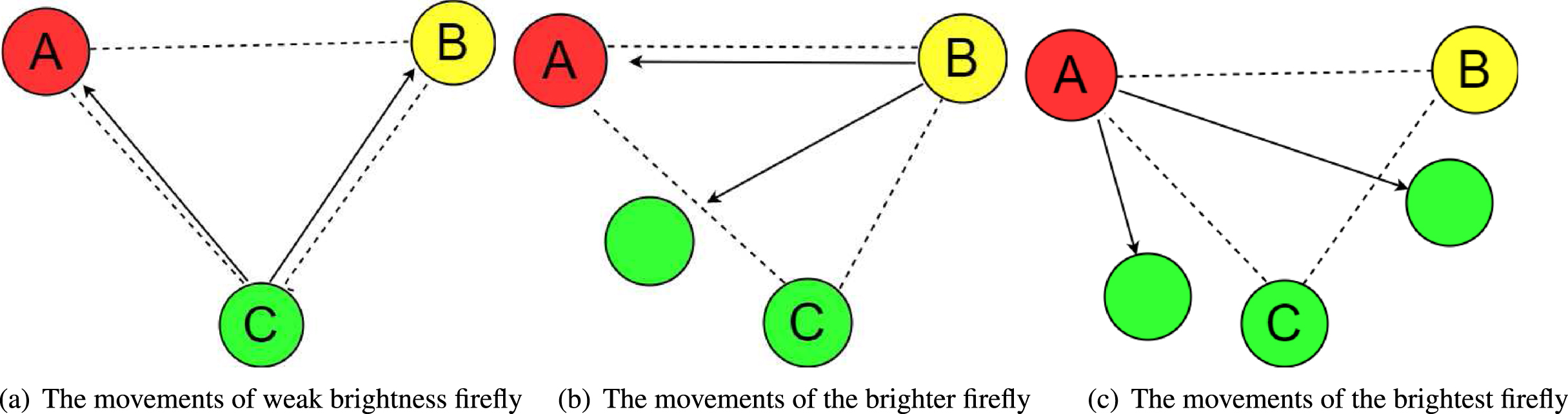
The movements process of sub swarm.
In each sub swarm, firefly x i compares with other firefly x j . x i in original status moves to x j while x j is brighter firefly, otherwise x i is firefly in free status. The movement in free status following such rules is shown as follows:
1) The free fireflies move to other fireflies which are randomly selected in population while compared with weak brightness fireflies. The free firefly moves to randomly selected firefly according to Eq. (8).
2) The brightness of free firefly is unchanged while the free firefly keeps on moving.
3) The fireflies with free status have a short memory to remember the position when it got the worst fitness, and the status of firefly returns to original status from free status While compared with brighter firefly.
How does the proposed approach to achieve a fit ratio between exploration and exploitation? The role of firefly switches between exploration operator and exploitation operator, different roles following different rules. Within two fireflies attraction, the weakness firefly plays the role of exploration operator which explores search space following FA rules, the better firefly plays role of exploitation operator which exploits satisfactory solution following proposed rules.
Initialize the population;
Compute the brightness of each firefly;
FEs=N;
Using Alg. ( 2) to group the population;
L = group(i,j);
M = group(i,z);
Evaluate the fitness of M from the worst brightness of its memory;
times(M)=0;
Evaluate the fitness of L according to Eq. (4);
Update position of L according to Eq. (8);
Record the worst position of L;
times(L)=times(L)+1;
the best firefly of each sub swarm is selected into remain_group;
Grouping the remain_group by Alg. (2);
Rank the fireflies and find best value;
t=t+1;
Output the best solution;
Meanwhile, the better firefly helps the weakness firefly in searching optimal solution for avoiding trap in local search space, the better firefly random moves for searching satisfactory solution. Once the weakness firefly gets optimal fitness, it may become a better firefly that plays a role as an exploitation operator. In contrast, the better firefly gets the weak position after its random moves, and it may become a weakness firefly that plays a role as exploration operator.
In addition, the parameter times are set to determine the movement step of better firefly and records the number of movement of better firefly keeps on. As times increases, there may be no better optimal solution in the population as the movement step of better firefly is increased for searching more space. Meanwhile, the better firefly may not be global solution because it is unnecessary to search more space around the position of better firefly, the maximum value of times is limited. Once the better firefly has moved with maximum times, it chooses the worst position from its history paths for evaluating the fitness of itself. This is often-used method for preserving the diversity of the population, which could avoid the population converges prematurely.
MSFFA consists of multiple swarm attraction model and status adaptively switch approach, with the multiple swarm attraction model in charge of fast finding the free firefly, the status adaptively switch approach in charge of determining which way for free firefly to move and when it returns original status. With well cooperation of these two approaches, MSFFA obtains robustness and achieves a prober ratio among exploration and exploitation. In addition, Cauchy jump [40] is used to increase the diversity of solution at each generation, enhancing the performance of MSFFA.
Experimental and results
Experiment preparation
To verify the performance of proposed algorithm, extensive experiments are performed in 28 test functions that come from CEC2013 [27]. In order to make the results close to reality, the average value of optimal comes from 30 independent runs indicated "MEAN", "STD" denotes to the standard deviation. To prove the effectiveness of proposed methods, FA with attraction model and strategy is compared with FA [6]. In order to analyze the performance of proposed approach more comprehensively, the experiments are compared with other algorithms in dimension 30, 50 and 100, respectively. The competitors include MFA [31], NaFA [20], DFA [41], PaFA [28] and NSRaFA [42].
In addition, in order to show the experiment results consistency, statistical analysis is conducted by Wilcoxon’s rank sum test and Friedman test. The Friedman test results are expressed as average ranks, and the Wilcoxon’s rank sum test results are represented by "+/≈/-". "+" means SASFA performs significantly better than the algorithm in the corresponding column, "≈" means equivalent to, and "-" means worse than. The optimal value for each function is shown in bold.
All experiments are performed on a computer with Inter Core i7-8700 CPUS, MATLAB language and Windows 10 platform is chosen for building experimental environment. First of all, in order to test which parameter settings of proposed algorithm is performed well, nine algorithms with different parameter settings are performed in CEC2013. The results are shown in Table 1.
Experimental results of MSFFA with different values of k, μ and Tmax
Experimental results of MSFFA with different values of k, μ and Tmax
How to find the best parameter combination which determines the performance of MSFFA is the first problem to be solved. From 6, it can be concluded that the smaller the parameter k, the less the number of attractions it is. So the value of k is between [2, 10], which is set to 3, 5, and 8 in testing, respectively. Both μ and times determine the step of movement of a better individual. For searching satisfactory solution around the position of a better individual, μ should be small between [0, 1], which is set to 0.025, 0.05, and 0.1 in testing, respectively. As times increases, there may be no better optimal solution in the population as the movement step of better firefly is increased for searching more space. Meanwhile, the better firefly may not be global solution because it is unnecessary to search more space around the position of better firefly, the maximum value of times is limited. From the above, times is set to 10, 30, and 50 in testing, respectively. In addition, some pre experiments have been performed with larger value of μ and unlimited value of times, which indicates the performance were not well. It is to say that the way of testing parameter is close to correct.
To efficiently find the best parameter combination, the Taguchi method in [43] is used, including a set of tables that enable main variables and interactions to be investigated in a minimum number of trials. We used L9(33) model which is designed by Minitab17 tool by which only 9 groups experiments are designed for optimum setting of control parameters. The orthogonal matrix of control parameters of k, μ, and times is (3, 0.025, 10), (3, 0.05,50), (3, 0.1, 30), (5, 0.025, 50), (5, 0.05, 30), (5, 0.1, 10), (8, 0.025, 30), (8, 0.05, 10) and (8, 0.1, 50), respectively. We can see the result shown in table 1 that the best combination is k = 5, μ=0.05 and Tmax=30, it obtains the lowest ranks of 3.21.
Meanwhile, MaxFES is set to 5.0E + 5 and N is set to 20 for all compared algorithms. The parameter setting of algorithms involved is shown in Table 2.
Parameters settings of compared algorithms
To test the performance of proposed approaches, FA with multiple swarm attraction model (MS+FA), FA with status adaptively switch approach (F+FA), and MSFFA are compared with FA respectively. The results of comparison with FA [6] are shown in Table 3. From the Wilcoxon’s sum test results which indicated by “+/≈/-”, multiple swarm attraction model is significantly better than FA on 22 functions except 6 functions (f2, f4, f5, f6, f8, f21). In this case, it not only reduces computation time, but also avoids algorithm falling into local space search successfully. FA with the status adaptively switch approach is better than FA on 14 functions. MSFFA wins FA out of 24 functions, and the results confirm that the status adaptively switch approach assist multiple swarm attraction model in enhancing the performance of balance between exploration and exploitation. From the Friedman test results, the average ranks of FA are 3.21. The proposed multiple swarm attraction model approach obtains average ranks of 2.02, and the best average ranks is 1.33 which is obtained by MSFFA. Obviously, the proposed algorithm combining the multi-subgroup attraction model with the status adaptively switch approach has achieved remarkable performance.
Experimental results of multiple swarm model, status adaptively switch approach, MSFFA and FA
Experimental results of multiple swarm model, status adaptively switch approach, MSFFA and FA
It can be concluded that each approach improves the performance of FA. Nevertheless, whereas combining multiple sub swarm attraction model with status adaptively switch approach, it obtains significantly better performance in the comparison.
Although the performance of MSFFA is significantly better than the standard FA, the computational cost of MSFFA is expensive. One reason is the population are grouped in each iteration. Introduced the new parameter times which records the number of random movement for all better fireflies is the other reason. However, MSFFA has fewer attractions than FA in each iteration. To verify the performance of MSFFA, we conduced comparison on runtime of FA and MSFFA. All experiments are performed on a computer with Inter Core i7-8700 CPUS, MATLAB language and Windows 10 platform is chosen for building experimental environment. Each algorithm is run 30 times per function, and the runtime of FA and MSFFA for all functions at D =30, 50 and 100 in one run is recorded. The experiments results are shown in Table 5.
Experimental results of all algorithms on 30 dimensions
Experimental results of all algorithms on 30 dimensions
runtime (in seconds) of FA and MSFFA for the execution of the program
From Table 5, the computational cost of MSFFA is similar to FA. It proves that the number of attractions is indeed reduced, which helps to obtain a good convergence rate. We can conclude that MSFFA enhance the efficiency of searching optimal solution.
In this section, to verify the robustness of the proposed an algorithm, FA and 5 modified FA variants were compared with MSFFA in different dimensions.
The results of tests on 30 dimensions are shown in Table 4. From the optimum value which is indicated in bold, MSFFA wins the first on 16 functions (f1, f3, f7, f11, f13, f14, f15, f16, f19, f20, f21, f22, f23, f24,f25, f28), the best value of 5 functions (f5, f8, f9, f10, f27) are obtained by MFA, NaFA wins the best performance on 3 functions (f12, f17, f18) as well as FA on 3 functions (f2, f4, f6), and DFA wins the first on 1 function (f26). Obviously, MSFFA has the better capability of global spatial search than compared algorithms. Considering both "MEAN" and "STD", the results of the comparison show that MSFFA is the winner and it obtains the best performance on 9 functions, MFA and FA perform better, and obtain the best value on 3 functions. Therefore, MSFFA is more stable than other competitors in searching optimal solutions.
From Friedman test which is expressed as average ranks, MSFFA obtains average ranks of 2.09 as the best value from the comparison, and the results denote that MSFFA obtains the best performance in the comparison. From the Wilcoxon’s sum test, MSFFA is better than FA and NSRaFA on 24 functions, and it is better than DFA and PaFA on 23 functions. Therefore, MSFFA is significantly better than these four algorithms. Compared with MFA and NaFA, MSFFA wins MFA on 17 functions and loses on 4 functions, and beats NaFA on 15 functions and loses on 5 functions, obviously, MSFFA is better than MFA and NaFA.
From the above, MSFFA achieves the best performance in comparison with these advanced algorithms whereas dimensions is set to 30.
The results of tests on 50 dimensions are shown in Table 6. From the Friedman test results, MSFFA obtains the best average ranks of 2.39, the worst average ranks is 5.89 which obtained by NSRaFA. The result indicates that MSFFA is significantly better than other six algorithms. From the Wilcoxon’s sum test results, the proposed approach wins MFA on 10 functions but loses by 9, and it wins NaFA on 8 functions but losing by 7. The result shows that MSFFA is still better than MFA and NaFA. MSFFA wins FA,DFA,PaFA and NSRaFA all over 20 functions. Therefore, the proposed algorithm is significantly better than these 4 competitors whereas the dimensions are set to 50.
Experimental results of all algorithms on 50 dimensions
Experimental results of all algorithms on 50 dimensions
In conclusion, the proposed algorithm obtains robustness in comparison with other competitors whereas the dimensions are set to larger.
For further comparison with these algorithms, the results of tests on 100 dimensions are displayed in Table 7.
Experimental results of all algorithms at 100 dimension
From the Friedman test results, the winner is MFA which obtains the best average ranks of 1.96, but MSFFA is still ahead of other 5 competitors and obtains the average ranks of 2.25, with the worst average ranks 6.61 obtained by FA. The results denote that MSFFA obtains better performance in comparison with other 5 algorithms except MFA. Through the Wilcoxon’s sum test, MSFFA wins FA on 26 functions, wins DFA on 21 functions, wins PaFA on 25 functions, and wins NSRaFA on 25 functions. The result denotes that MSFFA is significantly better than these 4 algorithms. From the above, MSFFA is still robust in comparison with most algorithms when dimensions are set to huge.
To give a intuitive comparison of these algorithms, Boxplots of the results of all algorithms running on 6 functions which covers all function styles are shown in Fig. 3. The mean value of all algorithms comes from Table 4, Table 6, and Table 7, respectively. As the dimensions increase, all algorithms present some outliers except for MSFFA, and MSFFA obtains the best value. It can be concluded that MSFFA is significantly better than other competitors because of higher and more stable accuracy values obtained on these functions.
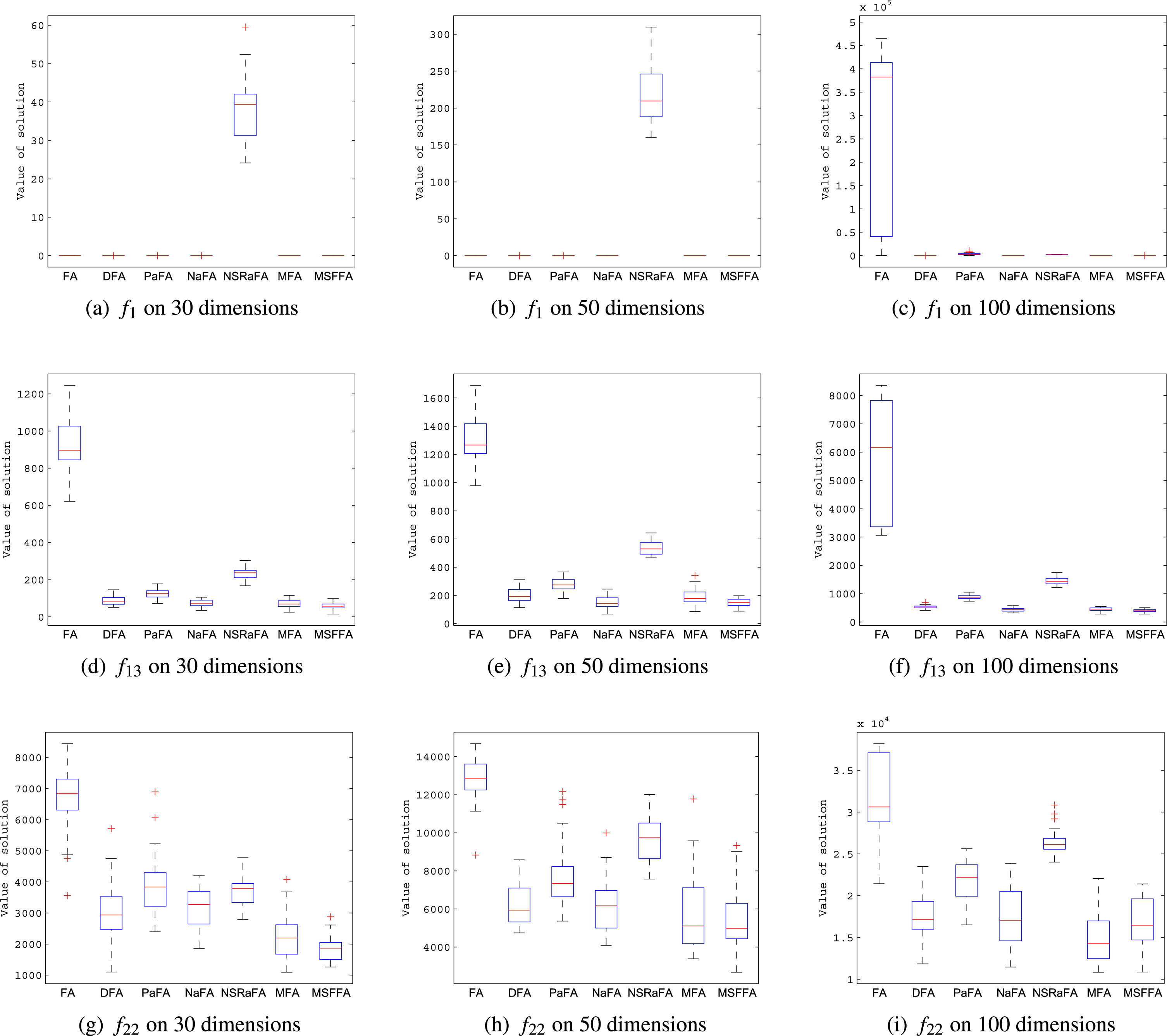
Boxplots of FA, DFA, PaFA, NaFA, NSRaFA, and MFA for some selected functions.
In conclusion, MSFFA is a new and effective algorithm for solving nonlinear, multidimensional and complex optimization problems.
As we all know, whereas MaxFEs is the same set for all algorithms, a better algorithm obtains both of fast convergence rate and high accuracy value. Therefore, how to accelerate the convergence of algorithms is one of the most important aspects of algorithms to obtain robustness.
The convergence rate of MSFFA in comparison with other six algorithms is shown in Fig. 4 which comes from Table 4. By comparing the mean error to the iteration, 6 functions covering all function types are selected for analyzing. f1 and f3 are unimodal functions, f13, f15 are basic multimodal functions, f22, f24 belong to composition functions.
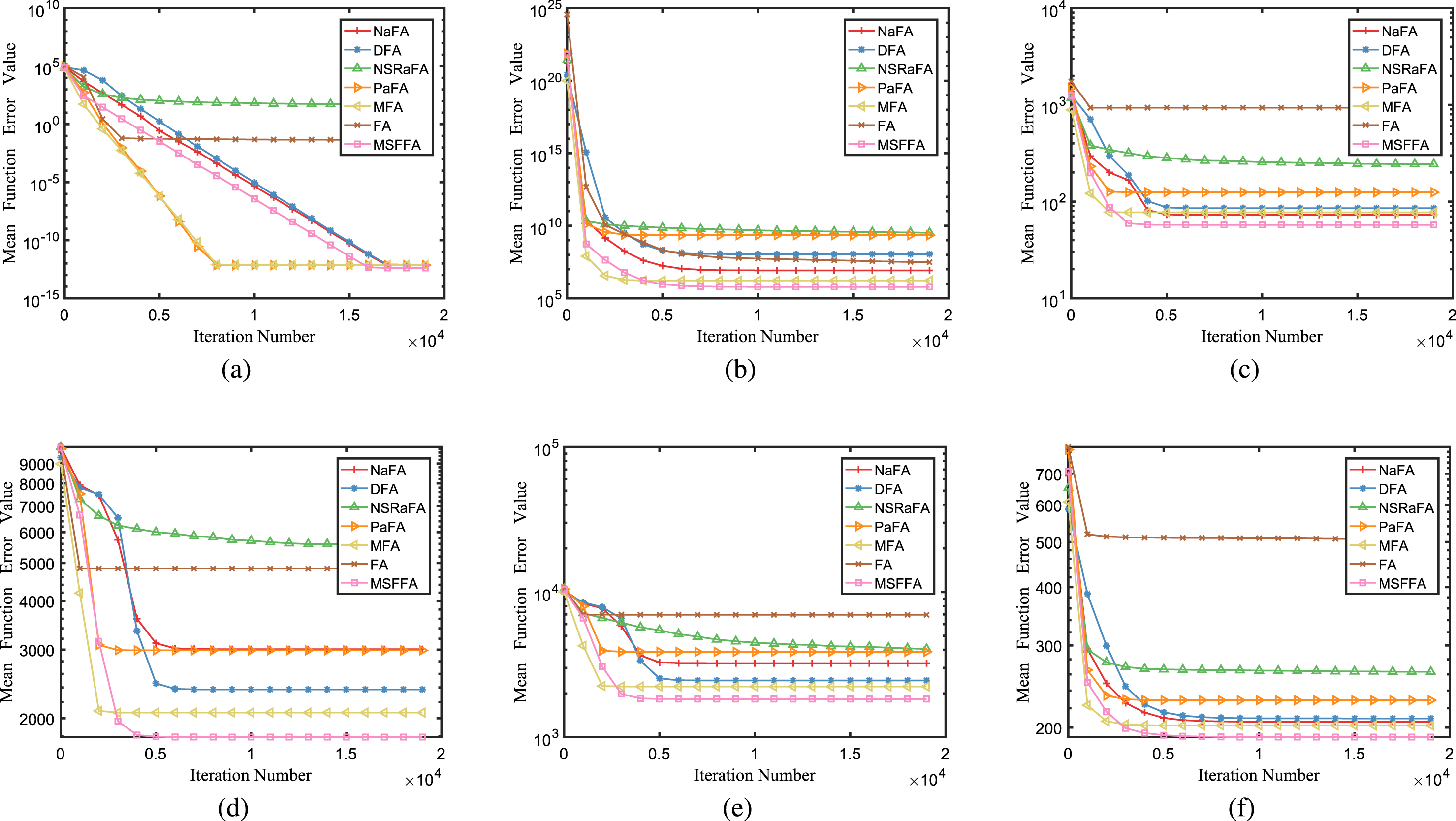
Convergence graphs of FA, DFA, PaFA, NaFA, NSRaFA, and MFA for some selected functions.
Obviously, the convergence rate of FA is slow and premature. Meanwhile, the precision of it is worse than other competitors. In the early stage of the search, MSFFA is the winner that is faster than all other algorithms on 2 functions (f3, f24), MFA wins the first on the rest of functions (f1, f13, f15, f22). In the middle stage, MSFFA is the winner that it is faster than every other algorithms on function f1, and MFA is still the winner of the rest of the functions. As the iteration grows, the convergence speed of all algorithms becomes the same, but the precision of MSFFA is the higher than all other competitors. Therefore, MSFFA achieves robustness for all classes of functions, outperforming other competitors in comparison.
From the results, it can be concluded that the proposed strategy plays a vital role in MSFFA, which achieves a fit ratio between exploration and exploitation.
In this paper, we proposed multiple swarm strategy firefly algorithm, which contains multiple swarm attraction model and status adaptively switch approach. In the proposed attraction model, the numbers of attraction of FA are reduced thus enhancing the efficiency of searching optimal solution and avoiding its premature convergence. In the suggested status adaptively switch approach, the role of firefly switches between exploration operator and exploitation operator, different roles following different rules. Within two fireflies attraction, the weakness firefly plays the role of exploration operator which explores search space following FA rules, the better firefly plays role of exploitation operator which exploits satisfactory solution following proposed rules. Meanwhile, the better firefly helps the weakness firefly in searching optimal solution for avoiding trap in local search space, the better firefly random moves for searching satisfactory solution. Once the weakness firefly gets optimal fitness, it may become a better firefly that plays a role as an exploitation operator. In contrast, the better firefly gets the weak position after its random moves, and it may become a weakness firefly that plays a role as exploration operator. For assisting in enhancing balance between exploitation and exploration, the maximum times of free firefly movements is set, besides the worst position for free firefly to selected, it preserves the diversity of the population. In order to verify the performance of MSFFA, it has been performed on CEC2013 and the results have been compared with other state of art algorithms, i.e., FA, DFA, MFA, NaFA, PaFA and NSRaFA. Aiming to show the experimental results consistency, Wilcoxon’s rank sum test and Friedman test were used to statistical analysis. Fortunately, the result of experiments shows that the proposed algorithm MSFFA achieves good performance and wins over other the compared algorithms. In the future, how to generalise our work to solve some real-world application problems remains an attractive topic.
Footnotes
Acknowledgments
This work is supported by the National Natural Science Foundation of China (No.61763019), the Science and Technology Plan Projects of Jiangxi Provincial Education Department (No.GJJ170963).