In this work, we have proposed a new relationship among rough set, soft set and quantales with the help of soft compatible relation. This typical relationship is used to approximate the fuzzy substructures in quantales in association with soft compatible relations by using aftersets and foresets. This type of approximation is extended notation of rough quantales, rough fuzzy subquantales and soft subquantales. We have corroborated this work by considering some test examples containing soft compatible relations over quantales. Moreover, by using soft compatible relations, we will describe the relationship between upper (lower) generalized rough fuzzy soft substructures of quantale and the upper (lower) approximations of their homomorphic images with the help of weak quantale homomorphism. The comparison of this type approximations and their results affirms the superiority of our new approximation method over current methods on the topic.
The rough approximations theory presented by Pawlak [22], finds its application in various problems such as image processing, data mining, medical informatics, pattern recognition, extracting interesting patterns in databases, in conjunction with other uncertain reasoning methods such as fuzzy logic, neural network and genetic algorithm. A rough set, is a formal approximation of a crisp set in terms of a pair of sets which give the lower and the upper approximation of the original set and these lower and upper approximation sets are crisp sets itself. In a rough set theory an equivalence relation palys a vital role while approximating a undefinable subset of universe. A rough fuzzy set is a pair of fuzzy sets resulting from the approximation of a fuzzy set in a crisp approximation space. In rough fuzzy set presented by Dubois and Prade [7], universal set and equivalence relation on it, is necessary. Generalized rough set [38] contains the concept of set valued mapping between two different sets instead of equivalence relation. That is T : U → P (V). For X ⊆ V, and are called the upper and lower generalized approximations of X and the pair is referred to as a generalized rough set. This generalized rough set is generalization of Pawlak rough sets. In this work, we have applied a way of carrying out approximation in a different way, which is again a generalization of Pawlak rough set and rough fuzzy set.
Thus, in this work by keeping above methods, we have taken Ω : H → P (K1 × K2), where H is a subset of E (parametersset). Then (Ω, H) is called a soft binary relation from a quantale K1 to K2. For a fuzzy subset ψ of K2, the lower approximation and the upper approximation of ψ with respect to the aftersets are the two fuzzy soft sets over K1, defined as follows:
Thus, rough fuzzy soft sets are obtained in association with soft compatible relations powered by aftersets. Further, these concepts are applied to quantales K1 and K2.
Quantales introduced by Mulvey [21], are a generalisation of locales. The aim behind this is to provide a constructive formulation of the foundations of quantum mechanics. There is a relation between quantale theory and linear logic introduced by Yetter [40] showed a complete class of models for linear intuitionistic logic. There are many research topics where quantales are employed like functional analysis, rough set theory [23, 39], theoretical computer science [28], algebraic theory [16], linear logic [8] and topological theory [9].
Molodtsov’s soft set theory [19] was proposed as a general scientific tool to manage vulnerability. Several algebraic operations in soft set theory, [18] were examined by Maji et al. and to consolidate the algebraic aspects of soft sets, some new operations were discussed by Ali et al., [5]. Soft set theory has been applied to many algebraic structures including soft modules [35], soft groups [2] and some contributions to soft groups [3], soft rings [1], soft ordered semigroups [4] etc.
Approximations by soft binary relations with the help of aftersets and foresets are extensively and considerably utilized these days. Kanwal and Shabir [11], at first, introduced approximation of ideals in semigroups by soft relations. Rough approximation of fuzzy substructures based on soft relations was introduced by Kanwal and Shabir [12]. Further, generalized approximation of substructures of quantales by soft relation, [13] was introduced Kanwal et al. Soft substructures of semigroups were approximated by soft binary relation by Kanawal and Shabir [14]. Roughness applied to a set by (α, β)-indiscernibility of Bipolar fuzzy relation were presented by Gul and Shabir [29]. Modified rough bipolar soft sets was introduced by Shabir and Gul [32].
The fuzzy set, introduced by Zadeh [41], had been applied to generalize the fundamental ideas of algebra. Fuzzy substructures in quantales were first investigated in [17]. They defined rough fuzzy substructures of quantale. Generalized rough fuzzy substructures in quantales were introduced by Qurashi and Shabir [23]. Generalization of approximation of fuzzy substructures in quantales in the form of (∈ , ∈ ∨ q) and (∈ γ, ∈ γ ∨ qδ) were studied by Qurashi and Shabir [25, 26]. Some results related to fuzzy hyperideals of hyperquantales [20], were introduced by Farooq et al. Several authors related fuzzy set theory to different algebraic structures like groups, rings, modules, semirings, semigroups and ordered semigroups, etc. Rough Pythagorean fuzzy ideals in semigroups, [10] were discussed by Hussain et al. Fuzzy idempotent near-ring was studied by Hussain and Shabir [33]. Some studies about regular and intra-regular semirings in terms of bipolar fuzzy ideals [34], was investigated by Shabir et al. Rough fuzzy ternary subsemigroups based on fuzzy ideals with three-dimensional congruence relation was studied by Bashir et al., [6].
In this paper, we have explored the approximation of fuzzy substructures of quantales with respect to soft binary relations powered by foresets and aftersets. In recent years, several methods have been proposed to delve into approximations of algebraic and fuzzy algebraic structures but as far as we know, this technique is novel and has not been employed for quantale.
The whole paper is organized as follows. After introduction, some related definitions and results are presented in Section 2 while Section 3 presents approximations by soft compatible relations with respect to a fuzzy subset with the help of aftersets and foresets and in this way fuzzy soft sets are obtained. These concepts are applied to fuzzy substructures of quantales in Section 4 and generalized rough fuzzy soft substructures in quantales are obtained. Moreover, under quantale homomorphism, relation between lower and upper approximations of fuzzy soft substructures of quantales and the lower (upper) approximations of their images under quantale homomorphism are discussed in Section 5.
Preliminaries
Some definitions which are basic in nature and are related to next sections, are given in the following.
Definition 1. [30] A complete lattice K having associative binary operation ⊗ is called a quantale if for all w, z ∈ K and {zi} , {wi} ⊆ K (i ∈ I). The following hold;
Let Xi, X1, X2 ⊆ K. Then the following are defined;
Let K be a quantale and ∅ ≠ K1 ⊆ K. Then K1 is a subquantale of K if it is closed under arbitrary sup and ⊗.
Throughout the paper, the symbol K1 and K2 will be utilized for quantales, the symbol ⊤ will denote the top element and ⊥ will stand for the bottom one for quantales, unless stated otherwise.
Now, some definitions about ideals, fuzzy ideals of quantale and some examples of them are given in the following.
Definition 2. [36] Let K be a quantale and ∅ ≠ I ⊆ K is called an ideal of K if the conditions below are satisfied:
(i) If z,w ∈ I, then z∨ w ∈ I ;
(ii) for all z, w ∈ K and w ∈ I such that z ⩽ w implies z∈ I ;
(iii) for all z ∈ K and w ∈ I implies z ⊗ w ∈ I and w ⊗ z ∈ I.
Let I be an ideal of a quantale K. Then, I is said to be a prime ideal if z ⊗ w ∈ I implies z ∈ I or w ∈ I for all z, w ∈ K. An ideal I is said to be a semi prime ideal if z ⊗ z ∈ I implies z ∈ I for each z ∈ K.
Definition 3. [41] A function ψ : K ⟶ [0, 1] is known as fuzzy subset of K. For α ∈ [0, 1], the sets ψα ={ k ∈ K ∣ ψ (k) ≥ α } ; ψα+ ={ k ∈ K ∣ ψ (k) > α } are called, α-cut and strong α-cut of the fuzzy subset ψ, respectively.
Definition 4. [7] Let (X, Ω) be an approximation space where X is a non-empty set and Ω is an equivalence relation on X. A fuzzy subset ψ is a mapping from X to [0, 1] then for x ∈ X, we define
They are called, the lower and upper approximations of ψ, respectively. If , then is called a rough fuzzy set with respect to Ω.
If ψ1 and ψ2 are the fuzzy subsets of K. Then, ψ1⊆ ψ2 if and only if ψ1 (z) ≤ψ2 (z) for all z ∈ K. Also (ψ1 ∩ ψ2) (z) = Min {ψ1 (z) , ψ2 (z)} and (ψ1 ∪ ψ2) (z) = Max {ψ1 (z) , ψ2 (z)} for all z ∈ K. Throughout this paper, Min for infimum and Max for maximum in [0, 1] will be employed, while the symbols ∧ and ∨ will be utilized for infimum and supremum for the elements of K. Moreover, we will express fuzzy subset, fuzzy subquantales, fuzzy ideals, fuzzy prime and fuzzy semi-prime ideals by fsst, fsq, fid, fpid and fspid, respectively unless stated otherwise.
Definition 5. [25] Let ψ be a fsst of a quantale K. Then ψ is a fsq of K if
(i) ψ (∨ i∈Izi) ≥ ψ (zi) ;
(ii) ψ (y ⊗ z) ≥ Min {ψ (y) , ψ (z)} for all {zi} ⊆ K (i ∈ I) and for all z, y ∈ K.
Definition 6. [17] A non-empty fsstψ of K is called a fid of K, if the following conditions are satisfied;
(i) z≤ w ⇒ ψ (w) ≤ ψ (z) ;
(ii) Min {ψ (z) , ψ (w)} ≤ψ (z∨ w) ;
(iii) Max {ψ (z) , ψ (w)} ≤ψ (z ⊗ w) for all z, w ∈ K.
From (i) and (ii) in Definition 6, it is observed that ψ (z ∨ w) = Min {ψ (z) , ψ (w)} for all z, w ∈ K. Thus, a fsstψ of K is a fid of K if and only if ψ (z ∨ w) = Min {ψ (z) , ψ (w)} and ψ (z ⊗ w) ≥ Max {ψ (z) , ψ (w)} for all z, w ∈ K.
Definition 7. [17] A non-constant fidψ of a quantale K is called a fpid of K if ψ (z ⊗ w) = ψ (z) orψ (z ⊗ w) = ψ (w) for all z, w ∈ K.
Definition 8. [17] Let ψ be a fid of a quantale K. Then ψ is called a fspid of K if ψ (z ⊗ z) = ψ (z) for all z ∈ K.
Definition 9. [31] A pair (Ω, A) is called a fuzzy soft set over U if Ω is a mapping given by Ω : A → ₣(U) and A is a subset of E (the set of parameters) and ₣(U) is the set of all fuzzy subsets of U.
Definition 10. [31] Let (Ω, A) and (Γ, B) be two fuzzy soft sets over a common universe U. Then (Ω, A) is a fuzzy soft subset of (Γ, B) if
(1) A ⊆ B and
(2) Ω (e) is a fuzzy subset of Γ (e) for all e ∈ A.
(Ω, A) and (Γ, B) over a common universe U are said to be fuzzy soft equal if (Ω, A) is a fuzzy soft subset of (Γ, B) and (Γ, B) is a fuzzy soft subset of (Ω, A).
For convenience, we employ FSS, FSTQ, FSTI, FSTPI and FSTSPI for fuzzy soft set, fuzzy soft quantale, fuzzy soft ideal, fuzzy soft prime ideal and fuzzy soft semi-prime ideal.
Definition 11. Let K be a quantale and (Ω, A) be a FSS over K. Then
(1) (Ω, A) is called a FSTQ over K if Ω (e) is a fsq of K for all e ∈ A with Ω (e) ≠ ϕ.
(2) A FSS, (Ω, A) over a quantale K is called a FSTI over K if Ω (e) is a fid of K for all e ∈ A with Ω (e) ≠ ϕ.
(3) A FSS, (Ω, A) over a quantale K is called a FSTPI over K, if Ω (e) is a fpid of K for all e ∈ A with Ω (e) ≠ ϕ. A FSS, (Ω, A) over a quantale K is called a FSTSPI over K, if Ω (e) is a fspid of K for all e ∈ A with Ω (e) ≠ ϕ.
Definition 12. [13] A soft binary relation Ω from a quantale K1 to K2 is called soft compatible if (a, b) , (c, d) ∈ Ω (u) ⇒ (a ⊗ c, b ⊗ d) ∈ Ω (u) and also (ai, bi) ∈ Ω (u) ⇒ (∨ i∈Iai, ∨ i∈Ibi) ∈ Ω (u) for all a, c, ai ∈ K1 and b, d, bi ∈ K2 (i ∈ I) and for all u ∈ A.
Definition 13. [13] Let (Ω, H) be a soft compatible relation from a quantale K1 to K2. Then (Ω, H) is called soft ∨-complete and soft ⊗-complete with respect to aftersets if
(1) aΩ (u) ∨ bΩ (u) = (a ∨ b) Ω (u) and
(2) aΩ (u) ⊗ bΩ (u) = (a ⊗ b) Ω (u) for all a, b ∈ K1 and for all u ∈ H.
If it is both ∨-complete and ⊗-complete, then it is called a soft complete relation with respect to aftersets. Similarly, one can define Definition 13 but for the foresets.
Roughness of a fuzzy set by soft relations
In this section, while using two quantales, foresets and aftersets are applied to find out approximations of fssts in two ways with the help of soft binary relations from K1 and K2. That is by taking the fsst of a quantale K2 and then evaluating their lower and upper approximations by aftersets, the resulting fsst of K1 are obtained. Likewise, for fsst of K1 and by taking their lower and upper approximations by foresets, the resulting fsst of K2 are obtained.
Definition 14. [15] Let Ω : H → P (K1 × K2), where H is a subset of E (parametersset). Then (Ω, H) is called a soft binary relation from a quantale K1 to K2. For a fsstψ of K2, the lower approximation and the upper approximation of ψ with respect to the aftersets are the two FSS over K1, as defined follows:
and
And for a fsst, η of K1, the lower approximation and the upper approximation of η with respect to the foresets are the two FSS over K2, as defined follows:
and
for all u ∈ H, where k1Ω (u) = {k2 ∈ K2 : (k1, k2) ∈ Ω (u)} and is called the afterset of k1 and Ω (u) k2 ={ k1 ∈ K1 : (k1, k2) ∈ Ω (u) } and is called the foreset of k2. Moreover, , and for each ψ ∈ ₣(K2) and η ∈ ₣(K1) , respectively.
Theorem 1.[15] Let (Ω, H) and (Γ, H) be two soft binary relations from non-empty sets K1 to K2 and ψ1, ψ2 be non-empty fsst of K2. Then the following hold:
(1) for all u∈ H ;
(2) for all u∈ H ;
(3)
(4)
(5)
(6)
(7) (Ω, H) ⊆ (Γ, H) implies
(8) (Ω, H) ⊆ (Γ, H) implies .
Theorem 2.[15] Let (Ω, H) and (Γ, H) be two soft binary relations from non-empty sets K1 to K2 and ψ1, ψ2 be non-empty fsst of K1. Then the following hold:
(1) ψ1≤ ψ2 ⇒ for all u∈ H ;
(2) ψ1≤ ψ2 ⇒ for all u∈ H ;
(3)
(4)
(5)
(6)
(7) (Ω, H) ⊆ (Γ, H) implies
(8) (Ω, H) ⊆ (Γ, H) implies .
The following result follows from parts (7) and (8) of Theorem 1.
Theorem 3.Let (Ω, H) and (Γ, H) be soft binary relations from K1 to K2. If ψ is a fsst of K2. Then
(1) .
(2) .
The following example shows that the equality does not hold in above Theorem 3.
Example 1. Let K1 = {⊥ 1, b, ⊤ 1} and K2 = {⊥ 2, u, v, ⊤ 2} be two complete lattices shown in Fig. 1 and Fig. 2 with the binary operations shown in Tables 1 and 2, respectively. Then K1 and K2 are quantales. Let H = {u1,u2} andΩ : H ⟶ P (K1 × K2) and Γ : H ⟶ P (K1 × K2) be defined by:
Illustration of K1.
Illustration of K2.
Binary operation cirle-1 subject of K1
⊗1
⊥1
b
⊤1
⊥1
⊥1
⊥1
⊥1
b
⊥1
b
b
⊤1
⊥1
b
⊤1
Binary operation cirle-2 subject of K2
⊗2
⊥2
u
v
⊤2
⊥2
⊥2
u
v
⊤2
u
⊥2
u
v
⊤2
v
⊥2
u
v
⊤2
⊤2
⊥2
u
v
⊤2
The aftersets with respect to Ω (u1) and Γ (u1) are as follows,
and
Define ψ1 : K2 ⟶ [0, 1] by,
Then ψ1 is a fsst of K2, but
This shows that
Now, define ψ2 : K2 ⟶ [0, 1] by
Then ψ2 is a fsst of K2. However,
This shows that
The following result follows from parts (7) and (8) of Theorem 2.
Theorem 4.Let (Ω, H) and (Γ, H) be soft binary relations from non-empty sets K1 to K2. If η is a fuzzy subset of K1, then
(1) ;
(2).
The following example shows that the equality does not hold in above result.
Example 2. Consider the quantales in Example 1. Let H = {u1,u2} , Ω : H ⟶ P (K1 × K2) and Γ : H ⟶ P (K1 × K2) be soft binary relations defined by
The foresets with respect to Ω (u1) and Γ (u1) are as follows;
and
Define η1 : K1 ⟶ [0, 1] by
Then η1 is a fsst of K1. However,
This shows that
Now define η2 : K1 ⟶ [0, 1] by
Then η2 is a fsst of K1 but,
This show that,
Approximation of fuzzy substructures in quantale
In this section, we are considering soft compatible relations by taking two different quantales. By taking the fuzzy substructures of quantale K2, their lower and upper approximations by aftersets, the resulting fuzzy substructures of K1 are obtained. Moreover, for fuzzy substructures of K1, their lower and upper approximations by foresets, the resulting fuzzy substructures of K2 are obtained.
In the next, the following shortened form SBR, SCR, SCTR and FSSQ will be used for "soft binary relation from a quantale K1 to a quantale K2 ", "soft compatible relation from a quantale K1 to a quantale K2 ", "soft complete relation from a quantale K1 to a quantale K2 " and fuzzy soft subquantale, respectively.
Definition 15. Let (Ω, H) be a SBR and ψ be a non-empty fsst of K2. Then ψ is said to be generalized upper (lower) rough fuzzy soft subquantale (ideal) ofK1 with respect to the aftersets if the upper approximation is a fuzzy subquantale (fuzzy ideal) of K1 for any nonempty fsst ψ of K2. Likewise, let ψ be a non-empty fsst of K1 and (Ω, H) be a SBR. Then ψ is said to be generalized upper (lower) fuzzy soft subquantale (ideal) ofK2 with respect to the foresets, if the upper approximation is a fuzzy subquantale (fuzzy ideal) of K2 for any nonempty fsst ψ of K1.
Theorem 5.Let (Ω, H) be a SCR and ψ be a fsq of K2. Then ψ is a generalized upper rough FSSQ of K1 with respect to aftersets.
Proof. As ψ is a fsq of K2, so we have ψ (∨ i∈Ipi) ≥ ψ (pi) and ψ (p ⊗ 2t) ≥ Min {ψ (p) , ψ (t)} ∀ p, t, pi ∈ K2. Since (Ω, H) is a SCR, so we have p1Ω (u) ∨ p2Ω (u) ∨ . . . ∨ piΩ (u) ⊆ (∨ i∈Ipi) Ω (u) for all u ∈ H and pi ∈ K1 (i ∈ I).
Let ai ∈ K1 for some i ∈ I. Then
Hence ∀ ai ∈ K1 and for all u ∈ H.
As (Ω, H) SCR, we have aΩ (u) ⊗ bΩ (u) ⊆ (a ⊗ b) Ω (u) for all a, b ∈ K1 and for u ∈ H.
Consider a, b ∈ K1 and
Hence ∀ a, b ∈ K1. Thus is a FSSQ of K1. □
The next example shows that the converse of Theorem 5 do not hold in general.
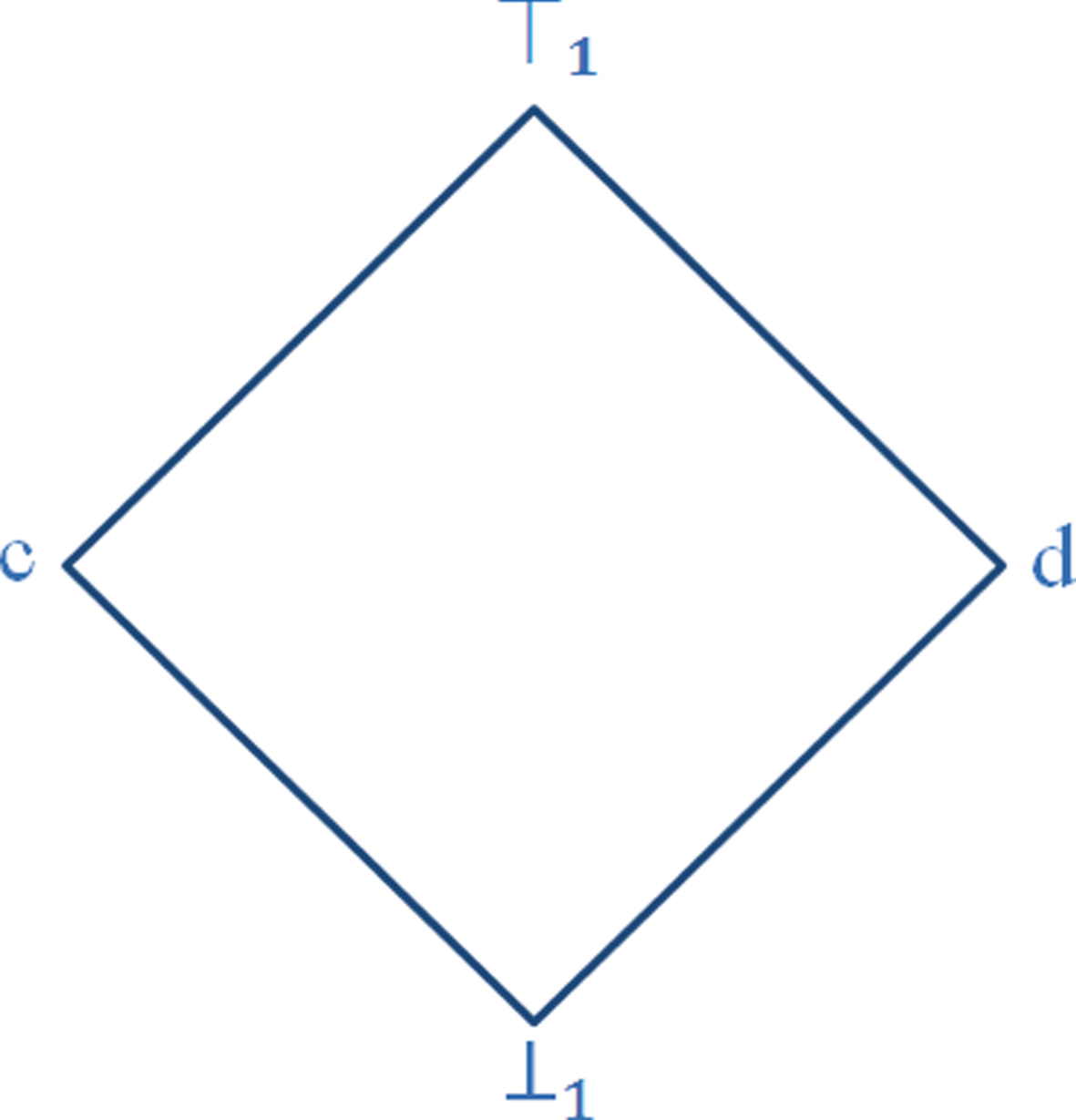
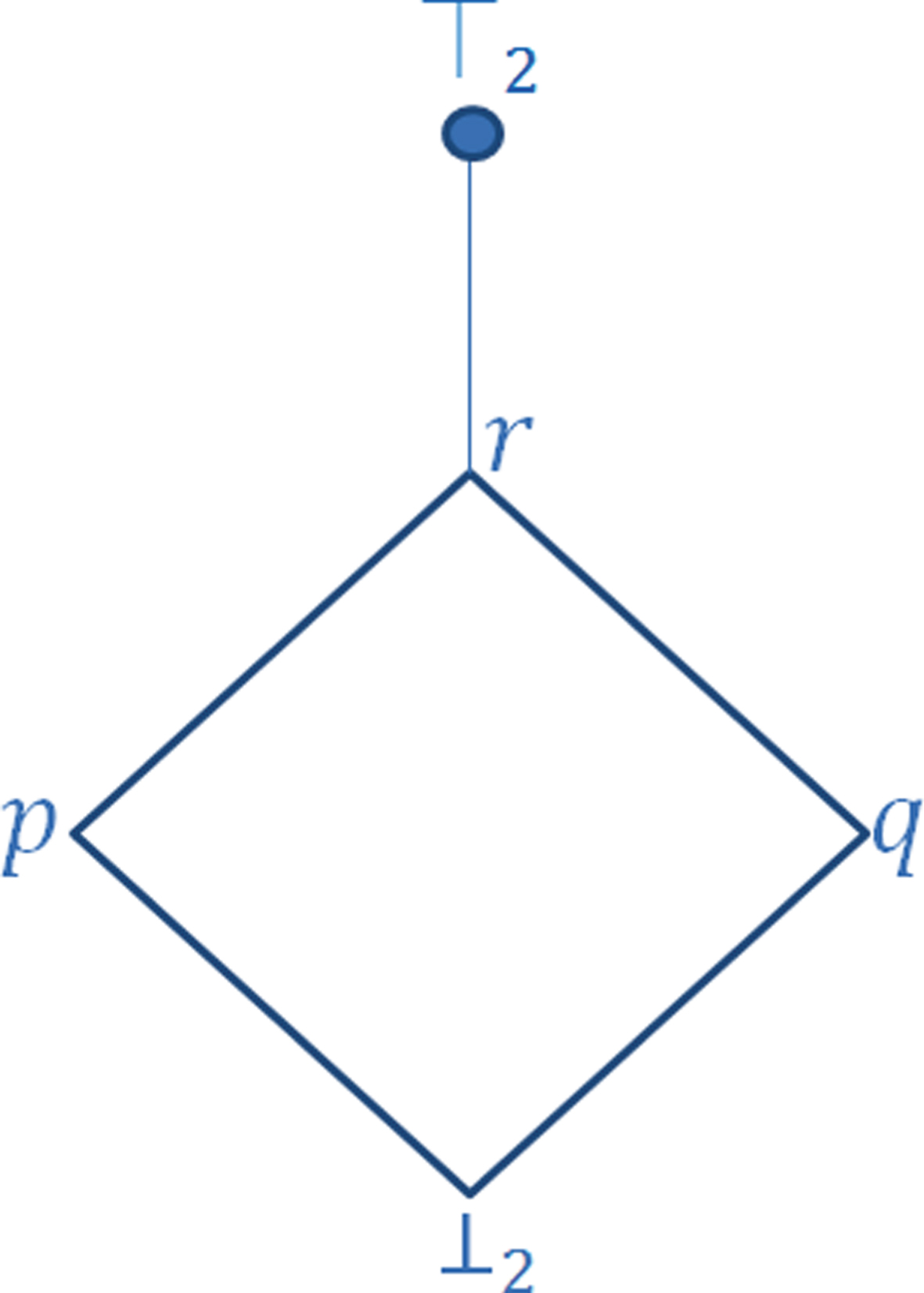
Example 3. Let K1 = {⊥ 1, c, d, ⊤ 1} and K2 = {⊥ 2, p, q, r, ⊤ 2} be two complete lattices shown in Fig. 3 and Fig. 4 with the binary operations shown in Tables 3 and 4, respectively. Then K1 and K2 are quantales. Let H = {u1, u2} and Ω : H ⟶ P (K1 × K2) be a SCR.
Illustration of K1.
Illustration of K2.
Binary operation cirle-1 subject of K1
⊗1
⊥1
c
d
⊤1
⊥1
⊥1
⊥1
⊥1
⊥1
c
⊥1
c
⊥1
c
d
⊥1
⊥1
d
d
⊤1
⊥1
c
d
⊤1
Binary operation cirle-2 subject of K2
⊗2
⊥2
p
q
r
⊤2
⊥2
⊥2
p
q
r
⊤2
l
⊥2
p
q
r
⊤2
m
⊥2
p
q
r
⊤2
n
⊥2
p
q
r
⊤2
⊤2
⊥2
p
q
r
⊤2
Then (Ω, H) is a SCR. Aftersets with respect to Ω (u1) and Ω (u2) are as follows;
Foresets with respect Ω (u1) and Ω (u2) are as follows, respectively;
Let ψ : K2 ⟶ [0, 1] be defined by,
Then ψ is not a fsq of K2. However,
The shows that and are fsq of K1 but ψ is not a fsq of K2. Hence ψ is generalized upper rough FSSQ of K1with respect to aftersets.
Let η : K1 ⟶ [0, 1] define by,
Then η is not a fsq of K1. However,
Thus above shows that and are fsq of K2 . Hence η is generalized upper rough FSSQ of K2 with respect to foresets.
Theorem 6.Let (Ω, H) be a SCTR and ψ be a fsq of K2. Then ψ is a generalized lower rough FSSQ of K1 with respect to aftersets.
Proof. Let ψ be afsq of K2 and (Ω, H) SCTR. Then and ψ (p ⊗ 2t) ≥ Min {ψ (p) , ψ (t)} ∀ p, t, ci ∈ K2 and m1Ω (u) ∨ m2Ω (u) ∨ , . . . , ∨ miΩ (u) = (∨ i∈Imi) Ω (u) for all mi ∈ K1 and u ∈ H.
Consider,
Since c ∈ m1Ω (u) ∨ m2Ω (u) ∨ , . . . , ∨ miΩ (u), there exist c1 ∈ m1Ω (u), c2 ∈ m2Ω (u),..., ci ∈ miΩ (u) be such that c = ∨ i∈Ici.
Hence,
Thus we have, ∀ mi ∈ K1.
Since (Ω, H) SCTR, we have pΩ (u) ⊗ 2qΩ (u) = (p ⊗ 1q) Ω (u) for all p, q ∈ K1 and for all u ∈ H.
Consider,
As c ∈ pΩ (u) ⊗ 2qΩ (u), we obtain x ∈ pΩ (u) and t ∈ qΩ (u) such that c = x ⊗ 2t.
Hence,
Hence ∀ p, q ∈ K1. Thus, is a FSSQ of K1 ∀ u ∈ H. □
Moreover, the next example shows that the converse of Theorem 6 do not hold in general.
Example 4. Consider the quantales in Example 3. Let H = {u1, u2} and Ω : H ⟶ P (K1 × K2) be defined by,
Now, aftersets with respect to Ω (u1) and Ω (u2) are given below;
Then (Ω, H) is a SCTR with respect to aftersets. Define ψ : K2 ⟶ [0, 1] by,
Then ψ is not a fsq of K2. But
This shows that and are fsq of K1 . Hence ψ is generalized lower rough FSSQ of K1with respect to aftersets.
Now define Ω : H ⟶ P (K1 × K2). Then
Now foresets in terms of Ω (u1) and Ω (u2) are as follows;
Then (Ω, H) is a SCTR with respect to foresets. Define η : K1 ⟶ [0, 1] by,
Then η is not a fsq of K1. The lower approximations with respect to foresets are as follows;
Thus and are fsq of K2 . Hence η is a generalized lower FSSQ of K2 with respect to foresets.
Remark 1. Theorem 5 and Theorem 6 can be proved for foresets by considering fssts of K1.
Proposition 1.Let (Ω, H) be a SCR. Let ψ be a fsst of K2. Then for each α ∈ [0, 1], the following hold:
(1)
(2)
(3)
(4) .
Proof. (1) Let
⇔ψ (a) ≥ α
for some a∈ zΩ (u) ;
⇔ zΩ (u)∩ ψα ≠ ∅ ⇔ .
proof of (3) and (4) are similar to the proof of (1) and (2). □
Remark 2. The Proposition 1 also holds for foresets.
Theorem 7.Let ψ be a fsq of K2 and (Ω, H) be a SCTR. Then is a FSSQ of K1 with respect to afterset if and only if for each α ∈ [0, 1] , where ψα ≠ ∅] is a subquantale of K1 for all u ∈ H.
Proof. Let be a FSTQ of K1 and for some i ∈ I. Then for all i ∈ I. But is a FSTQ, so ≥α. Hence . Let p, q ∈ . Then and . But since be a FSTQ, we have , we get . Hence, is subquantale of K1.
Conversely, let be a subquantale of K1 and for all u ∈ H.
Consider,
Since (Ω, A) be a SCTR and c ∈ m1Ω (u) ∨ m2Ω (u) ∨ , . . . . , ∨ miΩ (u) , then there exist c1 ∈ m1Ω (u) and c2 ∈ m2Ω (u) , . . . . , ci ∈ miΩ (u) such that c = ∨ i∈Ici. Hence
So, ∀ mi ∈ K1. Let ∀ p, q ∈ K1. Then . Hence, . If either or . In both the cases, ≥α. Let = α. So ≥. Hence, is a FSSQ of K1. □
Theorem 8.Let (Ω, A) be a SCTR and ψ be a fid of K2. Then ψ is a generalized lower rough FSTI of K1 with respect to aftersets.
Proof. Let ψ be a fid of K2 and (Ω, A) be a SCTR. Then ψ (p ∨ q) = Min {ψ (p) , ψ (q)} and ψ (p ⊗ 2q) ≥ Max {ψ (p) , ψ (q)} ∀ p, q ∈ K2. Also, (z1 ∨ z2) Ω (u) = z1Ω (u) ∨ z2Ω (u) ∀ z1, z2 ∈ K1.
Therefore,
Since c ∈ z1Ω (u) ∨ z2Ω (u), there exist c1 ∈ z1Ω (u) and c2 ∈ z2Ω (u) such that c = c1 ∨ c2.
Hence,
Hence ∀z1, z2 ∈ K1.
As (Ω, A) be a SCTR so (z1 ⊗ 1z2) Ω (u) = z1Ω (u) ⊗ 2z2Ω (u) ∀ z1, z2 ∈ K1.
Thus, we have,
Now since c ∈ z1Ω (u) ⊗ 2z2Ω (u) so there exist c1 ∈ z1Ω (u), c2 ∈ z2Ω (u) such that u = c1 ⊗ 2c2.
Thus,
Hence, ∀z1, z2 ∈ K1. Thus, is a FSTI of K1. □
Likewise, we show that the converse of Theorem 8 do not hold in general.
Example 5. Consider the quantales in Example 1. Let H = {u1,u2} and Ω : H ⟶ P (K1 × K2) be,
Now,the aftersets with respect to Ω (u1) and Ω (u2) are calculated as follows;
Then (Ω, H) is a SCTR with respect to aftersets. Define ψ1 : K2 ⟶ [0, 1] by,
Then ψ1 is not a fid of K2. But,
Thus and are fid of K1 . Hence ψ1 is generalized lower rough FSTI of K1 with respect to aftersets by SCTR.
The following Theorem has similar proof as reported in the proof of Theorem 8.
Theorem 9.Let (Ω, A) be a SCR and ψ be a fid of K2. Then ψ is a generalized upper rough FSTI of K2 with respect to aftersets.
Remark 3. Theorems 8 and 9 can be obtained for foresets by considering fssts of K1.
Theorem 10.Let ψ be a fid of K2 and (Ω, H) be a SCTR. Then is a FSTI of K1 with respect to afterset if and only if for each α ∈ [0, 1], where ψα ≠ ∅] is an ideal of K1 for all u ∈ H.
Proof. Let be a FSTI of K1. Let . Then and . But is a FSTI, so ≥α. Hence . Let and p ∈ K1 such that p ≤ q. Then . Thus . Let and ∀ z ∈ K1. Then , we get . Similarly, . Hence, is an ideal of K1.
Conversely assume that is an ideal of K1. Let α = ∈ for any z1, z2 ∈ K1. Then and . That is and . Hence, .
Consider,
Since (Ω, A) be a SCTR and c ∈ z1Ω (u) ∨ z2Ω (u) then there exist a1 ∈ z1Ω (u) and a2 ∈ z2Ω (u) such that c = a1 ∨ a2.
Hence we have,
So, ∀ z1, z2 ∈ K1.
Now for and ∀ y ∈ K1, we obtain and . Hence, and . If either or . In both the cases, ≥α. We suppose = α. So ≥. Hence, is a fid of K1. □
Theorem 11.Let (Ω, H) be a SCTR and ψ be a fpid of K2. Then ψ is a generalized lower rough FSTPI of K1 with respect to aftersets.
Proof. Let ψ be a fpid of K2. Then ψ (p ⊗ 2q) = ψ (p) or ψ (p ⊗ 2q) = ψ (q) ∀ p, q∈ K2. Since ψ is a fpid of K2 so it is fid of K2, so by Theorem 8, is a FSTI of K1.
Consider,
Since (Ω, A) be a SCTR, therefore for c ∈ pΩ (u) ⊗ 2qΩ (u) there exist b ∈ pΩ (u) and d ∈ qΩ (u) such that c = b ⊗ 2d.
Hence,
Thus, or ∀ p, q ∈ K1. Hence is a FSTPI of K1 for all u ∈ H. □
Example 6. Consider the quantales in Example 1. Let H = {u1,u2} and Ω : H ⟶ P (K1 × K2) be defined by Ω (u1) = and Ω (u2) = .
Now, aftersets in terms of Ω (u1) and Ω (u2) are below;
It is easy to confirm that (Ω, H) is a SCTR with respect to aftersets. Define ψ1 : K2 ⟶ [0, 1] by,
Then ψ1 is not a fpid of K2 but,
This show that and are fpid of K1 . Hence ψ1 is generalized upper FSTPI of K1with respect to aftersets. Define ψ2 : K2 ⟶ [0, 1] by,
Then ψ2 is not a fpid of K2 but,
It is concluded from above that and are fpid of K1 . Hence ψ2 is generalized lower FSTPI of K1 with respect to aftersets.
The Theorem 12 has similar proof as the proof of Theorem 11.
Theorem 12.Let ψ be a fpid of K2 and (Ω, A) be a SCTR. Then ψ is a generalized upper rough FSTPI of K1 with respect to afterset.
Theorem 13.Let (Ω, H) be a SCR and ψ be a fpid of K2. Then is a FSTPI of K1 with respect to afterset if and only if where ψα ≠ ∅] for each α ∈ [0, 1] is a pid of K1 for all u ∈ H.
Proof. Let ψ be a fpid of K2. Then ψ (a ⊗ 2c) = ψ (a) or ψ (a ⊗ 2c) = ψ (c) ∀ a, c ∈ K2. Suppose is a FSTPI of K1, then is a FSTI of K1. By Theorem 10, is an ideal of K1. To show that is a pid for all α ∈ [0, 1], we have to show that for a⊗ 1c ∈ implies that or . Let . Then or . Thus, or . Hence is a pid of K1.
Conversely, let be a pid of K1. Then is an ideal of K1. By Theorem 10, is a FSTI of K1.
Consider,
Since (Ω, A) be a SCTR, so we have a ∈ xΩ (u) , c ∈ yΩ (u) such that d = a ⊗ 2c.
Hence,
Therefore or ∀ x2, y2 ∈ K1. Hence is a FSTPI of K1. □
Theorem 14.Let ψ be a fspid of K2 and (Ω, H) be a SCTR. Then ψ is a generalized lower rough FSTSPI of K1 with respect to aftersets.
Proof. Let ψ be a fspid of K2. Then ψ (p2) = ψ (p) ∀ p ∈ K2 and thus ψ is a fid of K2. By Theorem 10, is a FSI of K1 for all u ∈ H.
Consider,
Thus ∀ y ∈ K1. Therefore is a FSTSPI of K1 for all u ∈ H. □
Proposition 2.Let ψ be a fspid of K2 and (Ω, H) be a SCTR. Then ψ is a generalized upper rough FSTSPI of K1 with respect to aftersets.
Theorem 15.Let (Ω, H) be a SCTR and ψ be a fspid of K2. Then is a FSTSPI of K1 with respect to afterset if and only if for each α ∈ [0, 1], where ψα ≠ ∅] is a spid of K1 for all u ∈ H.
Proof. Let is a FSTSPI of K1. Then is a FSTI of K1. By Theorem 10, is an ideal of K1. Let . Then . Thus, we have . Hence is a spid of K1.
Conversely, let is a spid of K1. Then is an ideal of K1. By Theorem 10, is a FSTI.
We have to show that ∀ z ∈ K1. As (Ω, H) be a SCTR and ψ is a fspid of K2. Then
Thus ∀ z ∈ K1. Hence is a FSTSPI of K1 for all u ∈ H. □
Homomorphic images of generalized rough fuzzy soft substructures
This section includes the relations between the upper (lower) generalized rough fuzzy soft substructures of quantales and the upper (lower) approximations of their images under weak quantale homomorphism. Some notions related to establish such results are first explained.
Definition 16. [30] Let (K1, ⊗ 1) and (K2, ⊗ 2) be two quantales. A map ξ : K1 ⟶ K2 is called a weak quantale homomorphism (WQH) if
(1) ξ (p⊗ 1q) = ξ (p) ⊗ 2ξ (q) ;
(2) ξ (p ∨ q) = ξ (p) ∨ ξ (p) for all p, q ∈ K.
A weak quantale homomorphism ξ : K1 ⟶ K2 is called an epimorphism if ξ is on to K2 and ξ is called a monomorphism if ξ is one-one. If ξ is bijective, then it is called an isomorphism. It is clear that if p ≤ q, then ξ (p) ≤ ξ (q). That is ξ is order-preserving. In the following the term WQH will be utilized for weak quantale homomorphism.
Lemma 1.Let ξ : K1 → K2 be a surjective WQH and (Ω2, H) be a SBR on K2. Set Ω1 (u) ={ (s, t) ∈ K1 × K1 : (ξ (s) , ξ (t)) ∈ Ω2 (u) } for all u ∈ H. Then the following hold:
(1) (Ω1, H) is soft compatible if (Ω2, H) is soft compatible.
(2) (Ω1, H) is SCTR with respect to aftersets (with respect to foresets) if (Ω2, H) is SCTR with respect to aftersets (with respect to foresets) and ξ is one one.
(3) = for C ⊆ K1 and for all u ∈ H.
(4) for all u ∈ H and if ξ is one one, then = for all u ∈ H.
(5) Let ξ : K1 ⟶ K2 be one-one. Then for all u ∈ H.
Proof. (1) and (2) are obvious.
(3) Let for some z ∈ K2. Then there exists a ∈ K1 such that and ξ (a) = z. Thus there exists x ∈ aΩ1 (u) ∩ C such that (a, x) ∈ Ω1 (u) and x ∈ C. This shows that (ξ (a) , ξ (x)) ∈ Ω2 (u) ⇒ ξ (x) ∈ ξ (a) Ω2 (u). Moreover, ξ (x) ∈ ξ (C). Thus . That is . Conversely, let . Then wΩ2 (u)∩ ξ (C) ≠ ∅. So there exists a ∈ wΩ2 (u) ∩ ξ (C) such that (w, a) ∈ Ω2 (u) and a ∈ ξ (C). Since ξ is onto so there exist x ∈ C and s ∈ K1 such that a = ξ (x) and w = ξ (s). Thus (ξ (s) , ξ (x)) = (w, a) ∈ Ω2 (u) ⇒ (s, x) ∈ Ω1 (u). This implies x ∈ sΩ1 (u) ∩ C, so we have . That is . Thus ⊆ . Hence for all u ∈ H.
(4) Let for all u ∈ H. Then there exists such that aΩ1 (u) ⊆ C and ξ (a) = b. Let p ∈ bΩ2 (u). Then there exist q ∈ K1 such that ξ (q) = p and ξ (q) ∈ ξ (a) Ω2 (u) , i.e., (ξ (a) , ξ (q)) ∈ Ω2 (u). Hence (a, q) ∈ Ω1 (u). That is q ∈ aΩ1 (u) ⊆ C and so ξ (q) ∈ ξ (C) and bΩ2 (u) ⊆ ξ (C). This shows that . So we have for all u ∈ H. Now let . Then there exists a unique a ∈ K1 such that ξ (a) = b and ξ (a) Ω2 (u) ⊆ ξ (C). Let q ∈ aΩ1 (u) , i.e., (a, q) ∈ Ω1 (u). Then (ξ (a) , ξ (q) ∈ Ω2 (u). That is ξ (q) ∈ ξ (a) Ω2 (u) ⊆ ξ (C) , and so q ∈ C. Thus, aΩ1 (u) ⊆ C, which gives . Then and so for all u ∈ H.
(5) Let for all u ∈ H. Then for all u ∈ H. Conversely suppose that . Then there exists such that ξ (p) = ξ (p′). Since ξ is ono-one, we get . □
Theorem 16.Let ξ be a surjective WQH and (Ω2, H) be a SCR with respect to aftersets on K2. Set
for all u ∈ H. Then for all ∅ ≠ C ⊆ K1 and u ∈ H, the following hold;
(1) is an ideal of K1 if and only if is an ideal of K2 for all u ∈ H.
(2) is a pid of K1 if and only if is a pid of K2 for all u ∈ H.
(3) is a spid of K1 if and only if is a spid of K2 for all u ∈ H.
(4) is a subquantale of K1 if and only if is a subquantale of K2 for all u ∈ H.
Proof. (1) Let be an ideal of K1 for all u ∈ H. It is to show that is an ideal of K2 for all u ∈ H. By Lemma 1(3), we have for all C ⊆ K1 and for all u ∈ H.
(i) Let and for all u ∈ H. Then be such that ξ (p) = z, ξ (q) = y. Since is an ideal and ξ is WQH, we have .
(ii) Let . Then there exist w1 ∈ K1 and such that p = ξ (w1) and q = ξ (w2). Since ξ (w1) ≤ ξ (w2) , we have . By Lemma 1(5), we have . Since is an ideal and w1 ≤ w1 ∨ w2, , we have w1 and p.
(iii) Let y = ξ (a) ∈ K2 and w = ξ (b) ∈ . Then by Lemma 1(5). Since is an ideal, we have and thus y ⊗ 2w = ξ (a) ⊗ 2ξ (b) = ξ (a ⊗ 1b) ∈ . Similar argument shows that . Thus = is an ideal of K2 from (i)-(iii) for all u ∈ H.
Conversely, let = is an ideal of K2 for all u ∈ H.
(i) Let p1, p2 for all u ∈ H. Then ξ (p1) , ξ (p2) . Since is an ideal, so ξ (p1 ∨ p2) = ξ (p1) ∨ ξ (p2) . Then by Lemma 1(5), we have .
(ii) Let . Then ξ (p1) ≤ ξ (p2) . Since, is an ideal, we have ξ (p1) and thus p1 ∈ by Lemma 1(5).
(iii) Let z ∈ K1 and . Then and ξ (z) ∈ K2. Since is an ideal of K2, we have and thus by Lemma 1(5). The similar argument shows that . Thus, is an ideal of K1 from (i)-(iii).
(2) First, we show that for all u ∈ H, that is . Suppose that . Since ξ is surjective, we have ξ ( . Conversely, assume that . For each z ∈ K1, we have ξ (z) ∈ ξ (K1) = K2 = ξ ( . Then by Lemma 1(5), we have and thus . Assume that is a pid of K1 for all u ∈ H. Then is an ideal of K1 and . By (1), is an ideal of K2. It is also known that . Now suppose w1, w2 ∈ K2 and . Since ξ is surjective, there exist z1, z2 ∈ K1 such that ξ (z1) = w1, ξ (z2) = w2. Then . By Lemma 1(5), we have . Since, is pid, we have or and thus or . So, is a pid of K2.
Conversely, assume that is a pid of K2. Then and thus . Since is an ideal of K2. By (1), is an ideal of K1. Now suppose z1, z2 ∈ K1 and . Then . Since is pid, we have or . By Lemma, 1(5), we have or . Thus is a pid of K1.
The proof of (3) and (4) are similar to the proof of (1) and (2). □
The next Proposition has similar proof as reported in Theorem 16.
Proposition 3.Let ξ be a surjective WQH and (Ω2, H) be a SCR on K2. Set
for all u ∈ H. Then for all ∅ ≠ C ⊆ K1 and u ∈ H, we have
(1) is an ideal of K1 if and only if is an ideal of K2 for all u ∈ H;
(2) is a pid of K1 if and only if is a pid of K2 for all u ∈ H;
(3) is a spid of K1 if and only if is a spid of K2 for all u ∈ H;
(4) is a subquantale of K2 if and only if is a subquantale of K2 for all u ∈ H.
Remark 4. Theorem 16 and Proposition 3 can be obtained for foresets and have similar proof.
The relation between fuzzy algebraic substructures of a quantale K1 and fuzzy algebraic substructures of a quantale K2 are described in the following.
Theorem 17.Let ξ : K1 ⟶ K2 be a surjective WQH and (Ω2, A) be a SCR on K2 and ψ be a fsst of K1. Set
for all u ∈ H . Then following hold;
(1) is a fid of K1 if and only if is a fid of K2 ;
(2) is a fpid of K1 if and only if is a fpid of K2 ;
(3) is a fspid of K1 if and only if is a fspid of K2 ;
(4) is a fsq of K1 if and only if is a fsq of K2.
Where,
That is, ξ (ψ) is the standard Zadeh image of the fsstψ under the mapping ξ.
Proof. (1) Note that (ξ (ψ)) α+ = ξ (ψα+) for each α ∈ [0, 1]. Also if and only if .
Let be a fid of K1. Then if for all α ∈ (0, 1]. By Theorem 10, we have is an ideal of K1. Also by using Proposition 1, we obtain is an ideal of K1. Now, by Theorem 16(1) and Proposition 1, we have is an ideal of K2. Thus, by Theorem 10, we have is a fid of K2.
Conversely, suppose is a fid of K2. We have is an ideal of K2 by utilizing Theorem 10 and Proposition 1. Thus, is an ideal of K1 from Theorem 16(1). Hence is a fid of K1 by Theorem 10.
(2) Let be a fpid of K1. Now for , then for each α ∈ [0, 1]. Since is a fpid of K1, then by Theorem 13 and Proposition 1, we have is a pid of K1. Hence is a pid of K2, by Theorem 16(2). Thus, by Theorem 13, we have is a fpid of K2.
Conversely, suppose is a fpid of K1. By Theorem 13, we have
is a pid of K2. Thus from Theorem 16(2), is a pid of K1. Hence is a fpid of K1 by Theorem 13.
The similar proof of (3) and (4) can be obtained from (1) and (2). □
The similar proof of next Proposition can be obtained from Theorem 17.
Proposition 4.Let (Ω2, H) be a SCR with respect to aftersets on K2 and ψ be a fsst of K2. Let ξ : K1 ⟶ K2 be a surjective WQH. Set
for all u ∈ H . Then following hold;
(1) is a fid of K1 if and only if is a fid of K2 ;
(2) is a fpid of K1 if and only if is a fpid of K2 ;
(3) is a fsq of K1 if and only if is a fsq of K2.
(4) is a fsq of K1 if and only if is a fsq of K2.
Remark 5. Theorem 17 and Proposition 4 can be obtained for foresets and have similar proof.
Conclusion
This paper extend and develop the notion of "rough approximation" defined by Pawlak and "rough fuzzy set" by Dubois and Prade. In this paper, we are motivated to establish the relations between fuzzy substructures and quantales with the help of soft compatible relations. This is done with the help of afterset and foreset. Moreover, we present soft complete relation to find out the lower and upper approximation of ideals, prime ideals, semi-prime ideals and subquantales of quantales with the help of afterset and foreset. We also present the relation between two quantales and observed that if ψ is a fuzzy substructure of K2 then, its upper and lower approximation with the help of afterset are fuzzy substructure of K2 by using compatible relation. Similarly, upper and lower approximation with the help of foresets are fuzzy substructure of K1 by using compatible relation, if we are considering ψ as a fuzzy substructure of K1.
From all motivation, one can proceed the above mentioned ideas to others algebraic structures, like rings and semirings.
References
1.
AcarU., KoyuncuF. and TanayB., Soft sets and soft rings, Computers and Mathematics with Applications59 (2010), 3458–3463.
2.
AktasH. and ÇagmanN., Soft sets and soft groups, Inform Sci177 (2007), 2726–2735.
3.
AslamM. and QurashiS.M., Some contributions to soft groups, Annals of Fuzzy Mathematics and Informatics4(1) (2012), 177–195.
4.
AliM.I., Soft ideals and soft filters of soft ordered semigroups, Computers and Mathematics with Applications62 (2011), 3396–3403.
5.
AliM.I., FengF., LiuX.Y., MinW.K. and ShabirM., On some new operations in soft set theory, Comput Math Appl57 (2009), 1547–1553.
6.
BashirS., AbbasH., MazharR. and ShabirM., Rough fuzzy ternary subsemigroups based on fuzzy ideals with three-dimensional congruence relation, Computational and Applied Mathematics (2020), 39–90.
7.
DuboisD. and PradeH., Rough fuzzy sets and fuzzy rough sets, Int J General Syst17 (1990), 191–209.
8.
GirardJ.Y., Linear logic, Theoretical Computer Science50 (1987), 1–101.
9.
HohleU., Topological representation of right-sided and idempotent quantales, Semigroup Forum. 107
10.
HussainA., MahmoodT. and AliM.I., Rough Pythagorean fuzzy ideals in semigroups, Computational and Applied Mathematics67 (2019), 1–15.
11.
KanwalR.S. and ShabirM., Approximation of ideals in semigroups by soft relations, Journal of Intelligent & Fuzzy Systems35 (2018), 3895–3908.
12.
KanwalR.S. and ShabirM., Rough approximation of a fuzzy set in semigroups based on soft relations, Computational and Applied Mathematics (2019), 38–89.
13.
KanwalR.S., QurashiS.M. and ShabirM., Generalized approximation of substructures in quantales by soft relations, Computational and Applied Mathematics (2020), 39–24.
14.
KanwalR.S. and ShabirM., Approximation of soft ideals by soft relations in semigroups, Journal of Intelligent & Fuzzy Systems37 (2019), 7977–7989.
15.
KanwalR.S. and ShabirM., An approach to approximate a fuzzy set by soft binary relation and corresponding decision making (submitted).
16.
KrumlD. and PasekaJ., Algebraic and categorical aspects of quantales”, M. Hazewinkel (Ed.), Handbook of Algebra5 (2008), 323–362 in.
17.
LuoQ. and WangG., Roughness and fuzziness in Quantales, Inform Sci271 (2014), 14–30.
18.
MajiP.K., BiswasR. and RoyA.R., Soft set theory, Comput Math Appl45 (2003), 555–562.
19.
MolodtsovD., Soft set theory-First results, Comput Math Appl37 (1999), 19–31.
20.
FarooqM., MahmoodT., KhanA., IzharM. and DavvazB., Fuzzy hyperideals of hyperquantales, Journal of Intelligent & Fuzzy Systems36(6) (2019), 5605–5615.
21.
MulveyC.J., Rendiconti del Circolo Matematico di Palermo, 12(2) (1986), 99–104.
22.
PawlakZ., Rough sets, International Journal of Computer11(5) (1982), 341–356.
23.
QurashiS.M. and ShabirM., Generalized rough fuzzy ideals in quantales, Discrete Dynamics in Nature and Society Volume 2018, Article ID 1085201, 11 pages.
24.
QurashiS.M. and ShabirM., Roughness in Quantale Module, Journal of Intelligent & Fuzzy Systems35 (2018), 2359–2372.
25.
QurashiS.M. and ShabirM., Some studies in the approximation of (∈γ, ∈ γ ∨ qδ)-fuzzy substructures in Quantales, Computational and Applied Mathematics2020, 39–117.
26.
QurashiS.M. and ShabirM., Generalized approximations of (∈γ, ∈ γ ∨ qδ)-fuzzy ideals in quantales, Computational and Applied Mathematics37 (2018), 6821–6837.
27.
QurashiS.M. and ShabirM., Characterizations of Quantales by the properties of their (∈γ, ∈ γ ∨ qδ)-fuzzy (subquantales) ideals, Punjab University Journal of Mathematics. (Accepted).
GulR. and ShabirM., Roughness of a set by (α, β)-indiscernibility of Bipolar fuzzy relation, Computational and Applied Mathematics39 (2020), 160.
30.
RosenthalK.I., Quantales and their applications, Pitman Research Notes in Mathematics, Longman Scientific & Technical, New York, (1990).
31.
RoyA.R. and MajiP.K., A fuzzy soft set theoretic approach to decision making problems, J Comput Appl Math203 (2007), 412–418.
32.
ShabirM. and GulR., Modified rough bipolar soft sets, Journal of Intelligent & Fuzzy Systems3(39) (2020), 4259–4283.
33.
ShabirM., HussanM., Fully fuzzy idemptent near-rings, Southeast Asian Bull Math (2010), 959–970.
34.
ShabirM., LiaquatS. and BashirS., Regular and intra-regular semirings in terms of bipolar fuzzy ideals, Computational and Applied Mathematics38(4) (2019), 197.
35.
SunQ.-M., ZhangZ.-L. and LiuJ., Soft sets and soft modules, Lecture Notes in Comput Sci5009 (2008), 403–409.
36.
WangS.Q. and ZhaoB., Ideals of quantales",, Journal of Shaanxi Normal University (Natural Science Edition)31(4) (2003), 7–10 (in Chinese).
37.
XiaoQ.M., LiQ.G., Generalized lower and upper approximations in quantales, J Appl Math (2012).
38.
YamakS., KazanciO. and DavvazB., Generalized lower and upper approximations in a ring, Inform Sci180 (2010), 1759–1768.
39.
YangL.Y. and XuL.S., Roughness in quantales, Inform Sci220 (2013), 568–579.
40.
YetterD.N., Quantales and (noncommutative) linear logic, The Journal of Symbolic Logic55(1) (1990), 41–64.