



Abstract
In 1982, Pawlak set up a fresh approach to deal with uncertainties namely rough set theory, Multiple-Criteria Decision Making (MCDM) first traced by Benjamin Franklin in 17th century. Several researchers did significant contribution to MCDM thereafter. An assignment problem involves what happens to the effective function when each of a number of sources is associated with the same number of destinations. Using MCDM, Rough matrices and Assignment model we are inducing an idea to pick Best’11 in all three formats (Test, One Day Internationals (ODI), Twenty20 International matches (T20I)) in the game of cricket with players from two nationals. Using the existing data, we are providing best batting position for any player to maximize team’s run. In addition, based on the preprocessing of informations, we are bringing some new indices to pick Indian squad for the 2019 World Cup cricket held in England from May 2019 to July 2019. After making a selection from our framework, we will compare the list of selected players by Board of Cricket Control Board in India (BCCI) and giveaway the percentage of similarity between the our selection against BCCI’s selection. We pick 11 players after selecting 15 players from 24 players to formulate the assignment model and offer the best batting order to optimize team’s run.
Introduction
Pawlak [1] coined a prominent conception to deal with uncertainties namely rough sets with two approximations from the universe set. Many theories to deal with uncertainties exists. To name few, probability, fuzzy sets [5], vague set and interval mathematics. Rough membership function is stated by Pawlak [2, 8]. The ornamental of the rough set theory is that lack of clarity is personified by set boundary region rather than membership function. In 2013, Vijayabalaji and Balaji [6] gave a 3-valued matrix representation of rough sets whose elements are r m (x)=1, if x belongs to lower approximation
r m (x) =0, if x belongs to upper approximation
r m (x) = (0, 1), if x belongs to boundary region and termed it as a rough matrix. In 2015,Vijayabalaji and Balaji [7] applied rough matrix theory in MCDM problems.The papers [12–14] and [16] describes about the fusion of cricket game with many theories using different techniques.
Information systems (IS) [9] being a pedagogical frontier has its roots in 1960. He made a survey by prioritizing the counterplan of data processing applications in 10 organizations. An IS is 4-fold [8] IS = (U, Q, V D , f) where U ≠ 0 is a set of finite objects; Q ≠ 0 is a finite set of characteristics; V D =⋃ domains, V = ⋃ q∈QV q , where V q is the value set of attribute q, called the domain of q; f : U * Q → V D is an information function which assigns particular values from domains of attributes to objects such as ∀q ∈ Q, x ∈ U. f (q, x) ∈ V q where f (q, x) denotes the value of attribute a for object x.
An assignment model‘s [10] objective is to find the change in the effectiveness function when each number of origin is associated with each number of destination in such a way as to extremize the overall effectiveness.A specific type of problem with linear programming is known as problem of assignment [10]. It deals with allocating various resources on a one-to-one basis to specific activities in such a way as to maximize the resulting effectiveness. The Mathematical representation of the assignment model [10] with the assignment of i th member to j th job (denoted by x ij ) is defined as,
Minimize
Subject to the constraints
and
We shall have a Brief introduction about the game of cricket. Cricket is a game, played in a ground, with a rectangular pitch being in the centre of the play area called field. Three sticks with bails called as stumps are placed on either sides of the pitch. It’s a team game. It needs two teams to play cricket. Each team needs a minimum of 11 players. Say, if two teams, Team A and Team B are playing against each other. The game happens in two sessions. The team that will bat first will be decided by a toss. Say, When team A wins the toss and opts for batting, Then,in first session of play, two players from team A, will use a bat to hit the ball bowled by a bowler from team B. a wicketkeeper stands behind the stump. All the other 9 players from team B will try to stop the ball hit by the batsman, which is called as fielding. the batting team(team A) needs to hit most number of runs and set a target within a stipulated number of overs.in the second session of play, the target set by team A should be surpassed by team B. In the second session Team B will bat and Team A will field and bowl to defend the target they set in the first session. The game will be refereed by two umpires.one would stand behind the stumps in the non-striker end and the other would stand in the field at a position called square leg who is called “leg umpire”. The decision given the umpire is final. There is a third umpire who sits outside the field and gives decision if asked to review, by looking in the camera feed action replays. If the target set by team A is not surpassed by team B, then Team A wins the match. If the target set by team A is surpassed by team B by at least one run, the game is won by team B.If team A target are not met and the same scores are achieved, then they are called ’tie.’ The game is played in three formats, namely Test cricket-Played for five days or 2 innings, One Day International (ODI) (50 overs per team per session), Twenty 20 (T20) (A maximum of 20 overs or until the loss of 10 wickets whichever is earlier).
Test cricket is played for 5 days. Maximum of 90 overs per day can be bowled by the bowling team. Two innings can be played.in each innings both the team will bat and bowl once. If two teams play, say Team A and Team B.If A wins the toss and opts first for batting,, after team A’s batting is over, Team B will bat. This one cycle is called as one innings. After the first innings is over, second innings will start, Team A will bat in the second innings again followed by Team B. If Team B surpasses the runs scored by Team A in both innings by at least one run, then Team B is the winner. If Team B does not exceed the runs scored by Team A in both innings and loses all the wickets before score is reached, then Team A is the winner. If team B does not overtaking the score of team A in both the innings, but plays all through the rest of the days without losing all the wickets, then the result of the match is called ‘Draw’. In test cricket, there is no specific stipulation for a team to bat. If the first batting team bats for all the five days without losing all the wickets, it is allowed. In the first innings, the first batting team will score runs as much in as many days. The second batting team should score runs not less than half of the runs scored by the first batting team. If the second batting team fails to do so it will be forced to bat again in its second innings, this is called follow-on. If team A plays first sets a total, that the team B could not achieve even half the total runs, then Team would be forced to follow on. Even in the second innings if team B loses the all wickets before scores the runs scored by team A in the first innings. Then it is called as ‘Innings defeat’ by team A.
One Day International (ODI) is played by two teams for a day. The toss winning team will determine first whether to bat or bowl. If the toss winning team chooses to bat first, the first batting team will bat for 50 overs in that session and set a target. The team that bat later should surpass the target set by the first batting team by at least one run to win the match. When the first batting team is in a position to prevent the second batting team from achieving the set target of runs, the former is the winner. Unlike test cricket, the first batting team has to complete their batting in their first session within 50 overs. The bowling team should complete their 50 overs before the stipulated time else would face penalty for slow over rate.
Twenty 20 (T20) is similar to one day international match. But played by two teams for twenty overs apiece.in this format certain rules are exclusive to it, such as a no ball bowled by the bowler will invite a ‘free hit’, where in the next ball bowled by the bowler is awarded as free hit to the batting team. If the batsman is caught or bowled or stumped, it won’t be called as out.
We shall have a glance about frequently used batting terminologies. During batting by a team, two batsmen from the team will enter the ground; the rest will be non-playing outside the ground. The two batsmen will stand in either ends of the pitch. The batsmen who will face the ball from the bowler is called striker. The one who stands in the opposite end of the striker is called as non-striker. From the non-striker’s end, the bowler must bowl the ball. The batsman will face the ball bowled by the bowler, the batsmen will attempt to score as follows.
(1) Run: one running between the wickets is called as one run by hitting the ball with the bat, then running between the wickets until the ball is thrown back to meet the stump.
(2) Four: when a batsman hits the ball along the ground in a way, the fielders can’t stop the ball and pitches within the boundary line before touching the boundary line or crossing it, then is declared as four and four runs would be awarded to the batsman.
(3) Six: when a batsman hits the ball and the ball crosses the boundary line before hitting the ground, then is declared as ‘six’. Six runs would be awarded to the batsman.
We shall have a look about frequently used bowling terminologies.The bowler intention will be on two things, to get the batsmen out by the allowed methods of dismissals and also to restrict the batsman from scoring runs. The dismissal of a batsman can be happen in any one of the following predominant ways, the ball caught by the fielder after being hit by the batsman but before it touches the ground. The ball bowled by the bowler hits the stumps and dislodges the bails is known as bowled. When the batsmen run between the wickets and fail to successfully reach the crease line before the player of the fielding team dislodges the bails of the wicket at the respective end is known as run out. When the ball is bowled by the bowler and the ball hits the batsman’s leg below the knee before touching the bat in straight line with the stumps of the wicket is adjudged out using the terminology leg before wicket (LBW).
Glossary of terms in cricket are as follows.
Ground: The play field with some grass.
Pitch: It is the 22 yard hard surface on which the ball is bowled, the area between the wickets on either ends.
Wicket: the three stumps with a set of bails on the top of the stumps.
Umpire: The official authority present on the field to officiate the game.
Third Umpire: The official authority present outside the field to assist the on field umpires.
Batsman: The two players who play with the bat on the pitch.
Bowler: The bowler who bowls to the batsman.
Fielder: The player of the bowling team.
Wicket keeper: The player who stands behind the stumps and keeps wickets.
Over: Contains 6 legal deliveries which a bowler bowls at one go.
Innings: One innings played by a team this is in any one of the above mentioned three formats.
GLB-greatest lower bound, Mat -matches played, Inns - innings (batted / bowled), NO-not out, HS-highest score,
Ave - average (bowler/batsman), BF- balls faced, SR-strike rate (bowler/batsman), I by C - index by cases, BatI1 - batting index 1, BatI2- batting index 2, OBatI - overall batting index, Econ-economy rate, W/I - wickets per innings, Top - batsman batted 1-3,Middle - batsman batted 4-7, Tail - batsman batted 8-11, I by D- bowlers index by dismissal information, BI - bowler’s index, OBowI- overall bowling index,Pacebat - fast cum handy batsman, Batpace - batsman cum handy pace bowler,SpinBat - spin cum handy batsman, BatSpin - batsman cum handy spin bowler, BatWK- batsman cum Wicket Keeper, O Ave -overall average, O SR - overall strike rate, O100 - overall hundreds, O50- overall fifties, ICO Bat - overall index by cases dominant by bat, ICF Bat - 2015-2019 cases by index dominant by bat, ICO bow - overall index by cases dominant by bowl, ICF Bow -2015-2019 index by cases dominant by bowl, BowI - bowling index, F Ave - average between 2015-2019, F SR - strike rate between 2015-2019,F100 - hundreds between 2015-2019, F50 -fifties between 2015-2019, DI Bow -dismissal Index for bowler,OW/I - overall wickets per innings. FW/I -wickets per innings between 20015-2019,BowI - bowling index IVR- index by venues and results, IVR H -IVR index for home venue, IVR A -IVR index for away venue, IVR N - IVR index for neutral venue, IVR W - IVR index for won matches, IVR L -IVR index for lost matches, ICV bow - bowling index by cases using venues, ICR bow - bowling index by cases using result of the match, IC F - index by cases during 2015-2019, Ave H -average at home, Ave A - average at away, Ave N - average at neutral, Ave W - average in won matches, Ave L - average in lost matches,SR H -strike rate at home,SR A -strike rate at away,SR N -strike rate at neutral,SR W -strike rate in won matches,SR L -strike rate in lost matches, WI H - wickets per innings at home,WI A - wickets per innings at away,WI N - wickets per innings at neutral,WI W - wickets per innings in won matches,WI L - wickets per innings in lost matches.
We say how the team earn points in all three formats by the below tables from dream’11 concept.
The captain of our fantasy cricket team is going to gain twice as much. The Vice Captain will earn one and a half times more points for his performance. Only strike rate scores below 70 runs per 100 balls are valid. After the live match starts, our Fantasy team receives points based on the success of the players we pick. After the match is over, final scores, rankings and winners are declared.
In this paper, we propose a new technique namely Best’11. A new methodology is provided to select a cricket team and Best’11 players from it. To justify this, we have considered cricinfo [3], dream ’11 [11] and howstat [4]. With this we have given an example of choosing 15 players for Indian team 2019 world cup. It is evident to note that our method gives 93 percent of accuracy in choosing teams & players and it is justified by means of an example.
This paper is arranged as follows. Section 2, gives the basic terminologies and historical background that are required in choosing Best’11 cricket players. Section 2 we introduced the new concept Best’11 assignment models from the inspiration of dream’11 [11]. Section 3 provides marked down algorithm for choosing Best’11 players using rough matrix theory derived from the information systems. Section 4 give MCDM approach using rough matrix theory in cricket. Section 5 dealt batting positions using assignment models for all three formats. Section 6 compares our approach with the existing approach [15]. The merits and demerits of our method is clearly exhibited in this section using evaluation index. A concluding remark is provided in Section 7.
Best’11-An overview
In this section, enlighted by the theory of Dream’11, rough sets and assignment models, we coined new concept of Best’11 game. Best’11 cricket is about using our experience and expertise in cricketing to build Best’11 squad. Our Best’11 squad receives points based on how our chosen cricketers are doing in matches in real life. It is a strategy game focused on choosing cricketers before starting a match. Fantasy cricket on Best’11 is a ability game so brush on your knowledge of cricket and you’ll have a much better chance of winning. Using our cricket thinking skills we can choose Best’11 and we are going to play tournaments with the positive intention of winning. If we win the match checks our teams score after the match.
To create a team before the match, we need to follow the following conditions,
i) Choose captain and vice-captain
ii) Pick the 11 cricketers from both the teams according to Definition 4.1.
iii) Add players to each category from the available selection.(i.e., you can add 5-batsman, 2-all-rounders, 1-wicketkeeper and 3-bowlers).
Step 1. Create your team
Use your skills to create your Best’11 cricket team with 1 billion in virtual money.
Step 2. Join a league
Enter a league and use the skills to beat other teams.
Step 3. Check your status
After the match, test our teams score to see if we’ve won the title.
Step 4. Creating our team
Choose a match first and set up a team by selecting 11 cricketers, including the captain and vice-captain.
Select 11 cricketers from the two squads. Select players for our team on the basis of their ranking, i.e., ICC Ranking and Best’11Ranking. Add players to each category from the available selection.
i.e., you can add 5-batsman, 2-all-rounders, 1-wicketkeeper and 3-bowlers. Enable selection from one national team up to a maximum of 7 cricketers. Select captain and vice-captain.
Governing the squad Create limitless modifications to our team until the deadline. Even we may change captain and vice captain. Make sure you keep a eye on who’s playing and who isn’t, tracking your squad at all times and improve the chances of winning the cash prize.
Algorithm
Algorithm for Best’11 fantasy cricket game by using rough matrix theory is as follows.
Step 1.Choose the specific match that you want your Best’11 team to build for.
Step 2. From the list of probable squad of both the teams, we have to give Estimated Ranking Parameter for all the players, in conditional attributes.
Step 3.Find Estimated Ranking Parameter =
GLB{ICC Ranking, Best’11 Ranking}.
Step 4. Based on the conditional attributes, provide ‘1’ for selected players and ‘0’ for remaining players in the decision table.
Step 5. From the decision table, we have to form rough matrix.
Step 6. Based on the rough matrix, we have to select ‘11’ players from both the teams. The requirements given as 5 batsmen,3 bowlers,2 all rounders and 1 wicket keeper.
Step 7. Conclusion
Consider 32(14 batsmen, 10 bowlers, 4 wicket keepers and 4 all-rounders) players from 2 countries.The problem is to choose Best’11 players from both the team.
We Compare the ICC ranking with our Best’11 ranking and provide in the form of 4 tables as below.
In following tables, T1BAT1 means Team 1 Batsmen number 1, similarly T2BAT8 means Team 2 Batsmen number 8.
MCDM approach using rough matrix theory in cricket
We will define an Estimated Ranking Parameter(ERP). ERP =GLB{ICC Ranking, Best’11 Ranking}
Let R S = {Universe(U), Attributes (A),
Conditional Attibutes(C), Decision(D)}, where U = {Bat{1,2, ...,14},Bowl{1,2, ...,10},
Wk{1,2,3,4},All-Rounder{1,2,3,4}}.
A = {Test, ODI, T20},
C = Estimated Ranking Parameter. (ERP)
D = {Yes, No}
From the tables listed above, table columns are identified by player attributes and rows, while table entries are attribute values. Therefore each table row can be interpreted as details about a particular player. For example, in the above table T1BAT1 is defined by the following value collection of attributes (Test Ranking-1), (ODI Ranking-1), (T20 Ranking-1). So he was chosen in TEST-YES & ODI-YES, but T20-NO which forms the player knowledge. Likewise we can produce all the relationships of indiscernibility that shape the table above. We will construct Rough matrix from the table now. Matrix entries were represented as row wise in the following table, first 14 entries for batsmen, next 10 entries for bowlers, then 4 entries for wicket keepers and lastly 4 entries for all-rounders.
From the above matrix
Determining batting positions using assignment models
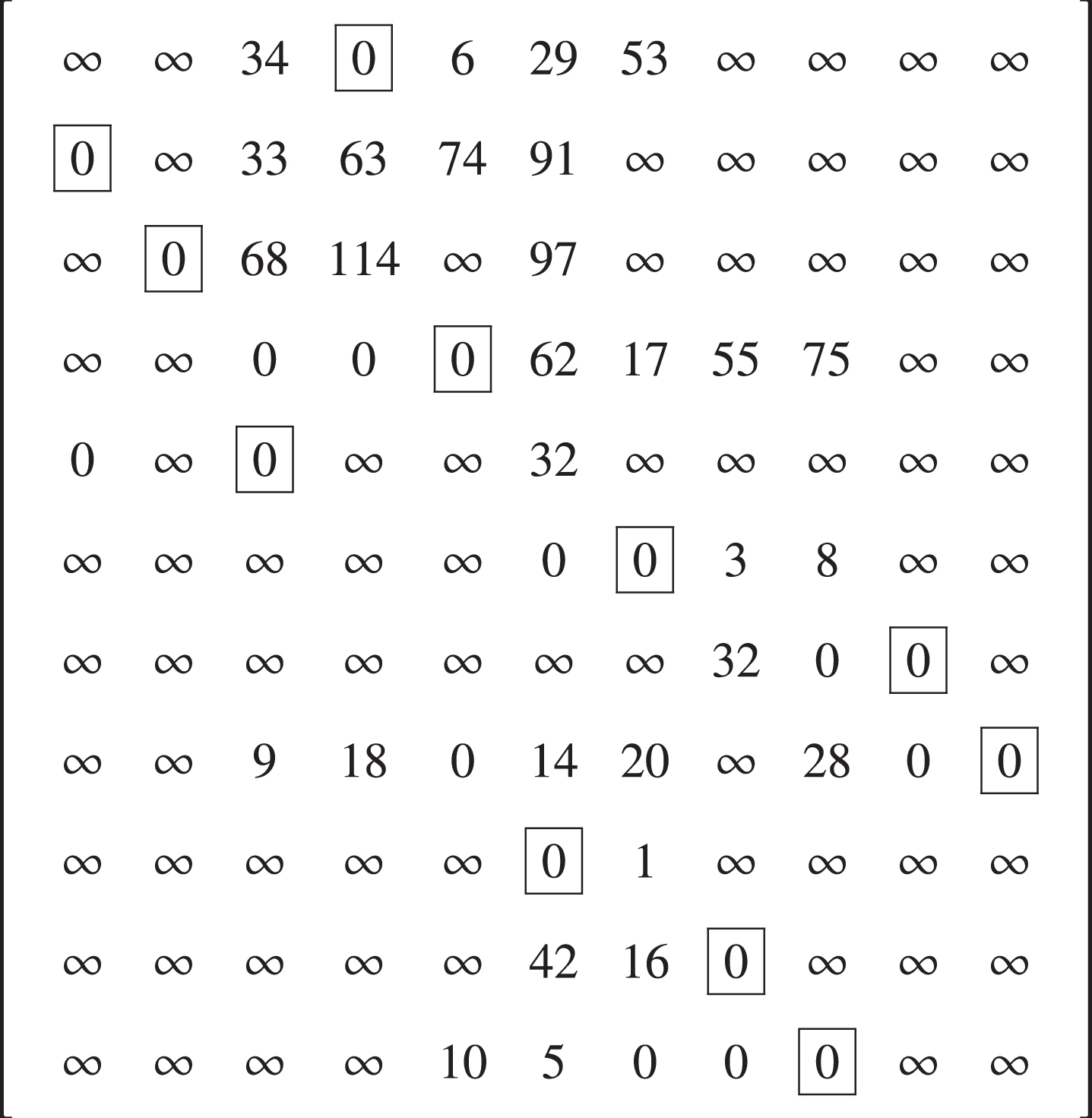
After selecting the Best 11 for all three formats, to increase the winning percentage, we want to choose one more criteria best position(batting order)for all the players based upon their averages in the respective formats using assignment models is discussed in this section. Here, we are going to assign a batting position for the players selected in Test format based on the batting average in different position by using assignment model problem. The following table entries are batting averages of players in different batting positions.
The following problem can be read as row wise for
(R1,T1BAT1),(R2,T1BAT3)(R3,T2BAT10),
(R4,T2BAT12),(R5,T2BAT13),(R6,T1BOWL4),
(R7,T2BOWL7),(R8,T2BOWL8),(R9,T1WK1),
(R10,T1ALL1),(R11,T1ALL2).
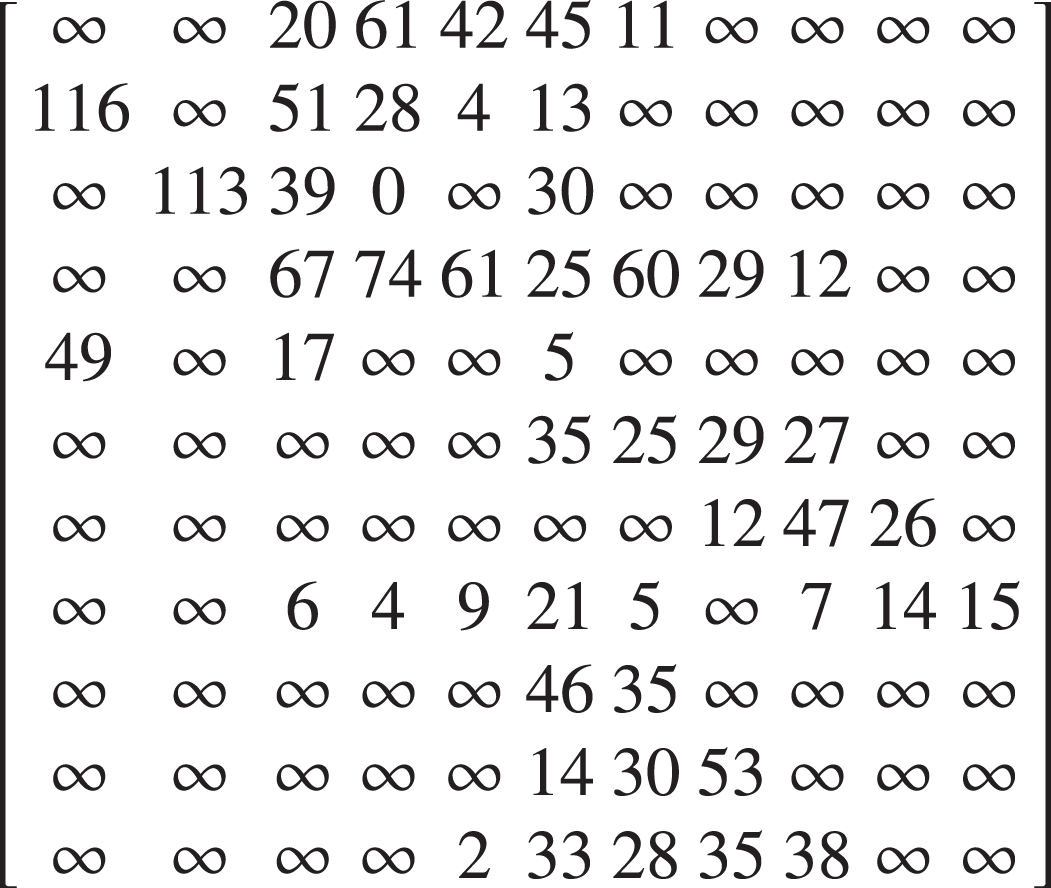
Step-I: Applying the row operation, i.e., subtracting the highest element of each row from every element of the respective row, we got the following reduced matrix
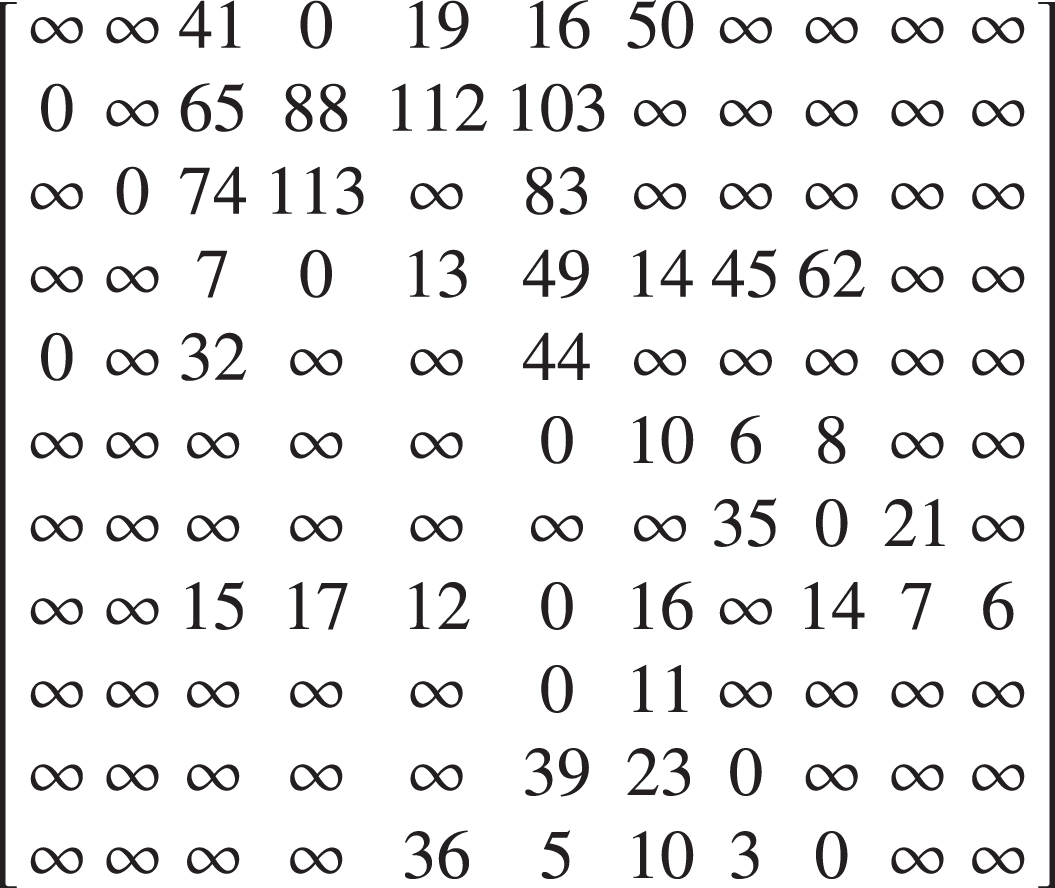
Step-II: Now applying the column operation, i.e., subtracting the smallest element of each column from every element of the respective column. We get the following reduced matrix.

Step-III:
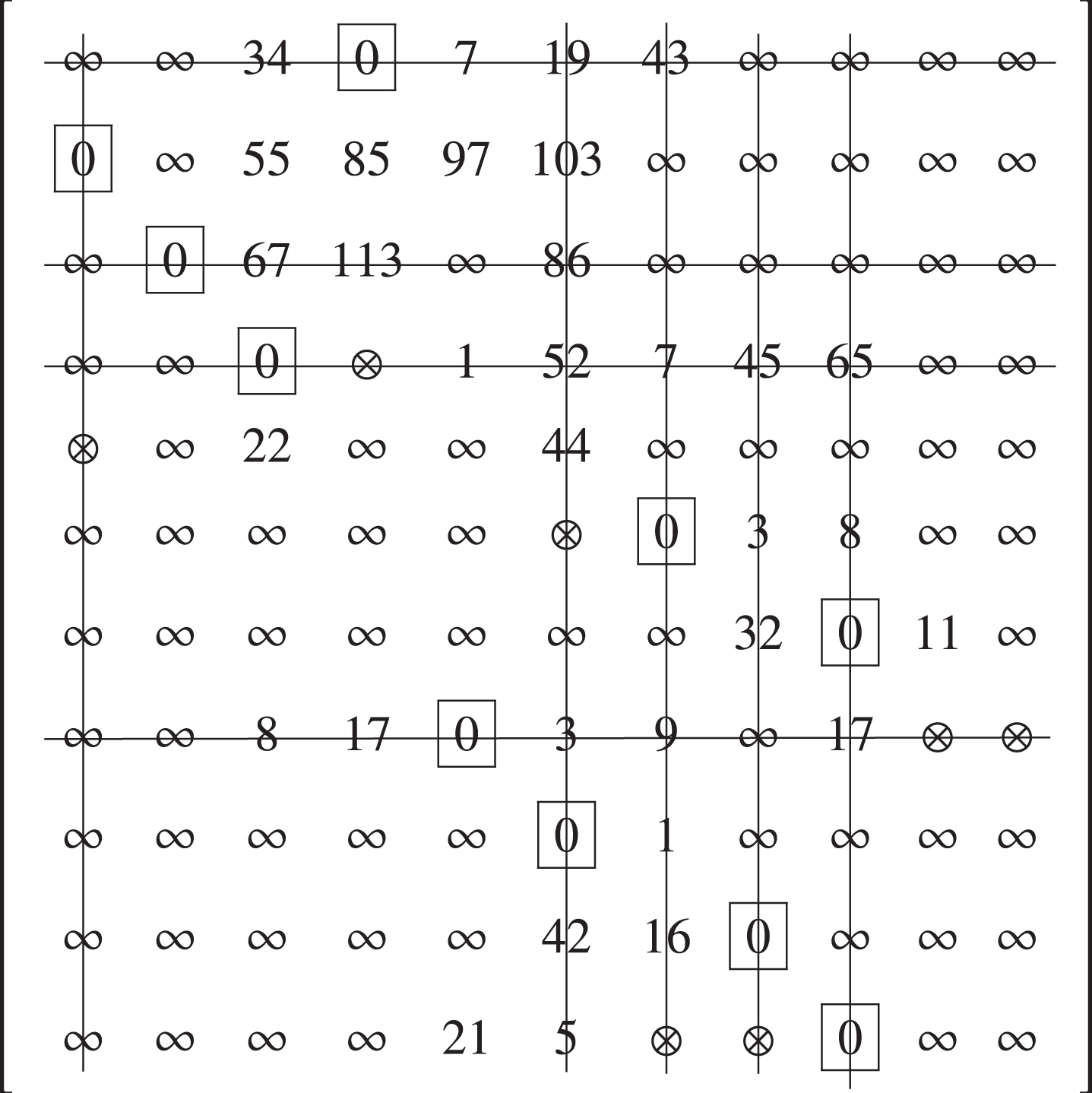
Step-IV:
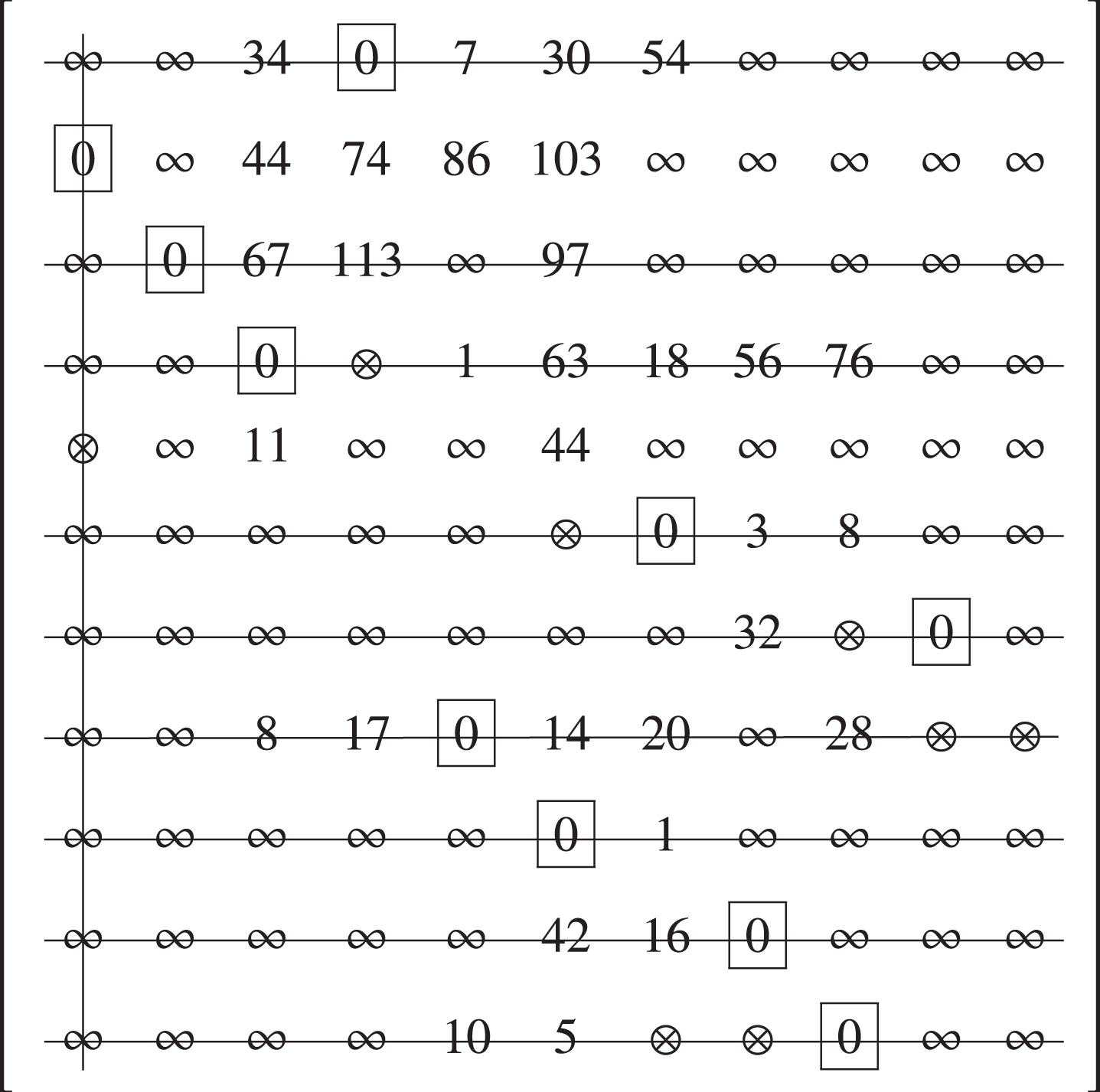
Step-V:

Step-VI:
Step-VII:
From step VII of the assignment problem, we can fix the batting position of the players in test format to win Best’11 game and also it provides us optimal runs obtained by this batting order is 571. we can implement the same idea to ODI and T20 to get opt batting position and optimal runs to their corresponding solutions.
Prediction of Indian world cup 2019 squad using our approach
In this section, a comparative analysis of our work with the existing literature taken from [15] is done. We introduce the idea of several indices to justify our work. So with respect to players data there are two main classifications 1) overall Performance, 2)performance during 2015-2019. Our goal is to pick 15 Indian squad members out of 24 for the 2019 World Cup.Our goal is to implement the new algorithm defined in Section 3 and methodology in Section 4 to select 15 member squad.
In Table 1, we can see batsmen data,which is predominantly dominant by 2015-19 performance and overall performance(starting from individual’s debut) has less dominant comparing to the prior. Our aim is to find new index from the data, which was dominated by their batting abilities. There are three indices that we are going to define using Table 1.
Batsman’s information table (Overall & 2015-19)
ICO Bat =
(0.4) × O Ave + (0.3)×O SR + (0.2) × O100 + (0.1) × O50
ICF Bat =
(0.4) × F Ave + (0.3) × F SR + (0.2) × F100 + (0.1) × F50
From the above two formulae we can find batting index 1(Bat I1) by the following formula
BatI1 = (0.3) × ICO Bat + (0.7) × ICF Bat .
Our assessment of a player’s recent performance has a strong impact on team success, so we gave 0.7 weight to recent performance (2015-2019) and 0.3 weight to overall results.
Table 2 reveals the Batsmen information table based on the venues and results. Using Table 2 our goal is to find Bat I2. In England, played the 2019 World Cup, which is a neutral venue for the Indian team. Therefore, instead of home venue, we need to give comparatively higher weights for away and neutral venue, and also give higher weights to matches won rather than lost.
Batsmen Information table based on venues and results
BatI2 = (0.15) × Ave H + (0.25) × Ave A + (0.3) × Ave N
+ (0.2) × Ave W + (0.1)×Ave L .
In Table 3, we obtained Ranks based on OBatI.
Decision Table based on OBatI
OBatI is shown in Table 3.
The higher you get OBatI, the better rated player that you are.
In Table 4, we can see Information table based on players bowling skills in overall matches and matches between 2015-2019. Our objective is to find DI Bow , ICO Bow , ICF Bow and BowI from Table 4.
Information table based upon bowling skills (Overall & 2015-19)
In the above calculation, we have given highest weight (0.5) to the bowler who dismissed opponents top order batsman(Batsman 1,2 and 3), higher weight (0.3) to the bowler who dismissed opponents middle order batsman (Batsman 4,5,6 and 7) and least weight (0.2) to the bowler who dismissed opponents tail enders(Batsman 8,9,10 and 11). If DI Bow is high which means he dismissed more number of top order batsman on the other hand if some bowlers dismissal percent is quite similar in all three mode of dismissals which means the bowler is impact bowler and gives breakthrough whenever he ask to bowl by captain.
BowI = (0.4) × ICO Bow + (0.6) × ICF Bow
To find BowI, we need two values ICO Bow and ICF Bow which is defined by
ICO Bow = (0.4) × O Ave + (0.3) × O SR + (0.2) × DI Bow + (0.1) × OW/I
ICF Bow = (0.4) × F Ave + (0.3) × F SR + (0.2) × DI Bow + (0.1) × FW/I
In Table 5, we are given Bowlers Information table based on venues and results. Our objective is to find OBowI using this table.
IVR H = (0.4) × Ave H + (0.4)×SR H + (0.3)×WI H
IVR A = (0.4) × Ave A + (0.4)×SR A + (0.3)×WI A
IVR N = (0.4) × Ave N + (0.4)×SR N + (0.3)×WI N
IVR W = (0.4) × Ave W + (0.4)× SR W + (0.3)×WI W
IVR L = (0.4) × Ave L + (0.4)×SR L + (0.3)×WI L
ICV Bow =
(0.25) ×IVR H + (0.35) ×IVR A + (0.4) ×IVR N
ICR
Bow
= (0.6) ×IVR
W
+ (0.4)×IVR
L
OBowI index based on bowlers information table using venues and results in 2015–19
Players rank by bowling skills
Bowling styles & ranking of players dominance by bowling
Players rank & OBatI dominance by batting skills
Batting style & ranking dominance by Batting
Comparison table for our approach against BCCI list
Similarity percentage for our approach with BCCI selected list
Assignment table to decide batting order
Final solution table
Best’11 batting order
Conclusion
Thus we have provided a Best’11 algorithm for choosing best 15 squad members. To justify our algorithm we have to compare our work with the existing literature namely [15]. We have concluded that our idea of choosing 15 squad members almost coincides (93 percent) with BCCI’s list. We have used assignment model and rough matrix theory to enhance our new algorithm.
As a further work, we plan to extend this idea for Test and T20I’s.