The aim of this work is to solve the linear system of equations using LU decomposition method in bipolar fuzzy environment. We assume a special case when the coefficient matrix of the system is symmetric positive definite. We discuss this point in detail by giving some numerical examples. Moreover, we investigate m × n inconsistent bipolar fuzzy matrix equation and find the least square solution of the inconsistent bipolar fuzzy matrix using the generalized inverse matrix theory. The existence of the strong bipolar fuzzy least square solution of the inconsistent bipolar fuzzy matrix is discussed. In the end, a numerical example is presented to illustrate our proposed method.
Fuzzy set initially proposed by Zadeh [35] which leads to definition fuzzy number and its usage in approximate reasoning and fuzzy control problem. Fuzzy sets and fuzzy arithmetic play a significant role when the problem having uncertain variables. It helps to define the problem in real form and the solution for these uncertain variables has been obtained. Dubois and Prade [22, 23], Tanaka and Mizumoto [27, 28] and Nahmias [30] discussed fundamental arithmetic operations and methods of fuzzy numbers. Voxman and Goetschel [25] proposed the concept of fuzzy calculus. They presented the fuzzy number in the parametric form and inserted the set of fuzzy numbers into a topological vector space. Moghadam et al. [29] developed the idea of trapezoidal fuzzy numbers. The other affected investigations were appeared by Wu and Ma [18] and Puri and Ralescu [32]. Zhang initiated the notion of YinYang bipolar fuzzy sets (bipolar fuzzy set) in [37, 38] as an extension of fuzzy sets. A bipolar fuzzy set is a powerful tool for depicting fuzziness and uncertainty. This model is more flexible and practical as compared to the fuzzy model. In several domains, it is significant to have the capacity to manage bipolar fuzzy information. The positive information communicates what is allowed to be conceivable and negative information communicates what is thought to be inconceivable. Akram and Arshad [5] proposed a new trapezoidal bipolar fuzzy TOPSIS method for group decision-making.
The concept of linear systems play an important role in the various fields of engineering sciences and physics including traffic flow, fluid flow, heat transport and circuit analysis, etc. In the vast majority of the problem, usually we work with approximate data. To overcome these errors, we may represent given data as a fuzzy and more general bipolar fuzzy number rather than a crisp and fuzzy number. In several applications, at any rate, a few parameters of the system are expressed by bipolar fuzzy number in place of the crisp numbers. The fuzzy linear system has been examined by many investigators. Friedman et al. [24] studied a general model to illuminate a fuzzy linear system of equations by using an embedded approach. Allahviranloo et al. [13, 14] presented some notable numerical methods for solving a fuzzy system of linear equations. Moreover, Abbasbandy et al. [1, 2] presented the Steepest descent method and LU-decomposition method to solve the fuzzy system of linear equations (FSLEs). Further, Allahviranloo and Salahshour [15] developed a novel method to solve an FSLEs by using 1-cut extension. Many authors have been studying to solve fuzzy linear systems (FLS) numerically [1, 21]. Asady et al. [16] considered the full row rank system to solve the system m × n FLS. Wang and Zheng [43] investigated the m × n the inconsistent FLSs and general FLSs by using generalized inverses of the coefficient matrix of the FLSs. Abbasbandy et al. [4] considered the minimal solution of the general dual FLSs by using the theory of the generalized inverse of the matrix. Zengtai et al. [36] considered the m × n inconsistent fuzzy matrix equation (FME) and its fuzzy least square solution by using the generalized inverse theory of matrix. Akram et al. [6, 10] and Saqib et al. [33] studied linear system of equations based on bipolar fuzzy information. They discussed the system of linear equation and its solution procedure with right-hand side as parametric bipolar fuzzy numbers. Other useful investigation about fuzzy rough set were presented in [40–42].
In this paper, we solve the bipolar fuzzy system of linear equation (BFSLE) by LU decomposition method and compare this solution with an exact solution. We assume a special case when the coefficient matrix of the system is symmetric positive definite. We discuss this point in detail by giving some numerical examples. Moreover, we define a family of inconsistent bipolar fuzzy matrix equations (IBFMEs) in which is an m × n crisp matrix and the right-hand side matrix is an m × j arbitrary bipolar fuzzy number matrix. Further, we discuss the solvability of the LU decomposition method in detail and describe the concept of inconsistent bipolar fuzzy matrix equations and then we find the bipolar fuzzy least square solution of a bipolar fuzzy inconsistent matrix by using the theory of generalized inverse matrix Q and . In the end, we study the strong bipolar fuzzy least square solution and illustrate this concept with an example. Our results are extensions of works of [1, 36].
LU decomposition method for system of linear equations in bipolar fuzzy environment
Definition 2.1. [6] A bipolar fuzzy number in parametric form is a quadruple of the functions ; 0 ≤ r ≤ 1, -1 ≤ s ≤ 0 and satisfying the given conditions:
is a bounded monotonically increasing(non-decreasing) left continuous function on a set (0, 1] and right continuous at point 0,
is a bounded monotonically decreasing(non-increasing) left continuous functions on a set (0, 1] and right continuous at point 0,
is a bounded monotonically decreasing(non-increasing) left continuous functions on a set (-1, 0] and right continuous at point -1,
is a bounded monotonically increasing(non-decreasing) left continuous functions on a set (-1, 0] and right continuous at point -1,
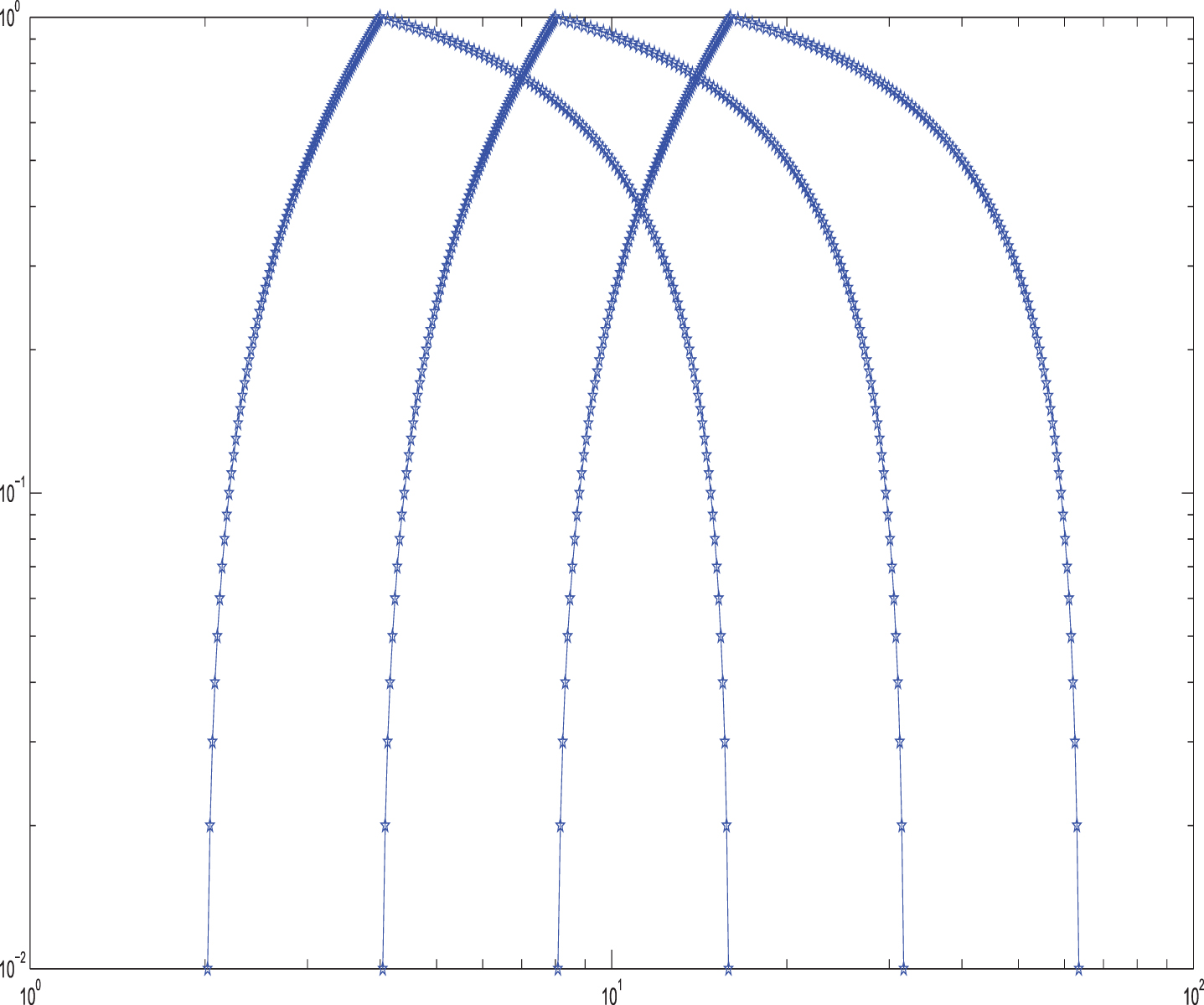
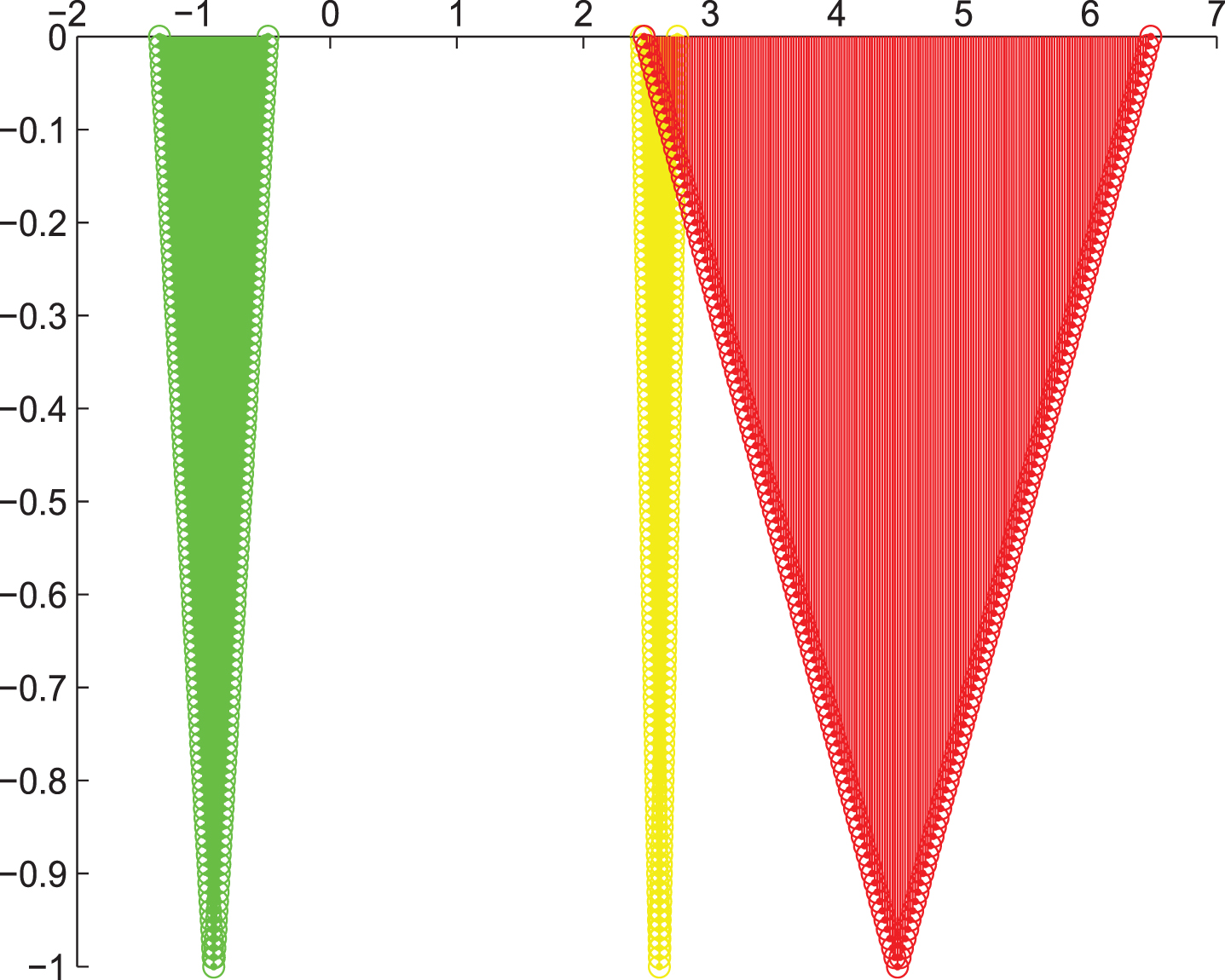
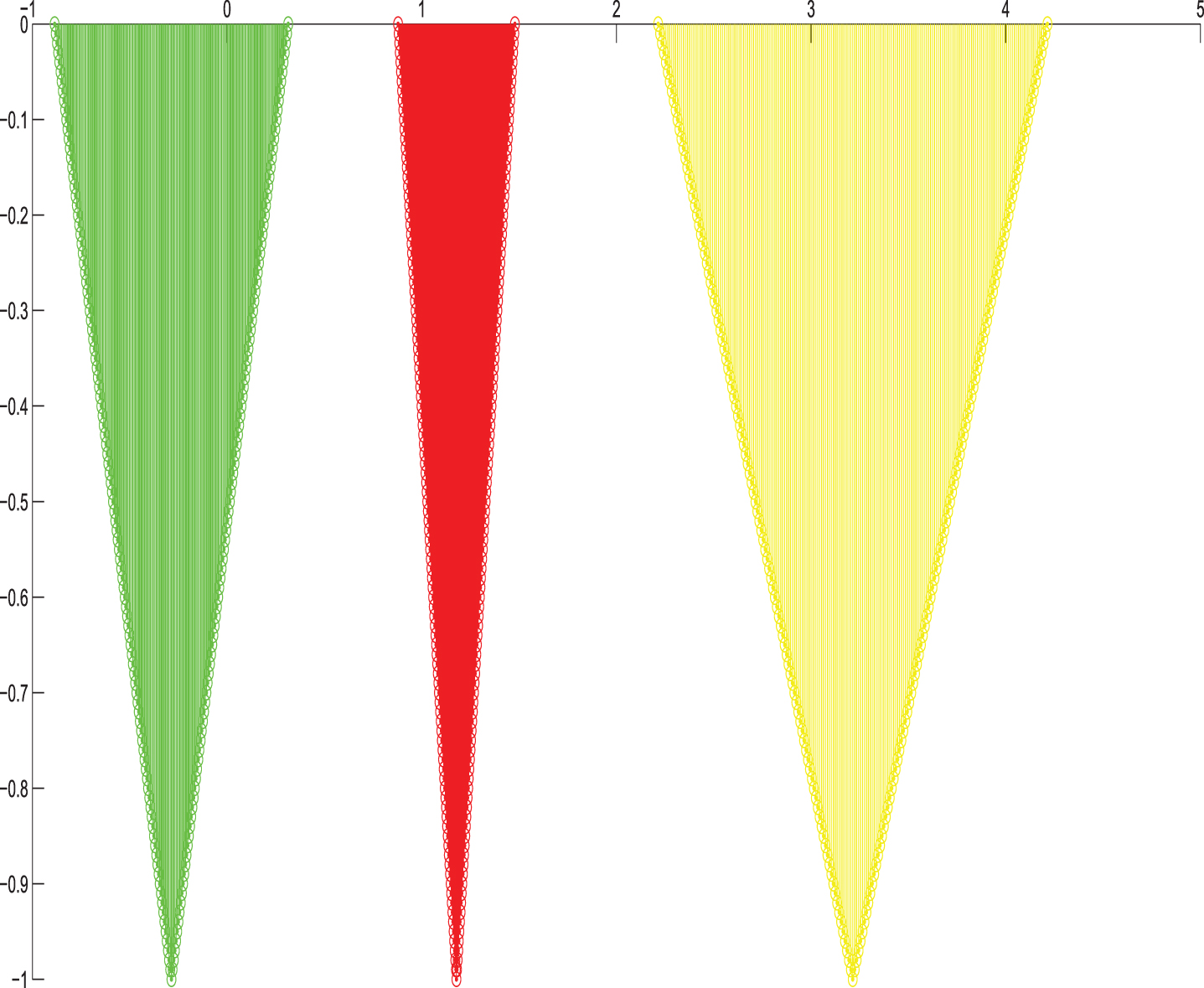
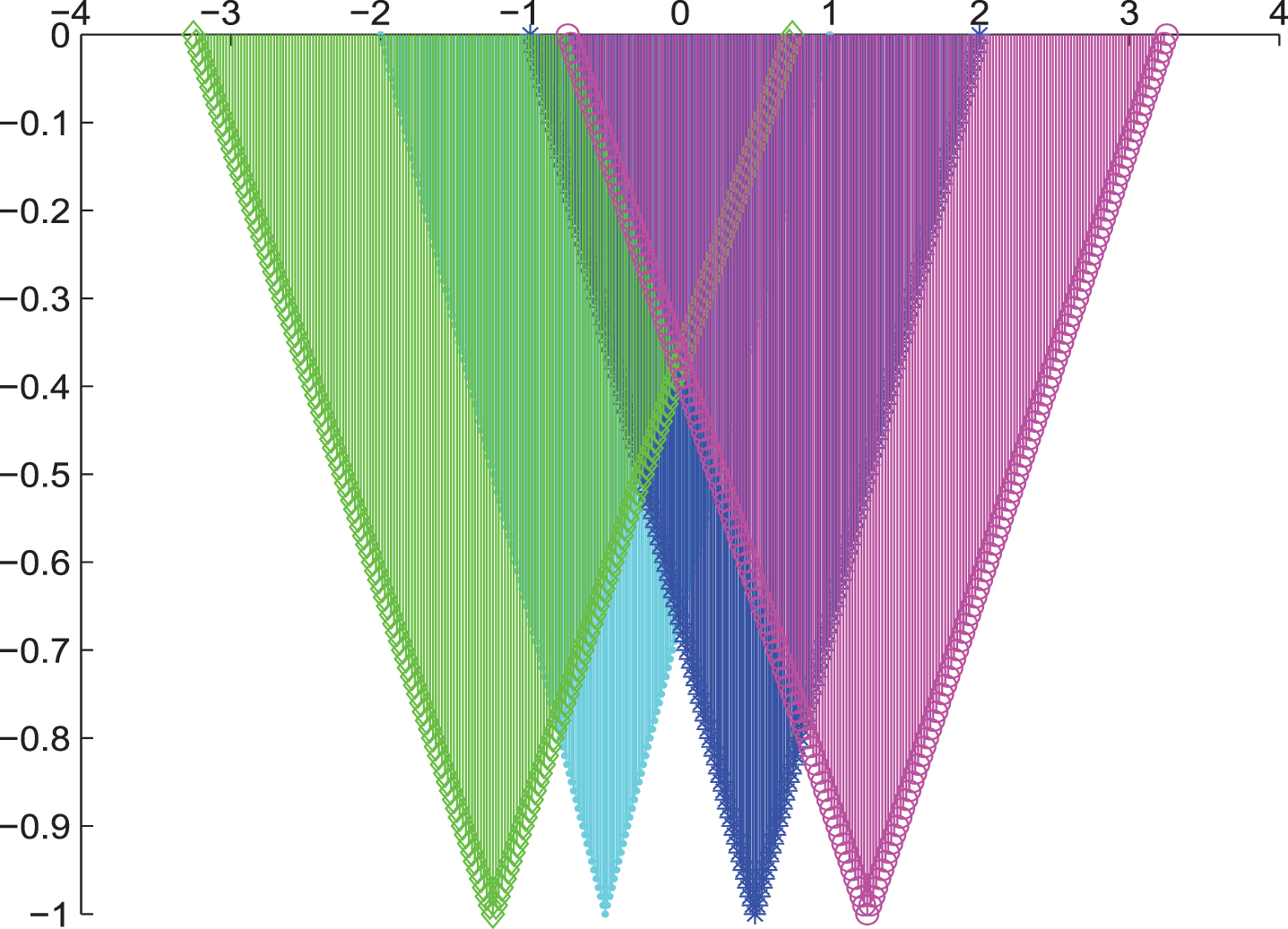
Example 2.2. On the base of [5]. We define the parametric bipolar fuzzy number un = (2N + r (2N+1 - 2N) , 2N+3 - r (2N+3 - 2N+1) , 2N+2 - s (2N+4 - 2N+2) , 2N+5 + s (2N+5 - 2N+4)) is the (r, s)-cut of trapezoidal bipolar fuzzy number [(2N, 2N+1, 2N+3) , (2N+2, 2N+4, 2N+5)], 0 ≤ r ≤ 1, -1 ≤ s ≤ 0, N = 1, 2, 3, ⋯
In particular, graphically representation, as shown in Figures 1 and 2, of parametric bipolar fuzzy numbers for N = {1, 2, 3}.
The graph of positive membership function of bipolar fuzzy numbers.
The graph of negative membership function of bipolar fuzzy numbers.
Definition 2.3. For arbitrary and c > o, we define , and scalar multiplication by c as follows:
, ,
, ,
, , c ≥ 0,
, , c ≥ 0,
, , c ≤ 0,
, , c ≤ 0.
The family of all bipolar fuzzy numbers with addition and scalar multiplication, denoted by I E, are convex and concave cones.
Definition 2.4. The m × n linear system of equations
where the coefficient elements cuv, 1 ≤ u ≤ m, 1 ≤ v ≤ n is a crisp m × n of matrix, zu∈IE, 1 ≤ u ≤ m and yv, 1 ≤ i ≤ n are unknown bipolar fuzzy numbers, is called BFSLEs.
Definition 2.5. The matrix system
where the coefficient elements are crisp numbers and in the right hand matrix are bipolar fuzzy numbers (BFNs) is called a general bipolar fuzzy matrix equation (GBFME). By using matrix equation, we have
Definition 2.6. [6] A bipolar fuzzy number vector given by
is called the solution of system (1) if
and
For a particular u, cuv > 0, 1 ≤ v ≤ n, we have
From above expression, we have 2m × 2n crisp linear system as follows:
or
cuv ≥ 0 ⇒ qu,v = cuv, qu+m,v+n = cuv, qu,v+n = 0, qu+m,v = 0, cuv < 0 ⇒ qu,v = 0, qu,v+n = - cuv, qu+n,v = cuv, qu+m,v+n = 0, 1 ≤ u ≤ m, 1 ≤ v ≤ n. If any quv is not determined is considered as 0.
Thus a system in Definition (2.4) extended to the crisp system (4), where A = Q1 + Q2 and Equation (4) can be written as
Similarly,
Remark 1. In fuzzy linear system, on the left hand side, a crisp matrix Q and some vector Y which is corresponding to Q. But in bipolar fuzzy linear system, would be factually Q. As is any matrix. That is why, for facilitating we take , there would be some of it correspond. We shall take bipolar fuzzy number at right hand side which will be QY = Z and .
On the base of [19, 24], we extend the results in bipolar fuzzy environment as:
Theorem 2.7.The matrix is non-singular if and only if the matrices Q1 - Q2 and Q1 + Q2 are both also non-singular. Similarly, is non-singular if and only if the matrices and are both also non-singular.
Definition 2.8. If is a solution of system (3) and for every v, 1 ≤ v ≤ n the inequalities hold, then the solution is said to be strong solution of the system (3), otherwise it is called the weak solution of the system (3).
Theorem 2.9.Let the matrix Q be a non-singular and the unique solution of QY = Z give always a bipolar fuzzy number vector for arbitrary Z, the necessary and sufficient condition that Q-1 is non-negative. Similarly, let the matrix be a non-singular and the unique solution of give always a bipolar fuzzy number vector for arbitrary , the necessary and sufficient condition that is non-negative.
Theorem 2.10. Let Qn×n be a matrix with all real numbers except 0 with leading principal minors. Then the matrix Qn×n has a unique factorization:
where [L] and [U] are unit lower-triangular and upper-triangular, respectively.
In order to eliminate the reduction of Q, we must found the matrices [L] and [U] such that Q = [L] [U], which is
where L11, L22 and U11, U22 are lower and upper triangular matrices, L21 and U21 are any matrices and O is null matrix, respectively.
Now we assume that Q = Q1 + Q2 has LU-decomposition. We have
then
So, we can write as
Let be a matrix with all real number except 0 with leading principal minors. Then has a unique factorization:
where and are unit lower-triangular and upper-triangular, respectively. In order to eliminate the reduction of we just set and , then we get
So, we can write as
From Equation(6,7) and Equation (9,10) if and all have LU-decomposition, then Q and are also LU-decomposition.
Theorem 2.11.Let Qn×n be a symmetric positive definite matrix then there exists a unique matrix [L] with positive diagonal entries such that
Proof. Suppose that Qn×n is a symmetric and positive definite matrix. We have
then
So, we can write as
By following Theorem 2.11 in LU-decomposition method, Q1 and should be symmetric positive definite. By using similar argument, we have
This completes the proof.□
Remark 2. In this article, the weak solution is rejected and it is not necessary to investigate it. Only the strong solution is found and discussed.
Here, we solve some numerical examples to illustrate our proposed method.
Example 2.12. Consider 2 × 2 bipolar fuzzy linear system
The first extended 4 × 4 matrix is [6]
corresponding matrix of the above system is
and ,
and hence
The second extended 4 × 4 matrix is
corresponding matrix of the above system is
and ,
and hence
The exact solution is
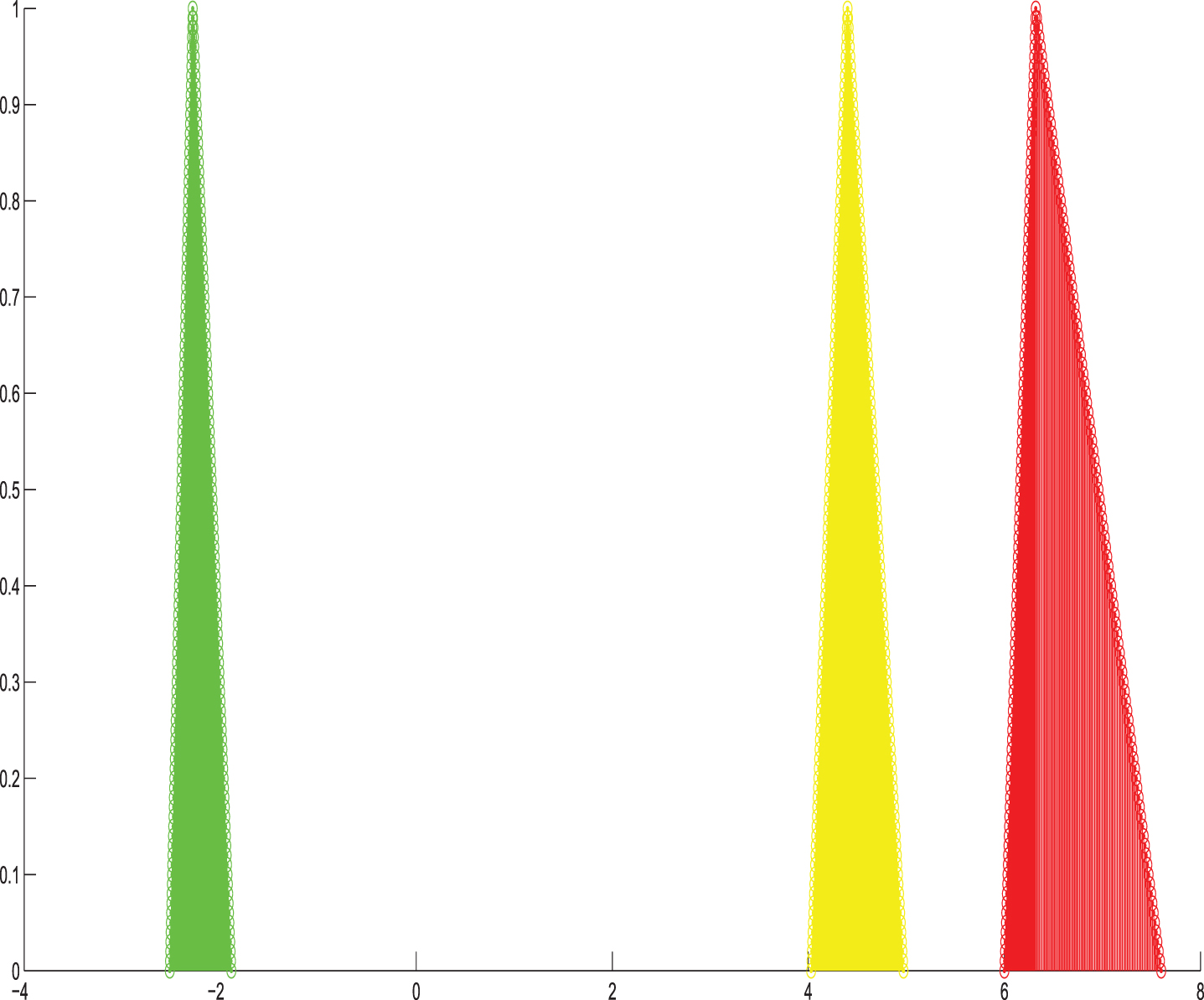
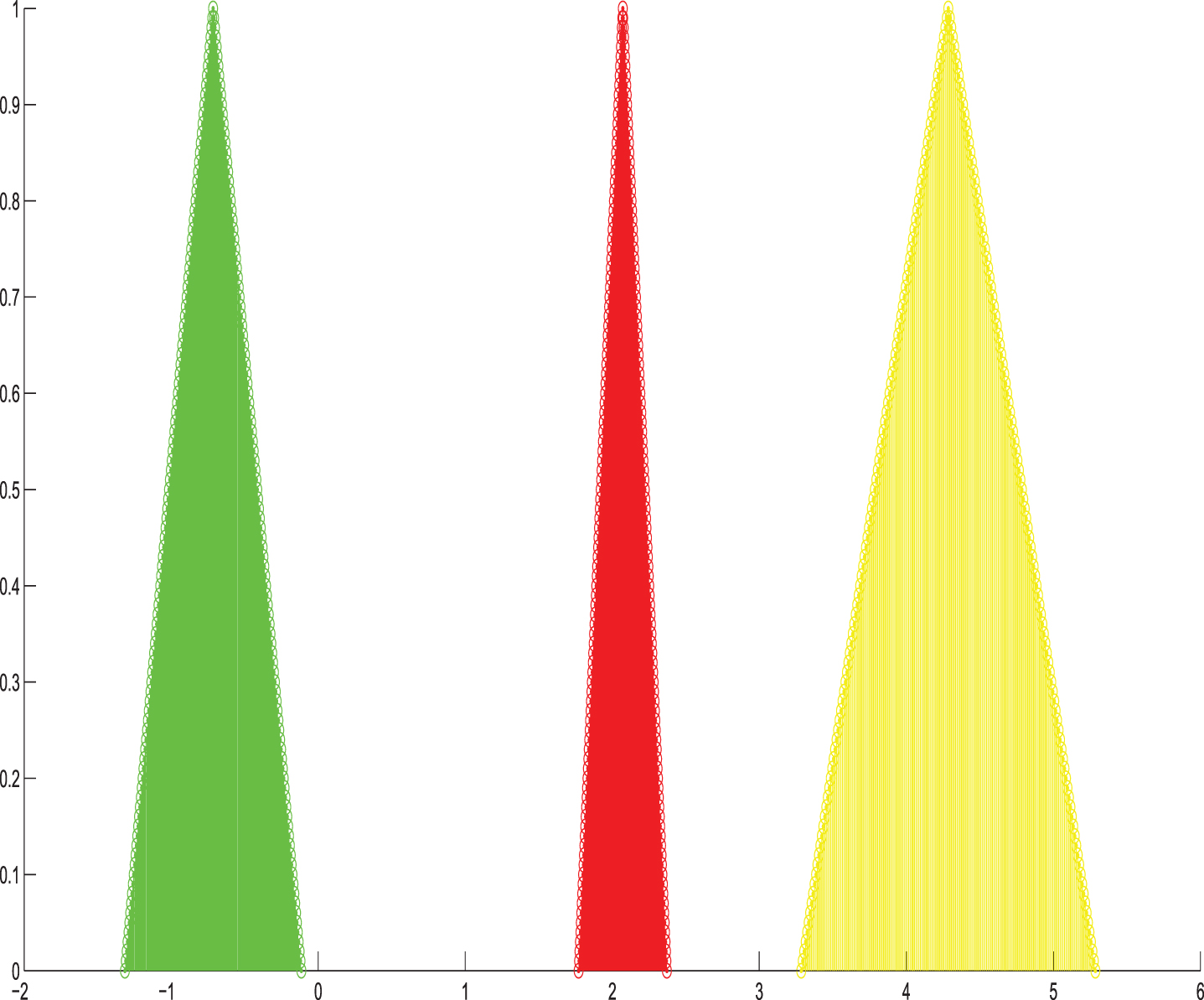
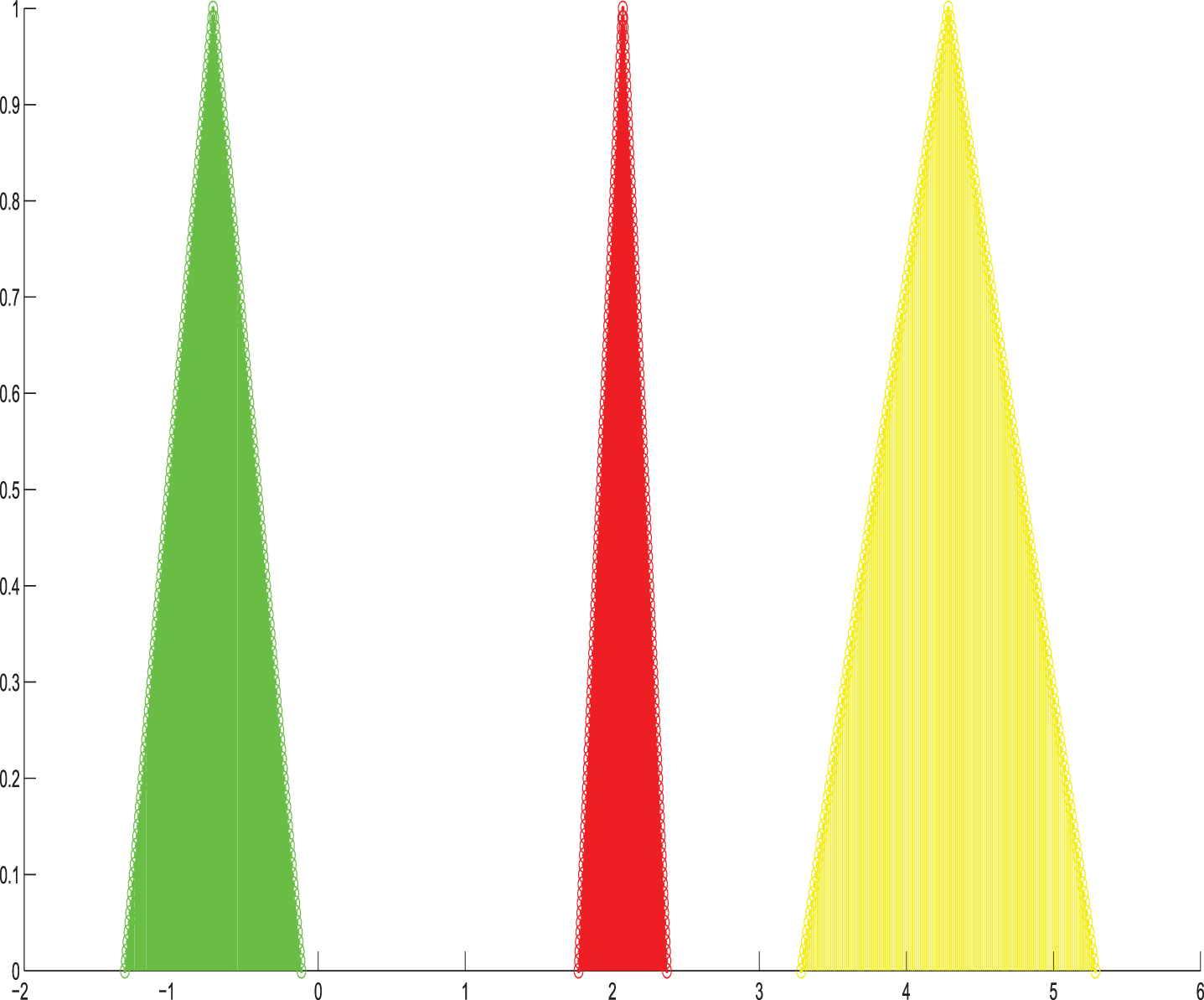
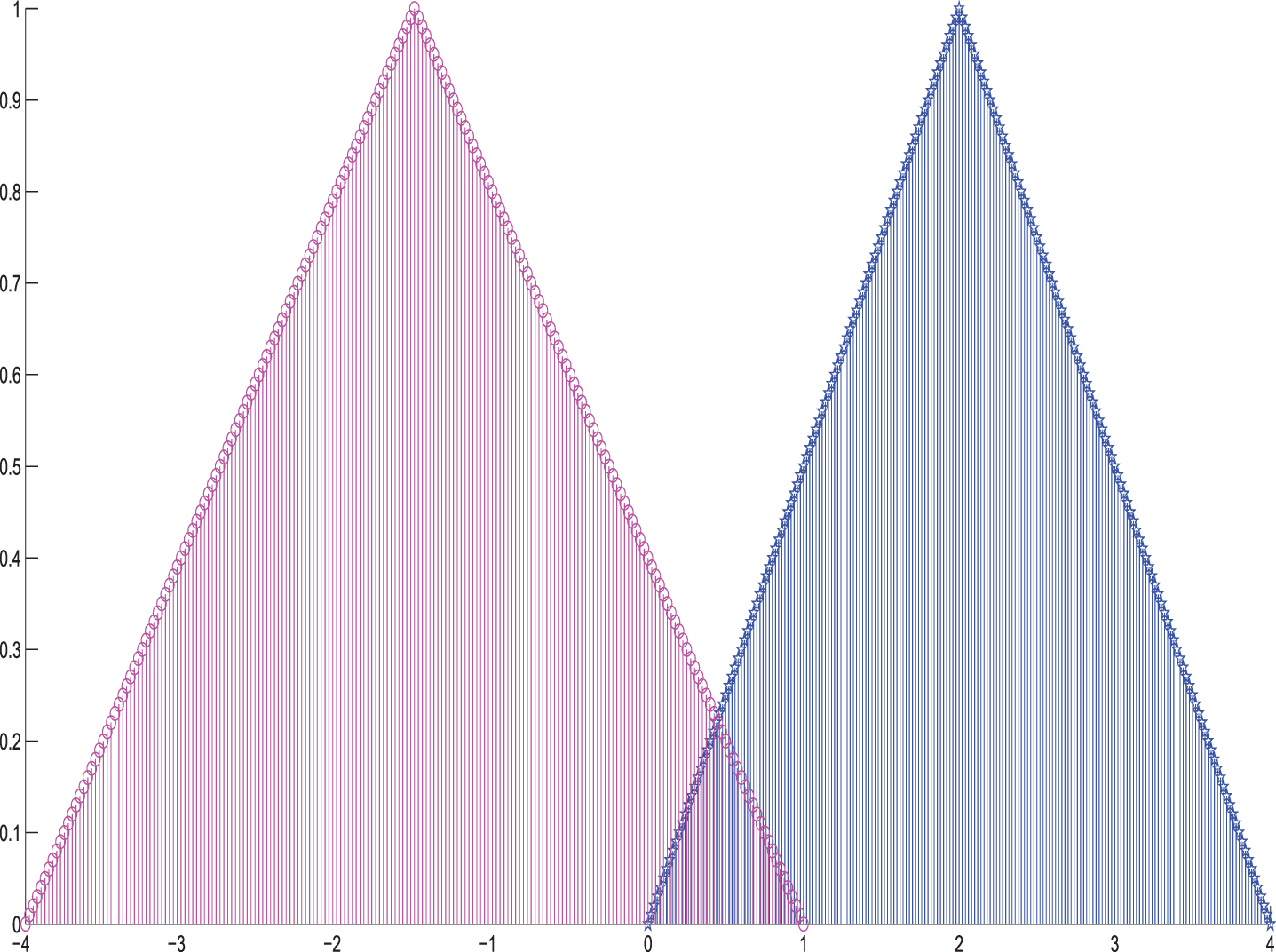
The exact and obtained solution with LU decomposition of positive membership function of bipolar fuzzy number are plotted in Figures 3 and 4.
Exact solution. The Hausdorff norm of errors with ε = 10-8 is 7.7037e-034.
The solution with LU decomposition method. The Hausdorff norm of errors with ε = 10-8 is 7.7037e-034.
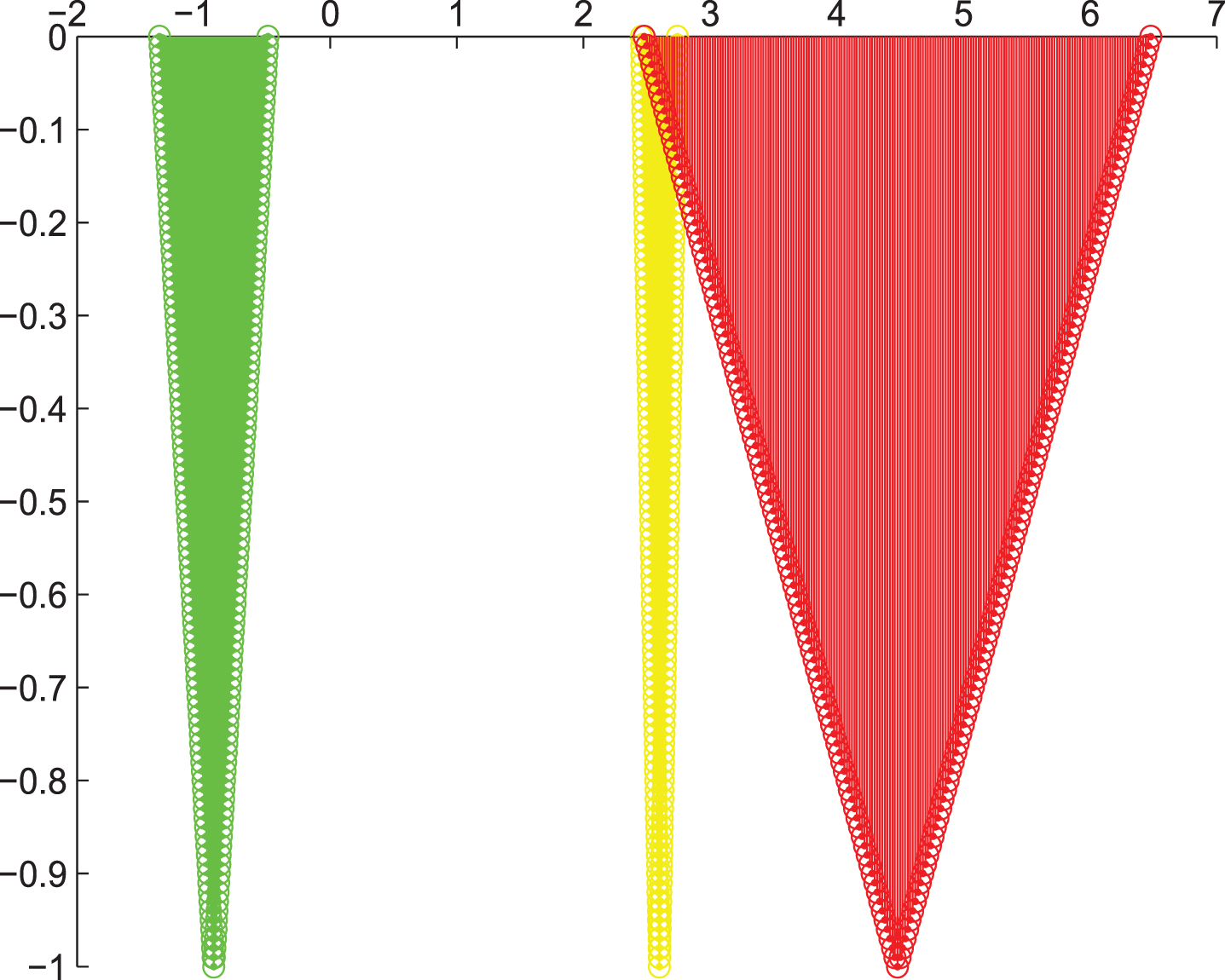
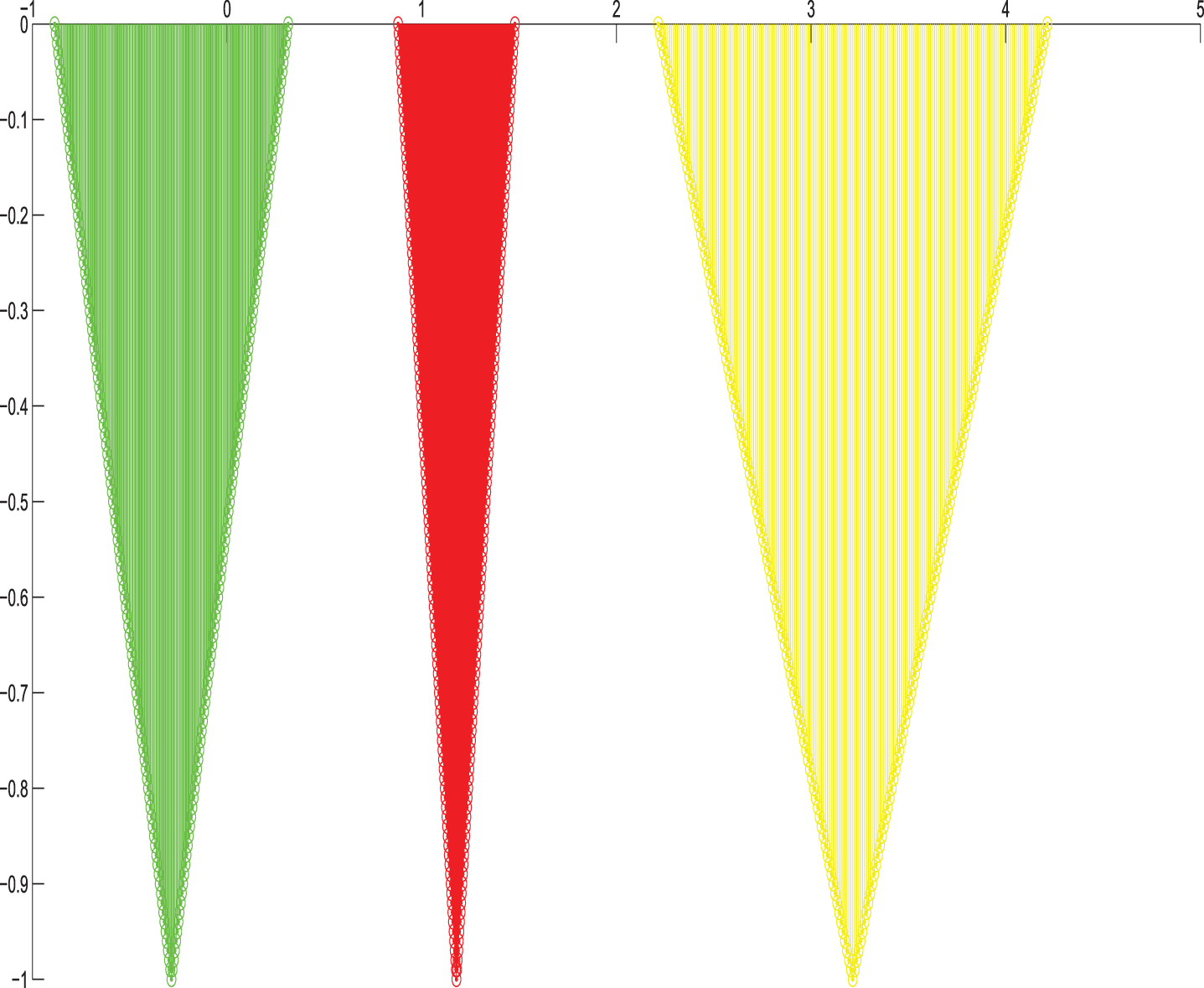
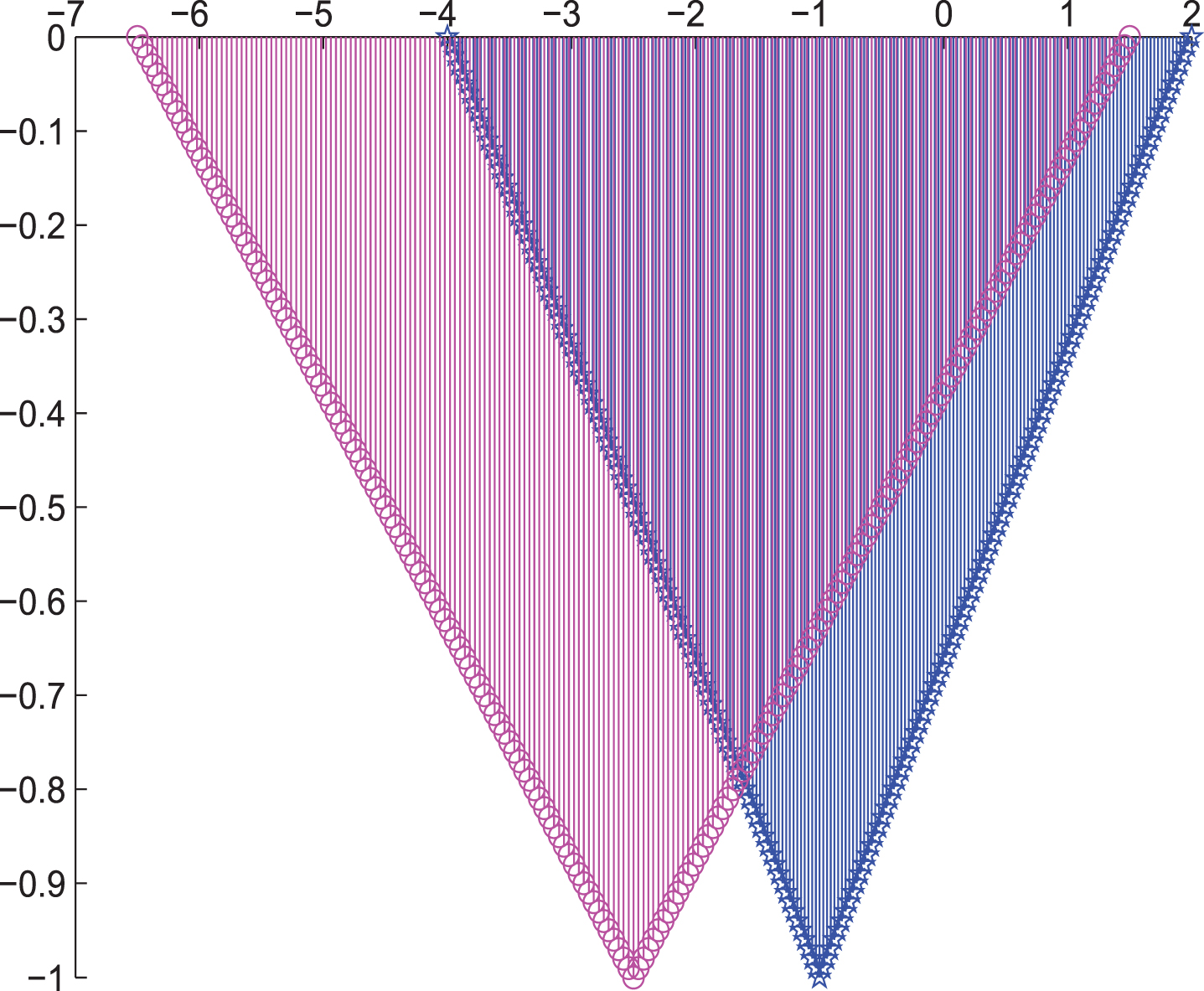
The exact and obtained solution with LU decomposition of negative membership function of bipolar fuzzy number are plotted in Figures 5 and 6.
Exact solution. The Hausdorff norm of errors with ε = 10-8 is 7.7037e-034.
The solution with LU decomposition method. The Hausdorff norm of errors with ε = 10-8 is 7.7037e-034.
Example 2.13. Consider the 3 × 3 bipolar fuzzy linear system
The first extended 6 × 6 matrix is
and
and hence Q = LU is
The second extended 6 × 6 matrix is
and
and hence is
The exact solution is
The exact and obtained solution with LU decomposition of positive membership function of bipolar fuzzy number are plotted in Figures 7 and 8.
Exact solution. The Hausdorff norm of errors with ε = 10-8 is 3.0875e-009.
The solution with LU decomposition method. The Hausdorff norm of errors with ε = 10-8 is 3.0875e-009.
The exact and obtained solution with LU decomposition of negative membership function of bipolar fuzzy number are plotted in Figure 9 and 10.
Exact solution. The Hausdorff norm of errors with ε = 10-8 is 3.0875e-009.
The solution with LU decomposition method. The Hausdorff norm of errors with ε = 10-8 is 3.0875e-009.
Example 2.14. Consider the 3 × 3 bipolar fuzzy linear system
The first extended 6 × 6 symmetric positive definite matrix is
and
and hence Q = LLT which
The second extended 6 × 6 symmetric positive definite matrix is
and
and hence Q′ = L′L′T which
Now the exact solution is
The exact and obtained solution with LLT decomposition of positive membership function of bipolar fuzzy number are plotted in Figures 11 and 12.
Exact solution. The Hausdorff norm of errors with ε = 10-8 is 1.4248e-031.
The solution with LU decomposition method. The Hausdorff norm of errors with ε = 10-8 is 1.4248e-031.
The exact and obtained solution with L′L′T decomposition of negative membership function of bipolar fuzzy number are plotted in Figures 13 and 14.
Exact solution. The Hausdorff norm of errors with ε = 10-8 is 1.4248e-031.
The solution with LU decomposition method. The Hausdorff norm of errors with ε = 10-8 is 1.4248e-031.
Lemma 2.15. The solution of BFSLEs exists if and only if the rank of the matrices Q and Q′ equals to that of matrices (Q, z) and (Q′, z′) that is,
when Rank (Q) = Rank (Q, z) =2n and Rank (Q′) = Rank (Q′, z′) =2n the system has unique solution, the system have infinite many solutions if Rank (Q, z) = Rank (Q) <2n and Rank (Q′, z′) = Rank (Q′) <2n and no solution if Rank (Q, z) > Rank (Q) and Rank (Q′, z′) > Rank (Q′).
Theorem 2.16. The system QY = Z (r) and Q′Y′ = Z′ (s) have solution if and only if
Proof. Let , , where
Since the following matrices are equivalent
If Rank (Q, Z (r)) = Rank (Q) and Rank (Q′, Z′ (s)) = Rank (Q′), then we have Rank (Q, zu (r)) = Rank (Q) and ∀u, since Rank (Q, Z (r)) ≥ Rank (Q, zu (r)) ≥ Rank (Q) and . By Lemma 2.15, all linear equations Qyu = zu (r) and ,u = 1, 2, 3, ⋯ , v have solutions. So, the necessary condition is meaningful.
Conversely, assume that QY = Z (r) and Q′Y′ = Z′ (s) is solvable, that is, every linear equations Qyu = zu (r) and , u = 1, 2, 3, ⋯ , v have solution. Let
and
where , u = 1, 2, 3, ⋯ , 2n.
By using equations Qyu = zu (r) and ,u = 1, 2, 3, ⋯ , v, we have
From the above equations, it follows that zu (r) and can be expressed as linear combination of q1, q2, q3, ⋯ , q2n and , that is,
This completes the proof.□
From the above Theorem 2.16, we can deduce the following result about solvability of Equation (3).
Theorem 2.17.The Equation (3) has equivalent solution to the following equation
Theorem 2.18.The Equation (3) has solution, then the necessary and sufficient condition that the rows of Z (r) and Z′ (s) have same linear relation as rows of Q and Q′ matrices.
Theorem 2.19.If the Equation (3) has no solution, then the correspondence bipolar fuzzy matrix equation is so.
Corollary 2.20. Under the condition
if Rank (Q) = Rank (Q′) =2n, then the equation (3) has a unique, else infinite number of solutions.
Corollary 2.21. If the crisp system (3) has only one solution, then is equivalent to that a bipolar fuzzy linear equation
has only one solution.
Inconsistent bipolar fuzzy matrix equation
Definition 3.1. If the crisp matrix Equation (3) have no solution, the associated bipolar fuzzy matrix equation (BFME)
and
where the coefficient matrix C = (cuv) , 1 ≤ u ≤ m, 1 ≤ v ≤ n is crisp matrix, the right-hand matrix and are bipolar fuzzy number are called an inconsistent bipolar fuzzy matrix equation (IBFME).
We consider the following examples.
Example 3.2. Bipolar fuzzy matrix system
is non-singular, while the extended 6 × 6 matrix
is singular. The given example shows that a bipolar fuzzy matrix system which is singular even if the original matrix is nonsingular, may have infinite number of solutions or no solution exists.
Example 3.3. Consider the bipolar fuzzy matrix system
The extended 4 × 6 matrix is
and the augmented matrix of QY = Z (r) and Q′Y′ = Z′ (s) is
since Rank (Q) =3 and Rank (Q, Z (r)) =4 also Rank (Q′) =3 and Rank (Q′, Z′ (r)) =4, so the original system is inconsistent. The Examples 3.2 and 3.3 represent that the BFME exists some time without the solution. It is essential to find the approximate solution of this type of BFME. If the system (3) is inconsistent, we can find the desired approximate solution by minimizing some norm of (Z (r) - QY (r)) and (Z′ (s) - Q′Y′ (s)). We often use least square solution of Equation (3) for an approximation solution which defined by minimizing of the Frobenius norm of (Z (r) - QY (r)) and (Z′ (s) - Q′Y′ (s)),
that is, minimizing the sum of squares of moduli of (Z (r) - QY (r)) and (Z′ (s) - Q′Y′ (s))
and
Now we define the bipolar fuzzy least squares solution (BFLSS) to the IBFME given by Definition 3.1.
Bipolar fuzzy least squares solution From the above investigation, we analyze that the BFME is inconsistent if Rank (Q) ≠ Rank (Q, z (r)) and Rank (Q′) ≠ Rank (Q′, z′ (s)) in its extended crisp system (3). When BFME is inconsistent, then we may consider its least squares solutions. However, the BFLSS may not have a bipolar fuzzy number matrix. We restrict our discussion to the quadruple bipolar fuzzy numbers, that is, and consequently are all linear functions of r and s, and having to calculate Y and Y′ which solves (3), we can characterize the bipolar fuzzy solution to the bipolar fuzzy matrix as follows:
Definition 3.4. Let represent the least squares solution of (3). The bipolar fuzzy number matrix defined by
is called the BFLSS of QY = Z (r) and Q′Y′ = Z′ (s). If are all bipolar fuzzy numbers then and U(r,s) is called a strong BFLSS. Otherwise, U(r,s) is called a weak BFLSS.
Bipolar fuzzy least squares solution to the bipolar fuzzy matrix equation
First, we analyze the following Lemma.
Lemma 4.1. [43]. Let Q ∈ R2m×2n and Q′ ∈ R2m×2n. A vector Y (r) and Y′ (s) is a BFLSS of the extended crisp function linear equation QY = Z (r) and Q′Y′ = Z′ (s), that is,
and
which is converted from the IBFME (2), if and only if
In this case, the general least squares solutions of the above crisp matrix equation can be expressed by:
where Q{1,3},Q′{1,3} is the least squares generalized inverse of matrix Q and Q′, I2n is unit matrix of order 2n, w (r) and w′ (s) are arbitrary vector with parameter r and s, respectively. According to the Lemma 4.1 and the hypothesis of generalized inverses theory, we have following Theorems about the least squares solution to the Equation (3).
Theorem 4.2. Let Q ∈ R2m×2n and Q′ ∈ R2m×2n. The matrix Y (r) and Y′ (s) is the least squares solution (LSS) of the matrix system (3), if and only if
For this situation, the general LSSs of the crisp matrix Equation (3) can be denoted by:
where Q{1,3},Q′{1,3} is the least squares generalized inverse of the matrices Q and Q′, w (r) and w′ (s) are 2m × j any matrices with the parameters r and s, respectively.
Proof. First, we consider the crisp matrix Equation (3) in block forms of matrix
where Y (r) = [y1 (r) , ⋯ , yj (r)], Z (r) = [z1 (r) , ⋯ , zj (r)], , . Let be the least squares solution of Equation (16). By following the matrix theory [17], the matrix equations QY (r) = Z (r) and Q′Y′ (s) = Z′ (s) are inconsistent if and only if at least one of the linear equations QYv (r) = Zv (r) and is inconsistent. By following Lemma 4.1, we have
and
where W (r) , W′ (s) are 2m × j any matrix with the parameter r and s, respectively. Since and is the LSSs of the linear equation QYv (r) = Zv (r) and , we have
where,
In fact,
That the expression
holds which is equivalent to the given conditions below:
where
and
Therefore, the matrix
is the LSS of the Equation (3). Based on the operations of block forms of matrix, the following results are meaningful
where
□
Remark 3. It is noted that the LSS is unique only when Q and Q′ are of full rank, that is, the LSS of the matrix Equation (3) is
and
Otherwise, the Equation (3) deliver an infinite set of such solutions.
Theorem 4.3.Among the general least squares solutions to the system (3),
is one of the minimum norm, where Q† and are the Moore-Penrose inverse of the matrices Q and Q′, respectively. We know that Q† and are unique. Therefore, the system 19 is unique. To show the LSS to a bipolar fuzzy matrix, now we consider the generalized inverses of the matrices Q and Q′ in an exceptional structure. Since,
we have to follow the assertion:
Lemma 4.4. Let Q and Q′ be in the form of Equation (20). Then the matrix
and
are {1, 3}-inverse of the matrices Q and Q′, where (Q1 + Q2) {1,3}, (Q1 - Q2) {1,3} are {1, 3}-inverse of matrices (Q1 + Q2) and (Q1 - Q2), respectively. Specifically, the Moore-Penrose inverse of the matrices Q and Q′ are
and
The following Theorem provides the necessarily or sufficient conditions for the LSS matrix to be the bipolar fuzzy number matrix (BFM), given by an arbitrary input BFM Z (r) and Z′ (s) and the next Theorem provides a sufficient condition for one LSS to be the BFM.
Theorem 4.5.For the IBFME (3) and any least squares inverse Q{1,3} and of the coefficient matrices Q and Q′, the expression Y (r) = Q{1,3}Z (r) and Y′(s)=Q′{1,3}Z′ (s) are the solution to the system and therefore, it admits a strong or weak BFLSS. In particular, if Q{1,3} and are nonnegative with the structure (21), the expression Y (r) = Q{1,3}Z (r) and Y′(s)=Q′{1,3}Z′ (s) admits the strong bipolar fuzzy solution for arbitrary bipolar fuzzy matrices Z (r) and Z′ (s).
Proof. From the Theorem 4.2 and the theory of generalized inverses, the expression Y (r) = Q{1,3}Z (r) and Y′(s)=Q′{1,3}Z′ (s) are the LSS to the IBFME (3). From the previous analysis in Theorem 4.2, one LSS of the Definition 2.5 is accompanied with the solution of the Equation (3). By Definition 3.4, therefore it admits a strong or weak BFLSS. To prove this theorem, it is enough to show that the definition of bipolar fuzzy number is hold for Y (r) and Y′ (s). Let
We denote
we can get the LSS of the system (3), that is,
Since, , are non-negative. So
Since is monotonic increasing (non-decreasing) and is monotonic decreasing (non-increasing), is monotonic decreasing (non-increasing) and is monotonic increasing (non-decreasing), also the bounded left continuity of and are straightforward, also since they are in the form of the linear combinations of and . This completes the proof.□
Remark 4. From Theorem 4.5, if Q and Q′ have a least squares generalized inverse Q{1,3} and such as (21) and (60) with Q{1,3} ≥ 0 and , the system Y (r) = Q{1,3}Z (r) and Y′(s)=Q′{1,3}Z′ (s) have strong bipolar fuzzy least square solution. In particular, if Q† and (Moore-Penrose inverse) such as (61) and (62) are non-negative, the system Y (r) = Q†Z (r) and Y′(s)=Q′†Z′ (s) have also strong bipolar fuzzy least square solution. By Theorem 4.3, it is the minimum norm BFLSS. Now we give some results for such Q{1,3}, and Q†, are non-negative. Usually, (·) ⊤ denotes the transpose of a matrix (·).
Theorem 4.6. The matrix Q of rank r except zero row or column, which admits the condition Q{1,3} ≥ 0 and the necessary and sufficient that there exists some permutation matrices U, V such that
where the direct sum of r positive is R, rank-one matrices. By using similar arguments, we have
where the direct sum of r positive is R, rank-one matrices.
Theorem 4.7. Let Q† and be the non-negative matrices inverse of Q and Q′, respectively, if and only if
for some positive diagonal matrix F. In this case,
By using similar arguments, we have
Example 4.8. Consider the following bipolar fuzzy linear systems
The extended 4 × 4 matrices are
and the augmented matrices
Since Rank (Q) ≠ Rank (Q, Z (r)) and Rank (Q′) ≠ Rank (Q′, Z′ (s)). So the original system is inconsistent. One {1, 3}-inverse of Q and Q′ are
and
non-negative, the corresponding solution given by
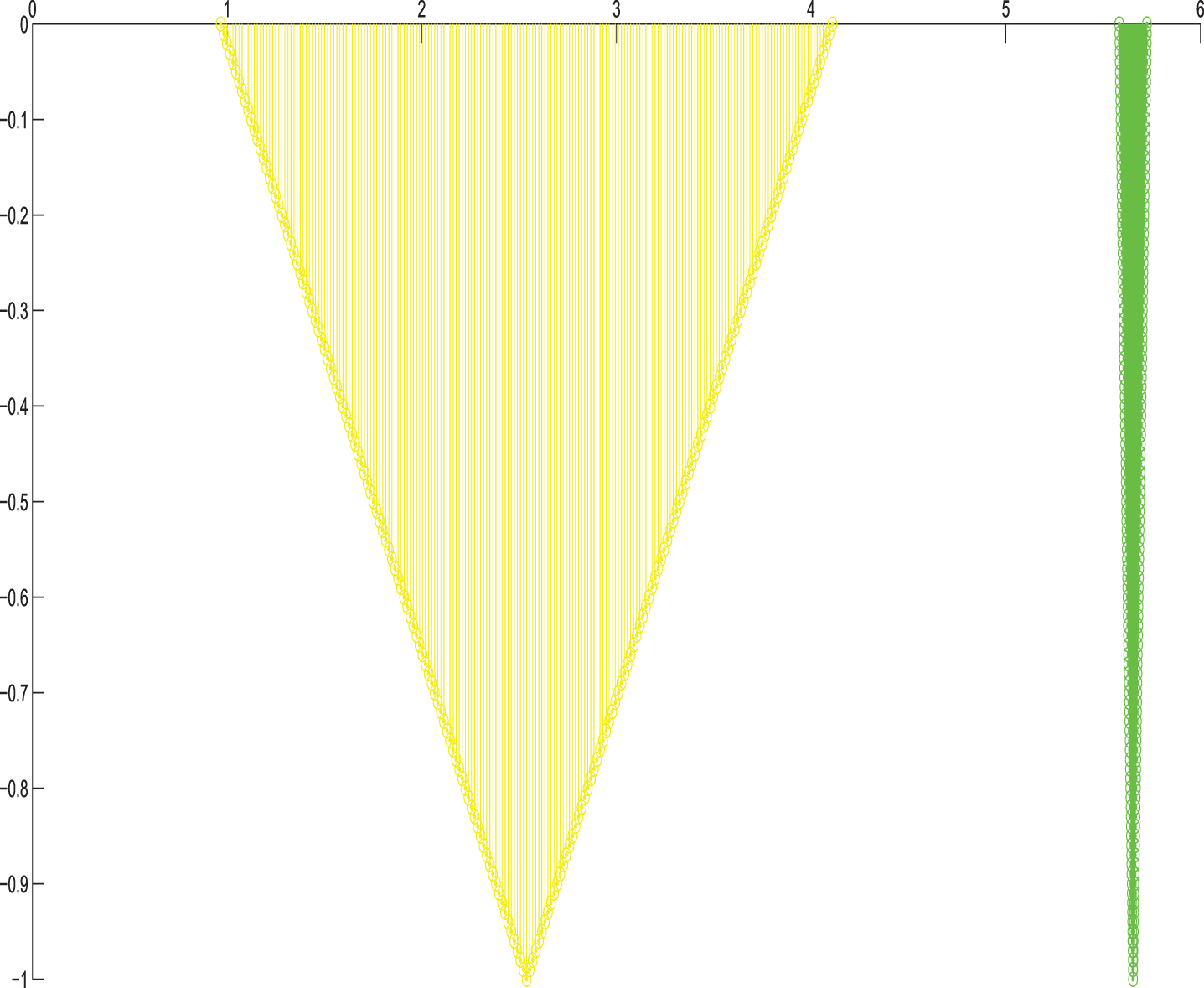
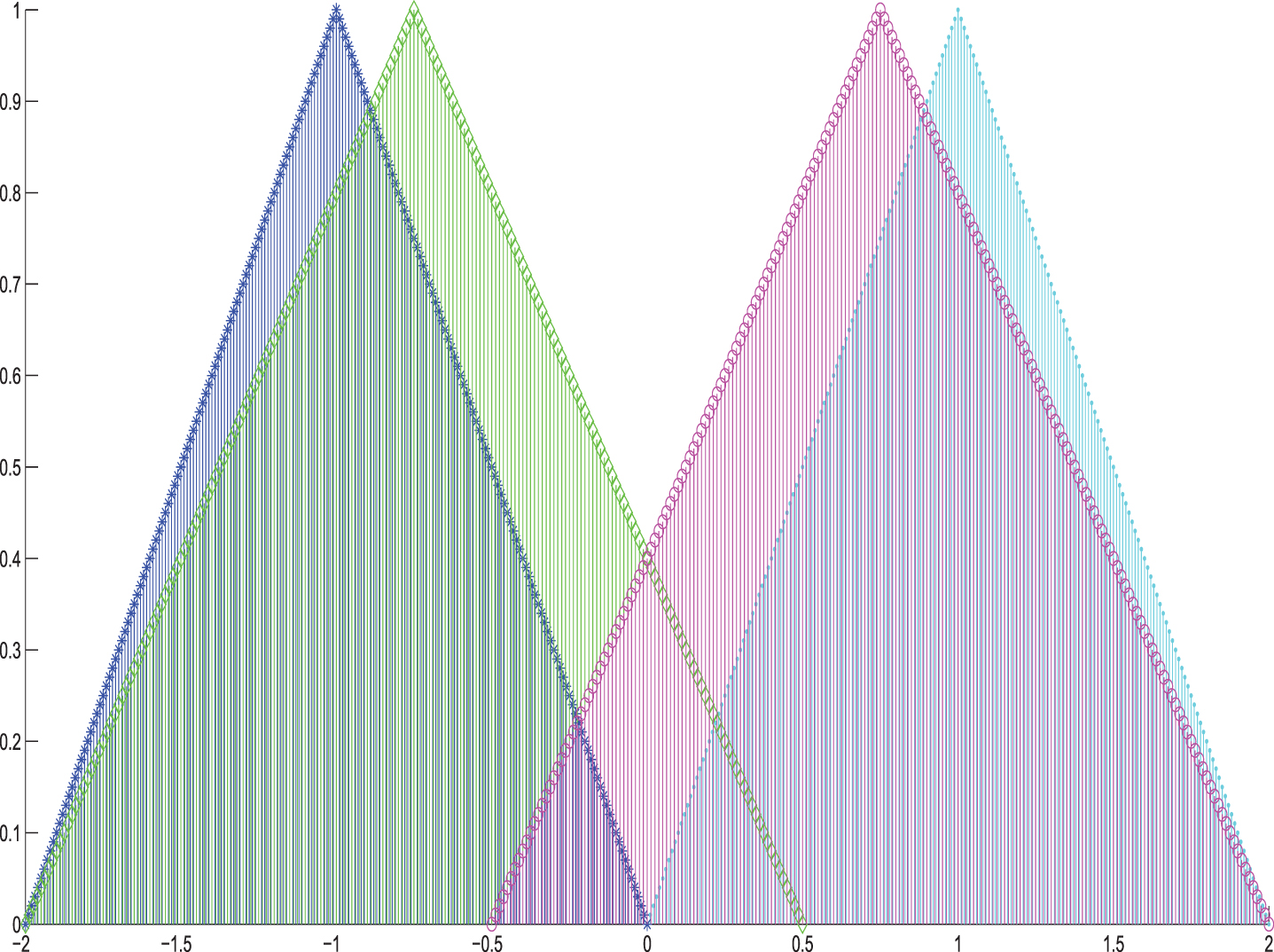
and it is a strong bipolar fuzzy least squares solution. These solutions are shown in Figures 15 and 16.
The graphically representation of bipolar fuzzy least square solution of positive membership function.
The graphically representation of bipolar fuzzy least square solution of negative membership function.
The Moore-Penrose inverse of Q and Q′ are
and
non-negative. Therefore the original system has a strong bipolar fuzzy solution
which leads to the minimum norm bipolar fuzzy least squares solution. Moore-Penrose bipolar fuzzy least square solutions are shown in Figures 17 and 18.
The graphically representation of Moore-Penrose bipolar fuzzy least square solution of positive membership function.
The graphically representation of Moore-Penrose bipolar fuzzy least square solution of negative membership function.
Conclusion
In this work, we have solved the system of linear equations by using LU decomposition method. We have analyzed that if the matrices and have LU, L′U′ or LLT, L′L′T decomposition then Q and Q′ is decomposable, and if Q and Q′ are symmetric positive definite matrix then it has LLT and L′L′T decomposition. Moreover, we have define a class of IBFMEs having m × n crisp matrix, and the right-hand side matrix is m × j arbitrary bipolar fuzzy number. We have discussed the solvability of LU decomposition method in detail and described the concept of IBFME and then we obtain the bipolar fuzzy least square solution by using the theory of generalized inverse matrices Q and Q′. Finally, we have studied the strong bipolar fuzzy least square solution and illustrate this concept with an example.
Conflict of interest: The authors declare that they have no conflict of interest.
Footnotes
Appendix A
Let Mm×n be a matrix and (.) ⊤ is a transpose of (.), here we recall that the generalized inverse G of M is an Mn×m matrix which satisfied at least one of the Penrose equations
For the subset {u, v, w} of set {1, 2, 3, 4}, the set of matrices of order n × m which satisfying the equations contained in {u, v, w} is denoted by M {u, v, w}. The matrix M {u, v, w} is said to be the {u, v, w}-inverse of M and is represented by M {u, v, w}. In particular, a matrix G is called {1}-inverse of M or a g-inverse and is denoted by M {1} if it satisfies the condition (1). Usually, the g-inverse of M is denoted by M-. G is said to be {2}-inverse if it satisfied by (2) and G is said to be {1, 2}-inverse of M or reflexive inverse if it satisfies equation (1) and (2). If G satisfies equation (1)-(4) then G is called The Moore-Penrose inverse of M. An arbitrary matrix M which delivers a unique Moore-Penrose inverse, represented by M†. It is noted that the solution of the following linear equation
can be found by using the generalized inverses of the coefficient matrix C. For instancing, when the system (27) is consistent, then the solution of (27) can be represented by y = Gd in which G ∈ M {1}, and when the system (27) is inconsistent, then its least square solution to (27) can be represented by y = Gd in which G ∈ M {1, 3}. In spatial, y = M†d is the minimum norm LSS to the system (27). We refer to the reader [17] for more result on generalized inverses.
References
1.
AbbasbandyS., EzzatiR. and JafarianA., LU decomposition method for solving fuzzy system of equations, Applied Mathematics and Computation172 (2006), 633–643.
2.
AbbasbandyS. and JafarianA., Steepest descent method for system of fuzzy linear equations, Applied Mathematics and Computation175 (2006), 823–833.
3.
AbbasbandyS., JafarianA. and FzzatiR., Conjugate gradient method for fuzzy symmetric positive definite system of linear equations, Applied Mathematics and Computation171 (2005), 1184–1191.
4.
AbbasbandyS., OtadiM. and MoslehM., Minimal solution of general dual fuzzy linear systems, Chaos Solitons Fract29 (2008), 638–652.
5.
AkramM. and ArshadM., A novel trapezoidal bipolar fuzzy TOPSIS method for group decision-making, Group Decision and Negotiation28(3) (2019), 565–584.
6.
AkramM., MuhammadG. and AllahviranlooT., Bipolar fuzzy linear system of equations, Computational and Applied Mathematics38(2) (2019), 69.
7.
AkramM., MuhammadG. and HussianN., Bipolar fuzzy system of linear equations with polynomial para-metric form, Journal of Intelligent and Fuzzy Systems37(6) (2019), 8275–8287.
8.
AkramM., MuhammadG., KoamA.N. and HussainN., Iterative methods for solving a system of linear equations in a bipolar fuzzy environment, Mathematics7(8) (2019), 728.
9.
AkramM., SaleemD. and AllahviranlooT., Linear system of equations in m-polar fuzzy environment, Journal of Intelligent and Fuzzy Systems37(6) (2019), 8251–8266.
10.
AkramM., AliM. and AllahviranlooT., Certain methods to solve bipolar fuzzy linear system of equations, Computational and Applied Mathematics39 (2020), 213.
11.
AllahviranlooT., Numerical methods for fuzzy system of linear equations, Applied Mathematics and Computation153 (2004), 493–502.
12.
AllahviranlooT., The adomian decomposition method for fuzzy system of linear equations, Applied Mathematics and Computation163 (2005), 553–563.
13.
AllahviranlooT. and KermaniM.A., Solution of a fuzzy system of linear equation, Applied Mathematics and Computation175 (2006), 519–531.
14.
AllahviranlooT., AhmadyE., AhmadyN. and AlketabyK.S., Block Jacobi two-stage method with Gauss-Sidel inner iterations for fuzzy system of linear equations, Applied Mathematics and Computation175 (2006), 1217–1228.
15.
AllahviranlooT. and SalahshourS., Fuzzy symmetric solutions of fuzzy linear systems, Journal of Computational and Applied Mathematics235(16) (2011), 4545–4553.
16.
AsadyB., AbbasbandyS. and AlaviM., Fuzzy general linear systems, Applied Mathematics and Computation169 (2005), 34–40.
17.
Ben-IsraelA. and GrevilleT.N.E., Generalized Inverses: Theory, second ed., Springer-Verlag, New York, (2003).
18.
CongxinW. and MingM., On embedding problem of fuzzy number spaces, Fuzzy Sets and Systems44 (1991), 33–38.
19.
DattaB.N., Numerical Linear Algebra and Applications, ITP press, New York, (1995).
20.
DehghanM. and HashemiB., Iterative solution of fuzzy linear systems, Applied Mathematics and Computation175 (2006), 645–674.
21.
DehghanM., HashemiB. and GhateeM., Solution of the full fuzzy linear systems using iterative techniques, Chaos Solitons Fract34 (2007), 316–336.
22.
DuboisD. and PradeH., Operations on fuzzy numbers, International Journal of Systems Science9 (1978), 613–626.
23.
DuboisD. and PradeH., Fuzzy number: an overview, in: J.C. Bezdek (Ed.), The Analysis of fuzzy Information, 1: Mathematics, CRC Press, Boca Raton, FL, (1987) 3?39.
24.
FriedmanM., MingM. and KandelA., Fuzzy linear system, Fuzzy Sets and Systems96 (1998), 209–261.
25.
GoetschelR. and VoxmanW., Elementary calculus, Fuzzy Sets and Systems18 (1986), 31–43.
26.
GoulbG.H. and Van LoanC.F., Matrix Computation, LTD Press, London, (1984).
27.
MizumotoM. and TanakaK., The four operations of arithmetic on fuzzy numbers, Systems Comput Controls7(5) (1976), 73–81.
28.
MizumotoM. and TanakaK., Some properties of fuzzy numbers in: M. M. Gupta, R. K. Ragade, R. R. Yager (Eds.), Advances in Fuzzy Set Theory and Applications, North-Holland, Amsterdam, (1979), 156?164.
29.
MoghadamK.G., GhanbariR. and AmiriN.M., Duality in bipolar triangular fuzzy number quadratic pro-gramming problems, Proceedings of the International Conference on Intelligent Sustainable Systems (2017), 1236?1238.
30.
NahmiasS., Fuzzy variables, Fuzzy Sets and Systems1 (1978), 97–111.
31.
PlemmonsR.J., Regular nonnegative matrices, Proceedings of the American Mathematical Society (1973).
32.
PuriM.L. and RalescuD., Differential for fuzzy function, Journal of Mathematical Analysis and Applications91 (1983), 552–558.
33.
SaqibM., AkramM. and ShahidaB., Certain efficient iterative methods for bipolar fuzzy system of linear equations, Journal of Intelligent & Fuzzy Systems 2020, DOI: 10.3233/JIFS-200084
34.
WangK. and ZhengB., Inconsistent fuzzy linear systems, Applied Mathematics and Computation181 (2006), 973–981.
35.
ZadehL.A., Fuzzy sets, Inform and Control8 (1965), 338–353.
36.
ZengtaiG. and XiaobinG., Inconsistent fuzzy matrix equations and its fuzzy least squares solutions, Applied Mathematical Modelling35 (2011), 1456–1469.
37.
ZhangW.R., Bipolar fuzzy sets and relations: a computational framework forcognitive modeling and multi-agent decision analysis, Proceedings of IEEE Conference (1994), 305?309.
38.
ZhangW.R., Bipolar fuzzy sets, Proceedings of FUZZ-IEEE (1998), 835?840.
39.
ZhangX.D., Matrix Analysis and Applications, Tsinghua and Springer Press, Beijing, (2004) (in chinese).
40.
ZhanJ., JiangH. and YaoY., Covering-based variable precision fuzzy rough sets with PROMETHEE-EDAS methods, Information Sciences538 (2020), 314–336.
41.
ZhanJ., JiangH. and YaoY., Three-way multi-attribute decision-making based on outranking relations, IEEE Transactions on Fuzzy Systems, (2020), DOI: 10.1109/TFUZZ.2020.3007423
42.
ZhangK., ZhanJ. and WuW.Z., On multi-criteria decision-making method based on a fuzzy rough set model with fuzzy a-neighborhoods, IEEE Transactions on Fuzzy Systems, 2020, DOI: 10.1109/TFUZZ.2020.3001670
43.
ZhengB. and WangK., General fuzzy linear systems, Applied Mathematics and Computation181 (2006), 1276–1286.