



Abstract
Wind power is a typical clean and renewable energy, which has been widely regarded as one of the replaceable energies in many countries. Wind turbine is the key equipment to generate wind power. It is necessary to evaluate the risks of each stage of the wind turbine with regard to occupational health and safety. In this study, the stage of production of life cycle of wind turbine is considered. The aim of this study is to propose a new method to identify and evaluate the risk factors based on strengths-weaknesses-opportunities-threats (SWOT) analysis and D number theory, named D-SWOT method. A wind turbine firm is used to demonstrate the detailed steps of the proposed method. SWOT is conducted to identify the risk factors of production stage of the wind turbine company. Experts are invited to perform the risk assessment, and D number theory is carried out to do the processes of information representation and integration. After that, some suggestions are provided to the company to lower the risks. The D-SWOT method obtains the same results as the previous method of hesitant fuzzy linguistic term set (HFLTS). Compared with HFLTS method, D-SWOT method simplifies the process of information processing, and D-SWOT method is more intuitional and concise. Besides, a property of pignistic probability transformation of D number theory (DPPT) is proposed in the manuscript, which extends D number theory and has been used in the process of decision making of D-SWOT.
Keywords
Introduction
Energy crisis is one of the hot issues in current society [1]. The development of clean and renewable energy, summarized as new energy, is an imperious demand. Wind power which converts the kinetic energy of wind into electricity, is a typical new energy [2]. Wind power resource is inexhaustible and low-cost. There are several benefits to develop wind power, such as reducing environmental pollution, saving conventional energy (coal, oil), etc. Wind power as one of the candidate new energies has been widely developed in many countries. However, the production of wind power still has some limitations, such as highly depending on wind, noise pollution [3], birds disturbance [4], etc. Wind turbine is the essential equipment with towers which have large vaned wheels rotated by wind to generate electricity. Despite of the importance of wind turbine in wind power, there still exist many risk factors during the phrases of production, operation and transportation. Workers in the wind energy sector are faced to hazards resulting in loss of lives and fatal injuries in a wind turbine investment. In order to create a safe and healthy work environment and ensure the sustainability in the industry of wind turbine, identification and evaluation the risk factors are necessary.
Occupational health and safety (OHS) provides a valid way to identify risk factors in many industries, which has attracted more and more attention from companies and employees in order to prevent job losses [5]. The whole life cycle of wind turbines’ stages are accompanied with many risk factors in relation to OHS. Recently, researchers have proposed some methods to identify risk factors of the life cycle of wind turbine. Shafiee et al. proposed a method to assess the risk of wind turbine base on failure mode and effect analysis (FMEA) method [6]. Beskese et al. proposed a comprehensive method for wind turbine evaluation based on analytic hierarchy process (AHP) and technique for order performance by similarity to ideal solution (TOPSIS)[7]. Anicic et al. proposed a method of evaluation the noise of wind turbine based on soft computing methodology [8]. Jin et al. proposed a quantitative way to evaluate the faults of wind turbine [9]. Adem et al. investigated the risk factors of wind turbine companies in Turkey based on fuzzy AHP [10], and two most risky stages of life cycle of wind turbine were identified as transportation and production. The transportation stage is the external factor for these manufacturing firms, and the production stage is the internal factor for wind turbine companies.
Occupational risk assessment is an effective way to evaluate the risk factors in relation to a certain occupation. The problem of identification occupational risk factors involving many aspects can be viewed as one of the applications of multi-criteria decision-making (MCDM) [11–13]. Recently, several measures have been put forward to solve the MCDM problem, such as fuzzy set [14–18], Pythagorean fuzzy set [19], rough set [20–25], intuitionistic fuzzy set [26–29], Deng entropy [30–33], Z-number [34], R-number [35], neutrosophic number [36], ranking range [37–39], and so forth [40–45]. For the issue of occupational risk assessment of wind turbine, some works have been conducted by researchers. Gul et al. proposed a fuzzy based method occupational risk assessment for construction and operation period of wind turbines [46], based on fuzzy analytical hierarchy process (FAHP), Fine-Kinney risk analysis and fuzzy VIKOR (FVIKOR)method. It is clearly that both FAHP and FVIKOR methods are time-consuming. It is worth mentioning that strengths-weaknesses-opportunities-threats (SWOT) [47] and hesitant fuzzy linguistic term set (HFLTS) [48] are integrated to score the occupational risk for wind turbine, named HFLTS-SWOT method [49]. In their study, SWOT is carried out to analyse all the risk factors and explain clearly the risks factors refer to the production stage of wind turbine. SWOT is a powerful tool to represent the strengths and weaknesses of a firm, as well as its opportunities and threats [50]. HFLTS, as one of the applications of fuzzy set [51], is used for experts to express their opinions when they are unable to express precise information. The computation of HFLTS is based on the operation of arithmetic mean. However, there still exists some limitations while HFLTS is applied. The computation flow is not perceptual intuition, since the interval values are obtained.
Inspired by the integrated application of SWOT and HFLTS, a new conjunction between SWOT and D number theory is attempted to solve the problem of identification and ranking risk factors in the life cycle of wind turbine, especially during the stage of production in this manuscript, named D-SWOT method. D number theory is a new tool to represent and deal with uncertain information, mirroring the framework of Dempster-Shafer evidence theory (D-S theory) [52, 53]. D number theory is often regarded as an extension of D-S theory, since it overcomes the restrictions and limitations of D-S theory. In D-SWOT method, SWOT is applied to conduct risk analysis from the aspects of strengths, weaknesses, opportunities, and threats of a firm, and risk factors of the firm will be presented. Furthermore, experts are asked to evaluate risk factors based on D number theory. After that, some usefulness and workable measures are also provided to prevent the risk of the stage of production of wind turbine. In addition, a numerical example is used to demonstrate the effectiveness of D-SWOT.
The reminder of the manuscript is organized as follows. Section 2 provides some background knowledge of SWOT, D-S theory and D number theory. Section 3 presents the framework of the proposed method. An application of wind turbine to demonstrate the effectiveness of the proposed method and some necessary discussion are given in Section 4. Section 5 concludes the manuscript.
Preliminaries
In this section, some background knowledge of SWOT, D-S theory and D number theory will be recalled, respectively.
SWOT
SWOT, also named situational analysis, proposed by Weihrich in 1982 [54] is an effective tool, which is often used in corporate strategy development, competitor analysis and other occasions [55]. SWOT is taken to synthesize and summarize the internal and external conditions of a company, in order to analyse the strengths, weaknesses, opportunities and threats. The main processes of SWOT are shown as follows. List the strengths, weaknesses, possible opportunities and threats for a company. Combine strengths, weaknesses, opportunities and threats, respectively, to generate the strategies of Strengths-Opportunities (SO), Strengths-Threats (ST), Weaknesses-Opportunities (WO) and Weaknesses-Threats (WT), as shown in Fig. 1. Ascertain suitable strategies of SO, ST, WO and WT of the company based on the results of discrimination.
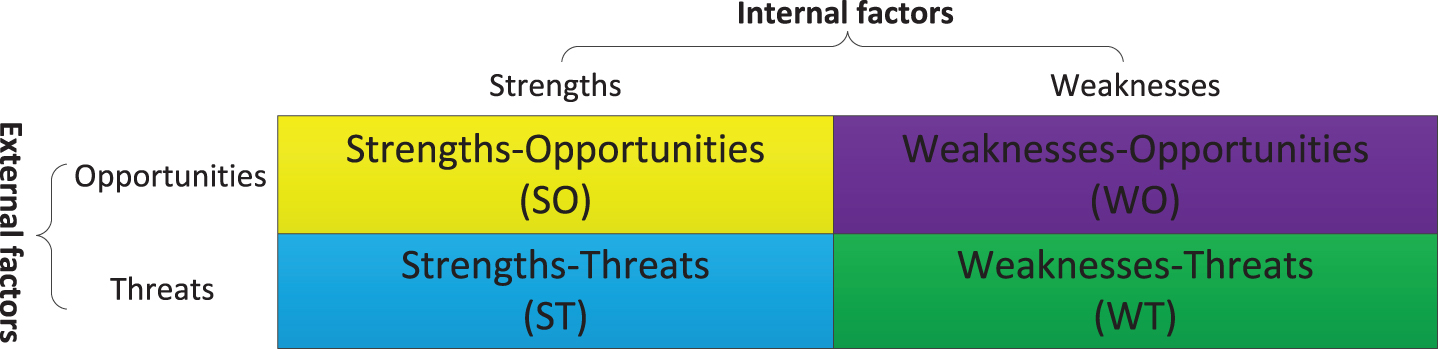
The combination between external and internal factors in SWOT analysis.
Figure 1 indicates that yellow part SO is the best choice, one should take full advantage of the combination of strengths and opportunities to accelerate the development of company. The purple part WO means that weaknesses and opportunities are coexisted, one should utilize the opportunities and avoid the weaknesses to sustain the momentum of balanced of company. The light blue part ST indicates that there exist tight connections between strengths and threats, one should make good use of strengths and lower the threats to endeavour for the further development of company. The green part WT reveals that there exist weaknesses and threats, one should pay more attention to keep the stabilization of company.
A toy example is used to demonstrate the detailed processes of SWOT. Suppose there exists a small startup training institution, named Wukong studio, which aims at the training of Python language. There are only six employees. The purpose of Wukong studio is to help these trainees to get the professional skills of Python and can be qualified for these works, such as data analysis and data mining. This type of courses are scarce, and rivals have not provided these service of practical exercise. In view of this, Wukong studio intends to get this thing done. In order to promote the optimum development of Wukong studio, SWOT is carried out to analyse the strengthes, weaknesses, opportunities and threats, as follows.
Strengthes (S): Because it is a small and startup firm, the group is condensed, and the strategy can be adjusted quickly. The time of course is limited to 15 rather than 40 minutes each lesson, and there content is of high quality. It provides 1 vs 1 service for trainees.
Weaknesses (W): Since it is a startup firm, there may exist these common features of startup firms, such as insufficient fund, lack of materials. The speed of update of courses will be relatively slowly subjected to the high quality requirement of courses.
Opportunities (O): Along with the development of Internet, the demand for one who are skilled in the area of artificial intelligence is increased. The courses are welcome and scarce, since some existing courses of counterpart are boring, outmoded and unserviceable.
Threats (T): The copyright awareness is weak in the area of online courses, and the analogous courses can be copied easily. The same courses developed by large institutions or firms have more attractions to trainees than small firms. That is the large firm is more competitive than small one. Therefore, the market may be occupied by the former quickly.
Based on the aforementioned analysis, the different strategies are figured in Fig. 2, and detailed discussed as follows. SO strategy is to develop it to the hilt. Because the size of Wukong studion is small and some decisions can be made and conducted timely, it can focus on the improvement of high quality contents and services, extension the scope of free classes. The reputation will be greatly promoted quickly. ST strategy is to utilize the advantages but lessen disadvantages. It is clearly that the contents may be copied by some large institutions, but the services cannot be copied. The product can be adjusted timely according to the feedback of users in small institution, however it cannot be done in large institutions. WO strategy is to utilize opportunities but avoid weaknesses. The development of Wukong studio is constrained to the resource and fund, however it can deliver its distinctive contents to these free or paid media in order to propagate it quickly. WT strategy is to restrict the development. Because of little resource, and the potential risk of contents may copied by large institutions, Wukong studio is not suggested to expand more products in new areas. It is suggested to do the current business well.
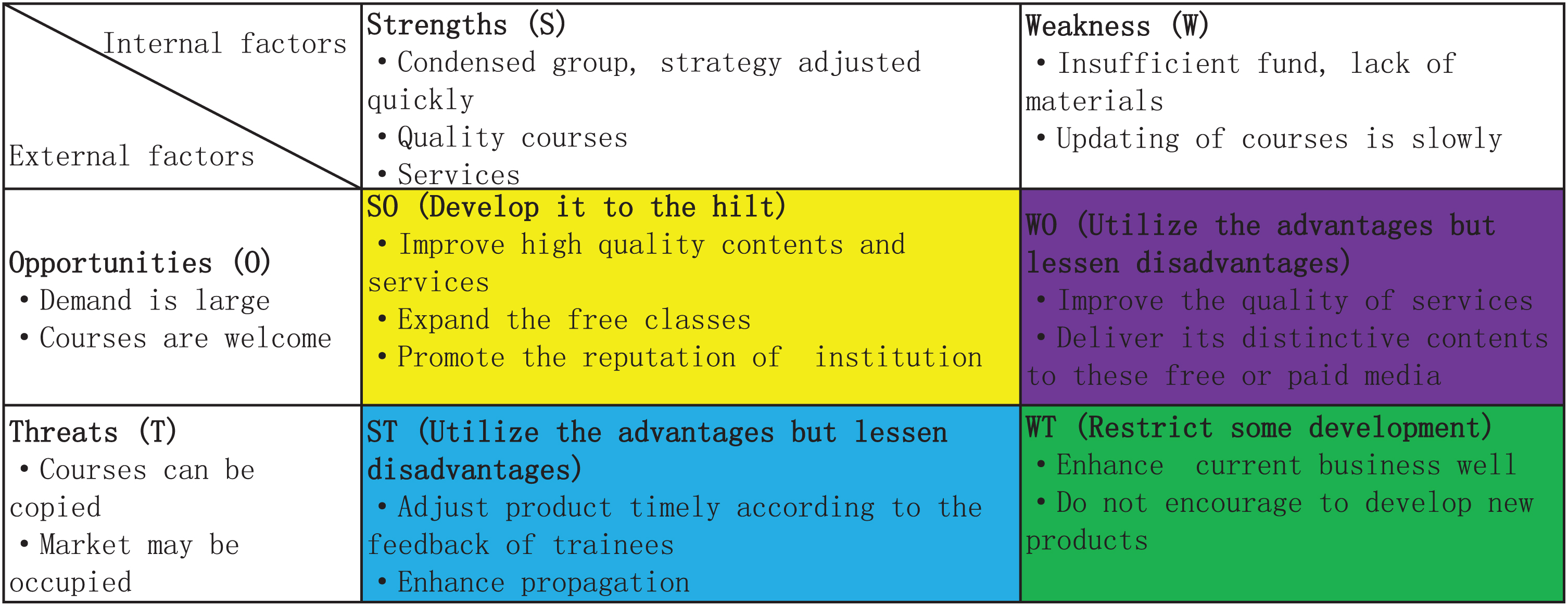
Different strategies for Wukong studio.
D-S theory was firstly proposed by Dempster in 1967 [52] and later extended by Shafer in 1976 [53]. D-S theory is often regarded as an extension of traditional Bayes probability, since D-S theory can be applied in more areas than Bayes probability. The typical differences between Bayes probability and D-S theory are shown in Table 1, which indicates that D-S theory is more powerful than Bayes probability to represent and deal with information. Since these advantages of D-S theory, it has been widely used in many areas, such as decision making [56, 57], human reliability analysis [58], data fusion [59, 60], nuclear safeguard evaluation [61], aphasia diagnosis [62], etc. Besides, D-S theory has been together applied with other tools, such as FMEA [63–65], VlseKriterijumska Optimizacija I Kompromisno Resenje (VIKOR) [66], to solve some real life problems.
The differences between Bayes probability and D-S theory
The differences between Bayes probability and D-S theory
In D-S theory, a problem domain, also called the frame of discernment, is composed of a finite nonempty set, whose elements are mutually exclusive and exhaustive. Some basic concepts of D-S theory are given as follows.
Where ∅ is an empty set and A is any element of P (Ω). The mass function m (A) represents how strongly the evidence supports A. Any subset A of Ω such that m (A) >0 is called a focal element. Given two independent BPAs m1 and m2, Dempster’s combination rule can be used to combine them and yield a new BPA.
k is a normalization constant, called the conflict coefficient between two BPAs, which is determined by summing the products of mass functions of all sets where the intersection is null. The larger the value of k is, the more conflicting information the sources are, and the less informative their combination. Dempster rule of combination is the core of D-S theory, satisfying commutative and associative properties, i.e., (1). m1 ⊕ m2 = m2 ⊕ m1; (2). (m1 ⊕ m2) ⊕ m3 = m1 ⊕ (m2 ⊕ m3). Thus if there exist multiple BPAs, the combination of them can be carried out in a pairwise way with any order.
The PPT function provides an effective way to transfer the non-singleton elements to singleton element, which is favorable for decision making.
D-S theory expands the application areas of Bayes probability theory, however, there still exist some inherent limitations in D-S theory. The first is the elements on the framework must be mutual exclusive, which cannot be always met in real-life situations. It is obvious that there may exist some intersections among these linguistic items “excellent”, “good”, “bad”, and so on. The second is the framework must be complete, which means the sum of mass functions must be equal to 1. This is also hard to be always met. Due to lack of abundant knowledge or subject to some subjective or objective reasons, it is feasible to obtain partial information rather than force to make information completely. The third is BPAs must be totally independent when Dempster combination rule is applied, which cannot always be met. The fourth is the computational effort is with exponential increasing when the number of evidences is with linear increasing. The fifth is the incapability to deal these total contradictory information.
To overcome the aforementioned limitations of D-S theory, D number theory was proposed by Deng in 2012 [68]. The aforementioned limitations of D-S theory are well settled in D number theory. D number theory is a new effective tool to represent and handle with uncertain information, which originates from D-S theory. The mutual exclusive and completeness constrains are discarded in D number theory. Besides, an integration property of D number theory is developed to combine information, which reduces the time complexity prominently.
D number theory can be regarded as an extension of D-S theory. Because D number theory mirrors the framework of D-S theory, it not only inherits all the advantages of D-S theory, but also expands the data fusion ability of D-S theory. D number theory has been widely used in many fields, such as data fusion [69], risk assessment [70], performer selection [71], rockfill dams evaluation [72], preventive maintenance planning [73], radiation source identification [74], environmental impact assessment [75], motorcycles performance assessment [76], green supply chain management [77], feature evaluation [78], location selection [79], assessing health-care waste treatment technology [80], and so forth. Besides, D number theory has been together with other tools, such as Choquet integral [81], intuitionistic fuzzy number [82], decision-making trial and evaluation laboratory (DEMATEL) [83, 84], game theory [85], FMEA [86], to solve some real-life problems. Some basic concepts of D number theory are given as follows.
It should be pointed out that different from D-S theory, the elements in set Ω do not require mutually exclusive and the completeness constraint is also not necessary in D number theory. If ∑A⊆ΩD (A) = 1, the information is said to be completeness. Otherwise, the information is assumed to be incompleteness.
For a discrete set Ω = {b1, b2, ⋯ , b i , ⋯ b n }, where b i ∈ R, a special form of D number can be expressed by
Similar to D-S theory, D number theory also has some properties as follows.
In this section, a new method to solve the problem of risk factors, including identification and rank, in the life cycle of wind turbine based on SWOT and D number theory is proposed, named D-SWOT. The main flow of D-SWOT is shown in Fig. 3, which can be divided into two partes. One is the SWOT analysis, aiming to identify the risk factors of the company. Another is the evaluation of risk factors based on D number theory to calculate the total score of risks of the company.
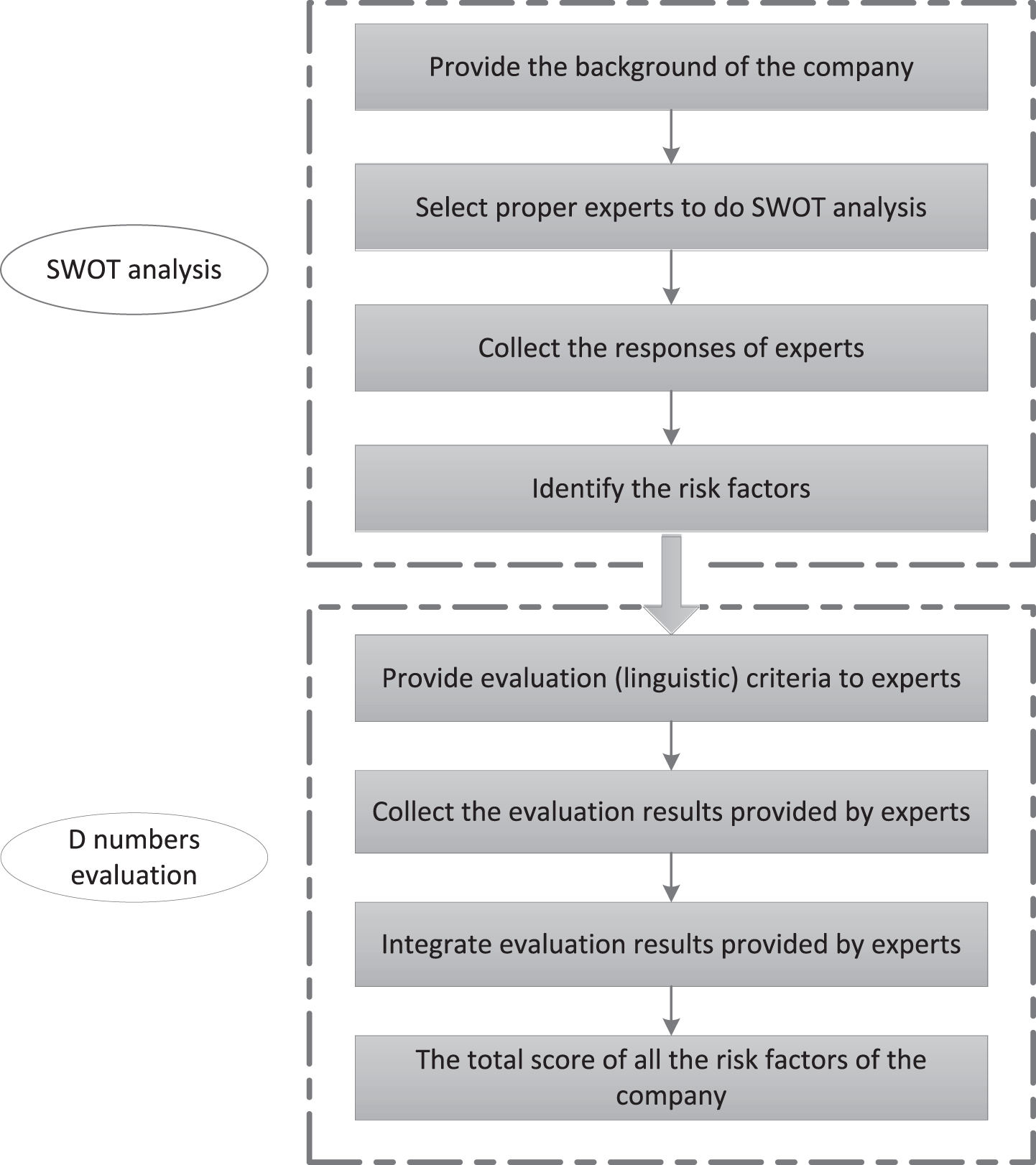
The main flow of D-SWOT method.
For the part of SWOT analysis, some basic information of the company should be introduced firstly, including the scale, main business, etc. After that, these experienced and acquainted experts to the relevant industry are invited to do the analysis of SWOT of the company. It should be pointed out that, the basic knowledge and steps of SWOT should be reviewed by experts. Experts are asked to detailed analyse the internal factors of strength and weakness, and external factors of opportunity and threat of the company. Collect and sort out the evaluation results especially for weakness and threats of the company, provided by experts. Finally, the risk factors will be presented.
After the risk factors are identified, the next work is to evaluate them. The first is to provide evaluation criteria to the experts. In order to express evaluation information smoothly, linguistic form of criteria is adopted. Besides, some conjunctions of context free grammar, such as “at least”, “at most”, “between”, “lower than”, “greater than”, are also provided to enrich the linguistic criteria. Based on this, experts can express their viewpoints in a more natural way. Then, experts are asked to express their opinions based on linguistic evaluation criteria according to their knowledge background and specialities. It should be pointed out that experts are allowed to give up their viewpoints limited to the subjective or objective reasons, which will generate incomplete information. The original linguistic evaluation information given by experts should be tidied. Based on the common features of linguistic information and D number theory, tidied linguistic information can be transformed to the form of D number theory, no matter the information is complete or not. After that, the integration property of D number theory is carried out to integrate the evaluation results provided by experts. Finally, total score of risk factors of the company will be presented, and some necessary suggestions will be provided.
In this section, a numerical example will be carried out to illustrate the detailed steps of D-SWOT method, some contrastive analysis between D-SWOT method and other methods are given, and some necessary discussion of the proposed method is provided.
Application
In this subsection, an application of wind turbine [49] is used to demonstrate the effectiveness of the proposed D-SWOT method. The detailed steps of SWOT analysis are shown as follows.
Step 1. Background introduction of the company. There is a company about wind turbine located in Ankara, Turkey, whose business scope of coverage includes manufacturing, operation, construction, maintenance, and repowering/life extension, etc. The size of the company is small/medium.
Step 2. Select experts to do SWOT analysis. Three experts, who are very skilled at the industry of wind turbine and have at least five years’ experience in the firm, are employed to do the SWOT analysis, especially to evaluate the company’s threats and weaknesses.
Step 3. Collect the responses of experts. After carefully examine each stage of wind turbine, focusing on the stage of production in this study, different experts give their opinions of weakness, threats, opportunities and strengths of the company. In this study, we mainly focus on the weaknesses and threats, while the opportunities and strengths are kept in mind and not presented.
Step 4. Identify the risk factors. After the evaluation of experts, the main risk factors of the company were identified and listed in Table 2.
The risk factors and descriptions
The risk factors and descriptions
After that, the risk factors are identified, the next step is to evaluate them by D number theory, detailed as follows.
Step 1. Provide evaluation linguistic evaluation criteria to experts. In this study, the below linguistic criteria (LC) are provided, such as “not important (n)”, “very low important (vl)”, “low important (l)”, “medium important (m)”, “high important (h)”, “very high important (vh)” and “absolute important (a)”, simplified as
Step 2. Collect the evaluation results by experts. Three experts are invited to evaluate the risk factors identified in the part of SWOT analysis, and the results are presented in Table 3. And Table 3 can be transformed to Table 4 based on Equations (8)–(8C1).
Step 3. Integrate the evaluation results provided by experts. The evaluation result is now in linguistic form, which should be transferred to the form of D number.
Linguistic evaluation results of each expert
Evaluation matrix by experts (linguistic form)
Taking risk factor “r2” for example, expert “e1” believes its risk level is “a”, which means the credit of “a” given by expert “e1” is 1.0, and it can be rewritten as De1,r2 (a) =1.0, or De1,r2 = {(a, 1.0)}. It should be pointed out that, there also exist non-singleton elements in the evaluation results as shown in Table 4. Such as risk factor “r1”, expert “e1” believes that the probability is the composite value of (h, vh, a), because expert “e1” do not have the ability to evaluate it definitely. That is De1,r1 (h, vh, a) =1.0, or De1,r1 = {(h, vh, a) , 1.0)}. For this situation, the property of DPPT should be adopted as shown in Equation (7). Taking (h, vh, a) for example, it can be rewritten as
Then, Table 4 can be transformed to Table 5.
Evaluation matrix by experts (D number form)
An utility function is employed to transfer the linguistic information to numerical information in Table 6 in order to apply the integration property of D number theory.
The scale for linguistic expressions
Then Equations (14)-(15) can be transferred based on Table 6, as follows.
Each risk factor evaluated by expert “e1” can be transferred based on the integration property of D number theory, using Equation (6), as follows.
Similarly, the risk factors by the remaining two experts can also be transferred, as shown in Table 7.
The score and rank of risk factors
Step 5. As shown in Table 7, the final column represents the rank of risk factors.
We can see that, the top-5 risk factors are identified as “falling from height (r2), equipment falling on a worker (r7), electric shock (r1)”, “noise (r3)” and “Forklift crashes (r5)”.
The company is suggested to pay more attention to reduce the aforementioned risk factors. And the below measures are suggested by the administrator of the company to prevent the risks, including but not limited to: The safety net is an essential and useful measure to minimize the hurt to workers who are working at the potential dangerous area of height on blade assemble. Falling from height includes the workers falling down to the flow and the equipments which located in the place of height, etc. The purpose of installing a safety net is to reduce the effects of workers falling down to the flow indeed and prevent the risk of equipment falling on the workers. In many occasions, the measure of installing a safety net is effective and low-cost. Electric shock is accompanied with the running of equipments inevitably. Both the employee and employer should have the awareness of the electric shock of the surrounding. A necessary training is needed to popularize the basic knowledge about electric shock. Isolation fence is necessary to reduce the diffusion of electric shock to the external environments. For the worker, the functional clothes, such as radiation protection, are needed to defense actively. It is strongly suggested to purchase some wheeled transport vehicles to move the heavy materials instead of manual handling, which is a potential risk to cause hurts to workers. And the forklift is also not needed because the work area is not always large enough to operate forklifts at the same time, but these small or medium manual wheeled transport is competent, which is cheaper and needs a little size place.
In order to verify the effectiveness of the proposed D-SWOT method, another method based on HFLTS and SWOT, named HFLTS-SWOT is adopted [49].
In HFLTS-SWOT method, after the analysis of SWOT, the evaluation information for each risk factor by experts are presented in the form of HFLTS. Two indices of optimistic and pessimistic are involved to denote the interval value of each risk factor. Optimistic and pessimistic collective preferences for each risk group is calculated based on arithmetic mean. The operator of arithmetic mean for optimistic and pessimistic values is conducted again. Then, the finally value will be presented.
Both the proposed D-SWOT method and HFLTS-SWOT methods obtained the same order of the risk factors, as listed in Table 8. However, D-SWOT simplifies the process of integration of experts’ evaluation, which takes advantage of the integration property of D number theory. The main difference between D-SWOT method and HFLTS-SWOT method is the way to represent and compute linguistic information. In HFLTS-SWOT method, the computation of linguistic information is based on the two indices of pessimism and optimism, which is obtained by twice operations of arithmetic mean. However, in D-SWOT method, the linguistic information is transformed to the form of D number directly, based on the common features of D number and linguistic information. And the computation of linguistic information is based on the integration property of D number theory. It is clearly that the new proposed D-SWOT method is more intuitive, and the flowchart is also succinct. There exists only one arithmetical operation in D-SWOT method but two in HFLTS-SWOT method, which indicates the computational effort of the former is less than the latter.
The rank by different methods
The rank by different methods
OHS has been arisen as one of the hot issues recently. The development of wind energy has created many new jobs and the generation of wind power has a great benefit to the problem of mitigation energy crisis and alleviation the environmental pollution, etc. However, an assessment of OHS in the life cycle of wind turbine is still necessary in order to promote the welled development of the industry of wind power.
In this paper, a D-SWOT method is proposed to finish the work. The study focuses on a real-situation application, and SWOT is carried out to identify risk factors. After the risk factors of the company are clearly identified, experts are invited to evaluate them, and the expression of evaluation may be in the linguistic form of D number theory. The rank of different risk factors indicates the level of risk factors. Some suggestions are provided to the employer of the company for the risk factors with the highest scores.
The main contributions of this manuscript can be summarized as follows. (1) D number theory and SWOT analysis are firstly integrated to solve the real-life problems. (2) In D-SWOT model, the linguistic information is extended with the context free grammar by some conjunctions to enrich the linguistic term set. (3) The flowchart of the D-SWOT model is clear and easy to understand. (4) The computational complexity of D-SWOT is smaller because of the integration property of D number theory. (5) The linguistic information can be directly treated with D number in D-SWOT model. (6) A property of pignistic probability transformation of D number theory (DPPT) is proposed, which extends D number theory. The D-SWOT model can not only be used for safety risk evaluation in wind turbine, but also suitable for other occasions of decision making areas. Besides, D-SWOT provides a generalized framework, it can be flexibly adjusted according to the real-life situation.
It should be pointed out that, in this study, the weights are omitted not matter for the risk factors or experts, which means they are viewed as the same weights. In the next work, the mechanism of weights of risk factors and experts should be considered, which will be more flexible and more closer to the real situation.
Footnotes
Acknowledgments
The authors greatly appreciate the editor’s encouragements and the anonymous reviewers’ valuable comments and suggestions, which have led to the improvement of the manuscript. This work is supported by General Research Program of the Science Supported by Sichuan Minzu College (Grant No. XYZB18013ZB).