



Abstract
Over past two decades, steady-state evoked potentials (SSVEP)-based brain computer interface (BCI) systems have been extensively developed. As we all know, signal processing algorithms play an important role in this BCI. However, there is no comprehensive review of the latest development of signal processing algorithms for SSVEP-based BCI. By analyzing the papers published in authoritative journals in nearly five years, signal processing algorithms of preprocessing, feature extraction and classification modules are discussed in detail. In addition, other aspects existed in this BCI are mentioned. The following key problems are solved. (1) In recent years, which signal processing algorithms are frequently used in each module? (2) Which signal processing algorithms attract more attention in recent years? (3) Which modules are the key to signal processing in BCI field? This information is very important for choosing the appropriate algorithms, and can also be considered as a reference for further research. Simultaneously, we hope that this work can provide relevant BCI researchers with valuable information about the latest trends of signal processing algorithms for SSVEP-based BCI systems.
Keywords
Introduction
Brain computer interface (BCI) gives their users access to communication and control. This does not depend on the normal output of the brain, such as peripheral nerves and muscles [30]. Because electroencephalography (EEG) signals have the advantages of low acquisition cost, simple and convenient recording, non-invasiveness, and high temporal resolution, EEG signals are widely employed in BCI research. As a novel human computer interaction way, BCI makes it possible to use EEG signals to directly control external devices, such as multi-degree-of-freedom wheelchair [28]. From the current technical level, it is still impossible to read human thoughts according to EEG signals. However, it is possible to distinguish the categories of certain mental tasks.
To date, a variety of EEG signals have been used in BCI systems. Among them, three types of EEG signals are most common and popular in BCI field. (1) P300 evoked potentials, when a desired target stimulus such as visual, auditory or tactile stimuli appears randomly, a significant positive potential is induced in the user’s cerebral cortex at 300 ms after stimulus appears [36]. (2) Steady-state evoked potentials (SSVEP), when the user receives visual stimuli at a steady-state frequency, a harmonic change potential of the same frequency appears in the visual area of the brain [15]. (3) Event-related desychronizations/ event-related synchronization (ERD/ERS), when the user performs motor imagery or completes motor tasks, the phenomenon of potential change occur in certain cortical area of the brain [18]. Various BCI systems have their own advantages. P300 and SSVEP-based BCI systems need to be induced by external stimuli. They belong to evoked BCI, also known as non-independent BCI. It performs specific activities under synchronous instruction. Generally, it belongs to synchronous BCI. ERD/ERS BCI systems do not require external stimuli, and the required EEG signals come entirely from the user. It belongs to spontaneous BCI, also called independent BCI. It can be synchronous BCI or asynchronous BCI. In comparison, SSVEP-based BCI requires external stimuli, no training period, and the classification performance is higher. In view of the maturity of the technology and its advantages, a large number of SSVEP-based BCI systems have been developed. Nowadays, SSVEP-based BCI systems are being widely explored in designs with multiple stimuli, due to the robustness and high signal-noise ratio of their response.
In the past two decades, SSVEP-based BCI systems have been concerned. In 1999, Tsinghua University in China has developed SSVEP-based BCI system for cursor movement. In this system, four rectangular blocks around the cursor flashed on the screen at different frequencies, and indicated four directions [46]. After that, SSVEP-based BCI systems have been applied to many aspects such as wheelchair control, word spelling, and computer game. With the development of technology, this type of BCI continues to make progress, and is combined with other types to form multimodal BCI [79].
Up to now, various signal processing algorithms have been employed in SSVEP-based BCI systems. The algorithms play an important role, and have a critical impact on recognition performance and information transmission rate (ITR). The rest of the paper is organized as follows. In Section 2, typical structure of SSVEP-based BCI is explained. In Section 3, our objectives, research route and paper selection are presented. In Section 4, common recent signal processing algorithms are discussed in detail. Finally, conclusion is given.
Typical structure of SSVEP-based BCI
A SSVEP-based BCI system generally performs five-step process: preprocessing, feature extraction, classification, command translation, and feedback. Typical structure of SSVEP-based BCI is as shown in Fig. 1 [26].

Typical structure of SSVEP-based BCI.
In this system, preprocessing, feature extraction, classification are critical. Command translation and feedback usually exist in online application, and they are not necessary in every BCI. Preprocessing is used to remove artifacts and enhance signal-to-noise ratio (SNR). Feature extraction is designed to produce significantly different feature vectors. Classification is scheduled to complete the conversion from feature vectors to control signal.
This paper focuses on state-of-the-art and recent developments of signal processing algorithms for SSVEP-based BCI system. The purpose of this review is to focus on solving the following key problems. (1) In recent years, which signal processing algorithms are frequently used in each module? (2) In recent years, which signal processing algorithms attract more attention? (3) In BCI field, which modules are the key to signal processing? The resolution of the above three problems can indicate state-of-the-art and recent developments of signal processing algorithms for SSVEP-based BCI system. This information is important for choosing the appropriate algorithms, and can also be used as a reference for further research.
Up to now, BCI research has covered various different fields, such as rehabilitation engineering, neuroscience, etc [32]. Reviews, especially high-quality ones, provide powerful help for novices. The following reviews describe the research status of BCI field from different aspects. Three studies [29, 43] simply expressed available brain signal modes, commonly used EEG signals, signal processing algorithms, and applications. Two works [9, 10] introduced the principles, state-of-the-art and challenges of affective BCI, and BCI based on sensorimotor rhythms (SMR), respectively. A study [23] expressed modality, paradigms, application, feature, classification in EEG-based BCI system from 2007 to 2011. A work [61] discussed brain interface technology designs in detail prior to January 2006. Another work [16] investigated four kinds of EEG control signals. However, these reviews do not include signal processing algorithms in detail. Two studies [55, 68] expressed preprocessing, meta-classification schemes, and channel selection algorithms in EEG-based BCI system, respectively. In addition, a work [56] introduced the state of signal processing algorithms for SSVEP-based BCI prior to 2014. However, it does not represent state-of-the-art and recent developments in this field. Through the above analysis, there is no comprehensive survey about the latest development trends of signal processing algorithms for SSVEP-based BCI.
In this study, the latest relevant literatures published after 2014 are investigated through the database “Web of Science”, and various common signal processing algorithms for SSVEP-based BCI are summarized. This process consists of three steps, which are described as follows.
(1) Preliminary screening of literatures
The candidate papers are chosen using the database “Web of Science”. They include two keywords, ‘BCI’ and ‘SSVEP’, in their title, abstract or keywords. Afterwards, more than 500 initial candidate papers between 2016 and June 2020 are distinguished in the database. The types of these papers include article, meeting, review, etc.
(2) Determination of final literatures
In this way, the preliminary candidate papers are further analyzed. Some of them have nothing to do with this theme. We focus on the papers published in authoritative journals in nearly five years. These papers can represent state-of-the-art and recent developments of this subject. Through in-depth reading, lots of irrelevant papers are excluded, and the final 67 papers are confirmed.
(3) Induction and summary
Finally, signal processing algorithms for SSVEP-based BCI are discussed and summarized in order to form guidance for future research.
Discussion
Under the criteria selecting, some recent signal processing algorithms may be missing on the SSVEP systems for wheelchair navigation and speech communication. But these do not influence the essence of this paper. In signal processing, preprocessing, feature extraction and classification modules are usually employed, and feature selection is seldom used in SSVEP-based BCI. Sometimes there is no obvious boundary between two modules. Some spatial filtering algorithms are used as preprocessing in one paper, while they are considered as feature extraction in another paper, such as canonical correlation analysis (CCA) [42, 82]. Specifically, three tables are summarized to illustrate signal processing algorithms in preprocessing, feature extraction and classification modules. In each module, the algorithms or abbreviations, short descriptions and references are introduced.
Preprocessing
The purpose of preprocessing is to directly remove artifacts hidden in EEG signals, such as electromyography (EMG), electrooculography (EOG), electrocardiography (ECG), channel position change, 50/60 Hz power line noise, and enhance SNR of EEG signals. Signal processing algorithms in preprocessing module are divided into four types, namely down-sampling, frequency filtering, spatial filtering and other method. Among them, frequency filtering and spatial filtering are widely used in SSVEP-based BCI. Although data segmentation, frequency band and time optimization are regarded as preprocessing in some studies, here they are excluded. The algorithms are given in Table 1.
Signal processing algorithms in preprocessing module
Signal processing algorithms in preprocessing module
The function of down-sampling is to reduce the dimension of original data, which can save computer processing time of next step. Though Sampling theorem, when sampling frequency is greater than twice of maximum frequency, useful information can been retained in original signals. Since the frequency of EEG signals is below 50 Hz, down-sampling frequency is usually higher than 100 Hz. In practical applications, down-sampling frequency is several times of the frequency of EEG signals [4, 74].
Frequency filtering
Band-pass filtering and notch filtering are two most common frequency filtering methods. In lots of BCI studies, down-sampling, band-pass filtering and notch filtering are embedded into hardware instrument of data acquisition. Band-pass filtering limits the signals into a certain frequency range, which is related to the stimulation frequencies, their harmonics and artifacts. Band-pass filtering can easily been completed by infinite impulse filtering, such as 4th order Butterworth filter [6]. In some circumstances, band-pass filtering is carried out by hardware instrument firstly, and then is completed by the filter. Due to EOG maximum frequency 4 Hz and EMG minimum frequency 30 Hz, low-pass and high-pass filtering are employed to remove the artifacts in EMG or EOG signals in some circumstances. Frequency filtering is common and simple in preprocessing module, but this method can not handle time-varying signals, and acquires limited amount of information. Notch filtering is employed to suppress 50/60 Hz power line noise. In most countries power frequency voltage is 50 Hz, such as China [85]. Next, widely used spatial filter are discussed, such as common average reference (CAR) [2, 70], CCA, independent component analysis (ICA) [25], Surface Laplacian (SL).
Spatial filtering
Spatial filtering usually uses multiple channels to increase SNR of EEG signals. CAR is a constant global spatial filter, and it is calculated to subtract average value to all other channels from target channel. It can eliminate the average EEG activity viewed as noise, and enhance SNR of EEG signals. CCA calculates the relationship between two multi-variable datasets after linear combination of original data. CCA as popular method will be discussed in feature extraction in detail. ICA is considered as blind source separation method, and it translates mixed signals into independent components in statistics. ICA can effectively remove EOG, EMG artifacts from EEG signals [67]. It is generally completed by FastICA algorithms, due to its fast convergence. The output vector of FastICA algorithm may be reversed and the amplitude of output signal changes when the order is arranged. SL emphasizes localized activity, and it is calculated as the difference between the target channel and weighted average of four neighboring channels. Small Laplacian uses the four nearest neighboring channels, while large Laplacian employs the four next-nearest neighboring channels. In the absence of specific circumstances, SL usually refers to Small Laplacian. SL and CAR in C3 channel are shown in Fig. 2.
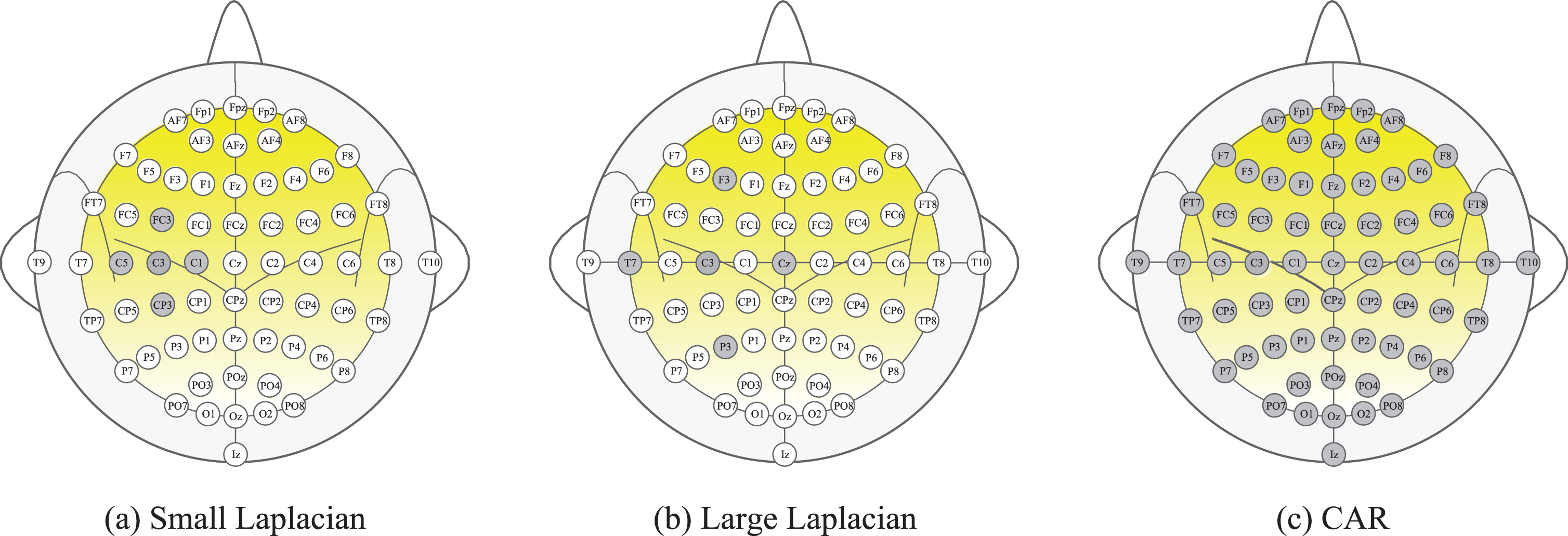
SL and CAR in C3 Channel.
In minimum energy combination (MEC), the channels are combined so as to minimise the energy of EEG signals that are unrelated to SSVEP, and generated reference (GR) generates a reference signal by linear combination of several reference channels, which is helpful for SSVEP signal detection [3]. Minima controlled recursive averaging (MCRA) is very significant in reducing the effect of noises. It can improve the recognition performance of SSVEP-based BCI [11]. In the literature [13], the presented adaptive spatial filter is based on a similarity analysis between standard electrode locations. It reduces artifacts and preserves useful information. Complex sparse spatial filter (CSSF) can detect both the frequency and phase of SSVEP from EEG signals of multiple channels [50]. In the literature [57], discrete wavelet transform (DWT) is used to analyze EEG signals and provide useful information in the time-frequency domain. Common spatial pattern (CSP) maps EEG signals of multiple channels to linear subspace, where one class is maximized and another class is minimized simultaneously. In the literature [73], CSP is used for preprocessing in SSVEP-based BCI. It is also very popular in feature extraction of motor imagery BCI.
In addition, peak detection is used to avoid mistakes from SSVEP-based BCI [41]. It belongs to artifact rejection method, such as threshold, amplitude.
In preprocessing module, band-pass filtering and spatial filtering are frequently employed. Sometimes they are adopted simultaneously. In some cases, this combination can effectively remove artifacts and enhance SNR of EEG signals. At the same time, it also makes up for the shortcomings of limited information in frequency filtering. Next, feature extraction is discussed in detail.
Feature extraction
Feature extraction is always a critical issue, and plays an important role in SSVEP-based BCI. Many algorithms are used in feature extraction module, such as CCA variants, methods based on Fourier transforms (FT). The algorithms are given in Table 2.
Signal processing algorithms in feature extraction module
Signal processing algorithms in feature extraction module
From the selected literatures, standard CCA is the most popular algorithm in feature extraction for SSVEP-based BCI. Many BCI studies either use standard CCA directly or employ standard CCA in comparison [7, 49]. Standard CCA supposes two datasets are linearly related. CCA as a multivariable statistical method can reveal the underlying correlation between two datasets. CCA calculates the relationship between two multi-variable datasets after linear combination of original data. In CCA method, the frequency of the target stimulus is identified by finding the maximal correlation coefficient between two multi-variable datasets. In most of studies, only the first maximum canonical coefficient is employed. Other canonical coefficients are worth considering. In real life, it is necessary to study this multivariate correlation. In addition, power spectrum density analysis (PSDA) is also often applied in feature extraction for SSVEP-based BCI. Compared with PSDA, CCA has higher classification performance [7]. Next, a variety of widely used improved CCA-based methods are discussed. For simplicity, these methods are called CCA variants.
Various CCA variants
CCA variants overcome the limitations of standard CCA, are widely applied in SSVEP-based BCI. These methods include task-related component analysis (TRCA), extended CCA (eCCA), filter bank CCA (FBCCA), multiset CCA (MsetCCA), etc.
TRCA as a user-dependent training method can obtain spatial filter that extract task related source activities from multi-channel EEG signals. This method extracts task related components by maximizing their reproducibility during task periods [6, 75]. Ensemble TRCA (eTRCA) can achieve extra high performance in SSVEP-based BCI, however, the recognition performance deteriorate if the calibration trials are insufficient [27, 48]. Through new learning plan, eTRCA can be extended to multi-stimulus eTRCA (ms-eTRCA). eCCA is similar to eTRCA. It is equipped with learning from subject’s training data, and can obtain excellent performance in target recognition in SSVEP-based BCI. However, when calibration trials are insufficient, the recognition performance will quickly deteriorate through this method. Similarly, it can be extended to multi-stimulus eCCA (ms-eCCA). Besides, the combination of ms-eTRCA and ms-eCCA is used for detecting SSVEP signals [12].
FBCCA is a powerful and widely used for feature extraction in SSVEP-based BCI systems. This method makes it difficult to accurately describe the mutative, complex and different physiological SSVEP signals. Therefore, there is huge room for improvement in classification performance in this method [52, 86]. MsetCCA extracts potential common feature from multiple trials at same stimulus frequency. The common feature is used as reference signals instead of artificial sine-cosine signals to improve recognition performance. Multilayer correlation maximization (MCM), a sophisticated extension of MsetCCA, is used to further improve the performance [87].
Besides, some other CCA variants, including multi-way CCA (Mway CCA), canonical variates with autoregressive spectral (CVARS), individual template CCA (ITCCA) [77], correlated component analysis (CORCA), binary subband CCA (BsCCA), normalized CCA (NCCA) [45], combined CCA [51], channel projection-based canonical correlation analysis (CPCCA) [58], kernel CCA, CCA reducing variation (CCARV) are also used for detecting SSVEP signals. However, these methods have not been applied on a large scale in SSVEP-based BCI. In short, various CCA variants improve the performance of standard CCA from different aspects.
Methods based on PSDA and FT
PSDA is the most widely used technique for detecting SSVEP signals [38]. Before PSDA, band-pass filtering is usually performed for EEG signals. Through breaking recorded signals, EEG signals are separate into short time epochs. In PSDA, FT of each epoch is completed, and power spectra are averaged to reduce the effects of artifacts. These averages are used to determine SSVEP content [14]. Power estimation (PE) can also be used in feature extraction for SSVEP-based BCI, but it is rarely employed in practice [3]. Besides, power spectrum (PS) in interested frequency bands is used in feature extraction [73].
FT is originally designed for linear and stationary signals. SSVEP signals are reasonably segmented and considered as linear and stationary signals. In this way, methods based on FT can be used to process SSVEP signals. Most of methods based on FT are used for PSDA. Fast FT (FFT) is commonly used to compute spectral powers [33, 83]. By consuming a lot of calculation time, FFT is easily completed. The advantages are with simple calculation and clear significance. Discrete FT (DFT) consumes more calculation time than FFT, and phase property of DFT spectrum is used in SSVEP-based BCI [71]. Short time FT (STFT) divides signals into many segments and then computes FT for each segment individually, and this method is also time-consuming [39]. Next, multivariate linear regression (MLR) is simply stated, as there are only a few applications.
MLR
Through minimizing the sum-of-squares cost function, MLR is applied to estimate the time-frequency electrophysiological responses from single trial of EEG signals. MLR is implemented on dimensionality-reduced EEG training data and a constructed label matrix to find optimally discriminative subspaces. In one study [24], MLR significantly outperforms CCA and Mway CCA for detecting SSVEP signals. In another study [1], the combination of Mset CCA and MLR is used for detecting SSVEP signals, and obtain satisfactory performance. Considering the amount of literature applications, least absolute shrinkage and selection operator analysis (LASSO), multivariate synchronization index (MSI), minimum energy combination (MEC) and other methods are simply discussed.
LASSO
LASSO can be used in SSVEP-based BCI in 2012 [8]. It assumes SSVEP signals are a standard linear regression model of stimulation signals. This method has the capability of model selection and shrinkage estimation. Due to its sparse approximation constraints, it provides low variance and high interpretable solution for linear regression. LASSO provides higher performance for short time processing windows [62], and has better performance than standard CCA [65].
MSI
MSI is built based on the theory of S-estimator and the entropy of normalized eigenvalues of correlation matrix of multivariate signals. The method uses the synchronization level between actual mixed signals and reference signals as potential indicator for detecting SSVEP signals [40]. In MSI, a nonlinear combination of multi-channel EEG signals is achieved and more useful information is extracted. MEC as a time-independent method has some shortcomings. Temporally local MSI (TMSI) improves original MSI through temporally local information, and achieves better averaged performance than MSI [5, 76].
MEC
MEC is implemented to find the linear combination of multi-channel EEG signals to reduce the noise at nuisance frequencies. MEC can be used to calculate the power or SNR at stimulation frequency and its harmonics [53]. In MEC, SSVEP signals are filtered, and then the power corresponding to each stimulation frequency is estimated as feature variable. This method makes better use of EEG signals from different channel, and is better than standard CCA in classification performance [21].
Other methods
Wavelet transforms (WT) as time-frequency method is employed in BCI community. It has multi-resolution, and is very suitable for processing time-varying EEG signals. In one study [26], wave atom transform (WAT) is used in feature extraction for SSVEP-based BCI, and mutli-resolution analysis of EEG signals is performed. In another study [80], WT and CCA are jointly used for feature extraction one by one.
EMD (empirical mode decomposition) is widely used to analyze the nonlinear and non-stationary processes, such as EEG signals. In EMD, EEG signals can been decomposed into a serried of intrinsic mode functions and this reflects more accurate local characteristics of EEG signals. However, this method consumes more computation time. In a study [80], EMD-CCA and multivariate EMD-CCA (MEMD-CCA) are employed for detecting SSVEP signals.
Besides, some other methods, including patio-temporal equalization dynamic window (STE-DW) and patio-temporal equalization fixed window (STE-FW), spatiotemporal beamforming (BF), independent vector analysis (IVA), the combination principle frequency component (PFC) and harmonic wave components (HWC) [17], sum of squared correlations (SSCOR) [19], latent common source extraction (LCSE) [20], periodic CA (πCA), tensor based multiclass multimodal analysis scheme (TbMMS), common and individual feature analysis (CIFA), maximum contrast combination (MCC), channel averaging, (AVG) [47], Ramanujan periodicity transforms (RPT), bistable stochastic resonance (BSR) [54], underdamped second-order stochastic resonance (USSR), singular spectrum analysis (SSA) [64], Box-Jenkins model [65] and partial least-squares (PLS) [66], are used for detecting SSVEP signals. For example, STE-DW has low computational complexity and does not need training data. It can significantly increase ITR of SSVEP-based BCI. πCA can separate out components corresponding to interested frequency from EEG signals by capturing the temporal information. These methods have their own characteristics and are suitable for different situations. Since these methods are only used once, they are briefly described in the table.
Classification
Feature extraction and classification are important for the whole BCI system. In a considerable portion of SSVEP-based BCI systems, stimulation frequency has been identified in feature extraction. Classification is used to generate control signals for external devices. In some cases, classification and feature extraction are tightly intertwined. Since the main job of SSVEP-based BCI is to complete stimulation frequency detection, classification is briefly explained. The algorithms are summarized in Table 3, such as support vector machine (SVM).
Signal processing algorithms in classification module
Signal processing algorithms in classification module
SVM is one of the most popular methods in BCI community. This classifier is based on statistical learning theory. It can solve high-dimensional, non-linear problem under limited sample conditions. It has many advantages, such as good generalization performance, and can deal with the curse of dimensionality. Moreover, SVM can also map samples into high-dimensional spaces and perform a nonlinear classification by kernel trick efficiently. In practice, Libsvm toolbox is widely employed to complete SVM algorithms [81]. This method can be used to resolve two-class or multi-class problem. Specifically, multi-class SVM with one-versus-rest strategy is used in one study [35].
LDA
LDA can be used to resolve two-class or multi-class problem [44]. In LDA, the samples are projected into low dimensional space and the optimal direction with maximum Fisher ratio is obtained. For multi-class problem, one-verse-rest and one-versus-one strategy are employed in practice. However, one-versus-one strategy needs to construct multiple classifiers. The advantage of this method is its simplicity and low computational complexity, so it is suitable for online applications.
Other methods
Some other methods, such as Bayesian classifier (BSC) [72, 78], convolutional neural network (CNN) [31], logistic regression (LR) [84], K-nearest neighbors (KNN), and extreme learning machine (ELM) [63] are employed in classification. The main purpose of SSVEP-based BCI is to complete the detection of stimulation frequency. Classification often involves training with testing data to calibrate some parameters. This process is very complicated. In classification module, these methods are briefly described in the table.
Other aspects
Feature selection is used to obtain more effective feature or feature subset form a large number of feature vectors. Since the main job of SSVEP-based BCI is to complete stimulation frequency detection, feature selection is seldom applied in SSVEP-based BCI. In most cases, it is integrated into classification, such as weighted Fisher criterion [22], and multiple kernel learning (MKL) [69].
Besides the algorithms themselves, other factors, such as stimulation type, frequency selection, calibration procedure and parameter optimization are affect the performance of SSVEP-based BCI. The flickering of low and medium frequency may lead to visual fatigue or even induce epileptic seizures, and high frequency stimulation may be preferable for safety and comfort. The experimental design sometimes affects the recognition performance of SSVEP-based BCI. To the best of our knowledge, there are many challenges in SSVEP-based BCI research. For example, one of the main challenges has been to reduce training time while maintaining good BCI performance [60]. In short, the recent developments of signal processing algorithms are helpful to deal with these challenges.
The future directions of SSVEP-based BCI mainly include two aspects, namely paradigm designs and decoding algorithms. Research on evoked methods, encoding methods, and comfort levels belongs to paradigm designs, and decoding algorithms are the core issues in this field. The selection of signal processing algorithms is very critical to the latter. At present, there are many specific challenges in the research of SSVEP-based BCI systems, such as high efficiency, easy of use, and generality. In addition, asynchronous SSVEP-based BCI system is also very necessary for practical applications.
The significant recent work for BCI includes the research on brain mechanisms, experimental design, neural feedback, and clinical application, and so on. These works are worth exploring for researchers, and they are also meaningful for the further development of BCI.
Conclusion
This review studies state-of-the-art and recent developments of signal processing algorithms for SSVEP-based BCI using the database “Web of Science”, especially through the papers published in authoritative journals in nearly five years. The results provide a valuable reference for selecting suitable signal processing algorithms in preprocessing, feature extraction and classification modules. From the investigation of signal processing algorithms of SSVEP-based BCI, we find that down-sampling, band-pass filtering and notch filtering are frequently used in preprocessing module, and CCA, CCA variants, methods based PSDA and FT, MLR, LASSO, MSI and MEC are frequently employed in feature extraction module. In addition, SVM and LDA are still popular classifiers in BCI community. This is significant for further research of this type of BCI.
In specific scenario, external applications have different requirements, such as real-time control, multi-degree-of-freedom control. Multimodal BCI can deal with the problem of multi-degree-of-freedom, and this BCI is a development trend that has attracted more attention of many researchers. The ideal BCI system is not only suitable for disabled people, but also normal people can also operate external devices in this way. When we select signal processing algorithms, these should be considered. We hope that this review not only reveal the recent developments of signal processing algorithms for SSVEP-based BCI, but also promote this technology forward. Although there are still many challenges in BCI community, it may contribute to BCI practical applications in near future.
Future research on SSVEP-based BCI systems will develop towards multimodality, and the combination of EOG detection and SSVEP signal is a popular development trend. In addition, the development of practical SSVEP-based BCI systems is also worthy of attention, which requires the developments of small collection equipment, dry electrodes, and application programs. Finally, we hope that this work can provide relevant BCI researchers with valuable information about the latest trends of signal processing algorithms for SSVEP-based BCI systems.
Footnotes
Acknowledgments
The authors would like to extend their gratitude to the friendly editor and anonymous reviews for giving suggestions, which help to improve the quality of this paper. The research is supported by “111 Project” (Grant no. B13044).