This paper first describes a characterization of a lattice L which can be represented as the collection of all up-sets of a poset. It then obtains a representation of a complete distributive lattice L0 which can be embedded into the lattice L such that all infima, suprema, the top and bottom elements are preserved under the embedding by defining a monotonic operator on a poset. This paper finally studies the algebraic characterization of a finite distributive.
L-fuzzy sets and structures have been widely studied since Goguen’s first paper [10]. These structures appear when the membership grades can be represented by elements of an ordered set, instead of just by numbers in the unit [0, 1]. L-fuzzy sets play an important role in many areas of research such as algebraic theories including order-theoretic structures (see e.g., [8, 20]), automata and tree series (see e.g., [1]) and theoretical computer science (see e.g., [3]). It is well known that every L-fuzzy structure is uniquely determined by the collection of cut sets. The cut sets can be ordered naturally by reverse inclusion. Thus cut sets are one of the most important links between L-fuzzy sets and classical theory of ordered structures. That is to say, an L-fuzzy set provides many useful techniques and methods to investigate classical theory of ordered structures (see e.g., [13, 17]).
In 2003, Šešelja and Tepavčević [18] introduced a particular completion which is equivalent to the famous Dedekind-MacNeille completion by fuzzy sets. Moreover, they presented a survey on representations of ordered structures by fuzzy sets, and proved that the structure itself is uniquely represented by the collection of cut sets ordered dually to inclusion (see [19]).
In 2010, Jiménez, Montes, Šešelja and Tepavčević [14] first introduced an L-fuzzy up-set and then they showed a necessary and sufficient condition under which a collection of up-sets of a poset X consists of cut sets of an L-fuzzy up-set. In particular, they obtained a representation of any finite distributive lattice as a family of cut sets of an L-fuzzy up-set, i.e., they gave a version of the famous Birkhoff Representation Theorem by using L-fuzzy up-sets. The famous Birkhoff Representation Theorem says that any finite distributive lattice L can be isomorphically represented by the collection of all up-sets on the set of all meet-irreducible elements of L. Therefore, an interesting problem is: What are the characterizations of a lattice which can be represented as the collection of all up-sets of a poset? This paper will focus on the problem by applying L-fuzzy up-sets.
The paper is organized as follows. For the sake of convenience, we give some notions and previous results in Section 2. Section 3 describes a characterization of a complete distributive lattice which can be represented as the collection of all up-sets of a poset by using L-fuzzy up-sets. In Section 4, we first introduce the concept of a monotonic operator on a poset, and then present a representation of a complete distributive lattice which can be embedded into a lattice with an additional representation property by up-sets. This paper also provides an algebraic characterization of a finite distributive in Section 5. Conclusions are drawn in Section 6.
Preliminaries
We first list some necessary notions and relevant properties from the classical order theory in the sequel. For more comprehensive presentation, see e.g., books [4, 11].
A poset is a structure (P, ≤), or P for short, where P is a nonempty set and ≤ an ordering (reflexive, antisymmetric and transitive) relation on P. A complete lattice is a poset (L, ≤) in which every subset M has the greatest lower bound, denoted by ⋀M, and the least upper bound, denoted by ⋁M. A complete lattice L possesses the top element 1L and the bottom element 0L. We say that an element a in a lattice L is completely meet-irreducible if a ≠ 1L and for every family {xi ∣ i ∈ I} of elements in L, a = ⋀ i∈Ixi implies that a = xi for some i ∈ I. Furthermore, we denote by M (L) the set of all completely meet-irreducible elements of L.
A complete lattice L is called infinitely distributive if, for all x ∈ L and S ⊆ L, x ∧ ⋁ S = ⋁ s∈Sx ∧ s. A complete lattice L is called dual infinitely distributive if its dual is infinitely distributive.
An up-set (a semi-filter) on a poset P is any sub-poset U, satisfying: for x ∈ U, y ∈ P, x ≤ y implies y ∈ U.
Next, we recall a natural way that distributive lattices appear among ordered structures.
Lemma 2.1.The collection of all up-sets of a poset X is a complete distributive lattice under inclusion. Further, it is infinitely and dual infinitely distributive.
If a is an element of a complete lattice L, then a representation a = ⋀ Q with Q ⊆ M (L) is called a decomposition of a. Further, we say a complete lattice L has a Decomposition Property (often abbreviated as DP) if every element of L has a decomposition.
In the following, we present some notations from theory of L-fuzzy up-sets. More details about the relevant properties can be found e.g., in [14, 19].
An L-fuzzy up-set is a mapping μ : X → L from a poset (X, ≤) (domain) into a complete lattice (L, ≤) (co-domain) with the condition that for all x, y ∈ X
If μ : X → L is an L-fuzzy up-set on a poset X then, for p ∈ L, the set
is called the p-cut, a cut set or simply a cut of μ. Let μL = {μp ∣ p ∈ L}. Moreover, let Lμ be defined by
where μ (X) = {μ (x) ∣ x ∈ X}. Then Lμ is a complete lattice (see [14]).
The following four statements present some characterizations of the collection of cuts of an L-fuzzy up-set.
Proposition 2.1. ([14, 18]) Let be a family of some up-sets of a poset X which is closed under intersections and contains X. Let be defined by
Then, μ is an -fuzzy up-set on X with the co-domain lattice such that and for every it holds that p = μp.
Lemma 2.2.([12]) Let be a family of some up-sets of a poset X which is closed under intersections and contains X. Then there exists an -fuzzy up-set with the co-domain lattice such that and .
Proposition 2.2.([14]) Let X be a poset, let L be a complete lattice and let μ : X → L be an L-fuzzy up-set. Then the following two statements are equivalent:
(a1) μL is formed by all the up-sets of X.
(a2) For every family {xi ∣ i ∈ I} of elements from X and every x ∈ X, it holds that
Proposition 2.3.([14]) Let X be a poset, let L be a complete lattice and let μ: X → L be an L-fuzzy up-set. If μL is formed by all the up-sets of X, then μ (x) ∈ M (Lμ) for all x ∈ X.
Given any set A, we denote its cardinality by |A|. Then we say a lattice L is trivial if |L|=1. In what follows, we assume that all lattices are non-trivial and denote by the set of all complete distributive lattices. Furthermore, we always denote by the set of all up-sets of a poset X, and assume that it is equipped with the inverse ⊇ of the set inclusion.
A characterization of a complete distributive lattice
In this section, we give an important characterization of a complete distributive lattice L satisfying the following condition
2
:
() For each q ∈ M (L), if q ≥ ⋀ C for some C ⊆ M (L), then q ≥ p for some p ∈ C.
For this purpose, we first give the following two lemmas.
Lemma 3.1.Let X be a poset. Then , has DP, and satisfies ().
Proof. By Lemma 2.1, . By Lemma 2.2, we have a -fuzzy up-set
such that and . Further, by Proposition 2.3, for all x ∈ X. Then it follows from formula (1) that has DP, which means that has DP.
Next, we shall prove that the condition () holds. Let and q ≥ ⋀ C for some . Then
by Lemma 2.1. Thus, q = q ∨ p for some p ∈ C since . Therefore, q ≥ p, i.e., () holds. □
Lemma 3.2.Let , and L have DP and satisfy (). Then .
Proof. Define μ : M (L) → L by μ (x) = x for all x ∈ M (L). Clearly, μ is an L-fuzzy up-set. Suppose that μ (x) ≥ ⋀ i∈Iμ (xi). Then x ≥ ⋀ i∈Ixi. Thus the condition () yields that there exists i ∈ I such that x ≥ xi. Further, from Proposition 2.2, it follows that . Therefore, it suffices to prove (L, ≤) ≅ (μL, ⊇). Let f : L → μL be defined by f (p) = μp for all p ∈ L. We just need to prove that f is an isomorphism.
First, f is a map from L to μL obviously. Furthermore, if T ∈ μL then T = μq for some q ∈ L. Thus T = μq = f (q), which means that f is surjective.
Secondly, assume that p ≠ q but f (p) = f (q). Let r ∈ L. We have that
since μ (x) = x for all x ∈ M (L). Furthermore, as L has DP,
Thus f (p) = f (q) implies that p = q, a contradiction. Therefore, f is injective.
In view of the proof in the preceding two paragraphs, the mapping f is a bijection.
Finally, we prove that, f and f-1, preserve the orders ≤ and ⊇.
If p ≤ q then obviously μp ⊇ μq, i.e., f (p) ⊇ f (q), which means that f preserves the order ≤.
Let S ∈ μL. Then S = μs for some s ∈ L. Thus S = f (s) and s = ⋀ S by formulas (2) and (3). So that f-1 (S) = ⋀ S for each S ∈ μL. If T1 ⊆ T2 and T1, T2 ∈ μL then f-1 (T1) = ⋀ T1 ≥ ⋀ T2 = f-1 (T2). Therefore, f-1 also preserves the order ⊇.
Thus f is an isomorphism from (L, ≤) to (μL, ⊇). Consequently, . □
The following corollary is directly obtained by Lemma 3.2.
Corollary 3.1.Let and both of them have DP and satisfy (). Then L1 ≅ L2 if and only if (M (L1) , ≤) ≅ (M (L2) , ≤).
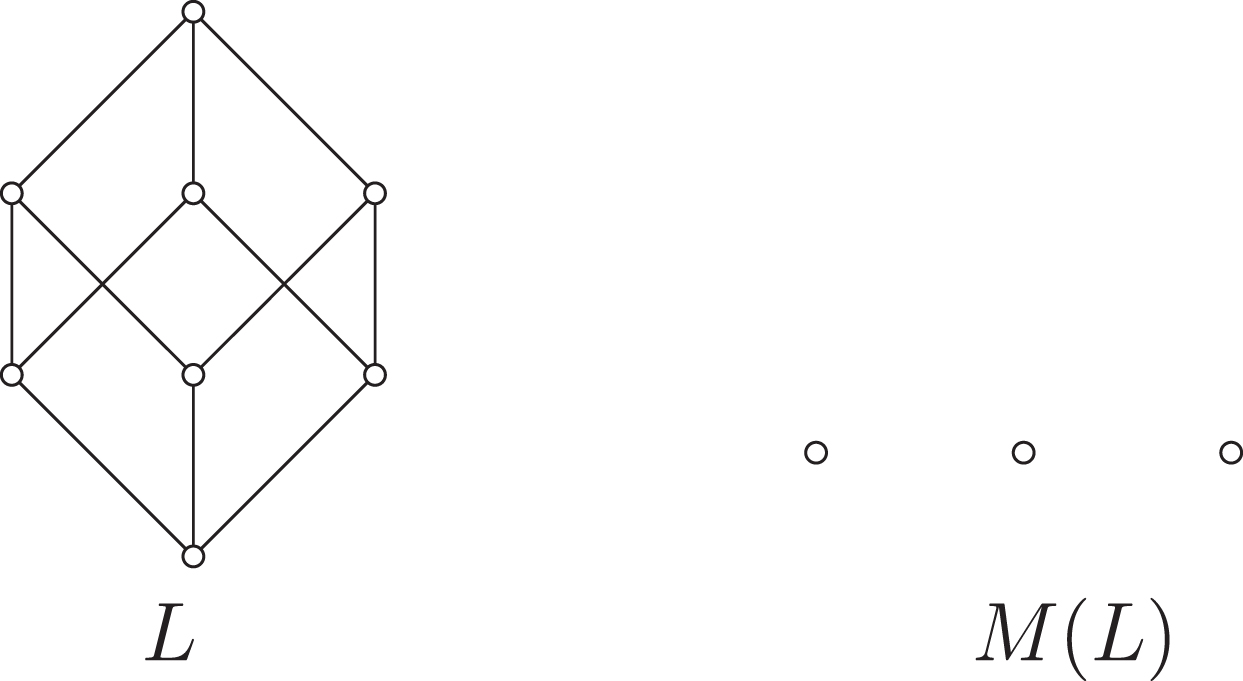
By Lemma 3.2. and Corollary 3.1, we know that there exists a one-to-one connection between the lattice L and the sub-poset (M (L) , ≤) when L is a complete distributive lattice and it has DP and satisfy (). For example, the lattice L and the sub-poset (M (L) , ≤) in Fig. 1 are determined by each other.
Hasse diagrams of L and M (L)
From lemmas 2.1, 3.1 and 3.2, we shall obtain the following theorem.
Theorem 3.1.The following conditions are equivalent:
(b1) There exists a poset X such that .
(b2) , L has DP, and satisfies ().
(b3) L is dual infinitely distributive and it has DP.
Proof. First, it is clear that (b1) and (b2) are equivalent by Lemmas 3.1 and 3.2. Secondly, it follows from Lemmas 2.1 and 3.1 that (b1) implies (b3). Finally, we shall prove that (b3) implies (b2). Obviously, the condition that L is dual infinitely distributive yields that . It remains, therefore, to show that (b3) implies ().
Let q ∈ M (L) and {qi ∣ i ∈ I} ⊆ M (L). Suppose that q ≥ ⋀ i∈Iqi. Then
since L is dual infinitely distributive. Further, as q ∈ M (L), q = q ∨ qj for some j ∈ I. Then q ≥ qj. Thus, the condition () holds. Consequently, (b3) implies (b2). □
The most obvious example satisfying Theorem 3.1 is a complete atomic boolean lattice. One can easily verify that the lattice L in Fig. 1 satisfies Theorem 3.1.
By Lemma 2.1 and Theorem 3.1, we have the following corollary.
Corollary 3.2.If a lattice L is dual infinitely distributive and it has DP, then it is also infinitely distributive.
In general, a dual infinitely distributive lattice is not infinitely distributive (see p.118 in [2]), and an infinitely distributive, dual infinitely distributive lattice does not have DP (For example, the complete chain [0, 1] does not have DP).
Applying Theorem 3.1 again, we have the following corollary.
Corollary 3.3.Let . If L is finite then L has DP and satisfy ().
Proposition 3.1.Let and L have DP and satisfy (). If |M (L) | = n then each maximal chain of L has n + 1 elements.
Proof. Let M (L) = {a1, a2, ⋯ , an}. Without loss of generality, suppose that
for any 1 ≤ i < j ≤ n. Let Ck = {ak, ⋯ , an} if 1 ≤ k ≤ n, otherwise, let Cn+1 =∅.
We claim that Ck is an up-set on (M (L) , ≤) for any 1 ≤ k ≤ n + 1. First, Cn+1 is an up-set. Now, we prove that Ck is an up-set for any 1 ≤ k ≤ n. Let au ∈ M (L), av ∈ Ck and au ≥ av. By formula (4), u ≥ v. On the other hand, av ∈ Ck deduces that v ≥ k. Thus u ≥ k, and then au ∈ Ck. So, Ck is an up-set. Therefore, Ck is an up-set on (M (L) , ≤) for any 1 ≤ k ≤ n + 1.
By Lemma 3.2, . Obviously, M (L) = C1≺ C2 ≺ ⋯ ≺ Cn+1 = ∅ is a maximal chain of . So that there exists a maximal chain of L which has n + 1 elements. As , |l| = n + 1 for each maximal chain l of L. □
Now, we shall give an example to illustrate Proposition 3.1.
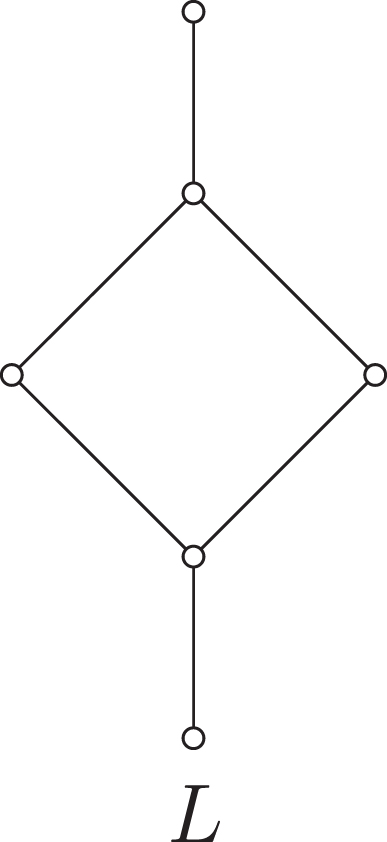
Example 3.1. Consider the lattice L in Fig. 2. Clearly, |M (L) |=4.
Hasse diagram of L.
In fact, each maximal chain of L has 5 elements.
From Proposition 3.1, we have the following remark.
Remark 3.1. If L is an infinite complete distributive lattice and it has DP and satisfies (), then there exists an infinite chain in L.
Let us conclude this section with a version of the famous Birkhoff Representation Theorem. From Theorem 3.1, we know that any complete distributive lattice L can be isomorphically represented by the collection of all up-sets on (M (L) , ≤) if and only if L has DP and satisfies (). Moreover, by the proof of Lemma 3.2, we can define an L-fuzzy up-set whose cut sets are order isomorphic to L. Therefore, we obtain a representation of the lattice L as the family of all cut sets of an L-fuzzy up-set. This L-fuzzy up-set is the embedding of M (L) in L, that is, μ : M (L) → L with μ (x) = x for every x ∈ M (L).
Embeddedness of a class of distributive lattices
Below, let E (L) be the set of all lattices which can be embedded into the lattice L, such that all infima, suprema, the top and bottom elements are preserved under the embedding.
We know that every complete sublattice of a complete distributive lattice L can be embedded into L such that all infima and superma are preserved under the embedding. However, the sublattice may not be in E (L) as illustrated by the following example.
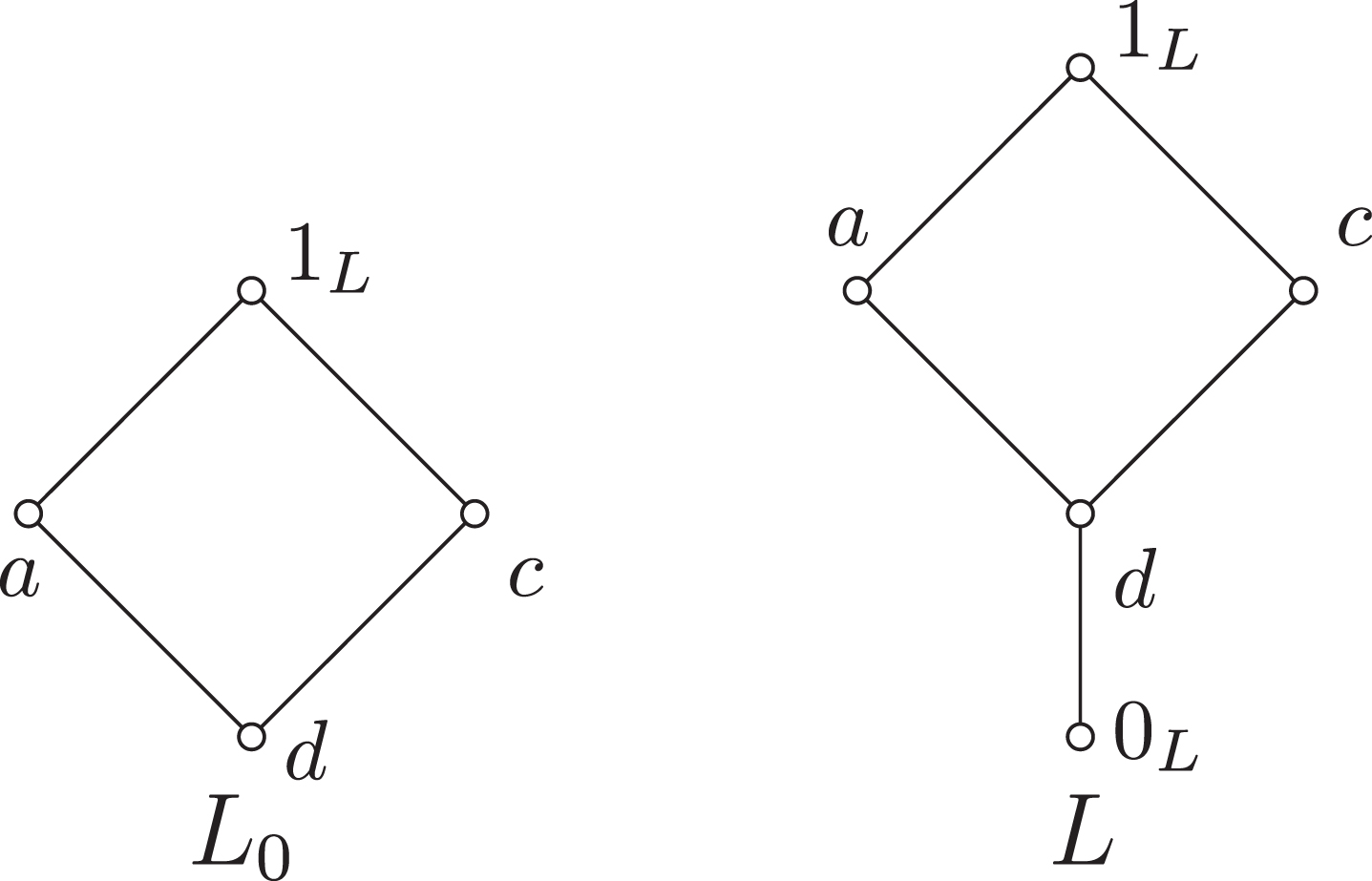
Example 4.1. Let us consider the complete distributive lattices L0 and L represented in Fig. 3.
Hasse diagrams of L0 and L.
Clearly, L0 is a sublattice of L but L0 ∉ E (L).
Let and they have DP and satisfy (). Then from Lemma 3.2, . In [13], He and Wang proved that for all closure operators C on M (L), if then L0 ∈ E (L). Also, they gave an example to show that there exists L1 ∈ E (L) such that for any closure operators C1 on M (L), in which , and L1 has DP and satisfies (). Therefore, an interesting problem is: What is the condition that for a certain operator C* on M (L) for any L1 ∈ E (L)?
In this section, we shall define a monotonic operator G on M (L), and then prove that L0 ∈ E (L) if and only if there exists a monotonic operator G on M (L) such that .
Let X be a nonempty set and . Furthermore, we denote by PX.
Definition 4.1. A monotonic operator G on a poset X is a function G : X → PX such that, for all x, y ∈ X, x ≤ y implies G (x) ⊇ G (y).
Clearly, a monotonic operator G is also a PX-fuzzy up-set on X and we have the following lemma.
Lemma 4.1.Let G be a monotonic operator on a poset X. We consider a relation ∼ on X defined by x ∼ y if and only if G (x) = G (y). Then:
(a) ∼ is an equivalence relation on X.
(b) The set X/∼ can be ordered: [x] ≤ [y] if and only if G (x) ⊇ G (y) where [x] = {z ∈ X ∣ x ∼ z} for all x ∈ X.
(c) (X/∼ , ≤) ≅ (G (X) , ⊇) where G (X) = {G (x) ∣ x ∈ X}.
Proof. Obviously, (a) and (b) hold. Now, we shall show (c).
Let f : (X/∼ , ≤) → (G (X) , ⊇) be defined by
for all [x]∈ X/∼. Thus, we only need to prove f is an isomorphism. From (b), [x] = [y] if and only if G (x) = G (y), then f is a map from (X/∼ , ≤) to (G (X) , ⊇). Further, f is bijective obviously. Again, from (b), we know that both f and f-1 preserve the orders ≤ and ⊇, respectively. Therefore, f is an isomorphism. □
In the following, we denote X/∼ by X/G if G is a monotonic operator on X. Then we have the theorem as below.
Theorem 4.1.Let X be a poset and G be a monotonic operator on X. Then .
Proof. Let
for all and
Now, we prove . Let be defined by f (T) = ST for all . Clearly, f is a surjective map by (5) and (6). Suppose that T1 ≠ T2 in . We claim that f (T1) ≠ f (T2). We suppose that f (T1) = f (T2). Then ST1 = ST2. Without loss of generality, we suppose that [x] ∈ T1 but [x] ∉ T2 since T1 ≠ T2. Thus x ∈ [x] ⊆ ST1 by (5), which means that x ∈ ST2. Hence, there exists [y] ∈ T2 such that x ∈ [y], and this means that [x] = [y] ∈ T2, a contradiction. So that f is injective.
Therefore, f is bijective.
We prove that both f and f-1 preserve the order ⊇.
If T1 ⊇ T2 then obviously f (T1) = ST1 ⊇ ST2 = f (T2), i.e., f preserves the order ⊇.
Furthermore, we claim that T1 ⊇ T2 when f (T1) ⊇ f (T2). Suppose T1⊉T2 but f (T1) ⊇ f (T2). Then there exists an element [z] ∈ T2 but [z] ∉ T1. Note that z ∈ ST2 = f (T2) by formula (5). This implies that z ∈ f (T1) since f (T1) ⊇ f (T2). Thus, from (5), there exists [u] ∈ T1 such that z ∈ [u], and so that [z] = [u] ∈ T1, a contradiction. Consequently, f-1 preserves the order ⊇.
Thus f is an isomorphism from to , i.e.,
Next, we shall prove that .
First, by (5), we observe that
Now, let . Then, applying (6), we know that there is a such that K = ST. By Lemma 4.1 and Definition 4.1, we know that for all x, y ∈ X,
Suppose that x ∈ K, y ∈ X and y ≥ x. Then from formula (5), we have [x] ∈ T since K = ST. Thus, by formula (9), the condition y ≥ x implies that [y] ∈ T since . Hence, y ∈ ST = K which means that . Therefore, by the arbitrariness of K, we have
Secondly, let . From (6), it follows that there exists such that Si = STi for any i ∈ I. Thus ⋂i∈ISi = ⋂ i∈ISTi and ⋃i∈ISi = ⋃ i∈ISTi. Let W = ⋂ i∈ITi and R = ⋃ i∈ITi. Observe that since is a complete lattice. Thus, by (6), . Note that [x]∩ [y] = ∅ for any [x] ≠ [y]. Thus, by (5), we further know that SW = ⋂ i∈ISTi and SR = ⋃ i∈ISTi. Therefore,
Finally, from formulas (7), (8), (10) and (11), we know that . □
The following example will illustrate Theorem 4.1.
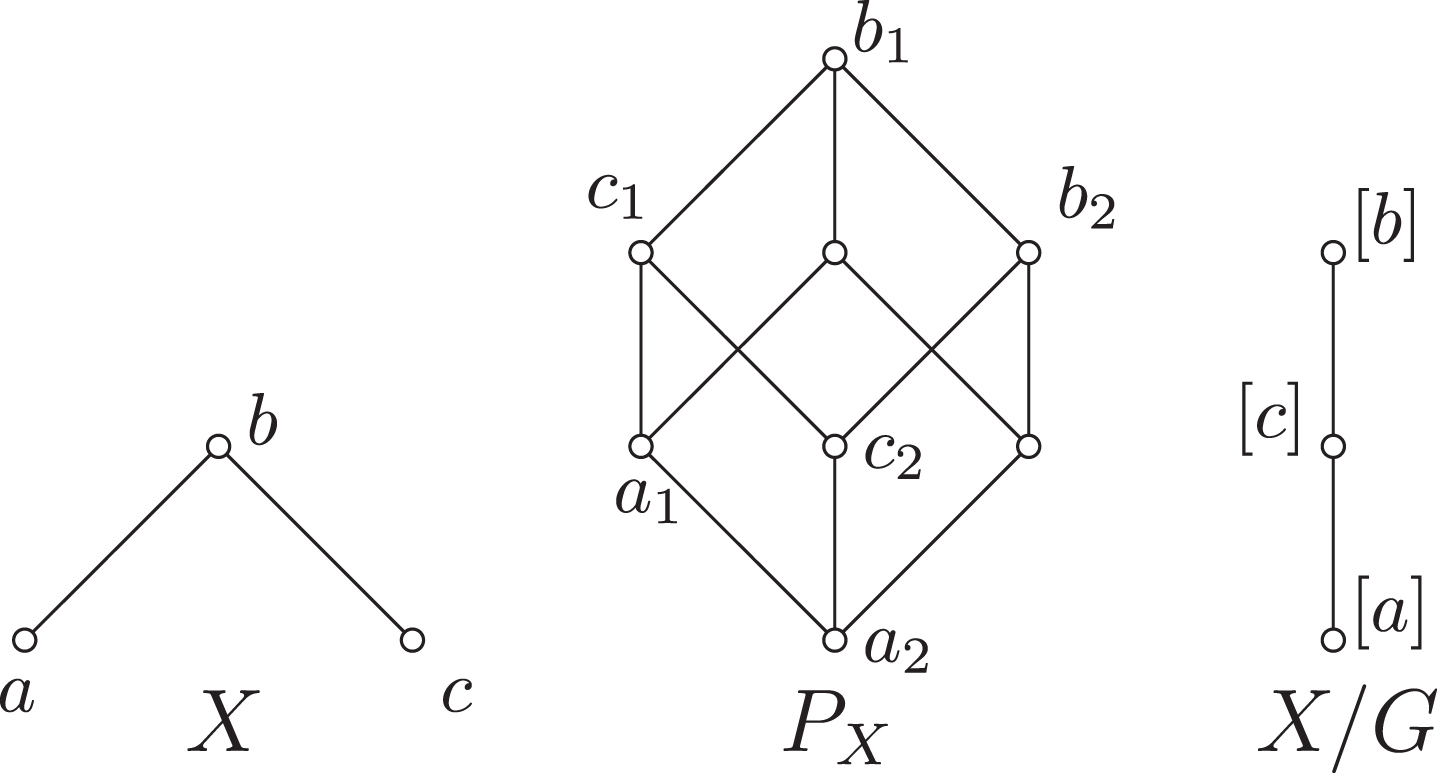
Example 4.2. Let us consider the posets X and X/G represented in Fig. 4, where G is a is a monotonic operator on X with
Hasse diagrams of X, PX and X/G.
It is easy to check that
Obviously, .
The following theorem shall answer the question: What is the condition that for a certain operator C* on M (L) for any L1 ∈ E (L)?
Theorem 4.2.Let and they have DP and satisfy (). Then L0 ∈ E (L) if and only if there exists a monotonic operator G on M (L) such that .
Proof. Notice that, from Lemma 3.2, we know that and .
Suppose that L0 ∈ E (L). Then there exists with such that and is a complete sublattice of . Let . Then L0 ≅ S. This means (M (L0) , ≤) ≅ (M (S) , ⊇). Thus, since . Therefore, it suffices to show that there exists a monotonic operator G on M (L) such that
Let μ : M (L) → S be defined by
for all x ∈ M (L). Since S is a complete sublattice of and , we know that μ fulfills the conditions of Proposition 2.1. Thus μ is an S-fuzzy up-set on M (L).
First, we shall prove that
Let x ∈ M (L). Note that S has DP since S ≅ L0. Thus there exists a set {Ti ∣ i ∈ I} ⊆ M (S) such that μ (x) = ⋀ i∈ITi. Assume that μ (x) ∉ M (S). Then for all i ∈ I, Ti > μ (x), i.e.,
We claim that
Indeed, if I =∅ then μ (x) =⋀ ∅ =1S = ∅ (in the complete sublattice , ∅ is the top element 1S), a contradiction since x ∈ μ (x) by formula (13). Moreover, since S is a complete sublattice of ,
Thus, by formulas (1310) and (1312), it follows from x ∈ μ (x) that there exists k ∈ I such that x ∈ Tk. Further, by formula (13), we have Tk ⊇ μ (x), contrary to (1311). Therefore, μ (x) ∈ M (S), i.e., μ (M (L)) ⊆ M (S).
On the other hand, let T ∈ M (S). Then T ≠ 1S and . Note that 0S = M (L). Thus, T ⊆ M (L). Furthermore, by formula (13), z ∈ μ (z) ⊆ T for all z ∈ T. Thus T ⊆ ⋃ z∈Tμ (z) ⊆T. Then T = ⋃ z∈Tμ (z), which means that T = ⋀ z∈Tμ (z) since S is a complete sublattice of . As T ∈ M (S) and T≠ ∅, there exists y ∈ T such that μ (y) = T. Hence, T ∈ μ (M (L)). Therefore, M (S) ⊆ μ (M (L)).
In view of the proof in the preceding two paragraphs, M (S) = μ (M (L)).
Secondly, let
for all x ∈ M (L). Then we shall prove
Note that S is a sub-poset of PM(L). As μ is an S-fuzzy up-set on M (L), if x ≤ y then G (x) = μ (x) ≤ μ (y) = G (y), i.e., G (x) ⊇ G (y). Thus, G is a monotonic operator on M (L) by Definition 4.1. From formula (18), G (M (L)) = μ (M (L)). Thus, by formula (19), M (S) = μ (M (L)) = G (M (L)). Therefore, (M (S) , ⊇) ≅ (G (M (L)) , ⊇).
Finally, from Lemma 4.1,
Thus, by formula (1313), (M (S) , ⊇) ≅ (M (L)/G, ≤). Therefore, , i.e., (12) is true.
Conversely, suppose that there exists a monotonic operator G on M (L) such that . Then by Theorem 4.1, . Therefore, L0 ∈ E (L) since . □
Note that Example 4.1 also tell us that if L0 is a finite sublattice of a distributive lattice L then L0 may be not in E (L) generally. However, the following theorem will show us that all finite sublattices of a complete atomic boolean lattice L are in E (L).
Let A and B be two sets. Then we denote A \ B = {x ∈ A ∣ x ∉ B}, for convenience, if B = {b} then we write A \ B as A \ b.
Theorem 4.3.Let L be a complete atomic boolean lattice and let L0 be a complete sublattice of L, L0 have DP and satisfy (). Then L0 ∈ E (L).
Proof. Because L is a complete atomic boolean lattice, we know that L ≅ PM(L) and for all a, b ∈ M (L),
Thus , and then
Furthermore, by Theorem 3.1, L has DP and satisfies (). Therefore, by Theorem 4.2, we only need to construct a monotonic operator G on M (L) such that
First, as L0 is a complete sublattice of L, it follows from formula (21) that there exists a sublattice of such that . Let , and then let and . Clearly, 1S′ =∅. Moreover, let f : S → S′ be defined by
Obviously, f is an isomorphism from S to , i.e., S ≅ S′. Moreover, from the construction of S′, we know that since . Thus, as S is a complete sublattice of , is also a complete sublattice of .
Secondly, since 0S′≠ ∅ and 0S′ ⊆ M (L), we know that (0S′, ≤) is a sub-poset of M (L). Thus for all x, y ∈ 0S′, x and y are incomparable by (20). Let f : L → μL be defined by
for all x ∈ 0S′. Note that S′ is a complete sublattice of . Thus μ fulfills the conditions of Proposition 2.1. So that μ is an S′-fuzzy up-set on (0S′, ≤). Similar to the proof of (19), we can prove
Suppose that w ∈ 0S′ and let G : M (L) → PM(L) be defined by
Clearly, G (M (L)) = μ (0S′), which together with (23) deduces that G (M (L)) = M (S′). Furthermore, by formula (20), G is a monotonic operator on M (L).
Finally, from Lemma 4.1,
Thus, G (M (L)) = M (S′) implies that
Hence,
On the other hand, from L0 ≅ S and S ≅ S′, we know L0 ≅ S′. Thus (M (L0) , ≤) ≅ (M (S′) , ⊇). So that . As L0 has DP and satisfies (), we have that by Lemma 3.2. Therefore, by (25),
i.e., (22) holds. □
By Corollary 3.3 and Theorem 4.3, the next corollary is obviously.
Corollary 4.1.Let L be a complete atomic boolean lattice. If L0 is a finite sublattice of L then L0 ∈ E (L).
We shall give an example to illustrate Corollary 4.1.
Example 4.3. Let us consider the complete atomic boolean lattice L in Fig. 1 again. It is clear that each sublattice can be embedded into the lattice L, such that all infima, suprema, the top and bottom elements are preserved under the embedding.
One can check that every sublattice L0 of a finite chain L satisfies L0 ∈ E (L). However, L is not a complete atomic boolean lattice when |L|≥3.
Conditions under which the poset of classes of monotonic operators is a lattice
Let be the set of all monotonic operators on M (L). For each , we denote that where is defined by (6). Let , and L have DP and satisfy ().
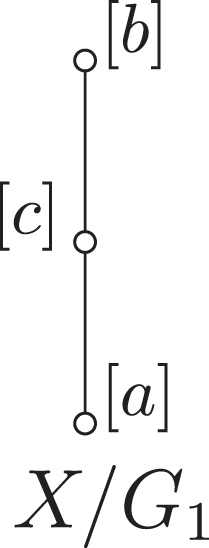
From Theorem 4.2, we know that the monotonic operator G plays an important role in studying the structure of a lattice L which can be represented as the collection of all up-sets. However, there may be two different monotonic operators such that X/G1 = X/G2. Then SG1 = SG2 as illustrated by the following example.
Example 5.1. Let us consider Example 4.2 again. Let G1 : X → PX be a function with
Obviously, G1 is also a monotonic operator on X. The poset X/G1 is represented as Fig. 5.
Hasse diagram X/G1.
One can check that X/G1 = X/G. However, G1 ≠ G.
Therefore, the set does not reflect the structure of L really. Motivated by the foregoing reasons, in this section, we define an equivalence relation on , show that the quotient set of with respective to this equivalence relation can be naturally ordered and give conditions under which the resulting poset is a lattice.
Definition 5.1. Let ≈ be the relation on , defined as:
From Definition 5.1, we easily obtain the following lemma.
Lemma 5.1. Let , and L have DP and satisfy ().
(i1) ≈ is an equivalence relation on .
(i2) The quotient set can be ordered: [G1] ≤ [G2] if and only if where for any .
Lemma 5.2.([2]) If any two elements of a finite poset P with the top and bottom elements have a meet (resp. join), then P is a lattice.
Noticing that if we understand more characteristics about then we will have a deeper understanding of the lattice L since is the set of all monotonic operators G on M (L). The following theorem shall study the structure of .
Theorem 5.1.Let L be a finite distributive lattice. Then is a lattice.
Proof. By Corollary 3.3 and Lemma 3.2, . Let be a sublattice of with . Then S is a finite distributive lattice. Again, by Corollary 3.3 and Lemma 3.2, . Now, we shall prove that is a lattice by two steps as below.
(I) There exists a monotonic operator such that SG = S, i.e., .
Let G be a function defined by (18) in which μ is given by (13). Then, by the proof of Theorem 4.2, we know that and μ fulfills the conditions of Proposition 2.1. Let . Then
Further, by (18), p = {x ∈ M (L) ∣ G (x) ⊆ p}. Therefore,
by the definition of [x] in Lemma 4.1.
Let T = {[x] ∣ x ∈ M (L) , G (x) ⊆ p}. Suppose that [y] ∈ M (L)/G, [x] ∈ T and [y] ≥ [x]. Then G (y) ⊆ G (x), obviously. Note that G (x) ⊆ p. Thus G (y) ⊆ p, which means that [y] ∈ T. Then T is an up-set of M (L)/G. Hence, from formulas (5) and (26), we have p = ST. Thus by (6). Therefore,
On the other hand, by the proof of Theorem 4.2,
Moreover, by (7), . Thus , which together with yields that S ≅ SG. Therefore, by (27), , i.e., S = SG.
(II) is a lattice.
The proof of (II) is made in two steps.
(i) By (I), there exists such that and SV = ({∅ , M (L)} , ⊇), respectively. Obviously, [U] and [V] are the top and bottom elements of , respectively.
(ii) Suppose that . From the proof of Theorem 4.1, both SG1 and SG2 are the sublattices of and . So that
is a sublattice of . Further, by (I), there exists such that . Therefore, by Lemma 5.1.
From Lemma 5.2, (i) and (ii) imply that is a lattice since is finite. □
Conclusions
This paper mainly presented some characterizations of lattices which can be represented as the collection of all up-sets of a poset. Especially, it pointed out: Determining whether a lattice can be embedded into a complete distributive lattice L such that all infima, suprema, the top and bottom elements are preserved under the embedding is equivalent to finding a monotonic operator on (M (L) , ≤) (Theorem 4.2). Because -complete posets propose a general framework for various kinds of ordered structures, e.g., lattices, complete lattices, dcpos, etc. (see [7]), it will be interesting to see some possible formulations of the presented results in such framework in future investigations. Vague lattices and complete vague lattices (see [5, 6]) can also be considered as another direction for possible extensions of the existing results in future studies.
As it is well known, the famous problem of Dilworth says that for an algebraic distributive lattice L, whether there exists a lattice L0 such that L ≅ Con (L0), often referred to as CLP. In 2007, Wehrung constructed an infinite algebraic distributive lattice L satisfying that L ≇ Con (L0) for all lattice L0 (see [21]). However, Grätzer proved that every finite distributive lattice L can be represented as the congruence lattice of a finite semimodular lattice (even a finite rectangular lattice) L0 with (M (L) , ≤) ≅ (M (Con (L0)) , ≤) (see [11]). In this paper, we have proved that if and they have DP and satisfy (), then L1 ≅ L2 if and only if (M (L1) , ≤) ≅ (M (L2) , ≤) (Corollary 3.1). Therefore, an interesting problem is: Is there a semimodular lattice (even a rectangular lattice) L0 such that L ≅ Con (L0) if and L has DP and satisfies ()?
Footnotes
Acknowledgments
The authors are grateful to the responsible editor and the anonymous referees for their valuable comments and suggestions, which helps the authors to improve the earlier version of this paper.
In case M (L) is a complete sublattice of L, notice that L satisfies the condition () if and only if each q ∈ M (L) is a -co-compact element of M (L) in the sense of [] where denotes the subset selection system assigning to each poset X the set of all up-sets of X.
References
1.
BorchardtB., MalettiA., ŠešeljaB., TepavčevićA. and VoglerH., Cut sets as recognizable tree languages, Fuzzy Sets and Systems157 (2006), 1560–1571.
2.
BirkhoffG., Lattice Theory, vol.XXV, 3rd ed., American Mathematical Society Colloquium Publications, Providence, RI, (1973).
3.
ChechikM., DevereuxB., EasterbrookS., LaiA.Y.C. and PetrovykhV., Efficient multiple-valued model-checking using lattice representations, in: Lecture Notes in Computer Science, Vol. 2154, Springer, Berlin, (2001), 451–465.
4.
CrawleyP., DilworthR.P., Algebraic Theory of Lattices, Prentice Hall, Englewood Cliffs, NJ, (1973).
5.
DemirciM., A theory of vague lattices based on many-valude equivalence relations-I: general representation results, Fuzzy Sets and Systerms151 (2005), 437–472.
6.
DemirciM., A theory of vague lattices based on many-valude equivalence relations-II: complete lattices, Fuzzy Sets and Systerms151 (2005), 473–489.
7.
DemirciM., ()-complete partially orderd sets and their representations by -spaces, Applied Categorical Structures21 (2013), 703–723.
8.
DemirciM., -equivalence relations on-fuzzy sets,-partitions of-fuzzy sets and their one-to-one connections, International Journal of Approximate Reasoning111 (2019), 21–34.
9.
DemirciM., On the representations of-equivalence relations on-fuzzy sets with applications to locally vague environments, International Journal of General Systems2 (2020), 1–21.
10.
GoguenJ.A., -fuzzy sets, J Math Anal Appl18 (1967), 145–174.
11.
GrätzerG., WehrungF., Lattice Theory: Special Topics and Applications, Birkhäuser, Basel, (2014).
12.
HeP. and WangX.-p., On the uniqueness of-fuzzy sets in the representation of families of sets, Fuzzy Sets and Systerms333 (2018), 28–35.
13.
[13] HeP. and WangX.-p., A note on L-fuzzy up-sets by using closure operator, Journal of Intelligent and Fuzzy Systems38 (2020), 4667–4673.
14.
JiménezJ., MontesS., ŠešeljaB. and TepavčevićA., On lattice valued up-sets and down sets, Fuzzy Sets and Systems161 (2010), 1699–1710.
15.
PangB., MiJ.S. and XiuZ.Y., -fuzzifying approximation operators in fuzzy rough sets, Information Sciences480 (2019), 14–33.
16.
ŠešeljaB. and TepavčevićA., Representation of lattices by fuzzy sets, Information Sciences79 (1993), 171–180.
17.
ŠešeljaB. and TepavčevićA., On a representation of posets by fuzzy sets, Fuzzy Sets and Systems98 (1998), 127–132.
18.
ŠešeljaB. and TepavčevićA., Completion of ordered structures by cuts of fuzzy sets, an overview, Fuzzy Sets and Systems136 (2003), 1–19.
19.
ŠešeljaB. and TepavčevićA., Representation ordered structures by fuzzy sets, an overview, Fuzzy Sets and Systems136 (2003), 21–39.
20.
ŠešeljaB. and TepavčevićA., A note on natural equivalence relation on fuzzy power set, Fuzzy Sets and Systems148 (2004), 201–210.
21.
WehrungF., A solution to Dilworth’s congruence lattice problem, Adv Math216 (2007), 610–625.