



Abstract
The product form evolutionary design based on multi-objective optimization can satisfy the complex emotional needs of consumers for product form, but most relevant literatures mainly focus on single-objective optimization or convert multiple-objective optimization into the single objective by weighting method. In order to explore the optimal product form design, we propose a hybrid product form design method based on back propagation neural networks (BP-NN) and non-dominated sorting genetic algorithm-II (NSGA-II) algorithms from the perspective of multi-objective optimization. First, the product form is deconstructed and encoded by morphological analysis method, and then the semantic difference method is used to enable consumers to evaluate product samples under a series of perceptual image vocabularies. Then, the nonlinear complex functional relation between the consumers’ perceptual image and the morphological elements is fitted with the BP-NN. Finally, the trained BP-NN is embedded into the NSGA-II multi-objective evolutionary algorithm to derive the Pareto optimal solution. Based on the hybrid BP-NN and NSGA-II algorithms, a multi-objective optimization based product form evolutionary design system is developed with the electric motorcycle as a case. The system is proved to be feasible and effective, providing theoretical reference and method guidance for the multi-image product form design.
Keywords
Introduction
In a highly competitive product market, product form will affect consumers’ first impression and become an important factor that influences consumers’ purchasing decisions, in addition to the functionality and suitability [1]. It’s identified that product modeling can contribute to reflect the perceptual factor in the most direct way, and the product form design based on the product modeling image has become an important competitiveness of enterprises [2, 3]. Kansei engineering [4, 5] is a multidisciplinary engineering technology proposed by Mitsuo Nagamachi of Hiroshima University that combines design, computer, psychology and statistics to transform the user’s sentimental demands into the product design field, that is, perceptual clustering [6]. The basic assumption [7] lies in the causal relationship between product attributes and user emotional responses [8]. When consumers want to buy something, they have a feeling and image of the product in their mind. Kansei engineering quantifies this feeling and image, and aims at translating the emotional response into product design elements of the product, so that to provide a basis and reference for the design of products that meet the user’s expectations and satisfy their potential emotional needs [9].
Cluster analysis [10], principal component analysis [11–13], quantification theory type I (QTT-I) [14], etc. are the traditional statistical analysis methods of Kansei engineering to study the perceptual emotion represented by product modeling. QTT-I is usually used to explain the relationship between independent variables and dependent variables, but its accuracy will be reduced when the predicted relationship is nonlinearly correlated [15]. At present, some researchers have designed product modeling through neural network (NN), which incorporates human perceptual image into product modeling and establishes product models based on the theories and methods such as Kansei engineering, fuzzy theory, grey theory, two-dimensional Kano model and genetic algorithm (GA) [16]. For example, Zairan Li et al. [17] studied to construct a perceptual image research system for the morphological characteristics of high-heeled shoes using fuzzy algorithm and back propagation neural network (BP-NN). Xu et al. [18] applied BP-NN, grey theory and Markov chain to address the problem that it is difficult to quantitatively predict the generational product consistent form feature. In addition, Kang et al. [19] calculated the satisfaction and weight of the perceptual image using the method of fuzzy Kano model combined with fuzzy analytic hierarchy process, explored the relationship between emotional factors and customer satisfaction by fuzzy Kano model and further determined the development priority of perceptual images. Besides, they also identified the key perceptual image of improving satisfaction based on the initial weight value of fuzzy analytic hierarchy process. Tang C Y et al. [20] constructed the correspondence between conceptual product modeling data and perceptual image vocabulary using three-layer artificial neural network model (ANN), and then successfully applied GA to optimize the product modeling design of mobile phones. It is difficult to express the mapping relationship between product modeling elements and users’ Kansei image, but the BP-NN, as one of the most commonly used methods in the ANN, is very suitable for establishing the relationship between the two. However, these studies dedicated to neural networks mainly focus on the product modeling design of a single objective image. In practice, consumers usually require products that meet their multiple images of products, such as “simplicity”, “fashion” and “technology”. Therefore, it is particularly important to develop the multi-objective image modeling so that to satisfy the consumer’s multi-image demand for products and their emotional needs.
The Non-dominated Sorting Genetic Algorithm-II (NSGA-II) proposed by Deb et al. [21] is currently the most commonly used multi-objective algorithm. As a multi-objective evolutionary algorithm, NSGA-II has been used by many researchers to study the evolutionary design of product multi-image objectives. H. Jiang [22] developed a multi-objective optimization (MOO) model for designing mobile phones using NSGA-II. Shieh et al. [23] constructed a predictive model of product emotional response by QTT-I, and then used NSGA-II as a multi-objective evolutionary algorithm to derive the Pareto optimal solution. Some previous studies attempted to combine Kansei engineering with NSGA-II algorithm and other related technologies for MOO product modeling design in order to explore the possibility of combining Kansei Engineering with related algorithms. These studies showed that it was feasible to combine nonlinear product modeling and optimization related techniques such as BP-NN with Kansei engineering.
The majority of consumers have more demands for products that meet multi-image needs. This makes the multi-image product form evolutionary design (MIPFED) significantly important. Although the multi-image design has begun to be used in the field of product modeling design, there are few researches aiming at the MIPFED based on multi-objective GA, and it still needs to be further improved. Therefore, a MIPFED modeling that combines BP-NN and NSGA-II algorithms from the MOO perspective based on genetic algorithm is established in the present study and electric motorcycle is taken as a case to show how the proposed modeling runs. The rest of the paper is organized as follows: A literature review is conducted in Section 2. Section 3 presents the detail of the proposed integrated methodology. Case study is applied in Section 4 and the discussion of this study is summarized in Section 5. Section 6 gives the conclusions of this paper and some suggestions for future research.
Literature review
Back propagation neural networks
Perception refers to a series of behaviors that occur after the brain and nerve process the complex information. As an information processing system with highly nonlinear network structure, ANN can be used to simulate people’s perceptual behavior and the simulation is very consistent with the nonlinear perceptual process of human brain NN structure. It has been successfully applied in the field of product modeling design recently. Zheng and Lin [24] constructed a fuzzy TOPSIS expert system based on neural network model in the new fragrance bottle design process, which can help product designers effectively find the optimal combination of new design form elements. Vaskovsky and Chvanova [25] substantiated the relevance of the design of a neural network personalizing food for people with a genetic predisposition to diabetes in the process of developing an information system for personalizing food products.
As a representative and widely used nonlinear fitting method in ANN, BP-NN combined with Kansei engineering has a good application in product modeling design. Fu Guo et al. [26] established a BP-NN model between modeling design variables and user preferred Kansei images using phone as the research object and established an algorithm for product modeling optimization design. Zheng et al. [27] developed a design decision support system based on ANN for facilitating the vehicle form design process and matching specific needs in the sand making machine design. The NN technique has been verified to be helpful in designing products that meet specific needs. Lin et al. [28] built evolutionary neural networks accompanied by Taguchi method into a robust product design procedure to help designers search for an optimum combination of variable characteristic values for a given product design problem. Quan [29] indicated that the difficulty to capture users’ preferences and the lack of intuitive visual inspiration for designers hindered creative product design. In order to address the inspiration issue in product innovation, they combined Kansei engineering with BP-NN to establish a mapping model between product properties and styles. Lv et al. [30] introduced a user cognitive surrogate design method based on the error BP-NN which involved interactive genetic algorithm with individual fuzzy interval fitness to create alternative complex patterns. In addition, Yeh [31] built an ANN-based predictive model in conjunction to GA optimization technique in the selection of sports shoe design for a given product image and the Kansei objective value was obtained as the output of the GA-based ANN model. In order to predict the key form features of products more accurately for a certain KANSEI adjective, Li Zairan et al. [17] applied the BP-NN method to the shoe KANSEI evaluation system. The existing literature has shown that BP-NN has good performance in KANSEI evaluation, and it has been proved to be very suitable for constructing a relationship model between product characteristics and emotional response and user preference [4]. Therefore, the study builds the correspondence between product modeling data and a series of perceptual image vocabularies using BP-NN to promote product modeling design more effectively. Through the construction, training and deviation analysis of NN, the product image modeling evaluation system is established, providing a basis and criteria for the next stage of product multi-image modeling evolutionary design research.
Multi-objective evolutionary algorithm
Standard GA is the most basic evolutionary algorithm for product image design and has been widely used in the product conceptual design, personalized design and other research fields [32–34]. The traditional method is to aggregate all objectives into a single objective function based on the weight. Dou et al. [35] applied the combination of interactive genetic algorithms (IGAs) with Kano model to conduct customer-driven product design, which fully considered customers’ individual preferences and at the same time enhanced effective user involvement, thereby quickly responding to customers’ personalized demand and achieving customization in industrial design. Since IGAs is an effective way to find optimum solutions in the product color design schemes, Yang et al. [36] established the genetic algorithms by combining users’ cognition noise to provide users with plentiful product color solutions that embody users’ preference. However, single-objective optimization (SOO) has many limitations in practical applications. In order to solve the problem, the MOO algorithm based on the Pareto imperative conception has been fully developed in group optimization to solve the problem of two or more conflict objectives, including non-dominated Sorting Genetic Algorithm (NSGA) [21] and other GAs. NSGA is featured by complicated calculation in constructing the Pareto optimal solution set, and lacks the retention mechanism of the optimal individual [21]. To overcome this shortcoming, Deb et al. proposed an improved NSGA algorithm, namely NSGA-II, an elitist genetic algorithm commonly used to solve MOO problems in 2002. NSGA-II is mainly characterized by lower computational complexity, elitist strategy and fewer shared parameters, which directly supports the crossover and mutation of real-valued decision variables using real-coded simulated binary crossover (SBX) [37, 38] operators and real-coded polynomial mutation operators [39]. Deb et al. found that NSGA-II can maintain better de-spreading and better convergence than other multi-objective GAs. Therefore, we propose a multi-image objective form evolutionary design based on NSGA-II algorithm.
NSGA-II based MOO has been successfully demonstrated and studied in product modeling design. The optimal individual retention of NSGA-II can not only improve the performance of the algorithm, but also prevent the loss of good product modeling, so that it is tried to be applied to the field of product modeling design. CC Yang [5] integrated the support vector regression (SVR) and the multi-objective GA into a hybrid Kansei engineering system to study product form design. H. Jiang et al. [22] proposed a NSGA-II based algorithm to solve the MOO problem of new product engineering requirements and design attributes. Shieh et al. [23] used quantification theory type I to construct a prediction model of emotional response and used NSGA-II as an algorithm to derive the Pareto optimal solution of multi-objective evolution. QTT-I provides the influence of various design variables on the emotional response through partial correlation coefficients but its prediction accuracy is relatively low. A more accurate prediction model can be obtained using BP-NN [23]. The product design modeling established by the BP-NN model can continuously and quantitatively describe the relationship between consumer emotional response and product form elements. Therefore, the algorithm we proposed in the present study combines BP-NN and NSGA-II algorithms to solve the MOO problem. The research in this paper is divided into the following three steps: 1) In order to explore the correspondence between consumer’s emotional response information and product form factors, BP-NN is employed to fit the nonlinear complex function relation and the BP-NN model is used to simulate the influence of product form on consumer’s emotional response; 2) The product multi-image form evolutionary design method based on NSGA-II algorithm is proposed to balance the best combination of product design elements under the multi-image objective; 3) The Matlab software (2017 version) is used to develop the product multi-image form evolutionary design system.
A Two-stage hybrid algorithm for the MIPFED
The main purpose of this study is to develop a MIPFED system based on BP-NN and NSGA-II algorithms. The electric motorcycle form design is taken as an example in this study and the experiment is divided into three stages: 1) The morphological analysis method [40] is applied for the form construction and encoding of electric motorcycles and the semantic differential method [41] makes consumers to describe their emotional responses (perceptual image) of the product sample according to a series of image vocabularies; 2) The mapping relation between emotional response vocabularies and product form elements is established using BP-NN. First, the characteristic elements of product form and the average of the perceptual image of each sample are taken as the input and output of BP-NN respectively, and then the two sets of data are nonlinearly fitted using BP-NN to obtain the relationship model between product form modeling and perceptual image; 3) the fitting of BP-NN in the previous stage is applied to the subsequent multi-objective optimization. The multi-objective image factor based on NSGA-II algorithm is used to develop and optimize the MIPFED system. The research process is shown in Fig. 1.
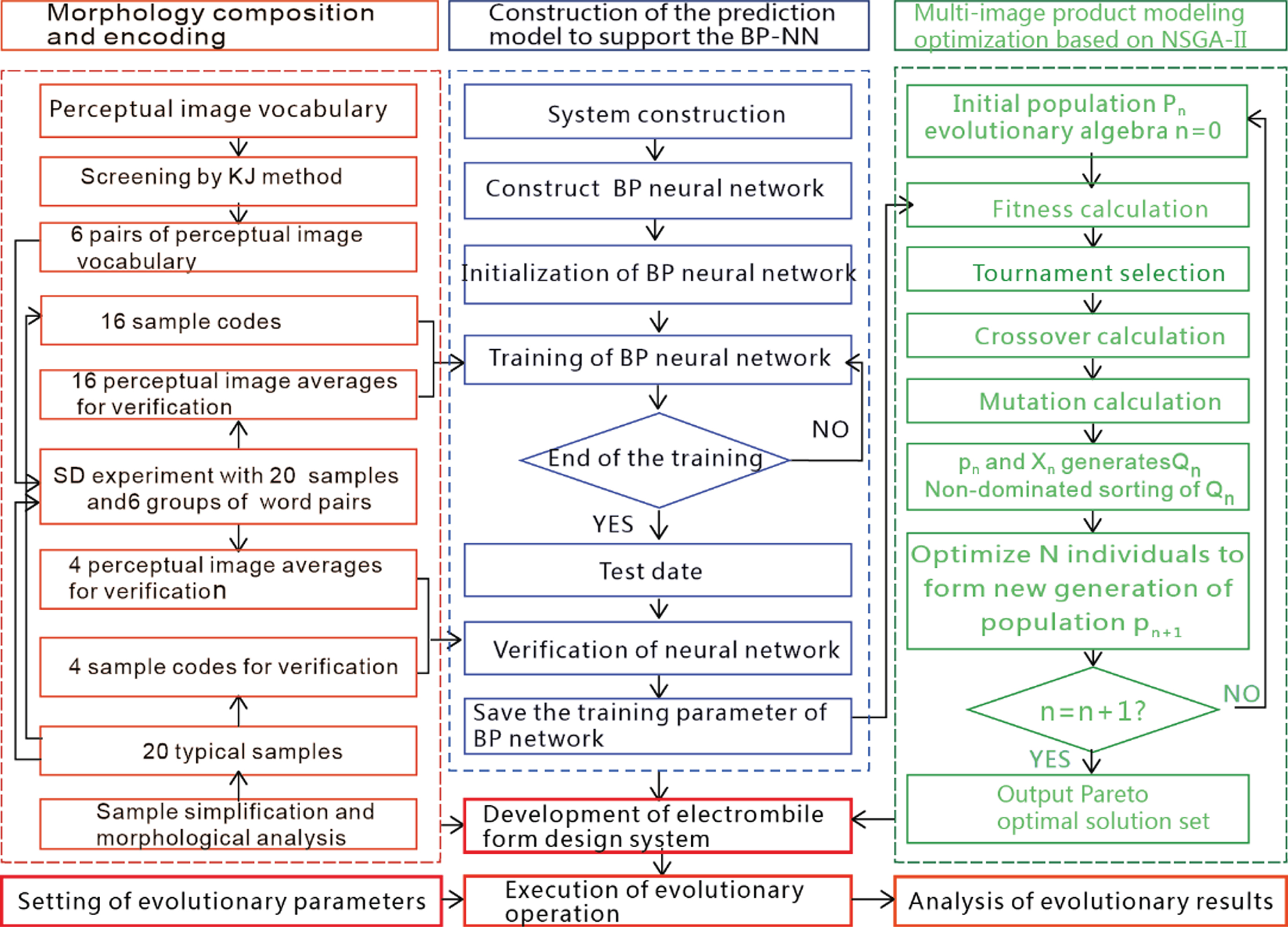
A hybrid method for multi-image product form evolutionary design system.
Figure 1 clearly shows that the algorithm is mainly composed of three parts: morphology composition and encoding, construction of the prediction model to support the BP-NN and multi-image product modeling optimization based on NSGA-II. Furthermore, consumers’ emotional responses to product sample form are evaluated by semantic differential method to obtain the average scores of emotional responses to each product sample, which is used for the output values in the BP-NN model. Specifically, at the stage of morphology composition and encoding for electric motorcycles, 6 pairs of perceptual image vocabularies and 20 typical samples are obtained through the extraction of perceptual image vocabularies and screening them by KJ method. Then the morphological analysis method in Kansei engineering is applied to deconstruct the morphological characteristics of the product [42], that is, decompose the morphological characteristics of the electric motorcycle into several major components (items). Subsequently, the encoding method is designed so that the abstract design elements are represented by real numbers. In addition, a well-trained model is established after the construction of artificial neural network, data initialization and data sample training at the stage of construction of the prediction model to support the BP-NN. Finally, NSGA-II is applied to establish the MIPFED modeling, which designs a series of algorithm flow including population initialization, fitness calculation, tournament selection, crossover operators and mutation operator. After a certain number of iterative calculations, the Pareto solution set of multi-image product modeling optimization problem is obtained at this stage.
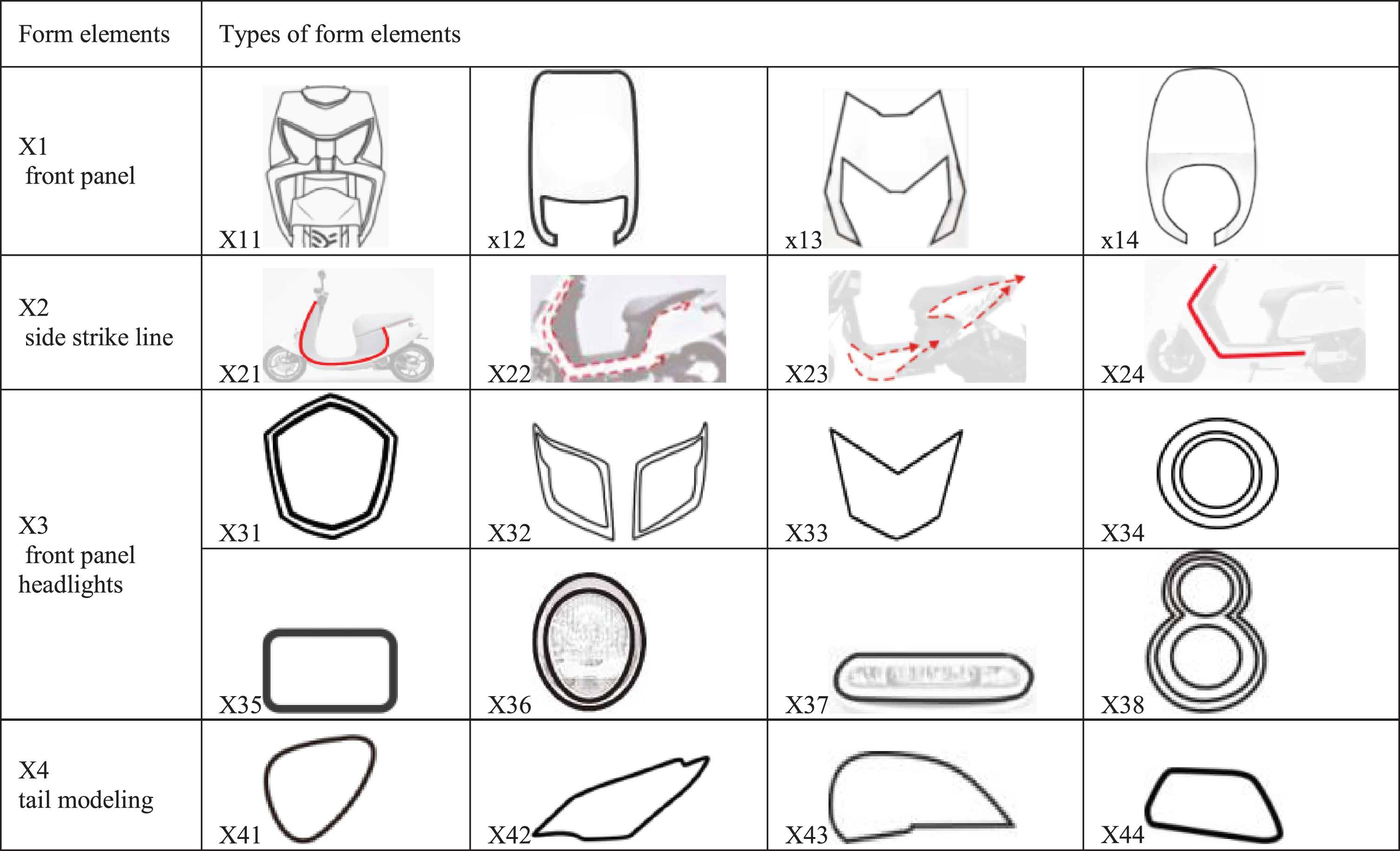
The electric motorcycle is taken as the research case to illustrate the model proposed in this paper. Through the official websites, e-magazines and sales outlets of electric motorcycles, we collected the morphological information of various models and brands of electric motorcycles. 50 students from the Product Design Department were participated in the collection and organization of data. After removing the poorly recognized pictures, a clear visible front view, side view and rear view of a total of 50 electric motorcycle samples were obtained. These pictures were then processed using Adobe Photoshop software. Since the study was to evaluate the impact of the morphological characteristics of the electric motorcycle on the user experience, the brand information and product colors were removed. 8 people with more than 5 years of design experience compared the structure and form of the 50 samples and removed that with high similarity. Then the KJ method was used for secondary screening and 20 samples with larger differences in design elements were finally. The morphological analysis method [34] in Kansei Engineering was used to deconstruct the morphological characteristics of the obtained samples. This method first decomposed the morphological characteristics of the electric motorcycle into several major components (items) and then further checked the possible attributes (categories) of each component. In this case, the electric motorcycle was decomposed into four components (front panel, side feature line, front panel headlight and tail features), which respectively have 4, 4, 8 and 4 design element types. Then these 20 design elements of the electric motorcycle were encoded because they cannot be directly used as input parameters. As depicted in Fig. 2, the number of bits per sample code is the same as the total number of design elements, i.e. 20. For each sample, the quantity of each of the four components is taken as a sequence number and its corresponding position in each design element type is the position of number 1. Each design element type has only one digit of number 1 and the rest are 0. For example, the quantity of the four components of sample 1 are 4, 1, 1 and 7 respectively and thus the code is 4 (0, 0, 0, 1), 1 (1, 0, 0, 0), 7 (0, 0, 0, 0, 0, 0, 1, 0), 1 (1, 0, 0, 0), that is, 0001100000000010100. The other samples are encoded in the same way as the input layer parameters.

Encoding diagram.
The perceptual vocabularies of electric motorcycles were collected through user interviews, literature review, etc., and screened using the KJ method. 20 target users were invited to select those words that match their perception of the product form in the obtained vocabularies, and the top 6 would be used in the evaluation of consumers’ emotional responses to the product form using semantic differential method [42]. The questionnaire was used to collect the data for the evaluation experiment of consumers’ emotional responses. Invalid questionnaires were removed to improve the credibility of the questionnaire and obtain more accurate and complete data. In the questionnaire, the Likert five-point scale was used to measure the scores of the emotional responses. Given 1 perceptual semantic vocabulary, 20 representative sample pictures were showed to the respondents and they would score based on how well their emotional responses to each picture fits the given vocabulary. In this way, consumers can express their subjective feelings for each product sample. The average scores of all respondents were used for the output values in the BP-NN model.
Construction of the prediction model to support the BP-NN
A prediction model of the product modeling elements (input) and the consumer’s perceptual image to products (output) was established for the BP-NN. As shown in Fig. 3, the algorithm used a three-layer ANN model (i.e. input layer, output layer and hidden layer) to simulate the impact of experimental parameters on consumer’s emotional responses to products. N, M and P represent the number of neurons in the input layer, hidden layer and output layer (indexed by i, j and k respectively), while

Three-layered BP-NN structure [32].
It is well known that the BP-NN is a system that has the learning ability of training data through the forward propagation of information and the back propagation of deviations. When it comes to the network training, a group of input modes or signals
In particular, in the learning stage of training the network, there are S training samples. First it can assume that one of the samples p is used to train the network. The input of the j-th neuron in the hidden layer under the action of sample p could be obtained by following equation [45].
The output of the j-th neuron in the hidden layer is as Equation (2):
The output
Finally, four samples were selected as the test set to test the BP-NN model. The data obtained by the true value and the predicted value of each factor in the training set are detected by the performance evaluation function. The mean square deviation performance analysis function mean squared error (MSE) is selected for the performance analysis function. The MSE value less than 0.01 proved the reliability of the established BP-NN model.
Depending on the input multiple affective response (MAR) value specified by the designer (such as concise, smooth and fashionable), the NSGA-II can help to obtain Pareto front-end product substitutes. The elite retention strategy of NSGA-II ensures that good product modeling is not lost in evolutionary design and techniques such as non-inferior classification, crowding distance and pruning operation makes the population highly horizontal and evenly distributed during evolution.
The NSGA-II optimization randomly generates an initial population Pn of chromosomes within the range of modeling features at the beginning and then each chromosome is assigned a fitness value calculated by the BP-NN prediction model for product modeling multi-image. Better chromosomes in the parent population are selected in each generation using crowded tournament selection operators and the selected chromosomes will generate progeny Xn by SBX and polynomial mutation operator. Finally, Pn and Xn are fused to form the merged population Qn. Then the non-inferior classification order value and crowding distance of the product multi-image in Qn are calculated. The product number of the population Pop is set to N, and the population Pop is classified into r subsets according to the non-inferior classification strategy. P1, P2, ... , Pr are the non-inferior classifications of population Pop, which are achieved based on the non-dominated relation among the multiple images of product modeling. Each product in P1 does not dominate every product in P2, ... , and Pr, and the products in P1 cannot be compared in their non-dominated relation. The crowding distance is used to further sort the multi-image products with the same non-inferior classification needs, which not only solves the problem that multiple images cannot be sorted among the same classified products in evolutionary design, but also maintains the uniform distribution of products and has good robustness. Finally, the sorting problem is resolved according to the order value and the crowding distance, thereby pruning out the same number of products as the parent generation as the new population, which is the result of the evolutionary design of the next generation evolutionary parent or product modeling, and the pruning operation advances the product multi-image modeling evolutionary design towards the Pareto optimal solution.
In this study, the BP-NN model was embedded in the NSGA-II algorithm, and the computer code that combines BP-NN and NSGA-II MOO methods was developed using MATLAB. The hybrid evolutionary optimization process of ANN and NSGA-II is shown as follows: Step 1: Randomly generate a population P0 with N individuals, perform fast non-dominated sorting, and initialize the rank values of all individuals in the population, and the evolutionary algebra n = 0; Step 2: Use the fitness value output by the BP-NN prediction model as the objective function of each chromosome in the population; Step 3: Randomly select individuals from Pn for genetic operation and generate progeny Xn (The binary tournament selection operation, crossover strategy of SBX and polynomial mutation method are used); The number of individuals N (given integer) are randomly generated in the first generation. The individual is a digital tuple representing the value of the procedure parameter. All individuals in a generation are referred to as a set P, denoted as a set P; Step 4: Integrate Pn and Xn to generate Qn and calculate the objective function value, and perform fast non-dominated sorting operation on Qn; Step 5: Calculate the crowding degree and crowding distance of individuals in Qn to optimize N individuals and form a new population Pn +1; Step 6: If n = n+1 (that is, the maximum evolutionary algebra is reached), the loop ends when the termination condition is satisfied, otherwise, goes to Step 2; Step 7: Find the Pareto optimal solution set.
Computational results
The construction of the neuron
The BP-NN model is constructed to establish the relationship between the product perceptual image and the modeling design elements. The modeling elements of electric motorcycles are decomposed into four morphological elements by morphological analysis namely X1 front panel features, X2 side features, X3 front panel headlights and X4 tail features. The four morphological elements are further divided into several types (Table 1), for example, X3 front panel headlights are divided into 8 types (X31-X38), and a total of 20 types are obtained according to the encoding rule, as shown in Table 2. Based on the analysis above, each electric motorcycle has four modeling feature elements (X1-X4), and the code of each modeling feature element is combined in order to form the morphological characteristic code of each sample (20 bits in total). The code of 20 morphological types is taken as the input in input layer, that is, there are 20 learning samples in input layer and each contains 20 neurons. After collecting and screening, the top six perceptual image vocabularies of electric motorcycle form selected by target users are “simple”, “unique”, “smooth”, “technological”, “fashionable” and “light”, and they are determined to be the multi-objectives in the electric motorcycle form design in this case. The evaluation scores of the six perceptual image vocabularies of 20 samples are the target output values, and the output layer had 6 neurons. The number of input layer nodes in this paper, the type of 20 electric motorcycle form design elements, is the number of perceptual words, i.e. 6. According to Chen et al. [47], when the number of neurons in the hidden layer is one-half of the sum of the number of neurons in the input layer and the output layer, the root mean square deviation value is small, based on which the number of neurons in the hidden layer is set as 13.
Morphology composition of the electric motorcycle
Morphology composition of the electric motorcycle
Coding of 20 training samples
The 2017 version of the MATLAB NN toolbox was employed to implement the calculation of the process, which can complete a series of work including network structure design, weight initialization, network training and result output by calling the relevant subprogram, and thus eliminating the trouble of writing complex and huge programs. The coding of 20 electric motorcycle modeling feature elements and the evaluation scores of six perceptual image vocabularies are used as the input and output data and the data is stored in the data. mat file, using input referring to the function to input data, and outputting data with the out function. 16 groups of data and 4 groups of data are selected from the input data as the network training data for normalization processing and network test data respectively. BP-NN is trained with training data to make the network can predict the output of nonlinear function. The trained BP-NN is used to predict the nonlinear function output, and its fitting ability is analyzed through the predicted output and expected output of BP-NN.
Figure 4 shows the variation of MSE of the train set, test set and validation set with iterations and indicates the train set, test set and validation set show a convergence state. When the number of iterations is 6, the MSE of the validation set is optimal.
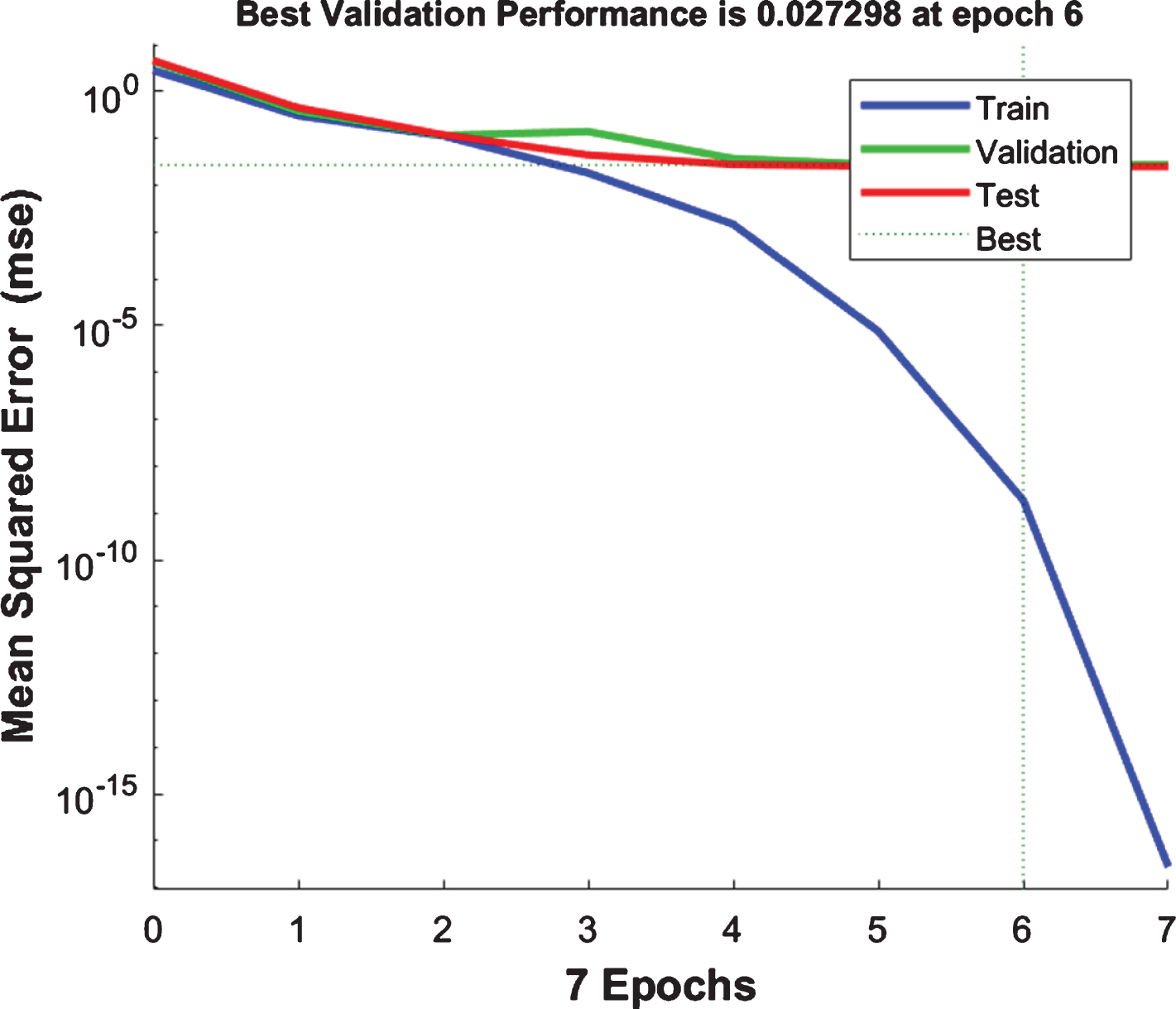
Variation of MSE with iterations.
Figure 5 shows the determination coefficient R diagram for BP-NN training. The R of the train set, test set and validation set are all higher than 0.95, indicating that the data set obtained from the survey is very good.
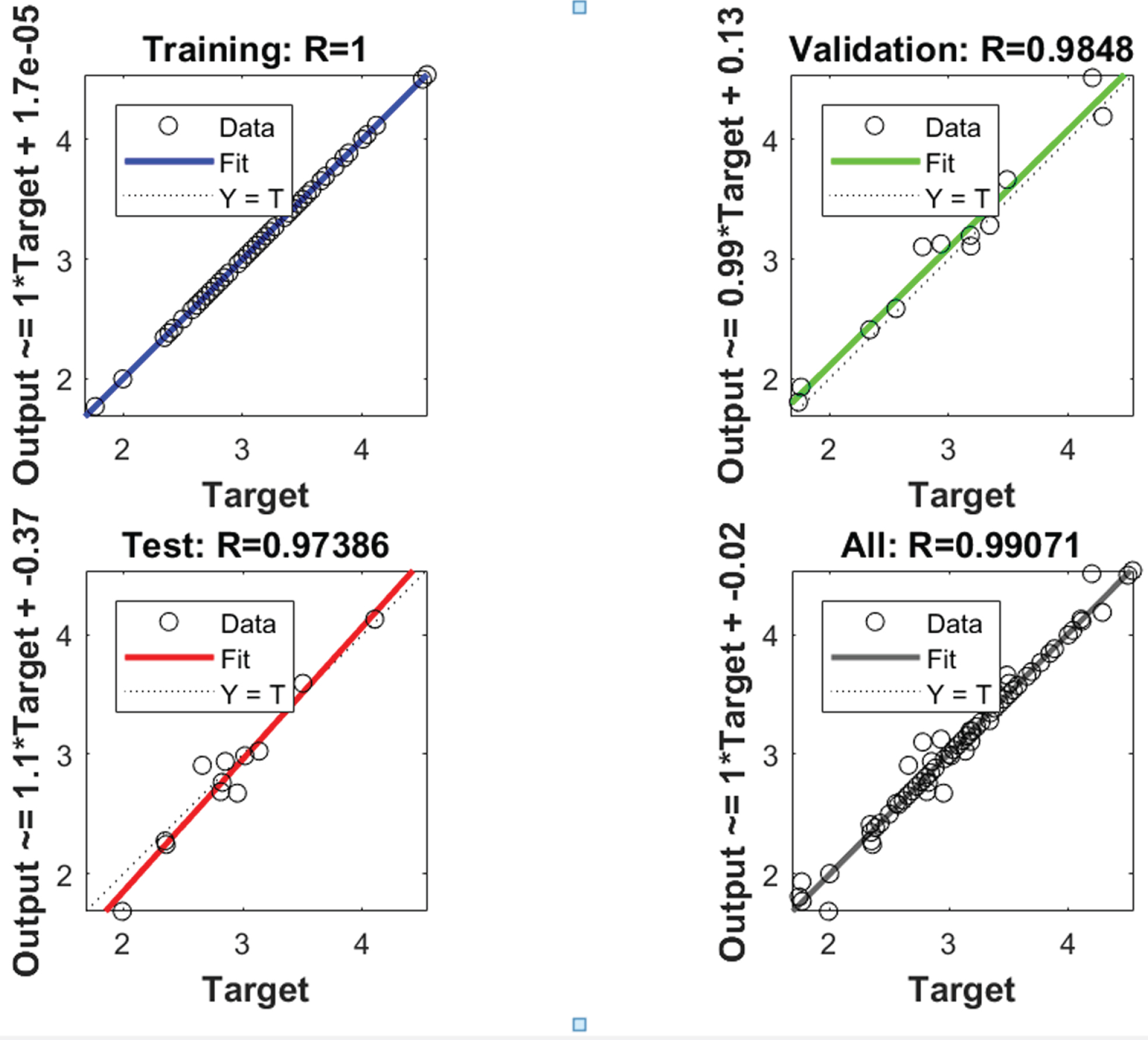
BP-NN regression R diagram.
Perceptual vocabularies of 16 selected samples were scored by the respondents and their scores were compared with those obtained by BP-NN to further check the validity of the model (Fig. 6). Figure 6 shows the comparison of the true value and the predicted value of each factor in the train set and the results clearly indicates that the established BP-NN still has excellent nonlinear fitting ability in the case of multiple inputs and outputs.

Comparison between the true value and the predicted value of each factor in the train set.
In order to prevent the BP-NN model from being over-fitting, four samples were selected as the test set to test the BP-NN model. Figure 7 shows the comparison of the predicted value and the true value of the test set. The MSE of Factor 1-6 are 0.002912, 0.003883, 0.002881, 0.004831, 0.001680, 0.001989 respectively and the corresponding R2 are 0.988719, 0.992707, 0.992274, 0.967280, 0.989163, 0.984028. It is observed that the MSEs are all within a small range of 0.1 and R2 is close to 1, indicating a good regression effect of the prediction set. This shows that the NN fitting does not fall into an over-fitting state, and the BP-NN can be fully applied to the subsequent NSGA-II MOO.
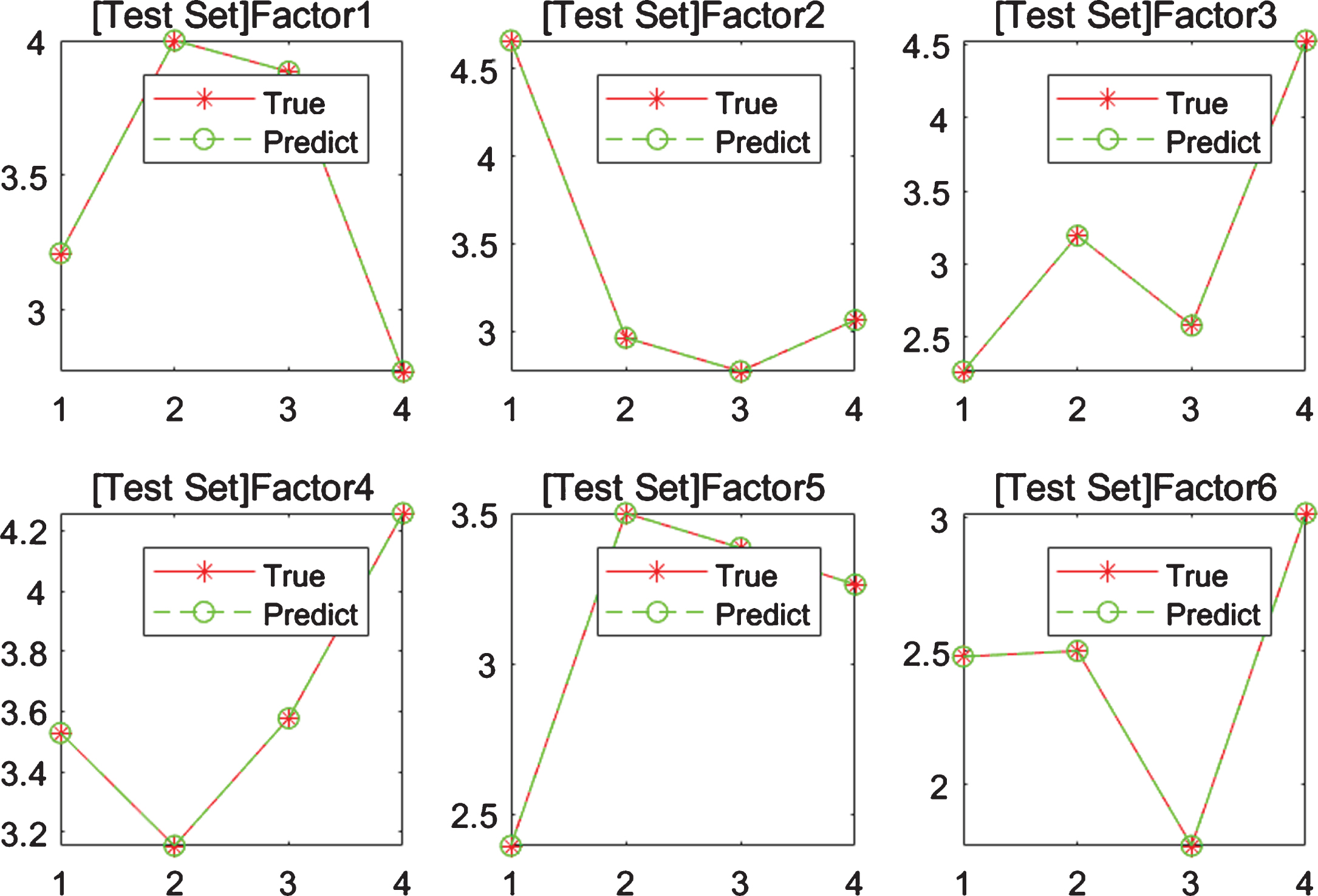
Comparison between the true value and the predicted value of each factor in the test set.
Figure 8 shows the MOO results of Factor 1 (concise), Factor 2 (unique) and Factor 3 (smooth) when the population is set as 50, iterations as 50, the mutation probability as 0.2, and the Pareto front-end ratio as 0.3. A total of 15 Pareto front-end non-inferior solutions were obtained. The resulting type combinations are all integers and are all within the specified range, which demonstrates that the algorithm supports multi-objective integer programming very well. It should be noted that since the population of the algorithm is randomly generated, the solution obtained by each run will be slightly different. In addition, Fig. 8 displays the non-inferior solutions are distributed in a relatively scattered way, which indicates that each group of solutions can be used as the optimization result. The crowding distance of the product multi-images not only solves the problem that the products in the same category cannot be further sorted, but also maintains the even distribution of the product. If more emphasis is placed on image Factor 1, then the larger solution of factor 1 is selected, and other image factors are selected in the same way. Thus, we can design a multi-objective product form that takes “simple”, “unique” and “smooth” into account as the image factor.

Pareto front-end distribution of multi-objectives of factors 1, 2 and 3.
In order to simplify the operation, an electric motorcycle modeling design system is designed, which mainly consists of two parts: BP-NN training and multi-objective image factor optimization based on NSGA-II algorithm. The use steps are as below: 1. Click the BP-NN Train button; 2. Select the factors to be optimized (2-3); 3. Select the NSGA-II parameter; 4. Click the NSGA-II button for optimization.
For the multi-image modeling evolutionary design of electric motorcycles, we set the population as 50, the iterations as 50, the cross-distribution index as 0.9, the mutation probability as 0.2, the Pareto front-end ratio as 0.3, the image Factors 1, 2, and 3 respectively as “simple”, “unique” and “smooth”, and executed the “Run” command. Figure 9 shows the evolutionary design results of the multi-images of Factor 1, 2 and 3. For example, for one group of the Pareto front-end non-inferior solutions, with Type1 of 3, Type 2 of 3, Type3 of 6, Type4 of 1, the corresponding code is 00100010000001001000, so that the combination of elements for the form design of electric motorcycles under image Factors 1, 2 and 3 can be judged, which can be used as the guiding direction for the form design of electric motorcycles.

NSGA-II optimization result of multi-objectives of factors 1, 2 and 3.
In the morphological deconstruction of electric motorcycles, four morphological characteristic components and 20 attributes of electric motorcycles are summarized using the morphological analysis method. Then the relationship between the consumers’ perceptual images of products and the morphological elements is established using BP-NN model, where the morphological elements are encoded as the input layer parameters and the average score of consumers’ evaluation on the perceptual image of each sample is taken as the output layer parameter. The Matlab software is used to repeatedly train and test the BP-NN model of electric motorcycle modeling, thereby establishing a mapping model between product perceptual image and morphological elements. The MSE value demonstrates that the deviation of the NN model of the nonlinear mapping relationship between the vector spaces of the product form parameter and the target image is reasonable. The study in this stage shows that because of the nonlinear relationship between the morphological characteristic elements and the consumers’ perceptual image, BP-NN, as a nonlinear operation method, can accurately describe the consumers’ perceptual image and product form design. Take them as samples for learning and training, and fit the mapping relationship between the consumer’s perceptual image evaluation and the electric motorcycle’s morphological elements. The validity of the model is verified through testing, which provides a fitting function for establishing MIPFED modeling in the next stage. Furthermore, NSGA-II algorithm adopts techniques such as non-inferior classification, crowding distance and pruning operation to make the population highly horizontal and evenly distributed in the process of product multi-image modeling evolutionary design. In the obtained Pareto front-end non-inferior solution set, each group of solutions can be used as an optimization result for consumers’ multi-image needs. Finally, a multi-image modeling evolutionary design system of electric motorcycles is developed in this paper. By setting the relevant parameters in this system, the Pareto front-end non-inferior solution set can be obtained after running, which provides designers or consumers a clearer understanding of product form design according to the optimal combination of multi morphological elements. This model overcomes the limitations of the single-image product form evolutionary design in previous studies.
Conclusions
Most product design is the single-image optimization design, which is not as good as the multi-image product design to satisfy consumers’ complex emotional needs for product forms. The multi-image product form design has great potential to meet increasing individual needs of consumers in modern society. BP-NN and multi-objective GA are applied in this article to expand the depth of product form design, which can meet the complex multi-image needs of consumers and thereby increasing the added value and market competitiveness of products. To be specific, the following conclusions are drawn: 1. The mapping relationship between the consumer’s perceptual images and the morphological elements is established and then fitted by BP-NN because of the ability of deal with the complex mapping relationships between the optimization object (product form elements) and the optimization objective (consumers’ perceptual image). 2. The trained NN model is embedded into the NSGA-II multi-objective evolutionary algorithm to construct a multi-image product form evolutionary design system based on hybrid BP-NN and NSGA-II algorithms. Electric motorcycle is taken as the case to illustrate the MIPFED system. BP-NN, as a non-linear calculation method, can accurately describe the relationship of consumers’ perceptual images and product form design elements. Through learning and training, the mapping relationship between the evaluation of consumers’ perceptual image and the morphological elements is well fitted, and the effectiveness of the model has been verified through tests. The established algorithm could meet the requirements of designers and customers for multi-image optimization, to a certain extent. In addition, it also points out that the mapping relationship between the optimization object and the optimization objective can be constructed by combining other NN algorithms which can also effectively establish a nonlinear system such as the fuzzy neural network. With the continuous improvement and upgrading of the algorithm, it can be combined with new intelligent algorithms to be applied to the multi-image product form design. Future work will focus on improving designs in terms of reusability and speed, more effective algorithm optimization methods might be introduced to better align with the customer preferences. Appropriate evolutionary strategies including combining with other effective algorithm or heuristic method are still needed to accelerate the algorithm convergence and distribution.