



Abstract
Multigranulation rough set (MGRS) theory provides an effective manner for the problem solving by making use of multiple equivalence relations. As the information systems always dynamically change over time due to the addition or deletion of multiple objects, how to efficiently update the approximations in multigranulation spaces by making fully utilize the previous results becomes a crucial challenge. Incremental learning provides an efficient manner because of the incorporation of both the current information and previously obtained knowledge. In spite of the success of incremental learning, well-studied findings performed to update approximations in multigranulation spaces have relatively been scarce. To address this issue, in this paper, we propose matrix-based incremental approaches for updating approximations from the perspective of multigranulation when multiple objects vary over time. Based on the matrix characterization of multigranulation approximations, the incremental mechanisms for relevant matrices are systematically investigated while adding or deleting multiple objects. Subsequently, in accordance with the incremental mechanisms, the corresponding incremental algorithms for maintaining multigranulation approximations are developed to reduce the redundant computations. Finally, extensive experiments on eight datasets available from the University of California at Irvine (UCI) are conducted to verify the effectiveness and efficiency of the proposed incremental algorithms in comparison with the existing non-incremental algorithm.
Introduction
Rough set theory (RST), proposed by Pawlak [38], provides a soft computing framework for data processing [3, 63]. During the past decades, this theory has been widely used in decision making [1, 68], machine learning [26, 53] and rule acquisition [32, 71].
Generally speaking, Pawlak rough set model and most of its extensions are established on the basis of a single granular structure. In these models, the lower and upper approximations, which are basic notations, can be used for rules extraction and related decision making tasks. On one hand, the knowledge hidden in information systems can be described in the form of decision rules by taking advantage of the lower and upper approximations. More precisely, an object belonging to the lower approximation generates a certain rule, whereas an object belonging to the upper approximation forms a probable rule. On the other hand, the lower approximation, which plays a pivotal role in positive region-based attribute reductions [59], can be used to acquire attribute reducts. Due to the requirement of practical applications, information systems may vary over time, e.g., variation of objects, variation of attributes and variation of attribute values. It is noteworthy that the dynamic change of information systems may result in the change of the potential valuable knowledge, e.g., the lower and upper approximations. The non-incremental approach needs to re-calculate the entire data set from scratch and makes it time-consuming for updating new knowledge, owing to the lack of using prior information. Therefore, it is necessary to develop the techniques to update new knowledge effectively from the efficiency perspective. Incremental technique has the ability to perform the computation by means of prior knowledge from the original data assisted with newly arriving data to acquire new knowledge, which avoids reprocessing the whole computation for achieving new knowledge. Recently, numerous findings [6, 58] concerning incremental updating approximations and attribute reduction in dynamic contexts have been investigated from the efficiency perspective. Furthermore, they are roughly grouped into three categories. (1) Many incremental frameworks have been developed under the variation of objects [4, 43]. Liu et al. established dynamic knowledge updating approaches in incomplete information systems when the objects vary [31]. Considering the data with fuzzy information, Hu et al. [14] designed an incremental algorithm for computing fuzzy approximations. In addition, Luo et al. [35] explored incremental algorithms for updating probabilistic approximations. (2) Numerous studies regarding updating approximations and attribute reducts have been exploited under the variation of attributes [5, 52]. Based on characteristic relations, Li et al. [24] developed incremental methods for maintaining approximations when adding or deleting attributes. Incremental algorithms for updating approximations in set-valued ordered systems were investigated by Luo et al. in [34] when adding or deleting attributes. (3) Under the variation of attribute values [23, 61], a lot of dynamic frameworks have been developed. For example, Chen et al. put forward the incremental algorithms for maintaining decision rules [7] and approximations in incomplete ordered decision systems [8], respectively. Wang et al. [48] proposed an incremental attribute reduction method when feature values evolve over time. These outstanding achievements have provided theoretical guidelines for updating knowledge in dynamic environments.
However, the above-mentioned theoretical frameworks established by a single granulation have some limitations for handling various special data in practical applications, such as, multi-source data, distributive data and multi-agent systems. Therefore, to fill this gap, multigranulation rough set (MGRS) theory, emerged as one of the most distinguished paradigm, has been proposed by Qian et al., where the approximations are established by multiple granular structures [40]. This theory has been utilized to decision making, and attribute reduction [42]. Since then, several state-of-the-art theoretical frameworks in the multigranulation spaces [44–46, 67] have been developed from theoretical point of view, such as, MGRS under tolerance relations [41], neighborhood-based MGRS models [29], covering-based MGRS and its extensions [2, 65], fuzzy MGRS [15, 66], Multi-granulation hesitant fuzzy rough sets [69]. These well-established models not only significantly benefit the theoretical analysis but also show the potential to be applied in various applications. Interestingly, there are also many studies concerning combination of multigranulation rough sets and other theories, such as, Bayesian theory [70], concept lattices [22], three-way group decision [36, 51], as well as three-way concept learning [21]. In the viewpoint of knowledge acquisition, Qian et al. [39] developed an attribute reduction method for acquiring rule in the pessimistic MGRS. Zhan et al. [62] proposed covering-based intuitionistic fuzzy rough sets for multi-attribute decision-making. Ju et al. [18] investigated an effective cost-sensitive rough set framework with multigranulation strategy and established the approximations of cost-sensitive MGRS. In addition, Yao et al. [57] presented a theoretic framework for classification in multigranulation spaces.
Although these theoretical models have promoted the development of MGRS, they are incapable to handle dynamic data sets in multigranulation contexts due to lacking the update mechanisms by utilizing previous knowledge. Accordingly, to acquire new useful knowledge in dynamic multigranulation contexts, one should recalculate the new entire data sets from the very beginning. Nonetheless, this will consume a large number of computational time. Therefore, several incremental mechanisms have been naturally developed to update multigranulation approximations and reducts by considering diverse variations of data sets. For instance, Yang et al. [55] proposed an efficient approach for incrementally computing multigranulation approximations with the increasing of granular structures. Meanwhile, Ju et al. [19] investigated incremental methods for updating approximations and reduction in fuzzy MGRS. In addition, to handle dynamic neighborhood systems, we [13] explored incremental mechanisms to acquire approximations under dynamic granular structures. Furthermore, Yu et al. [60] developed matrix-based methods for updating approximations in neighborhood multigranulation spaces when neighborhood classes decrease or increase over time. Recently, we [11] proposed dynamic algorithms for maintaining dominance-based multigranulation approximations for evolving ordered data.
As discussed above, the well-established dynamic approaches in multigranulation environments were investigated from different perspectives. It is well-known that the change of multi-source data is not only in the sense of evolving granular structures but also in the sense of adding or deleting objects. Taking a comprehensive evaluation system based on multiple experts as an example, the experts often need to evaluate results for all objects of the universe with reference to different evaluation subjects. When new objects that need to be evaluated by different experts arrive, these objects should be added into the original evaluation system. Moreover, some objects in the original evaluation system may be useless and therefore need to be deleted from the system. Accordingly, the approximations and rules hidden in the multigranulation space may vary over time under these circumstances. Therefore, how to update knowledge by making use of previous information so as to enhance the efficiency of acquiring knowledge is a key issue. To address this issue, in this paper, we explore matrix-based incremental mechanisms for updating approximations in MGRS when multiple objects dynamically change. Different from previous work, the main contributions of this study are outlined as follows: (1) Matrix-based incremental frameworks for updating multigranulation approximations are explored when adding or deleting objects. (2) The proposed algorithms can be used to handle dynamic categorical data under the variation of multiple objects from multigranulation perspective. (3) Comparable experiments on UCI datasets are performed to evaluate the performance of the incremental algorithms in terms of computational efficiency.
The remainder of this paper is organized as follows. In Section 2, several fundamental notions of RST and MGRS are reviewed, and a matrix representation of approximations in MGRS is introduced. In Section 3, incremental mechanisms for updating multigranulation approximations are proposed while adding or deleting objects, and numerical examples are employed to illustrate the feasibility of the proposed mechanisms. In Section 4, the corresponding incremental algorithms are developed while adding or deleting multiple objects. Extensive experiments are conducted to validate the efficiency of the proposed incremental updating algorithms in Section 5. The paper ends with a brief summary and some future research topics in Section 6.
Preliminaries
In this section, we review the preliminary notions of RST and MGRS [38–40], and proceed to introduce a matrix representation of multigranulation lower and upper approximations [12].
Multigranulation rough sets
An information system [38] is defined as IS = (U, A, V, f), where U = {x i |i ∈ {1, 2, …, n}} is a non-empty finite set of objects, A = {a k |k ∈ {1, 2, …, m}} is a non-empty finite set of attributes, V = ⋃ a k ∈AV a k is the domain of attributes values, V a k is the domain of the attribute a k , and f : U × A → V is a decision function with f (x i , a k ) ∈ V a k , for any a k ∈ A, and x i ∈ U.
A binary indiscernibility relation R B in terms of each non-empty subset B ⊆ A is defined as follows [38]:
Clearly, R B is an equivalence relation on the universe U, which forms a partition U/R B = {[x i ] B |x i ∈ U}, where [x i ] B denotes the equivalence class of x i with respect to B, i.e., [x i ] B = {y ∈ U| (x i , y) ∈ R B }.
Based on these approximations, three disjoint regions of X with respect to B ⊆ A, namely, the positive, boundary and negative regions, can be described as:
In the classical rough set model, the approximations were constructed based on a single granulation [38]. To provide a distinguished paradigm for making decisions, Qian el al. [39, 40] proposed a multigranulation rough set model, which consists of the optimistic MGRS and pessimistic MGRS. In what follows, we introduce the basic concepts of approximations in the multigranulation rough set model.
According to Definition 2, we can see that an object belongs to the lower approximation of the optimistic MGRS if and only if at least one granular structure satisfies with the inclusion condition between equivalence class and the target concept. The upper approximation of the optimistic MGRS can be considered as a set in which objects have non-empty intersection with the target concept in terms of each granular structure.
According to the optimistic multigranulation approximations, the optimistic multigranulation three regions can be formalized as:
According to Definition 3, we can conclude that an object belongs to the lower approximation of the pessimistic MGRS if and only if each granular structure satisfies with the inclusion condition between equivalence class and the target concept. The upper approximation of pessimistic MGRS is regarded as a set in which objects have non-empty intersection with the target concept in terms of at least one granular structure.
Analogously, by making use of the pessimistic multigranulation approximations, the pessimistic multigranulation three regions can be formalized as:
In this subsection, we briefly summarize a matrix representation of rough approximations in MGRS which has been proposed in [12].
Given an information system IS = (U, A, V, f), X ⊆ U and U = {x
i
|i ∈ 1, 2, …, n}, the column vector F (X) = [f1, f2, …, f
n
]
T
(“T " refers to the transpose operation) is defined as [34]
Clearly, the column vector F (X) is an n × 1 Boolean matrix. In order to represent the equivalence classes of each granular structure from the matrix perspective, the equivalence relation matrix [12]
According to the equivalence relation matrix with respect to each granular structure, the induced diagonal matrix can be constructed by using the sum of all elements of each row in corresponding equivalence relation matrix.
where
According to Definition 4, we can easily derive that the element
Notably, the column matrix play a significant role in the construction of the cut matrices. Next, we show the definition of two cut matrices by using the column matrix.
According to Definition 6, by using two different parameters α and β, two cut matrices, which are directly used for constructing the column vectors of the lower and upper approximations in MGRS, can be easily obtained. On the basis of the aforementioned properties of matrix operations, the column vectors of the optimistic and pessimistic multigranulation approximations of X can be established in the following theorems.
It can be easily seen from Theorem 1 that the column vectors of the lower and upper approximations of the optimistic MGRS can be obtained when we set the values of the parameters α and β in the cut matrices of each granular structure. Based on Theorem 1, the lower and upper approximations of optimistic MGRS can be further calculated by using the definition of the column vector.
It can be easily seen from Theorem 2 that the column vectors of the lower and upper approximations of the pessimistic MGRS can be obtained when we set the values of the parameters α and β in the cut matrices of each granular structure. Based on Theorem 2, the lower and upper approximations of pessimistic MGRS can be further calculated by using the definition of the column vector.
In dynamic contexts, information systems are always evolving with the changing of the available data, which include the addition or deletion of multiple objects, the variation of the attribute values, and the generalization of attribute sets. In this section, we explore matrix-based incremental mechanisms for updating approximations in MGRS when multiple objects are respectively added into or deleted from information systems.
Adding multiple objects
Let IS = (U, A, V, f) be an information system, where A = {a k |k ∈ {1, 2, …, m}}, U = {x i |i ∈ {1, 2, …, n}} and X ⊆ U. Assume that an objects set UΔ = {xn+1, xn+2, …, xn+s} is added into U and the granular structures keep unchanged. In what follows, matrix-based incremental mechanisms for updating approximations of a target concept X in MGRS are explored when multiple objects are added into an information system. When adding an object set UΔ into the original universe U, if the target concept X is changed, then the column vector of X can be updated by the following theorem.
An information system
The added object set UΔ
As previously discussed, the equivalence relation matrix plays a key role in the entire process for updating approximations in MGRS. Therefore, in the following theorem, the updating mechanism for equivalence relation matrix of each granular structure is demonstrated when an object set UΔ is added into information systems, which can reduce computational time effectively.
According to Theorem 4, we only need to calculate three incremental relation matrices so as to update the new equivalence relation matrix
On the basis of the incremental relation matrices, when an object set UΔ is added into information systems, the incremental mechanism for the induced diagonal matrix of each granular structure can be updated as follows.
According to Theorem 5, we can update the induced diagonal matrix of each granular structure based on previously calculated results and incremental relation matrices, which can reduce some unnecessary calculations. When adding an object set, the following example is to state the incremental mechanism for updating the induced diagonal matrix.
Similarly, we calculate the element
Thus, we have
On the basis of three incremental relation matrices and the updated column vector, when an object set UΔ is added into information systems, the updating mechanism for the intermediate matrix of each granular structure is demonstrated in the following theorem.
As a consequence, according to Definitions 5 and 6, Theorems 1 and 2 which are presented in Section 2.2, we can easily calculate the column vectors of the updated multigranulation approximations when adding the object set UΔ as follows:
Finally, by Eq. (8), we can calculate the updated multigranulation approximations as follows:
From the above results, when adding multiple objects, we can conclude that the multigranulation lower and upper approximations of a target concept obtained by means of incremental mechanisms are equivalent to that of the defined matrix-based approach in Section 2.2. Compared with the defined matrix-based approach, the proposed incremental mechanisms can achieve substantially promising results while reducing some redundant computations.
Let IS = (U, A, V, f), where A = {a k |k ∈ {1, 2, …, m}}, U = {x i |i ∈ {1, 2, …, n}} and X ⊆ U. Assume that an object set U▿ = {xn-s+1, xn-s+2, …, x n } is deleted from U and the granular structures keep unchange. In the following, matrix-based incremental mechanisms for updating approximations of a target concept X in MGRS are developed when multiple objects are deleted from an information system. When deleting an object set U▿ from U, if the target concept X is changed, then the column vector of X can be updated by the following theorem.
□
The object set U▿ deleted from U
In the light of Theorem 8, we can update relation matrix
When the objects are deleted from the universe, the size of the equivalence relation matrix of each granular structure is decreased. This will result in the change of the elements in the induced diagonal matrix of each granular structure. In the following, we show the updating mechanism for the induced diagonal matrix of each granular structure when an object set U▿ is deleted from information systems.
According to Theorem 9, the induced diagonal matrix
Thus, we have
The following theorem demonstrates the updating mechanism for the intermediate matrix
It can be seen from Theorem 10 that the intermediate matrix
Thus, we have
Subsequently, according to Definitions 5 and 6, Theorems 1 and 2 in Section 2.2, we can calculate the column vectors of updated multigranulation approximations when deleting the object set U▿ as follows:
Finally, by Eq. (8), we can calculate the updated multigranulation approximations as follows:
From the above results, we can conclude that, when deleting multiple objects, the multigranulation lower and upper approximations of the target concept obtained by taking advantage of the incremental mechanisms are equivalent to those of the defined matrix-based approach in Section 2.2. Compared with the defined matrix-based approach, the proposed incremental mechanisms make fully use of previous knowledge to reduce the computational cost of acquiring knowledge.
The matrix-based static algorithm for computing approximations in multigranulation rough sets (Abbreviated as SACAM) has been proposed in our previous work [12]. Therefore, in this section, based on the proposed incremental mechanisms, we focus on developing the matrix-based incremental algorithms for updating approximations when adding or deleting multiple objects.
Incremental algorithm for updating approximations in MGRS when adding multiple objects
Algorithm 1, which is abbreviated as IAUAMA, is a matrix-based incremental algorithm for updating approximations in the context of MGRS when an object set UΔ is added into U. Steps 2-5 update the column vector according to Theorem 3, whose time complexity is O (|U| + |UΔ|). Steps 6-14 update the relation matrix of a k , k ∈ {1, 2, …, m} by Theorem 4, whose time complexity is O (m (|UΔ|2 + |U||UΔ|)). Steps 15-20 update the diagonal matrix and intermediate matrix according to Theorems 5 and 6, whose time complexity is O (m (|U||UΔ| + |UΔ|2)). Steps 21-22 compute the column matrix, whose time complexity is O (m (|U| + |UΔ|)). Steps 23-24 compute the cut matrices of a k by Definition 6, whose time complexity is O (m (|U| + |UΔ|)). Steps 25-26 compute the column vectors of multigranulation rough approximations, whose time complexity is O (m (|U| + |UΔ|)). Step 27 outputs the updated approximations of MGRS, whose time complexity is O (|U| + |UΔ|). To be brief, the total time complexity of IAUAMA is O (m (|U||UΔ| + |UΔ|2)).
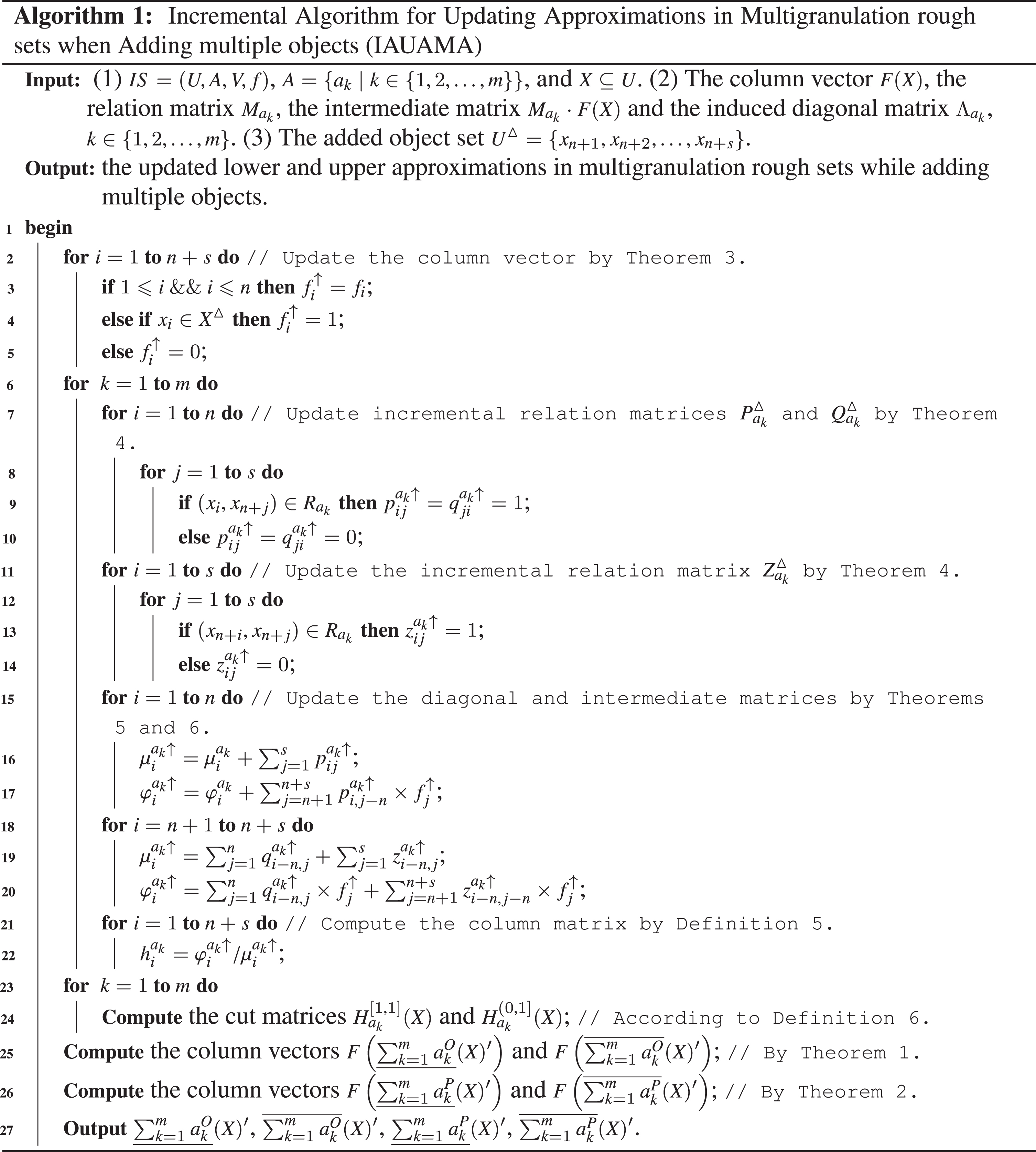
Table 4 indicates a comparison of time complexity between SACAM and IAUAMA for updating multigranulation approximations while adding multiple objects. It is easy to see from Table 4 that the computational time complexity of the incremental algorithm IAUAMA is better than that of SACAM when an object set UΔ is added into U. Therefore, the incremental algorithm IAUAMA is more efficient than static algorithm SACAM when multiple objects are added into information systems.
The time complexity of SACAM and IAUAMA
The time complexity of SACAM and IAUAMA
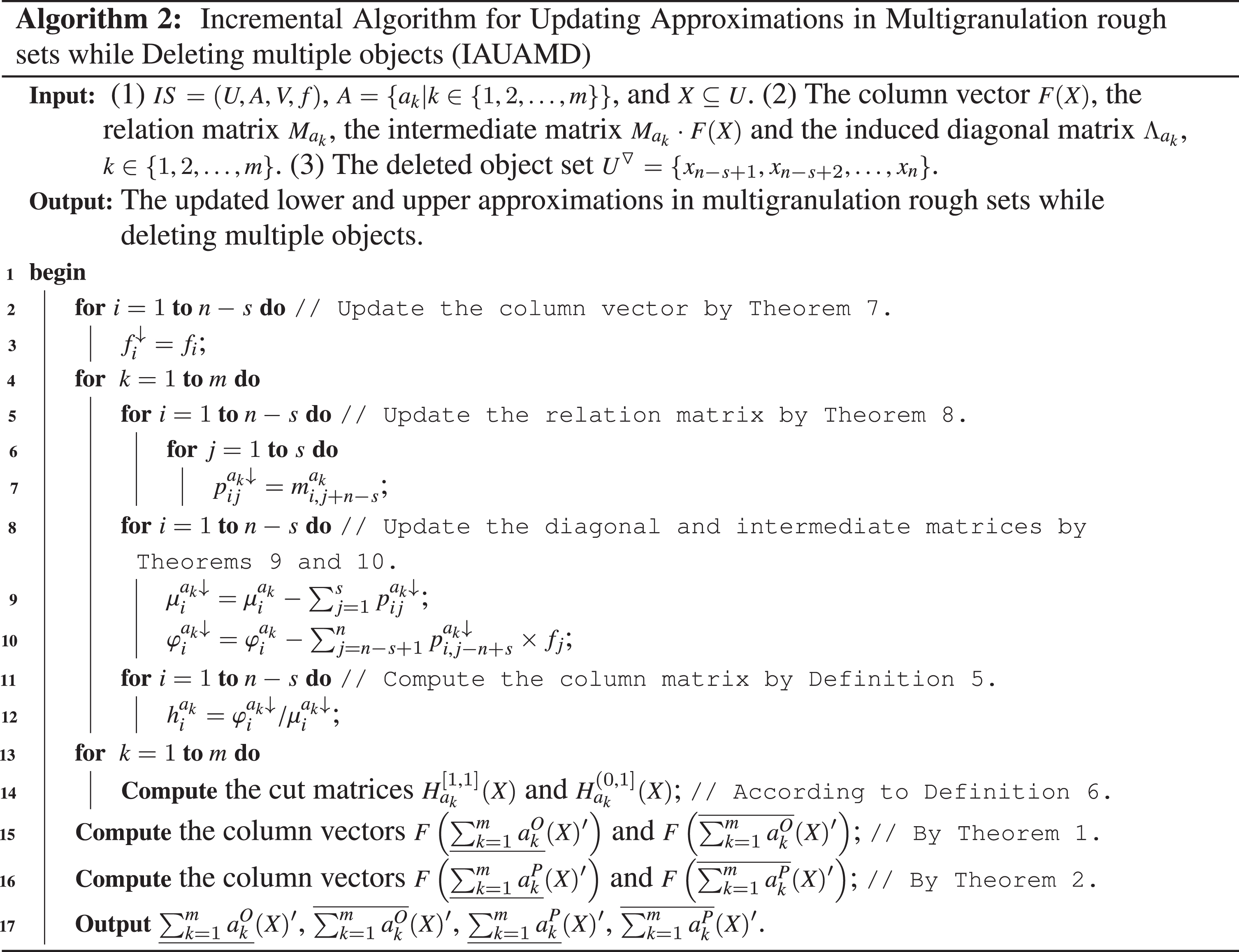
Algorithm 2, which is abbreviated as IAUAMD, is a matrix-based incremental algorithm for updating approximations in multigranulation rough sets when an object set U▿ is deleted from U. Steps 2-3 update the column vector by Theorem 7, whose time complexity is O (|U▿|). Steps 4-7 update the relation matrix of a k k ∈ {1, 2, …, m} by Theorem 8, whose time complexity is O (m|U▿| (|U| - |U▿|)). Steps 8-10 update the diagonal matrix and intermediate matrix according to Theorems 9 and 10, whose time complexity is O (m|U▿| (|U| - |U▿|)). Steps 11-12 compute the column matrix, whose time complexity is O (m (|U| - |U▿|)). Steps 13-14 compute the cut matrices of the granular structure a k by Definition 6, whose time complexity is O (m (|U| - |U▿|)). Steps 15-16 compute the column vectors of multigranulation rough approximations, whose time complexity is O (m (|U| - |U▿|)). Step 17 outputs the updated approximations of multigranulation rough sets, whose time complexity is O (|U| - |U▿|). Hence, the total time complexity of the incremental algorithm IAUAMD is O (m|U▿| (|U| - |U▿|)).
Table 5 refers to a comparison of time complexity of updating multigranulation approximations while deleting multiple objects between SACAM and IAUAMD. It can be observed from Table 5 that |U| - |U▿| is usually greater than |U▿| when the number of deleted objects is very small. Hence, the time complexity of updating multigranulation approximations by the proposed incremental algorithm IAUAMD is usually better than that of SACAM when an object set U▿ is deleted from U. Therefore, the incremental algorithm IAUAMD is more efficient than SACAM when multiple objects are deleted from information systems.
The time complexity of SACAM and IAUAMD
The time complexity of SACAM and IAUAMD
To evaluate the performance of the proposed incremental algorithms for updating multigranulation approximations, comparative experiments are conducted in the empirical study. Eight data sets downloaded from UCI Repository of Machine Learning Database 1 are used in the experiments. The detailed description of experimental data sets is outlined in Table 6. Furthermore, in order to construct a multigranulation space, each attribute is considered as a granular structure. The algorithms are performed on a personal computer with operation system Windows 7, Intel(R) Core(TM) i3-4010U CPU@1.70GHz and 4GB memory. Moreover, the algorithms are developed in Java and the software being used is Eclipse LUNA. In our experiments, we set α = 1 and β = 1 when updating lower approximation in MGRS, whereas we set α = 0 and β = 1 when updating upper approximation in MGRS.
The description of data sets
The description of data sets
In this subsection, to compare the performance of the static algorithm SACAM and the proposed incremental algorithm IAUAMA versus different adding ratio when adding multiple objects, we select 50% objects of each data set as the original data set, and select 10%, 20%, …, 100% from the remaining 50% objects as the incremental data set. The computational times of SACAM and IAUAMA for updating multigranulation approximations can be obtained when adding multiple objects, respectively. Let R a be ratio of the size of adding objects and original objects, denoted as adding ratio, changing from 10% to 100% and the size of increase step is 10%. The comparison of computational times between SACAM and IAUAMA versus different adding ratios of the objects is shown in Table 7. In addition, the corresponding trend lines of computational time under different adding ratios are shown in Fig 1, where the square line denotes the computational time of SACAM and the star line stands for the computational time of IAUAMA. In each sub-figure of Fig. 1, the x-coordinate pertains to the adding ratio of adding objects which starts from 10% to 100% of the remaining 50% objects and the y-coordinate concerns the computational times of SACAM and IAUAMA.
A comparison of SACAM and IAUAMA versus different adding ratios of the objects
A comparison of SACAM and IAUAMA versus different adding ratios of the objects
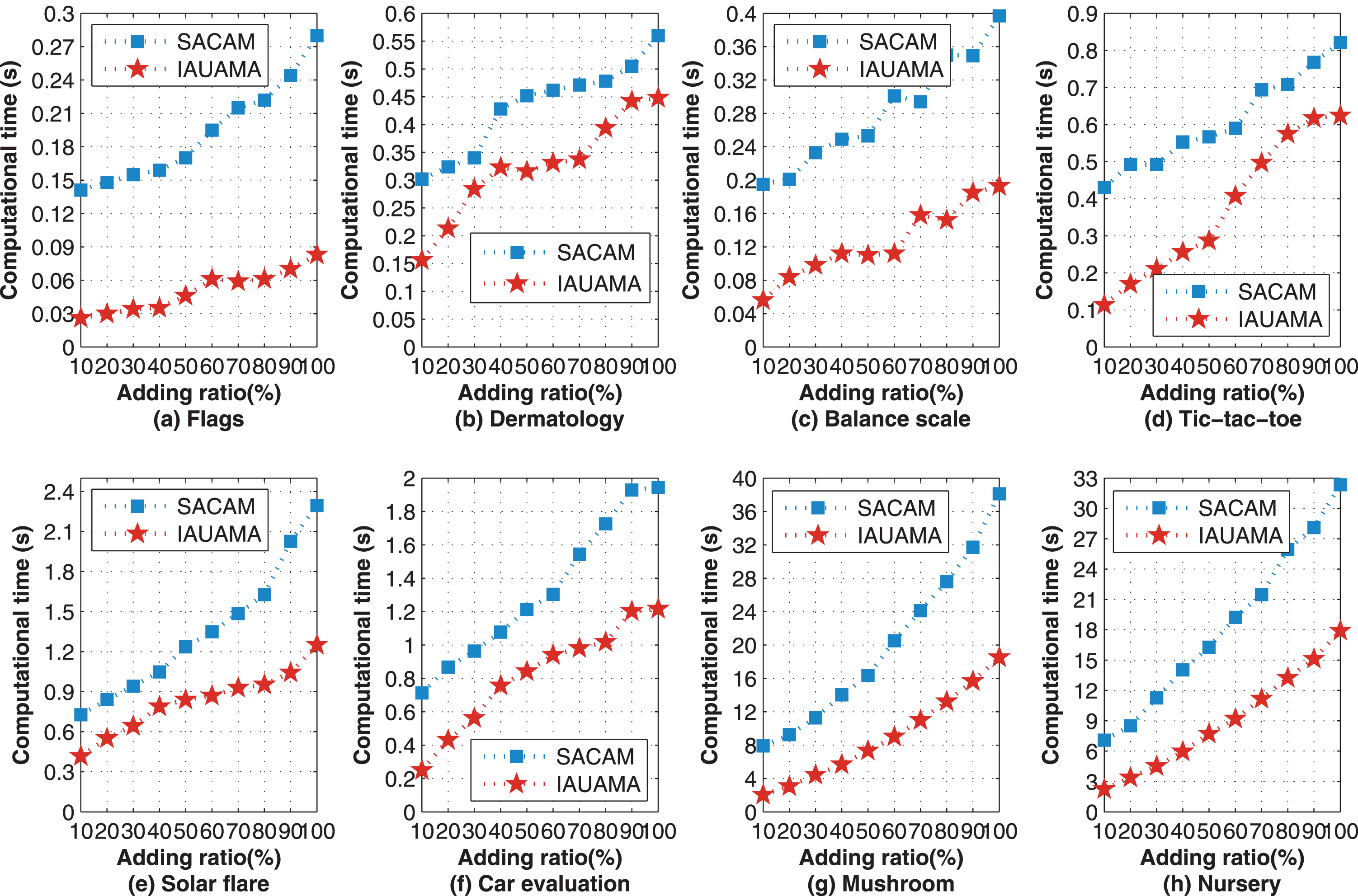
Computational times of SACAM and IAUAMA versus different adding ratios of the objects.
From Fig. 1, it can be observed that the computational times of SACAM and IAUAMA increase with the adding ratio of the objects. Furthermore, according to according to the trendlines of SACAM and IAUAMA, it is clear that IAUAMA is always much fast than SACAM when the adding ratio of the objects increases. The reason should be that IAUAMA can be capable of updating relation matrix and intermediate matrix of each granular structure based on the utilization of previous information without re-training from scratch. However, SACAM needs to re-calculate relation matrix and intermediate matrix of each granular structure from the very beginning. In summary, to accelerate the processing of dynamic information systems, the proposed incremental algorithm is to reduce the calculation of relative matrices by means of incremental mechanisms. Therefore, the proposed incremental algorithm IAUAMA is more efficient to update multigranulation approximations while adding multiple objects.
To further demonstrate the advantage of IAUAMA, an incremental speedup [13] is denoted as IncS=T s /T i , where T s is the computational time of the static algorithm and T i is the computational time of the incremental algorithm. Table 8 indicates the incremental speedup versus different adding ratios of the objects. The last row records the average speedup on eight data sets. It is worth noting that the incremental algorithm IAUAMA achieves 1.742× to 5.350× speedup over the static algorithm SACAM with the adding ratio of 10%. Obviously, from the perspective of speedup, the incremental algorithm IAUAMA performs better than the static algorithm SACAM with the increasing of adding ratio.
The incremental speedup versus the adding ratio of the objects
In this subsection, to compare the performance of the static algorithm SACAM and the proposed incremental algorithm IAUAMD versus different deleting ratios when deleting multiple objects, we take out the whole data set as the original objects, and select 10%, 20%, …, 90% from the whole data set as the deleting objects. The computational times of SACAM and IAUAMD for updating multigranulation approximations can be obtained when deleting multiple objects, respectively. Let R d be ratio of the size of deleting objects and original objects, denoted as deleting ratio, changing from 10% to 90% and the size of increase step is 10%. Moreover,the comparison of computational times between SACAM and IAUAMD versus different deleting ratios of the objects is shown in Table 9. The trendlines of computational time in terms of different deleting ratios are shown in Fig. 2. In addition, the square line refers to the computational time of SACAM whereas the star line represents the computational time of IAUAMD. In each sub-figure of Fig. 2, the x-coordinate pertains to the incremental ratio of deleting objects which starts from 10% to 90% of the original objects and the y-coordinate concerns the computational times consumed by SACAM and IAUAMD.
A comparison of SACAM and IAUAMD versus different deleting ratios of the objects
A comparison of SACAM and IAUAMD versus different deleting ratios of the objects

Computational times of SACAM and IAUAMD versus different deleting ratios of the objects.
According to Fig. 2, it can be observed that the computational time of SACAM decreases with the deleting ratio of the objects, while that of IAUAMD is fluctuant for some data sets with the deleting ratio of the objects. Furthermore, IAUAMD usually outperforms SACAM until reaching a threshold value of deleting ratio. The reason should be that when deleting the small scale objects from the original datasets, the computational time of IAUAMD by making use of the previous matrices information to update multigranulation approximations is less that of SACAM by recalculating the entire datasets. However, with the increasing of deleting ratio of objects, the advantage of IAUAMD becomes narrower, such as deleting ratio of 70% for data sets Tic-tac-toe, Solar flare and Nursery, deleting ratio of 80% for data sets Car evaluation and Mushroom. Clearly, the algorithm IAUAMD is influenced by the deleting ratio of objects.
Similarly, we make use of an incremental speedup to demonstrate the advantage of the incremental algorithm IAUAMD. Table 10 presents incremental speedup versus different deleting ratio of the objects. The last row records the average speedup on eight data sets. It is worth noting that the incremental algorithm IAUAMD achieves 1.451× to 7.979× speedup over the static algorithm SACAM with the deleting ratio of 10%. With the increasing deleting ratio of the objects, the speedup becomes smaller and smaller. Furthermore, the speedup is less than 1 for data sets Tic-tac-toe, Solar flare and Nursery when the deleting ratio of objects reaches 70%, for most experimental data sets such as Car evaluation, Mushroom, etc, when the deleting ratio of objects reaches 80%. Therefore, the proposed incremental mechanisms can be capable of learning new knowledge incrementally without the need to retrain the entire updated data set, and the results indicate that IAUAMD can effectively reduce the computational time when the deleting ratio of objects is limited to a small-scale.
The incremental speedup versus the deleting ratio of the objects
Multigranulation rough set has the abilities to analyze and address the uncertainties from multigranulation perspective so that it has been broadly utilized for solving many kinds of practical problems in various fields. With the increasing volume of data available, the information systems from various fields dynamically vary over time. Therefore, it is meaningful to develop incremental updating mechanisms that are capable of acquiring valuable knowledge in dynamic circumstances. In order to overcome the limitations of the existing incremental approaches for dealing with dynamic multi-source information systems, in this paper, incremental approaches for updating approximations in multigranulation rough sets were proposed under dynamic information systems. Based on the matrix representation of multigranulation approximations, when adding or deleting multiple objects, the updating mechanisms of the equivalence relation matrix, the intermediate matrix and the induced diagonal matrix were investigated. Furthermore, the incremental algorithms were proposed to update approximations in MGRS. Finally, experimental studies regarding eight UCI data sets indicated that the proposed matrix-based incremental algorithms can reduce computational time of updating multigranulation approximations compared with the non-incremental algorithm. Accordingly, the proposed incremental algorithms provide an effective solution to fuse multi-source uncertain information in a dynamic manner. Due to the changing of objects in dynamic information systems, the incremental attribute reduction needs to be updated in the multigranulation environment. Our future work will focus on developing dynamic attribute reduction algorithms in multigranulation rough sets under the variation of information systems.
Acknowledgments
This work is supported by the Natural Science Foundation of the Jiangsu Higher Education Institutions of China (No. 19KJA550002), the Anhui Provincial Natural Science Foundation (Nos. 2008085MF224, 1808085MF170), the Natural Science Foundation of Educational Commission of Anhui Province (No. KJ2018A0432), the Collaborative Innovation Center of Novel Software Technology and Industrialization, the Six Talent Peak Project of Jiangsu Province of China (No. XYDXX-054), the Soochow Scholar Project and the Priority Academic Program Development of Jiangsu Higher Education Institutions.
Declaration of competing interests
We wish to confirm that there are no known conflicts of interest associated with this publication and there has been no significant financial support for this work that could have influenced its outcome.
