



Abstract
This paper investigates novel intuitionistic fuzzy preferences relations to determine the imprecise linguistic terms with fuzzy goals. The proposed intuitionistic fuzzy goal programming (IFGP) considers the degree of vagueness and hesitations simultaneously. Different sorts of membership functions such as linear, exponential, parabolic, and hyperbolic have been introduced to depict the linguistic importance term. The overall satisfaction level is achieved by maximizing the convex combination of each fuzzy goals and the preference relations simultaneously. To verify and validate the proposed IFGP model, a numerical example is presented with the comparative study. Further, it is also applied to a banking financial statement management system problem. The proposed IFGP approach outperforms over others. At last, the conclusion and future research direction are suggested based on the performed study.
Keywords
Introduction
In Operations Research, Goal Programming (GP) has been extensively used in the field of multi-objective optimization problems. Firstly [22, 23] proposed the GP method and afterward it was widely used by [20, 45] and many other authors. The GP method mainly comprises the optimization of over (positive) and under (negative) attainment degree of goals with the least deviation of each objective from their respective targeted goal. In a conventional GP approach, the aspiration degree of goals is considered as known and deterministic. However, it may not always be possible to express the aspiration level with crisp values in real life. Therefore, to deal with vague or uncertain goals, the fuzzy concept is a more convenient and handy tool. The fuzzy set theory was first proposed by [56], and later on, [14] applied to a decision theory in a fuzzy environment. Uncertainty may exist in various forms and can be handled by the appropriate techniques.
The fuzzy optimization techniques inherently consider the maximization of satisfaction degree for each objective that assists the decision maker(DM) in contemplating the best compromise possible solution. Many authors have proposed different fuzzy goal programming models such as [24, 37]. The existence of uncertainty among imprecise preferences for the priorities goals and their aspiration levels yield in complex decision-making problems. The [6] method develops a new fuzzy goal programming model to address the multi-objective mathematical programming problems, where the imprecise preference relations among goals have been defined by linguistic terms, such as goal X is significantly or moderately or slightly more important than goal Y. After [6], these linguistic importance relation is applied and extended by many authors, such as [43, 11]. [39] also taken advantage of the linear membership function for three linguistic preference terms and investigated or extended it into ten terms. Later on, it was successfully implemented by [40] in supply chain design network.
Moreover, fuzzy goal programming techniques with imprecise preference relations only deal with maximization of the belongingness degree of the imprecise relations and do not consider the non-belongingness degree of the imprecise relations among fuzzy goals. The uncertainty which contains vagueness or imprecision and some hesitation due to lack of information or a ludicrous predetermined idea, then an intuitionistic fuzzy approach, is a better option to deal with the problem rather than classical fuzzy techniques. The intuitionistic fuzzy optimization techniques consider both the aspects of satisfaction degree which consists of maximization of the membership function (belongingness) and minimization of non-membership function (non- belongingness) of the different objective functions simultaneously. The concept of intuitionistic fuzzy set was first introduced by [13] and later on [10] discussed the optimization problem in the intuitionistic fuzzy environment. [7–9] have made a significant contribution in the domain of bipolar fuzzy linear system and intuitionistic fuzzy left k-ideal of semi-rings. Several authors such as [15, 46] discussed the real-life applications in intuitionistic fuzzy environment.
This research study’s primary aim and objective are to provide a more realistic framework for determining the preferences among different fuzzy goals in decision-making processes. While dealing with many goals then assigning the additional crisp weight to all goals according to the decision-makers’ priority level is not feasible because it may be time-consuming to obtain the desired combination of the different goals that may not be much reason in the real-life problem. Also, there is no guarantee that the crisp weighting scheme’s best combination is well-identified and assigned.
So far, imprecise preference relation among different fuzzy goals is depicted by the fuzzy concept, which does not consider the degree of hesitation. Thus, we have two crucial motivation to explore or introduce the intuitionistic fuzzy goal programming (IFGP) model with imprecise fuzzy preferences. Firstly, linguistic importance preference relations can be represented in a more generalized and effective manner by incorporating the degree of hesitations (non-membership functions). Secondly, apart from linear-type membership and non-membership functions, it is worthwhile to introduce nonlinear-type membership and non-membership functions (such as exponential, parabolic, and hyperbolic) for imprecise preference relations. The structure of nonlinear-type membership functions is flexible in nature due to the existence of additional parameters.
Literature reveals that previous authors have discussed the linguistic importance preference relation among the fuzzy goals, which contains vagueness and ambiguity with a linear membership satisfaction degree, which may not represent the real-life situation in a better way. To model the problems with uncertainties and ambiguities more realistically, we have proposed IFGP with different nonlinear membership and non-membership grades with imprecise preference relations among fuzzy goals. Also, we extended the work of [6] from linear to nonlinear membership function. To the best of our knowledge and belief, no one has discussed in this domain so far. Therefore, this present work fills the gap as mentioned above.
The main contribution can be regarded as follows: A novel intuitionistic fuzzy preference relations among different fuzzy goals have been introduced for the linguistic preference terms. Opportunity to select the different types of membership and non-membership functions such as linear, exponential, parabolic, and hyperbolic is presented, which provides the choices for decision-makers’ satisfaction level. The proposed IFGP model balance the trade-off between fuzzy goals and preference relations more effectively and conveniently. The proposed IFGP model is implemented on the previously discussed numerical, and comparative study is performed. Besides, a Banking financial management system is also presented to show the real-life applications.
In Section 2, the basic definitions regarding fuzzy set and the intuitionistic fuzzy set has been discussed while Section 3 represents the proposed intuitionistic fuzzy goal programming (IFGP) approach with different preference relation membership and non-membership functions. In Section 4, a numerical example has been studied to show the validity and performance of the proposed approach. Finally, conclusions and future scope have been discussed in section 5.
Basic definitions
Some basic definitions and related terms of the fuzzy set and intuitionistic fuzzy set have been discussed in this section.
Multi-objective optimization problems are very common in day to day life. Due to the conflicting nature of each objective function, it may not always easy to provide the crisp weight to the most preferred/desired goals over others. In this situation, uncertainty may be incorporated in relative preference relations among the goals, or simultaneously the use of relative preference relations among the goals may contains some vagueness and hesitation from the decision makers (DMs) point of view.
The vagueness and hesitation due to the imprecise preference relations among different goals may be dealt with intuitionistic fuzzy goal programming (IFGP) in a very convenient manner. The concept of imprecise preference relation among the goals with three different linguistic term was first given by [6] later on [39] extended it into ten different linguistic preference term with linear membership function. The research work in this domain by different authors has been summarized in the Table 1.
Research work on FGP with imprecise preferences based on [6]
Research work on FGP with imprecise preferences based on [6]
Here, we define the linguistic fuzzy importance relation among different goals given by [6] namely, goal A is slightly more important than or moderately more important than or significantly more important than goal B. These linguistic term has been assigned with the fuzzy relations defined as
Linguistic relative preferences of goal k over l.
Previously, all the linguistic importance relations have been evaluated by using linear membership function to obtain the achievement of preferences degree. However, it may be possible to represent the achievement level of preference relation with the aid of nonlinear membership function. The flexible behavior of nonlinear membership functions also well enough to determine the marginal evaluation of preference relations satisfaction degree. It also depends on some parameters’ value which is well enough to execute the DM(s) strategy efficiently.
In multiobjective optimization problem, it seldom happens that the single solution is optimal for each objective. However it is possible to have the compromise solution that satisfies each objective simultaneously. The marginal evaluation of each objectives are defined by its membership function. The appropriate selection of membership functions is always a crucial task for decision makers. In the similar way, the choice of membership function for linguistic preference relation has its own importance. In order to reveal the performance of various membership functions, we have developed a couple of linear and nonlinear membership function which marginalize each linguistic preference relations among the different goals in fuzzy environment.
Linear Membership function
The linear membership function for each linguistic preference relation can be defined as follows and achieved by maximizing it. [see [6]]
The exponential membership function for each linguistic preference relation can be defined as follows.
The Parabolic membership function for each linguistic preference relation can be defined as follows:
The Hyperbolic membership function for each linguistic preference relation can be defined as follows:
In brief, we recall the work of [6] with the extension of linear to nonlinear membership function in a more generalized way. Let b kl , k, l = 1, 2, . . . , K where k ≠ l; be a binary variable, taking value 1 if there is an importance relation defined between the goal Z k and Z l , and 0 otherwise.
In order to achieve these fuzzy goals, we define membership function
With the help of equation (2.6), the model of [6] has been re-represented as follows:
where
The above presented FGP model is more generalized and extended version of the [6] model as it considers the nonlinear membership function for the linguistic fuzzy preference relation among different goals.
The intuitionistic fuzzy set is based on more intuition as compared to fuzzy and deals with both membership and non-membership function of each objectives in any decision making process. Therefore, the membership and non-membership functions are more practical approach for the marginal evaluation of each objectives individually. Likewise, it is quite beneficial to consider the membership and non-membership functions for linguistic preference relations among different goals. Again, we have developed the couple of linear membership and non-membership function and different nonlinear membership and non-membership function that marginalize each linguistic preference relations among the different goals in intuitionistic fuzzy environment.
Linear membership and non-membership function
The linear membership function for each linguistic preference relation can be defined as follows and achieved by maximizing it.
The linear non-membership function for the fuzzy preference relation is given by the following which are to be minimized in order to achieve the relative importance among the fuzzy goals.
The exponential membership function for each linguistic preference relation can be defined as follows and achieved by maximizing it.
The exponential non-membership function for the fuzzy preference relation is given by the following which are to be minimized in order to achieve the relative importance among the fuzzy goals.
Where, s is measurement of the grade of fuzziness and defined by the decision makers according to the ambiguousness of the problem.
The parabolic membership function for each linguistic preference relation can be defined as follows and achieved by maximizing it.
The parabolic non-membership function for the fuzzy preference relation is given by the following which are to be minimized in order to achieve the relative importance among the fuzzy goals.
The hyperbolic membership function for each linguistic preference relation can be defined as follows and achieved by maximizing it.
The hyperbolic non-membership function for the fuzzy preference relation is given by the following which are to be minimized in order to achieve the relative importance among the fuzzy goals.
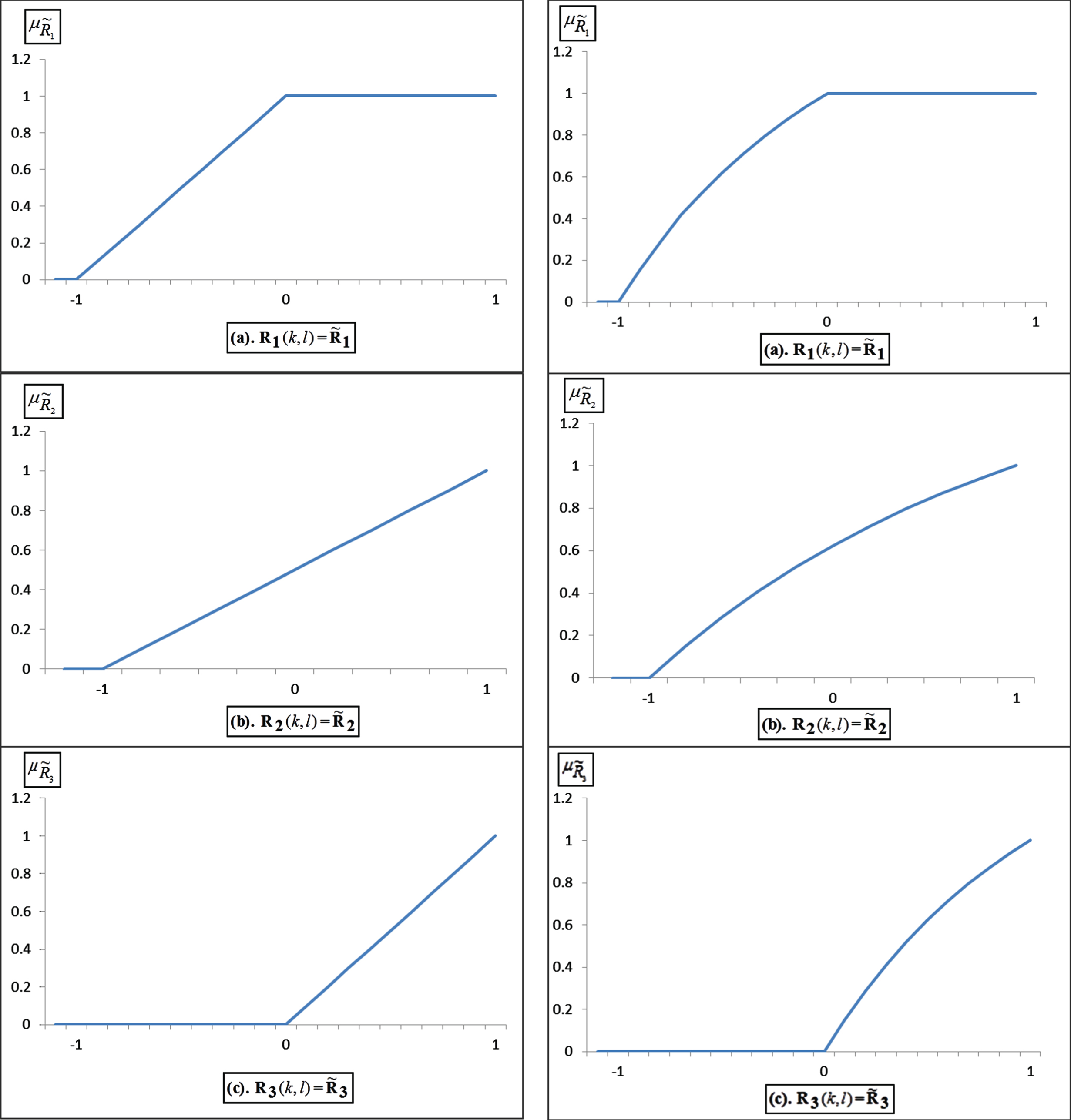
Linear (LHS) and exponential (RHS) membership functions.
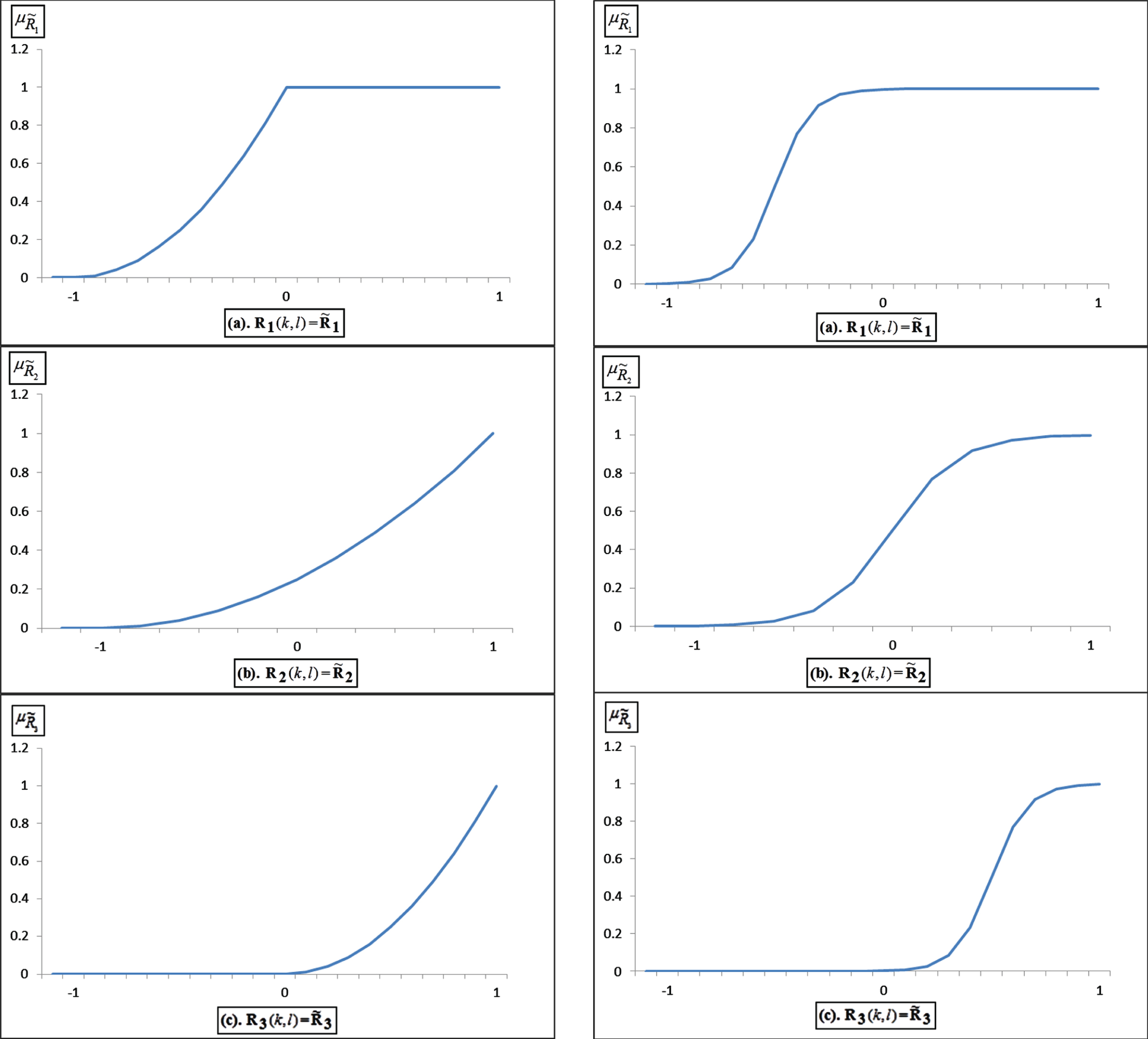
Parabolic (LHS) and hyperbolic (RHS) membership functions.
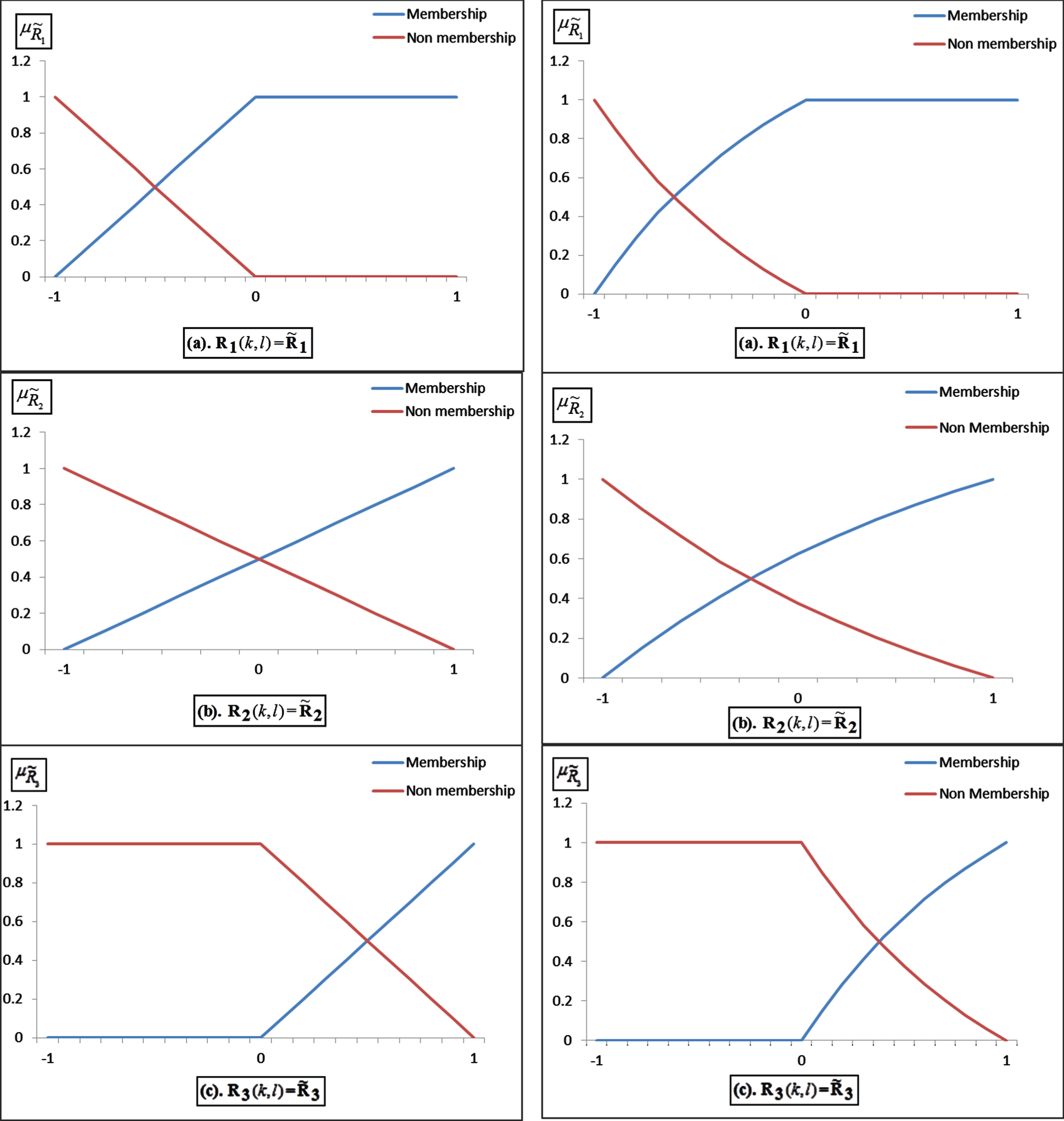
Linear (LHS) and exponential (RHS) membership and non-membership functions.
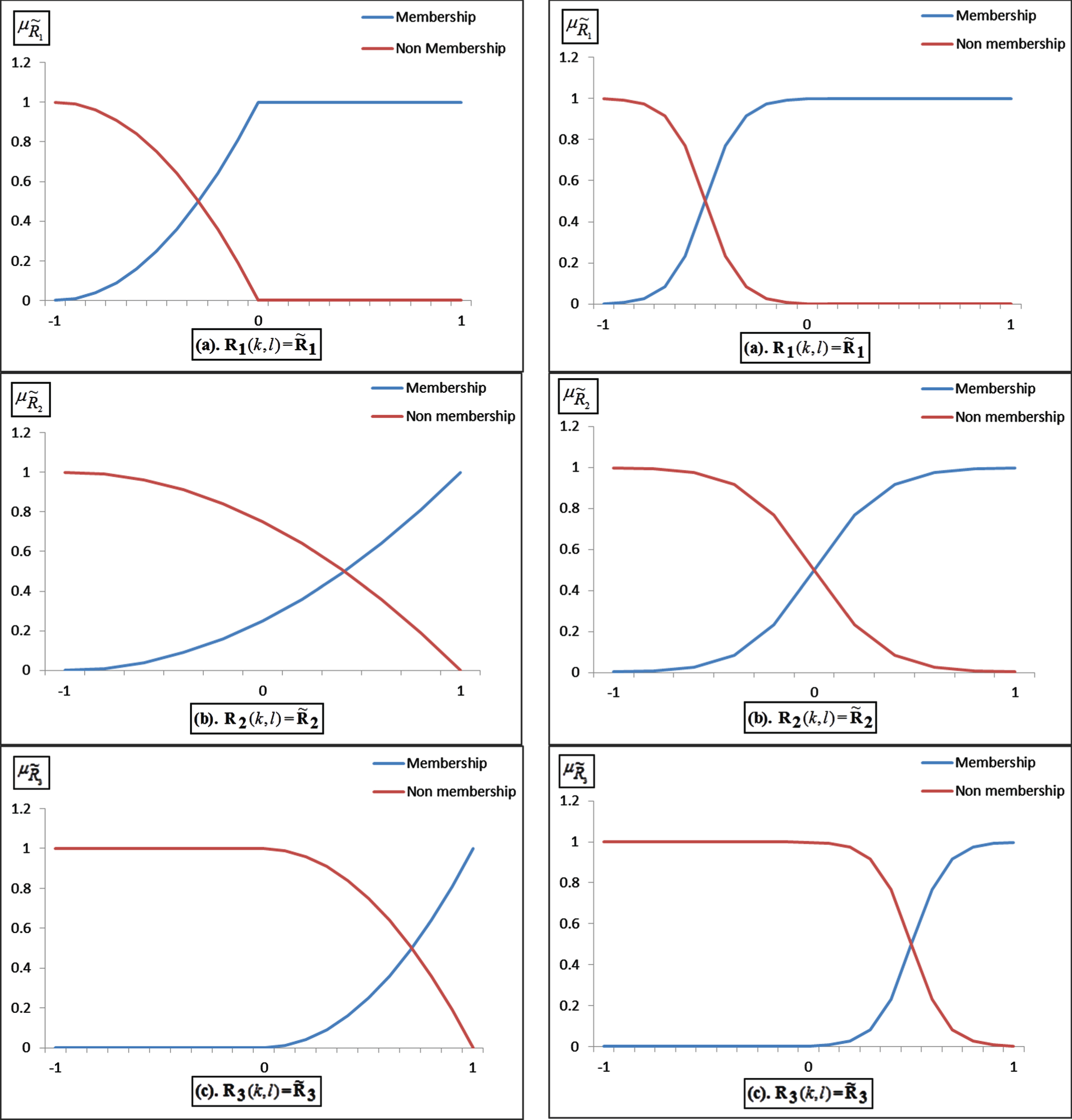
Parabolic (LHS) and hyperbolic (RHS) membership and non-membership functions.
Till now, the achievement function were defined as a convex combination of the sum of individual membership function of fuzzy goals and the sum of satisfaction degrees of the imprecise linguistic importance relations but here, we define the achievement function as a convex combination of the sum of individual membership function of fuzzy goals and the sum of score functions of the imprecise linguistic importance relations given as follows:
Let b kl , k, l = 1, 2, . . . , K where k ≠ l; be a binary variable, taking value 1 if there is an importance relation defined between the goal Z k and Z l , and 0 otherwise. The lower and upper tolerance limit for each fuzzy goal is represented by t k and u k respectively.
In order to achieve these fuzzy goals, we define score function
So, the proposed model with new achievement function and with weight α in intuitionistic fuzzy environment is represented as follows:
where
To modify the optimization model of [6] into an intuitionistic fuzzy goal programming model, one needs to solve each objective function individually and has to determine the aspiration values. By using these aspiration values, construct the preferred membership and non-membership functions under an intuitionistic fuzzy environment. The optimal choice of membership function can be varied with practical problems, and one can choose a specific one from a set of well-defined membership and non-membership function (Linear, Exponential, Parabolic, Hyperbolic). After considering individual membership and non-membership function, the different linguistic preference relations can be assigned based on decision-makers’ choice and formulate the proposed IFGP models under an intuitionistic fuzzy environment. The stepwise solution procedure is given as follows:
Model implementation
Numerical example
The proposed IFGP model have been validated by the following numerical example which has been extensively used by [24, 11]. The mathematical programming problem has been formulated as IFGP model and than the outcomes have been summarized. The obtained mathematical programming problem has been coded in AMPL language and solved with the aid of CONOPT solver by using NEOS server, on-line facility provided by Wisconsin Institutes for Discovery at the University of Wisconsin in Madison for solving Optimization problems, see [31, 48].
The different sort of linguistic preference relations among the goals are:
-Goal 1 is moderately more important than Goal 2.
-Goal 2 is moderately more important than Goal 4.
-Goal 2 is moderately more important than Goal 5.
-Goal 3 is moderately more important than Goal 2.
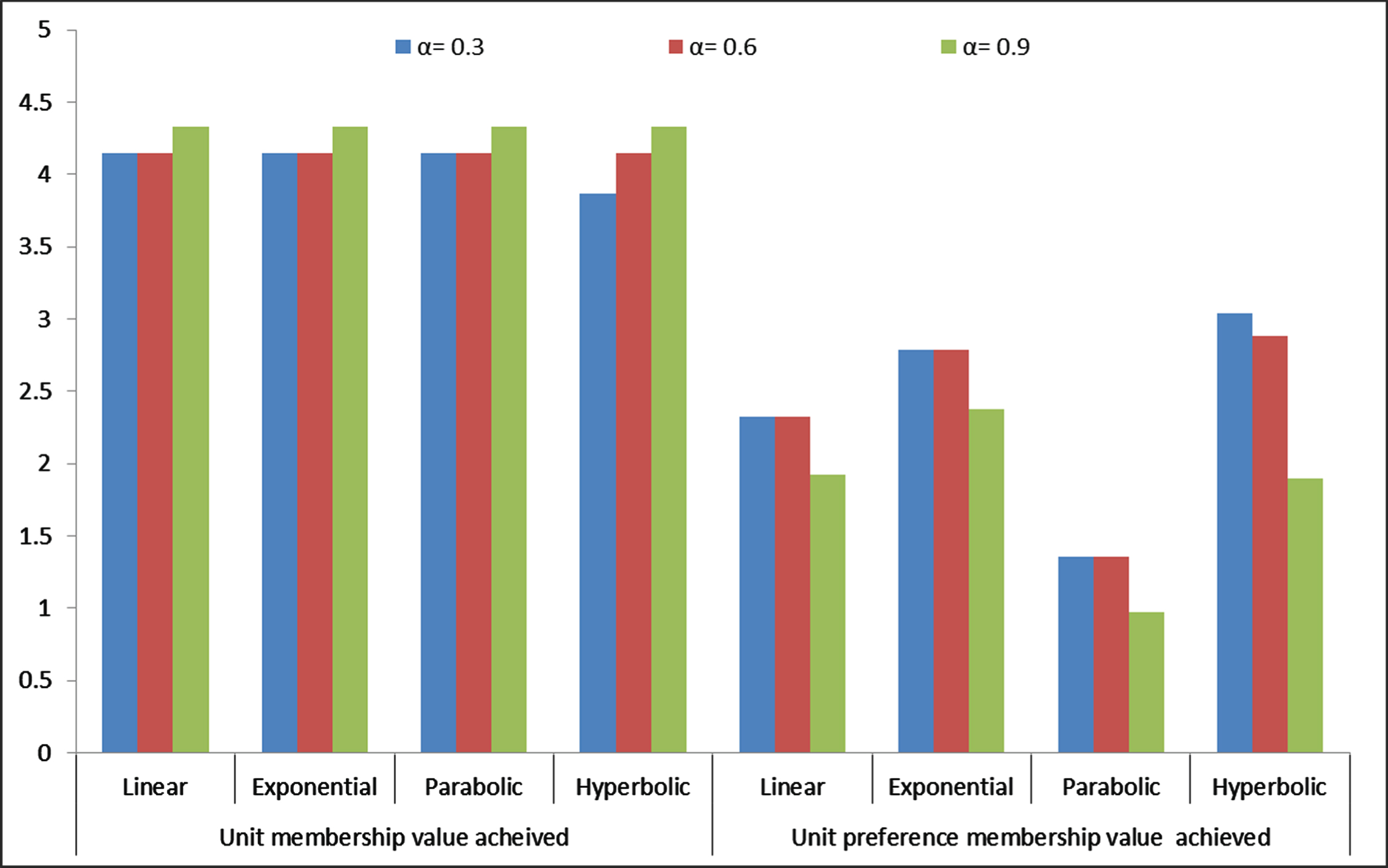
Graphical representation of numerical results by FGP approach.
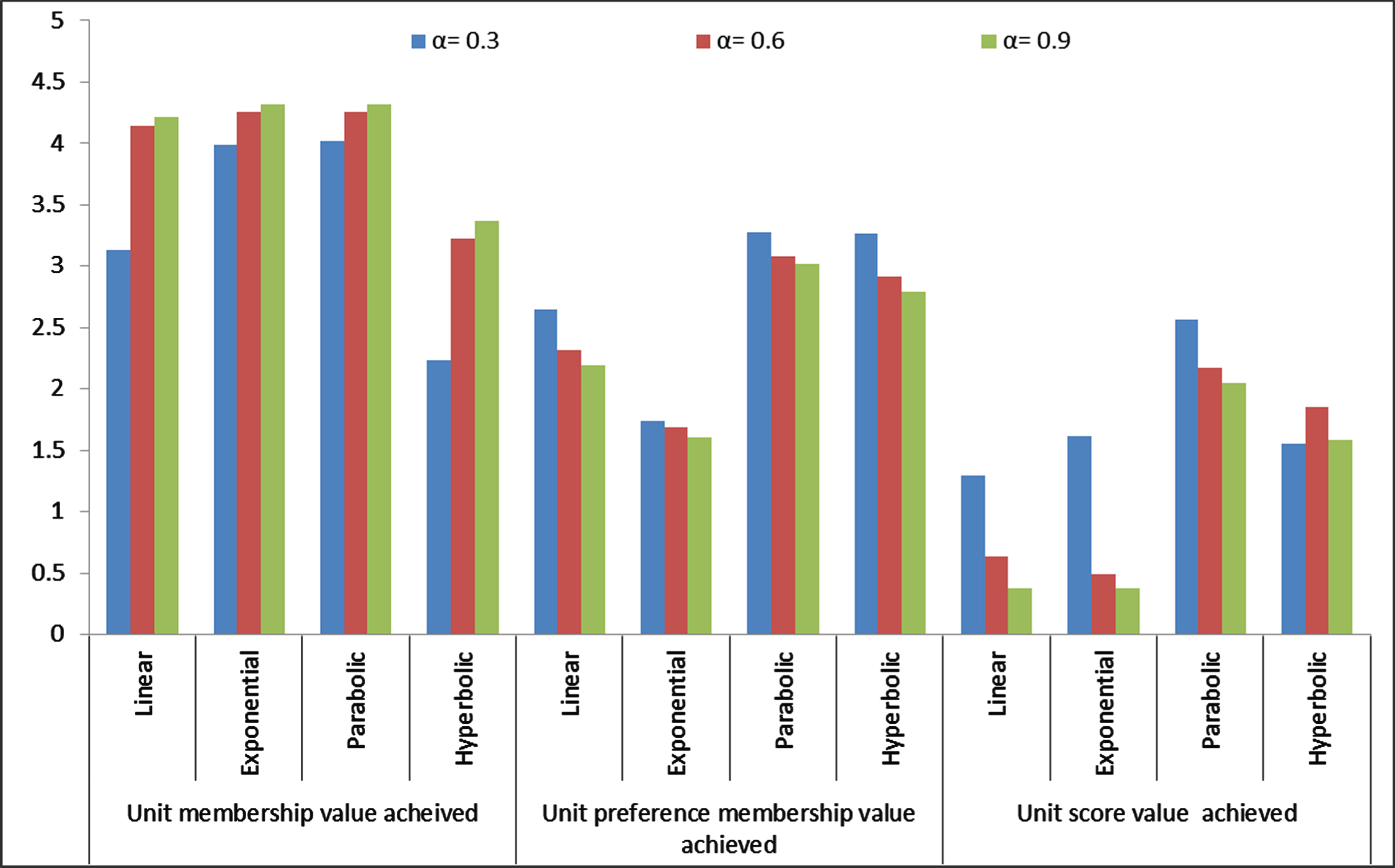
Graphical representation of numerical results by IFGP approach.
A real-life application has been studied with the Banking Financial Statement Management System of Maybank in our study. Financial statements, including total assets, liabilities, total equity, earning, and profit, are obtained from [32]. However, the aspiration values for each goal are hypothetically considered according to their respective goals. The details are summarized in Table 6.
The decision variables are:
x1= the amount of financial statement in year 2010
x2= the amount of financial statement in year 2011
x3= the amount of financial statement in year 2012
x4= the amount of financial statement in year 2013
x5= the amount of financial statement in year 2014
The following fuzzy goals are: 0.3367x1 + 0.4516x2 + 0.4948x3 + 0.5603x4 + 0.6403x5 ≥ 2.4837; (asset goal)
0.3080x1 + 0.4157x2 + 0.4509x3 + 0.5126x4 + 0.5856x5 ≤ 2.2729; (liability goal)
0.0287x1 + 0.0325x2 + 0.0438x3 + 0.0477x4 + 0.0547x5 ≥ 0.2074; (equity goal)
0.0038x1 + 0.0026x2 + 0.0057x3 + 0.0066x4 + 0.0067x5 ≥ 0.0254; (earning goal)
0.2908x1 + 0.3766x2 + 0.4256x3 + 0.4792x4 + 0.5518x5 ≥ 2.1241; (profitability goal)
0.9680x1 + 1.2790x2 + 1.4209x3 + 1.6064x4 + 1.8391x5 ≥ 7.1135; (financial statement goal)
x1, x2, x3, x4, x5 ≥ 0 (non-negativity restrictions)
The type of preference relations among the bank financial statement goals are:
-Asset goal is moderately more important than liability goal.
-Liability goal is moderately more important than earning goal.
-Liability goal is moderately more important than profitability goal.
-Asset goal is moderately more important than profitability goal.
Results & discussions, limitations and future research direction
The results obtained by FGP approach with different non-linear membership function has been summarized in Table 4. We observed that at each value of α, the exponential membership is giving better results for the sum of the individual membership function of each fuzzy goals. It is also concluded that the sum of the membership function of fuzzy preference relations is comparatively best achieved by using hyperbolic membership function.
The numerical example has also been solved by using the IFGP approach and presented in Table 5. From the table; at α = 0.9, the sum of membership function and the sum of the preference membership function is 4.34 and 1.92, which is obtained by [6] (Table 3), but by using proposed IFGP with parabolic membership and non-membership function, it is 4.32 and 3.02 which reveals that sum of the membership function is differed by 0.2 due to the consideration of hesitation in preference relations. In contrast, the sum of the preference membership function is relatively better in IFGP with parabolic membership and non-membership function. One can use this IFGP approach when the more priority is given to the uncertain preference relations among goals.
Solution Results by [6] approach
Solution Results by [6] approach
Solution Results by FGP approach
Solution Results by IFGP approach
Data summarized from Maybank financial statement from year 2010 to 2014 (RM’ trillion).
Furthermore, the proposed IFGP approach can be divided into two criteria: (1) sum of individual membership function and (2) sum of preference membership function achievement level. Based on these two criteria with a different value of α, the performance of the various membership and non-membership function can be analyzed. When the decision-maker specifies the highest priority to (1), then the performance of parabolic ≥ exponential ≥ linear ≥ hyperbolic membership function, respectively. Likewise, when the decision-maker specifies the highest priority to (2), the performance of parabolic ≥ hyperbolic ≥ linear ≥ exponential membership function. Parabolic membership and non-membership function is giving better results in both the criteria.
The bank financial statement goals achievement level has been obtained by the proposed IFGP approach and shown in Table 7. To provide more flexibility in results, exponential membership and non-membership have been used to get the desired results because parameter s depends on the decision-makers’ choice. In all the cases at α = 1 with a different value of s, almost every goal is fully achieved with the desired imprecise preference relations.
Results of bank financial statement goals obtained by proposed IFGP approach
The specific priorities among the goals may need not to be taken into account while using the proposed IFGP model. The flexible priority structure of intuitionistic fuzzy preference relations may help the decision-makers achieve the hierarchical goals and imprecise linguistic importance among the goals simultaneously. The proposed IFGP approach considers the degree of belongingness and non-belongingness simultaneously, which is a better representation of uncertain importance relations among goals because it enhances the membership degree and efficiently reduces the non-membership degree. It also provides more flexible results since nonlinear membership, and non-membership function may depend on the decision-makers’ parameters. Despite all, while dealing with a large number of goals at a time. Assigning the different crisp weight to all goals according to the decision-makers’ priority level is not feasible because it may be time-consuming to obtain the desired combination of the other goals and may not be much reason in real-life problems.
The limitations of the proposed IFGP approach can be highlighted because it cannot be applied to multi-criteria or multi-attribute decision-making problems as the crisp weights are needed to assign each criterion or alternatives. Moreover, the proposed IFGP model is lagging behind the more generalized framework and robust concept of Pythagorean fuzzy set [1, 55], neutrosophic set [2?5], picture fuzzy set [26, 54], T-spherical fuzzy set [16, 19], interval-valued picture fuzzy set [12, 42], interval-valued T-spherical fuzzy set [52, 53].
In the future, the presented work can be extended by considering the above generalized intuitionistic fuzzy sets, and the most promising outcomes can be obtained efficiently. Furthermore, the proposed IFGP model may also use modeling the actual encounter problems, especially when many objectives have to deal with. One can extend this approach to more than three imprecise linguistic importance relations with the application in agriculture, economics, engineering, and management science.
This study presented a new IFGP model that involves achieving both fuzzy goals and uncertain preference relation among goals with the degree of belongingness and non-belongingness simultaneously. Fuzzy binary relations represent the imprecise preference relations among the goals. To balance the trade-off between fuzzy goals and preference relations, a new achievement function has been determined, which is the convex combination of the sum of individual grades and the score function of preference relations among the goals. Different linear and nonlinear membership and non-membership functions for the imprecise relative importance among goals lead to the more realistic representation of the linguistic term. It provides flexibility in the decision-making process to achieve an indispensable goal. The proposed IFGP model is implemented on the numerical example, which outperforms over the fuzzy goal programming model. The banking financial statement management system’s different goals have also been fully attained with exponential-type membership functions.
Conflict of interest
All authors declare no conflict of interest.
Footnotes
Acknowledgments
All authors are very thankful to the Editor-in-Chief and potential reviewers for providing in-depth comments and suggestions that improved the readability and clarity of the manuscript.