



Abstract
An q-rung orthopair fuzzy set is a generalized structure that covers the modern extensions of fuzzy set, including intuitionistic fuzzy set and Pythagorean fuzzy set, with an adjustable parameter q that makes it flexible and adaptable to describe the inexact information in decision making. The condition of q-rung orthopair fuzzy set, i.e., sum of q th power of membership degree and nonmembership degree is bounded by one, makes it highly competent and adequate to get over the limitations of existing models. The basic purpose of this study is to establish some aggregation operators under the q-rung orthopair fuzzy environment with Einstein norm operations. Motivated by innovative features of Einstein operators and dominant behavior of q-rung orthopair fuzzy set, some new aggregation operators, namely, q-rung orthopair fuzzy Einstein weighted averaging, q-rung orthopair fuzzy Einstein ordered weighted averaging, generalized q-rung orthopair fuzzy Einstein weighted averaging and generalized q-rung orthopair fuzzy Einstein ordered weighted averaging operators are defined. Furthermore, some properties related to proposed operators are presented. Moreover, multi-attribute decision making problems related to career selection, agriculture land selection and residential place selection are presented under these operators to show the capability and proficiency of this new idea. The comparison analysis with existing theories shows the superiorities of proposed model.
Introduction
Multi-attribute decision making (MADM) performs a significant part in finding an excellent alternative from all the appropriate alternatives depending upon certain attributes. Mostly, the approach of different alternatives and the corresponding weights for various attributes are given in crisp values. The crisp sets were incompetent to portray the inexact information as there exist many complicated MADM problems in real-life for which the objectives and conditions are vague and unclear. To handle such situations, fuzzy sets (FSs) were initiated by Zadeh [43] which were employed to deal vagueness in problems. Atanassov [7] broadened the literature on fuzzy set theory by introducing well versed intuitionistic fuzzy sets (IFSs) to dominate the deficiencies of FSs. The IFSs have both membership degree (MD) and nonmembership degree (NMD) with condition μ + ν ≤ 1 but there are many problems in which sum of MD and NMD exceeds by 1. To reduce such type of complications, Yager [38] delivered the idea of Pythagorean fuzzy sets (PFSs) with condition μ2 + ν2 ≤ 1 which make them eminent among the existing models. The existence of problem, where the condition of PFS is violated, motivated the researchers to put forward a more generalized model to exhibit the imprecise data regardless the strict conditions of IFSs and PFSs. Finally, the spadework of Yager [37] provides the grounds for the establishment of q-rung orthopair fuzzy sets (q-ROFSs) in which μ q + ν q ≤ 1. q-ROFSs have more capability to handle the decision making problems and they possess larger space of membership and nonmembership functions as compared to IFSs and PFSs, as shown in Fig. 1.
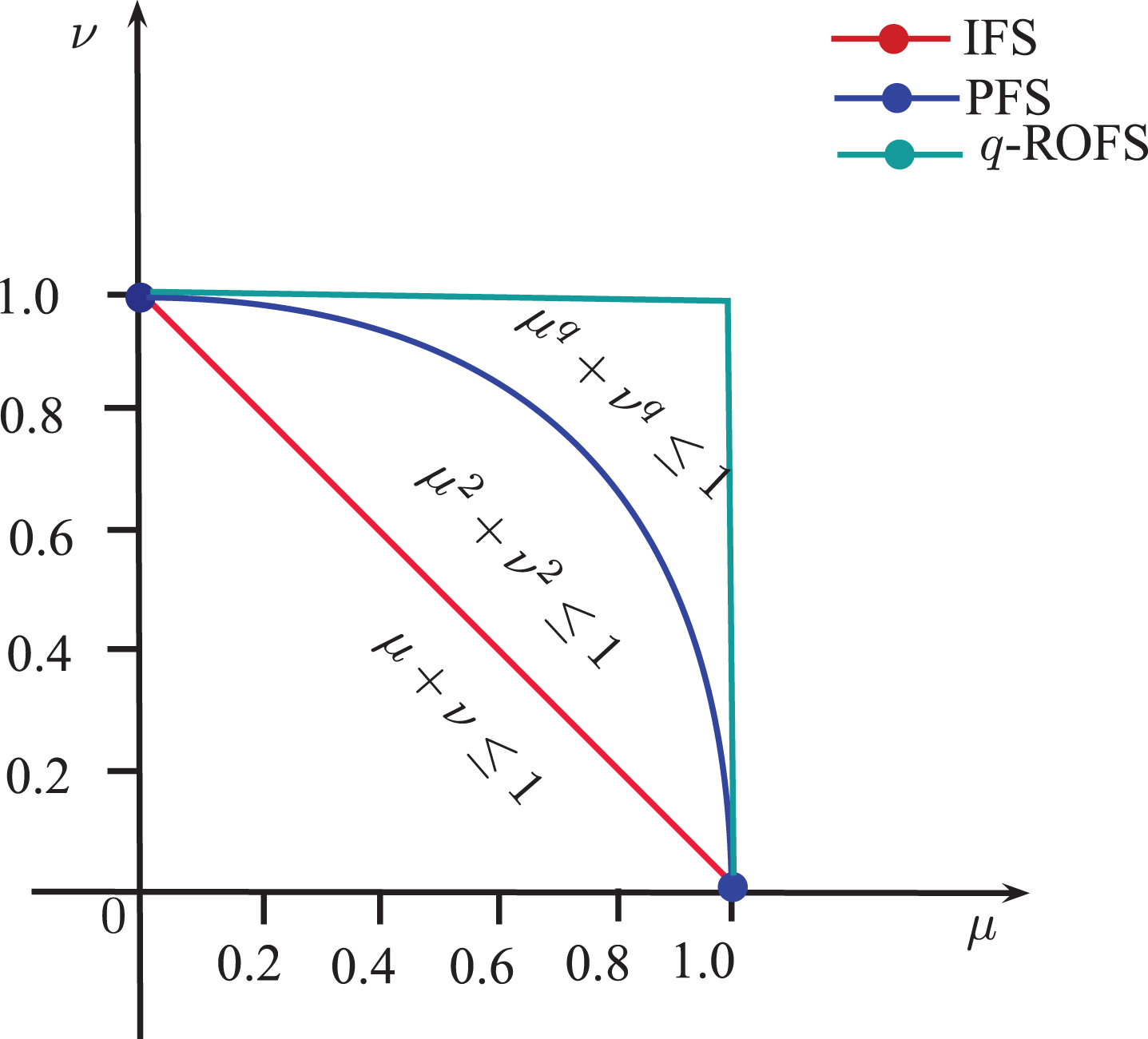
Comparison of q-ROFNs, PFNs and IFNs spaces.
For obtaining a unique and best decision, the concept of aggregation operators (AOs) was introduced. Xu [35] developed some AOs under intuitionistic fuzzy (IF) environment that proved to be very fruitful in decision making. The concept of generalized AOs for IFS was developed by Zhao et al. [48]. Zhao and Wei [47] studied the Einstein hybrid AOs under IF environment. Wang and Liu [30] established some advanced IF AOs using Einstein operations to cumulate the data more accurately. The induced interval-valued IF Einstein ordered weighted average operators were developed by Cai et al. [9]. Fahmi et al. [10] developed the cubic fuzzy Einstein AOs. Rahman et al. [26] introduced Pythagorean fuzzy (PF) AOs and demonstrated the efficiency of these operators with the help of applications. Garg [11] studied the generalized PF Einstein weighted arithmetic AOs. Garg [12] also proposed the generalized PF Einstein weighted geometric AOs. Pythagorean Dombi fuzzy AOs with applications were discussed by Akram et al. [2]. Shahzadi et al. [29] proposed the decision making approach using PF Yager AOs. Liu and Wang [20] expressed q-rung orthopair fuzzy (q-ROF) weighted AOs. Liu et al. [19] initiated the idea of q-ROF Bonferroni mean operators. Wei et al. [32] proposed weighted Heronian mean AOs for q-ROFS. Multi-attribute group decision making (MAGDM) approach using q-ROF power Maclaurin AOs was developed by Liu et al. [18]. Jana et al. [14] discussed Dombi AOs under q-rung orthopair fuzzy numbers (q-ROFNs). Joshi and Gegov [16] studied the confidence levels q-ROF aggregation operators. Garg and Chen [13] introduced the neutrality AOs for q-ROFS. For more information on operators, the readers are referred to [1, 49–54].
The motivations of this article are as follows: q-ROFS is a highly proficient and well versed tool to portray the ambiguous information, whose flexible condition makes it superior than the traditional models. In fact, q-ROFS, possessing larger space, is more potent to handle decision making issues as compared to IFS and PFS. Einstein AOs yield the more precise and accurate results when applied to real-life MADM problems. Therefore, we have employed the theoretical basis of Einstein operations to define the proposed operators that enjoy the accuracy and potential of Einstein AOs. Due to the dominant behavior of q-ROFS, the proposed operators can be efficiently applied to IFSs, PFSs and other extensions of fuzzy sets by selecting a suitable value of q. In other words, the proposed operators have an edge over the existing approaches under the decision making environments.
The contributions of this article are as follows: Predominantly, the main objective of this article is to propose q-ROF Einstein AOs, namely, q-rung orthopair fuzzy Einstein weighted averaging (q-ROFEWA) operator, q-rung orthopair fuzzy Einstein ordered weighted averaging (q-ROFEOWA) operator, generalized q-rung orthopair fuzzy Einstein weighted averaging (Gq-ROFEWA) operator and generalized q-rung orthopair fuzzy Einstein ordered weighted averaging (Gq-ROFEOWA) operator, for the evaluation of single choice for alternative among various choices by merging the skills of Einstein operators with the flexibility of q-ROFS. Some fundamental properties along with some major results of the proposed operators are illustrated. An algorithm, based on Gq-ROFEWA operator, is presented to deal with complicated realistic MADM problems under q-ROF data. Three explanatory MADM problems, for the selection of career, agriculture land and residential place, indicate the potential of proposed algorithm. A validity test is discussed for the approval and authenticity of proposed theory. The comparative study of the proposed MADM technique with existing approaches shows the dominance of proposed AOs over the existing operators.
The remaining paper is as follows: Section 2 recalls the notion of q-ROFS and related score functions. Section 3 introduces Einstein operational laws for q-ROFNs. In Section 4, we study the q-ROFEWA and q-ROFEOWA operators, respectively and related properties to them. Section 5 handles the idea of Gq-ROFEWA and Gq-ROFEOWA operators, respectively and some properties of these operators. In Section 6, we propose the algorithm for our new model and discuss MADM problems, i.e., selection of best future career, selection of agricultural land and residential place under proposed operators. Section 7 provides the validity criteria to prove the consistency of proposed work. Section 8 discusses the comparison analysis of proposed theory with existing operators. In Section 9, we conclude results about proposed theory.
If If If If If If
Einstein operational law of q-ROFNs
(i)
(ii)
(iii)
(iv)
(v)
(vi)
(vii)
Thus,
(v) For ω1, ω2 > 0 .
Similarly, others can be verified. □
q-Rung orthopair fuzzy Einstein aggregation operators
q-rung orthopair fuzzy Einstein weighted averaging operators
Here, we define Einstein weighted averaging operators under q-ROF environment
When
Suppose result holds for
Moreover,
Also,
Thus,
q-ROFEWA
q-ROFEWA
(i) Idempotency: If
Here, we define Einstein ordered weighted averaging operators under q-ROF environment.
We give some properties without their proofs.
q-ROFEOWA
(i) Idempotency: If
Generalized q-rung orthopair fuzzy Einstein weighted averaging operators
Particularly, If ω = 1, then Gq-ROFEWA becomes q-ROFEWA. If
When ω = 1, then
Generalized q-rung orthopair fuzzy Einstein ordered weighted averaging operators
When ω = 1, then
MADM problems using q-ROF information
To handle a MADM problem under q-ROF environment, let
The following Algorithm 1 is used to solve the MADM problems with q-ROFN based on using Gq-ROFEWA operator.
Selection of suitable alternatives and attributes. Use the q-ROFDM and Gq-ROFEWA operator
Use the score degree
Selection of best future career
Human physiological and psychological needs are to be satisfied. This is necessary for life and for continuation of life. The way we address our these needs is important in our lives. The occupation or the career we select must conform to our basic needs and then to our psychological satisfaction. Selection of career is a big question for our youth graduating from universities. Some are thinking of initiating a business, some have tendency to industrial work, others try to join service sector or agriculture. These selections depend upon tendency, aptitude, previous education and futuristic view of oneself.
It is observed that in most cases, students opt for wrong career and ultimately end up with dissatisfaction and loss of interest in their work which certainly lead to unproductive efforts. So the selection of career and profession is vital in life. Consider a decision making problem under professional aspect. Consider a person who has completed his academic degree. Now he wants to select that profession which is suitable for him. He has three choices.
Some factors that influence his decision are outlined as below:
1. The q-ROFDM is shown in Table 1.
q-ROFDM
q-ROFDM
2. The weights assigned by decision maker are
Step 1. For performance values
Step 2. Compute the scores
Agriculture provides the bedrock for a country’s economy. Those areas where land supports agriculture are blessed ones. Selection of a suitable land for cultivation has been remained a basic question for farmers. Since there are lot of factors that influence the cultivation so it has been very difficult to select and focus a suitable piece of land for cultivation. Here, we are trying to develop a model that will help the interested quarters in selection of agriculture land. Suppose that a farmer wants to choose a agriculture land. Let
1. The q-ROFDM is shown in Table 2.
q-ROFDM
q-ROFDM
2. The weights assigned by decision maker are
Step 1. For performance values
Step 2. Calculate the scores
The whole procedure of this application is explained in Fig. 2.
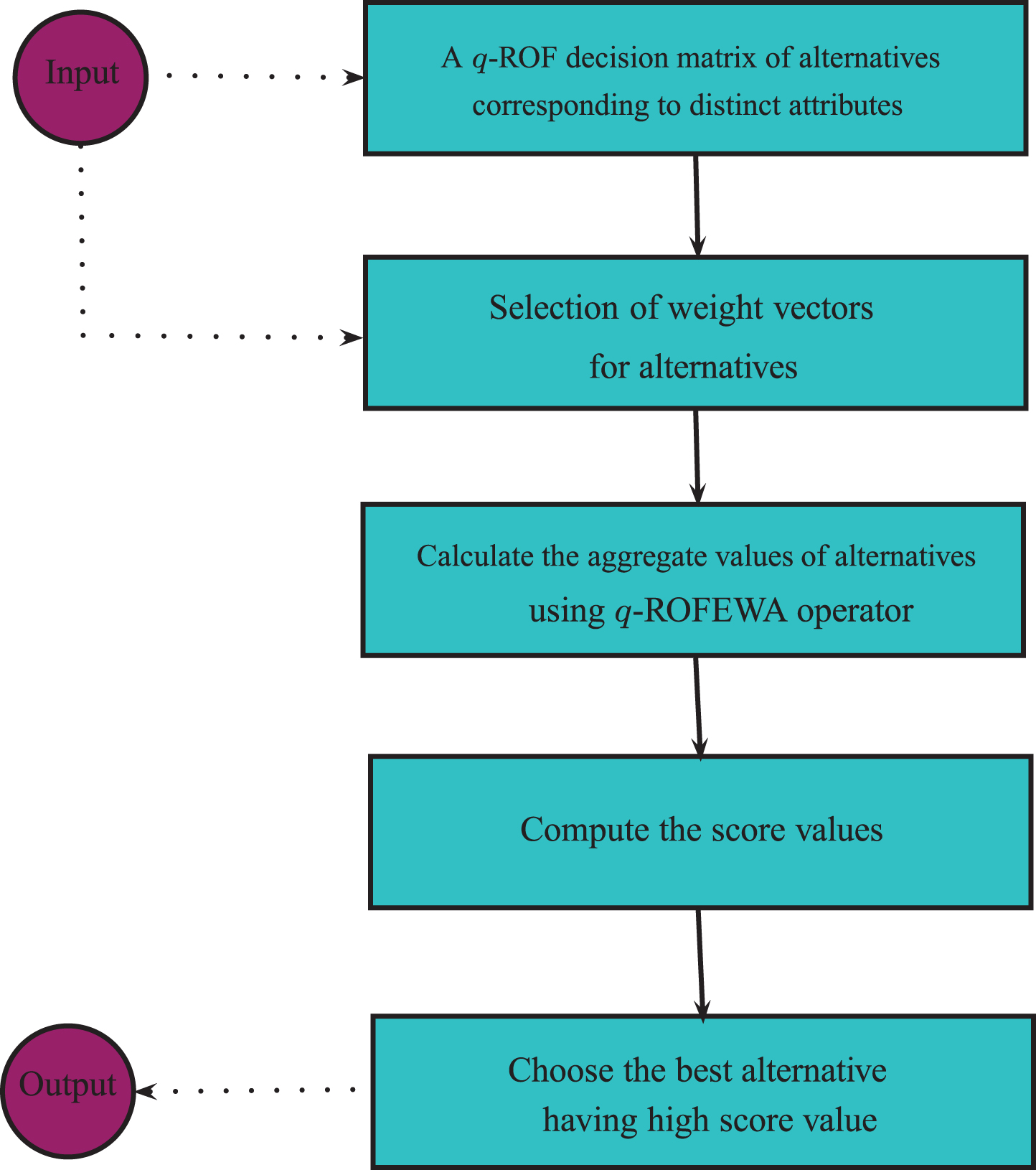
Flowchart for the selection of suitable agriculture land.
Suppose a group of Professors of Vidyasagar University [28] wants to construct their home in a certain place. They construct a team named Senapati Construction Limited (SCL) among them. The SCL visits four places Ashoke Nagar (
1. The q-ROFDM is shown in Table 3.
q-ROFDM
q-ROFDM
2. The weights assigned by decision maker are
Step 1. For performance values
Step 2. Calculate the scores
The best alterative from [28] and our proposed approach is same. So, it shows that the results of proposed approach are same as the original results exist in reality. The speciality of this method is that here we can see the effect of different values of parameter ω and it is very short and easy approach to get the best alternative. The theory given in [28] holds only for μ q + ν q ≤ 1, where q = 3 and fails when cubic sum of MD and NMD is exceed by 1 but proposed theory covers all such shortcomings.
For the validity and authenticity of MADM methods, Wang and Triantaphyllou [31] developed a testing criteria, given as follows: By applying the Gq-ROFEWA operator for ω = 1 and score function, the score values of alternatives are
Now, we discuss the validity of our proposed MADM technique for Application 6.1 by testing the above criteria.
Reconstructed q-ROFDM
Reconstructed q-ROFDM
We provide comparison analysis of the developed Einstein AOs with others operators such as GPFEWA [11], GPFEWG [12], PFYWA [29] and PFYWG [29] operators to show the validity of our proposed model. For Application 6.1, it can be seen from Table 5 and Fig. 3 that the final rankings by applying the Gq-ROFEWA, GPFEWA, GPFEWG, PFYWA and PFYWG operators are However, the final score values are not same. It is clear that the optimal decision, using all these operators, is same. This shows that our model is applicable to resolve the real life MADM problems. 2. The reason behind our proposed model is that PFNs can deal only those problems where μ2 + ν2 ≤ 1. There exist many real life problems where data does not fulfill the condition μ2 + ν2 ≤ 1, then we need q-ROFS. To show feasibility and attractiveness, we have elaborated another application for the selection of agriculture land. GPFEWA, GPFEWG, PFYWA and PFYWG operators cannot solve the Application 6.2. That’s why we need our proposed method. The q-ROF Einstein AOs are a more flexible and easy approach. The best alternative can be obtained by a short process. The results from the proposed theory are more accurate and closest to original results.
Comparison analysis for Application 14 with existing operators (suppose q = 3, ω = 1)
Comparison analysis for Application 14 with existing operators (suppose q = 3, ω = 1)
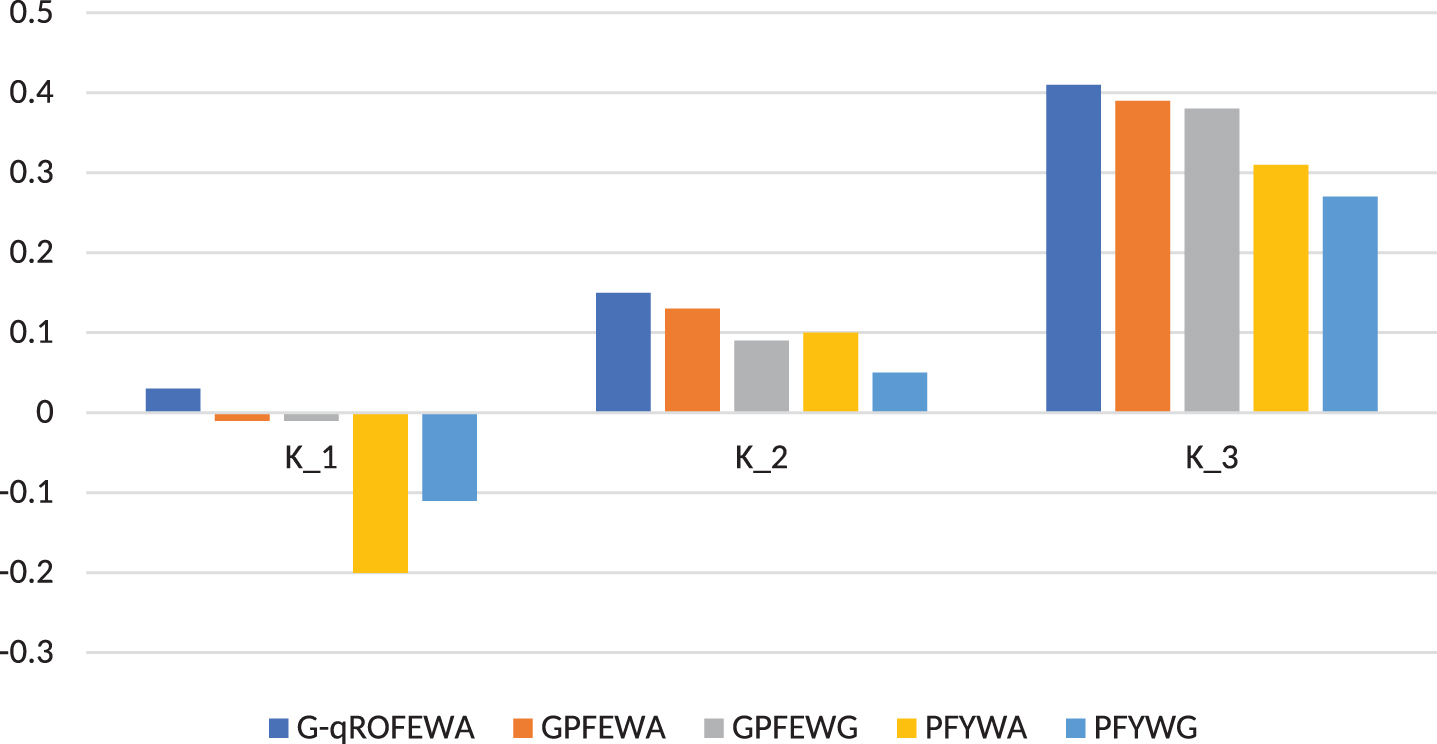
Comparison with existing operators.
q-ROFSs have appeared as more useful tool to portray uncertainty in MADM problems as compared to IFSs and PFSs. The speciality of the q-ROFS is that it generalizes the constraint of PFS that square sum of MD and NMD is bounded by 1 with the sum of q th power of MD and NMD is bounded by 1. In this article, new multi-skilled AOs, namely, q-ROFEWA, q-ROFEOWA, Gq-ROFEWA and Gq-ROFEOWA operators have been proposed that enjoys the proficiency of q-ROFS as well as the advanced skills of Einstein AOs. Some fundamental properties of these operators have been discussed. In short, the proposed generalized Einstein AOs under the q-ROF environment, being highly competent, overcome the shortcomings of the existing AOs.
Another goal of this study have been achieved by presenting a MADM strategy based on proposed operators to manipulate q-ROF data. Further, three MADM problems under these operators have been discussed, i.e., the selection of best future career, the selection of agriculture land and residential place. Moreover, the results of the elaborated applications have been compared with existing operators to exhibit the superiority and potency of proposed operators. For the approval of proposed theory, validity test have been discussed to highlight the reliability and authenticity of the proposed strategy.
In future, our aim is to merge the theory of Einstein operators with some well versed models to develop innovative AOs, including, (i) q-ROF soft Einstein weighted averaging operators; (ii) q-rung picture fuzzy Einstein weighted averaging operators; (iii) q-rung picture fuzzy Einstein weighted geometric operators.
Conflict of interest
The authors declare no conflicts of interest.