




Abstract
Mountains are attraction spots for tourists, and tourism contributes to the country’s gross domestic product. Mountains have many benefits such as biodiversity, tourism, and the supplication of food, to name a few. However, there are challenges to protect mountain lives from hazards such as fire caused by tourist activities in mountains. The in-time fire detection and notification to the authorities have always been the central point in literature studies, and different studies have been carried out to optimize the notification time. In this paper, we model the fire detection and notification as a real-time internet of things application and uses task orchestration and task scheduling mechanism to provide scalability along with optimal latency. The proposed fire detection and prediction mechanism detect mountain fire at the earliest stage and provide predictive analysis to prevent damage to mountain life and tourists. The architecture is based on microservice-based IoT task orchestration mechanism and device virtualization, which is not only lightweight but also handles a single problem in parallel chunks, thus optimizes the latency. The in-time information about the fire is used for predictive analysis and notified to safety authorities which helps them to make a more informed decisions to minimize the damage caused by mountain fire. The performance of the proposed mechanism is evaluated in terms of different measures such as RMSE, MAPE, MSE, and MAPE. The proposed work approaches the fire detection and notification as a collection of tasks, and thus those tasks are selected for deployment which are guaranteed to be executed and have minimum latency. This idea of pre-planing the latency and task execution is the first attempt to the best of the authors’ knowledge.
Keywords
Introduction
People build their dream houses in the mountains due to the quiet, peaceful, and calm environment. Mountains are places for recreational activities and tours. Tourism contributes to the gross domestic product(GDP) of a country. People choose mountains for hiking, ski resort, to name a few. Fire can be caused by volcanic eruption, earthquake, lightning or due to human activities or a problem in the machine operations [1]. Fire safety is a major concern since the very beginning of human civilization. Recently, much scientific research has published on the fire safety mechanism [2]. Fire safety policies are considered in the construction of new buildings; in the case of mountains, houses and tourist resorts are designed with an evacuation plan in case of fire occurrence. Fire hydrants are placed on every checkpoint of these buildings, restaurants, and resorts. These checkpoints also have fire extinguishing systems installed.
Each year many precious lives are lost due to fire occurrences. National Fire Protection Association (NFPA) survey statistics based on the USA shows that even in developed countries like the USA, 10,600 civilians injured due to fire occurrence, which is 72% of all injured peoples. The survey by NFPA also shows that in the USA, the fire department responds to fire somewhere in the nation every 24 seconds. Apart from this, an estimated 23$ billion property damage and 10$ billion loss occurred due to fire occurrence. In developing countries, the number of losses and damage is much more significant [3]. The National Fire Agency (NFA) of South Korea reported 40,030 occurrences of fire, resulting 2219 injuries, 284 deaths and 805.9 billion won property damage. NFA attributed the damage done by fire occurrence to the series of mountain fires and traditional marketplace fires [4].
One of the biggest challenges which has been the focal point of the literature studies is to detect the fire as early as possible and then notify the authorities as soon as possible. Different techniques such as image segmentation and machine learning are used to detect the fire using sattelite images, however these techniques are slower and thus in the process of detection and notification, the chances of the loss of human lives are more higher. The loss can be approximated if the delay is deterministic and this will only possible if the job of fire detection and notification is performed with a set of sensors and actuators’ tasks in a conventional internet of things (IoT) environment [5, 6].
Internet of Things is connecting all the things, environments, and processes to the internet. Researchers are proposing sustainable solutions based on IoT, hence bringing innovations to all fields of science [7]. Starting from simple IoT applications consisting of one sensor to the complex IoT applications comprised of a global network of orchestrated devices, IoT is making our world an exciting new place for everyone to be part of it. The IoT based sustainable solution for mountain fire detection and tracking will allow the fire safety authorities to monitor the fire 24/7, reducing cost and time of human resources. IoT based Fire detection, and tracking mechanism fire can enable the earliest detection of fire, and hence immediate actions are taken to reduce the loss of property damages and precious lives. Human beings are good at fire recognition as humans can observe aspects of fire such as flame, heat, smoke, etc. For a machine to detect fire, these human capabilities should be programmed to devices. Due to advancements in the IoT, various sensors are introduced with these capabilities. For example, heat can be detected through a temperature sensor; the smoke can be detected through a smoke sensor, fire flame can be detected from the fire pattern calculated from sensing data of temperature, smoke, humidity sensors. Figure 1 shows a configuration of fire detection and prediction Mechanism, fire is detected using fixed sensors installed at various points in the tourists resort and houses in the mountains.

Configuration of fire detection and prediction mechanism.
Drone drops disposable sensors near the fire at various fire points. Fire points are random points around the circular area of the fire. These disposable sensors are used to track the fire parameters. The drone acts as an edge gateway between the sensing devices and the IoT server. Prediction module provides predictive analytics on the fire profile data such as fire flame height, estimated fire spread and fire intensity.
In this study, we propose microservice-based IoT task orchestration architecture to detect the fire, track the fire and perform predictive analytics on the fire profile data. The proposed mechanism based on the architecture detects fire at the earliest stage and provide predictive analysis to the safety authorities. The predicted fire profile helps the safety authorities to make on-time decisions to minimize the damage caused by mountain fire. There are two main contributions of this paper, first fire detection and notification at an early stage based on real-time task orchestration mechanism to avoid any harm to the tourists resort and mountain life. The second contribution is predictive analytic on the firing profile computed through the microservice-based IoT task orchestration application.
The rest of the paper is structured as follows. Related work is presented in Section 2; Section 3 presents the design of Fire detection and Prediction Mechanism. Section 4 presents the results and discussions of Fire detection and Prediction mechanism. Section 5 presents the conclusion and future work direction.
In this section, we will discuss existing studies regarding fire detection and notification systems. Some of the studies focus on the minimization of cost while some studies focus on reliability, portability and scalability of fire detection and notifications systems. The aim of such systems is detecting fire at the earliest stage possible and notify it to the authorities in real-time so that the on-time prevention mechanism will be applied. Most of these studies use sensing devices such as a temperature sensor, CO2 sensor to detects parameters of the file profile. The sensing and actuating devices are connected to a server for processing the sensing data. Different studies focus on different protocols and mechanisms for the communication between sensing devices and the server installed at fire safety authorities centres. Now we will discuss and highlights the contribution made to the fire detection and notification mechanism.
In literature, image processing based techniques have been used for the development of automatic systems for fire detection from real-time landscape images of the fire area. Various segmentation algorithms are proposed for the extraction of envelopes of pixels which is used to describe the various phenomena such as smoke [8]. Chi Yuan et al. proposed an unmanned aerial vehicle-based fire detection and tracking mechanism for wildfires. A set of algorithms were proposed for fire detection such as colour space conversion, Otsu threshold segmentation, median filtering, and blob counter. The proposed experimental design can effectively track the fire zone. The experiment is performed in two scenarios, one on real-time images of forest fire and the later on the scenario of lab environment using images collected by the unmanned aerial vehicle [9]. Video fire detection mechanism is faster, more reliable as compared to other fire detection mechanisms [10]. A colour video camera is used to record video shoots of the fire scene, and features such as shape and colour of the fire are processed for fire detection [11].
Chen et al. [12] proposed an early fire-notification approach using RGB (red, green, blue) model. The saturation and intensity values of the Red component is used for fire-pixels extraction. Fire detection mechanism using surveillance cameras is proposed in [13, 14]. Fire region is detected using colour and movement information of the video to design an expert system. In paper [15], stereo camera-based fire detection method used to extract candidate fire region. Flame features such as flame size, flame shape, and variation of the flame motion were applied to a fuzzy logic-based system for real-time verification of fire. However, these video-based fire detection mechanisms have poor adaptability and sensitivity to the interference of the environment. To address these weaknesses, Teng Wang et al. proposed a fire detection model based on fire colour dispersion. In order to reduce false fire detection, the similarity of video frames of the detected area integrated into a tracking algorithm based on kinematic features of the flame [16].
Sensors are used in wireless Sensor Network to monitor environmental conditions, such as humidity, temperature, pressure, motion [17]. In a wireless sensor network, each node has one or more sensors equipped with a communication device, battery and microcontroller. The nodes function includes forwarding and relaying data packets to the nearest base station. Wireless sensors usually have an ad-hoc wireless network that supports a multi-hop routing algorithm [18]. Wireless area network utilizes devices that consume less power. In paper [19] authors described features of a sensor network for military uses such as detection of forest fire and monitoring of animals. These features include low-cost, fault tolerance and robustness. P.J.M. [20] proposed approach for early fire detection using estimation of best sensors groups. A study by C. Intanagonwiwat et al. [21] explains the requirements differences between sensor networks and wireless networks. G.Zhang [22] proposed a ZigBee technique based on wireless network paradigm for fire detection in forests. The proposed architecture monitor forest region in real-time in the form of an environmental parameter such as humidity, temperature. D.Estrin et al. [23] describe an operating system for wireless sensor network called TinyOS, which is based on an event-driven model. D. M. Doolin et al. [24] propose the design of a wildfire monitoring system based on wireless sensors network. The system collects sensing data such as temperature, humidity and pressure. Sensing data shows that humidity slightly increases and temperature value decreases slightly preceding the flame front, indicating that even during relatively slow-moving grass fires, significant weather conditions develops. A. Divya et al. proposed IoT based fire detection of forests, the system alerts warnings of fire occurrence in the earliest stage. The proposed system use microcontroller to connect to sensing devices and a wireless communication medium. Collected sensing data is sent to the nearest ground station using a small satellite. The proposed scheme detects the fire with the help of wireless sensor networks(WSN). Sensing devices are deployed at certain distances on the whole forest area. These sensors will detect changes in the environmental parameters, and notify the warning events automatically [25]. Predictive analytics is a statistics-based study field that extracts meaningful information from data. This information is used to predict behaviour patterns and trends. Predictive analytics techniques can be used to extract knowledge of the present, past or future. For example, identifying criminal suspects after the occurrence of credit card fraud [26]. Predictive analytics is used for effective planning of waste management by Imran et al [27]. Naeem Iqbal et al. used predictive analytics for Effective Management of Rental Book Data of Academic Libraries [28]. V. L. Uskov et al. used predictive analytics for evaluating the performance of student academic in the case study of STEM Education [29]. It is important to note, however, that the accuracy of predictive analytics results depends significantly on the quality of assumptions and data analysis procedures. Predictive analytics is a technology that learns from data experiences to predict the behaviour of individuals in future to enable better decisions [30]. In Table 1 we present a summary of the well-known fire management system. fire management system are summarized based on modules, methodology, goal,and open-source.
Summary of the existing Fire management systems
Summary of the existing Fire management systems
In this section, we will discuss the design of mountains fire detection and prediction Mechanism using microservices-based task orchestration in the IoT environment(MTO-IoT). Steps involved in the design of the MTO-IoT are virtualization of fire sensors and actuators, Tasks generation from fire microservices, mapping and scheduling of fire tasks on virtual objects and allocation of fire tasks on physical fire detection sensing devices. MTO-IoT output fire profile, predictive analytics, and send to public administration and safety department using IoT gateway. The MTO-IoT system is designed with microservices such as fire detection, fire notification, fire Spread and intensity prediction. Each microservice contains tasks, which are executed by one or more IoT devices. All the IoT devices are registered to the IoT server registry and virtualized. Virtualization of physical devices is the mechanism of creating virtual objects of the IoT devices. Each virtual object contains device profile information such as location, methods and status.
Fire tasks mapping (FTM) is the mechanism of mapping fire detection and notification tasks on virtual objects based on the device profile. FTM generates pairs of fire tasks and virtual objects. Fire tasks scheduling(FTS) mechanism produces optimal order pairs of tasks and virtual objects. FTS enable MTO-IoT to execute the tasks in the right order; for example, the system should execute sensing data reading tasks first and those tasks which need sensing data later such as compute fire intensity task. Processes are created for one or more tasks and executed on the physical devices on the scheduled time. Tasks allocation is the mechanism of allocating fire tasks based processes on physical IoT devices. Design of MTO-IoT based Fire Detection and Prediction Mechanism is given in Fig. 2. Fire tasks are generated using microservice analyzer. Generated tasks are stored to tasks repository. Virtual device manager module generates virtual objects from the IoT devices registered at IoT server registry. Virtual device manager fetches device metadata, supported protocols, supported methods and provide an interface for adding, deleting and updating virtual objects.
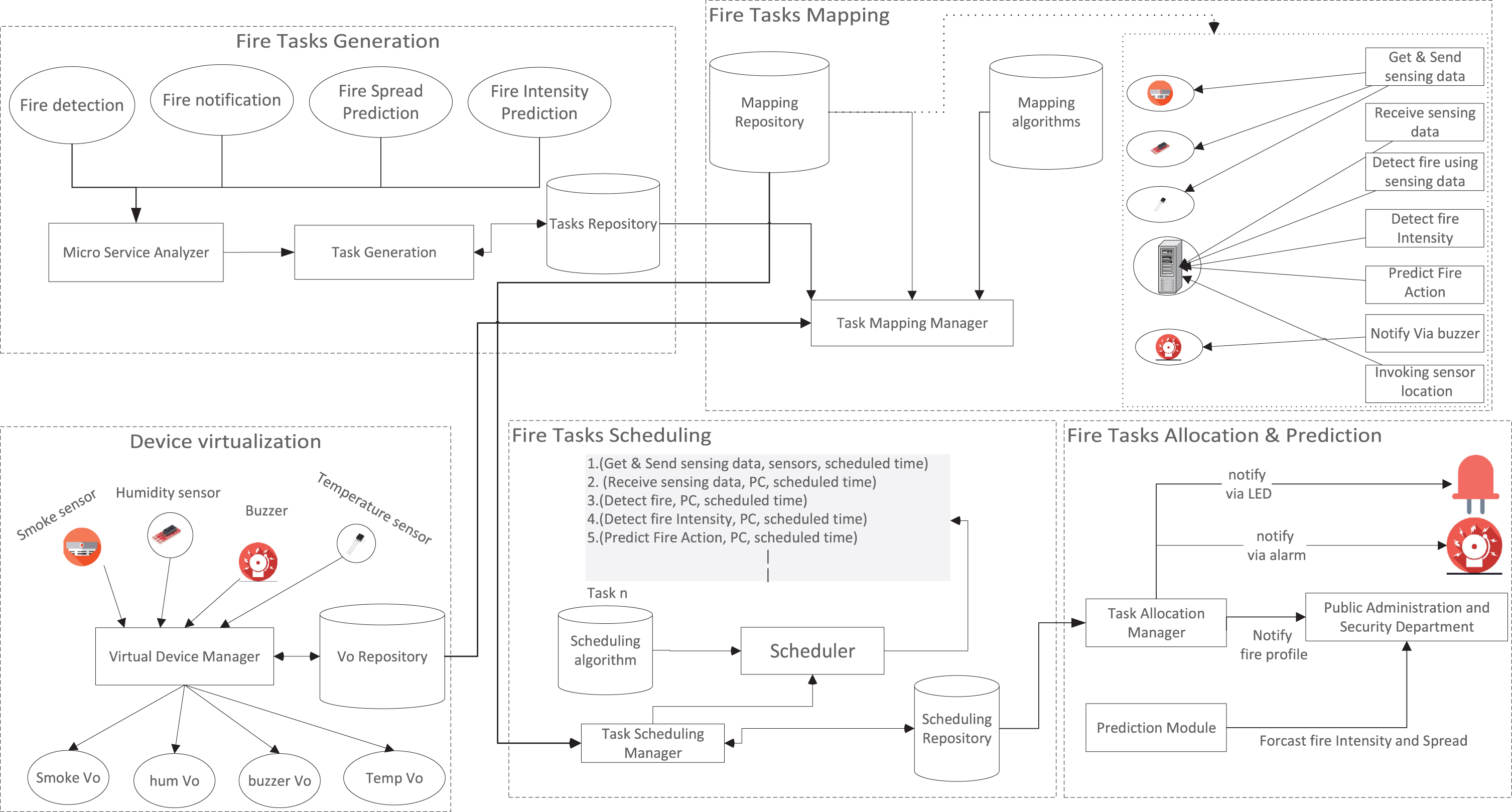
Design of MTO-IoT based fire detection and prediction mechanism.
FTM manager responsibility includes initialization of mapping libraries and graphical user interface(GUI). FTM manager have access to both task and virtual object repositories. It retrive all fire tasks,virtual objects and generate tasks virtual objects pairs. FTM manager also visualize the connection between fire tasks and virtual objects using an arrow line from task to a virtual object. These fire tasks and virtual objects pairs are stored to mapping repository. FTS manager generates optimal ordered pairs of fire tasks and virtual objects. FTS manager is connected to the tasks, virtual objects and task mapping repositories. Tasks-virtual objects pairs are stored into fire tasks scheduling repository. FTS manager also initializes GUI and charts libraries. Fire tasks allocation (FTA) manager create process from the scheduled tasks and execute it on physical IoT device. FTA manager also sends detected fire profile, predictive analytics to the public administration and security department. Fire profile contains fire parameters such as fire sensing data, fire intensity, fire flame and fire spread information. MTO-IoT prediction module uses current fire profile along historical fire data are to estimate the fire spread and intensity.
MTO-IoT five Layered architecture as given in Fig. 3. The physical layer manages physical IoT resources. These IoT resources include sensors and actuators for Fire detection and notification mechanism. Sensors include fixed sensors which are installed at various checkpoints in the mountains resorts and restaurants such as temperature, humidity and smoke sensors. Actuators include devices such as an alarm device to notify the fire detection. The Virtual Object Layer(VoL) represents the whole virtualization mechanism. Virtual Device manager controls the functionality of VoL, such as virtual objects generation from the physical IoT resources. The Fire Micros service layer(FMsL) divides the whole fire detection, notification, and prediction mechanism to functional units called microservices such as fire detection, fire notification, and fire spread prediction. FMsL also performs microservices analysis for tasks generation.
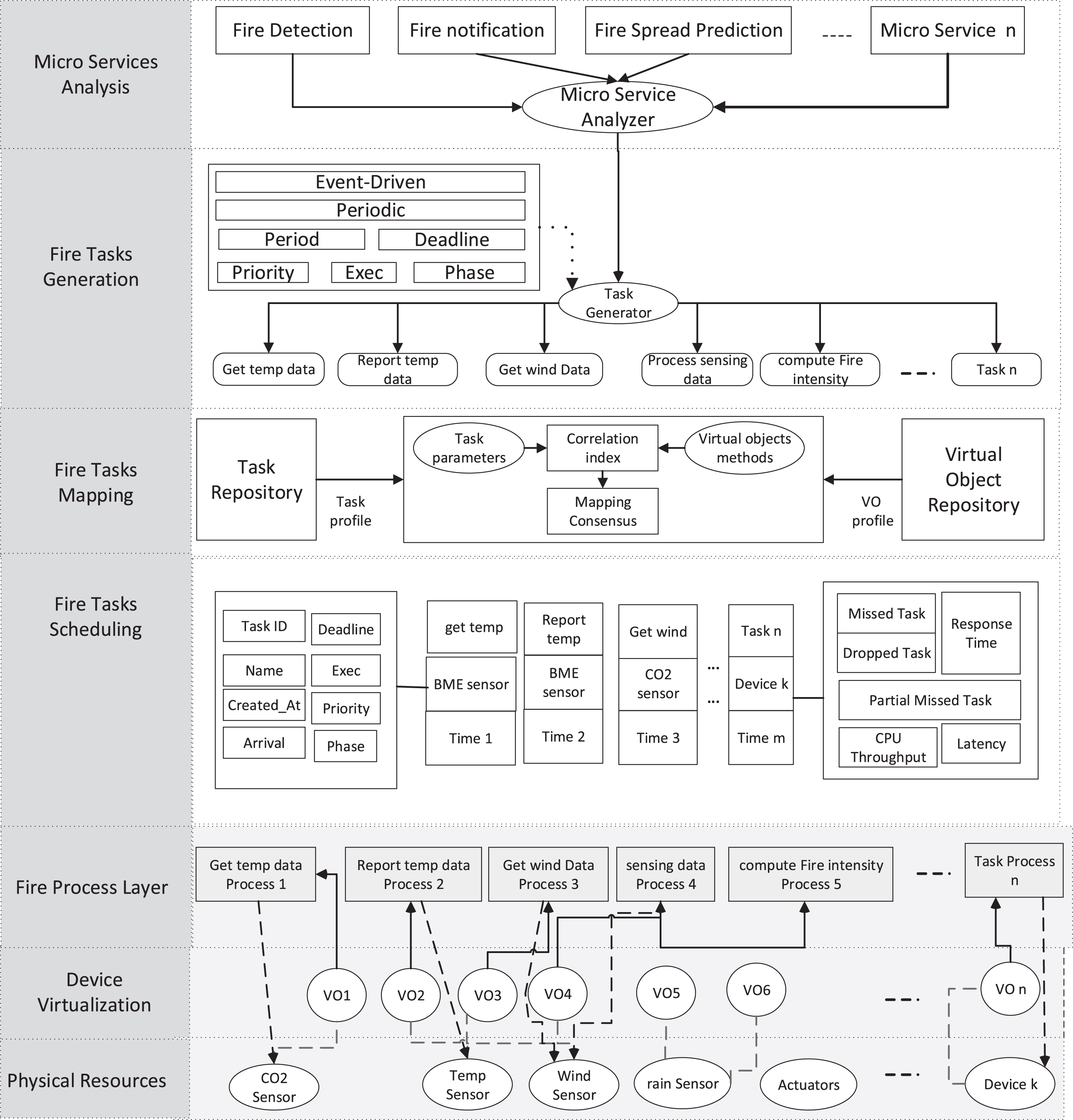
MTO-IoT Architecture for Fire Detection and notification.
Tasks are the subunits of microservices, and one microservice may have one or more tasks. Fire tasks generated from the microservices analysis are managed by Fire Tasks layer(FTL). Examples of tasks are ’get temperature,’ ’report temperature,’ ’get wind data,’ etc. The FTL uses fire tasks layer data to create processes from one or more tasks, which are finally executed at the physical device. Task Mapping layer(TML) maps tasks on related virtual objects on the basis of correlation index, mapping consensus, and task parameters. TML produces mapped pairs of virtual objects and tasks. Task scheduling layer(TSL) produce an optimal order of the tasks virtual objects pairs. Optimal pairs of tasks and virtual objects are selected based on performance metrics such as latency, CPU throughput, dropped and missed tasks, and response time. Fire Process layer (FPL) creates process from the scheduled tasks and virtual objects, finally, these processes are executed on the physical device based on the scheduling information.
Now we will discuss the detailed sequence interaction diagram of MTO-IoT based developed system given in Fig. 4. Device virtualization generates virtual objects of the buzzer, temperature sensor, humidity sensor, smoke sensor from the device’s physical properties. These sensors and actuating devices are accessible to the Virtual device manager through the server registry of the PC Server.
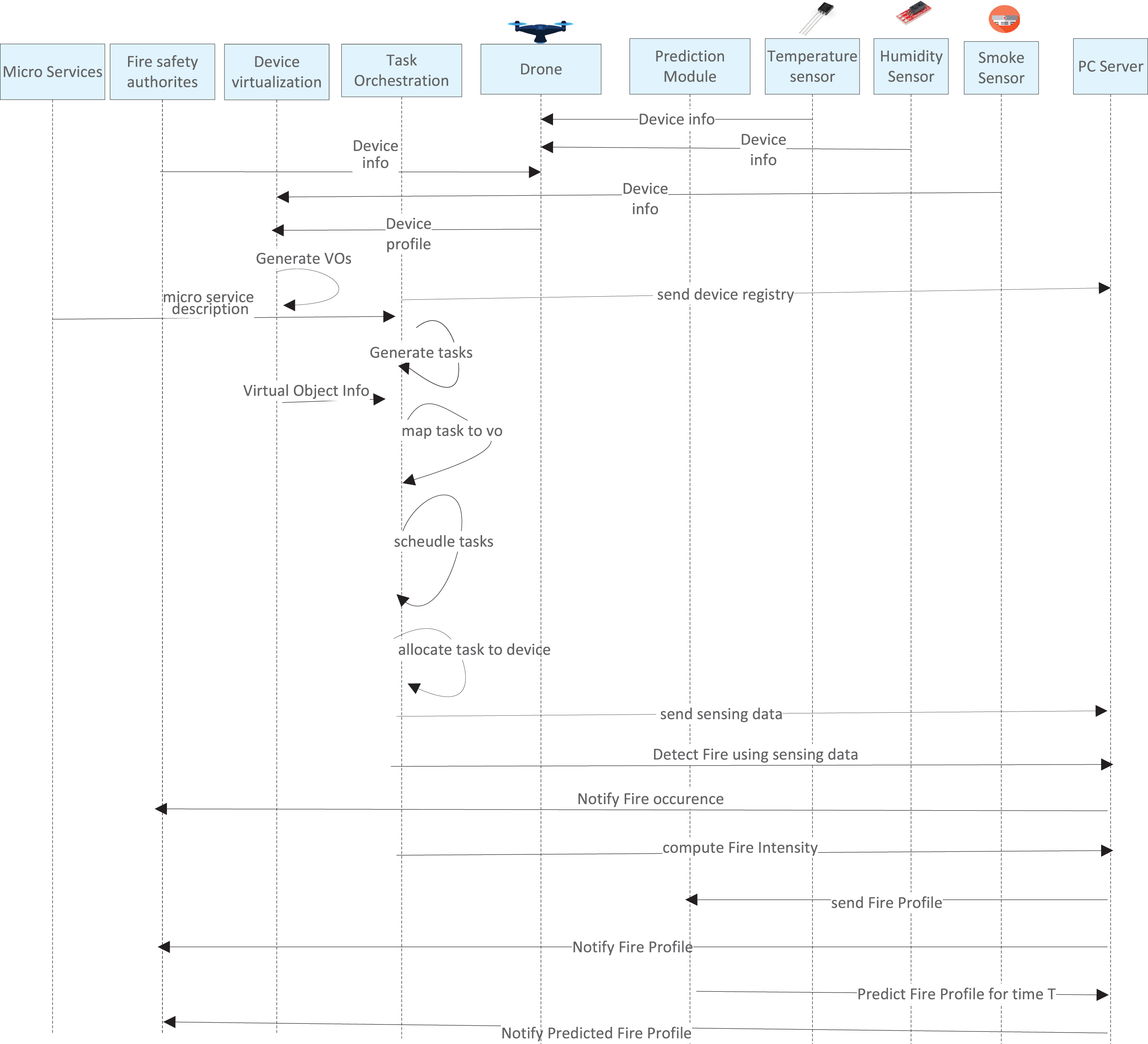
Interaction model of MTO-IoT based fire detection and prediction mechanism.
Task orchestration handles the minute details of the fire tasks generation, mapping, scheduling and allocation. Task orchestration is responsible for the tasks-virtual Objects pairs generation and producing optimal order pairs of the fire task and virtual objects mapping pairs. A drone is responsible for dropping disposable sensors near the fire to help calculate the fire spread and fire intensity. Prediction module is responsible for predictive analytics on the fire profile data using models trained with historical fire data. Fire safety authorities are notified when a fire is detected. Prediction module uses historical profile data from PC server, to predict the fire profile at time t in future. Fire safety authorities use fire profile and predictive analytics for on-time decision to prevent damage and harm to the mountain life and tourists.
The design of MTO-IoT Predictive analytics procedure is given in Fig. 5. MTO-IoT predictive analytics uses fire profile data, machine learning algorithms to estimate the likelihood of such fire events in future based on historical fire events data. The goal of any predictive analytics procedure is to know what is happened in the past for providing the best estimation of what events will occur in the future. Input data contains fire profile such as fire location, wind, humidity, temperature, time-related data such as day and month. In this study, we use predictive Regression models to predict the fire spread range and fire intensity. A predictive regression model is one of the most popular methods in big data and statistics. Predictive regression analysis estimates relationships among the fire parameters such as temperature, humidity, wind and fire spread. From fire intensity, we calculate the fire flame height, from fire height and wind direction we estimate the fire spread range in meters. Data is prepared using feature engineering techniques for model training, testing and evaluation. To evaluate and test model dataset from the local fire safety authorities is used. The trained models are deployed as part of the MTO-IoT system, which predicts the fire profile in real-time on real fire profile data.
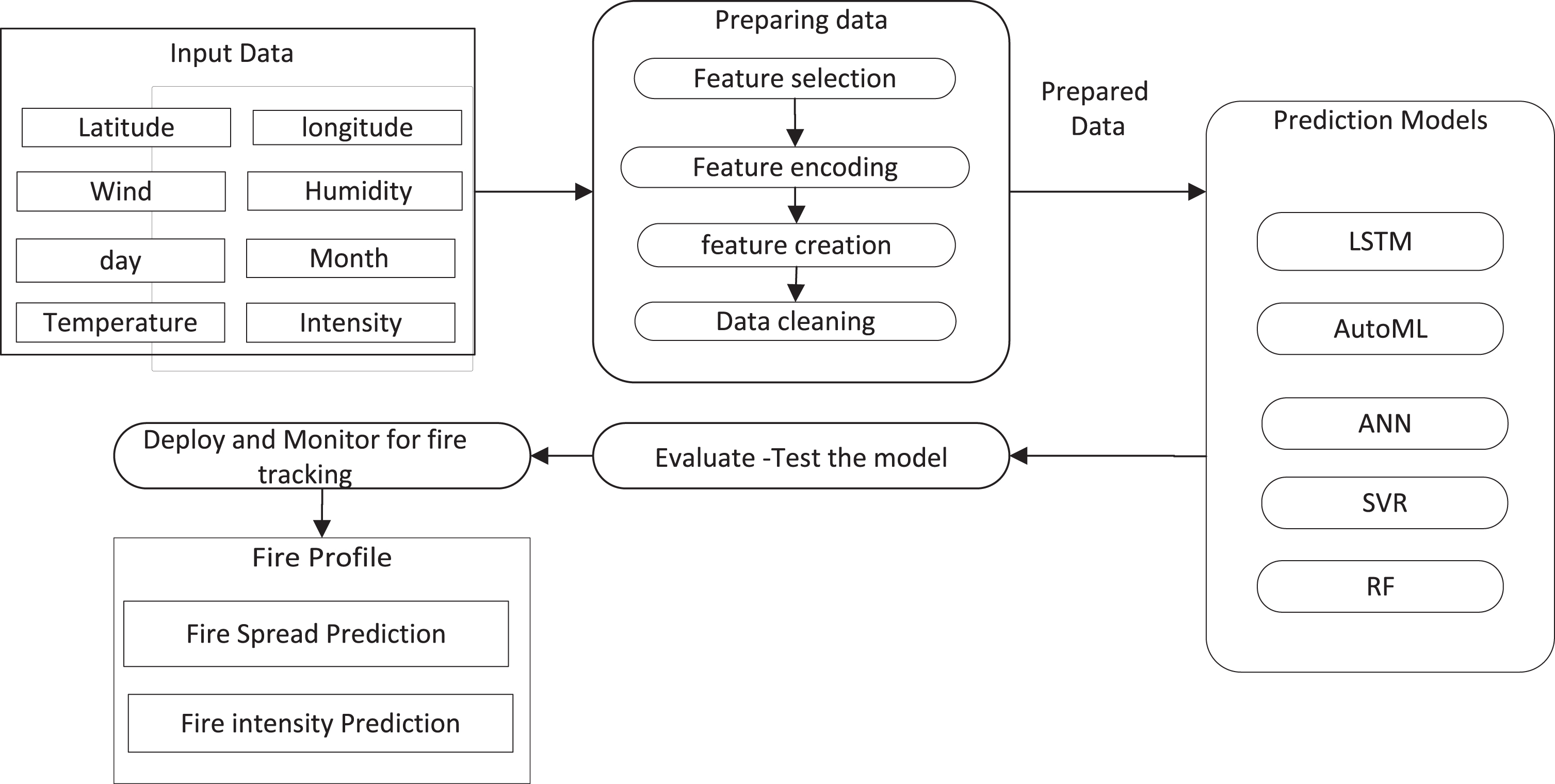
Predictive analytics procedure for fire profile prediction.
For prediction, we developed models using Long Short Term Memory networks(LSTM), Automated machine learning (AutoML), Artificial neural networks (ANN), Support Vector Regression(SVR) and Random Forest(RF). The data is time series, so LSTM and AutoML are based performing for time-series data mining. Time series fire profile data means its time-stamped and collected over day and month intervals. These time-series techniques combine forecasting techniques with traditional data mining procedures.
In this section, we will discuss the implementation and results of Fire detection and Prediction application developed based on proposed MTO-IoT design. There is two main part of the implementation, web-based application for fire detection and notification. The second part is predictive analytics on the prepared dataset from various simulation data at MCL IoT lab at Jeju National University and the data received from the fire safety authorities. For the IoT Task Orchestration Application, we implemented IoT Server through Flask Web server at Raspberry PI. The Flask server maintains the registry of all IoT devices connected to the server using the Edge gateway. The Flask server registry contains essential information regarding the status of the devices. Device state can be ’connected’, ’disconnected’, ’busy’ or ’available’. An edge gateway is implemented on another Raspberry PI using with EdgeX Foundry. EdgeX Foundry is an open-source platform for accelerating the development. For this study, we used actuator such RED LEDs and sensors such as BME 280 a hybrid of three sensors for humidity, temperature, pressure and CO2 gas sensor. For data persistence we used MySql based database but any database or data storage mechanism can be used. The physical resources used for the experimentation are shown in Fig. 6.

Physical Devices for the Implementation of case study for MTO-IoT.
In this section, we will discuss the steps involved in MTO-IoT from an implementation perspective as given in Fig. 7. Step 1 is virtualization of devices using Virtual device manager. A virtual object contains information such as the virtual object name. Tags are tasks tags which shows what tasks can be executed on the physical device. Endpoint URL is the device URL, and methods are how tasks are executed on the device. Properties contain device attributes. The virtual objects configuration are stored in the form of XML temporarily which is then stored to virtual objects repository. Step 2 represents the generation of tasks from microservices. The generated tasks are saved to tasks repository or discarded. Get tasks reads sensing data from the sensors such as ’get temperature’, ’get humidity’ and ’get wind data’. Report tasks report the value of the sensor retrieved to the server to other tasks in MTO-IoT. Reports tasks example are ’report temperature’, ’report humidity’ and ’report wind data’. Some tasks are executed at the PC server based on the sensing data. Task ’process sensing data’ process the sensing data and produce valuable parameters from it. Task ’compute fire intensity’ is used to calculate fire intensity using the sensing data. Task ’Predict fire action’ is based on the fire intensity if the fire is of high intensity, then authorities are informed else if its smoke due to the tourists’ actions such as smoking, then mountain authorities are notified to take actions.
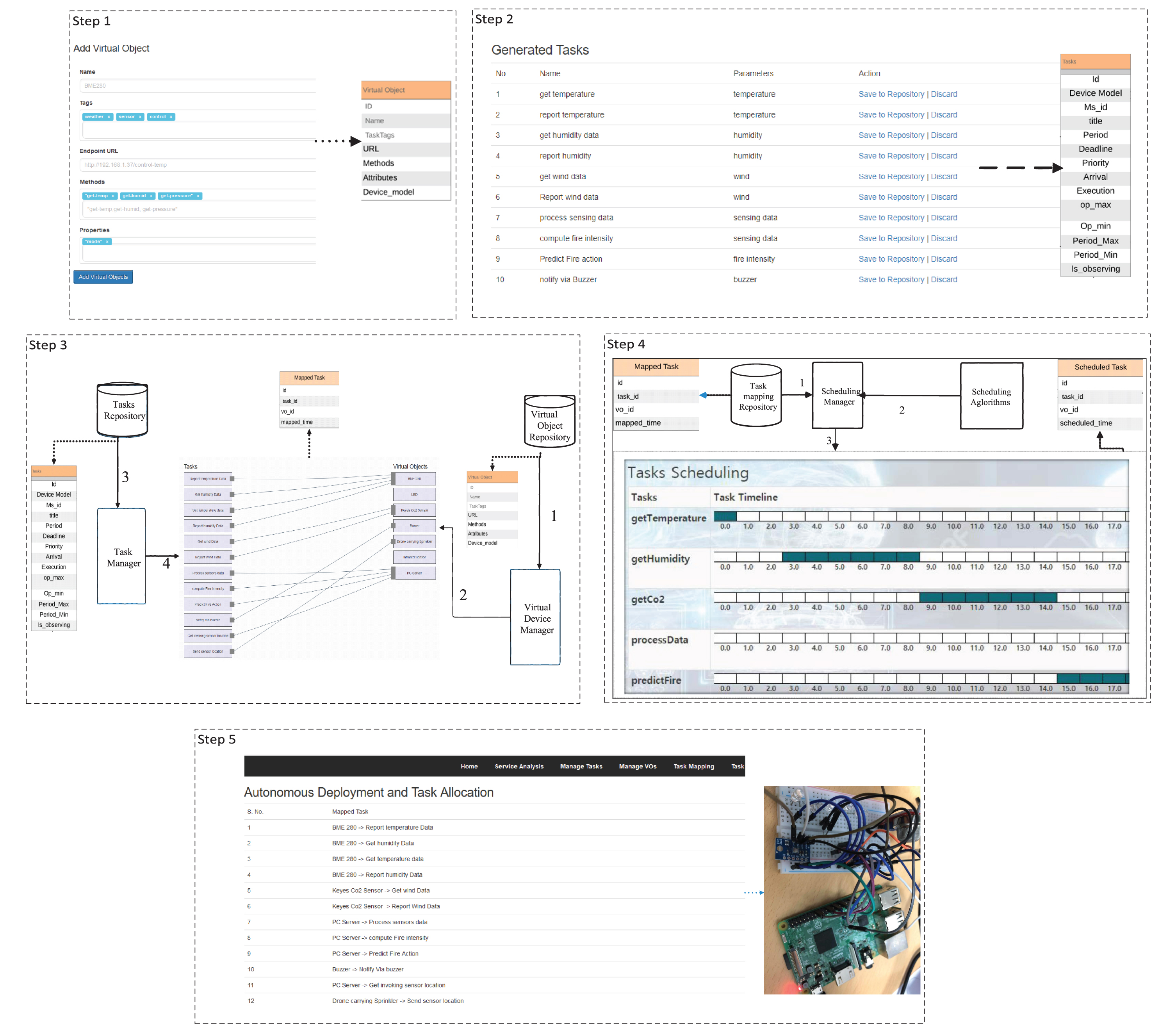
MTO-IOT- from implementation perspective.
Once the fire detection and notification devices are virtualized into virtual objects, and fire tasks are generated from microservices, the next step in MTO-IOT mechanism is the generation of mappings pairs called fire task mapping. The Mapping mechanism is an autonomous process, which generates the tasks and virtual objects mapping pairs based on the correlation index of the virtual objects task tags and the task. Virtual devices manager feed the virtual objects to the fire task mapping module, whereas Fire task manager extracts all the available tasks from the tasks repository and feeds it to the fire mapping module. Once pairs of tasks and virtual objects are generated, it is stored into fires task mapping repository.
MTO-IOT tasks scheduling mechanism is used to generate ordered pairs of tasks and virtual objects which can achieve minimum latency. The concept of fires task mapping is to execute those tasks first, which should be executed first. For example, get Tasks should be executed first then report tasks and computational tasks. MTO-IOT Task scheduling windows provide visualization of scheduled tasks. FTS manager is responsible for fetching fire tasks and virtual objects mapping pairs along with their profiles. FTS manager orders the mapping pairs and visualizes ordered pairs at grant chart. Grant chart displays tasks and tasks timeline. FTS manager store the scheduled tasks into fire tasks scheduling repository. For each scheduled tasks, processes are created, and these processes are executed on the physical devices at the allocated time.
In this section, we explain the study area, dataset, formulation of fire spread and fire flame assumptions. The dataset prepared based on the simulation results from MTO-IoT and dataset based on local fire safety authorites. The data instances are based on the location of Hallasan. Hallasan is the highest mountain in three main mountains in Jeju Island of South Korea. It is the a shield volcano on Jeju. There are two parks designed around the mountain area, one national park and other Hallasan National Park. Quantum Geographic Information System (QGIS) open-source geographic information system software which visualises, analyse, create, edit, and publishes geospatial information. Figure 8 represents the visualisation of some instance of data based on QGIS software.
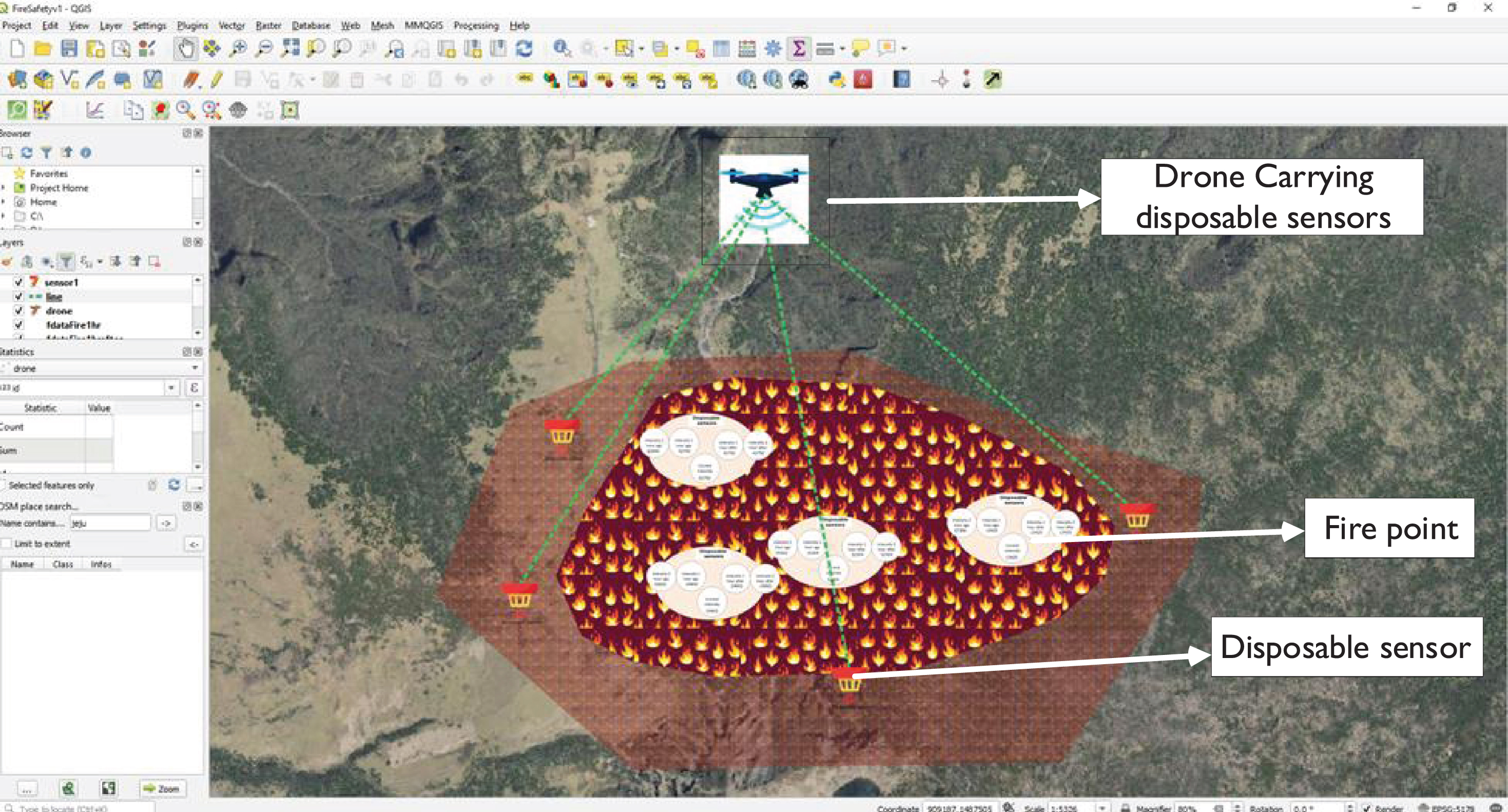
QGIS simulation of Hallasan study area.
Table 2 represents dataset features and its description. The dataset contains temperature, wind, humidity, fire intensity. The data to be used is from mountain fires in the Hallasan mountains Jeju, and there are 1517 incidents of mountain fires with information on days, months, location coordinates. Now we will formulate fire spread from fire intensity, temperature, humidity and wind data. Table 3 lists notions and Symbols used in the features formulation. Equation 1 represents fire spread (R) in meter which is calculated based on Byram’s fire intensity equation [32].
Dataset
Summary of Symbols and its description
Now we analyze the dataset fire intensity and fire flame in term of mean, maximum(max), Standard deviation(std), Minimum(Min) terms. We used Std to analyze the variation which exists in the fire intensity and fire flame from the mean of fire intensity and fire flame. Std measures the spread of the fire intensity and fire flame distribution. The larger the std value, the bigger the spread of distribution in the fire intensity and fire flame. The mean measures fire intensity and fire flame central tendency and its distribution. The mean by itself cannot accurately statistically estimate as it gets distorted by outlier values, and hence we report it through std value. Figure 9 represents Fire Intensity in term of mean, std, min and max.
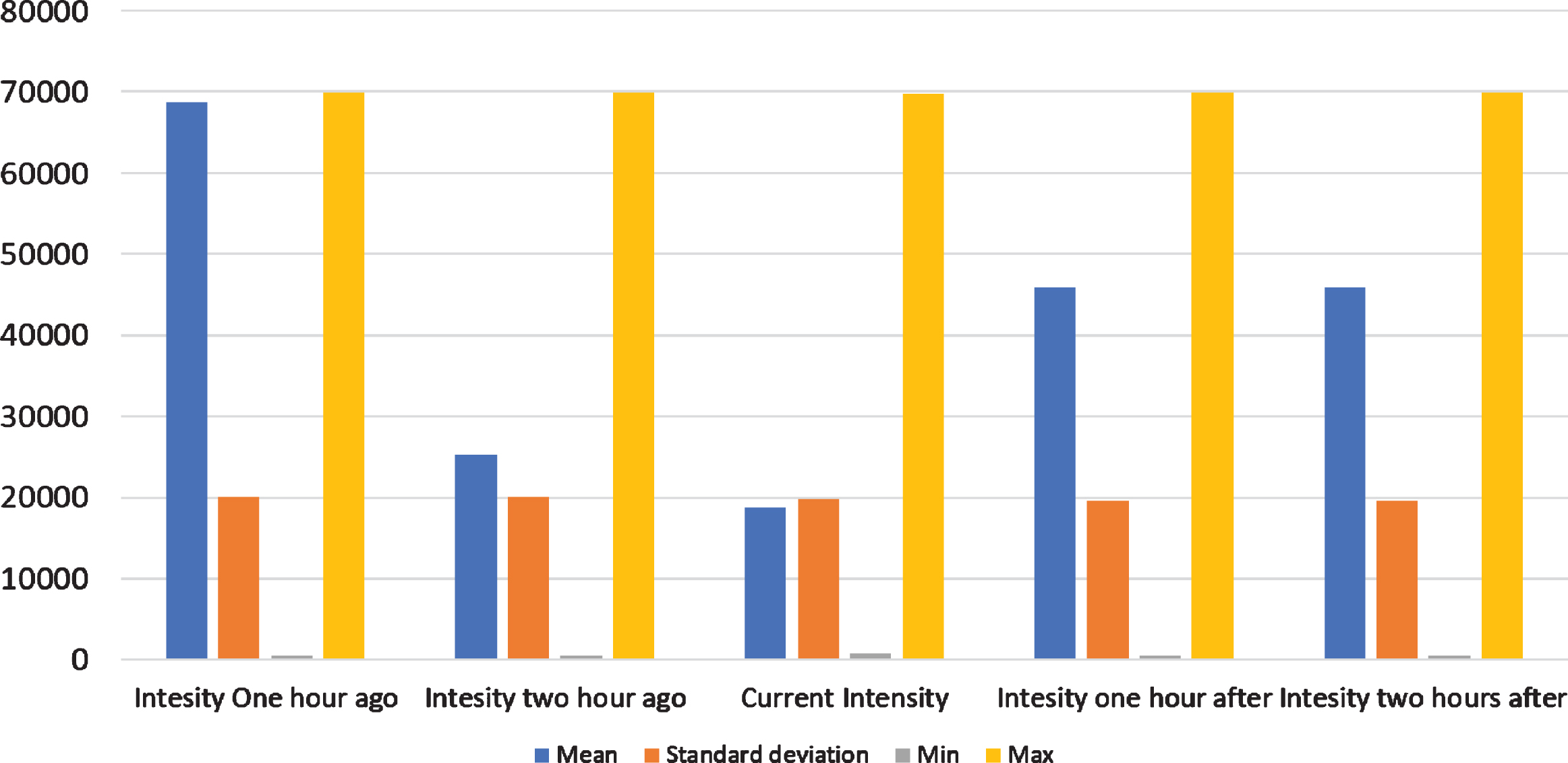
Hourly comparison of fire intensity in term of mean, std, min, max.
The X-axis represents an hourly comparison; for this study, we consider only two hours intensity value before and after the fire occurrence. The analysis can be improved by considering more hours of data. Y-axis represents the fire intensity in Kilowatt per meter(KW/m). Maximum and minimum Fire intensity metrics show the severity of the fire. Fire flame height can be a significant parameter when it comes to forest and mountains. Woods and trees may catch fire when the fire intensity is more, and hence fire flame will be more. High fire flame along wind speed can widen the fire flame and hence more chances of fire spread. Figure 10 represent comparison on of fire flame in term of mean, std, min and max. The X-axis represents an hourly comparison of the fire flame height. Y-axis represents the fire flame height in meter.
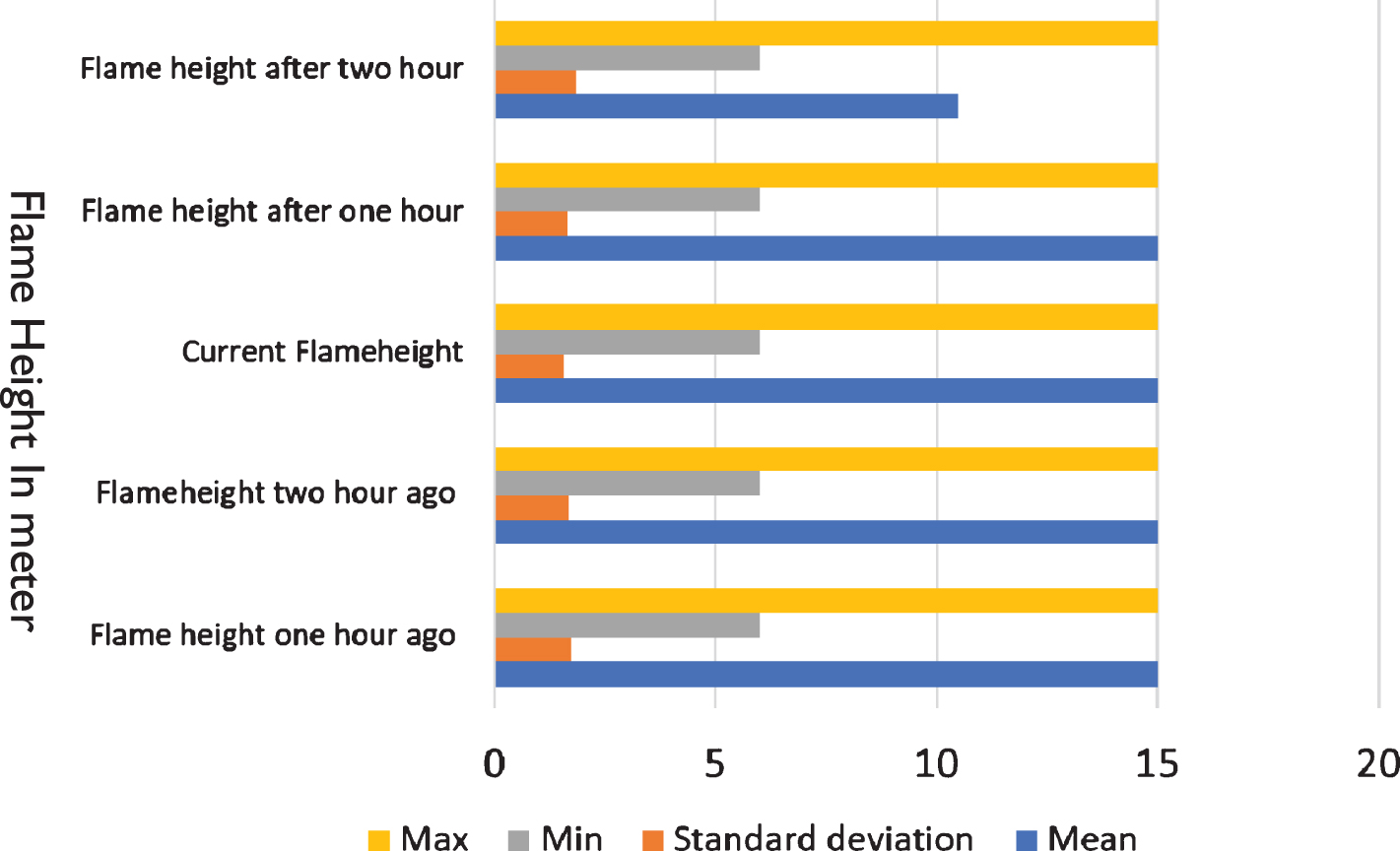
Hourly comparison of flame height in term of mean, std, min, max.
In this section, we explain the fire spread and fire intensity prediction results, Fig. 11 shows fire intensity prediction using LSTM, AutoML, ANN, SVR and RF. LSTM based fire intensity prediction is best as compare to the rest of the algorithms. If the MTO-IoT application detects fire outbreak has recently occurred in a particular Mountain area using a fixed sensor, the MTO-IoT fire propagation module is activated.

Fire intensity prediction.
From the fire spread and fire intensity, authorities take decisions and select which neighbouring Mountain areas are more likely to favour fire spread and to be affected by fire outbreak. For LSTM we used a batch size of 240, number of epochs 1000 and timesteps of 60. Batch size defines after how much input data size neural networks weights should be updated. A large batch size consumes more memory and reduces the model generalization ability of various data features. Small batch size is useful for less more consumption and reducing the training speed. For LSTM we use Mean square Error (MSE) as a loss function, and ADAM as optimizer. For the Activation function, we used relu and sigmoid functions. AutoML is the process of automating the process of applying machine learning to real-world problems such as in the case of this study; we applied to fire spread and fire intensity prediction. AutoML based on the data analysis of our dataset, build an Ensemble model based on Extra Trees Regression (ETR) and LassoLars Regression (LassoLarsR). ETR based prediction is made by averaging predictions from decision trees. LassoLarsR is developed using the LARS algorithm. Stacking estimation is used for stacking the output of ETR and LassoLarsR algorithms to compute the final prediction. Figure 12 shows fire spread prediction using LSTM, AutoML, ANN, SVR and RF. AutoML based fire spread prediction is good as compare to the rest of the algorithms.

Fire spread prediction.
For the comparative analysis, we consider four performance metrics namely MAD(Mean absolute deviation), MSE(mean absolute error), RMSE (root mean square error) and MAPE (mean absolute percentage error). Tables 4 and 5 shows the performance analysis comparison of the algorithms in term of MAD, MSE, RMSE and MAPE. For Fire intensity prediction AutoML perform best with mean absolute percentage error 8.87. For Fire spread prediction LSTM perform best with mean absolute percentage error 14.86.
Performance comparison for fire spread prediction
Performance comparison for fire intensity prediction
The main contribution of this work is the introduction of task orchestration-based mechanism to model deterministic delays of each task with conventional real-time scheduling algorithms before deploying in the real IoT environment. This approach is not only on a safer side but also very flexible and scalable. In previous studies [34, 35], claims were made that real-time IoT systems can be deployed in hard real-time systems but there were no concrete application in which the idea was applied. In this paper, MTO-IoT based fire detection and prediction platform is the first-ever attempt towards mountains fire detection and predictive analysis in the IoT environment of mountain towns using this approach. Existing fire detection and notification approach are using IoT, but it does not provide analysis of fire profile data at the device edge or server level. First and foremost, The fire management platform developed on the proposed fire detection and prediction architecture is a complete solution addressing various aspects of mountain fire management in the IoT environment. The proposed architecture is scalable to other fire modules such as efficient resource management in the fire containment, people at risk monitoring and evacuation plannings. Table 6 provides a comparison of the proposed and the related IoT based fire management platforms. We consider open-source, support for descriptive and predictive analysis, Remote monitoring, mechanism and fire modules for the comparative analysis. The freedom from hardware dependence, fire task-level management and loosely coupled nature makes our fire management solution significant towards the mountains fire detection and prediction.
Comparative analysis of proposed system with existing fire management platforms
Comparative analysis of proposed system with existing fire management platforms
In this paper, we use IoT Task orchestration architecture based on microservices for efficient and early-stage fire detection. The microservices modeled as a collection of IoT tasks are deployed only if theoretically it has optimal latency and guaranteed deadline meet. Additionally, a prediction module is coupled with task orchestration to predict the fire spread and fire severity. An IoT application is developed based on the architecture which detect forest fire and compute fire parameter such as intensity from the fire sensing data. The architecture enables real-time notification of fire detection and fire profile to fire safety authorities. The Task orchestration process is visualized in the application for the easy management of device virtualization of fire detection and notification. Another contribution is predictive analytic on the basis of historical data and the fire profile results from the task orchestration application. Performance results of the system indicates that mountain fire is predicted at earliest stages, further the fire profile forecasts enables the authorities to make on time decision to avoid potential harm to resources of the mountains and tourism sector. For future directions we will consider more parameters which have impact on mountains fire such as weather data. Furthermore we will consider fire containment resources minimization, and people at risk evacuation plans.
Conflicts of interest
The authors declare no conflict of interest.
Imran is currently pursuing Ph.D. in the Department of Computer Engineering in Jeju National University, Republic of Korea. He received his MS degree in Computer Science from Bahria University, Islamabad, Pakistan in 2018. He did his BS(Hons) in Information Technology from University of Malakand,KPK Pakistan. His work experience include Full Stack Software Development, IT Trainings and Entrepreneurship. His research work mainly focused on Internet of Things applications, Machine learning, Data science and BlockChain applications.
Shabir Ahmad is currently pursuing Ph.D. in the Department of Computer Engineering in Jeju National University, Republic of Korea. He received his MS in Computer Software Engineering from National University of Science and Technology, Islamabad, Pakistan in 2013. He did his BS in Computer System Engineering from University of Engineering and Technology, Peshawar, Pakistan and is now serving in the same university as a faculty member of Software Engineering Department. His research work mainly focused on Internet of Things application, cyber-physical systems and Intelligent systems.
DoHyeun Kim received the B.S. degree in electronics engineering from the Kyungpook National University, Korea, in 1988, and the M.S. and Ph.D. degrees in information telecommunication the Kyungpook National University, Korea, in 1990 and 2000, respectively. He joined the Agency of Defense Development (ADD), from Match 1990 to April 1995. Since 2004, he has been with the Jeju National University, Korea, where he is currently a Professor of Department of Computer Engineering. From 2008 to 2009, he has been at the Queensland University of Technology, Australia, as a visiting researcher. His research interests include sensor networks, M2M/IOT, energy optimization and prediction, intelligent service, and mobile computing.
Footnotes
Acknowledgments
This research was supported by Energy Cloud R&D Program through the National Research Foundation of Korea(NRF) funded by the Ministry of Science, ICT (2019M3F2A1073387), and this research was supported by Institute for Information & communications Technology Planning & Evaluation(IITP) grant funded by the Korea government(MSIT)(No.2018-0-01456, AutoMaTa: Autonomous Management framework based on artificial intelligent Technology for adaptive and disposable IoT). Any correspondence related to this paper should be addressed to Dohyeun Kim.