



Abstract
In this paper, a multistage decision-making problem concerning uncertainty and ambiguity is discussed using Pythagorean fuzzy sets. Complement Pythagorean fuzzy membership grades and their properties are also considered. Using the definition of an alpha-level set, we introduce the multistage decision-making problems, where the possibility theory and satisfaction grades are declared with the help of Pythagorean membership grades. Pythagorean multistage decision-making is an uncertain theory, where decision-maker has only one opportunity to choose the scenario under the combination of Pythagorean possibility and satisfaction grades at each stage. According to the selection of criteria, a series of decision points are concluded. The payoff collaborates with these decision points at each stage. The multistage decision-making using Pythagorean fuzzy sets is the scenario-based theory in place of other theories like lottery-based theory etc. The results have been calculated using multistage Pythagorean fuzzy sets in which the decision-maker has only one chance to select the optimal solution. The TOPSIS technique has been applied and the comparison between these two techniques is highlighted.
Introduction
Each rational human being has to make many decisions in life. These decisions might be tactical, operational and strategical. Tactical decisions are less critical; one makes such decisions daily. These decisions do not affect the overall success or failure separately but collectively they can play massive role. Operational decisions are medium termed and have more weightage than tactical decisions. The most important among all the types of decision are strategical decisions which play a key role in success or failure. It is highly required to be careful while making such decisions, e.g. selection of the players for a crucial match; finalizing the production units for the one-shot summer season, recruitment of employee for a key managerial post and deciding about career options etc.
Decisions involve risks because of uncertainties. There are many internal and external constraints which can affect the way of success towards the final destination through the specific strategical decision. It could be the change in weather & climate, the strategy of competitors, economic conditions (recession or boom), market demand, fashion and trend etc. In short, making the right decision considering all probabilities is an art, technique and it might be termed as “super-science”.
This paper is focused specifically on such strategical decisions where time is short for making the decision and there are more chances to make wrong decisions. Following are few examples from real-life showing the motivation of this work. A fashion clothing designing firm has to make the decision not only about the new designs but also about the quantity required for production. All these decisions are necessary to be made before the start of the summer season because the product life cycle is short and has only a few months, i.e. starting from the mid-April to the beginning of September. The firm might not have enough time and opportunity during this short period, i.e. four and half months to increase the supply of any specific design because the fashion designing production process is long and takes many months. For that, the preparation of next season starts immediately after the end of the previous one. Another example is the newsboy model of inventory management generally known as the newsvendor problem, also known as a single-period problem. The buyer must decide how many commodities to purchase before the starting of the season. A classical newsboy problem is to find the order quantity of a commodity that maximizes the estimated profit (or minimizes cost) of a retailer under stochastic demand. Moreover, It can also be used to control the capacity and determine the advance booking of transactions in a few industries like airline tickets, hotels, etc., where the time frame is often short.
The Decision-making problem of uncertainty is most likely related to the lottery-based theories [7], where the chance of selection is the probability of winning or losing, for expected utility and subjective expected [20] utility or the prospects theory [13] of the choice of objects. But these theories are the lottery-based which pursue the weighted average of the work. Pythagorean multistage decision theory is representative of those circumstances where the decision-maker has only one chance to select the optimal alternative from the incomplete information at each stage. The real-life examples of Pythagorean multistage decision-making (PMDM) are locust land problem, the solidity of the dam, and rain, etc. PMDM discusses the uncertainties and ambiguity of these problems. We will also discuss problems related to trade, economics and medical care for the diagnosis of diabetes, heart and so on.
PMDM is a scenario-based theory in which a decision-maker has multiple choices at every stage to decide which state occurs with uncertainty or ambiguity as compared to other theories. The main purpose of this theory is to avoid the deficit quickly at the stage of peak demand and the beginning of the work as well. Let us consider a real-life example. Africa faced the largest attack of the locusts 25 years ago resulting in the scarcity of food, unusual changes in weather, the devastation of crops, destruction from floods, drought and heavy rains.
An article (July 09, 2019) mentioned that Pakistan faced the attack of the locusts in 1961 and now it has recurred after 58 years. The crops mostly hit by the attack are mustard, fenugreek, wheat and cumin. Nowadays locusts are heading towards the Province of Punjab, Pakistan. According to the Food and Agriculture Organization, 30 countries in the world are affected as shown in Fig. 1.

Locusts affected regions.
This PMDM consists of two steps: one is to select the attractive points in the states and the second is the selection of the best alternative. The selection of the optimal alternatives depends upon the attractive points which are acquired from the combination of possibility grades and satisfaction grades. A sequence of attractive points is obtained, which shows the priority behavior of the decision-maker. In this regard, we consider twelve stages which demonstrate the behavior of the decision-maker. This theory as an example is applied in real-life and the exploration shows the connection between the behavior of the decision-maker and the uncertain situation. It is important to note that PMDM solves situation of uncertainty or ambiguity in dynamic programming, whereas Pythagorean multistage decision shows a sequence of decision paths that are prepared at every stage.
Zadeh [26] proposed the notion of fuzzy set theory where the membership degrees allocated against each value of the universal set and these membership values reflect the degree of truthfulness with range [0, 1] . The ‘1’ shows the presence of the element in the class and ‘0’ shows no relation to it while the other different values show the level of membership in it. Later on, Atanassov [2] presented the concept, known as intuitionistic fuzzy sets. An intuitionistic fuzzy set comprises the values known as membership value μ, non-membership value ν and the degree of hesitation π which belong to the real unit interval [0, 1] where μ + ν ≤ 1 and μ + ν + π = 1. The idea of an intuitionistic fuzzy set provides additional details for expanding uncertainty and ambiguity. But there are some circumstances where the sum of membership and non-membership value is greater than one. This restriction in IFS (intuitionistic fuzzy set) motivates to establishing Pythagorean fuzzy set [23]. To deal with ambiguity and uncertainty with membership and non-membership values, the Pythagorean fuzzy set has been proposed which obeys the conditions μ (x) + ν (x) ≤1 or μ (x) + ν (x) ≥1 . Furthermore, it follows μ2 (x) + ν2 (x) + π2 (x) =1 . Pythagorean fuzzy set (PFS) can be used more accurately and amplied to characterize uncertain information than IFS. Fig. 2 clearly shows an advantageous geometrical explanation concerning the spaces of intuitionistic fuzzy set and the Pythagorean fuzzy set values. It is easy to observe that the intuitionistic fuzzy set values and PF values are focusing under the conditions μ P (x) + ν P (x) ≤1 and (μ P (x)) 2 + (ν (x)) 2 ≤ 1 respectively. The space of Pythagorean grades is generally larger than that of intuitionistic fuzzy grades.

Differentiation of spaces between IFS and PFS.
PMDM face correlative decisions at each step. In 1957, Bellman [3] introduced the concept of dynamic programming which solves the problems related to multistage decision theory. In 2009, Cristobal, Escudero & monge [6] used multistage decision-making concerning uncertainty to manage the stochastic dynamic problems. In 2011, Chen, Ghate & Tripathi [5] developed a stochastic dynamic programming problem for the lot-sizing decisions. These types of problems to develop an expected value for the maximization of the problem. Bellman and Zadah’s framework [4] used dynamic programming decision-making in a fuzzy environment with constraints in 1970. Kacprzyk [12] used this framework in the ambiguity in human selection in multistage decision-making problems. Sabbadin et al. [17] generalized multistage decision-making with possibility theory to measure fuzzy events in 1998. In 2004 Abo-Sinna et al. [1] gave the notation of multiple goal programming by solving multiple-objective based problems using fuzzy dynamic programming. In 2011, Chen et al. [5] handled multistage decision-making under risk by using stochastic dynamic programming. Guo [9] used possibility theory and satisfaction in multistage decision-making problems with uncertainty. In 2019, inequitable predictability of market events was discussed by Smirnov and Dimitri [18]. Three-way weighted combination based on entropy measure for three-layer granular structures has been introduced by Jun et al. [11].
Multistage optimization problems related to ambiguity and uncertainty are complexity computation. Some new approximation techniques are proposed to reduce the computational challenges. These approximation techniques hold the basic framework of the issues. These techniques for decision-making have attracted the researchers. In 2017, Zhu and Guo [33] discussed the multistage programming models and their application in the newsvendors’ problems. In 2017, Gyuai et al. [10] showed robust planning problems using a multistage system. Three-structured multistage principal component analysis has been discussed by Su et al. [19]. In 2019, Zhang et al. [29] presented multistage stochastic programming problems and their implementation in irrigation water allocation. Mahboob et al. [16] generalized the multistage problems with uncertainty using the intuitionistic fuzzy environment in 2018. Wang and Li [21] extend Pythagorean Bonferroni mean aggregation operators in multiple attribute decision making. In [22], the authors introduced Pythagorean fuzzy interactive Hamacher power aggregation operators for assessment of express service quality with entropy weight. A linguistic distribution-based approach in multi-attribute large-scale group decision making for multigranular unbalanced hesitant fuzzy linguistic information is introduced in [31]. A novel consensus model for multi attribute group decision making based on multi-granular hesitant fuzzy linguistic term sets under uncertainty is developed in [25]. A consensus group decision making problems under social network environment is introduced in [32].
In this article, the dynamic programming problem concerning uncertainty and vagueness is proposed to solve Pythagorean fuzzy sets. PMSDM is an exemplary situation for those problems where a decision-maker has a single opportunity for decisions at each stage. We introduce the multistage approach for short-life products with respect to uncertainty and ambiguity, where a decision-maker chooses criteria for each alternative, known as the attractive points. These attractive points are examined from the outcomes of Pythagorean possibility grades and satisfaction grades which can be attained at each stage. In multistage decision-making, optimal alternatives depend on the attractive points and a series of optimal alternatives is obtained by short-life products. The attractive points comprise twelve stages which show different preferences to the decision-maker for the selection of scenario. These optimal directions decide which scenario is to be considered at each stage and why such decisions are made. This paper is organized as, in section 2, the basic concept of PFS and comparison of Pythagorean fuzzy grades. while the method for finding the attractive points with the help of Pythagorean fuzzy sets for multistage decision problems has been presented in section 3 . We present some theorems which cover the relationship between the stages of attractive points in section 4 . In section 5, a case study and graphical view to demonstrate the proposed method is provided and also some comparison study is provided. Finally, section 6 concludes the remarks for this paper.
The main objective of this section is to discuss the basic definition of possibility function, satisfaction level, payoff functions and parity between two Pythagorean membership grades.
(1) If S (α) < S (β) , then α< β ;
(2) If S (α) > S (β) , then α> β ;
(3) If S (α) = S (β) , then α = β .
Let X be universe of discourse and P be a Pythagorean fuzzy set. Then (α, β)-cut of P is the crisp subset Cα,β (P) of the Pythagorean fuzzy set is defined as:
In multi-criteria decision-making, Pythagorean membership grade (μ
P
(x) , ν
P
(x)) is associated with alternative. We shall propose a strategy for the selection of best alternative for comparing [24] of Pythagorean membership grades. Let a function F : P → [0, 1] be the set of Pythagorean membership grades, is defined as:
Satisfaction criteria of alternatives
So we get, r (x) 2 = (0.48) 2 + (0.58) 2 = 0.57, r (x) =0.75, and cos (θ (x)) =0.48/0.75, θ (x) =0.88(rad);
and r (y) 2 = (0.62) 2 + (0.32) 2 = 0.49, r (y) =0.70, and cos (θ (y)) =0.62/0.70, θ (y) =0.48(rad).
Using equation 2.3,
Hence, alternative y is preferred.
We will consider dynamic programming problem for short-life cycle as the production of the products are uncertain due to the environmental changes. The uncertainty of the products has an effect on demand and supply. Multistage optimization problems with uncertainty are computational difficulties with short life cycles. A decision-maker has only a chance to choose the optimal ideal at each stage. To analyze these stages of problems, we utilize the Pythagorean multistage decision theory. PMDT consists of two steps, first is to select the attractive points and the second is to select the optimal alternative. PMDT has twelve stages of attractive points which show the behavior of a decision-maker, associated with these attractive of optimal alternatives.
Pythagorean attractive points
In multistage problems, a decision-maker selects one most appropriate state among all states of nature, according to the Pythagorean possibility and satisfaction grades. These selected particular states are called attractive points for alternatives. These attractive points show the behavior of the decision-maker. Twelve stages of attractive (decision) points are proposed with their characteristics. Now we derive the mathematical model of these attractive points as under:
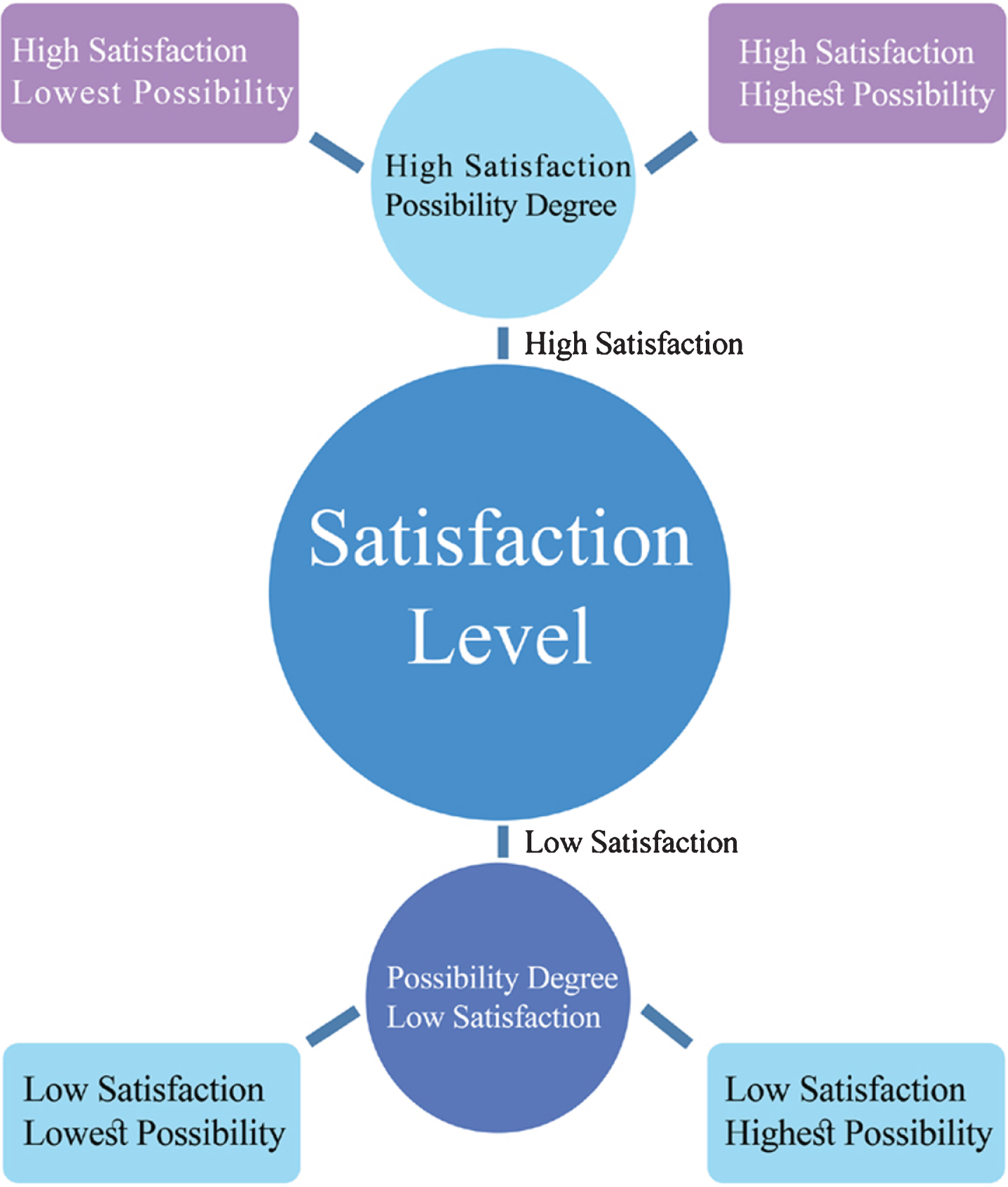
In the first stage, the action of Pythagorean possibility grade is high where the satisfaction grade of Pythagorean is also high and in stage two, the Pythagorean possibility grade is higher but the Pythagorean satisfaction grade is not higher. In stage third, the Pythagorean possibility grade is low and the satisfaction grade of Pythagorean grades are highest and in the fourth stage, the Pythagorean possibility grade is low and the satisfaction grade of Pythagorean is also lowest as shown in the Fig. 3, whereas the (α, β) cut categorizes between low and high Pythagorean grades.

Explanation of first four stages.
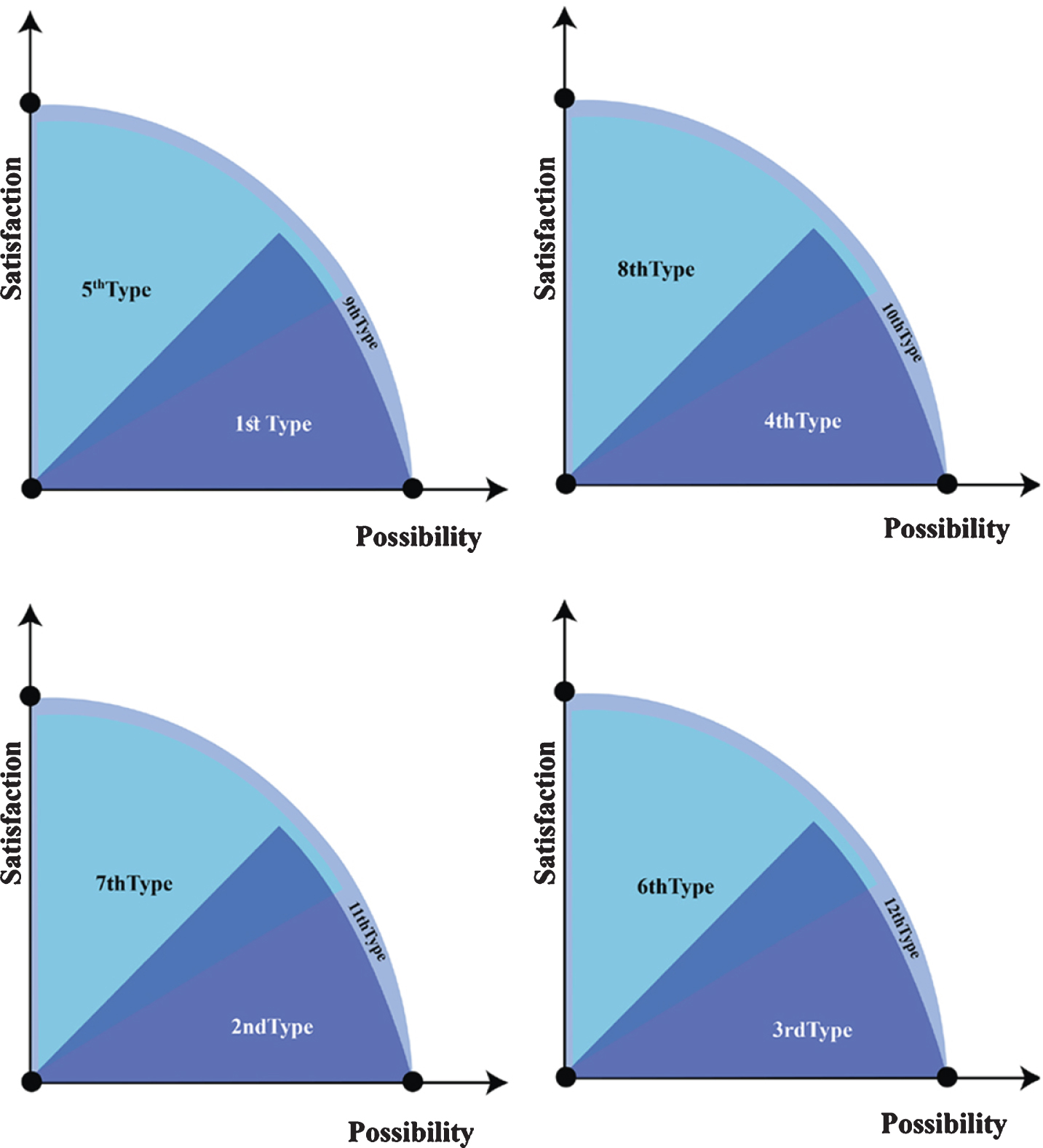
In these stages, (γ, δ) cut differentiate the high and low satisfaction grades and the Pythagorean possibility grades depend upon the above mention satisfaction grades to help the decision maker. The fifth stage shows the highest satisfaction grades and high possibility grades. The sixth stage shows the action of the highest satisfaction grades and the low possibility grades. The seventh stage contains the lowest satisfaction grades and the possibility grades are high. The eighth stage shows the lowest satisfaction grades and the low possibility grades. All these actions can be seen clearly in Fig. 4.
Explanation of stages fifth to eighth.
It comes out from equation 3.10, the upper bound of the vector is
Similarly, we can be capable to discern in equation 3.11 that is the action point which has high Pythagorean possibility grade whereas the low level of satisfaction grades which look like as suitable for a pessimistic DM.
In equation 3.12, recognize that X12 is the state of nature which has Pythagorean low level of possibility grades and high level of satisfaction grades. This attractive point can be used to describe the attitude of purchase of lottery. Even if the possibility of winning is very low, a high reward (high satisfaction level) can tempt a DM to contemplate such a circumstance. The twelfth attractive point is appropriate for a challenge to DM. Fig. 5 provides the characteristics of four (ninth to twelfth) attractive points.
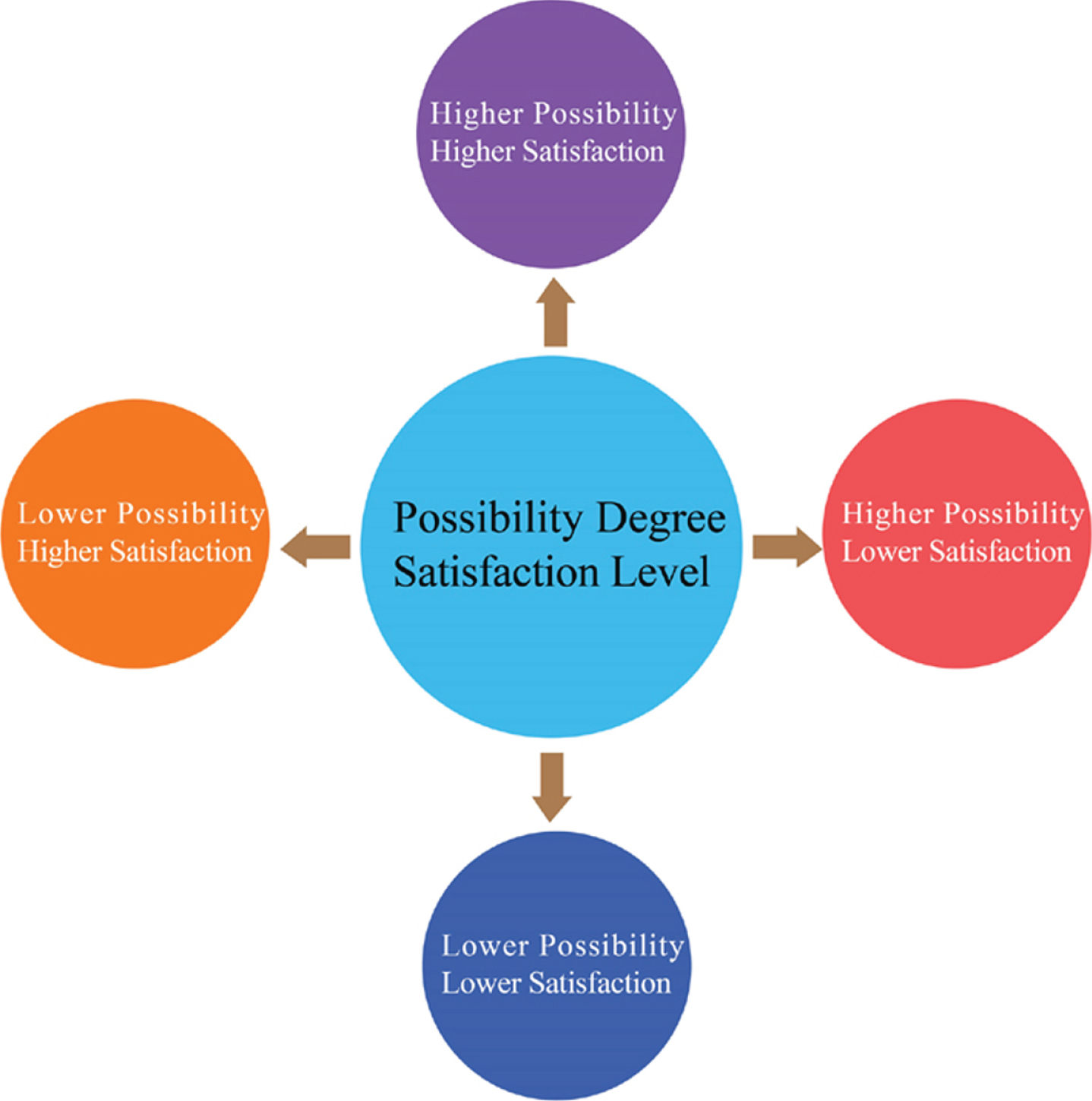
Explanation of stages ninth to twelfth.
In multistage problems, the first step is to calculate the Pythagorean attractive points. In the problem of Pythagorean multistage decision-making, a decision-maker thinks that attractive points are the most convenient decision points, so an alternative is chosen that can produce the best result after the attractive points are true. As there are twelve stages of attractive points, there are twelve stages of optimal alternatives corresponding to these decision points, as shown below.
The reflection of the decision-maker about the possibility and satisfaction degrees have been discussed in twelve stages of attractive points. Therefore, the relationship between attractive points is as under:
⇒x t ∈ ξ (μ P (x) , ν P (x))
⇒ξ (μ P (x t ) , ν P (x t )) ≥ max min [λ (μ P (x) , ν P (x)) , ξ (μ P (x) , ν P (x))] , ∀ x ∈ X, and λ (μ P (x t ) , ν P (x t )) ≥ max min [λ (μ P (x) , ν P (x)) , ξ (μ P (x), ν P (x))] .
Thus, min [λ (μ P (x t ) , ν P (x t )) , ξ (μ P (x t ) , ν P (x t ))] ≥ max min [λ (μ P (x), ν P (x)) , ξ (μ P (x) , ν P (x))] .
Obviously, min [λ (μ P (x t ) , ν P (x t )) , ξ (μ P (x t ) , ν P (x t ))]≤ max min [λ (μ P (x) , ν P (x)) , ξ (μ P (x) , ν P (x))] .
Therefore, min [λ (μ P (x t ) , ν P (x t )) , ξ (μ P (x t ) , ν P (x t ))] = max min [λ (μ P (x), ν P (x)) , ξ (μ P (x) , ν P (x))] .
⇒x t ∈ X9 (A)
This shows that
Similarly, it can be prove that
Hence, it is holds that the first stage and the fifth stage contain in ninth stage. ■
In the same way, we can prove other relations that the union of fourth stage and eighth stage contain in tenth stage. The union of second stage and the seventh stage contain in eleventh stage. Furthermore, the third stage and sixth stage contain in twelfth stage.
and
⇒λ c (μ P (x t ) , ν P (x t )) ≥ min [λ c (μ P (x) , ν P (x)) , ξ (μ P (x) , ν P (x))] .
⇒λ c (μ P (x t ) , ν P (x t )) ≤ ξ (μ P (x t ) , ν P (x t )) .
As, λ (μ P (x t ) , ν P (x t )) ≤ max [λ (μ P (x) , ν P (x)) , ξ c (μ P (x) , ν P (x))] .
Therefore, λ (μ P (x t ), ν P (x t )) ≥ ξ c (μ P (x t ), ν P (x t )) .
Combing the last two equations.
Similarly, second can be proved. ■
The analysis of Pythagorean attractive points evidently described from Fig. 6. Here, we monitor that the first stage of Pythagorean decision point shows the high possibility Pythagorean grades and the highest satisfaction Pythagorean grades, as well as the fifth stage of a Pythagorean decision point is the highest Pythagorean possibility grades and the high satisfaction Pythagorean grades which both contain in the ninth stage because in ninth stage include the higher possibility Pythagorean grade and the higher Pythagorean grade of satisfaction. In the second case, the fourth stage of Pythagorean decision point, Pythagorean possibility grade is the lowest and Pythagorean satisfaction grade is low and the eighth stage of Pythagorean decision point, Pythagorean possibility grade is low and Pythagorean satisfaction grade is lower. Moreover, both stages contain in the tenth stage of the Pythagorean choice point because the Pythagorean possibility grade is lower and Pythagorean satisfaction grade is also lower. The eleventh stage of Pythagorean decision point includes the high Pythagorean grade of possibility and lower Pythagorean grade of satisfaction. In the second stage contains the highest Pythagorean possibility grades and lowest Pythagorean grade of satisfaction. Therefore, both the second and seventh stages contain in the eleventh type. The twelfth stage of this choice point contains higher satisfaction Pythagorean grades and lower possibility Pythagorean grades whereas the third stage consists of the highest satisfaction Pythagorean grades and low possibility Pythagorean grades and in sixth stage the lowest possibility Pythagorean grades and high Pythagorean satisfaction grades. Therefore, the sixth and third stages contain in the twelfth stage.
Relation between attractive points.
In this section, we use an example of the proposed method and then we discuss the TOPSIS for PFS on the matching results through some comparative analysis.
Case study
The set of criteria are c1, c2, c3, c4, c5 and set of alternatives are A1, A2, A3. The Pythagorean possibility grades and the satisfaction grades for each alternative is shown in Table 2 and Table 3. The payoff for the criteria is shown in Table 4. Let us suppose Pythagorean cut (0.7, 0.6) and (0.6, 0.5) for categorized the Pythagorean possibility grades and satisfaction grades into groups according to the high and low grades.
Pythagorean possibility grades
Pythagorean possibility grades
Pythagorean satisfaction grades
Payoffs associated to each state
X9 (A3) = max {min [(0.6, 0.7) , (0.43, 0.7)], min [(0.8, 0.5) , (0.28, 0.8)], min [(0.9, 0.4), (0.6, 0.7)], min [(0.7, 0.4), (1.0, 0.0)], min [(0.5, 0.8), (0.69, 0.5)]} .
r (λ (c1)) 2 = 0 .62 + 0 .72 = 0.85, r (λ (c1)) =0.92,
According to equation 3.10,
According to equation 3.11, X11 (A1) = c4 and using equation 3.12, X12 (A1)
Let us examine Fig. 7. There are five criteria c1, c2, c3, c4, c5 for the alternative A3, the Pythagorean possibility and satisfaction are shown in Table 2 and Table 3, after applying the Pythagorean formula 2.3 and 3.9 follows that the c3 is the best attractive point because it contains Pythagorean possibility grades higher and the high satisfaction grades, whereas the c4 is the lowest Pythagorean satisfaction grade and lowest possibility for A2. Moreover, all attractive points for the alternative A1, A2, A3 are shown in Table 5, and their correspondence payoff is represented in Table 6.
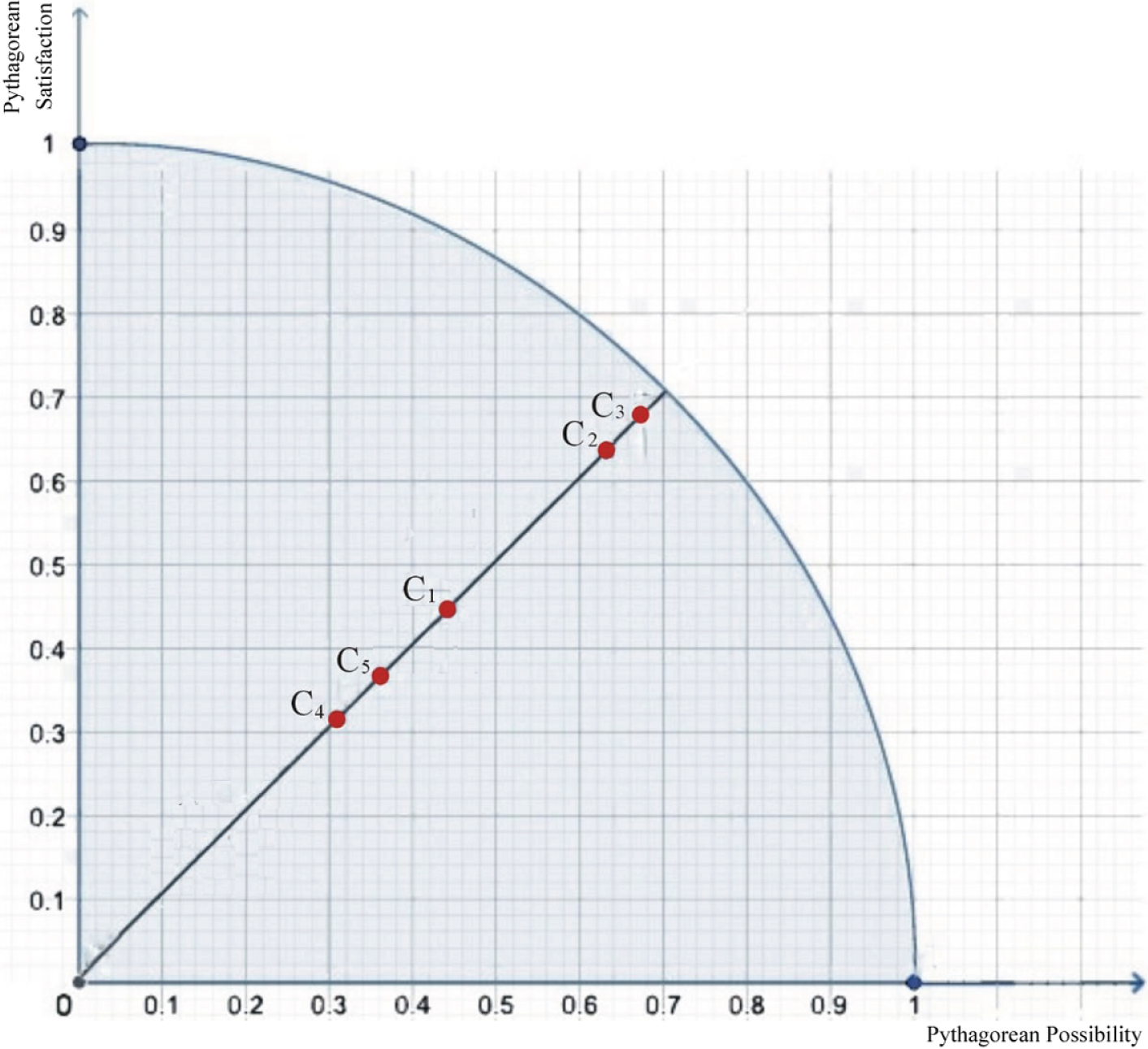
The optimal attractive point for A2.
Possible attractive points of each alternative
Payoff for attractive points
According to 3.11 to 3.24, it is clear in Table 6 that in first stage A3 has a maximum payoff, so, optimal alternative for first stage is A3, and in the eleventh stage the maximum payoff is 130, so, the optimal alternative for the eleventh stage is A1 . Therefore, the optimal alternative against each attractive points are A3, A1, A1, A2, A3, A1, A3, A3, A3, A3, A1, A1 respectively.
Zhang & Xu [28] presented TOPSIS (technique for order preference by similarity to ideal solution) for Pythagorean fuzzy sets. The following steps show the TOPSIS procedure:
Step 1: Let [(μ ij , ν ij )] m×n be a fuzzy decision matrix for the MCDM problem under the environment of Pythagorean fuzzy set. Let {A1, A2, . . . , A m } be the set of alternatives and {c1, c2, . . . , c n } be the set of criteria, where 1 ≤ i ≤ m and 1 ≤ j ≤ n.
Step 2: The TOPSIS technique depends on the rule that positive-ideal solution and negative-ideal solution. This methodology begins using the Pythagorean fuzzy sets for the positive-ideal solution and negative-ideal solution. To recognize the positive-ideal solution and negative-ideal solution, we use the score function for the comparison shown in definition 5. The PIS and NIS are denoted as
i = 1, 2, . . . , m and
i = 1, 2, . . . , m and
Step 3: The positive ideal separation matrix (S+) and negative ideal separation matrix (S-) are defined as:
and
where the distance between alternative and the positive ideal solution and the distance between alternative and negative ideal solution for the Pythagorean fuzzy set can be determined according to equation 2.2 as follows:
Here we will discuss the same case which has been discussed in section 5.
Step 1: The decision matrix shown in Table 3.
Step 2: We determined the Pythagorean fuzzy positive ideal solution and the negative ideal solution respectively, using equation 5.1 and 5.2. Therefore,
A+ = {(1.0, 0.0) , (1.0, 0.0) , (0.8, 0.4) , (1.0, 0.0) , (0.69, 0.5)} .
A- = {(0.43, 0.7) , (0.67, 0.5) , (0.6, 0.7) , (0.4, 0.8) , (0.25, 0.8)} .
Step 3: Positive ideal separation matrix and negative ideal separation matrix are determined using equation 5.3 and results shown in Table 7.
Results of Pythagorean fuzzy TOPSIS
Step 4: Moreover, we have determined relative closeness (RC) of alternative A i and results also shown in Table 7.
Step 5: According to RC (A i ), the optimal ranking of three alternatives are A2 ≻A3 ≻ A1, and therefore the best alternative is A2 .
A comparative study between the proposed method and TOPSIS is discussed and the analysis is that TOPSIS based on Pythagorean fuzzy PIS and Pythagorean fuzzy NIS, then rank the alternatives using relative closeness and select the alternative with the maximum value. In contrast, the proposed technique has two steps: the first is to determine the Pythagorean attractive points which are totally based on the payoff and the second step is to search out the alternatives with their attractive points and maximum payoff in the attractive points is the best solution. It means that this multistage decision-making method is more straightforward and more comfortable than TOPSIS. TOPSIS and proposed multistage technique deal with totally different ways to select the scenario. An alternative is to be examined by TOPSIS based on the relative closeness. TOPSIS does not consider the limitations of the behaviour of the decision-maker e.g; a decision might give the maximum payoff, but it might have such limitations that him/her can not choose it. Suppose advertisement on electronic media in the competitive environment could be the best solution, but the business can not afford such heavy cost. So, it needs to consider the possible alternatives. While on the other hand, in the proposed method, multistage decision making does discuss, evaluate and analyze the behaviour of the decision-maker. It considers not only the satisfaction on the best payoff but also the possibility of decision. TOPSIS uses the weighted function to deal with uncertainty which is not the real solution of the problem of uncertainty. If the optimal alternative is repeated a large number of times, the total payoff obtained almost indeed attains the maximum in the sense of the strong law of large numbers. In contrast, the proposed multistage decision-making process considers the possibility, not the probability.
The proposed method is introduced as the most beneficial for ranking the scenarios at each stage, but TOPSIS is never able to find out the capable ranking of strategies for multistage problems. Moreover, the proposed approach is relevantly proficient in ranking the alternatives by Pythagorean possibility and satisfaction function and it determines the best solution at each stage with action points. Clearly, the proposed method is highly useful for solving multistage decision-making problems with great flexibility. So, it can be declared categorically that the proposed approach would be a great addition to the field of decision-making.
Conclusion
In the family of a fuzzy set, the concept of a Pythagorean fuzzy set is comparatively innovative and has a high ability to catch inaccuracy enclosed in decision-making. In this article, the idea of the Pythagorean fuzzy set has been discussed in detail. The study shows that every Pythagorean fuzzy set is not IFS, but every IFS is a PFS. In the end, the application of the Pythagorean fuzzy set was conducted based on multistage problems.
The uncertainty is more linked with the market demand and proposed Pythagorean possibility function deals with it. In this regard, this is an effective and straightforward method. The obtained possibility distribution is the reflection of the expert’s knowledge of the demand for the new product associated with the attractive points in multistage problems. Subjective expected utility (SEU) is a lottery-based theory, whereas the proposed model is a scenario-based model which is totally different from the previous one.
A Pythagorean fuzzy set is proposed for the short life cycle product and optimal alternatives are determined in multistage decision theory. Twelve stages are introduced for the development of a businessman. At each stage, the businessman has to select one scenario from all the set of space according to the market situation which shows the attitude of the decision-makers. A sequence of Pythagorean attractive points is derived according to the situation and perspective of decision-maker. A track of decision alternatives is based on these Pythagorean attractive points.
In this paper, we examine the short-life cycle products model in the Pythagorean possibilistic distribution. Pythagorean multistage decision approaches are useful for the situations where a decision is made once and probability is not available because of insufficient information. Furthermore, it analysis that how short-life products vary between stages. The research on Pythagorean multistage under uncertainty has been discussed here. It opens up the gates for further research on critical and applied situations. Like as, Pythagorean multistage cases can be developed for the multiple attribute decision making based on q-rung orthopair fuzzy generalized mean operators [15]. A multiple attribute group decision-making approach based on multi-granular unbalanced hesitant fuzzy linguistic technique can be analyzed for multistage decision making problems [14]. Moreover, the proposed multi-stage decision theory can be used in fuzzy preference relations with self confidence [30].
Footnotes
Acknowledgments
The authors are highly obliged to the referees for the constructive, valuable comments and feedback along with the relevant information and suggestions which have really improved the manuscript.