



Abstract
With the development of “Internet+”, online auction platforms of used cars have emerged a lot. As a typical representative of the continuous purchase environment, online sequential auction of used cars faces many uncertainties, including uncertain revenue and risk. To describe them, adopting fuzzy theory to create mean-variance model to estimate the revenue and risk is showed in this paper. Moreover, three types of sellers, aggressive, conservative and rational sellers are analyzed respectively, and strategy models are built, where the multi-criteria optimal function for the latter one is adapted Cobb-Douglas production function. Then, a genetic algorithm based on fuzzy simulation is proposed through integrating the fuzzy simulation and 0-1 genetic algorithm, which can solve the models validly. Lastly, the practical example from Guazi website shows the optimal strategies derived by models can meet sellers’ demands, especially goals of both higher revenue and lower risk for rational sellers, which proves practicability of the model and validity of algorithm.
Introduction
With the development of “Internet+”, online auction platforms for used cars have emerged in large numbers. In 2019, the share of online trading takes account the whole used car market around 19%, with the sales volume online 30260000 [1]. The “Guazi” online used car auction platform established in 2015 and transaction turnover reached 37 billion [2]. Moreover, it covered 28 provinces, including 208 cities nowadays. The online auction website page of Guazi is shown in following (Fig. 1.) [3]:

Some details of Guazi website page.
Obviously, there is a hot issue in online used car auction, a typical representative in the continuous purchase environment, and bidders would obtain more surplus through sequential auction [4]. The issue that the auctioneers focus on how to make sequential auction strategy of different items, is to obtain a larger revenue or a lower risk. Consequently, the study of sequential auction strategy has important theoretical significance and practical value, owing to the online used car auction is hot in recent years [5].
Due to the uncertainty and complexity of the decision-making environment for different cars in used car auction, there will be various possibilities of transaction prices, when different auction sequences are adopted. Therefore, when the auctioneer lacks the bidder’s existing relevant information, such as the willingness to pay [6], how to make decisions on the auction sequence of cars with different values has become the research focus of sequential auction strategy. Salladarre et al. [7] used empirical research to show that even the same commodity, the price in one day would be affected by many factors and the abnormal price reduction phenomenon could occur, which indirectly indicating that the revenue brought by different items in different auction sequences also exists in great uncertainty.
The uncertainty of revenue generated by different sequence auction strategies is most directly reflected in the uncertainty of transaction price, which mainly derives from the following causes:
(1) Market uncertainty [8]: In the actual auction process, the market trend is ever-changing, and it is extremely difficult to obtain the accurate relevant information (valuation distribution that probability distribution function of price from bidders willing to pay and other information data) of current bidders.
(2) Information asymmetry [9]: Under different strategies or situations, the bidders’ bidding prices information will change, that is, the auction of the same item in different sequences will generate different revenue and risk.
(3) Competition degree uncertainty [10]: The uncertainty of the competition degree in the auction can’t be ignored, such as the auctioneer’s inability to accurately judge the competitive degree of the auction to be held, especially online channel [11].
These above risks and uncertainties are what auctioneers must confront during auction process. Therefore, auctioneers need to sequence the selling cars appropriately before auction in case of lower revenue or higher risk.
In addition, not each auctioneer is rational, owing they have different preference of revenue or risk, which can be represented by three types in detail including aggressive, conservative and rational sellers, respectively. Aggressive sellers would rather focus on maximal revenue than minimal risk, but the conservative sellers are converse. Rational sellers weight two goals and want to achieve better revenue with lower risk, therefore they would have their own preference of revenue and risk in some degree according to their actual situation in which includes the lowest acceptable expected revenue level and highest acceptable risk level. Former two types just pursuit single objective, as a result, have simpler solutions than the rational sellers do. How to make a sequential strategy that they can get higher revenues with lower risks is a difficult point in the current research, which is because no matter which sequential strategy is adopted, the auction will create great uncertainties. Therefore, how should sellers sequence their offerings to maximize their revenue or resist risk facing uncertainty [7, 12]?
Many literatures focus on the topic, but there also exist some limitations. Most of the previous researches on auction sequential strategy just focus on the bidder’s perspective of bidding strategy and purchase behavior. For example, the study on purchase order [13] considering budget constraint of the bidder, and the bidding decision considering behavioral preference [14] or whether to choose reservation [15]. Some researches on sellers, most consider identical products [16,17, 16,17], reverse auction (procurement) [18], or online clicking behavior of consumers [19]. Besides, lots of methods have been employed to study this. Baroudi et al. [20] used Pareto improvement to study dynamic multi-objective auction by proposing different approaches to solve the multi-objective optimization problem including heuristic methods. Kim et al. [21] adopted fuzzy regression model through trapezoidal fuzzy numbers to establish a statistical model that deals with the number of bidders participating. However, the study on the uncertain revenue of different used cars caused by different auction sequential strategies from the perspective of auctioneer has been rarely discussed, especially using fuzzy theory.
Moreover, some researches of using fuzzy theory on online deal problems mostly used fuzzy sets like interval-valued sets [22, 23], or used fuzzy data envelopment analysis (DEA) [24], but without involving fuzzy research on the yield generated by auction in different sequences. Based on fuzzy set theory and multi-objective decision theory, Wu et al. [25] introduced fuzzy multi-objective people decision-making evaluation methods with focusing on engineering bidding. Yang et al. [26] proposed an online support model using deep-learning-based opinion mining and q-ROFIWHM operators for buyers.
To address the above mentioned uncertain problem for auctioneer, we refer to the methods of fuzzy theory and data processing, which was used in many areas such as multiphase portfolio revenues, risk of uncertain research and so on [27–29]. For expected values of fuzzy variables, Liu et al. [30] has proposed the concept. Similarly, in this paper, the uncertain revenue of a car auctioned in a certain sequence is defined as a fuzzy variable, and the uncertain revenue (mean) and uncertain risk (variance) of the cars auctioned in a corresponding sequence are obtained. Therefore, we adopt mean-variance model to carve three different strategies and design a multi-criteria approach to optimize decision of different type sellers.
In detail, different from the Cobb-Douglas production function used by Liu et al. [31] to select bidders’ utility and winning preference, we mainly analyzes the two objectives of maximizing revenue and minimizing risk. Then, based on fuzzy theory, models of sequential auction strategies made by aggressive, conservative and rational sellers are established, SAMM, SAMV and SAMR, respectively. Furthermore, the 0-1 genetic algorithm based on fuzzy simulation is proposed to solve the models. In particular, for rational strategy, the multi-criteria 0-1 genetic algorithm is employed. Moreover, to better solve practical issue, we crawled data from Guazi website including Audi, BMW, Mercedes-Benz, Accord, Volkswagen, TOYOTA, Ford and NISSAN.
The main contribution of this research is summarized as follows: (1) Different from many researches on used cars in online sequential auction, our work focused on the view of seller but not buyer. (2) Based on the mean-variance model of the seller, three optimization models were supposed to solve the uncertainty of deal prices, after considering two important criteria of revenue and risk. (3) The genetic algorithm based on fuzzy simulation was proposed to solve the multi criteria models. (4) The actual data are crawled from Guazi website including eight different types of used cars, which is the basis of showing the effectiveness of models and algorithm.
The rest of the paper is organized as follows. Section 2 reviews the preliminaries about fuzzy variables and credibility theory. Section 3 gives explicit expressions for different types of sequential auction strategy model based on fuzzy theory. Section 4 introduces fuzzy simulation and genetic algorithm. Section 5 presents practical problem from Guazi website to demonstrate the effectiveness of our proposed algorithm. Section 6 concludes the paper and provides suggestions for sellers.
Let Γ be a nonempty set, p (Γ) be its power set [32]. Each element of p (Γ) is an event. Credibility measure (Cr) is a set function of p (Γ) as Cr ∈ [0, 1]. Previous researchers [30, 33] established a complete fuzzy theory by putting forward the concepts of fuzzy variable and expected value operator, so as to provide a theoretical basis for handling fuzzy variables.
When Cr serves as a credibility measure, we consider the triple (Γ, p (Γ) , Cr) as a credibility space. If a fuzzy variable ω is a function from a credibility space (Γ, p (Γ) , Cr) to the set of real numbers
where
Fuzzy sequential auction strategy models
Auctioneer has n different used cars, and wants to complete the whole auction in T sequences. Auctioneer decides to sell car i, (i = 1, 2, . . . n) in t, (t = 1, 2, . . . T) sequence. His decision can be described as decision variable x it , x it ∈ {0, 1}, which means car i will be sold in t sequence if x it = 1, otherwise x it = 0. We use fuzzy variables ω ij to represent the uncertainty caused by the decision, i.e. the uncertain revenue of selling car i in t sequence.
The revenue of selling car i in t sequence is:
And the revenue in the whole auction is:
According to Equation (2), we can know that total revenue w T is also a fuzzy variable, owing w T is the function of fuzzy variable ω it . Therefore, we need to calculate the expectation value E (w T ) and risk (variance) V (w T ) of total revenue w T by fuzzy simulation algorithm.
However, there is a common rule in trading markets: the higher the return, the higher the risk. That is, high return and low risk are hard to achieve simultaneously. Therefore, as to different degree of concerning revenue and risk, we divide sellers into three types: aggressive sellers, conservative sellers and rational sellers. As for aggressive sellers who care more about the total return, the sequential auction maximal mean model (SAMM) can be formulated as
For conservative sellers, as long as the return is not less than the expected return level, the most important concern is to minimize the risk. The sequential auction minimal variance model (SAMV) can be formulated as
For rational sellers, they want to pursue both goals of maximum revenue E (w
T
) and minimum risk V (w
T
). We propose the sequential auction multi-criteria strategy (SAMR) model. To weigh the importance of the two goals according to actual situation of sellers, we use Cobb-Douglas production function [31]. Assume that the lowest acceptable expected revenue is a, the highest acceptable risk is b, the strategy function F is
The first constraint and second constraint describe the requirements that the revenue is not less than lowest acceptable expected revenue level a and risk does not exceed the highest acceptable risk level b, respectively. The others are same as two above models.
In this section, we present the processes of Genetic Algorithm (GA) for solving the fuzzy sequential auction strategy models. Specifically speaking, we employ fuzzy simulation technique [35] to approximate the values of E (w T ) and V (w T ), and integrate fuzzy simulation and GA to tackle the proposed optimization problem.
To solve the above models (SAMM, SAMV and SAMR), fuzzy simulation algorithm is adopted to calculate E (w T ) and V (w T ). Then the 0-1 genetic algorithm is used to solve the objective function.
Stochastic fuzzy simulation algorithm (FS algorithm)
Fuzzy simulation is the process where we can get value of the credibility measures of
The decision variables can be denoted as
Firstly, we have random N vectors as
Secondly, according to Definition 6 and Definition 7, for the sake of the approximation of the values of E (w
T
) and V (w
T
), we need to approximate the credibility functions Cr {w
T
(
Then according to the Definition 4, we set Cr {w
T
(
Therefore, the mean value and variance of fuzzy variables are calculated by FS algorithm. Details are shown in the Table 1.
Fuzzy simulation process
Fuzzy simulation process
Lastly, the value of V (w
T
) can also be approximated by the above processes except replacing ι and ρ by
Guo et al. [27] proposed integrating the fuzzy simulation algorithm and genetic algorithm to solve the fuzzy problem of multi-phase portfolio, which was also adopted by many scholars. Therefore, this paper will integrate the fuzzy simulation algorithm and the genetic algorithm of multi-criteria to solve the sequential strategy problem of multi-criteria fuzzy random uncertainty sequential auction. The following is the procedure of genetic algorithm. initialization Encode decision variable ( Fitness function We design fitness function to assign a probability of reproduction to each chromosome in order to make its likelihood of being selected proportional to its fitness relative to other chromosomes in the population. Only by constantly selecting the better chromosomes can we get the results we want in the continuous evolution of the population. For convenience of calculation, we directly select the target function as fitness function and consider the real part of the result. The fitness function is
Crossover process We use crossover process commonly in order to generate one more population. In detail, two individuals were randomly selected from the population of n individuals firstly. Secondly, each of them was reorganized in reverse order to generate two new individuals. Thirdly, the process was repeated until the amount of new individuals reached 2n, and merged 2n with the original population into the size of 3n. Fourthly, the individuals who satisfy the constraints are formed into the new population (newfarm), and calculated each fitness function values of all individuals. Lastly, select the individual whose function value is the largest, and copy it twice to randomly replace two individuals of new population (newfarm). We show the process in Table 2. Mutation We denote parameter pm as the probability of mutation, and r as the random number in [0, 1]. If pm > r, any chromosome in i individual mutates to 1, otherwise 0. Then through judging the constraints, only the eligible individual can replace the i individual, which shows as Table 3.
Crossover process
Crossover process
Mutation process
From the Guazi website of auctioning used cars shown in Fig. 1, generally, only 8 cars can be exhibited at the same time. Therefore, we assume that in one used car auction, the auctioneer has 8 different used cars for sale, which will take 8 sequences to complete the whole auction. We crawled data from Guazi website to get prices of different used cars [3], including Audi, BMW, Mercedes-Benz, Accord, Volkswagen, TOYOTA, Ford and NISSAN, respectively. The details of these cars are shown in Table 4.
Details of different used cars
Details of different used cars
Besides, triangular fuzzy number is used to characterize fuzzy variables. Though crawling data appeared in April 4, 2020 from website, we approximatively calculated the triangular fuzzy number (a
i
, b
i
, c
i
). According to historical data of cars, we assume the interval [d
j
, dj+1], j = 1, 2, . . m includes all data. q
i
denotes the frequency of prices appeared in [d
j
, dj+1] [27, 36]. The details of the triangular fuzzy number (a
i
, b
i
, c
i
) can be written as:
Moreover, the lowest acceptable expected revenue for an auctioneer is a = 100, and the highest acceptable risk is b = 60. In addition, we assume the auctioneer’s decision about the weights about degree of his preference for expected revenue and expected risk according to his actual situation are α = 0.8, β = 0.2, respectively. The fixed advertising fee is c = 3000 yuan.
Eight different used cars will generate different fuzzy variables in different sequence of auction. The list of triangular fuzzy numbers is shown in Table 5, and the mean value and variance according to fuzzy simulation algorithm, are calculated and shown in Table 6.
The triangular fuzzy number of fuzzy variables (Unit: 10000 yuan)
The triangular fuzzy number of fuzzy variables (Unit: 10000 yuan)
Mean value and variance of fuzzy variable (Unit: 10000 yuan)
The maximal revenue strategy of SAMM is MaxU (7, 2, 2, 1, 8, 8, 1, 7), which means the first car sells in seventh sequence, the second car sells in second sequence, and so on. Its objective function value is MaxU (f) =118.04, where the expected (mean value)is E (w T ) =118.04(Unit: 10000 yuan), and expected risk (variance) is V (w T ) =59.43. The iterative process of fitness function in solution process is shown in Fig. 2.

Convergence curve of optimal fitness function in SAMM.
The minimal risk strategy of SAMV is MinR (7, 3, 8, 0, 8, 6, 2, 7), and its objective function value is MinR (f) = -49.31, where the expected (mean value) is E (w T ) =101.1 (Unit: 10000 yuan) and expected risk (variance) is V (w T ) =49.31. The iterative process of fitness function in solution process is shown in Fig. 3. In the optimal strategy, the conservative sellers directly give up the sale of fourth car to get lowest risk.

Convergence curve of optimal fitness function in SAMV.
The sequence of strategy for rational seller from SAMR is BothS (7, 3, 8, 5, 8, 6, 2, 7), and its objective function value is BothS (f) =28.4424, where the expected (mean value) is E (w T ) =114.05 (Unit: 10000 yuan) and expected risk (variance) is V (w T ) =55.52. The iterative process of fitness function in solution process is shown in Fig. 4.
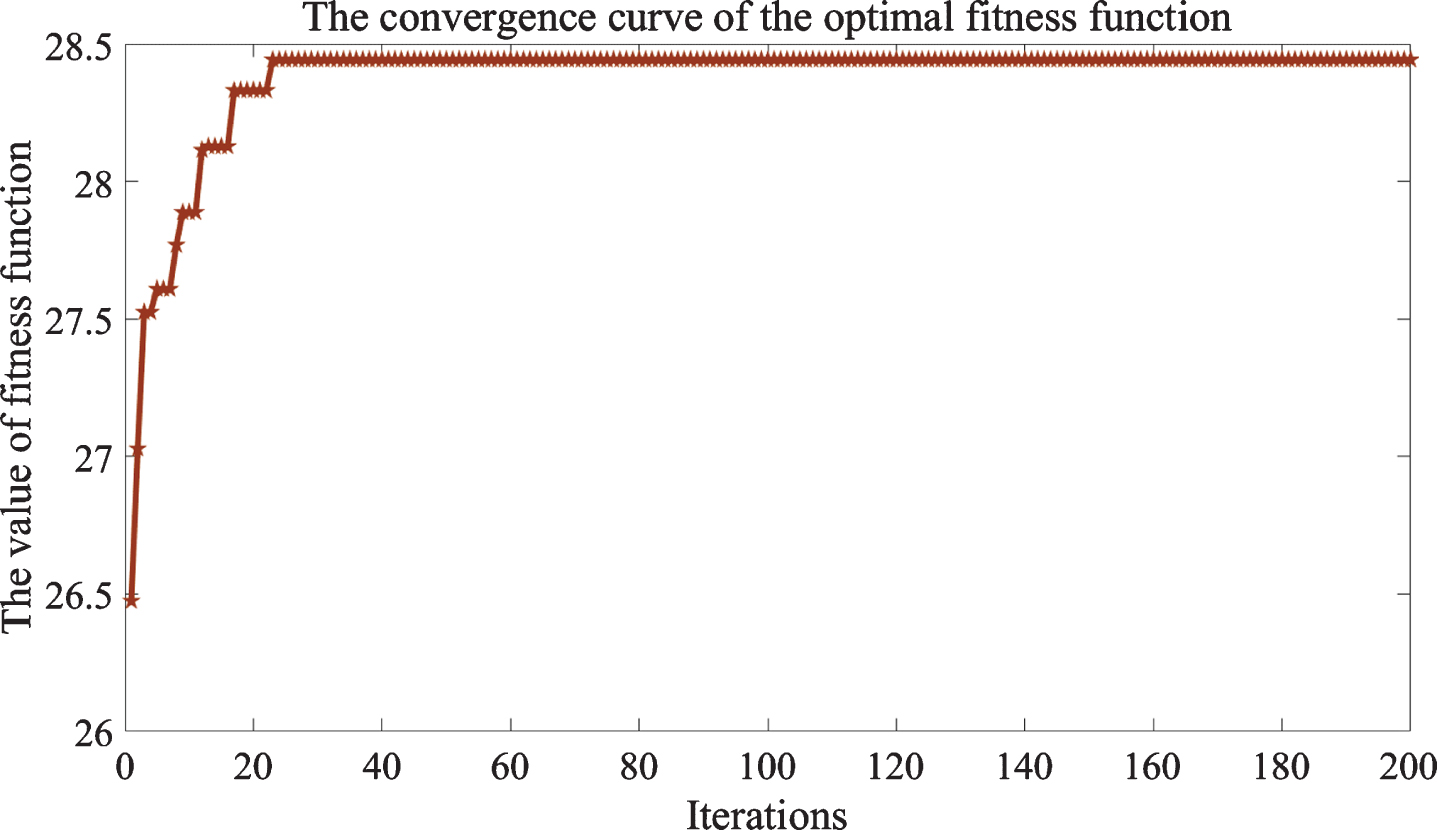
Convergence curve of optimal fitness function in SAMR.
Obviously, the revenue of SAMM is biggest but the risk is same highest, which shows aggressive sellers would rather focus on revenue maximum than risk minimum though facing much uncertainty. Constraint by the lower accept revenue, the conservative sellers struggle to pursuit minimal risk, V (w T ) =49.31, the lowest risk among three type sellers. However, his revenue in SAMV is just meeting the lowest requirement. In SAMR, the rational sellers can weight both goals and get better results, with the advantages of meeting risk constraint and more revenue. The revenue is little lower than SAMM with much lower risk and the risk is litter higher than SAMV with much higher revenue, which means rational strategy solved in this paper can effectively guarantee higher revenue under lower risks.
According to the strategy of eight different brand used cars from above analysis, some suggestions are given for sellers:
(1) According to their own types, choosing one strategy among three different models is optimal for pursuing their revenue after considering uncertainty based on acceptable risk level or acceptable expected revenue level.
(2) Different preference of revenue and risk causes different type sellers, who can find optimal strategy from our model. As for aggressive sellers, maximal revenue strategy of SAMM inspires them to put cars that have higher value forward or back. However, once emphasizing risk, conservative or rational sellers should actively adjust the sequence different from aggressive type.
(3) Among the three strategy, we can see that the sequences of Audi-a4l (Audi), golf (Volkswagen) and xuanyi (NISSAN) not change, which means they can bring stable revenue, i.e. they have higher revenue with lower risk than other category cars. Sellers can choose to sell more cars like above three category.
In conclusion, using fuzzy theory to describe uncertainty can better evaluate the uncertainty of revenue and risk, and support the auctioneer to make better strategies.
This paper proposes optimization models of revenue or/and risk for three types of sellers, which provides a better auction sequential strategy for auctioneers and guarantees different expected goal, including the higher revenue with lower risk. The main conclusions are as follows.
(1) Models about different types of sellers (aggressive conservative and rational) are analyzed in online sequential auction of used cars based on fuzzy theory, including maximal revenue, minimal risk and both simultaneously required. In particular, Cobb-Douglas production function is employed to help rational auctioneer make sequential strategy that meets two goals.
(2) Integrating fuzzy simulation technique and (multi-criteria) 0-1 genetic algorithm, we use MGA-FS algorithm to tackle SAMM, SAMV and SAMR models. The MGA-FS algorithm is effective and valid, which is presented in practical numerical example from Guazi Website.
(3) The results of example analysis show that the optimal strategy obtained by SAMR model has higher revenues with lower risks comparing to other strategies. In detail, the revenue of SAMM is biggest but the risk is also highest, which shows aggressive sellers would rather focus on revenue maximum than risk minimum facing much uncertainty. Constraint by the lower accept revenue, the conservative sellers struggle to pursuit minimal risk, the lowest risk among three type sellers. However, his revenue in SAMV is just meeting the lowest requirement.
To sum up, the model and algorithm proposed in this paper provides a new theoretical perspective for the sequential auction strategy in used cars sequential auction and provides decision support for the seller to make the sequential strategy.
In addition, some limits are also in our study, like just considering triangular fuzzy numbers and needing to classify different brands of cars. In future, big data technology can be employed to solve real-time actual problem. Adding the constraints of sequence cannot be empty is also important for actual strategy, which should be emphasized in following work.
Footnotes
Acknowledgments
The work is supported by National Natural Scientific Foundation of China (No. 71771181). We are very grateful to the editors and referees for their careful reading and constructive suggestions on the manuscript.