



Abstract
The emerging technologies with IoT (Internet of Things) systems are elevated as a prototype and combination of the smart connectivity ecosystem. These ecosystems are appropriately connected in a smart healthcare system which are generating finest monitoring activities among the patients, well-organized diagnosis process, intensive support and care against the traditional healthcare operations. But facilitating these highly technological adaptations, the preserving personal information of the patients are on the risk with data leakage and privacy theft in the current revolution. Concerning secure protection and privacy theft of the patient’s information. We emphasized this paper on secure monitoring with the help of intelligently recorded summary’s keyframe extraction and applied two rounds lightweight cosine-transform encryption. This article includes firstly, a regimented process of keyframe extraction which is employed to retrieve meaningful frames of image through visual sensor with sending alert (quick notice) to authority. Secondly, employed two rounds of lightweight cosine-transform encryption operation of agreed (detected) keyframes to endure security and safety for the further any kinds of attacks from the adversary. The combined methodology corroborates highly usefulness with engendering appropriate results, little execution of encryption time (0.2277-0.2607), information entropy (7.9996), correlation coefficient (0.0010), robustness (NPCR 99.6383, UACI 33.3516), uniform histogram deviation (R 0.0359, G 0.0492, B 0.0582) and other well adopted secure ideology than any other keyframe or image encryption approaches. Furthermore, this incorporating method can effectively reduce vital communication cost, bandwidth issues, storage, data transmission cost and effective timely judicious analysis over the occurred activities and keep protection by using effective encryption methodology to remain attack free from any attacker or adversary, and provide confidentiality about patient’s privacy in the smart healthcare system.
Introduction
Nowadays connectivity of the smart devices has enhanced their worldly presence with the ecosystem of Internet of things which is well-known as a classification of ubiquitous computing. The main purpose of the expanding network edge enabling with these smart devices as an IoT system to replace direct user engrossment by connecting and employed various sensor enable mechanism to restrict each possible human interaction [1–4]. The various types of application which is associated as a built-in sensor based intelligent system that are handling various crucial task in the field of smart healthcare (SH), construction of smart cities (SC), smart wireless multimedia sensor networks (SWMSN), efficient self-driving vehicles (SV), drone monitoring (DM), advanced monitoring on farm animals (AMFA), efficient smart homes (ESH), automobiles invention setup (AIS), highly organized smart transportation system (HOSTS), behavior monitoring system (BMS) and crop monitoring system (CMS) etc. [5–11]. These extensive researches innovate a high capacity processing skill set such as operational intelligent IoT ecology that is eloquent of communicating environs. Wireless multimedia surveillance networks are highly contributor in the IoT enabled ecosystem which have vast implementation of visual sensor data in terms of uniformly determining each possible non-stop apprehending visual images. Due to always running these processes and generating mammoth multimedia data as a result stablishing enormous redundant visual data in the system [12–19].
Concerning great amount of available visual data which is a kind of redundant visuals in any intelligent setup, a consensus comes from the researchers that it would be required most relevant and meaningful information processed throughout the monitoring system. In this way, it is essential as a best possible way that the recorded visual information should be used to deal forthcoming related activities like tracing behavior, diagnosis process, activities of the operation theater, behavior capturing from the staff (Nurses and Doctors) to the patients, tracing equipped highly hygienic facilities which is monitoring throughout each section in the smart healthcare system. Recognizing every measurement to capture each possible event whether its normal or abnormal behaviors, the optimum emphasis followed with accurate detection with best organized methods as a supervision of video abstraction. The high objective for fulfilling better approach is to reduce whole transmission and try to transfer meaningful information regarding context because transferring whole visual data by any communicating medium before dealing out is not more appropriate any way. It can be containing vast consumption of energies and bandwidth for any transferring data. Additionally, these things are tough, very problematic, time consuming among the specialist to deliver verdict as well as action-oriented intelligence against extracted high volume monitoring visuals data [20].
Therefore, it is highly essential to engage such types of approach or machinery that can collect every individual valued data by incorporating highly optimized skills set with better communicating capabilities in the smart IoT sensors. The best quality works in these methodologies are appropriate intelligent selection of visual information by using multiple views that are captured most relevant, informative data in the real-time. These data should accurately transfer to the authority for the forthcoming usage. Additionally, the quick action is the most importance by the specialist at the time of investigation among the giant volume of informative visuals. Therefore, a conventional approach of secure monitoring is showing on Fig. 1. This methodology is capturing every critical aspect with accurate detection of each materialized activities absolute intelligent way and approaching real-time to the concern authority with promptly action taken in the entire system. Using this approach, a disciplined robustness performance and resource utilization is achieved. That is the key aspect when dealing with any type of smart monitoring system in the form of (WMSNs) wireless multimedia sensor networks through well-organized incorporation of visual sensors in specially difficult time to resolve operational, technical and human malfunctioning defects [21, 22]. Concerning behavior of visual transmission from base station (BS) to visual processing hub (VPH) vice versa in the wireless atmosphere as WMSN. The way of these communication is highly vulnerable and needs huge security threads accordingly, it is enormously endorsed that each visual information as a keyframe data can be secure manner handover to base station as a highly secured guided approach without any alteration from unrecognized (unauthenticated) parties. Additionally, it (utilized devoted communication) is supposed to face problem of highly congested (jammed) spectrum sharing approach in the WMSN ecosystem.
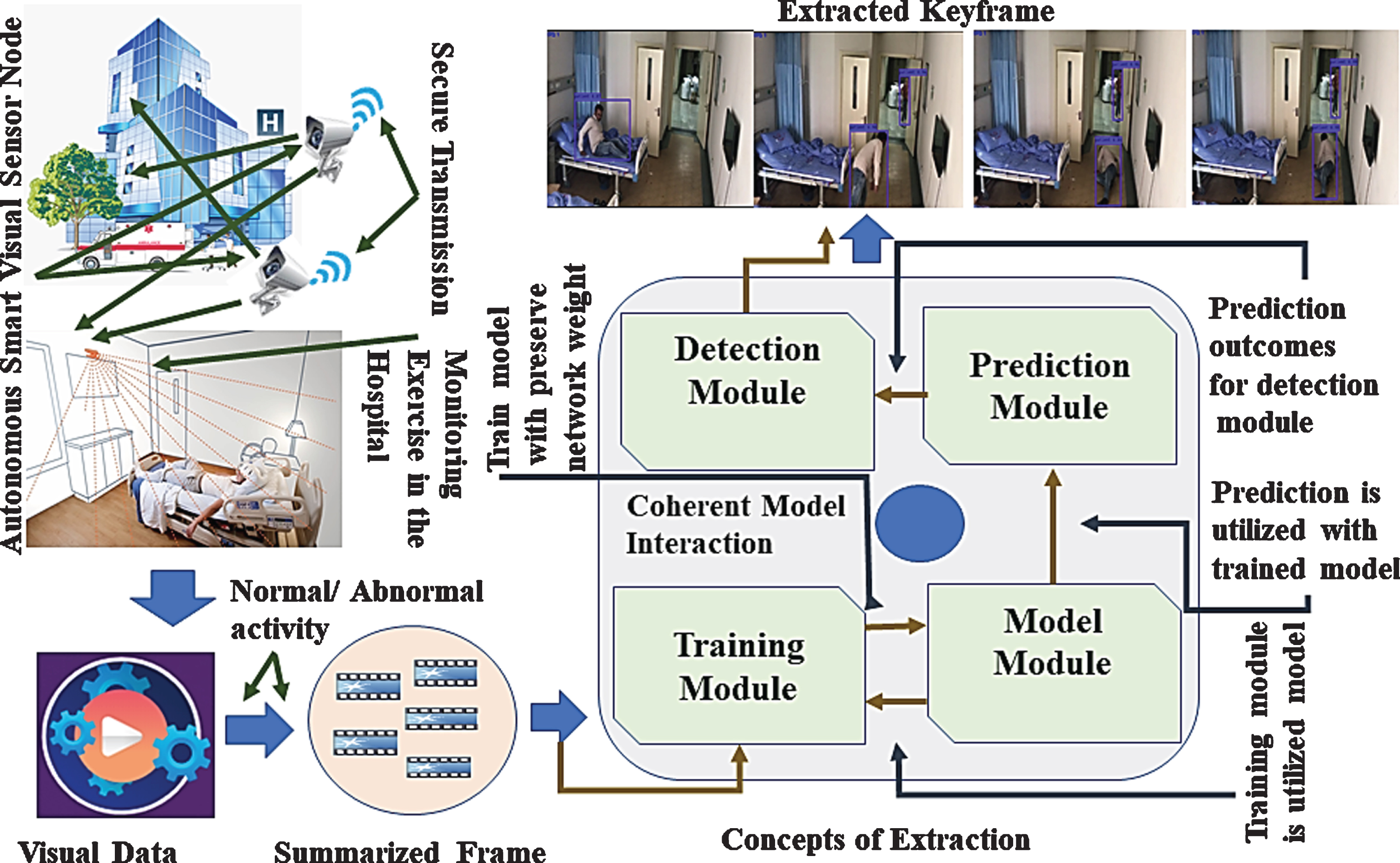
Model of extraction with visual stream data.
Furthermore, the produced article is emphasized to overcome above highlighted problems with accumulating intelligent as well as efficient approach which can handle by incorporating better way with gathering most relevant data in the real-time and quick action-oriented approach against happened any activities. Accumulating these things, our approach can be highly capable for reducing transmission cost and whole consumption among the congested bandwidth. Additionally, our approach has prime objective to enrich highly adoptable security prototype. Concerning security prototype this approach is taking special measure in each type of care, related protection of WMSN with upgraded utilization in the direction of managing authority. Technically our approach has stimulated encrypted keyframe before transferring extracted keyframe as a cipher encrypted keyframe data to the concern authority to remain high-rate of security and privacy for the protection from any adversary or human interruption in the smart healthcare system.
The conceptual contributions of this research article are enumerated as follows: We propose efficient secure surveillance on smart healthcare IoT system through cosine-transform encryption. This approach is applied initially to extract meaningful (most relevant information) keyframe from summarized video in model of extraction keyframe. Further, plotted a regimented lightweight cosine-transform encryption methodology over the extracted keyframes for dominant robust security feature to restrict any attack from adversary. The approach is pragmatic amalgam technologies with python, TensorFlow and lightweight YOLOv3 intended for extraction. The simulated work of cryptography is produced by using MATLAB. The produced result and its security analysis with discussion are certified that our approach is highly capable to reduce cost of transmission and its efficiency of ingesting bandwidths. The outcomes of this research countersign the imperatival appearances of the patients’ data privacy with applauding encrypted cipher keyframes to restrict attack. This research work is also agreed and withstand to many rigorous security threads.
Further this article is introduced as follows. Section II has expressed preliminaries regarding monitoring system, smart healthcare conceptual system, video summarization and encryption methods of color image. Section III has applied a highly effective secure monitoring approach aggregation with executed lightweight cosine transform encryption approach. Section IV has inspected the aforementioned experimental setup and comparative discussions. Section V has briefly come across frequent rigorous security scrutiny with using every conceivable secure parameter. At the last section, Section VI is concluding professionally complete work and future perspective research direction.
Current advancement with the research and development in the area of WMSNs is stablishing an IoT based ecosystem. In which a smart healthcare system is the best example as a well-organized and promotes premium practices associated with hospital management to provide security, safety and patient privacy. That is serving to ensure confidentiality and scrutinize as a visual intelligence with effective encryption methods which can authorize the competence as well as genuineness of the designated approach to protect patient’s confidential data and health safety measure. Although giving satisfaction to human lives, the gigantic monitoring reflects challenging job of expenditure of valued time as well as picking footage required energies. Consequently, needs appropriate way of some methodology which deliver most meaningful data in terms of video summary and extract most relevant keyframe within contained video summary as a substitute of observing all the monitoring visual data. These days video summary is gained enormous coverage due its suitability and efficient adaptation in the technologies for reducing energy constraints and bandwidth. Concisely it can be understood, its assistances to shorten long videos or numerous images like video skimming or static storyboard.
Hussain et al. [23] explained how to incorporate video summarization in case of multi-view environment. He is enforcing his idea to implement video summarization with supporting his logic about to reducing redundant part of the data by employing this technique. Furthermore, he counted advantages as well as some disadvantages in his detailed survey article. Regarding video summarization and multi-view video summarization (MVS) concepts [24, 25] had also optimized on the convolutional neural network and deep neural network framework. These two approach are claiming highest keyframe recording score [24] and two-tier concept to espouse soft computing progression [25]. Khan et al. [26] addressed that summarized videos can be distributed via secure networks to wireless sensor nodes and I can be optimized through blockchain technology to avoid data exploitation and to validate each transmitted data as a outcomes. He emphases on various keyframe extraction steps from a video accompanied by safe and trustworthy user transmission. His framework allows users to summarize the criteria of video constructed on humans and things. With blockchain, cryptographic hashes are utilized, hashes are created, certified then distributed via blockchain from summarized video frames. Ma et al. [27] reported as neighboring objects are visually analogous, in comparison to sparse presence, participant keyframes also appear in sequential blocks. A block-sparsity of applicant keyframes is factored into the equation, formulating the VS (video summarization) challenge as a block-sparse modelling approach for the corpus. In addition, including model optimization, a continuous block edition of the OMP (orthogonal matching pursuit) methodology is intended. Within each block, two keyframe implementation process are also investigated. Rani et al. [28] projected The methodology of social media description focused on multi-visual function fusion and the self-organizing map of Kohonen. In order to improve the efficiency of key frame retrieval, both color as well as structure-based functionalities are utilized. Due to energizing circumstances, an adaptive mechanism is used to accommodate incremental shifts. To equate the projected method with the current methods, reliability and SRD (shot reconstruction degree) factors are incorporated.
The cryptosystem based on encryption methods among the digitally produced images are varied at the nature of the images such as color or gray images. Encryption over gray scale images are competitively easy due to one plane but it would be difficult to operate over color scale images because it is comprised three color channel red, green and blue. The operation of digital security concerning encryption methods are huge problem. It somehow limits the IoT based ecosystem but the modern approach of the security patterns is always providing new concept of existence with wider acceptance of IoT based secure services. Roy et al. [29] conveyed his thought about key sensitive areas such as smart healthcare, defense or critically trusted area cannot bear the loss when using conventional approach to operate their need. Furthermore, addressed about use of IoT with his developed cellular automata (CA) grounded encryption method due to its intrinsic simplicity and easily implementation without disturbing competence to produce random pattern. The justification given by [29] that the approach Von-Neumann cellular automata is lightweight, lossless, robust and correlation immune characteristics comprises. Yildirim et al. [30] incorporated chaotic system with operational transconductance amplifier constructed memristor for producing image cryptography. In his approach, he showed better security feature to defend his thought with satisfying remarks over the security analysis. Junchao et al. [31] reported quantized logistically constructed stream map encryption over the wireless body area networks (WBAN). The ecosystem surrounded with WBANs are highly devoted to spread as well as dealing out human-development of biomedical evidence. In this concept the adopted mechanism is followed with execution of chaotic oriented encryption. Furthermore, the produced outcomes relate with the advantages among the relatively secure objectives and defense mechanism.
Xian et al. [32] uniquely proposed a classification of geometric-characteristic processing matrices, called the fractal sorting matrix (FSM), and presents its process of iterative measurement. Scrambling images or statistical information upon that nearest centroid of geometries, for particular, will effectively boost the security of the encryption system. Then, through two chaotic series, this paper introduces a new universal pixel diffusion technique that provides excellent security as well as better encryption performance. He develops a somewhat more effective and stable chaotic cryptosystem than many other methods, relying upon this FSM as well as general unpredictable pixel distribution. The optimization model becomes quicker but also has a better passing rate compared to local Shannon entropy with others work. Liu et al. [33] reported revolutionary 3D enhanced coupling quadratic map (3D-ICQM) is built inspired by the original quadratic map including numerous bifurcations as well as intermittent streams. It has been shown to have greater ergodicity, further complicated nonlinear behavior, greater chaotic variety with improved randomness. 3D-ICQM oriented color image encryption scheme with the rounded key extension is conducted to explore it being used in cryptography. The hash function including its preceding round’s preliminary cypher is translated through fresh initial condition to further increase the unpredictability of the stream cipher as well as delivered directly through 3D-ICQM to produce that key stream for latest session.
Haider et al. [34] projected a cryptosystem which is relayed on elliptic curves image encryption. The description of this approach is targeted three step incorporation. Firstly, the process utilizes the specific invertible elliptic curve form throughout a prime area as well as fumbles image’s pixel location. It therefore diffuses the intra-correlation between the pixels of real image as well as therefore is willing to defend the mechanism from numerous statistical attacks. Secondly, using some invertible elliptic curves, that strategy produces several S-boxes containing better cryptographic characteristics. The S-boxes created are being used to replace the fragmented information which causes optimal uncertainty throughout the encrypted data. Ultimately, via the mathematical operations including its elliptic curves rather than elliptic curve community policy, the encryption method produces PRNG; this method used throughout the framework creates significant unpredictability as a consequence of their suggested technique showing high protection towards traditional attacks. Vijay et al. reported principles of DNA cryptographic are used including the chaotic method of Lorenz-Rossler as well as 2D logistic sequences. Utilizing DNA cryptographic primitives, the suggested solution encrypts RGB files. Throughout the diffusion stage, a chaotic mechanism of Lorenz and Rossler is being utilized into pixel level to encode the three sampling image channels. Subsequently, on those kind of magnified red, green, and blue streams in confusion step, the bit-wise unstable ponytail method is incorporated at bit level 2-D logistic pattern. Hamza et al. [35] expressed and recommend a rapid probabilistic cryptosystem to protect biomedical keyframes using a prioritization approach derived from the wireless capsule endoscopy technique. In the cryptosystem ‘s encrypted images reveled unpredictable actions, ensuring computation time with the maximum degree of protection for keyframes toward different outbreaks. In addition, it conducts health information avoiding exposing any data, thereby protecting the privacy of the patient by enabling decryption only through approved users.
Hua et al. [36] addressed a well incorporated method to assemble different types of chaotic pattern as a mix combination and generated rich sequences to operate in the encryption process. Furthermore, he incorporated some scrambling method and substitution approach to adjust his encrypting behavior and produced encrypted cipher matrix. His incorporation based on better adjustment with generating complex sequences and collective encryption method. The experiments and results are also showed that quite well design and generated outcomes received. Hamza et al. [37] suggested a system which based on the video summarization with WCE. The process followed with this method is initially used a framework for the video portrayal and extraction. Furthermore, used a well-known chaotic pattern to incorporate a better cryptosystem and generated outcomes which is already satisfying towards security and privacy of received keyframe data matrix. Hamza et al. [38] explained a mechanism which can incorporated a better cryptographic approach at the same time equipped with monitoring process. In his method, initially processed a lightweight approach which can efficiently retrieved keyframe from the monitoring. Then further, operated relative enhanced method to support well in terms of cryptography to protect keyframe at quite well space. Faragallah et al. [39] incorporated 2-D fractional Fourier transform (2-D FrFT) as well as 2-D logistic mapping (2-D LM), an accurate with stable opto color image cryptosystem. Two uncertainty phases in time were used for the suggested opto 2-D LM-based 2-D FrFT color matrix cryptosystem as well as 2-D FrFT optical-based incorporating 2-D LM for RGB images. In relation to dual pseudo-random masks, the cryptography mechanisms are improved by using the 2-D-FrFT edges as well as instructions as additional secret key. Looking at recent state-of-the-art in the same domain, the simulations results showed an increase in the supremacy of the suggested opto 2-D LM-based 2-D FrFT color-image cryptosystem.
Zhou et al. [40] expressed with a quite high degree of security, as well as composed of two very closed orbits of chaotic structures, a generalized color scheme image encryption method. Firstly, utilizing plaintext, the preliminary value of this 1-D chaotic systems is extracted. After which, to produce three recent chaotic patterns, received two very closed orbits of 1-D chaotic maps. After that, the RGB elements of the color space are simultaneously encrypted by the created schemes. Ultimately, to achieve the required encrypted data with the combination of each encrypted color frame. Khan et al. [41] introduced an image encryption with the efficient lightweight for the minimal computational operation over the execution. The presented scheme originally divides the plaintext image into a number of frames and afterwards calculates the composite reliability of every other row. Pixel-wise XOR operated with the random data created with the incorporation of skew tent map centered on an optimum verge value is the block by means of highest correlation coefficient outcomes. Finally, through two random iterations created by beginning TD-ERCS chaotic systems and entire image is allowed to encryption. Enayatifar et al. [42] reported 3-D logistic pattern with deoxyribonucleic acid (DNA) pattern operation and incorporated image encryption methodology. The 2-D real image information is transformed towards 1-D to develop the projected technique. Afterwards, permutation as well as diffusion measures for every pixel are recorded simultaneously to decrease the sending processing time. In order to transpose a pixel, the permutation stage practices chaotic pattern as well as DNA, whereas diffusion practices DNA classification at last with the incorporation of DNA encryption process happen to encrypt the pixel. The proposed approach of this article is followed with an enhanced advance study of our previous work with the distinctive additional security analysis and some operational modification to produce less computational overhead and perform faster encryption outcomes [43].
Proposed work
The autonomous standardized monitoring is rising with the improved creation and advancement of visual sensor technologies. This development is fetching highly enhanced managing tools and technique that can easily analysis digitally adapted world with the snowballing network which is prominently known smart healthcare system. These ecosystems are well enabled and the capability of autonomous intelligently collaborated work in the real-time scenarios of the visual contents. VSN (visual sensor networks) has the smart interaction ability and likeminded to deportment critical and multifaceted real-time visual data handing out through processing measurements with amplified storage. In the healthcare environments the observation of videos recording for multi-view, its computing aptitude can be applied for evaluation of the video streaming data to classify keyframe as well as afterwards to eliminate any meaningless, obsolete visual data, by this means reducing these parameters can arrangement for minimizing bandwidth. In this way, the advance communicating skill set of the sensor nodes can easily operate all-inclusive scene assessment to harvest real-time Multiview impressions among the monitoring keyframe images.
The dedicated smart intelligent sensors can be operated to harvest a quick automated retort after uncharacteristic activities are traced (detected) it can be like discomfort of the patients due to high or low blood pressure, patient’s emergency call, cardio patients requirement during symptoms of heart attacks, intolerable pain amongst the patients and any other required help for making disturbance in the wards, highly risky patients such as heart failure, transplant and cancer patients when the required treatment is carrying on [44]. Furthermore, our approach is integrating a lightweight cosine-transform encryption against the detected keyframe to make available further high security, processing measurements, memory, privacy as well as transmission confines visual information of the patients from any attacks or adversaries. A regimented exceedingly adequate smart healthcare IoT system is design into the Fig. 1. The approaching segments are the superlative illustration strategies for the accomplishing obligatory consequences and its crucial personifications.
Model of extraction with visual stream data
In this model, the visual information is received from across the visual sensors through VPH (visual processing hub) as a video data frame across the smart healthcare setup which is immense quantity of visual data. The transportation of each visual data from one point to other, covering more distance VPH to base station or covering whole networks in the setup due to its limitations as well as bandwidth constraints in VSN. To solving these issues most of the research communities are employed some special idea or technique to control as well as limits such colossal visuals data. Some of the researchers are assumed some compression schemes [45, 46] and someone emphasized video summary process to curtail gigantic visual data at VPH for that meaning only most relevant video can travel on the way to base station [20]. The involvements of energy with bandwidth restraints the adopted highly well dominated approach is used to extract accurate data for minimizing redundancy [47]. Regarding this, the tracing of keyframe is used as a lightweight YOLOv3 methods of extraction in terms of well-equipped manner [48]. Using this approach our key emphasis for the extraction of most informative data with the help of pre-processed summarized video data from intelligent sensors which is constantly received incorporated wireless multimedia surveillance networks in the setup. Lightweight YOLOv3 is effectively espoused with its spinal darknet-53 network [49].
In this algorithm, the YOLO layer worked as a detection layer and network of up-sampling process. YOLOv3 is exceptionally reliant on Darknet-53 whenever required for extraction through visual input data. The fundamentally each network is utilizing such as a residual. In this way five layer used as a residual with the selection of various parameter to perform well and fashioned output among the layers. The convolutional 53 exhibited among the process of the residual blocks with the paring 3×3 as well as 1×1 layer. It is used smaller 1/32 spatial resolution comparing with input visual data by the side of concluding feature plot size. It is generally known that YOLOv3 has three scale layers. Due to this feature, it is efficient detection at the objects with various layer of scale. Initially, it is grid resolution which has 1/32 input visual content and provide detection as a big object. It contains 1/8 resolution the end of the process for the detection of unimportant size of objects. Amongst these two layers it is contained up-sampling layers as well as numerous convolution layers [50].
The projected approach of extraction consequence is screening a well-organized conceptual illustration in the above Fig. 2. In these methods, we used an extraction process for each visual data by the incorporating four key modules. Initially, engaging each visual data into training modules. This module has characteristics that trained data with the consent of model module. After that the process of model data is modelled each approaching visual data from training module. If any problem occurs during trained data with modeling in the model module, it incorporates again to satisfy possible modelled process vice versa. Next process to predict accurate data after the modelled visual data is reached in the prediction model. At the final step, the predicted visual data is transferred from prediction module to detection module to show the accurate detected visual content in terms of patients keyframe or any human presence in the video summary of organized smart healthcare system setup.
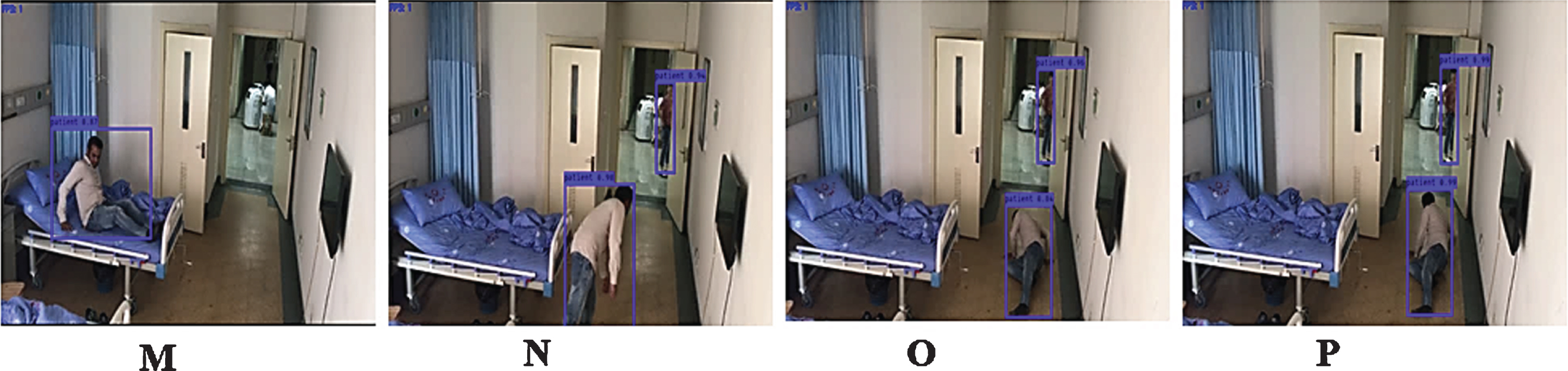
Extracted outcomes as a keyframes from visual sensor.
Additionally, the projected process is rehabilitated in the atmosphere of TensorFlow. Incorporating this method, it is always required to attain high precision. Concerning this to achieve, we highly trained the model with the wider-face dataset [51] which has rich collection of images. At the initial stage of the processing it is set by default floating point. After that it is transformed as a fixed-point model via concept of TensorFlow. Due to these transformations of model, it acts very competent computationally as well as very fluent incorporation of smart healthcare system comparing with any such ecosystem which is using small devices and operating with visual sensors that required bandwidth and energy constraints. This model is also successfully tested as a methods of extraction by incorporation of best known Face Database (FDB) [52]. In this way, our disciplined approach is projected to intensification recognition precision when inspiring a real-time demonstrating YOLOv3 bounding box that is the suitable mark of single stage-detection. This approach is providing average accuracy as a result around 90% with recognized 1-16 (fps) file per second detection. The used environment to run this model is Intel i5-5th generation and Raspberry Pi, Quad-core processor of Armv7, 1.9 GHz, Ubuntu 14.04 LTS environment that is highly pertinent among the monitoring IoT enabled smart healthcare system. The extracted keyframe from used model is displaying on Fig. 2 which is perfectly capturing each possible interaction M to P on the smart healthcare. From the detected keyframe, it is displayed that the captured keyframe has high precision and remain inside the bounding boxes. This operation is installed in the whole area of the healthcare to detect any happening activities. After significantly detection of keyframe this model is hand over that keyframe to the next processing model for producing encryption by incorporating lightweight cosine-transform encryption.
This section is familiarized the behaviors of projected cosine-transform method and incorporated highly reliable encryption process in the smart healthcare environments [36]. This adopted mechanism is encrypted by the produced keyframe from installed visual sensor streamed data. Basically, this approach is producing firstly Pseudorandom Number Generators (PRNG) from cosine-transform mechanism with the help of secret key. Aft that, a well-organized two round operation is produced confusion and diffusion among the keyframe as a combination with bitwise XOR as well as fast efficient scrambling concepts [36] that are well representing on the Fig. 3. This adopted approach is achieved fast color image/ keyframe encryption, highly randomized multifaceted categorizations of cipher matrix. The generated cipher matrix from this approach is not recognizable from any attacker for data theft. The inputted extracted keyframe is received from monitored visual data that is developed in the form of RGB format as well as installed high resolution enabled video sensor setup in the smart healthcare system.

Two rounds of encryption and decryption methods of the keyframe.
Generating key for any encryption approach is required reliability in nature that wheels sine tent cosine-transform (STC) prime states. Obtaining this reliability [53], the scientific research community emphasized and decidedly endorsed to withstand assorted category of the attacks. On every occasion the key of cryptographic chaos-based protocol shall be resemble to 2100. The best way to generate key is used effective length of key that can give easiness to preserve higher security characteristic. Keeping this concept, ESTC (encryption through sine tent cosine) approach is using 256-bit length space that can understand as 2256. The description of key has five significant machineries and can be see like K={X0, Y0, W, M, N} that is illustrated in Fig. 4. Each constraint can be briefly addressed such as preliminary states is (X0, Y0,), W is constraint of disturbance, M is preliminary states coefficient and N is disturbance coefficient which is embodied as {N1, N2, N3, N4}. Each individual segment of key is structured as 32-bit length. Few of the variable has characteristics as a float that can be represented X0, Y0, W with the range contains [0,1] and rest variable has the characteristics as an integer that can be represented M, N1, N2, N3, N4. The float and integer values can be evaluated as follows:

Key size used in STC.
Using Equation (1) additional rounds of cryptographic operation can be calculated with the preliminary state as follows:
The arising sine tent cosine-transform is scattered uniformly chaotic sequences that is exhibiting on the Fig. 5 after approaching the combination of bitwise XOR with fast efficient scrambling at each preliminary stage like (X1, Y1).
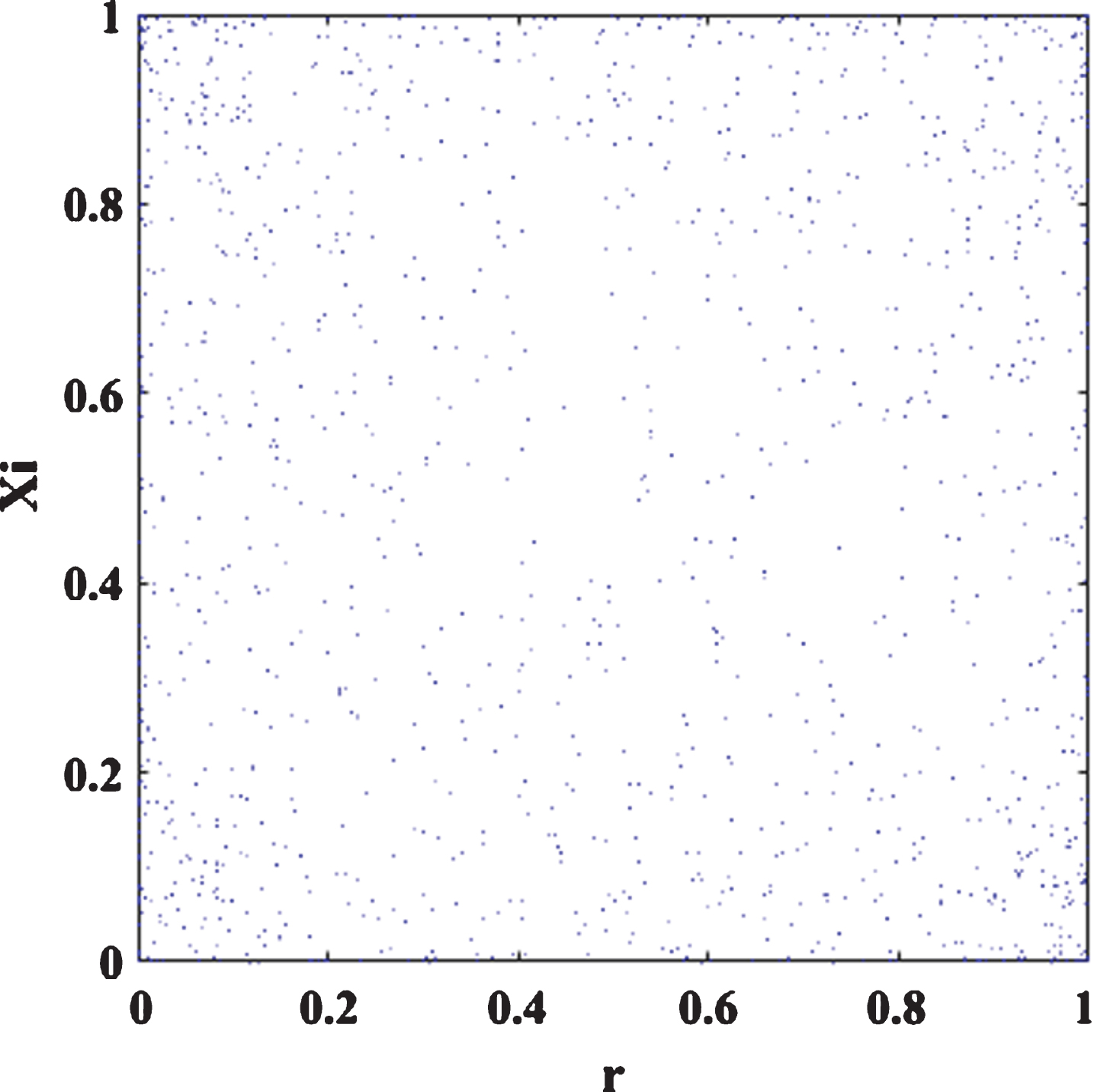
Complex STC sequences.
The constructive addressing of cosine-transform due to chaotic maps have a little existing drawback as well as propensities in terms of weakness. To overcome these issues and imminent addition in the chao-based crypto-system is required such conclusive approach for providing rich complex sequencing with the combination of two chaotic seed maps as an operation of cosine function. For example, it can be addressed as a mathematically proved concept as follows:
Where A () = A (a, x i ) and B () = B (b, x i ) are two unalike any identified functional chaotic seed maps and C is used as a constant shifting with its mentioned value is -0.50 at the operating in the algorithms. The incorporating this concept as mentioned in the Equation (2) we are received efficient complex sequence generation as well as a flexibility of countless fresh chaotic sequences. Concerning required nature of complex sequences, we can choose any of the chaotic seed maps with quite handy alternative way. The producing effective combination of the cosine-transform here we are adjusting from Table 1 as an alternative seed map in our smart healthcare architecture that are follows on Table 1. Using suggested chaotic seed map of the Table 1 and generating its alternative cosine-transform pair (CP) on the Table 2 for employing better responded cosine-transform pair (CP) in our methods. Where at each equation r ∈ [0, 1], the required replacement of a is r and b is 1- r. This mechanism is used CP 2 cosine-transform pair which is actually STC maps (Sine Tent Cosine-transform) and the entire article is composed with the combination of Sine and Tent seed map of the cosine function.
Chaotic seed map equation
Generated cosine-transform equation
The operation of encryption with cosine-transform is promised and prominent in the cryptoanalysis to be used chaotic maps as a cosine function for causing complexity in the sequences. The used ESTC is the better example for the alteration of real data as a cipher text. Basically, ESTC is the adapted method including characterized two effective mechanism bitwise XOR with fast efficient scrambling concept [36] to afford relatively fast execution among the keyframes with the exhibition of confusion and diffusion which is conceptually demonstrated on the Fig. 3. The incorporation of the methods extend as a combination with two rounds to achieve highest possible confusion as well as diffusion to ensure satisfactory encrypted cipher matrix without any identification from outside world or attackers in the system. The proposed ESTC model is represented on the Tables 3, 4 and its key processing is demarcated as a step by step in the followings:
Algorithm 1, Process of encryption method via bitwise XOR
Algorithm 1, Process of encryption method via bitwise XOR
Algorithm 2, Key process of Fast efficient scrambling
Initially, the extracted keyframe is best possible permuted with used cosine function of two seed map sine and tent. This cosine function is incorporated random generation of secret key to achieve complex behavior. Additionally, obtained reshaping process to adjust keyframe image and incorporated splitting RGB keyframe in terms of each color matrix to perform two rounds mechanism bitwise XOR with fast efficient scrambling concept. The diffusion process is performed with the combination of bitwise XOR through fast efficient scrambling to cause cipher data matrix. Furthermore, the confusion process is took guard via fast efficient scrambling concept [36] to compose cipher data matrix of the keyframe.
The approach of decryption mechanism is completely inverse of the adapted step of encryption mechanism which is successively decrypted the cipher matrix data of keyframe to real one. The above process and Tables 3, 4 are justified that the pseudocode bitwise XOR, cosine function sequence generation as well as fast efficient scrambling is suitable for our proposed smart healthcare system. Where M×N is size of extracted keyframe and S is the produced sequence of the used cosine function of two chaotic seed maps (Sine and Tent). The used secure key is produced for the entire cryptographic process and it is created via random generation methods.
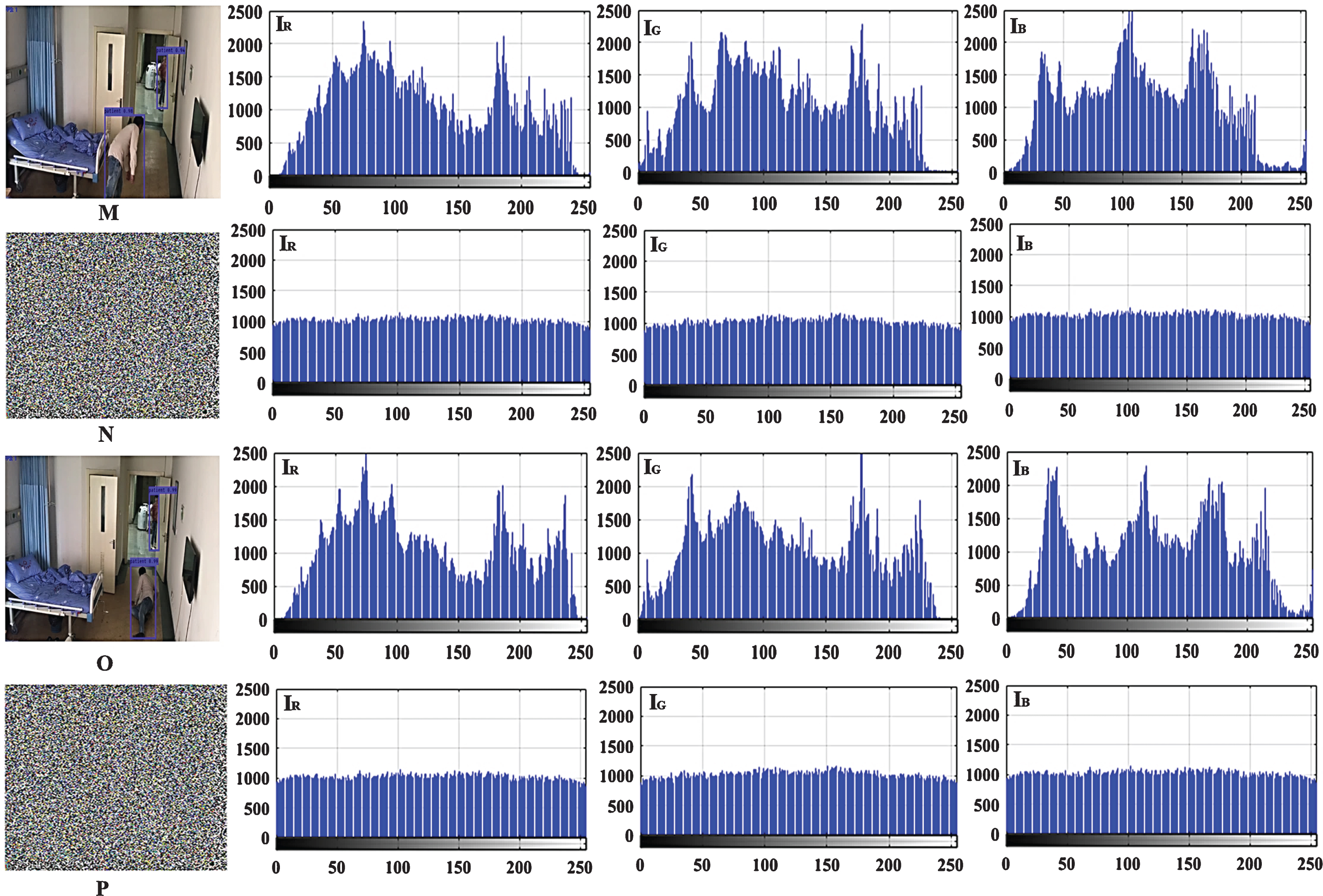
This unit enacts with the discussion of produced outcomes of the projected ESTC concepts over the MATLAB 2018a and relates its consequences in terms of security parameter with the eminent image repository of USC-SIPI [54] collection data. For attaining ideal as well as protuberant encryption, it is continuously encrypting different kinds of cipher data image. The quality of strongly optimized encrypted concept is only retrieved whether its key any how known. Unless leakage the top-secret key no way to extract any information in our thoroughly sequenced smart healthcare architecture. The exhibition of proposed encryption concepts is purely optimized on the test images which is used such as baboon and house. The reflection of cryptographic phenomena of the baboon images is displayed M to N on Fig. 6 with corresponding each color channels. The histogram of the baboon M is showing their color IR, IG and IB physiognomies relatively encrypted N is also displaying a uniform distribution characteristic at each IR, IG and IB. Similarly, house image is displayed O to P with determined correlation of the pixels. The histogram of the house image O is reflecting IR, IG and IB as a characteristic of the plain image and relatively encrypted P is efficiently visualizing a uniform distribution physiognomy at each IR, IG and IB.
Correspondingly, the monitored patient’s activity trying to fell as an extracted keyframe is reflected cryptographic phenomena in the Fig. 7 where expressed encryption concepts from M to P. The histogram of the keyframe M is screening its color IR, IG and IB appearances efficiently with fairly encrypted N is also demonstrating a uniform distribution characteristic at each IR, IG and IB. Similarly, keyframe O where patient lies on the ground in the critical emergency. The histogram of this extracted keyframe is screening its each color IR, IG and IB channels and showing their better correlation in each pixel as a plain image and its encrypted counterpart such as image P which is illustrated as a uniform distribution nature in corresponding color IR, IG and IB channels. These two Figs. 6 and 7 are quite well-defined results that is reflecting our proposed concepts are fast efficient, uniformly distributed pixel at each corresponding cipher data matrix. Therefore, it is quite satisfactory that any intruder or data leakage cannot easily retrieved to access its original patients image data from the system. In this way, our incorporated concepts are robust, fast executed, efficient, minimal computational process with organizing bitwise XOR in addition with fast efficient scrambling approach in this healthcare ecosystem. Consequently, the adopted encryption concepts can be better alternative as a proficient, faster, competent in the field of IoT scenario to incorporate enhanced security and privacy to protect patients related issues at any emergency prerequisite. The experimental setup to deal with simulated cryptosystems are employed with the required hardware such as Microprocessor of Intel (R) Core i5-6500, 3.20GHZ CPU, 8 GB RAM (Random Access Memory) and installed Windows 10 Operating System. Using this configuration of the hardware and software setup, the adopted mechanism of encryption (ESTC) is verified in terms of exhibiting fast keyframe among the different categories of methods and images that are competing on the Table 5. The used ESTC concepts are nearly equivalent of high quality of cryptographic process which deals in terms of fast disturbance in the entire pixels as encrypted data matrix and inversely it can be obtained real image through decryption process.
Security analysis
To express ascendancy of the ESTC concepts, this part scrutinizes the security analysis with competent secure parameter among them are speed assessment, histogram analysis, differential attack analysis, key analysis, information entropy analysis, correlation analysis, comparative discussion among the surveillance approach and quality analysis. Additionally, to show effectiveness of our proposed system we equate and cite correspondingly available scientific research outcomes directly from reputed journal and conferences published recent papers. This comparison recognizes a fair and noticeable conclusion in the field of image cryptography.
Speed assessment
This unit is making acquainted for the processing task as well as computational behavior which is operated through cryptosystem in terms of speed assessment on Table 5. Every encryption process is depending on speed of handling each activity such as permutation, diffusion process and generation of used chaotic maps to complete encryption mechanism. Administering smart healthcare cryptosystem, we tried to produce minimal computational activity to each process and reply in quick secession. We observed that each processing unit is jointly incorporated and using bitwise XOR with fast efficient scrambling concepts is relatively generating advantages for producing efficient way of encryption hurriedly. The projected concepts are verified towards each average encryption time among the various set of keyframe image. The eminent processing competence, numerically obtained encryption time are best way presented on the Table 5. Additionally, this Table is also comparing produced outcomes with earliest published scientific contributions to effectively show that the proposed outcomes is comparably attained lowest possible time to encrypt keyframe into cipher matrix data. Concerning this achievement, the projected concepts are taking very less or minimum computational time that clearly suggesting, it is best suited real-time scenarios to deal healthcare issues in quick succession and produce help to the highly needful patients in the smart healthcare prospective.
Speed assessment and its fair comparison
Speed assessment and its fair comparison
The histogram is generally best known as the healthiest graphical representation of any image in terms of pixel rate distribution. Using this analytical parameter each image/ keyframe can be statistically evaluated in terms of their effectiveness and robustness as an encrypted phenomenal algorithm behavior. In statistic, it reports the actual gray values which are distributed in the keyframe or image and recognizes any type of smooth distribution among the image matrix can be a way to expose security that can be a targeted thing to lead data theft from the attackers or intruders. However, the cryptographic wonders are enforcing that attaining any encryption from the proposed setup there should be uniform distribution in the histogram. The incorporated cryptographic approach is demonstrated on the Figs. 6, 7 that the histogram of the keyframe and its encrypted cipher matrix are showing fair arrangement of pixels correlation. In which plain keyframe has fair variation in terms of the correlation of the pixels where cipher matrix images are showing fair amount of uniform distribution of the pixels in each color channels [55, 60].
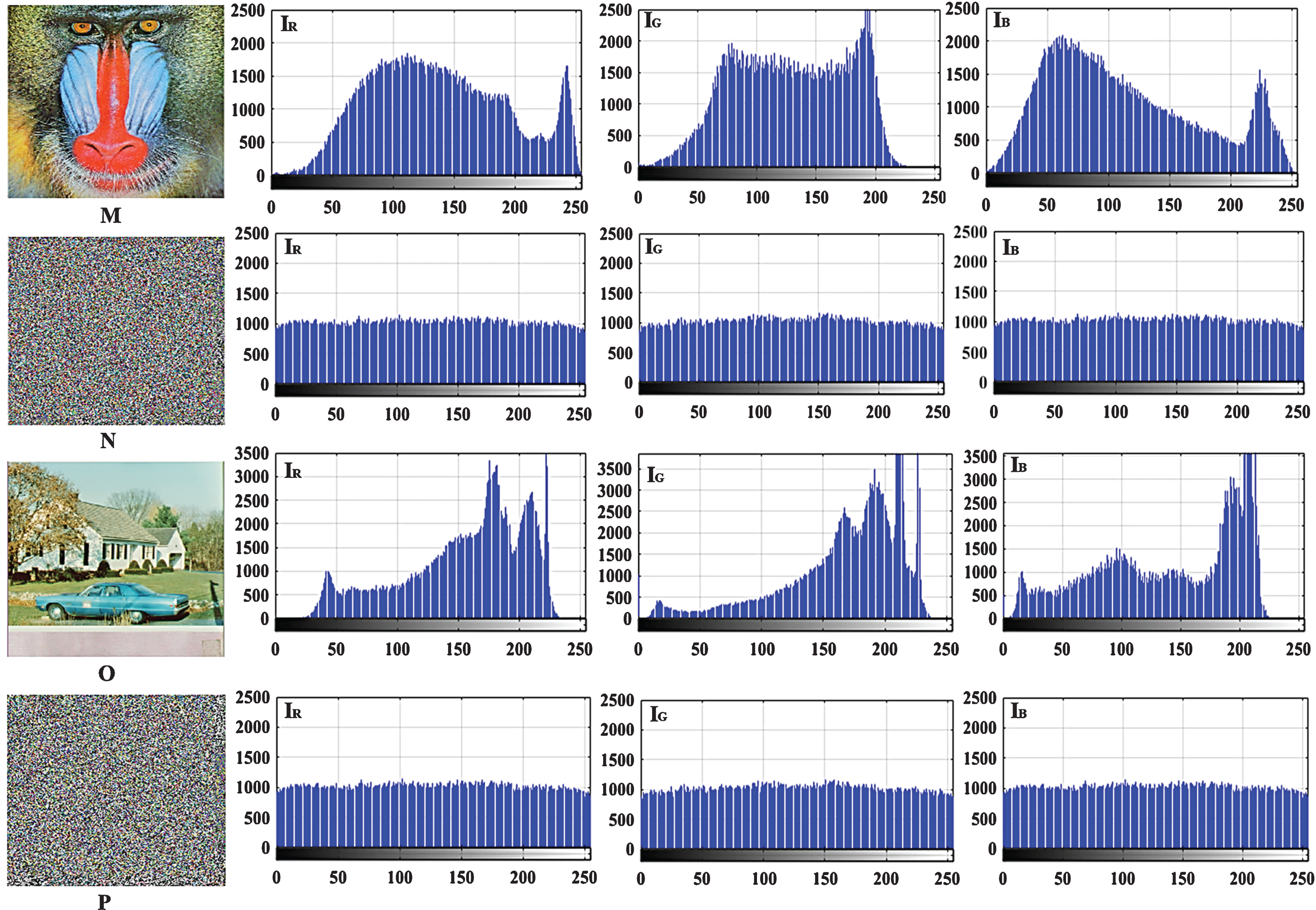
Results of Simulated test images of ESTC method.
Results of simulated keyframe (images) of ESTC method.
The deviation among the histogram is utilized to measure each cipher encrypted keyframe, due to these parameters a significant analysis can be find as the remarkable contributions. It recognizes that the quality of variation among the cipher keyframe is unimportant it consists greater impact of the uniformity. Stimulating histogram analysis, Fig. 6 is signifying used test images histogram. In which it is firmly proved that each color channel has fair depiction with their cipher images precisely. It is visualizing that the color frame of test images is screening their feature naturally prior to operation and after encryption happened, it is screening completely uniform characteristics. This whole context occurred same behaviors as well when performing keyframe images too on Fig. 7. The behavior of uniformity among any histogram can be premeditated numerically trough variance. Uniformity nature of any histogram is entirely dependent of its generated variance. This can be recognizing with the impact of the variance if variance is lower than it has higher uniformity and it will be reverse when variance are recognizes higher then uniformity is lower vice versa. Variance of any histogram can be easily calculated in terms of the numerical values among the statistically scattered data in the keyframe with the Eq (3). This equation can be described that the values of the gray scale is n, Zi and Zj are the corresponding values of the ith as well as jth level [55, 61]. Subsequently, if there anything happened to steal any piece of data and decrypt information concern keyframe, it is observed that no such information can attacker retrieved due to highly skillful encryption concepts incorporated to deal data privacy. The encrypted cipher matrix remains identical which is absolute sign for no data loss throughout communication in the whole setup. Therefore, it is equally extenuating that the projected ESTC concepts are strappingly circumvented any way of statistically or numerically data breaching and authenticating its integrity as well as consistency throughout transmission in the whole smart healthcare setup.
The eminent image encryption attacks and used in terms of active attack is called differential attack. Its attentions on edifice a robust association among the keyframes or images with each succeeding encrypted cipher matrix images through distinguishing in what about differences occurred at keyframe which can disturb or interrupt encrypted cipher matrix images. If its sanctuaries diffusion behavior in the ideal prospective, the concept of encryption terminologies retains high efficacy in the circumventing differential attacks. The behavior of diffusion technique evidences that cipher matrix perhaps will scatter any minute change throughout keyframe or image as a outcomes whole data will be showed different statistically in the keyframe. The adopted ESTC concepts are fairly demonstrated with the unique diffusion technique as shown in the Figs. 6 and 7. Regarding examining differential attack for any adopted encryption concepts it required two well-known constraint. One of them is NPCR (Number of Pixel Change Rate) and second metrics is UACI (Uniform Average Change Intensity) [68]. Above both metrics is highly recognized to show differential attack analysis in any encryption methods. NPCR computes the variation rate among the pixel spots in cipher matrix keyframe or image through fine-tuning value of one pixel into keyframe. UACI estimates the average intensity difference among the
Let assume two cipher matrixes symbolized as C1 and C2. In which there are slightly one-bit variance in its conforming keyframe or images, at these scenarios each NPCR and UACI are governed from Equations (4)–(6).
Size of each keyframe matrix is used M×N, and Equation (16) is manipulative U (i, j) that is the pixels difference amongst the conforming encrypted cipher keyframe matrixes. Table 6 is significantly exemplified the most favorable NPCR and UACI outcomes from the test images as well as keyframe in the adapted ESTC. This Table is also comparing reasonably well against recent referenced published encryption approaches in various platforms. From the produced data of NPCR and UACI, the data analysis is showing that NPCR is approaching to reach very closely near to hundred marks and UACI is also targeting to reach one third of the hundred marks too. The values that we achieved through ESTC concepts, it is purely indicated its usefulness, dissimilar randomize keyframe and truly misses any type of effectiveness of differential attack. The produced outcomes of the NPCR and UACI is making this ESTC concept is referenced for the cryptosystem and highly ensured its security as well as privacy for any such data theft activity from the intruder or attacker to not retrieve any information in the smart healthcare setup.
Illustration of NPCR, UACI and its fair comparison
For example, a complete investigation for an ideal cryptosystem for its randomness behavior in terms of NPCR and UACI. Let assume size of the matrix is M×N. The encrypted cipher matrix of keyframe are C1 and C2. A preferably cipher matrix is a subjective arena at each size, integer i ∈ [1, M], j ∈ [1, N], the uninformed pixel worth C (i, j) identically and self-reliantly happens as an inaccessible uniform distribution captivating 0 to C’s primary reinforced integer G. This can be defined as ∀i ∈ [1, M] , ∀ j ∈ [1, N] , ∃ C (i, j) ∼ i . i . d U (O, G) [68]. The hypothesis NPCR (C1, C2) by resources of β-level significance shadows as [68] at Equation (7):
It is understood that at what the condition NPCR (C1, C2) < ς
NPCR
, in such manner the hypothesis H0 is purely rejected. This recognizes highly for the testing NPCR conditions. On the different prospective, the hypothesis H0 is accepted. The value of
Where
The mentioned condition is fulfilling the criteria of
Tables 7 and 8, congruently, revelations outcomes level β=0.05 over NPCR and UACI.
Random NPCR test
Random UACI test
The construction of chaotic cryptosystem is fast utilitarian to the initial conditions. The remarkable and better cryptographic arrangement is confidential in terms of superiority with quality to select or consider appropriate key size. This incorporation is generated to execute sufficiently computational complexity as well as efficient process handing during communication in the secure operation. This adapted ESTC concepts is utilizing 256-bit length or 2256 key size. Analyzing this key size, we found that 256-bit size could be better alternative to deal real-time operation in our proposed smart healthcare setup. This key size encounters the main executive performance with exceedingly avoiding various sorts security threads [36, 69]. Additionally, the projected concepts including architectural key size is behaving good complexions of each required parameter and shown in the Fig. 4. The adopted ESTC concepts are articulated distinguished key size on the Table 9 and a fair comparison provided with eminent recent published reference to show status of the used key size is noticeable. It countersigns the used key size is delivering outstanding contribution and healthier variety to stimulate relatively complex behavior. This 256-bit size key is also giving indication to satisfactorily avoided any types of possibility with the brute force attacks and encouraging in the smart healthcare setup to accomplish task to protect personal privacy data.
Key size and its fair comparison
Key size and its fair comparison
This unit enacts the comparative discussion among the surveillance approach with our proposed concepts as a novel encrypting incorporation in the smart healthcare system on the Table 10. This Table 10 is composed each secure characteristics or parameter to provide approval in terms of speed assessment, histogram and (CCxy) correlation coefficient, key analysis, NPCR values, UACI values and information entropy etc. on the smart healthcare setup. The concluded summary of the proposed concepts is fairly judicious and around to ideal standard of the security. Table 10 exhibits a fair comparison provided with eminent recent published reference to show its acceptance with efficient generation of outcomes. It can be seen in the comparisons that the ESTC is produced fast acceptable outcomes to qualify proper security and confidentiality parameter among the diverse platform too. The significance of this model is minimal complexity, high speed, improved entropy, better correlation coefficient (lowest), reasonable NPCR and UACI obtained values. These enhanced consequences are flagged well that our ESTC concepts are quite admirable in the field of health industry to provide cryptographically balanced ecosystem.
Comparative analysis among the surveillance system
Comparative analysis among the surveillance system
The mechanism of analysis in terms of quality of uncertainty, its randomness behavior over the correlated pixels on the encrypted matrix is reasonably known as information entropy. This can be explained in terms of mathematically as follows on Equation (13):
This Equation 13 is represented H(n) as an information entropy, P(ni) is known as the probability of the manifestations at every ni. Usually, the numerical worth of the probable information entropy is 8. This is only possible in the ideal prospective at the each random keyframes matrix. In an ideal scenario, the discreate images are behaving identical probabilities at each ni. As a consequence, the probability amongst the ni are touched 1/256. After encrypting any images or keyframe, it is highly required that the cipher matrix should be arrange best probable random image matrix. The validation of any keyframe or image matrix in terms of information entropy is statistically 8 values. Equation 13 can be proved each image matrix with containing information entropy around 8 that is significantly showed randomness and slight leakages image matrix data in adopted smart healthcare system.
Information entropy is demonstrated on the Table 11 with corresponding keyframe (7-11), encrypted cipher matrix and comparison amongst the referenced published article recently to approve acceptance our proposed ESTC concepts. The outcomes on the Table 11 is verified its effectiveness to approach around the ideal values that indicates the adopted ESTC concepts are highly acceptable to protect privacy, security and randomness attitude which is very essential at any cryptographic methodology. Therefore, this approach is better to deal any type of entropy attack in our projected smart healthcare system and the administration can satisfy with all the effort used in the mechanism for protection of valued data.
Information entropy and its fair comparisons
The concepts of validating randomness data amongst the two adjacent or very close neighboring pixel of the cipher matrix and plain image are addressed in the field of correlation analysis with the calculating its correlation coefficient CCxy by the utilizing mathematical Equations (14)–(19). Obtaining correlation coefficient is to analyze it’s all possible linear correlation amongst the closely related pixels in the keyframe matrix. The nature of images is highly correlation amongst its each direction vertical, horizontal and diagonal. The objective of the ESTC concepts are to remove highly correlation amongst the pixels by smashing its causal relationship with adjoining pixels and retain around zero correlation. Achieving zero correlation is guaranteed unpredictively, randomness and fashioned different keyframe matrix and cipher matrix which has no original values to guess any adversary or attacker [60, 78]. The correlation coefficient performance lies between positive one to negative one. Less correlation coefficient is received from plain image or cipher images whether negative or positive it indicated that highest quality of correlation to restrict any sort of statistically attacks. Following are the three condition of the correlation coefficient as mentioned:
Table 12 is determined the random variety of the ten thousand amalgamations of two conforming pixels lengthwise directions, (CCxy) correlation coefficient values of test image baboon, house and patients extracted keyframe through the size of (512×512). The findings from the Table 12 states expressively that the CCxy of neighboring pixels of keyframe at each direction is approximately to 1. Though, cipher keyframe matrix is nearly zero (0). The findings from the Table 12 and histogram of Figs. 6, 7 successfully validating the topmost dominance of smashing each possible correlation link among the neighboring pixels in both test as well as keyframe images in our proposed ESTC concepts and brought fairly comparison with recent reference published article. The comparisons and the generated outcomes are confirming that the projected ESTC concepts are extraordinarily, unpretentious to any sorts of statistical attacks on the smart healthcare system.
CC of two neighboring pixel, plain, cipher images and its fair comparisons
The quality analysis of the decrypted images can be checked through a faint variation of a pixel on the ciphered matrix. If ESTC incorporated data missed any fragments of evidence, inversely the progression of decryption can correspondingly simply convalesce real keyframe matrix data. Figure 8 is verified the test of image quality after the decryption progression when the ESTC incorporated, cipher images grieved some noises or countless percentage data loss. Figure 8(M) is distinguished and witnessed that the decryption progression is wholly recovered house test image at that process no data loss. Even however the cipher-matrix had also vanished a little data or noise, additionally, their decrypted discoveries integrate the furthermost sensory data of distinct house images, that are obtainable on Fig. 8 (N) to (P). Consequently, the hired ESTC can equally decrypt with better quality of cipher matrix data.
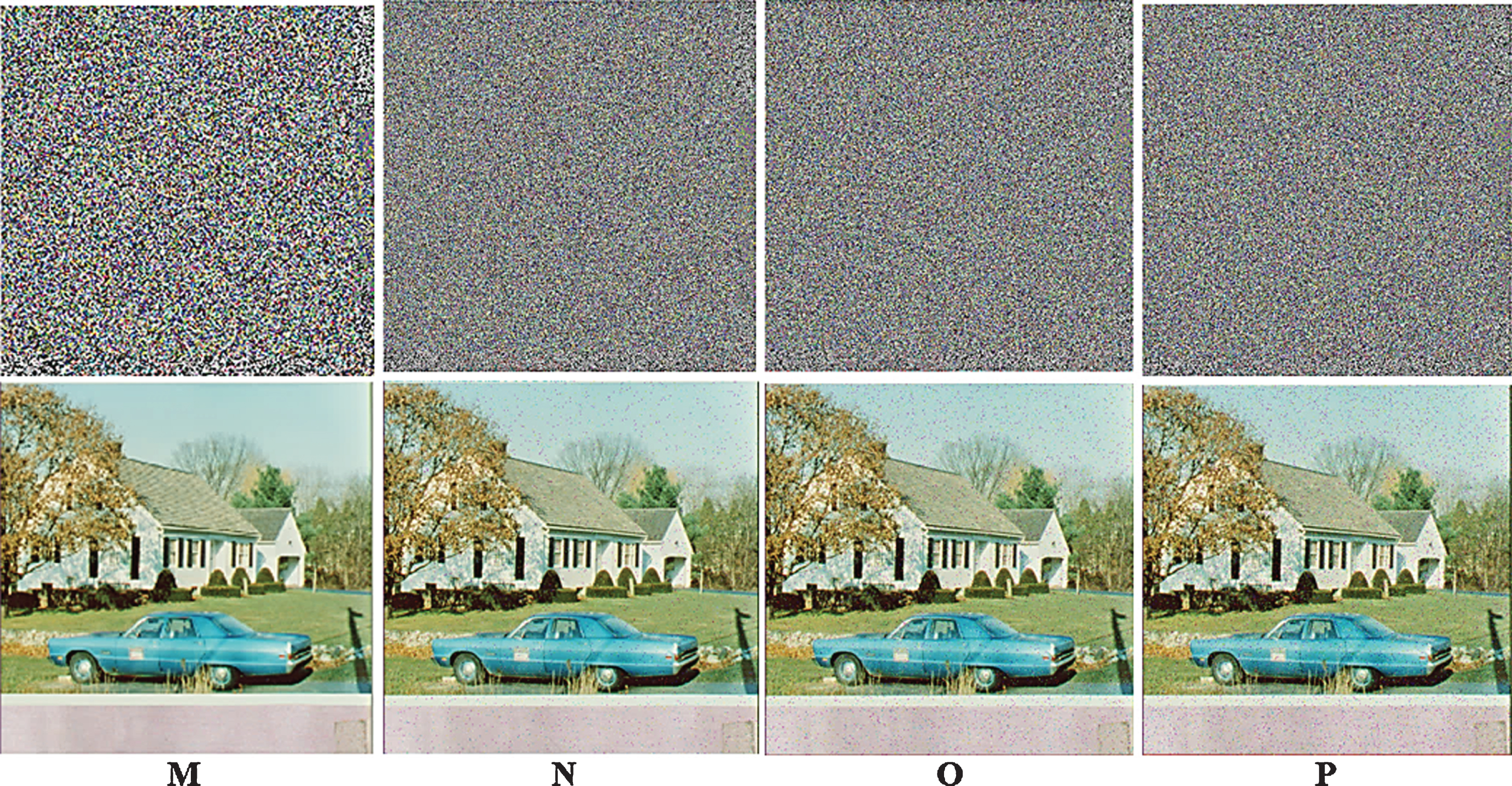
Decrypted house images: M) encrypted vice versa decrypted image, N) noise encrypted vice versa decrypted image of 1% ’ salt & pepper ’ O) noise encrypted vice versa decrypted image of 2% ’ salt & pepper ’ P) noise encrypted vice versa decrypted image of 3% ’ salt & pepper ‘.
To avoid any types of statistical attacks, the pixels among the ideal encrypted image must be uniformly scattered. In order to examine the randomness variations produced by the implemented ESTC method should be calculated. We utilized to test from one of the best cryptographic applications produced by the national institute of standards and technology (NIST) named as statistical test suite for PRNG (NIST SP 800-22) [84–87].
The basic ideology behind to test NIST SP 800-22 is that to evaluate cipher keyframe images in the certain three keys addressing such as 1) There should be equi-distribution among zeros and ones, 2) There should be no specific patterns among the random numbers, 3) There should be independent flow of each numbers to others [88]. It (NIST SP 800-22) comprises 15 sub-tests and utilizes as input a group of binary sequences. Both sub-tests seek to classify the binary sequences’ non-randomness areas. In particular, every test provides a P-value amongst 0 and 1., that will be a real number. If the resulting P-value is bigger than a significant value, (assign default value is 0.01), each pattern is considered success (passed), and else considered fail.
Our test analysis experiment is utilized four keyframe images from the extracted keyframe collection. Initially, these keyframe images (size 512×512) are encrypted to obtain each four encrypted cipher-images with incorporating the ESTC and then each encrypted cipher-image is utilized as a binary representation. We recognized on the Table 13 that over the entire set of examined outputs, the results of the randomness tests are highly satisfying. In other words, each generated pattern of the encrypted cipher keyframe have passed the NIST tests successfully as showed in the Table 13. These findings are demonstrated the efficacy of the generated pattern with proposed ESTC method to adopt in the smart healthcare system and provide better security privacy towards the patient’s confidential activities and valued data.
Test results of randomness among the cipher-images by ESTC incorporating NIST test suite (SP800-22)
Test results of randomness among the cipher-images by ESTC incorporating NIST test suite (SP800-22)
In accumulation to enhanced observation, the uniformity in to the histogram of the cipher images is further evaluated in terms of maximum deviation, uniform histogram (UHD) deviation and irregular deviation. These indicators are being used to equate other systems with the referenced published article in the Table 14. The description and mathematical operations which performed to address our proposed approach are following with each three kind of deviation methods such as maximum, uniform and irregular deviation metrices.
Deviation analysis of the cipher images and its fair comparisons
Deviation analysis of the cipher images and its fair comparisons
Maximum deviation is well-known as an effective tool of mathematical analysis which is incorporated by measuring a change throughout the pixel values of both the plain image as well as cypher image to quantify the efficiency of an encryption approach. The highest maximum deviation value means that the encrypted image’s pixel values have been adjusted to a large degree, which in turn will make that the encryption system is stable as well as more secure in the nature. It is possible to compute maximum deviation as following Equation (20).
In which D i = |D Cipher - D Plain | is the absolute difference among the encrypted keyframe and plain image between each gray level, N represents the total of greys with such a scope of [0,256]. There seems to be a significant disparity amongst the pixel values of plain and encrypted cipher image if MMAXD has achieved a high range of values.
UHD explores the deviation from an ideal of the histogram of the cipher image. Pixels in a cipher text must have a significant chance of being very identical to pixel values from some kind of uniform histogram in order to obtain the minimum deviation. In a standardized histogram, the pixel values vary depending on the actual size of the normal plain image. This can be easily calculated with the Equation (21).
Where M and N is distinguished width as well as height about the cipher image and UHD can be easily retrieved with the help of Equation (22) as below.
Here HCI in the equation is the calculated grey value over the histogram of encrypted keyframe at the index I. A smaller value is recognized of DUHD significantly lower deviation, which means a uniform distribution, from the ideal histogram.
The degree of variation from a standard statistical distribution is calculated in terms of irregular deviations technique. This can be easily intended as a mathematical model from the Equation (23) as below:
Here Hi is recognized as the absolute difference amongst the keyframe histogram as well as its encrypted cipher image at index I, while AH is incorporated mean value of the histogram. The lower value of IIRD demonstrates the uniform distribution of the pixels throughout the cipher image, and that is a desired property for an encrypted image cipher.
The outcomes of these measurements of histograms are summarized in the Table 14. For comparison with other referenced published article on image encryption schemes which used the same evaluation metrics, four distinct keyframe images were used. Across all the three evaluation criteria, it is evidently seen that the proposed ESTC methods outperforms and successfully defended the secure parameter which is going to protect privacy and security for the smart healthcare system.
An effective and commonly utilized cryptanalysis methodology is the chosen-plaintext attack analysis [89, 91]. These types of attacks are firmly resisted by the incorporation of proposed ESTC cryptosystem. Secret keys, i.e., the preliminary values as well as control parameters of its ESTC system, depend not only on the initial values as well as control parameters specified, but also on keyframe images. So, throughout the encryption method, the keys are updated for each entry of keyframe images. Therefore, by encrypting any predesigned special images, adversaries cannot retrieve meaningful information, since the cryptographic output is only connected to the selected keyframe images. This reveals that the proposed ESTC methodology is extremely image-dependent and reliable of defeating known-plaintext as well as selected-plaintext attacks successfully. The capacity and the illustration of the ESTC to withstand the chosen plaintext attack is efficiently demonstrated in Fig. 9(M-P). By encrypting one test image and one keyframe twice using the random generated secret key, two encrypted outcomes are obtained, as well as the distinction between the two cryptographic results is measured. Figure 9(P) indicates that the two encrypted outcomes are entirely different. Therefore, an attacker is unable to measure the predictive connections between by selecting any plaintext to encrypt, the plaintext as well as ciphertext. The ESTC is, therefore, highly strong enough to resist the selected plaintext attack.
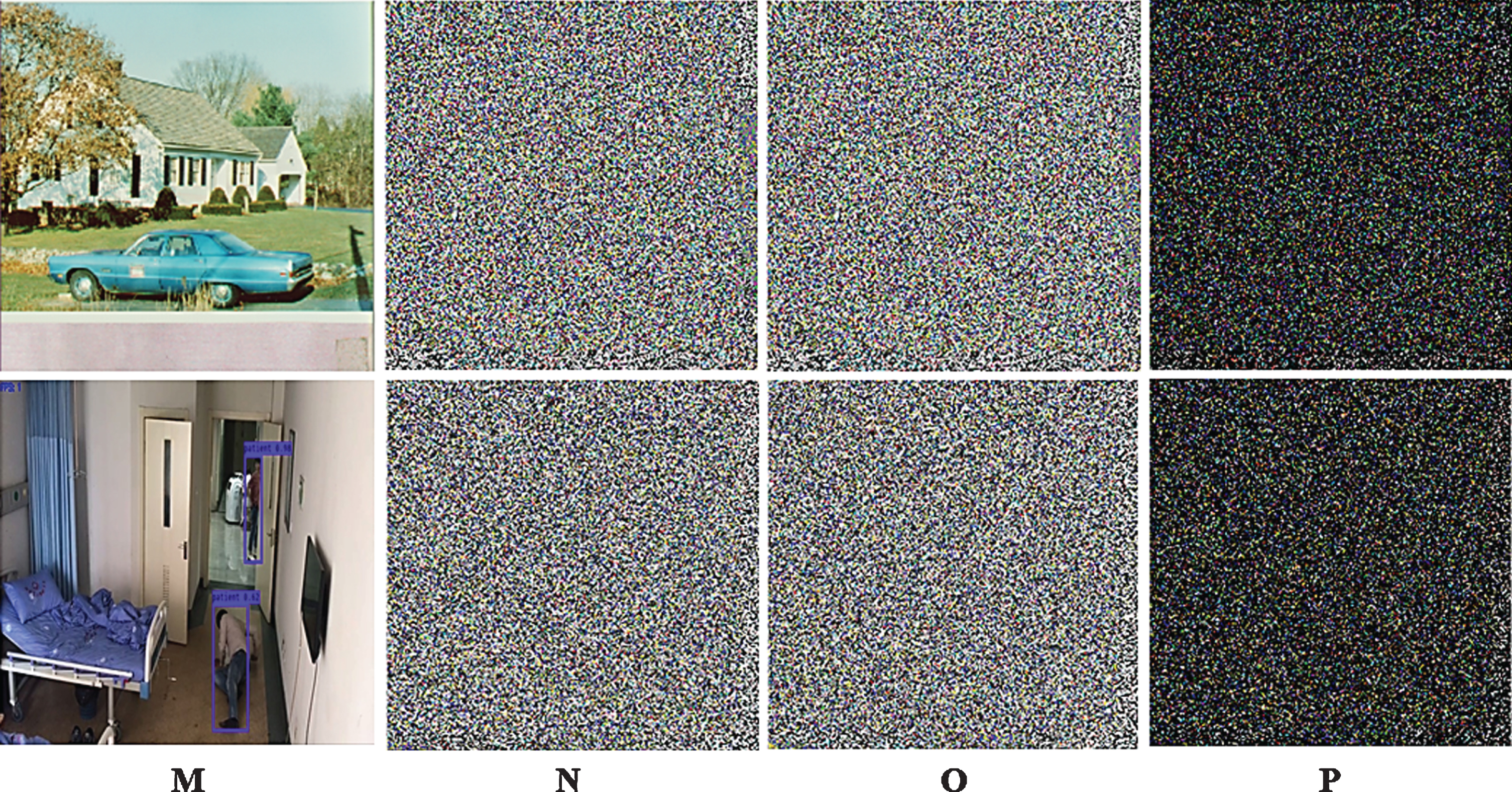
Capability of ESTC to fight chosen-plaintext attack M) test and keyframe image, N) test and keyframe first encrypted image I, C1 = Enc (I, K1) O) test and keyframe second encrypted image C2 = Enc (I, K2) P) absolute difference=|C1-C2|.
The technological advancement and emerging highly enhanced ecosystem of IoT is completely providing an effective smart healthcare system that can deliver finest services in terms of secure surveillance, cryptographically security and privacy of the patient’s information. This article is tried to established a mechanism which can provide best possible monitoring and keyframe encryption. The projected approach is utilized to well-equipped, trained lightweight YOLOv3 algorithm for monitoring and after that employed ESTC concepts for providing keyframe encryption as a cosine transform function and bitwise XOR with fast efficient algorithm. Each operation is performed well and generated high quality of outcomes to favor this methodology for the privacy and security in the smart healthcare system.
Investigating through various aspect of the security analysis, the proposed approach is showed extensively secure characteristics and faster speed encryption, minimal computational throughout operation in the system. It also confirms its achievement in abating bandwidth, transmission costs, storage space, communication cost, and harmoniously diminishing spending time of the authority’s supervision due to enormous volume of monitoring statistics to take decision over suspicious action at any emergency among the patients in smart healthcare system. This concept can be utilized in different real-time scenarios such as crime control system, fire detection, traffic control system and smart transporting services in the smart cities.
Aimed at future work, it can be reinforced to integrate as an advance system, plentiful applications with added advance security facet, privacy communications within healthcare sector. State-of-the-art direction can also be feasible to assimilate dynamic key in the functional way for the additional patterned of the security and privacy.
Acknowledgments
This work was supported by the National Natural Science Foundation of China (Grant No. 61370073), the National High Technology Research and Development Program of China (Grant No. 2007AA01Z423), the project of Science and Technology Department of Sichuan Province.
Conflicts of interest
The authors declare that they have no competing interests.