



Abstract
Semiconcept, a new data processing model, enriches the development of formal concept analysis. However, the classical semiconcept is supported by two-way decisions. In the study of classical semiconcept theory, how to express the information of jointly not possessed is also essential in making decisions. Therefore, this paper tries to combine the classical semiconcept theory with three-way decisions to present three-way semiconcepts, and carry on the further study. Firstly, we define new operators and give some properties of them. Two kinds of three-way semiconcepts —OE-semiconcept and AE-semiconcept, are presented. And the corresponding structures are searched out from the perspective of lattice theory. Furthermore, we analyze the relationship among three-way concepts, three-way semiconcepts and classical semiconcepts. On this basis, the algorithms to build OE-semiconcept and AE-semiconcept are presented. At the meanwhile, we take some examples to examine and explain the obtained results.
Introduction
Based on a formal context, formal concept analysis (FCA) provides a simple and useful tool for analyzing data. It was proposed by Ganter and Wille [5] and used mainly for knowledge discovery [1, 15] and data extraction [16, 33]. Two main areas of research at the FCA are finding formal concepts [5] and constructing formal concept lattice [5].
A formal concept depends on extension and intension of its interdependence. And they have a relationship of jointly possess. Based on dual operators, extension and intension can be formed, so that philosophical concepts can be expressed in mathematical language by formal concepts. Formal concept lattice is a partially ordered collection with formal concepts as elements, and it is hierarchical. The correspondent Hasse diagram of formal concept lattice is visualized, and it determines the formal concept lattice under isomorphism.
The formal concept analysis theory introduced in [5] takes into account the feasibility of data processing with the method of operators. However, there are some issues with the FCA. (1) The classical formal concept only takes into account the common characteristics. The information that not be shared by a series of objects (attributes) cannot be determined from a formal concept. (2) The extension and intension must have the relation of have in common. For this reason, not all subsets of objects (attributes) can be the extension (intension) of a formal concept. That is, for a formal concept (A*, A**), the information expressed as (C, D) sometimes cannot be found in the family of (A*, A**), where C ⊆ D* or D ⊆ C*.
In view of problem (1), Qi et al. [20] put forward three-way concept analysis (3WCA) that applies three-way decisions to the FCA. Three-way decisions [25] is a decision model based on human cognition. In the actual decision-making process, due to insufficient information and incomplete cognition of events, people’s decisions are not completely the result of yes or no. For example, in the process of reviewing manuscripts, excellent manuscripts are directly accepted, while those of poor quality are directly rejected. However, in most cases, the manuscript may be innovative, but need to be further improved, then the chief editor will often choose to modify and re-examine. In medical treatment, for some minor diseases, doctors can quickly and accurately make the diagnosis of disease or no disease. For some difficult diseases, some tests may be required before further diagnosis. The revision of the paper and further observation are the delayed decisions added to three-way decisions. In addition, three-way decisions have a very broad application background [3, 26]. Three-way decisions have been successfully applied in the fields of medicine, engineering, management and information [4, 27].
In fact, the set of non-common is not equal to the set of common not. The set of non-co-owning is not the same as the set of common. 3WCA divides the set of attributes or set of objects into three parts: positive region, negative region, and boundary region. They represent the jointly owned features, the jointly unowned features, and the partially jointly owned features, respectively. Yao [8] discusses three-way concepts in an incomplete formal context. Zhao [29] studies the relationship between three-way concept lattices. Zhi [30] proposes three-way dual concept analysis based on dual concept analysis. As a major breakthrough in the FCA, 3WCA is a hot topic in data research and has been applied in many areas [19, 28].
In order to solve the problem (2), Vormbrock and Wille [23] introduced semiconcept which obviously generalizes the representation of the formal concept analysis. Semiconcept also consists of extension and intention, but requires fewer restrictions than that of a formal concept. Semiconcept only requires finding shared attributes or objects, not vice versa. That is, the shared attributes D for a set of objects C. This means D ⊆ C*, and so (C, D) is a semiconcept. Additionally, there is more information to be expressed through a semiconcept because any subset of objects (attributes) is the extention (intention) of asemiconcept [23, 24]. In this regard, Vormbrock [22, 23] studied the algebraic properties of semiconcepts. Mao [14] proposes the approximate operators on semiconcepts and discusses the combination of semiconcept and rough sets in [31]. Malik [13] generalizes the theory of the semiconcept in graphs. FCA has been enriched in its applications with the introduction of semiconcept [17], and semiconcept is a lift of the formal concept.
However, with the widespread use of the semiconcept, nor can it represent the features that common unshareds. The expansion of classic semiconcepts is on the agenda. In real life, for example, biologists sometimes study the relationships between species and biological characteristics in biological research. By using semiconcept, we can get the set of common features among species, but we do not discuss the feature from the perspective of common unshared. If we combine three-way decisions, we can discuss the relationship between species from both the perspective of common and common unshared. It is obvious that more information can be obtained by introducing the framework of a trisecting-and-acting into semiconcept.
Few studies combine three-way decisions with classical semiconcepts. This paper therefore tries to combine common shared features with common unshared features in analogy to the method proposed by 3WCA. To distinguish three-way semiconcepts examined in this paper, we call it classical semiconcept.
To achieve this goal, we will do the following works in this paper.
(1) First, we specify semioperators based on the relationship between the classical semiconcept and formal concept, and we define two types of three-way semiconcepts.
(2) Second, the properties of semioperators and the lattice properties of two kinds of three-way semiconcepts are discussed. At the same time, we explore the relationship between three-way concepts and three-way semiconcepts, as well as between classical semiconcepts and three-way semiconcepts.
(3) Finally, algorithms for designing three-way semiconcepts are proposed, and the effectiveness of the algorithm is verified through examples.
The study is arranged as follows. Section 2 is to review basic notions what we need later on. In Sections 3 and 4, definitions of two types of three-way semiconcepts are presented. Some properties are given for three-way semiconcepts also. Section 5 offers algorithms to generate two types of three-way seminconcepts. And examples to illustrate algorithms are in Section 6. The last one is Section 7 to draw conclusions.
Preliminaries
This section goes over the definitions and properties needed in the following discussion.
Some definitions in FCA
In K = (U, V, R), the correspondent operators are defined as follows.
Negative operators
Positive operators represent shared features and negative operators embody the characteristic of jointly not possess. According to Definition 2, it is obvious that there is a dual relationship between positive operators and negative operators.
Definitions in semiconcept
We will use Example 1 to explain Definition 3.
A formal context for some animals K
A formal context for some animals K
Suppose 1=Bat, 2=Monkey, 3=Penguin, a=can fly, b=has hands, c=has wings. Then Table 1 can be expressed as Table 2.
A formal context K1
According to K1, we can say U ={ 1, 2, 3 }, V ={ a, b, c } and R1 is shown in Table 2. According to Definition 3, if X1 = { 1, 3 } ⊆ U,
For convenience, we write {{ 1, 3 } , { 1, 3 } * } as (13, c) in this paper.
Let Y1 = { a, c } ⊆ V, using Definition 3, we can get
Analogously, we can obtain the family of ∩-semiconcepts and ∪-semiconcepts in K1.
(2) Let (R, ≤) be a poset. If ∀ a, b ∈ R have supremum a ∨ b and infimum a ∧ b, then (R, ≤) is called a lattice.
Definitions in 3WCA
(1) A pair of OE-operators is defined by
where
(2) An OE-concept has the form (Y, (C, D)) if Y<· = (C, D) and (C, D) ·> = Y.
(O1) Y ⊆ Y<··> and (C, D) ⊆ (C, D) ·><·,
(O2)
(O3) Y<· = Y<··><· and (C, D) ·> = (C, D) ·><··>,
(O4) Y ⊆ (C, D) ·> ⇔ (C, D) ⊆ Y<·,
(O5)
(O6)
(2) And the infimum and the supermum are given by (Y1, (C1, D1)) ∧ (Y2, (C2, D2)) = (Y1 ∩ Y2, ((C1, D1) ∪ (C2, D2)) ·><·) , (Y1, (C1, D1)) ∨ (Y2, (C2, D2)) = ((Y1 ∪ Y2) <··>, (C1, D1) ∩ (C2, D2)) .
Definitions of OE-semiconcept and some related properties.
This section focuses on OE-semiconcept. Also, it is exactly the theory of lattices to make classical formal concept lattice developed and applied in many fields. Hence, we also discuss the lattice structure of OE-semiconcepts. All the research we do in the following is based on a formal context K = (U, V, R).
Definitions of OE-semiconcept
According to the operators in formal concept analysis, we define three-way semiconcepts in combination with three-way decisions.
< · :
From Definition 5, we can state that OE-semioperator is one part of OE-operator. Next, similar to the discussion for OE-operators in Qi [20], we can easily obtain the results about OE-semioperator.
(1)
(2)
(3)
Since Y1 ⊆ Y2, it follows
To prove item (2).
Hence, it follows
To prove item (3).
As
We call X and (A, B) the extension and the intension of (X, (A, B)), respectively. The family of OE-semiconcepts is in notation δ OE (K).
Next we use an example to interpret Definition 6.
Properties of OE-semiconcept in lattice
Through similar discussion for partial order and lattice property for classical formal concept lattice in Wille [5], we will obtain the following theorems about OE-semiconcept and prove it in detail.
(Y1, (C1, D1)) is called a sub-OE-semiconcept of (Y2, (C2, D2)) and (Y2, (C2, D2)) is called a sup-OE-semiconcept of (Y1, (C1, D1)).
(2) (δ
OE
(K) , ≤) is a lattice if the correspondent infimum and supremum are given by
We call this lattice OE-semiconcept lattice, written as OESCL (U, V, R).
By Lemma 1, we divide three steps to prove ≤ be reflexive, antisymmetric and transitive.
Step 1. Due to Y1 ⊆ Y1 and C1 ⊆ C1 with D1 ⊆ D1, one can easily verify that (Y1, (C1, D1)) ≤ (Y1, (C1, D1)). That is, ≤ is reflexive.
Step 2. Let (Y1, (C1, D1)) ≤ (Y2, (C2, D2)) and (Y2, (C2, D2)) ≤ (Y1, (C1, D1)). According to Lemma 3(1), we get (Y1, (C1, D1)) = (Y2, (C2, D2)) since Y2 = Y1, C1 = C2 and D1 = D2. That is, ≤ is antisymmetric.
Step 3. Let (Y1, (C1, D1)) ≤ (Y2, (C2, D2)) and (Y2, (C2, D2)) ≤ (Y3, (C3, D3)). Then (Y1, (C1, D1))≤ (Y3, (C3, D3)) holds since Y1 ⊆ Y2 ⊆ Y3, C1 ⊇ C2 ⊇ C3 and D1 ⊇ D2 ⊇ D3. That is, ≤ is transitive.
To prove item (2).
As
Let (Y3, (C3, D3)) ∈ (δ
OE
(K) , ≤) be a lower bound. We can consider Y3 ⊆ Y1 ∩ Y2 and (C3, D3) ⊇ (C1, D1) ∩ (C2, D2). Therefore, we can decide
It follows that
How to use Theorem 1 is illustrated in Examples 4 and 5.
(1, (ac, b)) ∨ (13, (c, b)) = (13, (c, b)) .
(1, (ac, b)) For the semiconcept (1, (ac, b)), it means that the bat has the attributes of flying and having wings and does not have hands. Semiconcept (13, (c, b)) indicates that the shared features of bats and penguins is that they have wings, but the common feature that they do not have is that they have hands. Both bat and penguin must have the attribute that is less than or equal to that of a bat or a penguin. From a biological point of view, (1, (ac, b)) and (13, (c, b)) is a subdivision of the supremum (13, (c, b)). For the infimum (1, (ac, b)), it is a subdivision of (1, (ac, b)) and (13, (c, b)).
Based on the relationship between formal concept and classical semiconcept, we also wonder whether the relationship can be extended to OE-semiconcept. Next, we will talk about the relationships between OE-concept and OE-semicncept, and between ∩-semiconcept and OE-semiconcept, respectively.
We will introduce the definitions of two kinds of ∩-semiconcepts.
P∩-semiconcept represents the positive information that the set of common shared attributes. And N∩-semiconcept represents the negative information that the set of common unshared attributes.
(1) (X**, X*) is a P∩-semiconcept.
(2)
Definitions and properties of AE-semiconcept
Since the proof of relative notions of AE-semiconcept is similar to those in Section 3, the correspondent interprets are omitted here. In this process, we mainly describe the definitions and properties.
(1)
(2)
(3)
We call (X, Y) and A the extension and the intension of ((X, Y) , A), respectively. The family of AE-semiconcepts is in notation δ AE (K).
We call OE-semiconcept and AE-semiconcept three-waysemiconcepts.
((Y1, Z1) , B1) is called a sub-AE-semiconcept of ((Y2, Z2) , B2) and ((Y2, Z2) , B2) is called a sup-AE-semiconcept of ((Y1, Z1) , B1).
(2) (δ
AE
(K) , ≤) is a lattice if the correspondent infimum and supremum are given by
The AE-semiconcept lattice is denoted as AESCL (U, V, R).
(1) (A*, A**) is a P∪-semiconcept.
(2)
Algorithms searching for OE-semiconccept and AE-semiconcept
This section will propose the constructing algorithms of searching OE-semiconcept and AE-semiconc-ept. And we give an example to illustrate the effect of these algorithms. Since the duality of OE-semiconcept and AE-semiconcept, we will provide and interpret the algorithm to construct OESCL (U, V, R) in detail. And the correspondent algorithm of AESCL (U, V, R) can be obtained by similar way.
Algorithms relative to OE-semiconcept
The algorithm will be realized with the assistance of classical semiconcept. To achieve this goal, we first give an equivalence relation on K to serve for finding OESCL (U, V, R).
For ∀ (Y, (C1, C2)) ∈ OESCL (U, V, R), it follows that Y* = C1 and
Secondly, we prove
If
1: Set SCL∩ (U, V, R) = ∅ .
2:
3:
4:
5: SCL∩ (U, V, R) ={ (X, A) } ∪
SCL∩ (U, V, R)
6:
7:
8:
9: Generate SCL∩ (U, V, R) .
10: Return SCL∩ (U, V, R) .
1: Set NSCL∩ (U, V, R) = ∅ .
2:
3:
4:
5: NSCL∩ (U, V, R) ={ (Y, B) } ∪
NSCL∩ (U, V, R)
6:
7:
8:
9: Generate NSCL∩ (U, V, R) .
10: Return NSCL∩ (U, V, R) .
We propose Algorithm 3 to build OESCL (U, V, R) based on the aid of Algorithms 1 and 2.
1: Set
2: Use Algorithm 1 to calculate the set SCL∩ (U, V, R) of all ∩-semiconcepts.
3: Use Algorithm 2 to generate the set NSCL∩ (U, V, R) of all ∩-semiconcepts.
4:
5:
6: OESCL (U, V, R) ={ (X, (A, B)) } ∪
OESCL (U, V, R)
7:
8:
9: Generate OESCL (U, V, R) .
10: Return OESCL (U, V, R) .
Next, we analyze the above algorithms in the aspect of time complexity.
Algorithm 1, proposed in view of Definition 7, depends on steps 4-6. Step 2 is to find all the family of subsets of U and step 3 is to find all the family of subsets of V. So the time complexities of steps 2 and 3 are O (2|U|) and O (2|V|), respectively. Step 4 finds out a new ∩-semiconcept, and hence the complexity of Algorithm 1 is O (2|U|+|V|).
Similar to Algorithm 1, it is easy to obtain the complexity of Algorithm 2 is O (2|U|+|V|).
In Algorithm 3, step 2 is generated by Algorithm 1. Likewise, step 3 is generated by Algorithm 3. Steps 5-7 are based on Theorem 9 and we need to verify whether X = Y, where X, Y ⊆ U. That is, the execution process of Algorithm 3 consists of three parts: buliding SCL∩ (U, V, R) by Algorithm 1, constructing NSCL∩ (U, V, R) by Algorithm 2, and finding OESCL (U, V, R) based on Theorem 9. To sum up, the time complexity of Algorithm 3 is O (2|U|+|V|).
Algorithms relative to AE-semiconcept
AESCL (U, V, R) =
Next, Algorithm 4 is proposed to search SCL∪ (U, V, R) and Algorithm 5 is to build NSCL∪ (U, V, R), respectively.
1: Set SCL∪ (U, V, R) = ∅ .
2:
3:
4:
5: SCL∪ (U, V, R) = { (Z, C) } ∪ SCL∪ (U, V, R) .
6:
7:
8:
9: Generate SCL∪ (U, V, R) .
10: Return SCL∪ (U, V, R) .
1: Set NSCL∪ (U, V, R) = ∅ .
2:
3:
4:
5: NSCL∪ (U, V, R) ={ (W, D) } ∪
NSCL∪ (U, V, R) .
6:
7:
8:
9: Generate NSCL∪ (U, V, R) .
10: Return NSCL∪ (U, V, R) .
In the following, we propose an algorithm to construct AESCL (U, V, R) based on Theorem 10, shown as Algorithm 6.
1: Set
2: Use Algorithm 4 to find the set SCL∪ (U, V, R) of all ∪-semiconcepts.
3: Use Algorithm 5 to generate the set NSCL∪ (U, V, R) of all ∪-semiconcepts.
4:
5:
6: AESCL (U, V, R) ={ ((Z, W) , C) } ∪
AESCL (U, V, R) .
7:
8:
9: Generate AESCL (U, V, R) .
10: Return AESCL (U, V, R) .
Actually, the time complexity of both Algorithms 4 and 5 to be O (2|U|+|V|). And the time complexity of Algorithm 6 is O (2|U|+|V|).
Example
In the following, we illustrate the above algorithms to construct six different lattices based on a formal context detailedly.
The complement context K2 of K1
The complement context K2 of K1
Firstly, we get the OESCL (U, V, R) of formal context K1.
(1) To build SCL∩ (U, V, R) by Algorithm 1. First, let ρ (U) be the subsets of U. Then we can get eight subsets of U since |U|=3. ρ (U) = {∅ , 1, 2, 3, 12, 13, 23, U}. Then we can get ∅* = V, 1* = {a, c} , 2* = {b} , 3* = {c} , {1, 2} * = {∅} , {1, 3} * = {c} , {2, 3} * = {∅} , G* = ∅ . So, SCL∩ (U, V, R) = {(∅ , V) , (1, ac) , (2, b) , (3, ac) , (12, ∅) , (13, c) , (23, ∅) , (U, ∅)}.
(2) To build NSCL∩ (U, V, R) by Algirithm 2. As ρ (U) = {∅ , 1, 2, 3, 12, 13, 23, U}. Then we can get
(3)To build OESCL (U, V, R) by Algorithm 3. Based on SCL∩ (U, V, R) and NSCL∩ (U, V, R), we can get the corresponding OESCL (U, V, R) = {((∅ , (V, V)) , (1, (ac, b)) , (2, (b, ac)) , (3, (c, ab)) , (12, (∅ , ∅)) , (13, (c, b)) , (23, (∅ , a)) , (U, (∅ , ∅))}.
That is, through the analysis of OE-Semiconcept, we can get the following classification:
OESCL (U, V, R) = {(∅ , (V, V)) , ({Bat} , ({can fly, has wings} , {has hands})) , ({Monkey} , ({has hands} , {can fly, has wings})) , ({Penguin} , ({has wings} , {can fly, has hands})) , ({Bat,Monkey} , (∅ , ∅)) , ({Bat,Penguin} , ({has wings} , {has hands})) , ({Monkey,Penguin} , (∅ , {can fly})) , (G,(∅ , ∅))} .
Based on the analysis of Algorithm 3, the complexity of Example 7 is O (2|3|+|3|) = O (23+3) = O (26). Figures 1,3 and 5 are the correspondent Hasse diagrams. In OESCL (U, V, R), for example, the OE-semiconcept (13, (c, b)) indicates that both Bat and Penguin have wings, but they do not have hands. The conclusion can be stated that Bat and Penguin are classified into one group in terms of having wings and not having hands attributes. Therefore, we can further study the relationship between Bat and Penguin. Thus, OE-semiconcept can express more information than classical semiconcept.
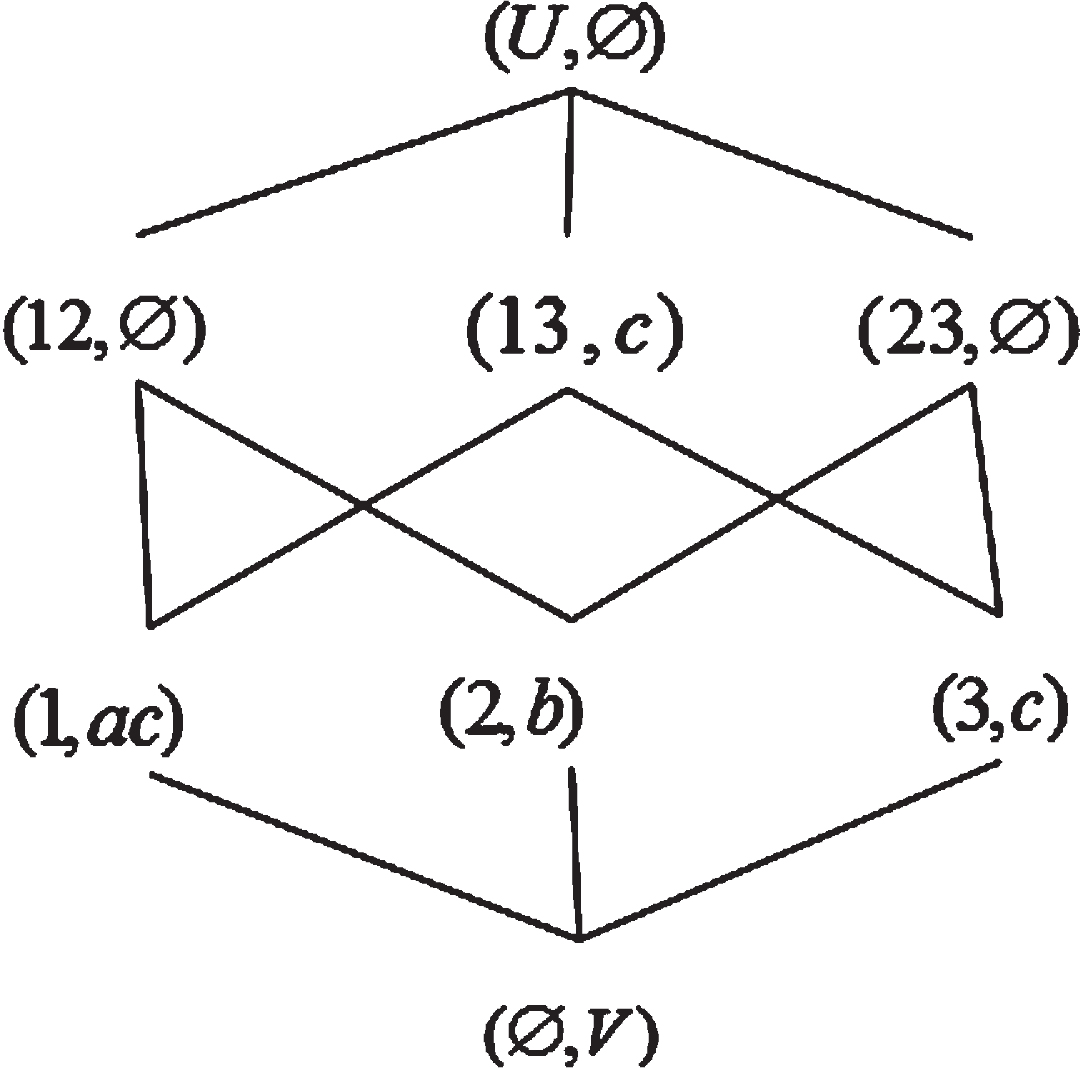
SCL∩ (U, V, R).
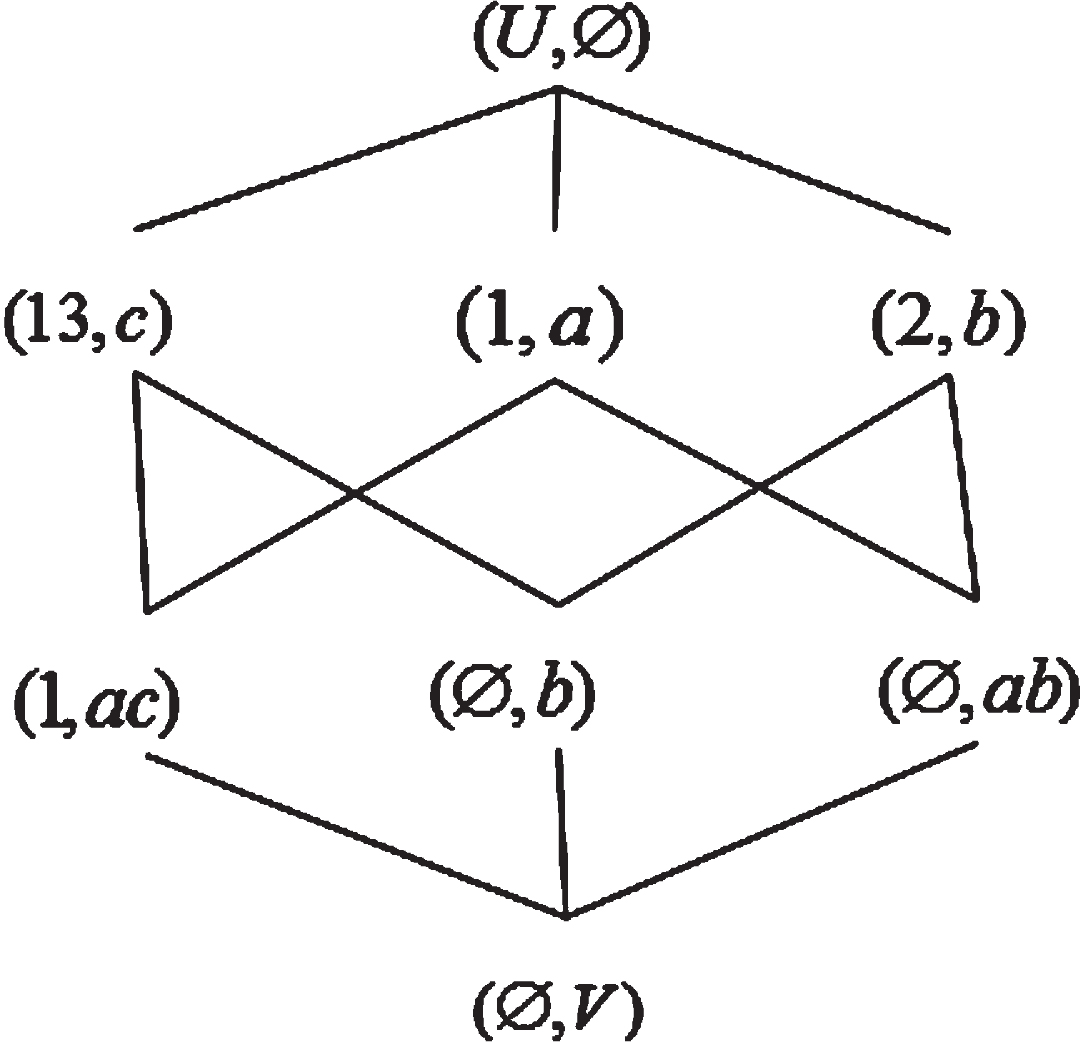
NSCL∪ (U, V, R).

NSCL∩ (U, V, R).
AESCL (U, V, R) = {((∅ , ∅) , V) , ((1, 23) , a) , ((2, 13) , b) , ((13, 2) , c) , ((∅ , 3) , ab) , ((1, 2) , ac) , ((∅ , ∅) , bc) , ((U, U) , ∅)}.
Figures 2, 4 and 6 are the correspondent Hasse diagrams.
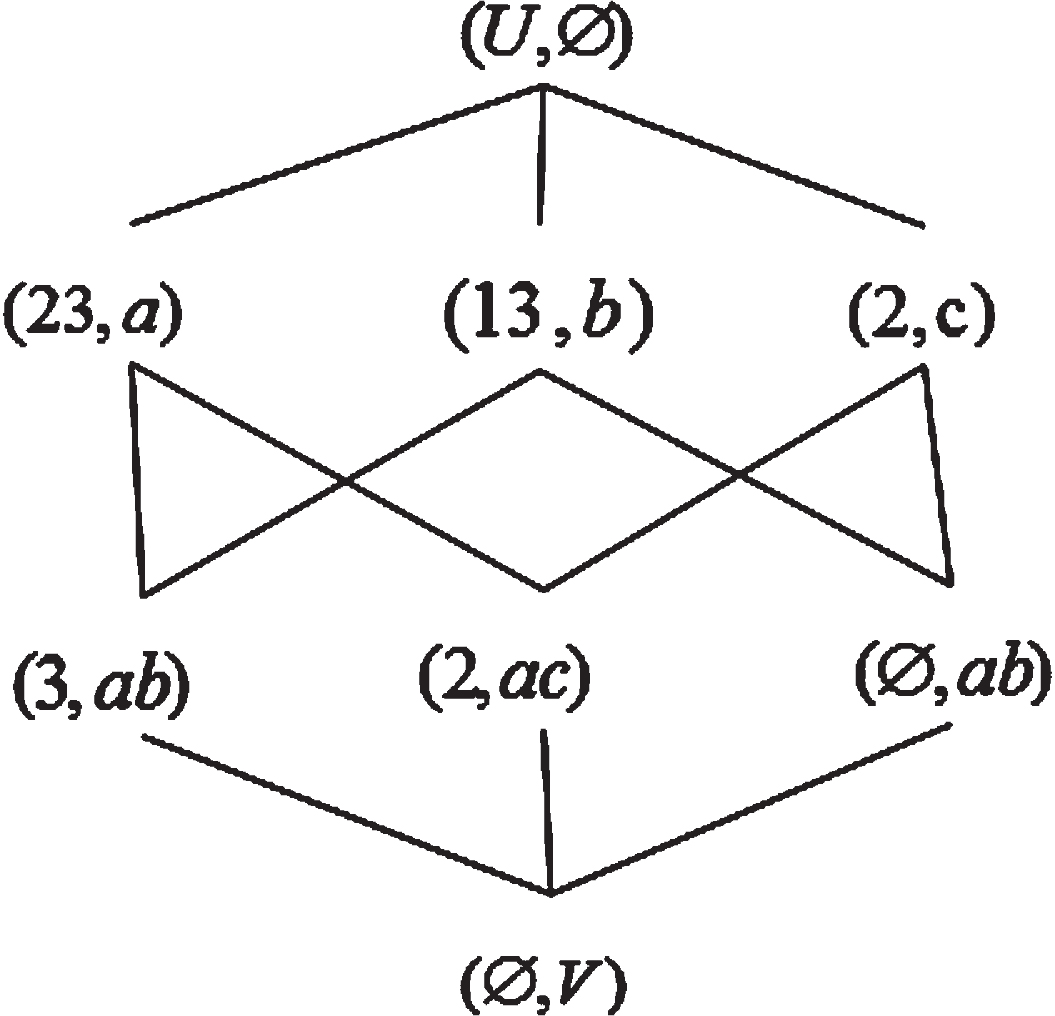
NSCL∪ (U, V, R).

OESCL (U, V, R).
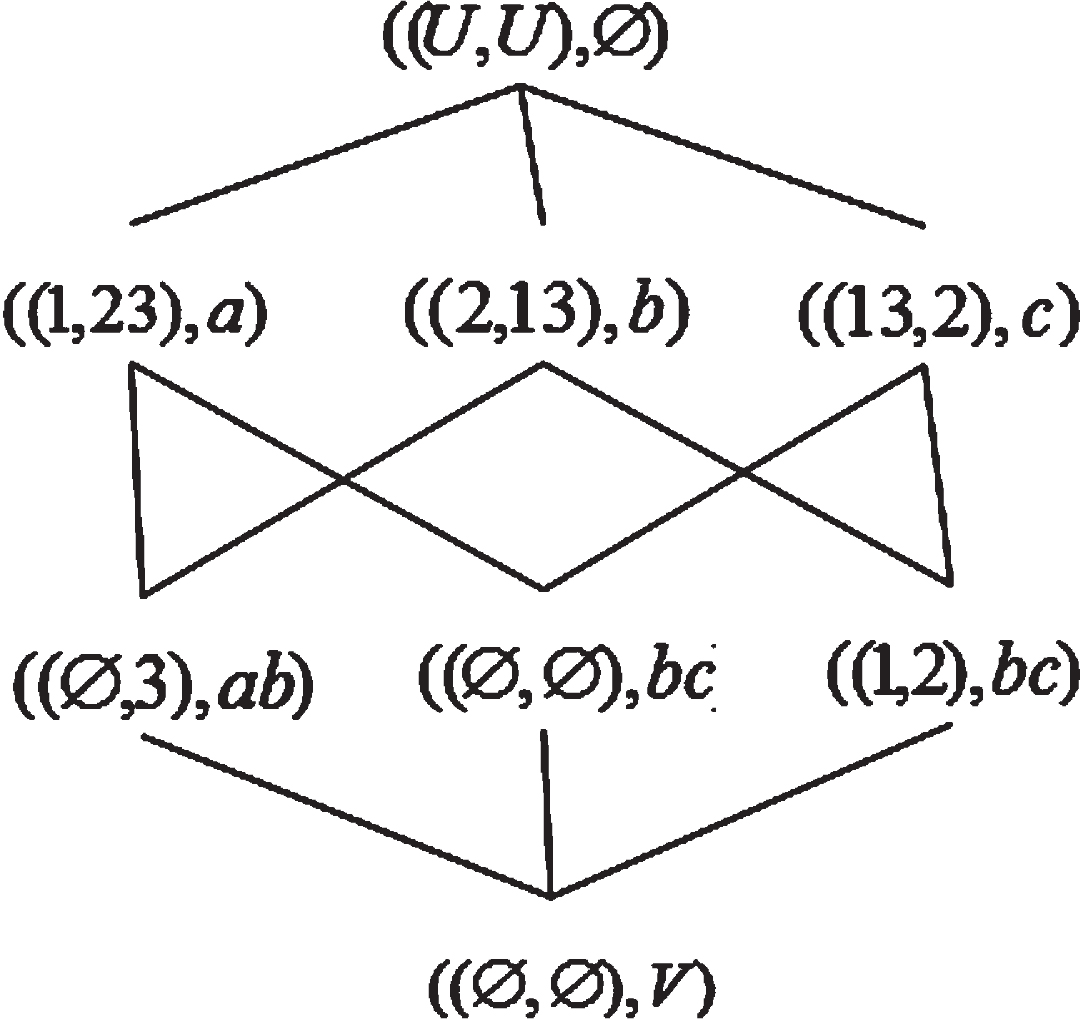
AESCL (U, V, R).
As this example shows, AE- semiconcept conveys important information. For example, if we want to discuss species in terms of attribute b, we can find Ae-semiconcept((2, 13) , b). So what tells us is that there only Monkey has the attribute b, but Bat and Penguin both have the attribute b. Therefore, using three-way semiconcepts can help biologists to analyse species.
In the process of information processing, the idea of three-way semiconcepts is easier to understand and accept than three-way concepts. To sum up, OE-semiconcept and AE-semiconcept can express more information than classical semiconcept, improving the capability of data analysis.
By extending classical semiconcept to 3WD, we present two types of three-way semiconcepts—OE-semiconcept and AE-semiconcept. An OE-semiconcept (AE-semiconcept) is also made by an extension and an intension. Different from 3WCA, three-way semiconcepts only considers the relationship between attributes and objects uniaxially. We get every three-way semiconcept is a three-way concept. Meanwhile, and discuss the lattice properties of OE-semiconcept and AE-semiconcept with the detailed proof. We study the relationshipps among three-way semiconcepts, classical semicocept and three-way concepts. Finally, we give the building algorithms of OE-semiconcept and AE-semiconcept based on classical semiconcept. And use examples to demonstrate the new algorithms. Three-way semiconcepts contains both positive information and negative information, which makes it more widely used and better than classical semiconcept.
On the basis of the results in this paper, there exist some problems remaining such as how to define three-way semiconcepts in an incomplete formal context, and the attribute reduction of OE-semiconcept and AE-semiconcept in the future. We hope that three-way semiconcepts can be used for not only making decisions but also knowledge engineering and other areas.
Footnotes
Acknowledgment
This work is granted by the National Natural Science Foundation of China (61572011), the Natural Science Foundation of Hebei Province (A201820117), Post-graduate’s Innovation Fund Project of Hebei Province (CXZZSS2020004).