



Abstract
In this paper, we give construction methods for triangular norms (t-norms) and triangular conorms (t-conorms) on appropriate bounded lattices. Then, we compare our methods and well-known methods proposed in [2, 19]. Finally, we give different construction methods for t-norms and t-conorms on an appropriate bounded lattice by using recursion. Also, we provide some examples to discuss introduced methods.
Introduction and motivation
A brief review on the development of triangular norms and triangular conorms
In 1960, Schweizer and Sklar [21] presented t-norms and t-conorms on the unit interval [0, 1]. T-norms and t-conorms have numerous applications in different field, such as fuzzy sets, fuzzy logic, expert systems, decision making, image processing, etc. In several real problems we cannot deal with real scales, but with some more general scales, such as bounded chains, lattices or posets, in particular with different kinds of linguistic scales. Then the aggregation theory should be developed for theses more general scales, as it was stressed in a recent overview paper [17] and supported by numerous publications and conference contributions. In particular, Klement et al. in 2002, [13] researched t-norms as ordinal sums of semigroups in the way of Clifford [7]. First Saminger [19] introduced the ordinal sum of t-norms on bounded lattices in 2006. Also, she concentrated on ordinal sums of t-norms (t-conorms) acting on bounded chains or ordinal sums of posets. Saminger-Platz et al. [20] quarreled the expansion of t-norms (t-conorms) on bounded lattices in 2008. They used bounded sublattices as carriers for arbitrary summand t-norms. Then, in 2012, Medina [16] ensured a characterization of ordinal sums being t-norms (t-conorms) on bounded lattices. Moreover, Medina [16] ensured a characterization when an ordinal sum of t-norms is a t-norm on bounded lattice. In 2015, Ertuğrul et al. [8] proposed a modification of ordinal sums of t-norms (t-conorms) resulting to a t-norm (t-conorm) on an arbitrary bounded lattice.
The motivation
An interesting and natural study topic of t-norms and t-conorms is their research based on bounded lattices. It is worth noting that unlike the various classes of t-norms and t-conorms on the unit interval [0, 1], nowadays, the classes of t-norms and t-conorms on bounded lattices are not very clear yet, even though Ertuğrul et al. [8] provided some further investigations for the construction of ordinal sums of t-norms and t-conorms on bounded lattices, respectively. Therefore, from the theoretical point of view, the construction of ordinal sums of t-norms and t-conorms on bounded lattices becomes one of the most important and meaningful studies. Also, t-norms and t-conorms investigated on bounded lattices can be used to enrich their classes and to analyze their construction methods.
In 2020, Aşıcı and Mesiar [2] proposed some new methods to construct t-norm on a sublattice [0, a] and t-conorm on a sublattice [a, 1]. Also, when considering the existence of t-norms on a sublattice [0, a] and t-conorms on a sublattice [a, 1], respectively, there are no different corresponding investigations for the ordinal sums construction of t-norms and t-conorms on bounded lattices. So, in this paper, we introduce new ordinal sum constructions of t-norms and t-conorms on an appropriate bounded lattice, respectively, by using the existence of t-norms on a sublattice [0, a] and t-conorms on a sublattice [a, 1]. Thus, in this paper, we have two main motivations to investigate as follows.
• One of the motivations of this paper is that we suggest new ordinal sum constructions of t-norms and t-conorms on an appropriate bounded lattice, respectively, by using the existence of t-norms on a sublattice [0, a] and t-conorms on a sublattice [a, 1]. In particular, we show that the new construction approaches presented in this paper can be generalized by induction to a modified the ordinal sums construction of t-norms and t-conorms on appropriate bounded lattices.
• Another motivation of this paper is that, similarly to the investigation of ordinal sums of t-norms and t-conorms on the unit interval [0, 1], we provide constructions of ordinal sums of t-norms and t-conorms on bounded lattices and investigate their related properties.
In this study, we propose construction methods for t-norms and t-conorms on an appropriate bounded lattice which has some restrictions for a fixed element a ∈ L \ {0, 1}. We organized this paper as follows. In Section 2, we provide basic definitions to help our main study. In Section 3, we propose construction methods for t-norms and t-conorms on an appropriate bounded lattice, where a ∈ L \ {0, 1}, t-norms act on [0, a], and t-conorms act on [a, 1], respectively in Theorems 3 and 4. Also, we give some illustrative examples for clarity. Then, we ensure some examples to show that our construction approaches presented in this paper are different from the approaches proposed by Ertuğrul, Karaçal, Mesiar [8] and Aşıcı, Mesiar [2]. We submit our constructions in its full generality in Section 4. And we ensure some examples for clarity. Finally, some concluding remarks are added.
Preliminaries
i) If x ∥ y for all x ∈ I
a
and y ∈ (0, a], then the function T∼ : L2 → L defined as follows is a t-norm on L
Some methods to obtain t-norms and t-conorms on appropriate bounded lattices
The following definition of an ordinal sum of t-norms defined on subintervals of a bounded lattice (L, ≤ , 0, 1) has been extracted from [19], which generalizes the methods are given in [14] on subintervals of [0, 1].
Definition 4 can also be defined for t-conorm using duality. In Formula (1), the function T does not need to be a t-norm. Now, we will give an example only for t-norms because the example can be obtained for t-conorms from duality.

The lattice L1.
The function T on L1
In this section, we give a new way to construct t-norms and t-conorms on an arbitrary bounded lattice in Theorems 3 and 4, respectively, where a ∈ L \ {0, 1} and V is t-norm on [0, a] and W is t-conorm on [a, 1], respectively. Also, we give some examples to discuss introduced methods in Theorems 3, 4. Then, we investigate the relation between introduced methods in Theorems 3 and 4 and other methods proposed in [2, 8] and [19]. Also, we give some illustrative examples to well understand our approaches.
Proof. We have T V (x, 1) = inf {x, 1} = x. So, the fact that 1 ∈ L is a neutral element of T V . It is easy to see commutativity of T V .
i) Monotonicity: We prove that if x ≤ y, then T
V
(x, z) ≤ T
V
(y, z) for all z ∈ L. The proof can be split into all possible cases. If z = 1, then we have that T
V
(x, z) = T
V
(x, 1) = x ≤ y = T
V
(y, 1) = T
V
(y, z) for all x, y ∈ L. If x = 0, then we have that T
V
(0, z) =0 ≤ T
V
(y, z) for all y, z ∈ L. If z = 0, then we have that T
V
(x, 0) =0 = T
V
(y, 0) for all x, y ∈ L. If y = 0, then it is clear that monotonicity is held. x ∈ (0, a) y ∈ (0, a) z ∈ (0, a) T
V
(x, z) = V (x, z) ≤ V (y, z) = T
V
(y, z) z ∈ a, 1) T
V
(x, z) = inf {x, z} ≤ inf {y, z} = T
V
(y, z) z ∈ I
a
T
V
(x, z) =0 = T
V
(y, z) y ∈ a, 1) z ∈ (0, a) T
V
(x, z) = V (x, z) ≤ z = T
V
(y, z) z ∈ a, 1) T
V
(x, z) = x < a = T
V
(y, z) z ∈ I
a
T
V
(x, z) =0 = T
V
(y, z) y ∈ I
a
. Since x ∈ (0, a) and y ∈ I
a
, then according to our constraint it must be x ∥ y. So, it can not be the case y ∈ I
a
. y = 1 z ∈ (0, a) T
V
(x, z) = V (x, z) ≤ z = T
V
(1, z) z ∈ a, 1) T
V
(x, z) = x < a ≤ z = T
V
(1, z) z ∈ I
a
T
V
(x, z) =0 ≤ T
V
(1, z) x ∈ a, 1). Then, it must be the case that y ∈ a, 1]. y ∈ [a, 1) z ∈ (0, a) T
V
(x, z) = z = T
V
(y, z) z ∈ [a, 1) T
V
(x, z) = a = T
V
(y, z) z ∈ I
a
T
V
(x, z) =0 = T
V
(y, z) y = 1 z ∈ (0, a) T
V
(x, z) = z = T
V
(1, z) z ∈ [a, 1) T
V
(x, z) = a ≤ z = T
V
(1, z) z ∈ I
a
T
V
(x, z) =0 ≤ z = T
V
(1, z) x ∈ I
a
. Then, it must be the case that y ∈ I
a
or y ∈ (a, 1]. y ∈ I
a
z ∈ (0, a) or z ∈ [a, 1) T
V
(x, z) =0 = T
V
(y, z) z ∈ I
a
T
V
(x, z) = inf {x, z} < inf {y, z} = T
V
(y, z) y ∈ (a, 1) Since x ∈ I
a
and y ∈ (a, 1), then according to our constraint it must be x ∥ y. So, it can not be the case y ∈ (a, 1). y = 1 z ∈ (0, a) or z ∈ [a, 1) T
V
(x, z) =0 ≤ z = T
V
(1, z) z ∈ I
a
T
V
(x, z) = inf {x, z} ≤ z = T
V
(1, z) x = 1. Then, since y = 1, it is clear that T
V
(x, z) = T
V
(y, z) for all z ∈ L.
ii) Associativity:
If at least one of x, y, z in L is 1, then it is satisfied associativity. x ∈ [0, a) y ∈ [0, a) z ∈ [0, a) T
V
(x, T
V
(y, z)) = T
V
(x, V (y, z)) = V (x, V (y, z)) = V (V (x, y) , z) = T
V
(T
V
(x, y) , z) z ∈ [a, 1) T
V
(x, T
V
(y, z)) = T
V
(x, y) = V (x, y) = T
V
(V (x, y) , z) = T
V
(T
V
(x, y) , z) z ∈ I
a
T
V
(x, T
V
(y, z)) = T
V
(x, 0) =0 = T
V
(V (x, y) , z) = T
V
(T
V
(x, y) , z) y ∈ [a, 1) z ∈ [0, a) T
V
(x, T
V
(y, z)) = T
V
(x, z) = T
V
(T
V
(x, y) , z) z ∈ [a, 1) T
V
(x, T
V
(y, z)) = T
V
(x, a) = x = T
V
(x, z) = T
V
(T
V
(x, y) , z) z ∈ I
a
T
V
(x, T
V
(y, z)) = T
V
(x, 0) =0 = T
V
(x, z) = T
V
(T
V
(x, y) , z) y ∈ I
a
z ∈ [0, a) or z ∈ [a, 1) T
V
(x, T
V
(y, z)) = T
V
(x, 0) =0 = T
V
(0, z) = T
V
(T
V
(x, y) , z) z ∈ I
a
T
V
(x, T
V
(y, z)) = T
V
(x, inf {y, z}) =0 = T
V
(0, z) = T
V
(T
V
(x, y) , z) x ∈ [a, 1) y ∈ [0, a) z ∈ [0, a) T
V
(x, T
V
(y, z)) = T
V
(x, V (y, z)) = V (y, z) = T
V
(y, z) = T
V
(T
V
(x, y) , z) z ∈ [a, 1) T
V
(x, T
V
(y, z)) = T
V
(x, y) = y = T
V
(y, z) = T
V
(T
V
(x, y) , z) z ∈ I
a
T
V
(x, T
V
(y, z)) = T
V
(x, 0) =0 = T
V
(y, z) = T
V
(T
V
(x, y) , z) y ∈ [a, 1) z ∈ [0, a) T
V
(x, T
V
(y, z)) = T
V
(x, z) = z = T
V
(a, z) = T
V
(T
V
(x, y) , z) z ∈ [a, 1) T
V
(x, T
V
(y, z)) = T
V
(x, a) = a = T
V
(a, z) = T
V
(T
V
(x, y) , z) z ∈ I
a
T
V
(x, T
V
(y, z)) = T
V
(x, 0) =0 = T
V
(a, z) = T
V
(T
V
(x, y) , z) y ∈ I
a
z ∈ [0, a) or z ∈ [a, 1) T
V
(x, T
V
(y, z)) = T
V
(x, 0) =0 = T
V
(0, z) = T
V
(T
V
(x, y) , z) z ∈ I
a
T
V
(x, T
V
(y, z)) = T
V
(x, inf {y, z}) =0 = T
V
(0, z) = T
V
(T
V
(x, y) , z) x ∈ I
a
y ∈ [0, a) z ∈ [0, a) T
V
(x, T
V
(y, z)) = T
V
(x, V (y, z)) =0 = T
V
(0, z) = T
V
(T
V
(x, y) , z) z ∈ [a, 1) T
V
(x, T
V
(y, z)) = T
V
(x, y) =0 = T
V
(0, z) = T
V
(T
V
(x, y) , z) z ∈ I
a
T
V
(x, T
V
(y, z)) = T
V
(x, 0) =0 = T
V
(0, z) = T
V
(T
V
(x, y) , z) y ∈ [a, 1) z ∈ [0, a) T
V
(x, T
V
(y, z)) = T
V
(x, z) =0 = T
V
(0, z) = T
V
(T
V
(x, y) , z) z ∈ [a, 1) T
V
(x, T
V
(y, z)) = T
V
(x, a) =0 = T
V
(0, z) = T
V
(T
V
(x, y) , z) z ∈ I
a
T
V
(x, T
V
(y, z)) = T
V
(x, 0) =0 = T
V
(0, z) = T
V
(T
V
(x, y) , z) y ∈ I
a
z ∈ [0, a) or z ∈ [a, 1) T
V
(x, T
V
(y, z)) = T
V
(x, 0) =0 = T
V
(inf {x, y} , z) = T
V
(T
V
(x, y) , z) z ∈ I
a
T
V
(x, T
V
(y, z)) = T
V
(x, inf {y, z}) = inf {x, y, z} = T
V
(inf {x, y} , z) = T
V
(T
V
(x, y) , z)□
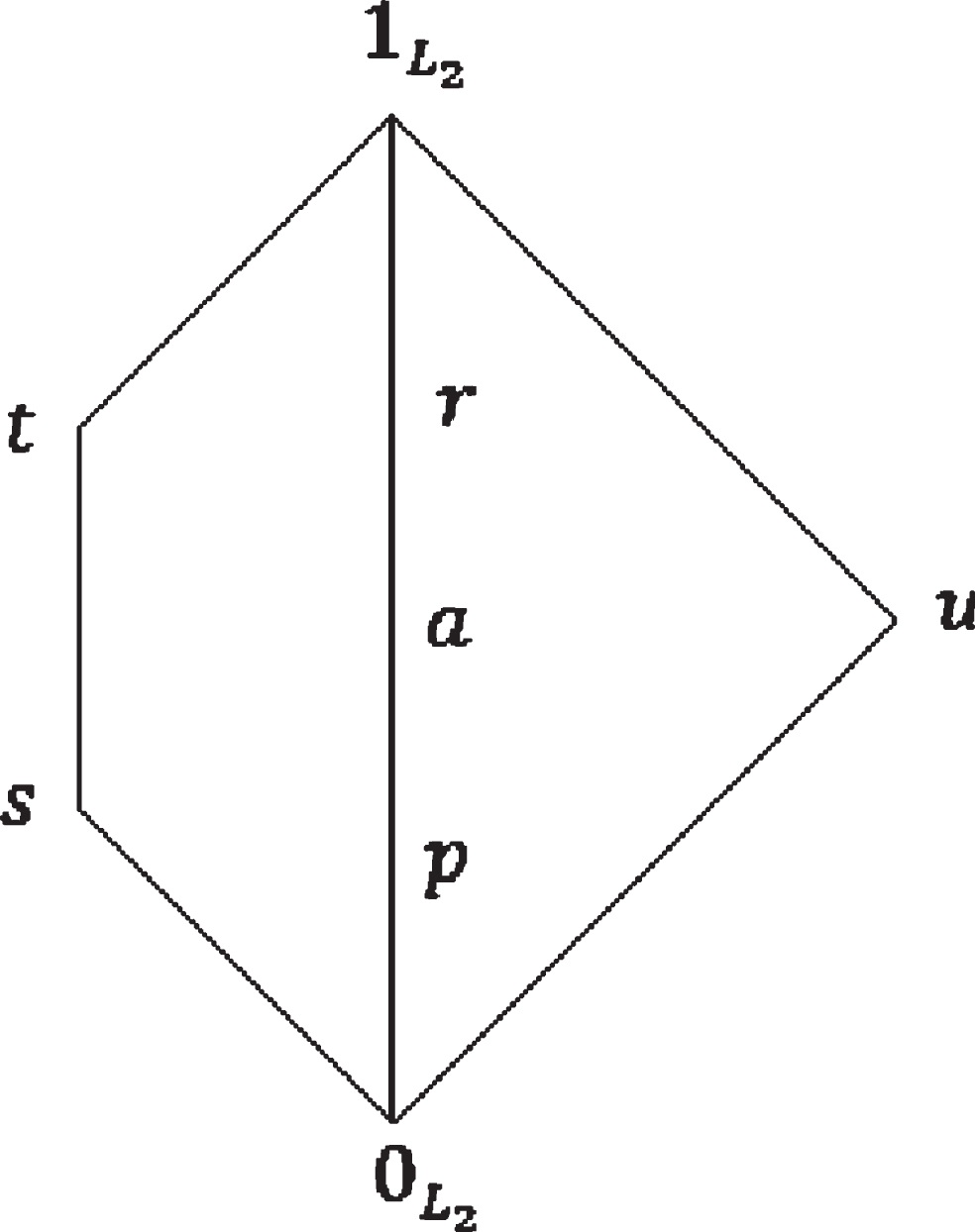
The lattice L2.
Then, by using Theorem 3, the function T V on L2 defined by Table 2 is a t-norm.
The t-norm T V on L2
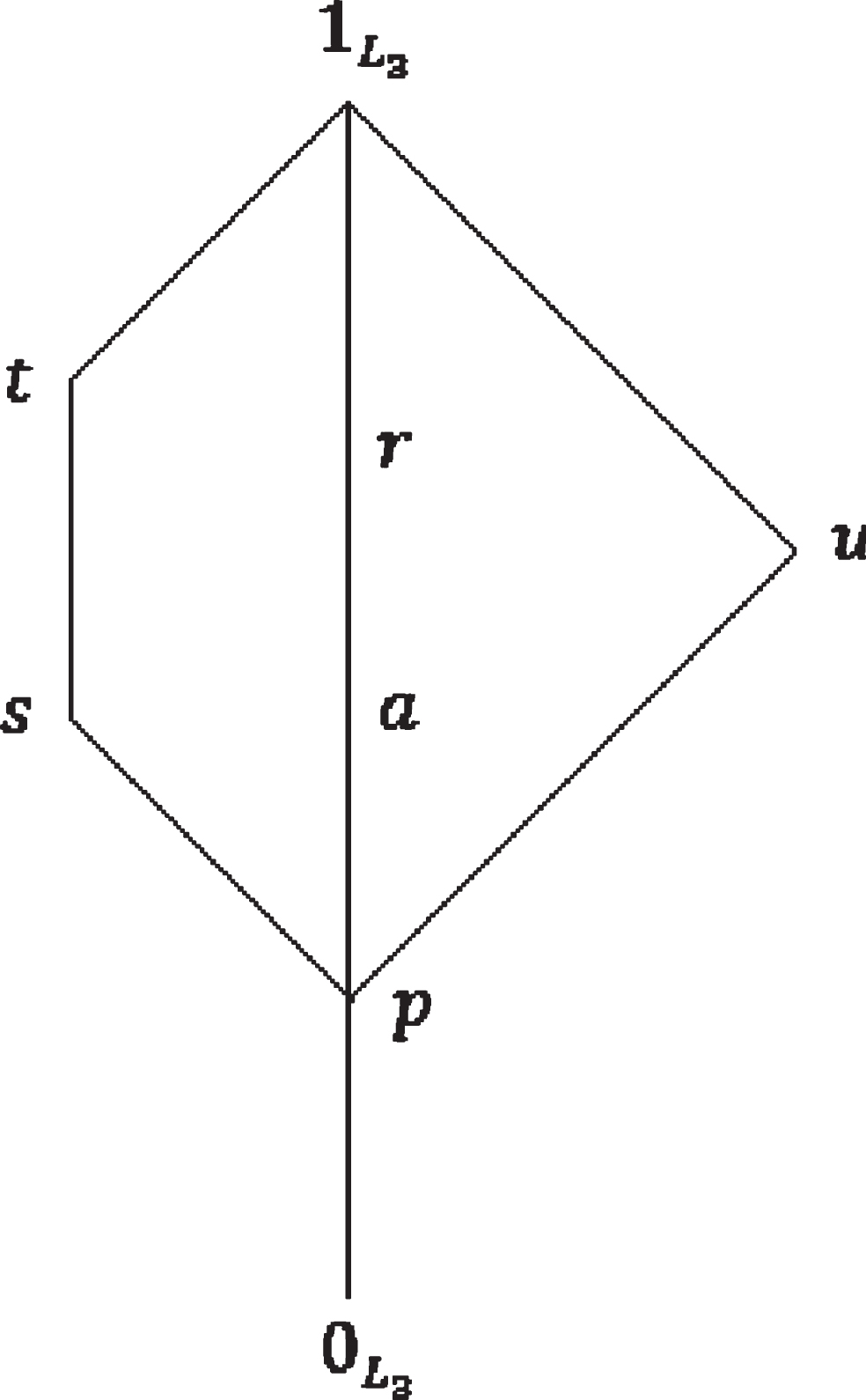
The lattice L3.
Then, the function T V on L3 defined by Table 3 is not a t-norm. Indeed, it does not satisfy monotonicity. Clearly, p < s and T V (p, p) = p≰0 L 3 = T V (s, p).
The function T V on L3
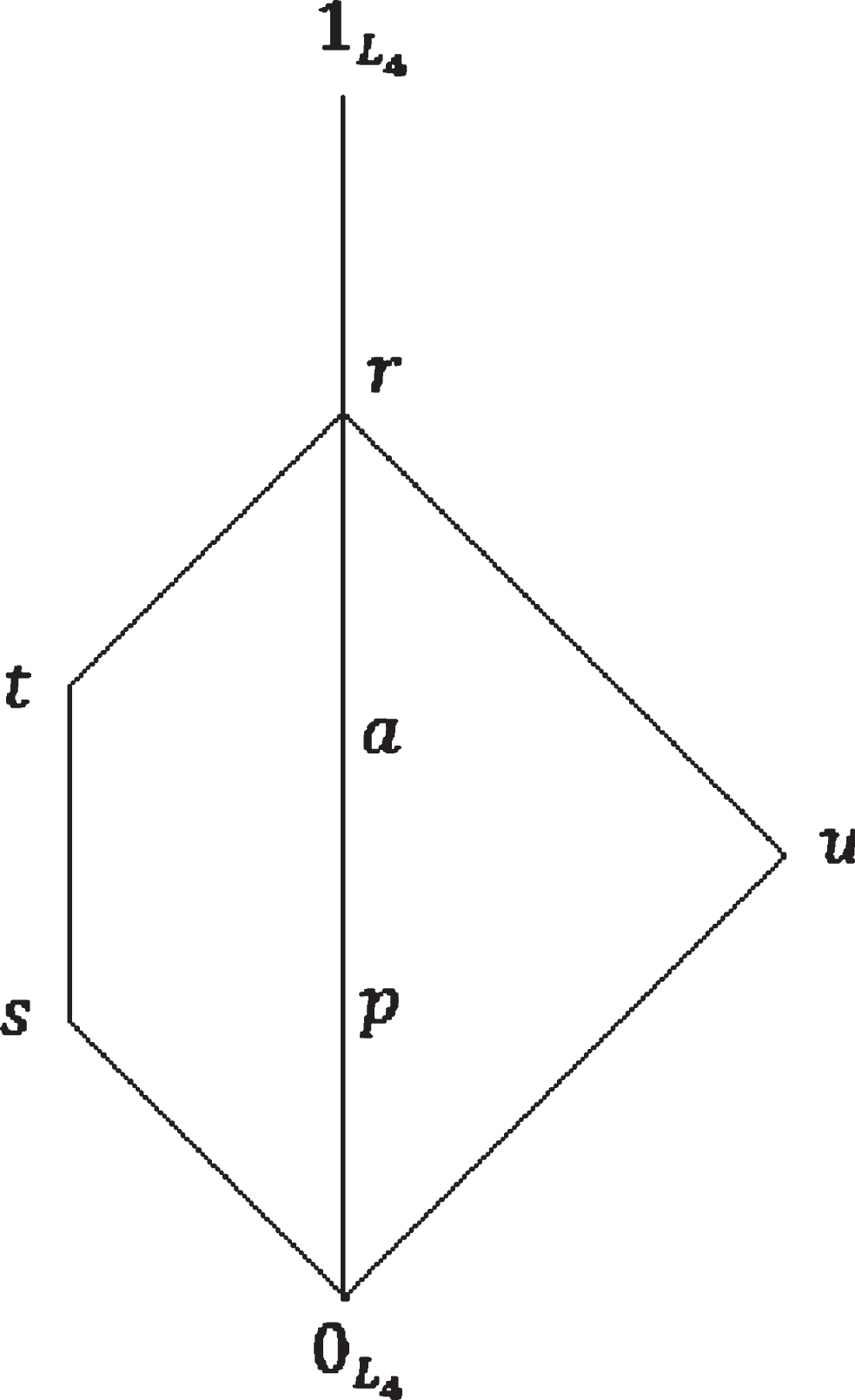
The lattice L4.
Then, the function T V on L4 defined by Table 4 is not a t-norm. Because, it does not satisfy monotonicity. Clearly, t < r and T V (t, s) = s≰0 L 4 = T V (r, s).
The function T V on L4
Proof. Since T V and T have the same t-norm V on [0, a], we need only to consider the cases such as on [0, a].
Let (x, y) ∈ [0, a) × I a ∪ I a × [0, a) ∪ [a, 1) × I a ∪ I a × [a, 1). Then, we have T V (x, y) =0 ≤ inf {x, y} = T (x, y).
Let (x, y) ∈ [a, 1) 2. Then, we have T V (x, y) = a ≤ inf {x, y} = T (x, y).
For all other possible conditions, we have T V (x, y) = inf {x, y} = T (x, y). □
The t-norm T on L4
On the other side, we proved that the function T V defined by Table 4 in Example 4 is not a t-norm on L4.
By using Theorem 3, Theorems 1 and 2 define the corresponding t-norms T V , T★ and T∼ as given in Tables 6 and 7, respectively.
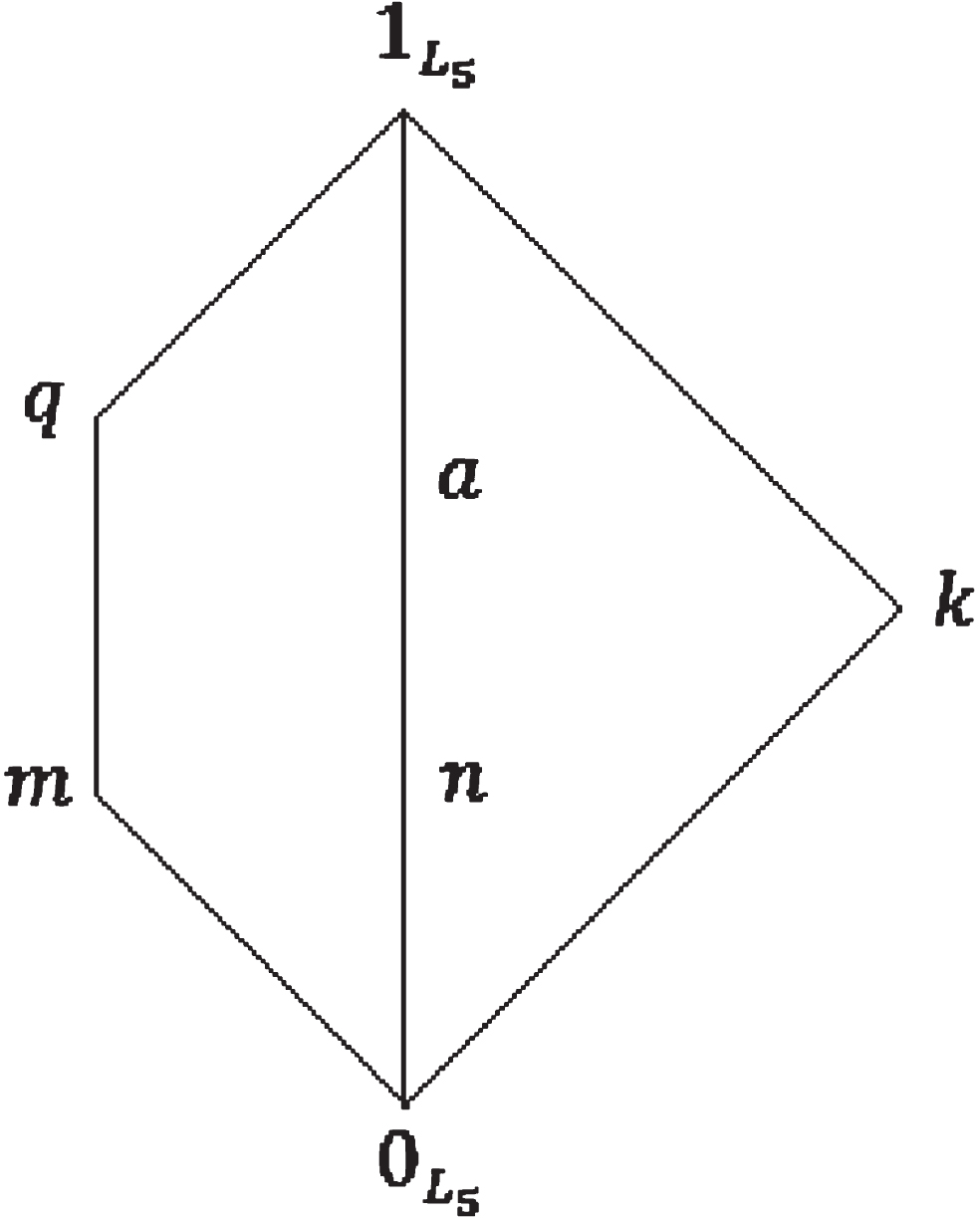
The lattice L5.
The t-norm T V on L5
The t-norm T★ = T∼ on L5
According to the Tables 6 and 7, it is clear that the T★ = T∼ < T V on the bounded lattice L5.

The lattice L6.
By using Theorem 3, Theorems 1 and 2 define the corresponding t-norms T V , T★ and T∼ as given in Table 8, Table 9 and Table 10, respectively.
The t-norm T V on L6
The t-norm T★ on L6
The t-norm T∼ on L6
According to the Tables 8, 9 and 10, it is clear that the T V < T★ and T V < T∼ on the bounded lattice L6.
The t-norm T★ on L2
The t-norm T∼ on L2
In the following, we provide three lattices L7, L8 and L9 which satisfies and does not satisfy the constraints of Theorem 4, respectively.
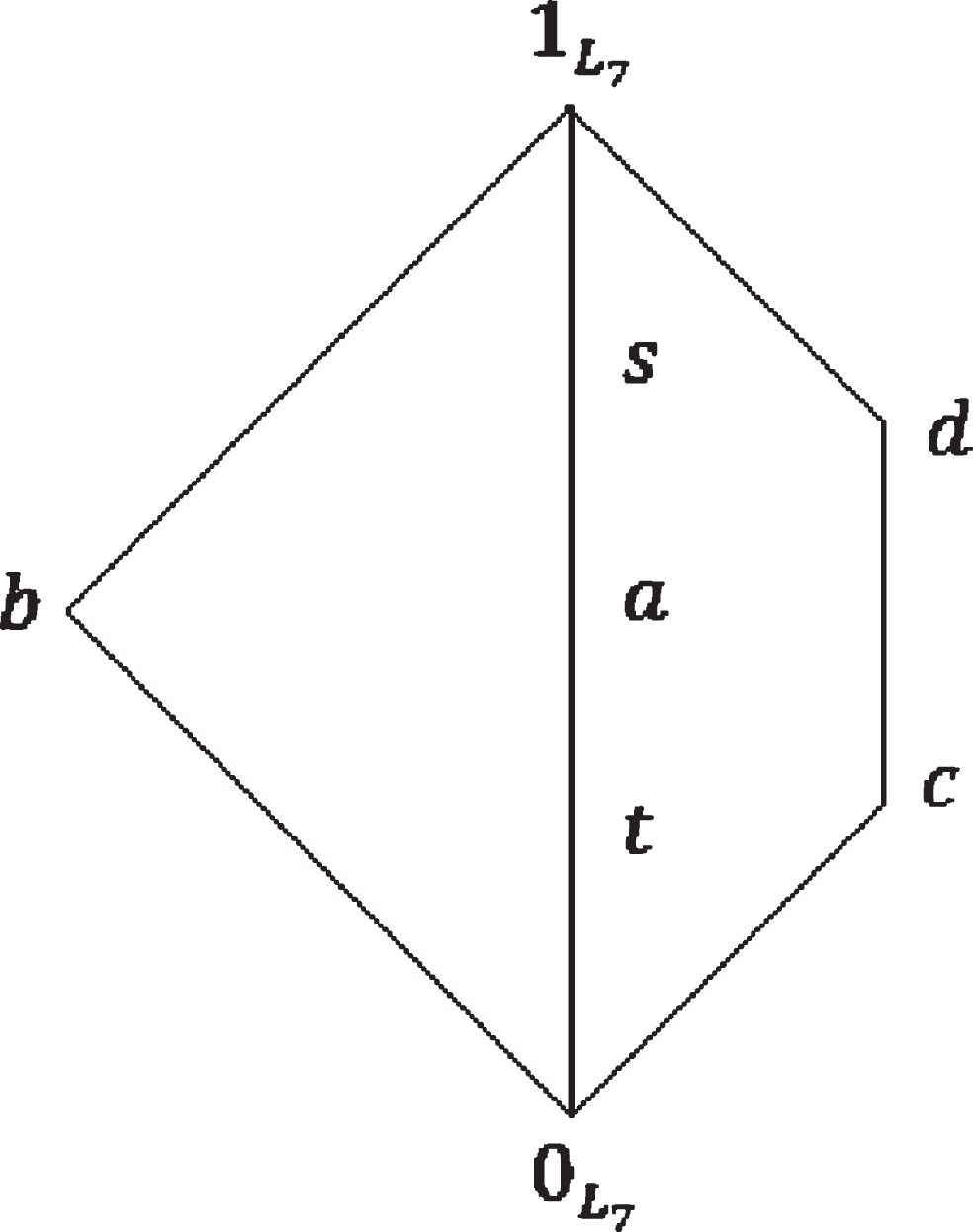
The lattice L7.
Then, the function S W on L7 defined by Table 13 is a t-conorm.
The t-conorm S W on L7
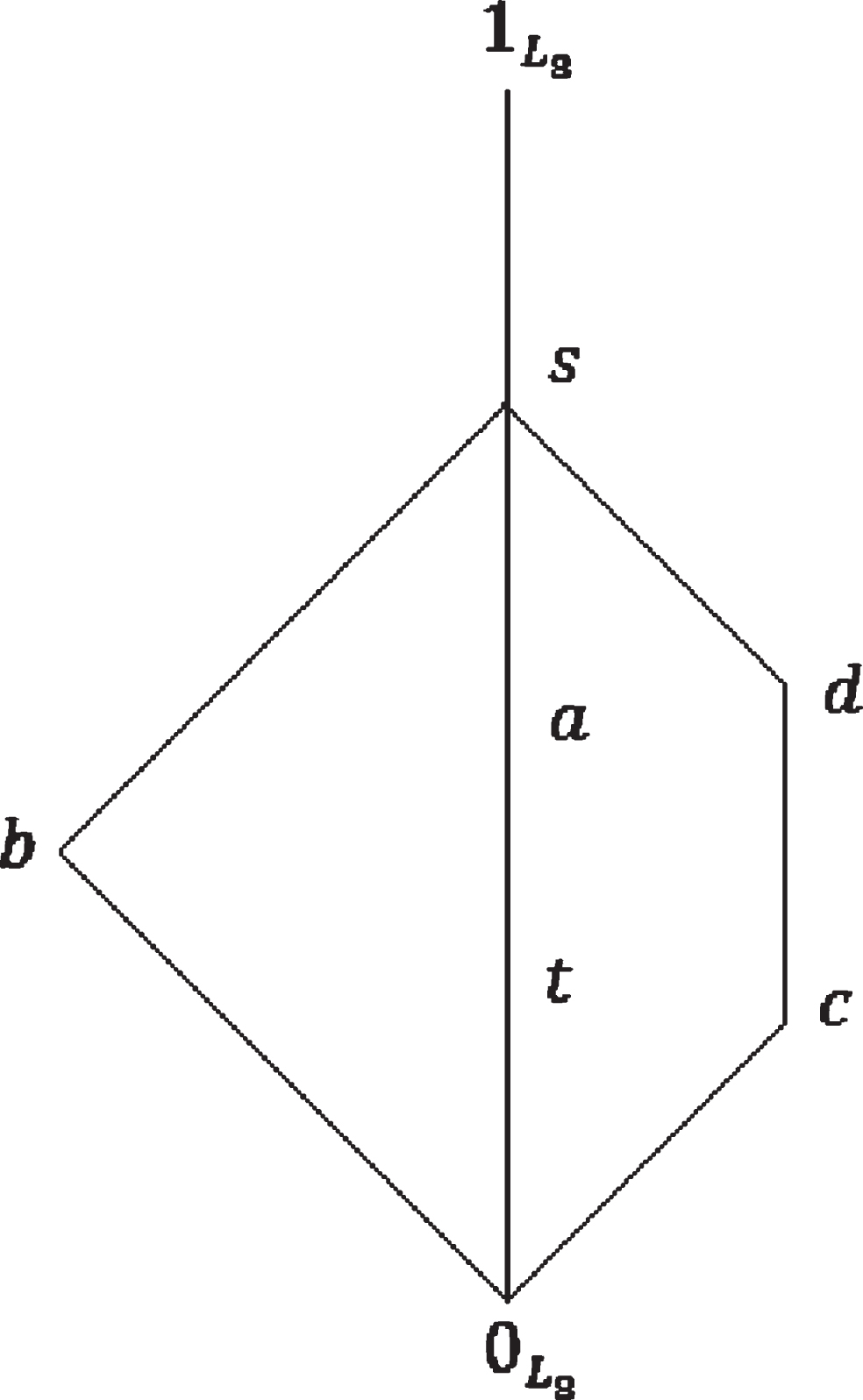
The lattice L8.
The function S W on L8 defined by Table 14 is not a t-conorm. Indeed, it does not hold monotonicity. Clearly, d < s and S W (s, d) =1 L 8 ≰s = S W (s, s).
The function S W on L8
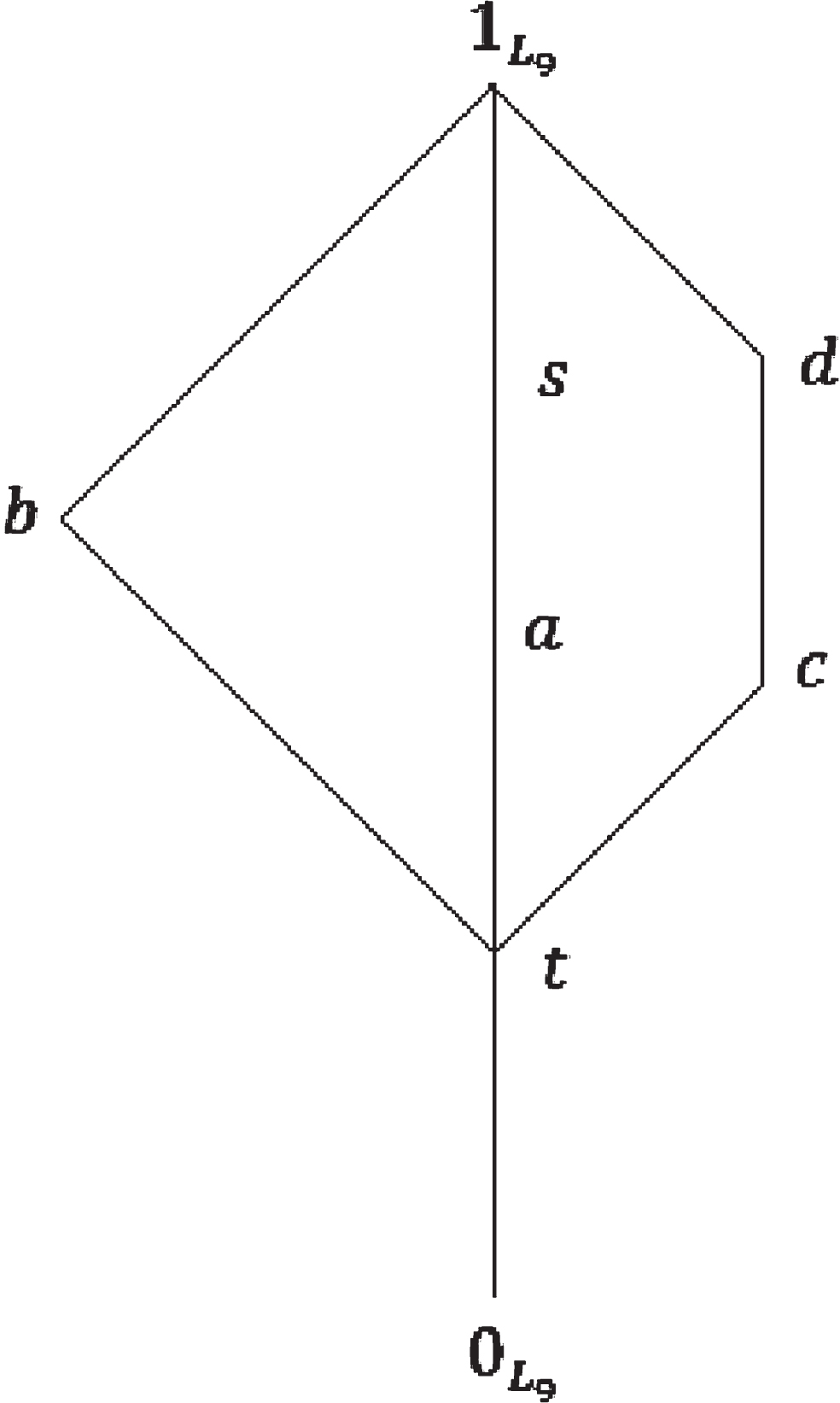
The lattice L9.
The function S W on L9 defined by Table 15 is not a t-conorm. Indeed, it does not satisfy monotonicity. Clearly, t < c and S W (t, d) =1 L 9 ≰d = S W (c, d).
The function S W on L9
The t-norm S on L9
On the other side, we proved that the function S W defined by Table 15 in Example 11 is not a t-conorm on L9.

The lattice L10.
By using Theorem 4, Theorems 1 and 2 define the corresponding t-conorms S W , S★ and S∼ as given in Tables 17 and 18, respectively.
The t-conorm S W on L10
The t-conorm S★ = S∼ on L10
According to the Table 17 and Table 18, it is clear that the S W < S★ = S∼ on the bounded lattice L10.

The lattice L11.
By using Theorem 4, Theorems 1 and 2 define the corresponding t-conorms S W , S★ and S∼ as given in Tables 19, 20 and 21, respectively.
The t-conorm S W on L11
The t-conorm S★ on L11
The t-norm S∼ on L11
According to the Tables 19, 20 and 21, it is clear that the S★ < S W and S∼ < S W on the bounded lattice L11.
The t-norm S★ on L7
The t-norm S∼ on L7
We know that new t-norms and t-conorms on bounded lattices can be obtained using recursion. In this section, based on the approaches of constructing t-norms and t-conorms proposed in Section 3, we introduce new ordinal sum constructions of t-norms and t-conorms on an arbitrary bounded lattice L using recursion.
We omit this proof because of the proof of Theorem 3.
If we put L is a chain rthen we can rewrite the Formula (2) as the following:

The lattice L12.
The t-norm T2 on L12
The t-norm T3 on L12
The t-norm T4 on L12
If we put L is a chain then, we can rewrite the Formula (3) as the following:
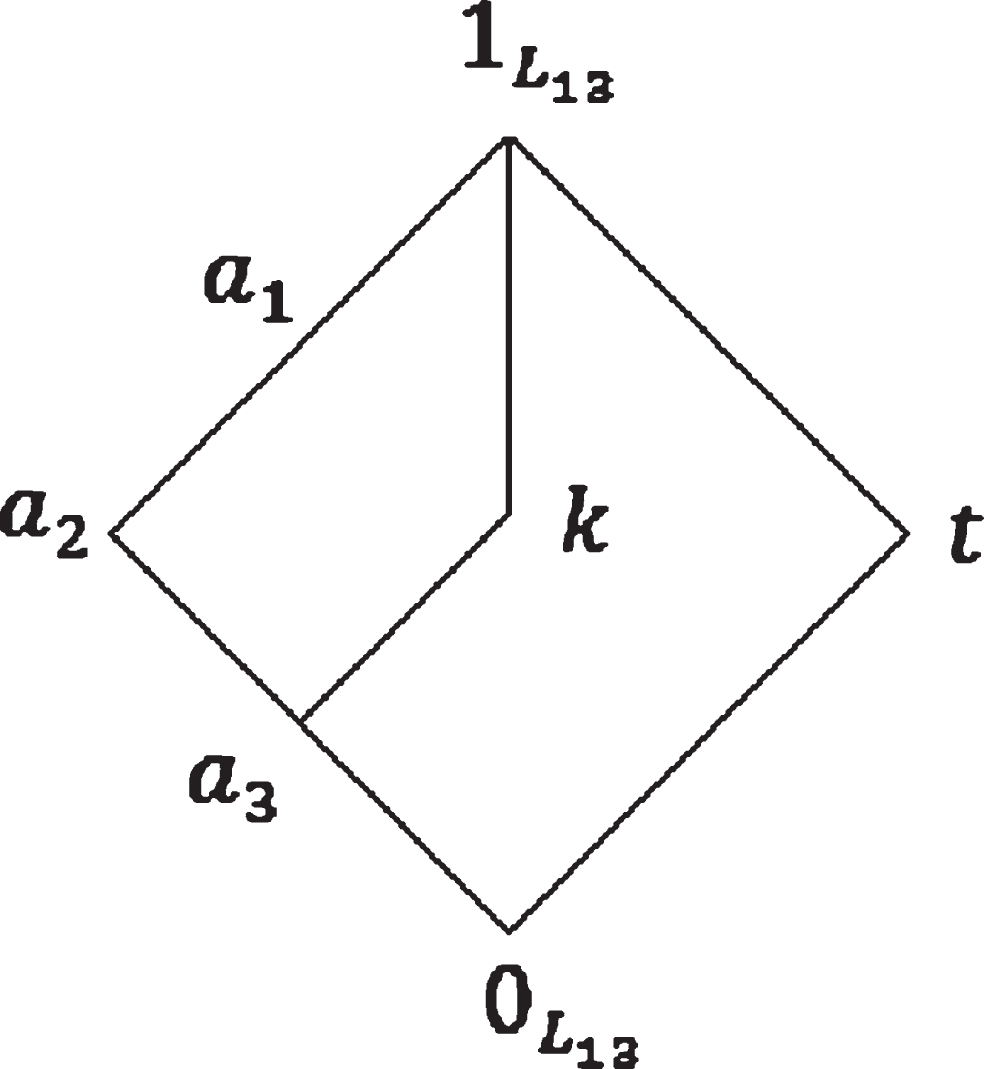
The lattice L13.
The t-conorm S2 on L13
The t-conorm S3 on L13
The t-conorm S4 on L13
A t-norm is a kind of binary operation used in the framework of probabilistic metric spaces and in multi-valued logic, specifically in fuzzy logic. A t-norm generalizes intersection in a lattice and conjunction in logic. The name t-norm refers to the fact that in the framework of probabilistic metric spaces t-norms are used to generalize triangle inequality of ordinary metric spaces. T-norms are a generalization of the usual two-valued logical conjunction, studied by classical logic, for fuzzy logics. Indeed, the classical Boolean conjunction is both commutative and associative. The monotonicity property ensures that the degree of truth of conjunction does not decrease if the truth values of conjuncts increase. The requirement that 1 be an identity element corresponds to the interpretation of 1 as true (and consequently 0 as false). Continuity, which is often required from fuzzy conjunction as well, expresses the idea that very small changes in truth values of conjuncts should not macroscopically affect the truth value of their conjunction. T-norms are also used to construct the intersection of fuzzy sets or as a basis for aggregation operators (see fuzzy set operations). In probabilistic metric spaces, t-norms are used to generalize triangle inequality of ordinary metric spaces. Individual t-norms may of course frequently occur in further disciplines of mathematics, since the class contains many familiar functions. T-norms have numerous applications in different field, such as fuzzy logics, expert systems, decision making, image processing, etc. One of the earliest applications of idempotent t-norms appeared in the framework of decision making in a fuzzy environment, see [11], see also [10]. In bipolar decision making, Grabisch [12] has introduced and applied a particular t-norm. Luo and Wang [15] have presented the interval-valued fuzzy reasoning triple I algorithms based on left-continuous interval-valued t-representable t-norms.
Our results contribute to the theory of aggregation on bounded lattices. T-norms on bounded lattices have been studied widely. In particular, the construction of t-norms related to algebraic structures on bounded lattices is still an active research area. In this paper, we have continued to study the topic of t-norms on bounded lattices from a mathematical point of view.
In this aim, we have investigated and introduced new construction methods for building t-norms and t-conorms on an appropriate bounded lattice with a constraint concerning the specific splitting point a. Based on this ordinal sum method, we have introduced a new class of t-norms T and t-conorms S on an arbitrary bounded lattice, respectively, by using the existence of a t-norm V on a sublattice [0, a] and a t-conorm W on a sublattice [a, 1] in Theorems 3 and 4. In order to well understand the constructed t-norms T and t-conorms S, we have given some illustrative examples. Also, in Proposition 1, Example 5, Remark 7, Example 6, Example 7, Example 8 Proposition 2, Example 12, Remark 7, Example 13, Example 14, Example 15 we have investigated the relation between introduced methods Theorems 3, 4 and other approaches proposed in [2, 19]. Finally, we have shown that the new construction methods can be generalized by induction to a modified ordinal sum for t-norms and t-conorms on arbitrary bounded lattice, respectively.
Though our results are purely theoretical, we expect possible application in several domains dealing with lattice-valued scales. Up to the logics dealing with truth values forming a bounded lattice, where the introduced t-norms and t-conorms can play the role of conjunction or disjunction, we should stress the domain of qualitative decision theory. For example, our results can help to advance the resent paper [9, 15] dealing with some basic t-norms to evaluate decisions under incomplete information. Similarly, lattice-valued integrals where t-norms play the role of multiplication could be a promising field for application of our results.
Footnotes
Acknowledgment
We are grateful to the anonymous reviewers and editors for their valuable comments, which helped to improve the original version of our manuscript greatly.